


Introduction
One century ago, beginning in the fall of 1913 through the summer of 1915, the U.S. Commission on Industrial Relations convened with the purpose of subjecting the conditions of American industrial relations to an objective and thorough inquiry, such that the chronic and acute strife that had come to characterize American industrial relations might be addressed before some greater social upheaval were to transpire (Adams Reference Adams1966: 32). The federal commission had been proposed in the wake of the October 1910 bombing of the Los Angeles Times building. The bombing took the lives of 20 people and was ultimately determined to have been perpetrated by James and John McNamara, two executive members of the American Federation of Labor (AFL), who had launched the attack as a means of lashing out against the antiunion sentiments held by the paper's owner, Harrison Otis Gray (Adamic Reference Adamic1983; Adams Reference Adams1966). The blast was but one in a string of violent and fatal breaches of industrial normalcy within the United States dating back three decades to the Molly Maguires of the 1870s. Fatally violent encounters would continue to mar labor-management relations within the United States for more than three decades thereafter. By the time U.S. picket-line violence phased out during the post–World War II era, America's bloody legacy had been secured. Historians have identified the American labor movement as the most contentious (Filipelli Reference Filipelli1990) and bloody (Taft and Ross Reference Taft, Ross, Graham and Gurr1969) of any Western industrialized nation. No less than 1,129 strike-related deaths have been recorded within the United States during at least 244 violent strike events throughout the period from 1877 to 1947 (Lipold and Isaac Reference Lipold and Isaac2009: 189). Victims were claimed during both interclass and intraclass struggles as otherwise peaceful strikes escalated into bloody conflicts that pitted strikers against company guards, police, militia, and even federal troops, on the one hand, and nonstrikers, replacement workers, or even rival union members, on the other. The lives of workers were therein waged upon either joining or ignoring a strike; and their deaths stand as both a manifestation of and testament to the determination of all parties involved to assert and/or protect their perceived rights to property and labor. Why were some of the participants willing to risk their lives? Why were others willing to take them? In short, what caused the extreme violence on America's picket lines?
The correlated topics of strike-related violence and fatalities have long attracted the attention of those seeking to maintain, transform, or merely understand the modern industrial system. Large-scale violent episodes such as the Great Railway Strike of 1877 and the Haymarket Affair of 1886 alarmed industrialists in the late nineteenth century (Hacker Reference Hacker1969: 257) and aroused suspicions of incipient Marxist and anarchistic movements (Fusfeld Reference Fusfeld, Bright and Harding1984). The Commission on Industrial Relations was inspired by a desire to mollify industrial relations during the Progressive Era (Adams Reference Adams1966: 214). With the general cessation of strike-related violence post–World War II, social scientists and historians have increasingly looked to labor's turbulent past in an effort to explain its moribund present (e.g., Fusfeld Reference Fusfeld, Bright and Harding1984; Goldstein Reference Goldstein1978; Lipold and Isaac Reference Lipold and Isaac2009; Sexton Reference Sexton1991; Voss Reference Voss1993), and constructed a rich tapestry of class-conflict literature.
Yet, the study of extreme labor-management violence in the United States remains inadequately tested (Lipold and Isaac Reference Lipold and Isaac2009). As a political entity, for instance, the congressional commission's objectivity has been challenged by those disaffected by its findings (Adams Reference Adams1966), while the narrow temporal window and range of events upon which their hearings had been based further impugned their generalizability. Several subsequent, otherwise thoughtfully crafted scholarly studies focusing on the determinants of strike-related violence have nonetheless problematically either (1) failed to include the American case (e.g., Grant and Wallace Reference Grant and Wallace1991; Shorter and Tilly Reference Shorter and Tilly1971; Snyder and Kelly Reference Snyder and Kelly1976); (2) lacked the methodological rigor required of sociological analysis (e.g., Goldstein Reference Goldstein1978; Taft and Ross Reference Taft, Ross, Graham and Gurr1969); and/or (3) failed to address the most extreme outcome of labor-management conflict—fatalities (e.g., Brinker Reference Brinker1985). Although most major theories of social movements have provided conceptual space for the role of rebellion and repression (e.g., McAdam Reference McAdam1982; Piven and Cloward Reference Piven and Cloward1979; Tilly Reference Tilly1978) and sought to explain violence in terms of rational choice and tactical utility (e.g., Gamson Reference Gamson1990), they have by and large failed to explain why individuals were willing to risk their lives (Loveman Reference Loveman1998), or even the social conditions most prominent in doing so.
Recent scholarship by Paul F. Lipold and Larry W. Isaac (Reference Lipold and Isaac2009) has challenged the existent status quo by providing annual counts of 1,160 fatalities recorded on American picket lines between the years 1870 and 1970—eclipsing the previous best estimate (Taft and Ross Reference Taft, Ross, Graham and Gurr1969) for fatalities during this same period by some 400 deaths. They thereby not only problematized our preexistent understanding of the historical level of violence within US labor-management relations, but so too argued that until this violence that so characterized the formative era of American industry and industrial relations has been adequately addressed our understanding of the strength and trajectory of the American labor movement may well be dangerously undertheorized. Was the violence critical to labor movement expansion? Or, did the violence critically weaken the movement? How does such violence jibe with notions of conservatism? Was such conservatism a cause or an outcome of the violence? What, if anything, about the American labor movement was truly exceptional?
Nearly 100 years after the Commission on Industrial Relations, labor-management strife has again captured America's headlines.Footnote 1 Thus far the mass protests of disaffected laborers have not precipitated bloodshed. That past strife may residually structure contemporary outcomes warrants consideration (Lipold and Isaac Reference Lipold and Isaac2009). Yet our lingering ignorance as to the causes of past violence presents a conceptual stumbling block to more fully understanding its consequences.
In this paper, I take the requisite step of reengaging a long-dormant yet timely line of inquiry by presenting time-series regression evidence designed to systematically gauge the causes of extreme labor-management violence in US history. I begin with a brief overview of both the theoretical arguments regarding the suspected determinants of extreme labor-management violence in the United States and empirical profile thereof.
Literature Review
Speculation as to the violent strain within American labor relations has a long and rampant history, propagated oftentimes by the very parties to the conflict. Laborers, labor leaders, industrialists, and politicians alike dominated the discourses on violence within and against the labor movement from its onset during the last quarter of the nineteenth century. Objectivity was seldom their primary concern, as through what might be dismissed as little more than propaganda, rhetoric, and/or conjecture they sought to affect the course of events as well as the prevailing structure of labor relations (Jeffreys-Jones Reference Jeffreys-Jones1974) oftentimes through the disparagement of one another: their conclusions extrapolated from a fragmented historical record—contradictory evidence conveniently dismissed by partisan adherents in their own narrow self- and/or group interests. Over time, a patchwork of historical and sociological investigations into the causes of picket-line conflicts both within and beyond US borders have enlightened the discourse. Yet, a lack of consensus remains. As discussed in the following text, it remains possible to delineate five causal narratives/theoretical perspectives. For descriptive purposes, I have labeled these five perspectives: (1) labor militancy; (2) employer intransigence; (3) market reformist; (4) political opportunity; and (5) situational.
Labor Militancy
The labor militancy perspective emphasized the role that one or another group of workers, union organizations, and/or labor leaders played in the proliferation of strike violence. It took root in the late nineteenth century, when speculation as to the unprecedented and as of yet unmatched violence of the Great Railway Strike of 1877 centered upon the criminal makeup of “frenzied mobs” and “foreign” rabble-rousers (Bruce Reference Bruce1970; Wilentz Reference Wilentz, Moody and Kessler-Harris1989), and again during the dubious trial, conviction, and execution of several Chicago anarchists in the aftermath of the Haymarket bombing of 1886 (Adamic Reference Adamic1983). The very term labor violence exemplifies the hegemonic control that owners successfully exerted over the early discourses regarding labor-management disputes and implies that violence emanates from within the working class. Such assumptions inspired many of the court decisions rendered against labor during the last quarter of the nineteenth century (Avery Reference Avery1988–89) and antiunion rhetoric espoused by the National Association of Manufacturers (NAM) in the first quarter of the twentieth century. In general, its adherents railed against “un-American” socialists and warned against the “tyranny of labor” while espousing the virtues of laissez-faire capitalism and vices of many if not all unions (see also, Hacker Reference Hacker1969; Haydu Reference Haydu1999; Isaac Reference Isaac2002, Reference Isaac2008).
Employer Intransigence
The antimanagement perspective emphasized “employer intransigence,” that is, the willingness of many employers to either provoke or utilize violence as a means of deterring the union movement. In fact, some have argued that what was truly exceptional about US industrial relations were not its labor unions but rather its exceptionally antiunion management (Goldstein Reference Goldstein1978; Haydu Reference Haydu1999; Jacoby Reference Jacoby and Jacoby1991; Voss Reference Voss1993). Particular tactics, such as the recruitment of strikebreakers and deployment of armed guards have been argued to inflame otherwise peaceful strikes, causing strikers to lash out in a sense of frustration and betrayal (Gitelman Reference Gitelman1973). But the main emphasis was neither to explain nor justify violence by strikers, internecine or otherwise. Clearly, both capital and labor tactically employed violence. But who was responsible for the bulk of the violence? Contrary to the antiunion message that was being pressed by the employers, Bruce Johnson (Reference Johnson1976: 96) has argued that, “Most violence surrounding American labor history was instigated by elites, business or governmental” (see also, Lipold and Isaac Reference Lipold and Isaac2009; Wallace Reference Wallace1970–71). No major labor union within the United States ever openly advocated violence (Taft and Ross Reference Taft, Ross, Graham and Gurr1969: 282). Rather, the antimanagement narrative continues, the forces of repression were responsible for the vast majority of strike site killings (Tilly Reference Tilly1978), and, most frequently, their attacks were unprovoked. Trade union journals, sympathizers, and apologists thus made much ado of events such as the massacres in Lattimer, Pennsylvania (1897) and Ludlow, Colorado (1914), whereupon vigilantes in the first instance and state militia in the second mercilessly fired upon unarmed strikers and their supporters.
Market Reformist
The chief thrust of the reformist perspective has always been to look beyond the behavior of particular individuals and groups to the systemic roots of labor discord. Industrial violence was argued to have been catalyzed by vagaries of the market, including structural unemployment, wage deflation, unsafe work environments, economic downturns, wealth disparities, and similar trappings of class divisions and corporate greed. The reformist critique necessarily problematizes various aspects of market functions and the overarching structure of the political economy more generally. Considerable research has emphasized the economic impetus for labor-management violence, that is, the impact of general economic variables on strikers’ standard of living and corporate bottom lines. The obvious theoretical assumption regarding workers is that they react violently to conditions of absolute or relative deprivation. The Davies J. Curve suggests that the likelihood of violence increases when employee expectations of rising wages and benefits are not met (Fishback Reference Fishback1995: 431). Boswell and Dixon (Reference Boswell and Dixon1993) have claimed to find support for Marx's contention that levels of economic exploitation condition rebellion. A corollary argument concerning elite violence suggests that elite tolerance ebbs during periods of economic crisis, thereby increasing the likelihood of repression and subsequent fatalities insofar as elite legitimacy remains high and suitable target groups have been identified (Goldstein Reference Goldstein1978: 559). Such economic crises, moreover, may be motivated either internally (e.g., an economic depression or other investment crisis) or externally (e.g., a foreign war).
Political Opportunity
The US Commission on Industrial Relation's final report was issued in August 1915. It identified the following four major causes of unrest: (1) unjust distribution of wealth; (2) high unemployment and the denial of an opportunity to earn a living; (3) inequality before the law; and (4) the denial of labor's right to organize into independent unions and collectively bargain (Adams Reference Adams1966: 216–17), thereby fettering the chorus of not just economic, but also political reform. The political opportunity perspective emphasized the effect that government officials and policies have had upon labor-management conflicts both directly and indirectly. Direct interventions such as injunctions and troop deployments were perhaps the most palpable. Labor law (Taft and Ross Reference Taft, Ross, Graham and Gurr1969), policy initiatives (Fusfeld Reference Fusfeld, Bright and Harding1984), and the attitudes of officials (Goldstein Reference Goldstein1978) at all levels of government have also been argued to influence labor militancy, employer intransigence, and market conditions. As the ubiquitous third party to labor relations, agents of the state have both actively participated in the meting out of strike violence and the brokerage of labor peace. The extent and direction of that influence, however, remains somewhat ambiguous. Direct interventions have been argued to both reduce (Petro Reference Petro1978) and incite (Gitelman Reference Gitelman1973) strike violence. So too have broader policy initiatives. The New Deal was followed by a wave of violence while Taft-Hartley was not.
Other relevant variables include the degree of openness to the political system, the character of the prevailing legal regime, and the regime's legitimacy. The openness of the system refers to the access to political power within a particular system and the distribution of power therein (McAdam Reference McAdam1982). The legal regime refers to the constellation of laws and juridical decisions that govern and structure labor relations (McCammon Reference McCammon1993a). Legitimacy refers to the perceived validity of and satisfaction with the existing regime. In general, an inverse U-shaped relationship is argued to exist whereby rebellion is least likely in both extremely open and closed regimes and most likely in moderately open regimes in which the government's legitimacy is low (see, e.g., Boswell and Dixon Reference Boswell and Dixon1993). Conversely, repression is most likely within an extremely closed regime and/or when a challenger group's political power and legitimacy are low (Piven and Cloward Reference Piven and Cloward1979).
Situational
By focusing upon violent strikes, it may be possible to lose sight of the fact that even in the United States, violent strikes, particularly those involving fatalities, were relatively rare events. The annual ratio of US strikes involving fatalities rarely exceeded 1 percent of the overall strike total even during its most violent era (Lipold Reference Lipold2003: 82). Price V. Fishback (Reference Fishback1995: 444) thus admonished his audience that, “any examination of violence (during strikes) has to consider that the norm was no violence at all.” A fifth causal narrative, while not substantively distinct from the other four, nonetheless shifts our focus from the individual and macrolevels of analysis to that of the event, thereby seeking to identify specific “situational” factors that precipitated extreme outcomes.
The goal of the strike as well as the number of issues at stake (Shorter and Tilly Reference Shorter and Tilly1971; Snyder and Kelly Reference Snyder and Kelly1976) has been identified as an important determining factor. Strikes for higher wages and improved working conditions were less likely to lead to violence than strikes involving union recognition and/or shop-control (Taft and Ross Reference Taft, Ross, Graham and Gurr1969). The size and duration of strikes have been positively correlated with violence (Snyder and Kelly Reference Snyder and Kelly1976). So too have the presence of strikebreakers, armed guards, and state militia (Gitelman Reference Gitelman1973), and/or similar instances whereupon authorities confront strikers (Tilly Reference Tilly1978). The industry within which the strike occurs may also be an important factor as strike-related fatalities within the United States have been heavily concentrated within specific extraction and transportation industries (see Lipold Reference Lipold2003; Lipold and Isaac Reference Lipold and Isaac2009). These same industries comprised the core upon which economic expansion and integration of national markets were becoming increasingly dependent and seems to suggest that violent outcomes were correlated with the “disruptive potential” of situational strife and militancy (see, e.g., Perrone Reference Perrone1984).
And so these perspectives have evolved over the course of the past 135 years: each historically grounded. Yet each are largely untested and unproved against one another, enabled along their disparate trajectories, at least in part, by a body of research overly reliant upon extrapolation and inference to have adequately assayed their relative validity. It seems reckless to assume that the conclusions drawn from studies of other less violent nations should necessarily apply to the American case, especially in so far as labor historians have identified American labor-management relations as an exceptionally violent outlier (Gitelman Reference Gitelman1973; Sexton Reference Sexton1991). Yet, none of the major sociological studies that have been designed to infer the causal determinants of violence during strikes examined the United States (e.g., Grant and Wallace Reference Grant and Wallace1991; Shorter and Tilly Reference Shorter and Tilly1971; Snyder and Kelly Reference Snyder and Kelly1976).
Nor, however, is that to valorize existent studies of violence within and against the American labor movement, those very studies which have intoned its “exceptionally” violent character (e.g., Goldstein Reference Goldstein1978; Taft and Ross Reference Taft, Ross, Graham and Gurr1969). As insightful, provocative, and compelling as many of their arguments and characterizations may seem, they have been derived from what may at best be described as fragmentary historical evidence, thereby lacking the scope and/or reliability required for either sound theoretical development and/or statistical inference and modeling (Lipold and Isaac Reference Lipold and Isaac2009).
Conversely, case histories involving specific industries (e.g., Fishback Reference Fishback1995) and events (e.g., Bruce Reference Bruce1970) afford greater detail at the expense of limited generalization. The concern is all the more acute because the period in question comprised an era during which the economy of the United States metamorphosed from that of a postbellum agrarian society to one of international industrial preeminence. Not only was the transformation historically unique, but the very structure of capitalist relations, nature of work, character of employment and industry, and composition of the labor force—all potential determinants of violent strike outcomes—were in a constant state of flux. Given the disparities in findings between these studies and more generalized concerns of inferring causality across temporal and spatial horizons (Isaac Reference Isaac1997; Isaac and Griffin Reference Isaac and Griffin1989; Isaac and Lipold Reference Isaac and Lipold2012), we can have little confidence that their results are applicable to the entirety of the United States case throughout the time in question (see Snyder Reference Snyder1976).
Insulated from sufficient temporally and/or spatially sensitive comparative analysis, varied explanations as to the causes and character of American labor-management violence have proliferated. In an effort to assay their relative merit, this paper seeks to hold them to a common standard, a measure unavailable until only recently (Lipold and Isaac Reference Lipold and Isaac2009; Sexton Reference Sexton1991). Lipold and Isaac's strike fatality series, as described in the following text, presents just such a standard. It is to an overview of both the descriptive and analytical utility of that data that I now turn.
Profiling US Strike Mortality
Charles Tilly (Reference Tilly1978: 188) neatly summarized the promise and perils of the study of collective violence more than three decades ago,
The occurrence of damage to persons or objects gives us some small assurance that at least one of the parties to the collective action took it seriously. More important, violence makes collective action visible: authorities, participants, and observers tend to set down some record of their actions, reactions, and observations. Collective violence therefore serves as a convenient tracer of major alterations in collective action as a whole.
To the topic of labor-management relations within the United States, the Lipold-Isaac data set serves as one such tracer, evidence to which owners and workers during the formative years of American industrial capitalism pressed their perceived rights to property and labor with grave seriousness. A graphical representation of the annual fatality data provided by Lipold and Isaac (Reference Lipold and Isaac2009) has been presented in figure 1.Footnote 2 The period began with the single most violent year ever recorded in American labor history, the year of the Great Strike of 1877 wherein an estimated 100 individuals lost their lives.Footnote 3 After the initial flurry of 1877, violence reignited with the Haymarket bombing and other events of 1886. Fatalities remained common to the labor movement throughout the 1890s and Progressive Era, peaking in 1894 and again 20 years later in 1914, the years of the tumultuous Pullman strikes and Ludlow mine wars, respectively. The general upward trend that lasted from 1895 through 1914 abated during World War I. After a brief onslaught of fatalities accompanying the employers’ open-shop campaign immediately following the war, strike fatalities became generally uncommon before violence was again renewed during the New Deal era. With the advent of World War II, strike-related violence again abated never to return to its elevated prewar levels.
US strike fatalities per year, 1870–1970
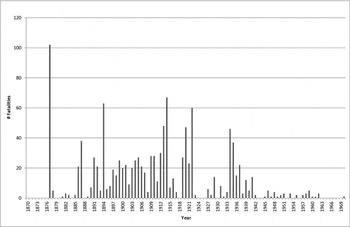
The contour of strike fatalities in figure 1 can neither dispel nor uphold the various causal arguments delineated in the preceding text. It does provide the opportunity to subject a variety of hypotheses regarding the social roots of extreme strike violence to systematic empirical analysis. In so far as they may be deemed suitable measures of US strike violence, they appropriately serve as dependent variables in the models discussed in the following text. I therefore provide a brief recapitulation of this argument.
Data Compilation
The Lipold-Isaac count of 1,160 annualized US strike fatalities (FATALITIES) occurring from 1870 to 1970 was amassed through a content analysis, cross-reference, and supplementation of six other prominent sources of US strike violence and fatality data (Filipelli Reference Filipelli1990; Fishback Reference Fishback1995; Goldstein Reference Goldstein1978; Jeffreys-Jones Reference Jeffreys-Jones1974; Steuben Reference Steuben1950; Taft and Ross Reference Taft, Ross, Graham and Gurr1969), in such fashion as to balance the information, accuracy, and professionalism of these authors, on the one hand, against possible omissions, biases, and errors, on the other.
As described by Lipold and Isaac (Reference Lipold and Isaac2009: 180–82), Philip Taft and Philip Ross (Reference Taft, Ross, Graham and Gurr1969) and Robert Justin Goldstein (Reference Goldstein1978) had provided the two most comprehensive works on violence within and against the labor movement, respectively. Taft and Ross's study was the most inclusive, providing a general survey of violent strikes and related events across industries from the 1870s through the early post–World War II era while Goldstein's study of political repression focused upon elite violence and the plight of radical segments within the labor movement. As general surveys of violence and repression, neither intended to provide complete accounts of strike-related fatalities. Despite accounting for more than 700 strike-related deaths, their counts self-admittedly, “grossly understate(d) the casualties” (Taft and Ross Reference Taft, Ross, Graham and Gurr1969: 380). Much the same is true of Ronald Filipelli's (Reference Filipelli1990) encyclopedic account of 254 of the most “pivotal” conflicts in American labor history. Although reports of deaths and injuries are occasionally included in his event synopses, no concerted effort was made to include all such incidents; while his focus on large strikes systematically excluded fatalities known to have occurred in smaller, lower-profile strikes.
Though more modest in terms of scope, the remaining key sources were more clearly focused on strike deaths. Rhodri Jeffreys-Jones's (Reference Jeffreys-Jones1974) study identified 308 fatalities during the period from 1890 to 1909 while offering an interindustry comparison of total mortality figures by location and year. As reproduced in Steuben (Reference Steuben1950), the Labor Research Association (LRA) reported the date, location, and names of more than 130 deaths of workers and labor organizers killed during strikes and organizing related functions between the years 1934 and 1949. Finally, Price V. Fishback (Reference Fishback1995) gave a brief synopsis of more than 60 violent strikes and concomitant deaths within the bituminous coal industry between the years 1877 and 1927. His list was compiled through a survey of secondary sources that included both Taft and Ross (Reference Taft, Ross, Graham and Gurr1969) and Jeffreys-Jones (Reference Jeffreys-Jones1974).
The fatality series was derived according to what Lipold and Isaac defined as a “strike first” approach, whereby a list of fatal strike events was first constructed and then “best estimates” of the total fatality counts for each event were determined. Fashioned according to the varied goals and scopes of each project, the foundational works overlapped in regard to certain events and perhaps altogether obscured others. Their combined fatality count was thus marred by inconsistencies and missing data. Numerous case studies and other supplementary works including online searches of five major national newspapers including the New York Times (1870–1970), Chicago Daily Tribune (1872–1970), Washington Post (1877–1970), Atlanta Constitution (1868–1939), and Los Angeles Times (1881–1970) were thus employed to corroborate evidence, reveal oversights, and otherwise mediate disputes. Where discrepancies remained, the total fatality count registered per each event represented the most conservative estimate barring strong evidence to the contrary. Given the efforts and safeguards that went into the project, the Lipold-Isaac strike-fatality data set is the most accurate, reliable, and comprehensive presently available.
Data Utility: Strike Fatalities as Dependent Variable
Three issues inherent to the FATALITIES measure constrain its utility. First, strike violence and strike fatalities are not functional equivalents. Strike violence is a rather nebulous concept for which pundits of varying stripes have long sought to establish qualifying parameters and gradations. Physical assault has generally been recognized as the most egregious.Footnote 4 But the destruction of property has also been included, as have acts of intimidation.Footnote 5 Strike fatalities are an outcome of strike violence in its most extreme form. Apart from the profile of strike fatalities, a veritable mountain of nonfatal injuries, property damage, or even emotional strife that accompanied not only fatal but nonfatal violent strikes likely lurk beneath the visible surface. Some historical accounts offered damage reports and casualty figures that included injuries, particularly for the largest strikes. I have found these to be sporadic at best. But this is not particularly vexing. Extreme strike violence is in and of itself a worthy topic of sociological analysis (Tilly Reference Tilly1978; White Reference White1993). Therefore, I focus upon strike fatalities while taking care not to extrapolate these findings to its less visceral dimensions.
But even within such narrowly defined parameters, is the most violent year best conceived as that in which the highest number of fatalities was recorded, or in which the likelihood of being killed was highest? The ratio of strike fatalities per 100 strikes (FATALITYRATIO) has been provided in figure 2.Footnote 6 The year 1877 again stands out as the most violent, so much so that it has been excluded due to scale distortion.Footnote 7 As with FATALITIES, smaller peaks again cluster around the late 1880s, 1894, late Progressive Era, early 1920s, and early New Deal period. The year 1877 aside, the likelihood of being killed upon a picket line was greatest in 1922. This conclusion differs only slightly from a comparison with FATALITIES as seen in figure 1.
US strike fatalities per 100 total strikes, 1880–1970

A third issue derives from the fact that FATALITIES constitutes a national aggregate: such that (1) no distinctions are made between various categories of victims; and (2) the individual events have been dissociated from their microlevel contexts. The situation is partly reflective of available sources, which specifically categorized slightly less than one-half of all the recorded victims, and otherwise provided scarcely enough information to ascertain the year, industry, location, and best estimate of total fatalities for individual strikes (see Lipold Reference Lipold2003; Lipold and Isaac Reference Lipold and Isaac2009). For instance, for the years from 1870 to 1947, only 51.7 percent of the total strike fatalities over the period could be categorized by victim status (Lipold and Isaac Reference Lipold and Isaac2009: 200). Of those, 385 (64 percent) were strikers, labor organizers, or sympathizers, 71 (11.8 percent) were strikebreakers and/or nonstriking workers, 36 (6 percent) were either company guards or private agents hired by the company, 37 (6.1 percent) were federal-, state-, or local-level law enforcement agents, 61 (10.1 percent) were innocent bystanders, and 12 (2.1 percent) were either company executives or government officials. Rather than limiting themselves to a count of only those who had been either specifically categorized and/or involved in strikes with rich historical detail, therefore, Lipold and Isaac (Reference Lipold and Isaac2009) elected to utilize the generic total as the best overall proxy of extreme labor-management conflict.
There are clearly advantages and limitations of such a measure. On the one hand, aggregate data are readily amenable to tests of macrolevel politico-economic variables such as unemployment rates and party dominance ratios (e.g., the proportion of Republicans in Congress). On the other, suspected microlevel determinants such as who/what group was responsible for the bulk of the violence and/or what situational determinants tended to precipitate violent events cannot be measured at strike level (as might seem appropriate), but where applicable, must instead be proxied by other aggregated data.Footnote 8
Macrolevel attempts to address what are arguably microlevel matters may appear unsatisfactory to either those seeking to indict particular groups/organizations, or those convinced as to the primacy of situational determinants. The general thrust of the scholarly literature, however, recognizes a multitiered causal structure of strike violence, including macrolevel economic, political, and institutional factors (see, e.g., Grant and Wallace Reference Grant and Wallace1991; Snyder and Kelly Reference Snyder and Kelly1976). In lieu of a more detailed set of data, it makes sense to seize upon the opportunity for assessing the effects of both macrolevel determinants and microlevel proxies, remaining always cognizant as to the perils of extrapolating beyond our means.
Explanatory Variables
The independent variables introduced in the following text were selected to parsimoniously model the “labor militancy,” “employer intransigence,” “market reformist,” and “political opportunity” perspectives outlined in the preceding text in accordance with the empirical parameters inherent to the FATALITIES measure.Footnote 9 The primary concern is thus not to account specifically for who committed the violence, per se, but rather the practices and/or conditions that incited it. The descriptive statistics and the range of available data for each series have been summarized in the Appendix.
Labor Militancy Variables
Strike rates and union density are common indicators of labor strength and militancy. TOTALSTRIKES is simply a count of strikes recorded in the United States for a given yearFootnote 10 divided by 100 and POLSTRIKESFootnote 11 is a similar measure of strikes for union representation. Both are suspected to have positive influence on FATALITIES. Union militancy, meanwhile, is a conventional measure of union strength and cohesiveness, operationalized in this study as the percentage of nonagricultural employees who belong to unions (see Troy Reference Troy1965: 2). That having been said, it is not the measure of union density, per se, that will be included, but measures of the change in union density from one year to the next. I suspect that the greater the change in union density in either direction, the higher the level of violence: as a result of a strong offensive by labor, on the one hand, or a strong offensive by management, on the other. As a result of the competing logic, the series will be directionalized, such that percentage changes up (CHDENSITYUP) and percentage changes down (CHDENSITYDOWN) will be estimated separately (see Griffin and Isaac Reference Griffin and Isaac1992). The notion that the skill level of strikers positively correlates to strike violence owing to the increased vulnerability of the unskilled to replacements as demonstrated in Grant and Wallace's (Reference Grant and Wallace1991) study of strikes in Canada is theoretically compelling. Unfortunately, a lack of data regarding the ratio of skilled to unskilled laborers within the US workforce during this era prevents a direct assessment of this affect in the US case. That having been said, the measures of strikebreakers and immigration levels introduced in the following text provide at least some indirect proxies.
Employer Intransigence Variables
One of the more prominent strikebreaking techniques involved attempts to resume production without the striking workers by using a skeleton crew of nonstrikers and/or strikebreakers (e.g., Whatley Reference Whatley1993). Another popular strategy involved invoking government intervention, either as injunctive relief against strikes (see Forbath Reference Forbath1991; Friedman Reference Friedman1988: 416; McCammon Reference McCammon1993b) and/or troop deployments (Cooper Reference Cooper1977; Hacker Reference Hacker1969; Harring Reference Harring1983; Johnson Reference Johnson1976; Reinders Reference Reinders1977). AFAMSTRKBRKING, an annual count of events in which African American strikebreakers were deployed (see Whatley Reference Whatley1993), was utilized as an indicator of the former. INJUNCTIONS, a count of injunctions granted by state and federal courts against striking laborers inflated by a factor of 8.25 (see Forbath Reference Forbath1991; McCammon Reference McCammon1993b; Petro Reference Petro1978) was utilized as an indicator of the latter. As measures of employer intransigence, both are expected to have a positive influence on FATALITIES. Given that many such injunctions were issued under the guise of preempting picket-line violence, however, an interesting counterargument as to the dampening effect of INJUNCTIONS could also be made (Petro Reference Petro1978).
Whence public forces were unavailable, employers also had a myriad of private police agencies and services upon which to call, either to protect property and nonstrikers, or to heavy-handedly crush picket lines (Weiss Reference Weiss1986). The NAM was renowned for its virulently antiunion stance (Griffin et al. Reference Griffin, Wallace and Rubin1986) and thus serves as a proxy for employer countermobilization. Operationalized as membership within the NAM per annum (see Gable Reference Gable1950) divided by 1,000, NAM is thus also expected to have a positive impact on FATALITIES.
Market-Reformist Variables
The Progressives asserted that neither laborers nor their unions were inherently violent. Rather, they reasoned that they were driven to extremes by the vagaries and excesses of the emergent capitalist industrial system (Jeffreys-Jones Reference Jeffreys-Jones1974: 566–67). I thus included three variables as measures of desperation and otherwise economic motif. UNEMPLOYMENT is a standard measure of labor market conditions, operationalized in this instance as the annual percentage of the civilian labor force without work (see US Bureau of the Census 1975: 135). On the one hand, unemployment serves as a measure of general economic health and well-being. On the other, given the long recognized association between fluctuating levels of unemployment and union militancy, it also serves as a measure of working-class strength. More specifically, as unemployment increases, overall levels of union membership decrease and vice versa. One might therefore expect that increasing militancy associated with high employment translates into increased violence. But in another sense, this seems counterintuitive as high levels of unemployment and concomitant levels of economic hardship are expected to increase not only interclass tensions but fuel incendiary competition between competing groups of workers—both suspected motivators of increased violence. In so far as both high and low levels of unemployment arguably increase the likelihood of violence, net their effect of levels of strikes, it thus makes sense to test for both linear and curvilinear relationships.
Workers have also been argued to react violently to stagnant and/or declining wages (see Fishback Reference Fishback1995). Operationalized as the percentage change down in real wages per annumFootnote 12 and coded as “0” for nonchange and positive change years (Griffin and Isaac Reference Griffin and Isaac1992), WAGESDOWN is also expected to have a positive influence on FATALITIES. A count of the total number of immigrants to the United States per annum divided by 10,000 (TOTALIMMIGRANT) has also been included. As both increased competition for available work (Jenkins Reference Jenkins1978) and as a potential pool of strikebreaking candidates (see, e.g., Leonard Reference Leonard1979), the flow of immigrants is expected to positively influence FATALITIES.Footnote 13
Political Opportunity Variables
The readiness of strikers to commit acts of violence is believed to be influenced by an array of malleable considerations including the perceived legitimacy of the reigning politico-economic regime (Piven and Cloward Reference Piven and Cloward1979; Tilly Reference Tilly1978), the openness of that same regime to their concerns (Boswell and Dixon Reference Boswell and Dixon1993), various legal and juridical precedents that structure their behavior (Taft and Ross Reference Taft, Ross, Graham and Gurr1969), and the threat of repression (Grant and Wallace Reference Grant and Wallace1991; Piven and Cloward Reference Piven and Cloward1979). The likelihood of repression, meanwhile, has been argued to vary on the basis of another constellation of considerations that are also forever in flux. A noncomprehensive list would include the attitudes of government officials and their degree of coordination with industrial elites (Friedman Reference Friedman1988; Fusfeld Reference Fusfeld, Bright and Harding1984 Goldstein Reference Goldstein1978), the power of the relevant authority structure both absolutely and relative to that of the challenger groups (McAdam Reference McAdam1982; Tilly Reference Tilly1978), support from the middle classes, and a whole host of extraneous politico-economic factors ranging from the influence of foreign investors (Oppenheimer and Canning Reference Oppenheimer and Channing1979–80) to the prerogatives of foreign war.
REPUBCONGRESS, the percentage of Republicans in Congress per annum,Footnote 14 is expected to reflect the influence of business interests on the government, the willingness of the government to repress labor disputes on the behalf of business, and, as a result, strike violence. Conversely, one should expect that labor militancy is most likely expressed when the likelihood of repression is at its least, thereby increasing the range of potential opportunities for violence. One might thus expect a concentration of fatalities when REPUBCONGRESS is near either of its extremes, thereby warranting a test for curvilinear function (see, e.g., Boswell and Dixon Reference Boswell and Dixon1993; Snyder Reference Snyder1976).
A series of temporal dummy variables has also been included. Each stands as an open admonition that although the entire period from 1877 to 1947, bracketed by the Great Strike and Taft-Hartley, constituted a transformative and violent era in the overall trajectory of relations between labor, business, and government (Lipold and Isaac Reference Lipold and Isaac2009), the entire course of events passed through several distinctive phases. Each of these phases, or regimes, was unique in terms of prevailing attitudes; strategies; legislative enactments; judicial interpretations; political, economic, and social developments; and/or some combination thereof.
WARYEARS
World War I inaugurated an era of unprecedented cooperation and coordination between big labor, big business, and big government. The accord was encouraged by a federal government that was preparing to be involved in an international military endeavor, and as a result, one that was seeking to avoid the disruptive effects that labor strife might have on munitions and other essential production (Weinstein Reference Weinstein1968: 216). The cooperative approach between employers and conservative unions included no-strike pledges, and thus arguably reduced all forms of labor conflict, including fatalities. Leftist labor organizations (e.g., the International Workers of the World [IWW]), however, were alienated from both the war and wartime pact, becoming instead the targets of repression (Fusfeld Reference Fusfeld, Bright and Harding1984; Weinstein Reference Weinstein1968).
With the end of the war in sight, the cooperative pattern had already begun to break down, not to be fully resurrected until World War II. In an attempt to measure this wartime effect, I thus created a binary variable WARYEARS (years = t), which was coded as (1 = war year, 0 = otherwise)—war year having been defined as any given year during which the United States was officially engaged in either of the two world wars (1917–19 and 1941–45): both of which were assumed to have a similar effect upon the likelihood of strike violence.
REGIME1
The remaining dichotomous variables represent a sequence of temporal regimes. They mark transitory phases within the overall development of labor-management relations, but they are not in and of themselves conceived as static blocks of time. Change was constant even within periods. The years within each block were none the less sufficiently similar to constitute particular regimes: predominant patterns of labor, employer, and government interactions within evolving legal-juridical contexts. The regimes, meanwhile, were sufficiently dissimilar in their expected impacts on lethal strike outcomes to warrant juxtaposition.
REGIME1Footnote 15 spanned the years from 1877 to 1894. It included some of the most renowned labor clashes in US history such as the Haymarket Affair and the Battle of Homestead, and was bracketed by two of the most calamitous railroad strikes of national magnitude—the Great Strike and Pullman. The first, the Great Railway Strike of 1877, alerted capitalists to threats that militant workers posed to the emergent and increasingly integrated capitalist industrial order (Hacker Reference Hacker1969: 258). The most prominent response to what came to be known as “the labor question,” or the problematization of labor, was a desire among many employers and prominent citizens to hone the means of repression (Isaac Reference Isaac2002; Reinders Reference Reinders1977; Shefter Reference Shefter, Katznelson and Zolberg1986). The judiciary, meanwhile, constituted the most prominent government actors, as they sought to define and enforce particular forms and standards of labor protests and behavior (see Hattam Reference Hattam1992; McCammon Reference McCammon1993a).
REGIME2
Although socialist and other fringe anticapitalist groups attributed incidents of mass labor violence to the vagaries of the emerging capitalist industrial order prior to 1895, it was not until after the Pullman Strike that a reformist discourse achieved some prominence (Wiebe Reference Wiebe1967). In the wake of that event, the National Civic Federation (NCF), representing mostly large corporations within heavily capitalized industries, was formed. Symbolically, the NCF included Samuel Gompers of the AFL on its executive board, and advocated collective bargaining with conservative unions as the best long-term strategy to avoiding costly work stoppages and thwarting the indigenous Socialist movement. Although ardently opposed by organizations such as NAM and other vehemently antiunion employers who continued their oftentimes open war against unions of all stripes, it was the emergent reformist agenda that characterized the period from 1895 to 1918 and ultimately prevailed, assisted by both Progressive elements within and aside from the government and historical imperatives associated with the World War I (see Fusfeld Reference Fusfeld, Bright and Harding1984; Kolko Reference Kolko1963; Weinstein Reference Weinstein1968).
REGIME3
Repression of the American Left continued into the postwar Red Scare, punctuated by the Palmer Raids of 1921. But mainstream labor unions also came to realize how tenuous their wartime gains had been. The big government–big business–big labor nexus had already begun to unravel before the Treaty of Paris had been signed, replaced instead by a war against organized labor that was waged aggressively throughout the third temporal regime (1919–31). The opening salvo was fired against the steelworkers, whose strike for union recognition in 1919 was crushed with the help of the Pennsylvania Coal and Iron Police (Adamic Reference Adamic1983: 288–91; Goldstein Reference Goldstein1978: 152; Weinstein Reference Weinstein1968). Employer intransigence spread to other industries as businesses sought to regain their freedom from government and independent unions (Goldstein Reference Goldstein1978: 5), launching instead a new campaign for corporate responsibility and company unions under the guise of a voluntaristic “American Plan.” The heretofore supportive Wilson administration, meanwhile, became first fixated on its international agenda, and then replaced by a series of Republican regimes; and court interventions into labor disputes increased dramatically, such that the phenomenon became known as “government by injunction” (Forbath Reference Forbath1991). The antagonistic environment had a suffocating effect on union militancy, dramatically reducing the incidents of strikes and attempts at unionization (Bernstein Reference Bernstein1960; Brody Reference Brody1960; Griffin et al. Reference Griffin, Wallace and Rubin1986; McCammon Reference McCammon1993a; Montgomery Reference Montgomery1987).
REGIME4
Of course, labor militancy had not been vanquished altogether. Leftist unions continued in their attempts to organize the masses of unskilled workers but unions as a whole had little success until the postwar conservative regime had been swept from office during the 1932 elections. Democratic Party support for organized labor and concrete legislative victories characterized the early stages of this fourth and final subperiod (1932–47). The successes included the Norris-La Guardia Act of 1932 that brought an end to “government by injunction,” and the Wagner Act two years later that afforded legal sanction to the formation of trade unions with the right to bargain collectively (see Wallace et al. Reference Wallace, Rubin and Smith1988). These initiatives were greeted with a wave of organization efforts, on the one hand, and fierce resistance by many employers, on the other (Taft and Ross Reference Taft, Ross, Graham and Gurr1969). But by the late 1930s, the era of open conflict along America's picket lines was gradually coming to an end. As a response, in part, to the Supreme Court's decision in favor of the Wagner Act's constitutionality, employer resistance to unionization shifted from a strategic emphasis on repression to that of institutionalization and containment, much along the lines that the NCF had advocated several decades earlier. The imminence of World War II was also a likely contributing factor. Yet, even after US and Allied military victory had been assured, labor's most crucial postwar defeat came not in the form of bloodied strikers but management-friendly legislation: the Taft-Hartley Act of 1947 having circumscribed many of the labor movement's most effective tactics, leaders, and New Deal victories (Goldfield Reference Goldfield1987; Lipold and Isaac Reference Lipold and Isaac2009; McCammon Reference McCammon1994; Stepan-Norris and Zeitlin Reference Stepan-Norris and Zeitlin2003; Wallace et al. Reference Wallace, Rubin and Smith1988).
THREAT LEVEL
Finally, what better indicator as to the likelihood of aggression and/or repression than recent examples thereof? The lagged endogenous variable FATALITIES(-1) and both immediate and lagged effects of MASSACRES have thus been included in an effort to determine the resonant effect of recent strike violence on strike fatalities. MASSACRES is a dummy variable coded “1” for 1914 (Ludlow), 1922 (Herrin), and 1937 (Chicago) and “0” for nonevent years.Footnote 16 Are they mutative or inflammatory? Anecdotal evidence suggests that large-scale violent episodes within particular industries such as the railroads and steel tended toward extended periods of relative quiescence (Lipold Reference Lipold2003: 191–92). Violence within the coal industry, however, often seemed to carry the opposite effect (Fishback Reference Fishback1995). In aggregate, it may have either positive, negative, or no influence.
Estimation Procedures
Utilizing FATALITIES and FATALITYRATIO as dependent variables, I have specified and tested a number of regression models that seek to account for the annual variation in the pace of strike-related deaths and the causes of strike violence within the United States. In so doing, I have employed time-series regression analysis, a technique common to both historical-sociology (Ostrom Reference Ostrum1990) and the study of strike violence within several Western industrialized nations (see, e.g., Grant and Wallace Reference Grant and Wallace1991). All of the equations were computed using the statistical software package EViews, version 6, including the relevant serial correlation diagnostics.Footnote 17 As an integer-level “count measure,” all models of FATALITIES were first subjected to Negative Binomial (NB) estimations. For those models in which the NB dispersion parameter was found insignificant at p ≥ .10, Poisson estimations were utilized instead (see, e.g., Barron Reference Barron and Marsden1992; Isaac and Christiansen Reference Isaac and Christiansen2002; Minkoff Reference Minkoff1997).Footnote 18 All FATALITYRATIO models were estimated using ordinary least squares (OLS).
Time-series determinants of strike fatalities, 1901–30

*p < .10. **p < .05. ***p < .01 (two-tailed tests).
Time-series determinants of strike fatalities, 1901–47

*p ≤ .10. **p ≤ .05. ***p≤ .01 (two-tailed tests).
Estimations of the effect of temporal regimes on strike fatalities, 1901–47

*p ≤ .10. **p ≤ .05. ***p ≤ .01 (two-tailed tests).
Time-series determinants of the relative frequency of strike fatalities, 1901–31 and 1901–47

*p ≤ .10. **p ≤ .05. ***p ≤ .01 (two-tailed tests).
Time-series determinants of strike fatalities, 1947–70

*p ≤ .10. **p ≤ .05. ***p ≤ .01 (two-tailed tests).
Periodization
Models have been estimated for three temporal ranges, 1901–30, 1901–47, and 1947–70. Estimates for the range 1877 through 1947, as bracketed by the Great Railway Strike and Taft-Hartley would have been ideal. However, the temporal framework was delimited by data availability—the lower temporal boundary established by a paucity of nineteenth-century wage data, and the high end by the upper limits of data regarding strikebreaking and injunctions (see Appendix). The models for 1901–30 include AFAMSTRKBRKING and INJUNCTIONS, whereas the models for 1901–47 do not, thereby exchanging theoretical depth for temporal breadth. The models for 1947–70, meanwhile, provide a comparison between the pre– and post–Taft-Hartley eras.
Regression Results
Turning to the first panel of regression equations presented in table 1,Footnote 19 most of the results were consistent with expectations. Changes in union density, the use of strike breakers, unemployment, and immigration flows were all found to positively influence strike fatalities. Total and political strikes, modeled separately due to their strong correlation, were also positive at statistically significant levels, but only net the effect of the slight positive curvilinear influence of unemploymentFootnote 20 (eqs. [1f] and [1g]) and/or the mild negative curvilinear influence of congressional Republicans (eq. [1b]). There is also some evidence that the use of injunctions actually muted strike violence, explicable perhaps by the fact that many injunctions were granted under the auspices of either preventing imminent violence and/or restoring law and order. Thus, the most surprising result would be that of the negative influence of declining wages, erstwhile argued to be a prominent incendiary factor (see, e.g., Grant and Wallace Reference Grant and Wallace1991).
Most of these relationships carry through the models expanded to include the years from 1931 to 1947. The first exception was the dropped statistical significance of total strikes, the models of which having thus been excluded from table 2 for sake of brevity. Second, those who generally accepted that the war eras–invoked labor peace might be surprised to learn that WARYEARS was shown to have a positive influence on strike fatalities, perhaps indicative of heightened attempts to repress leftist labor organizations, especially during World War I (see Fusfeld Reference Fusfeld, Bright and Harding1984; Goldstein Reference Goldstein1978). Third, the influence of both political strikes and organization of NAM turned decidedly negative, demonstrative of temporally varying causal parameters associated with these additional years (see, e.g., Isaac and Lipold Reference Isaac and Lipold2012). Such suspicions are confirmed by the evidence presented in table 3. Net the effect of all other variables included within these models, the years from 1932 to 1947 stand out as the least violent, while those ranging from 1919 to 1931 were the most so. As discussed in the following text, such findings seem to affirm existent arguments as to the relevance of historic shifts in the political opportunity structure.
The causal structures detected in models of FATALITYRATIO were strikingly similar to those of FATALITIES, although not all of the models were fit for comparison. TOTALSTRIKES was altogether excluded from models of FATALITYRATIO because it formed the denominator of that measure; while neither REPUBCONGRESS2 nor any of the temporal dummies could be included without introducing problematic levels of serial correlation. Nevertheless, within the somewhat limited scope provided by equations (4a) through (4d), not a single statistically significant finding concerning the determinants of the relative frequency of strike fatalities contradicted those of the raw count (see table 4). Indeed, they rather serve to substantiate the validity and reliability of the findings for FATALITIES, especially in regard to the robustness of the declining union density, strikebreaking, unemployment, and immigration variables.
What about the period after 1947? The equations presented in table 5 provide an opportunity to gauge whether or not the causal structures exhibited prior to the passage of the Taft-Hartley Act of 1947 carry through 1970.Footnote 21 In fact, of all of the regressors included in the post–Taft-Hartley period, only immigration flows retained its statistical significance. Yet, even at that, the direction of the relationship reversed from positive to negative, seemingly suggesting that the flow of immigrants during the post–World War II economic boom were no longer perceived as a threat by domestic strikers. While a detailed analysis of the postwar period lies beyond the scope of this paper, suffice it to say that the causal structures of the pre– and post–Taft-Hartley periods were clearly dissimilar.
The fact that time matters to our understanding of the fluctuating levels of extreme strike violence is thus one lesson to glean from the balance of the analysis. So, too, is the impact of the use of violence. Although the results of the annual lagged fatalities measure were not found to be statistically significant, those for both the relative frequency of strike fatalities and massacres were. As recorded in table 6, massacres were expectably found to make a substantial positive contribution to the overall level of strike violence during the given years that they occurred (eq. 6a). Their lagged influence, meanwhile, was not only strongly negative, but appears to have persisted for as much as three years. For the readers’ convenience, this and other key findings have been summarized in table 7.
Estimation of the effect of massacres on strike fatalities, 1901–47

*p < .10. **p < .05. ***p < .01 (two-tailed tests).
Summary of the key findings

Note: +S = positive and significant; −S = negative and significant; NS = nonsignificant
Discussion, Conclusions, New Directions
One century after the investigative US Commission on Industrial Relations was convened, this paper offers the first attempt to subject various hypotheses as to the causes of strike fatalities within the United States to time-series regression analytics. As an overarching assessment of the findings presented herein, three themes, in particular, emerge. First, strike violence increased in association with tightening labor markets. Second, strike violence was manifest in association with the struggle for and against unionization. Third, state support mattered.
Labor Market Competition
The long and widely held supposition that labor market competition enhanced the likelihood of strike violence was well supported by my results. From among the indicators of “labor market conditions,” measures of both unemployment and immigration (prior to 1947) were consistently found to increase the frequency of strike fatalities, this despite the fact that rising levels of unemployment actually depressed the overall level of strike activity during these same years. In a highly commodified market one's livelihood is dependent upon paid employment. During periods of high unemployment, the masses of unemployed constitute what Karl Marx referred to as “a reserve army of laborers,” which especially during the historical time period analyzed here, was comprised in part of waves of foreign immigrants and displaced natives.
The “ideal-typical” conflict scenario in regard to labor market tightness thus involved strikers and strike replacements violently engaged in a competition for scarce employment opportunities. But that model does not in and of itself capture the essence of American strike violence. Net of the effect of unemployment, both the immigration flow and strikebreaking measures remained statistically significant in most models, and vice versa. The violence associated with unemployment, therefore, need not have been indicative of intraclass conflict; nor, conversely, was the conflict, intraclass or otherwise, necessarily born of economic desperation and/or destitution. Recall, for instance, that another measure of working-class duress, a decline in wages, actually contraindicated strike fatalities. Quite simply, there appears to have been another motif, aside from economic desperation, sufficient to motivate strikes and precipitate strike violence, irrespective of the universe for alternative employment opportunities and economic gain.
The Struggle for and against Unionization
Based upon both the prevailing themes of American labor historiography and regression results presented in the preceding text, the other factor appears to have been the struggle for unionization. Labor historians and kindred analysts from within other academic disciplines have long contended that American corporations have historically contested unionization more fiercely than their counterparts elsewhere in the Western industrialized world (see, e.g., Friedman Reference Friedman1988; Gitelman Reference Gitelman1973; Jacoby Reference Jacoby and Jacoby1991), and that strikes for unionization were the most likely to become violent (Taft and Ross Reference Taft, Ross, Graham and Gurr1969). Much emphasis has been placed upon the NAM's coordinating role in the campaign against independent trade unions (Griffin et al. Reference Griffin, Wallace and Rubin1986); and although the indicators for “strikes for union recognition” (POLSTRIKES) and “employer mobilization” (NAM) proved to be neither especially robust in their effects nor conforming to theory, the measure of “decreasing union density” did.
The indicators of both “increasing union density” and “decreasing union density” were found to have a positive impact on the pace of strike fatalities: a salient point in two respects. First, it problematizes the notion that unions, unionists, or at least union strength breed violence. Second, it creates theoretical space for “elite” as opposed to “labor violence.” As to the former, antiunion employers and other purveyors of the antilabor “labor militancy” perspective had sought to stigmatize the unions as agents of foreign radicalism and violent means (Fusfeld Reference Fusfeld, Bright and Harding1984; Wilentz Reference Wilentz1984). Even the “market-reformist perspective,” which sought to look beyond the character of individuals and groups to the social roots of violence, often framed the proliferation of strike violence and Socialism as labor's response to the vagaries of unfettered capitalist industrialism, that is, “labor violence.” So the rise of strike violence in conjunction with increasing union density might have seemed to suggest that unionists strategically employed violence as a means to enhance their growth; while the increase of violence in association with immigration flows (an arguable source of radicals and radicalism) and strikebreaker deployments (potential nonunion targets of union aggression) might also be fashioned as indictments against union strong-arm tactics.
Such a slant, however, does not particularly square with the strong relation between union decline and strike violence. In deference to the “antimanagement perspective,” there appears to be a better explanation, namely, that elites employed violence too (Fusfeld Reference Fusfeld, Bright and Harding1984; Goldstein Reference Goldstein1978; Sexton Reference Sexton1991; Tilly Reference Tilly1978; Wallace Reference Wallace1970–71). In fact, it is important to bear in mind that strikers were the most likely victims of strike violence; and perhaps by corollary, management and/or the array of forces aligned on management's behalf were the most likely to employ violence during labor-management confrontations (Lipold and Isaac Reference Lipold and Isaac2009; Tilly Reference Tilly1978; Wallace Reference Wallace1970–71).
That “union density decline” enhanced strike violence lends itself to an interpretation that points to elite use of violence rather than the reverse, and the immigration measure too, warrants reconsideration. Waves of immigrant workers had become concentrated within the semi- and unskilled industrial occupations, and the leftist unions by which they had been organized. If leftist unions were in fact the most likely to be repressed, then the positive association between immigration and strike fatalities may well be indicative of that particularly aggressive campaign.
Government Disposition
In creating theoretical space for “elite violence,” in general, and the array of forces aligned on management's behalf, in particular, I also call to mind the role of the state and state intervention. Given the somewhat inconsistent legislative history of the federal government in regard to labor and unionization (Dubofsky Reference Dubofsky1995), the posited association between the state and elite violence and/or repression may seem inappropriate. Significant examples of both pro- and antilabor laws have indeed been enacted (Wallace et al. Reference Wallace, Rubin and Smith1988). Yet, when it came to direct and forceful intervention in labor-management disputes, the state was hardly neutral. Of the more than 1,000 fatalities accounted for by Lipold and Isaac (Reference Lipold and Isaac2009), for instance, not one was known to have involved the death of a company official at the hands of government forces.
The willingness of government officials to routinely intercede on the behalf of employers was founded upon their shared apprehension of the labor movement (Friedman Reference Friedman1988). The Great Railway Strike of 1877 initiated a new era of labor relations, one in which the dual threats of socialism and mass insurgency had been problematized. The immediate and lasting response was repression. During the Great Railway Strike of 1877, the federal government demonstrated the will to act forcefully, pressing 45,000 militia and 2,000 federal troops into action (Adams Reference Adams1995: 200). Shortly thereafter, the army and the militia were retooled as an effective and active strike-policing force (Cooper Reference Cooper1977). Between the years from 1886 to 1895, a total of more than 75,000 military troops were deployed over the course of 118 government-proclaimed “labor dispute” interventions (Adams Reference Adams1995: 201).
Gradually and somewhat opportunistically (Jeffreys-Jones Reference Jeffreys-Jones1974), the federal government came to realize that the laissez-faire doctrine was a greater threat to national security than organized labor. Net of the effect of all the other factors that had been considered within the regression models, the likelihood of strike violence was not only demonstrated to vary through time, but to do so in relation to the level of support/tolerance that federal officials provided unions. Between the years 1901 and 1947, the New Deal Era, that is, Regime 4 (1932–47), was both the most labor friendly and least violent. Regime 3 (1919–31) was both the least labor friendly and most violent. Regime 2 (1901–18) comprised an era during which various reformist, antiunion, and laissez-faire agenda clashed with one another. Neither especially pro- nor antilabor, it also ranked second of the three in terms of the net level of violence. Albeit as a result of a general refusal to engage picket lines directly or by pressuring employers to acquiesce, state support mattered.
Toward a Theoretical Synthesis and Beyond
Labor market conditions, the struggle for unionization, and governmental disposition are thus three empirically grounded components of a composite theoretical model of American strike violence. I would like yet to make the case for a fourth, their unifying thread. It is indicated not by any particular regression coefficient, but by the simple fact that more than 1,000 individuals were killed on American picket lines between the years 1877 to 1947. Recalling Tilly's (Reference Tilly1978: 188) assessment of the theoretical significance of various tracers of violence, “The occurrence of damage to persons or objects gives us some small assurance that at least one of the parties to the collective action took it seriously.” It is to this deadly “seriousness” of which I now speak. It was the catalyst, or ethos, that fostered not simply threatening gestures and property damage, but resolve in the face of death and the will to kill: the willingness to put one's life on and for the picket line; and the willingness to take that of someone else. It was a “struggle for survival,” involving elements of commodified labor, competitive capital, and a nonreformist state prior to the institutionalization of a well-developed regime of regulation.
The statistics presented in this paper confirm what has long been presupposed—that clashes during strikes for union recognition routinely contributed to US strike violence and deaths. They also suggested that this pattern of violence might not have been broken without government intervention and enforcement. Congress passed the National Labor Relations Act of 1935 (a.k.a. the Wagner Act) that reiterated the rights of workers to organize into independent trade unions and collectively bargain with representatives of their own choosing. In spite of sustained resistance from the NAM, Wagner's constitutionality was upheld, the Supreme Court in 1937 having recognized, “that the statutory regulation of capital-labor relations was necessary to sustain economic recovery” (Wallace et al. Reference Wallace, Rubin and Smith1988: 7).
Almost immediately, NAM began to lobby for Wagner's abrogation, eventuating in congressional passage of the Taft-Hartley Act of 1947 (Bluestone and Harrison Reference Bluestone and Harrison1982: 136). The legislation included a number of provisions designed to circumscribe the bargaining purview of existent unions while making it more difficult to form new ones (Davis Reference Davis1986: 111). A legal foundation for the postwar institutionalization of labor was thus effectuated along the lines that the NCF had advocated one-half century earlier. Collective bargaining agreements between management and conservative unionists within the nation's core industrial sectors were encouraged (Isaac and Leicht Reference Isaac and Leicht1997: 33), while leftist unionists were “left out” (Stepan-Norris and Zeitlin Reference Stepan-Norris and Zeitlin2003). These developments combined to reorient labor-management conflicts away from the picket lines and toward union electoral proceedings, contract negotiations, and government mediations. The frequency of strike-related fatalities within the United States has decreased dramatically ever since.
One must nevertheless take care not to overemphasize the impact of Wagner, Taft-Hartley, and/or other legislative enactments upon the ultimate trajectory of labor-management conflict. Not only were many dominant US corporations from within the economy's core industrial sectors eager to capitalize on their newly found industrial preeminence and, therefore, more apt to engage unions in collective bargaining than they had been before (Bluestone and Harrison Reference Bluestone and Harrison1982), but the resultant upward spiral of wages, productivity, and profit associated with America's postwar economic boom obviated many of the distressed “economic conditions” also determined herein to enhance the likelihood of extreme strike violence.
But then again, the heyday of Pax Americana was relatively short lived, and the postwar détente between American labor and management has long since come to an end. Strike violence of the scale and mortality common to the period 1877 to 1947 has not yet recurred. And given the strong positive statistical association that was found here to have existed between declining union density and strike fatalities prior to 1947, we may indeed be inclined to speculate that either (1) the Wagner-Taft-Hartley accords have, in fact, had a profound lasting influence on the pace of US labor-management violence after all; and/or (2) strikes simply have not been taken as “seriously” as they once were—in part, perhaps, because they no longer posed the threat to employers that they once did.
Lingering Issues and Questions
My conclusions have been based upon the most comprehensive count of US strike fatalities available to date, results of the first attempts to subject preexisting causal arguments to quantitative historical time-series analysis, and an array of invaluable if not incalculable insights as provided by American labor historiography, historical sociology, and social theory. They portray the causes of American strike violence in empirically grounded but broad strokes. A more detailed and perhaps more profound understanding of the sociohistorical relevance in regard the causes and consequences of American strike violence thus awaits. Three issues or research extensions deserve attention.
First, is the model overgeneralized? Like prominent sociohistorical analyses of the causes of strike violence within other Western industrialized nations (e.g., Grant and Wallace Reference Grant and Wallace1991; Snyder and Kelly Reference Snyder and Kelly1976), my regression analyses and inferred conclusions were based upon a national aggregate. Although appropriate as an important first step toward an enhanced understanding of American strike violence, there are some indications that at least within the United States interindustry differences should not be ignored. Strike fatalities were recorded within more than a dozen US industries, but roughly two-thirds were concentrated within the mines and along the rails (Lipold and Isaac Reference Lipold and Isaac2009). While an ideal portrait of US strike violence should capture both its concentration and heterogeneity, the national aggregate is skewed toward the former. In so far as social, economic, and workplace conditions varied markedly from one industry to the next even within the same year, the aggregate results may obscure significant interindustry differences, if not mask causal mechanisms altogether. Therefore, an important extension of this research is to analyze a “disaggregated composite” model of lethal strikes, one that recognizes both the interindustry “skewness” of the violence and potentially heterogeneous causal mechanisms.Footnote 22
Second, what were the consequences of the violence for the labor movement, for industry, and/or for the state? A corollary issue as to the causes of strike violence is certainly its consequences. Given the fact that industrial reforms were increasingly implemented throughout the era of American strike violence, it seems reasonable to speculate as to its effect on the reformist propensities within not only industry, but also the state (Gamson Reference Gamson1990; Isaac and Lipold Reference Isaac and Lipold2012; Jeffreys-Jones Reference Jeffreys-Jones1974). It is generally clear, however, that elites refused to be intimidated: their immediate inclination having been to first hone and then implement a repressive apparatus. The net effect of elite repression upon the aggregate pace of strike violence, meanwhile, is a matter of conjecture. In committing acts of violence, the state quite obviously contributed to the tally of strike deaths. That there was a secondary dampening effect on either violent and/or potentially violent strikes remains plausible, if not congruent with the stultifying effect of massacres depicted herein. Incorporating measures of strike violence into theories and empirical models of unionization and strike propensity are thus an important next step. By disaggregating the fatality measures into their “labor violence” and “elite violence” components, it might also be possible to determine their effect upon one another, and the prevailing political opportunity structure. Such advancements may well elucidate a dialectical interrelationship between the causes, consequences, and context of US strike fatalities (see Isaac and Lipold Reference Isaac and Lipold2012), that is, the transformative efficacy of bloodshed.
Third, what are the implications for future comparative-historical analysis? The results presented herein neither strongly confirm nor refute existent quantitative analyses of strike violence in France (Shorter and Tilly Reference Shorter and Tilly1971), Italy (Snyder and Kelly Reference Snyder and Kelly1976), or Canada (Grant and Wallace Reference Grant and Wallace1991). From among my key findings, the US case is the first for which the economic contextual variable unemployment was found significant. Strikes for union recognition, meanwhile, were previously found to be a significant determinant in Canada, but neither France nor Italy. The American results support Grant and Wallace in this regard and also indirectly affirm their conclusions regarding the significance of workers’ skill levels,Footnote 23 but contradict their findings on wages. While there appears to be some basis for consensus between the United States and Canada, it is important to bear in mind that Grant and Wallace analyzed the years from 1958 to 1967, a period following the postwar institutionalization of Canadian labor—problematic in that this paper clearly demonstrated that the causal mechanisms of lethal strike violence during the pre– and post–World War II eras within the United States differed.
Also at issue, this was the only study of the four: (1) not to model situational determinants such as size and duration of particular strikes—unfortunate in that they were found significant in the three other studies; and (2) to key in exclusively on the causal parameters of strike fatalities, the most extreme form of strike violence. The situation encourages further research into both the American case—including the situational determinants of fatal and nonfatal violent strikes during the pre– and post–Taft-Hartley eras; and international patterns of extreme strike violence.
Only through cross-national comparison can that which is truly “exceptional” about American labor be discerned. In a world of increasingly globalized competition, it seems quite likely that other nations either have been or will become just as “serious” about their economic development as the United States;Footnote 24 and it should come as no surprise if in another 30 years the United States has been supplanted from its dubious distinction by what at present appears a most unlikely challenger. Then again, the United States may not surrender its title quite so readily. As neoconservative movements continue to erode the political and economic bases of the post–World War II labor-management accords, who is to say that a new era of lethal contestation may not be in the offing?
Appendix
Source availability and descriptive statistics for nondichotomous variables



