




Impact statement
The United Nations Environment Assembly (UNEA) approved Resolution 5/14, entitled “End Plastic Pollution: Towards an International Legally Binding Instrument.” An Intergovernmental Negotiating Committee (INC) was established to negotiate the Global Plastics Treaty, which is expected to enter into force by 2025. This treaty is aimed at reducing plastic pollution along the entire plastic life cycle. The work of the literature and INC in the negotiations is critical to developing a genuinely successful treaty that minimizes plastic pollution. This systematic review of the Global Plastics Treaty provides an overview of the literature’s contributions to the negotiations. Among the crucial provisions and recommendations, the literature affirms the significance of limiting global plastic production as the most effective measure for mitigating plastic pollution.
Introduction
We are living in the “Plasticene” contemporary epoch (Haram et al., Reference Haram, Carlton, Ruiz and Maximenko2020; Alava et al., Reference Alava, Jahnke, Bergmann, Aguirre-Martínez, Bendell, Calle, Domínguez, Faustman, Falman, Kazmiruk, Klasios, Maldonado, McMullen, Moreno-Báez, Öberg, Ota, Price, Shim, Tirapé, Vandenberg, Zoveidadianpour and Weis2023), experiencing the effects of pollution and plastic production on the triple planetary crisis of pollution, loss of nature, and climate change (United Nations Environment Programme, 2022a). An effectively designed global legislative treaty to regulate plastics is necessary to mitigate the global crisis (Dauvergne, Reference Dauvergne2023b).
The United Nations Environment Assembly (UNEA) approved Resolution 5/14 entitled “End Plastic Pollution: Towards an International Legally Binding Instrument” in March 2022, which aims to address the issue of plastic pollution by implementing a worldwide and legally enforceable treaty on plastics (Bergmann et al., Reference Bergmann, Almroth, Brander, Dey, Green, Gundogdu, Krieger, Wagner and Walker2022; Walker, Reference Walker2022), known as the Global Plastics Treaty. To conclude the treaty, by the end of 2024, an Intergovernmental Negotiating Committee (INC) was established, and the negotiations are ongoing (Tiller and Nyman, Reference Tiller and Nyman2018).
To ensure the success of negotiations such as those of the Global Plastics Treaty and the long-term efficacy of their results, extensive involvement of researchers is essential (Wang et al., Reference Wang, Carlini and Wang2023), even if indirectly. The literature is essential for an in-depth understanding of plastic pollution and its implications (Carratta and Jaeckel, Reference Carratta and Jaeckel2023) and is the solid basis for discussion and decision-making.
In this study, a systematic review of the Global Plastics Treaty was performed based on searches in the Scopus, Web of Science, and Google Scholar databases. As the main focus of the analyzed literature, the adverse effects of plastic pollution, legislation, governance, and the economy were briefly discussed. Based on this, a comprehensive overview of the available literature is presented in the following pages, which may support the negotiations and construction of an effective treaty, and guide future research on the Global Plastics Treaty.
Methodology
A systematic review follows a protocol, a methodical technique known as Preferred Reporting Items for Systematic Reviews and Meta-Analyses (PRISMA) (Shamseer et al., Reference Shamseer, Moher, Clarke, Ghersi, Liberati, Petticrew, Shekelle and Stewart2015). Practice guidelines were formulated by compiling data from previous and ongoing investigations. Appropriate keywords and inclusion criteria are determined when the methodology is followed; this helps prevent biases and omissions, and produces a more substantial review of the research issue (Neves et al., Reference Neves, Ornaghi, Zattera and Amico2021). Thus, the results may guide future research and, in this case, the development of the Global Plastics Treaty.
Three literature databases were selected: Scopus, Web of Science, and Google Scholar. Both were accessed on December 6, 2023. The terms used in the searches were (global plastic* treaty), search within article title, abstract, and keywords.
Results from the data collection
In the diagram presented in Figure 1, gray shades represent the steps of the PRISMA protocol. In the identification step, 190 documents were found in the three databases. Some document types were excluded during the screening step, such as reviews, book chapters, notes, conference papers, and letters, resulting in 117 articles. Some articles were excluded in the eligibility step, such as those published in languages other than English and off-topic articles. Finally, 44 repeated articles were excluded, resulting in 59 articles. These articles were analyzed, and the results will be given from now on.
Steps of the systematic analysis of the Global Plastics Treaty.

Literature about the Global Plastics Treaty is interdisciplinary. In the literature analyzed, authors focused on the adverse effects of plastic pollution in general (Jahan, Reference Jahan2021; Karasik et al., Reference Karasik, Lauer, Baker, Lisi, Somarelli, Eward, Fürst and Dunphy-Daly2023; Prior and Seck, Reference Prior and Seck2023; Smith et al., Reference Smith, Singh and Sherman2023), legislation and governance (Dauvergne, Reference Dauvergne2018; Tiller and Nyman, Reference Tiller and Nyman2018; Khan, Reference Khan2020; Kirk, Reference Kirk2020; Jahan, Reference Jahan2021; Telesetsky, Reference Telesetsky2021; Stöfen-O’brien, Reference Stöfen-O’brien2022; Tiller et al., Reference Tiller, Booth and Cowan2022; Kurniaty et al., Reference Kurniaty, Widagdo, Madjid, Kharji and Putri2023; Prior and Seck, Reference Prior and Seck2023; Ralston et al., Reference Ralston, Carlini, Johns, Lencucha, Radvany, Shah and Collin2023; Cowan et al., Reference Cowan, Setsaas and Nørstebø2023a, Reference Cowan, Tiller, Oftebro, Throne-Holst and Normann2023b; O’Meara, Reference O’Meara2023a, Reference O’Meara2023b), and the economy (Grabiel et al., Reference Grabiel, Gammage, Perry and Dixon2022; Börger et al., Reference Börger, Hanley, Johnston and de Vries2023; Karasik et al., Reference Karasik, Lauer, Baker, Lisi, Somarelli, Eward, Fürst and Dunphy-Daly2023; Tang, Reference Tang2023; Tilsted et al., Reference Tilsted, Bauer, Deere Birkbeck, Skovgaard and Rootzén2023). Some articles may be classified into various categories.
As the primary objective of this study was to provide a comprehensive summary of the current literature’s contribution to ongoing negotiations, the following issues will be examined from this point: plastic pollution (it is crucial to assess the magnitude of the problem), adverse effects of plastic pollution, the economy, and international legislation and governance.
It is important to note that the subsequent sections do not aim to provide an exhaustive review of all challenges; instead, they emphasize critical points raised in the literature so far.
Plastic pollution
Numerous social, economic, and environmental advantages can be attributed to plastic, including extending the lifespan of food to prevent food waste and safeguarding medicines; lightweight plastic packaging and plastics in cars, using less fuel to move people and goods (UNEP and Minderoo Foundation, 2022), among many others. Its life savior role became apparent during the COVID-19 pandemic (de Sousa, Reference de Sousa2020; de Sousa, Reference de Sousa2021b). Moreover, it is relevant to achieve the 2030 Agenda for Sustainable Development, which sets out the Sustainable Development Goals (de Sousa, Reference de Sousa2021c, Reference de Sousa, Ghosh and Eduljee2023c). However, the production, use and disposal of plastic are not sustainable and cause serious harm to the environment, human health, and economy, along with profound societal inequalities (Landrigan et al., Reference Landrigan, Raps, Cropper, Bald, Brunner, Canonizado, Charles, Chiles, Donohue, Enck, Fenichel, Fleming, Ferrier-Pages, Fordham, Gozt, Griffin, Hahn, Haryanto, Hixson, Ianelli, James, Kumar, Laborde, Law, Martin, Mu, Mulders, Mustapha, Niu, Pahl, Park, Pedrotti, Pitt, Ruchirawat, Seewoo, Spring, Stegeman, Suk, Symeonides, Takada, Thompson, Vicini, Wang, Whitman, Wirth, Wolff, Yousuf and Dunlop2023a).
The main reasons for exacerbating the negative impacts of plastic are a virtually exponential and continuous rise in worldwide plastic production, inadequate rates of collection and recycling, and the prolonged persistence of plastic waste in the environment (Landrigan et al., Reference Landrigan, Raps, Cropper, Bald, Brunner, Canonizado, Charles, Chiles, Donohue, Enck, Fenichel, Fleming, Ferrier-Pages, Fordham, Gozt, Griffin, Hahn, Haryanto, Hixson, Ianelli, James, Kumar, Laborde, Law, Martin, Mu, Mulders, Mustapha, Niu, Pahl, Park, Pedrotti, Pitt, Ruchirawat, Seewoo, Spring, Stegeman, Suk, Symeonides, Takada, Thompson, Vicini, Wang, Whitman, Wirth, Wolff, Yousuf and Dunlop2023a). Global plastic production reached 390.7 million tons in 2021 (Statista, 2023). Packaging accounts for approximately 40% of all plastic produced, becoming waste in a lifespan of about 6 months on average (Montenegro et al., Reference Montenegro, Vianna and Teles2020).
Only approximately 12% of the total plastics generated have undergone incineration, and 9% have been recycled (UNEP, 2021; OECD, 2022). Approximately 22% is improperly managed (OECD, 2022) and has either been disposed of in landfills or in the ecosystem. Annually, it is estimated that approximately 20 million metric tons of plastic residues are mismanaged (Bergmann et al., Reference Bergmann, Almroth, Brander, Dey, Green, Gundogdu, Krieger, Wagner and Walker2022).
Approximately 60–90% of marine debris is plastic, with more than 9 million metric tons entering the oceans in 2015. This amount is equivalent to 5–6 grocery bags of plastic for every foot of coastline (Jambeck et al., Reference Jambeck, Geyer, Wilcox, Siegler, Perryman, Andrady, Narayan and Law2015). If no significant measures are taken, plastic waste reaching aquatic environments will increase almost three times, from approximately 11 million tons in 2016 to over 29 million tons in 2040 (UNEP, 2021). Literature indicates that China and India/South Asia are the sources of roughly half of the marine plastic pollution worldwide (Boucher and Friot, Reference Boucher and Friot2017), with five Asian countries—China, Vietnam, Thailand, the Philippines, and Indonesia—accounting for around 60% of this pollution (Ocean Conservancy and the McKinsey Center for Business and Environment, 2015). Plastic pollution has been much more noticeable since the COVID-19 outbreak, even though it is a life savior (de Sousa, Reference de Sousa2020, Reference de Sousa2021b).
Litter from consumer packaging and products, including shopping bags, straws, cling wrap, food containers, beverage bottles, and bottle caps, is the primary cause of this plastic pollution (Dauvergne, Reference Dauvergne2018). Nearly 50% of all plastic marine litter comprises single-use plastics (European Union, 2019). Abandoned and discarded fishing equipment also contributes to the accumulation of plastic waste (Dauvergne, Reference Dauvergne2018). Around 27% of the overall plastic marine litter consists of fishing-related things (European Union, 2019). Annually, smokers discard over 4.5 trillion cigarette butts, which accounts for approximately 75% of all cigarettes sold (Gould, Reference Gould2015).
Understanding how plastic spreads and its consequences is essential to developing the strategies needed to deal with this worldwide threat, which is plastic pollution (Pinheiro et al., Reference Pinheiro, MacDonald, Santos and Rocha2023). Thus, the adverse effects of plastic pollution will be addressed in the following section.
Adverse effects of plastic pollution
Plastic pollution can adversely affect human health and the biodiversity of both animals and plants (de Sousa, Reference de Sousa2023b). The plastic itself (different plastic sizes) and the chemicals (or additives) present in plastic formulations can impact them. However, regarding size, the literature focuses mainly on the adverse impacts of microplastic (MP) pollution (de Sousa, Reference de Sousa2023b). The literature emphasizes the importance of including MPs and additives in the ongoing negotiations of the Global Plastics Treaty (Dey et al., Reference Dey, Trasande, Altman, Wang, Krieger, Bergmann, Allen, Allen, Walker, Wagner, Syberg, Brander and Almroth2022; Wang and Praetorius, Reference Wang and Praetorius2022; Maes et al., Reference Maes, Preston-Whyte, Lavelle, Gomiero, Booth, Belzunce-Segarra, Bellas, Brooks, Bakir, Devriese, Pham and De Witte2023; Wang et al., Reference Wang, Carlini and Wang2023; Landrigan et al., Reference Landrigan, Symeonides, Raps and Dunlop2023b). Beyond this, plastic influences climate change through greenhouse gas (GHG) emissions (Andersen et al., Reference Andersen, Gao, Carvalho, Ferris, Gonzalez, Sherman, Wei and Zaelke2021) in all the stages of its life (three main stages are comprised in the plastic life cycle: manufacture, use, and disposal (Landrigan et al., Reference Landrigan, Raps, Cropper, Bald, Brunner, Canonizado, Charles, Chiles, Donohue, Enck, Fenichel, Fleming, Ferrier-Pages, Fordham, Gozt, Griffin, Hahn, Haryanto, Hixson, Ianelli, James, Kumar, Laborde, Law, Martin, Mu, Mulders, Mustapha, Niu, Pahl, Park, Pedrotti, Pitt, Ruchirawat, Seewoo, Spring, Stegeman, Suk, Symeonides, Takada, Thompson, Vicini, Wang, Whitman, Wirth, Wolff, Yousuf and Dunlop2023a)).
Another significant point highlighted in the studies is the correlation between plastic pollution and human rights, as plastic pollution disproportionately affects the most vulnerable communities (Karasik et al., Reference Karasik, Lauer, Baker, Lisi, Somarelli, Eward, Fürst and Dunphy-Daly2023; Landrigan et al., Reference Landrigan, Raps, Cropper, Bald, Brunner, Canonizado, Charles, Chiles, Donohue, Enck, Fenichel, Fleming, Ferrier-Pages, Fordham, Gozt, Griffin, Hahn, Haryanto, Hixson, Ianelli, James, Kumar, Laborde, Law, Martin, Mu, Mulders, Mustapha, Niu, Pahl, Park, Pedrotti, Pitt, Ruchirawat, Seewoo, Spring, Stegeman, Suk, Symeonides, Takada, Thompson, Vicini, Wang, Whitman, Wirth, Wolff, Yousuf and Dunlop2023a).
Concerning territory, particular emphasis is placed on the detrimental impacts of plastic pollution in the Arctic due to its unique and highly vulnerable ecosystem (Prior and Seck, Reference Prior and Seck2023; Cowan et al., Reference Cowan, Setsaas and Nørstebø2023a, Reference Cowan, Tiller, Oftebro, Throne-Holst and Normann2023b).
All these items will be briefly discussed in the sequence.
Chemical additives
Chemical additives are incorporated in plastic formulations to enhance or alter their characteristics. Plastics contain many chemicals, including monomers, additives in general, processing agents, and non-intentionally added organic or inorganic compounds (Filella and Turner, Reference Filella and Turner2023; Landrigan et al., Reference Landrigan, Raps, Cropper, Bald, Brunner, Canonizado, Charles, Chiles, Donohue, Enck, Fenichel, Fleming, Ferrier-Pages, Fordham, Gozt, Griffin, Hahn, Haryanto, Hixson, Ianelli, James, Kumar, Laborde, Law, Martin, Mu, Mulders, Mustapha, Niu, Pahl, Park, Pedrotti, Pitt, Ruchirawat, Seewoo, Spring, Stegeman, Suk, Symeonides, Takada, Thompson, Vicini, Wang, Whitman, Wirth, Wolff, Yousuf and Dunlop2023a). More than 13,000 chemicals are used in various plastic applications. Over 3,200 monomers, additives, processing aids, and unintentionally added substances could be dangerous because of their properties (Weber et al., Reference Weber, Ashta, Aurisano, Wang, Outters, De Miguel, Schlummer, Blepp, Wiesinger, Andrade, Scheringer and Fantke2023).
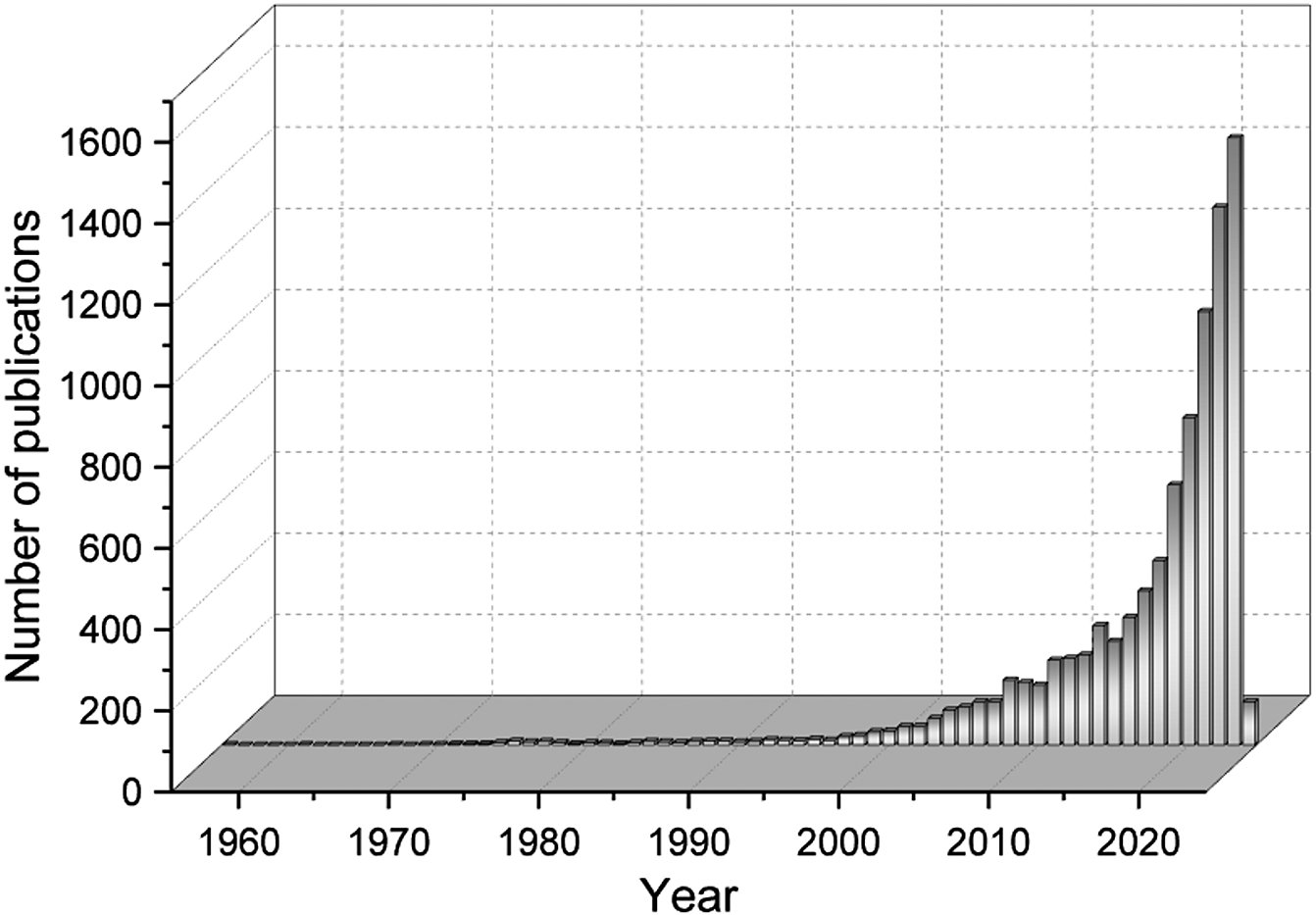
These compounds are the primary cause of plastics’ well-documented adverse effects on human and planetary well-being (Landrigan et al., Reference Landrigan, Raps, Cropper, Bald, Brunner, Canonizado, Charles, Chiles, Donohue, Enck, Fenichel, Fleming, Ferrier-Pages, Fordham, Gozt, Griffin, Hahn, Haryanto, Hixson, Ianelli, James, Kumar, Laborde, Law, Martin, Mu, Mulders, Mustapha, Niu, Pahl, Park, Pedrotti, Pitt, Ruchirawat, Seewoo, Spring, Stegeman, Suk, Symeonides, Takada, Thompson, Vicini, Wang, Whitman, Wirth, Wolff, Yousuf and Dunlop2023a). Literature has provided ample evidence of additives’ adverse effects on human health. A basic search in the Scopus database, using the terms (chemical additive* OR chemical* OR additive*) AND (plastic* OR polymer*) AND (human health), within the article title, abstract, and keywords, provided a total of 9,124 publications, ranging from 1956 to December 29, 2023 (Figure 2).
Number of publications per year about the effect of chemicals on human health.
Humanity is exposed to the leakage or migration of dangerous additives from production (mainly workers) to plastic disposal, reuse, or recycling. They are released and transferred to the environment and organisms (Walker, Reference Walker2022). In 2022, the president of UNEA 5 stated that chemicals connected to plastics were evidenced in his blood after having his blood drawn, including chemicals known to be harmful to humans (Tiller et al., Reference Tiller, Booth and Cowan2022).
Some hazardous additives are endocrine-disrupting chemicals (EDCs), such as bisphenols, brominated flame retardants, alkylphenol ethoxylates, perfluorinated compounds, phthalates, UV stabilizers and metals. EDCs may have harmful effects on the reproductive, metabolic, thyroid, immunological, and neurological systems (Flaws et al., Reference Flaws, Damdimopoulou, Patisaul, Gore, Raetzman and Vandenberg2020).
Furthermore, certain additives, such as pro-degrading agents, affect recycling by degrading the quality of the recycled materials. Using them, the chemical structure of fossil-based polymers is broken down more easily, producing molecules of lower molecular weight and inorganic particles that damage the environment and are not biodegradable. These additives can degrade the polymer matrix during the recycling process, thereby lowering the technical quality of the recycled materials (Hann et al., Reference Hann, Ettlinger, Gibbs and Hogg2016; European Commission, 2018).
Efforts to mitigate the dangers of plastics must focus on the potentially hazardous chemicals associated with plastics (Landrigan et al., Reference Landrigan, Raps, Cropper, Bald, Brunner, Canonizado, Charles, Chiles, Donohue, Enck, Fenichel, Fleming, Ferrier-Pages, Fordham, Gozt, Griffin, Hahn, Haryanto, Hixson, Ianelli, James, Kumar, Laborde, Law, Martin, Mu, Mulders, Mustapha, Niu, Pahl, Park, Pedrotti, Pitt, Ruchirawat, Seewoo, Spring, Stegeman, Suk, Symeonides, Takada, Thompson, Vicini, Wang, Whitman, Wirth, Wolff, Yousuf and Dunlop2023a). Thus, the issue of additives must be closely aligned with the Global Plastics Treaty and the subject included in the negotiations. According to Wang and Praetorius (Reference Wang and Praetorius2022), “to successfully end plastic pollution, holistic action is required to address chemicals present in plastics, including (1) reducing the complexity of chemicals in plastics, (2) ensuring the transparency of chemicals in plastics and (3) aligning the right incentives for a systematic transition.” In addition, further examination of chemical regulation and assessment of the necessity of additive use should also be considered (Maes et al., Reference Maes, Preston-Whyte, Lavelle, Gomiero, Booth, Belzunce-Segarra, Bellas, Brooks, Bakir, Devriese, Pham and De Witte2023): “Global leaders and policy mechanisms such as this are needed to support the development of National Action Plans (NAPs) on marine litter and plastic pollution, promoting universal bans of harmful substances, aligning chemicals of concern lists, agreeing to threshold limits for substances of concern in use, as well as aligning testing methods to evaluate the safety of substances and products.” Alternative choices that reduce risks to individuals and the environment should be encouraged, such as eco-friendly additives (Zanchet et al., Reference Zanchet, Garcia, Nunes, Crespo and Scuracchio2016, Reference Zanchet, de Sousa, Crespo and Scuracchio2018a, Reference Zanchet, Demori, de Sousa, Ornaghi Júnior, Schiavo and Scuracchio2018b). These additives can be derived from renewable sources or residues, optimizing their economic viability and making them sustainable additives.
Due to hazardous additives, the use of recycled plastics in specific applications (such as toys and food packaging) should be avoided (Geueke et al., Reference Geueke, Phelps, Parkinson and Muncke2023). Consequently, specific formulations are less likely to be recycled, contributing to plastic pollution. Reviewing additive use is therefore necessary to ensure that recycling and the use of recycled plastics are not compromised. The indiscriminate use of additives may also impact the circular economy, which is crucial for mitigating plastic pollution. Therefore, a comprehensive treaty must address every interconnected issue associated with plastic, as it is an integral component of the problem, including chemical hazards (Dey et al., Reference Dey, Trasande, Altman, Wang, Krieger, Bergmann, Allen, Allen, Walker, Wagner, Syberg, Brander and Almroth2022).
Greenhouse gases
Throughout their entire life cycle, from extraction to end-of-life, plastics emit GHG (Ford et al., Reference Ford, Jones, Davies, Godley, Jambeck, Napper, Suckling, Williams, Woodall and Koldewey2022). According to the authors (Ford et al., Reference Ford, Jones, Davies, Godley, Jambeck, Napper, Suckling, Williams, Woodall and Koldewey2022), the impact of plastic on climate change (measured in carbon-dioxide-equivalent, CO2e) can be classified into three distinct categories: (1) plastic production, transport, and use; (2) plastic disposal, mismanaged waste, and degradation; and (3) bio-based plastics.
The end-of-life of plastics contributes approximately 9% of the total GHG emitted over their lifetime (Zheng and Suh, Reference Zheng and Suh2019). This stage usually consists of three processes that produce different GHG emissions: incineration, landfill, and recycling (Ford et al., Reference Ford, Jones, Davies, Godley, Jambeck, Napper, Suckling, Williams, Woodall and Koldewey2022). Although recycling is sustainable, it is expensive, energy-intensive, and can produce low-quality plastics. It is possible to reduce GHG emissions by 77% when using only renewable energy (Zheng and Suh, Reference Zheng and Suh2019). Most common plastics (such as polyethylene) emit methane and ethylene during degradation when exposed to ambient solar radiation, producing direct and indirect GHG indefinitely. Polyethylene is the most common emitter of both gases (Royer et al., Reference Royer, Ferrón, Wilson and Karl2018). Concerning bio-based plastics, when improperly disposed of in the marine environment, biodegradable plastics pollute like fossil fuel plastics. Under these conditions, the degradation rate of polylactic acid (PLA) is equivalent to that of high-density polyethylene (HDPE) (Chamas et al., Reference Chamas, Moon, Zheng, Qiu, Tabassum, Jang, Abu-Omar, Scott and Suh2020). Therefore, it is necessary to be aware of plastic use and disposal, reducing its use whenever possible (de Sousa, Reference de Sousa2021a).
The process of plastic manufacturing requires a large amount of energy and has a substantial impact on climate change. Certain plastics use ozone-depleting substances (ODSs) and hydrofluorocarbons (HFC) as raw materials, most of which are potent GHG, contributing to climate change. It would be ideal to substitute these dangerous raw materials with more environmentally friendly alternatives (Andersen et al., Reference Andersen, Gao, Carvalho, Ferris, Gonzalez, Sherman, Wei and Zaelke2021).
Plastic production generates GHG emissions of 1.96 gigatons CO2e annually (Landrigan et al., Reference Landrigan, Raps, Cropper, Bald, Brunner, Canonizado, Charles, Chiles, Donohue, Enck, Fenichel, Fleming, Ferrier-Pages, Fordham, Gozt, Griffin, Hahn, Haryanto, Hixson, Ianelli, James, Kumar, Laborde, Law, Martin, Mu, Mulders, Mustapha, Niu, Pahl, Park, Pedrotti, Pitt, Ruchirawat, Seewoo, Spring, Stegeman, Suk, Symeonides, Takada, Thompson, Vicini, Wang, Whitman, Wirth, Wolff, Yousuf and Dunlop2023a). Plastic use is expected to nearly triple by 2060 (OECD, 2022). Consequently, GHG emissions from conventional plastics are expected to grow to 6.5 gigatons CO2e by 2050 (Zheng and Suh, Reference Zheng and Suh2019). Growing output means expanding effects on the environment across numerous planetary boundaries (Galán-Martín et al., Reference Galán-Martín, Tulus, Díaz, Pozo, Pérez-Ramírez and Guillén-Gosálbez2021).
Plastics are linked to 4.5% of GHG emissions worldwide during their life cycle (Cabernard et al., Reference Cabernard, Pfister, Oberschelp and Hellweg2021). Plastic manufacturing is responsible for approximately 3.7% of global GHG emissions. If the existing patterns persist without intervention, this proportion will rise to 4.5% by 2060 (Landrigan et al., Reference Landrigan, Raps, Cropper, Bald, Brunner, Canonizado, Charles, Chiles, Donohue, Enck, Fenichel, Fleming, Ferrier-Pages, Fordham, Gozt, Griffin, Hahn, Haryanto, Hixson, Ianelli, James, Kumar, Laborde, Law, Martin, Mu, Mulders, Mustapha, Niu, Pahl, Park, Pedrotti, Pitt, Ruchirawat, Seewoo, Spring, Stegeman, Suk, Symeonides, Takada, Thompson, Vicini, Wang, Whitman, Wirth, Wolff, Yousuf and Dunlop2023a). While it is an important signal and supportive force for change, compensating for GHG emissions during the manufacturing phase is insufficient to change how fossil fuels are used (Bauer et al., Reference Bauer, Holmberg, Nilsson, Palm and Stripple2020).
Microplastics
There is an urgent need for global action and solutions because an estimated 170 trillion plastic particles, mainly MPs, float in all of the world’s oceans (Eriksen et al., Reference Eriksen, Cowger, Erdle, Coffin, Villarrubia-Gómez, Moore, Carpenter, Day, Thiel and Wilcox2023).
The primary contributors to MP contamination are the laundering of synthetic clothes (such as polyester and nylon) and wear of tires on roads. Approximately 55% of all textile fibers are made of polyester (more than twice that of cotton fiber), which is the largest source of MP contamination from clothing (TextileExchange, 2016). Another notable cause of pollution is small fragments of plastic generated by urban activities (“city dust”), such as the wear and tear of running shoes and artificial turf (Boucher and Friot, Reference Boucher and Friot2017).
Humans are exposed to MPs mainly through food, but also through dermal contact and inhalation. Research has confirmed that the ingestion of MPs by humans leads to many harmful consequences, primarily associated with diverse forms of inflammation (Prata et al., Reference Prata, da Costa, Lopes, Duarte and Rocha-Santos2020; Xu et al., Reference Xu, Ma, Han and Chen2021; Yang et al., Reference Yang, Cheng, Chen, Liu, Yin, Pu and Liang2021; Zhao et al., Reference Zhao, Shi, Hu, Song, Cheng and Zhou2021; Zheng et al., Reference Zheng, Wang, Wei, Chang and Liu2021; Huang et al., Reference Huang, Zhang, Long, Yang, Bao, Yang, Wu, Si, Zhao, Peng, Wang and Yan2022, Reference Huang, Weng, Shen, Zhao and Jin2021; Junaid et al., Reference Junaid, Siddiqui, Sadaf, Liu and Wang2022; Liu et al., Reference Liu, Li, Wang, Wu and Guo2022; Nikolic et al., Reference Nikolic, Gazdic-Jankovic, Rosic, Miletic-Kovacevic, Jovicic, Nestorovic, Stojkovic, Filipovic, Milosevic-Djordjevic, Selakovic, Zivanovic, Seklic, Milivojević, Markovic, Seist, Vasilijic, Stankovic, Stojkovic and Ljujic2022; Rawle et al., Reference Rawle, Dumenil, Tang, Bishop, Yan, Le and Suhrbier2022; Tong et al., Reference Tong, Li, Li, Li, Zhang, Du and Zhang2022; Weber et al., Reference Weber, Schwiebs, Solhaug, Stenvik, Nilsen, Wagner, Relja and Radeke2022; Yuan et al., Reference Yuan, Nag and Cummins2022).
The Global Plastics Treaty must establish criteria for recyclability and classify MP as hazardous chemicals. It should promote evidence-based scientific decision-making and enforce obligatory regulations for reporting and sharing information (Dauvergne, Reference Dauvergne2023b).
Effects of plastic pollution in the Arctic
The literature is of specific concern regarding the effects of plastic pollution in the Arctic (Meyer et al., Reference Meyer, Lutz and Bergmann2023; Prior and Seck, Reference Prior and Seck2023; Cowan et al., Reference Cowan, Setsaas and Nørstebø2023a).
Despite its remote location, the Arctic is still affected by several types of pollution caused by human activities, such as persistent organic pollutants (POPs), carbon black, mercury and plastics, which affect its fragile ecosystems (Meyer et al., Reference Meyer, Lutz and Bergmann2023; Cowan et al., Reference Cowan, Setsaas and Nørstebø2023a). For instance, some authors (Meyer et al., Reference Meyer, Lutz and Bergmann2023) analyzed plastic debris from 14 remote Arctic beaches on the Spitsbergen archipelago and found plastic residues from all parts of the globe. Plastic pollution sources have local and global origins, moving northward through ocean currents, rivers, and winds.
These pollutants can substantially affect the Arctic ecosystems and their inhabitants. Therefore, pollution has been a critical focus of Arctic environmental governance since the 1990s (Prior and Seck, Reference Prior and Seck2023). The Arctic Ocean has one of the most significant concentrations of surface microparticles worldwide (Barrows et al., Reference Barrows, Cathey and Petersen2018).
Ships operating in the Arctic experience more prolonged periods of operation and expand their range further north because of global warming, including a decrease in sea ice extent and shorter periods of sea ice covering (Meyer et al., Reference Meyer, Lutz and Bergmann2023). Ships substantially contribute to the spread of plastic waste in the Earth’s waters (Kurniaty et al., Reference Kurniaty, Widagdo, Madjid, Kharji and Putri2023).
According to Osmundsen (Reference Osmundsen2023), the definition and characterization of port reception facilities (PRFs) in global agreements must be revised and more precise. It is an essential component of global legal and policy frameworks that focuses on preventing plastic waste discharge from ships to marine ecosystem. Additionally, the current direct fee procedure may not encourage ship operators to properly dispose of waste. The implementation of indirect cost regulations for waste disposal at ports, along with enhanced law enforcement, can encourage the adoption of appropriate waste management procedures (Kurniaty et al., Reference Kurniaty, Widagdo, Madjid, Kharji and Putri2023). All of these measures will help reduce plastic pollution in the Arctic (Osmundsen, Reference Osmundsen2023).
Human rights
Literature (O’Meara, Reference O’Meara2023a) argues for including a human rights perspective in the draft Global Plastics Treaty, especially by emphasizing the right to health and a healthy environment.
Numerous developed nations continue to export their plastic waste to low-income countries, especially countries in the Global South, tiny island nations, and marginalized regions in the Global North (Landrigan et al., Reference Landrigan, Symeonides, Raps and Dunlop2023b). Because of inadequate waste management in many of these areas, mainly the most vulnerable communities are exposed to plastic pollution and its consequences. The groups most severely impacted by the negative implications of plastics and plastic pollution are poor, disempowered, and marginalized populations, including workers, racial and ethnic minorities, “fenceline” communities, Indigenous groups, women, and children. These groups, which had minimal involvement in causing the current plastics crisis, need more political influence and resources to tackle this issue effectively (Landrigan et al., Reference Landrigan, Raps, Cropper, Bald, Brunner, Canonizado, Charles, Chiles, Donohue, Enck, Fenichel, Fleming, Ferrier-Pages, Fordham, Gozt, Griffin, Hahn, Haryanto, Hixson, Ianelli, James, Kumar, Laborde, Law, Martin, Mu, Mulders, Mustapha, Niu, Pahl, Park, Pedrotti, Pitt, Ruchirawat, Seewoo, Spring, Stegeman, Suk, Symeonides, Takada, Thompson, Vicini, Wang, Whitman, Wirth, Wolff, Yousuf and Dunlop2023a). In addition, the gender dimension must be considered as well. According to some authors (Prior and Seck, Reference Prior and Seck2023), focusing a higher priority on the gender dimension of plastic pollution can provide valuable insights to guide policy decisions addressing plastic pollution worldwide.
The social and environmental justice (SEJ) principles must reverse these unfair burdens, ensuring that no particular group bears an excessive proportion of the negative consequences of plastics. In addition, those who profit economically from plastic should bear an equitable number of expenses currently not accounted for (Landrigan et al., Reference Landrigan, Raps, Cropper, Bald, Brunner, Canonizado, Charles, Chiles, Donohue, Enck, Fenichel, Fleming, Ferrier-Pages, Fordham, Gozt, Griffin, Hahn, Haryanto, Hixson, Ianelli, James, Kumar, Laborde, Law, Martin, Mu, Mulders, Mustapha, Niu, Pahl, Park, Pedrotti, Pitt, Ruchirawat, Seewoo, Spring, Stegeman, Suk, Symeonides, Takada, Thompson, Vicini, Wang, Whitman, Wirth, Wolff, Yousuf and Dunlop2023a). The economic advantages of plastic are rarely used to lessen or minimize the health risks it causes, which widens the gap between those who gain and those who suffer (Karasik et al., Reference Karasik, Lauer, Baker, Lisi, Somarelli, Eward, Fürst and Dunphy-Daly2023).
Combating plastic pollution, axcelerating climate action, protecting ocean ecosystems, and protecting human rights would all be facilitated by incorporating human rights considerations through a precautionary and preventative approach, transferring responsibility to polluters, and expressing concern for intergenerational equal rights (O’Meara, Reference O’Meara2023a).
Economy
The plastics, chemicals, and fossil fuel sectors are closely connected (Tilsted et al., Reference Tilsted, Bauer, Deere Birkbeck, Skovgaard and Rootzén2023). The contribution of these groups amplifies the expenses associated with plastic pollution.
The minimum economic costs attributed to plastic pollution in the marine environment alone were estimated to range from US$3,300 to US$33,000 per year, encompassing expenses related to clean-up efforts and the decline in tourism. However, this estimation does not consider the valuation of impacts on human health or the deterioration of marine ecosystem services (Beaumont et al., Reference Beaumont, Aanesen, Austen, Börger, Clark, Cole, Hooper, Lindeque, Pascoe and Wyles2019). Approximately US$100 billion is spent annually on the socioeconomic consequences of plastic waste worldwide (UNEP and Minderoo Foundation, 2022).
The adverse effects of plastic on human health lead to substantial economic costs. In 2015, global health-related expenses associated with plastic manufacturing were predicted to surpass US$250 billion. In the United States, the costs of disease and disability caused by plastic-related chemicals exceeded US$920 billion. Over 85,000 premature deaths each year, 1.5 million occurrences of cardiovascular disease, and US$675 billion in medical expenses are attributed to chemicals that leach out of plastic and plastic waste in the USA (Landrigan et al., Reference Landrigan, Symeonides, Raps and Dunlop2023b).
New plastic business models should ideally address economic and social sustainability through methods that support capacity building, R&I, and the formation of new profitable companies and new jobs (Tang, Reference Tang2023). As an example of accomplishment, Spanish tuna freezer companies use end-of-life fishing nets as a raw material to produce textile items (Andrés et al., Reference Andrés, Zudaire, Larreta, Asueta, González, Molist, Uribesalgo and Basurko2022). In addition, companies should strive to adopt more sustainable practices in their operations.
To tackle the global plastic life cycle effectively, involving the industry in the negotiations is crucial. This will allow industry actors to be part of the process of creating commitments right from the beginning. The active participation of the plastic and chemical sectors should serve as a crucial foundation for the new instrument. However, it is essential to carefully consider the sector’s involvement concerning the interests of other stakeholders, such as non-governmental organizations (Stöfen-O’brien, Reference Stöfen-O’brien2022). “Because domestic structures and actors play a critical role in the negotiators’ decision to join or reject an agreement, relevant stakeholders must be involved in the negotiation process, including the private sector, non-profit organizations, and academia” (Tessnow-von Wysocki and Le Billon, Reference Tessnow-von Wysocki and Le Billon2019).
Package industries must adopt ‘Design for Recycling Guidelines’ to encourage multiple recycling cycles (Wang and Praetorius, Reference Wang and Praetorius2022). As an example, the European PET Bottle Platform (EPBP) has recently created a set of design guidelines that focus on improving the recyclability of food-grade opaque white PET (polyethylene terephthalate) bottles (Recycling Magazine, 2023). Nevertheless, the current situation, in which virgin fossil feedstocks like naphtha and ethane are so inexpensive, makes it extremely difficult for alternatives like bio-based or recycled feedstocks and materials to compete with virgin fossil ones. While not all plastic is recyclable, the failure to recycle recyclable plastic results in substantial losses. Nevertheless, a viable economic case for alternatives is required (Bauer et al., Reference Bauer, Holmberg, Nilsson, Palm and Stripple2020).
For industries, the most challenging topic will be the limitations of plastic production. The scientific community is very clear about this: a global cap on plastic production should be a core provision of the treaty (Simon et al., Reference Simon, Raubenheimer, Urho, Unger, Azoulay, Farrelly, Sousa, van Asselt, Carlini, Sekomo, Schulte, Busch, Wienrich and Weiand2021; Bergmann et al., Reference Bergmann, Almroth, Brander, Dey, Green, Gundogdu, Krieger, Wagner and Walker2022; Walker, Reference Walker2023; Landrigan et al., Reference Landrigan, Raps, Cropper, Bald, Brunner, Canonizado, Charles, Chiles, Donohue, Enck, Fenichel, Fleming, Ferrier-Pages, Fordham, Gozt, Griffin, Hahn, Haryanto, Hixson, Ianelli, James, Kumar, Laborde, Law, Martin, Mu, Mulders, Mustapha, Niu, Pahl, Park, Pedrotti, Pitt, Ruchirawat, Seewoo, Spring, Stegeman, Suk, Symeonides, Takada, Thompson, Vicini, Wang, Whitman, Wirth, Wolff, Yousuf and Dunlop2023a, Reference Landrigan, Symeonides, Raps and Dunlop2023b). In addition, determining which categories of polymers fall within the instrument’s scope will represent an additional complex topic. Considering the extensive range of plastics, which includes 4,000 distinct compounds used alone in plastic packaging and over 5,300 commercially accessible polymer formulations, determining the material reach of this instrument is crucial (Groh et al., Reference Groh, Backhaus, Carney-Almroth, Geueke, Inostroza, Lennquist, Leslie, Maffini, Slunge, Trasande, Warhurst and Muncke2019). Other difficult points will be: which plastic industry sectors will be involved? Will E-waste plastics be involved? Will the petrochemical sector be involved? And how about ships and ports?
With over 50 member nations, the High Ambition Coalition on Plastic Pollution has highlighted the need for legally-binding commitments. Meanwhile, those involved in the plastic and petrochemical industries, with different interests, persist in advocating postures that restrict the treaty’s scope (Tilsted et al., Reference Tilsted, Bauer, Deere Birkbeck, Skovgaard and Rootzén2023).
Fossil fuel-based plastics business interests and strong power hierarchies are at odds in the relationship between fossil fuels and plastics (Tilsted et al., Reference Tilsted, Bauer, Deere Birkbeck, Skovgaard and Rootzén2023). The recent COP28 meeting in Dubai, the 28th UN Climate Change Conference (the official name for Climate Conferences of the Parties), made the economic effects of fossil fuels very clear. With respect to the imperative to phase out fossil fuels to constrain global warming within 1.5°C, the President Sultan Al Jaber of COP28 argued against the validity of such measures, positing a dearth of scientific support and cautioning against their implementation due to potential impediments to sustainable development, unless one intends to regress society to a primitive state reminiscent of “taking the world back into caves.” The COP28 president also controls the state oil company of the United Arab Emirates (Carrington and Stockton, Reference Carrington and Stockton2023). Nevertheless, the COP28 can be considered a triumph as it was the inaugural historical event to tackle the issue of fossil fuels and their effects on climate change. An open debate occurred, and a resolution was adopted. The COP28 was the inaugural effort in the history of COPs to limit the usage of fossil fuels.
Another economic issue is the equity and sharing of abatement costs in forming international environmental agreements (Börger et al., Reference Börger, Hanley, Johnston and de Vries2023). This issue refers to the expenses associated with achieving international environmental agreements’ objectives, which are not always uniformly distributed among the participating nations. Additional considerations, such as politics, may influence the decision to contribute to cost-sharing.
International legislation and governance
Literature (Carratta and Jaeckel, Reference Carratta and Jaeckel2023) indicates that it is crucial to coordinate several governmental levels: International law, regional legislation, and measures at the national and local levels. The authors cite numerous significant environmental laws. A concise discussion will be provided on the legislation that established the core of the literature for the Global Plastics Treaty, with a particular emphasis on international laws.
International legislation
According to Dauvergne (Reference Dauvergne2023b), five particular principles of justice must guide the formulation and implementation of the Global Plastics Treaty:
-
(1) Distributive justice: Negotiators, policymakers, and implementors must prioritize distributive justice, considering the compelling evidence that plastic pollution is causing disproportionate harm to vulnerable populations, mainly in developing nations;
-
(2) Procedural justice: implementing the principles of procedural justice, guaranteeing the active and meaningful participation of Indigenous and marginalized populations;
-
(3) Justice across all governance levels and scales: at all levels of government, aim for environmental justice by rejecting policies, incentives, and market mechanisms that worsen social injustices or violate human rights;
-
(4) Corporate controls, transparency, and accountability: implementing stringent regulatory measures, such as trade and investment limitations, is necessary to improve corporate transparency and accountability regarding plastic pollution and environmental injustices;
-
(5) Justice-oriented financial and technical assistance: offering technical and financial support to shift disadvantaged communities towards an environmentally friendly global plastics economy. This approach aims to prevent additional financial burden on low-income countries while holding high polluting and economically capable countries responsible.
Additionally, the literature emphasizes the importance of considering existing agreements during INC meetings (Senathirajah et al., Reference Senathirajah, Bonner, Schuyler and Palanisami2023), since adjusting current legal instruments is just as important as creating a new treaty specifically for plastic pollution (Börger et al., Reference Börger, Hanley, Johnston and de Vries2023). Several international instruments are mentioned, such as Montreal Protocol on Substances that Deplete the Ozone Layer (Montreal Protocol) (Tessnow-von Wysocki and Le Billon, Reference Tessnow-von Wysocki and Le Billon2019; Kirk, Reference Kirk2020; Andersen et al., Reference Andersen, Gao, Carvalho, Ferris, Gonzalez, Sherman, Wei and Zaelke2021; Grabiel et al., Reference Grabiel, Gammage, Perry and Dixon2022), Kyoto Protocol (Tessnow-von Wysocki and Le Billon, Reference Tessnow-von Wysocki and Le Billon2019; Tang, Reference Tang2023), International Convention for the Prevention of Pollution from Ships, commonly referred to as MARPOL Annex V (Stöfen-O’brien, Reference Stöfen-O’brien2022; Kurniaty et al., Reference Kurniaty, Widagdo, Madjid, Kharji and Putri2023; Prior and Seck, Reference Prior and Seck2023; Cowan et al., Reference Cowan, Tiller, Oftebro, Throne-Holst and Normann2023b), Paris Agreement (Kirk, Reference Kirk2020; Tang, Reference Tang2023; Cowan et al., Reference Cowan, Tiller, Oftebro, Throne-Holst and Normann2023b), the United Nations Convention on the Law Of the Sea (UNCLOS) (Ortuño Crespo et al., Reference Ortuño Crespo, Mossop, Dunn and Halpin2020; Telesetsky, Reference Telesetsky2021; Kurniaty et al., Reference Kurniaty, Widagdo, Madjid, Kharji and Putri2023), Basel Convention (Khan, Reference Khan2020; Carratta and Jaeckel, Reference Carratta and Jaeckel2023; Prior and Seck, Reference Prior and Seck2023), the treaty on the Protection of Biodiversity in areas Beyond National Jurisdiction (BBNJ) (Tiller and Nyman, Reference Tiller and Nyman2018), Declaration on the Human Environment (the Stockholm Declaration) (Carratta and Jaeckel, Reference Carratta and Jaeckel2023; Kurniaty et al., Reference Kurniaty, Widagdo, Madjid, Kharji and Putri2023; Prior and Seck, Reference Prior and Seck2023), World Charter for Nature (Kurniaty et al., Reference Kurniaty, Widagdo, Madjid, Kharji and Putri2023), Washington Declaration on the Protection of the Marine Environment from Land-based activities (Kurniaty et al., Reference Kurniaty, Widagdo, Madjid, Kharji and Putri2023), Rio Declaration (Kurniaty et al., Reference Kurniaty, Widagdo, Madjid, Kharji and Putri2023), the United Nations Convention on the Law of the Sea (Kurniaty et al., Reference Kurniaty, Widagdo, Madjid, Kharji and Putri2023), Convention of the Protection of the Marine Environment of the Northeast Atlantic (Kurniaty et al., Reference Kurniaty, Widagdo, Madjid, Kharji and Putri2023), Protocol to the Convention on the Prevention of Marine Pollution by Dumping and other matter (Kurniaty et al., Reference Kurniaty, Widagdo, Madjid, Kharji and Putri2023), Honolulu Strategy (Kurniaty et al., Reference Kurniaty, Widagdo, Madjid, Kharji and Putri2023), Rotterdam Convention (Carratta and Jaeckel, Reference Carratta and Jaeckel2023), and the United Nations Framework Convention on Climate Change (UNFCCC) (Tang, Reference Tang2023).
In UNEA Resolution 5/14, some international conventions are also cited: the International Convention for the Prevention of Pollution from Ships of 1973, Basel Convention on the Control of Transboundary Movements of Hazardous Wastes and Their Disposal, Rotterdam Convention on the Prior Informed Consent Procedure for specific Hazardous Chemicals and Pesticides in International Trade, Stockholm Convention on Persistent Organic Pollutants, United Nations Convention on the Law of the Sea, Convention on the Prevention of Marine Pollution by Dumping of Wastes and Other Matters of 1972, Strategic Approach to International Chemicals Management, United Nations Framework Convention on Climate Change, Convention on Biological Diversity (United Nations Environment Programme, 2022b), among others.
During the Global Plastics Treaty negotiations, it is crucial to consider current legislation. The various rights and wrongs of this legislation have been extensively discussed in the literature. Some examples are as follows.
According to Tang (Reference Tang2023), “learning from the shortcomings of the Kyoto Protocol and Paris Agreement, the international treaties for the plastic economy could push for more ambitious goals progressively and garner more active participation from the developing countries, which are also major plastic producers and consumers.”
“Almost 40 years after the creation of the UNCLOS, we have a second opportunity as a global community to better address the conservation of living resources and the study, protection, and preservation of the marine environment beyond national boundaries” (Ortuño Crespo et al., Reference Ortuño Crespo, Mossop, Dunn and Halpin2020).
“While amending UNCLOS might be considered politically impractical, even a rudimentary conversation on amending the treaty would provide much-needed political focus on critical ocean topics where there are present governance gaps” (Telesetsky, Reference Telesetsky2021).
Literature suggests that the problem of plastic pollution should be considered through the lens of disaster risk reduction. This is especially true when implementing the precautionary principle in many international legal instruments. The Paris Agreement guidelines could be used to lead the Global Plastics Treaty, driven by national action plans, the potential to offset, and mandatory reporting requirements (Senathirajah et al., Reference Senathirajah, Bonner, Schuyler and Palanisami2023).
The literature also discusses the power and importance of activism in governing plastics (Dauvergne, Reference Dauvergne2023a). This involves implementing laws governing single-use plastics, funding waste infrastructure, expanding recycling initiatives, and developing policies to promote circular economies for plastics; media influencers alerting people about the adverse health and environmental effects of burning, disposing of, and littering plastics; community organizations campaigning for government legislation prohibiting the manufacturing, use, and import of “harmful” plastics; and a host of other initiatives (Dauvergne, Reference Dauvergne2023a). Each person’s involvement is crucial in combating plastic pollution.
Some authors (Carratta and Jaeckel, Reference Carratta and Jaeckel2023) analyzed the shortcomings of international environmental law at every stage of the plastic life cycle, indicated possible revisions, and also the crucial elements that the forthcoming plastic treaty should focus on. “The upcoming plastic treaty can offer a more comprehensive regulation of plastic pollution. It should promote sustainable production and consumption of plastic items, improve waste treatment systems, and encourage effective domestic plastic waste management. Furthermore, the treaty should address environmental protection strategies and the impact of MPs and other small plastic particles on a wider range of ecosystems” (Carratta and Jaeckel, Reference Carratta and Jaeckel2023).
Some authors call for a reevaluation of the involvement of non-state actors to facilitate more accessible access to meaningful participation in the design, negotiation, and subsequent implementation of the proposed Global Plastics Treaty and to create more opportunities for such participation (Akrofi et al., Reference Akrofi, Shang and Ciesielczuk2022). Furthermore, the plastic treaty under consideration might serve as the initial multilateral environmental accord to implement Principle 10 of the Rio Declaration. This principle delineates the following fundamental elements of environmental democracy: access to information, participation in decision-making processes concerning environmental matters, and access to justice on environmental issues.
Furthermore, INC must include representatives of these groups in the treaty negotiation and implementation processes to ensure that the agreement is fair and protects the health and human rights of vulnerable populations, including but not limited to children, pregnant women, waste pickers, individuals residing in fenceline communities adjacent to plastic industries, Indigenous populations and others (Landrigan et al., Reference Landrigan, Symeonides, Raps and Dunlop2023b).
Some authors have questioned whether existing regulations, such as the Montreal Protocol or the Paris Agreement, can work as examples for the new Global Plastics Treaty (Kirk, Reference Kirk2020). Other authors, motivated by the Montreal Protocol, provided evidence for and advantages of a gradual approach to international regulation of virgin plastic production and consumption (Grabiel et al., Reference Grabiel, Gammage, Perry and Dixon2022). Literature (Denta, Reference Denta2022) proposed that regulatory measures alone are insufficient to address plastic pollution.
Agreements have been established to deal with marine litter, including the London Convention and Protocol and MARPOL Annex V (Xanthos and Walker, Reference Xanthos and Walker2017). Despite their existence, establishing a new international treaty on plastics is considered necessary. Why is this so? Is the plastic “frightening enough” (Tiller and Nyman, Reference Tiller and Nyman2018) to be inserted into other current regulations? Nevertheless, “do we have time to wait for the international community to come together to ratify a treaty text on this, with the required years of negotiations in between?” (Tiller and Nyman, Reference Tiller and Nyman2018).
However, according to some experts, “there is no space for choosing between amending the existing legal instruments and adopting a new one. To regulate the full life cycle of plastics on a global scale, the two strategies should coexist and support each other” (Carratta and Jaeckel, Reference Carratta and Jaeckel2023). According to some authors (Carratta and Jaeckel, Reference Carratta and Jaeckel2023), the Global Plastics Treaty will be the first international environmental agreement to encompass all the stages of the plastics’ life cycle. Other environmental accords emphasize particular phases of the plastics’ life cycle, such as the Stockholm and Rotterdam Conventions (which indirectly address the production and manufacturing phases) and the Basel Convention, which primarily addresses the waste management stage.
To effectively regulate and reduce marine plastic pollution, legal regulations and policies under international water law and marine environmental law must align and coordinate with each other (Finska and Howden, Reference Finska and Howden2018). The successful implementation of the Global Plastics Treaty necessitates coordinating and supplementing international efforts with national, regional, and local interventions (Landrigan et al., Reference Landrigan, Raps, Cropper, Bald, Brunner, Canonizado, Charles, Chiles, Donohue, Enck, Fenichel, Fleming, Ferrier-Pages, Fordham, Gozt, Griffin, Hahn, Haryanto, Hixson, Ianelli, James, Kumar, Laborde, Law, Martin, Mu, Mulders, Mustapha, Niu, Pahl, Park, Pedrotti, Pitt, Ruchirawat, Seewoo, Spring, Stegeman, Suk, Symeonides, Takada, Thompson, Vicini, Wang, Whitman, Wirth, Wolff, Yousuf and Dunlop2023a). This can be a strategy to mitigate pollution in international watercourses and oceans (Finska and Howden, Reference Finska and Howden2018). Production controls are a prerequisite for achieving sustainable production and consumption of virgin plastic polymers (Grabiel et al., Reference Grabiel, Gammage, Perry and Dixon2022). Novel and alternative solutions are also necessary (Denta, Reference Denta2022).
Governance
A comprehensive definition of governance is the direction that public and private authorities give to actions. This includes state laws, business codes of conduct, international organizations, non-profit standards, and social conventions regarding what is right and wrong (Dauvergne, Reference Dauvergne2018). Concerning plastics, the wide range of pollution sources makes global governance challenging (Dauvergne, Reference Dauvergne2018).
Based on some authors (Bauer et al., Reference Bauer, Holmberg, Nilsson, Palm and Stripple2020), plastic governance should have an accurate focus. Governance frameworks regarding plastics and plastic pollution have traditionally concentrated on the challenges of improving recycling (Nielsen et al., Reference Nielsen, Hasselbalch, Holmberg and Stripple2020) and waste management (Bauer et al., Reference Bauer, Holmberg, Nilsson, Palm and Stripple2020; Nielsen et al., Reference Nielsen, Hasselbalch, Holmberg and Stripple2020). The governance panorama reflects industry efforts to oppose government regulation, transfer responsibility, and silence criticism. It also represents industry support for corporate self-regulation and consumer responsibility as basic governance concepts (Dauvergne, Reference Dauvergne2018). The absence of an integrated understanding of plastic pollution has fostered a fragmented decision-making process at all levels of governance (Carratta and Jaeckel, Reference Carratta and Jaeckel2023). Bottom-up governance of industries has become less effective globally, partly because the industry may need to take advantage of the fragmentation of authority to avoid responsibility, limit the scope of reforms, and create loopholes (Dauvergne, Reference Dauvergne2018). “While recognizing the severity of plastic pollution, the industry does not point the finger at plastics per se, especially single-use plastic, but rephrases the narratives by steering attention to plastic waste” (Akrofi et al., Reference Akrofi, Shang and Ciesielczuk2022). Implementing a globally binding method could effectively address certain obstacles in the governance of marine plastics (Tessnow-von Wysocki and Le Billon, Reference Tessnow-von Wysocki and Le Billon2019).
Nevertheless, many crucial elements need to be considered, including the dependency on fossil fuels, the climate impact of plastics, the fundamental political and economic dynamics of the petrochemical sector, and the long-term trajectory of conventional plastics (Bauer et al., Reference Bauer, Holmberg, Nilsson, Palm and Stripple2020). A robust global governance agreement to address all sources of plastic pollution still needs to be reached (Walker, Reference Walker2022). The management of oceans needs to be improved to safeguard marine biodiversity at a worldwide level (Dauvergne, Reference Dauvergne2018). The plastic industry must take responsibility for the damage to society and the environment that has resulted from its selfish nature and profit policies.
Other important remarks
As stated in this manuscript, the literature focuses on contributing to the ongoing negotiations on the Global Plastics Treaty. The authors proposed the following recommendations to be included in the negotiations and final treaty (some of which had previously been discussed):
(a) MPs (Stöfen-O’brien, Reference Stöfen-O’brien2022; Ambrose and Walker, Reference Ambrose and Walker2023; Eriksen et al., Reference Eriksen, Cowger, Erdle, Coffin, Villarrubia-Gómez, Moore, Carpenter, Day, Thiel and Wilcox2023; Landrigan et al., Reference Landrigan, Raps, Cropper, Bald, Brunner, Canonizado, Charles, Chiles, Donohue, Enck, Fenichel, Fleming, Ferrier-Pages, Fordham, Gozt, Griffin, Hahn, Haryanto, Hixson, Ianelli, James, Kumar, Laborde, Law, Martin, Mu, Mulders, Mustapha, Niu, Pahl, Park, Pedrotti, Pitt, Ruchirawat, Seewoo, Spring, Stegeman, Suk, Symeonides, Takada, Thompson, Vicini, Wang, Whitman, Wirth, Wolff, Yousuf and Dunlop2023a, Reference Landrigan, Symeonides, Raps and Dunlop2023b);
(b) Chemicals incorporated in plastics (Dey et al., Reference Dey, Trasande, Altman, Wang, Krieger, Bergmann, Allen, Allen, Walker, Wagner, Syberg, Brander and Almroth2022; Grabiel et al., Reference Grabiel, Gammage, Perry and Dixon2022; Stöfen-O’brien, Reference Stöfen-O’brien2022; Wang and Praetorius, Reference Wang and Praetorius2022; Filella and Turner, Reference Filella and Turner2023; Kurniaty et al., Reference Kurniaty, Widagdo, Madjid, Kharji and Putri2023; Maes et al., Reference Maes, Preston-Whyte, Lavelle, Gomiero, Booth, Belzunce-Segarra, Bellas, Brooks, Bakir, Devriese, Pham and De Witte2023; Tilsted et al., Reference Tilsted, Bauer, Deere Birkbeck, Skovgaard and Rootzén2023; Wang et al., Reference Wang, Carlini and Wang2023; Landrigan et al., Reference Landrigan, Raps, Cropper, Bald, Brunner, Canonizado, Charles, Chiles, Donohue, Enck, Fenichel, Fleming, Ferrier-Pages, Fordham, Gozt, Griffin, Hahn, Haryanto, Hixson, Ianelli, James, Kumar, Laborde, Law, Martin, Mu, Mulders, Mustapha, Niu, Pahl, Park, Pedrotti, Pitt, Ruchirawat, Seewoo, Spring, Stegeman, Suk, Symeonides, Takada, Thompson, Vicini, Wang, Whitman, Wirth, Wolff, Yousuf and Dunlop2023a, Reference Landrigan, Symeonides, Raps and Dunlop2023b);
(c) Decrease the chemical complexity of plastic products, establish health-protective criteria for plastics and plastic additives, mandate sustainable, non-toxic materials, ensure full disclosure of all components, and implement traceability of components. International collaboration will be crucial for the implementation and enforcement of these standards (Grabiel et al., Reference Grabiel, Gammage, Perry and Dixon2022; Wang and Praetorius, Reference Wang and Praetorius2022; Maes et al., Reference Maes, Preston-Whyte, Lavelle, Gomiero, Booth, Belzunce-Segarra, Bellas, Brooks, Bakir, Devriese, Pham and De Witte2023; Tilsted et al., Reference Tilsted, Bauer, Deere Birkbeck, Skovgaard and Rootzén2023; Landrigan et al., Reference Landrigan, Raps, Cropper, Bald, Brunner, Canonizado, Charles, Chiles, Donohue, Enck, Fenichel, Fleming, Ferrier-Pages, Fordham, Gozt, Griffin, Hahn, Haryanto, Hixson, Ianelli, James, Kumar, Laborde, Law, Martin, Mu, Mulders, Mustapha, Niu, Pahl, Park, Pedrotti, Pitt, Ruchirawat, Seewoo, Spring, Stegeman, Suk, Symeonides, Takada, Thompson, Vicini, Wang, Whitman, Wirth, Wolff, Yousuf and Dunlop2023a, Reference Landrigan, Symeonides, Raps and Dunlop2023b). Moreover, a broader definition of plastics as a substance composed of chemicals would be employed to govern the usage and disposal of plastic additives by law (Maes et al., Reference Maes, Preston-Whyte, Lavelle, Gomiero, Booth, Belzunce-Segarra, Bellas, Brooks, Bakir, Devriese, Pham and De Witte2023);
(d) Attribute the PBT criteria to plastics (i.e., be classified as a persistent, bioaccumulative, and toxic (PBT) pollutant) under the precautionary principle (Alava et al., Reference Alava, Jahnke, Bergmann, Aguirre-Martínez, Bendell, Calle, Domínguez, Faustman, Falman, Kazmiruk, Klasios, Maldonado, McMullen, Moreno-Báez, Öberg, Ota, Price, Shim, Tirapé, Vandenberg, Zoveidadianpour and Weis2023);
(e) A clause that prohibits or significantly limits the production and use of superfluous, preventable, and troublesome plastic products, particularly single-use and synthetic microbeads (Andersen et al., Reference Andersen, Gao, Carvalho, Ferris, Gonzalez, Sherman, Wei and Zaelke2021; Grabiel et al., Reference Grabiel, Gammage, Perry and Dixon2022; Smith et al., Reference Smith, Singh and Sherman2023; Tilsted et al., Reference Tilsted, Bauer, Deere Birkbeck, Skovgaard and Rootzén2023; Landrigan et al., Reference Landrigan, Raps, Cropper, Bald, Brunner, Canonizado, Charles, Chiles, Donohue, Enck, Fenichel, Fleming, Ferrier-Pages, Fordham, Gozt, Griffin, Hahn, Haryanto, Hixson, Ianelli, James, Kumar, Laborde, Law, Martin, Mu, Mulders, Mustapha, Niu, Pahl, Park, Pedrotti, Pitt, Ruchirawat, Seewoo, Spring, Stegeman, Suk, Symeonides, Takada, Thompson, Vicini, Wang, Whitman, Wirth, Wolff, Yousuf and Dunlop2023a);
(f) Taxation of virgin plastic pellets (Bauer et al., Reference Bauer, Holmberg, Nilsson, Palm and Stripple2020);
(g) Quotas for recycled and biobased feedstocks in newly manufactured plastic goods (Bauer et al., Reference Bauer, Holmberg, Nilsson, Palm and Stripple2020);
(h) Recognize and encourage mass-balance techniques in primary production that incorporate recycled and biobased feedstocks, with a growing minimum percentage of these inputs to promote progressive transformation (Bauer et al., Reference Bauer, Holmberg, Nilsson, Palm and Stripple2020);
(i) Regulations about extended producer responsibility (EPR), which hold fossil carbon producers, plastic producers, and producers of plastic items responsible for the safety and proper disposal of all the materials they produce and sell, legally and financially (Khan, Reference Khan2020; Carratta and Jaeckel, Reference Carratta and Jaeckel2023; Farrelly and Chitaka, Reference Farrelly and Chitaka2023; Landrigan et al., Reference Landrigan, Raps, Cropper, Bald, Brunner, Canonizado, Charles, Chiles, Donohue, Enck, Fenichel, Fleming, Ferrier-Pages, Fordham, Gozt, Griffin, Hahn, Haryanto, Hixson, Ianelli, James, Kumar, Laborde, Law, Martin, Mu, Mulders, Mustapha, Niu, Pahl, Park, Pedrotti, Pitt, Ruchirawat, Seewoo, Spring, Stegeman, Suk, Symeonides, Takada, Thompson, Vicini, Wang, Whitman, Wirth, Wolff, Yousuf and Dunlop2023a, Reference Landrigan, Symeonides, Raps and Dunlop2023b);
(j) Ban the burning of plastic in any form (Landrigan et al., Reference Landrigan, Symeonides, Raps and Dunlop2023b);
(l) Achieve zero emissions and decouple from dependence on fossil fuels by putting out industry and firm-level roadmaps (Bauer et al., Reference Bauer, Holmberg, Nilsson, Palm and Stripple2020);
(m) Regulate the implementation of plastic clean-up technologies (Falk-Andersson et al., Reference Falk-Andersson, Rognerud, De Frond, Leone, Karasik, Diana, Dijkstra, Ammendolia, Eriksen, Utz, Walker and Fürst2023);
(n) Integrate dynamic management in the high seas as area-based management tools (Ortuño Crespo et al., Reference Ortuño Crespo, Mossop, Dunn and Halpin2020);
(o) Build standardized monitoring systems (Aliani et al., Reference Aliani, Lusher, Galgani, Herzke, Nikiforov, Primpke, Roscher, da Silva, Strand, Suaria, Vanavermaete, Verlé, De Witte and van Bavel2023; Eriksen et al., Reference Eriksen, Cowger, Erdle, Coffin, Villarrubia-Gómez, Moore, Carpenter, Day, Thiel and Wilcox2023), and harmonized methods and datasets (Hurley et al., Reference Hurley, Braaten, Nizzetto, Steindal, Lin, Clayer, van Emmerik, Buenaventura, Eidsvoll, Økelsrud, Norling, Adam and Olsen2023) to track global trends and mitigate emissions of plastic pollution effectively;
(p) Address social and environmental justice solutions at every stage of the plastic life cycle and community knowledge gaps; promote equitable distribution and procedural fairness, including human rights (Jahan, Reference Jahan2021; Carratta and Jaeckel, Reference Carratta and Jaeckel2023; Karasik et al., Reference Karasik, Lauer, Baker, Lisi, Somarelli, Eward, Fürst and Dunphy-Daly2023; Prior and Seck, Reference Prior and Seck2023; Landrigan et al., Reference Landrigan, Raps, Cropper, Bald, Brunner, Canonizado, Charles, Chiles, Donohue, Enck, Fenichel, Fleming, Ferrier-Pages, Fordham, Gozt, Griffin, Hahn, Haryanto, Hixson, Ianelli, James, Kumar, Laborde, Law, Martin, Mu, Mulders, Mustapha, Niu, Pahl, Park, Pedrotti, Pitt, Ruchirawat, Seewoo, Spring, Stegeman, Suk, Symeonides, Takada, Thompson, Vicini, Wang, Whitman, Wirth, Wolff, Yousuf and Dunlop2023a; O’Meara, Reference O’Meara2023a; Dauvergne, Reference Dauvergne2023b).
In line with items (f–j), Simon et al. (Simon et al., Reference Simon, Raubenheimer, Urho, Unger, Azoulay, Farrelly, Sousa, van Asselt, Carlini, Sekomo, Schulte, Busch, Wienrich and Weiand2021) proposed three fundamental objectives for establishing a global agreement on plastic pollution. The objectives include reducing the production and consumption of virgin plastic (Goal 1: Reduce), supporting a circular plastic economy that follows waste hierarchy principles (Goal 2: Reuse – Repair – Recycle), and eradicating plastic pollution in the environment (Goal 3: Remove). Also, in line with items (f–h), Tang (Tang, Reference Tang2023) describes that participating countries can take several measures to decrease plastic pollution. Firstly, they can limit the production of conventional plastics by setting targets, similar to how carbon emissions are limited. Secondly, they can create market-based instruments that help achieve these production targets. Thirdly, they can progressively set more ambitious targets over time. Lastly, they can promote the development of environmentally friendly plastic alternatives, similar to the efforts to develop renewable energy to reduce carbon emissions.
As previously listed in item (o), with the establishment of international accords such as the Global Plastics Treaty, it is crucial to build standardized monitoring systems (Aliani et al., Reference Aliani, Lusher, Galgani, Herzke, Nikiforov, Primpke, Roscher, da Silva, Strand, Suaria, Vanavermaete, Verlé, De Witte and van Bavel2023; Eriksen et al., Reference Eriksen, Cowger, Erdle, Coffin, Villarrubia-Gómez, Moore, Carpenter, Day, Thiel and Wilcox2023), and harmonized methods and datasets (Hurley et al., Reference Hurley, Braaten, Nizzetto, Steindal, Lin, Clayer, van Emmerik, Buenaventura, Eidsvoll, Økelsrud, Norling, Adam and Olsen2023) to track global trends and mitigate emissions of plastic pollution effectively. For example, Ambrose and Walker (Reference Ambrose and Walker2023) identified the potential for Caribbean Small Island Developing States (SIDS) to establish a standard framework for monitoring MPs and mesoplastics. This data collection might support the ongoing discussions for the Global Plastics Treaty. Caribbean SIDS include Antigua and Barbuda, The Bahamas, Barbados, Belize, Cuba, Dominica, Dominican Republic, Grenada, Guyana, Haiti, Jamaica, St. Kitts and Nevis, St. Lucia, St. Vincent and the Grenadines, Suriname and Trinidad and Tobago. MPs and waste debris are transboundary at their shorelines due to their combined proximity to subtropical gyres. Their unique ecological, cultural, and economic characteristics, with a strong focus on tourism and marine-related businesses, have been adversely affected by plastic pollution.
Personally, given that the primary objective of the Global Plastics Treaty is to reduce plastic pollution, the treaty must include provisions to promote education. Depending on their awareness and knowledge, each individual may or may not contribute to plastic pollution (de Sousa, Reference de Sousa2023a). As previously observed, recycling contributes to climate change by emitting GHG. Hence, the most effective approach is to reduce the use of plastics. Through education, conscientious consumers can refuse basic items such as plastic bags in their everyday routines, thus contributing to the mitigation of plastic pollution.
Moreover, the design of treaties significantly influences the success of environmental regulatory regimes. Robust design treaties encourage involvement, promote adherence, and discourage non-compliance among all parties (Tessnow-von Wysocki and Le Billon, Reference Tessnow-von Wysocki and Le Billon2019). Thus, the literature proposes seven treaty design aspects for improving the effectiveness of a future legally binding method to address marine plastic pollution (Tessnow-von Wysocki and Le Billon, Reference Tessnow-von Wysocki and Le Billon2019), as follows:
-
(a) The acceptance of a principle of common but distinct responsibilities;
-
(b) A comprehensive scope that encompasses both land and sea sources, as well as chemical additives and all stages of the plastic’s life cycle;
-
(c) A connection between the issue and the international plastics trade;
-
(d) A financial mechanism to support the implementation of measures;
-
(e) Inherent flexibility to adapt to changes;
-
(f) Efficient monitoring, reporting, and review methods; and
-
(g) Enforcement through promoting compliance and preventing non-compliance.
“Since a change in social practices may be encouraged by effective lawmaking, a closer give-and-take between behavioral scientists and policymakers is desirable to shape broad and long-term strategies” (Carratta and Jaeckel, Reference Carratta and Jaeckel2023). Additionally, it is crucial to comprehend how families use plastic products to facilitate the development of accurate legislation (Northen et al., Reference Northen, Nieminen, Cunsolo, Iorfa, Roberts and Fletcher2023). For instance, specific directives, including the Single-Use Plastics Directive (European Union, 2019) and the Packaging and Packaging Waste Directive (European Commission, 1994), have impacted changing plastic consumption patterns. As evidenced by the successful examples of some African nations, it is imperative to enhance waste management systems, allocate resources for research, and mobilize regional funds for plastic management, emphasizing the local context and motivating behavioral change (Shomuyiwa et al., Reference Shomuyiwa, Onukansi, Ivanova and Lucero-Prisno2023). Consumers are essential in mitigating the adverse consequences caused by plastic-related issues. However, a lack of knowledge and/or awareness hinders it (de Sousa, Reference de Sousa2023a). Whether and to what degree people fear the problem will determine how effective a legally binding treaty to control plastic pollution will be. Because it is unclear how plastic pollution may affect human health, the public will become aware of it (Tiller et al., Reference Tiller, Booth and Cowan2022).
In conclusion, achieving a consensus regarding the Global Plastics Treaty will take work. It is only possible to satisfy some stakeholders as they all have unique interests. However, we must consider the future of the world that we bequeath to future generations. Stakeholders need to come together for the sake of humanity.
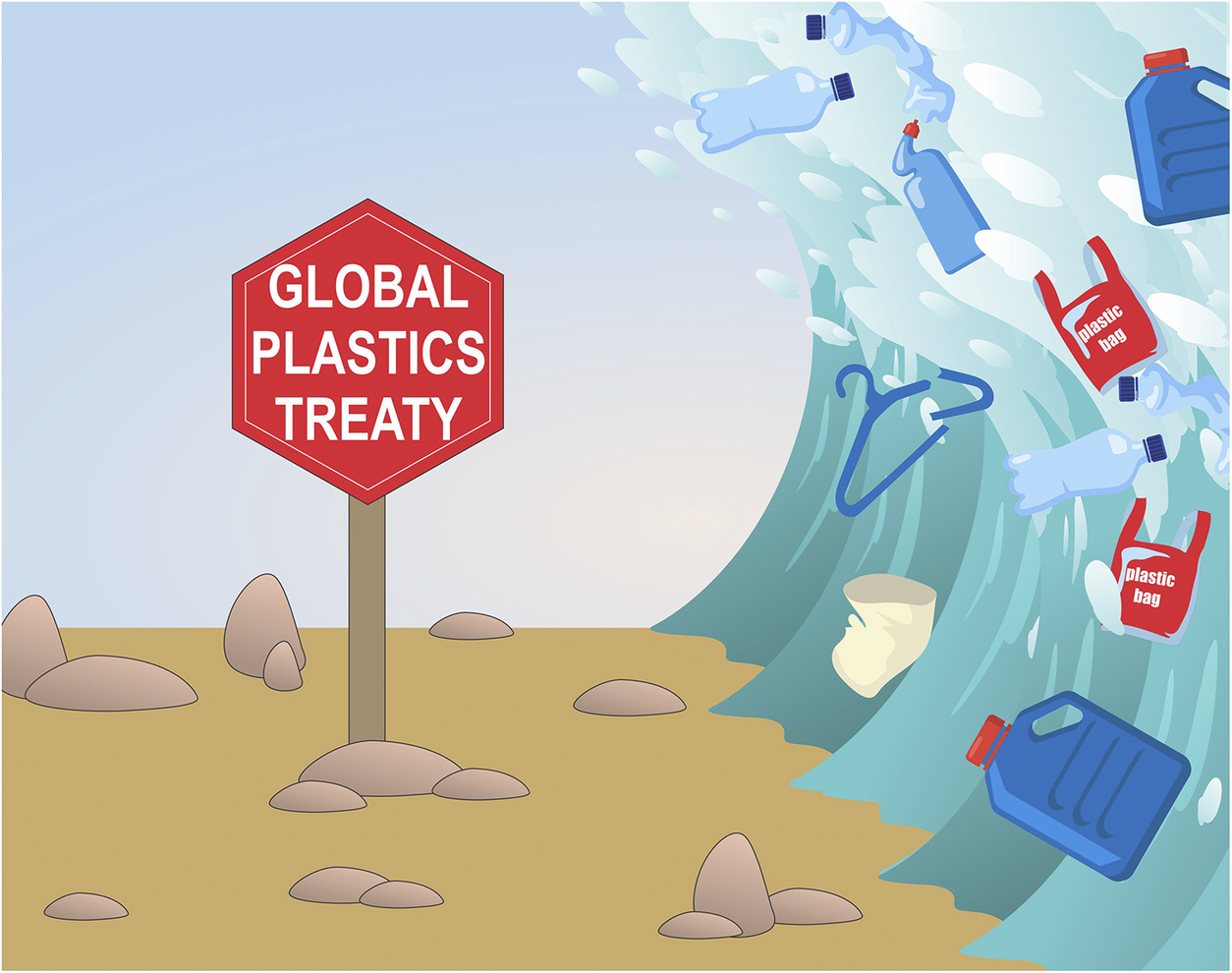
May there be no more dead whales with tons of plastic in their bellies, turtles with straws extracted from their nostrils, or dolphins that perish after getting entangled in fishing nets in the future. As told Inger Andersen, Executive Director of the UN Environment Programme, the global plastics treaty is “the most significant environmental multilateral deal since the Paris Accord…an insurance policy for this generation and future ones, so they may live with plastic and not be doomed by it” (Landrigan et al., Reference Landrigan, Symeonides, Raps and Dunlop2023b). As a polymer researcher, I agree with his words and trust in the success of the Global Plastics Treaty. May the Global Plastics Treaty break the plastic wave (Figure 3).
Will the Global Plastics Treaty break the plastic wave?

Conclusions
Plastic pollution has reached unsustainable levels. In an effort to reduce plastic pollution, an INC has been established by UNEP to reach a resolution by the end of 2024. Subsequently, an ambitious treaty to reduce plastic pollution, known as the Global Plastics Treaty, is expected to be enforced in 2025.
A systematic review was performed on the Global Plastics Treaty. The analyzed literature mainly focuses on the adverse effects of plastic pollution, legislation, governance, and the economy. The literature supports restricting worldwide plastic production as the most effective strategy to address plastic pollution.
This comprehensive summary of the current literature can contribute to the ongoing negotiations and guide future research on the Global Plastics Treaty.
Open peer review
To view the open peer review materials for this article, please visit http://doi.org/10.1017/plc.2024.14.
Author contributions
F.D.B.S. wrote and proofread the manuscript for language editing.
Competing interest
The author declares no competing interests.
Ethics statement
This article does not include human participants or biological material data.


 Open access


Comments
Dear Editor(s),
It is a great pleasure to present the perspective “Will the Global Plastics Treaty break the plastic wave? The beginning of a long discussion road” for your appreciation and publication in the journal Cambridge Prisms: Plastics.
We are experiencing the effects of the triple planetary crisis – climate change, nature loss, and pollution – which is aggravated by plastic pollution. Despite widespread global awareness of the adverse effects of plastic waste, the ongoing increase in pollution remains persistent, with an annual increase in plastic consumption and incorrect disposal contributing to this persistent problem.
The 175 nations agreed in 2022 to begin negotiations by the end of 2024 on a binding international agreement to control the life cycle of plastics, including preventing marine pollution. To ensure the efficacy of the Global Plastics Treaty in mitigating plastic pollution, it is imperative to have the extensive participation of researchers. Literature is, therefore, actively constructing a robust international agreement in tandem with the ongoing negotiations.
In this study, a systematic review of the Global Plastics Treaty was carried out. The analyzed literature mainly focuses on the adverse effects of plastic pollution, legislation, governance, and the economy. The resulting comprehensive overview of the subject can contribute to the ongoing negotiations.
From the best of my knowledge, there is no other work with the same purpose available in the literature.
I hope that the content of this article matches the goals of the periodic.
The work follows the form requirements as described on the journal’s website.
I declare that the work has not been published previously and is not under consideration for publication anywhere else. If accepted, it will not be published anywhere else in the same form, in English, or any other language, including electronically, without the written consent of the copyright holder.
Best regards,
Prof. Fabiula Danielli Bastos de Sousa
Universidade Federal de Pelotas
E-mail: fabiuladesousa@gmail.com