




Introduction
Across East Asia, Ming dynasty (1368–1644) porcelain was not only a luxury commodity but an aesthetic and technical standard that influenced regional ceramic production. In Chosŏn Korea (1392–1897), excavated finds – particularly from Hanyang, the former capital – demonstrate its widespread diffusion as both a courtly object and a material marker of political alignment.Footnote 1 Previous scholarship has largely emphasised tributary exchange and elite consumption, treating Ming porcelain as a regulated luxury restricted by sumptuary law.Footnote 2 While valuable, this framework obscures the significant shift in how Chosŏn elites’ engagement with imported porcelain shifted after the late sixteenth century. The Japanese invasions of Korea (Imjin War, 1592–8) fundamentally reconfigured the circulation of Ming material culture. Wartime mobilities brought Ming generals, soldiers and support personnel into direct contact with Chosŏn society, creating new pathways for objects to enter the peninsula.Footnote 3 This movement of people and goods resulted in what may be described as a form of material displacement, through which imported porcelain acquired new ritual and ideological meanings.
Archaeological assemblages from various sites across the Korean Peninsula reveal a notable decline in the quantity of early Qing porcelains. In contrast, Ming wares are found in significant numbers, while ceramics from the early Qing period are exceedingly rare. Most Qing-period sherds discovered in Chosŏn contexts date to the mid- or late Qing era. This trend is frequently linked to the strong anti-Qing sentiment that arose after the Manchu invasions of Chosŏn in 1627 and 1636.Footnote 4 Yet the persistence and even heightened symbolic value of Ming porcelain during the same period has received far less attention. Existing studies have not fully examined how the continued consumption and veneration of Ming porcelain coexisted with anti-Qing sentiment, nor how imported Ming wares mediated shifting boundaries of loyalty, identity and cultural memory.Footnote 5
Recent scholarship on the Imjin War has expanded beyond diplomacy and military strategy to examine cultural exchange, the circulation of goods and the migration of potters.Footnote 6 Especially influential are the studies by Adam Bohnet and Sun Weiguo, which demonstrate how encounters with displaced Ming subjects reframed Chosŏn literati ideology from a paradigm of ‘restoration’ to one of ‘inheritance’.Footnote 7 Bohnet’s research provides a compelling framework for understanding post-Imjin ideological transformation, tracing Chosŏn’s evolving perception of Ming refugees from a model of ‘Chunghwa Restoration Consciousness (中華恢復意識)’ to ‘Chunghwa Inheritance Consciousness (中華繼承意識)’.Footnote 8 This shift redefined Chosŏn’s legitimacy as inheritor, rather than restorer, of the Ming legacy. Sun further shows how memorial rites for Ming migrants reflect evolving loyalism. Building on these insights, this article examines Ming porcelain not simply as imported goods but as a material medium through which Chosŏn elites articulated Ming loyalism, anti-Qing sentiment and claims to cultural legitimacy.
This study focuses on Ming porcelain inscribed with ‘Great Ming’ (Da Ming 大明) excavated across the Korean Peninsula. When read alongside Chosŏn literati records, these inscriptions illuminate how imported objects shaped ideological discourse and ritual practice. The first section reassesses the circulation of Ming porcelain before and after the Imjin War, emphasising objects brought by Ming generals during military and diplomatic campaigns. The second section examines how Chosŏn literati referenced and interpreted these wares in their writings, placing them within broader debates on loyalty and cultural identity. The final section analyses their ritual use, especially in Altars to the Great Ming (大明壇), showing how material culture sustained Chosŏn’s long-term ideological relationship with the fallen Ming.
The influx and transformation of ‘Great Ming’ inscription porcelain in Korea
Ming reign marks, introduced in the late fourteenth century and standardised by the early fifteenth century, served as instruments of imperial authority and were applied to porcelain produced at the imperial kilns of Jingdezhen.Footnote 9 These inscriptions – either six-character marks specifying reign and dynasty or simplified four-character variants – appear on what is now broadly termed ‘Ming porcelain’.Footnote 10 Their function as visual signifiers of legitimacy shaped the reception of these objects across East Asia.Footnote 11
Ming Porcelain entered Chosŏn Korea primarily through official diplomatic exchanges. In 1430, Emperor Xuande (宣德, r. 1425–35) presented the Chosŏn court with three sets of blue-and-white tableware and three blue-and-white porcelain wine vessels described in historical sources as ‘cloud-and-dragon white porcelain wine vessels’.Footnote 12 These pieces are widely regarded as products of the Jingdezhen imperial kilns (guanyao 官窑), whose forms and decorative vocabulary closely correspond to extant Xuande-period imperial wares in major collections. In response, King Sejong (世宗, r. 1418–50) wrote a letter of appreciation, expressing his admiration for the porcelain’s design of brilliant clouds and soaring dragons.Footnote 13
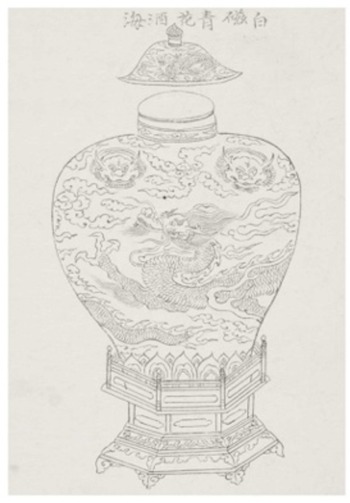
The ceremonial significance of Ming porcelain in Chosŏn extended beyond the realm of diplomatic exchange. Under King Sejong, the state ritual system known as the Five Rites (Orye) – the official framework governing state ceremonies and protocol – was codified in the Veritable Records of King Sejong (Sejong sillok). Drawing on Tang and Song precedents, it systematised auspicious and inauspicious rites, as well as those for guests, military occasions and family events. The illustrated ritual diagrams feature depictions of blue-and-white tableware, showcasing dragon postures and forms, cloud motifs enveloping the dragon’s head, and the decorative ornamental demon faces and mask patterns that closely resemble those found on Xuande-period guanyao porcelain (Figure 1).
Illustration of the Chunjak ŭi ye (Rite of Libation) in the Orye (Five Rites), from Sejong sillok, cxxxii, ‘Karye Sŏrye – Chunjak ŭi ye 1’. Taebaeksan Archive edition. National Institute of Korean History. Public domain (KOGL).

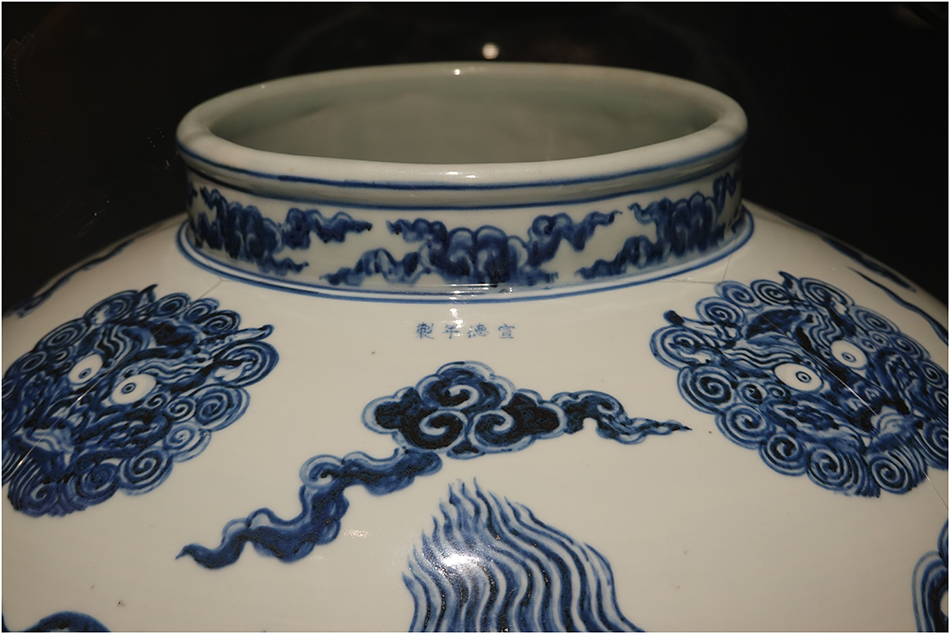
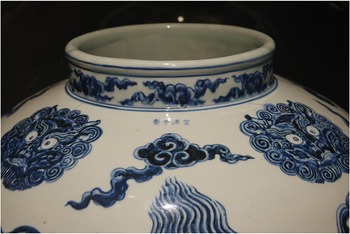
Extant pieces from the Idemitsu Collection in Japan – Xuande-period wares bearing imperial marks placed beneath the mouth rim, just below the cloud-motif band – further illuminate the nature of the guanyao likely presented to the Chosŏn court (Figure 2). As official Xuande porcelain was produced in batches of multiple identical copies with flawed pieces removed before imperial distribution, it is highly likely that the wares sent to the Chosŏn court bore comparable inscriptions. These guanyao pieces also served as material and visual prototypes for the ritual vessels codified in the Five Rites (Orye) during King Sejong’s reign.Footnote 14 The close correspondence between the forms in the Orye ritual diagrams and extant Xuande imperial wares indicates that the Chosŏn court adopted these Ming models as authoritative templates for its state ritual apparatus. Although the reign marks – such as ‘Made in the Xuande reign period of the Great Ming’ – do not appear in the ritual illustrations, their omission probably reflected schematic convention of ritual documentation rather than a diminished regard for Ming imperial authority. The symbolic weight of Ming-inscribed porcelain therefore remained operative within Chosŏn court culture, even when the inscriptions were omitted from formal visual representations.
Blue-and-white porcelain jar with cloud-and-dragon motifs, Xuande reign (1426–35). Idemitsu Museum of Arts, Tokyo. © Idemitsu Museum of Arts. Reproduced with permission.
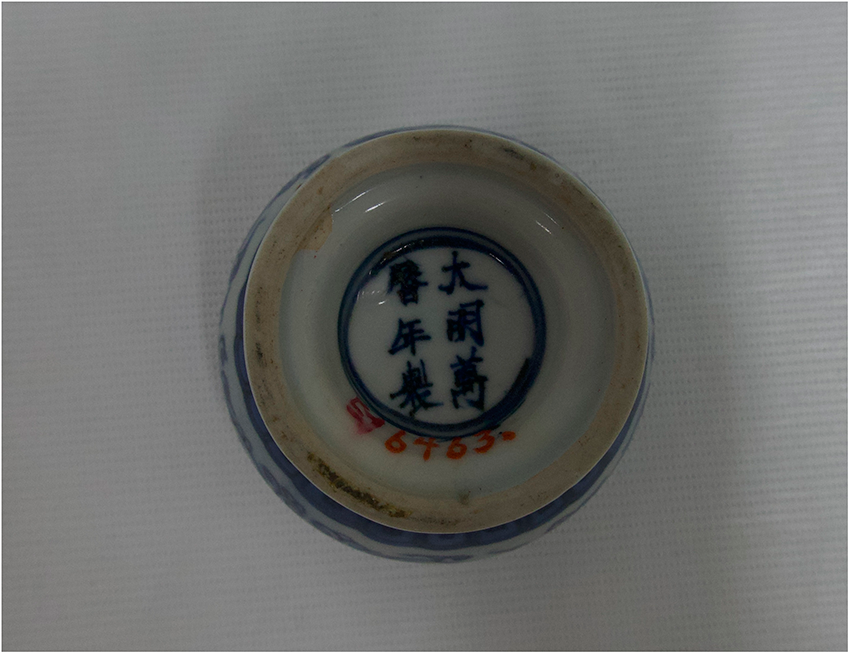
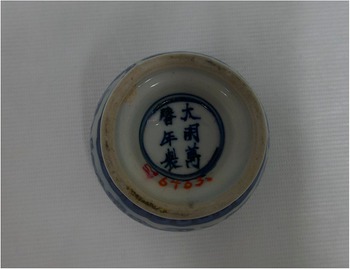
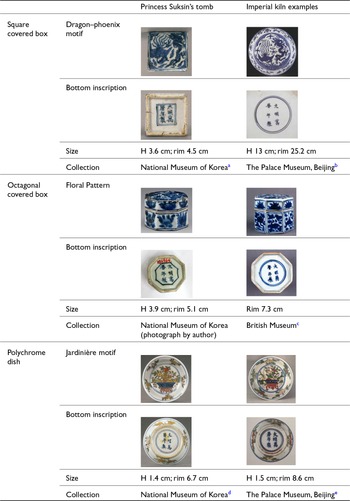
Excavated materials provide tangible evidence of the circulation, quality and symbolic value of Ming porcelain in Chosŏn. The assemblage from the tomb of Princess Suksin (淑慎, 1635–45), daughter of King Hyojong (孝宗, r. 1649–59), is especially significant: seven of the eight pieces bear the inscription ‘Produced in the Wanli reign period of the Great Ming’ (Da Ming Wanli nianzhi) (Figure 3). These include square covered boxes, octagonal boxes and a polychrome dish – forms that closely parallel extant Jingdezhen guanyao examples. Comparison with Palace Museum and British Museum counterparts (Table 1) shows that the Korean finds match, and in some cases exceed, the craftsmanship of surviving imperial wares.
Base inscription of a burial object excavated from the tomb of Princess Suksin. National Museum of Korea, Seoul. Photograph by the author. © National Museum of Korea. Reproduced with permission.
Comparison of ‘Da Ming Wanli’-inscribed porcelain: excavated vs extant imperial kiln examples

Notes:
a National Museum of Korea, Chungguk toja (Seoul, 2007), 319.
b Gugong bowuyuan and Jingdezhen shi taoci kaogu, Mingdai Jiajing Longqing Wanli yuyao ciqi: Jingdezhen yuyao yizhi chutu yu Gugong bcang chuanshi ciqi duibi (Beijing, 2018), fig. 108.
c Percival David Foundation of Chinese Art, Illustrated Catalogue of Underglaze Blue and Copper Red Decorated Porcelains in the Percival David Foundation of Chinese Art (2004), sect. 3, p. 72.
d National Museum of Korea, Chungguk toja (Seoul, 2007), 320.
e Gugong bowuyuan, Gugong bowuyuan cang wenwu zhenpin quanji 38: Wucai, Doucai (Hong Kong, 1999), 55.
The Wanli-period dragon-and-phoenix box, for example, preserves the characteristic head-to-tail motif and cloud-scroll framing of imperial productions, while the polychrome dish shows more refined brushwork and crisper mark execution than comparable pieces in Beijing. Even when produced under the guan-da min-shao (官搭民燒) systemFootnote 15 – imperially supervised but kiln-outsourced manufacture – such objects should still be understood as guanyao in function and status.
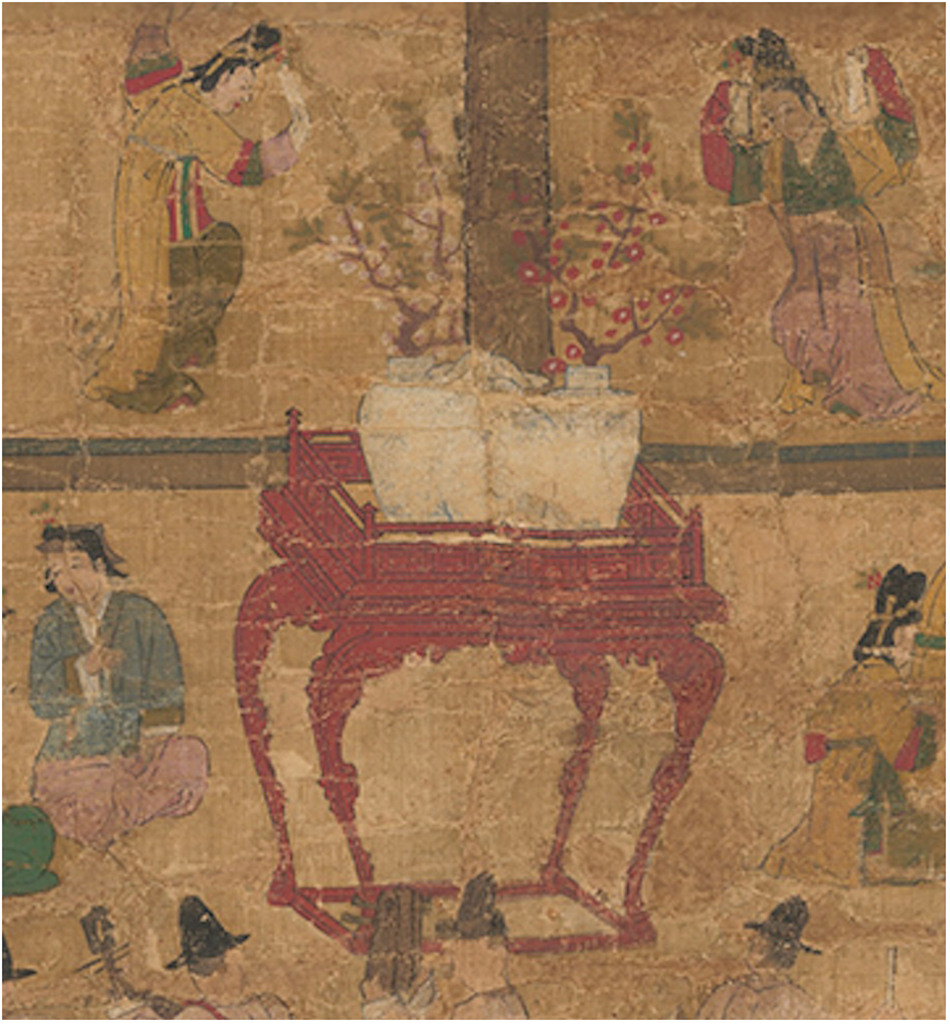
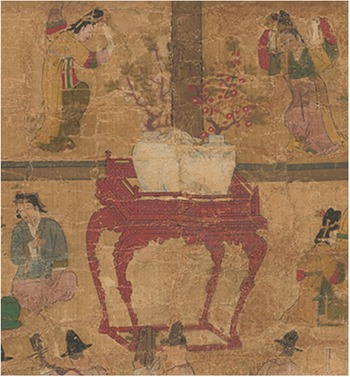
Demand for Jingdezhen wares increased as the prestige of imperial forms spread from the royal court to the literati. This diffusion was aided by the expansion of Jingdezhen production: from the mid-Ming, folk kilns increasingly imitated official prototypes, producing large quantities of blue-and-white vessels with retrospective or anachronistic reign marks.Footnote 16 Such wares – including jars, bowls, covered boxes and serving vessels – entered Chosŏn not only through formal tributary exchanges but also through semi-official and informal channels, as scattered references in the Veritable Records indicate.Footnote 17 By the late sixteenth century, Chinese porcelain had become so common in elite social gatherings that the court repeatedly issued prohibitions on its use, admonishing yangban families for their excessive reliance on ‘painted wares’ (畫器) at feasts and banquets (Figures 4).Footnote 18
‘Kiyŏng hoedo’ (耆英會圖), Treasure No. 1488, National Museum of Korea, Seoul. Public domain (KOGL).
Archaeological evidence corroborates this pattern. Blue-and-white jars and bowls of late Ming type have been recovered from elite residential zones in the capital, such as the Chŏngjin district in Seoul, where excavated fragments closely match forms shown in fifteenth-and sixteenth-century genre paintings depicting gatherings, feasts and tea preparation.Footnote 19 These finds indicate that Chinese porcelain had become embedded in the everyday material culture of the literati long before it acquired ideological force. Yet even as these wares circulated widely, their reign marks do not seem to have attracted special attention. Their value lay primarily in aesthetic refinement and social prestige, rather than political or commemorative significance.
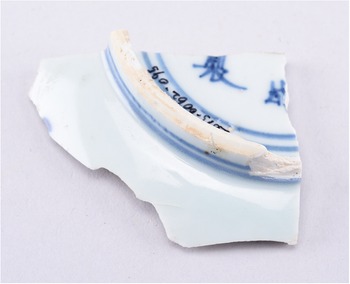
Within this broader landscape of elite consumption, the fragment unearthed from the estate of the renowned scholar-official Yun Sŏn-do (尹善道, 1587–1671) in Haenam, South Chŏlla Province, stands out as a rare case in which a piece of folk-kiln porcelain bearing a ‘Great Ming’ inscription can be directly linked to a specific literati household. A blue-and-white porcelain base – probably once inscribed with ‘Produced in the Chenghua Reign Period of the Great Ming’ (Da Ming Chenghua nianzhi, 大明成化年製), of which only the characters ‘cheng’ (成) and ‘zhi’ (製) are now legible – was found within a studio (Kyoŭi-jae, 敎義齋) (Figure 5).Footnote 20 Its simplified brushwork and coarser glaze mark it as folk-kiln ware, while its presence in a literati educational space suggests continued use of Ming porcelain into the mid-seventeenth century. Its discovery shows that foreign wares existed within elite environments and that Ming-inscribed porcelain, though valued, was not yet viewed through post-Imjin loyalist sentiment.
Blue-and-white porcelain base fragment excavated from the Yun Sŏn-do site in Haenam, National Museum of Korea, Naju. Public domain (KOGL).

Wartime redistribution and the reconfiguration of material circulation
The Imjin War ruptured established channels for Ming porcelain circulation and created new, irregular and militarised routes by which Ming goods entered Chosŏn.Footnote 21 The arrival of more than 160,000 Ming troops under the Wanli Emperor (r. 1572–1620) fundamentally altered interpersonal and material exchange, placing Chinese military personnel in unprecedented proximity to Chosŏn civilians and elites. This proximity facilitated the movement of Ming goods through informal and extra-tributary channels that bypassed the ritualised diplomatic system regulating Sino-Chosŏn exchange. The emergence of Chunggang (中江), a strategic inland hub on the Ming–Chosŏn border, further enabled large-scale transfers of goods into Hanyang.Footnote 22
Before the war, the Chosŏn court obtained Ming porcelain through multiple channels, one of which involved Japanese intermediaries – particularly merchants operating in Japanese settlements within Chosŏn, such as Chep’o (薺浦) – who handled re-exported Chinese goods.Footnote 23 By the late sixteenth century, however, this maritime network had weakened due to the Riot of the Three Ports (Samp’o waeran, 三浦倭亂, 1510), the Japanese Raid on Saryangjin (Saryangjin waebyŏn, 蛇梁鎮倭變, 1544), intensified waegu piracy and tightening Ming restrictions. Although the Waegwan (倭館, Japan House) reopened in 1512, and saw substantial trade during the Sengoku period, most exchanges chiefly benefited Japanese domains, leaving Chosŏn with only limited access to imported goods, particularly Chinese porcelains.
Wartime fostered new patterns of exchange as porcelain began to circulate through military networks by means of Ming commanders distributing goods to Chosŏn officials and local elites.Footnote 24 The Letters of the Ming Generals (Tangjang sŏch’ŏp, 唐將書帖), for example, describes instances in which incense burners were gifted to the Chosŏn court by Ming military officers.Footnote 25 Likewise, in the Records of Observations and Experiences at Yongman (Yongman mungyŏnnok, 龍灣聞見錄), Chosŏn scholar-official Chŏng Tak (鄭琢, 1526–1605) notes that deputy commander Tong Yangzheng (佟養正, ?–?) supplied Ming troops stationed in Ŭiju (義州), a key logistical outpost in north-west Korea near the Chinese frontier, with tableware, including porcelain bowls, stem cups and bottles:
When Shandong Provincial Administration Commissioner Han and Sun’an Inspector Zhou visited, … the general specially lent twenty sets of bowls (C. Tangfuer, K. Tangboa, 湯甫兒) porcelain, ten tea cups and one bottle … from the local garrison’s storage … Additionally, twenty sets of white-ground blue-and-white porcelain plates and fifty pairs of large oil lamps were gifted.Footnote 26
This generosity probably stemmed from urgent wartime supply concerns. Such military-facilitated exchanges marked a shift in Ming porcelain distribution: wares once restricted to elite diplomatic channels now entered Chosŏn through the interpersonal and institutional ties forged during wartime. A telling example appears in the case of Chosŏn official Yi Kyŏng-nam (李景南, ?–?), a provincial administrator from Sangju, who received Chinese inkstones and tea-cups from General Wu Youzhong (吳有忠, 1533–1611) in recognition of his administrative cooperation with Ming forces. These wartime transfers embedded Ming porcelain within Chosŏn’s elite, functioning not only as utilitarian goods but also as material emblems of loyalty, affiliation and cross-cultural alliance.
Yi Kyŏng-nam, a native of Wolseong, was the son of Ki Ryŏn and served as a Tongchu (同樞) official … During the war, he inspired villagers to form militia (義兵 ŭibyŏng). Ming General Wu Youzhong, stationed in this region, admired Yi’s efficiency in handling administrative records with exceptional speed and gifted him brushes, inkstones, ladles and cups.Footnote 27
These exchanges represented a fundamentally different model of circulation. Rather than moving through formal, court-mediated tributary channels ratified by ritual, Ming porcelain now travelled through ad hoc and localised routes. Military officers transferred goods directly to distant provincial elites. This wartime distribution system bypassed traditional gatekeeping mechanisms, embedding Ming material culture more deeply into the social world of Chosŏn literati and mid-level officials – many of whom would otherwise have had little or no access to such high-status objects.
Ming loyalism, anti-Qing sentiment and the reassertion of a Ming-centred world order
Chosŏn actively commemorated Ming’s assistance after the Japanese invasions by constructing monuments, altars and shrines, including the Altar of Great Retribution (Taebodan, 大報壇), Sŏnmu-sa (宣武祠) and Kwanwangmyo (關王廟), all established under royal initiative.Footnote 28 Sŏnmu-sa honoured Ming soldiers who died in battle, while Kwanwangmyo, built at the Ming court’s suggestion, was dedicated to Guan Yu in his divine form as Guan Wang.Footnote 29 Both shrines were later incorporated into the Chosŏn court’s ritual system as customary state rites. In 1699, the court also established a shrine to commemorate the Wanli Emperor (神宗) and Ming generals Li Rusong (李如松, 1549–98) and Shi Xing (石星, 1537–99).Footnote 30 The Chosŏn court even bestowed official positions on those who conducted ancestral rites for Ming emperors – a practice further illustrated in the following examples. These Ming-commemorative projects were not merely expressions of gratitude but also instruments of political legitimation. By presenting itself as the last defender of Ming Confucian civilisation, the monarchy reinforced its moral authority amid regional instability. Since the early fifteenth century, Chosŏn had aligned with Ming‐centred Sinocentrism and refused to recognise the Jurchens as a legitimate political entity. The Annals of King Sejong record the court’s consistent classification of the Jurchens as barbarians or tribal groups despite their increasing military coordination along the northern frontier.Footnote 31 This earlier perception later formed the ideological basis for Chosŏn’s rejection of Manchu authority in the seventeenth century. After the Qing invasion of 1636–7, the Chosŏn elite intensified their efforts to uphold a Ming‐centred world order, viewing the Manchu conquest as a profound ideological and cultural threat. In response, officials and scholars increasingly portrayed Chosŏn as the defender of orthodox Confucian civilisation and rightful inheritor of the Ming legacy.Footnote 32
This Sinocentric worldview was reflected in Chosŏn’s material and commemorative culture. Even after the Ming dynasty fell in 1644, Chosŏn literati continued to inscribe tombstones with the phrase ‘Chosŏn of Ming’ (Yumyŏng Chosŏn, 有明朝鮮), suggesting that the Ming dynasty endured in spirit.Footnote 33 Korean dynasties historically defined themselves in relation to contemporary Chinese powers, yet even after the Qing’s conquest of China and its rise as the new Sinic centre, the expression ‘Chosŏn of Qing’ (Yuch’ŏng Chosŏn, 有淸朝鮮) remained extremely rare. Chosŏn scholars even deliberately avoided Qing reign titles, continuing instead to date by the era name of the last Ming emperor, Chongzhen (崇禎, r. 1628–44). This reluctance shows Chosŏn’s refusal to recognise Qing legitimacy and reveals how a Ming-centred worldview also served as a rhetorical strategy that allowed the elite to maintain a sense of civilisational superiority despite political subordination to the Qing.
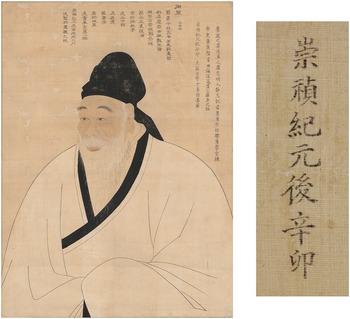
There are multiple examples of elites expressing Ming-centred worldviews, even in high-profile situations. The proposal to construct a shrine for Emperor Chongzhen was first made by Song Si-yŏl (宋時烈, 1607–89), the leading Neo-Confucian scholar of late seventeenth-century Chosŏn. He dated his writings using phrases such as ‘Sinmyo year after the Chongzhen era’ (崇禎紀元後辛卯),Footnote 34 eight years after the Ming collapse (1651) (Figure 6). Later scholars adopted similar practices; for example, the late Chosŏn intellectual Pak Chi-wŏn (朴趾源, 1737–1805) recorded his visit to Song’s shrine on the anniversary of Chongzhen’s death as ‘137 years after the Chongzhen era’, demonstrating the elite’s enduring symbolic allegiance to the Ming dynasty.
Unknown Artist, Portrait of Song Si-yŏl, Chosŏn Dynasty, seventeenth–eighteenth centuries, 89.7 × 67.6 cm, National Museum of Korea, Seoul. Public domain (KOGL).

‘Great Ming’ inscribed porcelain as emotional and ideological objects
The Chosŏn elite’s emotional attachment to Ming China appeared in the Chosŏn literati’s appreciation and collection of Ming porcelain inscribed with ‘Great Ming’ reign marks. As JaHyun Kim argues, Chosŏn scholars viewed themselves as protectors of Confucian civilisation, a sentiment reflected in their reverence for such pieces.Footnote 35 In his Anthology of Paekkok (Paekkok Seonsaengjip, 白谷先生集), Kim Tŭk-sin (金得臣, 1604–84) recounts an anecdote about blue-and-white Ming porcelain: a Sajegam (司宰監) officer of fourth rank once gifted a Chinese porcelain piece to a scholar named Yi Saeng (李生). The two examined its inscription – ‘Twentieth year of Chenghua’ (1484) – and reflected on its historical weight. Kim noted that it had been preserved for over 164 years. This episode shows how Ming porcelain became emotionally resonant commemorative objects for Chosŏn scholars. Kim Tŭk-sin’s record underscores that Yi Saeng and the Sajegam officer valued the porcelain not merely for its material quality but for the ‘Great Ming’ inscription it bore:
Yi Saeng valued and cherished this piece not only for its antiquity but also because it was crafted during the reign of Emperor Xianzong (憲宗, Chenghua Emperor, r. 1464–1487) of the Great Ming. ‘Our dynasty served the Ming for over two centuries; now that it has fallen to the Qing, who would not grieve?’ Deeply moved by the imperial reign mark, he recorded its discovery to express his veneration. His admiration was rooted less in craftsmanship than in the inscription itself. The ch’ŏm-jŏng (僉正) official who preserved it likewise treasured it out of sorrow for the Ming’s fall.Footnote 36
As they contemplated the reign mark of a fallen Ming emperor, Yi Saeng and the Sajegam officer reflected on the dynasty’s demise with deep sorrow, a sentiment that was closely tied to the political identity of the Chosŏn literati. Their emotional engagement with Ming porcelain reflects a broader ideological context: for these scholar-officials, such objects were not merely antiquarian curiosities but potent symbols of enduring Confucian allegiance and moral identity in opposition to Qing rule. Although surviving sources emphasise literati perspectives, similar sentiments may have extended more widely, though the strongest evidence concerns the elite who framed these objects as tools of memory and ideology.
Another example appears in the case of Sim Cho (沈潮, 1694–1756), who owned a blue-and-white cup inscribed ‘Da Ming Wanli nianzhi’ (Made in the Wanli reign period of the Great Ming). His diary expresses both joy at finding the Ming imperial mark and sorrow over the Ming’s fall:
At home, I have a beautifully decorated blue porcelain cup. I used it whenever I drank good wine. One day, I noticed an inscription on the base: ‘Da Ming Wanli nianzhi’. I was overcome with joy, as if light had entered my heart. Yet how long has it been since we, Chosŏn scholars, forgot Emperor Wanli’s benevolence? Who among us still values this precious artefact?Footnote 37
Porcelain inscribed with ‘Great Ming’ functioned not only as material artefacts but also as symbols of the Chosŏn literati’s ideological alignment with Ming China, with craftsmanship reinforcing their aesthetic and historical value.Footnote 38 Chosŏn scholars viewed these objects not simply as beautiful wares but as politically charged commemorative vessels. Treasuring ‘Great Ming’ porcelain represented loyalty to the Ming and embodied resistance to the Manchu-led Qing, reaffirming Confucian ideals and Chosŏn’s self-image as the guardian of a fallen civilisation.Footnote 39
Towards the end of the Imjin War, several Ming soldiers remained in Chosŏn due to injury or other circumstances.Footnote 40 Zhang Haibin (張海濱,1575–1657), who served under Ming General Wu Youzhong, stayed after being severely wounded during the retreat and settled in the present-day Kunwi (軍威) region of North Kyŏngsang Province, becoming the progenitor of the Korean Zhejiang (浙江) Zhang clan. During his time there, he built an altar for the Great Ming on Mount Puk (Puksan 北山) and performed the Westward Bowing to Ming (西向拜明) ceremony after the dynasty’s fall in 1644 to honour the deceased Ming emperors.Footnote 41
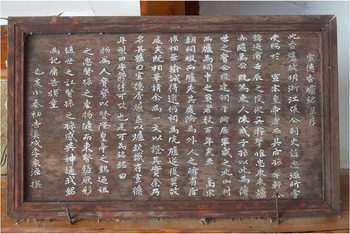
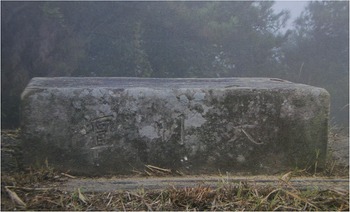
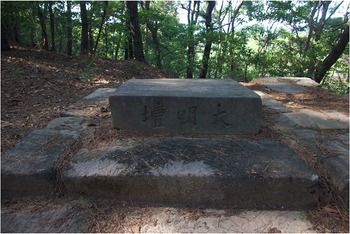
At Puksan Sŏwŏn (北山書院), the ancestral shrine of the Zhang clan, a plaque titled Record of the Seondeok Incense Burner (Sŏndŏk hyangnogi, 宣德香爐記) records Zhang Haibin’s construction of the altar for the Great Ming and his performance of sacrificial rites for Ming emperors (Figure 7). Other accounts state that he used an incense burner inscribed with ‘Made in the Xuande Reign Period of the Ming Dynasty’ (Xuande Nianzhi), brought directly from Ming China. As discussed above, this burner closely resembles the Xuande-marked example given to Chosŏn scholar Yi Kyŏng-nam by General Wu Youzhong. Today, these historical traces survive in the stone altar inscribed Taemyŏngdan (大明壇), the Altars to the Great Ming, on a hill opposite Puksan Sŏwŏn (Figure 8).
Sŏndŏk hyangnogi plaque, Puksan Sŏwŏn, Author’s Photograph.

Taemyŏngdan (136.5 × 102.5 × 32.5 cm), Zhejiang Zhang Clan Genealogy. Image provided by the Zhejiang Zhang Clan Association. Reproduced with permission.

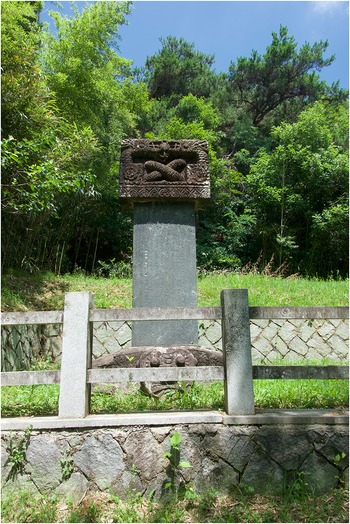
Where Zhang Haibin built Altars to the Great Ming in Kunwi to commemorate the Ming emperors, two former Ming soldiers – Xu He (徐鶴) and Shi Wenyong (施文用) – established another Taemyŏngdan in Sŏngju (星州), after the war, continuing Ming ritual traditions (Figure 9).Footnote 42 The area where they settled is still called ‘The Town of the Great Ming’ (Taemyŏng-dong, 大明洞), and an altar attributed to the two generals has been found on a nearby hill. An inscription records incense being burned on the first and fifteenth of each month as part of the Westward Bowing to Ming (西向拜明) ritual (Figure 10).Footnote 43 Following construction of the Taemyŏngdan, Shi Wenyong performed libation rites for the Ming emperors using the requisite ceremonial cup.Footnote 44 The spread of Altars to the Great Ming across various regions indicates that Ming memorial rites were preserved within local communities.
The Altar for the Great Ming, Sŏngju, Korea. Author’s photograph.

Monument to Shi Wenyong’s legacy, height: 314 cm. Author’s photograph.

Other records from the Chosŏn period also document the ritual use of the Ming porcelain given to Chosŏn scholar Yi Kyŏng-nam by General Wu Youzhong. Such Taemyŏngdan rites persisted into the late Chosŏn period. According to the Zhejiang Zhang Clan Genealogy, the Altar to the Great Ming honoured three Ming emperors – Hongwu, the founder; Wanli, who aided Chosŏn during the Imjin War; and Chongzhen, the last ruler. This commemoration expressed Chosŏn’s reverence for Ming’s founding and fall, framing Chosŏn loyalty as both political and emotional:
My ancestor, known by the sobriquet Hoong (壺翁), when performing rituals at the Ming shrine, took the Chenghua and Wanli reign-period cups and the Xuande incense burner bestowed by Wu Youzhong and cloistered himself in the temple. On the death anniversaries of the three emperors, he poured clear water into the cup and burned incense at the altar, bowing nine times and kneeling four times. He maintained this ritual without fail for ninety years. The incense burner was passed down through ten generations, preserving the practice of incense burning and ritual offerings. The cup, incense burner and inkstone remain as treasured family heirlooms.Footnote 45
The term ‘Xuande reign period incense burner’ (宣德爐) appears in these texts, possibly referencing the Xuande-era burners that were highly popular among collectors in the late Ming period.Footnote 46
Chosŏn scholar Pak Chi-wŏn also used Ming porcelain in a ceremony dedicated to Emperor Chongzhen. Following literati customs, he visited Song Si-yŏl’s shrine and joined the memorial rites using a porcelain basin inscribed ‘Made in the Chenghua Reign Period of the Great Ming’ (Da Ming Chenghua nianzhi). Because alcohol was prohibited at the time, honey water replaced wine, showing that despite such adjustments, the symbolic and ritual significance of Ming porcelain remained intact. Pak Chi-wŏn’s record describes the porcelain as ‘cups from the Chenghua and Wanli reign periods:
Because alcohol was prohibited, we used honey water instead, pouring it into blue-and-white porcelain cups inscribed ‘Da Ming Chenghua nianzhi’. After making our offerings, we bowed our heads and looked upon the cups so that we would never forget the fall of the Ming. While living in Hanyang, it was the 137th year after the Chongzhen era, the third cycle of a Kapsin year.Footnote 47 On the nineteenth day of the third month, the Martyred Emperor Yizong gave his life for the state. With dozens of scholars and students, I visited Master Song Si-yŏl’s residence in the city’s west, bowed before his portrait and shed tears of lamentation. Returning to the city walls, I clenched my fists, turned westward and shouted: ‘Barbarians!’Footnote 48
His outrage reflects the anti-Qing sentiment prevalent among Chosŏn literati. By retaining this sentiment while acknowledging Qing political dominance, the Chosŏn elite continued to affirm ideological and cultural loyalty to the fallen Ming. This attitude appeared not only in ritual practice and historical narratives but also in material culture through era names such as ‘Chosŏn of Ming’ and ‘Years after the Chongzhen era’. Late Chosŏn scholars understood this not as simple gratitude for Ming assistance but as a lamentation over the rupture of the Sinocentric order. Modern scholarship likewise interprets this movement as Chosŏn’s effort to position itself as the successor to Confucian civilisation. Thus, ‘Great Ming’ inscribed porcelain in Chosŏn was more than a utilitarian vessel. It symbolised ideological resistance and embodied Chosŏn’s continued commemoration of Ming China and rejection of Qing rule.
Conclusion
The enduring anti-Qing sentiment in Chosŏn influenced both political discourse and the material practices through which the dynasty expressed its moral stance following the fall of the Ming. The persistent use of terms like ‘Chosŏn of Ming’ and the dating of events according to the Chongzhen era reflect an attempt to maintain a Ming-centred world order at a time when it had already dissipated. Within this ideological framework, porcelain marked with the ‘Great Ming’ reign became a vital medium for conveying allegiance, mourning and a sense of historical continuity. What had previously circulated as luxury items under tribute relations was reinterpreted after the Ming’s collapse as tangible evidence of a shared civilisation.
Through objects inscribed with imperial markings, Chosŏn literati redefined their identity as heirs to orthodox Confucian civilisation. For scholars like Kim Tŭk-sin and Sim Cho, the discovery, use and preservation of Ming porcelain evoked both aesthetic enjoyment and political sorrow. These vessels functioned as commemorative artefacts, valued not only for their craftsmanship but also for their visible imperial origins. Their ritual use – whether in household offerings, local altars or memorial rites for Ming emperors – demonstrates how material objects were employed to uphold a moral position against Qing rule.
This process illustrates how imported objects could be recontextualised to bolster local political legitimacy. By incorporating ‘Great Ming’ porcelain into commemorative and ritual practices, Chosŏn transformed these items from symbols of imperial origin into semiotic instruments of ideological resistance. The interplay between material form and political significance reveals how early modern East Asian polities navigated cultural authority. Through Ming-marked porcelain, Chosŏn expressed not only gratitude for past support but also a claim to the stewardship of a fallen civilisation. In doing so, it positioned itself – both symbolically and materially – as the last guardian of the Sinitic world.

 Open access

