

Introduction
In 2020, the Black Lives Matter movement against racial police violence and the COVID-19 pandemic brought the persistence of ethnic and racial inequalities to the forefront of the public conversation in the United States and abroad (Beaman Reference Beaman2021a; Bonilla-Silva Reference Bonilla-Silva2022; Shepherd et al., Reference Shepherd, MacKendrick and Mora2020). Yet, the reality of racial inequity continues to stand in sharp contrast to the American public’s perception of equality of opportunity (Bobo Reference Bobo2017; Kraus et al., Reference Kraus, Rucker and Richeson2017). American optimism is disproportionately high considering the fact of limited upward mobility, especially for African Americans born into poverty (Alesina et al., Reference Alesina, Stantcheva and Teso2018; Chetty et al., Reference Chetty, Hendren, Jones and Porter2020). Survey research has also shown that while overt racial attitudes are on the decline, a significant share of White adults continue to hold racist beliefs (Bobo Reference Bobo2017), which are becoming more predictive of political behavior (Morgan Reference Morgan2022). The United States is not unique in this regard; similarly stark discrepancies abound across the Atlantic (Çankaya and Mepschen, Reference Çankaya and Mepschen2019; Chauvin et al., Reference Chauvin, Coenders and Koren2018; Horton and Kardux, Reference Horton and Kardux2004;).
This discrepancy between perception and reality fuels ‘racism by omission’—intentional inaction and a failure to address racial inequities (Bonilla-Silva Reference Bonilla-Silva2006). By redirecting focus from blatant prejudice to racism of omission, we hope to highlight the ramifications of covert, subtle beliefs that perpetuate ethnic and racial inequalities. To do so, we field an original survey experiment in two strategically selected Western nations, the United States and the Netherlands. Both countries are marked by pervasive ethnic and racial labor market discrimination (Quillian et al., Reference Quillian, Heath, Pager, Midtbøen, Fleischmann and Hexel2019; Van den Berg et al., Reference Van den Berg, Blommaert, Bijleveld and Ruiter2020) and inequality of opportunity (Alesina et al., Reference Alesina, Stantcheva and Teso2018; Inspectie van het Onderwijs 2020; Shores et al., Reference Shores, Kim and Still2020). In the United States, racism of omission finds its expression in widespread overestimation of the progress made toward closing the gap in racial disparities and providing equal opportunity to people of all races and ethnicities. Moreover, a majority of Americans explain racial inequalities not by reference to the legacy of racism and inherited inequities but as the result of a meritocratic process whereby ‘success’ is deserved and precarity reflects poor choices and a lack of effort (Bobo et al., Reference Bobo, Charles, Krysan, Simmons and Marsden2012; Davidai and Walker, Reference Davidai and Walker2022; Hunt Reference Hunt2007; Mijs Reference Mijs2018a).
We contrast the American myth of meritocracy with another form of racism of omission: across the Atlantic, in the Netherlands, ethnic and racial discrimination finds its roots in the public’s reluctance to acknowledge their history of racial violence. To illustrate, it was not until 2022 that the Dutch government formally apologized to Indonesia for atrocities committed in the 1940s, when Indonesians fought for independence from Dutch colonial rule, and not until later that same year that the government formally apologized for the country’s outsized role in the international slave trade from the sixteenth to nineteenth century. Yet statues of captains of the slave trade still line the country’s streets and squares. This reluctance to acknowledge and address racial and ethnic discrimination continues to this day (Chauvin et al., Reference Chauvin, Coenders and Koren2018; Ghorashi Reference Ghorashi2014, Reference Ghorashi2020; Horton and Kardux, Reference Horton and Kardux2004). Cementing this omission is the Dutch public’s self-perception of a progressive, tolerant, and egalitarian nation (Duyvendak Reference Duyvendak2011; Kuipers Reference Kuipers2013; Lechner Reference Lechner2012). As a consequence, the experiences of racial and ethnic minorities in the Netherlands are rendered invisible (Çankaya and Mepschen, Reference Çankaya and Mepschen2019; Hondius Reference Hondius2014).
Our survey experiment allows for an investigation of whether the provision of factual information about racial and ethnic inequalities could lead to challenge beliefs among majority and minority group members in societies marked by similar kinds of inequities but varying cultural narratives. Thus, we examine the discriminatory beliefs that underpin structural racism and explore grounds for meaningful interventions.
Our research takes place in contexts defined by three developments. First, as Joanna Marie Pinto-Coelho and Tukufu Zuberi (Reference Pinto-Coelho and Zuberi2015) observed, immigration has reshaped the ethnic makeup of Western societies, leading to new tensions in nations previously characterized as ethnically homogeneous. Second, and relatedly, on both sides of the Atlantic, we are seeing a surge of populist far right parties and politicians (Damhuis Reference Damhuis2020; Vossen Reference Vossen2016) as well as racially coded electoral campaigns, which have led to politicized racial and ethnic inequalities, spurred cries of reverse-racism, and arguably enabled Donald Trump’s election to office in 2016 (Bobo Reference Bobo2017). The Netherlands, meanwhile, has seen growing support for anti-Islamic rhetoric in political discourse, taking aim particularly at young Muslim men with immigrant parents (Coenders et al., Reference Coenders, Lubbers, Scheepers and Verkuyten2008; Maliepaard and Gijsberts, Reference Maliepaard and Gijsberts2012; Thijssen et al., Reference Thijssen, van Tubergen, Coenders, Hellpap and Jak2021). These public sentiments have accompanied a wave of support for populist radical right parties such as the Freedom Party (Partij Voor Vrijheid) which became the country’s second-largest party in the 2009 European Parliament elections and, more recently, Forum for Democracy (Forum voor Democratie) which won the 2019 provincial elections.
Third, our study takes place as racial inequality is at the forefront of public discourse. Coupled with the Black Lives Matter movement, the COVID-19 pandemic has shed a powerful light on the real ramifications of persisting structural inequities and the harmful impact of colorblind racism (Beaman Reference Beaman2021a; Bonilla-Silva Reference Bonilla-Silva2022; Bowleg Reference Bowleg2020). Economic and medical contingency plans aimed at reducing the impact of COVID-19 have repeatedly overlooked the needs of low-income groups, ignoring the fact that the world’s poorest are the most vulnerable to disease due to pre-existing chronic conditions (Ahmed et al., Reference Ahmed, Ahmed, Pissarides and Stiglitz2020), and especially in the United States, the COVID-19 crisis continues to disproportionately affect low-income Black communities (Kim and Bostwick, Reference Kim and Bostwick2020). In sum, growing economic inequality is unevenly expressed across racial and ethnic lines, heightening the stigma on marginalized minorities and their vulnerability to blame and self-blame (Wingfield and Chavez, Reference Wingfield and Chavez2020).
In this context, we ask, (1) how do the American and Dutch publics understand racial and ethnic inequalities in their societies, (2) how are perceptions, explanations, and attitudes about such inequalities impacted by the provision of factual information documenting ethnic and racial inequalities, and (3) is the impact of information shaped by people’s majority and minority group membership and/or their political orientation? To answer this threefold research question, we draw on a cross-national comparison with original data collected in two survey experiments fielded in August and September of 2020, a few months after the first extended lockdown, and amidst Black Lives Matter protests around the world.
In what follows we provide more background on our two country cases and extant research on racial inequality beliefs, before discussing our methods and presenting our findings.
Conceptualizing Racism and Choice of Focal Minority Group
Notwithstanding the valid and sometimes fruitful distinction between racial discrimination and culturalism, ethnicism, xenophobia, antisemitism, and Islamophobia (Mason Reference Mason1994; Winant Reference Winant2000; and see Brubaker Reference Brubaker2009), in this paper we take a broad view to understand racism as prejudice, stigmatization, or violence suffered by persons based on their perceived unalterable belonging to an ethnic or racial group. We acknowledge that racial and ethnic categories often overlap with religious categories (Emerson et al., Reference Emerson, Korver-Glenn and Douds2015; Wimmer Reference Wimmer2013). Such is the case, historically and contemporarily, with European Jews and Muslims. In fact, in George M. Fredrickson’s (Reference Fredrickson2002) historical tracing of western racism, he finds its origins in the Middle Ages with European Christians’ antisemitism leading to persecution, pillaging, and massacre. Arguably, a similarly deadly ethno-religious racism befell those Muslims subjected to Christian Crusades. As Fredrickson (Reference Fredrickson2002) documents, the “color-coded, white-over-black, variety of racism” only developed half a millennium later (p. 26).
Our broad conceptualization of ethnic and racial discrimination incorporates both attitudinal, interpersonal, and institutionalized discrimination, and encompasses blatant prejudice as well as, crucially, what Eduardo Bonilla-Silva (Reference Bonilla-Silva2006) calls “color-blind racism” and what Lawrence D. Bobo and colleagues (Reference Bobo, Kluegel, Smith, Tuch and Martin1997) have termed “laissez-faire racism.” The latter form of ethnic and racial discrimination refers to the public acceptance of ethnic and racial disparities as the deserved outcome of market forces and meritocratic selection (Hunt Reference Hunt, McLeod, Lawler and Schwalbe2014; Kluegel and Smith, Reference Kluegel and Smith1986) and the denial of society’s responsibility for intervention or redress (Krysan Reference Krysan2000). Indeed, scholarly evidence documents the widespread nature of this view of economic and ethnic and racial disparities not as the result of structural inequities but as reflecting hard work or lack of effort (Hunt Reference Hunt2002, Reference Hunt2007; Mijs Reference Mijs2018a), upbringing (Hunt et al., Reference Hunt, Croll and Krysan2022), or genetic makeup (Shostak et al., Reference Shostak, Freese, Link and Phelan2009; Suhay et al., Reference Suhay, Klasnja and Rivero2020). Hence, it is this form of discrimination that we pay particular attention to in this paper.
Ethnic and racial discrimination in the Netherlands confronts many minority groups, including but not limited to the blatant racism faced by citizens of Afro-Caribbean descent, as reflected both in interpersonal discrimination and in racist traditions such as the annual St. Nicholas parade which, despite growing protest, continues to involve actors in black face (Garen et al., Reference Garen, Carleton and Swaab2019; Little Reference Little2018; Pillay Reference Pillay2013); anti-Asian hate speech suffered by citizens with Chinese or Indonesian roots and immigrants from Southeast Asia alike, exacerbated during the COVID-19 pandemic (BNNVARA 2020; Broekroelofs Reference Broekroelofs2020); antisemitism and hate crimes targeting Jewish people, and the destruction of monuments commemorating Jewish victims of the holocaust (Het Parool Reference Parool2020; NOS 2017); and interpersonal and institutionalized discrimination targeting Muslims, whose structurally disadvantaged position in Dutch society is the subject of much public and political debate (Maliepaard and Gijsberts, Reference Maliepaard and Gijsberts2012).
In fairness, an argument can be made for focusing on any or all of these stigmatized ethnic and racial groups in the Netherlands, and especially for citizens of Afro-Caribbean descent who share with African Americans certain phenotypical traits and, importantly, a history of enslavement. Our focus in this paper, however, is on Muslims, who constitute the largest and, arguably, the most visible and disadvantaged ethnic minority group in the Netherlands.
Our choice of focal minority is motivated by four factors. First, no other ethnic or racial group confronts more educational inequalities (Crul and Doomernik, Reference Crul and Doomernik2003; Kalmijn and Kraaykamp, Reference Kalmijn and Kraaykamp2003; Van De Werfhorst and Van Tubergen, Reference Werfhorst, Herman and Van Tubergen2007) and labor market disadvantages (Andriessen et al., Reference Andriessen, Nievers, Dagevos and Faulk2012; Gracia et al., Reference Gracia, Vázquez-Quesada and Van de Werfhorst2016) than the approximately one million Muslims living in the Netherlands; young Muslim men in particular. For context, a recent meta study reports that Afro-Caribbean and Muslim minorities in the Netherlands face roughly similar levels of discrimination, indistinguishable from that faced by Black people in the United States (Thijssen et al., Reference Thijssen, van Tubergen, Coenders, Hellpap and Jak2021), but research focusing on Muslim men describes much higher ethnic penalties (Derous Reference Derous2011; Van den Berg et al., Reference Van den Berg, Blommaert, Bijleveld and Ruiter2020).
Second, the documented disadvantages faced by Muslims in the Netherlands are echoed by their experiences of discrimination. Muslims and citizens of Moroccan and Turkish descent report the highest levels of perceived discrimination: in a recent survey based on a true probability sample of Dutch citizens fifteen years of age and older, over a third of Muslim respondents reported having experienced interpersonal discrimination based on their religion, skin color, or ethnic background and almost half reported unfair treatment in school, at work, or by the government (Andriessen et al., Reference Andriessen, Dijkhof, van der Torre, Pulles, Iedema and de Voogd-Hamelink2020).
Third, Dutch citizens from Turkish and Moroccan descent, approximately ninety-five percent of whom identifies as Muslim (Maliepaard and Gijsberts, Reference Maliepaard and Gijsberts2012), constitute the only minority group whose experience of discrimination has not improved since 1990; in fact, the Netherlands is the only Western country where discrimination faced by these groups is trending upward (Quillian and Lee, Reference Quillian and Lee2023). All the while, Dutch Muslims’ disadvantaged position has been politicized by radical rightwing political parties and has for over two decades been at the forefront of heated public debate (Coenders et al., Reference Coenders, Lubbers, Scheepers and Verkuyten2008; Damhuis Reference Damhuis2020; Thijssen et al., Reference Thijssen, van Tubergen, Coenders, Hellpap and Jak2021).
A fourth factor is a practical matter reflecting the experimental design of our comparative study: focusing on Muslim minority men allows us to draw on high-quality research replicating, in the Dutch context, Devah Pager’s (Reference Pager2003) study of labor market discrimination in the United States (Van den Berg et al., Reference Van den Berg, Blommaert, Bijleveld and Ruiter2020). This means that we could develop the same experimental stimuli across the two national settings which allows for a one-on-one international comparison of public responses to a highly similar set of facts about ethnic and racial discrimination.
Racial and Ethnic Inequality on Both Sides of the Atlantic
Racial and ethnic discrimination is both prevalent and takes on a remarkably similar form in the United States and the Netherlands, as described in social science research. In the United States, a White job applicant is 2.5 times more likely to be hired for a position than a Black applicant with the same qualifications (Pager Reference Pager2003; Quillian et al., Reference Quillian, Heath, Pager, Midtbøen, Fleischmann and Hexel2019). In the Netherlands, applicants with a traditional Dutch name are about three times as likely to receive a callback than equally qualified job seekers with an Islamic name (Van den Berg et al., Reference Van den Berg, Blommaert, Bijleveld and Ruiter2020). Racial and ethnic discrimination in the U.S. and Netherlands also means that minority groups in both countries confront unequal treatment in the school system, long before even entering the workforce (Inspectie van het Onderwijs 2020; Shores et al., Reference Shores, Kim and Still2020). In both cases, discrimination is institutionalized in selection mechanisms and procedures that affect opportunities for upward mobility at every life stage and in various facets of social life. In the Netherlands, children from Turkish and Moroccan descent are disproportionately found in lower tracks for secondary school (Inspectie van het Onderwijs 2020; Van De Werfhorst and Van Tubergen, Reference Werfhorst, Herman and Van Tubergen2007). In the United States, African American children are significantly less likely to be placed in AP classes as White students with the same academic record. These inequities are compounded by inequalities in neighborhood resources and unequal access to education due to state policies that rely on local taxes as the main source of school funding (Walters Reference Walters2001; and see Rich and Owens, Reference Rich and Owens2023).
This reality of racial and ethnic inequality in the Netherlands and the United States is at odds with perceptions of equality of opportunity. Most Americans believe that the economic gap between Black and White individuals is smaller than it is in actuality, and that African Americans have a significantly greater shot at upward mobility than they really do (Davidai and Walker, Reference Davidai and Walker2022). Bobo and colleagues’ (Reference Bobo, Charles, Krysan, Simmons and Marsden2012) longitudinal study of racial perceptions find that while Whites have come to overwhelmingly accept principles of equality, they remain resistant to actions and policies that will alter the status quo. To this point, racist beliefs deeply affect the school enrollment preferences of families, effectively reproducing racial segregation in schools despite ostensible policy shifts and belief change (Billingham and Hunt, Reference Billingham and Hunt2016; Hunt and Smith, Reference Hunt and Smith2022).
Most Americans acknowledge the United States’ history of racial inequality, but the vast majority overestimates how much progress has been made in the present day. People assume that the socioeconomic gap between White and Black Americans today is about eighty percent smaller than it is in reality (Kraus et al., Reference Kraus, Rucker and Richeson2017). While Americans in 2016 estimated that Black families had ninety dollars for every 100 dollars owned by White families, in reality Black families only held eleven dollars (Kraus et al., Reference Kraus, Onyeador, Daumeyer, Rucker and Richeson2019). Thus, while public attitudes have come to favor ideals of equality, the material wealth gap between Black and White families in the United States has not budged since the 1960s.
In the Netherlands, the public’s perception of a socially progressive (Lechner Reference Lechner2012), tolerant and egalitarian (Duyvendak Reference Duyvendak2011), and meritocratic country (Mijs Reference Mijs2018b), similarly stands in sharp contrast to historical injustice and present-day inequalities. Rather than acknowledge racial disparities, as in the U.S. context, in the Netherlands race is an uncomfortable topic of discussion that is more often than not avoided altogether. As in other European countries, many Dutch citizens deny race and racism (Beaman Reference Beaman2021b; Boulila Reference Boulila2019; Lentin Reference Lentin2008). As Beaman (Reference Beaman2021a) observes,
This denial is entrenched in language and data collection, or the lack thereof … for example, in the Netherlands, there are no specific terms for racial and ethnic groups, but rather ‘Allochthone’ is used to refer to foreigners or immigrants (in contrast with ‘Autochtoon’ to refer to native Dutch). This is despite how that is often applied to non-White people in the Netherlands regardless of their place of birth. … Even the more recent usage of the replacement term ‘person with a migrant background’ poses a similar problem—that is, why are people being identified by their ancestral origins, however distant they may be, versus their societal or national membership? And why is an ‘immigrant background’ euphemistic for non-white (p. 106)?
Sinan Çankaya and Paul Mepschen (Reference Çankaya and Mepschen2019) argue that race is peripheralized in Dutch society as a result of the liberal, progressive concern with being ‘respectable’ and performing ‘good Whiteness’ which drives individuals to see themselves as uninvolved in historical and present-day racism. Hans Siebers and Marjolein H. J. Dennisen (Reference Siebers and Dennissen2015) also find that ethnic discrimination against immigrants in the Netherlands is typically motivated not by perceived biological differences but as resulting from assumed cultural incompatibility. Analysis of Dutch political and media discourse has revealed discriminatory discourse against all migrants, but against Dutch Muslims of Moroccan descent in particular (Andriessen et al., Reference Andriessen, Dijkhof, van der Torre, Pulles, Iedema and de Voogd-Hamelink2020; Crul and Doomernik, Reference Crul and Doomernik2003; Derous Reference Derous2011; Maliepaard and Gijsberts, Reference Maliepaard and Gijsberts2012; Siebers and Dennissen, Reference Siebers and Dennissen2015; Thijssen et al., Reference Thijssen, van Tubergen, Coenders, Hellpap and Jak2021).
At the institutional level, government policy in the Netherlands in the last two decades has centered on barring entry to potential immigrants, which rights watch organizations have condemned as violating human rights (Duyvendak and Scholten, Reference Duyvendak and Scholten2012; Mutsaers et al., Reference Mutsaers, Siebers, de Ruijter, Tripathy and Padmanabhan2014). Here, we can see racism by omission play out as a notable proportion of the Dutch population resists labeling this anti-immigrant rhetoric as ‘racist,’ and adopts ignorance, which Halleh Ghorashi (Reference Ghorashi2020) terms the ‘naive Dutch.’ The omission of race in public conversation and political discourse means that racism more easily flies under the radar, to the detriment of people of color whose experiences are rendered invisible (Çankaya and Mepschen, Reference Çankaya and Mepschen2019; Hondius Reference Hondius2014).
As further background to present-day racial and ethnic discrimination in the Netherlands, the country played a major role in the global slave trade by transporting over 500 thousand Africans across the Atlantic between 1526 and 1829 (The Colonial Williamsburg Foundation 2022). Though slavery was outlawed in Europe in the Middle Ages, the Dutch continued to own slaves in overseas colonies through 1872 (Postma Reference Postma1990).
This racist past is paved over by the purported achievements of colonialism, as evidenced by the plethora of public statues and street names honoring captains of the slave trade as folk heroes. Compared to the United States, the Netherlands’ history of state-sponsored racism has been easier to erase from public memory because a majority of Dutch slave owners never personally came in contact with the slaves and plantations they owned; most Dutch people had no firsthand experience of the colonial slave trade, which exclusively operated beyond the country’s borders. Key scholars and intellectual figures in the Netherlands have contributed to the omission of this dark historical period in historical records and school curricula (Chauvin et al., Reference Chauvin, Coenders and Koren2018; Horton and Kardux, Reference Horton and Kardux2004). As James Oliver Horton and Johanna C. Kardux (Reference Horton and Kardux2004) observe, “For the Dutch, who share the American people’s love of freedom and cherish their own nation’s history of religious and cultural tolerance, the Netherlands’ role in slaveholding and slave trading was so irreconcilable with their sense of national identity that it was long erased from public consciousness” (p. 52). Only very recently have political leaders begun to acknowledge, albeit hesitantly, these episodes in the country’s past. In fact, it was not until late December 2022 that the government officially apologized for the country’s part in the transatlantic slave trade, more than 200 years after the last slave ship sailed under a Dutch flag.
Addressing Racism of Omission
As such, the question arises whether and how ignorance and omission of racial and ethnic inequality, on both sides of the Atlantic, could be addressed. We acknowledge that self-serving beliefs are hard to address, and that affective change may be too much to hope for in the scope of a survey experiment. Even if we were to successfully increase empathy for ethnic and racial minority groups, a host of factors may intercede to keep affective change from motivating political action and increasing support for redistributive policies and redress, among them economic self-interest (Mijs and Hoy, Reference Mijs and Hoy2021), a sense of ‘zero-sum’ group competition (Bobo and Hutchings, Reference Bobo and Hutchings1996; Bobo Reference Bobo2017), and distrust in government (Alesina et al., Reference Alesina, Stantcheva and Teso2018; Gilens Reference Gilens2009).
Rather than focus on affective change through prejudice reduction and increased empathy (cf. the contact hypothesis; see Pettigrew and Tropp, Reference Pettigrew and Tropp2006), our focus in this paper is on the cognitive component of ‘laissez faire racism.’ To wit, James R. Kluegel and Lawrence D. Bobo’s (Reference Kluegel, Bobo, O’Connor, Tilly and Bobo2001) study of perceived group discrimination finds that the lack of support by White Americans for meaningful emancipatory policies is due at least in part to their underestimation of Black-White inequalities, as powerfully documented in recent research (Kraus et al., Reference Kraus, Rucker and Richeson2017). Their findings support the idea that research needs to illustrate the disadvantages faced by ethnic and racial minority groups, as a precondition for majority groups to support intervention. Our effort, then, is to make undeniable the structural inequities underlying ethnic and racial disparities. The empirical question, of course, is how much attitudinal and political change can be accomplished along a purely cognitive route—a question which our research is designed to speak to directly.
We take inspiration from recent scholarship which suggests that misperceptions about economic inequality can be confronted through the provision of facts. Jonathan J. B. Mijs and Christopher Hoy (Reference Mijs and Hoy2021) find that information describing actual levels of wealth inequality and social mobility led Mexican, Australian, and Indonesian participants toward a more structural understanding of inequality in their society. Alberto Alesina and colleagues’ (Reference Alesina, Stantcheva and Teso2018) research in the United States, Italy, France, Sweden, and the United Kingdom demonstrates that presenting individuals with information about limited intergenerational mobility can increase their support for redistribution, although the impact of information is moderated by political partisanship. Leslie McCall and colleagues (Reference McCall, Burk, Laperrière and Richeson2017) find that presenting American respondents with facts about growing economic inequality both strengthened their belief in the structural causes of inequality and heightened their support for policies aimed at reducing it.
Notwithstanding these promising findings from research on economic inequality, much less is known about the impact of information on misperceptions of racial and ethnic inequities. Ivuoma N. Onyeador and colleagues (Reference Onyeador, Daumeyer, Rucker, Duker, Kraus and Richeson2021) find that providing White Americans with information describing how African Americans’ life outcomes are impacted by racism led them to more accurately estimate the level of racial inequality in society. Similarly, increasing awareness of White privilege in American college students positively impacted their attitudes towards Black Americans, as when students were asked to write letters of support for hiring more Black faculty and were told these letters would have a significant impact on hiring outcomes (Stewart et al., Reference Stewart, Latu, Branscombe, Phillips and Denney2012). At the same time, research shows that exposure to news reporting on the racial achievement gap promotes the stereotypical belief that African Americans are undereducated (Quinn Reference Quinn2020) and that using racialized labels in the high school biology curriculum increases prejudice (Donovan Reference Donovan2017).
In this study, we ask whether (willful) ignorance about ethnic and racial inequality and discrimination can be addressed in the Dutch and American context by presenting study participants with factual information documenting the structural inequalities facing minority groups in each country. We acknowledge that the likelihood of belief change may depend on a respondent’s racial or ethnic identity, but we are agnostic about the direction. It may be that belief change is more likely when it ‘shocks’ majority group members with facts about structural inequalities faced by minority groups that were previously unknown to them. Conversely, the same information is unlikely to be all that surprising to minority group members who are more likely to have experienced these very inequities (cf. Mijs Reference Mijs2018b). On the other hand, it could be that belief change is less likely among majority group members because it threatens their position as a dominant group (Bobo et al., Reference Bobo, Charles, Krysan, Simmons and Marsden2012; cf. Hunt Reference Hunt2007). This sense of group competition may result in motivated disbelief and a distrust of information, dampening the impact of the facts provided in our study. Another source for motivated reasoning is people’s political orientation ( cf. Alesina et al., Reference Alesina, Stantcheva and Teso2018; Bolsen et al., Reference Bolsen, Druckman and Cook2014), given the especially politicized conversation about ethnic and racial inequalities on both sides of the Atlantic (Duyvendak Reference Duyvendak2011). As such, we investigate the potentially moderating role of people’s ethnic and racial group and political orientation on the impact of the informational treatment.
Finally, we consider the cross-cultural context in which information on racial and ethnic inequality is provided. The Dutch people’s failure to recognize such inequalities could make for a stronger impact of information as compared to the United States where such inequalities are harder to ignore. At the same time, the American Dream narrative (Hochschild Reference Hochschild1996) may lead our U.S. participants to interpret information through a distinctly meritocratic lens, downplaying or misconstruing facts that point to staggering levels of inequality. Whereas these considerations keep us from generating directional hypotheses, they pointedly inform our data collection, methods and analytical strategy, as we discuss next.
Data and Methods
Data
This study is based on an original survey fielded with representative samples of the population in the United States and the Netherlands. We set out to recruit 1000 participants in the United States using a quota sample provided by Prolific Academic stratified by sex, age, and race/ethnicity to match U.S. Census Current Population Statistics (see Supplementary Information (SI), S1 for further information). We obtained a sample of 1001 participants that matches population statistics on race and gender, skewing slightly toward a younger demographic (see S2 for details). Participants were randomly assigned to either the control (n = 499) or ‘race’ treatment (n = 502) condition. Based on power calculations on data collected in two pilot studies we ensured that the treatment and control group had 500 participants per condition to get a power of 0.9 when the Cohen’s d = 0.2.
In the Netherlands, we contracted CentERdata to recruit a sample of 1000 respondents from the Longitudinal Internet Studies for the Social Sciences (LISS), a true probability sample of 4500 households randomly drawn from the population register by Statistics Netherlands (see SI, S1). Response rates were higher than anticipated (89%), yielding a sample of 1097. Missing values motivate the listwise deletion of nineteen participants, meaning we obtain a final sample size of 1078, which matches population statistics on gender but skews to an older demographic (SI, S2). In the absence of official statistics on race in the Netherlands, a direct comparison cannot be made, but our best estimate suggests that our sample only slightly underrepresents Black, Asian and Middle Eastern minorities. Participants were randomly allocated to the control condition (n = 540) or ‘race’ treatment (n = 538). For our combined sample, we obtain an almost perfect post-allocation balance between participants in the control and treatment group on key dimensions (see SI, S3).
We took several steps to secure data quality. First, to accommodate people differently impacted by COVID-19, working and not working, with and without care duties, we provided an extended window during which participants could take the survey, spanning two working days and a weekend day. Further, we designed the survey to be short: the median time of completion was eleven minutes. Second, we tested our questions and treatment design in two pilot surveys (n = 100 and n = 150). Third, to minimize selection bias, we gave our survey a non-descript name (“Social topics in [country]”) and offered relatively generous compensation ($2.50 for our U.S. participants and €2.50 for the Dutch, corresponding to an hourly rate of approximately $14 or €14). Fourth, to address remaining response bias, we included a large bank of pretreatment control variables predictive of inequality beliefs. Finally, we ran checks for survey straightlining, but found no concerning patterns in our data.
Treatment Design
We carefully designed and extensively piloted our treatment to constitute a factual, non-partisan, and cognitively light set of visual and textual information. Participants in the treatment condition are presented with a graph visualizing the prevalence of racial or ethnic discrimination faced by African Americans (United States) or Muslim minorities (Netherlands) (see SI, S4, and S6, respectively). To contextualize the visual information, participants are presented with four further facts which convey (1) unfair treatment of the minority group, (2) specifically, the fact that White applicants are more likely to be called back for a job interview than equally qualified minorities and (3) even a White applicant with a criminal record has a higher chance of getting a job interview than a minority applicant without a record (Pager Reference Pager2003; Quillian et al., Reference Quillian, Heath, Pager, Midtbøen, Fleischmann and Hexel2019; Quillian and Lee, Reference Quillian and Lee2023; Thijssen et al., Reference Thijssen, van Tubergen, Coenders, Hellpap and Jak2021; Van den Berg et al., Reference Van den Berg, Blommaert, Bijleveld and Ruiter2020), and (4) minority students are less likely than White students with the same academic record to be placed in AP classes (United States) or get a college-track school advice (Netherlands) (Inspectie van het Onderwijs 2020; Shores et al., Reference Shores, Kim and Still2020).
Participants in the control condition are presented with an unrelated graph, based on official statistics, depicting what share of different age groups are getting enough exercise, accompanied with a set of facts on the positive health effects of physical exercise, describing what that entails, and stating the share of youth and adults that meets the recommended level of sports and exercise (SI, S5, and S7). We designed the informational control to have a similar look, length, and cognitive load as the two treatment conditions.
Analytical Strategy
The informational treatment is embedded into a between-subject survey design incorporating pretreatment and post-treatment questions. As in a standard between-subject design, we identify the treatment effect as the difference in post-treatment responses between participants in the treatment and control condition. Incorporating pretreatment questions that are distinct from but correlated with our post-treatment questions produces higher precision and more statistical power than a standard between-subjects design (Clifford et al., Reference Clifford, Sheagley and Piston2021; Lin Reference Lin2013). Specifically, we asked two questions which are correlated with the post-treatment questions about perceptions, explanations, and attitudes about inequality (.18 ≤ r ≤ .41) and include these as controls in regression models estimating the treatment effect. This means that participants in both the control and treatment condition are introduced to the topic of inequality prior to our measurement of their post-treatment beliefs. As such, our design produces a conservative estimate of the impact of information over and above a baseline level of inequality priming.
Measures
We focus on three dimensions of dependent variables pertaining to perceptions, explanations, and attitudes about racial and ethnic inequality. Participants’ perception of racial or ethnic inequality is assessed by the statement “[Black/ethnic minority] children do not have the same opportunities for getting ahead as White children,” responses to which are on a seven-point scale ranging from “strongly disagree” to “strongly agree.”
Following the International Social Survey Programme (ISSP Research Group 2018), we measure explanations of inequality on a five-point scale, ranging from “not important at all” to “essential.” Participants are presented with a set of factors, for each of which they are asked to assess its importance: “This question is about factors that may be important for achieving economic success. How important would you say is…” The factors listed are the following: (1) coming from a wealthy family, (2) having highly educated parents, (3) having a good education, (4) hard work, (5) knowing the right people, (6) race or skin color, (7) immigration or legal status. This study focuses on the last two factors to capture participants’ beliefs about the barriers faced by racial and ethnic minorities (cf. Hunt Reference Hunt2007).
Finally, we measure attitudes about inequality through the following item: “It is the government’s responsibility to combat racial and ethnic discrimination,” on a seven-point scale ranging from “strongly disagree” to “strongly agree.”
Models
For ease of interpretation, we use Ordinary Least Squares regression to estimate the treatment effect of information on participants’ inequality beliefs and replicate each of our main findings with an Ordinal Logistic Regression model, the results of which we report when the two differ or where the latter provides additional insight (cf. Greene Reference Greene2012; and see Breen et al., Reference Breen, Karlson and Holm2018).
All statistical models are estimated separately for each country and include pretreatment controls for age and age-squared, gender, education, household income, marital status, employment status (dummies for unemployed and student), self-placement on the social ladder, family placement on the social ladder, and political orientation. Table S9 provides sample descriptives. Including a relatively large bank of controls helps more precisely identify the conditional impact of information by accounting for factors that may simultaneously affect our independent and dependent variables (i.e., access to information and inequality beliefs) (cf. Kam and Trussler, Reference Kam and Trussler2017).
Having estimated the average treatment effect, we subsequently include interaction terms to analyze treatment effect heterogeneity, first, across a ‘majority group’ defined as White in the United States (n = 701) and non-immigrant White in the Netherlands (n = 921), and a ‘minority’ group of all other participants (n = 300 in the United States; n = 157 in the Netherlands). Second, we investigate effect heterogeneity by participants’ political orientation, measured as participants’ self-placement on a ten-point scale ranging from strong Democrat (U.S.) or far left (Netherlands) to strong Republican (U.S.) or far right (Netherlands), using the middle as a default starting position (cf. Dalton Reference Dalton2008). For use as an interaction term in our statistical models, we reduce the full range of responses to five groups, being participants who strongly identify as Democrat or far left (0 or 1 on the ten-point scale), those identifying as Democrat or left-leaning (2-3), participants identifying as Republican or right-leaning (7-8), those who strongly identify as Republican or far right (9-10), and those in the middle (4-6).
Findings
How do American and Dutch majority and minority groups perceive racial and ethnic inequalities in their society?
Before considering the potential treatment effect of factual information, we briefly describe the baseline beliefs about racial and ethnic inequality in the Dutch and American contexts drawing on survey responses of the control group in Figures 1 and 2.
Average of respondents’ perceptions and attitudes about inequality, by majority/minority group and country

Average of respondents’ explanations of inequality, by majority/minority group and country

In the United States, both majority and minority-group participants somewhat agree that racial minorities do not have the same opportunities as White Americans (Figure 1). Participants in the minority group are about halfway between “somewhat agree” and “agree,” whereas White participants, on average, are squarely on “somewhat agree”; a statistically significant difference (p < .05). In the Netherlands, on the whole, people are less convinced (p < .05); the typical response falls somewhere between “neither agree nor disagree” and “somewhat agree.” We do not find a statistically significant difference between the White, non-immigrant, majority group in the Netherlands and participants from ethnic minority groups.
Next, we consider whether participants believed the government has a responsibility to combat ethnic and racial discrimination. We find small variations across the two national contexts, the Dutch minority group being less likely to express agreement than the U.S. minority group (p < .05). The U.S. minority group also differs significantly from the majority group (p < .05). Notwithstanding these differences, across groups and countries the typical response falls between “somewhat agree” and “agree.”
Our last questions concern participants’ lay explanations of a person’s chances of making it in society, as helped or hindered by their race or skin color and their immigration or legal status, respectively (Figure 2). Here, too, we find that American participants express stronger belief in the importance of these non-meritocratic factors in shaping life outcomes than do the Dutch (p < .05). The typical Dutch participants’ response, majority and minority group alike, falls closest to “not very important.” American participants, in contrast, are more likely to believe race and skin color are “fairly important” in determining a person’s chances of success (p < .05) and believe a person’s legal or immigration status to be fairly to very important (significantly different from Dutch participants at p < .05). The between-country difference is again most pronounced for minority group participants; American minorities are more likely to attribute success to non-meritocratic factors than do Dutch minorities (p < .05).
How are perceptions, explanations, and attitudes about ethnic and racial inequality impacted by the provision of facts?
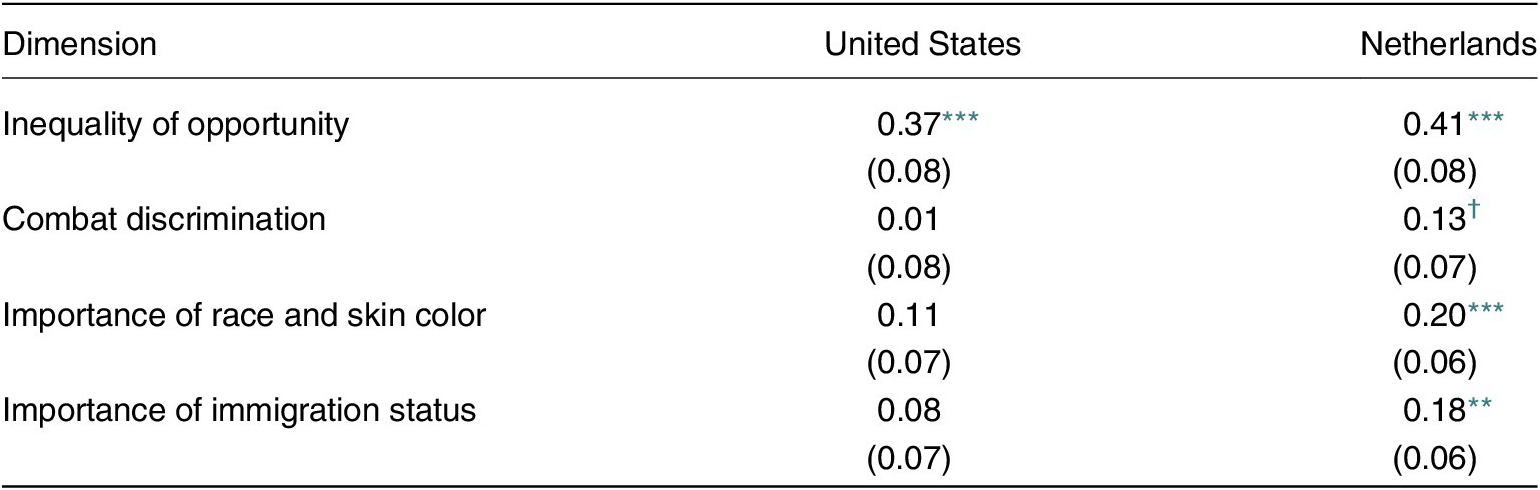
Having discussed participants’ baseline inequality beliefs, this section examines how the provision of facts about ethnic and racial inequalities affects those beliefs. To do so, we draw on OLS models to identify the average treatment effect of information on participants’ beliefs as the difference between treatment and control group, controlling for pretreatment beliefs and controls. Table 1 gives the regression results, where the estimated coefficients indicate the points difference in participants’ responses associated with the informational treatment, in each country.
The effect of information about ethnic and racial inequality, by dimension of inequality belief and country
Note. Coefficients denote the average treatment effect of information by country, estimated with ordinary least square regression (standard errors in parenthesis).
† p < 0.10,
* p < 0.05,
** p < 0.01,
*** p < 0.001 (two-tailed).
Source: author’s sample (n = 2079).
We find evidence of an average treatment effect on participants’ beliefs about racial inequality of opportunity in the order of 0.37 points (95% CI, 0.20 – 0.53) in our U.S. sample and 0.41 points (95 CI, 0.25 – 0.58) in the Netherlands. Substantively, this means that the provision of factual information about ethnic and racial inequality is associated with a stronger belief that minorities do not have the same opportunities as Whites, on a seven-point scale, about a third of the way from “somewhat agree” to “agree” (U.S.) and approaching half the way from “neither agree nor disagree” to “somewhat agree” in the Netherlands.
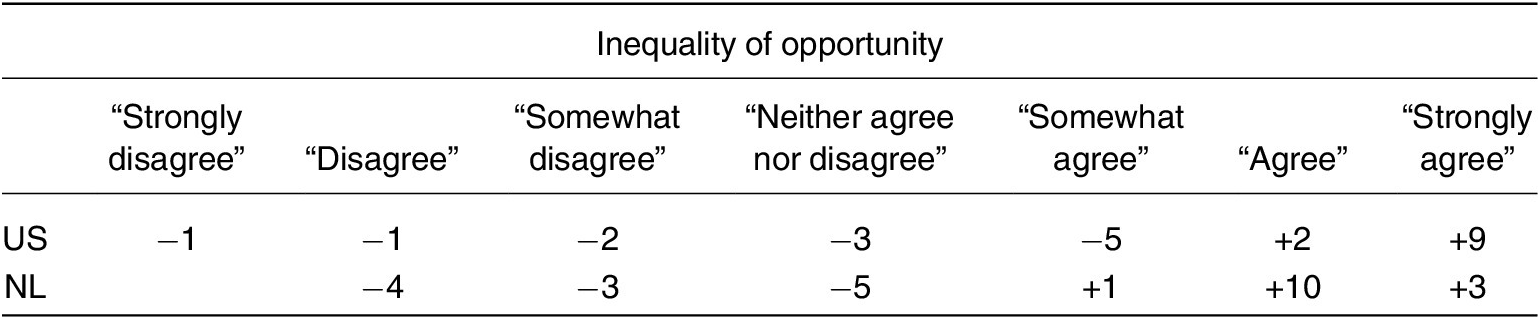
Estimation using ordinal logistic regression confirms these findings. The ordinal logit estimates allow us to see if the treatment effect is associated mainly with participants reconsidering their belief that ethnic and racial minorities do not face unequal opportunities or with participants strengthening their belief that they do. To this end, we estimate predictive margins, which give the percentages of participants in the control and treatment group for each response category. From these we can calculate the percentage point difference that is associated with the treatment effect, as summarized in Table 2.
Predicted percentage point difference between control and treatment group on perceptions of inequality
Note: Numbers indicate the percentage point difference associated with the information treatment across each of the seven response categories, based on predictive margins estimated from an ordinal logistic regression model. All point differences are statistically significant from zero at p < .05. Empty cells indicate non-significant differences. Source: author’s sample (n = 2079).
To highlight the key findings from the ordinal logistic regression analysis (Table 2), in the United States we find a shift across the distribution of responses as participants who receive the information treatment are less likely to “strongly disagree” (1% vs. 2%), “disagree” (2% vs. 4%), “somewhat disagree” (3% vs. 5%), “neither agree nor disagree” (6% vs. 9%) or “somewhat agree” (21% vs. 26%) that racial minorities face inequality of opportunity. Conversely, participants in the treatment group are more likely, by two and nine percentage points, respectively, to “agree” (36% vs. 33%) or “strongly agree” (31% vs. 21%). Taken together, the informational treatment is associated with a twenty-three percentage-point difference in the distribution of responses, comparing the control and treatment group. In the Netherlands, similarly, we find a twenty-six percentage-point difference between the distribution of responses in the control and treatment group. Interestingly, while the treatment is associated, most clearly, with a nine percentage-point difference in the number of U.S. participants who “strongly agree,” in the Netherlands, it is expressed as a ten percentage-point difference in the number of participants who “agree.”
Turning to attitudes about the role of government in the United States, we do not find evidence of a significant treatment effect (at p < .05), in either OLS or ordinal regression. In the Netherlands, we only find a small and marginally significant effect (p < .10) (Table 1). These null findings could plausibly reflect a ‘ceiling effect’ given the relatively high baseline support for government’s role in combating discrimination across countries: some 82% and 90% of control group participants in the United States and the Netherlands, respectively, already somewhat agree, agree, or strongly agree that the government has a responsibility to combat discrimination.
Next, we look at participants’ belief in the importance of race and skin color and immigration and legal status in determining a person’s chances of success (Table 1). We find evidence of a statistically significant treatment effect across the board only for our Dutch sample (p < .01), where participants in the treatment group are about a fifth of a point on a five-point scale closer to believing these factors are “fairly important” as compared to “not very important.” We do not find a statistically significant effect on their belief in the U.S. context (p > .10).
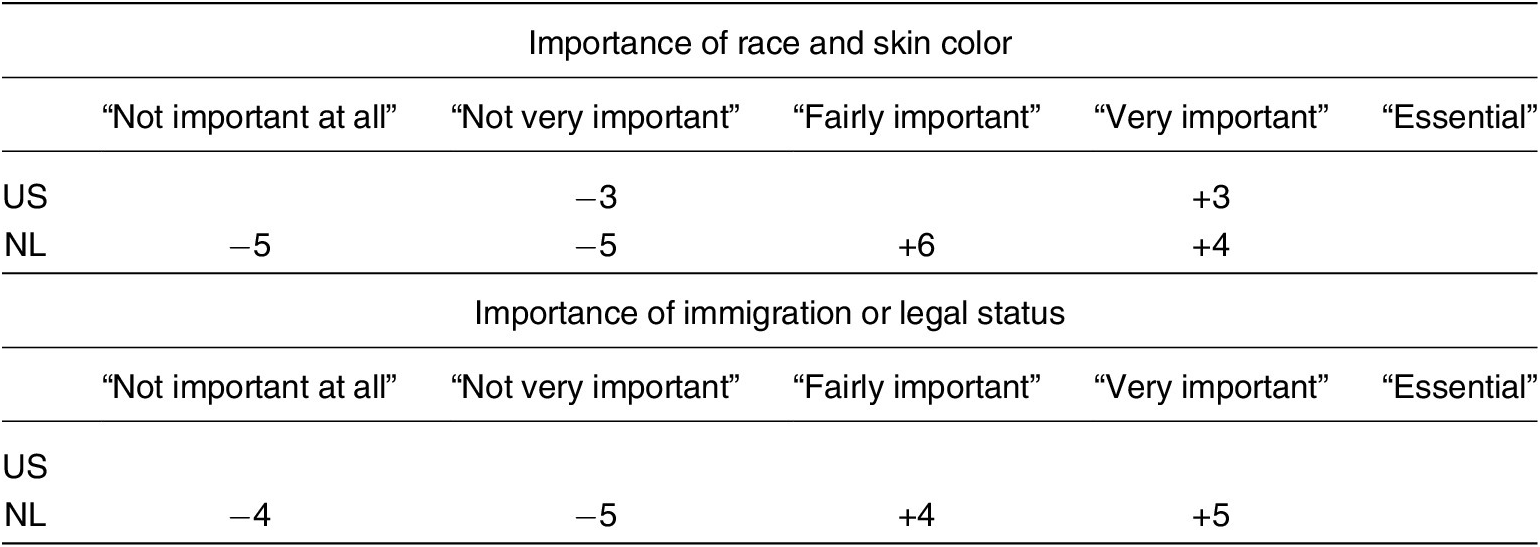
The ordinal logistic regression results reported in Table 3 confirm these findings, with one important difference. Whereas we find no evidence of a treatment effect in the United States for the perceived importance of immigration or legal status, regardless of the modeling approach we take, the ordinal logistic regression does reveal a treatment effect, albeit small, on beliefs about the importance of race and skin color. The treatment effect is associated with a three percentage-point difference between control and treatment group among participants who deem race and skin color to be “not very important” and a three percentage-point difference among participants who think it is “very important.” In the Netherlands, we find a substantially larger treatment effect associated with a twenty percentage-point difference in the distribution of responses on the perceived importance of race and skin color, and an eighteen percentage-point difference for the perceived importance of immigration or legal status. As we saw with perceptions of inequality of opportunity in the Netherlands, the treatment seems to move people closer toward agreement, while falling short of fully endorsing either statement.
Predicted percentage point difference between control and treatment group on explanations of inequality
Note: Numbers indicate the percentage point difference associated with the information treatment across each of the five response categories, based on predictive margins estimated from an ordinal logistic regression model. All point differences are statistically significant from zero at p < .05. Empty cells indicate non-significant differences. Source: author’s sample (n = 2079).
Although a between-country comparison of the magnitude of the average treatment effects cannot be readily made, we invariably find higher and more consistent treatment effects across dimensions of inequality in the Netherlands as compared to the United States. This difference likely reflects cultural differences in public perceptions of racial and ethnic inequalities. Coupled with the descriptive results discussed in the previous section, we have strong indication that the same information produces more of a shock to Dutch participants’ belief systems and, as such, is more likely to affect belief change. At the same time, we cannot rule out compositional differences between the two national samples, to which we now turn by systematically comparing treatment effects between majority and minority group participants in the two countries.
How are minority and majority groups’ inequality beliefs impacted by the provision of facts?
Table 4 presents the OLS regression estimates of conditional treatment effects by majority/minority group and by country. Results are based on the same statistical models as previously discussed, but additionally include an interaction term between the informational treatment and participants’ majority or minority group status.
Conditional treatment effect of information about ethnic and racial inequality, by minority/majority group and country
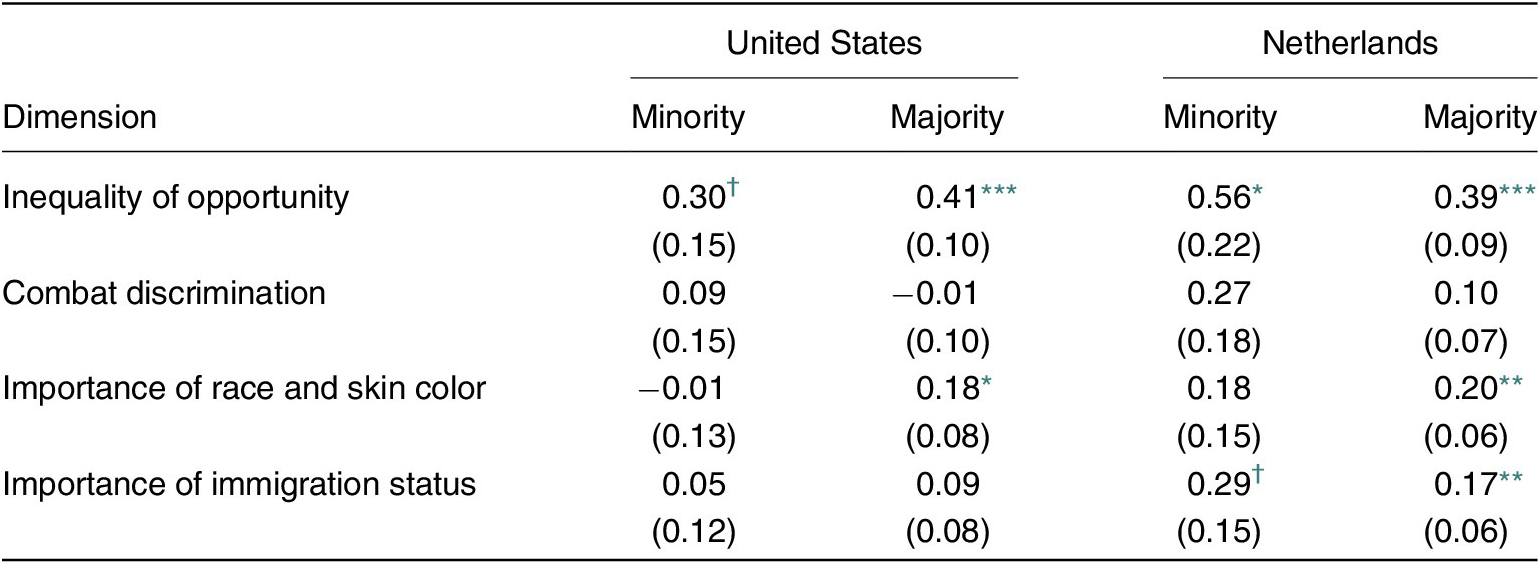
Note: Coefficients denote the conditional treatment effect of information by majority/minority group and country, estimated with ordinary least regression (standard errors in parenthesis).
† p < 0.10,
* p < 0.05,
** p < 0.01,
*** p < 0.001 (two-tailed).
Source: author’s sample (n = 2079).
Considering perceptions of racial and ethnic equality of opportunity, we find a significant treatment effect across groups and countries; albeit varying in size and significance. We find a similarly sized treatment effect among ethnic and racial majority groups in the United States (0.41; 95% CI, 0.22 – 0.61) and the Netherlands (0.39; CI, 0.21 – 0.57). Among minority groups, however, the findings diverge. Whereas we observe a substantively large treatment effect in the Netherlands (0.56; 95% CI, 0.12 – 0.99), we find only a marginally significant treatment effect among U.S. minority group participants (0.30; 95% CI, 0.00 – 0.60).
Turning to participants’ belief that government bears responsibility for combating discrimination, we do not find evidence of a significant treatment effect for any of the groups we studied. As suggested above, quite possibly, these null findings represent a ceiling effect. We do note that the coefficient for ethnic minority group participants in the Netherlands is substantively large, but the standard error is such that we cannot rule out a null effect. This is reflective of the small size of the Dutch minority sample and constitutes a limitation of our study, to which we return in the conclusion.
Examining the perceived importance of race and skin color in shaping a person’s chances of economic success, we find clear evidence of a significant treatment effect for the majority group in each country. That is, for White Americans (0.18; 95% CI, 0.02 – 0.34) and non-immigrant Whites in the Netherlands (0.20; 95% CI, 0.09 – 0.32), factual information describing racial and ethnic discrimination strengthens their belief that race matters for economic opportunities. Dutch majority group participants who received the informational treatment, similarly, are more convinced that immigration and legal status determines economic success (0.17; 95% CI, 0.04 – 0.29). We find comparable coefficients for Dutch minority group participants on both beliefs, albeit below the margin of statistical significance, whereas we find estimates approximating zero for the U.S. minority group.
Overall, then, we find evidence of conditional treatment effects by majority/minority group status. The evidence is most clear in the United States, where in each instance we find treatment effects of greater size and/or a higher level of significance among White participants. In the Netherlands, we observe the same general pattern but with the notable exception of an especially large treatment effect on minority group participants’ perceptions of inequality of opportunity. Taken together, these findings lend some support to the idea that the same information may produce more of a shock to (non-immigrant) Whites whose experiences with discrimination are likely to be limited. It is encouraging to see signs of belief change following the provision of information; a finding we return to in our conclusion.
As for the transatlantic comparison, on the whole, we find stronger and more consistent signs of belief change among the Dutch, although our conclusions at points are tempered by our limited statistical power, owing to the small number of ethnic minorities in our sample. We read these patterns as the Dutch ‘catching up,’ so to speak, with the American public, when they are forced to reckon with previously unacknowledged ethnic and racial inequalities that are centerstage in the American public conversation.
Does political orientation moderate the impact of the provision of facts on inequality beliefs?
As a last step in the analysis, we consider the mediating role of political orientation on the uptake of information about inequality. That is, does a person’s political identity impact whether and how they process information about inequality?
Table 5 summarizes what we learned. Starting with the United States, we highlight two notable findings. First, we observe an informational treatment effect on participants’ perception of inequality of opportunity among Democrats (0.67; 95% CI, 0.31 – 1.02), Republicans (0.54; 95% CI, 0.06 – 1.01), as well as those who identify with neither party (0.34; 95% CI, 0.04 – 0.63). Substantively, this finding suggests that the informational treatment cuts across partisan lines; affecting moderate Democrats the same way as it does moderate Republicans. Our second key finding in the United States paints a markedly less rosy picture of partisan polarization. Rather than make all participants more supportive of the government’s role in combating discrimination, our informational treatment seems to backfire with strong Republicans: following the provision of facts about racial discrimination, participants who identify as strongly Republican are less supportive of the government fighting discrimination by half a point on our seven-point response scale (-0.52; 95% CI, -1.02 – -0.01).
Conditional treatment effect of information about ethnic and racial inequality, by political orientation and country
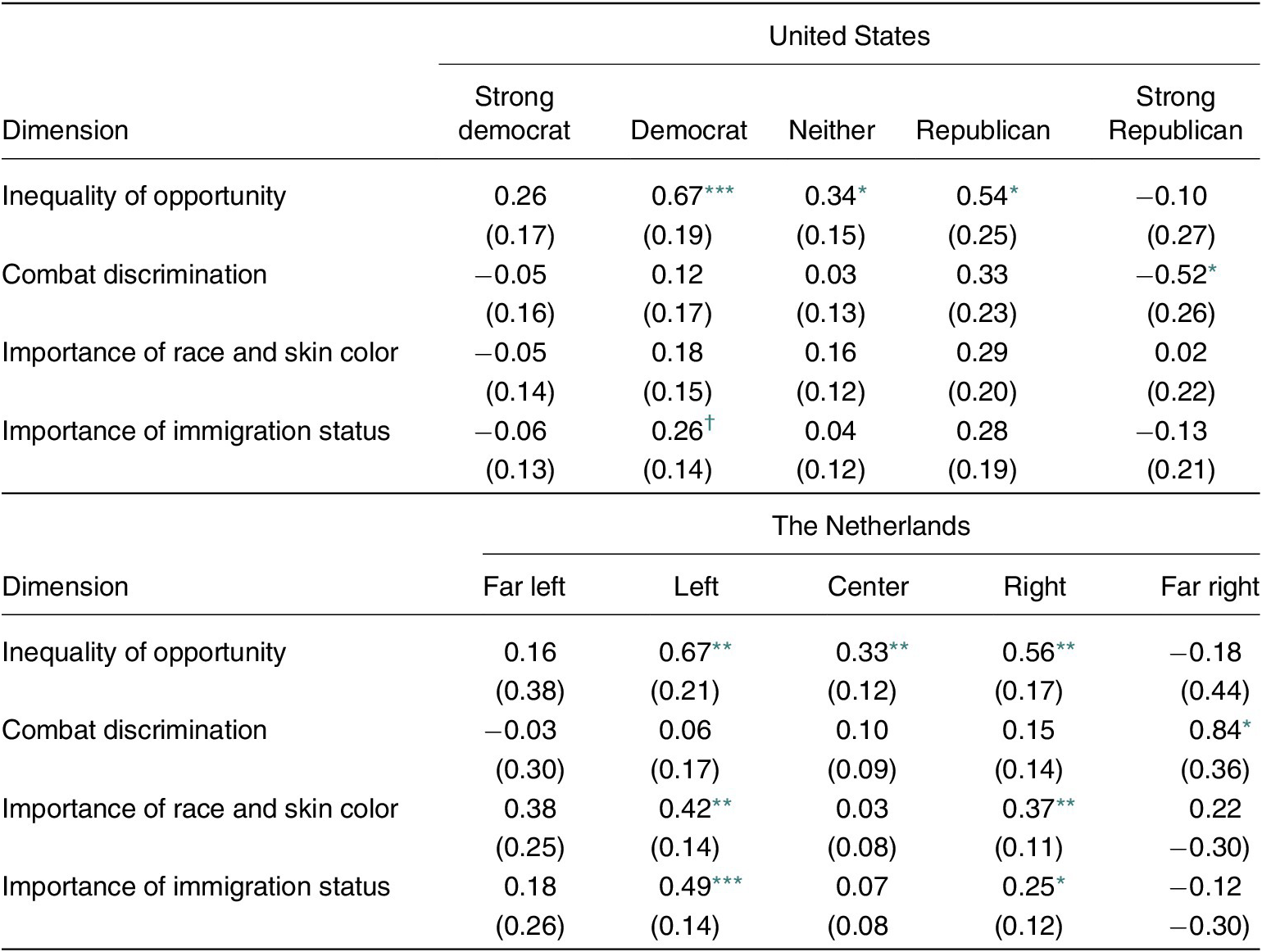
Note: Coefficients denote the conditional treatment effect of information by political orientation and country, estimated with ordinary least regression (standard errors in parenthesis).
† < .10,
* p < 0.05,
** p < 0.01,
*** p < 0.001 (two-tailed).
Source: author’s sample (n = 2079).
In The Netherlands, we find no sign of the informational treatment backfiring with the far right. Quite the opposite, we observe a substantively large and statistically significant positive treatment effect among participants who identify as far right (0.84; 95% CI, 0.14 – 1.55), indicating much greater support for the government’s role in combating discrimination, following the provision of factual information about ethnic inequality. For the other three outcomes, we find consistent evidence of belief change across the political spectrum, especially among participants identifying as left-of-center or right-of-center.
Conclusion and Discussion
In this empirical application and attempt to address racism of omission, against the background of the Black Lives Matter movement and COVID-19 pandemic, we investigated how majority and minority groups across the Atlantic understand racial and ethnic inequalities and whether their beliefs are malleable in the face of facts describing the reality of such inequities. Our findings are threefold.
First, we find that a sizeable share of the American and, especially, Dutch population does not believe unambiguously that ethnic and racial minorities face unequal opportunities. In other words, we find that public perceptions of the racial opportunity structure contrast sharply with the well-documented findings from scholarly research and government reports (Inspectie van het Onderwijs 2020; Kraus et al., Reference Kraus, Rucker and Richeson2017; Quillian et al., Reference Quillian, Heath, Pager, Midtbøen, Fleischmann and Hexel2019; Shores et al., Reference Shores, Kim and Still2020). These misperceptions are strongest among White Americans and the White, non-immigrant, majority in the Netherlands. Hence, beliefs about the nature of ethnic and racial inequality and opportunity support racism of omission on both sides of the Atlantic.
Second, and more optimistically, we find that providing people with factual information documenting these very inequalities, on the whole, increases their acknowledgement of the unequal racial and ethnic opportunity structure. At the same time, we find that the informational treatment is less likely to affect attitudinal change about the role of government and more deep-seated beliefs about the causes of inequalities (i.e., the perceived importance of race and skin color, and immigration and legal status, respectively, in aiding or obstructing economic success).
Third, we find that the same facts do not have the same effect on majority and minority groups’ beliefs. By and large, we find that information about ethnic and racial inequalities produces more change with people in the majority group. We do not find evidence of partisan motivated reasoning. In fact, our findings indicate that facts about ethnic and racial inequality can impact the inequality beliefs of people across the political spectrum. This pattern is most pronounced in the Netherlands, where we also find an instance of substantial belief change among participants who identify as far right. By contrast, in the United States, we find an instance of the informational treatment backfiring with strong Republicans, who become less supportive of government fighting discrimination after the provision of facts about racial inequality. These findings echo those of Jonathan J. B. Mijs and colleagues (Reference Mijs, de Koster and van der Waal2022), who argue that the political challenge of tackling social inequalities in the U.S. context means confronting within-party polarization on the Democratic and, especially, Republican side.
Our findings have important implications for research, theory, and practice. Survey experiments, we believe, are a promising avenue for documenting racism of omission and for identifying the possibilities and limitations of information designed to change beliefs. The empirical differences between perceptions, explanations, and attitudes, as documented in our study, means that these are key distinctions to make when designing prompts and questions for quantitative and qualitative research alike. Perceptions, our findings suggest, may be more malleable than explanations and attitudes, especially those on contentious issues like race and inequality.
Our research is not without its limitations. Whereas the experimental nature of our study compensates for some of the typical trade-offs involved in survey research (e.g., internal vs. external reliability), our study suffers from similar constraints as other (quantitative) research which by its nature is ill equipped to give context to people’s beliefs, cannot escape social desirability bias, and is unable to speak to the behavioral consequences of the documented attitudes. Our study is further limited by the small size of the minority-group sample in the Netherlands. Future research would do well to oversample ethnic and racial minority groups to document more precisely and definitively the between-group differences in beliefs and belief change suggested by our findings.
Theoretically, despite good reasons to expect majority group participants to be less likely to change their beliefs about ethnic and racial inequality (Bobo et al., Reference Bobo, Charles, Krysan, Simmons and Marsden2012; Hunt Reference Hunt2007; Hunt and Smith Reference Hunt and Smith2022), our research indicates what looks like a greater readiness for belief change among White, non-immigrant, participants. We make sense of this finding as the greater likelihood of the same information constituting a ‘shock’ to majority group participants’ beliefs. The upside is that impartially presented factual information could cut across group divides even in politically, ethnically, and racially polarized societies like the United States and the Netherlands.
Our findings also point to country context as a crucial mediating variable; the same information tends to make much more of a splash in the Netherlands than it does in the United States. One interpretation of this country-difference in treatment effects is of a floor effect, meaning that information produces greater belief change as ignorance about ethnic and racial inequalities in the Netherlands is greater than in the United States. Another way to make sense of this finding is that Dutch society’s denial of its racist past and the peripherality of race is more easily punctured by the provision of information than the American myth of equal opportunity.
To policy and practice, then, the documented effectiveness of informational provision may provide tools for activists and policymakers looking to raise awareness about inequalities and inequities. For instance, informational interventions could take the form of educational curricular reform (cf. Donovan Reference Donovan2017; Stewart et al., Reference Stewart, Latu, Branscombe, Phillips and Denney2012) or of nonpartisan NGO campaigning and government information provision (cf. McCall et al., Reference McCall, Burk, Laperrière and Richeson2017; Mijs and Hoy, Reference Mijs and Hoy2021; Onyeador et al., Reference Onyeador, Daumeyer, Rucker, Duker, Kraus and Richeson2021). Such efforts to document and disclose discrimination may prove to be an effective vehicle to raise awareness, confront racism of omission, and foster a fact-based public conversation about racial and ethnic inequalities.
Supplementary material
The supplementary material for this article can be found at http://doi.org/10.1017/S1742058X23000140.
Acknowledgements
We benefited from helpful feedback from Debby Carr, Carly Mast, Shradda Pingali, Kate Sandage, Jessica Simes, Ian Sue Wing, and Wesley Wildman. We also thank the editors and anonymous Reviewer 2 for their constructive comments. We gratefully acknowledge funding from the Center for Interdisciplinary Social Science at Boston University which supported the yearlong undergraduate research internship of which this paper is the product. In addition, the first author received funding from a Veni grant from the Nederlandse Organisatie voor Wetenschappelijk Onderzoek (NWO), grant no. VI.Veni.201S.003.


 Open access

