




Introduction
Although there is no formal environmental education curriculum mandated at the federal or state levels for early years settings in the United States, “connection to nature” is a curricular priority in the frameworks endorsed by national organisations that promote environmental education. For example, the guidelines produced by the North American Association for Environmental Education (NAAEE) state that “the task of environmental education for young children is to forge the bond between children and nature” (NAAEE, 2010, p. 4). Although this concept of connectedness has been studied from several perspectives, the relationships that these kinds of guidelines envision are both romantic and anthropocentric (Hohti & MacLure, Reference Hohti and MacLure2022; Taylor, Reference Taylor2011), effectively hemming “natural” into a discrete category of experience and “nature” into an entity teachers can provide for children through specific kinds of teaching and learning (Rautio, Reference Rautio2013). That is, some educational experiences are “natural” and some are not, or there are somehow discernible degrees of naturalness within educational experiences (and more nature is better), and that the right kinds of nature-related experiences will lead to positive outcomes for both the children and the natural environment (Merrick & Braus, Reference Merrick and Braus2013). With regard to early years education more broadly, scholarship and policy related to teaching and learning also remains a largely humanistic endeavour within our context in the United States. Within mainstream best practice (e.g., Friedman et al., Reference Friedman, Masterson, Wright, Bredekamp and Willer2021) the non-human is relegated to the realm of tools, supplies, objects or otherwise passive educational material and is rarely conceptualised as a curricular protagonist. And within this hierarchy, the “good” early childhood teacher is imagined as engaging in neat and timely cycles of constructive action and critical reflexion in order to orchestrate the (natural) educational experiences that allow children to construct increasingly accurate understandings of the world (Lenz Taguchi, Reference Lenz Taguchi2010).
This article aligns itself with the growing body of “material” and “animal” scholarship within childhood studies and early education internationally and takes as a given that the prevailing views of children, nature and teacher are not sensitive to nor inclusive of the complex relational reality of teaching and learning in early years spaces (Malone, Reference Malone2016). By applying relational and multispecies onto-epistemologies (e.g., Barad, Reference Barad2007; Braidotti, Reference Braidotti2019; Haraway, Reference Haraway2008; Tsing, Reference Tsing2015) to both children’s classroom relations and our own teacher-researcher subjectivities, this work aims to highlight what possibilities for early years practice might emerge when these dominant hierarchies are destabilised. Building upon research that explores the relationalities of children and non-human others (e.g., Malone, Reference Malone2016; Myers, Reference Myers2019; Tammi, Rautio, Leinonen & Hohti Reference Tammi, Rautio, Leinonen, Hohti, Cutter-Mackenzie, Malone and Barratt Hacking2018; Taylor & Pacini-Ketchabaw, Reference Taylor and Pacini-Ketchabaw2015), as well as “how movement does relationships” in early childhood educational contexts (Riley & Proctor, Reference Riley and Proctor2023, p. 663; See also, Riley & Proctor, Reference Riley and Proctor2022), we foreground our own becomings as early years teacher-researchers within the inquiry itself. This article maps our experiences as early years teacher-researchers, attending specifically to mutually constituted conditions of movement within and across educational timespaces. We engage with movement in both the literal and figurative — as an act of changing physical location or position, such as moving one’s body, and of progressing or developing in particular directions, such as being moved emotionally or intellectually — in an attempt to complicate the images of thought that ground mainstream understandings of children’s everyday engagements with the non-human in early years contexts, and to become different(ly) in the process.
Unsettling through research-creation and diffractive mapping
For the purposes of this article, we asked ourselves: If we approach understanding children’s engagements with the non-human and our way of refining and articulating those understandings with relational ontologies as a given, what is produced? Lather (Reference Lather2016) encourages researchers to disrupt settled places in their thinking and doing. For us, this led us to disrupt notions of easily definable and knowable relations, and timely and orderly reflective teaching. Instead, we engaged in research-creation processes that foregrounded the emergence of complex relations (i.e., the more-than-human), delimited process through the use of an enabling constraint (i.e., attending to events of movement) and relied on future-orientated vs. reflective capacities (Springgay & Truman, Reference Springgay and Truman2018; Truman & Springgay, Reference Truman, Springgay, Laverty and Lewis2015, Reference Truman, Springgay, Powell, Bernard and Mackinley2016). Our methods utilised deep reading, creative writing, poetic re-storying (McKnight, Reference McKnight2016; Riley & Proctor, Reference Riley and Proctor2023), and theoretical thinking-with each other over the course of a decade to generate speculative and affective research that is “necessarily selective, partial and never exhaustive” (Braidotti, Reference Braidotti2019, p. 33).
Our research-creation processes entailed diffractively engaging with data events from our teaching experiences in early years settings, “reading insights through one another while paying attention to patterns of difference’ (Barad, Reference Barad2011, p. 445). Drawing on both Haraway (Reference Haraway1997, Reference Haraway and Haraway2004) and Barad (Reference Barad2007, Reference Barad2011), we understand diffraction to be both metaphor and method. As a metaphor, diffraction gives an alternative image of thought that rejects the sameness and immediacy that “reflexion” implies. As a method or apparatus, thinking-doing diffractively in relation to events from early years education allows us to map productive differences that emerged within our teaching and learning processes, highlighting the contours of mattering in ways that more traditional approaches to data might not (Davies, Reference Davies2014; Lanas et al., Reference Lanas, Rautio, Koskela, Kinnunen, Viljamaa and Juutinen2017; Moxnes & Osgood, Reference Moxnes and Osgood2018; Myers et al., Reference Myers, Smith and Tesar2017). That is, instead of looking for themes or similarities that can be generalised to simplify or summarise a social context, we work from small moments of disturbance or rupture and map the effects of “the entanglement of bodies, texts, relationships, data, language, and theory” (Mazzei, Reference Mazzei2013, p. 745). Entering into a diffractive method allowed us to attend to the effects produced by difference and to (re)visit our teaching practices with young children “attentively and with care” (Bozalek & Zembylas, Reference Bozalek and Zembylas2016, p. 115). We not only read the events of movement through major and minor narratives on more-than-human relationships in educational contexts, early years teaching and learning, and teacher development, but also through the physical properties, material assertions and animalities of the more-than-human others who comprised the events. This “opens the possibility for seeing how something different comes to matter” (Davies, Reference Davies2014, p. 3) not only in the encounters between children and their non-human classmates, but also in our own teacher-researcher becomings, long after those initial moments of encounter in the early years classroom have passed.
The vignettes that follow are nonlinear, constructed cuts of teaching-researching events, read through relational onto-epistemologies. They are stitched together, not in chronological order or by theme, but in an effort to map the effects of movement on multiple scales (e.g., literal events of movement between teachers, children and non-humans, and the figurative movements of making and remaking ourselves as early years teacher-researchers). These more-than-human movements emerged during our classroom encounters with young children, animals and plants. They vary in intensity and duration, as we continue to engage with the constructed cuts and (re)presentations of these events years later as critical early years practitioners, researchers and long-time collaborators. These data events are re-constructions from our own photos and videos, woven with narratives that were created during our various teaching roles (e.g., preservice teacher, lead teacher, graduate student, teacher-researcher) and in various teaching contexts (e.g., laboratory schools, early years centres and outdoor education programmes) across the Midwest and South-east United States.
By highlighting the ways in which literal and figurative movements materialised, we attend to what emerges within these multispecies educational encounters, and contemplate how non-human others emerged as curricular protagonists in ways that we had not anticipated. Because this inquiry with/in more-than-human movement is “an assemblage that continues to become” (Nordstrom & Ulmer, Reference Nordstrom and Ulmer2017, p. 7), what follows can be understood as a mapping of the middle, wherein a complex (meta)physics of more-than-human movement affords literal and conceptual turning, enmeshing, decentering, connecting and rupturing, producing a less certain but more attuned early years teacher, one that ultimately has more questions than answers.
Movements from the middle
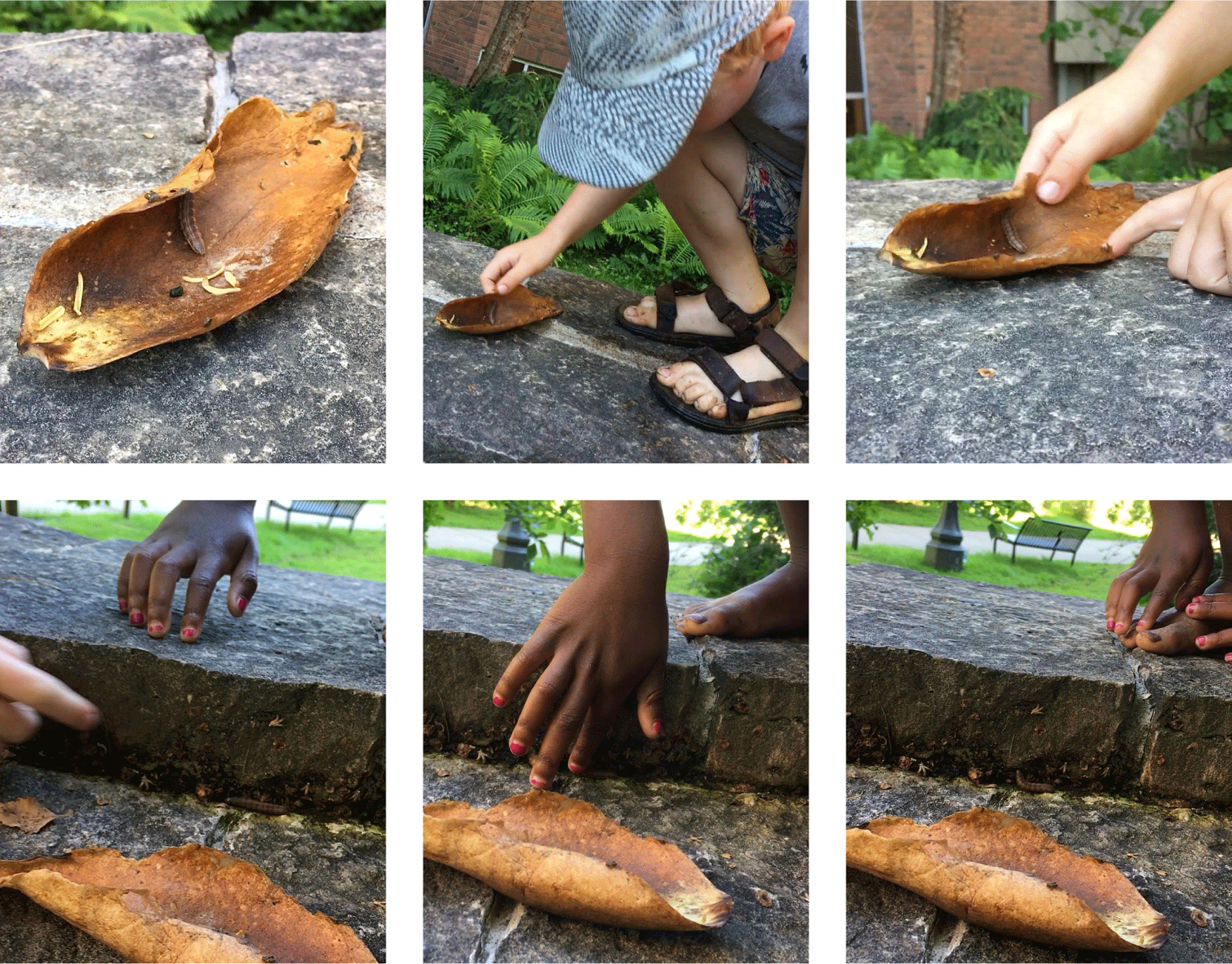
Caterpillar encounters, Rachael, teacher-researcher, graduate student (see Figure 1)
He’s waking up
He’s waking up
Here he comes
Is it a worm?
It’s a caterpillar
Oh yeah, it’s a caterpillar
A CATERPILLAR!
No, don’t!
Remember
if you yell
it will go back to sleep
Carefully, not to disturb
He gently lifts the leaf
Whew
no curl, no defense
trusting
She whispers
c a t e r p i l l a r
“Human nature is an interspecies
relationship” (Tsing, Reference Tsing2012, p. 144).
It camouflages in there
Look!
the leaf begins to move
A fast one!
Oh! He’s that fast
he’s that fast
One finger pet and a quiet voice
she whispers again
it’s a caterpillar
“Encounters are becomings …
they are movements, lines,
flows of differing” (Barua, Reference Barua2016, p. 265).
We relate through our difference
and alikeness
‘flows of differing’
reciprocal influencing that moves us to respond
with the world
to question
to (re)construct
knowledges
identities
concepts of time and place
what emerges are multispecies understandings
Oh my gosh
a caterpillar
In these moments of connection,
entanglements with the more-than-human
help shape the understandings children have of their worlds
“Actual encounters are what make beings” (Haraway, Reference Haraway2008, p. 67).
…
Caterpillar encounters.
Three teachers had been discussing for a few weeks what the children referred to colloquially as “bugs”—a category of animal that (for these children) included true insects, as well as other invertebrates such as worms and spiders. Perhaps it was because an unseasonably warm September and October supported a larger population, or perhaps it was that this specific configuration of children and teachers was particularly attuned to small creatures, noticing them in ways that others in seasons-past had not. Whatever the reason for this bug “explosion,” the effect was that these animals seemed to be engaging the children more than usual, inserting themselves into everyday school life. Stinkbugs on the windows quieting the children, mantid horror on the playground sending children screaming, bouncing grasshoppers enticing the children to hunt through tall wildflowers.
“We’re overrun lately – it’s like the population of grasshoppers has exploded…it’s an explosion. The children ask each morning to “go bug-hunting” in the wildflower patch.”
“(The stinkbugs) are all along the window screens as soon as the sun hits it, and the children line up to look at them…we spend a lot of time just looking quietly, talking about them, [laughing] smelling them.”
“I’ve never seen so many (mantids) all at once. The children found three yesterday on the playground. We watched one eat a cricket and the children screamed…they are still talking about it. They were, like, so disgusted but also thrilled by it…and now they want to find other bugs, food for them to eat.”
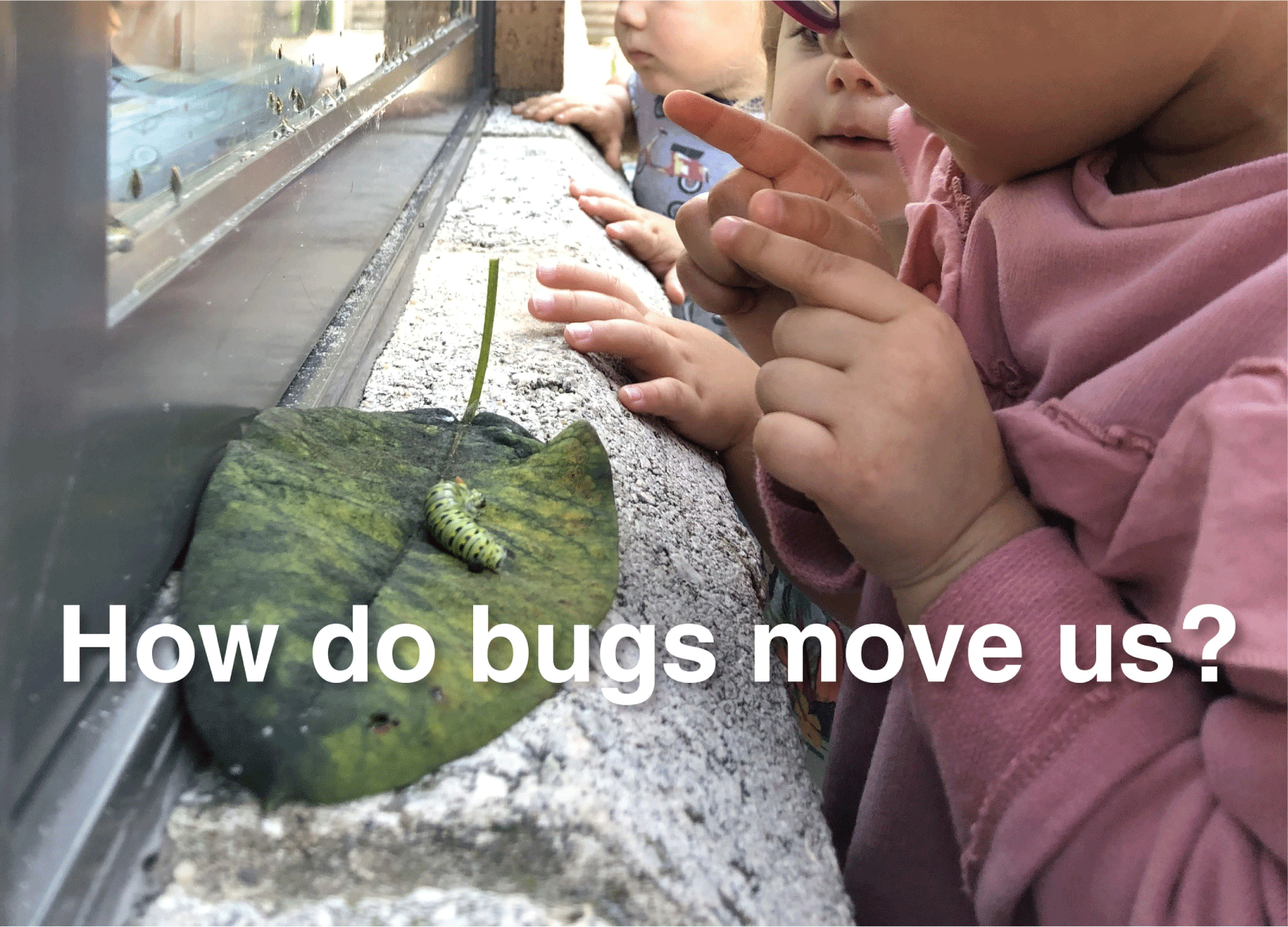
As the studio and research coordinator at a large university-affiliated early years laboratory school, I (Casey) met regularly with these lead teachers to discuss emergent themes in their curriculum, and how we might make these tangible to others across the school community. This work often entailed developing and installing large-scale public installations of photos and teaching narratives in collaboration with various teams of teachers, children, university students and families. In service of this, I printed large photos of these bug encounters and hung them in the main hallway, with text that read, “How do bugs move us?” (see Figure 2). I meant for the question to be provocative and vague. This was a question that we were grappling with in our curriculum meetings, and I wondered what other adults in the school community might notice about the ways in which bugs were setting children into motion or about the possibilities for non-humans to drive the curriculum.
A photographic panel, showing children engaged with various bugs on an outdoor window ledge, with text reading, “How do bugs move us?”
As I observed others’ engagement with the hallway installation over the course of several days, a version of this conversation happened frequently between adults and children as they passed:
Adult: It says, “How do bugs move?”
Child/ren: Fly! Slither!
Adult: Very good!
Adult: Do spiders fly or do they crawl?
Child/ren: Crawl!
Adult: Let’s crawl down the hallway like spiders. C’mon spider classmates, let’s go!
Over and over again, adults read this question in that particular way; How do bugs move us? became “How do bugs move?” when read aloud. I was not surprised that adults seized an opportunity to quiz children about the ways in which certain kinds of invertebrates moved. Within the context of the United States in particular, what is accepted as early childhood “best practice” serves to uphold the binary between human and other non-human “things.” This is especially persistent with regard to young children’s engagements with plants and animals; these are conceptualised as instrumental matters, wherein children are hyperautonomous individual learners (Prout, Reference Prout2005) and non-humans are relegated to the passive tools for children’s science learning (Myers, Reference Myers, Cutter-Mackenzie-Knowles, Malone and Barratt Hacking2018). But I was struck by adults’ seeming inability to read the question as it was written. My question was intended to be an inquiry into our relationships with creatures, but it was being read as a test wherein animals were the object of study and the correct answers could be performed by children. Was this intentional? It happened so often that it seemed like a case of particularly humanist pareidolia—the phenomenon wherein we perceive something ambiguous as something familiar, such as seeing a dragon in the clouds or a human face in a rocky cliffside. I had anticipated that some might not want to engage with the question. But I had not expected that the workings of anthropocentrism would be highlighted in this way, so persistent that it was rearranging words somewhere between the way they were written on the page and spoken aloud and perhaps so stealthily that the reader wasn’t even aware of the shift that had taken place.
Putting my dismay at being misunderstood aside, I can explore this as yet another tension (among so many others) in the affective-material worlds that children and the non-human share at school, wherein our thinking is entangled with doing and the collective agency of beings asserts itself, all the while humanist optics also constrain what is possible. Both despite and because of the misreading of the hallway display, bugs were still emerging differently and becoming variously intelligible to us from moment to moment: gathering the children’s attention, driving teacher practice, enmeshing with idea(l)s around teaching and learning, and embodied in the children’s miming in the hallway at the request of their teacher. These were/are collective movements upon movements, wherein the “singular ‘I’ becomes a relationally entangled I/us” (Riley & Proctor, Reference Riley and Proctor2023, p.663). How do bugs (continue to) move us?
…
Perhaps.
Perhaps, Rachael, early years and art teacher (see Figure 3)
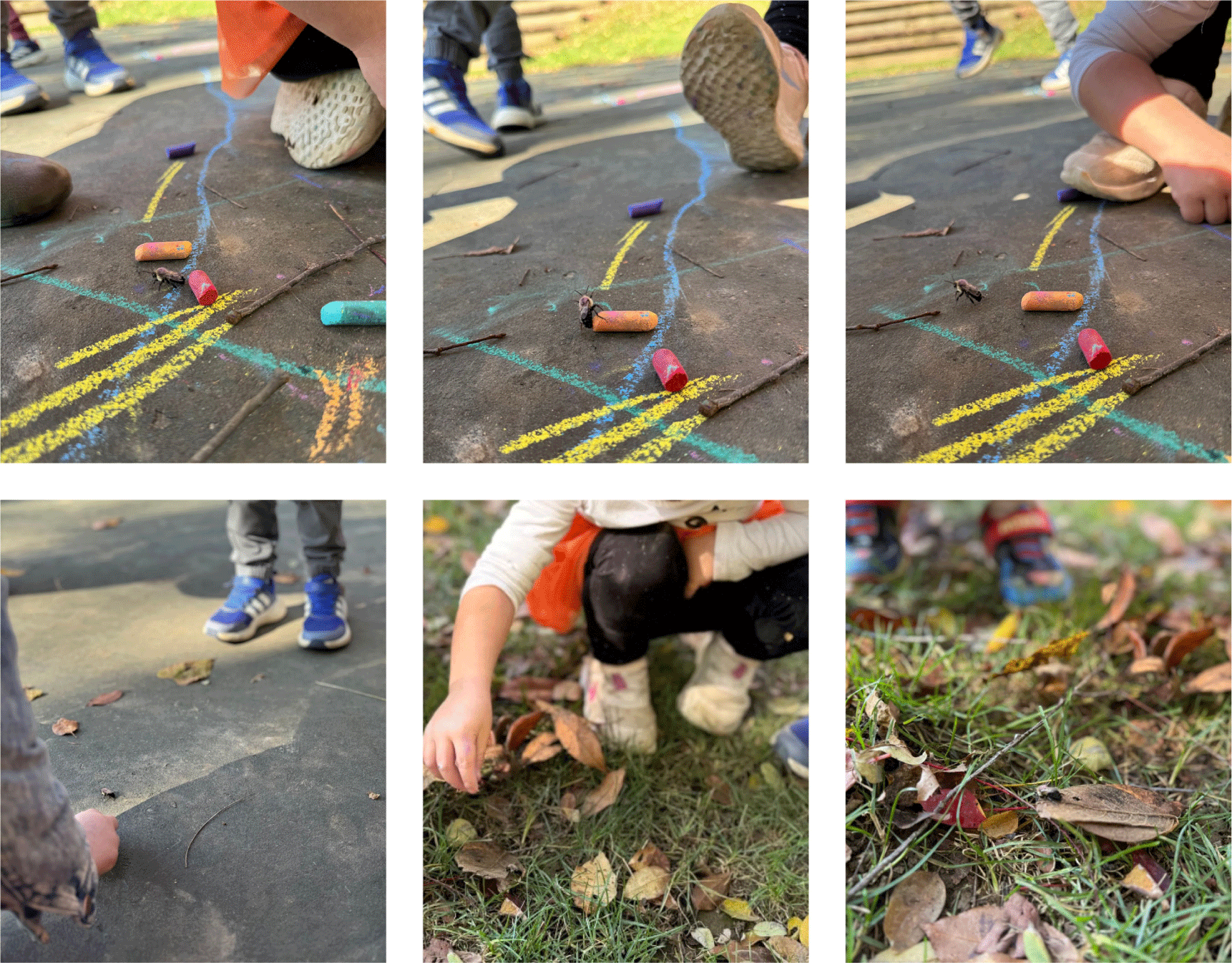
A bumblebee
crawling
right through a chalk drawing
purple dust
clinging to its hairs like pollen
Why did it land
on the green top?
I think it’s looking for food
a gust of wind disrupts their inquiry
creating a flurry of movement
of leaves and children
Uh oh!
It’s going to blow away!
she remains
crouching
a traditional position
to hide or protect oneself
but instead
she moves to protect
this tiny creature
“All living beings emerge
from and make their lives within multispecies communities” (van Dooren, Kirksey, & Münster, Reference van Dooren, Kirksey and Münster2016, p. 2).
We need space for it
What do you mean?
So it can walk!
It needs space
to walk
to go into the woods
Holding onto a leaf
that she caught in the air
she leans towards the bee
and scoops
Don’t!
Don’t!
leave it there
we can’t touch it
it has to be on the ground
Yeah it can’t fly
How do you know?
Well it’s on the ground
Maybe it’s just a baby
It’s ragged wings
tell me otherwise
It must be a baby
and you know
babies can’t fly
I think
about what she’s shared
‘babies can’t fly’
a reason
her belief
rooted in anthropocentrism
human babies cannot fly
but
there are precocial species
bats
ducks
chickens
megapode birds
whose young
can fly
soon after birth
Some babies can fly
It’s actually
just
a bumblebee
No, it’s a
b a b y
because
it can’t fly
Babies can’t fly
what moves us
to question our preconceptions
to unlearn
Maybe it’s going
to tiptoe
to the woods
and die
No,
it’s going to die or fly
but I think
it’ll fly
I’ll watch it
time moves our schedule
a normative and temporal
ordering
Not inclusive of multispecies
reminding me
of the hierarchy
of ‘who matters’
But “the world is a knot in motion”
(Haraway, Reference Haraway2003, p. 6)
relational understandings evolve
from us slowing down
when we attend to
our affective capacities
of becoming-with
so how might our everyday encounters
with children
be acts of response-ability
resistance
allyship
kinship
“I suggest that matter
is acknowledged as agential
for children, as for adults
and children may more freely be understood as humans
entangled with the non-human
and with each other” (Birch, Reference Birch2018, p. 516).
It’s time for us to go
but
let’s revisit
tomorrow
maybe
it will be flying
maybe
it will be gone
maybe
it will be back
with us
tomorrow
Perhaps
there are many
possibilities
…
It’s snack time in the laboratory school kindergarten classroom where I (Casey) am working as a classroom researcher. I am sitting at the snack table with two five-year-olds and a bowl of pears. They are to have one each for their snack. After several bites of her pear, Paige finds a worm in the centre of her fruit. Its tiny body is almost the same colour as the flesh of the pear.
Paige: It’s peeking its head out from a hole! Ha! It peeked out!
Casey: What is?
Paige: A worm! A worm! Ha!
Casey: There’s a worm in your pear? Really?
Paige: It’s peeking out! I see it moving!
She had bitten through to the core and the worm was in the small hollow space that houses the seed.
Jackson: Where? Oh!
Casey: Oh, I see it! Ha! It’s so tiny! How did you even notice it was there?
Paige: I saw it peeking out! I said so!
Casey: [Laughing, humbled] Oh, right. Of course.
The worm begins to crawl out of its hollow and across the flesh of the pear. Jackson and Paige squeal with delight. The classroom teacher arrives and asks the children to lower their voices. She places the worm and a few small pieces of pear into a glass jar. She assures the children that the jar will keep the worm safe; she takes the jar across the room and places it on a shelf in the “science center” area of the classroom. Jackson and Paige follow her across the room; the teacher reminds them to walk slowly. Jackson grabs a magnifying lens and the jar from the shelf and sits down.
Jackson: [Whispering] It’s wiggling…look.
Paige begins to jump up and down. The teacher reminds the children that the jar is made of glass and the worm is fragile. She tells them that if they want to observe the worm in the jar, they must sit and look quietly.
Jackson: Paige! STOP!
Paige: YOU stop! [Giggling] It peeked right out, like…
Jackson: You’re not going to get a turn. Stop!
Paige: I already saw! Casey, look! LOOK! Take a photo of this! Get this!
She continues to jump up and down and then she transitions into jogging in place, putting her finger in front of her face and wiggling it to mime the worm’s “peeking” motion. I press my camera’s shutter button and it fires several times in quick succession.
Paige: Did you get me? Let me see. [Scrolling through the digital images on my camera’s display screen] Oh yes. Ha! There I go! Worm, worm!
Paige scrolls back and forth on the camera’s viewfinder several times, smiling. Jackson continues to sit, inspecting the worm with the magnifying lens. Across the room, another child rings a small bell and announces that it is time for morning circle (see Figure 4). Their teacher calls them over to the carpet. Paige and Jackson leave the science area, Jackson walks but Paige continues to jog/hop across the room to where her class is gathering on the carpet. Her teacher reminds her to walk carefully. The teacher begins the class meeting by making an announcement about the worm in the jar; she tells the children it will be available for observation until recess, when it will be released into the school’s compost pile along with other offerings from the classroom’s scrap bucket.
Worm-wiggling.
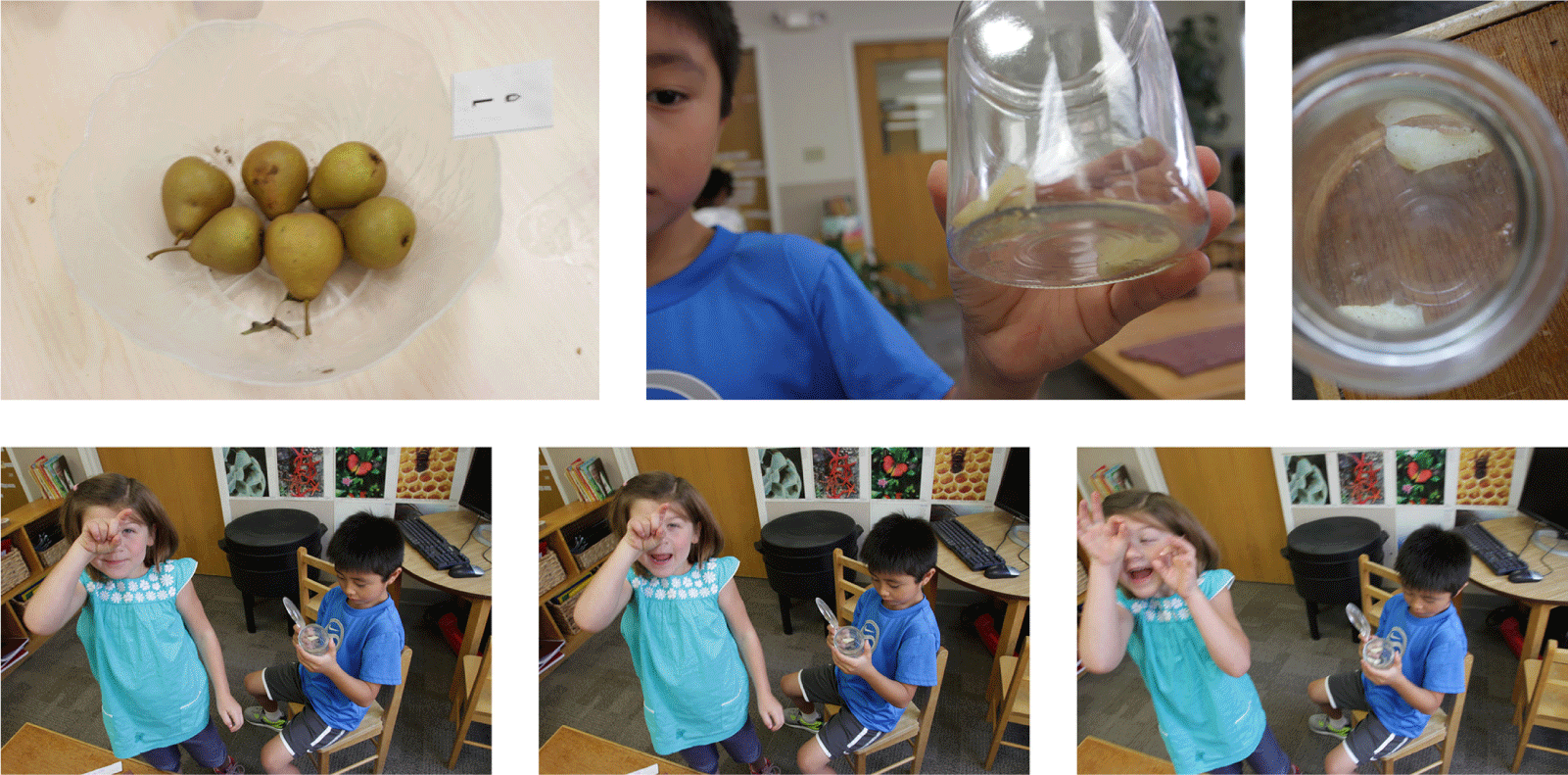
Biting, peeking, wiggling, squealing, placing, walking, sitting, looking, jumping, jogging, wiggling—this classroom encounter was rife with movements wherein child and worm became intelligible as certain kinds of entangled subjects. Paige’s biting and the worm’s peeking set into motion a cascade of classroom events, some of which reinforced the traditional educational hierarchy between children and animals, and some that disturbed it. Placed in the glass jar and transported across the room to the “science area” by the teacher, the worm became intelligible as an object of study. Jackson emerged as a serious and safe observer by remaining still in relation to the wriggling worm in the fragile glass. The “good” learner, the “mindful” teacher, the “wild” animal, the “passive” object of study, were all recognisable in that moment because of the ways they moved in synchrony with the prevailing discourses of knowledge construction (Lenz Taguchi, Reference Lenz Taguchi2010). But when Paige began recreating the peeking movements of the worm with her wiggling finger while also variously jumping or jogging, she emerged as a different sort of observer. Unserious, unsafe, worm-like. The simulated animation, viewing the images in my camera in succession like a digital flip book, became another collective movement. Motion-dependent observational worming. Becoming-with worm. How do our ideals around learning about animals vs becoming-with animals entangle with more-than-human bodies in motion?
…
Chloe: I wonder where it’s going?
She crouches down, watching the caterpillar closely.
Aiden: I can move my finger… Look! Like the caterpillar!
He holds out his hand, showing us how he can move his index finger forwards and backwards, like the ‘inching’ caterpillar’s movements.
Evan: Let me try!
He looks down at his own hand and moves his finger side to side. Aiden watches him.
Aiden: Yeah! Well kind of.
He moves a little closer to Evan, showing him the motion of pushing their finger out forwards and then pulling it backwards. Evan watches, then tries again.
Evan: I like how mine goes.
Ella interjects.
Ella: Guys, it’s really moving.
Rachael: I think this caterpillar is working hard. It looks like it’s using its whole body to crawl across this rock.
Aiden: I can use my whole body! Look! Woo hoo!
He sprints forward, then turns, running back to us.
Chloe: Maybe it’s working hard to get back home.
Ella: Oh no! What if it can’t find its momma?
Evan: But where is its home?
Ella: I don’t know.
Chloe shrugs, not knowing the answer to his question either.
Aiden: It’s probably just traveling. I travel to Maine!
Evan: You know, people travel in cars.
Chloe: And airplanes!
Ella giggles.
Ella: But not caterpillars!
Rachael: Oh, no?
Evan: No!
Aiden joins Ella in giggling.
Aiden: Ha! A caterpillar flying in an airplane.
(Re)attending to this encounter between children and a caterpillar that occurred during my graduate teacher-research project pushes me (Rachael) to sustain the “uneasy shift from the child as a learner to the child as an embodied experiencer” (Birch, Reference Birch2018, p. 3), to examine the diverse ways in which we make sense of each other through movement, and to trace the connections that collectively entangle us. The children attended to movement through movement—child-caterpillar becomings were transient, asymmetrical, embodied. These differences prompted them to think-with human and caterpillar bodies. A child moves a leaf to observe the caterpillar more closely; the caterpillar crawls in response to being uncovered, a changing stimuli; the children squeal and shush and whisper, noises shifting from loud to quiet; a child shares a finger pet, care is enacted through gentle touch; the caterpillar curls and then is still, a coordinated movement to protect itself, an instinct; the children quietly share their ideas about what is happening, questioning as a reaction to this collective experience; conversing and agreeing that the caterpillar fell asleep while making connections to their own nap times; a shifting of bodies between stillness and motion, awaiting the uncurling of the caterpillar. These responses to one another are ongoing and reciprocal, a back and forth conversation, communicating through movement. I am reminded that “becomings often involve the development of hybrid, embodied and multisensorial languages to communicate across species boundaries … Becomings are not imitation, nor literal transformation, but the proliferation of multiple identities and ways of being in the world” (Wright, Reference Wrightn.d.).
…
I (Casey) am sitting at a table near the bookshelf with Alex. We are drawing with markers as part of the art experience I’ve been offering to this pre-school classroom. A spotted ladybug lands on his arm.
Alex:Oh! Ha! Look! He just landed!
The ladybug crawls this way and that, and Alex turns his arms over and over, trying to keep the beetle in view (see Figure 5).
Driving all around.
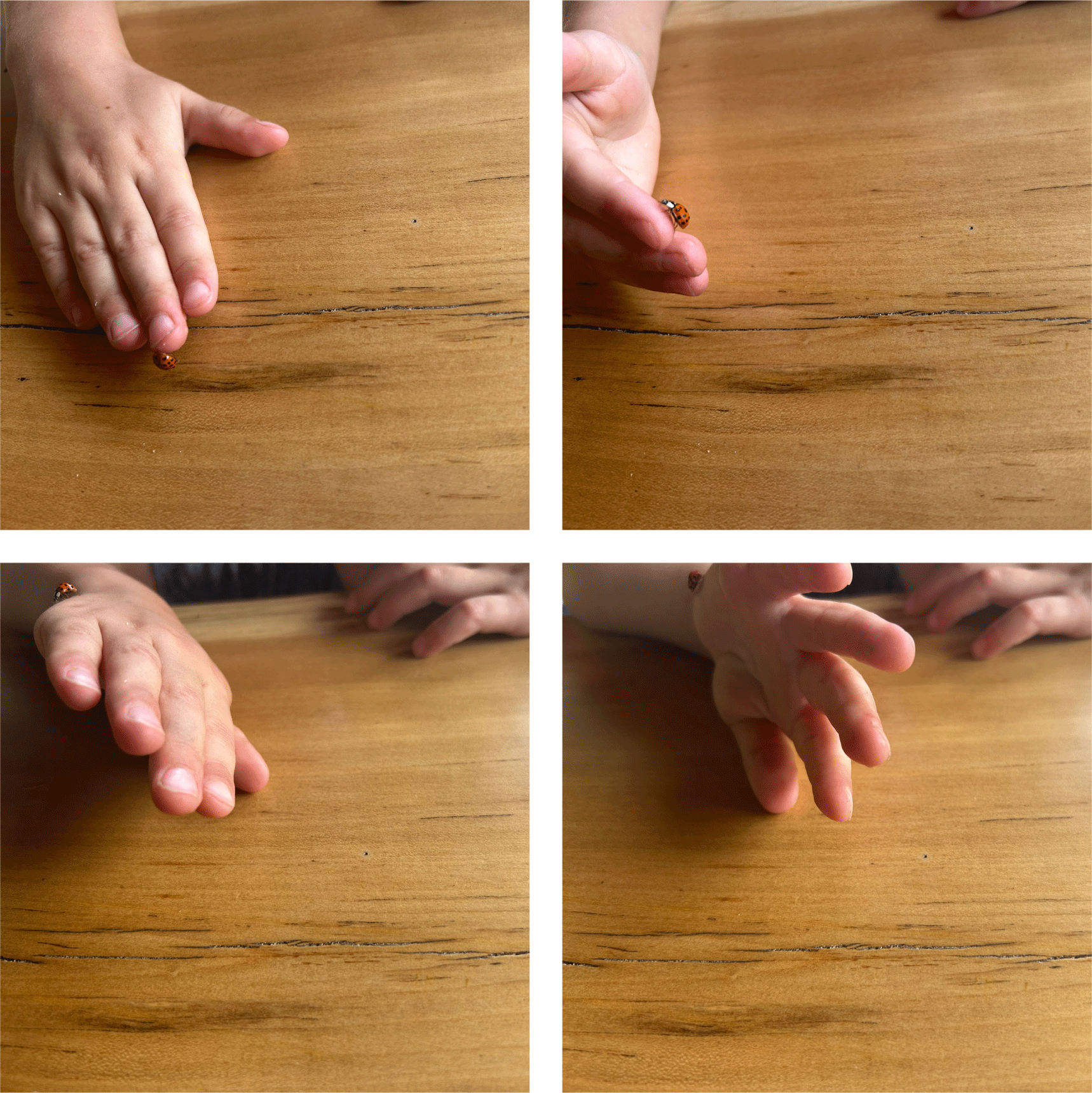
Alex: Don’t fall off my edge! Ha! He’s driving me all around. His little legs are so tickling to me. Aw, he’s just so cozy. I love him. He loves me!
As the ladybug traced a path across skin and hair, hands and arms twisted and turned. These were a kind of co-proprioceptive events, of sensing body position and movement in space, wherein both child and bug became “more than one but less than two” (Haraway, Reference Haraway2008, p. 244). Bodies, skin, legs, warmth, muscles and hair becoming together, “driving” each other.
This child-ladybug “comingling” event alerts me to the ways in which “things and beings become certain kinds of things and beings” (Tammi et al., Reference Tammi, Rautio, Leinonen, Hohti, Cutter-Mackenzie, Malone and Barratt Hacking2018) and that these relations can hold various and even contradictory associations. On the bookshelf close by, ladybugs were also present as crawling “others” in both picture books and non-fiction texts (see Figure 6). These images from books and the encounter between Alex and the ladybug present a stark contrast in how ladybugs emerge with/in the everyday moments of early years schooling. I am struck by the persistent coupling of “creepy” and “crawly” in these curricular materials (see Figure 6); aligning insect movement with disgust or fear is a persistent image of thought, a positioning of insects as humanity’s ugly “other” (Brown, Reference Brown2006). But what might it do to align a ladybug’s crawling with tickling, cozy, and/or love instead? How does a bug emerge differently when I can attune myself to Alex’s description of a ladybug encounter vs. receiving descriptions from classroom texts?
Ladybugs emerge with/in classroom books.
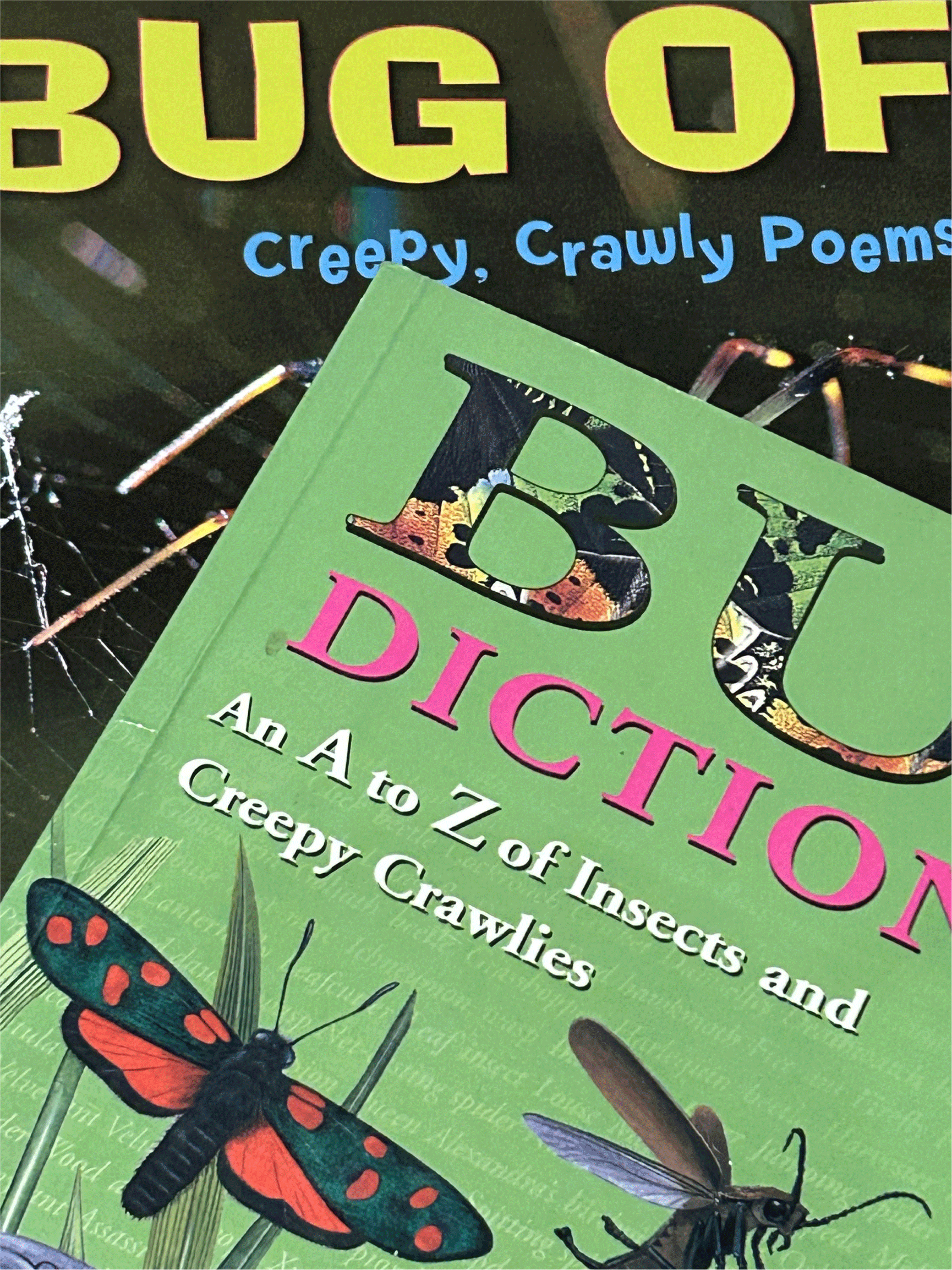
Researching various configurations of tickling-cozy-love in relation to bodies and touch, I encounter kinds of knowing-doing that exist outside of early years pedagogical literature. Research on pain and anxiety alerts me to the ways that the c-tactile fibres in the skin of mammals respond to gentle touch; the stimulation of particular neurons lends itself to stress reduction, homeostasis and bonding (Doucleff, Reference Doucleff2023). Across cultures, parents and carers have names for a kind of soothing, gentle touch wherein their fingertips trace paths across the skin of their children. In Spanish, it is piojitos—or “little lice.” What are the other(ed) ways multispecies care emerges in the classroom? How might we come to know them and name them?
…
Carrot Rapunzel, Rachael, kindergarten teacher
It’s Carrot Rapunzel!
Why do you call it that?
Looking down
she observes
the carrot in her hand
It’s because of her green
stuff
the vine
because girls have long hair
But boys can have long hair
too
How might the more-than-human
be working with us instead of for us?
Well
I think mine’s a girl
because it’s purple
But some boys like purple
so it could be a boy
And boys like pink
And girls can like blue
that’s my favourite colour
Rainbow is my favourite colour
because it’s
a l l
the colours
Perspectives and carrots passed around
children in motion with carrots
a symbiosis
carrots become curriculum
in ways I hadn’t considered
Mine has a long stem
she smiles
brushing her fingers
gently
over its leaves
like ‘Carrot Rapunzel’
Her delicate movements
provoke me to think
Does someone gently brush your hair?
This is how she nurtures the carrot
Is that how you feel cared
for?
Through the language of touch
they communicate and connect
Mine is like a tree carrot
these
he lifts its leaves upwards
are the branches and the leaves
his body and the carrot
create a familiar form
From planting and pulling
their embodied togetherness hollowed
spaces for possibility
And what emerged was
‘Carrot Rapunzel’
We a l l grow
because of the sun
But some things
like sun
and some things
like shade
our diverse interactions and complex relationships constitute
ecosystems
communities
of interconnectedness
“What if we imagined a human nature that shifted historically together with varied webs of interspecies dependence” (Tsing, Reference Tsing2012, p. 144).
carrots respond
to temperature
preferring to be cool
turning bitter in the heat
I can relate
they have ancestors
Queen Anne’s Lace,
the wild carrot
inherited perceptions
instincts
from their pasts
of growth
and evolution
“…organisms are situated within deep, entangled histories” (van Dooren et al., Reference van Dooren, Kirksey and Münster2016, p. 2).
I am rerooted
through relation
and grounded
in connection
Carrots have been moving us for some time, in both a literal and figurative sense
but so have other species
and beings
and things
“To be one is always to become with many” (Haraway, Reference Haraway2008, p. 4).
what a tangled relationship
between
us
and carrots
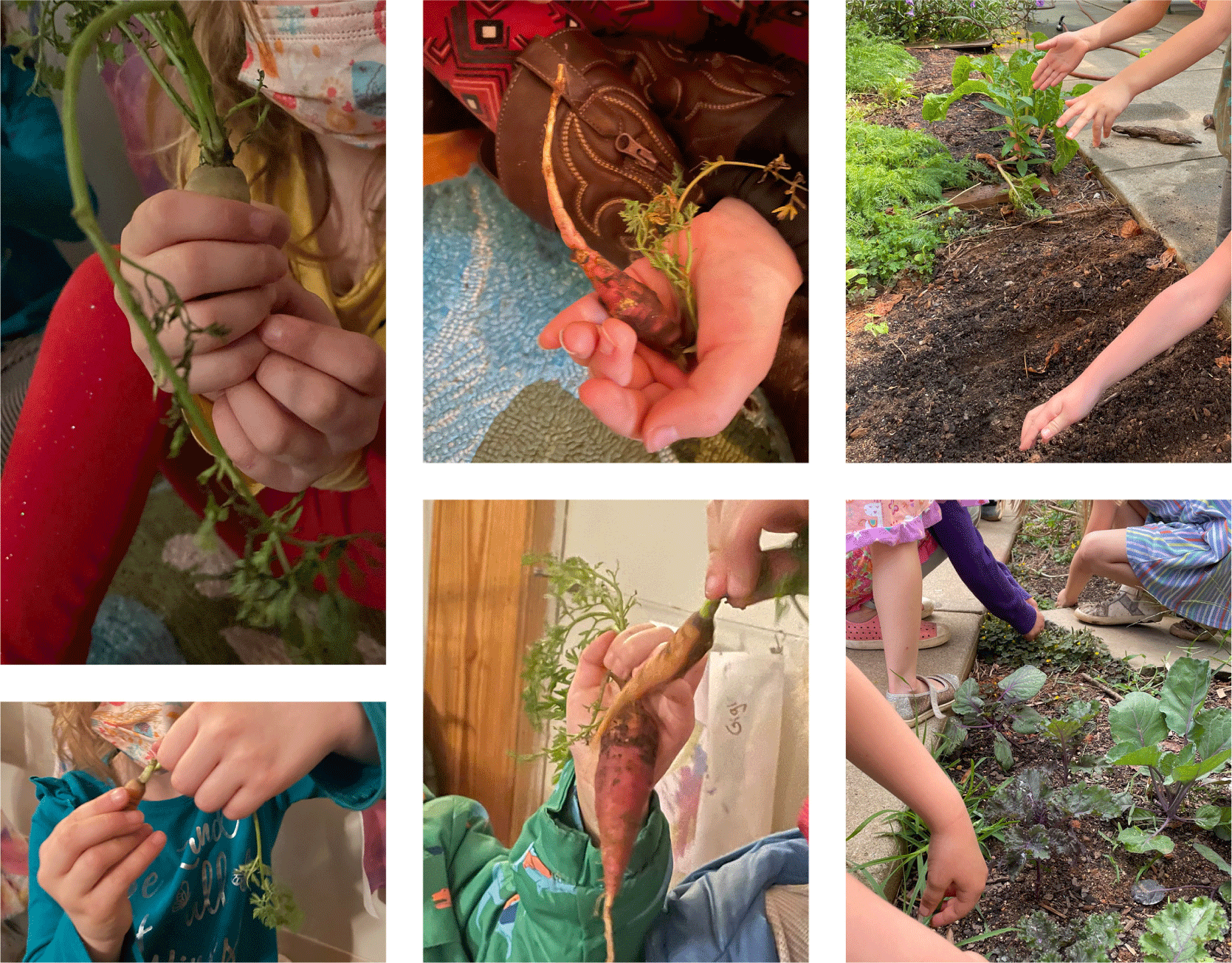
I (Rachael) vividly remember when we became kin with “Carrot Rapunzel” (see Figure 7), when we became “responsible to and for each other, human or not” (Haraway, Reference Haraway2010, p. 54). This place and these plants became a part of our community, our more-than-human classroom ecology. The collective experience of pulling carrots from the classroom garden created both a literal and figurative space of impact and connection. The carrots’ were situated in the ground, rooted and changed the moment the children began pulling them out of the soil, navigating the movement of bodies—moving with matter. The soil responded to this (dis)placement, to the carrots’ changing positions, by filling its hollowed spaces with itself, moving with what it received from the carrots to prepare for its next inhabitants. And we move, in turn—our ideas, beliefs, knowledges get (dis)placed through our encounters and our changing positions produce a hollow, a space created to (re)conceptualise and (re)shape, preparing us to engage more deeply with what happens next. Thinking about teaching and curriculum as layers of entangled, uneven movements “requires a complete paradigm shift: from learning about the world in order to act upon it, to learning to become with the world around us” (Common Worlds Research Collective, 2020, p. 2). These complex and messy relationships with the world, developing through our multispecies encounters, move me to think differently and reconsider: What does it do to learn with early childhood ecologies? Who and what are we tending in the garden?
Carrot Rapunzel.
…
A Toad House, Rachael, preservice-student teacher
If you let the toads have space
they won’t get hurt
But if it climbs up everything
it could die
Well
I do know they eat worms
we could feed them everyday
they share their knowledges
of toads
Toads that climb trees
are tree frogs
Tree frogs climb trees
not toads
they’re different
How?
I don’t really know
they just are
I note this inquiry How are toads different
than frogs?
the children walk together
and meet under a pine tree
this is the place
where they find toads
So this is their territory
This is where we find them
she squats down
bending
reaching
beneath the tree’s branches
to sift through a pile of materials
she picks up a piece of moss
what about if I stacked some moss
she places it
so delicately
atop the growing structure
here
Well
I was thinking
tall plants
so they can hide
from the snakes and creatures
that want to eat them
Yeah, okay
we definitely need to add tall plants
that will camouflage the toads
But toads
n e e d
to burrow
that’s how they hide
so we’ll just need to add
more soil
What can we add like a cloud?
he looks up at the sky
shading his eyes with his hands
Oh yeah
they will need shade too
she looks again
through their collection of things
of found materials
gathered from our walks
around the playground
through the field
and in the meadow
this branch can connect
as a roof
she lays the branch over the moss
balancing it
to bridge stacks of rocks
There!
she stands
steps back
dusting off sand and soil
from her hands and legs
a toad house
forming
under the tree
This was the first small group I (Rachael) co-led as a preservice teacher; the children were all deeply interested in the creatures they encountered while playing outdoors. The “Toad Group” emerged after a child in another classroom had handled a toad too roughly—this mismatch in strength and size resulted in the toad dying. News of this spread throughout the school. This particular group of children became concerned with toad safety and were determined to find ways to communicate with other children how to care for the toads they might find on the playground.
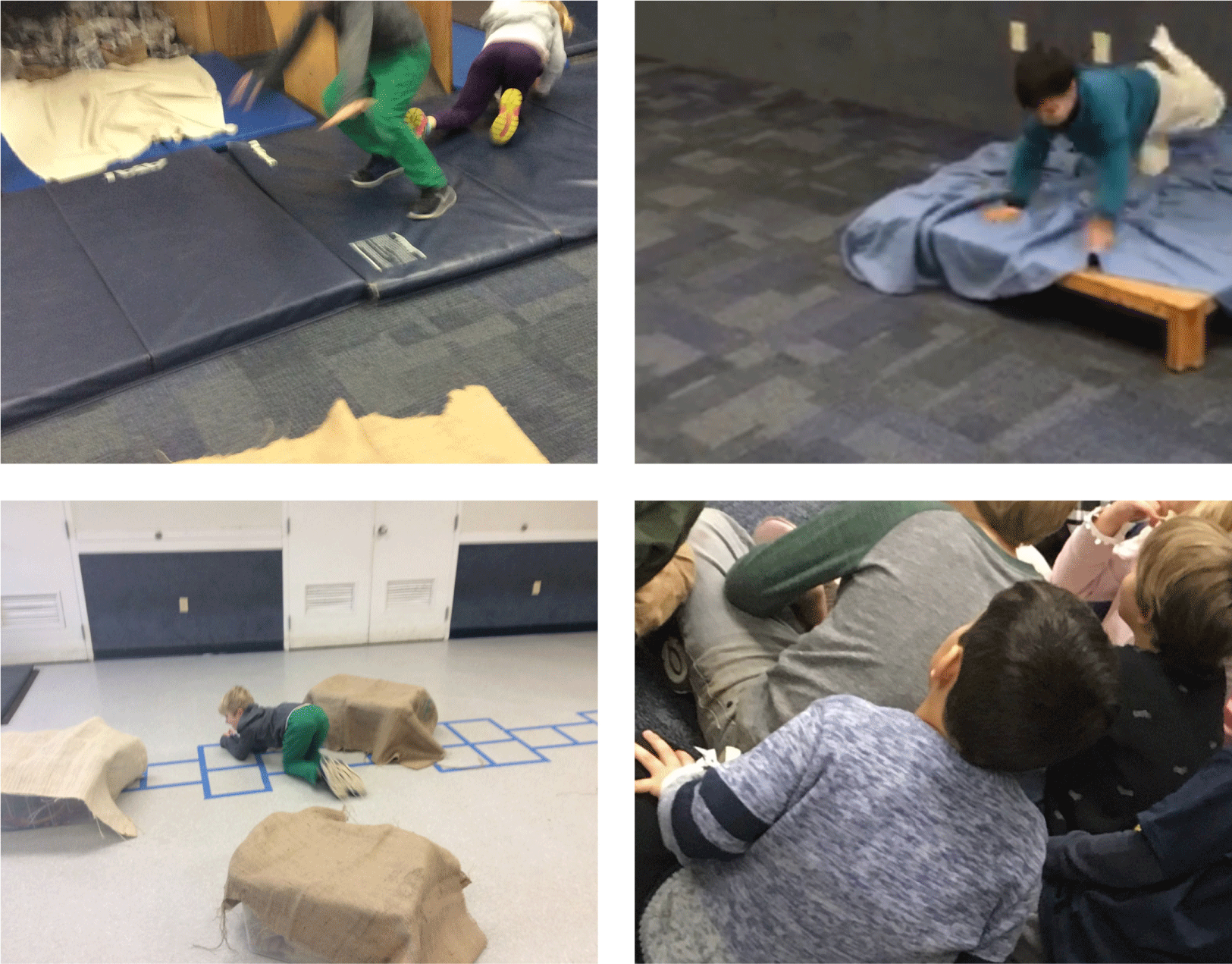
I had proposed developing a curriculum for this group based upon my observations of their building small toad refuges all around the playground (see Figures 8 and 9). During my initial observations, I noted misconceptions that the children had about toads, prompting me to gather non-fiction literature about toads to share with them. This information intrigued the children and they began expressing a desire to “become toads.” With this shift of interest—from educating others about caring for toads to becoming toads themselves—I began to share videos of toads with the children, giving them opportunities to see a toad’s camouflage and movements in different environments, and hear the different sounds toads make to call one another. This movement fostered the children’s relationality with toads—and they began to practice hopping, changing the ways in which they vocalised when calling to each other, and finding ways to camouflage with/in their surroundings. We transformed the school’s gross motor gym into a toad space, collecting outdoor materials, using crates and fabrics to make “tall grasses” and potato sacks as “burrowing spaces,” draping blue and brown fabrics for “ponds and muds,” and arranging tree cookies for the children to hop to and from. The children were becoming toads, eventually calling themselves Toad A, Toad Z, Toad E and Toad B instead of their human names. We noticed the ways in which they leapt from their “hind legs” to land on their “front legs,” their deep, full-throated calls to one another, and the different ways they travelled through the muds, grasses and waters. These embodied practices of thinking-with and moving-as toads provoked them to begin exploring dramatic play as toads, to act out toad stories. My assigned role in this play/storytelling was typically that of a predator, most often a snake.
Making toad houses.
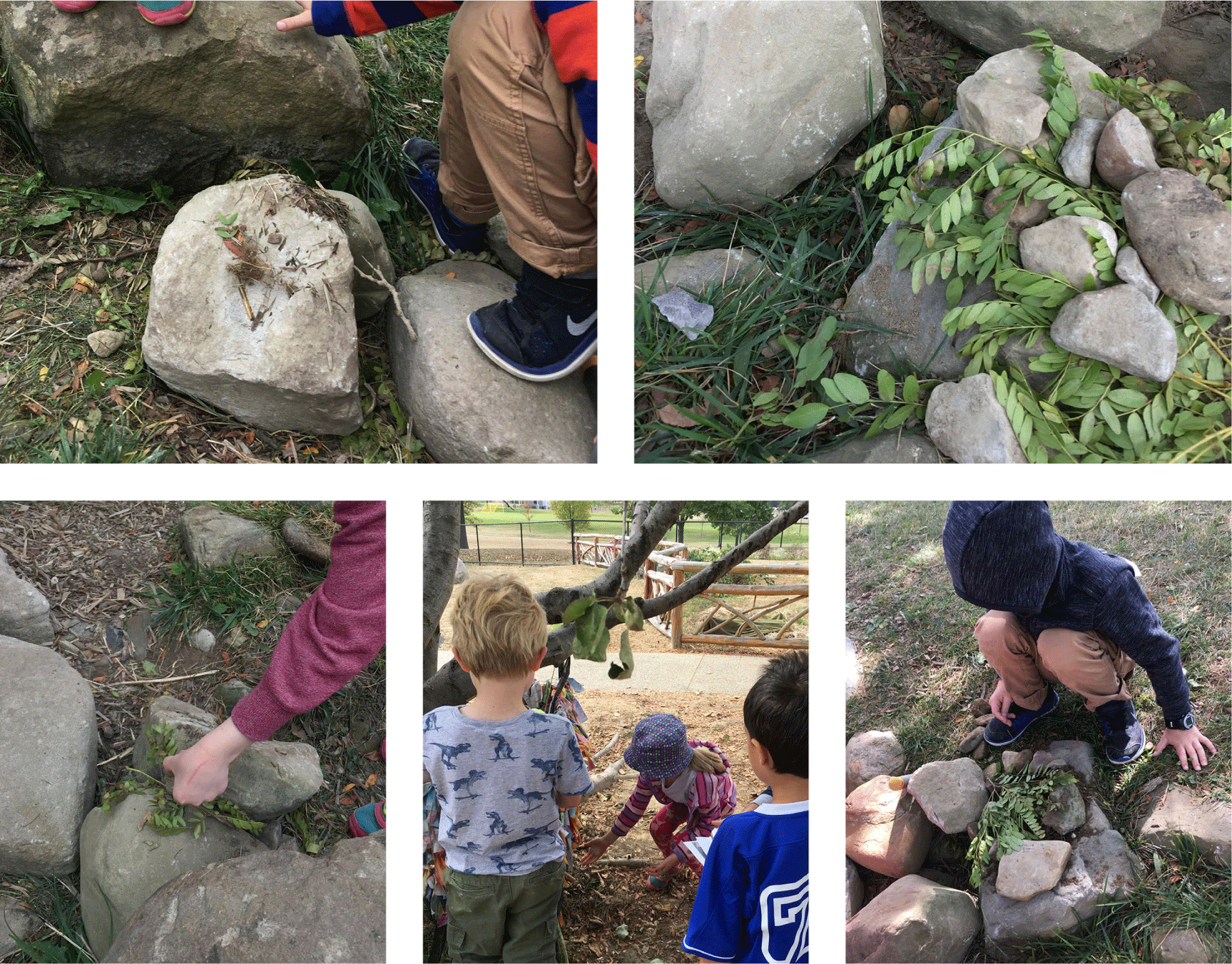
Collecting and arranging.
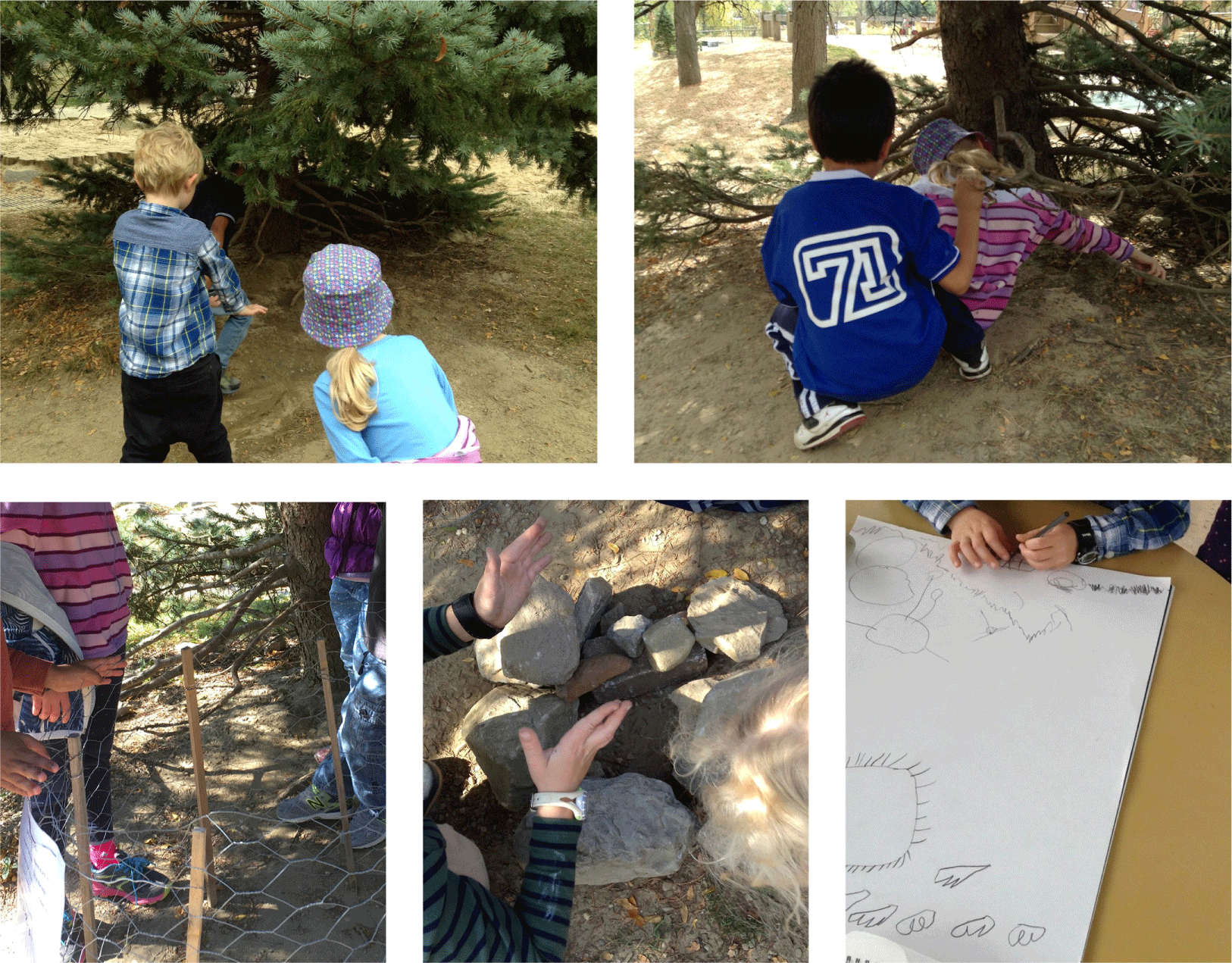
The children eventually decided that these becoming-toad play-stories would be the best avenue for others to understand toads and, in turn, increase their capacity for keeping the playground toads safe. They invited their classmates into their toad world, to experience what it might be like to be a toad, rather than simply give them a list of information about how to treat a toad well. Their classmates responded positively to their stories, feeling prepared to move-as toads throughout this world, too (see Figure 10). This embodied play extended to the playground where many of the children shared in these play-stories, collectively thinking-with toads and having conversations that integrated language related to toads’ instincts, habitats and lifestyles.
Toad play-stories.
Supporting children in engaging more deeply in their relationships with the toads—discovering and making connections to what toads were afraid of, how they protected themselves, their diets and habitats, and means of communication with other toads—made room within the curriculum to address “the small interspecies achievements of certain kinds of child–animal exchanges and interactions” (Taylor & Pacini-Ketchabaw, Reference Taylor and Pacini-Ketchabaw2015, p. 6). Caring for toads was not a linear path of acquiring and then disseminating “toad facts” to others, but rather about the potential of care-full human-toad relations, with all their complex entanglements of knowledge, movement, bodies, emotions, spaces and places. What other ways might we “hold” creatures carefully in our daily lives at school?
Attuning to movement and being moved
With this article, we attempted to resist limiting narratives of what relationships matter in early years curriculum and how they come to/continue to matter across time and space as teachers and researchers. A research-creation practice of diffractive mapping, wherein we revisited and reconstructed our teaching and researching roles in experimental and expansive ways, has helped us to attend to “ the various and complex configurations, alliances, assemblages, and constructions where human and nonhuman subjects are formed and potentially reformed” (Zapata et al., Reference Zapata, Kuby and Thiel2018, 481). Because movement is inherently relational and multi-temporal (Pallesen, Reference Pallesen2023), grounding our inquiry specifically in a meta/physics of movement allowed us to (re)orient ourselves, to explore our own teaching differently, to connect with a more-than-human early years classroom that is always already in the making.
We argue that attending, together, to the complexities that emerge through these kinds of everyday, more-than-human movements can disrupt and decentre humanist perspectives in teaching and learning. And this can support broader goals of “reconfiguring our curricula and pedagogies in accordance with more-than-human, collective, and relational notions of agency” (Common Worlds Research Collective, 2020, p, 7). Moving with the world can generate possibilities for the non-human to matter differently in early years curriculum and education. The complexities of children’s relationships with other species, the animacy and agency of non-humans, and the entanglements that hold our deep connections and shared knowledges must continue to move our work with young children. We argue that this way of being teacher-researchers, wherein we continue to engage with and allow ourselves to be moved by fleeting encounters with a more-than-human classroom across time and space, complicates the seemingly straightforward goals of early childhood environmental education, and affords shifts “from loving, caring, and preserving nature as an object outside ourselves towards becoming nature” (Weldemariam, Reference Weldemariam2020, p. 3).
We acknowledge that we could never fully capture or re-present all of the ways these relationships came to matter; the more-than-human early childhood classroom is certainly more complex than we are capable of thinking. But mapping more-than-human movements allowed us to approach an orientation of response-ability—an attuned “praxis of care and response” (Haraway, Reference Haraway2012, p. 302). Response-ability is “a relation always already integral to the world’s ongoing intra-active becoming and not becoming” (Barad, Reference Barad2007, p. 265) and this relation must entail navigating “near-infinite mo(ve)ments and reworking the norms of im/possibility” (Higgins, Reference Higgins2017, p.100). That is, attending to how both the dominant narratives and minor movements of early years education constrain or expand our relationships is essential to reconceptualising what it means to be an early years teacher, and to responding to serious questions of “being-becoming, knowing, getting along well together, and living well” (Barad, Reference Barad2014). Methodologically, attending to moments of movement through diffractive research-creation allowed us to formulate the kinds of questions that have the potential to move our teaching practices in novel directions. To this point, we end with a call for further movements, as our (in)ability to ask and the (im)possibility of answering requires ongoing vigilance (Higgins, Reference Higgins2017). The questions that emerged from our inquiry might move us towards whatever happens next:
What other ways might we “hold” creatures care-fully in our daily lives at school?
What does it do to learn with early childhood ecologies?
Who and what are we tending in the garden?
What are the other(ed) ways multispecies care emerges in the classroom? How might we come to know them and name them?
How do our ideals around learning about animals vs becoming-with animals entangle with more-than-human bodies in motion?
How might our everyday encounters with children be acts of response-ability, resistance, allyship, kinship?
Acknowledgements
Rachael and Casey would like to acknowledge the labor of the many children who participated in the generation of various data utilised for this project.
Financial support
None.
Ethical standard
For data generated during research procedures, ethical standards set by affiliated institutional review boards were applied, with all permissions sought and compliance verified by the IRB, including photographic release.
Author Biographies
Rachael Kovalchin is an early years specialist and children’s librarian, with a pedagogical focus on everyday materialities and multispecies relations. Her research interests include alternative and poetic representation, aesthetics-driven methodologies and toads.
Dr Casey Y. Myers is the co-founder of Watershed Community School, a progressive and sustainable early years centre. She is currently the lead researcher at the Child/hoods Research Collective, which focuses on young children’s relationships within the socio-material landscape of neighbourhoods. Her professional interests include posthumanisms and qualitative inquiry within the field of early childhood education, as well the phenomena of schooling in relation to childhoods.


 Open access

