




Introduction
From time of deposition to complete degradation, cattle (Bovidae) dung supports a complex and dynamic food web (Hanski Reference Hanski, Slansky and Rodriguez1987; Floate Reference Floate2023). Fresh deposits are a matrix of undigested plant material, with a water content of about 80%, and are rich in both nutrients and microorganisms that primarily include bacteria but also archaea, fungi, protozoa, and nematodes (Lee and Wall Reference Lee and Wall2006; Holter and Scholtz Reference Holter and Scholtz2007; Frank et al. Reference Frank, Brückner, Hilpert, Heethoff and Blüthgen2017; Cendron et al. Reference Cendron, Niero, Carlino, Penasa and Cassandro2020). The bacteria initially present in the pat originate from the gut of the animal, where anaerobic species dominate (Dowd et al. Reference Dowd, Callaway, Wolcott, Sun, McKeehan, Hagevoort and Edrington2008). These anaerobic bacteria quickly become replaced by aerobic bacteria with the exposure of the pat to the environment and to insect activity. The foundation of the faecal food web, these bacteria decompose cellulose, lignin, and other organic molecules in the pat to start the degradation process. Newly deposited pats are quickly colonised by coprophagous beetles, mites, and flies that breed and feed on microorganisms and plant fragments and also by predatory beetles, mites, and parasitoid wasps that feed on or develop in immature insects (Mohr Reference Mohr1943; Holter Reference Holter2000; Holter and Scholtz Reference Holter and Scholtz2007; Floate Reference Floate2023).
The insect members of the faecal food web are generally well known (Mohr Reference Mohr1943; Laurence Reference Laurence1954; Hanski Reference Hanski, Slansky and Rodriguez1987; Cambefort and Hanski Reference Cambefort, Hanski, Hanski and Cambefort1991; Skidmore Reference Skidmore1991; Floate Reference Floate2023), but much less information is available about how bacteria influence the structure of the web. The main mechanism is indirect and mediated by volatile organic compounds (VOCs). Produced by microbial activity, these VOCs are not widely recognised for their role in affecting insect behaviour (Davis et al. Reference Davis, Crippen, Hofstetter and Tomberlin2013; Goelen et al. Reference Goelen, Sobhy, Vanderaa, de Boer, Delvigne and Francis2020; Weisskopf et al. Reference Weisskopf, Schulz and Garbeva2021). Livestock manure may produce more than 160 VOCs (Mackie et al. Reference Mackie, Stroot and Varel1998), the composition and relative abundance of which vary with age and source of the deposit. Coprophilous insects use the VOCs to locate suitable deposits for colonisation (Stavert et al. Reference Stavert, Drayton, Beggs and Gaskett2014; Weithmann et al. Reference Weithmann, von Hoermann, Schmitt, Steiger and Ayasse2020 and references therein) from distances of hundreds of metres (Roslin Reference Roslin2000; Silva and Hernández Reference Silva and Hernández2015). In lab bioassays with an olfactometer, Dormont et al. (Reference Dormont, Epinat and Lumaret2004) showed that the preference of dung beetle species to VOCs emitted from horse versus cattle dung corresponded to their preference for these dung types in the field. Using dung from 23 vertebrate species, Frank et al. (Reference Frank, Brückner, Hilpert, Heethoff and Blüthgen2017) concluded that VOCs, and not nutritional content, attract insects to pats of different animals. In a study of 54 VOCs released by cattle dung during a one-week period, Sladecek et al. (Reference Sladecek, Dötterl, Schäffler, Segar and Konvicka2021) found that dung aged up to about two days released an early successional group of VOCs that preferentially attracted flies, whereas older dung released a late successional group of VOCs that preferentially attracted beetles. Fresh pats begin to form a crust almost immediately, reducing the release of VOCs, such that peak insect colonisation occurs within the first few days of dung deposition (Mohr Reference Mohr1943; Lee and Wall Reference Lee and Wall2006).
In addition to affecting insect colonisation, bacteria continue to influence the structure of the faecal food web by affecting insect development and behaviour and the abundance of other microorganisms. Many of the adult insects that colonise dung and their progeny that develop in the pat consume bacteria directly for nourishment (Skidmore Reference Skidmore1991; Lysyk et al. Reference Lysyk, Kalischuk-Tymensen, Selinger, Lancaster, Wever and Cheng1999; Gourgoulianni et al. Reference Gourgoulianni, Kümmerli and Blanckenhorn2024). Other bacteria may be pathogenic, such that some insects may develop better in heat-sterilised dung augmented with nutrients (Charpentier Reference Charpentier1968). Certain dung beetle species have cellulolytic bacteria that allow the larvae to extract nutrients from otherwise undigestible cellulose (Watanabe and Tokuda Reference Watanabe and Tokuda2010; Estes et al. Reference Estes, Hearn, Snell-Rood, Feindler, Feeser and Abebe2013). Bacteria present in the faeces of coprophilous flies may influence oviposition decisions by other species of flies (Hennig et al. Reference Hennig, Hung, Gooding and Gries2024). Insect activity may also increase the density of bacteria in order to reduce the densities of fungi (Lussenhop et al. Reference Lussenhop, Kumar, Wicklow and Lloyd1980). Antifungal properties of the gut microbiomes of three dung beetle species have been reported (Jácome-Hernández et al. Reference Jácome-Hernández, Desgarennes, Guevara, Olivares-Romero and Favila2024).
Given their foundational role in shaping the faecal food web, both by attracting insect colonists and affecting the survival of their progeny, what would happen if bacteria were absent in dung at the time of deposition? This scenario would never naturally occur, but it does pose an interesting way to think about the importance of bacteria to coprophilous insects. The present study examines this scenario with three experiments using dung from which bacteria were eliminated to reduce the release of VOCs. The first experiment examines the effect of VOCs on insect attraction by comparing insect recovery in pitfall traps baited with control versus autoclaved cattle dung. The second experiment compares the emergence of adult insects that have developed within pats of control versus autoclaved cattle dung exposed to colonisation in the field. The third experiment compares the development of the dung beetle Onthophagus taurus (Linnaeus) (Coleoptera: Scarabaeidae) provided with control versus autoclaved cattle dung in a lab bioassay. I am unaware of any previous work that has used autoclaved dung in the field to study dung insect ecology. Only a handful of studies have used autoclaved dung in the lab to examine the effects of bacteria on coprophilous insects (Charpentier Reference Charpentier1968; Byrne et al. Reference Byrne, Watkins and Bouwer2013; Estes et al. Reference Estes, Hearn, Snell-Rood, Feindler, Feeser and Abebe2013; Gourgoulianni et al. Reference Gourgoulianni, Kümmerli and Blanckenhorn2024).
Materials and methods
The research described here for pitfall trapping and dung pat rearing studies was done concurrently with and at the same study sites as research reported in Floate et al. (Reference Floate, Düring, Hanafi, Jud, Lahr and Lumaret2016).
Fresh dung (< 24 hours) was collected from the floor of feedlot pens housing Holstein cattle maintained on a diet of hay (in 2011) or barley (Poaceae) silage (in 2012). Cattle had not been treated with parasiticides in the previous six months to ensure the absence of insecticidal faecal residues (Floate et al. Reference Floate, Wardhaugh, Boxall and Sherratt2005; Lumaret et al. Reference Lumaret, Errouissi, Floate, Römbke and Wardhaugh2012). Dung was collected from multiple pats, thoroughly mixed by hand, and divided into two portions. One portion (control dung) was stored in pails (11-L capacity) at –20 °C for future use. The second portion (autoclaved dung) was autoclaved in autoclave bags using a solid cycle setting and then stored in pails at –20 °C. For both portions, pails were lined with plastic bags tied shut to prevent dung from drying out during storage.
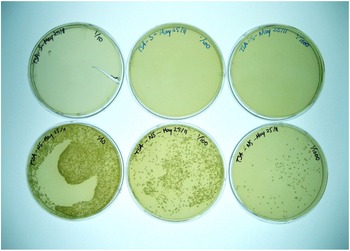
To test the effect of the autoclave process on microbe concentrations, fluid from control and autoclaved dung was diluted in double-distilled water at concentrations of 1:10, 1:100, and 1:1000. The diluted fluid was smeared on tryptic soy agar plates held at 27.5 °C for 24 hours and then photographed to document bacterial growth.
Pitfall trapping study
To assess the effect of autoclaving on the attractiveness of dung to coprophilous insects, dung-baited pitfall traps were operated in 2011 and 2012 adjacent to pastures with grazing cattle. Traps in 2011 were operated from 10 June to 4 July at the Lethbridge Research and Development Station (LeRDC) immediately east of Lethbridge, Alberta, Canada (latitude 49.691°, longitude –112.774°). Traps in 2012 were operated from 31 May to 23 June on private property about 15 km west of the LeRDC site and adjacent to the National Centre for Animal Disease, Lethbridge (NCADL; latitude 49.710°, longitude –112.943°).
Baits and traps were as described in previous papers from our lab (Floate Reference Floate2007; Kadiri et al. Reference Kadiri, Lumaret and Floate2014; Bezanson et al. Reference Bezanson, Dovell and Floate2021). Pails of control and autoclaved dung thawed at room temperature provided dung to form baits (∼250 mL each) wrapped in three-ply cheesecloth secured with twist ties. Baits were immediately refrozen until use. Traps comprised two plastic pails (2-L capacity), one nested inside the other and buried with the lip of the trap level with the soil surface. The inner pail was easily removed to empty the trap and held a 1:1 mixture of propylene glycol and water (∼100 mL) with one to two drops of liquid soap. A wire screen (∼25-mm grid) secured over the mouth of the trap with metal pins excluded small animals and supported a suspended bait secured with twist ties (see Floate Reference Floate2023, fig. 10).
At each location, 10 pairs of traps were placed along a linear transect (3 m between paired traps, ≥ 5 m between pairs of traps). Because the baits are largely ineffective after three days (Bezanson et al. Reference Bezanson, Dovell and Floate2021), they were replaced, and traps were emptied, every 3–4 days to maximise the recovery of coprophilous insects. Trap location can bias recovery of insects regardless of bait type (Floate Reference Floate1998). Therefore, the sequence of baits (control versus autoclaved) was alternated between paired traps each time traps were rebaited. The recovered insects (grouped by date, replicate trap pair, and bait type) were stored in 70% ethanol until sorted, counted, and identified. Identification was to the greatest taxonomic resolution possible for the expertise and taxonomic keys available: Coleoptera: Hydrophilidae (Smetana Reference Smetana1978), Scarabaeidae (Ratcliffe Reference Ratcliffe1991), and Diptera (McAlpine et al. Reference McAlpine, Peterson, Shewell, Teskey, Vockerother and Wood1981, Reference McAlpine, Peterson, Shewell, Teskey, Vockerother and Wood1987). Insects that were clearly not coprophilous – for example, ants, grasshoppers, plant bugs, and bees – were excluded from consideration.
Dung pat study
To assess the effect of autoclaved dung on insect emergence, pats of control and autoclaved dung were exposed in the field for insect colonisation, with placement randomised in a 1-m × 2-m grid. The use of a circular mould ensured pats of standard volume (0.5 L) and shape, which were deposited on a 1-cm layer of damp sand on StyrofoamTM plates (23-cm diameter). Chicken-wire mesh placed over the pats prevented disturbance by rodents and birds. After exposure, pats with their associated plates were individually held indoors in pails for insect emergence. The pails were fitted with a fine mesh sleeve, through which insects were removed using an aspirator (see Floate Reference Floate2023, fig. 13A). Insects were stored in 70% ethanol until sorted, counted, and identified using the aforementioned taxonomic keys.
Dung pats were exposed in the field in 2011 (at LeRDC) and 2012 (at NCADL), concurrent with the pitfall trapping study. In 2011, pats (10 replicates per treatment) were exposed from 9 to 16 June. There were early indications that these pats contained few insects, such that a second set of pats (10 replicates per treatment) was exposed from 29 June to 5 July, providing a total of 20 replicates per treatment in 2011. In 2012, pats were exposed from 30 May to 11 June (10 replicates per treatment).
The effect of dung type on insect emergence was compared for individual insect taxa, total insect number, and species richness. Shapiro–Wilk tests identified datasets with nonnormal distributions that could not be corrected with log transformation. Because of this, analyses were performed with the nonparametric Mann–Whitney test (critical P = 0.05). Analyses were limited to taxa represented in datasets by at least 20 specimens to increase the rigour of the analyses.
Onthophagus taurus lab bioassay
To more directly assess treatment effects, we examined reproduction of the dung beetle Onthophagus taurus when it was provided with either control or autoclaved dung. The beetles originated from a colony maintained at the LeRDC (Floate et al. Reference Floate, Watson, Coghlin and Olfert2015). Adults remove packets of dung that they form into balls and bury in tunnels below the fresh pat. The female lays one egg in each dung ball (= brood ball) or the dung ball may lack an egg (= food ball). There are two male morphs (male major, male minor) that differ in the amount of time they spend aiding females in the formation of dung balls and tunnels (Moczek Reference Moczek1999).
For the bioassay, pails (2-L capacity) were established with firmly compacted moist loamy soil (∼15 cm deep) and either control or autoclaved dung (50 mL; 20 replicate pails per treatment). Reproductively mature adults (1 ♂, 1 ♀) were added to each pail, with the number of male majors and male minors balanced across treatments. Gauze covering the opening of each container prevented beetle escape. Every 3–4 days, a fresh packet of either control or autoclaved dung (50 mL) was added to each pail. The dung was a subset of that collected for the dung pat study (see previous section). Packets were made before the start of the study and held at –20 °C until use.
The pails were set up on 16 February 2012. On 1 March, 15 March, and 12 April, the spent dung was removed from each pail, the soil was sifted to remove brood and food balls, and the number of dung balls removed and any beetle deaths were recorded. Dung balls from the same pail were held in moist vermiculite in a plastic container (250 mL). Conditions for the study consisted of a constant 16:8 light:dark photoperiod and 24 °C. At this temperature, egg-to-adult development is about 36 days (Floate et al. Reference Floate, Watson, Coghlin and Olfert2015).
Plastic containers were examined on 20 April (for dung balls removed on 1 and 15 March) and on 24 May (for dung balls removed on 12 April). The number and type of emerged F1 adult beetles (sex, male morph) were recorded. Dung balls were dissected, with contents identified as either egg, larvae, pupa, or non-emerged adult. Dung balls with no evidence of a life stage were recorded as food balls.
For the F1 generation, the effect of dung type was compared for numbers of females, male minors, male majors, eggs, larvae, pupae, non-emerged adults, for all life stages combined, and for food balls. Shapiro–Wilk tests identified datasets with nonnormal distributions that could not be corrected with log transformation. Analyses were performed with the nonparametric Mann–Whitney test (critical P = 0.05). Analyses were limited to taxa represented in datasets by at least 20 specimens to increase the rigour of the analyses.
Results
Dung water content was not assessed. However, because the dung was held in bags, it was assumed percentage moisture was not appreciably affected by the autoclave process. In a previous study from our lab, the moisture content of fresh dung from cattle maintained on hay and barley silage was 86 and 80%, respectively (Tiberg and Floate Reference Tiberg and Floate2011).
Examination of the tryptic soy agar plates documented the initial absence of microbes in autoclaved dung (Fig. 1). Recolonisation of this dung by bacteria would have begun once it was thawed before use. Bacterial levels would have further increased with exposure of the dung to environmental contamination and insect activity. The doubling times of bacteria can be measured in minutes for some species under ideal laboratory conditions but may require hours or days for these and other bacteria under field conditions (Gibson et al. Reference Gibson, Wilson, Feil and Eyre-Walker2018; Weissman et al. Reference Weissman, Hou and Fuhrman2021). Without knowing which bacteria were present in dung or their doubling times, it is reasonable to conclude that levels of bacterial activity and production of VOCs in the autoclaved dung were reduced compared to control dung during the first 1–2 days of the experiments.
Bacterial growth on tryptic soy agar (TSA) plates after 24 hours at 27.5 °C. Plates were smeared with fluid from autoclaved (top row; S = sterile) and non-autoclaved (bottom row; NS = nonsterile) cattle dung. Fluid was diluted in double-distilled water at concentrations of 1:10, 1:100, and 1:1000.

Pitfall trapping study
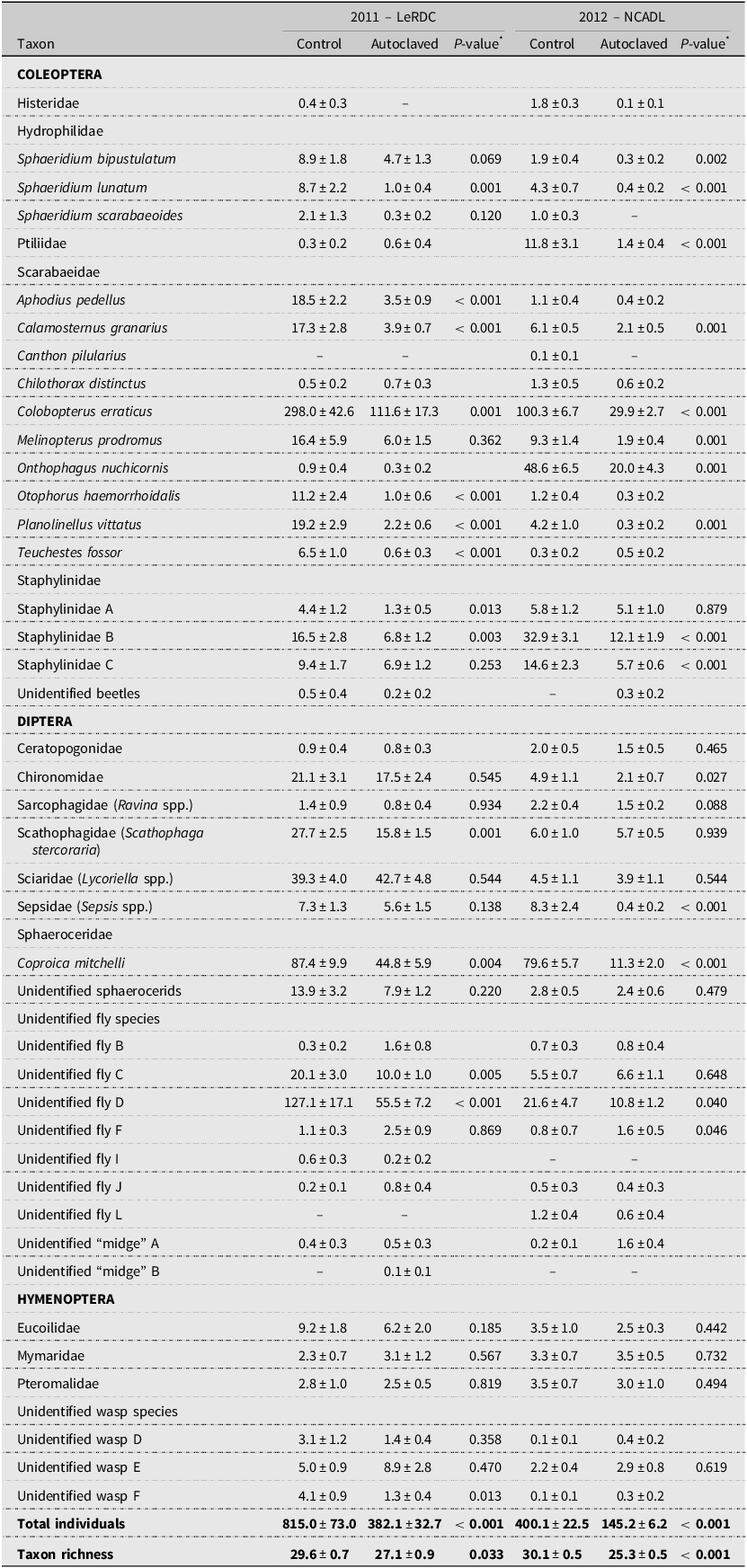
In 2011 and 2012, more individuals and taxa were recovered in traps baited with control versus autoclaved dung (Table 1). A total of 11 971 insects were recovered in 2011. Control samples contained an average of 2.1-fold more individuals (P < 0.001) and 29.6 versus 27.1 taxa for autoclaved dung (P = 0.033). A total of 5 453 insects were recovered in 2012. Control samples contained an average of 2.8-fold more individuals (P < 0.001) and 30.1 taxa versus the 25.3 taxa for autoclaved dung (P < 0.001).
Recovery of coprophilous insects in pitfall traps baited with cattle dung versus pitfall traps baited with dung from the same source but autoclaved. Data were collected in 2011 (from 10 June to 4 July) at the Lethbridge Research and Development Centre (LeRDC) and in 2012 (31 May to 23 June) adjacent to the National Centre for Animal Disease, Lethbridge (NCADL). Values are means ± standard error for 10 traps per treatment. Tests were not performed for taxa with fewer than 20 individuals
* Mann–Whitney test, 1 df, critical P-value = 0.05.
In both years, recovery of individual taxa was also greatest with control baits (Table 1). For statistical rigour, tests were performed only for taxa represented by at least 20 individuals in the dataset. In 2011, 29 taxa met this threshold, with a significant (P < 0.05) effect of bait type detected in 14 cases, all of which showed greatest recovery with control baits. In 2012, 26 taxa met the threshold, with a significant effect of bait type detected in 15 cases, all of which showed greatest recovery with control baits. Additional cases showing greater capture of insects with control baits likely would have been detected with larger sample sizes. In 2011, more individuals of the dung beetle Melinopterus prodromus (Coleoptera: Scarabaeidae) were recovered with control (16.4 ± 5.9) versus autoclaved baits (6.0 ± 1.5), but the difference was not significant (P = 0.362). Insects showing responses to bait type included true dung beetles (Scarabaeidae), predacious beetles (Coleoptera: Hydrophilidae, Staphylinidae), fungus-feeding beetles (Coleoptera: Ptiliidae), and coprophilous flies (Diptera: Scathophagidae, Sepsidae, Sphaeroceridae).
Dung pat study
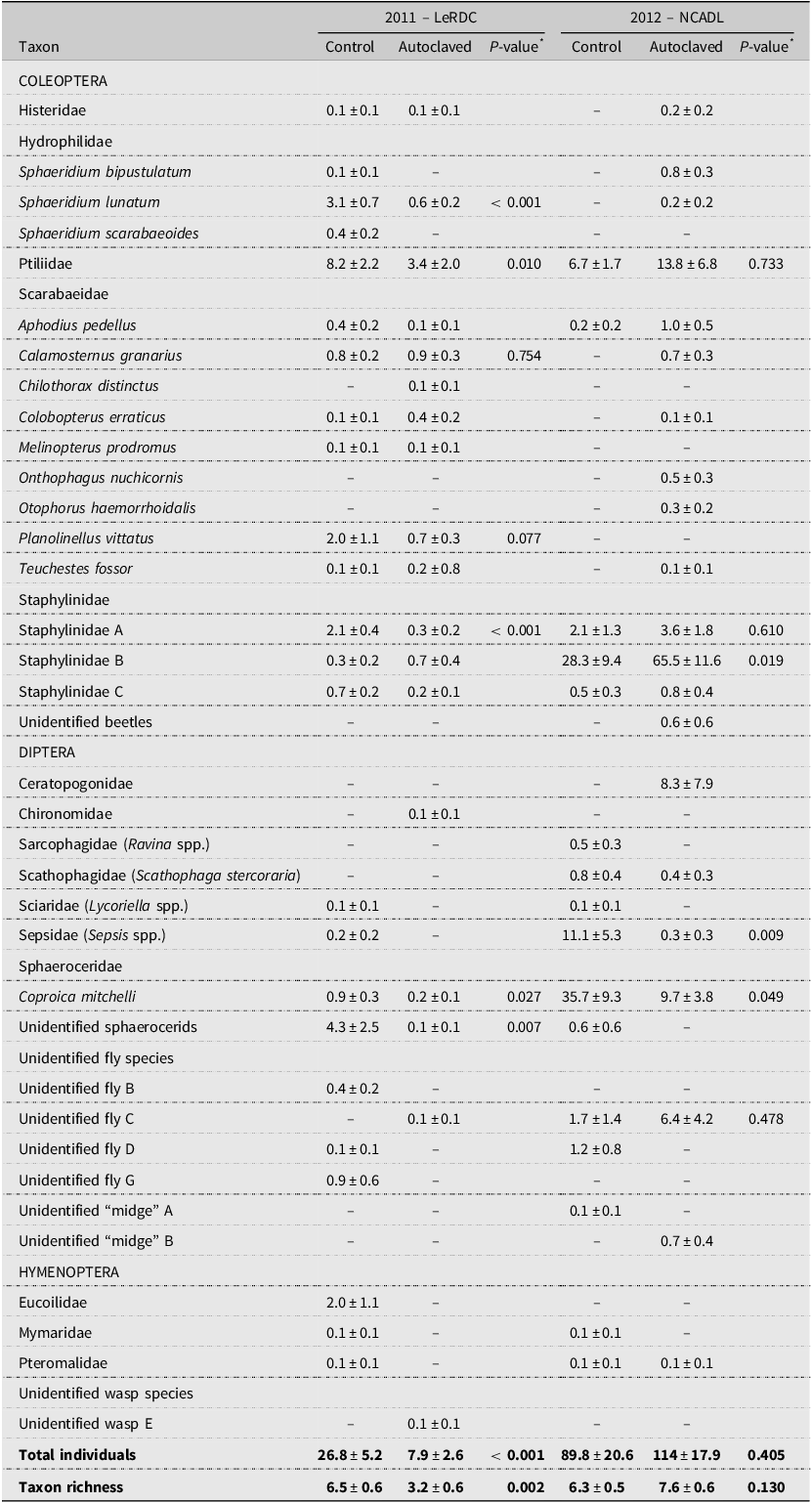
An effect of autoclaved dung on the number of individuals developing within pats to emerge as adults was evident but differed between years (Table 2). A total of 692 insects were recovered in 2011. Control pats produced an average of 3.4-fold more insects (P < 0.001) and 6.5 taxa versus the 3.2 taxa for autoclaved dung (P = 0.002). In contrast, 2039 insects were recovered in 2012, for which no difference was detected between control versus autoclaved dung for either the total number of insects (P = 0.405) or of taxa (P = 0.130) recovered.
Recovery of coprophilous insects reared from cattle dung versus cattle dung from the same source but autoclaved. Dung pats were exposed to colonisation in the field and then held in emergence cages for insect removal. Field exposure in 2011 (from 31 May to 23 June) occurred at the Lethbridge Research and Development Centre (LeRDC) and in 2012 (from 30 May to 11 June) occurred adjacent to the National Centre for Animal Disease, Lethbridge (NCADL). Values are means ± standard error for 20 and 10 dung pats per treatment in 2011 and 2012, respectively. Tests not performed for taxa with fewer than 20 individuals
* Mann–Whitney test, 1 df, critical P-value = 0.05.
Consistent with the pitfall trapping study, tests were performed for individual taxa represented by at least 20 individuals in the dataset (Table 2). For the seven taxa that met this threshold in 2011, a significant (P < 0.05) effect of treatment was detected for the five taxa that were most abundant in control dung. Tests were performed for six taxa in 2012, with an effect of treatment detected in three cases. Two taxa were more abundant in control dung, whereas one taxon was more abundant in autoclaved dung.
Onthophagus taurus lab bioassay
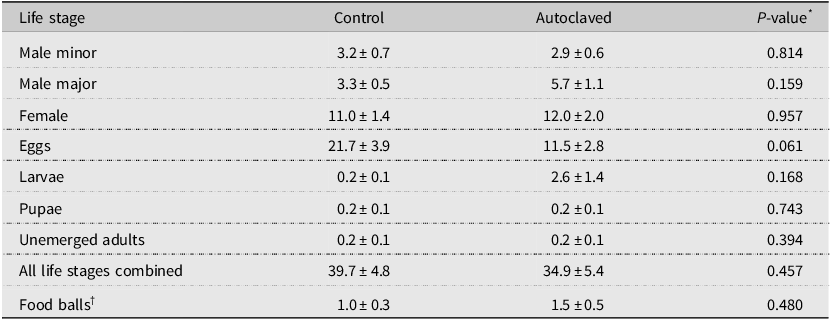
When provided with control versus autoclaved dung, no significant difference in the reproductive fitness of O. taurus was detected for any of the measures assessed (Table 3).
Offspring production by Onthophagus taurus provisioned with cattle dung versus cattle dung from the same source but autoclaved. Values are means ± standard error for 20 replicates (1 ♂ + 1 ♀ per replicate)
* Mann–Whitney test, 1 df, critical P-value = 0.05.
† Dung balls lacking evidence of an egg being laid.
Discussion
Results combined across the three experiments document the role of bacterial activity and associated VOCs in shaping the structure of the faecal food web. This occurs mainly by directly influencing the composition and abundance of insects that colonise the deposit. Further modification occurs within the pat by bacteria affecting insects directly (as a source of nutrients or as pathogens) or indirectly by influencing interactions among insects. The nature of these latter interactions largely reflects the taxon’s role in the food web (e.g., primary consumer, predator, parasitoid) but may differ among taxa within trophic levels.
Previous studies show that microbial activity in fresh dung produces VOCs to attract coprophilous insects (Dormont et al. Reference Dormont, Epinat and Lumaret2004; Stavert et al. Reference Stavert, Drayton, Beggs and Gaskett2014; Weithmann et al. Reference Weithmann, von Hoermann, Schmitt, Steiger and Ayasse2020; Sladecek et al. Reference Sladecek, Dötterl, Schäffler, Segar and Konvicka2021). Autoclaving eliminates bacteria such that baits made of autoclaved dung were expected to have depleted levels of bacteria, release fewer VOCs, and attract fewer insects than the control baits do. This expectation was met with pitfall trapping in 2011 with dung from cattle fed hay, and again at a second site in 2012 with dung from cattle fed barley silage. Combined across the two years, 29 of 55 statistical comparisons made for individual taxa showed a significant effect of treatment that, in all cases, identified greater recovery of insects in pitfall traps baited with control dung (Table 1).
The emergence of adult insects developing in pats reflects both the level of colonisation (an indication of oviposition activity) and the survival of the colonists’ progeny during development. With fewer insects attracted to autoclaved baits (Table 1), reduced emergence from autoclaved dung is most readily attributed to reduced colonisation. For the beetle taxa Sphaeridium spp. (Coleoptera: Hydrophilidae) and Ptiliidae and for flies Coproica mitchelli (Diptera: Sphaeroceridae), and Sepsis spp. (Diptera: Sepsidae), autoclaved dung attracted fewer colonists (Table 1) and produced fewer of their progeny (Table 2). However, the depletion of bacteria in autoclaved dung can also reduce its nutritional value to affect insect development. Previous work shows that Sepsis flies reared on autoclaved versus control cattle dung can exhibit lower egg-to-adult survival, prolonged development, and smaller adult body size (Gourgoulianni et al. Reference Gourgoulianni, Kümmerli and Blanckenhorn2024). Whether by less colonisation and (or) reduced survival, fewer flies developing in autoclaved cattle dung adversely affect predacious beetles and parasitoid wasps requiring prey items and hosts. Although not significant, fewer parasitoid wasps developed in autoclaved versus control dung pats in the present study (Table 2).
Results from 2012 for Staphylinidae B are the sole example of control baits attracting more individuals (P < 0.001) and greater recovery of their progeny (P = 0.019) from autoclaved dung pats. The reason for this is unknown but illustrates that not all species should be expected to respond in a similar fashion. Staphylinids associated with cattle dung include species that are predators, parasitoids, and fungivores (Floate Reference Floate2023). Survival of predacious staphylinids might be favoured in control dung, which attracted more insects and presumably contained more immature insects upon which to feed. Survival of fungivorous staphylinids might be favoured in autoclaved dung due to an abundance of fungi and a scarcity of natural enemies. Some species may do equally well in both types of dung. The staphylinid Platystethus americanus (Coleoptera) feeds on fly larvae when they are present but can develop in the absence of flies by feeding on fungi (Hu and Frank Reference Hu and Frank1995).
The O. taurus lab bioassay suggests that some species are protected from depletion of bacteria in the deposit by carrying with them the requisite bacteria for larval development. The bioassay did not detect a significant effect of autoclaved dung on any of the measures of reproductive fitness examined (Table 3). As described by Estes et al. (Reference Estes, Hearn, Snell-Rood, Feindler, Feeser and Abebe2013), adult females of the species lay an egg in a cavity (= brood chamber) in a ball of dung (= brood ball) buried in the soil. The female smears the brood chamber with saliva that contains cellulolytic bacteria that will be ingested by the newly hatched larva feeding on the brood ball. Once in the gut, the bacteria break down cellulose to nourish the larva. This process of bacteria transmission from parent to progeny has been reported for a number of dung beetle species (Schwab et al. Reference Schwab, Riggs, Newton and Moczek2016; Shukla et al. Reference Shukla, Sanders, Byrne and Pierce2016; Parker et al. Reference Parker, Dury and Moczek2019, Reference Parker, Moczek and Macagno2021; Chen et al. Reference Chen, Wang, Zhang, He, Yang and Zhang2024; but conversely, see Byrne et al. Reference Byrne, Watkins and Bouwer2013).
Although significant effects of treatment were not detected in the O. taurus bioassay, there were indications of greater success on autoclaved dung that might have shown significance (P < 0.05) with larger sample sizes (Table 3). First, half as many individuals were recovered as eggs in autoclaved versus control dung. This result suggests more rapid development and (or) greater egg viability in autoclaved dung. Second, autoclaved dung produced almost two-fold more male majors than did control dung. Greater production of male majors in this species occurs when larvae develop on higher-quality diets (Moczek Reference Moczek1998). Autoclaving may have removed pathogenic microorganisms that adversely affect egg hatch and (or) larval development, as has been suggested for the dung beetle, Aphodius constans (Coleoptera: Scarabaeidae) (Charpentier Reference Charpentier1968).
Most previous work on dung-breeding insects has focused on a few high-profile taxa that are pests of livestock, natural enemies of these pests, dung degraders, or model species for ecological research (Bezanson and Floate Reference Bezanson and Floate2019). Examining interactions among more than a small number of insect species quickly becomes complicated, and the role of bacteria is rarely considered. A notable exception is the work of Hammer et al. (Reference Hammer, Fierer, Hardwick, Simojoki, Slade and Taponen2016). They showed that antibiotic treatments applied to cattle altered the dung microbiota of the treated animals and, subsequently, the microbiota of the dung beetle, Teuchestes fossor (identified as Aphodius fossor) (Coleoptera: Scarabaeidae) feeding in the deposit. They also showed that the microbiota of the dung beetles was distinct from that of the dung upon which they fed. Changes in bacterial activity can affect the VOC profile of the deposit and, consequently, insect colonisation. This was shown by Sladecek et al. (Reference Sladecek, Dötterl, Schäffler, Segar and Konvicka2021), who documented changes in the VOC profile of aging dung corresponding first to preferential colonisation by flies and then by beetles. Treating cattle with parasiticides can affect the attractiveness of their dung to insects (Finch et al. Reference Finch, Schofield, Floate, Kubasiewicz and Mathews2020), a result that has been attributed to altered VOCs. In a test of this hypothesis, Urrutia et al. (Reference Urrutia, Cortez, Rosa-García, García-Prieto and Verdú2024) did not detect an effect of ivermectin treatment on VOC dung profiles nor on the response of the dung beetle Ateuchetus cicatricosus (Coleoptera: Scarabaeidae). More of these types of studies examining linkages between bacteria, VOC profiles, insect colonisation of, and subsequent interactions within, the pat are needed to fully appreciate the complexity of the cow dung community.
Acknowledgements
The author thanks R. Barrett, N. Kadiri, K. Tiberg, M. Youssef, and particularly P. Coghlin and P. Fletcher for assistance in field collections and identifications, as well as S. Rood for property access. The author also thanks D. Colwell and D. Wilches for their comments on an earlier draft of this manuscript.
Competing interests
The author declares that they have no competing interests in any form in relation to the above submission to The Canadian Entomologist.


 Open access

