


Introduction
Depressive disorders have been recognised since antiquity, although how they have been described and understood has changed considerably over time. In this chapter, we outline key aspects of the history of depression and some of the limitations in its current classification in ICD-11 and DSM-5-TR. We describe the range of symptoms experienced in depressive disorders, together with the recognised variations in clinical presentation and how these are conceptualised and classified. The relationship between depression and related disorders – including anxiety disorders, premenstrual dysphoric disorder and grief – is discussed, as well as boundary issues with bipolar disorder and primary psychotic disorders. We review current knowledge about depression’s considerable psychiatric and medical comorbidity as well as its epidemiology, natural history and health burden. A brief practical guide to assessing depressive disorders is given, together with rating scales that are useful for clinical assessment and monitoring.
History of Depression
Antiquity to the Renaissance
The Greek physician Hippocrates wrote in the fifth century BCE that ‘fears and despondencies, if they last a long time’ were symptomatic of melancholia. However, melancholy also included what are now considered non-affective psychoses, obsessive-compulsive disorders and anxiety disorders, with states of grandiosity, increased energy and exaltation not recognised as a separate condition. Melancholy was also associated with intellectual ability or even genius, rather as bipolar disorder has been linked with creativity today. Historical melancholy is therefore best seen as a broad, inconsistently applied term that could include much of today’s mental illness.
The humoural theory of illness, based on four humours (blood, yellow bile, black bile and phlegm), was systematised in Ancient Greece around the fifth century BCE and influenced medicine for the next 2,000 years. Deficiencies or excesses of humour could cause disease, with melancholia as the state associated with an excess of black bile. Galen, in the second century, proposed that moderate imbalances in humours (dyscrasias) produced different temperaments, meaning both psychological dispositions (sanguine, melancholic, etc.) and susceptibility to bodily illness. His writings influenced the Islamic world and were rediscovered in Europe in the second millennium. In contrast, supernatural causes of illness were invoked in many ancient civilisations and by Christianity in the Middle Ages. Psychological explanations were also entertained in antiquity; the Roman orator and statesman Cicero, in the first century, suggested that melancholy could be caused by excessive anger, fear or pain.
One of the most famous works on melancholy, The Anatomy of Melancholy by Robert Burton (1577–1640), is a culmination of the classical view written towards the end of the Renaissance. It is a vast wide-ranging book, extensively revised between 1621 and 1638, written to avoid and treat Burton’s own melancholy. It is full of quotations from classical to contemporary times, comprising a haphazard literary and medical encyclopaedia of types of melancholy and their symptoms, causes and treatments, drawing on the range of sciences of the day including theology and astrology. He distinguished dispositional or transitory melancholy – reactive to ‘occasions’ and from which ‘no living man is free’ – from melancholy as a habit, a serious ailment ‘not errant, but fixed’, a distinction still relevant today.
Seventeenth to Nineteenth Centuries
As observational and empirical methods of understanding nature gained ground in the Western world, the humoural system gave way to theories of disturbances of the brain and nervous system. A phase of viewing melancholy as a disorder of the intellect or judgement (i.e. characterised by delusions) independent of mood changes, exemplified by William Cullen (1710–1790) and Phillipe Pinel (1745–1826), was challenged in the nineteenth century when the core of affective symptoms was reasserted, and non-delusional melancholy closer to our current idea of depression was described by Joseph Guislain (1789–1860) and Daniel Tuke (1827–1895).Reference Kendler1 By the end of the nineteenth century, melancholy was accepted as primarily a mood disorder, in which delusions arose from the mood change, as described by Richard von Krafft-Ebing (1840–1902) and Emil Kraepelin (1856–1926) among others, laying the foundation for our modern concept of mood-congruent psychosis.Reference Kendler1 Melancholic and non-melancholic forms of mood disorder (such as neurasthenia) were recognised by the end of the nineteenth century, with Carl Lange (1834–1900) among the earliest to use the term ‘depression’ to describe a condition of low mood, enervation, difficulty making decisions, loss of joy in life and often anxiety, which he contrasted with melancholy.Reference Shorter2 In parallel, psychodynamic theories were developing, beginning with Sigmund Freud (1856–1939), who proposed that conflict within the unconscious results in emotional difficulties in adulthood. Freud theorised that melancholy is a pathological reaction to loss in which internally directed anger leads to guilt and self-loathing.
Twentieth Century to Today
Around the start of the twentieth century, Kraepelin famously distinguished dementia praecox (schizophrenia) from manic depressive illness (psychotic and non-psychotic depression, along with mania), although he also recognised a psychogenic form of depression reactive to social circumstances. By the second half of the twentieth century, there were a plethora of different terms applied to depression including endogenous, vital, involutional, neurotic, reactive and depressive personality, with attempts to identify differential clinical and biological determinants and treatment response. The World Health Organization, in the ninth revision of the International Classification of Diseases (ICD-9, 1970s to 1990s), followed Kraepelin in distinguishing ‘manic depressive psychosis, depressed type’ from neurotic depression and other neurotic disorders such as anxiety states and neurasthenia. In response to the psychoanalytic dominance in American psychiatry and a general lack of reliability in psychiatric diagnoses, operationalised diagnostic criteria were developed in the 1970s. The resulting Feighner criteria, based on observations in psychiatric populations, informed the Research Diagnostic Criteria (RDC) that were subsequently adopted by the American Psychiatric Association in the third edition of the Diagnostic and Statistical Manual of Mental Disorders (DSM-III) in 1980. DSM-III also distinguished between depression and bipolar disorder, originating from Karl Leonhard’s (1904–1988) re-evaluation in the 1950s of manic depressive illness according to polarity based on distinct family genetics. This distinction, together with the failure to be able to reliably identify depressive subtypes based on aetiology, or treatment response, led to the diagnosis we recognise today: eliminating the distinction between psychotic and neurotic disorders, putting depressive disorders together in a single group of mood disorders based on a limited number of features, and separating ‘unipolar’ from ‘bipolar’ depression. This change, continuing through subsequent editions of the DSM, was largely adopted by ICD-10 in 1992 and is now fully implemented in ICD-11 (2022). Criteria that were developed from a relatively small group of severely ill hospitalised patients have become applied to community settings, increasing the recognition of depression, which is now the most common mental health diagnosis. Different presentations of depression are identified by symptom profiles. The vertical hierarchical structure deals with horizontal symptom overlap by allowing comorbidity, so that a person can have more than one disorder at the same time (e.g. both a depressive and an anxiety disorder), or by using specific exclusions (e.g. a history of mania places a depressive episode under bipolar disorders).
Current Controversies and Implications
Whether depression is better viewed descriptively/phenomenologically or understood in terms of aetiology/causation is a dilemma still present today. Although the definition of depression is now relatively stable, the distinction between normal and pathological sadness and between different types of depression has become less clear. There remain tensions between depression as a dimension and as a category, uncertainty about how it relates to other disorders – especially anxiety disorders and bipolar disorder – little progress in identifying underlying pathology, no diagnostic clinical test or truly specific treatment, and no coherent conceptualisation of its likely multifactorial aetiologies.
KendlerReference Kendler3 argues that the current criteria for depression are useful as a rapid and reliably applicable index for a condition that has been recognised throughout history but that it is a category mistake to equate the limited criteria with the underlying condition, and the criteria do not capture the broader symptomatology present nor lived experience. In the continuing search for subtypes that might allow the identification of specific pathology and guide treatment, a meta-review identified five broad approaches based on symptom profile, aetiology, time of onset, gender and treatment resistance, but the meta-review argues that these approaches need to be integrated to enable the progress that has so far been elusive.Reference Baumeister and Parker4 Population surveys show an exponential distribution of depressive symptoms, with no evidence of bimodality or any ‘point of rarity’ that would suggest a pathological category of depression. However ParkerReference Parker, McClure and Paterson5 argues that melancholia is a distinct categorical depressive disorder if defined by key psychomotor features and that there is suggestive evidence for bimodality using this restricted symptom set.
These uncertainties have contributed to a wider questioning of the value of diagnosis in psychiatry. The aim of the Research Domain Criteria, developed by the US National Institute of Mental Health, is to characterise mental disorders trans-diagnostically according to patterns of variation in six higher-level neurobehavioural domains (positive and negative valence, cognition, social processing, arousal/regulatory, and sensorimotor systems) in order to investigate their multilevel biological and psychological underpinnings. It has been criticised for being a top-down approach with no account taken of natural history,Reference Ross and Margolis6 and the integration of biological and psychological constructs remains a challenge. Another approach, which overtly rejects diagnoses and causal biological pathology, is the Power Threat Meaning Framework.Reference Johnstone, Boyle and Cromby7 This proposes that social factors and trauma (Power, Threat) lead to emotional distress and behaviour (Threat Responses) that can be addressed by enabling someone to make sense of their experiences through the creation of more helpful narratives (Meaning), instead of seeing themselves as blameworthy, weak, deficient or mentally ill. It is suggested that, for some people, depression and anxiety are better seen as synonyms for a ‘general pattern’ of expressing distress, provisionally identified as ‘surviving defeat, entrapment, disconnection and loss’. Whatever the value of this approach for individuals, it is debatable whether what the authors describe as “broad […] patterns that synthesise the influences of Power, Threat, Meaning and associated Threat Responses” can replace diagnoses at a public health level.
What can we learn from this? First, a diagnosis of depression is primarily a cross-sectional description of a limited range of symptoms, providing an index of mood disturbance rather than representing the disorder itself, and therefore only a starting point. Second, the diagnosis doesn’t explain the mood symptoms or the person’s lived experience, with no distinction between responses to life difficulties and specific underlying pathology (the popular ‘scientific’ explanation of a chemical imbalance in the brain is essentially the humoural imbalance theory of old). Third, a diagnosis of depression does not by itself imply a particular, or even any, treatment, and management needs to be based on a broader clinical assessment and approached pragmatically and collaboratively. Finally, given that depression and its symptom profiles do not describe homogeneous populations, taking these as categories is likely to be unfruitful for research.
Symptoms and Signs
Depressive disorders include a range of possible symptoms and signs that are inter-related, interact with each other, and can change over time, with each person having an individual experience and pattern. Table 3.1.1 shows the frequency of a range of symptoms found in individuals seeking help for depression in studies in two settingsReference Tylee, Gastpar and Lépine8, Reference Faravelli, Servi and Arends9; they show a similar prevalence pattern of common symptoms in spite of the difference in the severity of depression. Notable is the high prevalence of fatigue/lack of energy and anxiety as well as low mood. A recent systematic review investigating possible gender differences found that depressed women are more likely than depressed men to report standard symptoms used for diagnosis, but the difference was small and the pattern broadly similar. Men did however show more risk taking, impulsive behaviour and alcohol and drug use, which may reflect a fundamental difference in presentation (so-called male depressive syndrome) or different self-medicating and coping behaviours.Reference Cavanagh, Wilson and Kavanagh10

- Not specifically assessed/reported; ‡ occurred in <30% but figure not given.
a Community participants (70% female) who had sought professional help for depression in the last six months. Some assessed symptoms are not reported if <30% (adapted with permission from Tylee et al. International Clinical Psychopharmacology 1999;14: 139–51).
b Sequential psychiatric outpatient referrals (69% female) with a depression diagnosis (11% bipolar depression) (adapted with permission from Faravelli et al. Comprehensive Psychiatry 1996;37: 307–15).
Affective Symptoms
Depressed Mood
Lowered mood is unsurprisingly a central feature of depressive disorders and the most commonly reported symptom (Table 3.1.1), although it doesn’t have to be present for the diagnosis to be made. For many, their depressed mood is qualitatively different to feelings of unhappiness or sadness (e.g. after experiencing a loss) although the experience is individual; one person might describe a general, persistent, oppressive feeling of misery and despair, whilst another might describe a highly unpleasant dark emptiness or hopeless numbness, and others as a ‘black dog’, ‘black days’ or a ‘dark cloud’. Some people will be tearful or easily moved to tears, whereas others may be unable to cry and feel that their ability to do so is blocked. Depressed mood may lead to a feeling of being disconnected from emotions and from others (see ‘Depersonalisation/Derealisation’). Typically, the depressed mood is unremitting and unreactive (or changing only minimally) in response to usually pleasurable events. Diurnal variation, in which mood and other symptoms are worse in the morning and lift somewhat as the day goes on, is not uncommon, but this may be lost in the most severe depression. In contrast, some individuals experience ‘atypical’ low mood similar to unhappiness or sadness, which is temporarily reactive to circumstances, and can improve in response to something positive, such as meeting a friend. This picture may also be accompanied by a worsening of mood as the day progresses and can be associated with sleeping more, increased appetite and anxiety (see section on ‘Atypical Depression’). In some, the predominant presentation may be anxiety, agitation or health preoccupations, and the depressed mood may be ‘masked’ by these features.
Anhedonia
Anhedonia is viewed as a core symptom of depression alongside low mood, although for a substantial minority, the intensity is below the symptom threshold (Table 3.1.1). Anhedonia is loss of interest in, and an inability to derive pleasure from, daily activities such as spending time with loved ones or enjoying activities they would typically enjoy (e.g. exercise, reading) and not caring about tasks, activities or others as much as they may have done previously. It may also be experienced as an inability to feel an improvement in mood despite positive things happening around them. Others may notice that the person is less engaged or interested in conversations and social activities. Anhedonia can also be closely linked to thoughts of worthlessness, diminished drive and energy, loss of libido, reduced engagement in activities, apathy and social withdrawal. It can also overlap, or be conflated with, depersonalisation/derealisation in which detachment from emotions is experienced (see later in the chapter).
Hopelessness
Hopelessness may be expressed as the future appearing dark, uncertain and unpleasant, with little or no hope that the situation can improve and the feeling of powerlessness to change things. It appears as an inability to think of positive future events rather than anticipating negative events, and it is often accompanied by feelings of worthlessness or inadequacy, with a sense of feeling trapped or defeated, and suicide may be seen as the only way out. Hopelessness is one of the strongest predictors of suicidal thoughts but with weaker effects on suicide attempts and death from suicide, so that the absolute effect is small and of limited use on its own to predict suicide risk.Reference Ribeiro, Huang and Fox11
Worthlessness, Shame and Guilt
Worthlessness can involve feeling useless, inadequate or unlovable, as well as thinking they have no worth as a human being or that they have failed in life. This often involves unfavourable comparison with others, believing that they are inferior – or worth less – than others around them. Low self-esteem and lack of self-worth may be pre-existing traits with childhood origins that become more intense and pervasive when depressed. This can lead to internalising feelings of self-blame, being defective and unlovable, being responsible for one’s own suffering and failure, and being a burden to others. Closely related is shame (not emphasised in the diagnosis of depression), which together with guilt, can arise in response to an experience of failure or wrongdoing. Shame typically involves attributing this failure or wrongdoing to the whole self, rather than a particular action, with a focus on being flawed as a person, whereas guilt tends to be directed towards the impact on others, attributing failure or harm to others to one’s intentions and actions. Guilt in normal circumstances is often adaptive and leads to a motivation to change behaviour or make amends. In depression, these emotions can be unwarranted and excessive and become generalised beyond specific events; shame leads to feelings of worthlessness, inadequacy and humiliation, and the guilt often magnifies perceived wrongdoings or past events, which may progress to the feeling that others know what they have done and are blaming or accusing them (ideas of reference). In severe depression, feelings of guilt may become delusional – for example, feeling responsible for disasters or evil events or of having committed a crime and needing to be punished for it. Worthlessness can also become delusional – for example, holding delusions of poverty or being bankrupt. In assessing whether guilt is excessive for someone, it is important to determine whether it is disproportionate given their situation and background; feeling guilty about letting other people down or causing financial difficulties may not be inappropriate. Shame, guilt and their interaction may lead to someone being fearful of rejection or judgement, as well as being reluctant to seek help, talk about their feelings or reveal their difficulty in coping. They can also manifest in statements that are self-critical and self-judgemental, in anger, and in suicidal thoughts and behaviour.
Anxiety
Anxiety is very common (Table 3.1.1) and an important aspect of depressive disorders (see section on ‘Anxious Depression’). The symptoms are often divided into psychic (or psychological) and somatic (or physical). Psychological symptoms include the feeling of tension, the inability to relax, being ‘on edge’, irritability, apprehension about the future, worry or churning thoughts that won’t stop regarding things that might happen or that seem minor to others. Sometimes, there can be catastrophic thoughts leading to panic attacks. Physical symptoms are largely related to autonomic system activation and muscle tension, including headaches, dry mouth, tingling, tremulousness, palpitations, chest pain, sweating, dizziness, shortness of breath, nausea, abdominal pain, cramps, a feeling of ‘butterflies’ in the stomach, heavy limbs, diarrhoea and urinary urges and frequency. Anxiety may be evident from worried or fearful facial expressions and motor overactivity (see ‘Agitation’). For some, the physical symptoms might lead to a preoccupation with physical health (see ‘Hypochondriasis’) and even obscure the depressive symptoms.
Irritability and Anger
Those who are depressed commonly describe a low threshold for annoyance or anger in the face of frustration, both in relation to their own perceived failings or the actions of others. This may be purely subjective or expressed by being ‘short’ or argumentative with others, in outbursts of temper or even physical violence to things or other people. Anger has long been believed to be integral to the experience of depression and, psychoanalytically, depression has been interpreted as anger turned inwards onto the self. In depressed people who deny anger, irritable feelings may present as self-criticism and self-blame, whereas those who admit irritability may feel guilt about the way they ‘take it out’ on their partner or family. In adults, irritability and anger are no longer emphasised in the diagnosis of depression, but they are recognised as important in the presentation of children and adolescents.
Cognitive Symptoms
Thought content in depression is usually congruent with, and integral to, the affective symptoms described earlier. Aaron Beck described a ‘cognitive triad’ of negative thoughts – occurring automatically – about self, the world and the future, which forms a central focus of cognitive therapy. Typically, these thoughts reflect self-criticism, self-blame, self-disgust and self-hatred, extending to automatic negative beliefs and assumptions about the motives and actions of others, obstacles being too difficult or demanding, and the future being without hope. As well as these ‘affective cognitions’ there is also impairment in attention, concentration and cognitive function more broadly.
Thoughts of Death and Suicide
Thoughts that life seems pointless and not worth living are common and may not involve any active wish to end life, although fleeting suicidal ideas can occur even when acting on them is not contemplated. Some may even find comfort in thinking of suicide as an option. Sometimes, rather than suicidal thoughts, mental images of one’s own death, or that of others, are experienced in an intrusive and distressing way. Underlying suicidal thoughts may be a desire to escape intolerable feelings, pain or situations; a method of punishing others; a belief that others would be better off without them; an atonement for perceived sins or wrongdoing; an apparently logical solution to a life that has nothing left in it worth living for; or the desire to join loved ones who have died. Depression is one of the most common associations with completed suicide, and the more persistent and planned the suicidal intent, the higher the risk; these include ‘final acts’ such as putting affairs in order, writing a suicide note and taking precautions against being found. However, suicidal impulses often occur unpredictably and can appear to be without warning. Evidence of risk to others needs to be taken seriously, although murder in the context of suicide – such as infanticide by a mother who then kills herself – is rare. There is no evidence that asking about suicidal ideation increases the risk of suicide; on the contrary, being given the opportunity to talk about it may bring relief, particularly if they have not felt able to discuss it with others. However, suicidal intent may be concealed, and a final decision to act on plans may be accompanied by apparent calm or an improvement in mood.
Self harm with suicidal intent needs to be distinguished from non-suicidal self injury (NSSI, sometimes called deliberate self harm), defined as ‘self-directed, deliberate destruction or alteration of bodily tissue in the absence of suicidal intent’, commonly manifest through cutting, head banging, scratching, picking at wounds or burning. It is not uncommon for both to co-exist in an individual – predisposing factors have been found to be similar for both – and the distinction can sometimes be unclear. NSSI is typically more common in those who are younger and female and, as well as occurring in mood disorders, is particularly associated with a diagnosis of borderline personality disorder. The motives for NSSI include self-punishment, release of psychic tension, distraction from emotional turmoil and the communication of internal distress to others. Self harm with suicidal intent frequently follows NSSI, with its risk being greater the higher the frequency and severity of NSSI.Reference Griep and Mackinnon12
Repetitive, Intrusive and Distressing Thoughts
Worry and Rumination
Worry and rumination appear to share similar psychological processes and often occur together, differing in time orientation and some aspects of content. Worry is perseveration on future experiences and associated with apprehension about future consequences, whereas rumination is typically more related to brooding on past experiences and the meaning and causes of negative emotions and thoughts, often involving self-criticism, self-blame and thoughts of worthlessness. Both can be attempts to problem solve, cope or understand the situation but instead they reinforce repetitive thought patterns that further entrench negative thoughts, feelings and behaviours.
Hypochondriasis (Illness Anxiety)
Hypochondriasis refers to a persistent, distressing and disproportionate preoccupation, or fear about the possibility, that one has a serious illness. This may relate to excessive focus on physical symptoms or involve checking for signs of illness, often accompanied by a lack of awareness or insight that the concerns are unreasonable. Hypochondriasis is now seen as a derogatory term, and many prefer health, or illness, anxiety. People with depression experience multiple physical symptoms (see ‘Anxiety’ earlier and ‘Somatic Symptoms’ later), and awareness of these may become heightened and preoccupying in the context of low, anxious and pessimistic mood. In severe depression, this can become a conviction of having a fatal disease or lead to beliefs of delusional intensity that the body is unhealthy or rotting, sometimes with a fantastic or nihilistic quality such as having no bowels that or other body parts are rotting, absent or don’t exist (i.e. Cotard delusion/syndrome, named after the neurologist who described it).
Obsessive-Compulsive Phenomena
Obsessions are thoughts, images or urges that are recognised as one’s own but are intrusive or unwanted, cause distress and anxiety, and lead to attempts to ignore, resist or neutralise them. They are often, but not always, experienced as being without foundation. They may be part of a pre-existing obsessive-compulsive disorder but can arise as part of a depressive episode, in which depression-related content pervades with themes of contamination, harm to self or others, aggression or obscenity. Compulsions are repetitive and time-consuming behaviours that may arise as a means of coping with, or neutralising, obsessions – for example, repeated checking, handwashing or cleaning, hiding dangerous implements, or avoiding places that could trigger these obsessions. They may also be a ritualistic way of warding off anxiety or something bad happening even if the activity is perceived as pointless. Usually, the obsessional nature of the thoughts or urges protects against acting on them (e.g. violently harming someone), but change to a more delusional quality can increase the risk.
Impaired Cognitive Function
An inability to concentrate and stay focused on tasks (e.g. reading, watching television, talking with others) is common and may be described as a ‘fog’ or ‘cloud’, impairing the capacity to process and retain information. This affects daily tasks, work requirements and engaging in interpersonal relationships, with impairment ranging from maintaining performance with effort through to failing to be able to carry out even simple tasks. Objective testing confirms impairments not only of attention and concentration but also memory, planning, problem solving and cognitive flexibility. There are also more subtle effects, such as tending to preferentially remember more negatively biased memories or having difficulty in recalling the specific details of memories (overgeneral memory). Memory and cognitive difficulties can be a focus of concern and even raise the question of dementia. Apparent dementia that resolves with improvement in depression has been called pseudodementia, a term now out of favour given the complex relationship between depression (particularly of late onset) and dementia, as well as the recognition that some aspects of cognitive impairment can persist even after depression has remitted.
Impaired cognitive function may lead to difficulty weighing up alternatives and making choices and may present as indecision. However, indecision is also strongly influenced by emotional factors such as low self-esteem, lack of self-belief, obsessional thinking and fear of making the wrong decision.
Delusions
Delusions, false beliefs not amenable to change on the basis of evidence and not culturally explicable, often relate to emotional and cognitive content (mood congruency), with some examples given earlier. In practice, the boundaries between intrusive themes, overvalued ideas (where there may be some doubt entertained) and delusions can be difficult to draw; in addition, the content may not be admitted due to embarrassment, suspiciousness or persecutory beliefs. Mood congruence is also not always clear (e.g. in some delusions of persecution) and may only apply to a proportion of the psychotic phenomena. Non-mood-congruent or bizarre delusions can raise the possibility of bipolar or schizoaffective disorder (see section on ‘Boundary Disorders’). Delusions have been viewed as a feature indicating severe depression but recently this has been questioned, and psychotic phenomena may be an independent aspect (see section on ‘Psychotic Depression’). Sometimes, there is a ‘delusional mood’ in which an unshakeable belief that something terrible, but not identified, is occurring and from which specific delusions may develop. The following broad types of mood-congruent delusions have been described:
Delusions of guilt
Delusions of poverty
Hypochondriacal delusions
Delusions of catastrophe
Nihilistic (Cotard) delusions
Persecutory delusions (e.g. being under surveillance or poisoned) and delusions of reference (e.g. believing they are being referred to by newsreaders on the media) may relate to feelings of guilt and worthlessness, but they sometimes can be seen as unjust or unwarranted.
Physical Symptoms
Reductions in sleep and appetite/weight in depression are sometimes called ‘neurovegetative symptoms’. However, caution is needed as, in some circumstances, the term is used more broadly to include anhedonia, loss of libido, diurnal variation, motor retardation and even fatigue. Hypersomnia and increased appetite are on occasion referred to as ‘reversed neurovegetative symptoms’.
Fatigue and Lack of Energy
Fatigue, encompassing tiredness and lack of energy, is one of the most common symptoms in depression (Table 3.1.1) and was included in ICD-10 as one of the three most typical features. It has a considerable impact on daily functioning, appears to improve more slowly than affective symptoms, and is a common residual symptom. Descriptions include feeling drained, physically weak, sluggish, lethargic and ‘heavy’. Activities that seemed small or easily managed previously may now feel like huge undertakings and necessitate great effort (e.g. taking a shower, getting dressed, cooking, walking or talking with others). ‘Leaden paralysis’ describes a physical feeling of heavy limbs that can only be moved with great effort (see section on ‘Atypical Depression’). Care may be needed to distinguish fatigue from overlapping symptoms such as anhedonia, difficulty with concentration and mental effort, and motivational deficits. Fatigue is a common feature of other medical and psychiatric disorders – and associated with some medications – so differential diagnoses need to be carefully considered, especially when fatigue is predominant, and care needs to be taken when ascribing causality.
Appetite and Weight
Changes in appetite, and consequently in weight, are not uncommon. Some may describe having no interest in food and feeling unable to derive any pleasure or taste from it; others may find they have so little energy or motivation that eating is no longer a priority. In more severe cases, there may be no desire for food at all, and people may miss meals or need to force themselves to eat, with failure to eat (and drink) an indication for urgent intervention. In contrast, some people find they turn increasingly to food as a way to bring relief or pleasure, with food offering some temporary form of contentment or self-soothing or a means of distraction/disconnection from difficult emotions or thoughts; in this situation, weight gain may occur. A change of at least 5 per cent in body weight in a month is often taken as an indication of significant weight change.
Sleep
Sleep disturbance is common and traditionally divided into initial insomnia (difficulty getting to sleep), middle insomnia (waking in the night and finding it difficult to get back to sleep) and late insomnia (early morning awakening and not getting back to sleep again). Anxiety, racing thoughts and not being able to ‘switch off’ are common in initial insomnia, whereas early morning awakening is viewed as a feature of typical depression, associated with diurnal mood variation and other melancholic features (see section on ‘Melancholic Depression’). Nightmares are particularly common in those with terminal insomnia and in those with melancholia.Reference Akkaoui, Lejoyeux and d’Ortho13 Insomnia occurs in spite of feelings of exhaustion, and at night, increased rumination and feelings of isolation and aloneness are often prominent. In contrast, others – most commonly, younger adults – may report increased sleep, sleepiness, naps during the day and difficulty waking up. Sleep may be seen as a way of finding respite or escape from low mood or negative thoughts. A change in time asleep of at least two hours is often taken as an indication of a significant change, although for some people the experience is of sleep being of poor quality, broken or unrefreshing, rather than a change in duration. There are objective abnormalities in sleep electroencephalographic measures associated with insomnia in depression. As well as the expected changes in sleep amount and continuity, sleep structure is altered with decreased rapid eye movement (REM) latency, increased REM sleep and REM density, and decreased slow-wave sleep. In contrast, those with hypersomnia have been found to have a normal sleep structure.Reference Plante, Cook and Barbosa14 Sleep difficulties impact cognition and daily functioning, impair the ability to regulate emotions and are associated with an increased risk of suicidal behaviour.
Somatic Symptoms
Pain, such as headaches, muscular, joint, stomach and back pain, is a common feature of depression, is more likely with greater depression severity, and may be the reason for seeking help or become a focus for illness anxiety. Also common are gastrointestinal symptoms such heartburn, diarrhoea and constipation and physical symptoms related to anxiety (discussed earlier). Given that depression is also associated with medical illness (see section on ‘Medical Comorbidity’) and medication can cause physical adverse effects, the direction of causation for somatic symptoms may be difficult to determine or be bidirectional.
Loss of Libido
Sexual function is affected by many aspects of depression, with loss of interest in sex often related to a general loss of motivation and interest in things, as well as changes in intimate relationships. There may also be an inability to become physical sexually aroused, including difficulties reaching orgasm or erectile dysfunction. Loss of libido has been seen as a loss of a basic drive, akin to loss of appetite, and sometimes included under neurovegetative symptoms. It was listed as one of the somatic (melancholic) symptoms in ICD-10 but no longer features in ICD-11 or DSM-5. Sexual dysfunction can also be a direct consequence of some antidepressant drugs, especially selective serotonin re-uptake inhibitors, which can complicate assessment.
Perceptual Symptoms
Hallucinations
Hallucinations (perceptions that appear real in the absence of a stimulus) are less common than delusions. When they occur, they are usually auditory and in the second person, consistent with depressive themes such as worthlessness, guilt, punishment or death. They can be indistinct or often simple phrases such as ‘you deserve to die’ and may be attributed to God or the Devil. It can be unclear whether or not they come from external space, and they may be experienced inside the head. Simple auditory hallucinations (noises) or those in other modalities, such as olfactory hallucinations of putrefaction, are relatively rare. It may be difficult to distinguish visual hallucinations from illusions, such as distortion of faces or visions of death. Command hallucinations can occur, including telling the person to kill themselves, and if the person feels compelled to act on them as though controlled by an external power (passivity phenomenon), the situation is extremely dangerous.
Non-mood-congruent hallucinations, including third person, running commentary, bizarre hallucinations or experiences such as thought insertion, may occur but, as with non-mood-congruent delusions, raise the possibility of schizoaffective disorder or schizophrenia, particularly if they are prominent.
Depersonalisation/Derealisation
Depersonalisation/derealisation (DPDR) describes an altered experience of oneself (depersonalisation) or of the external world (derealisation) in a way that is unpleasant and anxiety provoking. DPDR occurs on a continuum, from transient occurrences in healthy individuals to being a debilitating independent disorder highly comorbid with neurological and psychiatric conditions, including mood and anxiety disorders.Reference Mula, Pini and Cassano15 Information on DPDR in depressive disorders is limited, and it may be under-recognised, especially in those severely ill. The description of being cut off from feelings overlaps with the black numbness of severe depressed mood. It can appear similar to anhedonia but, rather than a loss of interest or pleasure, the experience is of being detached, feeling ‘cut off’ or ‘like a robot’, lacking emotions, not feeling affection for loved ones, or everything seeming unreal, distant, flat, lifeless, colourless or confusing. It may also need to be distinguished from nihilistic delusions, in which there is a fixed belief rather than an experience. DPDR has been proposed as a shutdown response to emotional overload.
Behavioural Features
Appearance
Appearances can be deceptive in a consultation, especially in less severe depression when a good ‘social front’ can be put on. There can be an apparent mismatch between expressed and observed mood. Some patients can present with ‘smiling’ depression, and it is only when they are caught off guard or don’t know that they are being observed that lowered mood is apparent.
Depressed affect can be observed in facial expression with a lack of expression or a miserable appearance and downturned mouth and furrowed brow (depressive facies). Sometimes, worry or fear may be apparent. Eye contact may be poor with a downward gaze, and there may be hopeless gestures such as sitting with head in hands and slumped shoulders. There may be tearfulness or crying, and often an empathic response is elicited in others of the despair and hopelessness that is being experienced. At other times, there may be hostility or reluctance. Talk may be soft, slow and sparse, with alteration in motor movements (see later). In severe depression there can be grey, dry or waxy look to the skin, perhaps contributed to by self-neglect and poor nutrition/hygiene.
Lack of Motivation and Apathy
Lack of motivation overlaps with fatigue, lack of energy and anhedonia, but it refers to a lack of will, volition or initiative to engage in tasks, rather than the physical effort involved or lack of enjoyment. It is included here because of its behavioural consequence of impairment in goal-directed behaviour with, at the extreme, apathy and failing to carry out basic daily activities such as a self care. This may be linked with feelings of hopelessness, pessimism and self-criticism over failure to find the will to do things that should be done. It has long been believed clinically that the risk of suicide may be elevated in the early stages of recovering from depression, due to an early increase in motivation and energy that allow suicidal impulses to be acted upon; however, empirical evidence tends not to support this period being associated with more risk than at other times. This does not detract from the need to be vigilant for suicidal risk, which can occur throughout the course of a depressive episode.
Altered Psychomotor Function
Retardation
Feeling slowed up (and also that time is moving slowly) is not uncommon in depression, but psychomotor retardation requires the slowing to be observable by others in speech, facial expression, movements and posture. Speech may be slow, quiet, low in pitch, hesitant, with pauses, delay before answering questions, and monosyllabic or impoverished content. There may be a lack of facial expression, fixed gaze and poor eye contact with slumped posture and little spontaneous movement, although increased self-touching of the face may occur. Psychomotor retardation is associated with both greater depression severity and, by definition, with melancholic depression, but the nature of the relationship remains unclear; as mentioned earlier, ParkerReference Parker, McClure and Paterson5 has argued for this feature being the defining characteristic of melancholia rather than just one symptom of it.
Agitation
Agitation is increased motor activity including pacing, handwringing, inability to sit still, fidgeting with objects or picking or pulling at hair, skin or clothing, which may be accompanied by verbal outbursts, irritability or inability to stop talking while not able to focus on any specific topic. In contrast to the situation in mania, these are an expression of intolerable inner tension, anxiety and worry in which the person doesn’t know what to do to relieve their distress, rather than being goal directed or due to elation or excess energy. The distinction between agitation in unipolar depression and mixed states as a presentation of bipolar disorder may be difficult (see also sections on ‘Agitated Depression’ and ‘Bipolar Disorders’). Apparently, paradoxically, psychomotor retardation and agitation are not mutually exclusive, and intense inner tension can be experienced by someone barely moving whereas someone who cannot sit still may only move slowly; depressive episodes with both psychomotor agitation and retardation may be more likely in bipolar disorder.Reference Swann16
Agitation also needs to be distinguished from akathisia as an extrapyramidal adverse effect of medication, in which motor restlessness in the absence of severe anxiety is usual, and from catatonic excitement or stereotopies (see next section).
Catatonic Features
Catatonia refers to a cluster of abnormal motor features including an absence of response, negativity, overactivity and unusual muscle tone and behaviours. How these are conceptualised in the context of depression is discussed in the section ‘Psychotic Depression and Catatonia’. Periods of inactivity may be interspersed with excitement, and it is difficult to access thought content. The boundary between severe psychomotor retardation and catatonic stupor can be unclear, the latter consisting of immobility while apparently awake and conscious as well as lack of response to even painful stimuli. Abnormal muscle tone and control can be evident with catalepsy (rigidity with limbs remaining where moved to), waxy flexibility (slight but even resistance to movement) and posturing (adoption of unnatural positions). There may be mannerisms (caricatured goal-directed movements), stereotopies (repetitive movements that are not goal directed), echopraxia (mirroring another’s movements), grimacing or excitement/agitation without obvious cause. Negativism may range from non-response to requests or physical guidance or to opposition or resistance. Speech abnormalities include mutism, echolalia (repeating another’s speech), perseveration or verbigeration (repetition of random words or phrases without a prompt). A case series found that immobility and mutism were the most common features, closely followed by staring, withdrawal and refusal to eat, with echolalia/echopraxia and verbigeration least common.Reference Rasmussen, Mazurek and Rosebush17
Dissociative and Histrionic Behaviour
Descriptions of melancholia and severe depressive states from the early twentieth century included dramatically altered behaviour including ‘hysterical’ convulsions, fainting fits, attention seeking, extreme dependency, melodramatic or exaggerated complaints, inappropriate intimacy or provocative acts. Today, these features are little mentioned in the context of depressive disorders, with possible explanations including decreased frequency due to a move from institutional inpatient care, societal changes in the expression and understanding of distress, less recognition or re-conceptualisation as part of comorbid personality disorders. Depression can exaggerate pre-existing personality traits and trigger uncharacteristic behaviour that disappears on recovery, so it is important not to assume that disturbances in behaviour are due to pre-existing personality or behavioural disorders rather than the depressive disorder. This is particularly the case when depression fails to improve or is persistent.
General Functioning
An impact on function and behaviour is an intrinsic feature of depression although, at milder severity, this may be hidden from, or not obvious to, others. Withdrawal from social life, impaired efficiency at work, and struggles with maintaining care for self and others, a daily routine and financial commitments may all become apparent and cause conflict. Irritability and emotional distance may cause strain and discord in close relationships, with at times cause and effect difficult to disentangle in the relationship problems. As described in the previous section, there can be changed behaviour, which can include shoplifting, taking sexual risks and causing violence, which may be combined with alcohol and drug misuse.
Types of Depressive Disorders and Their Classification
The classification of depressive disorders in the two major systems, ICD-11 (with implementation from 2022)18 and DSM-5 (implemented in 2013, with text revision [DSM-5-TR] in 2022),19 are very similar. The previous classification, ICD-10,20 will continue to be used in a transitional period varying by country. We focus on ICD-11 (at the time of writing, the detailed clinical descriptions and diagnostic guidelines had not been published) and describe differences from ICD-10. For simplicity DSM-5 is used in the text where DSM-5 and DSM-5-TR are identical.
Depressive disorders are defined in relation to a core depressive syndrome, called a major depressive episode in DSM-5. We will use the term (major) depressive episode when not specifying the classification system. ‘Clinical depression’ is a term best avoided, as it can be taken to imply that milder degrees of depression are not important and suggests a particular threshold for professional treatment. Depressive disorders are predominantly distinguished by duration, severity and longitudinal course (Tables 3.1.2 and 3.1.3); whether or not different symptom profiles denote discrete subtypes of depression is contentious, and they are identified by the use of added descriptions, specifiers or qualifiers (Table 3.1.4).
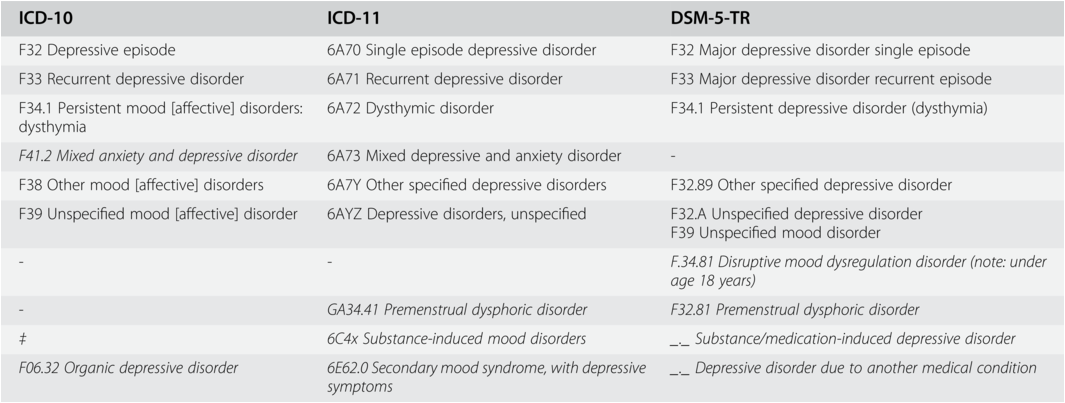
- not included; ‡ not specifically identified, coded under substance involved or as organic mental disorder depending on picture; x number used to identify substance; _._ coding based on substance/condition
Disorders in italics have primary classification elsewhere or are not consistently agreed primary (adult) depressive disorders.
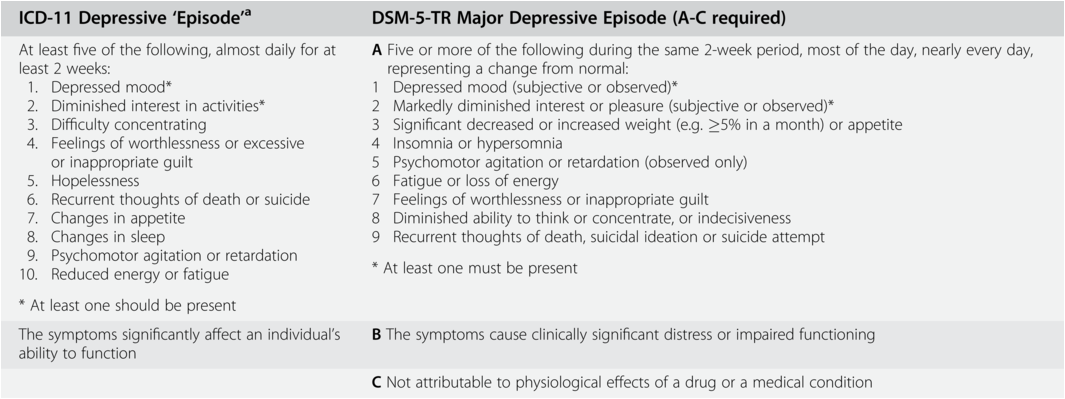
a Not independently defined and only included in description of individual disorders

The symptoms in depressive disorders should not be better accounted for by another psychiatric diagnosis such as bipolar disorder or schizophrenia. When a depressive syndrome is present but accounted for by the physiological effects of a physical illness or drugs, it is not identified as a primary depressive disorder but considered secondary or induced (Table 3.1.2). However, in the context of physical illness or substance use, careful clinical assessment and judgement are often required to decide the best way to account for the clinical picture (see section on ‘Comorbid Disorders’).
ICD-10 and ICD-11 use ‘diagnostic guidelines’ to retain the flexibility to apply clinical judgement whereas DSM-5 applies stricter diagnostic criteria and more exclusions in an attempt to maximise reliability.
Definition of a (Major) Depressive Episode
ICD-11 describes depressive episodes as part of individual disorders, whereas ICD-10 defined a depressive episode separately; we retain this in Table 3.1.3 for clarity. The term ‘major’ depressive episode in DSM was used to distinguish it from a ‘minor’ depressive episode, now called a depressive episode with insufficient symptoms in DSM-5 (see ‘Other Specified Depressive Disorders’).
A (major) depressive episode is polythetic with no single symptom needed for the diagnosis, although low mood or diminished interest in activities must be present – sometimes called ‘core symptoms’. Table 3.1.1 shows that low mood is not always present, the recognition of which led to anhedonia being incorporated into DSM-III and subsequently into ICD-10. The diagnostic definitions/criteria are aimed at discriminating depressive from other disorders and therefore only partially capture the clinical picture,Reference Kendler3 with non-criteria symptoms such as anxiety and somatic complaints equally prominent. Both systems emphasise the need for the depressive symptoms to be present for the majority of the time, but ICD-10 was more specific in stating that the lowered mood varies little from day to day, is often unresponsive to circumstances, and may show diurnal variation.
The symptom lists in ICD-11 and DSM-5 are almost identical, apart from the former retaining hopelessness about the future (present in ICD-10) as it performs well in differentiating depressive from non-depressed individuals.Reference Stein, Szatmari and Gaebel21 ICD-10 required two symptoms from low mood, anhedonia or fatigue to be present with a threshold of four symptoms for mild depression, although inter-rater reliability is low at this severity.20 Other changes from ICD-10 are the inclusion in ICD-11 of psychomotor symptoms and the recognition of increased – as well as decreased – appetite or weight as well as the omission of reduced self-esteem and self-confidence.
In distinguishing between a depressive episode and an understandable or appropriate reaction to significant loss or life event, DSM-5 requires judgement based on the individual’s history and cultural norms in expressing distress to loss. ICD-11 differentiates depressive disorders from normal reactions to adverse life events by the severity, range and duration of symptoms.
(Major) Depressive Disorders
ICD-11 and DSM-5 both identify three levels of severity for the current depressive episode, further classified by the absence or presence of psychotic symptoms (Table 3.1.4). The severity categories in both classifications have little empirical basis, and their relationship to rating scales scores, which are often used as a proxy, is imprecise and variable. Both ICD-11 and DSM-5 use symptom number and severity together with functional impairment to determine severity, although with slightly different emphases. ICD-10 had similar functional impairment requirements but was more prescriptive with regard to symptom numbers (at least 4 in mild, 6–7 in moderate, at least 7 in severe), and psychotic symptoms were only linked with severe depression. ICD-11 allows psychotic symptoms to also occur in moderate depression, whereas DSM-5 dissociates them from severity entirely. The UK NICE clinical guidelines on depression22 divides depression into less severe (subthreshold and mild) and more severe (moderate and severe) in order to guide treatment.
ICD-11 now follows DSM-5 in recognising partial and full remission (defined in Table 3.1.4) in contrast to ICD-10, where only the latter was described. The diagnosis of recurrent (major) depressive disorder is less strict in DSM-5 than in ICD-11 in requiring only two months of partial remission between episodes rather than several months without significant mood symptoms. It should be noted that even a single episode of depression now becomes a lifetime diagnosis in both systems.
Symptom Profiles in the Clinical Presentation of (Major) Depression
DSM-5 uses specifiers to describe different symptom profiles, and ICD-11 introduces qualifiers for the first time (Table 3.1.5), with both also applicable to other depressive disorders and to bipolar and related disorders. The presence of subsyndromal hypomanic symptoms (e.g. increased energy or elevated mood) in individuals with (major) depressive disorder raises a debate about the boundary between depression and bipolar II disorder, and DSM-5 has introduced a mixed features specifier (discussed in the section ‘Bipolar Disorders’).
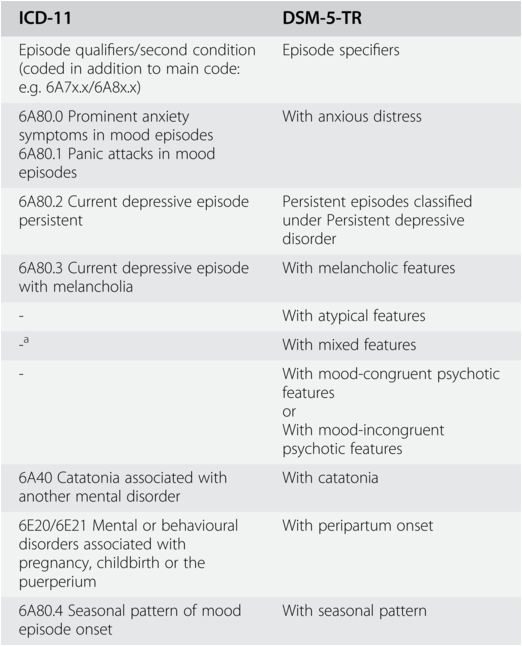
- no qualifier in ICD-11
a The term mixed is reserved for the co-existence of prominent manic and depressive symptoms during bipolar type I disorder (6A60)
Psychotic Depression and Catatonia
Historically, psychotic depression has been viewed as being at the highest end of a continuum of severity of (major) depression and associated with melancholia and severe impairment (as exemplified in ICD-10). However, psychotic and non-psychotic depression can be equally severe, and – in an individual presenting with psychotic depression – psychosis and severity often behave independently over subsequent episodes.Reference Dubovsky, Ghosh and Serotte23 Therefore, the view that psychosis is an independent trait has gained ground.
Catatonia, since its early description in the nineteenth century, has been linked primarily with psychosis – in particular, schizophrenia. Recently, however, it has become apparent that it is more commonly associated with affective disorders, as well as being a feature of organic disorders, substance misuse and autism. Stupor was included under psychotic symptoms in ICD-10 but not in ICD-11 and DSM-5, which describe catatonia separately (see Table 3.1.5). Different presentations of catatonia have been described, including a more common retarded type (including immobility and stupor) and excited type (with severe psychomotor overactivity – see also the section on ‘Agitated Depression’). It can be differentiated from psychosis in its response to benzodiazepines but not to antipsychotics. There remains uncertainty about the nosological status of catatonia as it is only seen in association with other conditions;Reference Parker, McClure and Paterson5 in ICD-11, it is a separate diagnostic category; ICD-10 diagnosed it under schizophrenia, whereas in DSM-5, it is a specifier. Catatonia is associated with severe mood episodes and psychosis, although delusions and hallucinations can be difficult to assess. ICD-11 requires the simultaneous occurrence of several symptoms such as stupor, catalepsy, waxy flexibility, mutism, negativism, posturing, mannerisms, stereotypies, psychomotor agitation, grimacing, echolalia and echopraxia. In DSM-5, at least three of these 12 symptoms are required.
The prevalence of psychotic symptoms has been estimated to occur in 10–19% of adults with (major) depression, rising to 25–45% of those hospitalised. Compared with non-psychotic depression, it is associated with an earlier age of onset, greater severity and chronicity, more and longer hospital admissions, greater psychiatric comorbidity and a poorer prognosis. It is also more likely to have a bipolar outcome than non-psychotic depression (especially in early onset illness), a risk that appears greater if the psychosis is mood incongruent.Reference Dubovsky, Ghosh and Serotte23 Knowledge about the prevalence of catatonia in depression is hampered by varying definitions, study settings and diagnoses; a recent meta-analysis reported a prevalence of about 8% in psychiatric inpatients and 3% in outpatients, less common in unipolar depressive disorder than bipolar disorder.Reference Solmi, Pigato and Roiter24
Anxious Depression, Mixed Depressive and Anxiety Disorder
Separating anxiety and depression has been compared to trying to disentangle wind and rain in stormy weather,Reference Demyttenaere and Heirman25 and their high rate of co-occurrence is a problem in their classification as separate disorders, with a mixture of anxiety and depression by far the most common presentation in primary care.Reference Demyttenaere and Heirman25 It was only in DSM-III and ICD-10 that they were completely separated; since then, it has become increasingly recognised that higher levels of anxiety in (major) depressive episodes are associated with poorer functioning and quality of life, higher suicide risk, more depressive episodes, a worse longitudinal course and poorer treatment response. This has led to DSM-5 and ICD-11 adding anxiety as a specifier/qualifier, but as this is the most common presentation of depression (and anxiety disorders do not have a depression specifier), the conceptual problem of their relationship is not resolved.Reference Demyttenaere and Heirman25
The ICD-11 anxiety qualifier for depressive disorders requires prominent and clinically significant anxiety symptoms (e.g. feeling nervous, anxious or on edge; not being able to control worrying thoughts; fearing that something awful will happen; having trouble relaxing; having motor tension; having autonomic symptoms) to be present for most of the time during the episode and, for separate diagnoses, if diagnostic requirements are also met for an anxiety or fear-related disorder. ICD-11 also has a separate panic attack qualifier (at least two panic attacks in the last month related to anxiety-provoking depressive cognitions). The future primary care version of ICD-11 (ICD-11 PHC) may include a new category of anxious depression in which case-level requirements (i.e. scoring above a threshold on rating scales) are met for a depressive and an anxiety disorder but using the same two-week duration requirement for both.
The DSM-5 anxious distress specifier requires the presence, during the majority of days in an episode, of a least two of: (1) feeling keyed up or tense, (2) feeling unusually restless, (3) difficulty concentrating because of worry, (4) fear that something awful might happen or (5) feeling that the individual might lose control of themself. In addition, severity is specified by the number of symptoms present: mild (2 symptoms), moderate (3 symptoms), moderate-severe (4–5 symptoms) or severe (5 symptoms with motor agitation). If anxiety symptoms meet the criteria for a specific anxiety disorder, then that is given as a comorbid diagnosis. DSM-5 appears at first sight to differ from ICD-11 in not having a panic attack specifier, for depressive disorders, but in fact it is described in the section on anxiety disorders.
A separate mixed depressive and anxiety disorder is recognised in ICD-11, when the two occur together but requirements for neither a full anxiety nor a depressive disorder diagnosis are met (it was called mixed anxiety and depressive disorder in ICD-10, classified with anxiety disorders). DSM-5 found the diagnosis insufficiently reliable to include.
Psychological distress not meeting specific criteria for an anxiety or depression diagnosis accounted for nearly half of the psychological problems found in England in 2014, over twice that of depression,Reference McManus, Bebbington and Jenkins26 but the prevalence of mixed anxiety and depressive disorder is highly variable in epidemiological studies, ranging from less than 1% to 10%,Reference Möller, Bandelow and Volz27 presumably related to poor reliability. About three quarters of patients with DSM-5 major depressive disorder in both psychiatric and community samples also have anxious distress,Reference Hasin, Sarvet and Meyers28 consistent with the symptom profile in Table 3.1.1.
Melancholic Depression
There is agreement that there are depressed patients with a cluster of symptoms now designated melancholic, but evidence that this reflects a distinct subgroup remains elusive, and it has only a modest tendency to repeat across different episodes; an alternative view has been that it is a manifestation of more severe illness and older age. There is large overlap between melancholic and depression historically described as ‘endogenous/endomorphogenic’, ‘biological’, ‘vital’ or ‘neurovegetative’. Endogenous/endomorphogenic (originating from within) and biological refer to presumed aetiology whereas the concept of vital depression, arising in Continental Europe, stems from a theoretical contrast between vital (somatic) and sensuous (stimulus-related) feelings and, like neurovegetative, focuses on early morning waking, loss of appetite and weight, physical fatigue and diurnal variation.
The ICD-11 melancholic qualifier requires several of the following symptoms during the worst period of the current episode: pervasive anhedonia, lack of emotional reactivity to normally pleasurable stimuli, waking at least two hours before the usual time, depressive symptoms worse in the morning, marked psychomotor retardation or agitation, or marked loss of appetite or loss of weight. In ICD-10, the somatic syndrome was the equivalent of melancholia and required ‘usually’ at least symptoms (from the above list plus marked loss of libido).
DSM-5 criteria are broadly similar, requiring a minimum of four of eight features occurring together at the most severe stage of the episode:
A. At least one from (1) near complete loss of pleasure in (almost) all activities or (2) lack of reactivity to usually pleasurable stimuli
B. At least three from (1) distinct quality of depressed mood (qualitatively different to sadness, ‘emptiness’, profound despair), (2) depression worse in the morning, (3) early morning awakening (at least 2 hours earlier than usual), (4) marked psychomotor agitation or retardation observable by others (noted as almost always present), (5) significant anorexia or weight loss or (6) excessive or inappropriate guilt.
In two large naturalistic studies including primary care and psychiatric outpatients with major depressive disorder, 16–24% were reported to have melancholic features according to DSM criteria. Compared with non-melancholic patients, those with melancholia had more severe depression and poorer response to antidepressant treatment.Reference McGrath, Khan and Trivedi29, Reference Gili, Roca and Armengol30
Atypical Depression
The term atypical depression was first used in the middle of the last century based on a distinction from typical (i.e. endogenous or melancholic) depression, but confusingly it has had at least eight different definitions,Reference Łojko and Rybakowski31 many with overlapping features including anxiety, reversed neurovegetative features, mood reactivity to circumstances and prominent fatigue; some early definitions also emphasised preferential response to monoamine oxidase inhibitors over tricyclic antidepressants. There remains uncertainty about its value and definition as discrete presentation within the non-melancholic group, particularly with regard to the roles of mood reactivity and anxiety.
ICD-11 does not have an atypical features qualifier while the use of atypical in ICD-10 referred to presentations that do not fit the usual description, noted to be particularly common in adolescence. The atypical features specifier in DSM-5 first appeared in DSM-IV and has not been changed in spite of uncertainty about the usefulness of the mood reactivity criterion, and it does not include anxiety symptoms. The criteria are that for the majority of the days of the episode:
A. There is mood reactivity (mood brightening in response to actual or potential positive events, even including euthymia for extended periods of time in favourable circumstances)
B. There are at least two of (1) significant weight gain or increase in appetite, (2) hypersomnia (at least 10 hours/2 hours more than usual a day which may include daytime naps), (3) leaden paralysis (heavy lead-like feeling in arms or legs) or (4) a long-standing pattern of interpersonal rejection sensitivity not limited to mood disorders causing functional impairment
C. Criteria for melancholic features or catatonia are not met in the same episode
The atypical specifier uniquely includes a criterion related to personality – that of long-standing interpersonal rejection sensitivity – and is clearly demarcated as a non-melancholic presentation of depression. However, it also illustrates considerable overlap with personality disorders (e.g. avoidant personality disorder) and has a high comorbidity with anxiety disorders, binge eating disorders and bulimia nervosa, ICD-10 neurasthenia (fatigue and weakness, muscular aches and pains, autonomic and depressive symptoms) and seasonal affective disorder (see later), and is commonly found in bipolar disorder.Reference Łojko and Rybakowski31
Major depressive disorder with atypical features has been found to be only modestly stable over time, and patients can fluctuate between melancholic and atypical episodes more frequently than reliably repeating either type. Nevertheless, atypical features are consistently associated with younger age of onset and a greater female preponderance that non-atypical depression; anxiety is common and a family history of depression more frequent. Atypical features are found in 15–29% of depressed patientsReference Łojko and Rybakowski31 and, in a naturalistic study, were associated with milder severity, fewer depressive episodes and higher rates of remission than melancholic patients.Reference Gili, Roca and Armengol30 However, other studies have reported that depression with atypical features is associated with a more chronic course than melancholic depression.
Agitated Depression
Agitated depression is not a recognised diagnosis but is a term commonly used clinically, and it has been associated with more severe illness, poorer prognosis and suicide risk.Reference Sampogna, Del Vecchio and Giallonardo32 Before the delineation of bipolar and unipolar disorders, it was recognised that presentations featuring both excitement and inhibition (‘excited depression’) could occur, as described by Kraepelin and others in the nineteenth century, derived from the concept of melancholia agitata. Agitated depression was included in RDC criteria and in DSM-III, but it disappeared in subsequent versions of the DSM. In ICD-10, it was included in severe depressive episodes, but it does not appear in ICD-11. DSM-5-TR gives acute agitation as an example of the reintroduced diagnosis of ‘Unspecified mood disorder’ in which a mood disorder is suspected but criteria for a specific bipolar or depressive disorder are not met.
One of the problems is that agitated depression is not clearly defined. At the core are physical restlessness and psychic tension; however, it can include emotional lability, talkativeness and crowded or racing thoughts, rumination, impulsive behaviour, suicide attempts and verbal outbursts. There has been debate about the degree to which agitated (or activated) depression is a mixed state on the bipolar disorder spectrum (see also the section on ‘Bipolar Disorders’) as opposed to a potentially distinct manifestation of unipolar depression. In practice, it is likely that agitation can be a feature of a number of overlapping presentations ranging through psychosis, catatonia, melancholia and severe anxiety to mixed features or mixed states. One potentially useful distinction is whether the agitation is a reflection of inner tension with anxious overactive thoughts and behaviours that are weakly goal directed (e.g. hand wringing, pacing, ruminations) or a reflection of disinhibited, disorganised, goal-oriented behaviour together with racing thoughts or flight of ideas; the former is more suggestive of unipolar (major) depression and the latter of a bipolar disorder. In assessing agitation, it is therefore important to examine its nature and the range of accompanying symptoms to guide diagnosis and treatment options.
(Major) Depressive Episodes Defined by Timing of Onset
Seasonal Affective Disorder
Seasonal affective disorder (SAD) (predominantly onset in autumn/winter and recovery in spring/summer, less commonly associated with the summer period) was first described in the 1980s and characterised by low mood associated with hypersomnia, increased appetite and overeating (with carbohydrate craving) and extreme loss of energy. SAD of the winter type, which has a strong female preponderance and higher prevalence in younger people,Reference Meesters and Gordijn33 has become widely accepted, with an apparently plausible link to chronobiology and congruent with beliefs about ‘winter blues’, hibernation, and the mood-elevating effects of sunlight (and bright light therapy). It has however been difficult to identify a clear aetiology, and epidemiological studies do not substantiate a general effect of season or latitude on the overall prevalence of depression. SAD has symptomatic overlap with atypical features, but a seasonal pattern has been found in only about 10 per cent of the latter,Reference Łojko and Rybakowski31 consistent with the finding that major depression with seasonal pattern has a low prevalence.Reference Meesters and Gordijn33, Reference Traffanstedt, Mehta and LoBello34 The apparent specificity of bright light treatment for SAD has been challenged by evidence of its efficacy in non-seasonal depression, with the evidential quality poor for both. Beliefs about seasonal depression appear influenced by cultural perceptions and self-selection, and instruments assessing seasonality of depression have methodological problems.Reference Traffanstedt, Mehta and LoBello34 There is therefore considerable uncertainty about the status of the seasonal pattern specifier/qualifier for depressive disorders, and some evidence that feeling worse in winter may apply generally across mental disorders, and indeed to non-clinical mood states.
ICD-11 requires a regular seasonal pattern of onset and remission of depressive episodes with a substantial majority corresponding to the seasonal pattern. They should not be related to a psychological stressor (e.g. seasonal unemployment) that regularly occurs at that time of the year. ICD-10 only included SAD as a diagnosis of uncertain status in its research version.
The DSM-5 seasonal pattern specifier requires:
A. A regular temporal relationship between the onset of a major depressive episode and particular time of year (e.g. winter)
B. Full remission occurring also at a characteristic time of year (e.g. spring)
C. Two major depressive episodes with this pattern having occurred in the last two years with no non-seasonal pattern episodes in the same period
D. A lifetime seasonal pattern of major depressive episodes substantially outnumbering non-seasonal pattern episodes
In addition, the seasonal pattern should not be better explained by seasonal stresses. Specific symptoms are not required, but it is noted that they are often those of SAD as described at the start of this section.
Peripartum Depression
Peripartum onset of a (major) depressive episode refers to onset in pregnancy or in a defined period after delivery (puerperium), which is four weeks in DSM-5 and about six weeks in ICD-11 (and ICD-10). Its importance is related to its consequences for maternal and infant health and the safety of treatment options, which likely explains why the commonly used term of postpartum (or postnatal) depression (PPD) for non-psychotic (major) depression occurring after childbirth covers the subsequent period of six months or even a year. However, PPD is not a diagnostic category in either classification system and is often used more broadly to cover the whole range and severity of mood changes that can occur after childbirth.Reference Jones and Cantwell35
Although there is some debate, (major) depression after childbirth has not been clearly established as a separate type of depression given that the weight of evidence does not find a distinct symptomatic profile, its risk is strongly increased if there is a history of depression, and in about 50 per cent of cases, the episode starts during pregnancy.Reference Jones and Cantwell35 In spite of the profound hormonal and bodily changes during pregnancy and after childbirth, their contribution to the risk of depression appears less than that of psychosocial factors (both general and related to transition to parenthood). The prevalence of depression in the postpartum period may be elevated, especially in the first few months, but the evidence for this is weak, and assessment is complicated by variation in the assessment tools used, and the overlap of some depressive symptoms with those related to pregnancy and the postpartum period (including loss of energy, disturbed sleep and appetite and weight changes).Reference O’Hara and McCabe36 A recent meta-analysis found the pooled prevalence of perinatal depression to be 11.9% but considerably lower if diagnostic instruments – rather than symptoms scales – had been used and also lower in high- versus low- and middle-income countries.Reference Woody, Ferrari and Siskind37
(Major) depression with peripartum onset is distinct from postpartum (puerperal) psychotic episodes, which typically occur in the first two postpartum weeks. These have clearer evidence for a specific relationship to childbirth (prevalence about 1–2 per 1,000 births) and are usually a presentation of bipolar disorder characterised by fluctuating and mixed-mood symptoms.Reference Jones and Cantwell35
Depression with Onset in Later Life
Kraepelin originally distinguished between involutional melancholia and manic depressive illness but abandoned this distinction in later editions of his textbook. The term ‘involutional melancholia’ nevertheless persisted in psychiatry, describing a depression of gradual onset occurring during the involutional years (around the menopause in women and a decade later in men) characterised by agitation, somatic concerns and hypochondriasis, often with a prolonged course and poor prognosis. The term fell out of use in the second half of the twentieth century due to lack of evidence for a specific type of depression associated with the menopause. However, the question has remained as to whether depression with onset later in life differs from earlier onset disorder given the effects of ageing on the brain, greater medical comorbidity and the possibility of organic brain disease. A systematic review of studies comparing early- and late-onset depression (age 60 years as the typical cut-off) reported that some inpatient cohorts reported a more severe presentation, hypochondriasis, somatic delusions and gastrointestinal symptoms in those with late onset. However, this was not consistently replicated nor found in community samples, suggesting possible selection bias, and overall phenomenological differences were not supported, apart from some evidence of more pessimistic/suicidal thinking in early onset depression.Reference Grayson and Thomas38 The same review also found little evidence for differences in response to antidepressants, risk factors or aetiology (apart from a reduced family history of depression in those with late-onset depression). The current evidence is that potential neurobiological/aetiological differences between early- and late-onset depression do not translate into consistent differences in clinical presentation or management.
Persistent Depressive Disorders
Traditionally, mood disorders have been viewed as episodic, remitting disorders, but it was recognised in the 1970s that many patients with depression had a chronic course. This has proved difficult to satisfactorily describe and is reflected in differences between the ICD and DSM classifications. The term ‘dysthymia’ was introduced in DSM-III (and subsequently in ICD-10), bringing together older, overlapping concepts of depressive neurosis and depressive personality, with continuing debate about the degree to which low-grade persistent symptoms dating back to childhood or adolescence reflect a personality disorder or style rather than a mood disorder. This has contributed to dysthymia having relatively little clinical recognition or adoption. Dysthymia is associated with higher rates of personality disorders and neuroticism than non-chronic (major) depressive disorder but also has strong similarities with the latter in terms of a positive family history of depression, the development of (major) depressive episodes and response to antidepressants. To add to the confusion, a number of different clinical pictures are seen in the longitudinal course in individuals with chronic/persistent depressive symptoms related to the presence or absence, pattern, timing and degree of recovery of (major) depressive episodes, influenced by age of onset. It is estimated that 20–30% of depressive disorders have a chronic course, rising to 33–50% in clinical settings.Reference Schramm, Klein and Elsaesser39
ICD-11 includes a current depressive episode persistent qualifier for episodes that have lasted at least two years. These are distinguished from dysthymic disorder, which is characterised as persistent (i.e. lasting two years or more) depressive mood for most of the day, for more days than not, accompanied by additional symptoms from the list for a depressive episode (except ideas of self harm or suicide) but not sufficient to meet the diagnosis of a depressive episode. Dysthymic disorder is excluded if there has been a depressive episode during the first two years of the depressed mood. In children and adolescents, depressed mood can manifest as pervasive irritability. The ICD-10 diagnosis of dysthymia was broadly similar, although it allowed a mild depressive episode to have occurred at the start. It noted that onset was typically early (late teenage/early 20s) and lasts for several years, sometimes indefinitely, but that late onset can occur, often in the aftermath of a depressive episode and associated with bereavement or other stress. Full depressive episodes can also be superimposed during the course of dysthymic disorder/dysthymia (sometimes called double depression).
DSM-5 takes a more radical approach and consolidates all chronic depression into a broad category of persistent depressive disorder. The rationale is that the different presentations have more in common than they differ in terms of comorbidity, personality, impairment, personal and family history and treatment response and that, in naturalistic follow-up, there is shifting between different forms over the course of the illness. In addition, there are differences between chronic and non-chronic major depression, including greater childhood adversity, earlier onset, higher rates of depression in relatives, greater functional impairment and a higher suicide rate in the former, with the distinction between the two remaining stable over time.Reference Schramm, Klein and Elsaesser39 In spite of this apparent simplification, a complex array of types/specifiers are applied to chart the clinical presentation. The criteria for persistent depressive disorder are:
A. Depressed mood most of the day, for more days than not, for at least two years
B. At least two of (1) poor appetite or overeating, (2) insomnia or hypersomnia, (3) low energy or fatigue, (4) low self-esteem, (5) poor concentration or difficulty making decisions or (6) hopelessness
C. During the two years, the individual has never been without these symptoms for more than two months at a time. In children and adolescents the required duration is reduced to 1 year.
In addition, the symptoms cause clinically significant distress or impaired functioning, and it is possible to meet criteria for a major depressive episode throughout the two years. As for all depressive disorders, a lack of history of mania or hypomania is required, and the symptoms are not better explained by another psychiatric or medical disorder or effects of a substance.
There are four types specified based on the symptom profile of the pattern of major depression in the last two years: (1) pure dysthymic disorder (full criteria for a major depressive episode have not been met), (2) persistent major depressive episode (full criteria met throughout), (3) with intermittent major depressive episodes, with current episode (periods of at least 8 weeks not meeting threshold criteria, but currently meets criteria) and (4) with intermittent major depressive episodes, without current episode (not currently meeting threshold criteria but met in the last two years).
Onset is specified as early (before 21 years) and late (21 years or older), and current severity and atypical and anxious distress episode specifiers can be applied (Tables 3.1.3 and 3.1.4), as discussed in the last section. It is worth noting that the severity requirements for persistent depressive disorder are therefore lower (between three and seven symptoms) than for major depressive disorder (five to nine).
Other Specified Depressive Disorders
The category is primarily concerned with other presentations that fail to meet the duration or severity criteria for (major) depression but cause significant distress or impairment. At the time of writing, ICD-11 had not published the details of disorders included here.
Recurrent Brief Depression
Recurrent brief depression remains somewhat of an enigma and has made little impact on clinical practice, possibly because it is poorly represented in clinical samples and due to uncertainty or pessimism about its effective treatment. Descriptions of short but severe episodes of mood disorder date back to the middle of the nineteenth century, but the current concept of recurrent brief depression – in which full syndromal (major) depressive episodes last less than eight days – was first published in the 1980s by Jules Angst based on a longitudinal epidemiological cohort.Reference Pezawas, Angst and Kasper40 Some studies have reported this picture in conjunction with borderline personality disorder, but this comorbidity is reportedly rare in epidemiological studies, which generally report an annual prevalence between 5–8%, an overlap with (major) depressive disorder and an increased risk of suicide.Reference Pezawas, Angst and Kasper40
ICD-10 included recurrent brief depressive disorder in which sometimes intense depressive episodes last less than two weeks (typically 2–3 days) about once a month over the period of a year with full recovery in between, unrelated to the menstrual cycle (although those linked to the menstrual cycle can be specified). DSM-5 retains the name of recurrent brief depression and specifies depressed mood and at least four other depressive symptoms lasting 2–13 days at least once a month for at least 12 consecutive months, unrelated to the menstrual cycle. The criteria for another mood disorder must never have been met nor those for an active or residual psychotic disorder met currently.
Other Specified Disorders
DSM-5 also includes ‘short-duration depressive episodes’, lasting 4–13 days that have similar requirements to recurrent brief depression apart from the frequency and recurrence criteria, as well as ‘depressive episodes with insufficient symptoms’ equivalent to minor depression (mentioned earlier), which requires depressed mood and at least one other symptom and lasting at least two weeks but not meeting criteria for any other mood, psychotic or mixed anxiety and depressive disorder. DSM-5-TR now includes major depressive episodes superimposed on primary psychotic disorders (see section below) under this category, apart from for schizoaffective disorder where an additional depressive disorder diagnosis is not warranted.
Related and Boundary Disorders
Related disorders (premenstrual dysphoric disorder and complicated grief) have similarities to depressive disorders with some debate as to whether to include them in the group, whereas boundary disorders have manifestations in which the syndromal criteria for a depressive episode are met, but the diagnoses are mutually exclusive. We briefly consider key aspects here and how they are dealt with in the two classification systems.
Premenstrual Dysphoric Disorder
Reports of a link between the menstrual cycle and disturbance in mood have a long history, but it was only in 1931 that Frank described premenstrual tension, subsequently renamed as premenstrual syndrome in 1953 by Greene and Dalton.Reference Zachar and Kendler41 Premenstrual syndrome consists of at least one affective symptom (mood changes, anger, confusion, social withdrawal) or somatic symptom (swelling/bloating of abdomen, breast or extremities; breast tenderness; weight gain; headache; joint or muscle pain) in the second half of the menstrual cycle and relieved after menses, with the syndrome associated with identifiable dysfunction. Premenstrual dysphoric disorder (PMDD) overlaps with it but emphasises psychiatric symptoms and has more stringent criteria (see later). The debate about whether PMDD is a distinct disorder or a depressive disorder has been both cultural (including gender political aspects) and scientific.Reference Zachar and Kendler41 Support for it being a distinct diagnosis include its menstrual-cycle pattern – which is stable over time – cessation at the menopause, cross-cultural occurrence, reasonably high heritability (which is distinct from major depression) and rapid response to serotonin reuptake inhibitors (SSRIs) and hormonal treatments (see below). The evidence for it being a type of depression is based on mood disturbance being a key feature, with major depression the most frequently reported previous disorder. However, the pathophysiology remains obscure, it is not simply related to peripheral hormonal levels and, at least in some studies, depressed mood and anhedonia are less common than mood lability, irritability, anxiety and lethargy. In addition, physical symptoms such as bloating and breast tenderness are among the most common symptoms.Reference Epperson, Steiner and Hartlage42
Unlike ICD-10, ICD-11 now includes premenstrual dysphoric disorder (distinct from premenstrual tension syndrome), classified as a genitourinary system disease, although cross-referenced with depressive disorders. It requires, in the majority of menstrual cycles within the past year, a pattern of mood symptoms (depressed mood, irritability), somatic symptoms (lethargy, joint pain, overeating) or cognitive symptoms (concentration difficulties, forgetfulness) that begin several days before the onset of menses, start to improve within a few days after the onset of menses, and then become minimal or absent within approximately one week following the onset of menses. The symptoms should cause significant distress or functional impairment and not represent the exacerbation of a mental disorder. The pattern should ideally be confirmed by a prospective symptom diary over at least two symptomatic menstrual cycles.
PMDD was identified as a proposed disorder needing further research in both DSM-III-R in 1987 (called late luteal phase disorder) and DSM-IV, finally moving into the main text as a depressive disorder in DSM-5.Reference Zachar and Kendler41 The DSM-5 diagnostic criteria for PMDD are that, for the last year:
A. At least five symptoms occur in the majority of menstrual cycles, are present in the final week before menses, start to improve within a few days after menses and are minimal or absent in the week after menses
B. At least one symptom of (1) marked affective lability (mood swings or sensitivity to rejection), (2) marked irritability or anger or increased interpersonal conflict, (3) marked depressed mood, hopelessness or self-deprecation or (4) marked anxiety, tension or feeling keyed up or on edge
C. At least one symptom, to make at least five combined with those from (B) of (1) decreased interest in usual activities, (2) subjective difficulty in concentration, (3) lethargy, easy fatigability or marked lack of energy, (4) marked change in appetite, overeating or specific food cravings, (5) hypersomnia or insomnia, (6) a sense of being overwhelmed or out of control or (7) physical symptoms such as breast tenderness or swelling, joint or muscle pain, bloating or weight gain.
D-E. The symptoms are associated with significant distress or interference with usual activities or relationships and are not merely an exacerbation of symptoms of another disorder such as a depressive, anxiety or personality disorder (but may co-exist with them). The symptoms should be confirmed by prospective ratings in at least two symptomatic cycles and not be attributable to the physiological effects of a substance or medical disorder.
Whereas about 80 per cent of premenopausal women report at least one physical or psychiatric symptom in the luteal phase, most do not report significant impairment in their daily life. PMDD (by self-report ratings only) has an annual prevalence of about 5 per cent and is most highly comorbid with anxiety disorders but also with depressive and somatoform (somatic symptom) disorders.Reference Epperson, Steiner and Hartlage42, Reference Wittchen, Becker and Lieb43
Randomised, controlled, trials (RCTs) have shown that SSRIs administered continuously, and intermittently in the 14 days before menses, are effective in the treatment of PMDD, with the latter not associated with significant antidepressant withdrawal symptoms. Intermittent SSRIs started at symptom onset appears less consistently beneficial. Hormonal treatments are viewed as second line in view of more limited evidence. The oral contraceptive pill in standard dosing (21 days active, 7 placebo) has not been shown to be beneficial, but continuous treatment, or reducing the placebo to 4 days in the cycle, has some RCT support for efficacy. Ovarian suppression using the gonadotrophin releasing hormone agonist, leuprolide, has also been shown to be effective given as a monthly depot but has a significant side-effect burden. There is current interest in drugs targeting progesterone and allopregnanolone, with preliminary evidence for efficacy.Reference Carlini and Deligiannidis44 Cognitive behavioural therapy has its proponents but robust evidence is lacking for significant benefit.
Grief and Bereavement-Related Depression
Grief is a universal emotional and cognitive reaction to bereavement, with mourning (bereavement-related behaviour and customs) strongly culturally influenced. It is a normal experience that will affect nearly everyone, with most people coming to terms with their loss without the need for professional intervention. The symptomatology of grief has many similarities to that of depression; bereavement was given as a cause of melancholy by Burton in his Anatomy of Melancholy, with descriptions of overwhelming despair experienced after the death of a loved one going back to antiquity, and Freud in Mourning and Melancholy proposed that the former is a healthy, and the latter a pathological, response to loss. The relationship between grief, complex grief and bereavement-related depression is however not straightforward and illustrates the difficulty in determining the threshold between normal and pathological experience, and this is reflected in different emphases in the classification systems.
‘Normal’ Grief
Following bereavement, many people experience a period of intense suffering in which there is an increased risk of mental and physical health problems, with adjustment highly variable between individuals and cultures and not simply dictated by a specific time period. Recovery for many is not ‘getting over it’ but rather learning to live with it over time. The experience of grief can include the range and severity of affective, cognitive, somatic and behavioural features seen in depressive disorders, but the difference is the focus on the deceased with yearning and the preoccupying thoughts and rumination about the person who has died. These can be associated with guilt and self-blame related to the person who has died, a sense of their presence, even briefly seeing or hearing the deceased as well as feelings of unreality, hopelessness or emptiness about the future without them. Grief often comes in waves triggered by thoughts or reminders of the person and can be interspersed with positive emotions or memories. Bowlby’s theory of attachment has influenced much of the current thinking about the process of grief, stating that once an attachment has been formed, as between a child and parent, a response is unavoidable if the bond breaks – commonly with fear, anger, frustration or grief. A number of models of grief have been described, including those of Parkes and Bowlby (four phases of initial shock and numbness, yearning and searching, disorganisation and despair, and reorganisation and recovery), Kübler-Ross (five phases of denial, anger, bargaining, depression and acceptance), with others such as Worden emphasising tasks of grieving rather than phases (acceptance of loss, processing the pain, adjusting to a world without the deceased, and retaining a connection with them while embarking on a new life). However, grieving doesn’t follow a prescribed or predictable route, and although these descriptions can be useful, there has been a move away from understanding grief as a sequential process – or a set of stages or tasks – and individuals experience qualitatively different paths through grief. In addition, grief is not just about pain but also about happy memories and positive feelings as well as finding meaning in the life of the deceased and in their legacy.Reference Stroebe, Schut, Boerner and Wright45
Bereavement is associated with an increased risk of mortality – highest in the first year – from suicide, accidents, alcohol-related causes and physical illness, in particular cardiovascular disease. The last is sometimes called ‘broken heart’ syndrome (also applied to acute stress-related cardiomyopathy) due to psychological distress and loneliness, as well as the secondary consequences of this such as changes in social ties, living arrangements, eating habits and economic support.Reference Stroebe, Schut and Stroebe46 Morbidity due to physical health problems is increased, and there are elevated rates of psychiatric disorders, especially depressive, anxiety and post-traumatic stress disorders, especially if the loss of life has been great or the death traumatic or horrific.Reference Stroebe, Schut and Stroebe46, Reference Onrust and Cuijpers47
In spite of the associated morbidity professional intervention is generally neither justified nor effective for uncomplicated forms of grief, with the necessary support received from family, friends and community groups. Societal resources (such as CRUSE bereavement support) are available to provide information, counselling and practical advice for those seeking further help.
Complicated Grief
Complicated grief refers to a deviation from what is considered the ‘normal’ experience of grief in a particular individual’s cultural and social context, either in time course, intensity or both. Many different terms have been used including abnormal grief, inhibited or delayed grief, prolonged or chronic grief, pathological grief, traumatic grief and persistent complex bereavement disorder. Chronic/prolonged grief is the most common type of complicated grief, typically defined as intense symptoms persisting beyond six months, with an overall prevalence of about 10 per cent after bereavement,Reference Lundorff, Holmgren and Zachariae48 although much higher prevalence in parents after the traumatic death of a child. However, these figures are dependent on the definition of what is normal, and individuals vary in their experience of grief. Risk and resilience factors related to developing complicated grief can be grouped into events related to the death (e.g. cause, circumstances, type and quality of relationship, pre-existing strains, subsequent conflict and hardship), intrapersonal factors and coping style (e.g. personality, attachment style, belief system, emotion regulation, grief work) and interpersonal or external (e.g. social and economic support).Reference Stroebe, Schut and Stroebe46
Complicated grief is not categorised as a depressive disorder but clearly has overlap with bereavement-associated depression, and the distinction is made on the nature of the symptoms and their severity. Under ‘Disorders specifically associated with stress’ ICD-11 has a diagnosis of prolonged grief disorder based on core symptoms of longing or persistent preoccupation with the deceased, as well as at least one additional symptom of intense emotional pain or another grief-related symptom, associated with significant psychosocial impairment and lasting at least six months. In ICD-10, grief reactions judged to be abnormal in form, content or duration are classified as adjustment disorders. DSM-5-TR also includes prolonged grief disorder as a ‘Trauma- and stressor-related disorder’ involving intense yearning/longing and/or preoccupation with thoughts or memories of the deceased together with at least 3 of 8 further symptoms (including clinically significant emotional distress, numbness, identity disruption, social integration difficulties) in response to the death, associated with clinically significant distress or functional impairment outside sociocultural norms, and a duration of at least 12 months.
Evidence is lacking that preventive interventions are beneficial but targeted psychotherapy for complicated grief once it occurs has RCT evidence for efficacy.Reference Stroebe, Schut, Boerner and Wright45 This is aimed at helping to find ways to think about the loss without experiencing intense distress, together with encouraging restoration of function and enthusiasm/planning for the future. Other psychotherapies that incorporate adaptation to grief, together with strategies to reduce avoidance of reminders of loss and behavioural activation, may also be helpful. While non-randomised trial evidence has suggested a benefit from antidepressants, an RCT found that citalopram was not significantly better than placebo in reducing symptoms of chronic grief, and did not enhance targeted psychotherapy, although in the latter case it did show a small significant additional benefit in improving depressive symptoms.Reference Shear, Reynolds and Simon49
Bereavement-Related (Major) Depression
In the immediate period following a bereavement, changes in mood that have the symptomatic features and course characteristic of ‘normal’ grief (as described earlier) have traditionally not been diagnosed as a psychiatric disorder, even though it not uncommon to have sufficient symptoms for a (major) depressive episode. Bereavement nonetheless can result in depression similar to other stressors, but given the overlap in symptoms, there is often difficulty in distinguishing between the two, especially in the early months after bereavement. This may be important in offering the appropriate support or treatment and in avoiding pathologising a normal human process. Those arguing against excluding depression in the early stages after a death (i.e. arguing against a ‘bereavement exclusion’) point to the similarities between bereavement-related depression and depression after other stresses in terms of clinical features, number of previous depressive episodes and comorbidities, and response to treatment. In contrast, those supporting the bereavement exclusion point out that, after bereavement, there is less treatment seeking and impairment, lower levels of guilt and neuroticism, and a lower risk of subsequent depressive episodes, which is similar to those without a history of depression.Reference Wakefield and First50, Reference Zachar, First and Kendler51
While ICD-10 did not directly address the issue, ICD-11 identifies a depressive episode during a period of bereavement by persistence of constant depressive symptoms a month or more following the loss and severe depressive symptoms such as extreme beliefs of low self-worth and guilt not related to the loss of the loved one, presence of psychotic symptoms, suicidal ideation or psychomotor retardation.Reference Zachar, First and Kendler51
DSM-IV had a bereavement exclusion and diagnosed major depression based on symptom duration (>2 months) or nature (similar to those in ICD-11). DSM-5, controversially, has removed this, noting that for all types of stressor, the decision about whether symptoms are an understandable or appropriate reaction to stress or are due to a major depressive episode requires clinical judgement based on the individual’s pattern of symptoms and history, and cultural norms in the expression of distress after loss.
The occurrence of a major depressive episode in the year following bereavement due to loss of a partner has been found to be about 20 per cent (by DSM-IV criteria) with a relative risk of 4–6 compared to a non-bereaved comparison group.Reference Onrust and Cuijpers47
Bipolar Disorders
Bipolar disorders form an important boundary with depressive disorders as the presence of manic symptoms excludes the latter, making them exclusive diagnoses. Although, as we have seen, historically this distinction was not made, it has yet to have a firm aetiological basis, and causes classificatory challenges at the boundary. Cyclothymia (instability of mood with numerous periods of sub-threshold mild depression and elation) was classified with dysthymia as a persistent mood disorder in ICD-10 but is included under bipolar disorders in both ICD-11 and DSM-5. Mood presentations meeting criteria for neither a bipolar nor depressive disorder are classified as ‘Unspecified mood disorder’ in DSM-5-TR.
Depression in Bipolar Disorder
Unrecognised, or yet to occur, episodes of hypomania or mania not infrequently lead to the initial ‘misdiagnosis’ of bipolar disorder as unipolar depression (see section on the ‘Natural History of Depressive Disorders’). Although differences have been proposed between depression occurring in the two disorders, these are not sufficiently established or distinctive to allow confident diagnosis at the level of the individual. Some features may raise the level of suspicion of bipolarity such as a family history of bipolar disorder, early onset, psychotic symptoms, frequent episodes and mixed features or mood states.Reference Fiedorowicz, Endicott and Leon52 It has also been suggested that bipolar depression should be considered in non-responders to antidepressant treatment, given the lack of evidence for antidepressant efficacy in bipolar disorder and the availability of alternative treatment options (see Chapter 4.1).
Mixed Features
It is now recognised that manic symptoms exist on a continuum with no natural cut-off between depressive disorders and bipolar spectrum/bipolar II disorder. One long-term follow-up study of patients presenting with a depressive episode found that 22% had at least one sub-threshold manic symptom at baseline, and each additional symptom increased the risk of subsequent hypomania or mania by 29% over a median 20 years follow-up.Reference Fiedorowicz, Endicott and Leon52 However, the optimal cut-off of ≥3 manic symptoms only had a positive predictive value of 42%, with 17% of those without any manic symptoms at initial presentation subsequently progressing to bipolar disorder.
ICD-10 and ICD-11 do not directly address this issue, and the presence of significant mixed-mood symptoms generally leads to classification with the bipolar disorders. DSM-5 has taken a different approach and, given the evidence that sub-threshold manic symptoms only weakly predict bipolar disorder, has added a mixed features specifier to major depressive disorder, consisting of at least three of (1) elevated expansive mood, (2) inflated self-esteem or grandiosity, (3) more talkative than usual or pressure of speech, (4) flight of ideas or subjective racing thoughts, (5) increase in goal-directed activity (social, work or sexual), (6) increased or excessive involvement in activities with a high potential for painful consequences or (7) decreased need for sleep (sleeping less but feeling rested). These symptoms need to be a change in usual behaviour observable by others, not meet criteria for mania or hypomania, nor be attributable to the physiological effects of a substance. A US national survey found that 15.5% of individuals with major depressive disorder met criteria for the mixed features specifier.Reference Hasin, Sarvet and Meyers28
Primary Psychotic Disorders
Schizophrenia, and related disorders including schizoaffective disorder (called here primary psychotic disorders), are the other main boundary group in which prominent non-affective psychotic features during an acute episode of illness excludes a depressive disorder. However, the high prevalence of depression at all stages of primary psychotic disorders causes conceptual, aetiological and classificatory challenges. Mood disturbance during an acute psychotic illness is usually seen as an intrinsic dimension of psychosis. At other times, depression could also potentially reflect common aetiological factors or a psychological reaction to the psychosis, better viewed as a comorbid disorder (although assessment is complicated by the overlap with negative symptoms); a recent systematic review reported the prevalence of major depression to be 33% in patients with stabilised schizophrenia.Reference Etchecopar-Etchart, Korchia and Loundou53
Apart from schizoaffective disorder where depressive episodes are included in the diagnosis, ICD-10, 1CD-11 and DSM-5 retain a hierarchical structure when there are active or residual symptoms from a primary psychotic disorder and do not diagnose comorbid depression in this situation. ICD-11 has a depressive mood symptoms qualifier for primary psychotic disorders, including when they are in remission, whereas ICD-10 allowed an additional depressive disorder diagnosis if the psychotic disorder had fully resolved. DSM-5-TR has introduced a comorbid diagnosis of major depressive episode, superimposed (classified under `Other specified depressive disorder) in this situation.
Comorbidity in Depressive Disorders
Comorbidity refers to the co-occurrence of different disorders in an individual, but this apparently simple term hides the potential complexity of their relationship in terms of chronology (e.g. which occurred first, occurring at the same time or at different times), aetiology/risk factors (e.g. chance/independent risk factors, common risk factors, one disorder directly causing the other, interaction between common risk factors) and even whether the apparently different disorders are facets of the same underlying condition (e.g. depressive and anxiety disorders, as discussed earlier). The use of the term ‘secondary’ for depression occurring in the course of another disorder, or physical illness, has now largely fallen out of use in favour of an agnostic stance on causation. However, the concept of direct causation is retained for depressive disorders that are better explained as direct manifestations of the physiological effects of physical illness or substances, and ICD-11 retains the term secondary mood syndrome for the former. In general, the greater the number of comorbidities, the poorer is the clinical outcome.
Psychiatric Comorbidity
A comprehensive worldwide study shows the pervasive nature of comorbidity within mental disorders, highest in those disorders more closely related and when starting before the age of 20 years with the greatest risk of developing a second disorder in the first two years after onset and slowly decreasing over time or plateauing after about 10 years. Although the first onset of a depressive disorder can precede the onset of other disorders, the risk is much higher for it to follow them; for example, bulimia nervosa is hardly ever first diagnosed after a first episode of depression whereas about 60% of those with bulimia nervosa will have a subsequent major depressive episode, and for panic disorder, the figures are 7% versus 50% respectively.Reference McGrath, Lim and Plana-Ripoll54
Surveys and claims data find that 60–67% of people with depression also meet criteria for another mental disorder – most of these anxiety disorders – with the risk increasing with depression severity.Reference Steffen, Nübel and Jacobi55 One important aspect is that even when the depressive disorder has resolved, anxiety symptoms/disorder may persist. Substance use disorders are the second most common comorbidity, with a systematic review finding a prevalence of 25%, with similar rates in major depression and dysthymia and nearly twice as high in men (36%) as women (19%). It is most commonly comorbid with alcohol misuse disorder (21%) with illicit drug use disorder occurring in 12% of cases.Reference Hunt, Malhi and Lai56
The prevalence of comorbid personality disorder has been reported to be 45% in major depression and 60% in dysthymia in a systemic review of studies using predominantly DSM criteria.Reference Friborg, Martinsen and Martinussen57 The greatest comorbidity was with cluster C disorders (most commonly avoidant) followed by cluster B disorders (mostly borderline); in contrast, a study using German national health insurance claims data and ICD-10 criteria reported the prevalence of comorbid personality disorders to be much lower at 10%,Reference Steffen, Nübel and Jacobi55 which is likely to reflect both methodological and classification differences.
Medical Comorbidity
A wide range of diseases have been shown to have an elevated prevalence of depressive disorders, often varying according to the activity of the disease, with the prevalence of major depression usually greater than 10% and not infrequently above 20%.Reference Gold, Köhler-Forsberg and Moss-Morris58 The mechanisms of the association are usually obscure and, in practice, likely to be multifactorial, combining physiological and psychosocial factors, with direction of effect often going both ways (note this is also true for comorbid substance use disorders in the previous section). This can make a clear distinction between primary and secondary depressive disorders difficult, if not impossible. The emphasis is usually on comorbid depressive disorders in established physical conditions, but a recent large population-based national cohort examined the risk of subsequent medical conditions following the diagnosis of mental disorders. It found that for all mental disorders, including mood disorders, there was an increased risk of developing medical illnesses, highest early on and persisting beyond 15 years of follow-up, with only the cumulative incidence of cancers not increased.Reference Momen, Plana-Ripoll and Agerbo59 One of the highest was the cumulative incidence of a circulatory condition after the diagnosis of a mood disorder, which reached 41% after 15 years compared to 33% in a reference group without a mood disorder. These data do not prove causation but highlight the complexity that lies behind comorbidity.
Epidemiology
The reported prevalence of depressive disorders is influenced by the classification, instruments and methodology used, as well as variation in geography, cultural and social factors, so great caution is needed in interpreting different studies. A survey of European studies carried out at the end of the last century found a median annual prevalence for (major) depression of 6.9% (range 3.1–10.1%)Reference Wittchen and Jacobi60 while a systematic review reported a global point prevalence of 4.4% in 2010, varying between 2.5% in East Asia and 7.4% in North Africa/Middle East and about 5% in Western Europe.Reference Baxter, Scott and Ferrari61 Lifetime prevalence of depression found in surveys is about twice that of the annual prevalence (i.e. 10–20%). Whether or not the overall prevalence of (major) depression has been increasing in recent decades is debated. In England, an increase in the point prevalence of (major) depression from 2.2% in 1993 to 3.8% in 2014 has been reported for 18–64 year olds,Reference McManus, Bebbington and Jenkins26 whereas no change in age-adjusted estimates was found between 1990 and 2010, either globally or regionally, in the systematic review previously cited.Reference Baxter, Scott and Ferrari61 An increase in psychological distress measured by symptom checklists had increased however, possibly due to greater public awareness and a wider use of terms such as depression to describe distress.Reference Baxter, Scott and Ferrari61
About one-and-a-half to two times as many women compared with men experience (major) depressive episodes, with the peak age of onset between adolescence and 29 years and the highest prevalence between ages 18–64 years. In women, the perimenopausal period is associated with around twice the risk of depression compared to the pre-menopause but only in those with a previous history of depression.Reference Maki, Kornstein and Joffe62 It is sometimes claimed that depression is more common in the elderly, but national surveys show a lower prevalence above 65 years compared to earlier ages,Reference McManus, Bebbington and Jenkins26, Reference Hasin, Sarvet and Meyers28 although it may rise again after the age of 75 years.
Less is known about persistent depressive disorders, but the lifetime prevalence of dysthymia has been estimated as 1–6% and that of DSM-5 persistent depressive disorder (i.e. dysthymia together with persistent major depression) as 4–6%.Reference Schramm, Klein and Elsaesser39
Natural History of Depressive Disorders
Long-term outcomes of depressive disorders vary between studies and settings; a systematic review of prospective cohorts who were followed over the course of 3 and 49 years in community and primary care settings found that 35–60% of participants had a single episode with stable recovery, and 10–17% had a chronic course. Recurrence rates were 35–65% in studies with follow-up over 20 years.Reference Steinert, Hofmann and Kruse63 The median duration of depressive episodes was between 12 and 24 weeks in one extended follow-up study (those with higher rates of recurrence at the shorter end of the range), and another study estimated that over the course of 23 years of follow-up – for a patient who has received a diagnosis of depression – 15% of the time on average was spent in a major depressive episode. Given that up to half of patients with bipolar disorder present initially with depression, a proportion of those with an apparent (unipolar) depressive disorder will ‘convert’ to bipolar disorder, with the rate estimated to be about 1% a year in the early years after diagnosisReference Baldessarini, Faedda and Offidani64; one study of psychiatric patients presenting with a major depressive episode and followed for a median length of 20 years found that about 20% were re-diagnosed as having bipolar disorder (about twice as many with bipolar II compared with bipolar I disorder).Reference Fiedorowicz, Endicott and Leon52 However, a lower figure of 10–15% had received a bipolar diagnosis up to 40 years after the onset of a depressive disorder in a comprehensive analysis of nationally representative epidemiological studies.Reference McGrath, Lim and Plana-Ripoll54
Depression is associated with considerable morbidity, and in 2019, the WHO reported that depressive disorders ranked highest of all psychiatric disorders in its global disease burden measured by disability-adjusted life years (DALYs, the number of years lost due to ill-health, disability or early death). It ranked seventh in non-communicable diseases in all age groups combined but between second and fourth in age groups under 50 years. Its burden has remained essentially unchanged between 1990 and 2019 as measured by the age-standardised DALY rate, although the percentage of global DALYs that are attributable to depression increased from 1.1% to 1.8% over this period.Reference Steinert, Hofmann and Kruse63 It has been suggested that impairment due to depression is usefully conceptualised along two orthogonal axes of severity and chronicity – the latter historically over-looked, meaning that the distress and impairment associated with dysthymia tends to be relatively unrecognised. The highest impairment and suffering are found with the combination of high severity and high chronicity.Reference Schramm, Klein and Elsaesser39
Systematic reviews have found that depressive disorders are associated with twelve-fold increase in the risk of suicide compared with the general population,Reference Too, Spittal and Bugeja66 with a 2.2% lifetime prevalence of suicide in mixed inpatient/outpatient depressed patients (compared with less than 0.5% in the non-affectively ill population) rising to 4% in those hospitalised and 8.6% if hospitalised for suicidality.Reference Bostwick and Pankratz67 Depression is also associated with an increased risk of dying from natural causes (typically 1.5–2 times), although a causal link has been questioned. A recent large population-based cohort study found that the mortality rate ratio was raised for all mental disorders; for mood disorders (unipolar and bipolar disorder combined), it was 1.9 (increased for all types of illness apart from cancer), translating into about seven life years lost. Also highlighted was the high mortality rate ratio in mood disorders for deaths from external causes, especially due to accidents.Reference Plana-Ripoll, Pedersen and Agerbo68
Assessment
The general approach to the psychiatric clinical interview is covered elsewhere (see Chapter 2). It is important to try and understand the person as well as the features of the disorder. Finding out the wider picture involving developmental, personal and past history, strengths and vulnerabilities, social support, and their beliefs and expectations about their condition and treatment can help put the flesh on the skeletal diagnostic structure and give context and meaning to what is being experienced. Table 3.1.6 outlines relevant features to assess to determine the type of depressive disorder, which in its turn may give some general guidance about prognosis and treatment.
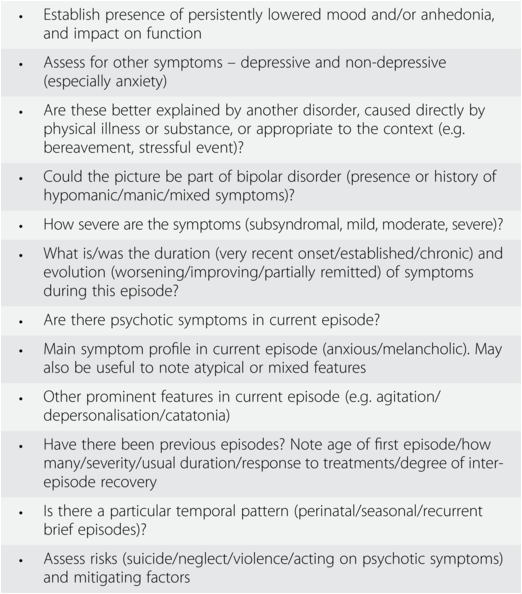
Rating Scales
Rating scales allow a quantitative assessment of symptoms. Some self-report scales are used for screening and for epidemiological studies, but it is important to realise that these do not accurately reflect clinical assessment and so should not be viewed as diagnostic instruments. Although sensitivity and specificity are important features of rating scales used for screening or as a proxy for diagnosis, ease of use, reliability and face validity are much more important when used to monitor symptoms in clinical care. Table 3.1.7 describes some of the more common and useful rating scales for use with depressive disorders.

Given differences in choice and wording of scale items, and sometimes weighting of different symptoms, the constructs measured by each rating scale vary, and correlation between scales may only be moderate. As rating scales cannot cover the whole range of an individual patient’s symptoms and concerns, they do not replace clinical assessment. Self-rating scales are increasingly favoured as providing the patient’s own perspective, and they offer clear advantages in terms of feasibility and time in clinical practice as they can be completed before a consultation; they do however need to be interpreted in light of the whole clinical picture, as responses may be influenced by illness factors, personality and circumstances. Rating scales are of great value in recording the overall severity of depression, anxiety and individual symptoms over time, assessing response to treatment, helping communication between professionals and between professionals and patients, and self-monitoring. However, they are woefully underused in clinical practice, even though recommended by NICE guidance.Reference Stein, Szatmari and Gaebel21


