


1. Introduction
System architecture decisions which determine the arrangement of functions and structure in a system, are typically established very early in the design process, well before the detailed engineering begins (Reference Cross and RoozenburgCross & Roozenburg, 1992; Reference Ulrich, Eppinger and YangUlrich et al., 2020). These decisions strongly influence not only functional performance but also the non-functional design objectives (often called ilities), such as flexibility and reliability (Reference Wyatt, Wynn, Jarrett and ClarksonWyatt et al., 2012). Although ilities may be achieved in different ways, many fundamentally address uncertainty (Reference Chalupnik, Wynn and ClarksonChalupnik et al., 2013) by introducing extra capability into the design, commonly referred to as design margins (Reference Eckert, Isaksson and EarlEckert et al., 2019). Despite their foundational influence on the design, architectural decisions are rarely recognised explicitly as mechanisms for introducing or generating margins in design (Reference Brahma, Ferguson, Eckert and IsakssonBrahma et al., 2023). For instance, choices such as modular interfaces or redundant system elements inherently create additional capacity to accommodate future changes or failures, yet these emergent properties are not framed as margins in design literature. Recognising these architectural margins is therefore critical to managing uncertainty at a systemic level and for avoiding undesirable effects such as overdesign or degradation of system performance.
The existing literature on margins predominantly focuses on parametric buffers and excesses (Reference Brahma, Ferguson, Eckert and IsakssonBrahma et al., 2023; Reference Eckert, Isaksson, Lebjioui, Earl and EdlundEckert et al., 2020), often applied late in the design process. While these margins are quantifiable and therefore can be optimised and traded off, margins added or emerging at the architecting stage are often abstract and difficult to quantify. Such margins arise from architectural choices related to subsystem decomposition, module definitions, interfaces, as redundant systems, as extra functionality and so on. This paper addresses that gap by highlighting the relationship between margins at the system architecture level and the desired ilities.
This paper introduces a perspective that (i) distinguishes margin allocation across three levels of abstraction i.e., macro (system-level architecture), meso (subsystems and interfaces) and micro (component parameters); (ii) explains how these margins relate to system architecture design objectives or ilities; and (iii) illustrates their role in managing uncertainty and supporting lifecycle goals through four examples.
2. Background
Building on the introduction, this section reviews the literature on margins and ilities focusing on how each has been treated in engineering design research to establish the conceptual foundation for the subsequent analysis.
2.1. Concept of margin in design and development
The concept of margin has evolved from historical practices of ad hoc factors to more formalised approaches of managing uncertainty in a design. Historically, margins were intuitive additions to design parameters such as safety or design factors to ensure safety against unknowns, or to bridge the gap between theory and practice (Reference ShanleyShanley, 1962). Such factors can still be seen in various codes and standards (Reference Brahma, Ferguson, Eckert and IsakssonBrahma et al., 2023). More recent perspectives emphasise that regardless of the motivation, margins appear as an extra capability in a system described through design parameters (Reference Eckert, Isaksson, Lebjioui, Earl and EdlundEckert et al., 2020). Based on this view, Reference Eckert, Isaksson and EarlEckert et al. (2019) define margin as the “difference between a design parameter’s minimum required value to ensure functionality and actual capability”, and propose a formalism in terms of requirements, constraints and capability. Reference Brahma and WynnBrahma and Wynn (2020) further reconceptualise margin as a ratio between the decided value of a parameter and the minimum required for the design to work, allowing comparison of margin across different parameters and units, facilitating system-level margin analysis.
A number of methods of sizing margins can also be found in the literature, many of which are context-specific. For example, probabilistic approaches such as by Reference PaganiPagani (2004) in the context of nuclear plants suggest an approach for calculating margins based on failure likelihoods. Reference Alfred Mohammed, Benson, Hirdaris and DowAlfred Mohammed et al. (2016) apply probabilistic analysis on the worst-case loads, calculated from the waves expected to hit the hull girder of a container ship. Other methods incorporate multi-factor risk analyses or stochastic intersections of failure and usage probabilities (Reference Peng, Li, Huang, Liu, Li and MiPeng & Li, 2021). Frameworks such as Quantification of Margins and Uncertainty (QMU) link the sizing of margin to the uncertainty absorption potential of a parameter. An approach used in QMU, for instance, is to first identify and quantify the uncertainties. Once identified, they are propagated through a model of the system to determine the points where failure occurs and therefore how much margin would be required to prevent such failures (Reference HeltonHelton, 2011). Reference Pepin, Rutherford and HemezPepin et al. (2008) propose a method to calculate the ratio of the available margin and the uncertainties. The design is considered safe if the ratio is greater than 1. Beyond sizing, the second group of papers discuss margin allocation strategies. Reference ThunnissenThunnissen (2004), for instance, views margin as a response to risks, distributing reserves according to tradable parameters and risk tolerances. Reference Zang, Mahadevan, Tai and MavrisZang et al. (2015) propose a constraint satisfaction-based approach where margins are first allocated, followed by the calculation of the probability of success. In another method, Reference Guenov, Chen, Molina-Cristóbal, Riaz, van Heerden and PaduloGuenov et al. (2018) explore the trade-offs between design performance and the given uncertainties. Their method employs a design of experiment technique to enable a systematic exploration of the “margin space” through the combinations of margin allocation and their impact on the system performance. In contrast to prior methods, the margin value method (MVM) (Reference Brahma and WynnBrahma & Wynn, 2020) focuses on the problem of analysing margin in existing designs. It uses a parameter network as the basis of the analysis. The MVM evaluates local excess margin and their relative effect on both the desirable effect of uncertainty absorption in a system and the undesirable effect of a deterioration in the system performance. This allows for a prioritisation of margins that are useful over those that could be removed.
Despite the availability of such methods in literature (see Reference Brahma, Ferguson, Eckert and IsakssonBrahma et al. (2023) for a review), a key limitation is their dependence on parameters to represent margins. While parameters do exist at the architectural level (e.g., number of seats in a car), most margin methods focus on detailed component parameters and overlook higher-level architectural decisions.
2.2. Concept of ilities in engineering design
Ilities, often referred to as non-functional requirements, are desired system properties which are important to stakeholders beyond the intended functionalities (Reference Crawley, de Weck, Eppinger, Magee, Moses, Seering, Schindall, Wallace and WhitneyCrawley et al., 2004). They play a central role in architectural decision-making and have system-wide implications that extend beyond individual functions. The literature proposes a multitude of ilities, which focus on various kinds of system design (Reference Campean, Eckert, Martinec, Škec, Škec and ŠtorgaCampean & Eckert, 2024; Reference Chalupnik, Wynn and ClarksonChalupnik et al., 2013; Reference Crawley, de Weck, Eppinger, Magee, Moses, Seering, Schindall, Wallace and WhitneyCrawley et al., 2004). Figure 1 compiles a non-exhaustive but illustrative set of ilities drawn from the literature and grouped into four aspects of system design. We selected ilities that (i) recur across well-established sources in system engineering and design, (ii) are central to architectural decisions and (iii) can be mapped to margin strategies at macro, meso and micro levels. Some ilities, such as adaptability and flexibility are introduced in a system keeping its evolution in mind. Others such as repairability and maintainability, provide physical characteristics to parts of a system to influence their repairability and maintainability. While supporting performance and the lifecycle, these ilities also contribute to environmental support, for example, by prolonging the system’s life. Many ilities therefore, conceptually overlap and are not mutually exclusive (Figure 1 is therefore not rigid). For example, adaptability, flexibility and changeability all aim to accommodate uncertainty differing only in scope and timing. Adaptability may involve adding new modules to extend functionality, flexibility might allow reconfiguration within an existing architecture and changeability may allow component substitution without redesign. Despite these distinctions, a common thread is that ilities ultimately function as design mechanisms for managing systemic uncertainties and maintaining the system-value over the lifecycle. A more detailed discussion about various kinds of ilities and the relationships between them can be found in Reference de Weck, Ross and Rhodesde Weck et al. (2012). A key observation in the literature is that most ilities are achieved by deliberate design strategies, enabled by decisions during the architecting stage of the design process.
Examples of ilities categorised under four aspects of system design; the set is non-exhaustive and is derived from literature (Reference Campean, Eckert, Martinec, Škec, Škec and ŠtorgaCampean & Eckert, 2024; Reference Chalupnik, Wynn and ClarksonChalupnik et al., 2013; Reference Crawley, de Weck, Eppinger, Magee, Moses, Seering, Schindall, Wallace and WhitneyCrawley et al., 2004; Reference de Weck, Ross and Rhodesde Weck et al., 2012)

Figure 1 Long description
A diagram categorizing ilities under four aspects of system design: performance and lifecycle support, environmental support, change and evolution, and architectural support. The diagram is structured into four overlapping hexagons, each representing one of the aspects. The hexagon for performance and lifecycle support includes ilities such as manufacturability, availability, quality, and modifiability. The hexagon for environmental support includes ilities such as sustainability, circularity, durability, reliability, repairability, robustness, maintainability, and safety. The hexagon for change and evolution includes ilities such as agility, survivability, adaptability, changeability, evolvability, extensibility, scalability, and flexibility. The hexagon for architectural support includes reconfigurability, interoperability, and resilience. Each hexagon overlaps with the others, indicating the interconnected nature of these ilities.
In practice, designing for an ility often involves increasing margin, either explicitly, e.g. by applying safety factors, corrosion allowances, or implicitly through architectural decisions that create buffer (or excess) capability. For example, flexibility and changeability are often achieved through introducing modularity at the architectural level (Reference Baldwin and ClarkBaldwin & Clark, 2000; Reference Machchhar, Bertoni, Wall and LarssonMachchhar et al., 2024). Similarly, safety might be achieved by the introduction of redundancy (Reference Cavique, Gonçalves-Coelho, Suh, Cavique and FoleyCavique & Gonçalves-Coelho, 2021; Reference LusserLusser, 1958). Concepts such as real options further illustrate how margin-based thinking can enable multiple ilities simultaneously by embedding flexibility for future changes or upgrades (Reference Sharman and YassineSharman & Yassine, 2007; Reference Engel, Browning and ReichEngel et al., 2017). Similarly, in changeability, real options provide a framework for assessing the benefits of designing systems with interchangeable or upgradable components, thereby avoiding costly redesigns (Reference Machchhar, Bertoni, Wall and LarssonMachchhar et al., 2024). This overlap illustrates that margins are not only fundamental to managing uncertainty on systemic levels but are also capable of enabling multiple ilities simultaneously. Further, it also illustrates that there are trade-offs involved; while margins can enable multiple ilities, they cannot be used indefinitely. Excessive margins may lead to overdesign, increased cost, or reduced performance. This creates a need for prioritisation, deciding which ilities should receive margin allocation and to what extent.
Despite these conceptual connections, the system architecture literature does not explicitly frame margin as a unifying common thread for ilities. Foundational work on ilities, for example, Reference Crawley, de Weck, Eppinger, Magee, Moses, Seering, Schindall, Wallace and WhitneyCrawley et al. (2004); Reference de Weck, Ross and Rhodesde Weck et al. (2012) emphasise strategies such as modularity and redundancy but do not prescribe margin allocation as a more fundamental concept to achieve such strategies. In contrast, the margin literature focuses on the parameters and does not explicitly link them to architectural strategies. A recent review on the topic by Reference Brahma, Ferguson, Eckert and IsakssonBrahma et al. (2023) confirms this gap. We posit that because the foundational principles are the same, integrating margin-based reasoning in system architecture design will ultimately reduce the often-overlapping nature of many ilities. Further, it will provide a structured way to reason about them using margins as a common concept.
3. Margin as an enabler of architectural objectives (ilities)
In this paper, we distinguish between three levels, macro, meso and micro, which represent a progression from high-level abstraction of system architecture to more detailed representations of design, such as parameters. The progression is framed macro-meso-micro to reflect the general direction of the system architecture design process. We propose a structured perspective that categorises margin allocation across the three aforementioned levels (macro, meso, micro) and relates them to ilities.
-
• At the macro level, the prime focus is the composition of a system. At this level, margins are conceptually abstract and are not described using precise values or parameters, but they enable higher-level system architecture objectives. At the macro level, overall system boundaries may also be considered where they share an interface with the outside world. Here margins may be needed to ensure compatibility with other interacting systems.
-
• At the meso level, focus is on the constituent sub-systems of the architecture. Margins are considered at the level of sub-systems and the interfaces between them. Like the macro level, margins at the meso level may also concern architectural objectives (ilities); however, the focus remains on the role of sub-systems and not on the system as a whole.
-
• At the micro level, the individual components and the margins on them are of concern. The margins are described in terms of quantifiable parameters or other measurable characteristics, e.g., part thickness, performance, weight, etc.
Achieving ilities in an engineered system inherently involves trade-offs and costs. For example, the architectural choice that increases modularity to enhance adaptability can, depending on the decomposition strategy, lead to an increase in the number of interfaces. This, in turn, can reduce reliability by indirectly increasing the points of failure, introduce additional integration points, or reduce manufacturability. Given such trade-offs, the perspective of margins provides a unifying concept examine such trade-offs. For instance, in the example of modularity, interfaces can be thought of in terms of margins i.e., flexible extra capacity allowing new components to be integrated without requiring a fundamental redesign of the system. The following subsections will explore how deliberate margin allocation can help as an explicit enabler for ilities.
The ilities and methods discussed are provided as a non-exhaustive set of examples to demonstrate how strategies at the macro, meso, and micro levels can be used for informed margin decisions during system design.
3.1. Margin as an enabler for reliability
One of the most critical ility for complex systems, reliability is defined as “the probability that a system will perform its intended function without failure, for a specified period under stated operating conditions” (Reference Kapur and LambersonKapur & Lamberson, 1977). Reliability can involve margins in two ways: as a deliberate addition to absorb uncertainty, or as an emergent consequence of strategies aimed at achieving an increased reliability. For example, redundancy or robust interfaces inherently introduce buffers in the system which act as a margin. This system-level reasoning contrasts with ad hoc approaches such as sprinkling safety factors everywhere, which lack targeted intent and may lead to overdesign.
At the macro level, a strategy may be to incorporate system-level redundancy that ensures contingency to ensure operational continuity (Reference Cavique, Gonçalves-Coelho, Suh, Cavique and FoleyCavique & Gonçalves-Coelho, 2021). This involves architectural choices such as incorporating parallel identical elements in the system that can fulfil the same functionality. If and when failure occurs in one of the two (or more) identical systems, the spare element takes over (Reference Chen and CrillyChen & Crilly, 2014). Until the failure occurs, the redundant identical system element remains an extra capacity of the system and therefore is a margin. Examples include the use of redundant flight control systems in aircraft, where multiple independent channels (e.g., electronic or hydraulic) allow the system to maintain functionality even if one of them fails. Such a margin is not parametric but is conceptual.
At the meso level, margins are introduced at the subsystem boundaries and interfaces to manage internal uncertainty and prevent the propagation of failures. For example, a margin can be created by deliberately over-specifying interfaces between two subsystems (Reference Hamraz, Hisarciklilar, Rahmani, Wynn, Thomson and ClarksonHamraz et al., 2013). The buffer capacity helps in absorbing uncertainty propagated from adjacent subsystems, effectively improving the reliability of the system as a whole. Further, the margin ensures that a subsystem failure does not compromise the entire system.
At the micro level, reliability is supported by traditional methods of applying safety factors and overspecification of parameters directly to components (Reference Ahn and KwonAhn & Kwon, 2006; Reference PaganiPagani, 2004). These intentional margins ensure that there is a difference between the capability of the component and what the operational requirement is. Component-level uncertainty upto a certain extent could be absorbed by the component, thereby making the component reliable in operation. These margins directly counter uncertainties such as thermal expansion, fatigue, or variability in manufacturing processes at the level of the component.
3.2. Margin as an enabler for robustness
Another design objective that is frequently discussed in the context of engineering systems is robustness, i.e., the ability of a system to maintain its intended performance despite unexpected variations (Reference Ross, Rhodes and HastingsRoss et al., 2008). Unlike reliability, which focuses on failure events or adaptability, which aims to respond to change, robustness broadly focuses on the stability of performance. There are various ways in which the concept of margin may be used to achieve robustness (Reference Juul-Nyholm and EiflerJuul-Nyholm & Eifler, 2024).
At the macro level, margin may help to decouple system functions from external sources of variation (Reference SuhSuh, 1999). For example, an electrical grid system may be architected to have generation reserves, multiple transmission paths and regional interconnections, all of which are margins in the form of buffer capacities deployed to stabilise performance. These features decouple the grid’s core function from localised disturbances, for example, due to weather conditions and therefore protect the system performance variability. Similarly, grid architects often include dormant “peak load plants” in the system architecture, which as opposed to “base load” plants, only operate when there is fluctuation in the demand for electricity, ensuring a stable supply despite variations in load.
At the meso level, margins are applied at the interfaces and connections between subsystems to absorb and damp internal variations (Reference Panarotto and Alonso FernándezPanarotto & Alonso Fernández, 2024). This strategy uses a deliberately added margin at the interface to provide stability. For example, shaft couplings are often used to transfer torque from one subsystem to another. It is quite common to have coupling designs that are physically flexible in their design and can absorb noise in the form of misalignment, variation from thermal expansion or vibrations. The additional design features of these couplings are otherwise not necessary for functionality in an ideal condition, and therefore represent extra capacity in the system as margins (Reference Alonso Fernández, Panarotto, Isaksson, Mortensen, Hansen and DeiningerAlonso Fernández et al., 2022).
At the micro level, robustness can be achieved by allocating margins on component parameters to make the component’s performance insensitive to noise factors. Robust design methodologies at the micro level are well established in the literature (Reference Juul-Nyholm and EiflerJuul-Nyholm & Eifler, 2024).
3.3. Margin as an enabler for adaptability
Margins can also enable adaptability, which is the system’s inherent ability to handle changes in its operating environment or evolving requirements over time (Reference Jacobson, Ferguson, Otto, Eisenbart, Eckert, Eynard, Krause, Oehmen and TroussierJacobson & Ferguson, 2023). From a margin perspective, adaptability can be enabled by adding additional capabilities at the various levels that are specifically intended to absorb changes initiated by external factors and over time (Engel et al., 2017). For example, margins could facilitate adaptability by embedding flexibility into the architecture, allowing for modifications that extend the system’s utility over time (Reference Ross, Rhodes and HastingsRoss et al., 2008). We can look at margins at the three levels of hierarchy:
At the macro level, adaptability margins involve architecture-level design choices like scalable architectures or functional diversity, where multiple functions are included to satisfy a core system requirement (Reference Chen and CrillyChen & Crilly, 2014). Unlike redundancy, described in the previous section, which relates to failure scenarios, adaptability focuses on changing requirements (Reference Tackett, Mattson and FergusonTackett et al., 2014). For example, in energy grids, diversifying the sources of energy may help in ensuring that the primary function of delivering energy is maintained even if there is a fluctuation in one source due to environmental conditions or because of user demand. The margin is the system’s built-in capability to bridge the gap between initial operational requirements and future, divergent requirements by switching to an alternative, already integrated (but normally unused) functional path.
At the meso level, margins focus on the adaptability at the level of subsystems and interfaces. Strategies such as standardised connectors or variable-capacity modules without redesigning the whole system (Reference Baldwin and ClarkBaldwin & Clark, 2000). These standardised connectors serve as margins by providing an extra capability in the interface design, allowing for a broader range of compatible components or modules to be integrated than initially required. For instance, in personal computers, standard RAM slots create margins at interfaces, allowing users to upgrade memory or connect various peripherals without replacing the entire system.
At the micro level, margins for adaptability are applied to component parameters to accommodate changing requirements or future expansions without replacing or redesigning the component (Reference Jacobson, Ferguson, Otto, Eisenbart, Eckert, Eynard, Krause, Oehmen and TroussierJacobson & Ferguson, 2023). For example, pumps rated for a higher-pressure range than initially needed introduce a margin that enables future performance upgrades (Reference Brahma and WynnBrahma & Wynn, 2020). Similarly, sensors in a car may be over-specified for temperature ranges which enable them to be deployed in a wider range of climatic conditions. Margins at the micro level, therefore, serve as enablers of system-level adaptability by keeping individual components ready for changes in requirements over time.
3.4. Margin as an enabler for platform resilience through commonality
The final example we present in this paper is that of margin as an enabler of product platforms through commonality. Commonality is often described as the degree to which features, parts or components are used by more than one end-product (Reference Krause and GebhardtKrause & Gebhardt, 2023). In platform strategies, commonality helps to reduce internal variety and complexity by enabling multiple products to be built on a shared architecture (Reference Robertson and UlrichRobertson & Ulrich, 1998). This shared architecture called the platform, integrates modules used across all variants, while other modules are customised for specific market needs (Reference Krause and GebhardtKrause & Gebhardt, 2023). The platform allows companies to create a diverse product portfolio with several diverse variants, while maintaining efficiency in development and manufacturing (Reference Robertson and UlrichRobertson & Ulrich, 1998).
To achieve this, the platform at the macro level must meet the most demanding requirements among all variants, which inevitably introduces margins for less demanding ones (Reference Alonso Fernández, Panarotto, Isaksson, Krusell and KeroAlonso Fernández et al., 2024). For example, a shared automotive platform used for sedans, hatchbacks, and SUVs may typically be sized for the SUV’s performance requirements. The same platform, when used for smaller vehicles, results in unused capacity or margins. These margins act as enablers of commonality that reduce redesign effort for individual customer segments.
At the meso level, interfaces such as those in electrical connectors are also specified for the highest-rated variant, creating margins when paired with modules of lower specifications. Similar is the case at the micro level, where components like bearings or fasteners are selected with ratings exceeding the minimum needs of smaller variants to maintain commonality across the platform.
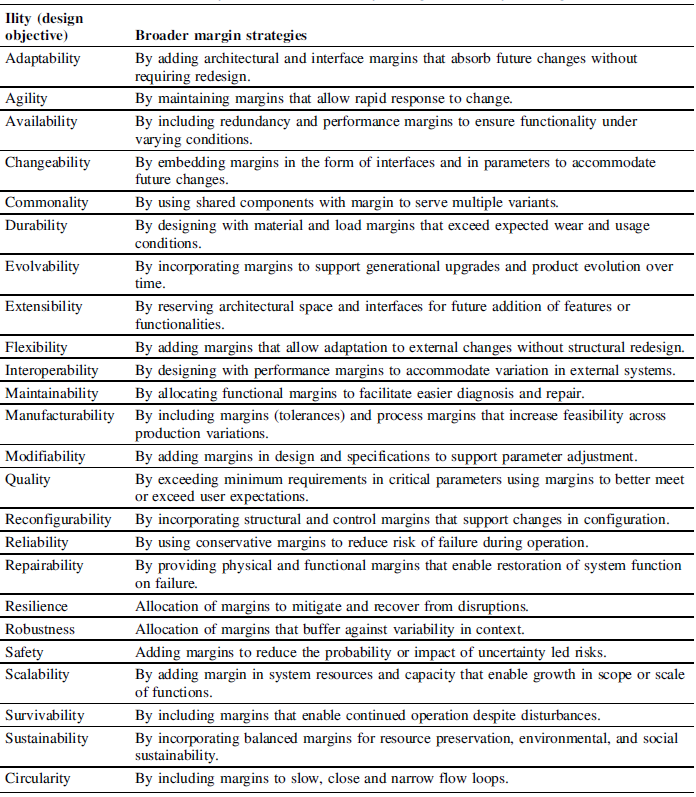
Table 1 generalises the macro-meso-micro margin perspective beyond the four worked examples discussed before. The table was constructed by synthesising definitions and mechanisms of ilities from the literature and then mapping them to margin strategies at the three levels, and then cross-verifying them with literature. Finally, the table and mapping were checked and refined by the co-authors to ensure plausibility and consistency. Note that the table shows the dominant margin mechanism for each ility and is not intended to be a one-to-one mapping.
Example of ilities and corresponding relationship to margin

4. Discussion
System architecture ilities are systemic properties that emerge from top-down reasoning during system design. They are typically achieved through strategies that consider interactions among all system elements. From the perspective of margins, these strategies can be understood as targeted allocations of margin resulting in extra capability than necessary, or as emergent consequences, resulting in additional capability that supports lifecycle objectives. This contrasts with the traditional approach of applying safety factors indiscriminately at the component level. Instead, margins at macro, meso, and micro levels can be viewed as carefully considered responses to uncertainty, aligned with specific lifecycle objectives. This reframing makes explicit how architectural decisions contribute to practical design outcomes. Framing margins as enablers of ilities offers several implications for design practice:
First, linking margin allocation to ilities provides a clear rationale for early design choices. Designers can articulate why a buffer on capability is introduced and how it supports specific lifecycle objectives, instead of relying on intuition or ad hoc safety factors. Even when margins are not deliberately added but emerge as a by-product of achieving an architectural objective, they can still be recognised and used to improve system performance or enable additional ilities. Second, many ilities overlap conceptually (e.g., adaptability, flexibility, changeability). A margin-based perspective suggests that many ilities share a common mechanism absorbing uncertainty through having extra capability. For instance, recent work by Reference Alonso Fernández, Panarotto, Isaksson, Krusell and KeroAlonso Fernández et al. (2024) supports this view by introducing the concept of platform margins as a means to evaluate flexibility over time, showing how architectural decisions can introduce hidden capacity to support multiple ilities simultaneously. While a margin perspective on ilities does not remove their inherent distinctions, it provides a useful and integrative way to think about overlaps and to structure early architectural trade-offs. Further, it can help make design objectives clearer. Their framework further demonstrates how margins can be used to balance internal and external variety, supporting the idea that margins, whether parametric or conceptual, can be used to enable lifecycle properties such as ilities in systems.
Third, considering margins at macro, meso, and micro levels enables trade-off studies at all levels of hierarchy, rather than focusing only on parameters. This extends existing margin-based reasoning beyond parameter-level decisions to architectural decision-making. Fourth, margins can support sustainability and circularity by prolonging system life and reducing redesign effort. Further prudent use of margins can also reduce the chances of overdesign, thereby helping to make the product more sustainable. Finally, a proactive management of uncertainty can be made possible by allocating margin at the architectural stage before detailed parameters emerge.
However, this perspective also introduces challenges. Margins at macro and meso levels are abstract and context-dependent, making quantification and trade-off analysis complex. While the proposed macro-meso-micro framework offers a way to relate margins and ilities, it is not always straightforward to define clear, orthogonal margins across these levels. In some cases, such as with global continuum parameters such as weight or volume, decomposition may be simpler. In other cases, however, especially where architectural decisions add extra capabilities, the boundaries between levels can be blurry. Therefore, utilising these ideas requires modifications of existing methods or the development of new methods across the levels of abstraction. Further, existing margin methods do not consider the time aspect, which could be critical for lifecycle properties such as reliability and maintainability. Incorporating time factors into approaches like the Margin Value Method (MVM) could expand them into margin-oriented reliability methods. Similar adaptations could enable margin-based approaches for other ilities.
5. Conclusion and future work
This paper highlights the relationship between margins and architectural ilities. It shows that margins which has traditionally been treated as parametric buffers and excesses, at the systemic level, can also be understood as enablers of lifecycle objectives. By framing margins at macro, meso, and micro levels, this paper provides a basis for more structured reasoning about architectural decisions and their trade-offs at various levels of hierarchy. However, applying this perspective in practice requires further development. Margins at higher levels of abstraction are difficult to quantify, making trade-off analysis complex. Most existing margin methods also overlook time-dependent factors which are critical for properties such as reliability and maintainability. Incorporating the time aspect into approaches like the Margin Value Method (MVM) could enable them to be used as margin-oriented reliability analysis tools. Other approaches, such as Value-Driven Design (VDD) also offer a complementary perspective by aligning design decisions with stakeholder value across the system lifecycle (Reference Isaksson, Kossmann, Bertoni, Eres, Monceaux, Bertoni, Wiseall and ZhangIsaksson et al., 2013). Future work could explore how these perspectives might be used to support early-stage architectural decisions in complex systems keeping ilities in mind.
Acknowledgement
The authors would like to acknowledge insightful conversations with Prof. Claudia Eckert and Dr. Scott Ferguson on the topic of margins in engineering design, which helped shape aspects of this work.


 Open access

