

Introduction
Recent research about the race to the South Pole asks specific questions about knowledge and innovation: What did the participants seek? What did they learn, and how did they apply what they learned? (Alp, Reference Alp2018; May, Reference May2013, Reference May2018; May & Airless, Reference May and Airrless2015; May & Lewis, Reference May and Lewis2015; Schultz et al., Reference Schultz, Vitton and Butz2015; Tahan, Reference Tahan2019; Turney, Reference Turney2018). Although previous research has examined elements of expedition management, the present analysis extends that to innovation in sledging (Karpoff, Reference Karpoff2001; Stuster, Reference Stuster1996, Reference Stuster2000; Savitt, Reference Savitt2004, Reference Savitt2008; Savitt & Lüdecke, Reference Savitt and Lüdecke2007). This is based on the proposition that Scott looked backwards to the British in their search for the Northwest Passage and ignored much of Antarctic experiences before his first expedition on the Discovery (1901–1904). A year after volunteering for command he was still astonishingly ignorant of polar exploration and had done very little reading on the subject (Huntford, Reference Huntford1999, p. 129). Amundsen drew upon knowledge gained from the recent past including his personal Antarctic experiences on the Belgica (1897–1899) and looked for new solutions for improving his equipment. Both expedition leaders represented two distinct views of polar exploration with the sense of times colliding. “Scott seemed to live in 1911 which is only forty years from the 1870s, Amundsen’s 1911 seems only forty years in advance of the 1950s” (Spufford, Reference Spufford1997, p. 267). Scott relied on the traditional British approach but disregarded recent developments on Antarctic expeditions. Amundsen’s program of continual innovation contributed to successfully reaching the South Pole; he perfected the integrated, dog-based sledging system. The analysis focuses on innovation, the changes in routine operations which arises by employing available knowledge or through experimentation. These are viewed in the context of the organisational models that each used and how they affected the search for knowledge and innovation.
Polar exploration came to prominence in the nineteenth and early twentieth centuries. Expeditions were sponsored by commercial enterprises, governments, religious organisations such as the Moravians, scientific societies and private donors. They were driven by three inextricably intertwined goals, economic exploitation, national prestige and science. Nations were in competition with one another mainly in the search for the magnetic pole of the southern hemisphere and the passages to Asia, the Northwest Passage in the western hemisphere and the Northeast Passage in the eastern hemisphere. There was little direct competition between specific expeditions being in the same area at the same time with the same goals. However, there were two exceptions, the competition between Frederick Cook and Robert Peary in searching for the North Pole and the race to the South Pole in the Antarctic (Cook, Reference Cook1919; Huntford, Reference Huntford2010; Peary, Reference Peary2001). Sixteen major expeditions took place in the area of Antarctica between 1892 and 1913 starting with the Dundee Whaling Expedition (1892–1893) and concluding with Scott’s British Antarctic Expedition (1910–1913). These expeditions contributed to an understanding of the Antarctic and were a source of knowledge for further exploration, see Table 1.
Major sources of Antarctic expedition knowledge in the heroic age including the race to the South Pole, 1892–1913.
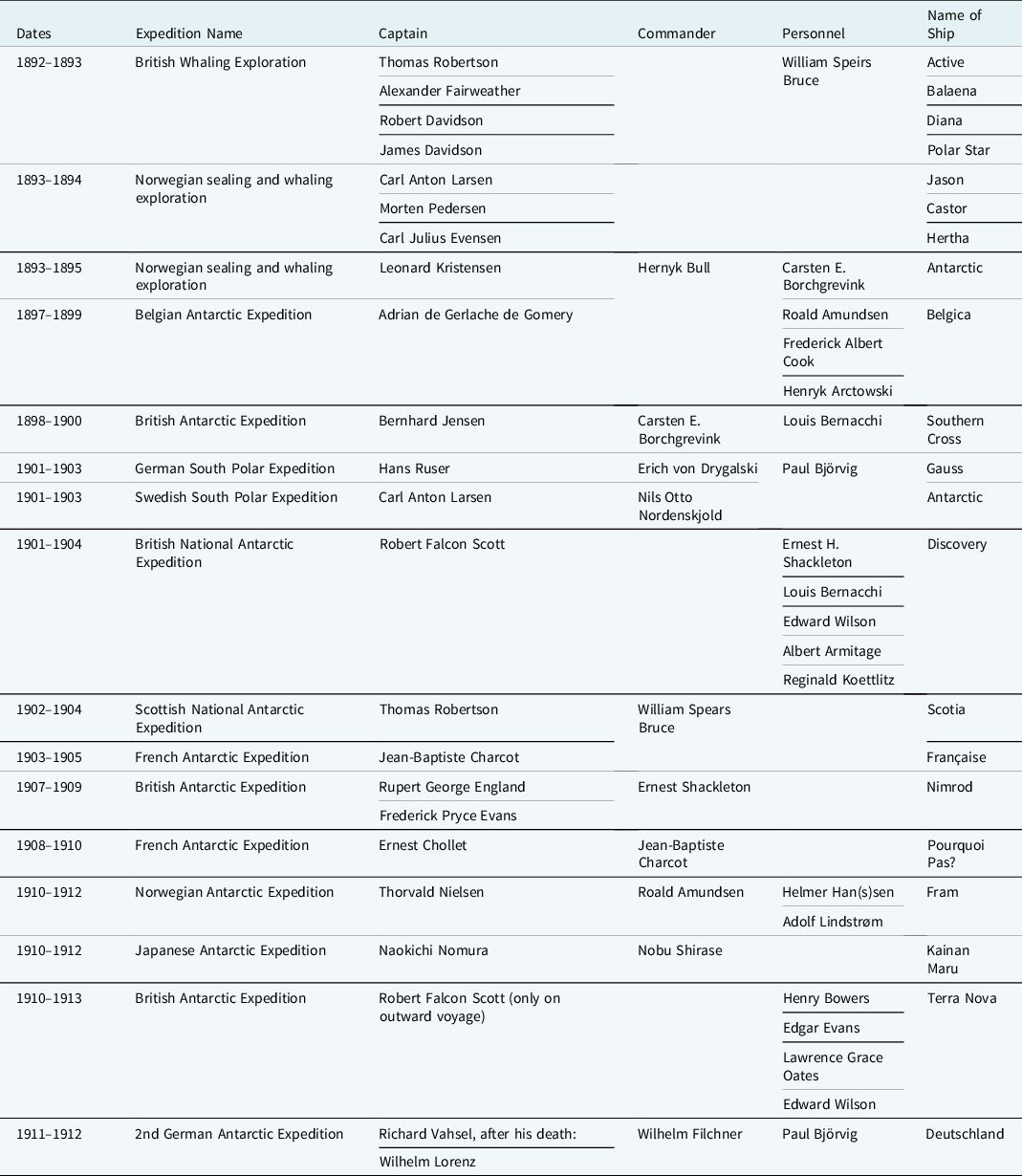
Source: Headland (Reference Headland2009).
The research includes a wide assortment of original and secondary materials including biographies, public records and scientific publications. It concentrated on documenting what knowledge was available at the time to advance haulage and sledging activities, the origin of the new methods, how they were evaluated, and how the new knowledge was applied. A substantial body of formal, written knowledge developed in the late nineteenth century, however, less is known about the knowledge of individuals who participated in previous expeditions. Few participants offer some insights about what had been directly learned from previous explorers; some reported their efforts, others said nothing and hence in some cases inferences were drawn from the records. Individual explorers accentuated their adventures with the hope of paying off debts and providing income for further activities rather than illuminate the contributions of others. Recent studies provide new insights, although several are hagiographic (Borkan & Hirzel, Reference Borkan and Hirzel2017; Capparell & Morrell Reference Capparell and Morrell2001; Huntford, Reference Huntford2010; Monatersky, Reference Monastersky2001; Perkins et al., Reference Perkins, Holtman, Kessler and McCarthy2000; Solomon, Reference Solomon2001; Stuster, Reference Stuster1996; Useem et al., Reference Useem, Useem and Assel2003). This article begins by defining the organisational models used in the Antarctic, continues with a description of knowledge available to Amundsen and Scott, and concludes with an analysis of how these factors affected their propensity to engage in innovation, the process of creating useable improvements by changing the activities required to complete a task; it is either spontaneous or continual and always involves taking risks (Yezersky, Reference Yezersky and Leon-Rovira2007, pp. 44–45).
Expeditions as organisations
As with all organisations, polar expeditions were organised and managed by past knowledge and new knowledge. This is the knowledge management process consisting of three elements: First is making “sense of changes and developments in the external environment” (Choo, Reference Choo1998, p. 1). Second is improving operations, and, third is making decisions based on what was learned (Choo, Reference Choo1998, p. 2). Organisations are defined by the individuals who create them and the social and political cultures in which they exist. They function most effectively when basic values are shared among all the members of the organisation (Schein, Reference Schein, Frost, Moore, Lundenberg and Martin1991, p. 247). Organisations differ in size, complexity and purpose. Each influences how knowledge is managed. “Like chess players organizations have a memory, a capacity to learn, and a mode of knowing” (Baumard, Reference Baumard1999, p. 17).
Three expedition models were used in the Antarctic in the late nineteenth and early twentieth centuries. They are the hierarchical model, the autocracy model and the scientific model. Each has unique features and strategies, none is pure, each often contains elements of the others. A priori one may appear more appropriate for exploration than another, however, each has limitations in application. Success or failure stems is not predetermined by the model but they influence how an expedition operates. The defining features are formality, complexity, risk taking, adaptability, knowledge management and leadership. Formality represents the organisation’s structure both vertically and horizontally and the specificity of responsibility for activities; complexity describes the number of divisions in the structure and the nature of communications among divisions; risk taking is the willingness to make decisions with limited knowledge of the outcome often without access to support; adaptability is the degree to which changes are made; knowledge management is the degree to which learning and knowledge influence success. Organizations succeed when they capture, use, and reuse the “best practices and intellectual assets” (Davenport & Klar, Reference Davenport and Klar1998, p. 195). Finally, leadership and management are the skills which inspire participants to follow the organisations goals, on the one hand, and on the other, follow the specific directions of the leader (Sternberg et. al., Reference Sternberg, Forsythe, Horvath, Wagner, Williams, Snook and Grigrorenko2000: 167). Beyond honesty and integrity, the “leader as manager” is required to assemble and allocate resources and gain respect for decisions even when unpopular (Capparrell & Morrell, Reference Capparell and Morrell2001, p. 45).
The hierarchical model is the most formal; it consists of a set of vertical structures representing various functions and horizontal levels with several layers within each carrying out the basic activities of an expedition. It can be visualised as pyramid with the ultimate authority at the apex. The vertical structures, often referred to as silos, each have a specific function. These include the ship’s operations consisting of the captain, a navigational staff of officers, a scientific staff and the exploration organisation. This model is found in several expeditions listed in Table 1 (Borchgrevink, Reference Borchgrevink1901, pp. 13–22: Charcot, Reference Charcot1911, pp. 22–23; Cook, Reference Cook1900; Speak, Reference Speak2003, pp. 77–79). Among these are the Antarctica, Belgica, Southern Cross, Discovery and Terra Nova expeditions. The two latter represent versions of the British naval model used in the Arctic between 1818–1916 (Savitt, Reference Savitt2004, p. 2). Authority is at the top of the vertical structure, communications move downward to intermediate and lower levels and little moves upwards. Communications among horizontal levels is limited. Individuals are rewarded based on adherence to commands and risk taking is limited. There is little incentive to innovate except where contingencies demand it. The Discovery and partly the Terra Nova differed from naval expeditions because the authority came from the Royal Society and the Royal Geographical Society, known as the “Societies Antarctic Expedition” (Markham, Reference Markham1921, pp. 448). “Elaborate instructions were drawn up for the guidance of the offers and men, and these were given to Captain Scott by Clements Markham, president of the Royal Geographical Society, himself; it contained discretionary power vested in the leader of the organization in the event of the instruction conflicting any way with local circumstances, or unexpected discovery of new territory or seas, that would constitute a change of plans” (Markham, Reference Markham1917, p. 329). This structure minimised conflict between the commander of the ship and the leader of the expedition in contrast to the Belgica where there was wide spread conflict among the captain, the commander of the expedition and the ship’s officers (Cook, Reference Cook1900). A recent popular treatise Madhouse at the End of the Earth illustrates describes what took place on the Belgica (Sancton, Reference Sancton2021). While used for exploration, the many of the personnel were not part of an exploration ethic. “Officers and men, ambitiously minded, volunteered for polar work not as ‘explorers’ in the twentieth-century idiom but as part of an ordinary naval career and they sailed for an unknown world of ice full of the robust confidence of the Victorian age” (Wallace, Reference Wallace1980, p. 79). The Royal Navy was the agent of authority. “It was the product of hierarchical service establishment based on discipline and its purpose was war and the keeping of peace and order” (Wallace, Reference Wallace1980, p. 5). The Discovery expedition (1901–1904) and the Terra Nova expedition (1911–1913) followed the hierarchical model in which “the planners repeated the mistakes of fifty years and condemned British Antarctic expeditions to tragedy in the second decade of the twentieth century” (Baughman, Reference Baughman1999, p. 4). The Admiralty and the Royal Societies provided orders allowing little discretion to the officers who were expected to obey them (Ellis, Reference Ellis1986, pp. 100–101). Rewards were based on how well individuals followed instructions. Risk taking except in dire circumstances was not encouraged. Discipline and courage defined what it meant to be a “good explorer,” and they were greatly favoured over self-reliance and initiative. Military command and control principles, known as the “heavy” approach to Arctic exploration, defined operations. Expeditions often included several ships and sailed as an armada. Vessel design paid attention to the “comfort and accommodations of both officers and men and to the greatest formal planning that human foresight could suggest, or a liberal Government provide” (Wallace, Reference Wallace1980, p. 10).
The adhocracy model is characterised by a flat structure with usually no more than two levels and without competition among the functions. While there is a clearly defined leader, the structure appears more like a box including a peak to indicate the leader. It includes the demarcation of specialized areas such as science and expedition operations, however, members “share common knowledge and responsibility” for the operations (Mintzberg et al., Reference Mintzberg, Lampel, Quinn and Goshal2002, pp. 223–224). The organisation is made up by a small group of individual volunteers and by a leader responsible for the expedition. Each member specialises in one area but has the knowledge to work in other areas. Expedition leadership and management are lodged in one individual; however, decision-making is shared among the various members as much as possible. Amundsen adopted this model based on the Arctic tradition of Fridtjof Nansen and Robert Peary and his Belgica experiences. He also attempted to ensure homogeneity among the crew (Amundsen, Reference Amundsen1927, p. 20). The model requires the concentration of resources with overlapping skills. The adhocracy model depends upon knowledge of past activities, the ability to apply direct experience and continual learning. Peary’s and Nansen’s expeditions are classic examples (Nansen, Reference Nansen1890; Peary, Reference Peary2001; Savitt, Reference Savitt2008). Members were carefully selected so as to ensure their commitment to the expedition goals and not as “an escape from civilised existence” (Huntford, Reference Huntford1999, p. 248). Size required a commitment to “systematic simulation, testing and evaluation of every item of equipment and the meticulous attention to detail as well as recognizing the importance of the crew’s well being” (Stuster, Reference Stuster2000, p. 54). Amundsen described this as the “essentials which brought success” (Amundsen, Reference Amundsen1927, p. 19–20).
The scientific model is the “scientific method” in action, observation, experimentation, revision and more experimentation. It approaches the hierarchical model except that the focus of the expedition is scientific rather than geographic discovery. In this model, there is a clear demarcation between the operation of the ship and the scientific activities with the latter having greater influence in organisation and operation of the expedition. In this way, it is more complex than the adhocracy model with several horizontal layers and less complex than the hierarchical models although it may contain elements of it. William Bruce wrote “The scientific side of the ship should be separate from the nautical, and the leader must be the intermediary and guiding hand for both” (Bruce, Reference Bruce1911, p. 241). Bruce organised the expedition around scientific areas, like biology, botany, geology, meteorology, and zoology in the British manner as described in the Royal Society instructions for scientific discovery in 1839 (Royal Society, 1840). The scientific orientation is seen in the Scotia’s structure, “two well-equipped laboratories, a dark room, and a Lucas sounding machine with two drums of 6000 cable each” (Speak, Reference Speak2003, p. 77). Bruce also delineated the roles of the various members. “The master of the ship must be subject to the leader, and the crew entirely responsible to the master, the leader strongly supporting the master in this position.” (Bruce, Reference Bruce1911, pp. 241–242). The Scottish National Expedition of 1902 and the French Antarctic Expeditions of 1903–1905 and 1908–1910 led by Bruce and Jean Charcot are examples (Bruce, Reference Bruce1902; Charcot, Reference Charcot1906; Charcot, Reference Charcot1911). Bruce applied Erich von Drygalski’s ideas (Hayes, Reference Hayes1928). Bruce’s crew was expected to know as much of the equipment as possible, and each became a scientist participating in a large experiment—as he saw his expedition. Bruce went a step further in “purity” and solicited funds only from those who understood his model. It “was the only Polar expedition to have been organized, supported and led wholly by … the people of Scotland” (Speak, Reference Speak1992, p. 138). Although successful in scientific achievements, Bruce and the Scotia expedition did not receive significant recognition outside of the scientific community, a matter attributed to Clements Markham (Speak, Reference Speak2003, p. 96). His expedition was never intended for extensive land exploration as were the other two models, but mostly for oceanographic investigations of the Antarctic waters.
Knowing and planning
Expedition planning begins with a search for what is known from the past and the search for additional knowledge both from current developments and from outside fields. Organizations that undertake this process are known as “the knowledge creating company” (Nonaka & Takeesuchi, Reference Nonaka and Takesuchi1995, p. 8). Amundsen and Scott had the luxury of not having to begin de nova. What knowledge existed did not mean they were fully aware of it, knew where it was located nor appreciate how useful it might be. Beyond the exploration literature, there were potential advances and discoveries from other fields. Core concepts for knowledge acquisition are exploration and exploitation. The former is “learning through discovery or experimentation” that leads to new ways of operating; exploitation is expansion of known concepts as a means of making improvements (Choo, Reference Choo1998, pp. 251–252). Regardless of what was known they did not have what was necessary to predict accurately the risks that they would face considering the various states of nature they might face. Searching for knowledge determines what is available so as to define uncertainty and establish alternatives and their probabilities. Some of what might be important may be outside of the realm of those searching and that is not often obvious (Nelson & Winter, Reference Nelson and Winter1982, p. 171). The advantage of external search, exploration, is the discovery of new methods, technologies and innovations as was the case of motor sledges. This requires risk taking beyond the comfort of what is familiar and the curiosity of asking whether “it can be employed in practice” (Nelson & Winter, Reference Nelson and Winter1982, p. 249). Changes can also be evolutionary over time and appear without much fanfare simply as “part of operations.” This is more likely to take place in organisations where individuals have high degrees of specialisation and are working together to solve a problem such as with Bruce and Amundsen. In those cases, knowledge is introduced to foster change (Leonard-Barton, Reference Leonard-Barton1995, p. 10).
Search focuses on limiting or reducing uncertainty and reaches to discover identifiable “alternatives” that can be explored, a process which should bring to light alternatives. “Real search processes take place in specific historical contexts, and their outcomes clearly depend in part on what those contain in the way of problem solution that are available to be ‘found’’’ (Nelson & Winter, Reference Nelson and Winter1982, p. 172). The organisations involved in the search have an important impact on the process. It is influenced by those who request it, those who conduct it and those who require it. Success is measured by how valuable the knowledge is and how well it can be used rather than how much of it is gathered. Planning matches what is known to assumptions about what is not known. Plans contend with “partial ignorance” when not all of the alternatives, methods and programs are known, for example. In spite of not being able to evaluate in advance, assumptions and plans can be made using “what if” (Ansoff, Reference Ansoff1987, pp. 39–44). The goal of planning is to reduce partial ignorance and minimise possible risk; however, they are always present. “The fact that the future can never be known with accuracy means that the planning of business firms [expeditions] is based on expectations about the future which are held with varying degrees of confidence; furthermore the expectations themselves are themselves essentially estimates of various possible outcomes in the future or a given action or series of actions” (Penrose, Reference Penrose1959, p. 56). The plan incorporates past knowledge, develops means for gaining new knowledge and applies these to the conditions which are expected and unexpected. Not everything will be known in advance and establishing contingency plans when the “unknown become known.” The plan establishes the goals and objectives, the resources necessary for undertaking the expedition and the means for allocating them, and alternatives in case the original plan has to be changed. The final step is to estimate the resources necessary to meet those conditions. Wilhelm Filchner, leader of the 2nd German Antarctic Expedition, wrote “Von der Vorbereitung einer Expedition und ganz besonders einer Polarexpedition hängt viel, mitunter vielleicht alles ab.” (“A great deal, sometimes perhaps everything, depends on the preparation for an expedition, and especially a polar expedition.”) (Filchner, Reference Filchner1922, p. 12). A point that Scott did not appreciate when he was quoted saying “that the worst part of the expedition was over when the preparations were finished” (Cherry-Garrard, Reference Cherry-Garrard1922, p. 1).
There are two sources of knowledge, formal and tacit. Explicit or formal knowledge in the form of articles, books and records is visible in expedition plans and documents where experiential/tacit knowledge can only be inferred. One of the most comprehensive sources at the time was “The Antarctic Manual” of 1901; it contains 491 references of articles, books, manuscripts and other printed materials for the 1700–1890 period; most were about scientific matters although a few offered insights about expeditions activities (Murray, Reference Murray1901, pp. 521–576). “The Antarctic Bibliography, compiled by Dr. Mill, is the first so far published which makes any claim to completeness, and though no doubt a certain amount of Antarctic literature exist which is not included, it is believed that no paper of any importance has been admitted.” (Royal Geographic & Royal Society, 1901, p. 160). There were reports on scientific materials whose categories came from previous Arctic manuals whose purpose was served “by giving easy access to information, otherwise inaccessible, which was required by the officers in their scientific investigations.” (Markham, Reference Markham and Murray1901, p. vii). There is no similar volume in the Norwegian literature although there are extensive reports and the writings by Nansen (Nansen, Reference Nansen1890; Tahan, Reference Tahan2019). Reports in English based on Nansen’s experiences were available; however, it is difficult to judge how widely they were circulated. Amundsen’s knowledge of the Norwegian experiences are well documented in the first chapter of his travel account of his Antarctic expedition (Amundsen, Reference Amundsen and Chater1912a, pp. 1–41; Bain, Reference Bain1897).
In contrast, “storehouses” of experiential or tacit knowledge do not exist. They reside with individual expedition participants, some of whom are well known, others who are not and still others who are not participants in a specific expedition. There are important examples in the literature describing individual contributions that were made at a specific time but much of these are lost and must be assumed. Tacit knowledge is difficult to document because “what we know” requires personal contact (Polanyi, Reference Polanyi1983, p. 4). “It can not be articulated fast enough” because of how it develops (Nelson & Winter, Reference Nelson and Winter1982, pp. 81–82). Individuals who experience and learn from events carry it with them. Tacit knowledge has the “function of producing fundamental innovations” if can be identified and used (Polanyi, Reference Polanyi1983, p. 55). That is why Amundsen relied on experienced members of his former expeditions. They could apply tacit knowledge when necessary. Experiential knowledge from experiences can be codified although they are not always available or useful as they might be (Sternberg et al., Reference Sternberg, Forsythe, Horvath, Wagner, Williams, Snook and Grigrorenko2000, p. 107). Amundsen made an interesting point about the relationship between explicit knowledge and tacit knowledge. “Secondhand experience out of books is often as good as first-hand, if the reader has had enough practical experience in the same field to understand and apply what he reads” (Amundsen, Reference Amundsen1927, p. 239). Antarctic explorers had to accept partial ignorance. They “did not have what was necessary to predict accurately the risks that they would face. By their very nature they were concerned with how to confront the unknown” (Dunn, Reference Dunn1992, p. 17). Their challenge was to develop a process to gather and apply knowledge for their operations similar to “dead reckoning”, informed guess work applied in navigation (Gurney, 1977, p. 25). Julius von Payer, member of the Austro-Hungarian North Pole Expedition (1872–1874) made this point “Every Arctic [Antarctic] expedition should be guided by the experiences of its predecessors, both in its plan and its equipment; hence, we have often to deplore the negligence of almost all polar navigators in failing to inform those who follow them of what they actually saw, of their modes of procedure, or of the mistakes which they committed. It will not, therefore, be labour thrown away, if we state our own experience and record our own observations for the guidance of others, in order to show, with the utmost possible clearness, what future explorers have before them, and how best to meet it.” (Payer, Reference Payer1876 (1), p. 62).
The British approach to knowledge and innovation
The British history of publishing exploration instructions began with James Clark Ross’s expeditions in 1839–1840 (Ross, Reference Ross1982). The Instructions to be Prepared for the Scientific Expedition to the Antarctic Regions provided recommendations for carrying out scientific work, although little was written about exploration methods (Royal Society, 1840, p. iii). Similar instructions were prepared for the Arctic expedition of 1875 (King, Reference King1876). In 1901, the Executive Committee of the Royal Geographical Society commissioned “Instructions to the Commander” as noted previously. Markham applied the format from the Manuals of 1875 and 1876 (Anonymous, 1875; King, Reference King1876: Markham, Reference Markham1921, p. 451). “The Antarctic Manual” contains materials from voyages to the Antarctic in a section titled “Geography.” Essays by John Biscoe, John Balley, Charles Wilkes, and M. J. Dumont d’Urville are included (Murray, Reference Murray1901, pp. 305–497). Henryk Arctowski and Louis Bernacchi offer first-person knowledge from the Belgica and the Southern Cross expeditions (Arctowski, Reference Arctowski and Murray1901, pp. 465–496; Bernacchi, Reference Bernacchi and Murray1901, pp. 497–514). Bernacchi served with Borchgrevink on the Southern Cross and a year after his return with Scott on the Discovery (Bernacchi, Reference Bernacchi2001). Only one article discussed exploration methods; it was M’Clintock’s “On Arctic Sledge-travelling” which describes preparations for sledge journeys including clothing, food, haulage methods, and the use of dogs (M’Clintock, Reference M’Clintock and Murray1901, pp. 293–304). The volume represented a major contribution so much so that Nansen “thought enough to ask for a copy of it” (Baughman, Reference Baughman1999, p 27). Interestingly and considering the extensive Arctic activities by the British it contained no references to the Arctic Blue Books, the British Parliamentary Papers documenting British experiences in the Canadian Arctic (Arctic/Subarctic Research Group, 2003). Yet both Royal Societies and the Royal Navy used knowledge from the Arctic to develop plans for the Discovery and the Terra Nova expeditions. A major source was Markham’s report on The Arctic Expedition of 1875–1876 in which he provides a detailed examination of the role of sledging activities. He states that it is necessary to spend one winter in the Arctic and “to look for sledge-traveling as the main instrument of discovery and exploration” (Markham, Reference Markham1876–1877, p. 542). Little was said about the methods and equipment except for references to “they laying-out of depots by autumn sledge traveling” (Markham, (Reference Markham1876–1877), p. 545).
Planning efforts were narrowly focused and gave little recognition to the previous Antarctic expeditions, noted in Table 1. Markham drew upon what he was most familiar, the Royal Navy. He was an officer of the Royal Navy himself; his appointed came from personal contacts with the Countess of Mansfield; he was awarded the “exalted rank of Naval Cadet” (Markham, Reference Markham1917, p. 18). His support was unwavering; however, he had difficulty with those outside of his social context such as Bruce who represented different views of how to organise expeditions (Markham, Reference Markham1921, pp. 437–438). Markham was less than helpful and supportive of Bruce’s attempts to develop a “rival enterprise” and basically rejected any aid based on the view that it was competition to the British expedition (Speak, Reference Speak2003, pp. 73–74). Markham did not give great value to non-British expeditions. (Baughman, Reference Baughman1999, pp. 10–34). He made light of the contributions of the Belgica and Southern Cross expeditions (Markham, Reference Markham1921, pp. 28–30). The latter was the British Antarctic Expedition; however, he did not regard it as British because Borchgrevink, the expedition leader, was Norwegian and it had a mixed crew from Britain and Norway, even though it was and financed by the English publisher Sir George Newnes (Borchgrevink, Reference Borchgrevink1901, p. 9). Markham held the Southern Cross up to ridicule “claiming everything but the money was Norwegian” which meant that “virtually everyone was urged to shun Borchgrevink”, and “the valuable experiences gained by this rogue; the refusal only increased to ignore the realities of modern polar travel (the suitability of dogs, the value of taking the nature of native Arctic people to the Antarctic for their experiences, the necessity of skis) and to rely on out-moded mid-century nineteenth century British Arctic Experience” (Baughman, Reference Baughman1999, p. 8).
Markham’s contributions to Antarctic exploration were substantial especially developing the support for such expeditions and providing the organisational context for their management (Markham, Reference Markham1921, pp. 444–465). As important as these were at the aggregate level, Markham did not appear to involve himself in operations. He did not consider the importance of dogs in the Southern Cross expedition: “Seventy-five dogs were landed, the first time dogs were used in Antarctica” (Mills, Reference Mills2003, p. 93). Borchgrevink discussed the trials and tribulations of the dogs on the voyage south but also attributes the expedition’s winter sledge journey success to them (Borchgrevink, Reference Borchgrevink1901, pp. 39–44 and p. 155, ff.) Such knowledge would have helped Scott. “It must be remembered that in making long sledge journeys in the South we had no previous experience to go on except that which had been gained in the North; we were forced [emphasis added] to assume that Southern conditions were more or less similar to those of the North” (Scott, Reference Scott1905 (1), p. 413). The contributions from the Southern Cross with its first ascent of the Barrier thought inaccessible since Ross’s time was not given much importance. Amundsen did and wrote “We must acknowledge that by ascending the Barrier, Borchgrevink opened a way to the south, and threw aside the greatest obstacle to the expeditions that followed.” (Amundsen, Reference Amundsen and Chater1912a, pp. 25–26). Also Cook’s experience on the Belgica expedition were not considered. He wrote “My story … is a record of the first expedition to pass through the ordeal of the long antarctic night and its gloomy winter storms. It is, I hope, a contribution of new human experience in a new, inhuman world of ice.” (Cook, Reference Cook1894, Reference Cook1900, p. xv). Cook, originally a physician was “an experienced and respected polar traveler, who had been an anthropologist on Peary’s Greenland expedition of 1892” and had much to contribute (Bryce, Reference Bryce1997; Kirwan, Reference Kirwan1962, p. 282). He understood the Peary system and its “light traveling” methods used by Frederick Schwatka during the last search for the disappeared Franklin expedition (1878–1880) (Savitt, Reference Savitt2008; Wamsely Reference Wamsely2017, p. 208).
The details about the Peary system were well known at the time of the Discovery. Donald B. MacMillan, Peary’s companion on several expeditions wrote in retrospect about Peary’s various expeditions in the Arctic and Greenland in the late nineteenth century. He described it as combining dogs, sledge design, personal equipment and the use of a “task force composed of five sledges” (MacMillan, Reference MacMillan1934, p. 160). Peary also contributed elements in a precise method for calculating the loading of sledge (Kaplan & LaMoine, Reference Kaplan and LaMoine2019, p. 54). He was not the traditional naval officer, but an “engineer and a technologist, a military planner concerned with strategy, tactics and logistics of his polar campaign” and his strategy included “the dispatch of small advance parties to blaze the trail and set up camps and depots … thereby saving the strength of the men and of the dogs reserved for the final dash” (Kirwan, Reference Kirwan1960, pp. 254, 258). Peary experimented with sledges using “native patterns” and studied sledge traction on different types of ice surfaces. He analysed the abilities and strengths of dogs including how much they could pull and how much food they required in order to determine the ideal size of a dog team. He began with the design of equipment, all of which had to be light weight and robust. The two attributes—“weight and durability”—had to be balanced including specifications for how sledges were to be loaded with food, tea and pemmican on top, above tools. Peary’s contributions to exploration methods were substantial. “He understood that expeditions could fail due to inattention to detail, and his men would also be more comfortable and work most efficiently if things were planned as well” (Kaplan & LaMoine, Reference Kaplan and LaMoine2019, p. 54). Markham acknowledged Peary but none of Peary’s books were found in the Discovery’s Library “Whoever selected the Polar Library for the Discovery was determined that members of the expedition should not greatly counteract their inexperience by reading. Scott regretted the deficiency of their shelves in the works of the only two polar travellers, Nansen and Peary, who had anything to teach; The First Crossing of Greenland was the only book either of these explorers that they possessed” (Hayes, Reference Hayes1928, p. 151). Peary’s detailed discussions of what led to his success were adopted by Amundsen. They came from a “carefully planned system … Every thing that could be controlled … was taken into consideration in the percentages of the probabilities provided as far as possible” (Peary, Reference Peary2001, p. 201).
Motor sledges as British innovation
Motor sledges were a significant innovation for exploration in Antarctica. They represented a quantum leap in haulage as a supplement to man and dogs as well as a possible singular mode of transportation. “The precise nature of the innovation actually arrived at is usually not predictable at the start of the endeavor that culminates in the innovation” (Nelson & Winter, Reference Nelson and Winter1982, p. 128–129). Innovation regardless of how practical the innovation might appear requires experimentation and testing especially in the environment in which it is to be used. Motorised transport would revolutionise exploration if it worked. Much needed to be known including answers to the following questions: Were they a supplement or a replacement? What skills were needed to drive them? How should they be maintained? Would they require specialised mechanics and stores of replacement parts? What type of petrol would work in cold climates? And how much testing should be undertaken before using them? The “consequences of employing an innovation—changing the routine—in general will not be closely predictable until a reasonable amount of operating experience has been accumulated” (Nelson & Winter, Reference Nelson and Winter1982, p. 129).
Scott saw the potential of motor sledges; however, he viewed sledging as a set of relatively independent components such as dogs, men and ponies and not as an integrated activity. He needed to know a great deal more than he knew before departure. What resulted was “on the job learning” which is “dangerous and wasteful of resources” (Savitt, Reference Savitt2004, p. 7). Scott admitted as much in his visit to Christiana (today: Oslo) that sledging was not a prime concern and certainly not the centre of his expedition prior to the Discovery expedition, when he wrote: “I should have liked to linger and increase my knowledge in this province [sledges] … However, I had learnt enough to give me a practical idea of the basis on which our equipment should be collected” (Scott, Reference Scott1905 (1), p. 411). But as we will see it was not simply his limited knowledge that mattered but the extent of knowledge of those who were involved in the development of these vehicles as well as those who were to use them. In an unattributed article in the South Polar Times, Scott reflects on what might have undertaken “to secure a better result on the ‘Southern Sledge Journey’ including matters that could have been foreseen” such as starfish for the dogs and the “unspeakable tedious of relay work” (Scott [attributed to 1903], p. 28). His limited focus continued when he prepared for the Terra Nova and his almost off handed manner in which he decided to take motor sledges. If he “had concentrated solely on dogs and had trained his people thoroughly in their management, he would have got comfortably to the Pole and back” (Huxley, Reference Huxley1977, p. 190). Instead of research, he extolled the English role in sledging “it is the direct outcome of that feverish energy in exploration which has distinguished our race for so many centuries and has led them to the performance within the Arctic Circle” (Scott, Reference Scott1905 (1), p. 403). He apparently disregarded Albert Armitage’s article in the first edition of the South Polar Times, where he described his disastrous experiences with ponies in Frederick Jackson’s expedition to Franz Joseph Land (1894–1897). Armitage wrote about how “[e]ach sledge-journey teaches something new; and although the discomforts of sledging can never be entirely done away with, much may be done to prevent them becoming hardships, if due care, attention and common sense, are brought to bear” and how the only one pony remained, the others being “very good ‘beef’” (Armitage, Reference Armitage1902, p. 2). Apparently little attention was paid to sledging in spite of Armitage who “came to the conclusion based on experience with Jackson that “dogs are the best animals for all-round purposes on these expeditions” and to the success of dogs in Southern Cross where Borchgrevink wrote “The dogs were invaluable to us on these journeys” (Armitage, Reference Armitage1925, p. 112; Borchgrevink Reference Borchgrevink1901, p. 170). Yet Scott settled on a series of haulage methods including dogs, men, ponies and motor sledges. Skis were regarded as entertainment (Scott, Reference Scott1905 (1), p. 125). He noted “Skis are the thing, and hence are my tiresome fellow-country men too prejudiced to have prepared themselves for the event” (Scott, Reference Scott and Jones2005, p. 345). One might ask “Why did not Scott better prepare his compatriots for the totality of haulage?” Bernacchi used Norwegian skis from the Arctic, but they were not included as part of haulage (Bernacchi, Reference Bernacchi2001, pp. 31–32). Scott “pinned his fate finally—[to] a number of Shetland ponies” (Amundsen, Reference Amundsen1927, p. 67).
With knowledge of the Nimrod expedition (1907–1909), Scott did not draw on Ernest Shackleton’s experiences in sledging with ponies and the viability of the motor car. Shackleton’s interest in motor vehicles came from the desire to support Arrol-Johnston in Paisley, Scotland, who was attempting to establish the Scottish automobile industry (Huntford, Reference Huntford1985, pp. 171–172). The vehicle was basically a modified automobile; little was known about how the petrol engine would behave in extreme cold and whether it had a suitable traction system for the snow. Shackleton “optimistically proposed taking it south without testing it first under working conditions” (Huntford, Reference Huntford1985, p. 173). There was no financial risk, because he received a vehicle for free, “partly for advertisement.” (Huntford, Reference Huntford1985, p. 173). It “will be of a special type, taking into consideration the temperatures and the surface to be travelled over. … As long as the car continued to remain satisfactory, it alone would be used to drag out equipment and provisions” (Shackleton, Reference Shackleton1907, p. 330). His knowledge from the Discovery provided scepticism as to whether the Barrier could be breached with the motor car. “I knew that it would not do to place much reliance on the machine in view of the uncertainty of the conditions.” (Shackleton, Reference Shackleton1909a (1), p. 21). He noted there were no difficulties at starting the car at 10 degrees below zero; however, “the driving-wheels were a great source of trouble, and the weight of the car its self-made it almost impossible to travel over the snow; the heavy rear wheels sunk into even the hardest snow and then spun around in the hole they had made for themselves.“ (Shackleton, Reference Shackleton1909a (1), p. 166). Eventually he concluded “The motor car had not proved a success” (Shackleton, Reference Shackleton1909b, p. 484). Scott’s interest in motor sledges was substantial, however, and in spite of testing did not evaluate them with regard to Antarctic conditions. He “put his faith in a technological panacea. In this he was following history and times. The Royal Navy was in the hand of materialists: that school of thought which saw in bigger and better gadgetry, by its mere possession of superiority and success putting machine before men.” (Huntford, Reference Huntford1999, p. 222). In spite of what was known, Scott went ahead adding motor sledges without evaluating their compatibility, reliability or sustainability. Their success depended on understanding ice conditions, snow and land features as well as wind and temperature. These had to be seen in terms of the vehicles’ operating capacities.
Scott selected a British chain traction vehicle instead of Shackleton’s modified automobile. The decision came after testing a French vehicle. In 1908, Charcot and Scott including Reginald Skelton and Michael Barne, engineer and officer respectively of the Discovery, tested two motor sledges developed by the French Ministry of War at Lautaret in the French Alps (Crane, Reference Crane2006, pp. 350–352). Charcot and Scott differed about them. Charcot wrote “We had the assistance of Lieutenant de La Besse, who had long given attention to motor-sledges” and “during eight days of the trial …. The results seemed most encouraging … Unluckily, we never came across, in the region we visited, any surface on which we could use them” including several attempts on January 11, 1909 (Charcot, Reference Charcot1911, pp. 17–18; p. 345). In Antarctica he realised “the whole [thing] will not be in working order until after numerous trials and changes, which will be made during our winter season. Besides I look at these automobile sledges in the light of a first experiment for future expeditions.“ (Charcot, Reference Charcot1911, p. 111). In 1910, Scott went to Norway to test a British model, but in a forest rather on a nearby glacier (Huntford, Reference Huntford2010, p. 255). These experiences gave him hope. Scott abandoned the French design and adopted vehicles patented by Major B. T. Hamilton that were built by Worsley in Britain (Ellis, Reference Ellis1969, pp. 101–102). After initial experiences, he concluded the propulsion system was satisfactory “but their use had to be abandoned owing to the over-heating of the air-cooled engines, a defect, which could undoubtedly be remedied” with more investigation before leaving for the south (Markham, Reference Markham1921, p. 490). Scott maintained confidence “of the possibility of motor traction, whilst realizing that reliance cannot be placed on it in its present untried evolutionary state” (Scott, Reference Scott and Jones2005, p. 284). An important finding but all too late. Other matters which should have been considered before departure included the air cooling system, lubricant gaskets, and the quality of the operating cylinder. “I am secretly convinced that we shall not get much help from the motors, yet nothing has ever happened to them that was unavoidable. A little more care and foresight would make them splendid allies. The trouble is that if they fail, no one will ever believe this” (Scott, Reference Scott and Jones2005, p. 300). Whatever the case, Scott did not know how to use or maintain them (Huntford, Reference Huntford2010, p. 108). A recent study looked at the role of petroleum and concluded it “was probably suitable for the power of powering the motor sledges … but [results] support the explanation that inadequate engine design was the primary cause of the failings” (McIntyre et al., Reference McIntyre, Volk, Batts and George2008, p. 277). Scott tested the French sledges in the Alps (1908 and 1909) and the British ones in Norway (1910). “After each trial the sledges were brought back and improved,” but he did not test if the improvements were satisfactory on snow (Scott, Reference Scott and Jones2005, p. 308 footnote). He took three motor sledges with him, the first was lost in the water as it was being unloaded (Scott, Reference Scott and Jones2005, pp. 71, 81). The two remaining motor sledges pulling three loaded sledges failed within a week and had to be abandoned on the Barrier (Scott, Reference Scott and Jones2005, p. 315). “If their collapse was not unexpected, it must have been an uncomfortable reminder to Scott of the fallibility of his judgement, for it was by his long persistence that they appeared on the scene” (Pound, Reference Pound1967, p. 268). Scott did not understand the technology he was embracing and did not rely on Reginald Skelton’s extensive knowledge, who accompanied him on the test of the French motor sledges (Preston, Reference Preston1999, p. 218). Skelton had served on the Discovery and had acted “for Scott in supervising “the design and construction of the latest motor sledges.” (Pound, Reference Pound1967, p. 185). It is difficult to conclude that if there had been more research and testing Scott might have had different results. By 1942, motor sledges were fully useable when “the Eliason motor sledge was patented and working in Sweden” (Swithbank, Reference Swithbank1962, p. 265). The choice of motor sledges was limited as were vehicle trials. Both Shackleton and Scott did not search enough for knowledge to understand their risks, but. “both Scott and Shackleton were innovators and made significant contributions to the technology of polar exploration, but innovating they forfeited reliability” (Sullivan, Reference Sullivan1962, p. 177).
The Norwegian approach to knowledge and innovation
With Amundsen’s conquest of the Northwest Passage, Norwegian explorers established their preeminence in Arctic exploration. Their ships were designed for sailing in polar waters. Their captains had extensive experiences in navigating in ice-chocked waters of the northern seas and Greenland served them well, for example, Carl Anton Larsen, the captain of the Antarctic in the Swedish Antarctic Expedition (1901–1904) (Kirwan, Reference Kirwan1962, pp. 240–241). Norway’s environment required travel over difficult terrain and through rough seas in harsh weathers. On land skiing was part of life. As a small tight-knit community adaptation and innovation were critical values. Norwegian commercial activities were focused on the sea including the hunting of seals, walrus, and whales. As a small nation in union with Sweden until its dissolution in the year 1905, they extended themselves to the larger world; cooperation with foreigners was commonplace. An important example is Eivind Astrup, a member of Peary’s Greenland Expedition (1891–1892), who knew much about dogs, sledges, and sleeping bags (Astrup, 1898, Reference Astrup and Bull2014). The experience of others was important to Amundsen who wrote “there are many useful things which you learn from an experienced polar explorer like Cook” who by chance participated in the same expedition as Astrup (Declair, Reference Decleir1999, p. 141). Amundsen selected his crew based on what they would bring to the expedition from their tacit knowledge. “What I have in mind, rather, is the specialised mental equipment, which is informed regarding the experiences of all proceeding expeditions.” (Amundsen, Reference Amundsen1927, p. 239). He knew what others had contributed by others such as Peary’s calculations of resources and used them. “That my estimate of the time it would take was not so very far out is proved by the final sentence of the plan: ‘Thus we shall be back on the Polar journey on January 25.’” and it was on that date that they returned to Framheim (Amundsen, Reference Amundsen and Chater1912a, 53).
Four experienced Norwegians contributed to Amundsen’s expedition planning. These were Fridtjof Nansen, Otto Sverdrup, Eivind Astrup and Carsten Borchgrevink (Amundsen Reference Amundsen and Chater1912a). Their contributions were in ship design, ice navigation, sledging equipment and methods. Nansen’s contributions included the Fram with its special hull which was built in 1892 by Colin Archer, a Scot who had extensive experience in ship building (Huntford, Reference Huntford1997, pp. 151–152). The Fram was a “highly adapted machine. Her engines, specially designed, were the latest thing in triple expansion—the apex of steam power before the advent of the steam turbine” (Huntford, Reference Huntford1997, p. 167). This is in contrast to the Discovery which was built 1901 and resembled “mid-century—British vessels that had plied the Arctic waters, than it did to the designs of Collin Archer, whose creations such the Fram incorporated the more modern features of polar ships” (Baughman, Reference Baughman1999, pp. 49–50). Nansen’s use of dogs haulage and using dogs to feed other dogs reduced the amount of food required for expeditions (Nansen, Reference Nansen1897, p. 87). Discussions of Amundsen and Scott’s “use and abuse of dogs” are found elsewhere (Lüdecke, Reference Lüdecke2011; Murray, Reference Murray2008; Tahan, Reference Tahan2019). Sverdrup’s experience came from Nansen‘s Greenland Expedition (1888–1889) and as captain of two Fram expeditions (1893–1896, 1899–1902) (Huntford, Reference Huntford1997, pp. 227–229). Astrup’s participation in the Peary’s second Expedition (1893–1894) provided Amundsen with examples to apply to sledging practices (Astrup, 1898, Reference Astrup and Bull2014, 144–149). Astrup was honoured before his untimely death at the age of 25 by the Norwegians with The Order of Saint Olav at the age of 21 and by The Royal Geographical Society with The Murchison Grant in 1895 “for his journeys with Lieut. Peary across Greenland, and his journey along the shores of Melville Bay” (Anonymous, 1895, p. 592). He also provided important insights about the “Eskimos [Inuit], their homes, their belief, their games and hunting exploits.” (Anonymous, 1899, p 83). Astrup, who never travelled with Amundsen, was an inspiration for him (Huntford, Reference Huntford1999, pp. 210–211). Amundsen used Borchgrevink’s knowledge about the ice barrier at the Bay of Whales in the Ross Ice Shelf as a winter base and the starting point for his race to the South Pole (Amundsen, Reference Amundsen and Chater1912a, pp. 25, 46).
When Scott arrived in Melbourne on 12 October 1910, he received a warning in a telegram from Amundsen written in Madeira and sent by his brother Leon from Christiania (today Oslo), which informed Scott about his plan to proceed to Antarctica (Gran Reference Gran and Hattersley-Smith1984: 14, Scott Reference Scott and Jones2005: 483). The British suspicion that Amundsen would race to the South Pole was underlined by the meeting of “Terra Nova” and “Fram” in the Bay of Whales on 5 February 1911. Scott realised that Amundsen’s route was 60 miles shorter than his own and that “[h]is plan for running them [dogs pulling sledges] seems excellent.” (Scott, Reference Scott and Jones2005: 135). Above all he could start earlier than Scott because the ponies needed better weather conditions. Scott knew that “Amundsen’s plan is a very serious menace to ours.” (Scott, Reference Scott and Jones2005: 135). However, he did not want to change anything in his own plan, but “to proceed exactly as though this had not happened. To go forward and do our best for the honour of the country without fear or panic.” (Scott, Reference Scott and Jones2005: 135).
Dog sledges and the Norwegian sledging system
In The First Crossing of Greenland (1890), Nansen presented a brief history of sledges used in the Arctic. He documented the experiences and shortcomings of the Americans, the British, the Germans and the Austro-Hungarians. He was particularly critical of the English, “one would suppose that the experience thus gained would have led to a high development of the sledge”, but they “set out with such large, clumsy, and impractical sledges”. (Nansen, Reference Nansen1890, pp. 31–32). Nansen’s influence on the development of sledges and sledging techniques was extensive and it was carried forward by Jackson who first relied on McClintock’s heavy approach but then changed to Nansen sledges. He described McClintock as “practically the Father of Sledging, and his sledges were as great an advance upon those of his predecessors” (Jackson, Reference Jackson1899 (1), p. 206). However, Jackson turned to Nansen sledges because of their light weight and the use of rawhide for lashing a practice drawn from the Inuit, this gave “greater spring and elasticity” which was based on experience in the field (Jackson, Reference Jackson1899 (1), p. 206). Nansen’s design reduced the weight to minimise the effort of the man pulling it and became the reason for restructuring sledging parties. It was based on the premise that several smaller sledges were better than a few larger ones (Nansen, Reference Nansen1890, p. 27).
Both Scott and Amundsen purchased sledges from Hagen’s in Christiana; however, Amundsen observed that the workmanship was defective and the lashings were not suitable (Huntford, Reference Huntford1999, p. 293). There is no evidence that Scott recognised the problems of the prefabricated sledges or was told by others of the problem; it is assumed that he used them without modifications. Amundsen engaged Olav Bjaaland, one of Norway’s best skiers and a skilled carpenter, who working with Helmer Hanssen, someone with familiarity of Inuit sledges, to remodel the Fram sledges adapting them to meet the need for speed on snow in the Antarctic. “While the heavy Nansen sledge would be more adequate on the glacial ice sheets similar in some part to those of the Arctic, they would not serve well on the snow as Bjaaland’s lighter sledges” (Huntford, Reference Huntford1999, p. 367). On his return, Amundsen wrote “We had to improve our equipment and make it lighter. We discarded all our sleds, for they were too heavy and unwieldily for the smooth surfaces of the Ice Barrier. Our sleds weighed 165 pounds each”, but the Bjaaland sledges “weighed only one-third as much as the old ones” (Amundsen, Reference Amundsen1912b, p. 828). Continual experimentation provided alternatives and those that prevailed provided “greater strengths and infinitely less weight. By this invention, he easily doubled the travelling radius of men and dogs” (Amundsen, Reference Amundsen1927, p. 241). This was based on several questions: “What will be the nature of the regions we have to cross? How will the sleds behave? Will our equipment meet the requirements of the situation? Have we the proper hauling power?” (Amundsen, Reference Amundsen1912b, p. 826). This came from Astrup who saw the need “to make everything as light as possible, where we could be accomplished without sacrificing too much strength”, a recognition after extensive trials with sledges of different sizes (Astrup, 1898, pp. 177–179).
Amundsen’s integrated sledging system was the core strategy of his expedition. As in contemporary modern logistics and supply-chain management he included replacement parts and knowledge to maintain operations in order to prevent breakdowns (Sivakumar & Roy, Reference Sivakumar and Roy2004). Redundant parts for each “element that would serve as a ‘replacement’ in the event of the first element’s demise, a trained understudy dog standing in the wings for each active dog,” for example (Tahan, Reference Tahan2019, p. 19). Peary provided a detailed discussion of the basis of his success which were found in Amundsen’s approach. It was a “carefully planned system … Every thing that could be controlled … was taken into consideration in the percentages of the probabilities provided as far as possible” (Peary, Reference Peary2001, p. 201) There was a “back up;” planning recognised the need for “redundant elements.” Sledges would carry only provisions guided by experienced skiers. The expedition made precise calculations for resources based on Peary’s depot system for resupply (Kirwan, Reference Kirwan1960, p. 258). Each element related to these principles “sledges, skis, sleeping-bags, and skin clothes, we had manufactured ourselves … with materials brought from America, and were the outcome of rather extensive experience and practical trial” (Astrup, 1898, p. 177). This was the culmination of Nansen’s ideas (Bain, Reference Bain1897, p. 164). Amundsen provided specific details of his calculations for the South Pole noting how they were first made on paper and then verified when materials were loaded on to sledges. “This work was done with as much care as if we were counting gold in a bank vault” (Amundsen, Reference Amundsen1927, p. 267). Scott used several almost independent haulage methods and only one experienced skier, a Norwegian at that. With irony Amundsen noted the differences: “We placed our whole trust on Eskimo [Inuit] dogs and skis, while the English, as a result of their own experience, had abandoned dogs as well as skis, but, on the other hand were well equipped with motor sleds and ponies” (Amundsen, Reference Amundsen1912b, p. 826).
Summary and conclusion
Both Amundsen and Scott engaged in innovative practices, the former brought past haulage methods to a new level through continual innovation, the latter used spontaneous innovation in the choice of the motor sledge to support his sledging based on man haulage and ponies. Amundsen created an innovative haulage system which in spite of its success to reach the South Pole came to an abrupt end although the principle of redundancy planning remains. In contrast, motor sledges dominated Antarctic expeditions in spite of the failures of Shackleton and Scott. Both were constrained by organisational values and the naval heritage which accepted mechanical innovations such as steam engines but not to sledging. Neither engaged in the extensive research and testing which was necessary. The adhocracy model employed by Amundsen focused on continual learning and innovation. The irony of these two different experiences is that the one for which little research and testing failed in the early attempts became the dominant and accepted haulage system in Antarctica to the present, not ignoring the use of air haulage. The concept of continual innovation brought forward by Amundsen remains viable. Later, Amundsen fell victim to the use of aircraft in his pursuit of the North Pole. When the drift of the Maud towards the North Pole failed, a venture similar to Nansen’s drift in the Fram, Amundsen reverted to aircraft; he and Lincoln Ellsworth used two Dornier flying boats starting from Spitsbergen (Amundsen & Ellsworth, Reference Amundsen and Ellsworth1925). This time Amundsen did not check the use of the new sun compass in advance and the expedition failed. For his next successful flight crossing the North Pole on the way from Spitsbergen to Alaska with a dirigible in 1926, Amundsen relied on the experience of its constructor the Italian Colonel Umberto Nobile and his crew (Amundsen & Ellsworth, Reference Amundsen and Ellsworth1927). This is the ironical twist of the story. In the end it was Amundsen who performed the development from land based dog sledging to flying in the air and who paved the way for the transition of the heroic era to modern polar research which is governed by technique (Lüdecke, Reference Lüdecke2011, pp. 198–201). He was experienced with the use of dogs and did not entertain motor sledges; they were a quantum innovation not compatible with his focused strategy. Yet later he did innovate with aircraft although that was because of the differences between Arctic and Antarctic geography.
Scott’s efforts with motor sledges did not succeed as he had hoped but their presence turned the heads of those who followed. Both Amundsen and Scott engaged in innovation in order to achieve their individual goals. Individual success is less important than the contributions which have lasted. Scott stimulated attention to motor sledges in spite of their failure and Amundsen’s innovations solidified the integrated planning model. Innovation is risky even when extensive research and experimentation is undertaken. It is a value which does not always guarantee success for innovators.
Acknowledgements
We wish to acknowledge William James Mills, late Librarian and Keeper of the Collection, Scott Polar Research Institute, who provided one of the authors with encouragement, guidance, patience, and support. This work and other contributions would never have seen the light of day without him. Now two decades later his contributions are as important as they were then.
Conflict of interest
The authors declare none.
Financial support
This research received no specific grant from any funding agency, commercial or not-for-profit sectors.


 Open access

