

1. Introduction
Can international organizations (IOs) effectively shape attitudes held by individuals? Many IOs have recently ramped up their efforts to directly engage the public by disseminating information, initiating advocacy campaigns, and making endorsements via social network platforms (Bouchard, Reference Bouchard, Bjola and Zaiotti2020; Ecker-Ehrhardt, Reference Ecker-Ehrhardt, Bjola and Zaiotti2020). Do individuals accept the information provided by IOs enough for it to change their attitudes, especially compared to information supplied by other authorities? Under what conditions does the public accept the information from IOs more readily?
The vast majority of IOs that lack such monitoring and enforcement mechanisms focus on disseminating information, publicizing advocacy campaigns, and providing endorsements in specific issue areas. Various funds and programmes under the United Nations perform these functions, including the United Nations Environment Programme, the United Nations Children’s Fund, and UN-WOMEN. Specialized agencies such as United Nations Educational, Scientific and Cultural Organization (UNESCO) and the World Health Organization (WHO) also focus on disseminating information and organizing campaigns. Lastly, many other IOs, including the World Bank and the Organization for Economic Cooperation and Development, also emphasize setting standards and supplying reliable information.
Recently, IOs have begun to engage with the public via social networking platforms. In a sharp departure from conventional ways of engaging with state authorities to disseminate information, many IOs now try to reach the public directly, providing them with information in the hopes of shaping their attitudes. For instance, the WHO routinely tweets about emerging public health issues, with messages such as ‘What you need to know about monkeypox’ or ‘WHO air quality guidelines’. Since the beginning of the COVID-19 pandemic, the WHO has tweeted infographics and other science-based knowledge in order to better inform the public and bust myths. In March 2020 alone, the WHO’s South-East Asia office published more than 45 COVID-19-related tweets.Footnote 1 Similarly, UNESCO routinely tweets to influence the public using hashtags like ‘#GenderEquality’, ‘#ProtectEducationFromAttack’, ‘#ClimateChange’, and ‘#ProtectHeritage’.
With the increasing efforts of IOs to directly engage individuals around the globe, there are recent studies that assess conditions under which such attempts are effective at influencing individuals (Heinzel and Liese, Reference Heinzel and Liese2021; Kobayashi et al., Reference Kobayashi, Cilizoglu, Heinrich and Christiansen2024; Heinrich et al., Reference Heinrich, Kobayashi and Motta2025; Matsumura et al., Reference Matsumura, Singh, Howell, Heinrich, Motta and Kobayashi2025). These studies examine how endorsement of an IO might change individuals’ opinions or behavioural intentions. Our study complements these studies by examining how and under what conditions an IO’s information provision can effectively influence the attitudes of the public, focusing both on IO characteristics and on individual traits. We do so in the context of the WHO, the IO in charge of global health management with near-universal membership, during the COVID-19 pandemic.
Adopting insights from the literature on information source effect, we theorize why and under what conditions the information provided by an IO might be more effective at shaping individuals’ attitudes than that supplied by domestic public authorities. Specifically, we highlight trustworthiness and scientific expertise of an IO as key factors in shaping the IO’s credibility as an information source and thus propose that citizens are more likely to accept information from an IO when they perceive IO 1) as impartial and apolitical and 2) as professional and equipped with expertise in its area of focus. We also consider traits of information recipients to hypothesize that IOs’ direct engagement with individuals is more effective when they do not hold strong preexisting attitudes, measured with partisan biases towards a particular issue.
We empirically test our hypotheses using the data from a survey experiment with a sample of 2865 Americans. We do not find a statistically significant difference between the WHO and domestic public health officials as the information source. When we explore heterogeneous effects across respondents with different characteristics, however, we find that among political independents, who did not have strongly held attitudes about COVID-19, information provided by the WHO was considered more trustworthy than information provided by domestic public health officials. This is especially the case when respondents received additional information about the professionalism of the WHO. We also report results from additional analysis that indicate a strong partisan effect: Democrats consider information provided by public authorities, whether public health officials or the WHO, more trustworthy, while Republicans do so less (Bayram and Shields, Reference Bayram and Shields2021).
This paper makes important contributions to the study of IOs. First, theoretically, we build on the information source effect literature to identify expertise and trustworthiness of an IO as key factors deciding the overall effectiveness of IO’s direct engagement. In doing so, we contribute to the emerging literature on IOs’ engagement with the public. Second, we further explore how personal political predispositions – partisanship – on the receiving end limit the effectiveness of IOs’ information dissemination to show that strong partisans with firmly held attitudes on a particular subject are less likely to be influenced by information from IOs than are independents, who are more willing to change their attitudes when new information is supplied by an IO. Third, by testing how the public has responded to various sources of information on COVID-19, we contribute to the growing body of pandemic-related research.
The paper is organized as follows. The next section reviews existing studies about IOs’ influence on the public and the role of the WHO, specifically in shaping individuals’ knowledge about COVID-19. The following section develops the theoretical argument of why IOs might be perceived as a more credible source of information. In addition, we develop additional arguments that delineate the conditions under which information supplied by an IO is deemed more credible and by whom. The empirical section introduces our survey experiment and presents the results of our analyses. The concluding section discusses the scholarly and policy-related implications of our main findings.
2. Literature review
Over the last decade, scholars have investigated public perceptions of IOs and how an IO’s endorsement of a state policy can change individual support for that policy. Many of these studies utilize survey experiments to investigate 1) how individuals perceive IOs and what factors are associated with more favourable views of IOs, and 2) how IOs’ endorsement of a state action influences respondents’ support for the policy.
Various studies have identified individual-level characteristics that are associated with more or less favourable views of IOs, while others have specified the conditions under which individuals support an IO. For instance, Kiratli (Reference Kiratli2022) shows that citizens who are less satisfied with their national economic conditions and those who live in countries with foreign policy preferences that are more distant from those of other members of an IO are less likely to hold favourable views of the UN or NATO. Chapman and Chaudoin (Reference Chapman and Chaudoin2020) demonstrate that citizens are less supportive of International Criminal Court investigations in their own country than in foreign countries. Bayram and Shields (Reference Bayram and Shields2021) investigate why some Americans have trusted the WHO more than others during the COVID-19 pandemic. They contend that Americans have tended to ‘take heuristic cues from their partisan identity, ideology, foreign policy dispositions, and sense of nationalism to form trust judgements about the WHO during the COVID-19 pandemic’ (2) and show that Democrats, political liberals, and those who support strong internationalist foreign policies tend to trust the WHO more than do Republicans, political conservatives, and people who prefer more nationalist foreign policies (Bayram and Shields, Reference Bayram and Shields2021). Other studies have investigated the extent to which IOs’ endorsements of a state policy increase citizens’ support for that policy. Anjum et al. (Reference Anjum, Chilton and Usman2021) demonstrate that in Pakistan, when citizens learn that policies aimed at improving women’s rights have been proposed by the UN, they are more likely to support those policies. Wallace (Reference Wallace2017) finds that when a humanitarian intervention is sanctioned by the UN, citizens are more likely to support the operation because they expect the UN to help overcome collective action problems. Similarly, Mikulaschek (Reference Mikulaschek2016) shows that when a U.S. military intervention has been unanimously endorsed by the UN Security Council (UNSC), Americans are more likely to support the use of force than when an intervention has been approved by the UNSC with less than unanimous support. Pinto et al. (Reference Pinto, Rickard and Vreeland2024) report that unpopular economic reforms are less opposed by citizens when they are informed that those reforms are required by IOs. Kobayashi et al. (Reference Kobayashi, Cilizoglu, Heinrich and Christiansen2024) demonstrate that when the public is informed of the WHO guidance against border closures, the public is more likely to decrease their support for border closures.
These studies have generally focused on how IOs’ endorsement of a policy of a government affects citizens’ approval of the policy. While these studies have contributed to our understanding of how IOs’ endorsements can increase public support for such actions, they have not addressed the increasingly common practice among IOs of directly engaging with the public.
More recent studies examine the effect of IOs as direct information source, and thus closely resemble our study. In a survey experiment, Johnson and Rickard (Reference Johnson and Rickard2017) investigated how individuals responded when they learned that the sustainable development plan Agenda 21 was initiated by the UN. Respondents who were informed that Agenda 21 was a UN document were more likely to support it; however, conservatives were less likely to believe that Agenda 21 was important if they learned that it was a UN document. Matsumura et al. (Reference Matsumura, Singh, Howell, Heinrich, Motta and Kobayashi2025) also report that when respondents are informed that a vaccine is endorsed by the WHO, their willingness to get vaccinated increases, although the effect is no stronger than endorsement by other credible organizations. Heinrich et al. (Reference Heinrich, Kobayashi and Motta2025) similarly find that respondents’ support for a government procurement of a vaccine of a particular country increases with the WHO’s endorsement. While Johnson and Rickard (Reference Johnson and Rickard2017), Matsumura et al. (Reference Matsumura, Singh, Howell, Heinrich, Motta and Kobayashi2025), and Heinrich et al. (Reference Heinrich, Kobayashi and Motta2025) found a positive effect of the UN as the promoter of the plan and the WHO as an endorser of a vaccine, Heinzel and Liese (Reference Heinzel and Liese2021) and Matsumura et al. (Reference Matsumura, Singh, Howell, Heinrich, Motta and Kobayashi2025) found that such effect is no stronger than any other comparable organizations, such as health ministries, domestic public health agencies, and universities.
Building on these studies, we purport to examine the conditions under which direct public engagement by IOs influences public attitudes. First, we theorize the conditions under which IOs are most effective as information sources in changing attitudes, focusing on 1) expertise and trustworthiness of an IO and 2) individual characteristics of information recipients. We then empirically examine the theoretically generated hypotheses in the context of the WHO and its efforts to inform the public about COVID-19. In particular, we explore how recipient characteristics interact with IO characteristics to enhance the effectiveness of IO’s information provision.
3. Theory
3.1. Credibility of the WHO
According to the literature on attitude change or persuasion in social psychology, information source, a speaker delivering a message, is considered one of the key components of persuasive communication (Pornpitakpan, Reference Pornpitakpan2004; Brinol and Petty, Reference Brinol and Petty2009). There are many studies that show information sources can influence how people process information and thus how likely they are to change their beliefs or attitudes. It serves as a cue (Briñol et al., Reference Briñol, Petty and Tormala2004), influences the confidence of receivers (Petty et al., Reference Petty, Brinol and Tormala2002), affects the amount of thinking (DeBono and Harnish, Reference DeBono and Harnish1988), or biases the direction of reasoning (Chaiken and Maheswaran, Reference Chaiken and Maheswaran1994).
Scholars particularly emphasize the concept of source credibility. Early social psychology studies by Hovland and Weiss (Reference Hovland and Weiss1951) and Hovland et al. (Reference Hovland, Janis and Kelley1953) demonstrate that more credible sources produced greater attitude change than less credible sources. In general, the effect of source credibility on persuasiveness is widely considered as a well-established finding (Petty et al., Reference Petty, Brinol and Tormala2002). Source credibility is a multi-dimensional concept commonly believed to consist of expertise and trustworthiness. Expertise refers to how much a source is seen as capable of making accurate and valid statements, while trustworthiness refers to the extent to which an audience believes the source’s willingness to deliver accurate and valid information (Hovland et al., Reference Hovland, Janis and Kelley1953; Pornpitakpan, Reference Pornpitakpan2004). Perceived expertise and trustworthiness contribute to source credibility. Existing studies show that regardless of whether the emphasis is on expertise or trustworthiness, high-credibility sources are more persuasive than low-credibility sources.
This implies that IOs can shape citizens’ attitudes towards certain issues when they are perceived as more credible, and thus the credibility of IOs can influence their capacity to craft and promulgate new ideas and norms. It is particularly important for IOs because, unlike states, they typically lack coercive power (Franck, Reference Franck1990; Hurd, Reference Hurd1999). The importance of credibility to shape individuals’ attitudes applies to the WHO. The WHO, as the foremost IO for public health, is a specialized agency of the United Nations that acts as ‘the directing and coordinating authority on international health work’ (World Health Organization, 1946). Like many other IOs, it is mainly charged with solving coordination problems by providing knowledge and information, in this case, on global health issues (Snidal, Reference Snidal1985). Globalization has increased states’ vulnerability to global health threats. Faced with common challenges regarding global health concerns, states delegate authority to the WHO to coordinate international responses that promote health and prevent the spread of diseases. Although the WHO has no legal authority to enforce its policies, it does have broad legal authority to serve as a forum for international conventions and agreements that address global public health issues (Meier et al., Reference Meier, Taylor, Eccleston-Turner, Habibi, Sekalala and Gostin2020). It is also able to develop and codify non-binding recommendations and regulations. The organization seeks to identify and disseminate information about the most effective ways to address global health concerns. It has also been at the forefront of global health emergencies, including global pandemics such as SARS and COVID-19, natural disasters, and humanitarian crises.
Importantly, the WHO maintains a reputation for scientific and technical expertise in health issues. It aims to provide guidelines and recommendations based on the best available scientific evidence, and these help states coordinate to resolve global health problems (Benvenisti, Reference Benvenisti2020). The organization is composed of more than 8,000 professionals, including doctors, epidemiologists, and scientists (World Health Organization, 2025). It also operates a team of experts in such areas as economics, statistics, and emergency relief. Thanks to expertise owned by the WHO, we expect that the WHO as an information source commands credibility, which will boost people’s willingness to trust the guidelines and recommendations it issues. The WHO might be especially effective under uncertain information environment during a health crisis, like the one during the COVID-19 pandemic.
In addition to its expertise in global health, there are other aspects of the WHO that make it a trustworthy information source. First, the WHO’s authority to coordinate and lead international responses to global health concerns in the collective interest confers its trustworthiness. The WHO has played important roles in coordinating ground-level emergency operations, often working with non-government organizations, at the forefront of global health emergencies, and this role as a first responder to health emergencies contributes to its trustworthiness. Second, its scientific knowledge can contribute to its trustworthiness. The WHO, staffed by these scientific and bureaucratic experts, emphasizes its technical and scientific character as a non-politicized organization that can establish global standards and provide reliable advice to countries (Gruszczynski and Melillo, Reference Gruszczynski and Melillo2022). For example, the director of the WHO’s Health Emergencies programme said in an interview that ‘[t]he power that we have is the power to persuade through science, persuade through evidence, persuade by demonstrating what other countries are doing and showcasing good examples of good practice (Huang, Reference Huang2020)’.
The WHO’s credibility, grounded on its expertise and trustworthiness, may be especially important in conveying the COVID-19-related information, since there has been considerable uncertainty among the public over the causes and consequences of COVID-19, and domestic discussions of COVID-19 have been highly politicized in the U.S. and elsewhere. Compared to domestic public health authorities that could be heavily influenced by domestic politics, the information provided by the WHO could be perceived as more credible. Based on the WHO’s formal mandate and substantial technical resources, we establish a baseline expectation for source credibility effects. The WHO’s institutional design assumes that technical expertise and international authority should enhance the persuasiveness of health information relative to domestic sources.Footnote 2 This reflects the classic source credibility model from social psychology, where expertise and trustworthiness are expected to increase persuasion (Hovland et al., Reference Hovland, Janis and Kelley1953).
H1: People are more likely to accept information from the WHO than from domestic public health authorities.
However, this baseline expectation may not hold universally, and even when it does, the magnitude of source effects may vary significantly based on how the WHO is presented. The effectiveness of expert sources depends on how they are perceived and framed rather than their objective characteristics alone (Bayram and Shields, Reference Bayram and Shields2021). We theorize that public acceptance of WHO information will vary based on how the organization is presented to audiences. Specifically, we test whether emphasizing different aspects of the WHO’s institutional profile affects its credibility relative to domestic sources.
First, if the WHO is perceived to have high expertise and sufficient competency in addressing the COVID crisis, the WHO’s guidelines and recommendations are likely to be credible, and the WHO is able to persuade the public. The emphasis that the WHO is an organization whose authority is based on technical expertise and scientific knowledge will increase the public’s perception of its expertise and knowledge and strengthen the credibility of the WHO as an information provider by activating positive competence assessments. We thus expect people to be more likely to accept the WHO’s guidelines and recommendations when they are presented as having scientific and professional expertise.
Meanwhile, when the WHO is perceived to represent the collective will and shared interests of its many member states, it will be perceived as more trustworthy (Lupia and McCubbins, Reference Lupia and McCubbins1998; Greenhill, Reference Greenhill2020). The flip side of this is that when the public perceives it as representing a particular member’s preferences or as being influenced by a single member, it will likely be perceived as less trustworthy. Indeed, in handling the COVID-19 pandemic, the WHO has weathered many criticisms, one of which is being too lenient towards China: the WHO did not publicly condemn China’s belatedness in sharing information about the COVID-19 outbreak and praised China for its transparency and cooperation. This criticism could pose a significant threat to the WHO’s trustworthiness and thus harm its credibility (Taylor, Reference Taylor2021). Thus, when people believe that the WHO maintains close political connections with certain countries for ideological, geopolitical, or economic reasons, they will be more likely to question its credibility and less likely to accept information – recommendations and guidelines – the WHO supplies. We propose that people are less likely to accept the WHO’s guidelines and information when it is presented as partial to China because such presentation undermines perceptions of impartiality, a key component of source trustworthiness.
H2: Providing information about WHO’s professional expertise will strengthen acceptance of WHO information relative to domestic public health authorities’ information.
H3: Providing information about WHO’s partiality to China will weaken acceptance of WHO information relative to domestic public health authorities’ information.
3.1. Modifying effects of pre-existing attitudes
We theorize that the effectiveness of WHO source credibility depends critically on recipients’ pre-existing attitudes and the thoughts they generate in response to health messages. According to the self-validation approach in social psychology (Brinol and Petty, Reference Brinol and Petty2009), source credibility can either enhance or undermine persuasion depending on whether recipients’ initial thoughts about a message are favourable or unfavourable. This suggests that the effects of WHO credibility should vary systematically across individuals with different pre-treatment attitudes towards international health authorities and COVID-19.
It is possible that many people had already developed firm attitudes about the WHO and/or the COVID-19 pandemic by the time we conducted our survey experiment in April 2022. Particularly, many studies demonstrate that partisanship plays a critical role in shaping pre-existing attitudes on highly politicized issues like the COVID-19.Footnote 3 To understand how partisanship shapes these attitudes, we draw on social identity theories of behaviour. Social identity theories of behaviour argue that individuals want to increase their self-esteem by differentiating their in-group from out-groups and favouring the in-group (Tajfel, Reference Tajfel1979). Social identity, particularly partisanship, is very influential in shaping people’ actions and beliefs.
Existing scholarship has shown that people tend to adopt the positions of co-partisan elites, particularly in highly polarized situations (Zaller, Reference Zaller1992; Druckman et al., Reference Druckman, Peterson and Slothuus2013). This is true even in non-political issues, including attitudes towards science (Blank and Shaw, Reference Blank and Shaw2015) and IO legitimacy (Dellmuth and Tallberg, Reference Dellmuth and Tallberg2020). Elite positions serve as heuristics, helping regular people determine their attitudes (Zaller, Reference Zaller1992). Beyond elite cues, another important mechanism is social norm and partisan conformity. Partisan identities as social identities come with social norms that affect political behaviour and attitudes (Pickup et al., Reference Pickup, Kimbrough and de Rooij2022). Several studies show that people care about their peers in social groups and their attitudes and behaviours are shaped by social pressures (Klar, Reference Klar2014; Suhay, Reference Suhay2015; Toff and Suhay, Reference Toff and Suhay2018). Particularly, Toff and Suhay (Reference Toff and Suhay2018) demonstrate that information about co-partisan peers’ policy preferences is just as influential as elite cues in shaping citizens’ own positions, with this peer influence being particularly strong among those with high partisan social identity. Within partisan networks, conformity pressures operate through social feedback mechanisms where individuals adjust their views to align with perceived group consensus. These dynamics can be reinforced by identity-protective cognition, where individuals unconsciously filter and interpret information in ways that protect their valued group relationships and maintain their standing within partisan communities (Kahan, Reference Kahan2013). This suggests that in the context of COVID-19 and WHO attitudes, partisans may have conformed not only to elite messaging but also to perceived norms within their partisan peer groups, potentially reinforcing resistance to WHO information among those whose co-partisans expressed scepticism. These partisan dynamics are particularly relevant for attitudes towards the WHO, as pre-existing partisan differences in support for IOs and science were already well-established. Republicans have historically been less supportive of IOs and multilateralism (Milner and Tingley, Reference Milner and Tingley2015; Smeltz et al., Reference Smeltz, Daalder, Friedhoff, Kafura and Sullivan2022) and less likely to trust science and scientists (Hamilton et al., Reference Hamilton, Hartter and Saito2015), compared to Democrats. Furthermore, since the outbreak of COVID-19 entered political conversations in the U.S. in January 2020, the pandemic has arguably been one of the most salient issues in public discourse, generating competing claims about preventive guidelines, false or misleading information, or even conspiracies about COVID-19 response efforts. The U.S. President Donald Trump continuously downplayed the threat of the pandemic and attacked the health policy community’s expertise at addressing the pandemic (Rutledge, Reference Rutledge2020). He frequently condemned the WHO’s handling of the coronavirus pandemic and accused the organization of being too deferential to China. Other Republican politicians and conservative media commentators articulated similar positions on the COVID-19 and the WHO, while Democratic politicians and liberal media commentators demanded stricter COVID-19 prevention measures and expressed support for the WHO (Allcott et al., Reference Allcott, Boxell, Conway, Gentzkow, Thaler and Yang2020; Grossman et al., Reference Grossman, Kim, Rexer and Thirumurthy2020; Clinton et al., Reference Clinton, Cohen, Lapinski and Trussler2021).
Having been exposed to a flood of information and misinformation on COVID-19 from various sources, citizens may already have formed strong pre-treatment attitudes towards public health agencies and the WHO. Indeed, existing studies have demonstrated substantial partisan differences in how people have evaluated COVID-19 policies and the public officials responsible for them (Gadarian, Reference Gadarian, Goodman and Pepinsky2022; Goldstein and Wiedemann, Reference Goldstein and Wiedemann2022; Golos et al., Reference Golos, Hopkins, Bhanot and Buttenheim2022). Bayram and Shields (Reference Bayram and Shields2021) also show that Democrats tend to trust the WHO more than Republicans.
Taken together, this discussion suggests that people are likely to have strong pre-existing attitudes towards the WHO and COVID-19-related issues and that partisanship is a main driver of these attitudes. Compared to Republicans, Democrats are more likely to support and accept the WHO’s guidelines and recommendations. Independents will likely be in the middle. Accordingly, we expect the WHO’s guidance to be less effective at influencing the attitudes of strongly partisan respondents, who already hold strong attitudes about COVID-19 and related policies and recommendations.
This raises the question of whether those without strong partisan attachments might be more receptive to WHO guidance. Independents are often viewed as moderate, politically unsophisticated and uninformed, lacking policy views and political commitments (Kinder and Kalmoe, Reference Kinder and Kalmoe2017; Freeder et al., Reference Freeder, Lenz and Turney2019; Fowler et al., Reference Fowler, Hill, Lewis, Tausanovitch, Vavreck and Warshaw2023). They tend to be less politically attentive, interested, and involved than other partisans. Thus, they are less likely to hold strong pre-existing attitudes towards COVID-related policies and the WHO’s guidance compared to Republicans and Democrats. Of course, we recognize that independents are a heterogeneous group since they include independent leaners who behave like strong partisans (Keith et al., Reference Keith, Magleby, Nelson, Orr and Westlye1992) and voters holding extreme policy views poorly described by a single ideological dimension (Broockman, Reference Broockman2016). Nevertheless, the proportion of moderate voters is indeed greater among self-identified independents than among other partisan groups (Fowler et al., Reference Fowler, Hill, Lewis, Tausanovitch, Vavreck and Warshaw2023). We expect that political independents are more likely to be receptive of the WHO’s information since they are less politically attentive and informed and are more likely to lack pre-existing policy views and commitment.
H4: The positive effect of WHO treatments on information acceptance will be greater among Independents than among either Democrats or Republicans.
4. Research design
To investigate how effective the WHO as an IO is in shaping the public’s attitudes, we conducted an online survey experiment in the U.S. in April 2022.Footnote 4 A total of 2,865 U.S. adults were recruited by Dynata, an online survey company.Footnote 5 Dynata used soft quota sampling to recruit a target population that matched the census averages for people aged 18 and over in terms of gender, education, age, income, and region. As a result, we obtained a diverse sample that resembled a nationally representative sample. The summary statistics of the socio-demographic characteristics of our sample are presented in Table A1.
To ensure the estimations were based on reliable responses, we focus our main analyses on respondents who passed this attention check because our complex, information-dense treatment requires careful processing to test information source effects. Specifically, we used two validation checks. First, we removed any respondents who did not pass Dynata’s own quality checks, which screen out inattentive respondents or speeders who flat-line or straight-line through grid questions. Second, we deliberately included a question in which we asked respondents to skip the item by selecting no answer. Those respondents who chose an answer for that item were dropped from the sample. However, as a robustness check, we also present results including all respondents in Appendix Section A7. We find that our main findings remain consistent.
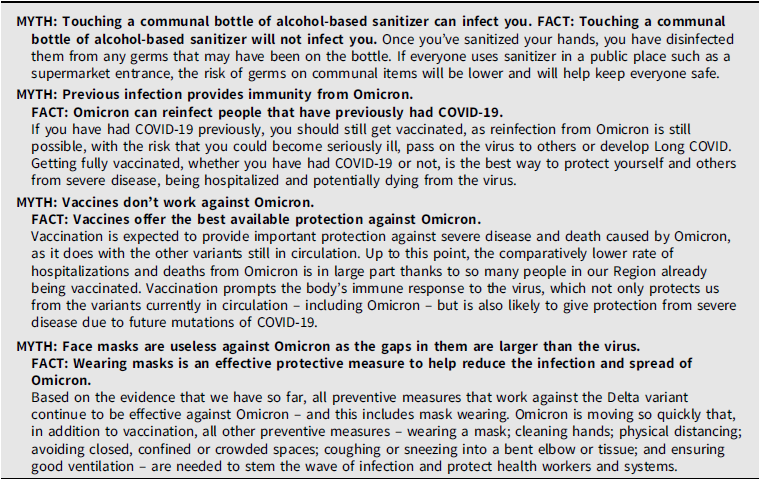
In the experiment, respondents were presented with four ‘myth-busting’ pieces of information about COVID-19, particularly the Omicron variant, which the WHO had published on their website (accessed in January 2022). The four statements were chosen because they presented information that we judged to be less-known to the public. To provide content and an information environment that were as realistic as possible in terms of what citizens might encounter online, we deliberately presented the exact wording of the myth-busting statements used by the WHO on its official website. These statements are presented in Table 1.
Actual wordings of the myth-busting statements on COVID-19 used in the experimental vignettes
Our experiment manipulates the source of information – either the WHO or domestic public health officials – to examine whether and how citizens are more likely to accept COVID-related in – formation from the WHO than domestic authorities. Before presenting the myth-busting statements about COVID-19, we presented the following sentence: ‘[The WHO / Public health officials] provide(s) the following guidance for the public on ways to protect themselves and prevent the spread of COVID-19’.Footnote 6
To investigate whether the WHO’s perceived credibility stemming from its perceived expertise and trustworthiness affects citizens’ acceptance of the public health information it provides, we also manipulated the information respondents received about the WHO, variously describing it as equipped with technical expertise or politically biased.Footnote 7 Specifically, for the respondents who were told that the myth-busting statements came from the WHO, there were three different experimental conditions that varied the specific information they received about the WHO. The first group was provided only a general statement that the WHO was the source of the information (the ‘General WHO’ condition). The other two groups received additional information, either that the WHO is run by international experts (the ‘Professional WHO’ condition) or that the WHO is deferential towards the Chinese government (the ‘Politicized WHO’ condition). The actual wordings of each condition are as follows:
General WHO condition: ‘The World Health Organization (WHO) is a specialized agency of the United Nations that advises the world on handling health crises. The WHO’s primary role is to direct international health within the United Nations’ system and to lead partners in global health responses’.
Professional WHO condition: ‘The World Health Organization (WHO) is a specialized agency of the United Nations that advises the world on handling health crises. The WHO’s primary role is to direct international health within the United Nations’ system and to lead partners in global health responses. WHO officials include 8000+ of the world’s leading public health experts including doctors, epidemiologists, scientists and managers. Together, they coordinate the world’s response to health emergencies and prevent disease based on scientific evidence’.
Politicized WHO condition: ‘The World Health Organization (WHO) is a specialized agency of the United Nations that advises the world on handling health crises. The WHO’s primary role is to direct international health within the United Nations’ system and to lead partners in global health responses. Numerous health experts and political observers, however, have raised concerns about WHO officials’ deference to the Chinese government. The WHO has also been blamed for moving too slowly in declaring a global health emergency’.
To measure our dependent variable of interest, after respondents were presented with one of the experimental conditions, they were asked, ‘Overall, how much do you think the guidelines mentioned above are trustworthy?’ on a 4-point scale ranging from ‘Not at all’ to ‘Very much’. We also asked respondents to indicate how likely they were to trust each of the four respective guidelines on a 4-point scale ranging from ‘Not at all likely’ to ‘Extremely likely’. Moreover, for the three guidelines that pertained to behaviours – touching a communal bottle of alcohol-based sanitizer, getting vaccinated, and wearing a mask – we asked respondents how likely they were to behave as suggested by the guidelines on a 5-point scale. The actual wordings of the questions are presented in Appendix Section B. In the estimations, we utilize the average values of the responses to the guidelines.
Respondents in the ‘public health officials’ condition serve as a control group. We utilize domestic public health officials as our comparison condition rather than a pure control to reflect how citizens typically encounter health information in real-world settings. Health-related information is almost always attributed to some source, and even with an unlabelled control condition, citizens would likely make assumptions about who is providing the information. By comparing the average levels of trust in the guidelines across the ‘General WHO’ treatment group and the control group, we test whether public acceptance of health information depends on the source of that information. Hence, comparisons with the control, on the one hand, and the ‘Professional WHO’ and ‘Politicized WHO’ conditions, on the other, allow us to interrogate whether a positive or negative framing of the WHO as a reliable source of information affects respondents’ perceptions about COVID guidelines. This is arguably a harder test of the WHO’s effectiveness as the WHO is compared to domestic public health authorities.
To ensure that respondents’ pre-treatment characteristics were balanced across the experimental arms of the analysis, we calculated standardized mean differences across various socio-demographic attributes, including age, gender, income, race, education, and party affiliation.Footnote 8 The results, presented in Table A2, show weak evidence of covariate imbalances: the standardized mean differences across almost all attributes are below 0.1 and statistically indistinguishable from 0 at the conventional level. Still, as a robustness check, we control for these attributes in the analyses and find that the main results remain substantively unchanged.
5. Findings
In Figure 1, we report the predicted mean values of different measures that capture public trust and behavioural intentions about COVID-19-related guidelines for each experimental group. First, overall trust in the information increases when the WHO is identified as the source of the guidance, as opposed to a domestic public health official. Specifically, the highest mean trust value is found among the group in the ’Professional WHO condition,’ followed by those in the ‘General WHO condition’ and then the ‘Politicized WHO condition’ group, suggesting that the emphasis on the WHO’s expertise and scientific approach may increase public trust in the information the organization provides, while negative information about the WHO’s legitimacy may have an adverse effect on perceptions of its trustworthiness.
Predicted mean values in each experimental condition.

While these descriptive patterns align with our theoretical expectations, further statistical analysis reveals a more nuanced picture. Despite conducting multiple analytical approaches, including various model specifications, subgroup analyses, and alternative operationalizations of our dependent variables, we do not find robust empirical evidence that citizens are more likely to accept information from the WHO than the domestic public health authority. The predicted mean values of the average trust levels for all of the experimental conditions are clustered closely and fall within the 95% confidence intervals of the other conditions. T-tests comparing predicted mean values show that the differences are not statistically significant at the conventional level, especially compared with the estimates for the ‘public officials’ condition, which serves as our control baseline.Footnote 9 We find similar results when we consider the average values of respondents’ trust in each of the separate guidelines and their likelihood of behaving in accordance with those guidelines. This finding is consistent with Heinzel and Liese (Reference Heinzel and Liese2021) and Matsumura et al. (Reference Matsumura, Singh, Howell, Heinrich, Motta and Kobayashi2025) that reports little difference across various domestic and international health authorities.
In sum, despite our thorough examination of the data through multiple analytical lenses, we find no significant evidence supporting our hypotheses (H1–H3) that predicted enhanced trust and compliance when information comes from the WHO compared to domestic public health officials. Still, it is important to note that our experimental design used domestic public health officials as the control condition. This design choice means our findings should be interpreted as showing no significant difference between WHO and domestic health authorities in their ability to generate trust and compliance, rather than suggesting the WHO lacks credibility entirely.
6. Exploring partisan heterogeneity
6.1. Partisan differences in pre-treatment attitudes towards public health officials and the WHO
Before testing H4 in a systematic manner, we investigated whether partisans had different baseline attitudes towards public health officials, the WHO, and COVID-19. These attitudes were measured before participants were exposed to the experimental conditions.Footnote 10 First, we examine respondents’ pre-existing beliefs regarding the handling of the COVID-19 pandemic by domestic public health officials and the WHO. Figure 2(a) shows that trust in public health officials is far higher among Democrats than among Independents or Republicans. When we asked how much respondents trusted the public health agencies on a 4-point scale of 1 (not at all) to 4 (very much), the mean value of Democrats’ responses was 2.54 (around the mid-point between a little and moderately), while the mean responses among Independents and Republicans were only 1.77 and 1.67, respectively. The results are largely consistent with what is reported in (Bayram and Shields, Reference Bayram and Shields2021). Partisan differences were also observed when assessing pre-existing beliefs regarding the effectiveness of the WHO. Figure 2(b) illustrates how effective respondents think the WHO has been at handling the COVID-19 pandemic on a 5-point scale. Democrats tend to judge the effectiveness of the WHO more positively than other partisans. The average values of Independent or Republican respondents’ evaluations of the effectiveness of the WHO are much lower, although Independents’ opinions are slightly more favourable than those of Republicans. We find a similar pattern regarding trust in scientific experts in Figure 2(c).
Partisan responses to pre-treatment questions about COVID-19 and information sources.
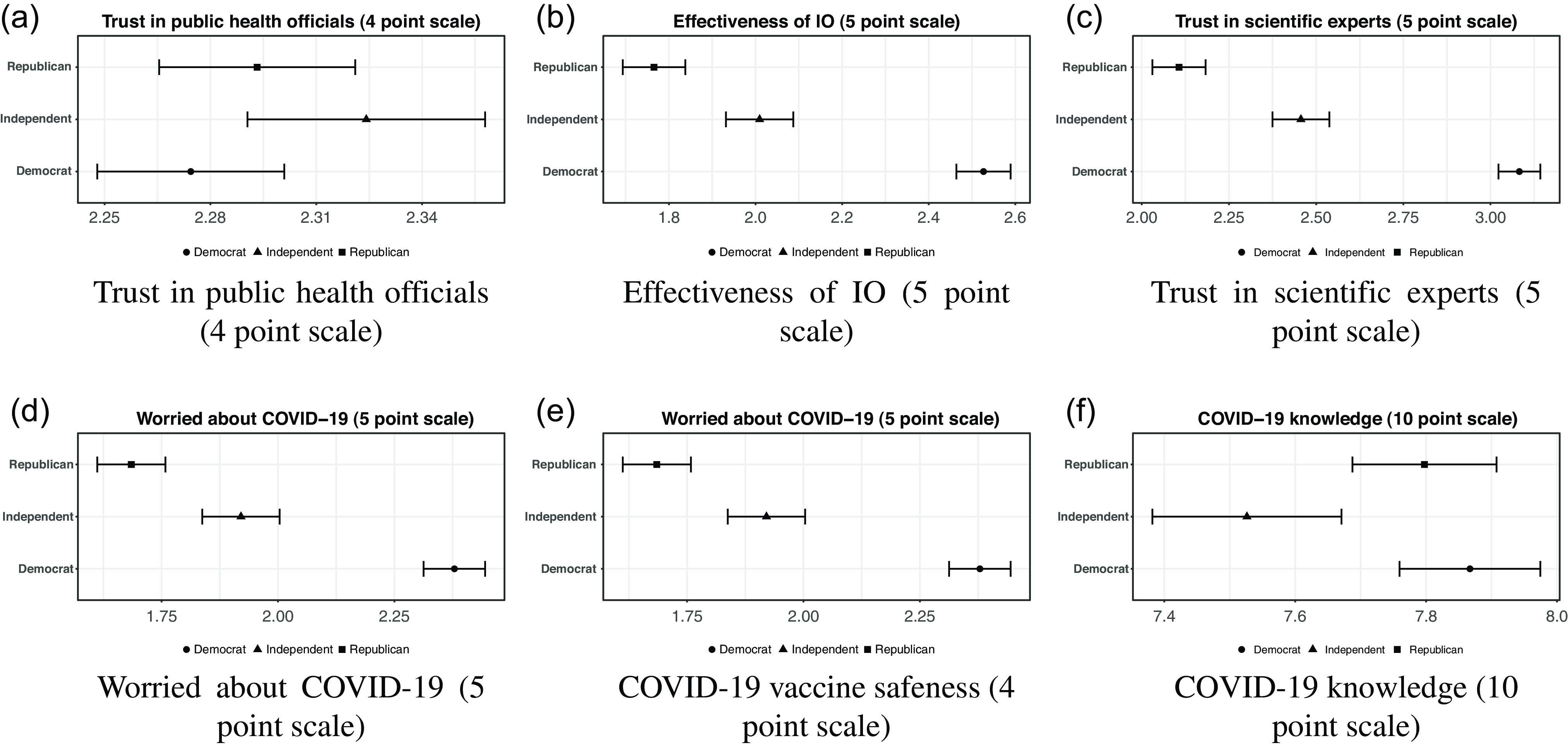
Second, we asked a series of questions about COVID-19. To capture respondents’ pre-existing openness to the COVID-19 guidelines, we asked respondents how worried they were about the impact of the coronavirus on themselves or their families, and how safe they thought the COVID-19 vaccine was on a 4-point scale that ranged from not at all (1) to very much (4). Figure 2(d) and (e) clearly illustrate partisan differences in respondents’ attitudes toward COVID-19. Democrats were more concerned about COVID-19 and more trusting of the vaccine’s safety compared to other groups. Republicans showed less worry about COVID-19 and more distrust of the vaccine. Independents’ views fell between these two, showing moderate levels of concern and vaccine trust. Last, we examined respondents’ knowledge of COVID-19 with a true-false quiz. Specifically, we presented 10 true-false questions from the myth-busting statements on the WHO’s website.Footnote 11 Figure 2(f) shows the mean number (out of 10) of respondents’ correct answers by party. We find that knowledge levels did not differ meaningfully across party affiliations. Nevertheless, Independents tended to be the least knowledgeable, while the difference from other groups’ means was quite small (around 0.3). To summarize, a descriptive exploration of respondents’ pre-existing beliefs regarding domestic public health agencies, the WHO, and COVID-19 clearly illustrates partisan differences. Both Democrats and Republicans have strong pre-existing attitudes toward COVID-19-related issues and the WHO, although their attitudes are totally different from each other. This suggests that both partisan groups can be less likely to be influenced by the WHO treatment, which explains the null findings in the main analysis. Contrarily, Independents have weaker pre-existing attitudes, being more prone to WHO-related treatment effects. Intriguingly, however, the partisan differences in COVID-19 knowledge were quite small.
6.2. Heterogeneous Treatment Effects Across Party Identification
We present the marginal effects on the average level of trust in the guidelines in Figure 3.Footnote 12 Figure 3(a) shows that the treatment effect of general WHO condition is larger among Independents, compared to Republicans and Democrats. However, it is not statistically significant at the 5% significance level. Contrarily, Figure 3(b) shows the positive and statistically significant effects of the ‘Professional WHO’ treatment at the 5% level in the subgroup of Independents. When Independents are provided with information that the WHO is a credible source of information due to its professionalism, their guidelines become more effective. As Figure 3(c) illustrates, however, the positive effects of the WHO as the information source disappear when the respondents are informed that the WHO is politically biased: the estimated effects of the politicized WHO condition are close to zero and statistically insignificant.Footnote 13 The findings related to Democrats are similar to those related to Independents, although the treatment effects for them are not statistically significant in all cases and are smaller in magnitude than those for Independents. We find that the results remain similar when different DVs are used, such as the average trust in each guideline or the average behavioural intention to follow each guideline (Appendix Figures A1 and A2).Footnote 14
Treatment effects on trust in the COVID-19 guidelines by party affiliation. The 90% (thicker lines) and 95% (thinner lines) confidence intervals are presented.
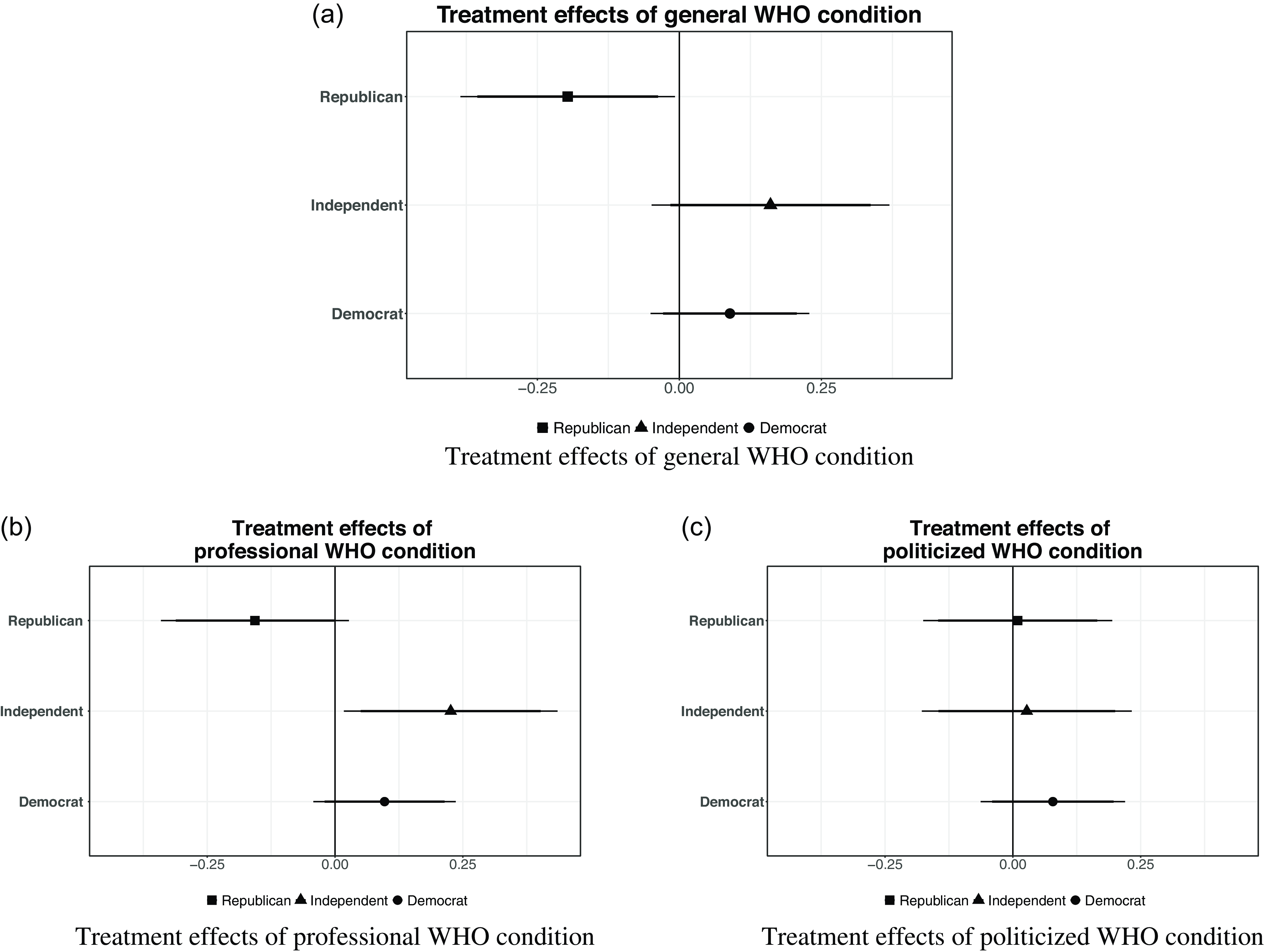
The results about Republicans suggest an adverse effect of the WHO as the information source. Republican respondents exposed to the general WHO condition were less likely to trust the guidelines than those in the public health officials condition. This may reflect that Republicans are more likely to question the credibility of an IO (Johnson and Rickard, Reference Johnson and Rickard2017; Funk and Tyson, Reference Funk and Tyson2022). Even the professionalism cue fails to mitigate this negative effect (from −0.23 to −0.21), implying that positive information about the WHO’s credibility may not change Republicans’ trust in the organization’s guidance. When it comes to the politicized WHO condition, we find null findings even for Republicans. Republicans may already have strong pre-existing beliefs that the WHO is politicized, which is consistent with the view that Republican media outlets have frequently expressed (Stecula and Pickup, Reference Stecula and Pickup2021).Footnote 15
We conducted additional analysis using the conditional average treatment effect approach proposed by Imai and Li (Reference Imai and Li2022), with various individual-level predispositions towards public health officials, the WHO, and COVID-19 serving as moderators. The results, presented in Appendix Section A5, demonstrate that multiple dimensions of trust – in domestic authorities, IOs, and scientific expertise – jointly determine receptivity to IO information. This suggests that IO effectiveness in public engagement depends on complex interactions between organizational credibility signals and individual predispositions across multiple domains. This reinforces our main conclusion that IO direct engagement is most effective among individuals with moderate prior beliefs and higher baseline trust in relevant authorities, but its effectiveness is limited among those with strong opposing predispositions.
7. Discussion
How IOs can effectively and directly engage the public and influence their attitudes is a theoretically and practically important question. In this article, we examine whether and under what conditions an IO can effectively influence the public’s attitudes. Specifically, we focus on the WHO and explore whether the public perceives information provided by the IO as more trustworthy than information provided by domestic public health authorities. Our central argument is that the effectiveness of an IO as information provider depends crucially on its credibility, which in turn is grounded by the IO’s perceived expertise and trustworthiness. Our findings provide limited evidence that the WHO is more effective than domestic health officials as an information source in the full sample (H1–H3). The effects we observe are restricted to political independents and only when the WHO’s professional expertise is emphasized. This suggests significant limitations to IO effectiveness in direct public engagement, particularly in polarized environments where many citizens hold strong prior beliefs. We also highlight the importance of individuals’ prior beliefs about the issue in question. Most importantly, we contend that the effect of the WHO as a source of information on COVID-19 compared with a domestic authority is greater when respondents’ pre-existing attitudes about COVID-19 and related policies and recommendations are weak.
Our survey experiment shows that the WHO being the source of guidelines related to COVID- 19 makes little difference in the public’s attitudes toward these guidelines. Regardless of how we manipulate the conditions about perceived expertise and political bias, there is little significant difference between the different sources of information (the WHO vs. domestic health officials). However, we find that Independents in the professional WHO condition are more likely to trust the WHO’s COVID-19 guidelines than those in the control group exposed to the domestic public health officials condition. The same is not true of Democrats or Republicans, who have stronger pre-existing attitudes about COVID-19. There is no evidence that information from the WHO impacts Democrats or Republicans more than does information from domestic health officials. This result provides the important evidence that domestic partisan cues affect citizens’ acceptance of the WHO guidance. It is consistent with Dellmuth and Tallberg (Reference Dellmuth and Tallberg2020) finding that domestic party cues significantly affect citizens’ beliefs towards IOs.
Though these findings provide fresh insights into the effects of IOs’ direct engagement with the public, this study has some limitations. First, our subgroup analyses involve multiple statistical comparisons and, despite being theoretically grounded, should be interpreted cautiously given the limited scope and marginal significance of our findings. These results represent suggestive evidence that requires independent replication before drawing firm conclusions.
Second, a notable limitation pertains to external validity. Our study focuses on the U.S. case, where COVID-19 issues were highly politicized, and the political system is partisan and polarized to a remarkable degree. In such a unique context, information about COVID-19 may not be strong enough to update citizens’ pre-existing beliefs, making the U.S. case a ‘hard case’ to detect evidence for the information effects of the WHO. This may constitute a particularly challenging context for detecting information operation effects, potentially limiting the generalizability of our findings to less polarized information environment. We conjecture that in less polarized information environment, the effectiveness of IO communication might be enhanced. Further empirical investigations in other issues or countries with varying levels of politicization and/or countries with different political environments would shed more light on the effects of IOs’ direct engagement.
Third, our findings regarding an information source effect might be applicable only to IOs that disseminate scientific information. People might be more likely to trust and accept this type of information from an IO compared with normative information. For instance, the strong modifying effect of pre-existing attitudes suggests that an IO that promotes improvements to human rights practices across the globe might face greater obstacles when attempting to persuade and motivate attitudinal and behavioural changes among the public. People might hold stronger prior beliefs about normative issues like human rights than about scientific information. This implies that future research should study other types of IOs and their messages to further explore the effectiveness of IO’s direct engagement with the public.
By utilizing a fact-checking information treatment, our study has implications for the effectiveness of IOs in correcting disinformation and misinformation. Disinformation and misinformation have posed significant challenges to international cooperation on global issues like pandemics and climate change, and IOs have been actively making efforts to counter them. For example, in August 2022, the UN Secretary-General released the ‘Countering Disinformation’ report, which urges the international community to discuss measures to curb the proliferation of disinformation and misinformation. Our study suggests that fact-checking efforts by IOs can be effective in correcting disinformation and misinformation, at least among those with less entrenched views, even in polarized political environments and regarding politicized issues.
Future study could also directly explore how people perceive IOs and what factors influence effectiveness of their information campaign. Thus far, few studies have directly investigated these questions. A systematic empirical examination of the following questions is still needed: What factors affect people’s perceptions of an IO’s credibility? Do people attach different weights to different dimensions of credibility? How do people update their perceptions of an IO’s credibility? To answer these questions, it is necessary to understand the micro-foundational cognitive processes through which individuals perceive credibility of an authority and to this end, future research should benefit from drawing from the social psychology literature.
Supplementary material
The supplementary material for this article can be found at https://doi.org/10.1017/S1468109925100170
Funding statement
This research was supported by the National Research Foundation of Korea: NRF-2021R1A2C1013622. Additionally, Nam Kyu Kim was supported by a Korea University Grant (K2309721).
Author contribution statement
All authors contributed equally to this article


 Open access

