


Debate about legal tech and the future of civil litigation typically focuses on high-technology innovations. This volume is no exception, and with good reason. Advanced technologies are spreading (or seem poised to spread) throughout the legal landscape, from discovery to online dispute resolution (ODR) to trials, and from individual lawsuits to aggregate litigation. These tools’ practical utility and social value are rightly contested.Footnote 1
But in some contexts, straightforward, low-tech solutions hold tremendous promise – and also demand attention. Here, we zero in on a modest tool that bears upon the management of multidistrict litigation, or MDL. In particular, we explore how improved online communication could enhance litigant autonomy, usher in a more “participatory” MDL, and supply a platform for further innovation.Footnote 2
The MDL statute – 28 U.S.C. §1407 – is a procedural vehicle through which filed federal cases involving common questions of fact, such as a mass tort involving asbestos or defective pharmaceuticals, are swept together into a single “transferee” court, ostensibly for pretrial proceedings (though very often, in reality, for pretrial adjudication or settlement).Footnote 3 Thirty years ago, MDLs were barely a blip on our collective radar. As of 1991, these actions made up only about 1 percent of pending civil cases.Footnote 4 Now, by contrast, MDLs make up fully half of all new federal civil filings.Footnote 5 This means that one out of every two litigants who files a claim in federal court might not really be fully represented by the lawyer she chose, get the venue she chose, or remain before the judge to whom her suit was initially assigned. Instead, her case will be fed into the MDL system and processed elsewhere, in a long, labyrinthian scheme that is often far afield and out of her sight.Footnote 6
Given these statistics, there’s no real question that the MDL has risen – and that its rise is significantly altering the American system of civil justice. There is little consensus, however, as to whether the MDL’s ascent is a good or bad thing. Some celebrate the MDL for promoting judicial efficiency, addressing harms that are national in scope, channeling claims to particularly able and expert advocates, creating economies of scale, and increasing access to justice – giving some judicial process to those who, without MDL, would have no ability to vindicate their essential rights.Footnote 7
Others, meanwhile, find much to dislike. Critics frequently seize on MDLs’ relatively slow speed,Footnote 8 their heavy reliance on repeat play,Footnote 9 and the free-wheeling judicial “ad hocery” that has become the device’s calling card.Footnote 10 Beyond that, critics worry that the device distorts the traditional attorney-client relationship and subverts litigant autonomy.Footnote 11 Critics fear that aggregation alters traditional screening patterns, which can unleash a “vacuum cleaner effect” and ultimately lead to the inclusion of claims of dubious merit.Footnote 12 And critics note that the device has seemingly deviated from its intended design: The MDL was supposed to aggregate cases for pretrial proceedings. So, the status quo – where trials are rare and transfer of a case back to a plaintiff’s home judicial district is exceptional – means, some say, that the MDL has strayed off script.Footnote 13
Stepping back, one can see: The MDL has certain advantages and disadvantages. Furthermore, and critically, many MDL drawbacks are baked in. There are certain compromises we must make if we want the efficiencies and access benefits MDLs supply. Aggregation (and, with it, some loss of litigant autonomy) is an essential and defining feature of the MDL paradigm. The same may be said for judicial innovation, the need to adapt the traditional attorney-client relationship, or the fact that some lawyers are tapped to lead MDLs in a selection process that will, inevitably, consign some able and eager advocates to the sidelines.
Recognizing these unavoidable trade-offs, in our own assessment, we ask subtly different and more targeted questions. We don’t hazard to assess whether MDLs, on balance, are good or bad. Nor do we even assess whether particular MDL features (such as procedural improvisation) are good or bad. Instead, we ask two more modest questions: (1) Do contemporary MDLs have avoidable drawbacks and (2) if so, can those be addressed? In this analysis, we zero in on just one MDL drawback that is both practically and doctrinally consequential: MDL’s restriction of litigant autonomy. And we further observe: Though some loss of litigant autonomy is an inevitable and inescapable by-product of aggregation and is therefore entirely understandable (the yin to aggregation’s yang), the present-day MDL may be more alienating and involve a larger loss of autonomy than is actually necessary. As explained in Section 8.1, that is a potentially large problem. But, we also argue, it is a problem that, with a little ingenuity, courts, policymakers, scholars, and litigators can practically mitigate.
The remainder of this chapter proceeds in three Parts. Section 8.1 sets the scene by focusing on individual autonomy. In particular, Section 8.1.1 explains why autonomy matters, while Section 8.1.2 draws on MDL plaintiff survey data recently compiled by Elizabeth Burch and Margaret Williams to query whether MDL procedures might compromise litigant autonomy more than is strictly necessary. Then, to assess whether transferee courts are currently doing what they practically can to promote autonomy by keeping litigants up-to-date and well-informed, Section 8.2 offers the results of our own systematic study of current court-run MDL websites. This analysis reveals that websites exist but are deficient in important respects. In particular, court websites are hard to find and often outdated. They lack digested, litigant-focused content and are laden with legalese. And they rarely offer litigants opportunities to attend hearings and status conferences remotely (from their home states). In light of these deficiencies, Section 8.3 proposes a modest set of changes that might practically improve matters. These tweaks will not revolutionize MDL processes. But they could further litigants’ legitimate interests in information, with little risk and at modest cost. In so doing, they seem poised to increase litigant autonomy – “low-tech tech,” to be sure, but with high potential reach.
8.1 Individual Autonomy, Even in the Aggregate: Why It Matters and What We Know
8.1.1 Why Individual Autonomy Matters
Litigant autonomy is a central and much-discussed concern of any adjudicatory design, be it individualized or aggregate. And, when assessing MDLs, individual autonomy is especially critical; indeed, its existence (or, conversely, its absence) goes to the heart of MDL’s legitimacy. That’s so because, if litigants swept into MDLs truly retain their individual autonomy – and preserve their ability meaningfully to participate in judicial processes – then the source of the MDL’s legitimacy is clear. On the other hand, to the extent consolidation into an MDL means that individual litigants necessarily and inevitably sacrifice their individual autonomy and forfeit their ability meaningfully to participate in judicial processes (and offer, or withhold, authentic consent to a settlement agreement), the MDL mechanism sits on much shakier ground.Footnote 14
On paper, that is not a problem: MDLs, as formally conceived, do little to undercut the autonomy of individual litigants. In theory, at least, MDLs serve only to streamline and expedite pretrial processes; they (again, in theory) interfere little, if at all, with lawyer-client communication, the allocation of authority within the lawyer-client relationship, or the client’s ability to accept or reject the defendant’s offer of settlement. That formal framework makes it acceptable to furnish MDL plaintiffs (unlike absent class members, say) with few special procedural protections.Footnote 15 It is thought that, even in an MDL, our old workhorses – Model Rules of Professional Conduct 1.4 (demanding candid attorney-client communication), 1.7 (policing conflicts), 1.2(a) (clarifying the allocation of authority and specifying “that a lawyer shall abide by a client’s decisions concerning the objectives of representation”), 1.16 (limiting attorneys’ ability to withdraw), and 1.8(g) (regulating aggregate settlements) – can ensure the adequate protection of clients.
In contemporary practice, however, MDLs are much more than a pretrial aggregation device.Footnote 16 And, it is not necessarily clear that in this system – characterized by infrequent remand to the transferor court, prescribed and cookie-cutter settlement advice, and heavy-handed attorney withdrawal provisions – our traditional ethics rules continue to cut it.Footnote 17 Indeed, some suggest that the status quo so thoroughly compromises litigant autonomy that it represents a denial of due process, as litigants are conscripted into a system “in which their substantive rights will be significantly affected, if not effectively resolved, by means of a shockingly sloppy, informal, and often secretive process in which they have little or no right to participate, and in which they have very little say.”Footnote 18
Individual autonomy is thus the hinge. To the extent it mostly endures, and to the extent individual litigants really can participate in judicial proceedings, authentically consent to settlement agreements, and control the resolution of their own claims, MDL’s legality and legitimacy is clearer. To the extent individual autonomy is a fiction, MDL’s legality and legitimacy is more doubtful.
The upshot? If judges, policymakers, scholars, and practitioners are concerned about – and want to shore up – MDL legitimacy, client autonomy should be fortified, at least where doing so is possible without major sacrifice.
8.1.2 Litigant Autonomy: What We Know
The above discussion underscores that in MDLs, litigant autonomy really matters. That insight tees up a clear – albeit hard-to-answer – real-world question: How much autonomy do contemporary MDL litigants actually have?
Context and caveats. That is the question to which we now turn, but before we do, a bit of context is necessary. The context is that, ideally, to gauge the autonomy of MDL litigants, we would know exactly how much autonomy is optimal and also how much is minimally sufficient – and how to measure it. Or, short of that, we could perhaps compare rigorous data that captures the experiences of MDL plaintiffs as against those of one-off “traditional” plaintiffs to understand whether, or to what extent, the former outperform or underperform the latter along relevant metrics.
Yet neither is remotely possible. Though litigant autonomy is an oft-cited ideal, we don’t know exactly what it would look like and mean, if fully realized, to litigants. Worse, decades into the empirical legal studies revolution, we continue to know shockingly little about litigants’ preferences, priorities, or lived experiences, whether in MDLs or otherwise.Footnote 19
These uncertainties prevent most sweeping claims about litigant autonomy. Nevertheless, one can, at least tentatively, identify several ingredients that are necessary, if not sufficient, to safeguard the autonomy interests of litigants. That list, we think, includes: Litigants can access case information and monitor judicial proceedings if they so choose; litigants can communicate with their attorneys and understand the signals of the court; litigants have a sense of where things stand, including with regard to the strength of their claim, their claim’s likelihood of success, and where the case is in the litigation life cycle; and litigants are empowered to accept or reject the defendant’s offer of settlement.Footnote 20 A system with these ingredients would seem to be fairly protective of individual autonomy. A system without seems the opposite.
Findings from the Burch-Williams study. How do MDL litigants fare on the above metrics? A survey, recently conducted by Elizabeth Burch and Margaret Williams, offers a partial answer.Footnote 21 The two scholars surveyed participants in recent MDLs, gathering confidential responses over multiple years.Footnote 22 In the end, 217 litigants (mostly women who had participated in the pelvic mesh litigation) weighed in, represented by 295 separate lawyers from 145 law firms.Footnote 23
The survey captures claimants’ perspectives on a wide range of subjects, including their reasons for initiating suit and their ultimate satisfaction with case outcomes. As relevant to litigant autonomy, information, and participation, the scholars found the following:
When asked if their lawyer “kept [them] informed about the status of [their] case,” 59 percent of respondents strongly or somewhat disagreed.Footnote 24
When offered the prompt: “While my case was pending, I felt like I understood what was happening,” 67.9 percent of respondents strongly or somewhat disagreed. Only 13.7 percent somewhat or strongly agreed.
When asked how their lawyers kept them informed and invited to list multiple options, more than a quarter of respondents – 26 percent – reported that their attorney did not update them at all.
Of the 111 respondents who reported on their attorneys’ methods of communication, only two indicated that their lawyer(s) utilized a website to communicate with them; only one indicated that her lawyer utilized social media for that purpose.
34 percent of respondents were unable or unwilling to identify their lawyer’s name.
Caveats apply: Respondents to the opt-in survey might not be representative, which stunts both reliability and generalizability.Footnote 25 The numbers, even if reliable, supply just one snapshot. And, with one data set, we can’t say whether litigant understanding is higher or lower than it would be if the litigants had never been swept into the MDL system and instead had their case litigated via traditional means. (Nor can we, alternatively, say whether, but for the MDL’s efficiencies, these litigants might have been shut out of the civil justice system entirely.Footnote 26) Nor can we even say whether MDL clients are communicated with more, or less, than those whose claims are “conventionally” litigated.Footnote 27
Even recognizing the study’s major caveats, however, five larger points seem clear. First, when surveyed, MDL litigants, represented by a broad range of lawyers (not just a few “bad apples”), reported infrequent attorney communication and persistent confusion.Footnote 28 Second, knowledgeable and independent experts echo litigants’ concerns, suggesting, for example, that “[p]laintiffs [within MDLs] have insufficient information and understanding to monitor effectively the course of the litigation and insufficient knowledge to assess independently the outcomes that are proposed for their approval if and when a time for settlement arrives.”Footnote 29 Third, plaintiffs’ lawyers in MDLs frequently have very large client inventories – of hundreds or thousands of clients.Footnote 30 When a lawyer has so many clients, real attorney-client communication and meaningful litigant participation is bound to suffer.Footnote 31 Fourth, when it comes to the promotion and protection of litigant autonomy, effective communication – and the provision of vital information – is not sufficient, but it is certainly necessary. Even well-informed litigants can be excluded from vital decision-making processes, but litigants, logically, cannot call the shots while operating in the dark.Footnote 32 And fifth, per Section 8.1, to the extent that individuals swept into MDLs unnecessarily forfeit their autonomy, that’s a real problem when it comes to MDL legitimacy and legality.Footnote 33
These five points paint a worrying portrait. Fortunately, however, alongside those five points, there is one further reality: Straightforward measures are available to promote litigants’ access to case information, their ability to monitor judicial proceedings, and their understanding of the litigation’s current path and likely trajectory. And, as we will argue in Section 8.3, these measures can be implemented by courts now, with little difficulty, and at reasonable cost.
8.2 Current Court Communication: MDL Websites and Their Deficiencies
Section 8.1 reviewed survey findings that indicate litigants within MDLs report substantial confusion and limited understanding. As noted, when given the prompt: “While my case was pending, I felt like I understood what was happening,” only 13.7 percent somewhat or strongly agreed.Footnote 34 These perceived communication failures are surprising. It’s 2023. MDL websites are common, and emails are easy; “the marginal cost of additional communication [is] approaching zero.”Footnote 35 What explains these reported gaps?
To gain analytic leverage on that question, we rolled up our sleeves and looked at where some MDL-relevant communication takes place.Footnote 36 In particular, we trained our gaze on MDL websites – resources that, per the Judicial Panel on Multidistrict Litigation (JPML) and Federal Judicial Center, “can be … invaluable tool[s] to keep parties … informed of the progress of the litigation.”Footnote 37 These sites are often described as key components of case management.Footnote 38 Scholars suggest that they facilitate litigants’ “due process rights to participate meaningfully in the proceedings.”Footnote 39 And, perhaps most notably, judges themselves have described these websites as key conduits of court-client communication.Footnote 40
Do MDL websites fulfill their promise of keeping “parties … informed of the progress of the litigation” by furnishing well-curated, up-to-date, user-friendly information? To answer that question, we reviewed each page of available websites for the twenty-five largest currently pending MDLs. Each of these MDLs contained at least 500 pending actions; together, they accounted for nearly 415,000 pending actions, encompassing the claims of hundreds of thousands of individual litigants, and constituted 98 percent of actions in all MDLs nationwide.Footnote 41 Thus, if judges are using court websites to engage in clear and frequent communication with individual litigants, we would have seen it.
We didn’t. Websites did exist. Of the twenty-five largest MDLs, all except one had a website that we could locate.Footnote 42 But, many of these sites were surprisingly limited and difficult to navigate. Indeed, the sites provided scant information, were not consistently updated, and often lacked straightforward content (like Zoom information or “plain English” summaries).
8.2.1 An Initial Example: The Zantac MDL
Take, as an initial example, the website that accompanies the Zantac MDL, pending in the Southern District of Florida.Footnote 43 We zero in on this website because it was one of the best, most user-friendly sites we analyzed. But even it contained serious deficiencies.
For starters, finding the website was challenging. A preliminary search – “Zantac lawsuit” – yielded over 1 million hits, and the official court website did not appear on the first several pages of Google results; rather, the first handful of results were attorney advertisements (mostly paid) or attorney and law firm websites.Footnote 44 A more targeted effort – “Zantac court website” – bumped the desired result to the first page, albeit below four paid advertisements.
Once we located the site, we were greeted with a description of the suit: “This matter concerns the heartburn medication Zantac. More specifically, this matter concerns the ranitidine molecule – the active ingredient of Zantac. The Judicial Panel for Multidistrict Litigation formed this MDL (number 2924) on February 6, 2020.”Footnote 45 We also were shown six links (Media Information, MDL Transfer Order, Docket Report, Operative Pleadings, Transcripts, and Calendar) and a curated list of PDF files (see Figure 8.1).
Zantac MDL docket

The “Calendar” led to a plain site listing basic information about an upcoming hearing, but with few details. The hearing in question was described only as “Status Conference – Case Mgt,” and it did not specify whether litigants could attend, either in person or remotely (see Figure 8.2).Footnote 46
Zantac MDL hearing notice

A litigant who clicked on the “Operative Pleadings” tab was taken to seven PDF documents (Pfizer, Inc. Answer; Class Economic Loss Complaint; etc.) described as those “of special interest,” plus a note that “the most accurate source for orders is PACER.”Footnote 47 (The site did not include information regarding what PACER is, though it did include a link; see Figure 8.3.)
Zantac operative pleadings

Finally, a search box allowed for a search of the case’s orders, again available as PDFs.
8.2.2 The Rest: Deficits along Five Key Dimensions
Within our broader sample, usability deficits were pervasive and very often worse than the Zantac MDL site. In the course of our inquiry, we reviewed websites along the following five dimensions: (1) searchability and identifiability; (2) plaintiff-focused content; (3) use of plain language; (4) whether the site supplied information to facilitate remote participation in, or attendance at, proceedings; and (5) timeliness. We found deficits along each.
Searchability and identifiability. A website is only useful if it can be located. As such, our first inquiry was whether MDL websites were easy, or alternatively difficult, to find. Here, we found that, as in Zantac, court sites were often buried under a thicket of advertisements for lawyers or lead generators (see Figure 8.4).Footnote 48 Commonsense search terms for the three largest MDLs yielded results on pages 13, 4, and 8, respectively.Footnote 49
Hernia mesh Google search

Litigant-focused content. Next, we evaluated whether websites featured custom content that was seemingly geared to orient individual litigants. Most didn’t. In particular, of the twenty-four sites we reviewed, only eleven contained any meaningful introductory content at all. Even then, those introductions focused primarily on the transfer process (including the relevant JPML proceeding) and a statement of the case’s overall topic – not its current status or its anticipated timeline. Meanwhile, only six of the twenty-four offered MDL-focused Frequently Asked Questions. And of those, most offered (and answered) questions at a general level (“What is multidistrict litigation?”) or that were clearly attorney-focused (regarding, for instance, motions to appear pro hac vice). Some others, while well intentioned, supplied limited help (see Figure 8.5).Footnote 50
Eastern District of Louisiana website link

Similarly, more than half of sites identified members of the cases’ leadership structure (e.g., by listing leadership or liaison counsel) and provided contact information for outreach. But none directed plaintiffs with questions to a specific point of contact among those attorneys.
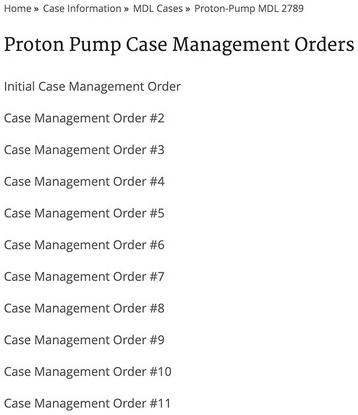
Finally, materials that were presented – typically, a partial set of key documents, such as court orders or hearing transcripts – were often unadorned. For instance, seven of the twenty-four reviewed sites linked to orders, as PDFs, with essentially no description of what those documents contain (see Figure 8.6).Footnote 51
Proton Pump case management orders
Better: Sixteen of the sites offered some descriptions of posted PDFs. But only two included status updates that went much beyond one-line order summaries (see Figure 8.7).Footnote 52
“Current developments” listing

To a litigant, therefore, the average MDL site is best understood as a free, and often partial, PACER stand-in – not a source of curated, distilled, or intelligible information.
Jargon and legalese. We next assessed whether the websites were written in plain language – or at least translated legalese. Here, we found that the majority of sites relied on legal jargon when they described key developments.Footnote 53 For example, our review found websites touting privilege log protocols, an ESI order, and census implementation orders. Even case-specific Frequently Asked Questions – where one might most reasonably expect clear, litigant-friendly language – stopped short of “translating” key legal terms.Footnote 54 Put simply, site content was predominantly written in the language of lawyers, not litigants.
Information to facilitate remote attendance. We also gauged whether the websites offered teleconference or Zoom hearing information. This information is important because consolidated cases – and the geographic distance they entail – leave many litigants unable to attend judicial proceedings in person, which puts a premium on litigants’ ability to attend key proceedings remotely, via video or telephone.
Did the websites supply the logistical information a litigant needs in order to “attend” remotely? Not particularly. Of the twenty-four sites we reviewed, thirteen did not offer any case calendar that alerted litigants of upcoming hearings or conferences. Of the eleven that did:
Five listed events on their calendar (though some of the listed events had already occurred) without any Zoom or telephone information;
Two included Zoom or telephone information for some, but not all, past events;
Two included Zoom or telephone information for all events listed on the case calendar; and
Two included dedicated calendar pages but had no scheduled events.
Put another way, most sites did not include case calendars; of those that did, more than half lacked Zoom or other remote dial-in information for some or all listed hearings. That absence was particularly striking given that, in the wake of the COVID-19 pandemic, nearly all courts embraced remote proceedings.Footnote 55
Unsurprisingly, the sites’ presentation of upcoming hearings also varied widely. In some instances (as on the MDL-2775, MDL-3004, and MDL-2846 sites shown in Figure 8.8 a–c), virtual hearings were listed, but no dial-in information was provided.Footnote 56 In contrast, some MDL sites (like MDL-2741Footnote 57) linked to Zoom information (Figure 8.9).
Link-less “Upcoming MDL Events” examples


Link-provided “Upcoming Proceedings” example

Timeliness. Lastly, recognizing that cases can move fast – and stale information is of limited utility – we evaluated the websites to see whether information was timely. Again, results were dispiriting. Of the sites that offered time-sensitive updates (e.g., calendars of upcoming events), several were not updated, meaning that a litigant or even an individually retained plaintiffs’ attorney who relied on the website for information was apt to be misinformed.Footnote 58 For instance, MDL-2913, involving Juul, was transferred to the Northern District of California on October 2, 2019. Its website included a calendar section and several “documents of special interest.”Footnote 59 The latest document upload involved a conditional transfer order from January 2020Footnote 60 – even though several major rulings had been issued more recently.Footnote 61 (The website’s source code indicates that it was last modified in May 2020.) Whether by conscious choice or oversight, the case’s online presence did not reflect its current status. Other sites, meanwhile, listed “upcoming” proceedings that had, in fact, occurred long before.Footnote 62 And, when we accessed archived, time-stamped versions of sites, we found several orders that were eventually posted – but not until months after they were handed down.Footnote 63
Nor were the sites set up to keep interested visitors repeatedly informed, as most of the sites did not themselves offer a direct “push” or sign-up feature, so that visitors could be notified via text or email when new material became available.Footnote 64
8.2.3 Explanations for the Above Deficits: Unspecified Audience and Insufficient Existing Guidance
What explains the above deficits? One possibility is that these websites were never intended to speak to, or otherwise benefit, actual litigants – and our analysis, then, is basically underscoring that websites, never meant to edify litigants, in fact, fail to edify them.Footnote 65 To some judges and attorney leaders, in other words, these sites may serve merely as internal or specialized resources, whether for state court judges involved in overlapping litigation, individually retained plaintiffs’ counsel, or even scholars and journalists.Footnote 66 Or, it could be that the “audience” question has never been carefully considered or seriously addressed. As a result, the websites may be trying to be all things to all people but actually serve none, as content is too general for members of the plaintiffs’ steering committee, too specialized and technical for litigants, and too partial or outdated for individually retained plaintiffs’ counsel or judges handling parallel state litigation.
A second culprit, in contrast, is crystal clear: Higher authorities have furnished transferee judges and court administrators with only limited public guidance.Footnote 67 In particular, current guidance tends to suggest categories for site content. But beyond that, it furnishes transferee judges only limited help. Illustrating this deficiency, the JPML and Federal Judicial Center’s Ten Steps to Better Case Management: A Guide for Multidistrict Litigation Transferee Court Clerks includes a discussion of recommended webpage content, but its relevant section provides only that:
Case name and master docket sheet case number
Brief description of the subject of the case
Name of the judge presiding over the case
List of court staff, along with their contact information
Names of liaison counsel, along with their contact information
In addition, it is useful to include the following types of orders in PDF:
Case management orders
Transfer orders from the Panel
Orders applicable to more than one case
Individual case orders affecting one case, but potentially pertinent to others
Suggestion of remand orders.Footnote 68
Several other pertinent resources are similarly circumscribed.Footnote 69 These publications have likely helped to spur websites’ creation, but they have stunted their meaningful evolution.
***
Whatever the reasons for the above deficiencies, the facts are these: Among the websites we reviewed, most suffered from basic deficits that could very well inhibit litigants’ access and engagement. And the deficits we identify could easily be addressed.
8.3. A Simple Path Forward: A “Low-Tech” Mechanism to Keep Litigants Better Informed
As noted in Section 8.1, MDLs rely, for legitimacy, on litigant autonomy, and while communication is not sufficient for litigant autonomy, it is necessary. Even well-informed litigants can be deprived of the capacity to make crucial decisions – but litigants, logically, cannot make crucial decisions if they are not reasonably well-informed. Meanwhile, while no one can currently prove that MDL litigants are underinformed, Section 8.2 compiled some evidence indicating information deficits are deep and pervasive. The Burch-Williams study paints a worrying portrait; knowledgeable scholars have long raised concerns; and our painstaking review of MDL websites reveals that one tool, theoretically poised to promote litigant understanding, is, in fact, poorly positioned to do so.
What can be done? Over the long run, the Federal Judicial Center (FJC), or another similar body, should furnish formal guidance to judges, court administrators, and lawyers on how to build effective and legible websites. This guidance would ideally be supplemented by a set of best practices around search engine optimization and language access. There is good reason to believe that such guidance would be effective. Noticeable similarities across existing websites suggest that transferee judges borrow heavily from one another. An implication of that cross-pollination is that better guidance from the FJC (or elsewhere) would (likely) rapidly spread.
In the meantime, we close with four concrete (though modest and partial) suggestions for transferee judges.
First, judges need to decide whom these sites are really for – and then need to ensure that the sites well-serve their intended audience. We suggest that MDL websites ought to be embraced as (among other things) a litigant-facing tool, and, as discussed below, they should be improved with that purpose in mind.Footnote 70 But, even if courts are not persuaded, they still need to do a better job tailoring sites to some particular audience. As long as the specific audience remains undetermined, courts are less likely to serve any particular audience adequately.
If courts agree that websites should speak directly to litigants, then a second recommendation follows: At least some clearly delineated website content should be customized for litigants. Courts should, as noted, avoid legalese and offer more digested (rather than just raw) material. For instance, judges might ask attorneys to supply monthly or quarterly updates; these updates, which should be approved by both parties and the court, should summarize the progress made in the preceding month and highlight what is on tap in the MDL in the immediate future. Here, the website should capture both in-court activity and noteworthy activity scheduled outside of the court’s four walls (e.g., depositions).
Third, irrespective of chosen audience, judges should take steps to ensure that MDL websites are visible and up-to-date. Regardless of whom the websites are meant to serve, websites cannot serve that audience if they cannot be quickly located.Footnote 71 And, because stale information is of limited utility, judges should ensure that the websites offer an accurate, timely snapshot of the case’s progress. The first steps are uncontroversial and straightforward; they include reliably adding hearings to the online calendar, removing them after they occur, and posting key documents within a reasonable time frame. Judges should also consider an opt-in sign-up that automatically emails or texts interested individuals when new content is added.
Fourth and finally, judges should ensure that websites clearly publicize hearings and status conferences, and, recognizing that MDLs necessarily and inescapably create distance between client and court, judges should facilitate remote participation whenever feasible. As noted above, many MDL judges have embraced remote hearings out of COVID-generated necessity; judges overseeing large MDLs should consider how the switching costs they have already paid can be invested to promote meaningful litigant access, even from afar.Footnote 72 Indeed, judges might cautiously pilot tools for two-way client-court communication, or even client-to-client communication – though, in so doing, judges must be attuned to various risks.Footnote 73
8.4. Conclusion: Zooming Out
We harbor no illusions about the role that better MDL websites can play. They’re no panacea, and vigorous debates about the merits and demerits of MDL will (and should) continue. But even so: Improved, refocused websites can keep litigants a bit more engaged; they can help litigants stay a bit better informed; and they can promote litigant participation in even distant MDL processes. More than that, improved websites can, however incrementally, promote litigant autonomy and, by extension, shore up the legitimacy of the MDL system. The day may come when some as-yet-unidentified high-tech innovation revolutionizes the MDL. Until then, low-tech changes can modestly improve the system, and just might serve as platforms for further reform.


 Open access