

Introduction
The rise in the mobilization power of public sector unions is a defining feature of twenty-first-century labor politics across both advanced and emerging market democracies. While private unions are in retreat, public unionism has spearheaded major labor battles. Among public sector unions, school teachers stand out as the most organized and contentious actors. Over recent decades, education workers have led massive strikes in contexts as diverse as Scandinavia (Mailand Reference Mailand2019), Israel (Shenkar and Shenkar Reference Shenkar and Shenkar2011), South Africa (Amoako Reference Amoako2012), China (Chang and Hess Reference Chang and Hess2018), the United States (Hertel-Fernández et al. Reference Hertel-Fernandez, Naidu and Reich2021), and the Arab world (Lacouture Reference Lacouture2025). Teacher organizations possess the capacity to influence public policies, and to serve as a cornerstone of the broader labor movement (Moe and Wiborg Reference Moe and Wiborg2017; Collier Reference Collier2021; Schneider Reference Schneider2022; Bishara and Grewal Reference Bishara and Grewal2022).
This article advances an explanatory framework to account for varied patterns of public sector union mobilization in democratic contexts. It begins by analytically distinguishing between public and private workers, and the institutional environments in which their unions operate. While both groups occupy a subaltern class position, public employees are significantly less vulnerable to price competition and outsourcing, and often enjoy legal protections against dismissal. With regard to institutional settings, collective bargaining in the public sector is subject to state regulation, whereas in the private sector it is de facto mandatory when unions are active, and conducted freely in most democracies. Taken together, these different features generate distinct conditions for collective action in the public and private economies.
We argue that three fundamental factors—economic, institutional, and political—shape the individual and organizational incentives underlying the mobilization of public unions. First, we posit that, unlike their private colleagues, public workers are less likely to protest during the expansionary phase of the economic cycle, when the economy grows and budget constraints are relaxed, as governments can defuse contention by allocating state resources. Second, mobilization declines when collective bargaining is mandatory, as labor disputes become institutionalized. Third, it also weakens when governments share a common partisan identity with a unified labor leadership, enabling a “political exchange” in which union moderation is traded for wage, non-wage, and organizational concessions. Conversely, mobilization in the public sector intensifies when the economy stagnates and fiscal adjustment becomes a necessity, when union organization is permitted but collective bargaining is not mandatory, and when government-union political exchange is improbable.
In previous work, we found statistical support for this argument using data on school teacher mobilization in Argentina between 2006 and 2019 (Etchemendy and Lodola Reference Etchemendy and Lodola2024). Here, we leverage the strengths of the case-study comparative method—tracing causal mechanisms and event sequences, refining concepts, and identifying omitted variables—to examine how subnational collective bargaining institutions, and government-union partisan alliances (or their absence) interact to produce distinct patterns of mobilization in the Argentine education sector. Building on a theoretically derived explanatory typology, we conduct in-depth analyses of four provinces that span wide variation in both mobilization outcomes and underlying causal mechanisms.
We follow the methodological guidance of Møller and Skaaning (Reference Møller and Skaaning2017) and Rohlfing (Reference Rohlfing2008) for case selection in theories that apply to larger populations or involve “nested” designs. This approach emphasizes the need to investigate both cases that represent the key explanatory factors, and cases that may reveal overlooked explanatory variables. The Argentine provinces of Neuquén and Chaco represent theory-consistent, “model cases” of high, bottom-up mobilization. In these jurisdictions non-mandatary collective bargaining, government-union partisan incongruity, and intense union organizational competition combined to obstruct political exchanges. By contrast, Mendoza embodies a model case of low mobilization under conditions that foster a neo-corporatist convergence. Collective bargaining rights coincided with an alliance between the single teachers’ union and copartisan governments, enabling an exchange of labor restraint for organizational and material benefits. Finally, Tucumán constitutes a “deviant case” since it experienced virtually no mobilization despite all prevailing conditions—informal wage-setting, partisan distance, and relatively fragmented teacher unionism—theoretically associated with heightened activism. We contend that this theory-unpredicted outcome is driven by a factor omitted from our framework: the top-down cooptation of leadership by provincial governments, a pattern we characterized as state corporatism.
Our qualitative approach thus uncovers causal mechanisms at work and discovers omitted explanatory variables that remained hidden in our prior Large-N analysis. For example, detailed examination of Neuquén reveals how organized teachers developed assembly practices and internal democratic mechanisms—far less frequent in the private sector—that undermined moderation by radicalizing demands and obstructing negotiated agreements. In-depth investigation of Tucumán illuminates how the character of the initial labor incorporation (“from above”) and enduring corporatist legacies—a factor outside our theory—shaped union organizational structures and relations to the state in ways that enabled provincial governments to co-opt and exclude union leadership.
This study contributes to two related bodies of literature. First, unlike the more unified research on private-sector labor politics, scholarship on public unionism remains fragmented across both disciplinary and regional camps that rarely speak to each other. The dominant approach in American politics and mainstream economics portrays public unions—particularly, teachers—as rent-seekers with extraordinary influence over state and local policies (e.g., Moe Reference Moe2011; Anzia and Moe Reference Anzia and Moe2015; DiSalvo Reference Di Salvo2015). The European comparative literature stresses the noncompetitive nature of nationally-oriented public unions, and whether they are subordinated to multi-sector, wage-moderating corporatist arrangements (e.g., Garrett and Way Reference Garrett, Way, Iversen, Pontusson and Soskice2000). Work on the Global South similarly draws on the corporatist approach to explain the transition from authoritarian rule and the surge of more autonomous public unions (e.g., Chambers-Ju and Finger Reference Chambers-Ju, Finger, Moe and Wiborg2016; Bishara and Greewal Reference Bishara and Grewal2022). Our framework integrates insights from these perspectives into a unified, cross-sub disciplinary theory of public sector union mobilization that yields portable propositions for comparative analysis across democratic settings.
Second, our study engages a growing strand of research on the rise of teachers’ unions in Latin America, which seeks to distinguish among different types of education worker organizations (Schneider 2021; Chambers-Ju Reference Chambers-Ju2024; see also Gindin Reference Gindin2011). The interest group or social movement type of teacher union—prevalent in Argentina and Brazil—originates bottom-up, operates under conditions of labor pluralism, and relies on grassroots mobilization to advance their policy and redistributive goals. The political machine or instrumentalist teacher organization—as found in Mexico—develops top-down under corporatist frames of interest representation, while it privileges leaders’ objectives and organizational strength over rank-and-file interests. Our theory, and its subnational empirical application, cuts across these alternative types of teachers’ unions, and thus accounts for mobilization—or the lack of thereof—in any organizational model.
In the following section we outline the theory of public sector union mobilization and develop the explanatory typology guiding our case selection. Then, we examine teacher militancy in Argentina during the 2000s from a subnational perspective. The empirical section offers case studies of four provinces. The conclusion summarizes the findings and discusses their implications for the study of public sector unions in an era of expanding power.
The Mobilization of Public Sector Unions
Disentangling the Logic of Labor Mobilization in the Private and Public Sectors
There are fundamental similarities and differences between public and private unions, and the workers they represent. First, in the private economy wage bargaining generally rests on the principle of free (though in practice often mandatory) negotiation between employers and organized workers. By contrast, in the public sector, labor relations and the right to collective bargaining are far more regulated through various (formal or informal) modalities of state intervention, even under democratic governments. Second, public sector workers possess a structural “advantage” over their private-sector counterparts: they are protected by legal safeguards and dismissal regulations, and they face significantly lower exposure to price competition and outsourcing pressures. Essential public services—such as waste collection, public safety, water sanitation, health care, and education—cannot be fully outsourced or replaced. When sustained grievances or wage demands emerge—as is often the case under democracy—our theory posits that three key factors shape individual and organizational incentives for public sector union mobilization.
The first factor is economic. In contrast to private workers, public employees are constrained less by market competition than by state budgetary conditions. During periods of economic expansion, governments are better positioned to appease potentially disruptive worker organizations by allocating state resources. By contrast, in downturns, fiscal restraint exacerbates wage disputes in the public sector. In view of their protection against layoffs, state workers are more likely to mobilize forcefully over scarce resources under recessionary conditions.
The second factor is institutional. Both the modality and scope of state regulation over wage bargaining in the public sector vary significantly across countries—and in federal systems such as Argentina, even within them. For analytical clarity, we borrow from American politics studies of public unions and distinguish between two broad modalities of collective bargaining. The formal modality is defined by institutional frameworks that establish a “duty-to-bargain”—making negotiations mandatory for the state—and specify the actors authorized to negotiate. The informal modality covers instances in which wage-setting remains largely at the discretion of the state, either through informal practices or unilateral decisions. Consistent with classic theories of labor institutionalization (Ross and Hartman Reference Ross and Hartman1960; Currie and McConnell Reference Currie and McConnell1994), we contend that formal—or duty-to-bargain—frameworks reduce union militancy by providing an institutional channel through which organized workers can advance their demands. In the absence of mandatory bargaining, unions lack reliable negotiation arenas and predictable mechanisms for securing concessions, which heightens activism.
It is worth stressing that this pattern departs from conventional collective bargaining in democracies. Mandatory and encompassing collective bargaining in the private sector only takes place in centralized settings, generally at the sectoral level. Where bargaining is not mandatory, negotiations occur at the firm level (e.g., Wallerstein and Golden Reference Wallerstein, Golden, Iversen, Pontusson and Soskice2000 for advanced countries; Bogliaccini Reference Bogliaccini2024, 16–17 for Southern Europe and Latin America). In the case of Argentine teachers—and many public sector unions worldwide—bargaining is centralized at the subnational or local level and covers all workers, whether unionized or not. Yet it is mandatory in some jurisdictions and non-mandatory in others.
The third factor shaping union mobilization in the public sector is political. Public union leaders are often inherently political creatures embedded in broader political struggles, where the fortunes of allied parties and administrations carry consequences form their strategic calculus. Drawing on the European neo-corporatist tradition (Cameron Reference Cameron and Goldthorpe1984; Swenson Reference Swenson1991; Murillo Reference Murillo2001 for Latin America), we posit that this “political exchange” between governing parties and ideologically aligned public sector unions dampens labor conflict, while its absence increases activism. In the famous formulation by Korpi and Shalev (Reference Korpi, Shalev and Zeitlin1980, 321), “class conflict moves to the political arena.”
The development of a stable political exchange—defined as a steady granting of perks in return for union moderation—depends on two requisites that function as necessary conditions.Footnote 1 The first is partisan: a shared party identity between labor-based left or national-popular governments and public sector unions (Pizzorno Reference Pizzorno, Crouch and Pizzorno1978, 277–98; Cameron Reference Cameron and Goldthorpe1984). The second requisite is labor unity: a monopolistic and cohesive union movement. Worker organizations are unified when they are insulated from competition, whether in the form of inter-union fragmentation or intra-union factionalism (Murillo Reference Murillo2001). Monopolistic unions—safe from external competitors—reduce intra-class distributive conflicts and favor cooperation. In contrast, union fragmentation complicates bargaining and fuels conflict by widening the range of demands, shortening actors’ time horizons, and spurring rival unions to outbid one another. Likewise, internal union competition—especially from radical leftist factions—weakens cohesiveness as it maximizes demands and constrains leaders’ strategic autonomy, particularly of those seeking negotiated solutions.
Like mainstream labor politics literature, we argue that political exchange tames contention in both the private and public sectors. Yet in most classic accounts of neo-corporatism and social-democracy, party-union coalitions tend to be stable, generally dominated by partisan leaders.Footnote 2 In the case of public unionism, these coalitions are more ad hoc and unstable, precisely because of the variables that, we argue, shape the political exchange: the degree of inter-union fragmentation and internal competition.
Collective Bargaining, Political Exchange, and Patterns of Public Sector Union Mobilization
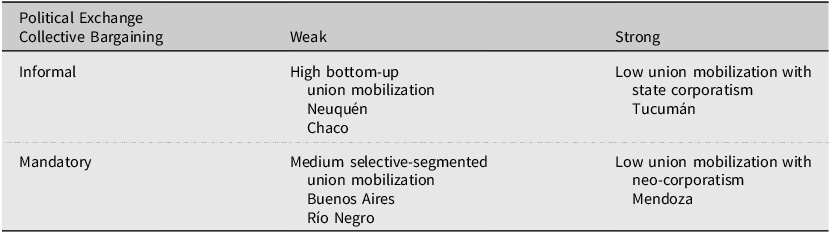
Table 1 presents a theoretically derived explanatory typology that maps the predicted configuration of mobilization outcomes—and their corresponding empirical cases—resulting from variation in our two key categorical independent variables, collective bargaining and political exchange, which can be grasped qualitatively.Footnote 3 Explanatory typologies are designed to specify causal connections between their underlying dimensions (variables) and the hypothesized outcomes (cell types), (Elman Reference Elman2005, 298; Collier et al. Reference Collier, LaPorte and Seawright2012). We construct this typology within the scope conditions of our theory—that is, the domain in which causal processes are presumed to be homogenous (Mahoney and Goertz Reference Mahoney and Goertz2004)—namely, democratic regimes characterized by freedom of union association and legally recognized strike rights.
Explanatory Typology of Public sector Union Mobilization (With Cases)

Table 1. Long description
The table presents a typology of public sector union mobilization outcomes, categorized by collective bargaining and political exchange. It features two main columns for weak and strong political exchange, each divided into informal and mandatory collective bargaining rows. The table includes specific cases for each category: high bottom-up union mobilization for informal with weak political exchange, low union mobilization with state corporatism for informal with strong political exchange, medium selective-segmented union mobilization for mandatory with weak political exchange, and low union mobilization with neo-corporatism for mandatory with strong political exchange. The cases listed are Neuquén and Chaco for high bottom-up union mobilization, Tucumán for low union mobilization with state corporatism, Buenos Aires and Río Negro for medium selective-segmented union mobilization, and Mendoza for low union mobilization with neo-corporatism.
We treat our independent variables as dichotomous dimensions. As discussed above, we distinguish between mandatory (duty-to-bargain) and informal modalities of collective bargaining. Moreover, we differentiate between strong and weak conditions for political exchange, depending on whether its two requisites—government-union partisan alignment and labor unity—are present. This conceptualization allows us to build a parsimonious explanatory typology with only four cell types.
The top-left cell, exemplified by the cases of Neuquén and Chaco, denotes intense bottom-up mobilization. When collective bargaining is not institutionalized and conditions for political exchange are weak—whether due to adversarial partisan relations, union competition (fragmentation or factionalism), or both—moderate union leaders confront pressures from below, as rival organizations or factions channel rank-and-file discontent. The bottom right cell, illustrated by Mendoza, reflects the opposite outcome. When collective bargaining is institutionalized and governments maintain stable alliances with copartisan and unified unions, a neo-corporatist convergence emerges in which labor moderation is exchanged for material and organizational benefits.
Comparing the top-left-bottom-right diagonal cells does not allow us to assess whether either factor alone is sufficient to produce union mobilization or moderation. We need to examine the off-diagonal cells, where only one explanatory factor varies.Footnote 4
The bottom-left cell, where duty-to-bargain rights structure wage negotiations and political exchange is unstable or absent, denotes cases of medium, selective, or segmented mobilization. The legal incorporation of unions into collective bargaining reduces militancy, but fragile political ties with the government reignite activism. Arguably, the two requisites for political exchanges interact with labor institutions in patterned ways, producing distinct and theoretically predictable forms of mobilization within this cell. Two scenarios merit attention.
The first features a hegemonic union movement—able to articulate consistent demands and coordinate collective action—that displays weak or no partisan ties with the government in an institutionalized bargaining environment. This incongruence—which often entails divergent views about labor policies—becomes the main axis of contention. As a result, union mobilization tends to be selective and issue-specific—focusing on particular disputes such as wage floors, budget allocations, or pedagogical reforms—rather than generalized, producing cycles of intermittent conflict. This pattern is embodied by the province of Río Negro. The second scenario envisions a competitive union movement in which those sharing the government’s partisan identity gain privileged access to informal negotiation channels, while rivals are sidelined. This asymmetry produces a pattern of segmented mobilization: aligned organizations moderate their demands to preserve access, while excluded actors escalate conflict to signal differentiation and/or to compensate for their limited influence. This is the case of Buenos Aires. In both scenarios, the outcome is a medium level of mobilization, with periods of heightened militancy interspersed with episodes of cooperation, depending on which actors take the lead at a given moment.
Finally, the top-right cell represents an unpredicted case of low mobilization according to our theory. Although conditions for political exchange are strong, labor relations remain weakly institutionalized and governments retain the capacity to unilaterally set wages. Under this combination, as seen in the case of Tucumán, we would expect at least moderate levels of conflict. We argue, however, that this configuration aligns with a state-corporatist mode of interest intermediation. Labor moderation did not arise from reciprocal government-union pacts or partial negotiations. Rather, the top-down character of labor relations produced a model in which demobilization is driven by state cooptation, the strategic promotion of favored leadership, and the exclusion of rival or dissenting groups.
Alternative Explanations
There are a variety of alternative explanations for public union militancy. First, traditional accounts on labor mobilization posit that activism responds to material conditions, particularly rising costs of living and wage-related grievances. All else equal, higher living costs and lower salaries raise the stakes of wage bargaining and, in turn, foster labor unrest. Our cases, however, do not support this expectation.Footnote 5 Consider first the southwestern neighboring and affluent provinces of Neuquén and Mendoza. Although both exhibited comparable high living costs, they sharply diverged in teacher mobilization outcomes.Footnote 6 If anything, wage dynamics in the 2000s would lead us to expect greater labor conflict in Mendoza, where teacher salaries were on average 22 percent lower than in Neuquén and consistently ranked among the lowest nationwide (CGCSE 2025). Nonetheless, Neuquén witnessed levels of teacher strikes roughly 13 times higher than Mendoza. A similar pattern is evident in the northern provinces of Chaco and Tucumán. Both ranked among the jurisdictions with the lowest cost of living, and both exhibited below-average teacher salaries. Yet they represent polar opposites in terms of teacher mobilization: Chaco experienced 33 times more strike activity than Tucumán.
Second, these two pairs of provinces are broadly similar in social development indicators and their economic structures. Neuquén and Mendoza score above the national average on human development.Footnote 7 Both have comparatively low levels of public employment, and developed dynamic private sectors—tourism and hydrocarbons in Neuquén, wine and food processing in Mendoza—that provide employment alternatives to state-centered patronage structures prevalent in other provinces. By contrast, Tucumán and Chaco rank substantially lower on social development, maintain large public sectors, lack private investment, and rely more heavily on domestic consumption and federal fiscal transfers.
Third, the labor politics literature underscores the enduring influence of historical legacies on union strategies (Collier and Collier Reference Collier and Collier1991; Caraway et al. Reference Caraway, Lorena Cook and Crowley2015). The nature of labor incorporation—how unions were founded and regulated by the state—shapes their resources and organizational structures, which in turn condition their strategies and patterns of mobilization. Examining teachers’ unions in Oaxaca (Mexico) and São Paulo (Brazil), Tarlau (Reference Tarlau2022) shows that long-term legacies of incorporation under authoritarianism shaped unions’ internal politics (factional disputes and partisan relations) under democracy, ultimately structuring their contemporary strategies of left-party alignment (São Paulo) or party autonomy (Oaxaca). Similarly, in a comparative-historical analysis of Argentina, Colombia, and Mexico, Chambers-Ju (2025) argues that the ways in which national teachers’ unions were founded influenced their organizational traits (factional competition and hierarchical relations) with enduring consequences for subsequent patterns of mobilization.
We built on this literature in our case studies and pay attention to the diverse pathways of incorporation and time periods when provincial teachers entered politics. In Argentina, private unionism emerged in the 1940s, “from above,” under state sponsorship and intervention. As such, private unions developed as centralized structures with limited, if any, internal competition. With few exceptions, teachers were not part of this foundational period, as they resisted corporatist control. Most teachers’ unions instead emerged through a second pathway in the 1970s and 1980s, within civil society, “from below,” and outside state regulation (Perazza and Legarralde Reference Perazza and Legarralde2008). However, this alternative democratic and pluralist model of teacher unionism, common to almost all provinces, harbor very different patterns and intensity of teacher union activism.
Subnational Teacher Union Mobilization in Argentina During the Twenty-First Century
Unlike much of Argentine unionism, teachers’ unions are today, in an era of globalization and economic liberalization, paradoxically more powerful than they were before the adoption of neoliberal policies. With nearly 950,000 workers—550,000 of whom are unionized—teachers constitute the largest union in a country of 40 million, exhibiting one of the highest unionization rates within what remains the largest labor movement in Latin America.
Education workers are also the most combative sector. Data for the 2006–19 period show that teachers’ unions accounted for more strike activity than any other sector (MTEySS 2020). Representing 10 percent of the formal workforce, they were responsible for 42 percent of all individual workdays lost to strikes. This number more than doubled public administration (20 percent), and was over ten times the most conflictive private-sector unions, industry and energy (4 percent).
Crucially, even after a nationwide coordination was achieved in 1973—when 147 local organizations formed the largest, dominant federation, CTERA (Confederación de Trabajadores de la Educación de la República Argentina)—teacher unionism remained highly decentralized. CTERA developed a continuous presence but exercised little hierarchical authority over a constellation of provincial organizations, leaders, and activists that constituted the real locus of union power and militancy (Gindin Reference Gindin2008, 161; Chambers-Ju Reference Chambers-Ju2024, 25).
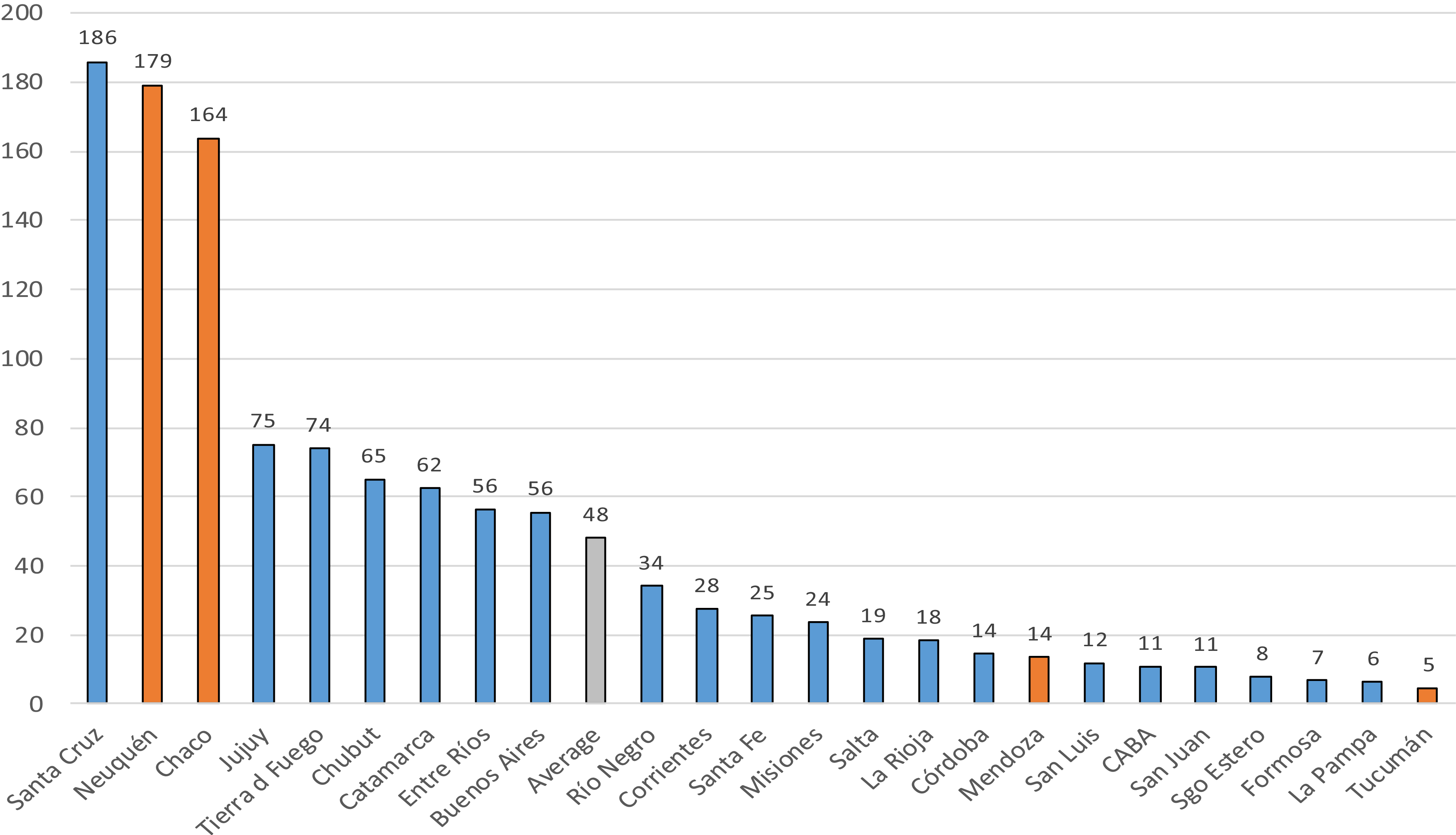
Indeed, as Figure 1 shows, teacher mobilization exhibited striking subnational variation across provinces. In some jurisdictions, education workers closed schools for months. In others, they ensured peaceful periods and conflicts remained episodic. Notably, the number of workdays lost to teacher strikes ranges from 186 in Santa Cruz—nearly an entire school year—to only five in Tucumán. More schematically, the data point to four groups of provinces. The first shows exceptionally high levels of teacher mobilization, with strike intensity reaching approximately four times the provincial average of 48 workdays lost. A second group consists of provinces with medium levels of militancy that remain above the average. Below this threshold, a third group displays moderate levels, with values exceeding this subset’s mean of 16 workdays. Finally, a fourth group falls below this mark, reflecting minimal levels of teacher mobilization. What accounts for such a notable variation?
Teacher Mobilization Across Provinces in Argentina, 2006–19.
Note: Individual workdays lost due to provincial public-school teacher strikes (primary, secondary, and tertiary/vocational non-university levels). Source: Ministerio de Trabajo, Empleo y Seguridad Social, Dirección de Estudios de Relaciones del Trabajo.

Figure 1. Long description
The bar graph compares teacher mobilization across provinces in Argentina from 2006 to 2019. The x-axis lists provinces, including Santa Cruz, Neuquén, Chaco, and others, while the y-axis measures the number of mobilizations, ranging from 0 to 200. The graph features vertical bars, with Santa Cruz having the highest mobilization at 186, followed by Neuquén at 179, and Chaco at 164. Other notable values include Jujuy at 75, Tierra del Fuego at 74, and Chubut at 65. The average mobilization across provinces is marked at 56. The color scheme uses blue for most bars and orange for a few, such as Neuquén and San Luis. The graph highlights significant variations in mobilization levels across different provinces. All values are approximated.
Methods and Case Selection
To test our theory of union mobilization in the public sector, we employ a subnational comparative case-study approach (Giraudy et al. Reference Giraudy, Moncada and Snyder2019). Our objective is to uncover the causal mechanisms and sequential processes—which are the foundations for “process-oriented causal inference”—that lead to union mobilization and moderation (Collier et al. Reference Collier, Brady, Seawright, Henry and Collier2004, 253). Examining provincial variation in strike militancy has the advantage of holding constant many institutional and cultural confounders that could vary cross-nationally, allowing for an assessment of the subnational-level implications of our argument.
Education at non-university levels in Argentina is administered by provinces, which are responsible for teachers’ salaries and working conditions, and define the statutory frameworks governing career trajectories. All jurisdictions operate within a common institutional setting that upholds core democratic principles, guarantees union freedom of association and activity, and constitutionally protects the right to strike. Considerable variation nonetheless exists in both mobilization outcomes and our key explanatory variables: the institutionalization of collective bargaining, and the requisites (partisan alignment and labor unity) for political exchange.
First, Argentine provinces employ different mechanisms to structure teacher salary negotiations. These arrangements range from provincially legislated collective bargaining agreements, to formal but non-sector specific procedures grounded in local norms, to informal meetings lacking legal bases, and even unilateral wage-setting by governors. During the 2000s, a national collective bargaining institution—the PND (Paritaria Nacional Docente)—established a federal minimum wage for school teachers. Its effects on provincial union mobilization, however, were limited. Participation was restricted to national unions and the wage floor functioned primarily as a baseline—though in poorer jurisdictions often as a ceiling—for local bargaining. Indeed, we showed elsewhere that the PND helps explain patterns of teacher militancy at the national, but not the subnational-level (Etchemendy and Lodola Reference Etchemendy and Lodola2024, 565–66). After a decade in operation, its suspension in 2017 triggered an increase of strikes called by CTERA nationwide. Otherwise, provincial unions rarely mobilized by themselves in direct response to national policy changes and instead acted autonomously from the confederation.
Second, the organizational structure of teacher unionism in Argentina differs markedly across provinces. In some jurisdictions—such as Chubut, Córdoba, Mendoza, Neuquén, and Río Negro—a single union monopolized representation. In others—including Buenos Aires, the City of Buenos Aires, Chaco, and Santa Fe—multiple organizations coexisted given internal splits or permissive labor regulations. Patterns of internal union competition also diverged notably across provinces. The institutional openness of teacher unionism, combined with statutory protections against layoffs, facilitated the emergence of radical leftist factions. In provinces such as Neuquén, Santa Cruz, and Tierra del Fuego, combative left-wing sectors gained leadership control. In Buenos Aires, Santa Fe, and Entre Ríos, CTERA-affiliated unions remained under moderate—mostly Peronist—leaders but faced persistent challenges from Trotskyist factions that commanded influential union sections. In other provinces, the left consolidated by organizing outside CTERA, as occurred in Río Negro and the City of Buenos Aires.
Third and finally, this diversity of teachers’ unions intersected with provincial administrations aligned with different national and local political parties, thus generating additional variation in the partisan condition for political exchange.
Drawing on methodological work on nested analysis, we employ a purposive case-selection strategy grounded in our explanatory typology. When a theory has already received cross-case support—as in our prior Large-N quantitative analysis (Etchemendy and Lodola Reference Etchemendy and Lodola2024)—qualitative methodologists concerned with sequential process tracing and causal mechanisms diverge in their recommendations for case selection. In his original, now classic formulation, Lieberman (Reference Lieberman2005) argues that researchers should select cases located along the regression line (i.e., with small residuals) that differ as much as possible on their outcomes. These “typical cases” are used primarily for theory-testing, as they make it possible to trace the mechanisms associated with each explanatory factor, or combination of factors, identified as sufficient for the observed outcomes (Seawright and Gerring Reference Seawright and Gerring2008, 299).
More recent scholarship cautions that restricting selection to cases well explained by the theory risks confirming under fitted regressions and weak hypotheses. These methodologists highlight the value of “deviant cases” for theory-refinement: unexplained observations may reveal additional or omitted explanatory factors that account for empirical anomalies, enabling researchers to reclassify the case into a predicted category and sharpen the explanatory typology (Rohlfing Reference Rohlfing2008; Schneider and Rohlfing Reference Schneider and Rohlfing2013; Møller and Skaaning Reference Møller and Skaaning2017, 1026–29). Thus, we select both typical cases and deviant cases for in-depth study.
Neuquén and Chaco constitute typical cases of high bottom-up mobilization: non-mandatory collective bargaining combined with adversarial (Neuquén) or no (Chaco) partisan relations between teachers’ unions and the government. But whereas in Neuquén sustained mobilization was driven by a single union under the strong influence of the radical left, in Chaco union fragmentation made it impossible for any organization to moderate conflict. By contrast, Mendoza represents a typical case of low mobilization under neo-corporatist pacts: duty-to-bargain rights and government-union political exchange facilitated by a shared (Peronist) partisan identity, and a hegemonic labor leadership. Finally, Tucumán constitutes a deviant case of low mobilization, even though wage negotiations were not institutionalized, teachers’ unions were relatively fragmented and lack partisan linkages to the provincial government—all conditions associated with strong activism. Teacher mobilization was curtailed not by a genuine neo-corporatist exchange, but rather by a long-standing pattern of state corporatism and union cooptation, uncommon in the landscape of Argentine teacher unionism.
We conducted four months of fieldwork in these provinces between April and July 2025. During this period, we carried out 43 in-person, semi-structured interviews—lasting approximately 90 minutes on average—with provincial teacher union leaders, union representatives of elected and appointed labor institutions, former ministers of education, and government officials involved in wage negotiations and public sector politics. We also held conversations with local observers, political elites, and activists from both national and provincial unions. In addition to primary sources, we relied on a variety of secondary materials, including scholarly work, data on union elections, provincial newspapers, recorded interviews, and social media content.
Our case-study narratives focus on the 2006–19 period, the interval for which systematic subnational data on teacher activism are available. When necessary, however, we trace “causal process observations” (Collier et al. Reference Collier, Brady, Seawright, Henry and Collier2004) back in time, briefly examining the origins of teachers’ unions in each province, and specific patterns of political exchange prior to time-frame referred.
The Cases
Neuquén: Bottom-up Mobilization with Union Factionalism
The oil and gas-rich Patagonian province of Neuquén ranks as the second most conflictive jurisdiction. Although a single union monopolized teacher representation, it was marked by intense internal competition and the early presence of a strong radical left. At the same time, a hegemonic and ideologically distant governing party maintained adversarial relations with union leadership, precluding political exchanges. In the absence of collective bargaining institutions, these conditions generated sustained bottom-up labor unrest.
Affiliated with CTERA since its founding in 1982, the teachers’ union ATEN (Asociación de Trabajadores de la Educación de Neuquén) emerged from a coalition of Peronist, Marxist, and progressive Catholic groups that later evolved into competing factions (Aiziczon Reference Aiziczon2020, 528–29). Operating within an organizationally dense and contentious environment—including unemployed workers’ movements, recuperated-factory workers, and indigenous communities—ATEN spearheaded opposition to educational decentralization in the 1990s and was an early adopter of roadblocks as a disruptive tactic in contemporary Argentina (Petruccelli Reference Petruccelli2005).
The union, the largest in the provincial public sector, was historically riven by leadership competition between Peronist and radical leftist factions. For most of the time, the Peronists Lista Celeste—which continuously held CTERA’s national executive committee—and Lista Azul y Blanca prevailed. Both positioned to the left of most teachers’ unions allied with Peronism in other provinces. Lista Azul y Blanca even criticized CTERA’s participation in the PND and instead advocated nationwide mobilization (Petruccelli Reference Petruccelli2023). The left, a factionalized sector increasingly dominated by Trotskyist organizations linked to minor national parties, controlled ATEN only briefly between 2012 and 2014.Footnote 8 Nonetheless, it often exerted a decisive influence over mobilization. Since 1994, left-wing factions controlled about one-third of the union sections, notably the Capital section, which encompassed 40 percent of the province’s school teachers. This foothold allowed combative groups to set the tone of ATEN’s activism, especially given its assembly-based governance, where decisions on strikes and wage agreements required rank-and-file approval. In short, ATEN can be characterized as a left-leaning union, even when Trotskyist sectors did not formally hold its leadership.
Alongside union factionalism, the partisan requisite for political exchange was absent from the outset. Provincial politics remained dominated by the MPN (Movimiento Popular Neuquino), an ideologically distant center-right party that governed uninterruptedly for four decades. The MPN and ATEN developed a deeply adversarial relationship. Education workers became the most hostile sector—averaging 60 percent of workdays lost to strikes in the period—while the government adopted a hardline approach that included attempts to break the union, the judicialization of protest, and the use of repressive force.
This confrontational stance unfolded amid non-mandatory collective bargaining institutions, which both the MPN and ATEN actually resisted. As the Secretary General of ATEN-Capital, Angélica Lagunas, remarked: “We don’t believe in collective bargaining tables; success only comes from fighting.”Footnote 9 Wage arrangements “in which the government is judge and jury” temper strike activity, and “confine negotiations to salary issues.” Former Minister of Labor, Ernesto Seguel, noted that union demands extended well beyond wages: “they not only came with salary proposals. They had demands on education policy, student food programs, transportation, infrastructure, and budget decisions. If those demands were rejected, they asked for even higher wage hikes.”Footnote 10
For its part, the MPN refused to recognize teacher collective bargaining and was reluctant to negotiate. In 2012, the government established a weakly institutionalized negotiation arena for public employees—the Mesa General del Diálogo. But teachers were excluded from this negotiation table, which was primarily used to offer low increases and pressure ATEN to concede. As Celeste’s leader, Marcelo Guagliardo stated: “The union, especially the left, always rejected collective bargaining … and the government never wanted to negotiate. It would call you only two days before classes began and offer just two percent. At one point we had to file 72 formal meeting requests.”Footnote 11 These dynamics weakened moderates and fueled radicals. A senior Peronist union leader succinctly captured the bottom-up logic of mobilization: “Our way of negotiating was warning MPN’s officials, ‘beware, the left is coming behind us.’”Footnote 12
The major strike waves that occurred in 2006–07 and 2010–13 nicely illustrate the mechanisms in more detail. Although these protests developed under different ATEN leaderships—first Peronist, then Trotskyist—they displayed a common dynamic: increasingly radical, maximalist factions intensified pressures over union leadership, pushing contention with a confrontational government toward near-deadlock.
In 2006, governor Jorge Sobisch, leader of the MPN’s hardline faction, exploited the absence of duty-to-bargain legislation and refused to negotiate wages. ATEN, led by the Celeste, launched an open-ended strike—deploying roadblocks to disrupt the province’s oil circuit—that struggled to sustain participation.Footnote 13 The following year, however, Peronist leadership was outflanked by left-wing sections that drove mobilization to its peak, including repeated 72-hour strikes, a 200-kilometer march to the provincial capital, and toll-lifting campaigns on the main highway bridge. In addition, ATEN’s provincial plenary declared itself in permanent session, enabling the union’s sections to act autonomously. Moderate leaders were ultimately overridden by an assembly decision to block Neuquén’s main tourist circuit during the Easter holiday. Police repression to clear the road turned violent, killing teacher activist Carlos Fuentealba. The conflict intensified; mass mobilizations were joined by the labor movement and civil society organizations, CTERA called a national strike, and ATEN demanded governor Sobisch’s resignation.Footnote 14
The government attempted to break the strike by hiring non-teaching personnel—about 10 percent of ATEN’s members—and declaring “education emergency,” which authorized the appointment of substitute teachers. The conflict ended after a 54-day stoppage—including a 20-day encampment around the Government House and a 30,000-person demonstration.Footnote 15 The lack of formal collective bargaining was reflected in the fact that talks occurred in a church mediated by the Archbishop of Neuquén, not in the Ministry of Labor or Education. Caught between negotiating with an administration responsible for lethal repression—which risked a leftist victory—and mounting social pressure as weeks passed without classes, the Celeste enforced the agreement only after narrowly securing majority support in the union plenary.Footnote 16
Bottom-up pressures also shaped the 2010–13 strike wave, exposing persistent union divisions and radicalization. After a month without classes, ATEN’s leadership sought to open dialogue with the government of Jorge Sapag (2008–12), aligned with MPN’s populist faction, and even supported certain measures, such as the formalization of auxiliary staff and tenure appointments (Cyunel Reference Cyunel2013). Dissident leftist sections opposed these talks, mobilized the two-thirds support required to initiate strikes—while bypassing the union plenary‘s ratification requirement—and put pressure on Peronist leadership. Following initial hesitation, the Celeste ultimately endorsed the protests.
The same dynamic persisted in 2013, under ATEN’s Trotskyist leadership. Factions outside the governing coalition rejected the wage agreement the government had reached with other public sector unions and launched a 39-day strike. Reluctant to reopen negotiations, the governor unsuccessfully proposed a bill to ban teacher strikes.Footnote 17 Within ATEN, a chain reaction developed in which the executive committee was continually outflanked by maximalist demands from more contentious groups. As a former left-wing leader put it, “in the end, even within the left, every ATEN activist in a leadership position is treated as a ‘bureaucrat.’”Footnote 18
Chaco: High Bottom-Up Mobilization with Union Fragmentation
The poorly developed northeastern province of Chaco is also on the podium of the most contentious jurisdictions. Unlike Neuquén, the primary driver of teacher mobilization was not internal union competition from a radical left—whose presence remained negligible—but extreme union fragmentation. Eventually, the province came to host 18 teachers’ unions. None developed consistent ties with the dominant political parties, Peronism and the UCR (Unión Cívica Radical), hindering government-union coalitions. These adverse conditions for political exchange unfolded within a non-institutionalized collective bargaining setting.Footnote 19
The fragmentation of Chaco’s teacher unionism stemmed from its entrenched regionalism, weak institutional regulation, and a political strategy that backfired in containing militancy. Contrary to patterns seen in other provinces―where teachers joined CTERA to bolster their influence―educators in Chaco resisted union nationalization and preserved a decentralized organizational structure. Weak regulations governing union formation further stimulated fragmentation. The provincial constitution establishes “no requirement other than inclusion into a special registry.” During a prolonged teacher strike, UCR governor Ángel Rozas (1995–2003) exploited this institutional loophole. Seeking to encourage union splintering and weaken their collective strength, his administration took over labor offices in 1997 and authorized—with minimal oversight—union leave and salary deductions to teacher organizations with as few as 200 members. Subsequent governments never regulated the constitutional provision and maintained this practice.Footnote 20
The union landscape is composed of three main organizations alongside a myriad of smaller groups. The oldest, ATECH (Asociación de Trabajadores de la Educación del Chaco), was created in 1985 by militants from diverse political backgrounds and operated without ties to a national confederation. Six years later, a dissident group formed F-SITECH (Federación Sindicato de Trabajadores de la Educación del Chaco). Structured as a provincial federation, it acted unified in wage negotiations, although its strongest sections retained autonomy to initiate strike action. In 2000, a progressive Peronist sector created UTRE (Unión de Trabajadores de la Educación), which affiliated with CTERA. Both ATECH and F-SITECH emerged as the largest and most combative organizations, each characterized by stable leadership and limited internal competition.Footnote 21 UTRE ranked third in membership thus lacking capacity to rival the militancy of the majoritarian unions. Dominated by the Celeste faction, it adopted a more pragmatic stance toward Peronist administrations. The proliferating list of teacher organizations included small splinters led by local unionists, and associations representing librarians, private teachers, technical instructors, and kindergarten educators. To strengthen bargaining power and reduce negotiation costs, many of these unions formed an umbrella organization, the Coordinadora de Sindicatos en Defensa de la Educación, often aligned with UTRE.
The mechanism linking union fragmentation with teacher militancy became evident during the UCR administration of Roy Nikisch (2003–07), when educators mobilized against low salaries and attempts to reform the teacher statute. Militancy peaked in 2005–06: strikes closed schools for 50 days; teachers camped outside the Government House, holding assemblies and public classes; and UTRE’s General Secretary—later Minister of Education—Sergio Soto went on hunger strike (Graciosi Reference Graciosi2019, 259–61). Although teachers’ unions shared salary demands, their divergent priorities hindered negotiations. ATECH and UTRE clashed over whether raises should target the lowest-paid or all teachers. More generally, ATECH prioritized defending the statute, a salary equivalent to 80 percent of the basic food basket, and incorporating increments into base wage.Footnote 22 In contrast, F-SITECH pushed for automatic indexation, while UTRE demanded enforcement of constitution, which required 33 percent of revenues be spent on education—a stance backed by smaller unions seeking specific gains.Footnote 23 Governor Nikish attributed the conflict and stalled negotiations to “constant competition among unions for control over workers and membership”.Footnote 24 For their part, unions demanded a wage-setting restructuring as the Salary Commission was merely a “delaying body without binding legal power.”Footnote 25
Under the Peronist government of Jorge Capitanich (2008–15), mobilization persisted, led primarily by ATECH and F-SITECH. To ease tensions, the governor appointed prominent UTRE leaders to head the Ministry of Education. But the attempt to forge a political alliance with the closest union backfired. Even allied with smaller organizations, UTRE was powerless to counter the mobilizing capacity of ATECH and F-SITECH. Lacking connections to parties or labor confederations, these unions relied on mobilization to gain influence. Unable to channel activism through negotiation, the government increasingly turned to punitive measures. This generated friction between UTRE’s officials in the provincial administration—who acted autonomously from the union’s organs—and UTRE’s leadership, undermining exchanges. The government repetitively invoked mandatory conciliation, docked strike pay, and threatened to consider strike absences as unjustified, risking disciplinary sanctions.
Ironically, the appointment of unionist Sergio Soto as Minister of Education in 2013 marked a tougher stance toward teachers. The government introduced an attendance-based salary supplement—the Fondo Estímulo—to prevent strikes. In response, F-SITECH and ATECH engaged in near-constant mobilization. The former radicalized, mounting roadblocks and occupying buildings that prompted police repression, while mass protests led to Soto’s interpellation by the legislature. Yet the government escalated as it authorized substitute hires to replace strikers. These measures branded UTRE as an “official” union, eroding its credibility. Indeed, UTRE lost affiliates and sectional control, while F-SITECH expanded in size and territorial reach. Outflanked and pressured to break with the government, UTRE eventually joined protests despite holding key government positions.Footnote 26
In 2015, Peronism retained power. The new governor, Domingo Peppo—Capitanich’s ally and chosen successor—unexpectedly adopted an austerity agenda. This sparked opposition from public sector unions, including UTRE. Salary erosion in a context of ruling-party splits, triggered the most intense strike activity of the period. Under the newly-created FGD (Frente Gremial Docente), ATECH, F-SITECH, UTRE, and the Coordinadora staged months of intermittent strikes—averaging 23 workdays lost—along with torchlight processions, noisy protests, encampments in the provincial capital, and a province-wide march. At unions’ request, Minister of Education Marcela Mosqueda was interrupted. Revealingly, seeking to undermine their legitimacy and curb fragmentation, she questioned union’s legal status, claiming that only ATECH and UTRE were authorized to participate in wage bargaining (Graciosi Reference Graciosi, Huertas and Ramírez2022, 348).
With negotiations blocked, the government found that wage deductions for strike days was the only mechanism available to contain protests.Footnote 27 It also declared an “educational emergency,” granting broad powers to ensure compliance with the school calendar. Faced with mounting social turmoil, the government relented, offering an automatic wage indexation clause―the cláusula gatillo. The FGD and governor Peppo signed the agreement at a public event broadcasted on radio and television. Nonetheless, in a sign of persistent fragmentation, FESICH-SITECH Castelli—a small, belligerent union with strongholds only in the regions of Castelli and Quitilipi—called a five-day strike, while “self-mobilized” teachers (autoconvocados) blocked a highway. In short, union fragmentation sustained militancy by weakening leadership control and coordination, while fostering competitive outbidding among teacher organizations—dynamics that prolonged and intensified strike activity throughout the period.
Mendoza: Low Mobilization with Neo-corporatist Convergence
Mendoza one of the least conflictive provinces. The reason for this lay in a combination of low union competition—a single organization only occasionally challenged by a fragmented radical left—and a shared partisan identity between union leadership and provincial governments. Moreover, coalition dynamics developed in an institutionalized collective bargaining environment that reinforced union hegemony and facilitated political exchanges. This neo-corporatist alliance was cemented through non-wage benefits and organizational side-payments.
Teacher unionism was dominated by SUTE (Sindicato Unido de Trabajadores de la Educación), a CTERA-affiliated organization founded in 1971 by Peronist and independent activists involved in the creation of the national teacher confederation. Representing teachers and school caretakers, it became the province’s largest union, comprising 40 percent of unionized state workers and exceeding commerce, the largest private-sector organization, by 15 percent (Lecaro and Gorri Reference Lecaro and Gorri2016). Thus, SUTE played a central role in Mendoza’s mandatory collective bargaining system, shaping wage expectations across public and private employees. The system, which covered all state workers, recognized this centrality by establishing a representation threshold that privileged SUTE as the sole representative of teachers.
The union functioned as a democratic organization. Strikes and wage bargaining were decided in assemblies and plenaries. Internal elections were held regularly with three political forces contending: Peronism, Radicalism, and the left. The dominant Peronist Celeste faction held power from 1985 to 2017. Unlike in Neuquén, internal opposition came from center-right groups, not from the left. Jointly, they obtained about 30 percent of the union vote. The left, a factionalized and territorially concentrated sector of Trotskyist currents, garnered 20 percent. Over time, the Celeste faced growing internal tensions, culminating in 2017 when its long-time leader, Gustavo Maure, was challenged by his right-hand man, Gustavo Correa. This division enabled a surprise left victory, though Peronism regained control four years later. In short, SUTE’s hegemony and sporadic internal competition reduced the risks that moderate leaders would be outflanked by combative rivals, while successive governments viewed the union as essential to labor peace. In periods of shared partisan identity—Peronism governed Mendoza between 2007 and 2015—SUTE’s leadership and provincial administrations developed an “organic relationship,” in which moderation was reciprocated with significant perks and organizational payoffs.Footnote 28
When Peronist Celso Jaque (2007–11) assumed the governorship, SUTE withdrew from a belligerent public sector union front and forged a close alliance with the new administration. Paradoxically, 2008 was the most conflictive year in this period —though only 3.3 workdays were lost. Yet the logic of these events nicely illustrate SUTE’s leadership commitment to preserving its coalition with the government. Before classes started, the union secured a wage agreement above inflation. Implementation soon faltered, however, when the new Secretary General, Eduardo Franchino—Maure’s designated successor—called a 48-hour strike to demand regularization of social security contributions.Footnote 29 The government agreed to cover contributions but refused to compensate strike days. Rather than negotiate, Franchino escalated: he called a 72-hour strike, expanded grassroots participation, and realigned SUTE with the public sector union front.Footnote 30 This approach strained relations with the government and fueled internal dissent. In 2009, Celeste’s leaders rebelled and excluded Franchino from the collective bargaining delegation. The following year, the union’s executive committee removed him from the Secretariat General and installed a close ally of Maure.Footnote 31
Soon after this group recuperated SUTE, the government-union alignment solidified into a neo-corporatist agreement. Teacher militancy dropped sharply, with only one minor strike in 2009 and none in 2010 and 2011. The provincial administration reinforced this exchange through non-wage concessions, mostly incorporated into collective agreements. To quote Andrés Cazabán, a long-time government negotiator: “there were resources available for distribution; debates centered on the timing and mechanisms, rather than on the amount. We focused on determining the nominal salary. Once that was settled, additional non-wage items were introduced one by one.”Footnote 32
Through this alliance, SUTE secured a 5 percent distribution in a government-run housing program, seniority compensations, funding for tourism and sports, permanent hiring of substitutes, subsidies for work materials, and the enactment of the school caretaker statute (SUTE 2012). Sector-specific bonuses were also common, and some wage increments were channeled through a “generalized zone,” effectively serving as covert across-the-board increases.Footnote 33 Equally important, the 2009 collective agreement expanded and restructured the Qualification and Disciplinary Boards to consolidate SUTE’s organizational and institutional power. Membership of these bodies grants unions significant influence—and some discretion—over teacher hiring, promotion, transfers, and dismissals. Crucially, the reform altered their composition. The original structure—four teacher-elected members and three government appointees—was replaced by a “three-thirds” formula, with three seats for SUTE, three for government appointees, and four for elected teachers.
In 2011, the union endorsed the victorious Peronist gubernatorial candidate, José Pérez. Under his administration, collective agreements also extended perks beyond wages to include school supply subsidies, clothing, free transportation, certification of titles, hardship compensations for caretakers, and the construction of recreational facilities (SUTE 2012). Another milestone was the creation of the higher-education institute IES (Instituto de Educación Superior) Simón Rodríguez, administered by SUTE to enable school caretakers complete their secondary education; for a time, it was directed by Maure himself.Footnote 34
The consolidation of a Peronist government-union coalition generated some contention by leftist factions. In 2012, a signed wage agreement was rejected in school assemblies following an intense Trotskyist-led campaign. Mobilizations denounced the accord as a “spurious pact” and labeled SUTE’s Peronist leaders “traitors.”Footnote 35 Mounting rank-and-file pressure forced the union to call two strikes despite its leadership’s preference for negotiation. In 2013, the Celeste secured a landslide victory in the internal election, but left-wing militancy persisted. Even so, Peronist control of the union’s plenary ensured ratification of agreements and limited the disruptive potential of strikes.Footnote 36
When UCR gubernatorial candidate Alfredo Cornejo (2015–19) defeated Peronism, the partisan foundation sustaining the neo-corporatist exchange collapsed. Upon taking office, Cornejo decreed an attendance-based wage supplement—the ítem aula—to curb absenteeism and discourage strikes. SUTE responded with protests. The government then doubled down. It deducted pay for strike days and, reviving a measure last used by Radical Julio Cobos in 2006, set teacher salaries by decree. This practice, which revoked duty-to-bargain rights, became a hallmark of Cornejo’s administration.
In 2017, a major split within the Celeste led to its electoral defeat. Running on a unified slate, Trotskyist factions narrowly prevailed over two Peronist lists. Yet militancy did not increase; actually, it declined: only two low-participation strikes occurred over the following four-year period. The left, which lacked a sprawling organizational structure to manage SUTE’s extensive apparatus, soon became mired in factionalism and constrained by an assembly-based decision model that hindered coordination. More importantly, Peronist factions undermined leftist leadership and obstructed mobilization by controlling 12 of the union’s 18 departmental plenaries. As a veteran SUTE leader recalled: “The Peronist leadership avoided a belligerent stance because the rank and file, not naturally aligned with Peronism, were unwilling to take risks. When the ítem aula was introduced, the Celeste consulted its affiliates about a strike plan. The response was negative: the government is right, they said; too many people abuse the system.”Footnote 37 This dynamic benefited the provincial administration by isolating union radicalism and contributing to its demobilization.
Tucumán: Low Union Mobilization with State Corporatism
The northern province of Tucumán recorded the lowest level of teacher mobilization. Yet it exhibited a number of attributes that, according to our theory, predict the opposite outcome. Extremely low labor conflict occurred despite the absence of institutionalized collective bargaining, government-union partisan incongruity, and a degree of union fragmentation. This makes Tucumán a deviant case. We argue that teacher moderation rested on an omitted explanatory factor: the top-down origins and reproduction of the main education unions, and their enduring ties to the provincial state.
Unlike most provincial teachers’ unions—which emerged in the early 1970s and 1980s amid processes of union nationalization and democratization—education workers’ organizations in Tucumán were born earlier, during the initial phase of labor incorporation which attempted to organize and control unions from above. As such, they became embedded in an atypical framework of political exchange sustained by governmental interference, monitoring, and cooptation. This state-corporatist model of interest representation promoted a leadership-driven strategy of demobilization, securing specific material benefits and political protection from both intra- and inter-union competition.
Teacher unionism in the province comprised three main organizations and a myriad of small unions. The largest, ATEP (Agremiación Tucumana de Educadores Provinciales), was among the earliest in the country. It was founded in 1949 under the tutelage of the local Peronist government, functioning as a transmission belt between teachers and the party’s women branch (Ramos Ramírez Reference Ramírez and Altabef2017, 231–36). Following the overthrow of Peronism in 1955, the union entered a phase of high militancy led by Isauro Arancibia—CTERA co-founder, later assassinated by the military dictatorship. With the return of democracy, ATEP reverted to its original logic broadening its base to include Radicals, Socialists, and Peronists, a coalition that never consolidated into a combative group. The union evolved as a negotiation-oriented organization that largely remained on the sidelines of labor conflicts, reinforcing its alignment with the provincial political power—namely, Peronism, which governed the province almost uninterruptedly since 1983.
In contrast to most CTERA-affiliated unions, ATEP neither developed an assembly-based structure nor fostered significant grassroots involvement, while it maintained only weak articulation through its departmental branches. Internal competition remained limited—winning factions secured between 60 and 75 percent of the vote—and small left-wing groups participated intermittently.Footnote 38 This concentration of power was further reinforced by a majoritarian single-district electoral system and the large number of union positions—around 230—required to field a slate. Over the post-democratic period, ATEP’s leadership was in fact monopolized by two figures: César Zelarayán (1989–2009) and his long-time deputy, David Toledo (2009–22). Notably, both belonged to the UCR—not to Peronism—although the union did not follow a partisan line. This suggests that the perdurable coalition between ATEP and successive Peronist governments constituted an elite-level arrangement rather than a partisan alliance.
The second-largest union, APEM (Agremiación del Personal de Enseñanza Media y Superior), was founded early in 1964. Its creation was backed by Arancibia, who sought to organize secondary school teachers—a sector beyond ATEP’s primary-education base. Conceived more as a complement than a competitor (Wieder Reference Wieder2017, 10), APEM coordinated closely with ATEP in the founding of CTERA and in conciliatory negotiations with provincial governments. Organizationally, it mirrored ATEP’s centralized structure and its limited internal pluralism, maintaining a single leadership since 2005.
A third smaller union, UDT (Unión de Docentes de Tucumán), emerged in 2000 from a heterogeneous group that split from ATEP (Toscano Reference Toscano2007). Initially, it adopted a confrontational stance driven less by substantive demands than by the goal of pressuring the government for inclusion in wage negotiations, from which all unions except ATEP were excluded. In 2003–204, UDT spearheaded mobilizations and helped establish a union front (the Intergremial), comprising APEM and the national unions SADOP (Sindicato Argentino de Docentes Particulares) and AMET (Asociación del Magisterio de Enseñanza Técnica), but not ATEP. The government’s response to this initiative nicely exemplifies the logic of state corporatism.
To contain the risk of escalating labor conflict and mounting challenge to ATEP, the Peronist administration of José Alperovich (2003–07) intervened in union affairs. First, it undermined the Intergremial by incorporating APEM and AMET into wage negotiations. Together with ATEP, these unions were encouraged to form an alternative union front (the Frente Gremial).Footnote 39 The nature of government-union negotiations, which continued to operate without legal obligations and according to “habits and customs,” were essentially political.Footnote 40 These negotiations were led by the Ministries of Government and Economy, with the Ministry of Education playing a secondary role, lacking authority to define wages or impose conditions.
Dissident organizations were excluded from informal wage bargaining arenas. As Mario Dionisi, Secretary General of private teachers’ union lamented, “they called us only after reaching an agreement with the Frente Gremial; our input had no real effect.”Footnote 41 This pattern demonstrates how executive control over labor relations, namely the absence of duty-to-bargain law, enabled the government to deploy exclusionary mechanisms—such as denial of legal recognition, administrative retaliation, and manipulation of institutional entry points—to suppress challengers to allied unions and preserve their cooptation. In a similar vein, UDT’s leaders acknowledged, “the government retaliated us because we broke a system of negotiation and cooptation; it did so through measures such as removing the payroll deduction code for union dues, marginalizing us from school boards, and appointing inspectors hostile to our cause.”Footnote 42 Additionally, the administration intervened in the Qualification and Disciplinary Boards, suspending teacher elections to them, and determining their composition according to an unwritten 50-50 allocation negotiated with ATEP.Footnote 43 Thus, the development of opposition factions capable of challenging the leadership of allied unions—and the corporatist system of interest intermediation—was severely curtailed. In short, the dual state-corporatist strategy combined cultivating a cooperative relationship with ATEP and APEM while simultaneously co-opting, fragmenting, and pitting unions against one another.
Conclusions
Mobilization of public sector unions is a defining feature of labor politics in both advanced and emerging economies in the twenty-first century. Indeed, in Argentina, the private-sector-based unions dominated both labor politics and social conflict during the second half of the twentieth century. In recent decades, however, teachers’ unions became by far the most contentious and combative labor actor—a trend that seems to be only deepening with time—with significant consequences for social peace and state policy effectiveness.
Public sector unions follow a distinct logic from those of the private sector. Labor relations in public unionism are considerably more regulated, public workers are generally shielded from outsourcing, and they commonly enjoy strong legal protections against dismissal. These contrasting institutional frameworks generate different incentives for collective action. Public unions are more likely to mobilize when formal wage-setting mechanisms are absent, and when political conditions—lack of partisan alignment between governments and unions, and intense inter- and/or intra-union competition—hinder the political exchange of labor moderation for state payoffs.
In previous work, we found robust statistical evidence supporting these claims in Argentina at both the national and subnational levels (Etchemendy and Lodola Reference Etchemendy and Lodola2024). Here, we extend that analysis trough a qualitative, subnational case-study approach. Focusing on four Argentine provinces, we trace the causal mechanisms and sequences underlying distinct patterns of labor contention or moderation—processes that remain lost in purely statistical analyses. These cases correspond to four mobilization outcomes: high bottom-up, medium segmented, low neo-corporatist, and low state-corporatist.
We show that in Neuquén bottom-up teacher mobilization was driven by radical leftist union factions and an assembly-based decision-making model, whereas in Chaco it stemmed from extreme union fragmentation and coordination problems among competitive organizations pursuing multiple, and at times conflicting, demands. Mendoza, in turn, exhibited a stable pattern of government-union convergence, only sporadically disrupted when the single teachers’ union radicalized and maximized its demands. Finally, in Tucumán, labor peace was cemented in state monitoring of unions and a long-standing pattern of leadership cooptation.
We also uncover causal mechanisms of union mobilization and moderation in the public sector that differ from those common in the private economy. For example, Neuquén illuminated the assembly-based system of union decisions—a key enabler of internal union competition. Every deal has to be subjected to internal, “live” votes in which the grassroots activism of historically strong union leftist factions exerts a powerful influence. Ironically, the Neuquén Trotskyite leaders themselves were victims of this “domino” of radicalization when they won the union and, at some point, also needed to reach a deal to end a month-length strike. In Chaco, each of the many unions prioritizes a certain aspect of labor demands: the statutory rights, the composition of wages for future pensions, the aggregate level of wages. The extreme variation of claims, together with the short-term material interests of every micro-union leader turns the coordination (and stabilization) of teacher’s wage negotiations an almost impossible task. Finally, in Tucumán, fieldwork simply uncovered new theoretical avenues (e.g., the historical patterns of state cooptation) to explain a deviant case, which always remains unexplored in the aggregate statistical analysis. In brief, our larger project intends to extract the best potentials of both quantitative and qualitative strategies to build a theory that can account for a key aspect of contemporary labor politics: the increasing hegemony of public sector unions.
Acknowledgments
We thank Juan Bogliaccini, Christopher Carter, Julián Gindin, Andrés Schipani, and participants of both the Seminar of the Department of Political Science and International Studies at Universidad Torcuato Di Tella, and the X Seminar of the Research Network on Teacher Unionism and Associationism (Red ASTE), for their valuable comments and suggestions.

 Open access

