


5.1 Introduction
The resilience of socioecological systems is the ability of biophysical systems that are exposed to hazards to resist, absorb, accommodate, adapt to, and transform and recover from effects of climate events in a timely and efficient manner, through institutional interventions that preserve and restore its essential basic structures and function (Jaramillo and Destouni Reference Jaramillo and Destouni2015). In 2019, the increasing frequency, intensity, and duration of droughts and floods impacted an estimated 1.4 billion and 1.6 billion people respectively and nearly 95 percent of infrastructure losses reported between 2010 and 2019 were due to water related disasters (United Nations 2023). Climate change induced changes can include reparable loss and irreparable damage to habitats, income and livelihoods, recreational opportunities, cultural heritage, and personal self-worth (Byrnes and Surminski 2019).
The transport and energy sectors are by far the biggest contributors of greenhouse gas emissions responsible for rising global temperatures, but the agriculture sector in the global south is disproportionately affected by the impact of droughts and floods because of the size of populations reliant on the sector for food security (Campbell et al. Reference Campbell, Beare, Bennett, Hall-Spencer, Ingram, Jaramillo, Ortiz, Ramankutty, Sayer and Shindell2017). It is therefore remarkable that in 2018, 93 percent of climate financing went towards measures that focused on mitigating emissions of greenhouse gases. There are opportunities to pursue cobenefits through cross-sectoral coordination because, for example, many water management interventions in fields of water reuse and climate smart agriculture can advance both mitigation and adaptation goals (United Nations 2023).
Paradoxically, while 90 percent of countries prioritize action on water for adaptation in their nationally determined contributions for climate financing, 50 percent of countries reported that they do not have the formal national mechanisms to facilitate cross-sectoral coordination that is critical to ensure resilient socioecological systems (United Nations 2023). Crucially, national mechanisms are sustained by norms (shared values), institutions (rules), and organizations (ministries and departments) responsible for design of policy frameworks that formalize the implementation of operational guidelines relating to environmental conservation (Harris et al. Reference Harris, Hunter and Lewis1995; Ostrom Reference Ostrom2009).
5.2 Monitoring Climate Response: Implications for Data, Information, and Knowledge
The discussion on “country readiness” or preparedness is premised on the notion that the use of improved assessment approaches, tools, and methods can generate the evidence that is required to design and deploy technologies and management systems that would restore climate resilience.Footnote 1 This is because conventional assessment techniques are unable to accommodate for institutional contexts where technology and financing produce nonlinear outcomes on account of heterogeneous responses of beneficiaries to project interventions (Dorward et al. Reference Dorward, Kydd, Morrisson and Poulton2005). The problem is compounded by development planning that is unable to capture feedback about the recursive effects of interventions, thereby blunting the ability to coordinate institutional response to climate events through reform of management information systems (MIS) (Kurian and Kojima Reference Kurian and Kojima2021).
Environmental changes are nonlinear, nonmonotone, and seldom recursive. This is because interactions of the agency with a wider political ecology are dynamic enough to produce diverse responses and erratic courses which cannot be addressed by postulates of rational action or fixed models alone.Footnote 2 Consequently, conventional environmental models have been unable to account for poor coordination between the proposed technical/management options and the fact that environmental outcomes are often shaped by uncertainty and changes that arise in the policy environment.Footnote 3 As a result, case studies alone may not be sufficient to unpack the functioning of commons resources such as forests, irrigation systems, livestock pastures, or groundwater basins (Turral and Kurian Reference Turral, Kurian, Kurian and McCarney2010). In this chapter we discuss two methodological innovations, trade-off intensity (TI) and typology assessments, that can unleash insights on structural variables that intersect with forces of history, reputation, hierarchy, and culture to produce changes in collective behavior (such as stall feeding of cattle or rules for irrigation water rotation) and have an ameliorating impact on environmental and social outcomes in the context of climate change. For this purpose, we rely on an analysis of five cases of common pool resources management combined with an expert panel review of climate loss and damage in Jordan to discuss their implications for the knowledge commons framework.
5.2.1 Reflections on the Institutional Analysis and Development (IAD) Framework
It is in this context that we believe that scholarship on the knowledge commons can support institutional analysis that informs policy and decision-making. By “knowledge commons” we refer broadly to commons arrangements (e.g., data repositories) for overcoming various social dilemmas associated with sharing and producing information, innovation, and creative works (Ostrom and Hess Reference Ostrom, Hess, Hess and Ostrom2006). These commons arrangements could furnish protocols that enable the co-curation and joint use of a wide range of knowledge resources such as scientific data, open-source software (e.g., R), and machine learning approaches (Frischmann et al. Reference Dedeurwaerdere, Frischmann, Hess, Lametti, Madison, Schweik and Strandburg2014). The adoption of a knowledge commons framework could revolutionize the use of case studies and agent-based modeling to better inform policy processes by aligning data, models, and data transformation tools (e.g., composite indices) with open-data principles: Findable, Accessible, Interoperable, and Reusable (FAIR) (Poteete et al. Reference Poteete, Jannsen and Ostrom2010; CGIAR 2021).
5.2.2 IAD Framework: Implications for the Knowledge Commons in the Context of Climate Change-Induced Loss and Damage
The knowledge commons framework borrows from the IAD framework with the objective of providing a systematic approach to case study design that would enable comparisons and aggregation of lessons across a wide range of institutional contexts. The ultimate objective of the exercise is to provide a basis for developing theories to explain the emergence, form, and stability of the observed cases and to eventually design models that can inform institutional design (Strandburg et al. Reference Dedeurwaerdere, Frischmann, Hess, Lametti, Madison, Schweik and Strandburg2014). Some have claimed that the IAD framework is pretheoretical, in that it stops at delineating a broad set of elements (and relationships among these elements) that could be used to analyze all types of settings relevant to the framework. Nevertheless, the framework was novel for its attempt to open a theoretical space for researchers from a wide range of disciplines to explore social dilemmas surrounding the commons.
Furthermore, by engaging the policy realm especially through the design principles that distinguished successful natural resources management, the framework emphasized the importance of evaluative criteria. Ostrom (Reference Ostrom1991, 239) argued that “rather than conceptualizing rule-governed choice as more important than rational choice, a general approach would attempt to explain how both rules and anticipated consequences affect behavior and outcomes.” This would presuppose a synthesis that involves two layers: first, rules determine the choice of available choices, while rational choice determines which of these options is selected. Second, rationality extends to the choice of rules. “To be rule-governed, the rational individual must know the rules of the games in which choices are made and how to participate in the crafting of rules to constitute better games” (Ostrom Reference Ostrom1991, 242). Ostrom was quick to point out in this context that “history, institutions and cultural traditions will play a more significant role in the evolution of rational choice theories in the future than they have in the past” (Ostrom Reference Ostrom1991, 242).
Ostrom (Reference Ostrom1998) introduced important elements of history in her analysis through the incorporation of concepts of reputation, trust, and reciprocity to better understand the rational choice theory of norms (Tarko Reference Tarko2016). According to this account, “levels of trust, reciprocity and reputations are positively reinforcing which also means that decrease in any one of these can lead to a downward spiral” (Ostrom Reference Ostrom1998, 13). This is an important advance, especially from the point of view of monitoring programs on climate change adaptation since instead of explaining levels of cooperation directly this approach links structural variables to an inner triangle of trust, reciprocity, and reputation, and how these in turn affect the levels of cooperation and net benefits. The International Forestry Resources and Institutions (IFRI) research project led by Elinor Ostrom played an important role in advancing the policy dimension of the IAD framework. The three goals of the IFRI project were to (1) enhance interdisciplinary knowledge of institutional trajectories with specific reference to forest stewardship, (2) provide a methodology to ground-truth aerial data and spatially link forest use to deforestation and reforestation, and (3) improve assessment capabilities of participating countries (Kurian and Kojima Reference Kurian and Kojima2021).
5.2.3 The Political Economy of Commons Management
IFRI explored ways to link research talent in each country and provide opportunities to collect information, build models, and influence policy change, which is as necessary as tree planting to combat deforestation. IFRI also pursued a strategy of starting with small-scale studies that identify the simplest concepts in which a process occurs so that particular processes can be studied on-site, starting with the most observable (read exhibiting extreme trade-offs) and moving to more global strategies (read based on cross-country comparisons) (IFRI 1997). The second concept which IFRI pursued was the development of “cost-effective prototypes of coupled models” (IFRI 1997, 7). As the IFRI experience suggests, assessments of institutional trajectories can be both time-consuming and rely heavily on continuous funding. In this sense, the IFRI project was ahead of its time in emphasizing the importance of sharing knowledge resources, and combining and coordinating preexisting resources to generate new knowledge, ethics, and modalities of data sharing and open data principles. The enormous advances that were made by IFRI to emphasize the evaluative power of IAD should, however, not prevent us from pursuing an important question: What innovation in the forms and reuse of data themselves could accommodate for a more dynamic storytelling using expert opinion to illuminate metaphor, history, and analogy in explanations of the commons? This would necessitate an engagement with factors of political economy to better understand structural variables and the effects of social difference and change in affecting commons outcomes.
5.3 Using Expert Panels to Monitor Trade-Off Intensity in Climate Assessments
Institutions are key to ensuring a balance between planetary health and the needs of a populace for basic services – water, energy, and food. Governing climate change induced losses is essentially about (1) understanding overall policy trade-offs, (2) delineating hotspots of extreme trade-off intensities, (3) prioritization of hotspots depending on the magnitude of losses and damages, and (4) institutional response to extreme TI. This is why we argue that an iterative process of theory led evaluations of climate programming can improve the governance of losses and damages. In this section, we will begin by describing how a composite index can be employed to operationalize hotspot mapping to support analysis of trade-off intensities.
5.3.1 Constructing a Loss and Damage Index for Soil and Water Conservation Programs
Most scientific models do not appreciate the fact that case study evidence cannot be persuasive in policy design because it is unavailable in a format usable by decision-makers (OECD 2008). By working with typologies, we seek to improve upon conventional methods by developing multidimensional models of socioecological systems instead of crafting theories of change purely based on analyzing nodes and density of social networks in public agencies (Deutsch et al. Reference Deutsch, Belcher, Claus and Hoffman2021). Second, instead of relying on massive data collection without engaging with feedback emerging from the policy process, we propose working with composite indices that rely upon expert panels to inform the design of policy/fiscal instruments (Kurian and Kojima Reference Kurian and Kojima2021). Finally, by undertaking an analysis of TI we embrace political ecological realities to explain the differences in the institutional response given the impact of losses and damages on the livelihoods of communities affected by climate change.
5.3.2 Why Institutional Mechanisms are Crucial for Monitoring Climate Resilience Policies
Both the first (Laos) and fourth (India) typologies illustrate contexts where the impacts of agricultural interventions resulted in unexpected adverse impacts owing to ineffective institutional response, which was reflected in an inability to adapt to changing market trends and trade policies. In typology 1, losses arising from soil erosion which had the potential to aggravate flooding in upstream catchments (the commons) elicited a response in the form of Improved Fallow technology that was promoted by the Consultative Group on International Agriculture Research (CGIAR). This management option was developed by the CGIAR in response to persistent poverty and soil erosion, which was partly triggered by intensive cultivation coupled with rainfall variability. Under a policy environment where Laos was transitioning from state ownership of land to private land titles, however, we found that trade policy orientation aggravated agricultural intensification in the context of rainfall variability. A lack of cross-sectoral coordination among multiple ministries/departments was compounded by the absence of multifaceted information on crop yields and conditions in labor markets and absence of credit and insurance support to enable farmers to adapt to changes in trade policy orientation (Stevenson and Vlek Reference Stevenson and Vlek2018).
Typology 4 (North India) demonstrates the losses and damages in food security (nutrition) in which people suffer from less diverse diets, which is aggravated by soil run-off (a commons resource) caused by intensified land use. The case illustrates how agricultural development challenges are layered, necessitating a longitudinal analytical framework to capture such relationships. The typology also suggests that an absence of intermediate financial schemes that could enable farmers to adapt to changed market conditions combined with a failure to coordinate multipronged policy directives involving trade, agricultural production, and rural development through the mechanism of an MIS that collects and synthesizes data has the potential to aggravate losses and damages in the context of increased frequency, duration, and intensity of climate change-induced flooding events.
There is a common assumption that reusing safely treated wastewater for agricultural production increases productivity and hence enhance livelihoods and protects ecosystem services (soil quality in particular) for peri-urban communities in the developing world. Typologies 2 and 5 address this assumption from global (case 2: global sustainable development goals, SDGs) and regional specific (case 5: South India) perspectives by focusing on water reuse models. Typology 2 demonstrates the public health risks arising from the use of untreated wastewater (irrigation as a commons resource) are aggravated by flooding that can impact small scale aquaculture and farming. On the other hand, typology 5 highlights the damage evident in impacts for public and environmental health (soil contamination). In both cases, these losses and damages occurred owing to flooding events caused by malfunctioning of sewer infrastructure that is aggravated by storm drain overflows in cities. In addition to the nonalignment of national financial instruments for the delivery of water and sanitation services with global targets, there is limited synchronization of roles and skills among concerned ministries/departments and an absence of information on the effects of water pollution on livestock and human populations.
Typology 3 (Tanzania) represents another variant of the losses in public health and livelihoods arising from deteriorating water quality. While typology 2 focuses on urban water and sanitation challenges caused by frequent flooding events, typology 3 deals with a similar developmental challenge in the context of rural water supply which has become unreliable owing to cumulative siltation of infrastructure (a commons resource) caused by agricultural intensification and exacerbated by frequency of dry spells. Both typologies 3 and 5 showcase variations on a similar theme whereby water scarcity exacerbated by flooding (typology 5) and dry spells/drought (typology 3) causes deteriorating health of human populations and the environment, thus adversely impacting the livelihoods of vulnerable communities.
5.3.3 Typologies of Climate Change-Induced Loss and Damage Stress
A failure to effectively coordinate institutional response by addressing a critical mass of financing and technology, capacity, and information will likely generate losses in the planetary, institutional, and political ecology domains.
1. Soil Conservation (Flooding events in upstream catchments)
Agricultural Development Intervention Areas:
Food security (production)
Poverty reduction
Environmental health
Losses in Institutional Response (IR) Domain:
Soil loss owing to agricultural intensification causing increased flooding
Losses in Biophysical Condition (PT) Domain:
Vulnerability of region to soil erosion intensified
Losses in Political-Ecology (PE) Domain:
Trade policy orientation induces agricultural intensification, resulting in shrinking livelihoods
1092. SDG 6.3 Urban Water Quality (Flooding events in urban environments)
Agricultural Development Intervention Areas:
Urban water and sanitation
Public health
Environmental health
Livelihoods
Losses in Institutional Response (IR) Domain:
Untreated wastewater induced by flooding heightens public health risks
Losses in Biophysical Condition (PT) Domain:
Frequent flooding events cause damage to wastewater treatment infrastructure
Losses in Political-Ecology (PE) Domain:
Flooding events intensify public health (water quality) risks and damage livelihoods dependent on small-scale aquaculture and farming
3. Water Quality in Rural Water Supply (Frequency, duration, and intensity of dry spells)
Agricultural Development Intervention Areas:
Livelihoods
Environmental health
Public health
Rural water supply
Losses in Institutional Response (IR) Domain:
Nonfunctional infrastructure results in deteriorating drinking water quality
Losses in Biophysical Condition (PT) Domain:
Siltation caused by agricultural intensification and exacerbated by frequent dry spells damages water supply infrastructure
Losses in Political-Ecology (PE) Domain:
Public health expenditure rises due to poor water quality and unreliable water supply, leading to decline in income from poultry raising and kitchen gardens
4. Soil Runoff (Frequency, duration, and intensity of flooding events in upstream catchments)
Agricultural Development Intervention Areas:
Livelihoods
Environmental health
Irrigation
Poverty reduction
Food security (nutrition)
Losses in Institutional Response (IR) Domain:
Nonfunctional infrastructure results in unreliable irrigation services, adversely affecting diet diversity and nonfarm livelihoods
Losses in Biophysical Condition (PT) Domain:
Siltation caused by agricultural intensification and worsened by frequent flooding damages irrigation infrastructure
Losses in Political-Ecology (PE) Domain:
Secular decline in local revenues from agriculture (farming/livestock rearing) and urban tourism (which relies on water sourced from rural catchments)
5. Peri-Urban Water Reuse and Soil Contamination (Flooding events in urban environments)
Agricultural Development Intervention Areas:
Public health
Environmental health
Livelihoods
Peri-urban agriculture
Urban water and sanitation
Losses in Institutional Response (IR) Domain:
Public and environmental health damage due to malfunctioning sewer systems caused by storm drain overflows
Losses in Biophysical Condition (PT) Domain:
Soil contamination from the use of untreated peri-urban wastewater in agriculture
Losses in Political-Ecology (PE) Domain:
Public health (water quality) risks from use of untreated wastewater in agriculture and impacts on nonfarm employment
Let us now turn to discuss the outlines of a Climate Induced Loss and Damage Agriculture Stress Index (CILDAS) index that can be employed to monitor climate losses and damages. We will employ typology 3 (Tanzania) as an example. As you recall, the typology highlights mitigation of extreme trade-offs between agricultural intensification and the quality of water supply. A CILDAS index can reflect this trade-off through a conceptual model of three sub-indices: (1) Political Ecology (PE); (2) Institutional Response (IR); and (3) Planetary Threshold (PT). Index construction starts with the PE component. The level (high, medium, and low) of TI for the effects of agricultural intensification (i.e., cropping intensity, fertilizer use), and water quality (i.e., turbidity, coliform bacteria) can be expressed through the selection of PE indicators that can range from public health to tourism revenues and livelihood loss.
The second step involves IR-assigning weights for three elements (siloes, thresholds, and critical mass) to map the institutional response to varying levels of TI. Finally, the contextualization of planetary thresholds in the form of PT can be drawn from biophysical data (rainfall, temperature, rates of land cover change, etc.). The combination of these three elements can express system-level stress on account of losses and damages of targeted regions/jurisdiction and their potential to aggravate slow onset events (e.g., droughts), noneconomic losses (e.g., the disappearance of certain crops from diets, loss of self-worth, and biodiversity loss), and loss of revenue streams for government agencies responsible for managing the poverty environment nexus (Dasgupta et al. Reference Dasgupta, Deichmann, Meisner and Wheeler2005).
5.3.4 Illuminating the Political Ecology Context through Analysis of Trade-Off Intensity
A loss and damage assessment framework should view institutional response to climate change-induced losses and damages as the outcome of negotiations involving groups with disparate power across administrative jurisdictions which ultimately shapes policy design, implementation, and monitoring. Adoption rates of soil and water conservation technologies in turn are influenced by the interaction with the larger political ecology context, an issue which is rarely articulated in climate financing programs. This is why we employ the concept of TI to understand the levels of stress that biophysical systems place on the magnitude and scope of institutional responses to climate threats. By combining analysis of biophysical stress and institutional response, we can specify the institutional capacity that needs to be developed given the landscape of economic trade-offs between environmental, social, and institutional priorities at any given time. Trade-off intensity analysis to monitor the effectiveness of climate financing programs.
Planetary Threshold (PT)
Temperature trending towards extremes
Rainfall/precipitation trending towards extremes
Quality of water resources trending positive
Quality of energy services trending positive
Rates of land cover change trending towards extremes
Rates of soil erosion/flooding/fires trending towards extremes
Natural resource use per-capita trending towards extremes
Trade-Off Intensity (TI)
Incidence of nutritional insecurity per-capita trending towards extremes
Secular changes in agriculture contribution to gross domestic product and employment trending towards higher variability
Hydropower/water discharge rates trending towards higher variability
Secular changes in labor demand and supply for agricultural operations trending towards higher variability
Cropping intensity rates trending towards extremes
Rates of land use change trending towards extremes
Volumes of agricultural input use for (fertilizers, pesticides, mechanization) agricultural operations trending towards extremes
Resource allocations towards infrastructure operation and maintenance trending towards higher variability.
Projected staffing and training on World Economic Forum (WEF) climate adaptation trending negative.
Criteria for disbursement prioritizing operation and maintenance of climate smart agricultural infrastructure/technology trending negative
Projected changes in trade policy with implications for WEF climate adaptation trending negative.
Extent of official recognition of TI for data in MIS trending negative.
Projected fiscal trends with implications for asset distribution for resource poor in agriculture sector trending negative.
Secular changes in agricultural terms of trade trending negative.
The challenge of engaging context-specific data to support analysis of TI can be effectively addressed by aggregating the views of expert panels using a sliding Likert scale. Such an exercise will serve to valorize data and models that inform decisions based on projections made by project, census, or statistics bureaus of a given jurisdiction.
5.4 Using Expert Panels in Jordan to Examine Perceptions of Climate Risk Based on a Multidimensional Model
The country of Jordan is situated in Southwest Asia and experiences a semiarid climate. A significant portion of its land (approximately 75 percent) is covered by desert, and the majority of its regions receive minimal rainfall each year, with levels averaging under 50 mm (MOPIC 2017). Jordan’s natural and energy resources are limited, and the country endures frequent existential water shortages (The World Bank 2022). The irreparable damage caused by the harsh weather, severe winds, temperature fluctuation, and heavy rains increases the vulnerability of infrastructure and utility systems in Jordan, most of which are outdated and fragile. Indeed, the irreparable damages and losses have affected the Jordanian socioeconomic sector, and this vulnerability has led to decreased crop production and reductions in some households’ income (Ministry of Environment 2021). Climate-related factors have caused some agricultural regions in Jordan to experience a reduction in income by 10–20 percent (Ministry of Environment 2021).
Many other factors are involved in defining policy choices and various systems, cultures, institutions, and environmental factors limit the capacity of policymakers to consider the evidence (Stoker and Evans Reference Stoker and Evans2016). As previously discussed, the conventional assessment techniques cannot adequately deal with the contextual changes and provide the required evidence to monitor changes and deal with the adverse effects of climate change. Therefore, we developed a local panel of experts consisting of six academics, scholars, and practitioners who specialize in environmental studies from three public universities in Jordan, strategically located in the north, central, and southern regions of the country. We also included policymakers who possess expertise in climate change adaptation in Jordan. Although we aimed to include female experts in the panel, no one expressed interest in joining. To maintain no more than six members, some have expertise in multiple areas, such as working with climate change governmental projects and academia (see Appendix A for details).
5.4.1 Data and Methods
We assessed the climate change-induced loss and damage in Jordan’s soil–water–food systems and agriculture sector through a targeted web survey. We embedded the survey link in the experts’ recruitment email, which directed the respondents to the platform to complete the questionnaire. We developed the regional analysis based on the geographic and topographic characteristics, dividing Jordan into three main climatic regions: the Ghor region (lowlands), the Highlands, and the Badia and Desert region (FAO 2020); see Figure 5.1. The assessment process involves three main steps. First, we identified Jordanian regions at high and low risk of climate change-induced loss and damage in soil-water-food systems. Second, we conducted a TI analysis by administering a twenty-three-question weighted binary questionnaire. The questions were derived for each of the variables listed under institutional response, TI, and planetary thresholds (Table 5.1) derived from the CILDAS model. Responses for most unlikely were scored 0 points while those indicating highly likely were scored 10 points. Third, we compared the results of the first two steps to determine any differences (see Appendix B).
Regions covered by expert assessments in Jordan.
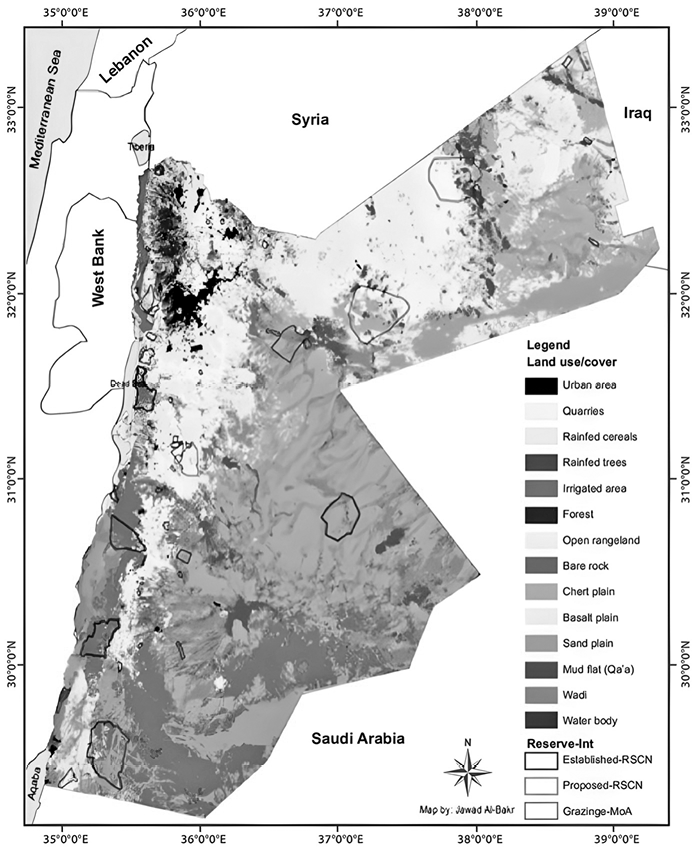
Figure 5.1 Long description
Map outlines Jordan and its neighboring countries, showing major land use and cover types. The western region includes urban areas, rainfed crops, irrigated farmland, and small forested zones clustered near cities such as Amman and along the Jordan Valley. The rest of the country is dominated by open rangeland, with areas of sand plain, basalt plain, chert plain, bare rock, wadis, and mud flats spread throughout the central, eastern, and southern desert regions. The map also marks the Dead Sea, the Sea of Tiberias, and the city of Aqaba for reference. Several protected zones are outlined, including established and proposed reserves and designated grazing areas distributed across both the western highlands and the eastern rangelands.
5.4.2 Implications for the Environmental Knowledge Commons Framework
According to the experts’ evaluation of the most vulnerable climatic region, the Highland regions, which extend to the north and south to the east of the Ghor region, have the highest risk of climate change-induced loss and damage in soil-water-food systems. The Jordanian highlands are divided into three main portions: north, central, and south. The north portion is bordered by the Yarmouk River to the north and the Zarqa River to the south, both of which are tributaries of the Jordan River (Shoup Reference Shoup2007). Irbid and Ajloun are the two biggest cities in this region. The central portion, known as the Balqa Heights, extends from the Zarqa River in the north to Wadi al-Mujib in the south. Amman, the capital city of Jordan, and the towns of Al-Salt and Madaba are located in this area. The south portion is known as Jabal al-Sharat, and includes the largest city in this area, Al-Karak, which is located near the southern end of the Dead Sea (Shoup Reference Shoup2007). Most of Jordan’s population and major cities are located in the highlands, which has the highest potential for rangeland in Jordan (FAO 2020).
Moreover, the experts have revealed that among the three climatic regions, the Badia and desert regions have the lowest risk of climate change-induced loss and damage in soil-water-food systems. This region stretches across an area of around 70,000 square kilometers and experiences an annual rainfall ranging from 50 to 100 mm. The southeastern part of the region is classified as a true desert, with an annual rainfall of less than 35 mm (FAO 2020). This vast landscape covers approximately 80 percent of the country and is home to unique archaeology, ancient history, and various fragile ecosystems (World Bank Group 2016). The Badia region is also home to Bedouin livestock breeders, many of whom are nomadic. However, numerous factors such as settlement, drought, and overgrazing are causing damage to their lands, jeopardizing their income earned from herding and agriculture (The World Bank 2016). Jordan’s Badia region is home to crucial groundwater reserves and resources, including the Al-Azraq basin and Disi aquifer (The Hashemite Fund for Development of Jordan Badia 2023). The largest and most improvised governorates in the Badia and desert are Ma’an and Mafraq.
In light of experts’ assessment of biophysical conditions, TI, and institutional response, we conducted a regional-wise summative assessment to identify the climate change-induced loss and damage. Table 5.1 indicates that the Desert and Badia region experienced the most significant loss and damage owing to climate change, followed by the Highland region.

Table 5.1 Long description
Table presents regional scores across three dimensions Planetary threshold A, Institutional response B, and Trade-off intensity C, with totals. Lowland region scores 186 for A, 266 for B, and 267 for C, giving a total of 719. Highland region records 312 for A, 257 for B, and 231 for C, totaling 800. Desert and Badia region shows the highest values with 498 for A, 523 for B, and 498 for C, totaling 1,519. Section totals are 996 for A, 1,046 for B, and 978 for C, resulting in an overall country score of 3,038.
Note.
* A higher total score may be an indication that the loss and damages are significant.
It is worth noting that the experts’ general assessment of Jordanian regions regarding which are considered at high and low risk of climate change-induced loss and damage in soil-water-food systems is discrepant from the regional-wise summative assessment of the TI analysis. We identified several reasons for this discrepancy, including the well-articulated assessment factors of the TI analysis, which enabled experts to specifically identify the lack of governmental intervention to deal with climate change.
The taxonomic approach of the trade-off analysis made experts leverage the comparative basis of the adverse effect of climate change among Jordanian regions. Ultimately, we argued that the intersection of the TI analysis and the Jordanian regional division provides insightful indicators that experts can use to assess the adverse effects of climate change in light of the Jordanian government’s uneven allocation of resources among Jordanian regions. Notably, the majority of developmental resources are directed towards the central region and specific sectors, whereas other marginalized areas such as the south and east regions, which are known as Desert and Badia in our analysis, receive less attention.
5.4.3 Predicting the Effect of Rule Changes
It must be pointed out that given the “non-linearity and complexity of many action situations, it is challenging to predict the precise effect of a change in a particular rule” (Ostrom Reference Ostrom2009, 239). This can be viewed as a limitation of the rational choice theoretical framework. Furthermore, the tendency to assign all authority to a central agency is based on a false assumption that only a few rules need to be considered and that only experts know these options and can design optimal policies. But the renewal of back casting approaches and the emergence of supervised machine learning has expanded the avenues for experts and nonexperts alike to be engaged in building a consensus based on prior knowledge of commons dilemmas. This would fit in well with Ostrom’s optimism about the drama of the commons and how it can be enriched by enabling people to act “pro-socially” in the interest of fairness and increasing welfare in general (Ostrom Reference Ostrom2000). More broadly, this would also address calls to make climate justice a reality by addressing issues of distributive (resource allocation), recognitional (local knowledge), and procedural (fairness in decisions) representation in the exercise of rules that govern the curation and use of environmental models (Rose Reference Rose1997; Dasgupta et al. Reference Dasgupta, Deichmann, Meisner and Wheeler2005).
To pursue thinking along these lines, we argue that analysis of TI can promote intersectoral policy coordination by actively tracking changes in weights for variables of institutional response: threshold capacity, critical mass of financing, and technology and information siloes. The constitution of periodical expert panels has the potential to support a robust monitoring ladder that informs the pilot testing of policy instruments such as guidelines, notifications, standards, circulars, and directives. Such an approach can overcome some of the shortcomings that relate to the discrepancy between market and nonmarket prices for cost and benefit analysis, key category analysis, and the concerns that have been expressed about the subjectivity of scoring and weights in climate assessments (ND-GAIN 2020; United Nations Framework Convention on Climate Change 2021). We acknowledge that the subjective nature of finding a consensus among experts may involve power hierarchies that are embedded in differences in disciplines, gender, and affinity to policy positions. Therefore, it is pertinent to inquire about the extent to which supervised machine learning can mitigate the excesses of political calculations of expert panel members with regard to the “majority view” on certain questions that involve the allocation of weights by professionalizing the exercise whereby the views of experts are aggregated to arrive at a consensus. This new frontier of rational choice theory has implications for managing the transformation of data into knowledge and information for decision-making with implications for the knowledge commons framework. An implicit assumption of such an endeavor will be that “humans are fallible learners who seek to do as well as they can give the constraints that they face and who are able to learn heuristics, norms, rules, and how to craft rules to improve achieved outcomes” (Ostrom Reference Ostrom2009, 7).
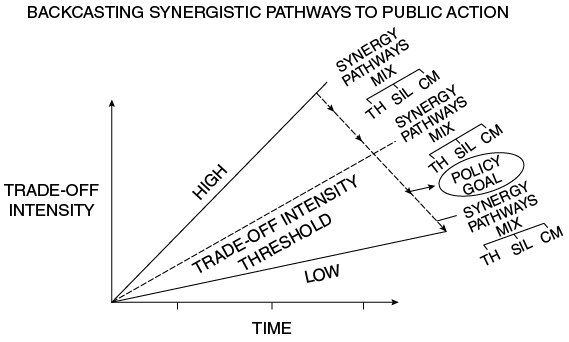
In practical terms, back casting can help overcome the limitations regarding predicting the effect of rule changes. For one, for every model of institutional change (e.g., CILDAS), it would be possible to view possible interventions along the spectrum of high to low TI by identifying a threshold criteria. Depending on the policy goal – whether it is to lower or increase TI, institutional reforms may target the three elements of our CILDAS model – capacity thresholds, information siloes, and critical mass of technology and financing.Footnote 4 From a monitoring perspective, knowledge commons research should be able to draw upon expert panels to predict the effect that changes in each of these can have on overall outcomes in complex, nonlinear systems. Second, as a sequel and once sufficient cases have been organized, knowledge commons research could inform the design of institutional rules that can be piloted using distinct phases and transition points for each of the three intervention areas – siloes, thresholds, and critical mass (see Figure 5.2). This approach would overcome some of the limitations of the IFRI database-driven strategy that made limited contributions to the design of institutional rules in a real-world setting, thus minimizing its impact on policymaking.
Monitoring institutional response to climate change-induced trade-offs.
*TH: Thresholds, CM: Critical mass of technology and financing, SIL: Siloes

Figure 5.2 Long description
Diagram presents a time-based framework for reaching a future policy goal. Trade-off intensity is plotted on the vertical axis and increases upward, while time moves along the horizontal axis. A horizontal threshold divides low and high trade-off zones. The policy goal is marked above this threshold at a future point in time. Several arrows originate earlier on the timeline and converge toward this goal, representing synergy pathways. Each pathway includes a synergy mix labeled with the components TH, SIL, and CM, indicating different elements that combine to form each route. The overall structure illustrates a backcasting approach, starting from the desired future goal and tracing multiple possible pathways back to the present to understand how the policy goal might be achieved within varying levels of trade-off intensity.
5.5 Conclusions
The climate loss and damage discussions have laid bare the tensions in financing adaptation efforts worldwide. Third world agriculture bears the brunt of the effects of emissions responsible for droughts, fires, floods, and heatwaves. While it is acknowledged that intersectoral coordination that addresses normative and institutional change is crucial, experience shows us that policy and science are slow to respond to signs of crisis. Elinor Ostrom was responsible for offering a third way that emphasized the importance of organizing collective action for the management of commons resources. This chapter reviews five cases of the natural resources commons to argue that the knowledge commons can offer pathways for organizing data, models, and information to create the basis for evidence-based decision-making. This presupposes that important questions of distributive, procedural, and recognitional justice are addressed.
We have previously inquired in Governing the Nexus (Kurian and Ardakanian Reference Kurian and Ardakanian2015) why good science does not translate into good policy. The answer is that political economy considerations play an important role in deciding which scientific problem gets priority. Ostrom’s conceptual framework attempted to overcome some of the limitations of the game theory, transactions cost, and rationality postulates of public choice theory. By underlining the importance of reputation, repeated interactions, and trust, Ostrom attempted to incorporate “pro-social” elements into her framework. We revert to her reformulation of the rationality postulate described as follows: “to be rule governed, the rational individual must know the rules of the games in which choices are made and how to participate in the crafting of rules to constitute better games” to base our call for the use of expert panels and supervised machine learning in designing better games with an eye on extracting lessons for policymakers. This is why we think the environmental knowledge commons framework can contribute by furnishing protocols where university-led research and science in general can contribute more directly towards the design of monitoring frameworks for climate adaptation (Ostrom and Hess Reference Ostrom, Hess, Hess and Ostrom2006).
Though not statistically significant, our use of a small group of experts in Jordan reveals that an exclusive focus on the biophysical domain would not suffice when addressing the challenges of climate losses and damages. Instead, a methodological framework that attempts to capture the political economic pressures of decision-making using the concept of TI can prove to be more effective in guiding climate investments. Depending on the policy goal – whether it is to lower or increase TI, institutional reforms may target the three elements of our CILDAS model – capacity thresholds, information siloes, and a critical mass of technology and financing.
From a monitoring perspective, knowledge commons research should be able to draw upon expert panels to predict the effect that changes in each of these can have on overall outcomes in complex nonlinear systems. Second, as a sequel and once sufficient cases have been organized, knowledge commons research could inform the design of institutional rules that can be piloted using distinct phases and transition points for each of the three intervention areas – siloes, thresholds, and critical mass. This approach would overcome some of the limitations of the IFRI database-driven strategy that made limited contributions to the design of institutional rules in a real world setting, thus minimizing its impact on policymaking.
Terminology List
Agent-based modeling: A type of computer simulation that models the actions and interactions of individual agents to understand the behavior of a system as a whole.
“Back casting”: Environmental back-casting takes one of the imagined futures as a given and asks what conditions produced it. In contrast of forecasts, back-casting would not focus on being predictive but instead emphasize the importance of posing the most relevant question, challenging conventional assumptions, shaking up mental models of how the world works and encouraging cognitive flexibility to consider outliers in statistical analysis. Back-casting-oriented research is focused on lowering the costs of monitoring environmental and social outcomes through a focus on mitigating trade-offs, feedback and social learning drawing upon co-curation of data based on locally defined indicators of quality, affordability, coverage and/or service reliability. For details, see Kurian and Kojima (Reference Kurian and Kojima2021, chapter 4 – Experiential Learning Via Environmental Backcasting).
Composite indices: Measurements that combine several different factors into a single score.
Cost-effective prototypes of coupled models: Affordable early versions of systems that combine different types of models, like economic and environmental models.
Cumulative siltation of infrastructure: The gradual build-up of sediment in structures like dams or ports over time.
Environmental changes: Environmental changes are defined by the conditions of institutional and environmental synergies. They are non-linear, non-monotone and seldom recursive. In a view of the conventional policy assumptions, institutional and environmental outcomes would demonstrate features characterized by the standardized response of consumers/users (monotone), the interaction between environmental resources and institutions are sequential and in fixed course (linear), ensured by well-coordinated and regularly updated institutional feedback mechanisms (recursive). In reality, however, institutional and environmental outcomes often exhibit diverse response of consumers/users as shown for instance, poor adoption rates of technical and management options recommended by global public goods research (non-monotone), dynamic course on the interaction between environmental resources and institutions which often the conventional assumption in the policy challenged by unforeseen uncertainties contained in the biophysical processes (non-linear) and ill-coordinated/weak updating feedback mechanism of institutional effects on environmental outcomes reflected in budgetary, strategies, staffing and information sharing (non-recursive), preventing effective multi-sectoral coordination in view of changes in the larger political and economic landscape. It is argued therefore, that institutional resilience is advanced when governance systems have developed the capacity to address these effects of non-linearity, non-monotony and recursiveness in design, implementation, monitoring and evaluation of public policy interventions (Kurian and Kojima Reference Kurian and Kojima2021, 9–13, 103).
Extreme trade-off intensities: Areas or situations where the choices between different options are particularly difficult or consequential.
Ground-truth aerial data: Verifying information collected from aerial or satellite imagery by checking it against direct observations on the ground.
Institutional trajectories: The paths that organizations or systems of rules take as they change over time.
Peri-urban: Areas immediately surrounding a city or town, often a mix of rural and urban characteristics.
Pre-theoretical: Ideas or frameworks that come before a fully developed theory, often used to guide initial research.
Sliding Likert scale: A way of measuring opinions or attitudes that allows for a range of responses, usually from strongly disagree to strongly agree.
Structural variables: Factors that are fundamental to how a system is organized and that influence its behavior.
Trade-off intensity: The degree of difficulty or importance of choices between different options, especially when improving one area might worsen another.
Typology assessments: Methods of categorizing things based on their similarities and differences.


 Open access