

Introduction
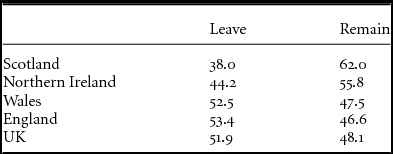
One of the most frequently discussed details of the referendum results was the differences between Scotland, Northern Ireland, Wales and England.
The majority vote to Remain in the UK in Scotland and Northern Ireland has continued to attract attention and discussion and, while the majority vote in Wales was to leave the EU, this did not align with the views of the Welsh devolved government. This scenario raises a number of issues: why EU membership had more support in Scotland and Northern Ireland than in England and Wales; the impact of the vote to leave the EU on each jurisdiction; and how arrangements established to implement Brexit will impact on and be influenced by existing devolution settlements.
A key underpinning factor as devolution became embedded after 1999 was the significance of seeing devolution through the lens of multi-level governance, as a framework of at least three levels: devolution, the UK government and the European Union. The Scottish Parliament and Government has been described as operating within a wider system of multi-level governance (Keating, Reference Keating2010; Cairney, Reference Cairney2011) along with UK and EU and local institutions. Birrell and Gormley-Heenan (Reference Birrell and Gormley-Heenan2015) describe the governance of Northern Ireland as a well developed example of multi-level governance with the EU highly relevant. The framework of multi-level governance has also been applied to Wales (Cole and Stafford, Reference Cole and Stafford2015) and is described by Entwistle et al. (Reference Entwistle, Downe, Guarneros-Meza and Martin2014) as co-governance by four levels of government, including local government.
A key principle of multi-level governance is the division of powers between levels of government. In the devolved context the allocation of social policy functions is significant. The particular salience of this is threefold: the allocation of social policy responsibilities between the UK and the EU; between the UK and the devolved administrations; and the linkages between the EU and the devolved administrations. While it is accepted that the influence of the EU in social policy extended in the 1980s and 90s (Hantrais, Reference Hantrais2007), Daly (Reference Daly2007: 2) has described EU focus on social policy as ‘fitful’ with ‘periods of intense activity followed by times when social policy is hardly spoken of’. The broad perspective is that the EU has limited competence over social policy with member states having maintained direct control over the main areas of social policy, including health and social protection (Naumann and Brodie, Reference Naumann and Brodie2016). The spectrum of regulation and directives in terms of social policy supports the view that EU social policy intervention is largely regulatory and closely linked to economic and employment-related issues (Clasen, Reference Clasen, Baldock, Mitton, Manning and Vickerstaff2012).
The EU/UK relationship, and within the UK the view that the Westminster government has jurisdiction over EU affairs, has to be set against a consequence of the devolution settlement – that most social policy powers are devolved matters. Key areas of interest are therefore what impact EU membership has had on social policy in the devolved administrations and how they developed their engagement and relationships with the EU. Such analysis provides the context for explaining the post-referendum responses of the devolved administrations and their interpretations of the implications of Brexit. Their views have, in part, been moulded by fears of the effects of Brexit on social policy and the insufficient notice taken by the Westminster government of the concerns of the devolved administrations.
The devolved governments and EU decision making
A fundamental constitutional principle is that EU matters are not devolved and therefore the sole responsibility of the UK government. However, the UK government recognised that many of the areas for which the EU had responsibility did impact on devolved policies (Jeffrey and Palmer, Reference Jeffrey, Palmer and Trench2007) and arrangements were established to accommodate the devolved administrations in EU affairs. They were given an official role in co-operation with the UK government on EU matters through an overarching concordat applying broadly uniform arrangements for each devolved administration (Whitman, Reference Whitman2017). This contained a commitment to the involvement of the devolved administrations in discussions about the formulation of UK policy on all EU issues touching on devolved matters. This inter-governmental co-operation became more institutionalised through a sub-committee of the Joint Ministerial Council (JMC), consisting of UK and devolved ministers deliberating ahead of each scheduled European Council meeting. Involvement in EU decisions included devolved ministers attending EU council meetings with the agreement of the lead UK departmental minister. This practice normally involved agriculture and fisheries but also the environment, energy, education and justice.
The devolved administrations also developed contacts with EU decision makers outside of the formal UK/EU structures through meetings with EU commissioners, committees and officials (Bulmer et al., Reference Bulmer, Burch, Hogwood and Scott2006). Plans were published for furthering Scottish (Smith, Reference Smith2010) and Welsh engagement with the EU (Welsh Assembly Government, 2009). Advised by the then President of the European Commission, Mr Barroso, the Northern Ireland government produced an action plan on increasing EU involvement (Northern Ireland Executive, 2009). Scotland, Northern Ireland and Wales all set up offices in Brussels as part of the UK Permanent Representation, more akin, as Cole and Stafford (Reference Cole and Stafford2015) note, to a diplomatic mission than a standard regional office. These facilitated the countries pursuing their interests and liaising with the offices of other European regions. While they were members of the Committee of the Regions they were also able to join the strongest regions in the Committee with legislative powers. Scotland used EU membership to forge co-operation arrangements with the regions of Catalonia, Tuscany, Bavaria and Flanders, and with some countries, for example, Estonia. Wales was linked on an equal basis with regions including Catalonia, Sicily, and the state of Latvia. The EU arena could be described as providing a new structure of opportunities for the devolved administrations. The relationship the devolved governments developed with the EU can also be seen in their membership of EU networks. Some are formal, such as the Confederation of Regions with Legislative Assemblies; others are based on an interest, such as the Network of Regional Governments for Sustainable Development, the Confederation of Peripheral and Maritime Regions and the European Regions for Research and Innovation.
Despite these arrangements, and the overlap in responsibility between the EU, UK and devolved governments in a number of policy areas such as agriculture and the environment (Whitman, Reference Whitman2017), it has become clear that the devolved administrations will have limited input into or control over the Brexit negotiations. Comments made by the UK Prime Minister, Theresa May, following the supreme court ruling in January 2017 (The Supreme Court, 2017) that the UK government was not legally compelled to consult the devolved administrations before invoking Article 50, point to a more legalistic approach by the Prime Minister. This positions the UK government as the negotiating party with little scope for the devolved governments to negotiate any separate arrangements with the EU (The Independent, 2017; Hansard, 2017; House of Commons, 2017).
Impact of the EU on social policy in the devolved administrations
EU funding
EU funding has influenced devolved social policies in a number of respects which can be described as follows: the impact of EU funding programmes in the devolved administrations; regulations and directives covering employment, movement of labour, higher education and equal rights; and, in Northern Ireland, the impact of the EU on peace building and cross-border movement and co-operation between Northern Ireland and the Republic of Ireland.
There has been a particularly significant impact on regional and rural policy with governments having considerable control over the design and distribution of the funding. Setting aside agriculture and the EU Common Agricultural Policy, the most significant support comes through the European Structural and Investment Funds (structural funds). These are focused on the development of the EU's poorest regions. Two of the funds have had a particular influence on social policy: the European Regional Development Fund (ERDF) and the European Social Fund (ESF) and these have been primarily targeted investment in infrastructure, education and training. Table 2 shows the combined allocation of ERDF and ESF funding for the period 2014–20.
The devolved administrations have had responsibility for distributing this funding to projects. In the case of the European Social Fund, Scotland and Wales adopted similar cross-cutting themes of equal opportunity, sustainable employment, and tackling poverty and social exclusion. Scotland has been able to pursue a strategy of priorities for reducing poverty, boosting education attainment and skills, growing employment, and climate change and energy saving. In the period 2007–13, structural funds were seen as significant in improving employment for those furthest from the labour market. Wales has the highest allocation of structural funds in absolute terms which have been strongly targeted on training and skills to address poverty resulting from unemployment, economic inactivity and youth unemployment but have also been used to improve public administration and partnership working through local service boards (Miller Research UK, 2017). Structural funds, together with European Investment Bank support, have made a major contribution to new higher education infrastructure in Scotland and Wales, including the building of Swansea University and Swansea Bay Science Park (LSE European Institute, 2016; Macpherson, Reference Macpherson2016).
In Northern Ireland, Structural Fund allocation has also had a strong economic focus. The ERDF has been used to promote investment in research and development and small and medium enterprises (SMEs) and the ESF to tackle economic inactivity focusing on people with no/low qualifications. The ERDF funding is also linked to some special programmes relating to Northern Ireland and Scotland. Interreg, an established programme to assist border regions in the EU and promote cross-border co-operation, is now part of the European Territorial Cooperation programme. Under Intereg VA programme, the border counties of the Republic of Ireland and the west of Scotland have been identified as eligible areas. The programme has funding of €240 million and the four priority topics are: research, the environment, transport, and health and social care. Projects in health and social care have included cross-border co-operation in services, support for voluntary and community bodies and assistance for providers. Another initiative is the EU Ireland-Wales programme designed to deliver social, economic and environmental benefits to maritime areas. One major project under this programme to date is funding £9 million to expand the life sciences sector across five universities.
A unique EU funding programme impacting on Northern Ireland is the Special Fund for Peace and Reconciliation. Existing since 1995 it is a direct result of a decision by the EU to make a positive contribution to support the peace process in Northern Ireland. It has been a cross-border programme covering the whole of Northern Ireland and the six border counties of the Republic of Ireland. Funding is mainly from ERDF and has been substantial over the four versions of the programme. The overall objective is to promote socio-economic stability and cohesion between communities, and projects mainly cover: shared education, children and young people, disadvantaged groups, victims of the conflict, and improving community relations. The current programme, Peace 4, is targeted at children and young people. The three previous Peace programmes between 1995 and 2013 contributed €1.3 billion and Peace 4 has a value of €270 million. The programmes are administered by a cross-border implementation body, the Special EU Programmes Body. These cross-border funds have also been important to the voluntary sectors with multi-sectoral partnerships encouraged (McCall and Williamson, Reference McCall and Williamson2000) and have supported substantial employment in the sector. The Northern Ireland Council for Voluntary Action (NICVA) has estimated that, from 2007–13, the overall level of EU funding allocation to the voluntary and community sector in Northern Ireland has been £74.4m (NICVA, 2015).
The UK is one of the largest beneficiaries of EU research funding from the Structural Investment Funds and Horizon 2020. The latter is the biggest EU research and innovation programme with a threefold focus on science; industrial leadership; and health, demographic change and well-being. Scotland has been particularly successfully in securing Horizon 2020 funding with institutions awarded €296 million since 2014, representing 11.4 per cent of the UK funding awards and 9.4 per cent of Scottish universities total research income for 2014–15 (Scottish Affairs Committee, 2016: 6). A study of Horizon 2020 by the Scottish European and External Relations Committee regarded it as one of the most significant opportunities for Scottish institutions (Scottish Parliament, 2012). Horizon 2020 funding has also been an important source of funding for higher education institutions in Wales and Northern Ireland. Wales has obtained funding in the region of £45 million for 95 projects with over half going to Welsh higher education institutions. Horizon 2020 also encourages transnational partnerships and this has been significant in Northern Ireland with a number of north-south collaborative projects and the projects have had a focus on collaboration in health and more generally on support for SMEs.
Directives and regulations
The laws establishing the Scottish Parliament and Assemblies in Wales and Northern Ireland include a requirement to comply with EU law and responsibility for implementing EU obligations where they relate to devolved matters. As Gordon and Moffett (Reference Gordon and Moffett2016) detail, The Scotland Act 1998 stipulates that Acts of the Scottish Parliament that are incompatible with EU law are outside the legislative competence of the Scottish Parliament. The Government of Wales Act 2006 provides that any Act of the Welsh Assembly that is incompatible with EU law, falls outside its competence and Section 24 of the Northern Ireland Act 1998 prohibits any legislation that is contrary to EU law.
Across the three categories of EU law: EU regulations and parts of EU treaties which are directly applied without the need for national law; EU directives implemented through Acts of Parliament; and UK regulations made to implement directives, there are potential issues for the devolved governments arising from decisions about the status of EU directives and regulations post Brexit. Areas covered by EU directives and regulations include many areas of devolved responsibility covering social policy, economics, social cohesion, consumer protection, safety and public health. Among the most significant directives for social policy have been those relating to the working time directive, agency workers’ rights and maternity rights incorporated into the GB Equality Act 2010 (Georghiou and Evans, Reference Georghiou and Evans2016). Freedom of movement regulations have brought many workers from member states into public services in all parts of the UK. In Wales it is estimated that, of 69,000 workers who have moved from EU states, one-third work in the public services (Zolle, Reference Zolle2016). There has been considerable influence also in the area of health regulations including procedures for medical and clinical trials and drugs used in the EU, reciprocal access to health care, recognition of professional qualifications, funding of medical research and cross-border projects; the latter is particularly important in Ireland (Thompson, Reference Thompson2016).
Post-referendum response and negotiations
Following the referendum much attention fell on the majority votes in Scotland and Northern Ireland for Remain and the complex political and constitutional issues created by the UK majority vote to leave the EU. Each of the devolved governments is run by a party or parties different to the party in power in Westminster. All three take a different approach to future UK/EU relationships than that being adopted by Westminster. In Wales, while there was a majority vote for Leave, the First Minister stressed that Wales must be able to play a full role in negotiations to leave the EU to ensure the interests of the Welsh people were protected, that the UK should retain access to the single market and that acceptance of a final deal should be subject to the support of the four parliaments (Welsh Government, 2016).
The referendum results led to the devolved governments declaring different positions on the negotiations, in part explained by their prior attitudes to and involvement with the EU and their economies. The view of the Scottish government was that, if Scotland was taken out of the EU against its will, it would be acceptable to hold another independence referendum (Cram, Reference Cram2016). Five Brexit tests were proposed for preserving Scotland's interests: democracy; economic prosperity; social protection; solidarity and influence (Scottish Government, 2016a). Maintaining access to the single market and freedom of movement were identified as red lines. A bill to have a second independence referendum was published for consultation and a panel to give expert advice was established. The position of the Northern Ireland Executive was more complex with the two parties who shared power, the DUP and Sinn Fein, adopting different positions on the referendum. Northern Ireland is also unique as the only part of the UK which, after Brexit, would have a land border with an EU member state. There was consensus within Northern Ireland that there should be no impediment to the cross-border movement of people, goods and services and that all parties should work to secure the best deal for Northern Ireland following Brexit (Northern Ireland Executive Office, 2016).
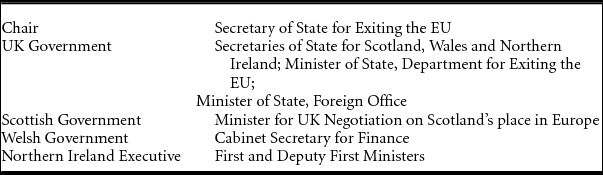
The devolved governments expressed the desire to be fully involved in discussions and negotiations in recognition of the impact of leaving the EU on the devolved administrations. The Prime Minister made early visits to the devolved countries and even referred to a UK approach and objectives but, a short time later, Philip Hammond, Chancellor of the Exchequer, stated there would be no special deal for Scotland and Theresa May made it clear that the actual negotiations would be a matter for her government alone. After a meeting between the Prime Minister and her devolved counterparts in October 2016, the Scottish and Welsh First Ministers expressed frustration at the apparent ambivalence of the Prime Minister towards the devolved administrations. While some action has been taken to provide a basis for consultation with the JMC Europe sub-committee to meet more regularly the value of this has been questioned with claims that, as an institutional arrangement, the JMC is not suited to developing a joint position on the EU (Whitman, Reference Whitman2017; House of Commons, 2017). The UK government controls the JMC agenda and has no obligation to explain or publically account for decisions (Paun and Miller, Reference Paun and Miller2016: 9). The first JMC (EU negotiations) was held in November 2016 with agreement to meet monthly and develop a work programme. The attendance (see Table 1) represents mainly junior UK ministers, the Secretaries of State and devolved ministers. To date, meetings have considered the initial priorities of the devolved governments and the subjects of market access, justice and security, immigration and trade (Department for Exiting the EU, 2016).
EU Referendum Results
Combined Allocation of ERDF and ESF Funding for 2014–20 (€ million)

Source: (Hunt et al., Reference Hunt, Lavery, Vittery and Berry2016)
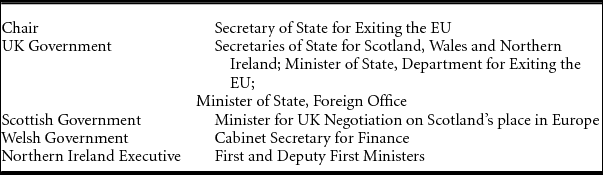
There was also surprise and criticism that the Cabinet sub-committee, overseeing the Brexit negotiations and the formation of a new relationship between the UK and the EU, does not have the three Secretaries of State for Scotland, Wales and Northern Ireland as formal members. As noted earlier, while constitutionally the relationship with the EU is a reserved matter, attention has also been drawn to the extent that EU law is embedded in devolved law. The assertion of the UK government of its right to make decisions for the UK with regard to Brexit also has to be set against the reality that the devolution settlement has created powerful legislative bodies with legitimacy bestowed through public referendums (Paun and Miller, Reference Paun and Miller2016: 9). The devolved settlement in Northern Ireland is also underpinned by an international agreement strongly supported by the EU and the USA.
Concerns of the devolved administrations
Concerns and fears have tended to be dominated by the possible economic consequences and uncertainties. For governments in Wales and Scotland, maintaining access to the Single Market has been a priority (Welsh Government, 2017; Scottish Government, 2016) and all three devolved administrations have expressed concern about restrictions on freedom of movement and the potential loss of migrant workers. As discussed earlier, all have made significant efforts to develop formal and informal networks across the EU and it is also evident they fear losing their place in Europe.
The Scottish government has been the most critical of the whole Brexit enterprise. It sees the UK government's approach as posing unacceptable risks to Scotland's democratic, economic and social interests and the rights of the Scottish Parliament. McGarvey and Stewart (Reference McGarvey, Stewart and Guderjan2016) base Scotland's concerns on a rejection of British insularity, a view of Scotland as an open and equal society with European involvement, a large welfare state and self-government. EU membership has been seen as contributing to Scotland's prosperity and to the rights of those living in Scotland (Scottish Parliament, 2016a). Scotland has also welcomed European immigration as necessary to develop the economic response to labour shortages and population decline. About 180,000 now UK-EU residents are living in Scotland, accounting for 20 per cent of the workforce in education, health and public administration. The Scottish Programme for Government (Scottish Government, 2016b) makes building Scotland's place in the world including Europe a major priority. This vision is accompanied by more practical concerns over aspects of social policies. There are fears over the loss of structural funds after 2020, and an adverse effect on the retention of employment, training, skills and living standards, the impact on the voluntary sector and further education, and on rural development, urban regeneration and transport. Concerns also relate to possible loss of social protection for employees, vulnerable groups and women and the threat to well established networks between civil society organisations in Scotland and organisations throughout the EU (Scottish Parliament, 2016a:17). The view that the EU has been good for Scotland has also been articulated by local government, with reference to the quantity and length of funding programmes and contacts throughout Europe (COSLA, 2016). On 28 March 2017, the Scottish Government won support in parliament for a second referendum on Scottish Independence but the UK government has indicated that it will not allow a vote before the conclusion of the Brexit negotiations.
The Welsh government has been in a more difficult position in that there was a Leave outcome to the referendum. It has emphasised pursuing the social and economic interests of the Welsh people, expressing a vision of a strong business environment while also delivering strong public services (Jones, Reference Jones2016). Given that Wales is a net beneficiary of EU funding there is much concern at the likely impact on public services (Zolle, Reference Zolle2016: 5). The Welsh Assembly has produced a lengthy list of concerns including health and other social policy issues. Attention has been drawn to dependency on staffing from the EU, coordination of health care coverage, combatting epidemics, recognition of professional qualifications, medical research co-operation and funding, and cross-border health. The Welsh Local Government Association, describing the change as seismic, has also expressed fears over protection for structural funds, workforce rights, anti-pollution measures and the role of the many networks and programmes for territorial co-operation. These cover local council networks, and topics such as urban regeneration, European cities, maritime and rural areas. Fears over agriculture and rural development, the environment, energy, and connectivity have also been detailed with their impact on public health and well-being (National Assembly for Wales, 2016). Brexit has also raised major fears that the third sector in Wales will be under severe strain and be a financial loser post-Brexit (Fiander and Williams, Reference Fiander and Williams2016). Concern at the future absence of the European Investment Bank has also been expressed, given its direct investment of £2 billion in Wales including support for university buildings.
There has been more limited expression of concern by the Northern Ireland Executive because of deep political cleavages between the two main parties. This has been exacerbated by the collapse of the political institutions in January 2017. Consensus between the two main parties in Northern Ireland has been largely limited to a joint letter to the Prime Minister stressing areas of concern for Northern Ireland focusing on the need to avoid a hard border, labour mobility, energy, and agri-food trade. Much of the other concerns expressed in Northern Ireland have related to the fears of the large voluntary sector which is dependent on structural funds and also EU peace funds.
EU membership gave Ireland and the UK a forum for co-operation across a wide range of policy areas and provided incentives not to disturb the Anglo Irish relationship or change the context for dealing with the border in uncertain ways. In practice, the main political concern is that the Irish border could become the main border point between the UK and the EU. There are two dimensions to the issue. Firstly, the movement of people across the border, relating to the Common Travel Area (CTA) and the introduction of the EU single market between Ireland, Northern Ireland and Britain and the largely open border policy. The CTA has existed since 1922 and is an arrangement between the UK and Ireland whereby legal provision exists in both jurisdictions to allow people living in either country free movement across the islands and access to employment, services and benefits (de Mars et al., Reference de Mars, Murray, O'Donoghue and Warwick2017). The introduction of the Single European Market eradicated the need for customs controls between the north and south of Ireland. The UK government's stated intention to leave the European customs union as well as the EU single market raises issues about the imposition of customs controls and the introduction of a hard border. An economic analysis has suggested that the customs union is more important for Northern Ireland as it will become a more immediate and visible barrier to trade on the island of Ireland in the event of a hard Brexit (Nevin Economic Research Institute, 2016). Secondly, the fear that some of the key arrangements in the peace process implementation would be compromised (Irish Government, 2017; McAleese, Reference McAleese2017; Tonge, Reference Tonge2016). In particular there is concern about cross-border bodies which provide services to an EU area and a non-EU area, and the perception of the EU as providing overarching support to maintain political stability. Summed up, the fear is really that Northern Ireland cannot afford to see a change in current arrangements regarding the free movement of goods, services, capital or people (Phinnemore, Reference Phinnemore2016).
Post-Brexit: predicting changes, impact and future scenarios
A great deal of uncertainty remains regarding who will have policy making authority following the Great Repeal Bill. The White Paper on legislating for exiting the EU (Department for Exiting the EU, 2017), while stating that ‘the expectation of the Government that the outcome of this process will be a significant increase in the decision making power of each devolved administration’ (para 4.5) provides no detail on this. At the same time, there is also the suggestion that some of the EU powers for devolved policy areas could be returned to the UK government so that Westminster can create a ‘UK policy framework’. Governments in Scotland and Wales are clear that they expect EU competences in the devolved policy areas would lie with the devolved administrations. The assumption by the UK government that some of these powers would be centralised can be seen as highly problematic (McEwan, Reference McEwan2017; Drakeford, Reference Drakeford2017).
There will be some change in the scale and nature of administrative functions, with the removal of the EU involvement in, for example, agriculture and rural development. There will be a whole range of transitions in delivering services relating to university research funding, social funds, and the environment. As outlined earlier, Northern Ireland, Scotland and Wales are more dependent on funding for agriculture, regional and rural development than England. However, there is no guarantee that the UK government will continue with similar area-based policies. While there is strong support for these in the devolved countries, as Bell (Reference Bell2017) outlines, there has been criticism of the effectiveness and cost efficiency of these EU funding mechanisms. If the decision is made to continue with this funding post-Brexit, there would still be issues relating to the priority attached to each area of spending and how funding would be allocated to the devolved administrations. It is highly possible that an outcome of Brexit will be changes to the Barnett Formula. This process determines the overall financial resources for devolved expenditure, and expenditure on health, social care, education, children's services, housing and planning dominates the existing patterns. Allocation of funds by the UK government for areas previously covered by EU funding could be allocated to the devolved administrations through the Barnett Formula. This is likely to be an attractive option for the UK government in terms of seeming the simplest administrative solution but it would present a number of challenges. If, for example, Treasury expenditure on agricultural subsidies in England were to be reduced, this would automatically reduce the Barnett allocation. In addition, the Barnett Formula is not related to need, bringing the risk that funding would not be used for higher priority needs (Bell, Reference Bell2017; Drakeford, Reference Drakeford2017). Bell (Reference Bell2017) has conducted an analysis of possible outcomes for dealing with EU area-based policies‚ i.e. EU agricultural, regional and rural policies.
He suggests that if the UK government decided to maintain this policy approach there are three possible options. Firstly, use of the Barnett Formula which, while reasonably transparent, would be linked to the UK's fiscal position. This would give devolved governments policy autonomy and could lead to reduced funding in other areas. Secondly, the assignation of equivalent revenues to the devolved administrations using agreed criteria giving them greater freedom to determine expenditure but with increased use of disputes. Thirdly, agreeing a level of support and devolving autonomy for raising a proportion of the revenue through additional tax, which does carry a risk regarding the amount of revenue which could be raised.
Obviously there are many unknowns about possible changes: whether there will be extra funding for public services across the UK; whether there will be compensatory funding for the loss of EU structural funds after 2020; whether special arrangements will be made to continue support for universities through Horizon 2020 and Erasmus; whether the same level of social protection for part-time workers, and other social rights, will be maintained; and whether a flexible work permit system may be introduced. The task of assessing and dealing with EU legislation on the UK statute book will involve the devolved countries in what has been described as a gargantuan exercise. It is estimated in Scotland alone that there are 3,500 items of legislation, regulation, directives and decisions (Scottish Parliament, 2016b:13).
The legislation setting up devolution will be amended, removing the specification that the devolved legislations have to be compatible with EU law. Extension to devolved powers or the transfer of new powers would mean that policy competence would be extended (Scottish Parliament, 2016b:3). This may give the devolved administrations power to decide whether to retain domestic legislation which implements EU directives. Matters of employment protection and regulations could be devolved to Scotland and Wales (these powers are already devolved to Northern Ireland). A House of Lords committee has recommended that aspects of immigration control and work permits might be devolved to reflect needs in Northern Ireland, arguments which apply to Scotland and Wales, and in the context of the Irish border (House of Lords, 2016). The Scottish government has suggested that, in relation to repatriation from the EU, powers relating to immigration, employment law, equality, and health and safety at work – as well as other powers over making international agreements, financial services, professional regulation and social protections – could be devolved (Scottish Government, 2016, para. 185). Brexit may actually lead to the removal of some blockages to decision making by the devolved administrations such as the restrictions on Scotland imposing minimum alcohol pricing under competition laws, and to Scotland's private finance programme which has been called into doubt by stricter EU rules on public spending.
Post Brexit relationships between Northern Ireland, Ireland, the UK and the EU
Due to the differences in views between the two main political parties in Northern Ireland on Brexit and the collapse of the Executive, in comparison to Scotland and Wales the Northern Ireland Executive has published little on the Brexit process and post-Brexit scenarios. Sinn Fein is continuing to argue for special status for Northern Ireland during and after the Brexit negotiations. It has also called for a referendum on Irish unity although there is no support for this from the UK or Irish Government. The DUP, as a pro-Brexit party, continues to stress the UK-wide referendum result and the potential benefits to Northern Ireland from Brexit.
Significant attention has been focused on the border, including by the European Council. The threat to the existence of a seamless border, far removed from the long customs queues and military checkpoints of the past has been a key concern (House of Commons, 2017, para 89 and 112). Over thirty-thousand people cross the border on a daily basis for work and there are multiple cross-border enterprises and projects. However, post-Brexit the border between Northern Ireland and the Republic of Ireland will become an international border between the EU and the UK. The UK government, Irish government, Northern Ireland political parties and the European Council have spoken of the need to avoid a hard border. That this issue features prominently in the guidelines for negotiations published by the European Council following the UK's notification to trigger Article 50 (European Council, 2017), and that it is one of three issues the EU requires resolution on before proceeding to full negotiations, is testament to the importance attached to it.
Brexit obviously has very significant implications for the Republic of Ireland, particularly with regard to trade and the maintenance of peace and stability on the island. The Irish government has referred to its work on Brexit as the ‘largest undertakings of the Irish Government over the last fifty years’ (Irish Government, 2017: 4). The Irish economy is heavily reliant on the UK as a trading partner with 17 per cent (€39bn) of all exports going to the UK and 14 per cent (€30bn) of all imports sourced from the UK (Irish Government, 2017). The maintenance of a soft border and the 1998 Good Friday Agreement, as well as institutions and the body of human rights protections contained within the agreement, are seen as inviolable. The Irish Foreign Minister has warned that ‘This is regardless of whether or not the UK remains within the European convention on human rights or not [post-Brexit]. It is important to remember that the Good Friday agreement is an international treaty, registered with the UN. I hope that all sides understand that this means its provisions – all of them – are inviolable.’ (Flanagan, Reference Flanagan2017).
Conclusions
The arrangements to date for the engagement of the devolved administrations in the Brexit process have been regarded as unsatisfactory by the devolved administrations and by Westminster committees (House of Lords, 2016; The House of Commons, 2017). It is recognised that the competences of the devolved countries will be affected by Brexit but reaching a firm conclusion on the impact of Brexit on the devolved administrations is complex and uncertain. The positions and concerns of the devolved administrations do not receive much sympathy and are not well understood within the UK cabinet or in Whitehall. The analysis in this article would suggest main considerations which relate to the devolved governments and the operation of devolution, all of which have implications for aspects of social policy. The considerations are: the loss of EU programmes and regulations relating to entitlements and equality; the impact on the economy; financial implications for the devolved administrations; the potential impact of changes to devolved powers; and specific issues relating to Northern Ireland, including the land border with the Republic of Ireland.
The loss of direct funding under the structural funds has been identified as a major difficulty for aspects of social policy in Scotland, Wales and Northern Ireland. There is some consensus that the UK government should replace some of the loss of funding after Brexit ends current arrangements. The wider impact of economic developments following Brexit is of much concern, especially the potential consequences for wages, employment, standards of living and particular important economic activities such as the agri-food industries and the associated well-being of rural communities. An issue for the devolved governments is the impact of Brexit on the operation of the Barnett Formula and the allocations from the UK Treasury. The issue of repatriation of EU powers and responsibilities has not received a great deal of detailed attention, including in the UK government's White Paper on exiting the EU, but is a matter of considerable importance to the devolved administrations. Repatriation should lead to an enhancement of devolved powers in areas already constitutionally devolved, particularly in the areas of agriculture, rural development and fisheries. The Scottish government has proposed some other matters would be better devolved to suit Scotland's needs, such as employment rights and protections. The whole area of employment is already devolved to Northern Ireland. A case can be made for other areas of social protection, relating to equality and aspects of social security, to be devolved in the context of repatriation of powers.
The political dynamic of Brexit does differ between the three countries. The Scottish government has led the way in pressing for a form of differentiated solution and is demanding a solution that will allow Scotland to remain part of the single market and the European Economic Area. The SNP continues to be committed to exploring the arrangements for a second independence referendum as a response to Brexit, to be held following the outcome of the Brexit negotiations. The Welsh government has also declared a desire to have continuing access to the single market. Also attracting support has been the idea of a separate immigration policy or policy covering visas and work permits for the devolved countries. If there is reluctance to establish special arrangements for Scotland and Wales, it may be that Northern Ireland is in a stronger position to obtain a bespoke Brexit given: features of the Common Travel Area between Ireland and the UK; the fact that people in Northern Ireland are entitled to become Citizens of the EU simply by applying for an Irish passport; the need to maintain a common trade area; the existence of cross-border implementation bodies delivering services across what will be an EU/non-EU border; and the possible threat of undermining the Good Friday Agreement. A hard Brexit may mean that the devolved administrations are likely to adopt a similar approach to that developed when confronted with welfare reform, using devolved powers in relation to social policy to, as far as possible, mitigate the most damaging effects of Brexit.