


Introduction
Effective mentorship plays a critical role in the long-term persistence and academic success of trainees in research career pathways, having a significant impact on mentees’ research productivity, academic and research self-efficacy, and career satisfaction [Reference Gutierrez, Guerrero, McCreath and Wallace1–Reference Felder, Braun and Wigfall7]. However, trainees from historically and systemically excluded groups are less likely than others to be in effective mentoring relationships [Reference Shen, Tzioumis and Andersen2,Reference Estrada, Hernandez and Schultz4,Reference Felder, Braun and Wigfall7–Reference Smith, Gilmer, Tansel and Miller12]. This knowledge has contributed to a burgeoning national focus on mentorship over the past decade and resulted in funding agencies requiring mentorship plans – and in some cases mentorship education (mentor and mentee training) – to improve the effectiveness of these relationships [13–15].
This article reports on the impact and national usage of one innovative approach to training research mentors: the asynchronous, self-paced, online module, Optimizing the Practice of Mentoring (OPM). OPM was developed over a decade ago at the University of Minnesota and is currently maintained with support from its Clinical and Translational Science Institute (CTSI) [16]. The first version of the module was targeted to mentors of graduate students, postdoctoral fellows, and junior faculty who are engaged in biomedical research. Subsequently, a version adapted for mentors of undergraduate students was created.
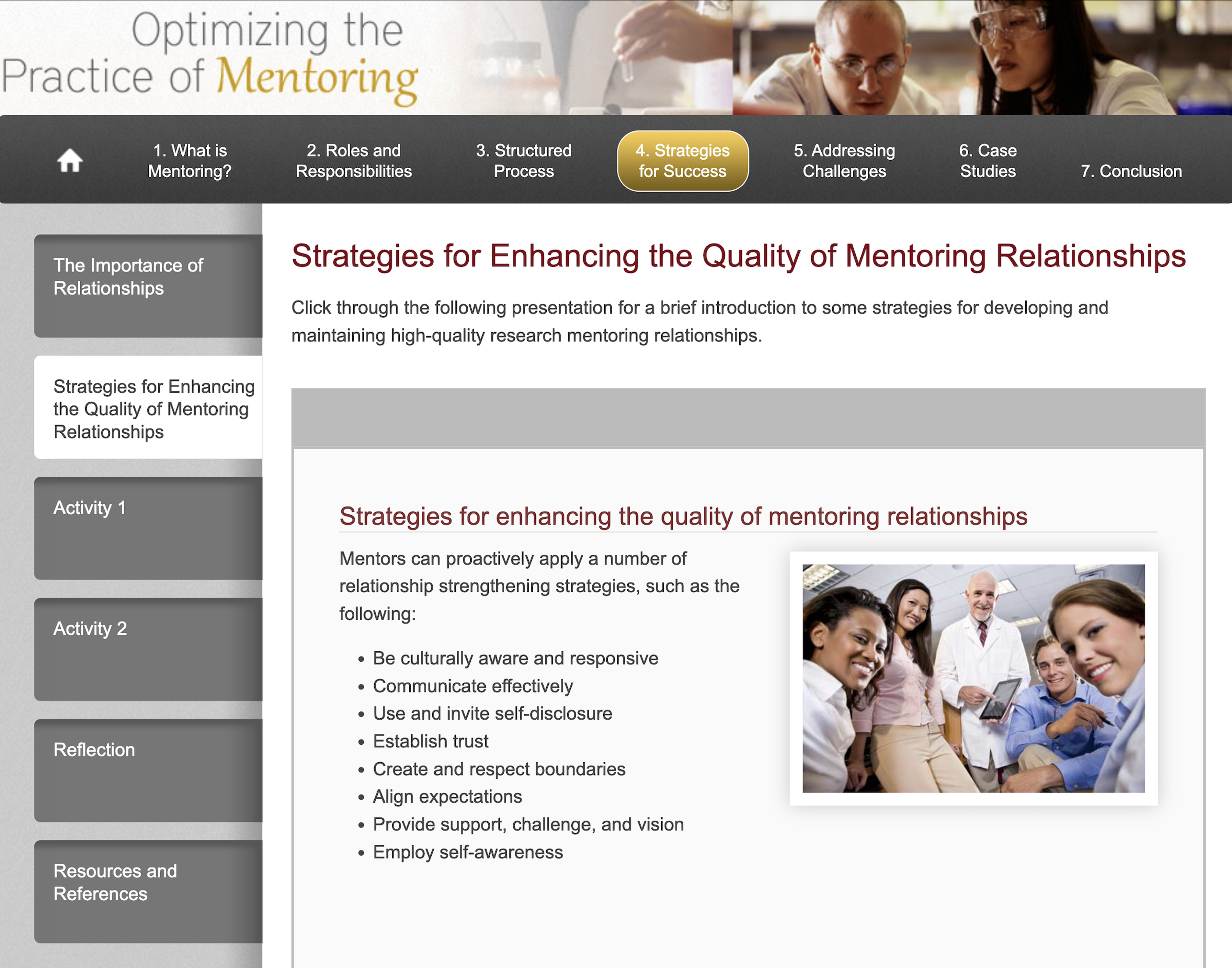
OPM content provides users with a foundational introduction to research mentorship. The module begins by describing the empirically demonstrated value of mentorship and the diverse ways it can be implemented (such as dyadic, group, and peer mentoring models). Section 2 of the module provides an example-laden overview of research mentors’ roles and responsibilities within the career and psychosocial domains of mentorship. In Section 3, users are provided with tips and tools to proactively attend to the four developmental phases of a mentoring relationship (preparation, negotiation, cultivation, and closure). Section 4 introduces some key strategies for developing and maintaining successful mentoring relationships, such as establishing trust, aligning expectations, offering mentees a combination of support and growth-focused challenges, and engaging in routine self-reflection. These strategies are reinforced in Sections 5 and 6 through case studies that highlight specific mentorship challenges. Users are prompted to reflect on these challenges and consider approaches for preventing and addressing them. OPM engages users through text, audio, mini-presentations, case studies, and brief interactive activities. Users also have access to a tool kit of resources and the option to create and email to themselves a mentoring action plan. A screenshot illustrating the overall organization of OPM content is provided in Figure 1.
Screenshot from the Optimizing the Practice of Mentoring online training module. Module content is divided into the seven major sections shown in the top horizontal bar. Users navigate to specific content within a section by clicking on the labeled tabs on the left side of the screen.
In 2019, OPM was updated with financial support from the National Institutes of Health’s National Research Mentoring Network (NRMN). This work was completed in partnership with investigators at the University of Wisconsin–Madison and other national collaborators affiliated with NRMN’s Mentor Training Core. Much of the module’s content was refreshed, with greater attention given to building cultural awareness in mentoring. Other improvements included changes in the registration platform, more streamlined curation of resources, addition of self-reflection questions, inclusion of a research self-efficacy exercise curated from a published module [Reference Butz, Byars-Winston, Leverett, Branchaw and Pfund17], and a new embedded evaluation survey. The version of OPM adapted for mentors of undergraduate students was also created at this time.
Since its initial launch in 2012, OPM has been publicly available at no cost to users, requiring only the creation of a University of Minnesota guest email account for registrants from other institutions. However, the full extent of the module’s reach has not been documented, and published data on its impact are limited. In 2019, findings were published from a pilot randomized controlled trial of the University of Minnesota CTSI’s Mentoring Excellence Training Academy [Reference Weber-Main, Shanedling, Kaizer, Connett, Lamere and El-Fakahany18]. This professional development program consists of two components: completion of the OPM online module, followed by 5 hours of in-person facilitated workshops based on the well-studied Entering Mentoring curriculum [Reference Pfund, Branchaw and Handelsman19–Reference Rogers, Gong and Byars-Winston23]. The workshop topics covered in the Academy included the following: maintaining effective communication, aligning expectations, addressing equity and inclusion, fostering independence, and promoting professional development. The Academy’s hybrid training model reflects how we envisioned OPM would most commonly be used – as a didactic, asynchronous, introductory module that provides mentors with foundational information about mentorship (its working definition, implementation models, core functions, and stages of relationship development) and introduces some of the many research mentorship competencies that might be more deeply explored in a subsequent workshop setting. The pilot trial [Reference Weber-Main, Shanedling, Kaizer, Connett, Lamere and El-Fakahany18] of the Academy demonstrated significant mentorship skills gains at 3-month follow-up for participants who completed the full hybrid training program. But the trial also generated promising preliminary evidence that OPM has significant value when used independently – that is, as a standalone training module. Specifically, mentors who engaged with OPM’s online, interactive material reported greater knowledge gains than mentors in the control arm who received only a simple written summary of the module’s content. Additionally, for 42% of mentors in the trial’s intervention arm, OPM completion alone (before any engagement in the synchronous workshop component) was sufficient to prompt an intention to make changes to their current mentoring practices.
This article builds on these early preliminary results of OPM’s impact. Our objective was to more comprehensively evaluate outcomes for OPM when implemented as a solo, asynchronous, self-paced intervention for mentor development. For the current analysis, we examined over 3 years of evaluation data collected from a large national sample of OPM users (specifically, the updated 2019 version for mentors of graduate students, fellows, and faculty). We used a retrospective pre-post survey design to assess users’ perceived changes in skills that reflect the module’s learning objectives, as well as changes in their self-rated quality of mentoring provided, confidence in mentoring, and confidence in meeting mentees’ expectations. We report on users’ satisfaction with the module and their intent to change behavior as a result of completing the OPM training. Additionally, we document the scope of OPM’s national dissemination during its first full decade of availability and cite examples of how OPM can be integrated as a component of a more comprehensive mentor development program.
Materials and methods
Assessment of module outcomes
Participant sample
To assess OPM’s impact on learner outcomes, we analyzed data for individuals who registered for the module from February 19, 2019 (when the updated module and its new evaluation survey were first made available) through June 1, 2022 (the selected cutoff date for this analysis). During this time period, there were 2,023 unique registrants. Of these, 1,298 (64%) submitted the module’s evaluation survey. We excluded 174 individuals who indicated they were a postdoctoral fellow, graduate student, or undergraduate student, because the module was designed for mentors of these types of trainees. Although some fellows and graduate students do serve as ancillary mentors (typically for undergraduate students), we reasoned that their exclusion from this analysis would better enable us to assess the module’s effectiveness among its intended target audience. Therefore, our final analysis sample consisted of 1,124 people.
Data collection
The data analyzed for this report were collected under a University of Wisconsin–Madison IRB exempt protocol (#2017-0026). Following completion of OPM, users are asked to complete an evaluation survey in Qualtrics (online survey platform). The survey collects information on OPM users’ demographic characteristics and professional backgrounds, including their previous mentoring experience and training. Respondents are asked to indicate how much time they spent engaging with OPM (choice of half hour increments, ranging from “less than 1 hour” to “3.5 or more hours”). User satisfaction is measured by Likert-scale items asking whether respondents felt that participating in OPM was a valuable use of their time (5-point scale, 1-Strongly disagree, 2-Disagree, 3-Neither agree nor disagree, 4-Agree, and 5-Strongly agree) and how likely they were to recommend the module to others (5-point scale, 1-Very unlikely, 2-Unlikely, 3-Undecided, 4-Likely, and 5-Very likely).
Eleven survey items were developed to assess OPM users’ self-reported skill gains in content areas covered by the module (for example, “Recognizing the pros and cons of different mentoring models,” “Fulfilling the psychosocial functions of being a research mentor,” “Applying a proactive, structured approach to mentoring,” “Engaging in difficult conversations with my mentees”). For each item, users are asked to rate how skilled they feel they were before completing the training, and how skilled they feel they are now after completing the training (7-point scale, 1-Not at all skilled, 4-Moderately skilled, 7-Extremely skilled). The survey also includes three items that are routinely assessed across other mentor training programs, including those offered by the Center for the Improvement of Mentored Experiences in Research (CIMER; www.cimerproject.org). Those items are as follows: “Thinking back to before the training and now after the training: How would you rate the overall quality of your mentoring?” “How confident are you in your ability to mentor effectively?” (7-point scale for each item, 1-Very low, 4-Average, 7-Very high); “To what extent do you feel that you are meeting your mentees” expectations?” (7-point scale, 1-Not at all, 4-Moderately, and 7-Completely). Lastly, users are asked whether they made or are planning to make any changes in their mentoring relationships as a result of participating in the OPM training (yes/no). Those indicating yes are invited to describe their intended changes as an open-ended response.
Data analyses
We used paired t-tests to compare OPM users’ mean post-training scores to their mean retrospective pre-training scores for each outcome of interest: mentorship skills, quality of mentoring provided, confidence in mentoring, and confidence in meeting mentees’ expectations.
We applied an iterative coding methodology [Reference Saldaña24] to analyze free-text responses to the question asking respondents to describe changes they made or plan to make in their mentoring relationships. As a first step, an NVivo word frequency query function was used to identify the most frequently occurring words within the dataset. The query included words with the same stem (e.g., plan, planned, planning). Stem words included in the free-text response of at least 50 unique individuals were considered as possible coding categories. One word, relationship, was used by more than 50 individuals but was excluded from further analysis because it largely overlapped with another category. A few words that fell below this frequency threshold were also examined (proactive, support) because of their close alignment with the module’s content. The criterion of 50 unique respondents was used as a cut off, because it represented 1% of the weighted responses and because most terms used less frequently were overlapping with selected words or were not linked to specific behaviors (e.g., clearly, ask, improve). If an individual respondent mentioned two different stem words, that individual was counted in both stem counts.
As a second step, responses containing the identified stem word or similar words were reviewed by two authors (CP, KS) and used to develop a coding definition that reflected similarity in respondents’ meaning. We acknowledge that only including responses with the selected stems is a conservative approach to coding, but one that reduces the chance of misinterpreting responses. Using the final definitions, both authors independently read each response and employed focused coding to assign categories to each response. For example, for all responses that included the stem word plan, the authors reviewed entries for duplicates to ensure respondents were not counted more than once. The authors then reviewed entries to ensure they aligned with the coding definition and mentioned creating a written plan such as a mentoring agreement or individual development plan. The approach omitted entries that mentioned general planning (e.g., “I plan to communicate more” or “More formal plans and goals…”).
Assessment of module dissemination
In addition to our analyses of OPM evaluation data for a 3-year period, we examined the full registration dataset extending back 10 years to characterize the national dissemination of OPM as a freely available, self-paced, online, asynchronous training intervention for research mentors. We assessed how many total people accessed the module during its first decade of availability (years 2012–2022), the extent of its reach both within and external to the University of Minnesota, and users’ motivations for participating in the training. Upon registering for OPM, users complete a brief online survey that collects their name, email, job title, institution, and reason for registering. Response options for the last item are as follows: “Required by my institution, department, or program;” “My own professional development;” “Reviewing module for possible use at my institution, department, or program;” and “Other.” Registration data are not linked to those acquired from the evaluation survey. The latter survey is anonymous and does not collect any identifying information.
Results
Module impact: evaluation data
Sample characteristics
Demographic and professional background characteristics of the OPM evaluation sample (n = 1,124) are summarized in Table 1. There was a nearly even split between those who self-identified as male and female, and 69% of those who reported on race selected White. Faculty participants at all academic ranks were represented. Lab-based research was the most common category for respondents’ research focus (61%), followed by translational research (20%) and clinical research (18%). OPM users exhibited diversity in their mentorship experience, both in terms of how long they had been a mentor (range of 0 to >20 years) and whom they were mentoring. The most common category of current mentees was graduate students (PhD or Master’s, 76%), followed by postdoctoral fellows (58%), undergraduate students (56%), and junior faculty (44%). The majority (58%) reported having had no prior research mentor training.
Demographic characteristics and mentoring background of participants in OPM evaluation sample (February 19, 2019 through June 1, 2022)
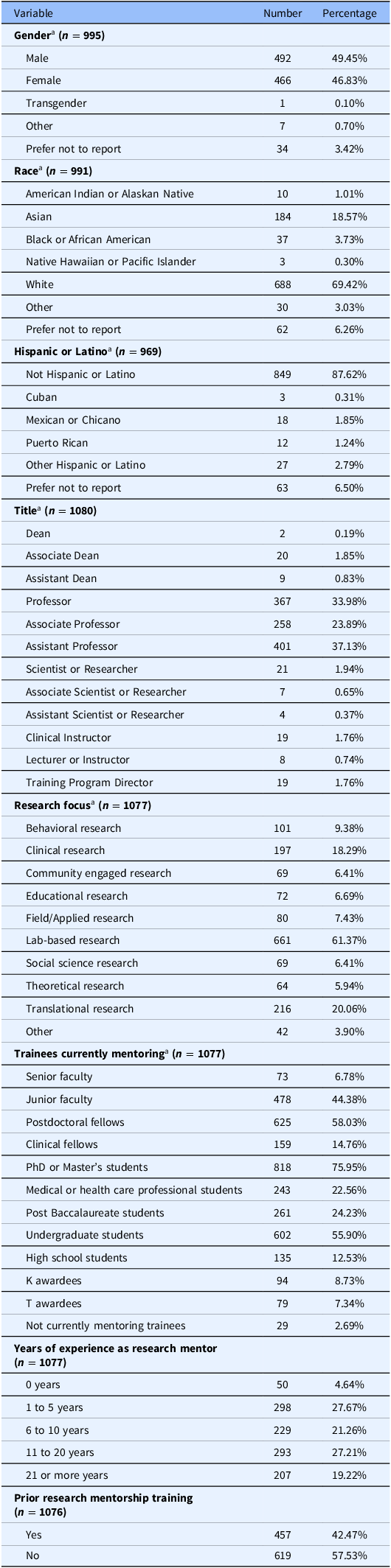
a Respondents could select more than one category.
OPM = Optimizing the Practice of Mentoring (online training module).
Engagement and training satisfaction
OPM users’ level of engagement with the module differed, but the majority (55%, 577/1049) reported spending 1.5 to 2 hours working through the content (Supplementary Figure 1). A large proportion of respondents (77%, 810/1048) agreed or strongly agreed that “Participating in this course was a valuable use of my time,” with a mean score of 3.92 (SD = 0.91) on a 5-point scale. Similarly, 69% (727/1049) of respondents indicated they were likely or very likely to recommend the course to a colleague. The mean score for this item was 3.79 (SD = 0.97) on a 5-point scale.
Self-appraised mentorship skills, confidence, and overall quality
OPM users reported significant pre-to-post gains in all 11 of the core content skill areas assessed (p < .001; Table 2). On a 7-point scale, their mean perceived skill levels before module completion (assessed retrospectively) ranged from 3.98 to 4.63, and increased to a range of 5.18 to 5.70 after module completion. Participants also reported significant improvements in their mean ratings for perceived overall quality of mentoring that they can provide, their confidence in mentoring, and the degree to which they feel they are meeting their mentees’ expectations (p < .001; Table 2).
Self-reported gains in mentoring skills, quality, and confidence, and in perceived effectiveness at meeting mentee expectations, after completion of OPM training
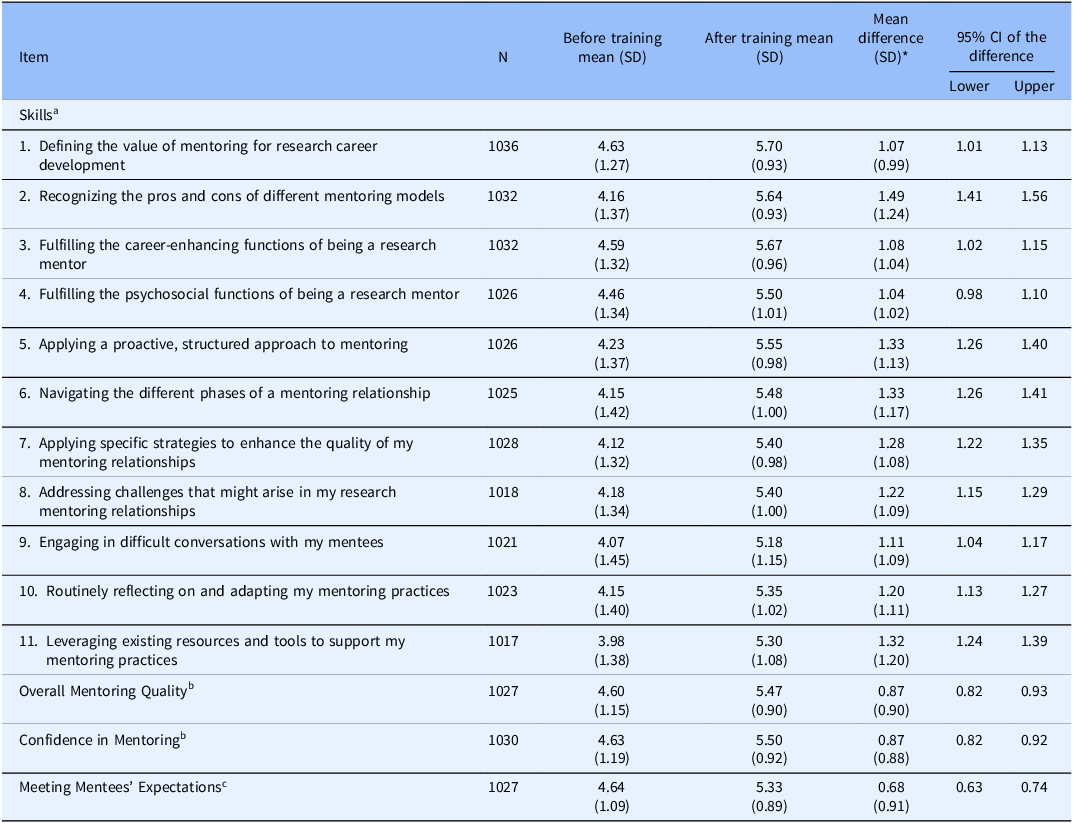
* p < 0.001 for the difference in mean scores between pre and post training for all items using paired t-tests.
a Retrospective pre-post (1–7 scale: 1 = not at all skilled, 4 = moderately skilled, 7 = extremely skilled).
b Retrospective pre-post (1–7 scale: 1 = very low, 4 = average, 7 = very high).
c Retrospective pre-post (1–7 scale: 1 = not at all, 4 = moderately, 7 = completely).
OPM = Optimizing the Practice of Mentoring (online training module).
Intention to change mentoring behaviors
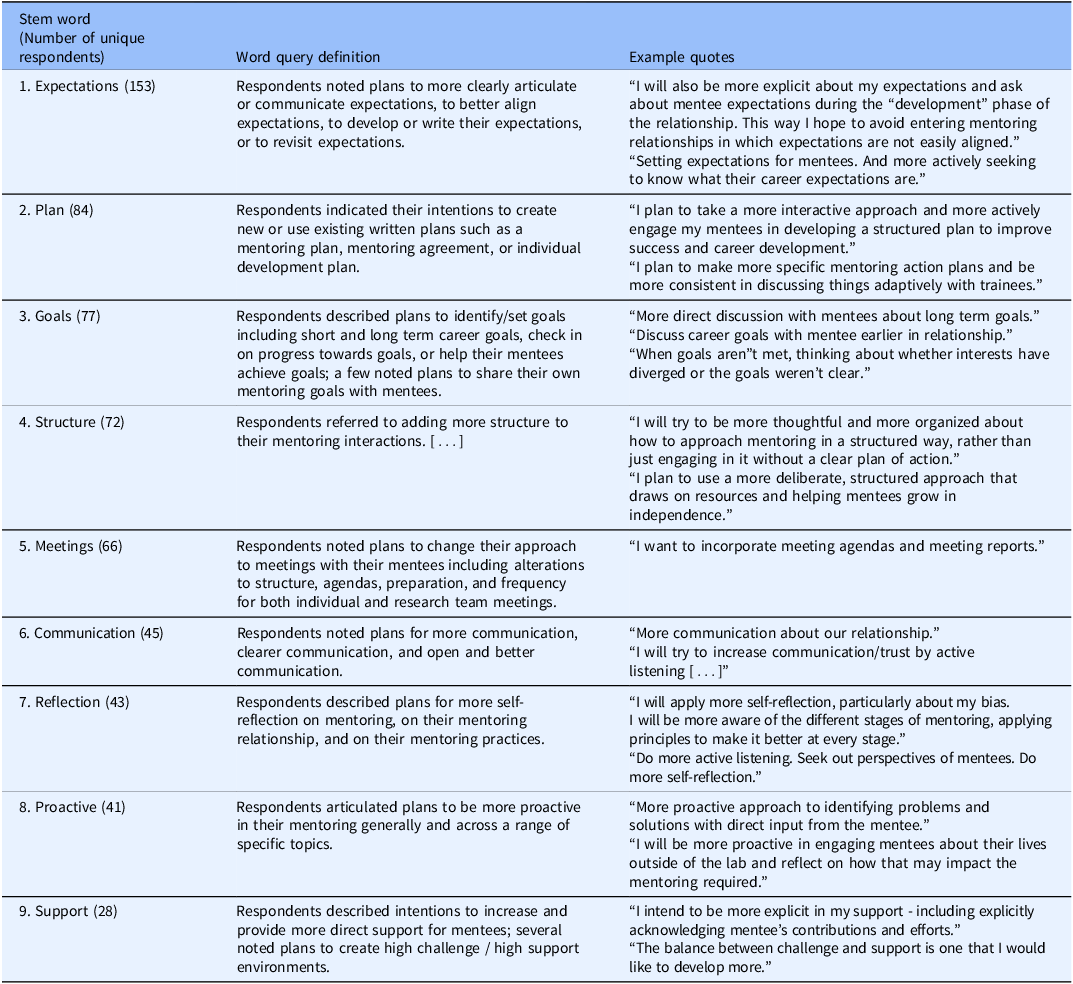
A high proportion of respondents (83%, 864/1044) reported making or intending to make changes in their mentoring relationships as a result of participating in the training. Of these, 688 individuals offered an open-ended description of their behavioral changes. Our word query analysis of these free-text responses identified several commonly used words that both aligned with the training module’s content and reflected behavioral actions (Table 3). Among the high-frequency words meeting both of these criteria, expectation was the most commonly cited (n = 153 unique respondents). These responses reflected OPM users’ intentions to more clearly communicate, align, and address expectations within their mentoring relationships. Other frequently referenced stem words were indicative of respondents’ intentions to use mentoring plans (n = 84), to pay more attention to goal setting (for the mentoring relationship and/or for the mentee’s career; n = 77), and to adopt a more structured approach to mentoring (n = 72). Some of the less commonly cited words, but all of which directly align with OPM module content, indicated respondents’ intentions to improve communication with their mentees (n = 45), to engage in more reflection about their approaches to mentoring and the impact of their approaches on mentees (n = 43), and to increase their support of mentees (n = 28).
Categories of intended behavioral change prompted by participation in OPM training
Module reach: total registrant data
The evaluation results described above were drawn from a subset of total OPM registrants. Our examination of the full registrant dataset identified 4,011 unique individuals who registered for OPM from its initial launch on October 17, 2012, through June 1, 2022. Growth over time in unique registrants per year and in cumulative number of registrants by year is illustrated in Supplementary Figure 2. Registrants included 663 (16.5%) individuals from the University of Minnesota and 3,348 (83.5%) from other institutions (Supplementary Table 1). More than 650 institutions are represented in this sample. We were able to confirm that 2,646 registrants (66%) were employed at one of 80 past or present CTSA-affiliated institutions. Most registrants were higher education faculty members and/or administrators, with the remainder identifying as a student or fellow, health professional, or other job category. Approximately half (52%) indicated that their engagement with the module was required by their institution or program, 37% were proactively using it for their own professional development, and 13% were reviewing the module for possible future use in their own institutions (Supplementary Table 1).
Discussion
Within clinical and translational science and related fields, the responsibilities of research mentorship are recognized as a constellation of competencies that can be honed through evidence-based professional development programs [6,Reference Pfund, House and Asquith21,Reference Stelter, Kupersmidt and Stump25–Reference Abedin, Rebello, Richards and Pincus28]. Our usage and evaluation data for the online module, OPM, demonstrate that this relatively brief mentor training mechanism – designed for self-paced, interactive, asynchronous learning – has broad appeal, yields positive gains in specific mentorship skills and other learner outcomes, and prompts behavior change intentions aimed at improving the quality of mentoring relationships.
In support of OPM’s efficacy as a training modality, individuals in our large evaluation sample reported post-training gains in each of the skill areas covered by the module. The first two OPM-specific skills (“Defining the value of mentoring for research career development” and “Recognizing the pros and cons of different mentoring models”) could be considered to be more reflective of knowledge gains. However, the remaining nine reflect categories of behaviors that either directly engage mentees (e.g., “Applying a proactive structured approach to mentoring”) or support users’ professional growth as mentors (e.g., “Routinely reflecting on and adapting my mentoring practices”). In comparison to previously reported pilot work involving OPM [Reference Weber-Main, Shanedling, Kaizer, Connett, Lamere and El-Fakahany18], the current sample was substantially larger and more diverse with respect to career stages and years of mentoring experience, thereby enhancing the generalizability of learner outcomes that we report.
Gains were also observed in the three general measures of perceived mentoring confidence, overall quality of mentoring, and effectiveness at meeting mentees’ expectations. For the latter two metrics, the measured gains for OPM users were of similar magnitude to those reported for individuals who participated in at least 6 hours of Entering Mentoring-based workshops [Reference Rogers, Gong and Byars-Winston23]. These findings offer additional support for OPM’s value as a standalone, asynchronous online training option – one that requires a modest amount of time to complete and can be accessed at a time and place convenient to individual learners. In the absence of data from a head-to-head trial, direct comparisons of OPM outcomes to those of other interventions should be interpreted cautiously. In terms of training duration alone, OPM is more comparable to the “low dose” (<4 hours) variations of Entering Mentoring workshops that have been previously found to be effective, though to a lesser degree on some measures than higher dose training iterations [Reference Rogers, Branchaw, Weber-Main, Spencer and Pfund22].
Engagement with OPM prompted a clear intention among a large proportion of users (83%) to adapt their mentoring in direct response to what they had learned. This metric compares favorably to that reported by participants in Entering Mentoring across different modalities and dosages (91%, unpublished data) and by participants in the advancing inclusive mentoring (AIM) program (90%) developed at California State University Long Beach [Reference Young, Finney, Marayong, Vu, Yamamoto and Mori29,Reference Young, Marayong and Vu30]. The intended behavioral changes noted by OPM users largely coalesced around the themes of aligning expectations, goal setting, and other planning-focused tasks reflective of a proactive approach to structuring their interactions with mentees. These topics are extensively addressed in the module and reinforced through checklists, tools, and suggested conversation prompts.
OPM was developed in partnership with experts in instructional design and e-learning. Their input ensured that users are given frequent opportunities for self-reflection and real-time engagement with the material (via brief exercises, mini-surveys, and simulated discussions). We posit, based on informal feedback from users, that features such as these have contributed to OPM’s appeal and impact as an independent mentor training program.
We also know from work by us and others that online, asynchronous approaches to mentor training offer versatility in how they are implemented [Reference Weber-Main, Shanedling, Kaizer, Connett, Lamere and El-Fakahany18,Reference Young, Finney, Marayong, Vu, Yamamoto and Mori29]. Although they cannot replicate the interpersonal discussions that might take place within a well-facilitated synchronous workshop setting, they can be leveraged to prepare mentors to more fully engage in meaningful group work. As noted in this article’s introduction, we have done this successfully within the hybrid mentor training approach of the University of Minnesota’s Mentoring Excellence Training Academy [Reference Weber-Main, Shanedling, Kaizer, Connett, Lamere and El-Fakahany18]. Academy participants exhibited knowledge gains and intention-to-change mentoring practices after completion of OPM alone; these gains were enhanced after completion of subsequent in-person workshops. In focus groups, mentors said they valued the synergy of the blended learning format, noting the unique strengths of each modality and the benefits of completing a foundational online module before in-person engagement. Across 6 more recent cohorts of the Academy, 82% of participants somewhat or strongly agreed that completion of OPM helped prepare them to engage in the facilitated workshops (unpublished data). Other examples of OPM’s successful integration into multimodal mentor training initiatives include the University of Wisconsin’s Building Equitable Access to Mentorship (BEAM) program [31], Washington University’s Mentored Training for Dissemination and Implementation Research in Cancer (MT-DIRC) program [Reference Padek, Mir and Jacob32,Reference Brownson, Jacob and Carothers33], and the Howard Hughes Medical Institute’s Gilliam Fellows Program [Reference Pfund, Sancheznieto and Byars-Winston34]. While individual programs can design their own mode of integration, OPM’s embedded reflection questions, which can be printed and saved by users, offer one simple option for organizing discussion groups that build on the module’s content and support communities of practice.
The full registration data for OPM’s first decade of public availability illustrate its widespread reach (over 4,000 unique registrants, two-thirds of whom are affiliated with CTSA hub institutions) and consistent growth (an average of 379 new users/year). At the University of Minnesota, OPM training is required for all faculty who mentor trainees in any CTSI-supported program, but users at this institution reflect less than 20% of registrants. These national usage outcomes are consistent with the module creators’ goal of broad dissemination to support mentor professional development.
Several factors are likely to have influenced the ongoing expansion of OPM enrollment. First, as shown by our data, satisfaction ratings for the training were generally favorable. Second, information about the module has been disseminated to target audiences through multiple modalities (e.g., a published article [Reference Weber-Main, Shanedling, Kaizer, Connett, Lamere and El-Fakahany18], the national academies report on The Science of Effective Mentorship in STEMM [6], websites for national organizations such as NRMN and CIMER, and multiple invited national presentations). Third, the COVID-19 pandemic heightened institutions’ need for virtual learning, which likely enhanced the attractiveness of online training options. Fourth, over half of OPM registrants indicated that module completion was “required by my institution, department, or program,” thereby driving enrollment.
There are limitations to our analyses of OPM evaluation data. Our results reflect those of approximately 60% of total registrants from the 3-year evaluation time period. Because the module was purposefully designed to allow for non-linear progression through the material, we are unable to determine whether the remaining registrants completed the course and chose not to submit the survey, or did not finish the course. Our findings could be positively skewed if survey respondents had more favorable views of the course or differed in other substantial ways than non-respondents. It is possible that some users completed the evaluation survey after only minimal engagement with OPM. This would make our positive findings a conservative estimate of the module’s impact. The evaluation survey does not capture longitudinal behavior change; the available data are limited to respondents’ immediate post-training intentions to apply the module’s content to their future mentoring practices. Finally, this report relies on mentor self-report data and does not capture the perspectives of mentees whose mentors participated in the OPM module. We know from other research that synchronous, in depth, mentor training approaches can have a positive impact on mentees [Reference Pfund, House and Asquith21,Reference Pfund, Sancheznieto and Byars-Winston34–Reference Lewis, Martina and McDermott38]. Future randomized trials of asynchronous training models such as OPM – with enrollment of mentor-mentor dyads and comparison of relevant outcomes for the mentees of trained versus untrained mentors – would be a valuable contribution to the field.
In conclusion, the evaluation and registration data for OPM demonstrate its value as an online, asynchronous training tool that can enhance mentorship skills, confidence, and practices across diverse settings. OPM’s design offers flexibility in its implementation as a standalone training module, as a prerequisite for more specific or advanced training, or as one component of a multifaceted mentor development program.
Supplementary material
The supplementary material for this article can be found at https://doi.org/10.1017/cts.2025.84.
Acknowledgments
The authors thank the many individuals who contributed to the initial development and subsequent revision of OPM modules. We also thank Seth Elis and Megan Larson of the University of Minnesota’s Clinical and Translational Science Institute for their support in collecting, managing, and reporting the OPM registration data.
Author contributions
Anne Marie Weber-Main contributed to the conception and design of the work, collection and management of data, interpretation of analyses, and drafting of the manuscript. Kimberly Spencer, So Hee Hyun, and Christine Pfund contributed to the conception and design of the work, collection and management of data, conduct and interpretation of analysis, and drafting of the manuscript. Emma Dums contributed to the collection and management of data, conduct and interpretation of analysis, and drafting of the manuscript. Anne Marie Weber-Main takes responsibility for the manuscript as a whole.
Funding statement
This work was supported by the National Institutes of Health via funding to the University of Minnesota’s Clinical and Translational Science Institute (grant #UL1TR002494 and #UM1TR004405), to the University of Wisconsin–Madison’s Institute for Clinical and Translational Research (grant #UL1TR002373), and to the National Research Mentoring Network (grant #U54GM119023). Additional support was provided by the University of Wisconsin–Madison’s Center for the Improvement of Mentored Experiences in Research. The funders had no role in the design, collection, analysis, and interpretation of data; in the writing of the manuscript; or in the decision to submit this manuscript for publication. The content is solely the responsibility of the authors and does not necessarily represent the official views of the National Institutes of Health.
Competing interests
The authors declare none.


 Open access

