1. Introduction
M-dwarf stars are most common stars, representing more than 75% of all stars within our Galaxy (Henry et al. Reference Henry, Fekel, Sowell and Gearhart2006, Reference Henry2018), They dominate the stellar populations by number, but have a very low mass range 0.075 M $_\odot\div$
0.50 M
$_\odot\div$
0.50 M $_\odot$
and effective temperature (
$_\odot$
and effective temperature ( $T_{eff}$
) less than 4000 K (Delfosse et al. Reference Delfosse2000). M dwarfs are main-sequence stars whose spectra display bands of TiO and other molecules such as CaH, CaOH, VO, FeH, and CrH (Kirkpatrick et al. Reference Kirkpatrick1993; Johnson et al. Reference Johnson1986). Low luminosity M dwarfs are of interest for both observational and theoretical reasons. The faintest M dwarfs include stars undergoing gravitational collapse to the main-sequence, stars burning hydrogen on the main-sequence, and stars with a mass too low to burn hydrogen, the ‘brown dwarfs’. These stars show frequent flaring, in the Johnson U photometric band up to 6 mag. The spectra of most flaring stars also show strong hydrogen Balmer, calcium H and K, helium, and sodium emission lines.
$T_{eff}$
) less than 4000 K (Delfosse et al. Reference Delfosse2000). M dwarfs are main-sequence stars whose spectra display bands of TiO and other molecules such as CaH, CaOH, VO, FeH, and CrH (Kirkpatrick et al. Reference Kirkpatrick1993; Johnson et al. Reference Johnson1986). Low luminosity M dwarfs are of interest for both observational and theoretical reasons. The faintest M dwarfs include stars undergoing gravitational collapse to the main-sequence, stars burning hydrogen on the main-sequence, and stars with a mass too low to burn hydrogen, the ‘brown dwarfs’. These stars show frequent flaring, in the Johnson U photometric band up to 6 mag. The spectra of most flaring stars also show strong hydrogen Balmer, calcium H and K, helium, and sodium emission lines.
The great majority of the M dwarfs discoveries has been based on the study of the proper motion catalogues, such as Lowell Observatory Proper Motion (Giclas, Burnham, & Thomas Reference Giclas, Burnham and Thomas1971), the proper motion ‘Catalogue of Nearby Stars, 3rd edition-CNS3’ (Gliese & Jahreiss Reference Gliese and Jahreiss1991), and the ‘New Luyten Two Tenths’ (NLTT) catalogue of Luyten (1979–80), which includes 58845 stars with proper motions larger than 0.18 arcsec yr $^{-1}$
. The presence of numerous M dwarfs has been confirmed among the proper motion objects in the Lépine & Shara (Reference Lépine and Shara2005) catalogue.
$^{-1}$
. The presence of numerous M dwarfs has been confirmed among the proper motion objects in the Lépine & Shara (Reference Lépine and Shara2005) catalogue.
More than two decades later, the discoveries of the high proper motion objects using the SuperCOSMOS Sky Survey are the primary target of the Research Consortium on Nearby Stars (RECONS; Henry et al. Reference Henry1997), on-line access via https://www.recons.org) survey. RECONS is currently extending the survey work to 25 parsecs. The RECON program (Jao et al. Reference Jao2005; Henry et al. Reference Henry2018) started analysing astrometry data in 1999, targeting red, brown, and white dwarfs within 25 pc.
Studies of M dwarfs two decade ago were limited by the number of available M dwarf spectra (Delfosse et al. Reference Delfosse, Forveille, Perrier and Mayor1998, Reference Delfosse1999) because of the difficulty of measuring reliable spectra from these faint objects. However, with the development of modern astronomical facilities, the number of M dwarf spectra has been increasing dramatically. West et al. (Reference West2011) presented the spectroscopic catalog including 70841 M dwarf spectra from Sloan Digital Sky Survey (SDSS) Data Release 7 (Abazajian et al. Reference Abazajian2009), providing fundamental spectroscopic data on M dwarfs for probing Galactic chemical evolution. Recently, Zhong et al. (Reference Zhong2019) presented a new catalog of M dwarf and M giant stars from the LAMOST (Large Sky Area Multi-Objects Fiber Spectroscopic Telescope (Cui et al. Reference Cui2012) release 5 (DR5) database. 501152 M dwarfs have already been identified based on a classification algorithm. Spectroscopic confirmations of thousands of M dwarfs identified in proper motion catalogues are also being provided in two big series of the papers, namely ‘The Solar Neighborhood’ (Vrijmoet et al. Reference Vrijmoet2022), and in series of the papers ‘Meeting The Cool Neighbors’ (Cruz et al. Reference Cruz2018).
M dwarf study has become of central interest for astronomy in the last two decades, notably for their application to exoplanet research (Tarter et al. Reference Tarter2007). The small radii, low mass, and low luminosity facilitate the discovery of orbiting low-mass planets via radial velocity (RV) and transiting photometry (Muirhead et al. Reference Muirhead2012; Martinez et al. Reference Martinez2017; Mann et al. Reference Mann2018). Recently, the Calar Alto High-Resolution search for M dwarfs with the Exoearth with Near-infrared and optical Echelle Spectrograph (CARMENES) (Quirrenbach et al. Reference Quirrenbach, Ramsay, McLean and Takami2014, Reference Quirrenbach, Evans, Simard and Takami2018), and HARPS (Astudillo-Defru et al. Reference Astudillo-Defru2017) surveys are targeting planets (extra-solar planets) around M dwarfs (Espinoza et al. Reference Espinoza2022; Alonso-Floriano et al. Reference Alonso-Floriano2015; Cifuentes et al. Reference Cifuentes2020). CARMENES is a stabilised, high-resolution, double-channel spectrograph at the 3.5 m Calar Alto telescope, which is monitoring M dwarfs to detect exoplanets with the RV method.
The main goal of the present paper is the characterisation of Galactic M dwarfs selected on First Byurakan Survey (FBS) plates (Gigoyan, Mickaelian, & Kostandyan Reference Gigoyan, Mickaelian and Kostandyan2019), using modern astronomical databases, mainly Gaia EDR3 (Brown et al. Reference Brown2021) and TESS (Transiting Exoplanet Survey Satellite; Stassun et al. Reference Stassun2019). This paper presents the preliminary results for FBS M dwarfs and is structured as follows. Section 2 introduces the FBS for late-type stars (LTSs) and its digitised version and characterise our sample of 236 M dwarfs, Section 3 presents spectroscopic observations for selected M dwarfs. Section 4 considers photometric and astrometric data, cross-correlations with Gaia EDR3, TESS, GALEX, and ROSAT catalogues, colour-colour and colour-absolute magnitude diagrams (CaMD), and spectral energy distribution of FBS M dwarfs, paying particular attention to the FBS 0250+167 star. Section 5 discusses possible multiplicity and companions around M dwarfs. A TESS light curve analysis for FBS M dwarfs is presented in Section 6. Finally, Section 7 recalls the main results obtained for the FBS M dwarfs and provides concluding remarks.
2. Target selection. FBS late-type stars catalog
All M dwarfs analysed here are presented in ‘The Second Revised and Updated Version of the FBS Late-Type Stars (LTSs) Catalogue’ at high Galactic latitudes, which is a comprehensive list of 1471 objects (131 C (carbon) stars, 1104 M giants and 236 M dwarfs, Gigoyan et al. (Reference Gigoyan, Mickaelian and Kostandyan2019), SIMBAD CDS Vizier Catalogue J/MNRAS/489/2030). LTSs are selected on the Digitized First Byurakan Survey (DFBS). Its images and spectra are available on the DFBS web portal1 in Trieste (1 https://www.ia2-byurakan.oats.inaf.it/) plates, which is a digitised version of the FBS (Markarian et al. Reference Markarian, Lipovetsky, Stepanian, Erastova and Shapovalova1989). From the 236 identified M dwarfs, 176 are new discoveries and 60 M dwarfs are proper motion objects known mainly from the ‘New Luyten Two-Tenth’-NLTT catalogue (SIMBAD VizieR Catalog I/98A), and from the Lépine & Shara (LSPM; Reference Lépine and Shara2005). For the great majority of the known proper motion objects, Gigoyan et al. (Reference Gigoyan, Mickaelian and Kostandyan2019) reported M dwarf spectral types. The limiting magnitude on different plates varies in the range 16.5 $^{\rm m}$
–19.5
$^{\rm m}$
–19.5 $^{\rm m}$
in V, however, for the majority it is 17.5
$^{\rm m}$
in V, however, for the majority it is 17.5 $^{\rm m}$
–18.0
$^{\rm m}$
–18.0 $^{\rm m}$
. C stars can be identified through the presence of Swan bands of the C
$^{\rm m}$
. C stars can be identified through the presence of Swan bands of the C $_2$
molecule and M-type stars can easily be distinguished thanks to the TiO molecule absorption bands (Gigoyan et al. Reference Gigoyan, Mauron, Azzopardi, Muratorio and Abrahamyan2001).
$_2$
molecule and M-type stars can easily be distinguished thanks to the TiO molecule absorption bands (Gigoyan et al. Reference Gigoyan, Mauron, Azzopardi, Muratorio and Abrahamyan2001).
BAO 2.6-m telescope spectra for three FBS M dwarfs, obtained on 2018 September 8/9 with the SCORPIO spectrograph, using a 600 line mm $^{-1}$
grism and CCD EEV 42-40 in spectral range
$^{-1}$
grism and CCD EEV 42-40 in spectral range $\lambda$
4000–7000 Å (pixel size 13.5
$\lambda$
4000–7000 Å (pixel size 13.5 $\unicode{x03BC}$
m, resolution
$\unicode{x03BC}$
m, resolution $\sim$
6 Å).
$\sim$
6 Å).

3. Optical spectroscopy
3.1. BAO 2.6 m telescope spectra
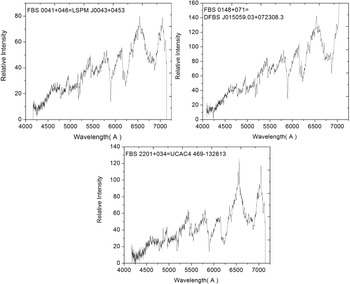
For FBS LTSs, medium-resolution CCD spectra are obtained at different epochs with the BAO (Byurakan Astrophysical Observatory) 2.6-m telescope (spectrographs UAGS, ByuFOSC2 and SCORPIO). Figure 1 presents examples of optical spectra for three FBS M dwarfs obtained with the SCORPIO spectrograph and an EEV 42-402048 $\times$
2048 pixel CCD.
$\times$
2048 pixel CCD.
3.2. LAMOST spectra
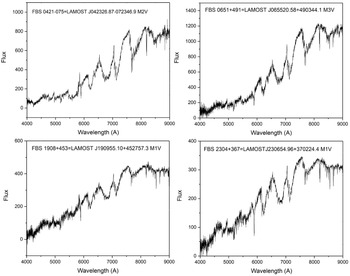
Moderate-resolution CCD spectra for 44 FBS M dwarfs (out of 236, presented by Gigoyan et al. Reference Gigoyan, Mickaelian and Kostandyan2019) were secured by LAMOST (Large Sky Area Multi-Object Fiber Spectroscopic Telescope) observations (Luo et al. Reference Luo2019, LAMOST DR7, spectra available on-line at http://dr7.lamost.org/search/, also see SIMBAD VisieR Catalog V/156/dr7/lrs). Figure 2 shows the LAMOST moderate-resolution CCD spectra for four FBS M dwarfs.
3.3. CAFOS observations
Observations for some amount of FBS M dwarfs were also secured with Calar Alto Focal Reductor and Spectrograph (CAFOS) mounted on the Ritchey-Chretien focus of the Zeiss 2.2 m Calar Alto telescope. Observations were carried out using G-100 grism, which resulted in a useful wavelength range of 4200–8300 Å at a resolution $R\sim 1500$
(Alonso-Floriano et al. Reference Alonso-Floriano2015). Spectral types are presented by these authors for 753 M dwarfs (SIMBAD Vizier Catalogue J/A+A/577/A128/Mstars/). For an accurate determination of spectral sub-classes, Alonso-Floriano et al. also observed standard stars with well-determined spectral types from M0 to M8.
$R\sim 1500$
(Alonso-Floriano et al. Reference Alonso-Floriano2015). Spectral types are presented by these authors for 753 M dwarfs (SIMBAD Vizier Catalogue J/A+A/577/A128/Mstars/). For an accurate determination of spectral sub-classes, Alonso-Floriano et al. also observed standard stars with well-determined spectral types from M0 to M8.
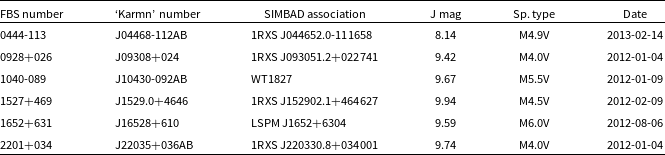
Table 1 lists CAFOS observations of 6 FBS M dwarfs (out of the 12 stars observed), namely FBS number, ‘Karmn’ (number with CARMENCITA identifier following the Karmn nomenclature format (CARMENCITA-CARMENES Cool dwarf Information and data Archive, Alonso-Floriano et al. (Reference Alonso-Floriano2015)), associations in SIMBAD database, 2MASS (Two Micron All-Sky Survey, Skrutskie et al. Reference Skrutskie2006) J magnitude, and spectral subclasses estimated (SIMBAD VoizieR Catalogue JJ/A+A/577/A128/M stars, ‘CARMENES input catalogue of M dwarfs’).
4. Astrometric and photometric data
4.1. Gaia EDR3 data
Gaia EDR3 (Gaia Collaboration; Brown et al. Reference Brown2021) provides high-precision astrometry, three-band photometry, effective temperatures, and information on astrophysical parameters for about 1.8 billion sources over the full sky brighter than $G = 21.0$
mag. All FBS M dwarfs were cross-matched with the Gaia EDR3 catalogue sources. These objects are relatively bright, so that G-band brightnesses were in the range 11.3 < G < 17.1 mag.
$G = 21.0$
mag. All FBS M dwarfs were cross-matched with the Gaia EDR3 catalogue sources. These objects are relatively bright, so that G-band brightnesses were in the range 11.3 < G < 17.1 mag.
4.2. TESS observations
NASA’s Transiting Exoplanet Survey Satellite (TESS) is an all-sky space-based mission designed to search for planets transiting around nearby M dwarfs (Ricker et al. Reference Ricker, Oschmann, Jacobus, Clampin, Fazio and MacEwen2014). Launched in 2018 April, it started regular science operation on 2018 July 25. Its observed $\sim$
73% of the sky across 26 sectors, each lasting 27.4 d and covering a 24
$\sim$
73% of the sky across 26 sectors, each lasting 27.4 d and covering a 24 $^{\circ}$ $\times$
96
$\times$
96 $^{\circ}$
field of view. TESS observed a number of stars at 2-mn cadence and collected full frame images (FFIs) every 30 min, covering the entire mission phase. By the end of 2 two-year primary mission, TESS identified 2241 exoplanet candidates (Guerrero et al. Reference Guerrero2021), known as TESS Objects of Interest (TOIs).
$^{\circ}$
field of view. TESS observed a number of stars at 2-mn cadence and collected full frame images (FFIs) every 30 min, covering the entire mission phase. By the end of 2 two-year primary mission, TESS identified 2241 exoplanet candidates (Guerrero et al. Reference Guerrero2021), known as TESS Objects of Interest (TOIs).
We have cross-correlated our list of 236 M dwarfs with the TESS Input Catalog, Version 8.2 (TIC v8.2, Paegert et al. Reference Paegert2021, SIMBAD CDS VizieR Catalog IV/39/tic82), giving the data for FBS dwarf M stars (Stassun et al. Reference Stassun2018), notably multiple key physical parameters for stars, parallaxes, proper motions, TESS(T) magnitudes, temperatures, masses, and luminosities in solar units.
4.3. GALEX ultraviolet detection
We have cross-correlated the FBS M dwarfs against the GR6+7 data release of the GALEX (Galaxy Evolution Explorer, far-UV band $\lambda_{eff}\sim$
1528 Å (FUV, 1344–1786 Å) and near-UV,
$\lambda_{eff}\sim$
1528 Å (FUV, 1344–1786 Å) and near-UV, $\lambda_{eff}\sim$
2310 Å (NUV, 1771–2831 Å). To match sources in the GALEX data with the FBS M dwarf sample, we searched GALEX (SIMBAD VizieR Catalogue II/335/galex-ais, Bianchi, Shio & Thilker (Reference Bianchi, Shiao and Thilker2017) data to identify UV sources within 5′′ and found GALEX counterparts for 43 FBS M dwarfs (out of 176 new discoveries) using 5′′ search radius.
$\lambda_{eff}\sim$
2310 Å (NUV, 1771–2831 Å). To match sources in the GALEX data with the FBS M dwarf sample, we searched GALEX (SIMBAD VizieR Catalogue II/335/galex-ais, Bianchi, Shio & Thilker (Reference Bianchi, Shiao and Thilker2017) data to identify UV sources within 5′′ and found GALEX counterparts for 43 FBS M dwarfs (out of 176 new discoveries) using 5′′ search radius.
4.4. ROSAT
Our list of all FBS M dwarfs was cross-correlated also with both the ROSAT All-Sky Survey Faint Source Catalog (Voges et al. Reference Voges2000) and the Second ROSAT All-Sky Survey (2RXS) Source Catalog (Boller et al. Reference Boller2016). We used a search radius of 15 arcsec, which is on the order of the astrometric precision of the ROSAT catalog. Our search identified 20 M dwarfs with the X-ray counterparts.
CAFOS spectral types for 6 FBS M dwarfs.

1RXS—‘ROSAT Bright Survey’, Fisher et al. 1998–2000, SIMBAD CDS VizieR Catalog IX/32/notes. LSPM—‘A Catalog of Northern Stars with Annual Proper Motions Larger than 0.15 arcsec yr $^{-1}$
’, Lépine & Shara (Reference Lépine and Shara2005). WT1827—Alonso-Floriano et al. (Reference Alonso-Floriano2015).
$^{-1}$
’, Lépine & Shara (Reference Lépine and Shara2005). WT1827—Alonso-Floriano et al. (Reference Alonso-Floriano2015).
4.5. 2MASS
Giant stars are notable for having infrared colours different from the M dwarfs, most apparent in near-infrared (NIR) a (J-H vs H-K) colour-colour. This has been known since Bessell & Brett (Reference Bessell and Brett1988) and Bessell (Reference Bessell1991). M dwarfs have comparatively blue J-H colours than giants. The 2MASS J-H versus H-K $_s$
colour-colour plots for all 1471 FBS M-and C-type stars, indicating their luminosity classes are presented in paper by Gigoyan et al. (Reference Gigoyan, Mickaelian and Kostandyan2019).
$_s$
colour-colour plots for all 1471 FBS M-and C-type stars, indicating their luminosity classes are presented in paper by Gigoyan et al. (Reference Gigoyan, Mickaelian and Kostandyan2019).
LAMOST moderate-resolution CCD spectra in the range 4000–9000 Å for a sample of FBS M dwarfs.

Among all FBS M dwarfs, the FBS 0250+167 star is rather exceptional with its extremely high proper motion (2MASS 02530084+1652532, $J-H = 0.511$
,
$J-H = 0.511$
, $H-K_s$
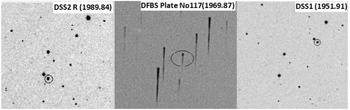
= 0.298). This object was discovered on the FBS plate No 117 (Kodak—IIAF, obtained on 1-m Schmidt telescope 1969 November 13). In our XIV-th list of the LTSs, we present this object as M7-M8 subtype star (Gigoyan et al. Reference Gigoyan2003). Figure 3 shows the DSS1 R and DSS2 R finder charts and lr 2D spectral shape of the FBS 0250+167 star.
$H-K_s$
= 0.298). This object was discovered on the FBS plate No 117 (Kodak—IIAF, obtained on 1-m Schmidt telescope 1969 November 13). In our XIV-th list of the LTSs, we present this object as M7-M8 subtype star (Gigoyan et al. Reference Gigoyan2003). Figure 3 shows the DSS1 R and DSS2 R finder charts and lr 2D spectral shape of the FBS 0250+167 star.
DSS1 R and DSS2 R, finder charts, also DFBS lr 2D spectral shape on the plate ${\mathop{\textrm{N}}\limits_{-}} 117$
for very high proper motion star FBS 0250+167.
${\mathop{\textrm{N}}\limits_{-}} 117$
for very high proper motion star FBS 0250+167.

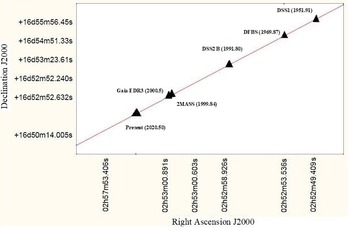
Figure 4 presents the direction of the motion of the high proper motion star FBS 0250+167, which was constructed, using DSS1, DSS2, DFBS Plate No117 data and also Gaia EDR3 high accurate astrometric data (Gaia EDR3 35227046884571776).
Direction of the motion of the very high proper motion (PM = 5.12 arcsec yr $^{-1}$
) star FBS 0250+167 which was found due to DFBS plate
$^{-1}$
) star FBS 0250+167 which was found due to DFBS plate ${\mathop{\textrm{N}}\limits_{-}} 117$
.
${\mathop{\textrm{N}}\limits_{-}} 117$
.

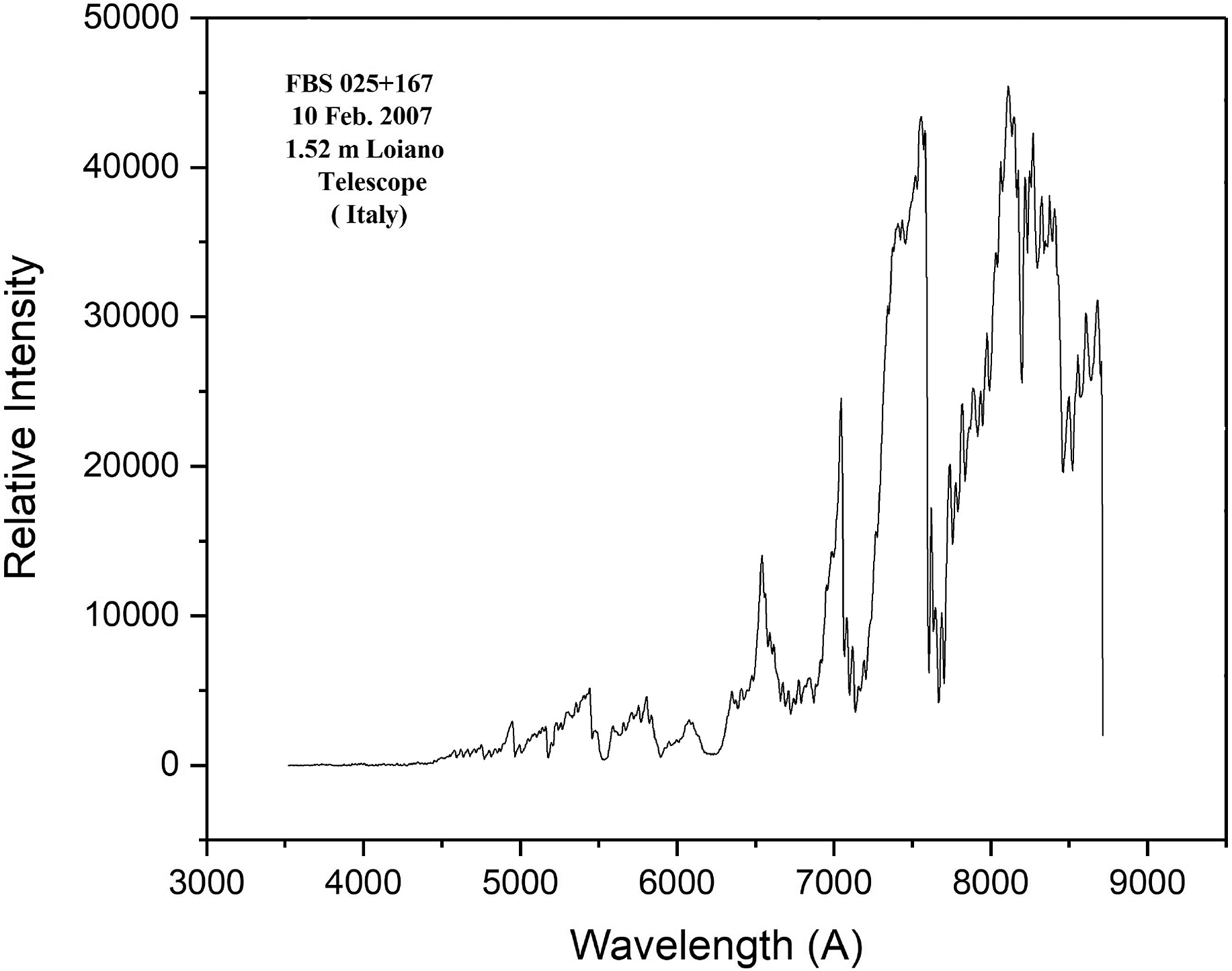
Moderate-resolution CCD spectra for object FBS 0250+167 in the wavelength range $\lambda$
3940–8500 Å were obtained on 10 of 2007 February with the 1.52 m Cassini telescope of the Bologna (Italy) Astronomical Observatory at Loiano (equipped with the Bologna Faint Object Spectrometer and Camera—BFOSC,
$\lambda$
3940–8500 Å were obtained on 10 of 2007 February with the 1.52 m Cassini telescope of the Bologna (Italy) Astronomical Observatory at Loiano (equipped with the Bologna Faint Object Spectrometer and Camera—BFOSC, $1300\times 1340$
pixel EEV P129915 CCD). The spectra are shown in Figure 5, where relative fluxes corrected for atmospheric extinction are plotted on the Y-axis. The correction for the instrumental response was also applied. The spectra were reduced by means of standard IRAFFootnote a procedures.
$1300\times 1340$
pixel EEV P129915 CCD). The spectra are shown in Figure 5, where relative fluxes corrected for atmospheric extinction are plotted on the Y-axis. The correction for the instrumental response was also applied. The spectra were reduced by means of standard IRAFFootnote a procedures.
The discovery of this very high proper motion star was reported for the time in 2003 May by Teegarden et al. (Reference Teegarden2003) who called the star SO 025300.5+165258 (object is also known as Teegarden‘s star). Teegarden et al. used the Sky Morph database of the Near Earth Asteroid Traking (NEAT) project (Pravdo et al. Reference Pravdo1999). We discuss Teegarden‘s star (SO 025300.5+165258=FBS 0250+167) in this context because this star is the brightest and one of the nearest ultracool dwarf in the solar neighbourhood. As part of CARMENES search for exoplanets around M dwarfs, Zechmeister et al. (Reference Zechmeister2019) obtained 245 RV measurements for FBS 0250+167 and analysed them for planetary signals (Figure 3 of paper by Zechmeister et al. Reference Zechmeister2019, see also for plots SIMBAS VizieR Catalog J/A+A/627A49). Zechmeister et al found periodic variability in the RV indicative of two planet candidates, each with 1.1 M $_{\odot}$
minimum mass orbiting at periods of 4.91 and 11.4 d, respectively. These two planets are among the lowest-mass planets discovered so far. This star exhibits occasional flares (Figure 1 of Zechmeister et al. Reference Zechmeister2019). TIC v8.2 catalogue gives the following data for FBS 0250+167 (TIC Identifier is 257870150,
$_{\odot}$
minimum mass orbiting at periods of 4.91 and 11.4 d, respectively. These two planets are among the lowest-mass planets discovered so far. This star exhibits occasional flares (Figure 1 of Zechmeister et al. Reference Zechmeister2019). TIC v8.2 catalogue gives the following data for FBS 0250+167 (TIC Identifier is 257870150, $M = 0.095$
M
$M = 0.095$
M $_{\odot}$
,
$_{\odot}$
, $L = 0.00077$
L
$L = 0.00077$
L $_{\odot}$
,
$_{\odot}$
, $T_{eff}$
= 2790 K, and
$T_{eff}$
= 2790 K, and $V = 15.13$
mag).
$V = 15.13$
mag).
The 1.52 m Bologna telescope spectrum for FBS 0250+167, covering the wavelength range 4000–8500 Å.

4.6. Colour-absolute magnitude (CaMD) diagrams based on Gaia DR3 and TESS data
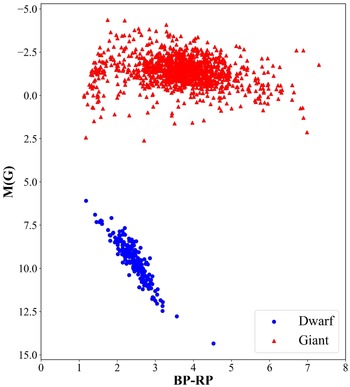
Figure 6 presents the observational Gaia EDR3 absolute magnitude (M(G)) versus BP-RP colour, or Hertzsrung-Russell Diagram-HRD) for all FBS detected M dwarfs. For comparison, the results for FBS M and C giants are also shown on the same diagram (Gigoyan et al. Reference Gigoyan, Mickaelian and Kostandyan2019).
Gaia EDR3 absolute magnitude M(G) vs BP-RP colour for FBS M dwarfs (blue circles) and giants (M and N giants—red triangles) for comparison. The faintest object among the sample is M dwarf FBS 0250+167 (M(G) = 14.35).

We have used the distance information derived from Gaia EDR3 by Bailer-Jones et al. (Reference Bailer-Jones, Rybizki, Fouesneau, Demleitner and Andrae2021). The absolute G-band magnitude is estimated using the common equation:
 \begin{equation}M(G) = G - 5 Log r + 5 - A(G) \end{equation}
A(G) is assumed to be very low for our objects because they are at high Galactic latitudes.
Meanwhile, this CaMD needs to be studied in more detail to age date for all FBS M dwarfs using various models (for example, isochrones BHAC15, Baraffe et al. Reference Baraffe, Homeier, Allard and Chabrier2015).
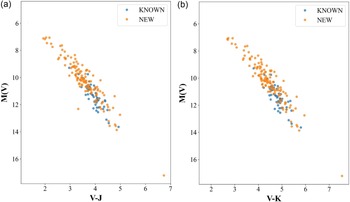
The panels (a, b) in Figure 7 show the absolute M(V) magnitude as a function of the optical-to-infrared V-J and V-K colour for FBS M dwarfs (J and K magnitudes are from the 2MASS database based on TESS Input Catalog data (SIMBAD CDS VizieR Catalog IV/39/tic82).
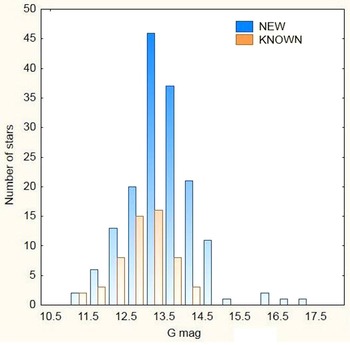
Figure 8 presents the histogram of the Gaia EDR3 G-wide band magnitude distribution of the FBS M dwarfs and M dwarfs which are known proper motion objects, mainly from NLTT and LSPM catalogues.
4.7. The infrared emission. Spectral energy distribution (SED)
Infrared emission from M dwarfs has been investigated in multiple studies. Cotten & Song (Reference Cotten and Song2016) reported on about near 500 IR-excess stars. Extra flux in the IR range characterised the circumstellar dust which mark certain stages in the life of a planetary system (protoplanetary disc, and final stage is a debris disc, Luppe et al. (Reference Luppe, Krivov, Booth and Lestrade2020)). Sgro & Song (Reference Sgro and Song2021) used Gaia DR2 and ALLWISE W3 and W4 passbands to search for M dwarfs with IR-excess, within 100 pc. Using a special SED fitting algorithm, Sgro & Song (Reference Sgro and Song2021) developed a photospheric model for each sampled star, determined its significance of excess (SOE), and discussed the nature of IR excess in more detail.
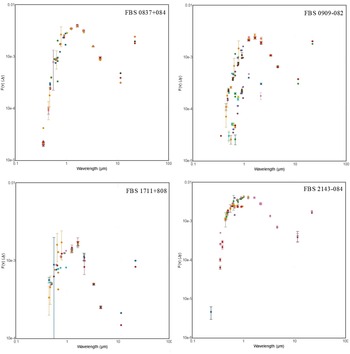
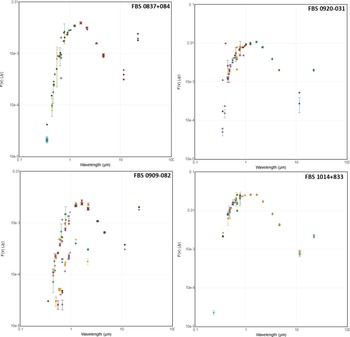
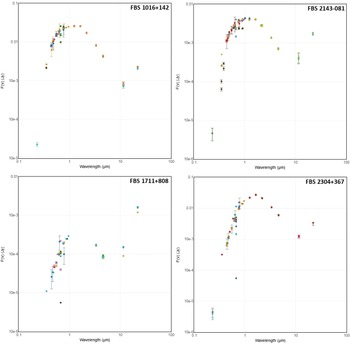
We examine visually the SEDs for all FBS M dwarfs to search for possible dusty discs signature around them. All these SEDs have been built and taken from the SIMBAD VizieR database (access via https://vizier.unistra.fr/vizier/sed/) using the SED builder tool. Note that SEDs for objects presented in Tables 2, 3 and 4 apparently show plots for two objects, confirming the multiplicity these objects.
SEDs for a sample of 12 FBS M dwarfs (among the 236 dwarfs considered) with very clear IR-excess are shown in the panels of Figures 9–11. In SEDs of these objects, the excess IR radiation is clearly visible after 10 $\unicode{x03BC}$
m (in WISE W3 and W4 passbands). An IR excess emission is not obvious in the SEDs of the other FBS M dwarfs.
$\unicode{x03BC}$
m (in WISE W3 and W4 passbands). An IR excess emission is not obvious in the SEDs of the other FBS M dwarfs.
In case of FBS 0909-082 (Figure 10), Gaia EDR3 and TESS data reveal two objects in 5 arcsec search. The existence of the secondary companion is well established in the SED of this object. Absolute similar SEDs show the objects Gaia DR2 2024760150182176896 and DR2 5480730048994706816, presented in paper by Sgro & Song (Reference Sgro and Song2021), with excess in IR emission.
An interesting line of future investigation would be to analyse the SEDs for all FBS M dwarfs using the spectral slope defined by Sgro & Song (Reference Sgro and Song2021) to measure the significance of excess (SOE).
5. Multiplicity. Possible companions
Multiplicity is the most common features of the stars in the Galaxy. About 35% of late-type main-sequence stars and 60% of known flare stars within 25 parsecs of the Sun are members of binary systems (Johnson et al. Reference Johnson1986). M dwarfs multiplicity rate has been investigated in many studies. For instance, stellar multiplicity among low-mass stars within 15 pc is presented by Ward-Duong et al. (Reference Ward-Duong2015). In many studies, authors typically explored the regions around M dwarfs in search of different types of objects at different separation from the star to identify substellar companions (small separation) and also wide binary systems (large separation). Finding and characterizing M dwarf multiples is useful in the study of transiting exoplanets, and multiplicity trends among them can yield insight into stellar formation and evolution (Lamman et al. Reference Lamman2020). Winters et al. (Reference Winters2019) have carried out the most comprehensive M dwarf multiplicity study, surveying volume-limited sample of 1120 dwarf primaries within 25 pc based on new observations, archived data, and literature search.
Currently, there are no direct and high-angular-resolution CCD imaging observations to search close companions around FBS newly detected M dwarfs. This type of observations is required to resolve the faint, close companions. As indicators for the possible presence of companions around FBS M dwarfs, we use high accuracy astrometric and photometric data mainly from the Gaia EDR3 and TESS catalogues. We also search for possible multiplicity data in the Gaia Catalogue of Nearby Stars (GCNS) database, for FBS M dwarfs up to 100 pc distances. Finally, as an additional indication, we check visually POSS II I-band direct images for FBS M dwarfs in STScI Digitized Sky Survey database https://stdatu.stsci.edu:cgi-bin/dss_form.
5.1. Gaia EDR3 search
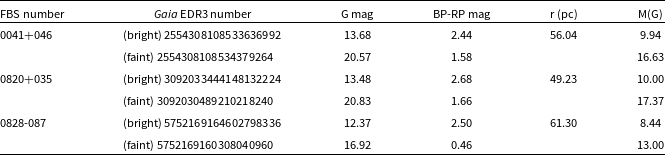
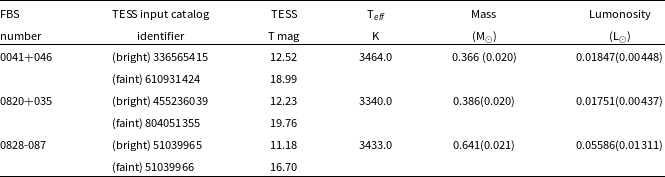
Gaia DR3 has the potential for extensive multiplicity studies. Gaia can resolve most companions down to 1 arcsec at magnitude contrast as large as six; closer systems are not resolved, regardless of secondary brightness (Ziegler et al. Reference Ziegler2018; Lamman et al. Reference Lamman2020). Out of 176 of our cross-matched FBS new M dwarf targets, 27 have a second Gaia EDR3 object within the 5 arcsec search radius. In 19 cases out these 27, Gaia EDR3 database indicates a nearly equal magnitudes in G-band for companion. Three objects, FBS 0041+046, FBS 0820+035, and FBS 0828-087, are of particular interest. There are very close to primary M stars with an extremely faint second object in G-band (see detail below). The sensitivity of the Gaia data to closely separated binaries is expected to improve in future data releases.
Observational HR diagram for FBS M dwarfs (M $_V$
vs V-J and V-K colour based on TESS Input catalogue data with measured trigonometric parallaxes). Symbols are: orange dots-FBS M dwarfs (NEW), blue dots-M dwarfs KNOWN.
$_V$
vs V-J and V-K colour based on TESS Input catalogue data with measured trigonometric parallaxes). Symbols are: orange dots-FBS M dwarfs (NEW), blue dots-M dwarfs KNOWN.

Histogram of the distribution of new FBS M dwarf sample (blue symbol) and known M dwarfs (orange symbol).

SEDs for four FBS M dwarfs builded in Vizier data base using Gaia EDR3, POSSII-I, POSSII-I, POSSII-F, POSSII-J, Johnson-B, SDSS u, g, r, i, z, 2MASS J, H, Ks, WISE W1, W2, W3, and W4 photometric data (for more detail see https://vizier.cds.unistra.fr/vizier/sed/.

5.2. TESS catalog search
TESS Input Catalog-v8.2 data indicate the presence of two objects in search radius 5 arcsec around position for 26 FBS M dwarfs. In 12 cases of out of these 26, the two objects have nearly-equal T (TESS T mag, Stassun et al. Reference Stassun2019) magnitudes. In this catalogue, three objects already pointed out above are rather exceptional with a bright primary star and very faint secondary companion.
In Tables 2 and 3, consequently, Gaia EDR3 and TESS data are presented for these three FBS M dwarfs and their very close and faint companions.
There are no parallax information (positional data only) about the very faint and close objects around these three FBS M dwarfs in Gaia EDR3 and TESS databases. If these objects are gravitationally bound, i.e. they are physical companions at the same distances, their G-band absolute magnitudes can be determined: M(G) = 16.83, 17.37, and 13.00 for FBS 0041+046, FBS 0820+035, and for FBS 0828-087, respectively (Table 2). Such BP-RP colours and absolute G-band magnitudes place them on White Dwarfs (WD) sequence on HRD (for detail see Figure 13 by Babusiaux et al. Reference Babusiaux2018).
Most probably, they are main-sequence M dwarf plus White Dwarf (dM + WD) binary systems. Note that these three FBS M dwarfs (Tables 2, 3) are also seen by GALEX satellite (Bianchi et al. Reference Bianchi, Shiao and Thilker2017). For 9 FBS M dwarfs having GALEX associations, Gaia EDR3 data indicate 2 objects in the 5 arcsec search radius, but it is difficult to claim that the second companion is a WD because of the absence of the BP-RP colours. Based on Colour-Magnitude-Diagram (CMD), age dating analysis presented by Sgro & Song (Reference Sgro and Song2021) using BHAC15 isochrones, one can adopt a minimum age 0.1 Gyr for FBS 0041+046, 0.04 Gyr for FBS 0820+035, and 0.03 Gyr for FBS 0828-087 (see detail Chapter 4.1.1 and Figure 6 in Sgro & Song Reference Sgro and Song2021).
5.3. Gaia Catalogue of Nearby Stars (GCNS) search
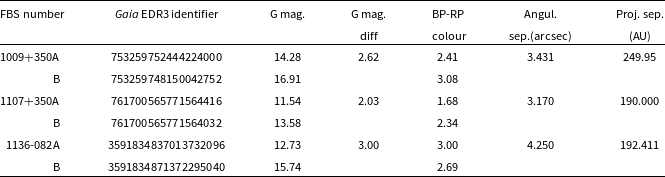
To search multiplicity and companions around new discovered FBS M dwarfs, we have cross-matched our results with the Gaia Catalogue of Nearby Stars (GCNS, Gaia Collaboration; Smart et al. Reference Smart2019). To search multiplicity and companions around new discovered FBS M dwarfs, we have cross-matched with the Gaia Catalogue of Nearby Stars (GCNS, Gaia Collaboration; Smart et al. Reference Smart2019). This catalogue has an estimated 331312 entries within 100 pc and gives information about 19176 resolved multiple systems.
Table 4 presents data for three FBS M dwarfs, which are presented as resolved binary systems in the GCNS database. Table 4 presents FBS Name for the bright, primary source (A), and for the secondary component (B), Gaia EDR3 source identifier, Gaia EDR3 G-band magnitude, BP-RP colour, G-band magnitude differences, angular separation of both objects, and projected separation in AU.
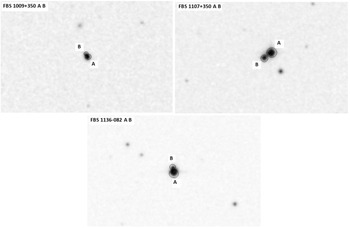
Figure 12 illustrates secondary physical components around three FBS M dwarfs on DSS2 I charts according to GCNS database.
For FBS 1107+350 GCNS gives 3 sources (Gaia Source ID 1 is 761700565771564416 and Gaia Source ID 2 is 761700462692366336) with angular separation 3.1798 arcsec, a magnitude differences is 6.3433 mag, and projected separation is 190.6806 AU. Most probably, FBS 1107+350 is a triple system (Gaia third Source ID is 761700462692366336).
5.4. Washington visual double star catalog
We also have cross-matched all FBS M dwarfs with the ‘Washington Visual Double Star Catalogue’ (WDS) objects (maintained by Brian Mason, 2001–2020, SIMBAD VizieR Catalog B/wds/wds; Mason et al. Reference Mason, Wycoff, Hartkopf, Douglass and Worley2001) in order to find publications with information on multiple systems. Four objects out of 236, namely FBS 0115-095, FBS 0913-103, FBS 1345+796, and FBS 1513+796, are associated with the visual double systems. Moreover, FBS 1345+796 is EA-type eclipsing binary.
Some important Gaia ERD3 catalogue data for three FBS M dwarfs.

SEDs for four FBS M dwarfs builded in Vizier data base using the same catalogue photometric data, as in Figure 9.

Some important TESS catalog data for three FBS M dwarfs.

SEDs for four FBS M dwarfs builded in Vizier database using the same catalogue photometric data, as in Figure 9.

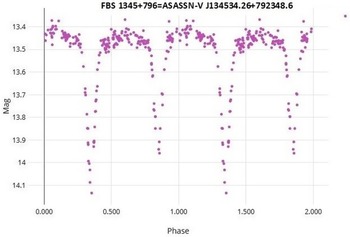
As example, Figure 13 shows ASAS-SN (Shappee et al. Reference Shappee2014; Jayasinghe et al. Reference Jayasinghe2018) light curve for M dwarf FBS 1345+796.
GCNS data for three new FBS M dwarfs as a binary systems.

POSS2 I images for three FBS M dwarfs, which are included in GCNS catalogue as a binary systems. Physical components are circled and noted as B. They all are within 100 pc from the Sun. Very important note, the Gaia BP-RP colours for all components are typical for dwarf M stars. Field is 15 arcmin $\times$
15 arcmin.
$\times$
15 arcmin.

ASAS-SN phased light curve for FBS 1345+796 classified as a EA-type eclipsing binary ( $P = 0.368$
d, Ampl. = 0.55 mag,
$P = 0.368$
d, Ampl. = 0.55 mag, $V_{mean}$
= 13.52 mag) where the secondary eclipse is clearly seen.
$V_{mean}$
= 13.52 mag) where the secondary eclipse is clearly seen.

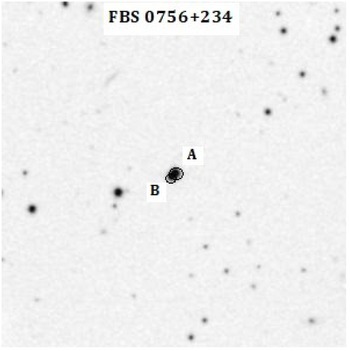
POSS2 I image of dwarf M star FBS 0756+234 (primary star-A) and its closer companion (B) that we view as a binary system. Angular separation is 1.74′ arcsec on I-image. Field is $5^{\prime} \times 5^{\prime}$
.
$5^{\prime} \times 5^{\prime}$
.

5.5. Visual inspection of the POSS2 I images
With help of the data visualisation software SAOImage ds9, we search the POSS2 I-band images for possible companions around the newly detected FBS M dwarfs. Such visualisation allows us to detect very close and comparatively bright possible physical companions around 6 dwarfs: FBS 0756+234, FBS 1010+205, FBS 1016+142, FBS 1340-049, FBS 1412-058, and FBS 1719+829. However, only in the case of FBS 0756+23,4 there is a very good match with the Gaia EDR3 catalogue distances (Bailer-Jones et al. Reference Bailer-Jones, Rybizki, Fouesneau, Demleitner and Andrae2021) for the primary M dwarf star and for very close companion. For the remaining 5 FBS M dwarfs, the distances for primary star and the faint close object are very different.
Figure 14 illustrates the POSS2 I-band image of the M dwarf star FBS 0756+234 and its companion. Spectra in the range 3900–9100 A for this object was secured by LAMOST telescope and classified as dM4 type star (identifier is LAMOST J075935.66+232039.5, on-line access via http://dr7.lamost/org/search/).
Table 5 includes Gaia EDR3 and TESS data for dwarf M star FBS 0756+234 and for very close companion.
The BP-RP colour index and $T_{eff}$
of the second and very close object ar also typical for M dwarfs, therefore most probably, we have pair of M dwarfs (M dwarf + M dwarf). High-angular-resolution CCD is required to resolve very well the second component of FBS 0756+234 and faint companions around FBS M dwarfs in general.
$T_{eff}$
of the second and very close object ar also typical for M dwarfs, therefore most probably, we have pair of M dwarfs (M dwarf + M dwarf). High-angular-resolution CCD is required to resolve very well the second component of FBS 0756+234 and faint companions around FBS M dwarfs in general.
6. Analysis of TESS light curves of FBS M dwarfs
M dwarfs are favourable targets for transiting exoplanet surveys. TESS collected data for thousands of M dwarfs that might host habitable exoplanets. Detection of 1617 new transiting-planet candidates has been identified in the TESS full-frame images observed during the Primary Mission (Sectors 1–26; Kunimoto et al. Reference Kunimoto2022). TESS data have been used in many studies devoted to detecting exoplanets around dwarf stars (Bryant & Bayliss Reference Bryant and Bayliss2022; Espinoza et al. Reference Espinoza2022; Gilbert et al. Reference Gilbert2022; Gan et al. Reference Gan2022; Giacalone et al. Reference Giacalone2022; Mori et al. Reference Mori2022; Vach et al. Reference Vach2022; Yee et al. Reference Yee2022). We here apply the same methodology in the search of planets around FBS M dwarfs. We downloaded the Presearch Data Conditioning Simple Aperture Photometry (PDC-SAP) light curves from the Mikulski Archive for Space Telescopes (MAST—https://mast.stsci.edu/portal/Mashup/Clients/Mast/Portal.html). We then used lightkurve (http://docs.lightkurve.org) to download the target pixel files (TPFs) and to analyse light curves for FBS M dwarfs monitored by TESS. No transit events are detected when analysing TESS light curves.
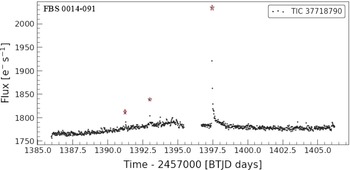
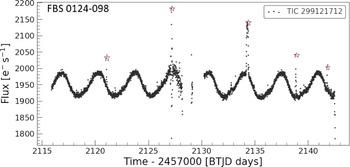
TESS phase-dependent light curves show flares for many FBS M dwarfs. Figures 15 and 16 show examples of such flares in TESS light curves for objects FBS 0014-091 and FBS 0124-098. TESS light curve of FBS 0124-098 also shows very clear rotational modulation with period $P=3.51$
d (TIC Number is 299121712,
$P=3.51$
d (TIC Number is 299121712, $M = 0.408$
M
$M = 0.408$
M $_{\odot}$
,
$_{\odot}$
, $L = 0.0231$
L
$L = 0.0231$
L $_{\odot}$
,
$_{\odot}$
, $r = 53.81$
pc). The ROSAT association of this object is 1RXS J012724.3-093359. M dwarfs can be X-ray emitters if they have significant chromospheric activity with the best indicator of chromospheric magnetic activity being the H
$r = 53.81$
pc). The ROSAT association of this object is 1RXS J012724.3-093359. M dwarfs can be X-ray emitters if they have significant chromospheric activity with the best indicator of chromospheric magnetic activity being the H $\alpha$
emission line (Yi et al. Reference Yi2014). High activity levels are typically linked to rapid rotations, which in M dwarfs, is indicative of either spin–orbit coupling in close binary (Silvestri, Hawley, & Oswalt Reference Silvestri, Hawley and Oswalt2005) or of young age (Silvestri et al. Reference Silvestri2006). It is likely that FBS 0124-098 is a rapid rotator. We plan to investigate in detail magnetic activity and flare energies of DBS M dwarfs in the future.
$\alpha$
emission line (Yi et al. Reference Yi2014). High activity levels are typically linked to rapid rotations, which in M dwarfs, is indicative of either spin–orbit coupling in close binary (Silvestri, Hawley, & Oswalt Reference Silvestri, Hawley and Oswalt2005) or of young age (Silvestri et al. Reference Silvestri2006). It is likely that FBS 0124-098 is a rapid rotator. We plan to investigate in detail magnetic activity and flare energies of DBS M dwarfs in the future.
Gaia EDR3 and TESS catalogue data for dwarf M star FBS 0756+234.

Demonstration of the detection of the TPF pipeline on example of the light curve for M dwarf FBS 0014-091 in TESS Presearch Conditioned Simple Aperture Photometry (PDC-SAP) from Sector 3. Red star symbols highlight the detection flare candidate peaks. The X-axis shows the time in Barycentric Julian Days(BJD), and Y-axis shows the normalised TESS PDC-SAP Flux.

TESS light curve for M Dwarf FBS 0124-098 from Sector 30 reduced with help of pipeline TargetPixelFiles, where red star symbols highlight flare peaks. The X-axis shows the time in Barycentric Julian Days (BJD), and Y-axis shows the normalised TESS PDC-SAP Flux. The ROSAT assocciation of this source is 1RXS J012724.3-093359.

7. Summary and future works
In order to gain more information on the M dwarfs identified in the First Byurakan Survey (FBS) low-resolution (lr) spectroscopic database, Gaia EDR3 high-accuracy astrometric and photometric data and Transiting Exoplanet Survey Satellite (TESS) data are used to characterise these M dwarfs and their possible multiplicity. Among the sample 236 relatively bright M dwarfs, 176 are discoveries.
These objects are relatively bright with their 2MASS KS magnitude lying between 7.3 and 14.4. We also search visually POSS II I-images and cross-matched all M dwarfs with the Gaia Catalogue of Nearby Stars (GCNS) and with the Washington Visual Double Star Catalogue. The Gaia EDR3 G broad-band magnitudes of the FBS M dwarfs are between $11.3 < G < 17.1$
, their TESS estimated masses lie in the range 0.095 (
$11.3 < G < 17.1$
, their TESS estimated masses lie in the range 0.095 ( $\pm$
0.02) M
$\pm$
0.02) M $_{\odot}\,\leq$
M
$_{\odot}\,\leq$
M $\leq$
0.7 (
$\leq$
0.7 ( $\pm$
0.1) M
$\pm$
0.1) M $_{\odot}$
and
$_{\odot}$
and $T_{eff}$
in the range 4000 K <
$T_{eff}$
in the range 4000 K < $T_{eff}$
< 2790 K. We analyse various colour-colour diagrams of the new M dwarfs. For 27 FBS M dwarfs, Gaia DR3 and TESS catalogues indicate two objects within the 5 arcsec radius. Three out of these 27 objects, FBS 0041+046, FBS 0820+035, and FBS 0828-087, are most probably binaries with the companion being a White Dwarf (WD). Four objects (FBS 0115-095, FBS 0913-103, FBS 1345+796, and FBS 1513+796) are found in the Washington Visual Double Star Catalogue. FBS 1345+796 is an EA-type eclipsing binary. According to Gaia EDR3 and TESS photometric data, FBS 0756+234 is most probably a close binary, and the Gaia EDR3 BP-RP colour diagrams for both objects are typical of M dwarfs. For FBS 1107+350, GCNS indicate 3 sources (Gaia Source ID 1 is 761700565771564416 and Gaia Source ID 2 is 761700462692366336) with angular separation 3.1798 arcsec, a difference in magnitude of 6.34 mag, and projected separation is 190.6806 AU. FBS 1107+350 represents most probably a triple system. If higher significance detection of the close companions around FBS M dwarfs are to be achieved and more knowledge about multiplicity of M dwarf be gained, high-angular-resolution CCD observations and possibly speckle interferometry are required for such studies.
$T_{eff}$
< 2790 K. We analyse various colour-colour diagrams of the new M dwarfs. For 27 FBS M dwarfs, Gaia DR3 and TESS catalogues indicate two objects within the 5 arcsec radius. Three out of these 27 objects, FBS 0041+046, FBS 0820+035, and FBS 0828-087, are most probably binaries with the companion being a White Dwarf (WD). Four objects (FBS 0115-095, FBS 0913-103, FBS 1345+796, and FBS 1513+796) are found in the Washington Visual Double Star Catalogue. FBS 1345+796 is an EA-type eclipsing binary. According to Gaia EDR3 and TESS photometric data, FBS 0756+234 is most probably a close binary, and the Gaia EDR3 BP-RP colour diagrams for both objects are typical of M dwarfs. For FBS 1107+350, GCNS indicate 3 sources (Gaia Source ID 1 is 761700565771564416 and Gaia Source ID 2 is 761700462692366336) with angular separation 3.1798 arcsec, a difference in magnitude of 6.34 mag, and projected separation is 190.6806 AU. FBS 1107+350 represents most probably a triple system. If higher significance detection of the close companions around FBS M dwarfs are to be achieved and more knowledge about multiplicity of M dwarf be gained, high-angular-resolution CCD observations and possibly speckle interferometry are required for such studies.
Among the FBS sample considered, the FBS 0909-082 object is the most distant M dwarf ( $r=780$
pc), with G-wide band absolute magnitude M(G) = 9.18,
$r=780$
pc), with G-wide band absolute magnitude M(G) = 9.18, $M = 0.59$
M
$M = 0.59$
M $_{\odot}$
,
$_{\odot}$
, $L = 0.13597$
L
$L = 0.13597$
L $_{\odot}$
, and
$_{\odot}$
, and $T_{eff}$
= 3844 K. This object can be classified as M1-M2 subtype dwarf. The nearest object is FBS 0250+167, a M7 subtype dwarf with an extremely high proper motion (5.13 arcsec yr
$T_{eff}$
= 3844 K. This object can be classified as M1-M2 subtype dwarf. The nearest object is FBS 0250+167, a M7 subtype dwarf with an extremely high proper motion (5.13 arcsec yr $^{-1}$
), which is located at 3.83 pc from the Sun. As part of CARMENES search for exoplanets around M dwarfs, two exoplanets were found around this very high proper motion dwarf, each exoplanets with 1.1 M
$^{-1}$
), which is located at 3.83 pc from the Sun. As part of CARMENES search for exoplanets around M dwarfs, two exoplanets were found around this very high proper motion dwarf, each exoplanets with 1.1 M $_{\odot}$
minimum mass orbiting at periods of 4.91 and 11.4 d, respectively (Zechmeister et al. Reference Zechmeister2019). These two planets were among the lowest-mass planets discovered so far. We also analyse the TESS phase- dependent light curves from the Mikulski Archive for Space Telescopes (MAST) for the FBS dwarfs. TESS light curves do not show transit events. Nonetheless, TESS phase-dependent light curves indicate numerous flares of FBS M dwarfs.
$_{\odot}$
minimum mass orbiting at periods of 4.91 and 11.4 d, respectively (Zechmeister et al. Reference Zechmeister2019). These two planets were among the lowest-mass planets discovered so far. We also analyse the TESS phase- dependent light curves from the Mikulski Archive for Space Telescopes (MAST) for the FBS dwarfs. TESS light curves do not show transit events. Nonetheless, TESS phase-dependent light curves indicate numerous flares of FBS M dwarfs.
Finally, for the first time, we estimate the detection limits of survey FBS for early and late-subclasses of M dwarfs with limiting magnitude 17.5–18.0 for FBS in V-band. Adopting M $_V$
= 8.0 for early-type M0 dwarfs (Reid et al. Reference Reid2004), the detection range can be estimated at up to
$_V$
= 8.0 for early-type M0 dwarfs (Reid et al. Reference Reid2004), the detection range can be estimated at up to $\sim$
1000 pc, and adopting M
$\sim$
1000 pc, and adopting M $_V$
= 19.0–20.0 for M8-M9 dwarfs, the detection range can be estimated up to 25 pc for survey FBS.
$_V$
= 19.0–20.0 for M8-M9 dwarfs, the detection range can be estimated up to 25 pc for survey FBS.
This paper is the first report devoted to FBS M dwarfs with the presentation of some of their key physical parameters based on Gaia EDR3 and TESS data. Future work will be certainly on the study of flares and stellar activity, ages, and rotation rates of FBS M dwarfs.
Acknowledgement
This work was supported by ERASMUS+2019-1-FRO-KA107-061818. KSG and KKG are grateful to Administration of OVSQ Observatory and LATMOS Laboratory (France) for organizing their visit. This research has made use of results from the SAO/NASA Astrophysics Data System Bibliographic Services, as well as the SIMBAD and VizieR databases, operated at CDS, Strasbourg, France, and Two Micron All Sky Survey, which is a joint project of the University of Massachusetts and the Infrared Processing and Analysis Center, funded by NASA and NSF. This research was made possible using the ASAS-SN and Catalina Sky Survey variability data bases. We used LAMOST telescope spectra. The LAMOST is a National Major Scientific project build by the Chinee Academy of Sciences. This work has made use of data from the European Space Agency (ESA) mission Gaia (https://cosmos.esa.int/gaia), processed by Gaia Data Processing and Analysis Consortium (DPAC, https://www.cosmos.esa.int/web/gaia.dpac.consortium). This paper includes data collected by the TESS mission, which are publicly available from the Mikulski Archive for Space Telescopes (MAST). This research has made use of the Washington Double Star Catalog maintained at the US Naval Observatory.
We thank the anonymous referee for the thoughtful comments that greatly improved the clarity of the paper.
Data availability
Not applicable.