


Introduction
The “Rust Belt” in the American Midwest played a key role in the U.S. presidential election of 2016. Over many years, this region had lost international economic competitiveness, leading to parts of its once‐dominant steel and car industries being moved elsewhere in the United States or abroad. Given this background, Donald Trump's promise to protect American workers from international competition resonated well with voters in states such as Michigan and Wisconsin. This begs the question of whether voters generally respond to changes in the international trade competitiveness of the regions in which they live, or whether this is simply a context‐specific outlier. Do they punish incumbent politicians when the goods and services they produce become less competitive on world markets and/or import penetration increases?
A considerable number of studies have already analysed the nexus between international trade and elections. Several of them indicate that changes in import competition matter for electoral outcomes. In an early study, Margalit (Reference Margalit2011) showed that an increase in the number of applications for Trade Adjustment Assistance in the United States – which reflects jobs lost owing to imports – negatively correlates with the incumbent vote share in presidential elections. More recently, Colantone and Stanig (Reference Colantone and Stanig2018) found that a surge in imports from China leads to a greater vote share for nationalist and radical right parties in Western Europe. Similarly, Autor et al. (Reference Autor, Dorn, Hanson and Majlesi2020) suggest that exposure to trade induced polarization among the U.S. electorate. Barone and Kreuter (Reference Barone and Kreuter2021), furthermore, find that increased exposure to trade undermines support for mainstream parties. In line with this logic, Dippel et al. (Reference Dippel, Gold and Heblich2015) suggest that extreme parties' electoral fate depends on changes in trade integration (but see Hays et al., Reference Hays, Lim and Spoon2019). Several studies also link an increase in trade exposure to growing vote shares for populist parties (e.g., Milner, Reference Milner2021).
This research note contributes to this literature by investigating how changes in a region's international trade competitiveness relate to incumbent electoral fate. Broadly in line with much of the literature cited above, we expect that voters react to changes in the trade competitiveness of the region in which they live by punishing the incumbent if trade competitiveness deteriorated. What we add in terms of theorizing is the expectation that this effect is moderated by political institutions and issue ownership (as captured by incumbents' political ideology). First, we anticipate stronger effects for elections where clarity of responsibility is high. This is the case in presidential systems under the condition of a unified government and in parliamentary systems under the condition of a single‐party government. Second, we anticipate that the fate of economically right‐wing incumbents is more dependent on changes in trade competitiveness, as these parties usually claim ownership of the issue of the economy. The empirical analysis supports the theoretical expectation regarding clarity of responsibility but provides mixed evidence with respect to the moderating effect of economic ideology.
Our approach complements existing research on the trade–elections nexus in three more ways. First, our analysis covers a large number of countries with different political systems. Concretely, we have data for 29 democracies across the world since 2000. This contrasts with existing research on the electoral consequences of economic globalization that has mainly focused on the United States and Western Europe. Broadening the empirical basis not only facilitates the generalization of findings but also permits us to test whether political institutions moderate the effect of changes in international trade competitiveness.
Second, we rely on a new measure to capture the economic consequences of international economic integration for voters. Changes in a region's international trade competitiveness should better capture how economic globalization matters for a region's economic fortunes than increases in imports alone. Imports may go up simply because of increased demand, which signals a thriving economy. By contrast, the measure that we use reflects both how exports fare in foreign markets and whether the region experiences a surge in imports. It hence better reveals the impact of international economic integration on a region.
Finally, our focus is on the difference between incumbent and opposition parties rather than between mainstream and either radical right or populist parties.Footnote 1 This approach, which is also generally used by the large economic voting literature (Lewis‐Beck & Stegmaier, Reference Lewis‐Beck and Stegmaier2019), is preferable to the approach focused on political parties with a specific ideological leaning because international trade competitiveness is most likely a valence issue (i.e., all voters agree that higher international trade competitiveness is desirable).
Besides speaking to the literature on the trade–elections nexus, this research note also contributes to the related literature on economic voting (for an overview of this literature, see Lewis‐Beck & Stegmaier, Reference Lewis‐Beck and Stegmaier2019). This literature has mainly looked at how inflation (Carlsen, Reference Carlsen2000; Powell & Whitten, Reference Powell and Whitten1993), unemployment (Helgason & Mérola, Reference Helgason and Mérola2017) or economic growth (Dassonneville & Lewis‐Beck, Reference Dassonneville and Lewis‐Beck2020; Wilkin et al., Reference Wilkin, Haller and Norpoth1997) matter for election outcomes. Our focus on the impact of changes in international trade competitiveness complements this field's attention to domestic economic trends. This is important given that the possibility that the globalization backlash may affect elections has recently received much public attention. Moreover, while studies in the economic voting tradition generally focus on changes in economic outcomes at the country level, our approach studies variation at the subnational level. Indeed, the American Midwest example used before suggests that for voters, economic developments in the region in which they live may be highly relevant.
Theoretical expectations
Does international trade affect electoral outcomes? We approach this question by analysing the effect of changes in regions' international trade competitiveness on changes in incumbents' vote shares. By trade competitiveness, we understand the average ability of firms from a region to sell their products abroad and withstand foreign competition at home. Focusing on changes in regions' trade competitiveness rather than just measuring import shocks as so far done in much of the literature on the trade–elections nexus hence allows us to consider both the ability of firms from a region to export to world markets and their exposure to import competition. A study only considering changes in imports is unable to discriminate between a situation in which an import shock reflects the decline of domestic industries, and one in which a flourishing economy (possibly because of increased exports) leads to greater demand for foreign products.
Our analysis proceeds at the subnational level, for three reasons. First, a country's international competitiveness is ill‐defined (Krugman, Reference Krugman1996). Countries do not have a higher degree of competitiveness than others; they only differ in the industries for which they have a comparative advantage. By contrast, at the subnational level, we can observe variation in the extent to which regions feature exporting and import‐competing industries. Second, the economic effects of international trade are most likely felt differently in different parts of a country (Autor et al., Reference Autor, Dorn and Hanson2013). What is more, especially in larger countries voters are more likely to feel or perceive regional than national effects of international trade. For the voter in Detroit, import competition for the city's car industry is likely to have a more direct impact than booming exports from Silicon Valley. Finally, the subnational level also gives us additional empirical leverage, because it allows us to study the effect of changes in regional competitiveness while keeping factors such as national institutions or party systems constant. We thus focus on the effect of changes in subnational trade competitiveness (STC).
A region's trade competitiveness can vary over time chiefly for two reasons. On the one hand, the country's comparative advantage may shift towards or away from the region's economic specialization, for example, because of technological changes, the rise of foreign competitors or domestic economic policies. On the other hand, a region's economic structure may change, for example, because companies relocate to parts of the country where productivity is higher or because droughts lead to a decline in its agricultural production.
Our expectation is for such changes in a region's trade competitiveness to matter for vote choices. This is so because, in the politically relevant short‐run, a decline (an increase) in trade competitiveness should lead to job and/or wage losses (gains) in that region (e.g., but just focusing on the consequences of an increase in import competition; Autor et al., Reference Autor, Dorn and Hanson2013, Reference Autor, Dorn and Hanson2021). As the region's international competitiveness declines, it will be less able to export its products abroad and more of its products will experience competition from foreign imports. It is unlikely that the region can offset these changes by reducing imports from (or increases in exports to) other parts of the country. On the contrary, changes in intra‐country trade patterns likely exacerbate the changes in international trade patterns. A tax on mining, for example, will make ores more expensive independent of whether they are destined for the domestic or foreign markets. Overall, therefore, a decline in a region's trade competitiveness leads to a decline in demand for the region's products, which also reduces demand for workers. In turn, this negatively affects the number of people being employed and/or the wages paid to them. These job or wage losses affect voters either directly or indirectly. The direct effects accrue to those employed in the sectors negatively affected by reduced exports or increased imports. The indirect effects matter for everybody in the region because job and wage losses produce ripple effects for the regional economy as a whole.
While a decline in trade competitiveness may go hand in hand with a general economic downturn, the two processes are not identical. For one, citizens likely feel the effects of a decline in trade competitiveness before they affect a region's overall economic activity. A decline in trade competitiveness also may only lead to a restructuring of a region's labour market (e.g., people moving from manufacturing to service jobs) without this causing an overall slowdown of the economy. Still, voters may view this restructuring negatively. Moreover, there can be a general economic downturn without a decline in trade competitiveness. Indeed, a downturn may even enhance trade competitiveness, by reducing demand for imports and lowering regional labour costs.
In short, changes in STC can affect voters' economic fortunes (or their perception of the economic well‐being of people in their environment, which would matter for voters with sociotropic distributional preferences). In line with much of the economic voting literature, these voters should react by punishing the incumbent if their economic situation deteriorated, as it is the incumbent that they should hold accountable. For our argument, it is irrelevant whether they switch to a mainstream or a fringe party, as long as they shift away from the incumbent. For this causal mechanism to work, voters do not need much political information; they only need to feel or perceive economic decline and blame the incumbent (Enns & Kellstedt, Reference Enns and Kellstedt2008). Whether an improvement in trade competitiveness leads to the opposite effect is less clear, as gains may not trickle down to voters but only accrue to owners. Neither is it so clear that incumbents can claim credit as easily as they get attributed blame. Most likely, therefore, the effect of changes in STC on incumbents' vote shares is non‐linear.Footnote 2 Overall, we thus hypothesize that
-
Hypothesis 1. In terms of change in regional vote share, incumbents do worse when the region's trade competitiveness decreases than when it stays stable or improves.
We also argue that this mechanism is moderated by two variables, namely the clarity of responsibility and incumbents' economic ideology. We focus on these two moderators because they capture both dynamics at the level of the political system and characteristics of the incumbents. Starting with the clarity of responsibility, several studies have shown that economic voting is more likely in some political systems than in others (Anderson, Reference Anderson2000; Lewis‐Beck, Reference Lewis‐Beck1988; Powell and Whitten, Reference Powell and Whitten1993). Following Powell and Whitten (Reference Powell and Whitten1993) and Anderson (Reference Anderson2000), we thus argue that the correlation between changes in regions' trade competitiveness and changes in incumbent vote share should be stronger, the higher the clarity of responsibility in a political system. Clarity of responsibility is low when institutional rules are complex, and the government lacks cohesiveness. This is more likely in parliamentary systems in the presence of coalition governments or presidential systems under the condition of divided government. As a result, we hypothesize
-
Hypothesis 2. The outlined relationship between changes in trade competitiveness and changes in incumbent vote share is stronger when clarity of responsibility is high.
We also argue that political ideology moderates the effect of changes in regions' trade competitiveness (for a similar argument related to employment insecurity, see Helgason & Mérola, Reference Helgason and Mérola2017). The starting point for this argument is that a decrease in trade competitiveness should affect the perceived competence of incumbent parties. This effect, however, should be stronger for parties who have a particular claim to economic competence. This is the case of economically right‐wing parties that themselves stake a claim to economic issues (Hibbs, Reference Hibbs1977; Seeberg, Reference Seeberg2017). For voters, how the economy is doing – including how the region's trade competitiveness evolves – hence should be particularly pertinent when evaluating an economically right‐wing incumbent. In other words, right‐wing parties' ownership of the issue of the economy makes them prone to electoral losses when voters perceive a decrease in trade competitiveness. By contrast, economically left‐wing parties tend to focus on social issues and redistribution. They may get punished when they are incumbents and a region's trade competitiveness declines, but to a lesser extent since they do not own the issue. In the form of a hypothesis:
-
Hypothesis 3. The relationship between changes in regions' trade competitiveness and changes in incumbent vote share is stronger for economically right‐wing parties than for left‐wing parties.
Research design
Case selection
To test our two hypotheses, we gathered data from 29 democracies across all continents and levels of development.Footnote 3 These are all the countries for which data for both the outcome variable, and the key predictor were available. We limited the time frame of our analysis to the period since 2000 but also collected data on the last election in each country just prior to the year 2000 to be able to compute the change in vote shares.
Outcome variable
To capture the outcome of interest, namely, changes in electoral results, we collected data from elections to lower houses or (in the case of presidential systems) the presidency by electoral region (e.g., states, provinces or regions).Footnote 4 Specifically, we collected the vote share of all parties (or the candidates that they fielded in presidential elections) that fulfilled at least one of the following three criteria: the party (or its candidate) gained more than 5 per cent of the vote nationally; it was part of the government coalition; or it gained representation in parliament. To measure the change in support for a given party, we calculated the change in vote share of each party in every electoral district by subtracting the previous election result from the current one. Our dependent variable thus measures the change in the vote share of a party across two elections in an electoral region. To ease interpretation, we multiplied the share change by 100 to arrive at percentage points. We stick to parties as the unit of analysis (instead of just having one value for the incumbent in the case of coalition governments) to be able to assess H3.
Predictors
For our key predictor, namely changes in regions' trade competitiveness, we rely on a set of indicators of STC that was developed by Huber et al. (Reference Huber, Stiller and Dür2023). These authors used national trade data to establish the revealed comparative advantage (RCA) of countries at the industry group level. RCA is intended to measure how competitive a specific industry from a country is on world markets. Since there is no agreement on how best to measure RCA, Huber et al. (Reference Huber, Stiller and Dür2023) apply four different approaches. The one that we use here is the ratio of the difference between a country's exports and imports in an industry group and the country's overall trade in this industry group (Supporting Information Appendix Section D contains results for the other three measures).
To move from the country level to the level of subnational entities, Huber et al. (Reference Huber, Stiller and Dür2023) then weighted the RCA values with the share of employees in a sector in a region, relying on regional employment data from labour and household surveys. Furthermore, they aggregated the weighted competitiveness of all industries to obtain a single value that expresses the overall trade competitiveness of this region. The STC variable hence is calculated as follows:
 $$\begin{equation} STC_{st} = \sum _{g=1}^N (\frac{X_{cgt} - M_{cgt}}{X_{cgt} + M_{cgt}} \cdot ES_{gst}), \end{equation}$$
where $s$ is the subnational region, $t$ is the year, $g$ is the industry group, $X$ exports, $M$ imports,
 $$c is the country and $ES$ is the employment share. Given that we want to measure the effect of changes in competitiveness on incumbents' vote shares, we use the difference between the trade competitiveness of a region in the year prior to the current election and the trade competitiveness of that region in the year before the last election. Because of our expectation of a non‐linear relationship between changes in STC and incumbents' vote shares, we binned the predictor into three groups, using half a standard deviation around the country mean as cutoff points (STC decrease, stability and increase). In robustness checks, we also use the continuous variable together with its square to model this non‐linearity.
STC is both conceptually and empirically distinct from a region's gross income or wealth. Illustratively, at least in the short term, a high‐income region that hosts industries that are relatively labour intensive may lack trade competitiveness because of high wages.Footnote 5 By contrast, a relatively low‐income region may possess international trade competitiveness because low wages allow it to produce at low costs. Indeed, Huber et al. (Reference Huber, Stiller and Dür2023) only find a low bivariate correlation between regions' gross income per capita and STC.
Next to changes in STC, we also need to measure the incumbent status of parties to test our expectations. We did so using publicly available information. In parliamentary systems, we coded all parties that were part of the governing coalition at any time between two elections as incumbents. To test H2, we coded clarity of responsibility as high in presidential systems when the president's party also controlled a majority in parliament. Alternatively, clarity of responsibility is high in parliamentary systems when a single party controls the government. In all other cases, we coded clarity of responsibility as low. This approach is similar to the one used by Powell and Whitten (Reference Powell and Whitten1993). For the coding, we relied on various publicly available sources. To code the economic ideology of parties, we used the Global Party Survey (Norris, Reference Norris2020). We converted the data on parties' economic left‐right placement, which ranges from 0 to 10, into a five‐point categorical variable (far‐left, left, centre, right and far‐right) to allow for the possibility that the moderating effect of ideology is non‐linear.
Model specification
We use linear mixed‐effects models to test our hypotheses, as the outcome variable is numeric and the data are hierarchical (namely, the election result of a party in a region is nested within both all election results of that party and all election results in the region). In our baseline model, which we use to test H1, we only include our measure of changes in STC and random intercepts for the country and the political party.Footnote 6 These random effects capture any systematic drivers of vote changes at the country and party levels that are time invariant. In robustness checks, we also control for the growth of subnational gross national income per capita (GNIpc) in U.S. dollars (2011, purchasing power parity) between the elections (Smits & Permanyer, Reference Smits and Permanyer2019). Since changes in STC partly work through changes in GNIpc (e.g., job losses and lower wages may result in lower GNIpc), controlling for GNIpc reduces the effect size that our models attribute to changes in competitiveness.Footnote 7 This robustness check hence results in conservative estimates. For tests of H2 and H3, we add interactions between change in STC and clarity of responsibility and incumbent ideology, respectively.
Results
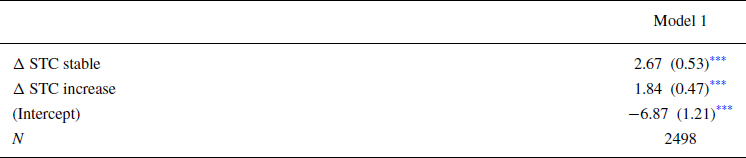
Model 1 in Table 1 reports the results of our test of Hypothesis 1. We find that changes in trade competitiveness are associated with changes in vote share. The results suggest that incumbents lose 6.9 percentage points compared to the previous election if STC decreases (as shown by the intercept). Compared to this condition, stable STC is associated with a statistically significant increase in the incumbent's result by 2.7 percentage points relative to the situation in which competitiveness decreases. In other words, the loss is limited to 4.2 percentage points. Similarly, an increase in STC is also associated with a relatively smaller loss for the incumbent than when STC decreases (a 1.84 percentage point smaller loss, to be precise). The difference between a stable STC and an increase in STC is not statistically significant at the 5 per cent level. This evidence thus offers strong support for Hypothesis 1.
Hypothesis 1: Binned $\Delta$ STC and $\Delta$ incumbent vote share

Note: $^{***}p<0.01$; $^{**}p<0.05$; $^{*}p<0.1$. Entries are unstandardised coefficients from a linear mixed‐effects model with random intercepts at the country‐ and party‐level. Standard errors in brackets. Goodness of fit measures are omitted and shown in Table B1 in the Appendix.
To test Hypothesis 2, which predicts a stronger effect of STC on incumbents' vote share in systems with high clarity of responsibility, in Model 2 (see Table B2 in the Supporting Information Appendix), we include an interaction effect of STC change and the variable capturing the political system's clarity of responsibility. Figure 1 visualizes the marginal effect of STC conditional on the system's level of clarity. Whereas we find a strong positive effect of STC stability and STC increase in the case of high clarity, this is not the case for cases with low clarity.
Hypothesis 2: Interaction effect with clarity of responsibility. Based on Model 2 in Table B1 in the Supporting Information Appendix. The ranges represent 90 per cent and 95 per cent confidence intervals.

Specifically, the incumbent results in systems with high clarity of responsibility are on average almost 6 points better when STC stays stable and almost 4 points better when STC increases, compared to a decrease in STC. In systems with low levels of clarity, we do not observe any statistically significant changes in incumbent vote share as a function of STC changes. These results do not only support Hypothesis 2 but also chime well with empirical evidence showing that presidential systems generate more polarized elections (Casal Bértoa & Rama, Reference Casal Bértoa and Rama2020, p. 513).
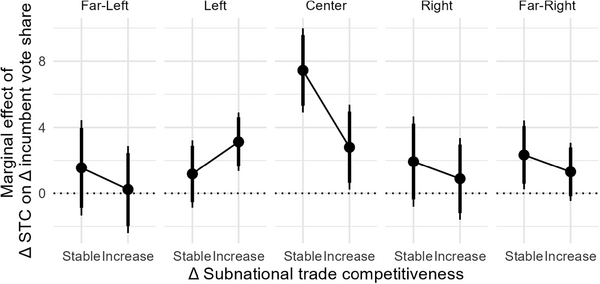
Our final hypothesis expects that the effect of changes in STC is particularly pronounced for economically right‐wing parties. Figure 2 visualizes the findings for this hypothesis (also see Table B3 in the Supporting Information Appendix). Specifically, the x‐axis shows the different STC changes, while the individual panels correspond to the ideological leaning of the incumbent party (from far‐left to far‐right). The y‐axis shows the marginal effect of STC stability and increase. In other words, a positive coefficient means that incumbents' electoral results are better when the STC stays stable or increases.
Hypothesis 3: Interaction effect with incumbent economic ideology. Based on Model 3 in Table B3 in the Supporting Information Appendix. The ranges represent 90 per cent and 95 per cent confidence intervals.

We do not observe a substantial change in the marginal effect of incumbent status across various levels of STC change for left‐ and right‐wing parties. In contrast, changes in STC positively correlate with changes in vote share of economically centrist incumbents. These results are at odds with our theoretical expectation outlined in H3. Rather, they suggest that the effect of STC changes is particularly strong in the centre.
In robustness checks, we replicated the analysis (a) relying on alternative measures of the dependent and independent variables to see whether our results are sensitive to the operationalization of key variables (see Supporting Information Appendix Sections C and D); (b) using a continuous measure of changes in STC and its square to make sure that the binning does not drive our results (Supporting Information Appendix Section E); (c) checking whether the effects are conditional on the level of STC because a region that did very well in terms of trade competitiveness may react differently to a decline in STC than one that was already doing badly (see Supporting Information Appendix Section F); (d) checking whether the effect is conditional on the size of the tradable sector in a region, since we would expect a stronger effect of STC change if the tradable sector is large (see Supporting Information Appendix section G); (e) adding GNI per capita growth (as a conventional measure of economic voting) as an additional control (see Supporting Information Appendix Section H); (f) investigating the sensitivity to dropping individual countries (see Supporting Information Appendix Section I); and (g) with an alternative random effects specification (see Supporting Information Appendix Section J). The Supporting Information Appendix sections contain detailed descriptions of the tests and the findings, which indicate that our results are robust and behave plausibly under various conditions.
Conclusion
Does trade matter for people's vote choice? Our argument and empirical findings suggest an affirmative answer to this question. Changes in regions' trade competitiveness have a considerable effect on changes in incumbents' vote shares. A decrease in STC hurts incumbents' electoral success; whereas incumbents' losses are much smaller in regions whose competitiveness stays steady or improves. This effect exists next to and beyond the effect of changes in per capita GDP on electoral outcomes. The effect of changes in competitiveness, however, is conditional on the country's political system and (although differently than originally expected) parties' or candidates' economic ideology. It only exists when clarity of responsibility is high but is absent when clarity of responsibility is low. Moreover, the effect is stronger for incumbents with an economically centrist ideology.
These findings contribute to an emerging literature on the electoral consequences of globalization (e.g., Colantone & Stanig, Reference Colantone and Stanig2018; Margalit, Reference Margalit2011; Milner, Reference Milner2021). So far, this literature has shown that import shocks increase vote shares of far‐right and populist parties. We add a distinct measure of exposure to the world economy, data for a larger and more diverse set of countries and the argument that the effects should vary across political systems and depending on parties' economic ideology to this literature. The research note also speaks to the already well‐established literature on economic voting (Lewis‐Beck & Stegmaier, Reference Lewis‐Beck and Stegmaier2019). Concretely, our findings suggest that voters engage in retrospective economic voting and that developments at the national level are not the only drivers of economic voting. At least partly, economic voting also responds to what happens at the subnational level. Finally, the paper explains why regions' trade competitiveness is reflected in legislators' trade attitudes (Dür et al., Reference Dür, Huber and Stiller2023).
In future research, it would be interesting to combine our observational approach with experimental data. Do respondents who are told that the competitiveness of their region has deteriorated show less support for the incumbent? Such experimental research could also help to disentangle the exact causal mechanism linking changes in trade competitiveness and changes in incumbent vote shares: Do voters mainly respond in an egotropic or a sociotropic manner to these changes? And do increases in imports and decreases in exports have the same effect? In terms of observational research, the next step would be to include an even larger number of countries in the analysis that would allow for an examination of other potential moderators of the effects we have studied here. With the world economy undergoing major changes, and these changes affecting the trade competitiveness of regions across the globe, this remains an exciting area of research.
Acknowledgements
This research has received funding from the European Research Council under the European Union's Horizon 2020 research and innovation programme (grant agreement No 724107). We gratefully acknowledge comments on earlier versions of this paper from Jessica Fortin‐Rittberger, Silvana Tarlea, the audiences at the 2022 conferences of the European Consortium for Political Research and the European Political Science Association as well as the editors of the European Journal of Political Research and four anonymous reviewers. We also thank statistical offices in various countries for giving us access to their data.
Data availability statement
All data required to enable full replication is available through the Harvard Dataverse (https://doi.org/10.7910/DVN/OCCX2K).
Online Appendix
Additional supporting information may be found in the Online Appendix section at the end of the article:
Data S1
 Δ
Δ Δ
Δ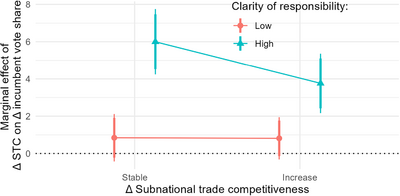


 Open access

