




1 Introduction
Let $\mathbb {D}$
and
$\mathbb {D}$
and $\partial \mathbb {D}=\{z:|z|=1\}$
denote, respectively, the open unit disc and the unit circle in the complex plane
$\partial \mathbb {D}=\{z:|z|=1\}$
denote, respectively, the open unit disc and the unit circle in the complex plane $\mathbb {C}.$
We denote as
$\mathbb {C}.$
We denote as $\mathrm{Mer}(\mathbb {D})$
the set of meromorphic functions defined in the unit disc
$\mathrm{Mer}(\mathbb {D})$
the set of meromorphic functions defined in the unit disc $\mathbb {D}$
. Let
$\mathbb {D}$
. Let $\mathrm{Hol}(\mathbb {D})$
be the space of all analytic functions on
$\mathrm{Hol}(\mathbb {D})$
be the space of all analytic functions on $\mathbb {D}$
.
$\mathbb {D}$
.
Given $g\in \mathrm{Hol}(\mathbb {D})$
, the Volterra-type operator
$g\in \mathrm{Hol}(\mathbb {D})$
, the Volterra-type operator $T_{g}$
is defined as
$T_{g}$
is defined as
 $$ \begin{align*}T_{g}f(z)=\int_{0}^{z}g'(\omega)f(\omega)\,d\omega,\quad\forall f\in \mathrm{Hol}(\mathbb{D}).\end{align*} $$
If $g=\log \frac {1}{1-z}$
, the Volterra-type operator
$g=\log \frac {1}{1-z}$
, the Volterra-type operator $T_{g}$
is known as the
$T_{g}$
is known as the $Ces\grave {a}ro$
operator. Another related integration operator is defined as
$Ces\grave {a}ro$
operator. Another related integration operator is defined as
 $$ \begin{align*}S_{g}f(z)=\int_{0}^{z}f'(\omega)g(\omega)\,d\omega,\quad\forall f\in \mathrm{Hol}(\mathbb{D}).\end{align*} $$
Denote the multiplication operator by $M_{g}f=fg$
, which satisfies the fundamental identity
$M_{g}f=fg$
, which satisfies the fundamental identity
 $$ \begin{align*}M_{g}f(z)=T_{g}f(z)+S_{g}f(z)+f(0)g(0).\end{align*} $$
On $H^2$
, the operator
$H^2$
, the operator $T_g$
is bounded if and only if
$T_g$
is bounded if and only if $g\in \mathrm {BMOA}$
[Reference Pommerenke11]; this extends to all
$g\in \mathrm {BMOA}$
[Reference Pommerenke11]; this extends to all $H^p$
with
$H^p$
with $1\le p<\infty $
[Reference Aleman and Siskakis2], and there is also a complete description of the boundedness of
$1\le p<\infty $
[Reference Aleman and Siskakis2], and there is also a complete description of the boundedness of $T_g:H^p\to H^q$
[Reference Aleman and Cima1]. For
$T_g:H^p\to H^q$
[Reference Aleman and Cima1]. For $g(z)=-\log (1-z),$
one recovers the shifted Cesàro operator, which is bounded on every
$g(z)=-\log (1-z),$
one recovers the shifted Cesàro operator, which is bounded on every $H^p$
[Reference Miao10, Reference Siskakis12], yet there exist functions
$H^p$
[Reference Miao10, Reference Siskakis12], yet there exist functions $f\notin H^p$
with
$f\notin H^p$
with $C(f)\in H^p$
. These facts motivated Curbera–Ricker to introduce the optimal domain viewpoint for C and, more generally, for
$C(f)\in H^p$
. These facts motivated Curbera–Ricker to introduce the optimal domain viewpoint for C and, more generally, for $T_g$
[Reference Curbera and Ricker5, Reference Curbera and Ricker6]. Conceptually, the Hardy theory shows that
$T_g$
[Reference Curbera and Ricker5, Reference Curbera and Ricker6]. Conceptually, the Hardy theory shows that $T_g$
measures the boundary oscillation of g through
$T_g$
measures the boundary oscillation of g through $g'$
, while the target space fixes the integrability scale. The optimal-domain perspective decouples “what the operator can accept” from any preassigned source space, which is precisely the lever one needs when the symbol has sparse regularity or large oscillation.
$g'$
, while the target space fixes the integrability scale. The optimal-domain perspective decouples “what the operator can accept” from any preassigned source space, which is precisely the lever one needs when the symbol has sparse regularity or large oscillation.
Definition 1.1 The space of the bounded analytic functions $H^{\infty }(\mathbb {D})$
consists of all functions f in
$H^{\infty }(\mathbb {D})$
consists of all functions f in $\mathrm{Hol}(\mathbb {D})$
such that
$\mathrm{Hol}(\mathbb {D})$
such that
 $$ \begin{align*}\|f\|_{\infty}=\sup\{|f(z)|:z\in \mathbb{D}\}. \end{align*} $$
Definition 1.2 If $0<\alpha \leq 1$
, the Lipschitz space
$0<\alpha \leq 1$
, the Lipschitz space $\Lambda _\alpha $
is defined as
$\Lambda _\alpha $
is defined as
 $$ \begin{align*}\Lambda_\alpha=\left\lbrace f \in \mathrm{Hol}(\mathbb{D}):\; \|f\|_{\Lambda_\alpha}=\sup\nolimits_{z \in \mathbb{D}}(1-|z|^2)^{1-\alpha} |f^{\prime}(z)|<\infty\right\rbrace. \end{align*} $$
For an in-depth description of the spaces $\Lambda _\alpha $
, we refer to [Reference Zhu14].
$\Lambda _\alpha $
, we refer to [Reference Zhu14].
Definition 1.3 For $0\leq \alpha <1$
, we also consider the Korenblum space
$0\leq \alpha <1$
, we also consider the Korenblum space $K_\alpha $
, defined as
$K_\alpha $
, defined as
 $$ \begin{align*}K_\alpha=\left\lbrace f \in \mathrm{Hol}(\mathbb D) :\; \|f\|_{K_\alpha}=\sup_{z \in \mathbb D}(1-|z|^2)^\alpha |f(z)|<\infty\right\rbrace.\end{align*} $$
We recall here some of the properties of $K_\alpha $
that we will use. First of all, it is clear that
$K_\alpha $
that we will use. First of all, it is clear that $f \in \Lambda _\alpha $
if and only if
$f \in \Lambda _\alpha $
if and only if $f' \in K_{1-\alpha }$
. Moreover, if
$f' \in K_{1-\alpha }$
. Moreover, if $f \in K_{\alpha }$
, then
$f \in K_{\alpha }$
, then $f \in K_\beta $
, for every
$f \in K_\beta $
, for every $\beta>\alpha $
. For an introduction to Korenblum spaces, we refer the reader to [Reference Korenblum8].
$\beta>\alpha $
. For an introduction to Korenblum spaces, we refer the reader to [Reference Korenblum8].
Definition 1.4 Let $\alpha>0$
, the Bloch-type space
$\alpha>0$
, the Bloch-type space $\mathcal {B}_{\alpha }$
is defined to be the space of
$\mathcal {B}_{\alpha }$
is defined to be the space of ${f\in \mathrm{Hol}(\mathbb {D})}$
such that
${f\in \mathrm{Hol}(\mathbb {D})}$
such that
 $$ \begin{align*}\|f\|_{\mathcal{B}_{\alpha}}:=|f(0)|+\sup\{(1-|z|^2)^{\alpha}|f'(z)|:z\in\mathbb{D}\}<\infty.\end{align*} $$
It is clear that $f \in \Lambda _\alpha $
if and only if
$f \in \Lambda _\alpha $
if and only if $f \in \mathcal {B}_{1-\alpha }$
. When
$f \in \mathcal {B}_{1-\alpha }$
. When $\alpha =1,$
it is the classical Bloch space
$\alpha =1,$
it is the classical Bloch space $\mathcal {B}.$
For further properties of Bloch-type spaces, we refer the reader to [Reference Hedenmalm, Korenblum and Zhu7, Reference Zhu15] and the references therein.
$\mathcal {B}.$
For further properties of Bloch-type spaces, we refer the reader to [Reference Hedenmalm, Korenblum and Zhu7, Reference Zhu15] and the references therein.
Definition 1.5 Given $0<\lambda < 2$
and
$0<\lambda < 2$
and $p>0$
, a function f in
$p>0$
, a function f in $\mathrm{Hol}(\mathbb {D})$
is said to belong to Bergman–Morrey space
$\mathrm{Hol}(\mathbb {D})$
is said to belong to Bergman–Morrey space $A^{p,\lambda }$
if
$A^{p,\lambda }$
if
 $$ \begin{align*}\|f\|_{A^{p,\lambda}}:=\left(|f(0)|^p+ \sup\limits_{a\in\mathbb{D}} (1-|a|^{2})^{2-\lambda}\int_{\mathbb{D}}|f'(z)|^{p}(1-|z|^{2})^{p}|\sigma^{\prime}_{a}(z)|^{2}dA(z)\right)^{\frac{1}{p}}<\infty,\end{align*} $$
where $\sigma _{a}(z)=\frac {a-z}{1-\overline {a}z}$
.
$\sigma _{a}(z)=\frac {a-z}{1-\overline {a}z}$
.
The Bergman–Morrey scale $A^{p,\lambda }$
may be viewed as a Morrey-type refinement of classical Bergman theory, aligned with the tent/Carleson-box geometry built into its definition. In particular, Yang–Liu developed a precise Carleson embedding for
$A^{p,\lambda }$
may be viewed as a Morrey-type refinement of classical Bergman theory, aligned with the tent/Carleson-box geometry built into its definition. In particular, Yang–Liu developed a precise Carleson embedding for $A^{p,\lambda }$
and established a mapping theory on this scale for the two Volterra-type integrals
$A^{p,\lambda }$
and established a mapping theory on this scale for the two Volterra-type integrals $T_g$
and
$T_g$
and $I_g$
– including norm and essential-norm formulations (e.g.,
$I_g$
– including norm and essential-norm formulations (e.g., $\|I_g\|\simeq \|g\|_{\infty }$
and
$\|I_g\|\simeq \|g\|_{\infty }$
and $\|T_g\|\simeq \|g\|_{\mathcal B}$
), as well as compactness criteria (see [Reference Yang and Liu13]). Against this background, the optimal-domain program becomes natural: for a fixed target
$\|T_g\|\simeq \|g\|_{\mathcal B}$
), as well as compactness criteria (see [Reference Yang and Liu13]). Against this background, the optimal-domain program becomes natural: for a fixed target $A^{p,\lambda }$
, we seek the largest (holo/mero)morphic input classes that
$A^{p,\lambda }$
, we seek the largest (holo/mero)morphic input classes that $T_g$
can admit while still landing in
$T_g$
can admit while still landing in $A^{p,\lambda }$
. Allowing meromorphic inputs with the constraint
$A^{p,\lambda }$
. Allowing meromorphic inputs with the constraint $fg'\in \mathrm{Hol}(\mathbb {D})$
neutralizes the zeros of
$fg'\in \mathrm{Hol}(\mathbb {D})$
neutralizes the zeros of $g'$
without losing analytic control of the primitive.
$g'$
without losing analytic control of the primitive.
In short, the space $A^{p,\lambda }$
supplies the right Carleson geometry and growth scale to quantify how much of
$A^{p,\lambda }$
supplies the right Carleson geometry and growth scale to quantify how much of $g'$
the Volterra primitive can absorb, and the (meromorphic) optimal domains record exactly that amount. In particular, when
$g'$
the Volterra primitive can absorb, and the (meromorphic) optimal domains record exactly that amount. In particular, when $\lambda =0$
,
$\lambda =0$
, $A^{p,0}=A^{p}$
. If
$A^{p,0}=A^{p}$
. If $0<\lambda \leq 2+p<\infty $
and
$0<\lambda \leq 2+p<\infty $
and $\alpha =\frac {p+2-\lambda }{p},$
then
$\alpha =\frac {p+2-\lambda }{p},$
then $A^{p,\lambda }$
is contained in the Bloch-type spaces
$A^{p,\lambda }$
is contained in the Bloch-type spaces $\mathcal {B}_{\alpha }$
.
$\mathcal {B}_{\alpha }$
.
For an arc $I\subset \partial \mathbb D$
, write
$I\subset \partial \mathbb D$
, write $|I|$
for its normalized arc length, so that
$|I|$
for its normalized arc length, so that $|\partial \mathbb D|=1$
. The Carleson box (or Carleson square) over I is defined by
$|\partial \mathbb D|=1$
. The Carleson box (or Carleson square) over I is defined by
 $$\begin{align*}S(I):=\bigl\{\, r e^{i\theta}\in\mathbb D:\ e^{i\theta}\in I,\ 1-|I|\le r<1 \,\bigr\}. \end{align*}$$
With this convention, if $I=\partial \mathbb D,$
then
$I=\partial \mathbb D,$
then $S(I)=\mathbb D$
(since
$S(I)=\mathbb D$
(since $|\partial \mathbb D|=1$
and hence
$|\partial \mathbb D|=1$
and hence $0\le r<1$
).
$0\le r<1$
).
Definition 1.6 [Reference Li, Liu and Lou9]
For $0<p<\infty ,$
a nonnegative measure
$0<p<\infty ,$
a nonnegative measure $\mu $
on
$\mu $
on $\mathbb {D}$
is called a p-Carleson measure if
$\mathbb {D}$
is called a p-Carleson measure if
 $$ \begin{align*}\sup _{I \subset \partial \mathbb{D}} \frac{\mu(S(I))}{|I|^{p}}<\infty.\end{align*} $$
When $p=1, ~1$
-Carleson measure is the classical Carleson measure.
$p=1, ~1$
-Carleson measure is the classical Carleson measure.
In [Reference Curbera and Ricker5], Curbera and Ricker showed that the optimal domain of the classical $Ces\grave {a}ro$
operator acting on Hardy spaces
$Ces\grave {a}ro$
operator acting on Hardy spaces $H^{p}(\mathbb {D})$
is strictly larger than
$H^{p}(\mathbb {D})$
is strictly larger than $H^{p}(\mathbb {D})$
. Then Bellavita et al. [Reference Bellavita, Daskalogiannis, Nikolaidis and Stylogiannis4] considered the optimal domain of
$H^{p}(\mathbb {D})$
. Then Bellavita et al. [Reference Bellavita, Daskalogiannis, Nikolaidis and Stylogiannis4] considered the optimal domain of $T_{g}$
acting on
$T_{g}$
acting on $H^{p}(\mathbb {D})$
and described its structural properties. The optimal domain of the Volterra-type operator
$H^{p}(\mathbb {D})$
and described its structural properties. The optimal domain of the Volterra-type operator $T_{g}$
acting on
$T_{g}$
acting on $A^{p,\lambda }$
is defined as follows:
$A^{p,\lambda }$
is defined as follows:
 $$ \begin{align*}[T_{g},A^{p,\lambda}]:=\{f\in \mathrm{Hol}(\mathbb{D})\,:\,T_{g}f\in A^{p,\lambda}\}.\end{align*} $$
Clearly, $[T_{g},A^{p,\lambda }]$
is a linear subspace of
$[T_{g},A^{p,\lambda }]$
is a linear subspace of $\mathrm{Hol}(\mathbb {D})$
. If g is constant, then
$\mathrm{Hol}(\mathbb {D})$
. If g is constant, then $[T_{g},A^{p,\lambda }]=\mathrm{Hol}(\mathbb {D})$
. If g is non-constant, this space is equipped with the norm
$[T_{g},A^{p,\lambda }]=\mathrm{Hol}(\mathbb {D})$
. If g is non-constant, this space is equipped with the norm
 $$ \begin{align*}\|f\|_{[T_{g},A^{p,\lambda}]}:=\|T_{g}f\|_{A^{p,\lambda}}.\end{align*} $$
The notation for the optimal domain follows that used in [Reference Bellavita, Daskalogiannis, Nikolaidis and Stylogiannis4].
Definition 1.7 Let $g\in \mathcal {B}$
and
$g\in \mathcal {B}$
and $1\leq p<\infty $
. The meromorphic optimal domain
$1\leq p<\infty $
. The meromorphic optimal domain $(T_g,A^{p,\lambda } )$
consists of all the functions
$(T_g,A^{p,\lambda } )$
consists of all the functions $f\in \mathrm{Mer}(\mathbb {D})$
, such that
$f\in \mathrm{Mer}(\mathbb {D})$
, such that $f g'\in \mathrm{Hol}(\mathbb {D})$
and
$f g'\in \mathrm{Hol}(\mathbb {D})$
and $T_g(f)\in A^{p,\lambda }.$
Zeros of $g'$
prevent a purely holomorphic domain from capturing all inputs f that are mapped by
$g'$
prevent a purely holomorphic domain from capturing all inputs f that are mapped by $T_g$
into the target space. Allowing f to be meromorphic, under the constraint
$T_g$
into the target space. Allowing f to be meromorphic, under the constraint $fg'\in \mathrm{Hol}(\mathbb {D})$
, restores a robust framework that mirrors the Hardy spaces setting and guarantees
$fg'\in \mathrm{Hol}(\mathbb {D})$
, restores a robust framework that mirrors the Hardy spaces setting and guarantees $T_g(f)$
is well defined. Also, the same condition implies that the poles of f belong to the zero set of
$T_g(f)$
is well defined. Also, the same condition implies that the poles of f belong to the zero set of $g'$
with at most the same multiplicity. In practice, this is the minimal enlargement that is stable under the algebra dictated by the identity
$g'$
with at most the same multiplicity. In practice, this is the minimal enlargement that is stable under the algebra dictated by the identity $(T_g f)'=g' f$
: it retains analytic control where it matters (on
$(T_g f)'=g' f$
: it retains analytic control where it matters (on $fg'$
) while accommodating the unavoidable singularities forced by the zeros of
$fg'$
) while accommodating the unavoidable singularities forced by the zeros of $g'$
.
$g'$
.
In order to study the properties of the meromorphic optimal domains, we remark that $(T_g,A^{p,\lambda })$
has the following description:
$(T_g,A^{p,\lambda })$
has the following description:
 $$ \begin{align} (T_g,A^{p,\lambda})=\biggl\{ f\in \mathrm{Mer}(\mathbb{D})\colon f(z)=\frac{h'(z)}{g'(z)} \text{ for some } h\in A^{p,\lambda}\biggr\} \end{align} $$
for non-constant $g \in \mathcal {B}.$
Viewed this way, $g'$
acts as a “change of density” between f and h: the zeros of
$g'$
acts as a “change of density” between f and h: the zeros of $g'$
are exactly the geometric barrier for bounded evaluations, and multiplier rigidity reflects that only bounded coefficients can be pushed through the Volterra primitive without losing control in the target space.
$g'$
are exactly the geometric barrier for bounded evaluations, and multiplier rigidity reflects that only bounded coefficients can be pushed through the Volterra primitive without losing control in the target space.
Characterizing all the functions $h \in \mathcal {B}$
such that
$h \in \mathcal {B}$
such that $(T_h,A^{p,\lambda })= (T_g,A^{p,\lambda })$
is an interesting problem. To address it, we define and study the following space.
$(T_h,A^{p,\lambda })= (T_g,A^{p,\lambda })$
is an interesting problem. To address it, we define and study the following space.
Definition 1.8 Let $1\leq p<\infty $
and
$1\leq p<\infty $
and $g\in \mathcal {B}$
. We consider the spaces
$g\in \mathcal {B}$
. We consider the spaces
 $$ \begin{align*} W_g^p&:=\left\lbrace h \in \mathcal{B} \colon (T_g,A^{p,\lambda})\subseteq (T_h,A^{p,\lambda})\right\rbrace,\\ V_g^p&:=\left\lbrace h \in \mathcal{B} \colon [T_g,A^{p,\lambda}]\subseteq [T_h,A^{p,\lambda}]\right\rbrace. \end{align*} $$
Our questions are symbol-theoretic: for which symbols do (mero)holomorphic optimal domains coincide, and how do these domains embed across symbols? The class
 $$\begin{align*}W_g:=\{\,h\in\mathcal B:\ (T_g,A^{p,\lambda})\subseteq (T_h,A^{p,\lambda})\,\} \end{align*}$$
is designed to capture meromorphic inclusion at the level of derivatives. Indeed, $(T_hF)'=h'F$
and
$(T_hF)'=h'F$
and $(T_gF)'=g'F$
show that inclusions are driven by factorizations
$(T_gF)'=g'F$
show that inclusions are driven by factorizations $h'=k\,g'$
. Our multiplier results identify the admissible coefficients as bounded analytic functions, which forces the structural formula
$h'=k\,g'$
. Our multiplier results identify the admissible coefficients as bounded analytic functions, which forces the structural formula
 $$\begin{align*}W_g=T_g(H^\infty)+\mathbb C, \end{align*}$$
and explains why $W_g$
does not depend on p. In turn, this yields practical equivalence criteria for meromorphic optimal domains and keeps the bookkeeping entirely at the symbolic level, exactly where the Volterra mechanism lives.
$W_g$
does not depend on p. In turn, this yields practical equivalence criteria for meromorphic optimal domains and keeps the bookkeeping entirely at the symbolic level, exactly where the Volterra mechanism lives.
Operationally, this says that the symbol is determined up to adding a Volterra primitive of a bounded function and a constant – an equivalence that packages the effect of g on optimal domains while stripping away inessential primitives. This p-independence is a strong hint that the phenomenon is structural rather than an artifact of a particular scale.
We emphasize that the general meromorphic optimal-domain framework for generalized Volterra operators, including the definition that allows meromorphic inputs f under the natural holomorphy condition $f g' \in \mathrm{Hol}(\mathbb{D})$
, as well as the associated symbol classes
$f g' \in \mathrm{Hol}(\mathbb{D})$
, as well as the associated symbol classes $W_g$
and
$W_g$
and $V_g$
and their core structural properties, was introduced and developed by Bellavita, Belli, Nikolaidis and Stylogiannis in [Reference Bellavita, Belli, Nikolaidis and Stylogiannis3]. Our contribution is to adapt and extend this
$V_g$
and their core structural properties, was introduced and developed by Bellavita, Belli, Nikolaidis and Stylogiannis in [Reference Bellavita, Belli, Nikolaidis and Stylogiannis3]. Our contribution is to adapt and extend this $W_g/V_g$
-based machinery to the Bergman–Morrey spaces, thereby obtaining sharp boundedness and (holo/mero)morphic optimal-domain descriptions for Volterra-type operators between Bergman–Morrey spaces.
$W_g/V_g$
-based machinery to the Bergman–Morrey spaces, thereby obtaining sharp boundedness and (holo/mero)morphic optimal-domain descriptions for Volterra-type operators between Bergman–Morrey spaces.
The article is organized as follows.
Section 2 collects preliminaries on Bergman–Morrey spaces, including equivalent norm characterizations and a sharp derivative growth estimate. Section 3 establishes sharp boundedness criteria for the Volterra-type maps between scales: $T_g:A^{p,\lambda _1}\!\to A^{p,\lambda _2}$
is bounded iff
$T_g:A^{p,\lambda _1}\!\to A^{p,\lambda _2}$
is bounded iff $g\in \mathcal B_{1+\frac {\lambda _1-\lambda _2}{p}}$
(for
$g\in \mathcal B_{1+\frac {\lambda _1-\lambda _2}{p}}$
(for $0<\lambda _1<\lambda _2<2$
,
$0<\lambda _1<\lambda _2<2$
, $p>\lambda _2-\lambda _1$
), and
$p>\lambda _2-\lambda _1$
), and $S_g:A^{p,\lambda _2}\!\to A^{p,\lambda _1}$
is bounded iff
$S_g:A^{p,\lambda _2}\!\to A^{p,\lambda _1}$
is bounded iff $g\in H^\infty $
. Section 4 develops the holomorphic optimal domain
$g\in H^\infty $
. Section 4 develops the holomorphic optimal domain $[T_g,A^{p,\lambda }]$
: we prove completeness (Banach structure), bounded point evaluations on compact sets, identify its multiplier algebra with
$[T_g,A^{p,\lambda }]$
: we prove completeness (Banach structure), bounded point evaluations on compact sets, identify its multiplier algebra with $H^\infty $
, and show strict inclusions as the parameters vary. Section 5 treats the meromorphic optimal domain
$H^\infty $
, and show strict inclusions as the parameters vary. Section 5 treats the meromorphic optimal domain $(T_g,A^{p,\lambda })$
: it coincides with
$(T_g,A^{p,\lambda })$
: it coincides with $\mathrm{Mer}(\mathbb D)$
exactly when g is constant; otherwise, it is a Banach space of meromorphic functions with bounded point evaluations off
$\mathrm{Mer}(\mathbb D)$
exactly when g is constant; otherwise, it is a Banach space of meromorphic functions with bounded point evaluations off $\mathcal Z(g')$
, multiplier algebra
$\mathcal Z(g')$
, multiplier algebra $H^\infty $
, and monotonicity in p. Section 6 introduces the symbol classes
$H^\infty $
, and monotonicity in p. Section 6 introduces the symbol classes $W_g$
and
$W_g$
and $V_g^p$
and analyzes symbol equivalence: we show
$V_g^p$
and analyzes symbol equivalence: we show $W_g=T_g(H^\infty )+\mathbb C$
(independent of p), obtain criteria for equality of optimal domains via bounded analytic multipliers, derive a comparison principle
$W_g=T_g(H^\infty )+\mathbb C$
(independent of p), obtain criteria for equality of optimal domains via bounded analytic multipliers, derive a comparison principle $g'=Bu'\Rightarrow V_g^p\subseteq V_u^p$
, and give a locally univalent corollary.
$g'=Bu'\Rightarrow V_g^p\subseteq V_u^p$
, and give a locally univalent corollary.
We use the symbol $\mathcal {Z}(h)$
to denote the zero set of
$\mathcal {Z}(h)$
to denote the zero set of $h\in \mathrm{Hol}(\mathbb {D})$
, where the elements of
$h\in \mathrm{Hol}(\mathbb {D})$
, where the elements of $\mathcal {Z}(h)$
are taken according to their multiplicities. For two functions F and
$\mathcal {Z}(h)$
are taken according to their multiplicities. For two functions F and $G,$
we write
$G,$
we write $F \lesssim G$
if there is a constant
$F \lesssim G$
if there is a constant $C>0$
, dependent only on parameters, such as
$C>0$
, dependent only on parameters, such as $p,\lambda ,\ldots $
, such that
$p,\lambda ,\ldots $
, such that $F \le CG.$
Furthermore, we denote
$F \le CG.$
Furthermore, we denote $F \approx G$
(i.e., F is comparable to G) if
$F \approx G$
(i.e., F is comparable to G) if $F \lesssim G \lesssim F$
holds.
$F \lesssim G \lesssim F$
holds.
2 Preliminaries
Lemma 2.1 [Reference Yang and Liu13, Remark 2.2]
Let $0<\lambda <2$
and
$0<\lambda <2$
and $p>0,$
then
$p>0,$
then $f \in \mathrm{Hol}(\mathbb {D})$
has the following equivalent norms in
$f \in \mathrm{Hol}(\mathbb {D})$
has the following equivalent norms in $A^{p, \lambda } :$
 $$ \begin{align*} \|f\|_{A^{p, \lambda}} & \approx|f(0)|+\sup _{a \in \mathbb{D}}\left(\left(1-|a|^{2}\right)^{2-\lambda} \int_{\mathbb{D}}\left|f^{\prime}(z)\right|{}^{p}\left(1-|z|^{2}\right)^{p}\left|\sigma_{a}^{\prime}(z)\right|{}^{2} d A(z)\right)^{\frac{1}{p}} \\ & \approx|f(0)|+\sup _{I \subset \partial \mathbb{D}}\left(\frac{1}{|I|^{\lambda}} \int_{S(I)}\left|f^{\prime}(z)\right|{}^{p}\left(1-|z|^{2}\right)^{p} d A(z)\right)^{\frac{1}{p}} \\ & \approx|f(0)|+\sup _{a \in \mathbb{D}}\left(\int_{\mathbb{D}}\left|f^{\prime}(z)\right|{}^{p}\left(1-|z|^{2}\right)^{p-\lambda}\left(1-\left|\sigma_{a}(z)\right|{}^{2}\right)^{\lambda} d A(z)\right)^{\frac{1}{p}}. \end{align*} $$
Estimating the growth rate of functions in $A^{p,\lambda }$
will be crucial for the subsequent proof of some later results.
$A^{p,\lambda }$
will be crucial for the subsequent proof of some later results.
Lemma 2.2 Let $0<\lambda <2$
and
$0<\lambda <2$
and $p \ge 1$
. If
$p \ge 1$
. If $f\in A^{p,\lambda }$
, then
$f\in A^{p,\lambda }$
, then
 $$ \begin{align*}|f'(z)|\lesssim\frac{\|f\|_{A^{p,\lambda}}}{(1-|z|^2)^{1+\frac{2-\lambda}{p}}},\quad \quad \forall z\in \mathbb{D}.\end{align*} $$
Proof Fix $b\in \mathbb {D}$
. Choose
$b\in \mathbb {D}$
. Choose $a=b$
in the above equivalent norm characterization and perform the change of variables
$a=b$
in the above equivalent norm characterization and perform the change of variables $z=\sigma _b(w)$
. By [Reference Zhu15, Lemma 4.12], we obtain
$z=\sigma _b(w)$
. By [Reference Zhu15, Lemma 4.12], we obtain
 $$ \begin{align*} \|f\|_{A^{p, \lambda}} & \approx|f(0)|+\sup _{a \in \mathbb{D}}\left[\left(1-|a|^{2}\right)^{2-\lambda} \int_{\mathbb{D}}\left|f^{\prime}(z)\right|{}^{p}\left(1-|z|^{2}\right)^{p}\left|\sigma_{a}^{\prime}(z)\right|{}^{2} d A(z)\right]^{\frac{1}{p}} \\ & \geq\left[\left(1-|b|^{2}\right)^{2-\lambda} \int_{\mathbb{D}}\left|f^{\prime}(z)\right|{}^{p}\left(1-|z|^{2}\right)^{p}\left|\sigma_{b}^{\prime}(z)\right|{}^{2} d A(z)\right]^{\frac{1}{p}} \\ & =\left[\left(1-|b|^{2}\right)^{2-\lambda} \int_{\mathbb{D}}\left|f^{\prime}\left(\sigma_{b}(w)\right)\right|{}^{p}\left(1-\left|\sigma_{b}(w)\right|{}^{2}\right)^{p} d A(w)\right]^{\frac{1}{p}} \\ & \gtrsim\left(1-|b|^{2}\right)^{1+\frac{2-\lambda}{p}}\left|f^{\prime}(b)\right|. \end{align*} $$
Since b is arbitrary, we conclude that
 $$ \begin{align*}\left | f'(z) \right | \lesssim \frac{\left \| f \right \|_{A^{p,\lambda} } }{(1-\left | z \right |^{2} ) ^{1+\frac{2-\lambda}{p}}},~~~~\forall z \in \mathbb{D}.\end{align*} $$
This completes the proof.
The next result leverages the derivative growth bound together with Carleson-box estimates to read off the exact Bloch-type regularity of the symbol.
3 Boundedness of Volterra operators
Having fixed the basic growth and box characterizations on $A^{p,\lambda },$
we now turn to the mapping theory of the Volterra kernels. The next section isolates the precise symbol regularity that governs boundedness between Bergman–Morrey scales.
$A^{p,\lambda },$
we now turn to the mapping theory of the Volterra kernels. The next section isolates the precise symbol regularity that governs boundedness between Bergman–Morrey scales.
Theorem 3.1 For $0< \lambda _{1}<\lambda _{2}<2$
and
$0< \lambda _{1}<\lambda _{2}<2$
and $p>\lambda _{2}-\lambda _{1} $
, the operator
$p>\lambda _{2}-\lambda _{1} $
, the operator $T_{g}:A^{p,\lambda _{1}} \to A^{p,\lambda _{2}}$
is bounded if and only if
$T_{g}:A^{p,\lambda _{1}} \to A^{p,\lambda _{2}}$
is bounded if and only if $g \in \mathcal {B}_{\alpha }$
, where
$g \in \mathcal {B}_{\alpha }$
, where $\alpha =1+\frac {\lambda _{1}-\lambda _{2}}{p}.$
Proof Suppose $g \in \mathcal {B}_{\alpha }$
,
$g \in \mathcal {B}_{\alpha }$
, $\alpha =1+\frac {\lambda _{1}-\lambda _{2}}{p}.$
For any
$\alpha =1+\frac {\lambda _{1}-\lambda _{2}}{p}.$
For any $f \in A^{p,\lambda _{1}}$
and any arc
$f \in A^{p,\lambda _{1}}$
and any arc $I\subset \partial \mathbb {D},$
let
$I\subset \partial \mathbb {D},$
let $\zeta \in \partial \mathbb {D}$
be the center of the arc I, and set
$\zeta \in \partial \mathbb {D}$
be the center of the arc I, and set $b=(1-\left | I \right | )\zeta \in \mathbb {D}.$
Then we have
$b=(1-\left | I \right | )\zeta \in \mathbb {D}.$
Then we have
 $$ \begin{align*} \frac{1}{|I|^{\lambda_{2}}} & \int_{S(I)}\left|\left(T_{g} f\right)^{\prime}(z)\right|{}^{p}\left(1-|z|^{2}\right)^{p} d A(z) \\& =\frac{1}{|I|^{\lambda_{2}}} \int_{S(I)}|f(z)|^{p}\left|g^{\prime}(z)\right|{}^{p}\left(1-|z|^{2}\right)^{p} d A(z) \\& \lesssim \frac{1}{|I|^{\lambda_{2}}} \int_{S(I)}|f(b)|^{p}\left|g^{\prime}(z)\right|{}^{p}\left(1-|z|^{2}\right)^{p} d A(z)\\&\quad + \frac{1}{|I|^{\lambda_{2}}}\int_{S(I)}|f(z)-f(b)|^{p}\left|g^{\prime}(z)\right|{}^{p}\left(1-|z|^{2}\right)^{p} d A(z) \\& \triangleq I_{1}+I_{2}. \end{align*} $$
For $I_{1}$
, by [Reference Yang and Liu13, Lemma 2.3], we obtain
$I_{1}$
, by [Reference Yang and Liu13, Lemma 2.3], we obtain
 $$ \begin{align*}|f(b)| \lesssim \frac{\|f\|_{A^{p,\lambda_{1}}}}{\left(1-|b|^{2}\right)^{\frac{2-\lambda_{1}}{p}}} \lesssim \frac{\|f\|_{A^{p,\lambda_{1}}}}{|I|^{\frac{2-\lambda_{1}}{p}}}.\end{align*} $$
We could estimate
 $$ \begin{align*} I_{1}&=\frac{1}{|I|^{\lambda_{2}}} \int_{S(I)}|f(b)|^{p}\left|g^{\prime}(z)\right|{}^{p}\left(1-|z|^{2}\right)^{p} d A(z)\\ &\lesssim\left \| f \right \|^{p} _{A^{p,\lambda_{1}}} \frac{1}{\left | I \right |^{2+\lambda_{2}-\lambda_{1}}} \int_{S(I)}\left|g^{\prime}(z)\right|{}^{p}\left(1-|z|^{2}\right)^{p} d A(z)\\ &\lesssim\|g\|_{\mathcal{B}_{\alpha}}^{p}\left \| f \right \|^{p} _{A^{p,\lambda_{1}}}. \end{align*} $$
Now, we estimate the term $I_{2}$
. Let
$I_{2}$
. Let $d\mu _{g}(z)=|{g}' (z)|^{p}(1-|z|^{2})^{p}dA(z).$
For any
$d\mu _{g}(z)=|{g}' (z)|^{p}(1-|z|^{2})^{p}dA(z).$
For any $z\in S(I)$
, we know that
$z\in S(I)$
, we know that
 $$ \begin{align*}1-\left|\sigma_{b}(z)\right|{}^{2} \gtrsim \frac{1-|z|^{2}}{|I|}.\end{align*} $$
For any $z,b\in \mathbb {D}$
, it is easy to see
$z,b\in \mathbb {D}$
, it is easy to see $(1-|z|)\leq |1-\overline {b}z|.$
Since
$(1-|z|)\leq |1-\overline {b}z|.$
Since $g\in \mathcal {B} _{\alpha },\alpha =1+\frac {\lambda _{1}-\lambda _{2}}{p},$
then
$g\in \mathcal {B} _{\alpha },\alpha =1+\frac {\lambda _{1}-\lambda _{2}}{p},$
then $d\mu _{g}(z)$
is a
$d\mu _{g}(z)$
is a $(2+\lambda _{2}-\lambda _{1})$
-Carleson measure, combining the above conditions yields
$(2+\lambda _{2}-\lambda _{1})$
-Carleson measure, combining the above conditions yields
 $$ \begin{align*} I_{2} & =\frac{1}{|I|^{\lambda_{2}}} \int_{S(I)}|f(z)-f(b)|^{p}\left|g^{\prime}(z)\right|{}^{p}(1-|z|^{2})^{p}dA(z) \\ & \approx (1-|b|^{2})^{2-\lambda_{2}} \int_{S(I)}\frac{|f(z)-f(b)|^{p}(1-|b|^{2})^{2}}{|1-\bar{b}z|^{4}}\left|g^{\prime}(z)\right|{}^{p}\left(1-\left|z\right|{}^{2}\right)^{p} dA(z) \\ & \approx (1-|b|^{2})^{2} \int_{S(I)}\frac{|f(z)-f(b)|^{p}(1-|b|^{2})^{2}}{|1-\bar{b}z|^{4+\lambda_{2}}}\left|g^{\prime}(z)\right|{}^{p}\left(1-\left|z\right|{}^{2}\right)^{p} d A(z) \\ &\approx (1-|b|^{2})^{2-\lambda_{1}} \int_{S(I)}\frac{|f(z)-f(b)|^{p}(1-|b|^{2})^{2}}{|1-\bar{b}z|^{4+\lambda_{2}-\lambda_{1} }}\left|g^{\prime}(z)\right|{}^{p}\left(1-\left|z\right|{}^{2}\right)^{p} d A(z) \\ & \lesssim\left \| g \right \| _{\mathcal{B_{\alpha}}}^{p} (1-|b|^{2})^{2-\lambda_{1}} \int_{\mathbb{D} }\frac{|f(z)-f(b)|^{p}(1-|b|^{2})^{2}}{|1-\bar{b}z|^{4+\lambda_{2}-\lambda_{1}}}\left(1-\left|z\right|{}^{2}\right)^{\lambda_{2}-\lambda_{1}} d A(z) \\ &\lesssim\left \| g \right \| _{\mathcal{B_{\alpha}}}^{p} (1-|b|^{2})^{2-\lambda_{1}} \int_{\mathbb{D} }\frac{|f(z)-f(b)|^{p}(1-|b|^{2})^{2}}{|1-\bar{b}z|^{4}}d A(z) \\ & \lesssim\left \| g \right \| _{\mathcal{B_{\alpha}}}^{p}\left \| f \circ \sigma_{b}(z)-f(b) \right \|_{A^{p}}^{p}\lesssim \left \| g \right \| _{\mathcal{B_{\alpha}}}^{p}\left \| f \right \|_{A^{p, \lambda_{1}}}^{p}.\\ \end{align*} $$
Consequently,
 $$ \begin{align*}\left\|T_{g} f\right\|_{A^{p, \lambda_{2}}}^{p} \lesssim I_{1}+I_{2} \lesssim\|g\|_{\mathcal{B}_{\alpha}}^{p}\|f\|_{A^{p, \lambda_{1}}}^{p},\end{align*} $$
which implies $\left \|T_{g}\right \| \lesssim \|g\|_{\mathcal {B_{\alpha }}}.$
On the other hand, assume $T_{g}:A^{p,\lambda _{1}} \to A^{p,\lambda _{2}}$
is bounded. For any
$T_{g}:A^{p,\lambda _{1}} \to A^{p,\lambda _{2}}$
is bounded. For any $I \subset \partial \mathbb {D},$
let
$I \subset \partial \mathbb {D},$
let $b=(1-|I|) \zeta \in \mathbb {D},$
where
$b=(1-|I|) \zeta \in \mathbb {D},$
where $\zeta $
is the center of
$\zeta $
is the center of $I.$
Then
$I.$
Then
 $$ \begin{align*}\left(1-|b|^{2}\right) \approx|1-\bar{b} z| \approx|I|, \quad z \in S(I)\end{align*} $$
(see [Reference Zhu15]). Let us consider the test function
 $$ \begin{align*}F_{b}(z)=(1-\left | b \right |^{2} )(|1-\bar{b} z|)^{\frac{\lambda_{1}-2}{p}-1}, ~ \text{ where}~ z\in \mathbb{D}. \end{align*} $$
It follows from [Reference Yang and Liu13, Lemma 4.2] that $F_{b}\in A^{p,\lambda _{1}} $
and
$F_{b}\in A^{p,\lambda _{1}} $
and $\left \| F_{b} (z)\right \| _{A^{p,\lambda _{1}}} \lesssim 1$
. Accordingly,
$\left \| F_{b} (z)\right \| _{A^{p,\lambda _{1}}} \lesssim 1$
. Accordingly,
 $$ \begin{align*} \frac{1}{|I|^{2+\lambda_{2}-\lambda_{1}}} &\int_{S(I)}\left|g^{\prime}(z)\right|{}^{p}\left(1-|z|^{2}\right)^{p} d A(z) \\ &\lesssim \frac{1}{|I|^{\lambda_{2}}} \int_{S(I)} \frac{(1-\left | b \right |^{2} )^{p}}{\left | 1-\overline{b} z \right |^{2+p-\lambda_{1}} }\left|g^{\prime}(z)\right|{}^{p}\left(1-|z|^{2}\right)^{p} d A(z) \\ &=\frac{1}{|I|^{\lambda_{2}}} \int_{S(I)}\left|F_{b}(z)\right|{}^{p}\left|g'(z)\right|{}^{p}\left(1-|z|^{2}\right)^{p} d A(z)\\ &=\frac{1}{|I|^{\lambda_{2}}} \int_{S(I)}\left|\left(T_{g} F_{b}\right)^{\prime}(z)\right|{}^{p}\left(1-|z|^{2}\right)^{p} d A(z)\\ & \lesssim\left\|T_{g} F_{b}\right\|_{A^{p,\lambda_{2}}}^{p} \lesssim\left\|F_{b}\right\|_{A^{p,\lambda_{1}}}^{p}. \end{align*} $$
Since I is arbitrary, we conclude that $g \in \mathcal {B}_{1+\frac {\lambda _{1}-\lambda _{2}}{p}}$
, which completes the proof.
$g \in \mathcal {B}_{1+\frac {\lambda _{1}-\lambda _{2}}{p}}$
, which completes the proof.
Complementing the $T_g$
, the companion operator
$T_g$
, the companion operator $S_g$
exhibits a sharper rigidity: boundedness collapses to boundedness of the symbol itself.
$S_g$
exhibits a sharper rigidity: boundedness collapses to boundedness of the symbol itself.
Theorem 3.2 Let $0< \lambda _{1}<\lambda _{2}<2$
. Then
$0< \lambda _{1}<\lambda _{2}<2$
. Then $S_{g}:A^{p,\lambda _{2}} \to A^{p,\lambda _{1}}$
is bounded if and only if
$S_{g}:A^{p,\lambda _{2}} \to A^{p,\lambda _{1}}$
is bounded if and only if $g \in H^{\infty }(\mathbb {D})$
.
$g \in H^{\infty }(\mathbb {D})$
.
Proof Let $g \in H^{\infty }(\mathbb {D}).$
For any
$g \in H^{\infty }(\mathbb {D}).$
For any $f \in A^{p,\lambda _{2}}(\mathbb {D}),$
we have
$f \in A^{p,\lambda _{2}}(\mathbb {D}),$
we have
 $$ \begin{align*} \left\|S_{g} f\right\|^{p}_{A^{p,\lambda_{1}}} &=\sup_{b \in \mathbb{D}}(1-|b|^{2})^{2-\lambda_{1}}\int_{\mathbb{D}}|{f}'(z) |^{p}|g(z)|^{p}(1-|z|^{2})^{p}|{\sigma_{b}}'(z)|^{2}dA(z)\\ &\lesssim \left \| g \right \|^{p}_{\infty} \sup_{b\in \mathbb{D}}(1-|b|^{2})^{\lambda_{2}-\lambda_1}(1-|b|^{2})^{2-\lambda_{2}}\int_{\mathbb{D} }|{f}'(z) |^{p}|{\sigma_{b}}'(z)|^{2}(1-|z|^{2})^{p}dA(z)\\ &\lesssim\left \| g \right \|^{p}_{\infty} \left \| f \right \|^{p}_{A^{p,\lambda_{2}}}\sup_{b\in \mathbb{D}}(1-|b|^{2})^{\lambda_{2}-\lambda_{1}}\\ &\lesssim \left \| g \right \|^{2}_{\infty}\left \| f \right \|^{2}_{A^{p,\lambda_{2}}}. \end{align*} $$
This leads to the boundedness of $S_{g}$
from
$S_{g}$
from $A^{p,\lambda _{2}}$
into
$A^{p,\lambda _{2}}$
into $A^{p,\lambda _{1}}$
.
$A^{p,\lambda _{1}}$
.
Conversely, if $S_{g}$
is bounded from
$S_{g}$
is bounded from $A^{p,\lambda _{2}}(\mathbb {D})$
to
$A^{p,\lambda _{2}}(\mathbb {D})$
to $A^{p,\lambda _{1}}(\mathbb {D}).$
For any
$A^{p,\lambda _{1}}(\mathbb {D}).$
For any $b \in \mathbb {D},$
set
$b \in \mathbb {D},$
set
 $$ \begin{align*}f_{b}(z)=(1-|b|^{2})^{\frac{\lambda_{2}-2}{p}} (\sigma _{b}(z)-b),\end{align*} $$
then $f_{b}(z) \in A^{p,\lambda _{2}}$
and
$f_{b}(z) \in A^{p,\lambda _{2}}$
and $\|f_{b}\|_{A^{p,\lambda _{2}}}\lesssim 1$
(e.g., [Reference Yang and Liu13, Lemma 4.2]). Thus, we get
$\|f_{b}\|_{A^{p,\lambda _{2}}}\lesssim 1$
(e.g., [Reference Yang and Liu13, Lemma 4.2]). Thus, we get
 $$ \begin{align*} \|f_{b}\|^{p}_{A^{p,\lambda_{2}}} & \gtrsim\left\|S_{g} f_{b}\right\|^{p}_{A^{p,\lambda_{1}}} \\ &\approx \sup _{a \in \mathbb{D}}\left(1-|a|^{2}\right)^{2-\lambda_{1}} \int_{\mathbb{D}}\left|f_{b}^{\prime}(z)\right|{}^{p}|g(z)|^{p}(1-|z|^{2})^{p}\left|\sigma_{a}^{\prime}(z)\right|{}^{2} d A(z)\\ & \geqslant\int_{\mathbb{D}}\left|\sigma_{b}^{\prime}(z)\right|{}^{p}|g(z)|^{p}(1-|z|^{2})^{p}\left|\sigma_{b}^{\prime}(z)\right|{}^{2} d A(z)\\ & =\int_{\mathbb{D}}\left|g\left(\sigma_{b}(w)\right)\right|{}^{p}\left(1-|w|^{2}\right)^{p} d A(w)\\ & \gtrsim|g(b)|^{p}, \end{align*} $$
where we used [Reference Zhu15, Lemma 4.12] again in the last inequality. Since b is arbitrary, we have $g\in H^{\infty }(\mathbb {D})$
.
$g\in H^{\infty }(\mathbb {D})$
.
The boundedness criteria determine what $T_g$
can do once a source space is fixed. To decouple the operator from any preassigned source, we pass to the optimal-domain viewpoint and endow
$T_g$
can do once a source space is fixed. To decouple the operator from any preassigned source, we pass to the optimal-domain viewpoint and endow $[T_{g},A^{p,\lambda }]$
with its natural norm.
$[T_{g},A^{p,\lambda }]$
with its natural norm.
4 The structure of the optimal domain
In this section, we identify the optimal domain of the Volterra operator $T_g$
on the Bergman–Morrey space
$T_g$
on the Bergman–Morrey space $A^{p,\lambda },$
namely,
$A^{p,\lambda },$
namely, $[T_{g},A^{p,\lambda }],$
and develop its fundamental properties as a Banach space.
$[T_{g},A^{p,\lambda }],$
and develop its fundamental properties as a Banach space.
Firstly, for $1\leq p<\infty $
, it is easy to verify
$1\leq p<\infty $
, it is easy to verify $([T_{g},A^{p,\lambda }],\|\cdot \|_{[T_{g},A^{p,\lambda }]})$
be a normed linear space. Non-negativity and absolute homogeneity can be directly verified. For triangle inequality, by the Minkowski inequality, we get
$([T_{g},A^{p,\lambda }],\|\cdot \|_{[T_{g},A^{p,\lambda }]})$
be a normed linear space. Non-negativity and absolute homogeneity can be directly verified. For triangle inequality, by the Minkowski inequality, we get
 $$ \begin{align*} \|f+h\|_{[T_{g},A^{p,\lambda}]}&=\sup\limits_{a\in\mathbb{D}} (1-|a|^{2})^{2-\lambda}\left[\int_{\mathbb{D}}|f(z)+h(z)|^{p}|g'(z)|^{p}(1-|z|^{2})^{p}|\sigma^{\prime}_{a}(z)|^{2}dA(z)\right]^{\frac{1}{p}}\\&\leq\sup\limits_{a\in\mathbb{D}} (1-|a|^{2})^{2-\lambda}\left[ \int_{\mathbb{D}}|f(z)|^{p}|g'(z)|^{p}(1-|z|^{2})^{p}|\sigma^{\prime}_{a}(z)|^{2}dA(z)\right]^{\frac{1}{p}}\\& \quad +\sup\limits_{a\in\mathbb{D}} (1-|a|^{2})^{2-\lambda}\left[\int_{\mathbb{D}}|h(z)|^{p}|g'(z)|^{p}(1-|z|^{2})^{p}|\sigma^{\prime}_{a}(z)|^{2}dA(z)\right]^{\frac{1}{p}}\\&=\|f\|_{[T_{g},A^{p,\lambda}]}+\|h\|_{[T_{g},A^{p,\lambda}]}. \end{align*} $$
Now, we give the boundedness of the point evaluation.
Lemma 4.1 Let K be a compact subset of $\mathbb {D}$
, for any
$\mathbb {D}$
, for any $z_{0} \in K\subseteq \mathbb {D}$
, then
$z_{0} \in K\subseteq \mathbb {D}$
, then $\delta _{z_{0}}(f)=f(z_{0})$
is bounded linear functional on
$\delta _{z_{0}}(f)=f(z_{0})$
is bounded linear functional on $\left [ T_{g},A^{p,\lambda } \right ].$
Proof Let $\delta _{z_{0}}(f)=f(z_{0})$
be a point evaluation of
$\delta _{z_{0}}(f)=f(z_{0})$
be a point evaluation of $\left [ T_{g},A^{p,\lambda } \right ]$
. In every compact subset K of
$\left [ T_{g},A^{p,\lambda } \right ]$
. In every compact subset K of $\mathbb {D},$
for any
$\mathbb {D},$
for any $z_{0} \in \mathbb {D},$
we need to prove
$z_{0} \in \mathbb {D},$
we need to prove $\delta _{z_{0}}(f):A^{p,\lambda } \longrightarrow \mathbb {C}$
is bounded, it means to demonstrate
$\delta _{z_{0}}(f):A^{p,\lambda } \longrightarrow \mathbb {C}$
is bounded, it means to demonstrate $|f(z_{0})|\le C\left \| f \right \|_{\left [ T_{g},A^{p,\lambda } \right ]}.$
For any $f \in \left [ T_{g},A^{p,\lambda } \right ]$
, namely,
$f \in \left [ T_{g},A^{p,\lambda } \right ]$
, namely, $T_{g}f \in A^{p,\lambda },$
then by Lemma 2.2,
$T_{g}f \in A^{p,\lambda },$
then by Lemma 2.2,
 $$ \begin{align*} |f(z_0)\cdot g'(z_0)|&=\,|(T_gf)'(z_0)|\\ &\lesssim \, \dfrac{\|T_g(f)\|_{A^{p,\lambda}}}{(1-|z_0|^2)^{1+\frac{2-\lambda}{p}}} =\dfrac{\|f\|_{[T_{g},A^{p,\lambda}]}}{(1-|z_0|^2)^{1+\frac{2-\lambda}{p}}}.\end{align*} $$
If $g'(z_{0} )\ne 0$
, then
$g'(z_{0} )\ne 0$
, then
 $$\begin{align*}|f(z_0)|\lesssim \frac{\|f\|_{[T_g,A^{p,\lambda}]}}{|g'(z_0)|(1-|z_0|^2)^{1+\frac{2-\lambda}{p}}}. \end{align*}$$
If $g'(z_{0} ) = 0,$
there exists an annulus
$g'(z_{0} ) = 0,$
there exists an annulus $A_{z_{0}} \subseteq K \subseteq \mathbb {D}$
centered at
$A_{z_{0}} \subseteq K \subseteq \mathbb {D}$
centered at $z_{0}$
such that
$z_{0}$
such that
 $$ \begin{align*}\min_{\zeta\in A_{z_0}}|g'(\zeta)|>\varepsilon>0. \end{align*} $$
Combining [Reference Zhu15, Lemma 4.12] and $\left |{A_{z_0}}\right |$
the area of the annulus
$\left |{A_{z_0}}\right |$
the area of the annulus $A_{z_{0}}$
shows
$A_{z_{0}}$
shows
 $$ \begin{align*} |f(z_0)|&\leq \frac{1}{|A_{z_0}|}\int_{A_{z_0}}|f(w)|\,dA(w)\\ &\lesssim \frac{1}{|A_{z_0}|}\int_{A_{z_0}}\frac{\|f\|_{[T_g,A^{p,\lambda}]}}{(1-|w|^2)^{1+\frac{2-\lambda}{p}}\min_{\zeta\in A_{z_0}}|g'(\zeta)|}\,dA(w)\\ & =\frac{\|f\|_{[T_g,A^{p,\lambda}]}}{\varepsilon|A_{z_0}|}\int_{A_{z_0}}\frac{1}{(1-|w|^2)^{1+\frac{2-\lambda}{p}}}\,dA(w)= C\,\|f\|_{[T_g,A^{p,\lambda}]}, \end{align*} $$
where $C>0$
depends only on
$C>0$
depends only on $z_0.$
In summary,
$z_0.$
In summary, $~~\delta _{z_{0}} $
is bounded linear functional on
$~~\delta _{z_{0}} $
is bounded linear functional on $\left [ T_{g},A^{p,\lambda } \right ].$
With point evaluations under control on compacta, completeness follows by a standard Cauchy-limit argument transported through $T_g.$
Theorem 4.2 Let $0<\lambda <2, p \ge 1,$
and
$0<\lambda <2, p \ge 1,$
and $g\in \mathcal {B}$
. Then
$g\in \mathcal {B}$
. Then $[T_g,A^{p,\lambda } ]$
equipped with the norm
$[T_g,A^{p,\lambda } ]$
equipped with the norm $\|\cdot \|_{[T_g,A^{p,\lambda }] }$
is a Banach space.
$\|\cdot \|_{[T_g,A^{p,\lambda }] }$
is a Banach space.
Proof Let $\{f_n\}$
be a Cauchy sequence in
$\{f_n\}$
be a Cauchy sequence in $[T_g,A^{p,\lambda }]$
, that is,
$[T_g,A^{p,\lambda }]$
, that is,
 $$ \begin{align*} \|f_n-f_m\|_{[T_g,A^{p,\lambda}]}=\|T_g(f_n-f_m)\|_{A^{p,\lambda}}\rightarrow 0 \quad \text{as} \quad m,n\to \infty.\ \end{align*} $$
So $\left \{ T_{g}(f_{n}) \right \}$
is a Cauchy sequence in
$\left \{ T_{g}(f_{n}) \right \}$
is a Cauchy sequence in $A^{p,\lambda }(\mathbb {D})$
. Since [Reference Yang and Liu13] already proved
$A^{p,\lambda }(\mathbb {D})$
. Since [Reference Yang and Liu13] already proved $A^{p,\lambda }(\mathbb {D})$
is a Banach space under
$A^{p,\lambda }(\mathbb {D})$
is a Banach space under $0<\lambda <2, p \ge 1$
, then there exists
$0<\lambda <2, p \ge 1$
, then there exists $k \in A^{p,\lambda }$
such that
$k \in A^{p,\lambda }$
such that $\|T_{g}(f_{n})-k\|_{A^{p,\lambda }} \rightarrow 0$
as
$\|T_{g}(f_{n})-k\|_{A^{p,\lambda }} \rightarrow 0$
as $n\rightarrow \infty .$
For any
$n\rightarrow \infty .$
For any $f \in A^{p,\lambda },$
by Lemma 2.2,
$f \in A^{p,\lambda },$
by Lemma 2.2,
 $$ \begin{align*}\left | f'(z) \right | \lesssim \frac{\|f\|_{A^{p,\lambda}}}{(1-|z|^2)^{1+\frac{2-\lambda}{p}}},\quad \quad \forall z\in \mathbb{D}. \end{align*} $$
Then for any $z \in \mathbb {D},$
 $$ \begin{align*}\left | (T_{g}f_{n}-k)^{'} (z) \right | \lesssim \frac{\|(T_{g}f_{n}-k)\|_{A^{p,\lambda}}}{(1-|z|^2)^{1+\frac{2-\lambda}{p}}} \rightarrow 0, \end{align*} $$
which means that $T_g'(f_n)(z)\rightarrow k'(z)$
as
$T_g'(f_n)(z)\rightarrow k'(z)$
as $n\rightarrow \infty .$
By Lemma 4.1, we have
$n\rightarrow \infty .$
By Lemma 4.1, we have
 $$ \begin{align*}\left | \delta _{z_{0} }(f_{n}-f_{m} ) \right | \lesssim \left \| f_{n}-f_{m} \right \| _{[T_g,A^{p,\lambda}]},\quad \forall z_{0} \in K\subseteq \mathbb{D}. \end{align*} $$
Thus, $\left | f_{n}(z_{0})-f_{m}(z_{0}) \right | \rightarrow 0$
as
$\left | f_{n}(z_{0})-f_{m}(z_{0}) \right | \rightarrow 0$
as $n,m \rightarrow \infty .$
Since we also know
$n,m \rightarrow \infty .$
Since we also know $f_{n}(z_{0}) \rightarrow f(z_{0}) $
as
$f_{n}(z_{0}) \rightarrow f(z_{0}) $
as $n \rightarrow \infty .$
Taking the primitives, then
$n \rightarrow \infty .$
Taking the primitives, then $k(z)=\int _{0}^{z} f(w)g^{'}(w)dw+C.$
And because
$k(z)=\int _{0}^{z} f(w)g^{'}(w)dw+C.$
And because $\left \| T_{g}(f_{n})-k \right \| _{A^{p,\lambda }}\rightarrow 0$
as
$\left \| T_{g}(f_{n})-k \right \| _{A^{p,\lambda }}\rightarrow 0$
as $n \rightarrow \infty , $
we have
$n \rightarrow \infty , $
we have $\left | T_{g}(f_{n})(0)-k(0) \right |\rightarrow 0 $
as
$\left | T_{g}(f_{n})(0)-k(0) \right |\rightarrow 0 $
as $n \rightarrow \infty $
. Finally, we get
$n \rightarrow \infty $
. Finally, we get $0=T_{g}(f_{n})(0)\rightarrow k(0)=C,$
namely,
$0=T_{g}(f_{n})(0)\rightarrow k(0)=C,$
namely, $C=0.$
So
$C=0.$
So $k=T_{g}(f),$
which completes the proof.
$k=T_{g}(f),$
which completes the proof.
Theorem 4.3 For $0<\lambda <2$
and
$0<\lambda <2$
and $p\ge 1$
,
$p\ge 1$
,
 $$\begin{align*}A^{p,\lambda}\ \subset\ \bigcap_{g\in\mathcal B}[T_g,A^{p,\lambda}]. \end{align*}$$
Proof If $g\in \mathcal B$
, then by [Reference Yang and Liu13, Theorem 4.4], we know
$g\in \mathcal B$
, then by [Reference Yang and Liu13, Theorem 4.4], we know $T_g:A^{p,\lambda }\to A^{p,\lambda }$
is bounded. Hence, for any
$T_g:A^{p,\lambda }\to A^{p,\lambda }$
is bounded. Hence, for any $f\in A^{p,\lambda }$
, we have
$f\in A^{p,\lambda }$
, we have $T_g(f)\in A^{p,\lambda }$
, that is,
$T_g(f)\in A^{p,\lambda }$
, that is, $f\in [T_g,A^{p,\lambda }]$
. Intersect over all
$f\in [T_g,A^{p,\lambda }]$
. Intersect over all $g\in \mathcal B$
.
$g\in \mathcal B$
.
Remark 4.4 Let $0<\lambda <2$
,
$0<\lambda <2$
, $p\ge 1$
, and
$p\ge 1$
, and $g\in \mathcal B.$
Then
$g\in \mathcal B.$
Then
 $$\begin{align*}A^{p,\lambda}\ \subsetneq\ [T_g,A^{p,\lambda}]. \end{align*}$$
Theorem 4.5 Let $0<\lambda <2, p \ge 1,$
and
$0<\lambda <2, p \ge 1,$
and $g\in \mathcal {B}$
. The multiplication operator
$g\in \mathcal {B}$
. The multiplication operator
 $$ \begin{align*}M_h:\,[T_g,A^{p,\lambda}]\to [T_g,A^{p,\lambda}] \end{align*} $$
is bounded if and only if $h \in H^{\infty }$
. Moreover, the norm of operator satisfies
$h \in H^{\infty }$
. Moreover, the norm of operator satisfies $\left \| M_{h} \right \| \approx \left \| h \right \| _{\infty }.$
Proof Let $f \in [T_g,A^{p,\lambda }]$
and
$f \in [T_g,A^{p,\lambda }]$
and $h \in H^{\infty }.$
It is straightforward to show that
$h \in H^{\infty }.$
It is straightforward to show that
 $$ \begin{align*} T_{g}(hf)=\int_{0}^{z} h(w) f(w)g^{'}(w)dw=S_{h}(T_{g}(f)). \end{align*} $$
By [Reference Yang and Liu13, Theorem 4.3], $S_{h}$
is bounded on
$S_{h}$
is bounded on $A^{p,\lambda }$
if and only if
$A^{p,\lambda }$
if and only if $h \in H^{\infty }$
. Therefore, we obtain
$h \in H^{\infty }$
. Therefore, we obtain
 $$ \begin{align*} \|M_h(f)\|_{[T_g,A^{p,\lambda}]}&=\|T_g(hf)\|_{ A^{p,\lambda}}=\|S_h(T_g(f))\|_{ A^{p,\lambda}}\\ &\leq C\,\|T_g(f)\|_{ A^{p,\lambda}}\,=\, C\,\|f\|_{[T_g,A^{p,\lambda}]}\,<\,\infty, \end{align*} $$
where $C\,=\,\| S_h\|_{A^{p,\lambda } \to A^{p,\lambda } }\,\approx \|h\|_{\infty }$
.
$C\,=\,\| S_h\|_{A^{p,\lambda } \to A^{p,\lambda } }\,\approx \|h\|_{\infty }$
.
Conversely, for any $h\in \mathrm{Hol}(\mathbb {D})$
, assume that
$h\in \mathrm{Hol}(\mathbb {D})$
, assume that $ M_h\colon [T_g,A^{p,\lambda }]\rightarrow [T_g,A^{p,\lambda }]$
is bounded. Let
$ M_h\colon [T_g,A^{p,\lambda }]\rightarrow [T_g,A^{p,\lambda }]$
is bounded. Let $z\in \mathbb {D}$
and denote by
$z\in \mathbb {D}$
and denote by $\delta _{z}$
the point evaluation functional in
$\delta _{z}$
the point evaluation functional in $[T_g,A^{p,\lambda }]$
. By Lemma 4.1,
$[T_g,A^{p,\lambda }]$
. By Lemma 4.1, $\delta _{z}$
is a bounded linear functional. Since
$\delta _{z}$
is a bounded linear functional. Since $[T_g,A^{p,\lambda }]$
contains the constant functions, then
$[T_g,A^{p,\lambda }]$
contains the constant functions, then $\|\delta _z\|\neq 0$
and
$\|\delta _z\|\neq 0$
and
 $$ \begin{align*}\|\delta_z\|:=\|\delta_z\|_{[T_g,A^{p,\lambda}]}\neq 0,\qquad \forall z\in\mathbb{D}.\end{align*} $$
Let $f\in [T_g,A^{p,\lambda }]$
with
$f\in [T_g,A^{p,\lambda }]$
with $\|f\|_{[T_g,A^{p,\lambda }]}=1$
, then we get
$\|f\|_{[T_g,A^{p,\lambda }]}=1$
, then we get
 $$ \begin{align*} |h(z)f(z)|&=|\delta_z(M_h(f))|\leq \|\delta_z\|\|M_h\|. \end{align*} $$
By taking the supremum on $f\in [T_g,A^{p,\lambda }]$
with
$f\in [T_g,A^{p,\lambda }]$
with $\|f\|_{[T_g,A^{p,\lambda }]}=1$
, we get
$\|f\|_{[T_g,A^{p,\lambda }]}=1$
, we get
 $$ \begin{align*}|h(z)|\|\delta_z\|\leq \sup_{\|f\|_{[T_g,A^{p,\lambda}]}=1}|h(z)f(z)| \leq \|M_h\|\|\delta_z\|. \end{align*} $$
Thus, $h\in H^{\infty }$
follows from
$h\in H^{\infty }$
follows from $\|\delta _z\|\neq 0$
. Moreover,
$\|\delta _z\|\neq 0$
. Moreover,
 $$ \begin{align*} \left \| M_{h} \right \| &=\sup\limits_{\|f\|_{[T_g,A^{p,\lambda}]}=1} \frac{\left \| M_{h}(f) \right \|_{[T_g,A^{p,\lambda}]} }{\left \| f \right \|_{[T_g,A^{p,\lambda}]} } = \sup\limits_{f\in [T_g,A^{p,\lambda}]}\left \| M_{h}(f) \right \|_{[T_g,A^{p,\lambda}]}\\ &\le \left \| S_{h} \right \| \left \| f \right \| _{[T_g,A^{p,\lambda}]}=\left \| S_{h} \right\| \approx \left \| h \right \| _{\infty }. \end{align*} $$
This completes the proof.
Since multipliers are exactly $H^{\infty },$
domain inclusions reflect only bounded analytic coefficients, a theme that reappears in the comparison principles below.
$H^{\infty },$
domain inclusions reflect only bounded analytic coefficients, a theme that reappears in the comparison principles below.
To complete the proof of our next theorem, we need to give two lemmas.
Lemma 4.6 [Reference Bellavita, Daskalogiannis, Nikolaidis and Stylogiannis4, Proposition 5]
Let $0\leq \gamma <\delta $
. Then
$0\leq \gamma <\delta $
. Then $M_g:\;K_\gamma \to K_\delta $
is bounded if and only if
$M_g:\;K_\gamma \to K_\delta $
is bounded if and only if $\,g \in K_{\delta -\gamma }$
.
$\,g \in K_{\delta -\gamma }$
.
Lemma 4.7 [Reference Bellavita, Daskalogiannis, Nikolaidis and Stylogiannis4, Lemma 2]
Let $g \in K_{\gamma }$
with
$g \in K_{\gamma }$
with $0<\gamma <1$
and let
$0<\gamma <1$
and let $0<\varepsilon <\min \{\gamma , 1-\gamma \}.$
Then, there exists a function
$0<\varepsilon <\min \{\gamma , 1-\gamma \}.$
Then, there exists a function $\phi \in \mathrm{Hol}(\mathbb {D})$
such that
$\phi \in \mathrm{Hol}(\mathbb {D})$
such that $\phi \cdot g \in K_{\gamma +\varepsilon } \backslash K_{\gamma }.$
Theorem 4.8 Let $g \in \mathcal {B}$
, for
$g \in \mathcal {B}$
, for $0< \lambda _{1}<\lambda _{2}<2 $
and
$0< \lambda _{1}<\lambda _{2}<2 $
and $p \ge 1$
, then
$p \ge 1$
, then
 $$ \begin{align*}[T_g,A^{p,\lambda_{2}}]\subsetneq [T_g,A^{p,\lambda_{1}}].\end{align*} $$
Proof It is easy to prove $A^{p,\lambda _{2}}\subsetneq A^{p,\lambda _{1}},$
and
$A^{p,\lambda _{2}}\subsetneq A^{p,\lambda _{1}},$
and
 $$ \begin{align*}\left \| f \right \| _{[T_g,A^{p,\lambda_{1}}]}=\left \| T_{g}(f) \right \|_{A^{p,\lambda_{1}}} \le \left \| T_{g}(f) \right \|_{A^{p,\lambda_{2}}}=\left \| f \right \| _{[T_g,A^{p,\lambda_{2}}]}\end{align*} $$
yields that $[T_g,A^{p,\lambda _{2}}]\subset [T_g,A^{p,\lambda _{1}}].$
Now, we will prove that this inclusion is strict for all
$[T_g,A^{p,\lambda _{2}}]\subset [T_g,A^{p,\lambda _{1}}].$
Now, we will prove that this inclusion is strict for all $g \in \mathcal {B}.$
To obtain a contradiction, suppose that $[T_g,A^{p,\lambda _{2}}]=[T_g,A^{p,\lambda _{1}}]$
. Let
$[T_g,A^{p,\lambda _{2}}]=[T_g,A^{p,\lambda _{1}}]$
. Let $Z(g')$
denote the discrete sequence of the zeros of
$Z(g')$
denote the discrete sequence of the zeros of $g'$
, repeated according to their multiplicity. Set X be a subset of
$g'$
, repeated according to their multiplicity. Set X be a subset of $\mathcal {B}$
, defined by
$\mathcal {B}$
, defined by
 $$ \begin{align*}X=\{G\in \mathcal{B}:\; Z(g')\subseteq Z(G')\}. \end{align*} $$
For any function $G\in X \subseteq \mathcal {B}$
, then
$G\in X \subseteq \mathcal {B}$
, then $\frac {G'}{g'} \in \mathrm{Hol}(\mathbb D)$
. Let
$\frac {G'}{g'} \in \mathrm{Hol}(\mathbb D)$
. Let $h\in A^{p,\lambda _{1}}$
, then
$h\in A^{p,\lambda _{1}}$
, then $\varphi =\frac {G'}{g'}\,h \in H{(\mathcal {D})}$
and
$\varphi =\frac {G'}{g'}\,h \in H{(\mathcal {D})}$
and
 $$ \begin{align*}T_g(\varphi )(z)=\int_0^z g'(w)\,\frac{G'(w)}{g'(w)}\,h(w)\,dw\,=\,T_G(h)(z). \end{align*} $$
Since $G\in \mathcal {B}$
, it follows that
$G\in \mathcal {B}$
, it follows that $\,T_G(h)(z)\in A^{p,\lambda _{1}}$
, and hence
$\,T_G(h)(z)\in A^{p,\lambda _{1}}$
, and hence $T_g(\varphi )(z)\in A^{p,\lambda _{1}}$
. This implies that
$T_g(\varphi )(z)\in A^{p,\lambda _{1}}$
. This implies that $\varphi \in [T_g,A^{p,\lambda _{1}}]$
. By assumption, we obtain that
$\varphi \in [T_g,A^{p,\lambda _{1}}]$
. By assumption, we obtain that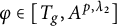 $\varphi \in [T_g,A^{p,\lambda _{2}}]$
. This means that for every
$\varphi \in [T_g,A^{p,\lambda _{2}}]$
. This means that for every $h\in A^{p,\lambda _{1}}$
,
$h\in A^{p,\lambda _{1}}$
, $T_G(h) \in A^{p,\lambda _{2}}$
. Therefore,
$T_G(h) \in A^{p,\lambda _{2}}$
. Therefore, $T_G:\;A^{p,\lambda _{1}}\to A^{p,\lambda _{2}}$
is bounded. It follows from Theorem 3.1 that G must be in
$T_G:\;A^{p,\lambda _{1}}\to A^{p,\lambda _{2}}$
is bounded. It follows from Theorem 3.1 that G must be in $\Lambda _{\frac {\lambda _{2}-\lambda _{1}}{p}}$
.
$\Lambda _{\frac {\lambda _{2}-\lambda _{1}}{p}}$
.
Note that $G \in \Lambda _{\frac {\lambda _{2}-\lambda _{1}}{p}}$
is equivalent to
$G \in \Lambda _{\frac {\lambda _{2}-\lambda _{1}}{p}}$
is equivalent to $G' \in K_{1+\frac {\lambda _{1}-\lambda _{2}}{p}}$
. By Lemma 4.7, we can find a function
$G' \in K_{1+\frac {\lambda _{1}-\lambda _{2}}{p}}$
. By Lemma 4.7, we can find a function $\phi $
such that
$\phi $
such that $\phi \cdot G' \in K_{1+\frac {\lambda _{1}-\lambda _{2}}{p}+ \varepsilon } \setminus K_{1+\frac {\lambda _{1}-\lambda _{2}}{p}}$
. Considering the function
$\phi \cdot G' \in K_{1+\frac {\lambda _{1}-\lambda _{2}}{p}+ \varepsilon } \setminus K_{1+\frac {\lambda _{1}-\lambda _{2}}{p}}$
. Considering the function
 $$\begin{align*}H_1(z)=\int_0^z \phi(w)\cdot G'(w)\,dw, \end{align*}$$
we see that $ Z(G')\subseteq Z(H_{1}')$
and for
$ Z(G')\subseteq Z(H_{1}')$
and for $G' \in K_{1-\alpha },$
where
$G' \in K_{1-\alpha },$
where $\alpha =\frac {\lambda _{2}-\lambda _{1}}{p}$
. Accordingly,
$\alpha =\frac {\lambda _{2}-\lambda _{1}}{p}$
. Accordingly,
 $$ \begin{align*} \frac{1}{\left | I \right |^{2} } \int_{S(I)}&\left | H_{1}'(z) \right | ^{2}(1-\left | z \right |^{2} )dA(z)\\ &=\frac{1}{\left | I \right |^{2} } \int_{S(I)}\left | \phi(w)G'(z) \right | ^{2}(1-\left | z \right |^{2} )dA(z)\\ &\lesssim \frac{\left \| \phi G' \right \|^{2} _{K_{1+\frac{\lambda_{1}-\lambda_{2}}{p}+ \varepsilon}}}{\left | I \right |^{2} } \int_{S(I)}\frac{1}{(1-\left | z \right |^{2} )^{\frac{2}{p}(\lambda_{1}-\lambda_{2})+2\varepsilon}} dA(z)\\ &\lesssim \left \| \phi G' \right \|^{2} _{K_{1+\frac{\lambda_{1}-\lambda_{2}}{p}+ \varepsilon}}. \end{align*} $$
This shows that $H_{1}\in \mathcal {B}$
, and so
$H_{1}\in \mathcal {B}$
, and so $H_1 \in X$
. But
$H_1 \in X$
. But $H^{\prime }_1 \notin K_{1-\alpha }$
or, equivalently,
$H^{\prime }_1 \notin K_{1-\alpha }$
or, equivalently, $H_1 \notin \Lambda _\alpha $
, which leads to a contradiction.
$H_1 \notin \Lambda _\alpha $
, which leads to a contradiction.
5 The structure of the meromorphic optimal domain
Zeros of $g'$
prompt a minimal enlargement of the holomorphic domain. This motivates the meromorphic optimal domain
$g'$
prompt a minimal enlargement of the holomorphic domain. This motivates the meromorphic optimal domain $(T_g,A^{p,\lambda }),$
where poles are constrained to the zero set of
$(T_g,A^{p,\lambda }),$
where poles are constrained to the zero set of $g'$
and the norm is transported through
$g'$
and the norm is transported through $T_g.$
We begin by specifying
$T_g.$
We begin by specifying $(T_g,A^{p,\lambda })$
in the constant-symbol case.
$(T_g,A^{p,\lambda })$
in the constant-symbol case.
Lemma 5.1 Let $g \in \mathcal {B}$
and
$g \in \mathcal {B}$
and $1\leq p<\infty , 0<\lambda <2.$
Then
$1\leq p<\infty , 0<\lambda <2.$
Then $(T_g,A^{p,\lambda })=\mathrm{Mer}(\mathbb {D})$
if and only if g is constant.
$(T_g,A^{p,\lambda })=\mathrm{Mer}(\mathbb {D})$
if and only if g is constant.
Proof Let f be meromorphic. If g is constant, then $g'\equiv 0$
; hence,
$g'\equiv 0$
; hence, $f\,g'\equiv 0$
is analytic and
$f\,g'\equiv 0$
is analytic and $T_g(f)\equiv 0$
. Therefore, the optimal meromorphic domain equals
$T_g(f)\equiv 0$
. Therefore, the optimal meromorphic domain equals $\mathrm{Mer}(\mathbb {D})$
.
$\mathrm{Mer}(\mathbb {D})$
.
For the converse, assume $(T_g,A^{p,\lambda })=\mathrm{Mer}(\mathbb {D})$
. Fix
$(T_g,A^{p,\lambda })=\mathrm{Mer}(\mathbb {D})$
. Fix $z_0\in \mathbb {D}$
and consider
$z_0\in \mathbb {D}$
and consider
 $$\begin{align*}f(z)=\frac{1}{z-z_0},\qquad z\in\mathbb{D}, \end{align*}$$
which is meromorphic with a simple pole at $z_0$
. By the hypothesis,
$z_0$
. By the hypothesis, $f\in (T_g,A^{p,\lambda })$
; consequently,
$f\in (T_g,A^{p,\lambda })$
; consequently,
 $$\begin{align*}\frac{g'(z)}{z-z_0},\qquad z\in\mathbb{D}, \end{align*}$$
is analytic on $\mathbb {D}$
. Hence,
$\mathbb {D}$
. Hence, $g'$
vanishes at
$g'$
vanishes at $z_0$
(with multiplicity at least one). Since
$z_0$
(with multiplicity at least one). Since $z_0$
was arbitrary, we obtain
$z_0$
was arbitrary, we obtain $g'\equiv 0$
on
$g'\equiv 0$
on $\mathbb {D}$
, and thus g is constant.
$\mathbb {D}$
, and thus g is constant.
For $g\in \mathcal {B,}$
we have
$g\in \mathcal {B,}$
we have $A^{p,\lambda }\subset (T_g,A^{p,\lambda })$
. Lemma 5.1 shows that
$A^{p,\lambda }\subset (T_g,A^{p,\lambda })$
. Lemma 5.1 shows that $(T_g,A^{p,\lambda })$
coincides with
$(T_g,A^{p,\lambda })$
coincides with $\mathrm{Mer}(\mathbb {D})$
only in the constant-symbol case. When g is not constant, we equip
$\mathrm{Mer}(\mathbb {D})$
only in the constant-symbol case. When g is not constant, we equip $(T_g,A^{p,\lambda })$
with the norm
$(T_g,A^{p,\lambda })$
with the norm
 $$ \begin{align} \|f\|_{(T_g,A^{p,\lambda})}:= \|T_g(f)\|_{A^{p,\lambda}}. \end{align} $$
Having isolated the trivial constant-symbol case, we show that non-constant symbols make the meromorphic norm genuine.
Since $T_g$
is linear,
$T_g$
is linear, $(T_g,A^{p,\lambda })$
is a vector space of meromorphic functions on the unit disc. The functional
$(T_g,A^{p,\lambda })$
is a vector space of meromorphic functions on the unit disc. The functional $\|\cdot \|_{(T_g,A^{p,\lambda })}$
defined in (5.1) is a seminorm: it is subadditive and absolutely homogeneous.
$\|\cdot \|_{(T_g,A^{p,\lambda })}$
defined in (5.1) is a seminorm: it is subadditive and absolutely homogeneous.
Lemma 5.2 Let $g\in \mathcal {B}$
be non-constant. Then
$g\in \mathcal {B}$
be non-constant. Then $\|f\|_{(T_g,A^{p,\lambda })}=0$
if and only if
$\|f\|_{(T_g,A^{p,\lambda })}=0$
if and only if $f=0$
. Hence,
$f=0$
. Hence, $\|\cdot \|_{(T_g,A^{p,\lambda })}$
is a norm in
$\|\cdot \|_{(T_g,A^{p,\lambda })}$
is a norm in $(T_g,A^{p,\lambda })$
.
$(T_g,A^{p,\lambda })$
.
Proof Clearly, $T_g(0)=0$
. Now, take
$T_g(0)=0$
. Now, take $f\in \mathrm{Mer}(\mathbb {D})$
with
$f\in \mathrm{Mer}(\mathbb {D})$
with $fg'\in \mathrm{Hol}(\mathbb {D})$
and
$fg'\in \mathrm{Hol}(\mathbb {D})$
and $\|T_g(f)\|_{A^{p,\lambda }}=0$
. Then
$\|T_g(f)\|_{A^{p,\lambda }}=0$
. Then $T_g(f)(z)=0$
for all
$T_g(f)(z)=0$
for all $z\in \mathbb {D}$
. Differentiating gives
$z\in \mathbb {D}$
. Differentiating gives
 $$ \begin{align*}g'(z)f(z)=0\,\, \text{ for all } z\in\mathbb{D}. \end{align*} $$
Because $g'\not \equiv 0$
, it follows that
$g'\not \equiv 0$
, it follows that $f(z)=0$
for every
$f(z)=0$
for every $z \in \mathbb {D}\setminus \mathcal {Z}(g')$
. Since
$z \in \mathbb {D}\setminus \mathcal {Z}(g')$
. Since $\mathcal {Z}(g')$
is at most countable, we have
$\mathcal {Z}(g')$
is at most countable, we have $\displaystyle {\lim _{z\to w}f(z)=0}$
for each
$\displaystyle {\lim _{z\to w}f(z)=0}$
for each $w\in \mathcal {Z}(g')$
. Hence, f has no poles and vanishes almost everywhere on
$w\in \mathcal {Z}(g')$
. Hence, f has no poles and vanishes almost everywhere on $\mathbb {D}$
; therefore,
$\mathbb {D}$
; therefore, $f=0$
.
$f=0$
.
Lemma 5.3 Let $g\in \mathcal {B}$
be non-constant. Let
$g\in \mathcal {B}$
be non-constant. Let $z_0\in \mathbb {D}$
and
$z_0\in \mathbb {D}$
and $\delta _{z_0}$
denote the point evaluation functional at
$\delta _{z_0}$
denote the point evaluation functional at $z_0.$
The functional
$z_0.$
The functional $\delta _{z_0}$
is bounded in
$\delta _{z_0}$
is bounded in $(T_g,A^{p,\lambda })$
if and only if
$(T_g,A^{p,\lambda })$
if and only if $z_0 \in \mathbb D\setminus \mathcal {Z}(g')$
.
$z_0 \in \mathbb D\setminus \mathcal {Z}(g')$
.
Proof Assume first that $z_0\in \mathbb D\setminus \mathcal {Z}(g')$
and let
$z_0\in \mathbb D\setminus \mathcal {Z}(g')$
and let $f\in (T_g,A^{p,\lambda })$
. By the standard estimate for point evaluations of derivatives of
$f\in (T_g,A^{p,\lambda })$
. By the standard estimate for point evaluations of derivatives of $A^{p,\lambda }$
functions, we obtain
$A^{p,\lambda }$
functions, we obtain
 $$ \begin{align*} |f(z_0)\cdot g'(z_0)|&=\,|(T_gf)'(z_0)|\\ &\lesssim \, \dfrac{\|T_g(f)\|_{A^{p,\lambda}}}{(1-|z_0|^2)^{1+\frac{2-\lambda}{p}}} =\dfrac{\|f\|_{(T_{g},A^{p,\lambda})}}{(1-|z_0|^2)^{1+\frac{2-\lambda}{p}}}.\\ \end{align*} $$
Consequently,
 $$\begin{align*}|f(z_0)|\lesssim \frac{\|f\|_{(T_g,A^{p,\lambda})}}{|g'(z_0)|(1-|z_0|^2)^{1+\frac{2-\lambda}{p}}}. \end{align*}$$
Thus, $\delta _{z_0}$
is bounded. Conversely, let
$\delta _{z_0}$
is bounded. Conversely, let $z_0\in \mathcal {Z}(g')$
. Since
$z_0\in \mathcal {Z}(g')$
. Since $\frac {1}{g'}\in (T_g,A^{p,\lambda })$
and
$\frac {1}{g'}\in (T_g,A^{p,\lambda })$
and $\lim _{z\to z_0}\frac {1}{g'(z)}=\infty $
, it follows that
$\lim _{z\to z_0}\frac {1}{g'(z)}=\infty $
, it follows that $\delta _{z_0}$
is not bounded.
$\delta _{z_0}$
is not bounded.
Theorem 5.4 Assume $g\in \mathcal {B}$
is non-constant and
$g\in \mathcal {B}$
is non-constant and $1\leq p<\infty $
. The pair
$1\leq p<\infty $
. The pair $ ( (T_g,A^{p,\lambda }), \|\cdot \|_{(T_g,A^{p,\lambda })})$
constitutes a Banach space of meromorphic functions, and the point evaluation functional is bounded at every
$ ( (T_g,A^{p,\lambda }), \|\cdot \|_{(T_g,A^{p,\lambda })})$
constitutes a Banach space of meromorphic functions, and the point evaluation functional is bounded at every $z_0 \in \mathbb D\setminus \mathcal {Z}(g')$
.
$z_0 \in \mathbb D\setminus \mathcal {Z}(g')$
.
Proof Let $\{f_n\}$
be Cauchy in
$\{f_n\}$
be Cauchy in $(T_g,A^{p,\lambda })$
, namely,
$(T_g,A^{p,\lambda })$
, namely,
 $$ \begin{align*} \|f_n-f_m\|_{(T_g,A^{p,\lambda})}=\|T_g(f_n-f_m)\|_{A^{p,\lambda}}\rightarrow 0 \quad \text{as} \quad m,n\to \infty. \end{align*} $$
Hence, $\left \{ T_{g}(f_{n}) \right \}$
is a Cauchy sequence in
$\left \{ T_{g}(f_{n}) \right \}$
is a Cauchy sequence in $A^{p,\lambda }(\mathbb {D})$
. Since
$A^{p,\lambda }(\mathbb {D})$
. Since $A^{p,\lambda }(\mathbb {D})$
is complete for
$A^{p,\lambda }(\mathbb {D})$
is complete for $0<\lambda <2, p \ge 1$
, there exists
$0<\lambda <2, p \ge 1$
, there exists $k \in A^{p,\lambda }$
with
$k \in A^{p,\lambda }$
with $\|T_{g}(f_{n})-k\|_{A^{p,\lambda }} \rightarrow 0$
as
$\|T_{g}(f_{n})-k\|_{A^{p,\lambda }} \rightarrow 0$
as $n\rightarrow \infty .$
For any
$n\rightarrow \infty .$
For any $f \in A^{p,\lambda }$
, Lemma 2.2 yields
$f \in A^{p,\lambda }$
, Lemma 2.2 yields
 $$ \begin{align*}\left | f'(z) \right | \lesssim \frac{\|f\|_{A^{p,\lambda}}}{(1-|z|^2)^{1+\frac{2-\lambda}{p}}},\quad \quad \forall z\in \mathbb{D}. \end{align*} $$
Therefore, for all $z \in \mathbb {D}$
,
$z \in \mathbb {D}$
,
 $$ \begin{align*}\left | (T_{g}f_{n}-k)^{'} (z) \right | \lesssim \frac{\|(T_{g}f_{n}-k)\|_{A^{p,\lambda}}}{(1-|z|^2)^{1+\frac{2-\lambda}{p}}} \rightarrow 0, \end{align*} $$
so $T_g'(f_n)(z)\rightarrow k'(z)$
as
$T_g'(f_n)(z)\rightarrow k'(z)$
as $n\rightarrow \infty .$
Invoking Lemma 5.3, we have
$n\rightarrow \infty .$
Invoking Lemma 5.3, we have
 $$ \begin{align*}\left | \delta _{z_{0} }(f_{n}-f_{m} ) \right | \lesssim \left \| f_{n}-f_{m} \right \| _{(T_g,A^{p,\lambda})},\quad \forall z_{0} \in K\subseteq \mathbb{D}. \end{align*} $$
Thus, $\left | f_{n}(z_{0})-f_{m}(z_{0}) \right | \rightarrow 0$
when
$\left | f_{n}(z_{0})-f_{m}(z_{0}) \right | \rightarrow 0$
when $n,m \rightarrow \infty .$
Consequently,
$n,m \rightarrow \infty .$
Consequently, $f_{n}(z_{0}) \rightarrow f(z_{0}) $
as
$f_{n}(z_{0}) \rightarrow f(z_{0}) $
as $n \rightarrow \infty .$
Taking primitives gives
$n \rightarrow \infty .$
Taking primitives gives $k(z)=\int _{0}^{z} f(w)g^{'}(w)dw+C.$
Since
$k(z)=\int _{0}^{z} f(w)g^{'}(w)dw+C.$
Since $\left \| T_{g}(f_{n})-k \right \| _{A^{p,\lambda }}\rightarrow 0$
as
$\left \| T_{g}(f_{n})-k \right \| _{A^{p,\lambda }}\rightarrow 0$
as $n \rightarrow \infty , $
it follows that
$n \rightarrow \infty , $
it follows that $\left | T_{g}(f_{n})(0)-k(0) \right |\rightarrow 0 $
as
$\left | T_{g}(f_{n})(0)-k(0) \right |\rightarrow 0 $
as $n \rightarrow \infty $
. Hence,
$n \rightarrow \infty $
. Hence, $0=T_{g}(f_{n})(0)\rightarrow k(0)=C,$
which forces
$0=T_{g}(f_{n})(0)\rightarrow k(0)=C,$
which forces $C=0.$
Therefore,
$C=0.$
Therefore, $k=T_{g}(f),$
completing the proof.
$k=T_{g}(f),$
completing the proof.
Theorem 5.5 For $1\leq p_1 \leq p_2<\infty $
and
$1\leq p_1 \leq p_2<\infty $
and $0<\lambda <2,$
we have
$0<\lambda <2,$
we have
 $$ \begin{align*}(T_g,A^{p_2,\lambda})\subsetneq(T_g,A^{p_1,\lambda}).\end{align*} $$
Proof The containment $(T_g,A^{p_2,\lambda })\subseteq (T_g,A^{p_1,\lambda })$
is immediate since
$(T_g,A^{p_2,\lambda })\subseteq (T_g,A^{p_1,\lambda })$
is immediate since $A^{p_2,\lambda }\subset A^{p_1,\lambda }$
. To show that the inclusion is proper, consider
$A^{p_2,\lambda }\subset A^{p_1,\lambda }$
. To show that the inclusion is proper, consider
 $$ \begin{align*}\phi(z)=\frac{1}{(1-z)^{\frac{2-\lambda}{p_2}+1+\epsilon}}\frac{1}{g'(z)} \qquad \text{for}\quad 0<\epsilon<(2-\lambda)\left(\frac{1}{p_1}-\frac{1}{p_2}\right). \end{align*} $$
Because every zero of $g'$
in
$g'$
in $\mathbb {D}$
has finite multiplicity, we have
$\mathbb {D}$
has finite multiplicity, we have $\phi \in \mathrm{Mer}(\mathbb {D})$
. In addition,
$\phi \in \mathrm{Mer}(\mathbb {D})$
. In addition, $\phi \,g'\in \mathrm{Hol}(\mathbb {D})$
and
$\phi \,g'\in \mathrm{Hol}(\mathbb {D})$
and
 $$\begin{align*}T_g(\phi)(z)= \frac{p_2}{2-\lambda+\epsilon p_2}[(1-z)^{\frac{\lambda-2}{p_2}-\epsilon }-1] \end{align*}$$
A routine verification yields $T_g(\phi )\in A^{p_1,\lambda }\setminus A^{p_2,\lambda }$
, which establishes the claim.
$T_g(\phi )\in A^{p_1,\lambda }\setminus A^{p_2,\lambda }$
, which establishes the claim.
Theorem 5.6 Let $\mathcal {M}(T_g,A^{p,\lambda })$
denote the multiplier space of
$\mathcal {M}(T_g,A^{p,\lambda })$
denote the multiplier space of $(T_g,A^{p,\lambda })$
. Then
$(T_g,A^{p,\lambda })$
. Then $\mathcal {M}(T_g,A^{p,\lambda })=H^{\infty }$
.
$\mathcal {M}(T_g,A^{p,\lambda })=H^{\infty }$
.
Proof Recall that for $g,F\in \mathrm{Hol}(\mathbb {D}),$
we set
$g,F\in \mathrm{Hol}(\mathbb {D}),$
we set
 $$ \begin{align*}S_g(F)(z)=\int_{0}^{z}g(\zeta)F'(\zeta)\,d\zeta, \end{align*} $$
which we call the $T_g$
-companion operator.
$T_g$
-companion operator.
Fix $f\in (T_g,A^{p,\lambda })$
and choose
$f\in (T_g,A^{p,\lambda })$
and choose $k\in H^\infty $
. We claim that
$k\in H^\infty $
. We claim that $kf\in (T_g,A^{p,\lambda })$
. By (1.1), pick
$kf\in (T_g,A^{p,\lambda })$
. By (1.1), pick $h\in A^{p,\lambda }$
with
$h\in A^{p,\lambda }$
with $f=\frac {h'}{g'}.$
Then
$f=\frac {h'}{g'}.$
Then
 $$ \begin{align*}k(z)f(z)g'(z)=k(z)h'(z)\qquad \forall z\in\mathbb{D}. \end{align*} $$
Since $fg'\in \mathrm{Hol}(\mathbb {D})$
, the product
$fg'\in \mathrm{Hol}(\mathbb {D})$
, the product $kf$
is meromorphic and
$kf$
is meromorphic and $kfg'\in \mathrm{Hol}(\mathbb {D})$
. Moreover,
$kfg'\in \mathrm{Hol}(\mathbb {D})$
. Moreover,
 $$ \begin{align*}T_g(kf)(z)=S_{k}(h)(z)\qquad z\in \mathbb{D}. \end{align*} $$
Appealing to [Reference Yang and Liu13, Theorem 4.3], we obtain $S_k(h)\in A^{p,\lambda }$
, hence
$S_k(h)\in A^{p,\lambda }$
, hence $T_g(kf)\in A^{p,\lambda }$
.
$T_g(kf)\in A^{p,\lambda }$
.
Conversely, let $\phi \in \mathrm{Mer}(\mathbb {D})$
be such that
$\phi \in \mathrm{Mer}(\mathbb {D})$
be such that $\phi f\in (T_g,A^{p,\lambda })$
for all
$\phi f\in (T_g,A^{p,\lambda })$
for all $f\in (T_g,A^{p,\lambda })$
. Because
$f\in (T_g,A^{p,\lambda })$
. Because $\frac {1}{g'}\in (T_g,A^{p,\lambda })$
, the very definition of
$\frac {1}{g'}\in (T_g,A^{p,\lambda })$
, the very definition of $(T_g,A^{p,\lambda })$
forces
$(T_g,A^{p,\lambda })$
forces $\phi \in \mathrm{Hol}(\mathbb {D})$
. By Lemma 5.3, if
$\phi \in \mathrm{Hol}(\mathbb {D})$
. By Lemma 5.3, if $z_0\in \mathbb {D}\setminus \mathcal {Z}(g'),$
then
$z_0\in \mathbb {D}\setminus \mathcal {Z}(g'),$
then $\delta _{z_0}$
is bounded; and since
$\delta _{z_0}$
is bounded; and since $(T_g,A^{p,\lambda })$
contains constants, we have
$(T_g,A^{p,\lambda })$
contains constants, we have $\|\delta _{z_0}\|>0$
. For any
$\|\delta _{z_0}\|>0$
. For any $f \in (T_g,A^{p,\lambda })$
with
$f \in (T_g,A^{p,\lambda })$
with $\|f\|_{(T_g,A^{p,\lambda })}=1$
,
$\|f\|_{(T_g,A^{p,\lambda })}=1$
,
 $$ \begin{align*}|\phi(z_0)f(z_0)| = |\delta_{z_0}(M_\phi(f))| \le \|\delta_{z_0}\|\|M_\phi\|. \end{align*} $$
Taking the supremum over all such f yields
 $$ \begin{align*}|\phi(z_0)|\le \|M_\phi\|. \end{align*} $$
Since $z_0$
was arbitrary, this estimate holds on
$z_0$
was arbitrary, this estimate holds on $\mathbb {D}\setminus \mathcal {Z}(g')$
. As
$\mathbb {D}\setminus \mathcal {Z}(g')$
. As $\phi \in \mathrm{Hol}(\mathbb {D})$
and
$\phi \in \mathrm{Hol}(\mathbb {D})$
and $\mathcal {Z}(g')$
is countable, continuity extends the bound to the points of
$\mathcal {Z}(g')$
is countable, continuity extends the bound to the points of $\mathcal {Z}(g')$
; thus, for every
$\mathcal {Z}(g')$
; thus, for every $z\in \mathbb {D}$
,
$z\in \mathbb {D}$
,
 $$ \begin{align*}|\phi(z)|\le \|M_\phi\|. \end{align*} $$
Therefore, $\phi \in H^\infty $
, completing the proof.
$\phi \in H^\infty $
, completing the proof.
6 The spaces $W^{p}_g$
and
$V^{p}_g$
$W^{p}_g$
and
$V^{p}_g$


Once the domains are set, the remaining questions are symbolic: when do different symbols induce the same (mero)optimal domain, and how do these domains embed across symbols? The classes $W^{p}_g$
and
$W^{p}_g$
and $V^{p}_g$
package precisely these inclusion relations. Our goal is to determine for which
$V^{p}_g$
package precisely these inclusion relations. Our goal is to determine for which $g_1,g_2\in \mathcal {B}$
the associated meromorphic optimal domains coincide, namely,
$g_1,g_2\in \mathcal {B}$
the associated meromorphic optimal domains coincide, namely, $(T_{g_1},A^{p,\lambda })=(T_{g_2},A^{p,\lambda })$
. By the very definition of
$(T_{g_1},A^{p,\lambda })=(T_{g_2},A^{p,\lambda })$
. By the very definition of $W_{g}^p$
, the identity
$W_{g}^p$
, the identity $(T_{g_1},A^{p,\lambda })=(T_{g_2},A^{p,\lambda })$
holds exactly when
$(T_{g_1},A^{p,\lambda })=(T_{g_2},A^{p,\lambda })$
holds exactly when $g_1\in W^p_{g_2}$
and
$g_1\in W^p_{g_2}$
and $g_2\in W^p_{g_1}$
. Thus, an explicit characterization of
$g_2\in W^p_{g_1}$
. Thus, an explicit characterization of $W_g^p$
is central.
$W_g^p$
is central.
Theorem 6.1 Let $g\in \mathcal {B}$
and
$g\in \mathcal {B}$
and $1\leq p<\infty $
. Then
$1\leq p<\infty $
. Then $h\in W_g^p$
if and only if there exists
$h\in W_g^p$
if and only if there exists $f\in T_g(H^{\infty })$
such that
$f\in T_g(H^{\infty })$
such that $h=f+h(0)$
. Equivalently,
$h=f+h(0)$
. Equivalently,
 $$ \begin{align*}W_g^p=T_g(H^{\infty})+\mathbb{C}.\end{align*} $$
Proof By Lemma 5.1, constant functions are contained in $W^p_g$
. Suppose
$W^p_g$
. Suppose $f-f(0)=T_g(k)$
for some
$f-f(0)=T_g(k)$
for some $k\in H^{\infty }$
. Then, for every
$k\in H^{\infty }$
. Then, for every $z \in \mathbb {D}$
,
$z \in \mathbb {D}$
,
 $$ \begin{align*}f'(z)=k(z)g'(z). \end{align*} $$
We claim $f\in W_g^p$
, that is,
$f\in W_g^p$
, that is, $(T_g,A^{p,\lambda })\subseteq (T_f,A^{p,\lambda })$
. Let
$(T_g,A^{p,\lambda })\subseteq (T_f,A^{p,\lambda })$
. Let $G\in (T_g,A^{p,\lambda })$
. By Theorem 5.6,
$G\in (T_g,A^{p,\lambda })$
. By Theorem 5.6, $kG\in (T_g,A^{p,\lambda })$
, and hence
$kG\in (T_g,A^{p,\lambda })$
, and hence
 $$ \begin{align*}T_f(G)=T_g(kG)\in A^{p,\lambda}, \end{align*} $$
which proves the desired inclusion.
Conversely, assume $f \in W^p_g$
. Since
$f \in W^p_g$
. Since $\frac {1}{g'}\in (T_g,A^{p,\lambda })$
and
$\frac {1}{g'}\in (T_g,A^{p,\lambda })$
and $(T_g,A^{p,\lambda })\subseteq (T_f,A^{p,\lambda })$
, it follows that
$(T_g,A^{p,\lambda })\subseteq (T_f,A^{p,\lambda })$
, it follows that $\frac {1}{g'}\in (T_f,A^{p,\lambda })$
. By the definition of the meromorphic optimal domain,
$\frac {1}{g'}\in (T_f,A^{p,\lambda })$
. By the definition of the meromorphic optimal domain,
 $$ \begin{align*}\frac{f'}{g'} \in \mathrm{Hol}(\mathbb{D}). \end{align*} $$
Now, take any $G\in (T_g,A^{p,\lambda })\subseteq (T_f,A^{p,\lambda })$
. Then
$G\in (T_g,A^{p,\lambda })\subseteq (T_f,A^{p,\lambda })$
. Then $T_f(G)\in A^{p,\lambda }$
and
$T_f(G)\in A^{p,\lambda }$
and
 $$ \begin{align*}T_g\!\left(\frac{f'}{g'}\,G\right)=T_f(G)\in A^{p,\lambda}. \end{align*} $$
Hence, $\frac {f'}{g'}$
acts as a multiplier of
$\frac {f'}{g'}$
acts as a multiplier of $(T_g,A^{p,\lambda })$
and, by Theorem 5.6, we conclude
$(T_g,A^{p,\lambda })$
and, by Theorem 5.6, we conclude $\frac {f'}{g'}\in H^{\infty }$
. Therefore,
$\frac {f'}{g'}\in H^{\infty }$
. Therefore, $f-f(0)\in T_g(H^{\infty })$
, completing the proof.
$f-f(0)\in T_g(H^{\infty })$
, completing the proof.
Lemma 5.1 shows that every constant belongs to $W_g^p$
for all
$W_g^p$
for all $g \in \mathcal {B}$
. Theorem 6.1 further yields
$g \in \mathcal {B}$
. Theorem 6.1 further yields $T_g(H^{\infty })\subset \mathcal {B}$
whenever
$T_g(H^{\infty })\subset \mathcal {B}$
whenever $g\in \mathcal {B}$
. In addition, by Theorem 6.1, the spaces
$g\in \mathcal {B}$
. In addition, by Theorem 6.1, the spaces $W^p_g$
do not depend on p for
$W^p_g$
do not depend on p for $1\leq p<\infty $
; we will therefore drop the superscript and write simply
$1\leq p<\infty $
; we will therefore drop the superscript and write simply $W_g$
. The structural formula for
$W_g$
. The structural formula for $W_g$
immediately yields a symbolic criterion for equality of meromorphic optimal domains.
$W_g$
immediately yields a symbolic criterion for equality of meromorphic optimal domains.
Theorem 6.2 Assume $1\leq p<\infty $
and
$1\leq p<\infty $
and $g_1,g_2\in \mathcal {B}$
are non-constant. The statements below are equivalent:
$g_1,g_2\in \mathcal {B}$
are non-constant. The statements below are equivalent:
-
a)
$(T_{g_1},A^{p,\lambda })=(T_{g_2},A^{p,\lambda })$
. -
b) There are
$k_1,k_2\in H^{\infty }$
with
$$ \begin{align*}g_1=T_{g_2}(k_1)+g_1(0) \text{ and } g_2=T_{g_1}(k_2)+g_2(0). \end{align*} $$


In addition, one has $k_2=\frac {1}{k_1}$
.
$k_2=\frac {1}{k_1}$
.
Proof Observe first that $(T_{g_1},A^{p,\lambda })=(T_{g_2},A^{p,\lambda })$
holds exactly when
$(T_{g_1},A^{p,\lambda })=(T_{g_2},A^{p,\lambda })$
holds exactly when $W_{g_1}=W_{g_2}$
. Assume
$W_{g_1}=W_{g_2}$
. Assume $(T_{g_1},A^{p,\lambda })=(T_{g_2},A^{p,\lambda })$
. For any
$(T_{g_1},A^{p,\lambda })=(T_{g_2},A^{p,\lambda })$
. For any $f \in W_{g_1}$
, we have
$f \in W_{g_1}$
, we have
 $$ \begin{align*}(T_{g_1},A^{p,\lambda})\subseteq (T_f,A^{p,\lambda}).\end{align*} $$
Since $(T_{g_2},A^{p,\lambda })=(T_{g_1},A^{p,\lambda })$
, it follows that
$(T_{g_2},A^{p,\lambda })=(T_{g_1},A^{p,\lambda })$
, it follows that
 $$ \begin{align*}(T_{g_2},A^{p,\lambda})\subseteq (T_f,A^{p,\lambda}),\end{align*} $$
which implies $f \in W_{g_2}$
. Hence,
$f \in W_{g_2}$
. Hence, $ W_{g_1}\subseteq W_{g_2}$
; the reverse inclusion is obtained by symmetry.
$ W_{g_1}\subseteq W_{g_2}$
; the reverse inclusion is obtained by symmetry.
Conversely, suppose $ W_{g_1}= W_{g_2}$
. Then
$ W_{g_1}= W_{g_2}$
. Then $g_1 \in W_{g_1}=W_{g_2}$
, and thus
$g_1 \in W_{g_1}=W_{g_2}$
, and thus
 $$ \begin{align*}(T_{g_2},A^{p,\lambda})\subseteq (T_{g_1},A^{p,\lambda}).\end{align*} $$
Likewise, $g_2 \in W_{g_1}$
, giving
$g_2 \in W_{g_1}$
, giving $(T_{g_1},A^{p,\lambda })\subseteq (T_{g_2},A^{p,\lambda })$
. Therefore,
$(T_{g_1},A^{p,\lambda })\subseteq (T_{g_2},A^{p,\lambda })$
. Therefore, $(T_{g_1},A^{p,\lambda })= (T_{g_2},A^{p,\lambda })$
.
$(T_{g_1},A^{p,\lambda })= (T_{g_2},A^{p,\lambda })$
.
Assertion (b) follows from Theorem 6.1, using that for each $g\in \mathcal {B,}$
one has
$g\in \mathcal {B,}$
one has $W_{g}=T_g(H^{\infty })+\mathbb {C}$
. The functions
$W_{g}=T_g(H^{\infty })+\mathbb {C}$
. The functions $k_1,k_2\in H^{\infty }$
satisfy the relations
$k_1,k_2\in H^{\infty }$
satisfy the relations
 $$ \begin{align*}\begin{cases} g_1'=k_1 g_2'\\ g_2'=k_2g_1'. \end{cases}\end{align*} $$
Hence, $k_2=\frac {1}{{k_1}}.$
We next examine structural features of $W_g$
. To that end, endow
$W_g$
. To that end, endow $W_g$
with the norm: for
$W_g$
with the norm: for $h \in W_g$
and
$h \in W_g$
and $h-h(0)=T_g(k)$
with
$h-h(0)=T_g(k)$
with $k \in H^\infty $
,
$k \in H^\infty $
,
 $$ \begin{align*}\|h\|_{W_g}=\|T_g(k)\|_{\mathcal{B}}+|h(0)|+\|k\|_{H^\infty}.\end{align*} $$
Theorem 6.3 Let $g\in \mathcal {B}$
be non-constant and
$g\in \mathcal {B}$
be non-constant and $1<p<\infty $
. The pair
$1<p<\infty $
. The pair $\left ( W_g, \|\cdot \|_{W_g}\right )$
is a linear subspace of
$\left ( W_g, \|\cdot \|_{W_g}\right )$
is a linear subspace of $\mathcal {B}$
and, moreover, a Banach space.
$\mathcal {B}$
and, moreover, a Banach space.
Proof Since $W_g=T_g(H^\infty )$
and
$W_g=T_g(H^\infty )$
and $T_g:H^\infty \to \mathcal {B}$
is bounded, the graph of
$T_g:H^\infty \to \mathcal {B}$
is bounded, the graph of $T_g$
– which coincides with
$T_g$
– which coincides with $W_g$
– is a closed subspace of
$W_g$
– is a closed subspace of $H^\infty \times \mathcal {B}$
. Consequently, endowed with the graph norm
$H^\infty \times \mathcal {B}$
. Consequently, endowed with the graph norm $\|\cdot \|_{W_g}$
, the space
$\|\cdot \|_{W_g}$
, the space $W_g$
is complete and thus Banach.
$W_g$
is complete and thus Banach.
In addition, for each fixed $z\in \mathbb {D}$
, the point-evaluation functionals are bounded on both
$z\in \mathbb {D}$
, the point-evaluation functionals are bounded on both $H^\infty $
and
$H^\infty $
and $\mathcal {B}$
. Hence, there exists a constant
$\mathcal {B}$
. Hence, there exists a constant $\delta _z>0$
, depending only on z, such that
$\delta _z>0$
, depending only on z, such that
 $$ \begin{align*}|f(z)|\leq \delta_z \|f\|_{W_g}. \end{align*} $$
Therefore, point evaluations define bounded linear functionals on $W_g$
.
$W_g$
.
Theorem 6.4 Let $g\in \mathcal {B}$
be non-constant and
$g\in \mathcal {B}$
be non-constant and $1< p<\infty $
. We have
$1< p<\infty $
. We have
 $$ \begin{align*}\bigcap_{h \in W_g\colon (T_g,A^{p,\lambda})\subsetneq(T_h,A^{p,\lambda}) } (T_h,A^{p,\lambda})=(T_g,A^{p,\lambda}).\end{align*} $$
Proof The inclusion $\supseteq $
is immediate. For the converse, take
$\supseteq $
is immediate. For the converse, take
 $$ \begin{align} f \in \bigcap_{h \in W_g\colon (T_g,A^{p,\lambda})\subsetneq(T_h,A^{p,\lambda}) } (T_h,A^{p,\lambda}). \end{align} $$
We first verify that $fg'\in \mathrm{Hol}(\mathbb {D})$
. Assume to the contrary that there is
$fg'\in \mathrm{Hol}(\mathbb {D})$
. Assume to the contrary that there is $z_0\in \mathbb {D}$
which is a pole of
$z_0\in \mathbb {D}$
which is a pole of $fg'$
of order
$fg'$
of order $\lambda _1>0$
. Since (6.1) holds, choose
$\lambda _1>0$
. Since (6.1) holds, choose $h_1\in W_g$
with
$h_1\in W_g$
with $(T_g,A^{p,\lambda })\subsetneq (T_{h_1},A^{p,\lambda })$
. By Theorem 6.1, there exists
$(T_g,A^{p,\lambda })\subsetneq (T_{h_1},A^{p,\lambda })$
. By Theorem 6.1, there exists $k_{h_1}\in H^{\infty }$
such that
$k_{h_1}\in H^{\infty }$
such that $h^{\prime }_1=g' k_{h_1}$
. Because
$h^{\prime }_1=g' k_{h_1}$
. Because $fh^{\prime }_1\in \mathrm{Hol}(\mathbb {D})$
, the function
$fh^{\prime }_1\in \mathrm{Hol}(\mathbb {D})$
, the function $k_{h_1}$
must vanish at
$k_{h_1}$
must vanish at $z_0$
with order
$z_0$
with order $\lambda _2\geq \lambda _1$
. Define
$\lambda _2\geq \lambda _1$
. Define
 $$ \begin{align*}k_{h_2}(z)=\frac{k_{h_1}(z)}{(z-z_0)^{\lambda_2}}(1-z)^{1+\frac{2-\lambda}{p}},\qquad z\in\mathbb{D}, \end{align*} $$
and let $h_2= T_g(k_{h_2})$
. Then
$h_2= T_g(k_{h_2})$
. Then $k_{h_2}\in H^\infty $
,
$k_{h_2}\in H^\infty $
, $k_{h_2}(z_0)\neq 0$
, and, by Theorem 6.1,
$k_{h_2}(z_0)\neq 0$
, and, by Theorem 6.1, $h_2\in W_g$
. Moreover,
$h_2\in W_g$
. Moreover, $(T_g,A^{p,\lambda })\subsetneq (T_{h_2},A^{p,\lambda })$
since
$(T_g,A^{p,\lambda })\subsetneq (T_{h_2},A^{p,\lambda })$
since
 $$ \begin{align*}F(z)=\frac{1}{g'(z)}\frac{1}{(1-z)^{2+\frac{2-\lambda}{p}}} \in (T_{h_2},A^{p,\lambda})\setminus (T_g,A^{p,\lambda}). \end{align*} $$
Indeed,
 $$ \begin{align*}T_g(F)(z)=\int_0^z \frac{1}{(1-\xi)^{2+\frac{2-\lambda}{p}}}d\xi\notin A^{p,\lambda} \end{align*} $$
and
 $$ \begin{align*}T_{h_2}(F)(z)=\int_{0}^z\frac{k_{h_2}(\xi)}{(1-\xi)^{2+\frac{2-\lambda}{p}}}d\xi=\int_{0}^z \frac{k_{h_1}(\xi)}{(\xi-z_0)^{\lambda_2}}\frac{1}{1-\xi}d\xi \in A^{p,\lambda}, \end{align*} $$
since $\frac {k_{h_1}(z)}{(z-z_0)^\lambda }\in H^\infty $
and
$\frac {k_{h_1}(z)}{(z-z_0)^\lambda }\in H^\infty $
and $-\log (1-z) \in A^{p,\lambda }$
.
$-\log (1-z) \in A^{p,\lambda }$
.
As f satisfies (6.1), the function $fh_2'\in \mathrm{Hol}(\mathbb {D})$
, which is impossible, since
$fh_2'\in \mathrm{Hol}(\mathbb {D})$
, which is impossible, since $ fh^{\prime }_2=fg'k_{h_2} $
has a pole at
$ fh^{\prime }_2=fg'k_{h_2} $
has a pole at $z_0$
.
$z_0$
.
Now, we prove that $T_g(f)\in A^{p,\lambda }$
. We chose
$T_g(f)\in A^{p,\lambda }$
. We chose $k_{1}(z)=(1+z)$
and
$k_{1}(z)=(1+z)$
and $k_{2}(z)=(1-z)$
. Because of Theorem 6.1,
$k_{2}(z)=(1-z)$
. Because of Theorem 6.1, $T_g(k_i) \in W_g$
and, as shown in the first part of the proposition,
$T_g(k_i) \in W_g$
and, as shown in the first part of the proposition, $(T_g,A^{p,\lambda })\subsetneq (T_{T_g(k_i)},A^{p,\lambda })$
.
$(T_g,A^{p,\lambda })\subsetneq (T_{T_g(k_i)},A^{p,\lambda })$
.
Let $\Sigma _+=\{z\in \mathbb {D}:\Re z\ge 0\}$
and
$\Sigma _+=\{z\in \mathbb {D}:\Re z\ge 0\}$
and $\Sigma _-=\{z\in \mathbb {D}:\Re z\le 0\}$
. Then for all
$\Sigma _-=\{z\in \mathbb {D}:\Re z\le 0\}$
. Then for all $z\in \Sigma _+$
, we have
$z\in \Sigma _+$
, we have $|k_1(z)|=|1+z|\ge 1,$
and for
$|k_1(z)|=|1+z|\ge 1,$
and for $z\in \Sigma _-,$
we have
$z\in \Sigma _-,$
we have $\ |k_2(z)|=|1-z|\ge 1,$
while always
$\ |k_2(z)|=|1-z|\ge 1,$
while always $|k_i(z)|\le 2$
in
$|k_i(z)|\le 2$
in $\mathbb {D}$
. For each arc
$\mathbb {D}$
. For each arc $I,$
write
$I,$
write $E_\pm :=S(I)\cap \Sigma _\pm $
. Then
$E_\pm :=S(I)\cap \Sigma _\pm $
. Then
 $$\begin{align*}\frac{1}{|I|^\lambda}\!\!\int_{S(I)}\!\!|f|^p|g'|^p(1-|z|^2)^p\,dA(z) =\sum_{\sigma\in\{+,-\}}\frac{1}{|I|^\lambda}\!\!\int_{E_\sigma}\!\!|f|^p|g'|^p(1-|z|^2)^p\,dA(z). \end{align*}$$
On $E_+$
, we use
$E_+$
, we use $|k_1|\ge 1$
to get
$|k_1|\ge 1$
to get $|f|\le |k_1 f|$
; similarly on
$|f|\le |k_1 f|$
; similarly on $E_-$
,
$E_-$
, $|f|\le |k_2 f|$
. Hence,
$|f|\le |k_2 f|$
. Hence,
 $$\begin{align*}\frac{1}{|I|^\lambda}\!\!\int_{S(I)}\!\!|f|^p|g'|^p(1-|z|^2)^p\,dA(z) &\le\ \frac{1}{|I|^\lambda}\!\!\int_{S(I)}\!\!|k_1f|^p|g'|^p(1-|z|^2)^p\,dA(z)\\ &\quad +\frac{1}{|I|^\lambda}\!\!\int_{S(I)}\!\!|k_2f|^p|g'|^p(1-|z|^2)^p\,dA(z). \end{align*}$$
Taking the supremum over all $I\subset \partial \mathbb {D}$
and using the box characterization for
$I\subset \partial \mathbb {D}$
and using the box characterization for $T_g(k_i f)$
yields
$T_g(k_i f)$
yields
 $$\begin{align*}\|T_g f\|_{A^{p,\lambda}}^p\ \lesssim\ \|T_g(k_1f)\|_{A^{p,\lambda}}^p+\|T_g(k_2f)\|_{A^{p,\lambda}}^p=\|T_{T_{g}(k_1)}f\|_{A^{p,\lambda}}^p+\|T_{T_{g}(k_2)}f\|_{A^{p,\lambda}}^p <\ \infty. \end{align*}$$
Thus, $T_g f\in A^{p,\lambda }$
.
$T_g f\in A^{p,\lambda }$
.
Theorem 6.5 Let $g\in \mathcal {B}$
be non-constant and
$g\in \mathcal {B}$
be non-constant and $1<p<\infty $
. Denote by
$1<p<\infty $
. Denote by $\mathcal {M}(W_g)$
the set of multiplier of
$\mathcal {M}(W_g)$
the set of multiplier of $W_g$
. Then
$W_g$
. Then $\phi \in \mathcal {M}(W_g)$
if and only if
$\phi \in \mathcal {M}(W_g)$
if and only if $\phi \in H^{\infty }$
and the integral operator
$\phi \in H^{\infty }$
and the integral operator $T_\phi $
acts boundedly on
$T_\phi $
acts boundedly on $W_g$
.
$W_g$
.
Proof Assume first that $\phi \in H^{\infty }$
and that
$\phi \in H^{\infty }$
and that $T_\phi $
is bounded on
$T_\phi $
is bounded on $W_g$
. We show that
$W_g$
. We show that $\phi f\in W_g$
for every
$\phi f\in W_g$
for every $f\in W_g$
. By Theorem 6.1, it suffices to verify that
$f\in W_g$
. By Theorem 6.1, it suffices to verify that
 $$\begin{align*}\frac{(\phi f)'}{g'}\in H^{\infty}. \end{align*}$$
Indeed,
 $$ \begin{align} \frac{(\phi(z) f(z))'}{g'(z)} &=\frac{\phi'(z) f(z)}{g'(z)}+\frac{\phi(z)f'(z)}{g'(z)} =\frac{T_\phi(f)'(z)}{g'(z)}+\phi(z)\frac{f'(z)}{g'(z)}. \end{align} $$
Since $\frac {f'}{g'}$
and
$\frac {f'}{g'}$
and $\frac {T_\phi (f)'}{g'}$
lie in
$\frac {T_\phi (f)'}{g'}$
lie in $H^{\infty }$
, it follows that
$H^{\infty }$
, it follows that
 $$\begin{align*}\frac{(\phi f)'}{g'}\in H^{\infty}. \end{align*}$$
Conversely, let $\phi $
be analytic, which is a bounded multiplier on
$\phi $
be analytic, which is a bounded multiplier on $W_g$
. Fix
$W_g$
. Fix $z\in \mathbb {D}$
and let
$z\in \mathbb {D}$
and let $\delta _z$
denote point evaluation on
$\delta _z$
denote point evaluation on $W_g$
. Because
$W_g$
. Because $W_g$
is a closed subspace of
$W_g$
is a closed subspace of $\mathcal {B}$
containing constants, we have
$\mathcal {B}$
containing constants, we have $0\neq \|\delta _z\|<\infty $
. As in the proof of Theorem 5.6,
$0\neq \|\delta _z\|<\infty $
. As in the proof of Theorem 5.6,
 $$\begin{align*}|\phi(z)|\le \|M_\phi\|\frac{\|\delta_z\|}{\|\delta_z\|}=\|M_\phi\|, \end{align*}$$
hence $\phi \in H^{\infty }$
. It remains to show that
$\phi \in H^{\infty }$
. It remains to show that $T_\phi $
is bounded on
$T_\phi $
is bounded on $W_g$
. For
$W_g$
. For $f\in W_g$
,
$f\in W_g$
,
 $$\begin{align*}\frac{\left(T_{\phi}(f)\right)'}{g'}=\frac{\phi' f}{g'}=\frac{(\phi f)'}{g'}-\frac{\phi f'}{g'}. \end{align*}$$
The first term belongs to $H^\infty $
because
$H^\infty $
because $\phi $
is a bounded multiplier of
$\phi $
is a bounded multiplier of $W_g$
, and the second term lies in
$W_g$
, and the second term lies in $H^\infty $
as a product of two
$H^\infty $
as a product of two $H^\infty $
functions. Thus,
$H^\infty $
functions. Thus, $T_\phi (f)\in W_g$
for all
$T_\phi (f)\in W_g$
for all $f\in W_g$
, and the boundedness of
$f\in W_g$
, and the boundedness of $T_\phi :W_g\to W_g$
follows by a standard application of the closed graph theorem.
$T_\phi :W_g\to W_g$
follows by a standard application of the closed graph theorem.
Theorem 6.6 Let $1\leq p<\infty $
and
$1\leq p<\infty $
and $g\in \mathcal {B}$
. Then we have
$g\in \mathcal {B}$
. Then we have
 $$ \begin{align*}T_g(H^\infty)+\mathbb{C}\subseteq V_g^p. \end{align*} $$
Moreover, if there exist $u\in \mathcal {B}$
and
$u\in \mathcal {B}$
and $B \in H^\infty $
with
$B \in H^\infty $
with $g'=Bu'$
, then
$g'=Bu'$
, then
 $$ \begin{align*}V_g^p \subseteq V^p_u.\end{align*} $$
Proof Write $h=T_{g}(q)+h(0)$
for some
$h=T_{g}(q)+h(0)$
for some $q\in H^\infty $
. For the first inclusion, it suffices to check that
$q\in H^\infty $
. For the first inclusion, it suffices to check that $T_h(f)\in A^{p,\lambda }$
for each
$T_h(f)\in A^{p,\lambda }$
for each $f\in [T_g, A^{p,\lambda }]$
. Invoking Theorem 4.5, we know
$f\in [T_g, A^{p,\lambda }]$
. Invoking Theorem 4.5, we know $fq\in [T_g,A^{p,\lambda }]$
and hence
$fq\in [T_g,A^{p,\lambda }]$
and hence
 $$ \begin{align*} T_{h}(f)=T_{g}(qf)\in A^{p,\lambda}. \end{align*} $$
For the second inclusion, assume $g'=Bu'$
and show
$g'=Bu'$
and show $V_g^p\subseteq V_u^p$
. Indeed, for every
$V_g^p\subseteq V_u^p$
. Indeed, for every $f \in [T_u,A^{p,\lambda }]$
,
$f \in [T_u,A^{p,\lambda }]$
,
 $$ \begin{align*}T_g(f)=T_u(Bf) \in A^{p,\lambda}\, \end{align*} $$
by Theorem 4.5. Thus, $[T_u,A^{p,\lambda }]\subseteq [T_g,A^{p,\lambda }]$
, which yields the claim.
$[T_u,A^{p,\lambda }]\subseteq [T_g,A^{p,\lambda }]$
, which yields the claim.
Theorem 6.7 Let $1\leq p<\infty $
and
$1\leq p<\infty $
and $g_1,g_2\in \mathcal {B}$
with
$g_1,g_2\in \mathcal {B}$
with $h=\frac {g^{\prime }_2}{g^{\prime }_1}\in \mathrm{Hol}(\mathbb D)$
. Then
$h=\frac {g^{\prime }_2}{g^{\prime }_1}\in \mathrm{Hol}(\mathbb D)$
. Then $[T_{g_1},A^{p,\lambda }]=[T_{g_2},A^{p,\lambda }]$
if and only if
$[T_{g_1},A^{p,\lambda }]=[T_{g_2},A^{p,\lambda }]$
if and only if $h \in H^\infty (\mathbb D)$
and the multiplier
$h \in H^\infty (\mathbb D)$
and the multiplier $M_h$
on
$M_h$
on $[T_{g_1},A^{p,\lambda }]$
is bounded from below.
$[T_{g_1},A^{p,\lambda }]$
is bounded from below.
Proof Assume first $[T_{g_1},A^{p,\lambda }]=[T_{g_2},A^{p,\lambda }]$
. By the Open Mapping Theorem, for all
$[T_{g_1},A^{p,\lambda }]=[T_{g_2},A^{p,\lambda }]$
. By the Open Mapping Theorem, for all $f \in [T_{g_1},A^{p,\lambda }]$
,
$f \in [T_{g_1},A^{p,\lambda }]$
,
 $$ \begin{align*}\|f\|_{[T_{g_1},A^{p,\lambda}]}\sim \|f\|_{[T_{g_2},A^{p,\lambda}]}. \end{align*} $$
Moreover,
 $$ \begin{align*}\|hf\|_{[T_{g_1},A^{p,\lambda}]}=\|T_{g_1}(hf)\|_{A^{p,\lambda}}=\|T_{g_2}(f)\|_{A^{p,\lambda}}=\|f\|_{[T_{g_2},A^{p,\lambda}]}\lesssim \|f\|_{[T_{g_1},A^{p,\lambda}]}. \end{align*} $$
Hence, $h \in \mathcal {M}([T_{g_1},A^{p,\lambda }])$
, and Theorem 4.5 gives
$h \in \mathcal {M}([T_{g_1},A^{p,\lambda }])$
, and Theorem 4.5 gives $h \in H^\infty (\mathbb D)$
.
$h \in H^\infty (\mathbb D)$
.
Conversely, for every $f \in [T_{g_1},A^{p,\lambda }],$
we have
$f \in [T_{g_1},A^{p,\lambda }],$
we have
 $$ \begin{align*} \|hf\|_{[T_{g_1},A^{p,\lambda}]} &=\|T_{g_2}(f)\|_{A^{p,\lambda}} =\|f\|_{[T_{g_2},A^{p,\lambda}]} \gtrsim \|f\|_{[T_{g_1},A^{p,\lambda}]}. \end{align*} $$
The reverse implication follows from the same estimates.
This criterion alone does not settle the question, since multipliers of $[T_{g},A^{p,\lambda }]$
that are bounded below have not been characterized. Thus, we next compare holomorphic optimal domains under additional natural assumptions on the symbols
$[T_{g},A^{p,\lambda }]$
that are bounded below have not been characterized. Thus, we next compare holomorphic optimal domains under additional natural assumptions on the symbols $g_i$
.
$g_i$
.
Locally univalent: When g is locally univalent, $g'$
never vanishes and the criteria simplify: equality of holomorphic optimal domains is equivalent to the existence of a bounded analytic change of density between
$g'$
never vanishes and the criteria simplify: equality of holomorphic optimal domains is equivalent to the existence of a bounded analytic change of density between $g'$
and
$g'$
and $h'$
. If g is locally univalent, the space
$h'$
. If g is locally univalent, the space $V_g^p$
admits an explicit description. As in Theorem 6.2, under this hypothesis, we can decide when two holomorphic optimal domains coincide.
$V_g^p$
admits an explicit description. As in Theorem 6.2, under this hypothesis, we can decide when two holomorphic optimal domains coincide.
Corollary 6.8 For $1\leq p<\infty $
, let
$1\leq p<\infty $
, let $g_1,g_2\in \mathcal {B}$
be non-constant. The following are equivalent:
$g_1,g_2\in \mathcal {B}$
be non-constant. The following are equivalent:
-
a)
$[T_{g_1},A^{p,\lambda }]=[T_{g_2},A^{p,\lambda }]$
; -
b) there exist
$k_1,k_2\in H^{\infty }$
such that
$$ \begin{align*}g_1=T_{g_2}(k_1)-g_1(0) \text{ and } g_2=T_{g_1}(k_2)-g_2(0). \end{align*} $$


Moreover, $k_2=\frac {1}{k_1}$
.
$k_2=\frac {1}{k_1}$
.
Data availability statement
Data sharing is not applicable to this article as no datasets were generated or analyzed during the current study.
Competing interests
The authors declare that they have no competing interests.



