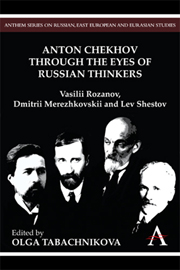
 Anton Chekhov Through the Eyes of Russian Thinkers
 Vasilii Rozanov, Dmitrii Merezhkovskii and Lev Shestov
Book contents
- Frontmatter
- Contents
- Acknowledgments
- Introduction
- List of Names
- List of Russian Cultural Concepts
- Three Brief Biographies – Rozanov, Merezhkovskii and Shestov
- Part One Vasilii Rozanov
- Part Two Dmitrii Merezhkovskii
- 5 Chekhov and Merezhkovskii: Two Types of Artistic-Philosophical Consciousness
- 6 Negating His Own Negation: Merezhkovskii's Understanding of Chekhov's Role in Russian Culture
- 7 An Illuminating Misinterpretation? On Merezhkovskii's Literary Criticism of Chekhov
- 8 Can Merezhkovskii See the Spirit in the Prose of Flesh?
- Part Three Lev Shestov
- Notes on Contributors
6 - Negating His Own Negation: Merezhkovskii's Understanding of Chekhov's Role in Russian Culture
from Part Two - Dmitrii Merezhkovskii
Published online by Cambridge University Press: 05 March 2012
Edited by

Book contents
- Frontmatter
- Contents
- Acknowledgments
- Introduction
- List of Names
- List of Russian Cultural Concepts
- Three Brief Biographies – Rozanov, Merezhkovskii and Shestov
- Part One Vasilii Rozanov
- Part Two Dmitrii Merezhkovskii
- 5 Chekhov and Merezhkovskii: Two Types of Artistic-Philosophical Consciousness
- 6 Negating His Own Negation: Merezhkovskii's Understanding of Chekhov's Role in Russian Culture
- 7 An Illuminating Misinterpretation? On Merezhkovskii's Literary Criticism of Chekhov
- 8 Can Merezhkovskii See the Spirit in the Prose of Flesh?
- Part Three Lev Shestov
- Notes on Contributors
Summary
He [Chekhov] wanted to kill Dostoevskii in us
Innokentii AnnenskiiDid Merezhkovskii under-appreciate the art of Anton Chekhov? Was he, indeed, dismissive of it? The few articles and monographs that treat the personal and literary interrelations of these two contemporaries do convey this impression – whether openly or implicitly. Rosenthal in her major book writes: ‘Merezhkovsky did not consider Chekhov great’. Bedford mentions Chekhov's name only three times in 200 pages.2 Chudakov's substantial l996 article ‘Merezhkovskii and Chekhov’ strongly suggests a certain unfairness in this critic's evaluation of Chekhov the man and artist.
Chudakov's article is probably the best contribution to the subject. It attempts to explain their differences from the fact that they represent two opposed types of fin-de-siècle Russian intellectual (as his subtitle ‘Two Types of Artistic-Philosophical Consciousness’ indicates). According to Chudakov, Chekhov represents an ‘older’ (he was only six years Merezhkovskii's senior) intelligentsia type – atheistic or agnostic, non-religious, not guided by ideology, devoted to progress, humanism, realistic, scientific, tolerant and nondoctrinaire. Merezhkovskii as his almost diametric opposite represents the new Decadent Symbolist type – committed to a Christian religious ideology, a believer, an idealist, doctrinaire and intolerant: ‘Merezhkovskii was organically incapable of tolerance’. Chudakov attacks Merezhkovskii, as many have done before him, for his cold, rational schematism, his way of viewing reality in terms of binary polarities – paganism versus Christianity, flesh versus spirit, Russia versus Europe, etc.
Information
- Type
- Chapter
- Information
- Anton Chekhov Through the Eyes of Russian ThinkersVasilii Rozanov, Dmitrii Merezhkovskii and Lev Shestov, pp. 113 - 128Publisher: Anthem PressPrint publication year: 2010
Accessibility standard: Unknown
Why this information is here
This section outlines the accessibility features of this content - including support for screen readers, full keyboard navigation and high-contrast display options. This may not be relevant for you.Accessibility Information
Accessibility compliance for the PDF of this chapter is currently unknown
and may be updated in the future.