


1. Introduction
1.1. Problem and motivation
Organizational Change (OC) is a fragmented research field (Reference Supriharyanti and SukocoSupriharyanti & Sukoco, 2023). Over the decades starting in the 1940’s, change has been looked at through different lenses: as a planned series of steps (Reference LewinLewin, 1947; Reference KotterKotter, 2011), the result of a psychological and behavioural predisposition of agents (Reference Wanberg and BanasWanberg & Banas, 2000; Reference Morrison and MillikenMorrison & Milliken, 2000), a sociotechnical balancing act (Reference Pasmore, Winby, Mohrman and VanassePasmore et al., 2019), an emergent process of situated action (Reference OrlikowskiOrlikowski, 1996; Reference Buchanan and DawsonBuchanan & Dawson, 2007), or the product of institutional or evolutionary forces (Reference DiMaggioDiMaggio & Powell, 1991; Reference Romanelli and TushmanTushman & Romanelli, 1994). This plurality has generated a rich but hard to navigate landscape in which scholars and practitioners often speak past one another, each relying on assumptions that remain implicit within their preferred paradigm. While existing syntheses of OC have clarified the main mechanisms and vocabularies used to describe transformation, these papers typically classify theories according to their external observable characteristics such as temporal patterns, disciplinary lineage, or components. What remains less explored are the deeper assumptions about the state of the world that give these theories coherence: how predictable, manageable, stable, or distributed the system is believed to be. Without a shared language to articulate such distinctions, comparisons across paradigms remain difficult and practitioners may end up referring to the wrong school of thought for their current paradigm.
Reference Van De Ven and PooleVan de Ven and Poole (1995) is a classic and widely cited framework. It distinguishes four “motors of change”. Our work owes a lot to this foundational paper (as is reflected in the Motor parameter) but it reflects the theoretical landscape of its time, before more recent notions of complexity, emergence, and nonlinearity had fully entered organizational discourse (Reference Riaz, Morgan and KimberleyRiaz et al., 2023). Building on this foundation, Reference ByBy (2005) synthesized the main schools of thought in his widely cited review, using Reference SeniorSenior’s (2002) three categories of change. These categories inspired our own, but we extend them to account for more recent developments on nonlinearity and emergence particularly highlighted by complexity theory, and for more distributed forms of agency and manageability that move beyond the largely top-down assumptions underlying By’s framework. Later, Reference Graetz and SmithGraetz and Smith (2010) offered a valuable synthesis, grouping the OC literature into ten “philosophies of change”. Recently, Reference Da Ros, Vainieri and BelléDa Ros et al. (2023) provided an extensive overview of reviews, cataloguing numerous variables of OC such as agents, participation, and outcomes. Both contributions illuminate the field’s diversity with a descriptive approach. Our work aims to move one level deeper by identifying underlying assumptions, which give coherence to existing categories and can serve as coordinates for a shared conceptual space. The worldviews underpinning the literature on OC are rarely explicit. As a result, when practitioners borrow from multiple methods — for example, combining planned-change tools with agile methods — they often face invisible incompatibilities rooted in conflicting assumptions about control, predictability, or causality. Here we can refer to Reference Bick, Spohrer, Hoda, Scheerer and HeinzlBick et al. (2018) describing how attempts to mix planned (waterfall) and agile practices can lead to persistent issues such as dependency management, as each logic assumes a different relationship between plannability and adaptability. Such clashes are not simply procedural but stem from divergent root assumptions, what we call “exclusion of the incompatible” (Reference Bertrand, Gardoni, Burrows and CardinalBertrand et al., 2025).
1.2. Contribution
This paper introduces a set of seven meta-theoretical parameters of change (7MTPC) to enable consistent comparison among OC approaches. The parameters—Plannability, Manageability, Stability, Trajectory, Origin, Motor, and Scale—emerged from an inductive synthesis of the OC literature. Each one captures a specific assumption researchers and practitioners make about OC and together, these dimensions aim to provide a parsimonious yet comprehensive framework for characterizing any theory of change, regardless of its disciplinary origin. The contribution of this paper is therefore conceptual. We do not attempt to produce a full systematics of the existing OC theories —this is the subject of ongoing work—but rather to define and justify the parameters that make such a typology possible. framework that makes those assumptions visible can serve practical purposes on top of its analytical value, by helping practitioners choose methods internally consistent, and consistent with their context.
2. Methodology: deriving the parameters
The 7MTPC did not arise from an a priori model but from an iterative synthesis of the organizational-change literature.
2.1. Corpus selection and exclusion criteria
Our process began with a broad bibliographic search in Scopus (Figure 1) and Google Scholar to identify the most cited publications and authors associated with the following keywords :“organizational change”, “organizational transformation”, “continuous change”, “change management”, “organization development”, “strategic change”, “resistance to change”, “change process”, “organizational adaptation”, “organizational learning”, “organizational evolution”, “organizational behavior”, “organizational inertia”, “organizational flexibility”, “complex change management”. The review was restricted to literature within business, management, engineering, and social science domains. We excluded publications from clinical, biomedical, purely technical engineering, or psychological literatures that did not treat organizations as the primary unit of analysis, as well as practitioner-oriented sources lacking a clear theoretical or analytical contribution.
This first step provided a foundation of most cited papers and researchers that structure the core of the field, such as Reference LewinLewin (1947), Reference PettigrewPettigrew (1990), Reference Romanelli and TushmanTushman and Romanelli (1994), Reference Van De Ven and PooleVan de Ven and Poole (1995), Reference OrlikowskiOrlikowski (1996), Reference WeickWeick (1995), Reference Weick and QuinnWeick and Quinn (1999), Reference Armenakis and BedeianArmenakis and Bedeian (1999), Reference Eisenhardt and MartinEisenhardt and Martin, (2000), Reference Tsoukas and ChiaTsoukas and Chia (2002), Reference Langley, Smallman, Tsoukas and Van De VenLangley et al. (2013), Reference Stouten, Rousseau and De CremerStouten et al. (2018), Reference Pasmore, Winby, Mohrman and VanassePasmore et al. (2019).
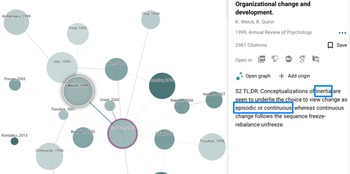
In a second step, we used Connected Papers (Figure 2) to find additional sources (older and more cited, which sometimes had not come out in SCOPUS), as well as related and relevant bodies of work. This network-based exploration helped us discover conceptual neighbours such as sensemaking, dynamic capabilities, institutionalism, sociotechnical systems, and complex adaptive systems—fields that approach transformation from distinct and complementary angles. In the below example, centering on Reference Weick and QuinnWeick and Quinn (1999), a whole network of connected papers is made visible, with the common keywords inertia , continuous change and situated change. We used these types of associations to discover relevant keywords on OC, which in turned informed the 7MTPC. In this illustrative example, the concept of inertia fed into our stability parameter. See Table 1 for complete mapping of sources to parameters.
Documents by subject area in our Scopus search for “Organizational Transformation” and “Organizational Change” - total = 318,758 documents found

Example of a Connected Papers (connectedpapers.com) search based on Reference Weick and QuinnWeick & Quinn (1999) and exploring the network of related works, and keywords

While not exhaustive, the overall corpus (see References) offers an empirical anchor broad enough to capture the recurring assumptions that differentiate families of thought.
2.2. Iterative synthesis and reduction
The 7MTPC were not decided on a priori but emerged inductively through repeated comparison of how different theories defined and opposed one another. For instance, Plannability and Manageability are correlated but distinct: change may be plannable to some extent while it escapes managerial control (see for example lifecycle models in Reference Van De Ven and PooleVan de Ven and Poole, 1995), while unplanned emergent processes can sometimes still be guided through local adaptation and sensemaking (Reference OrlikowskiOrlikowski, 1996, Reference WeickWeick, 1995). Each one of the 7MTPC corresponds to key ideas discussed in the literature, often appearing as conceptual synonyms or oppositions (see full details in section 3) : for example, we grouped notions of inertia (Reference Hannan and FreemanHannan & Freeman, 1984; Reference Kaganer, Gregory and SarkerKaganer et al. 2023) and path dependence (Reference Schreyögg and SydowSchreyögg & Sydow, 2011) under a common category as these two notions converge in portraying organizations as constrained by established structures and routines, emphasizing the stability dimension of change
3. Seven parameters for comparing organizational change approaches
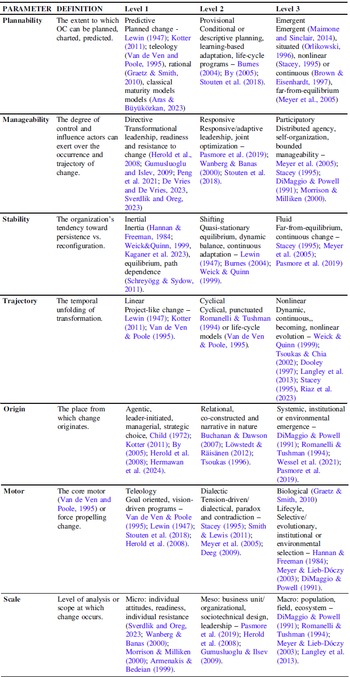
The 7MTPC define the conceptual coordinates through which theories of organizational transformation can be compared. The articles cited within each “Level” column (Table 1) are the same ones used for our corpus.
Table of the 7MTPC mapped to related concepts in the literature

3.1. Plannability — the extent to which organizational change can be planned, charted, predicted
In predictive models, change is conceived as a rational sequence of steps leading from a current to a desired state. Reference LewinLewin’s (1947) three-step model and Reference KotterKotter’s (2011) eight-step process exemplify this tradition, assuming that the path to change can be charted and managed through clear objectives, planning, and communication (Reference BurnesBurnes, 2004). Later perspectives recognized that formal plans rarely survive contact with organizational complexity. Scholars such as Reference Weick and QuinnWeick and Quinn (1999) and Reference Pettigrew, Woodman and CameronPettigrew et al. (2001) reframed change as provisional: partially plannable but contingent on feedback, negotiation, and contextual learning. Plans become heuristics rather than scripts, guides that themselves can be changed. Finally, processual and complexity-oriented portray plannability as largely improvised (Reference OrlikowskiOrlikowski, 1996), discontinuous (Reference DeegDeeg, 2009) and nonlinear (Reference StaceyStacey, 1995).
3.2. Manageability — the degree of control and influence actors can exert over the occurrence and trajectory of change
While plannability indicates the extent to which change can be anticipated or charted in advance, manageability deals with the extent to which actors are able to actively steer and influence its trajectory en route, whether they merely understand the currents or truly command the ship. In directive approaches, leaders are architects of change: they diagnose problems, design interventions, and drive implementation (Reference LewinLewin, 1947; Reference KotterKotter, 2011; Reference BurnesBurnes, 2004). Leadership research within this logic—particularly transformational and visionary leadership—frames success as a function of purpose, clarity, and control (Reference Herold, Fedor, Caldwell and LiuHerold et al., 2008; Reference Belias and KousteliosBelias & Koustelios, 2014). A responsive view relaxes the premise of top-down control. Organizations adapt by sensing and reacting to shifting environments, as in Reference Romanelli and TushmanTushman and Romanelli’s (1994) punctuated equilibrium or in the adaptive systems literature (Reference DeegDeeg, 2009; Reference Meyer, Gaba and ColwellMeyer et al., 2005). Here, leaders influence rather than command outcomes, emphasizing structures that enable timely adaptation. Finally, participatory models dissolve managerial primacy altogether. Agency is distributed across actors who co-construct change through dialogue, experimentation, and sensemaking (Reference WeickWeick, 1995; Reference Tsoukas and ChiaTsoukas & Chia, 2002; Reference Pasmore, Winby, Mohrman and VanassePasmore et al., 2019). Change becomes a collective process of interpretation rather than imposition.
3.3. Stability — the organization’s tendency toward persistence
In the inertial view, organizations exhibit structural inertia (Reference Hannan and FreemanHannan & Freeman, 1984) and change only episodically in response to shocks (Reference Romanelli and TushmanRomanelli & Tushman, 1994). Path dependence reinforces this rigidity, as self-reinforcing mechanisms lock organizations into established trajectories (Reference Gumusluoglu and IlsevSchreyögg & Sydow, 2009). Intermediate perspectives treat organizations as shifting systems in “quasi-stationary equilibrium” (Reference LewinLewin, 1947), where continuous adjustments maintain temporary balance. Reference Weick and QuinnWeick and Quinn (1999) depict change as continuous renewal—a succession of small adaptations that accumulate into transformation (Reference Tsoukas and ChiaTsoukas & Chia, 2002). At the opposite end, the fluid view posits that organizations are perpetually reconfiguring, operating far from equilibrium (Reference Meyer, Gaba and ColwellMeyer et al., 2005; Reference Pasmore, Winby, Mohrman and VanassePasmore et al., 2019). Here, stability is not an antecedent to change but a transient effect of ongoing processes.
3.4. Trajectory — the temporal unfolding of a transformation
In linear models, change follows a sequence of stages toward a defined end state: Reference LewinLewin’s (1947) unfreeze–change–refreeze cycle, Reference KotterKotter’s (2011) eight steps, or Reference JudsonJudson’s (1991) phased approaches.
Such models imply order, causality, and completion. In cyclical views, organizations evolve through recurring phases of stability and disruption. Reference Romanelli and TushmanRomanelli and Tushman (1994) describe punctuated equilibrium; Reference Van De Ven and PooleVan de Ven and Poole’s (1995) life-cycle motor reflects the same rhythm of progression and renewal. Even adaptive systems (Reference Meyer, Gaba and ColwellMeyer, Gaba & Colwell, 2005) oscillate through expansion and contraction as they coevolve with their environments. Nonlinear conceptions reject both linear closure and cyclical repetition (Reference Tsoukas and ChiaTsoukas & Chia, 2002; Reference Langley, Smallman, Tsoukas and Van De VenLangley et al., 2013; Reference StaceyStacey, 1995). Transformation has no fixed start or finish and is vastly dependent on initial conditions.
3.5. Origin — the place from which change originates
An agentic origin assumes intentional action by individuals or leadership teams. Reference LewinLewin (1947) and Reference KotterKotter (2011) frame change as deliberately initiated by purposeful agents who design and mobilize. Strategic-choice theory (Reference ChildChild, 1972) reflects this voluntarist stance. Relational perspectives shift attention to interactions among organizational members. Change emerges through networks of communication, negotiation, and narrative construction (Reference Buchanan and DawsonBuchanan & Dawson, 2007; Reference TsoukasTsoukas, 1996). No single actor controls the process; rather, collective sensemaking generates momentum. Finally, systemic views locate the origin beyond the organization itself. Institutional, ecological, and sociotechnical theories (Reference DiMaggioDiMaggio & Powell, 1991; Reference Romanelli and TushmanRomanelli & Tushman, 1994; Reference Pasmore, Winby, Mohrman and VanassePasmore et al., 2019) emphasize environmental or systemic pressures that compel adaptation.
3.6. Motor — the force propelling change
Here we directly use Reference Van De Ven and PooleVan de Ven and Poole’s (1995) notion of the motor of change—the mechanism that gives change its direction and energy. In teleological models, change is goal oriented: driven by vision, objectives, and intentional problem-solving (Reference Van De Ven and PooleVan de Ven & Poole, 1995; Reference Herold, Fedor, Caldwell and LiuHerold et al., 2008).
Leadership provides purpose and alignment (Reference Gumusluoglu and IlsevGumusluoglu & Ilsev, 2009). Dialectic perspectives reinterpret motion as arising from contradiction rather than purpose. Dialectical theories (Reference Van De Ven and PooleVan de Ven & Poole, 1995; Reference Smith and LewisSmith & Lewis, 2011) view transformation as the synthesis of opposing forces, while complexity theories (Reference StaceyStacey, 1995; Reference DeegDeeg, 2009) describe systems evolving at the edge of chaos through paradoxical feedback. In biological models (Reference Graetz and SmithGraetz & Smith, 2010), transformation is seen as a results from a natural lifecycle inherent to the organizational form (Reference Van De Ven and PooleVan de Ven & Poole, 1995) or environmental selection and retention rather than internal tension or intent (Reference Hannan and FreemanHannan & Freeman, 1984; Reference Romanelli and TushmanRomanelli & Tushman, 1994, Reference Bertrand, Gardoni, Burrows and CardinalBertrand et al, 2025). Variation arises continuously, but only certain forms persist via exclusion of the incompatible (Reference Longo and MontévilLongo & Montevil, 2013, Reference Bertrand, Gardoni, Burrows and CardinalBertrand et al., 2025).
3.7. Scale — level of analysis or scope at which change occurs
Scale specifies the unit of analysis and the level at which change is primarily theorized.
Micro-level approaches focus on individuals—their attitudes, emotions, and openness to change (Reference Wanberg and BanasWanberg & Banas, 2000; Reference Morrison and MillikenMorrison & Milliken, 2000; Reference Rafferty, Jimmieson and ArmenakisRafferty et al., 2013). Meso-level theories emphasize collectives, teams, or sociotechnical subsystems where routines and interdependencies mediate transformation (Reference Langley, Smallman, Tsoukas and Van De VenLangley et al., 2013; Reference Pasmore, Winby, Mohrman and VanassePasmore et al., 2019). Macro-level perspectives address organizational fields and institutions, where selection mechanisms, legitimacy pressures, or large-scale inter-organizational dynamics dominate (Reference DiMaggioDiMaggio & Powell, 1991; Reference Romanelli and TushmanRomanelli & Tushman, 1994). Scale thus bridges levels of analysis and clarifies whether a theory of change explains individual adaptation, collective learning, or systemic evolution.
4. Illustrative application: the case of change agility
To demonstrate how the 7MTPC make change approaches comparable in future research, we illustrate its use through the case of change agility, as described by Reference Mollahoseini Ardakani, Hashemi and RazzaziMollahoseini et al. (2018), where Agile practices such as Scrum (Reference SchwaberSchwaber, 1997) are adapted for OC.
Change agility as seen through the seven parameter framework

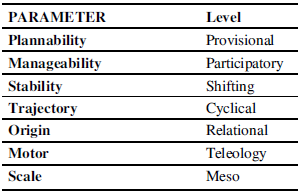
Agile change (AC) approaches such as adaptations of Scrum to the field of organizational transformation (Reference Mollahoseini Ardakani, Hashemi and RazzaziMollahoseini et al., 2018) position themselves at the midpoint between planned and emergent logics. Below we briefly justify the level assessments presented in Table 2.
-
• Plannability – Provisional. AC assumes short-term sprint plans that are repeatedly re-evaluated as the change process unfolds. Planning is iterative and learning-based rather than predictive; objectives evolve through feedback from teams and stakeholders rather than following a fixed roadmap.
-
• Manageability – Participatory. AC draws from agile practices the principle of collective steering through retrospectives, reviews, and team autonomy. In practice, however, participation is often partial, as higher management retains control over scope, priorities, or performance indicators.
-
• Stability – Shifting. AC maintains a balance between stability and flexibility. Iterative cycles and recurring ceremonies provide temporary anchors, yet structures and roles are regularly adapted to emerging needs, keeping the organization in a state of dynamic equilibrium.
-
• Trajectory – Cyclical. Change progresses through recurring sprint and review loops, creating an oscillating rhythm of exploration and consolidation rather than a linear sequence.
-
• Origin – Relational. Initiative arises from interactions within and between teams, through continuous dialogue with users, customers, and sponsors. Change is co-constructed rather than imposed.
-
• Motor – Teleology. While Agile takes a less linear approach to OC than more traditional models, its implementation in change initiatives is usually goal oriented, where a target is initially set (a fixed backlog of expected outcomes)
-
• Scale – Meso. AC operates primarily at the team or program level, where coordination mechanisms (e.g., Scrum-of-Scrums, PI planning) connect individual contributions to broader organizational goals.
This example illustrates how the 7MTPC enable consistent characterization of a given approach to change. In future work, we will apply the same logic systematically to a larger corpus of theories to explore their relatedness, reveal clusters of compatible assumptions, and map the broader evolutionary landscape of OC (see Reference Bertrand, Gardoni, Burrows and CardinalBertrand et al., 2025).
5. Conclusion
5.1. Discussion and practical implications
This paper proposes a framework grounded in the literature for the systematic comparison of organizational change (OC) theories through seven meta-theoretical parameters (7MTPC): Plannability, Manageability, Stability, Trajectory, Origin, Motor, and Scale . The 7MTPC provides a common analytical language for comparing how different approaches conceptualize, explain, and intervene in organizational change. By equipping researchers and change practitioners with this framework, we aim to offer an objective decision-support tool for selecting organizational change approaches suited to specific research questions or organizational contexts. Beyond instrumental use, the framework is also intended to foster cross-disciplinary dialogue by making explicit the often implicit assumptions that differentiate change theories.
As illustration of use, a future study could examine a set of large-scale AI-lead transformation initiatives across public and private organizations by systematically coding the change models explicitly or implicitly mobilized in each case along the seven 7MTPC dimensions. This would make it possible to compare transformation trajectories not only in terms of outcomes, but in terms of their underlying meta-theoretical configurations, and to assess whether certain configurations are more robust under specific contextual conditions (e.g., high uncertainty, strong institutional constraints, or multi-level governance).
In more advanced work, the authors plan to mobilize Reference Bertrand, Gardoni, Burrows and CardinalBertrand’s (2025) PhylOrg proposition as a complementary methodology, whereby systematic coding along the 7MTPC enables clustering and evolutionary analyses that reveal how change theories relate, diverge, or hybridize over time. In this perspective, the framework functions both as a map of conceptual diversity in the organizational change field and as a foundation for cumulative theorizing across disciplines.
5.2. Limitations
We acknowledge that defining 3 specific levels for each parameter is somewhat arbitrary. The process relied on explicit conceptual criteria rather than personal intuition, but some degree of subjectivity is inherent to any meta-theoretical classification. We treat these levels as ideal types for analytical purposes rather than strict categories, recognizing that real theories often blend assumptions across levels.
The parameters were derived through iterative synthesis of widely cited OC theories, combining inductive coding and theoretical abstraction. While the resulting dimensions appear distinct, formal tests of independence, reliability, and generalizability remain to be conducted. The current work thus represents an exploratory step toward a systematic classification. Future research will (1) document the coding procedure in detail, (2) assess inter-coder reliability and factor independence across a larger corpus, and (3) perform correlation analysis or orthogonality testing on the parameters to assess parsimony. For now, we have prioritized conceptual clarity and coverage of the major distinctions evident in the literature. Future work will also need to assess the framework’s reliability and validity through application to a broader corpus of theories and through triangulation of coding across independent reviewers and alternative classifications.


 Open access

