


Introduction
Science and the scientific method are based on objective, systematic and independent observation of quantifiable phenomena. Valid scientific knowledge is thus accumulated on the basis of the repeatability and reproducibility of results. Pseudoscience, which poses as science, yet is intrusive of and diverges from accepted scientific knowledge, can be defined as the acritical and biased treatment of phenomena with no adherence to standards (Leaf et al., Reference Leaf, Kassardjian, Oppenheim-Leaf, Cihon, Taubman, Leaf and McEachin2016). Given that pseudo means ‘false’ in Greek, pseudoscience, in fact, means ‘false science’, although it is often referred to in more benevolent terms as “that which aspires, but fails, to be science” (Alonso and Cortiñas, Reference Alonso and Cortiñas2014a).
Within the wide spectrum of pseudoscientific practices, complementary and alternative medicine (CAM) is the strand with the highest level of social acceptance and the greatest number of followers. Since CAM purports to be highly professional, it has overcome the barrier of mistrust of many people in society. It consequently poses the greatest danger, as it may, in extreme cases, cause the death of patients, given that its false promises lead patients to abandon conventional medical treatments for diseases for which prognosis is good (Yarritu et al., Reference Yarritu, Matute and Luque2015; Alonso and Cortiñas, Reference Alonso and Cortiñas2014a). CAM includes a wide range of so-called therapies, including homeopathy, acupuncture, reiki and Bach flower remedies, all of which are good examples of the extent to which pseudoscience — despite its potential and silent risk for public health — has become an acceptable part of ordinary life.
One of the main characteristics of these practices is that they seek to be perceived as natural and, therefore, innocuous. Recent research indicates that these therapies are surrounded by naturalistic and holistic discourses designed to legitimize their use (Salvador-Mata et al., Reference Salvador-Mata, Raffio and Cortiñas-Rovira2020; Salvador-Mata and Cortiñas Rovira, Reference Salvador-Mata and Cortiñas-Rovira2020). Many of these therapies are sold commercially as a natural, healthy remedy for diseases. This misconception –to think that something, because it is natural, is capable of healing- has become a key decision driver for many people. Peterson et al. (Reference Peterson, Wilson, Gruhl, Davis, Olsen, Parsons, Kann, Fagerlin, Whatt and Johnson2022) described that patients who initially decided to treat cancer using alternative therapies were more likely to express values associated with a natural discourse.
To assume that something, for the simple fact of being natural, has curative properties is to commit a fallacy ad naturam. And, as a matter of fact, the scientific literature contains numerous independent studies that point to a lack of efficacy and effectiveness of CAM beyond a placebo effect (Ernst, Reference Ernst2010; Thaler et al., Reference Thaler, Kaminski, Chapman, Langley and Gartlehner2009; Shang et al., Reference Shang, Huwiler, Nartey, Jüni and Egger2007; Pintov et al., Reference Pintov, Hochman, Livne, Heyman and Lahat2005; Walach et al., Reference Walach, Rilling and Engelke1999). CAM is thus clearly indicated to lack the ability to improve health according to current scientific knowledge regarding the impact of pharmaceuticals (Arendt, Reference Arendt2016). Numerous authors have pointed to the poor quality and reproducibility of CAM results obtained experimentally. CAM supporters counterclaim that these practices cannot be studied properly through controlled clinical trials, but only through observational methodologies. Some positive results of CAM therapies (isolated, limited and unsystematic), however, derive from non-specific effects, e.g., from the emotional and warm approach that is typical of alternative therapy practitioners. Rigorous studies generating accumulative and valid evidence have tended to consistently point to a placebo effect (Ernst, Reference Ernst2010; Oh et al., Reference Oh, Kim, Park and Kang2007). The scientific community broadly accepts the placebo effect of CAM as a valid beneficial effect.
Another main inducement for using CAM is the purported absence of adverse effects (Salvador-Mata and Cortiñas-Rovira, Reference Salvador-Mata and Cortiñas-Rovira2020). However, apart from the indirect risk posed by substituting effective conventional treatments with CAM remedies, several studies have reported a direct risk from substances used in homeopathic preparations (Stub et al., Reference Stub, Musial, Kristoffersen, Alraek and Liu2016; Posadzki et al., Reference Posadzki, Alotaibi and Ernst2012). Bleeding and the contraction of AIDS, hepatitis C and tuberculosis as a consequence of acupuncture pricks, and headaches, lethargy, vomiting, diarrhoea, hair loss, migraine, epilepsy and allergic reactions as side effects of other CAM treatments have been reported by numerous authors (Mulet, Reference Mulet2015; Posadzki et al., Reference Posadzki, Alotaibi and Ernst2012; Ernst et al, Reference Ernst, Pittler, Wider and Boddy2006). Many adverse effects may be due to poor hygiene and asepsis in the case of acupuncture, or to the intake of heavy metals such as arsenic, cadmium, mercury and iron (highly toxic even in small doses) included as active ingredients in homeopathic preparations. Reports issued by the UK House of Commons Science and Technology Committee (2010) and the Australian National Health and Medical Research Council (2015) further confirm that no credible or reliable evidence exists regarding the effectiveness of homeopathy or other CAM treatments in treating any health condition. Moreover, Australian authorities recommend that pharmacies should not sell homeopathic remedies (Commonwealth of Australia, 2017).
Despite the evidence against CAM, a 2016 study of social perceptions of science by the Spanish Foundation for Science and Technology (FECYT, 2016) found that over half of respondents believed that homeopathy (52.7%) and acupuncture (59.8%) were effective. Such findings worryingly point to a gathering social momentum of greater reliance on personal beliefs and superstitions and of greater acceptability of pseudosciences to the detriment of scientific evidence (Matute et al., Reference Matute, Blanco, Yarritu, Díaz-Lago, Vadillo and Barberia2015).
The media, which play a major role in the democratization of society, have an obligation to inform and educate society about issues and events. This obligation also includes promoting and restoring the lost union between science and society, given that the media can normalize and shape perceptions, behaviour, attitudes and opinions (Gao et al., Reference Gao, Fu, Lin, Nehl, Wong and Zheng2013; Wilde, Reference Wilde1993). The media are, in particular, an important source of information on science and, especially, on health-related issues (Ashwell, Reference Ashwell2016; Miranda et al., Reference Miranda, Vercellesi and Bruno2004; Stryker, Reference Stryker2002). In fact, numerous of people perceive that ‘real’ science is what they read in the press (Bruno and Vercellesi, Reference Bruno and Vercellesi2002). Since the media have the ability to influence individual and collective decision-making regarding health, they also have the moral obligation to educate and channel decision-making towards appropriate choices based on scientific truths (Arendt, Reference Arendt2016; Van-Esperen et al., Reference Van-Eperen, Marincola and Strohm2010; Stryker, Reference Stryker2002; Cortiñas et al, Reference Cortiñas Rovira, Alonso Marcos, Pont Sorribes and Escribà Sales2015).
Our aim was to provide new insights to media handling of four alternative therapies that have become particularly acceptable to society, namely, homeopathy, acupuncture, reiki and Bach flower remedies. We therefore identified, analysed and compared 379 articles on these four therapies published in the top 5 Spanish newspapers in 2011 to 2016 in terms of newspaper sections, journalistic genres, rigour and stance.
Materials and methods
Sampling
For the five-year study period (1 June 2011 to 31 May 2016), we empirically analysed Spain’s five most widely read (EGM, 2016) Footnote 1 general-interest printed newspapers — namely, El País, El Mundo, La Vanguardia, El Periódico and ABC — for articles containing the terms homeopathy, acupuncture, reiki and Bach flower remedies (and the respective plurals and derivations Footnote 2 ).
Advanced search functions were used to search the specialized press databases MYNEWS (https://www.mynews.es/) and FACTIVA (https://www.dowjones.com/products/factiva/) and the archives of each of the five newspapers.
Content analysis and evaluation
Content analysis involved recording data for each selected article as follows: newspaper details (name, publication date/page, headline, sub-headline/lead paragraph/text, and byline), genre, section, stance, arguments and rigour. These data were saved in a spreadsheet.
The genres were informative, Footnote 3 interpretive and opinion/editorial. Footnote 4 Editorials were analysed as a form of opinion, since they set the tone of a newspaper regarding particular issues and may be pertinent to our research. The sections were frontpage, international, Spain, opinion, sports, economics, society, Footnote 5 culture, local news/lifestyle, miscellaneous Footnote 6 and backpage.
The stance adopted regarding CAM was classified as for, against or neutral. A text was considered as “for” if it openly defended the use of CAM therapies to a greater or lesser extent or if it contained uncritical references to proponents of these practices. A text was considered as “against” if it was openly critical with these practices and if it used scientific and rigorous references to actively debunk CAM. Finally, a text was considered as “neutral” if it offered an unbiased view of a topic related with CAM or if it remained informative.
A two-step content analysis process was carried out. At first, the researchers individually analysed the total of articles retrieved in order to categorize each piece in one of these three levels (for, neutral, against). Afterwards, the researchers shared their results, with two possible scenarios: the evaluation was the same, and hence it was considered definitive, or the evaluation varied, in which case a dialogical process was opened until unanimously decided which of the two interpretations should prevail.
Furthermore, the researchers performed an inductive analysis to elicit the arguments used to bolster each stance in order to more accurately characterize the kind of discourse used in articles on the pseudosciences aimed at the public.
Rigour was measured as a quality index (QI) reflecting the presence, characteristics and quality of scientific or pseudoscientific content. Table 1 represents the main parameters taken into account for that analysis. The content analysis followed the same two-step process as previously described.
Criteria used for QI classification

Source. Authors.
Afterwards, a QIt coefficient was calculated using the following formula:
 $$QIt = \;\mathop \sum \limits_{i = 1}^N {{QIi} \over N}$$
where the average of the summed scores (QIi) from day 1 to day n, that is, QIt = QI1 + QI2 + QI3 + … + Qin, divided by the total number of articles, represented the quality of the content of the different newspapers. QI was scored on a four-item scale (0 to 3), where 3 and 0 reflected maximum and minimum scientific rigour, respectively. A score of 3 reflected alignment with scientific knowledge, the use of reliable and representative information sources (experts, official bodies or spokespeople, etc.), a clear message and useful additional information for readers. A score of 0, in contrast, reflected information that significantly deviated from journalism ethics and/or that lacked scientific rigour. Scores of 1 and 2 reflected intermediate levels of ethics and rigour.
Results
Pseudoscientific content in the Spanish press
A total of 540 articles were identified in the five most read newspapers in Spain that referred to any of the four studied pseudoscientific topics, i.e., homeopathy, acupuncture, reiki or Bach flower remedies.
Excluded were 161 articles (29.8%) that only used pseudoscientific terms in passing in metaphorically: in relation to homeopathy, expressions such as “growth at homeopathic doses”, “homeopathic effectiveness” and “a mere homeopathic 1%”, and in relation to acupuncture, expressions such as “acupuncture aimed at peripheral neighbourhoods punished by the crisis”. Interestingly, while the connotations were mostly rather negative and the words generally reflected an inconspicuous or insignificant level of action, the overall impression left by these excluded articles is one of CAM having already made significant inroads into society.
Table 2 summarizes details of the 379 (70.2% of the total articles identified) included articles, analysed in terms of topic and genre. Homeopathy was the most reported topic, with 192 (50.7%) articles, followed by acupuncture (31.1%), reiki (12.7%) and Bach flower remedies (5.5%). Interestingly, El País did not publish a single story on Bach flower remedies in the five years analysed.
Newspaper articles by topic and genre

EPA = El País; EMU = El Mundo; LVA = La Vanguardia; EPE = El Periódico; ABC = ABC
Source. Authors.
As for genre, the interpretive genre (74.1%) predominate both overall and in relation to the individual topics, followed at a distance by the opinion genre (20.1%). The CAM topic was minimally addressed in informative (4.2%) and in the frontpage (1.3%); the single editorial was a descriptive one (i.e., with no judgement for or against) on reiki workshops in Barcelona, published by El Periódico in 2015. No other editorial was detected in the other four newspapers.
Of the 379 articles identified, El Pais published 48 (12.6% of the total), El Mundo published 59 (15%), La Vanguardia 112 (29.5%), El Periódico 102 (26.9%) and ABC 58 (15.3%). Thus, La Vanguardia is the newspaper with the most articles published regarding complementary and alternative therapies (CAM), followed by El Periódico. El Pais was the one with the fewer articles published.
Rigour scores by genre and topic
In order to evaluate the rigour, each article was punctuated in a range from 0 to 3. Table 3 summarizes the results, organized by genre and topic. In no case, a score higher than 2 –which will be considered as somewhat rigorous- was obtained, neither in any genre nor in any topic. The scores move from very deficient to somewhat deficient, and only in a few cases it gets close to somewhat rigorous.
Rigour (QI) scores: total score/average score (n= number of articles)

Note. Results are expressed as the total QI score for each category and as the average of the total score for each article, where 0 is ‘very deficient’ and 3 is ‘very rigorous’.
Source. Authors.
The greatest rigour was obtained for the opinion genre (average score 1.6, between somewhat deficient and somewhat rigorous), while the lowest was obtained for the interpretative genre (average score 0.9, between very deficient and somewhat deficient).The interpretative genre comprises the 74.1% of the articles (table 2).
The topics analysed have a rigour score range between 0.7 (Reiki) and 1.2 (homeopathy and Bach flowers). The average topic score was 1.1, considered as somewhat deficient.
Many individual articles, especially in the interpretive genre, deviated significantly from the principles of good professional practice, with 40.4% awarded the lowest possible score (0), meaning that they were very deficient. These articles tended to make speculative and unrealistic claims, disregard scientific facts, omit information from rigorous reports and studies and draw on unreliable and unrepresentative sources, e.g., practitioners with no scientific or healthcare knowledge.
Only 31 (8.2%) articles received a score of 3. These articles, mostly belonging in the opinion genre, categorically repudiated the pseudoscience and the alternative therapies, employed clear language adapted to the target readership, used well-founded arguments based on current scientific evidence and drew on reliable and representative scientific sources.
In regard with the rigour score of each newspapers, and while the best and worst results were achieved by El País and El Periódico respectively, their average rigour scores of around 1 did not, in fact, differ by much. Therefore, no big differences were observed when comparing newspaper individual rigour score. Broadly speaking, significant flaws were observed, with similar results for all the newspapers analysed.
CAM distribution in newspaper sections
Figure 1 summarizes CAM distribution in the newspapers sections. The society section had the highest frequency of articles (46.4%), followed at a distance by opinion (13.7%), local news/lifestyle (9.5%); and backpage (9%). The remaining sections each represented under 7% (miscellaneous, 6.6%; culture, 5.5%; Spain, 2.9%; sports, 2.1%; economics, 1.6%; and international and frontpage with 1.3% each). The society section also accounted for the highest concentration of articles across practically all the newspapers. The striking imbalance of almost three times as many articles in the society section as in the next most important section indicates that the pseudoscience are encroaching on a space that properly corresponds to science.
Alluvial diagram that represents in which section of the newspaper (Frontpage, Society, Miscellaneous, Spain, Opinion, Local, Economy, Backpage, Sports or Culture) the articles of each topic (homeopathy, acupuncture, Bach flowers and reiki) are published. Source authors.

As expected, there is a minimal presence of CAM content in the International, Economy and Sports sections.
Newspapers stance on CAM content
Figure 2 summarizes results by stance according to newspaper.
Column chart that represents what proportion of the articles published by each newspaper has a “for”, “neutral” or “against” stance. Source authors.

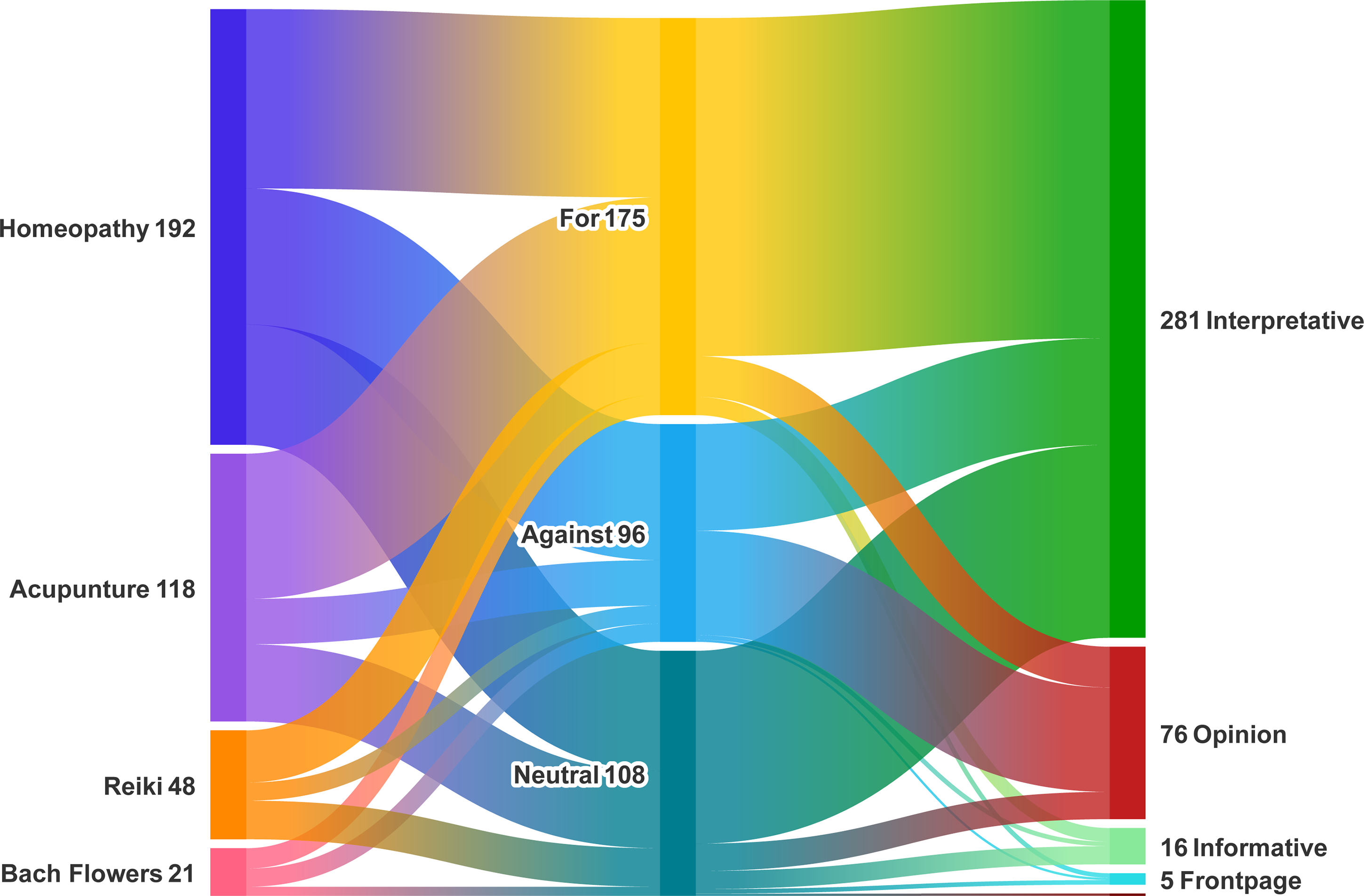
Multi-step alluvial diagram that shows how the articles of each topic are categorized (for, neutral or against) and, subsequently, how they are grouped by journalistic genres. Source authors.
El Periódico was the newspaper with the highest proportion of articles considered in favour of CAM content (58.8%), followed by La Vanguardia (48.2%) and El Mundo (47.5%). In ABC, the 32.7% of the articles were considered in favour of CAM content, while the most common stance was a neutral one (41.4% of the articles were considered neutrals). Finally, El País was the newspaper most against the alternative therapies, although with a modest 35.4% of articles against the pseudoscience and 29.2% considered in favour. However, El País only accounted for the 12.6% of the total articles published regarding CAM therapies (Table 2).
175 articles, which corresponds to the 46,2% of the total, reflected a stance in favour of the CAM therapies analysed. Hence, almost half of the articles published in the major Spanish newspapers support, somehow, CAM content. Articles adopting a neutral stance accounted for close to a third (28.5%), while articles that projected a negative view accounted for around one in four articles (25.3%). Therefore, of the total articles with CAM content, only 96 of 379 were clearly against them.
Analysing the results by genre (Figure 3, and Supplementary Table 1), the interpretive genre clearly predominated in terms of a stance in favour of the four studied therapies — 62 (47% of) articles on homeopathy, 58 (59.8%) on acupuncture, 21 (55.3%) on reiki and 8 (57.2%) on Bach flower remedies —. Only the 16.8% of the articles of the interpretative genre are clearly against pseudoscience. These results are consistent with the ones seen before (Table 3), in which the lower rigour score was obtained in the interpretative genre.
In contrast, the opinion genre was featured by a greater frequency of articles (around 60%) adopting a stance against the pseudoscience. Again, it is consistent with the greater score in rigour seen in table 3.
The informative genre, which has a low coverage of CAM content, presents a neutral stance in most of the articles (50%).
Arguments in favour
An analysis of the arguments used in articles in favour of CAM reveals a discourse that is illusory and inconsistent with science but which comes across as credible and persuasive for the population.
Our main finding is that the alternative therapies appear to fill a vacuum left by conventional medicine. Arguments predicate them as innocuous, inexpensive and medically acceptable and generate high expectations of improvement along the lines of ‘nothing to lose and much to gain’. Empty promises of miraculous and instant effects, however, fail to be backed up by even minimal scientific evidence. Fantastical and implausible theories that are impossible to verify through rigorous studies are used to explain the infallible solutions proposed for CAM.
The proponents of these therapies cite supposedly scientific studies of questionable reliability and methodological rigour to deny insinuations regarding lack of efficacy, when these therapies, at best, merely produce a placebo effect. They also use highly technical language that, while appearing to reflect science, is chameleonic in how it displays the fraudulence that lies at the very heart of these therapies.
Finally, use of the term ‘natural’, which tends to be associated with a lack of side effects and with a healthy lifestyle, further transmits the idea that these therapies are innocuous. An example of this message is the statement by the President of the Homeopathic Section of the Official College of Medical Practitioners of Barcelona: “Being able to improve a patient without using chemicals is not valued in our country in the same way as it is in other European countries such as France, Great Britain and Germany” (Escales, Reference Escales2014). We also found evidence that CAM is associated with an alternative lifestyle marked by usurpation of ‘conventional’ behaviours and attitudes regarding medicine, stoked by speculation about a hidden network of economic interests working against the health of people.
Discussion and conclusions
The present study analyses the coverage of complementary and alternative therapies (CAM) in mainstream press in the 2011-2016 period. The results shed light on how the five more read newspapers cover pseudoscience, specifically focused on CAM, and fuel the misinformation that prevails in society.
High prevalence of CAM content
The prevalence of CAM content in the newspapers was relatively high, as 379 articles were identified in the period study. 50.7% of the articles were related with homeopathy, whereas 31.1% with acupuncture. Those findings are consistent with the FECYT’s report, in which homeopathy and acupuncture are widely perceived as effective by an important part of population (52.7% and 59.8% respectively). This may indicate that there is a relationship between the CAMs with more support in society and their presence in the media. Although this study is not designed to establish causality, it should be noted that the constant appearance of this content in the media can contribute to forming opinions favourable to these treatments. In fact, different studies described the role of the media as elements of normalization and shaper of opinion, perceptions and behaviour in the population (Gao et al., Reference Gao, Fu, Lin, Nehl, Wong and Zheng2013; Wilde, Reference Wilde1993).
The relatively high prevalence of CAM content in the newspapers is consistent with the findings of Cortiñas et al. (Reference Cortiñas Rovira, Alonso Marcos, Pont Sorribes and Escribà Sales2015), who reported how a large proportion of science journalists (31%) perceived an increase in pseudoscientific content in the media.
CAM content is fairly evenly distributed among the mainstream newspapers analysed. La Vanguardia and El Periódico, both considered as quality newspapers, contain a high number of articles regarding CAM (112 and 102 respectively). El País was the one with fewer articles (48). These results suggest that much work remains to be done in two directions: a) the pseudoscientific content in the media must be reduced; and b) if present, it has to be done with scientific rigour.
Many researchers have pointed out that media coverage of healthcare-related topics are rated as poor, inaccurate, incomplete or biased, with newspapers tending to favour stories with a high emotive content over more factual or informative stories (Robinson et al., Reference Robinson, Coutinho, Bryden and McKee2013, Iaboli et al., Reference Iaboli, Caselli, Filice, Russi and Belletti2010, Bruno and Vercellesi, Reference Bruno and Vercellesi2002).
Uncritical articles in the interpretive genre and in the society section, critical articles in the opinion genre
Articles that are less critical with CAM are mostly found in the society section and in the interpretive genre. This belies the claims of a group of Spanish science journalists (Cortiñas et al., Reference Cortiñas Rovira, Alonso Marcos, Pont Sorribes and Escribà Sales2015), who assert that sections other than science or society are responsible for pseudoscientific content and that content is, in any case, decided by newspaper management.
There also appears to be little effort to produce articles that adhere to the standards of quality and rigour required for reporting science, despite the need to be cognisant of the prevalence of CAM in society. In general, and consistent with previous research (Salvador-Mata et al., Reference Salvador-Mata, Raffio and Cortiñas-Rovira2020; Salvador-Mata and Cortiñas Rovira, Reference Salvador-Mata and Cortiñas-Rovira2020), a tendency has been detected to establish naturalistic discourses to legitimize or minimize the risks of these practices, instead of addressing the fallacy that this implies (ad naturam). Few of the articles analysed used robust scientific knowledge to point out the multiple associated risks of these practices, even though there is plenty of scientific evidence related (Stub et al., Reference Stub, Musial, Kristoffersen, Alraek and Liu2016; Posadzki et al., Reference Posadzki, Alotaibi and Ernst2012, for instance). Furthermore, and corroborating Arendt (Reference Arendt2016), it seems that there is little recognition of the potential bias resulting from favourable attitudes or personal beliefs regarding CAM among journalists.
Our results also support an argument put forward by other authors (Escribà et al., Reference Escribà Sales, Cortiñas Rovira and Alonso Marcos2015; Revuelta, Reference Revuelta2006; García et al., Reference García, Peris, de Semir, Borràs, Revuelta, Méndez and Ribas2000), namely, that what is broadly referred to as the ‘society’ section — which goes under different names in different newspapers— is a hotchpotch of articles in which the most rigorous scientific content is presented side by side with lightweight reports and news on events and celebrities. This coexistence of science with more trivial news presents a challenge, as it trivializes science by giving it less importance than it merits. Science would undoubtedly be afforded more consideration if it were to be included in the culture section, as repeatedly requested by some science journalists.
Articles reflecting a rigorous and accurate approach to the pseudoscience predominate mainly in the opinion genre. This would seem to indicate that opinion writers tend to largely fulfil the screening function of journalists to fact-check and exclude articles lacking scientific rigour and journalistic quality.
Lack of an editorial perspective regarding pseudoscience
A lack of editorial commitment is detected in the fact that no editorials critical of CAM were published in the entire five-year period in any of the newspapers studied, despite the relatively high prevalence of CAM in other sections. The fact that the only editorial that referred to the CAM did so in a completely circumstantial manner does nothing to contribute to building opinions based on knowledge. This finding is corroborated by other studies of press handling of the pseudosciences as perceived by science journalists (Cortiñas et al., Reference Cortiñas Rovira, Alonso Marcos, Pont Sorribes and Escribà Sales2015) and of homeopathic content in Spanish and English news stories (Escribà et al., Reference Escribà Sales, Cortiñas Rovira and Alonso Marcos2015).
The mainstream press is therefore failing in its role as gatekeeper of the sciences. There is an urgent need for more efficient reporting of science, mainly through a thorough screening of scientific data as it becomes available and editorial policies aimed specifically at detecting and neutralizing pseudoscientific content in the media in general.
This would be the first front in the fight against the proliferation of pseudosciences. Society needs to be provided exclusively with demonstrably truthful and rigorous information that would encourage the formation of opinions based on knowledge and critical thinking.
Poor journalistic approach to CAM
Although all the analysed newspapers were broadly similar in terms of content percentages and locations in sections, some differences are worth remarking. Overall, in the five-year study period, CAM was approached in the most and least balanced way by El Pais and El Periódico, respectively. However, no newspaper received more than an overall rigour score of 2 (the minimally acceptable score) of a maximum of 3. This fact highlights the lack of commitment and social responsibility reigning in the Spanish press when it comes to providing rigorous scientific information — synonymous with good professional reporting practices.
These circumstances go some way to explaining how the enticing discourse of the pseudosciences overcomes the barrier of distrust to become socially accepted. If the press transmits the message that alternative treatments are effective and offer more advantages than disadvantages, then a climate of opinion favourable to pseudoscience is fostered. This can potentially lead to the discontinuation of conventional therapies to replace them with alternative therapies without proven effectiveness, even for the treatment of serious diseases (Peterson et al., Reference Peterson, Wilson, Gruhl, Davis, Olsen, Parsons, Kann, Fagerlin, Whatt and Johnson2022). This scenario may become even more likely in the case of those readers whose clinical or therapeutic expectations have not been met to the degree they expected by conventional medicine (Salvador-Mata et al., Reference Salvador-Mata, Raffio and Cortiñas-Rovira2020).
The lack of coherence, independence and accuracy in media coverage of CAM has already been pointed out by several studies. Bonevski et al. (Reference Bonevski, Wilson and Henry2008) showed that much of the information published in the Australian media regarding CAM is inaccurate or incomplete, especially in terms of an over-optimistic framing of effectiveness, a lack of supporting evidence and the potential for harm. Ernst and Weihmayr (Reference Ernst and Weihmayr2000), in a much smaller study, noted a certain permissiveness toward CAM in the British press, contrasting with a critical attitude in the German press. Escribà (Reference Escribà2014) and Beyerstein (Reference Beyerstein2001) highlighted over-enthusiasm, a lack of rigour and the absence of criticism in relation to the pseudosciences and CAM, which seem to be given free rein in the media.
The press ultimately has an obligation to provide critical, accurate, complete, balanced and comprehensible information on the dangers of pseudoscience (Iaboli et al., Reference Iaboli, Caselli, Filice, Russi and Belletti2010), particularly when these may be harmful to people’s health or to their enjoyment of a healthy and active life.
Limitations of this study and future research
This paper analyses the behaviour of five Spanish newspapers regarding CAM therapies over a period of five years. One of the inevitable limitations of this research derives from the methodological choice itself. When using qualitative content analysis, there may be some variability that we have tried to address in two different ways: the use of predefined and systematized criteria for categorization, and double analysis and subsequent consensus among researchers.
Likewise, this study was not designed to test causality of any kind. Future research could try to define whether the relatively high prevalence of CAM content in the media generates an increase in its use or, on the contrary, is a reflection of social’s perception. Furthermore, audience analysis could be performed to assess to which extent the unscientific prevalence of CAM in media is perceived by society.
Finally, this study must be replicated nowadays in order to evaluate how the covid-19 crisis affected the pseudoscientific coverage in media.
Conclusions
Much remains to be done, given that the press seems to have abdicated its responsibilities. Reading a mainstream newspaper is no guarantee that a person will obtain reliable and clear information based on sound scientific evidence. Rather, the reader is likely to encounter an arbitrary selection of rigorous articles located side by side with pseudoscientific gibberish.
Even the best of the newspapers fail to exclude false science from their pages. It must be disheartening for scientists to see how El País, one of Spain’s most reputable newspapers, published 14 articles in favour of pseudoscientific therapies in the five years covered by our study. Even more disheartening is the fact that, in the same five-year period, not a single editorial made the newspaper’s stance regarding such a thorny issue clear. Freedom of expression is no excuse; unreliable and misleading information should have no place in a cultural and information medium with a declared commitment to truthfulness, rigour and honesty in its reporting.
Competing interests
The authors declare no competing interests.


 Open access

