

In recent years, the world has undergone large-scale changes in economic, social, and political spheres. The COVID-19 pandemic, military aggression in Europe, the rise of artificial intelligence, and the threat of trade wars between economic powerhouses mean there is a lack of stability surrounding many organizations and their operations in the future. This climate of uncertainty, and parallel trends of rising costs of living and wage stagnation, has contributed to many employees electing to temporarily exclude themselves from the workforce in what is being termed the Great Resignation (Gittleman, Reference Gittleman2022; Hopkins & Figaro, Reference Hopkins and Figaro2021). Research (Liu, Reference Liu2023) suggests that individuals are prioritizing a greater balance between time and space arrangements in their work and personal lives. Employees are seeking jobs with organizations that better fit their needs, skillsets, and values, and in which they can feel engaged (Kuzior, Kettler, & Rąb, Reference Kuzior, Kettler and Rąb2022; Liu, Reference Liu2023). These desires are mirrored in the United Nations’ Sustainable Development Goal 8 which explicitly recognizes the need for sustainable, inclusive, productive work (UN, 2015). In the face of these issues, organizations may experience difficulties in attracting and sustaining a suitable workforce due to a low level of person–environment (PE) fit.
PE fit refers to the degree of similarity, match, congruence, or compatibility between personal characteristics (e.g., values, needs, abilities) and environmental attributes (e.g., values, supplies, demands; Edwards, Caplan, & van Harrison, Reference Edwards, Caplan and van Harrison1998; Van Vianen, Reference Van Vianen2018). Scholars have extensively researched PE fit because of the benefits that a successful PE fit brings to employers who are seeking to identify and attract talent that aligns with their organizations’ values during the employment decision-making process (Arthur, Bell, Villado, & Doverspike, Reference Arthur, Bell, Villado and Doverspike2006: Van Vianen, Reference Van Vianen, Evers, Anderson and Voskuijl2017). Employees also benefit from a PE fit perception as it helps them to fulfill their psychological needs, secure their personal values, and navigate their career paths. Scholars have found that PE fit can predict both positive work outcomes, including various job attitudes and work performances, and negative work-related outcomes, including turnover intentions (Caplan, Reference Caplan and Cooper1983; Ho & Astakhova, Reference Ho and Astakhova2018; Kristof-Brown, Zimmerman, & Johnson, Reference Kristof-Brown, Zimmerman and Johnson2005; Shipp & Jansen, Reference Shipp and Jansen2011).
While PE fit is widely recognized as important to organizations, PE fit research is often criticized due to its static nature, or the assumption that employees’ psychological needs and the surrounding environmental demands are stable and as such, an established PE fit is likely to be semipermanent (Kristof-Brown & Jansen, Reference Kristof-Brown, Jansen, Ostroff and Judge2007; Van Vianen, Reference Van Vianen2018). In fact, various shifts in employees’ attitudes, values, and personal preferences, as well as job, role, and organizational circumstances, mean that PE misfit occurs naturally and repeatedly. Such misfit encourages either employers or employees to revisit the existing PE fit. While the immediate negative effects of PE misfit can be discouraging, ongoing PE fit adjustments can provide organizations opportunities to reach even higher levels of PE fit (DeRue & Morgeson, Reference DeRue and Morgeson2007; Jansen & Shipp, Reference Jansen, Shipp, Kristof-Brown and Billsberry2013; Ostroff, Shin, & Feinberg, Reference Ostroff, Shin, Feinberg and Feldman2002; Vleugels, Verbruggen, De Cooman, & Billsberry, Reference Vleugels, Verbruggen, De Cooman and Billsberry2023).
In discussions of PE fitting in modern organizations, employee engagement has been highlighted as a psychological energy that can influence employees’ approaches to seeking a better fit (Vogel, Rodell, & Sabey, Reference Vogel, Rodell and Sabey2020). In studies of the structural relationships among job/personal resources, PE fit is generally considered to be a positive antecedent of employee engagement (Kim & Gatling, Reference Kim and Gatling2019). PE misfit, which is a hindrance job demand, may negatively influence employee engagement (Dyląg, Jaworek, Karwowski, Kożusznik, & Marek, Reference Dyląg, Jaworek, Karwowski, Kożusznik and Marek2013). However, engaged employees are willing to demonstrate agentic behaviors when experiencing PE misfit as a challenge demand. Such agentic behaviors enable them to develop a high level of PE fit (Lu, Wang, Lu, Du, & Bakker, Reference Lu, Wang, Lu, Du and Bakker2014; Vogel, Rodell, & Lynch, Reference Vogel, Rodell and Lynch2016). That is, employee engagement can also be considered an antecedent for PE fit through employees’ active agentic behaviors.
As these findings suggest, employee engagement is a salient job attitude that can help to reveal the dynamic nature of PE fit. By using the job demands–resources (JD-R) model and attending to the social cognitive theory of human agency (SCTHA) (Bandura, Reference Bandura2001a, Reference Bandura2006; Yoon, Reference Yoon2019), scholars of employee engagement can address environmental (i.e., job resources) and individual (i.e., personal resources) factors simultaneously in line with the theoretical foundations of PE fit (Bakker & Demerouti, Reference Bakker and Demerouti2007). The conceptualization of PE fit is based on an interactionist perspective that highlights active associations between environmental and individual factors in terms of organizational behaviors (Schneider, Reference Schneider1987a; Van Vianen, Reference Van Vianen2018).
The critical organizational problem represented by the term Great Resignation (Gittleman, Reference Gittleman2022; Hopkins & Figaro, Reference Hopkins and Figaro2021) and critiques of PE fit research assuming a static nature of the fit (Kristof-Brown & Jansen, Reference Kristof-Brown, Jansen, Ostroff and Judge2007; Van Vianen, Reference Van Vianen2018) demand great academic endeavors integrating existent relevant findings to address these issues. There have been previous reviews of the literature surrounding employee engagement and concepts such as performance (Kim, Kolb, & Kim, Reference Kim, Kolb and Kim2013), leadership (Carasco-Saul, Kim, & Kim, Reference Carasco-Saul, Kim and Kim2015), and work–life balance (Wood, Oh, Park, & Kim, Reference Wood, Oh, Park and Kim2020). There have also been reviews on the foundations of PE fit (Kristof-Brown & Guay, Reference Kristof-Brown and Guay2011; Van Vianen, Reference Van Vianen2018). This suggests that there has been a sustained interest from the academic community in the two concepts.
Although there have been calls to investigate the relationship between PE fit and employee engagement since at least 2011 (Christian, Garza & Slaughter, Reference Christian, Garza and Slaughter2011; Rayton, Yalabik, & Rapti, Reference Rayton, Yalabik and Rapti2019), a 2023 systematic literature review of the definitions and antecedents of engagement by Kossyva et al. highlighted the lack of research on the relationship. To that end, they called for increased focus on the relationship and went so far as to include the reciprocal relationship between employee engagement and fit as one of their main suggested future research directions (Kossyva, Theriou, Aggelidis, & Sarigiannidis, Reference Kossyva, Theriou, Aggelidis and Sarigiannidis2023). Despite the accumulation of evidence suggesting the possibility of a meaningful reciprocal relationship between the two concepts, to our knowledge, a comprehensive review of their relationship does not exist.
Recognizing this gap and that the literature holds key findings regarding the dynamic interplay between PE fit and employee engagement, this integrative literature review aims to (a) develop a comprehensive understanding of the relationships between PE fit and employee engagement, particularly by shedding light on the intervening mechanisms between PE fit and employee engagement; (b) represent how different types of PE fit and employee engagement interact; and (c) establish a comprehensive theoretical framework to guide future research based on the empirically examined constructs and their relationships.
Theoretical backgrounds
Employee engagement
Kahn (Reference Kahn1990) coined the term ‘personal engagement’ to describe how employees invest psychological energy into their roles. Today, ‘employee engagement’ can be defined as ‘a positive, fulfilling, work-related state of mind that is characterized by vigor, dedication, and absorption’ (Schaufeli, Salanova, González-Romá, & Bakker, Reference Schaufeli, Salanova, González-Romá and Bakker2002, p. 74). While the concept has been criticized as redundant due to the existence of adjacent job attitudes such as job satisfaction, job involvement, and organizational commitment (Harter & Schmidt, Reference Harter and Schmidt2008; Newman & Harrison, Reference Newman and Harrison2008), a meta-analysis by Mackay, Allen, and Landis (Reference Mackay, Allen and Landis2017) showed that employee engagement is a higher-order global concept that has a strong attitudinal basis and is a core feature of active work behaviors. Indeed, research has differentiated employee engagement from variables which occupy similar conceptual space, such as organizational commitment, job satisfaction, and job involvement, on the basis that it incorporates cognitive, emotional, and behavioral components (Shuck, Ghosh, Zigarmi, & Nimon, Reference Shuck, Ghosh, Zigarmi and Nimon2013). The multifaceted nature of employee engagement allows it to stand apart from concepts such as positive affect toward one’s organization. In addition, there have been questions surrounding the discriminant validity of other potential candidate variables for inclusion in our research such as thriving at work (Kleine, Rudolph, & Zacher, Reference Kleine, Rudolph and Zacher2019). Hence, employee engagement can be considered an effective predictor of higher-order employee outcome constructs incorporating job/contextual performance and turnover intentions.
The JD-R model has been employed as a theoretical framework to explain the structural relationships surrounding employee engagement. The model represents the interactions among job demands, job/personal resources, and employee engagement in relation to work-related outcomes (Bakker & Demerouti, Reference Bakker and Demerouti2007). Job resources refer to the physical, psychological, social, or organizational aspects of a job that can positively influence an employee’s work outcomes and decrease the negative effects of job demands. Personal resources refer to an individual’s sense of confidence and ability to successfully control their external environments (Gilbert, Foulk, & Bono, Reference Gilbert, Foulk and Bono2018; Hakanen & Roodt, Reference Hakanen, Roodt, Bakker and Leiter2010).
In the JD-R model, job/personal resources are broadly conceptualized as a bundle of individual and environmental factors (Bakker & Demerouti, Reference Bakker and Demerouti2017). The psychological mechanisms of buffering and coping underlie the complex associations among the broadly operationalized research variables in the JD-R model. Sufficient and various job/personal resources can buffer job demands that make employees feel fatigued and thwart goal attainment in the workplace (Bakker, Hakanen, Demerouti, & Xanthopoulou, Reference Bakker, Hakanen, Demerouti and Xanthopoulou2007; Bakker & van Wingerden, Reference Bakker and van Wingerden2021). Engaged employees are likely to cope with job demands by changing task goals and strategies for problem solving, as well as by soliciting emotional support from others (Byrne, Reference Byrne2022; Catalano, Chan, Wilson, Chiu, & Muller, Reference Catalano, Chan, Wilson, Chiu and Muller2011). In sum, one of the most salient underlying principles of the JD-R model to the current research is the interactionist nature of the individual and the environment in which they operate. Collectively, the job/personal resources which employees accumulate facilitate them in their efforts to meet the demands of their work (Bakker, Demerouti, & Sanz-Vergel, Reference Bakker, Demerouti and Sanz-Vergel2014, Reference Bakker, Demerouti and Sanz-Vergel2023).
In terms of PE fit, there are two different employee engagement research streams based on the JD-R model. First, in the literature examining how sufficient job resources can buffer the negative impacts of job demands on employee engagement, PE fit is primarily used as an antecedent for employee engagement, while employee engagement acts as a mediator that can connect PE fit and work-related outcomes (Kim & Gatling, Reference Kim and Gatling2019). However, a second and emerging perspective focusing on coping strategies suggests that employee engagement acts as an antecedent of PE fit (De Beer, Rothmann, & Mostert, Reference De Beer, Rothmann and Mostert2016; Lu et al., Reference Lu, Wang, Lu, Du and Bakker2014). In line with this emerging perspective, Yu (Reference Yu, Kristof-Brown and Billsberry2013) suggested an expanded model of PE fit in which employees who exhibit positive job attitudes tend to change themselves and their environments simultaneously to improve PE fit. When misfit between an employee and organization exists, an engaged employee is likely to show job-crafting behaviors (Dubbelt, Demerouti, & Rispens, Reference Dubbelt, Demerouti and Rispens2019). Engaged employees may make bottom-up changes to their job design, such as introducing new approaches to improve their work, adding preferred tasks or minimizing unenjoyable tasks, and changing standard job procedures (Leana, Appelbaum, & Shevchuk, Reference Leana, Appelbaum and Shevchuk2009; Zeijen, Peeters, & Hakanen, Reference Zeijen, Peeters and Hakanen2018). Engaged employees who communicate their optimism and positivity and exhibit proactive behavior to their coworkers and supervisors may attract the support of their organizations (Demerouti & Cropanzano, Reference Demerouti, Cropanzano, Bakker and Leiter2010; Wang, Zhang, Thomas, Yu, & Spitzmueller, Reference Wang, Zhang, Thomas, Yu and Spitzmueller2017).
PE fit
There are several types of PE fit, including person–vocation (PV), person–job (PJ), person–organization (PO), person–group (PG), and person–supervisor (PS) fit. These various forms of PE fit are largely based on the attraction–selection–attrition (ASA) model (Schneider, Reference Schneider1987b). The ASA model assumes that job seekers are attracted to organizations that they believe have values, needs, and required abilities that are similar to theirs and that these same employees leave their organizations when they experience misfit (Vogel, Rodell, & Lynch, Reference Vogel, Rodell and Lynch2016). These assumptions were further emphasized in a recent review of the fundamental principles of PE fit which foregrounded three primary tenets: (a) the interactionist nature of the relationship between person and environment, (b) the desirability of compatibility between personal and environmental attributes regardless of level, and (c) the negative outcomes associated with misfit regardless of if a deficiency or excess is experienced (Van Vianen, Reference Van Vianen2018).
Early research understood PE fit, and especially PV fit, as having a fixed nature that was formed at a certain point in time and requiring employers to match the required qualifications for a job with a job seeker’s personality, competencies, and individual characteristics during the pre-hire stage. The PO fit for value congruence between an entry-level employee and an organization was also highlighted for the selection and socialization stages (Caplan, Reference Caplan and Cooper1983). Finally, PO and PJ fits were two of the most widely and frequently researched dimensions of fit for employees and organizations for the long-term tenure and exit stages (Cable & DeRue, Reference Cable and DeRue2002; Lauver & Kristof-Brown, Reference Lauver and Kristof-Brown2001).
PO fit is operationalized through the mechanisms of values–supplies fit (or value congruence). Edwards and Cable (Reference Edwards and Cable2009) defined values as ‘general beliefs about the importance of normatively desirable behaviors or end states’ (p. 655). The values–supplies fit occurs when an employee applies their personal values to their actions and decision making while expecting that their organization’s values will be used as guiding principles and that the organization possesses a commensurate organizational structure, processes, and culture that can actualize the organization’s values (Edwards, Reference Edwards1996). This values–supplies fit can also be applied to PG fit and PS fit under the umbrella of PO fit, which relates to whether employees and their immediate coworkers share similar values and how supervisors transmit their organizations’ values on a daily basis. This values–supplies fit also occurs when an employee and their social environments have similar values, and their values mirror and supplement each other (Cable & Edwards, Reference Cable and Edwards2004).
PJ fit can be subdivided into needs–supplies and demands–abilities fits (Edwards, Reference Edwards1996). The fits result when both employees and organizations adjust themselves to complement individual and environmental characteristics. Needs–supplies fit represents an employee’s subjective perception of how well an organization’s available supplies and resources meet the employee’s psychological needs. In this framework, psychological needs refer to ‘extrinsic and intrinsic resources and rewards (e.g., money, social involvement, achievement)’ (Cable & Edwards, Reference Cable and Edwards2004, p. 823). Demands–abilities fit is the match between the environmental demands of a job and an employee’s knowledge, skills, and attitudes that can be used to address the demands (Edwards, Reference Edwards1996).
Recent PE fit research has highlighted the ongoing and dynamic process of PE fitting between the individual and the environment (Kim, Lee, & Byun, Reference Kim, Lee and Byun2020; Vleugels et al., Reference Vleugels, Verbruggen, De Cooman and Billsberry2023). Given the changing nature of the workplace, a stabilized PE fit is unlikely to last for the duration of an individual’s organizational tenure. For this reason, employees and organizations are spurred to revisit their shared values to meet their shifting needs (i.e., values–supplies fit) and develop new abilities and retool existing abilities (i.e., demands–abilities fit) to handle challenges (Van Vianen, Reference Van Vianen2018). Simultaneously, organizations must provide proper supplies to meet employees’ psychological needs (i.e., needs–supplies fit) and prevent negative work-related attitudes. These dynamic characteristics of PE fit shed light on the importance of temporal stages in PE fitting and encourage a deeper investigation of how employees react and adapt to workplace changes over time (Vleugels et al., Reference Vleugels, Verbruggen, De Cooman and Billsberry2023).
Methods
Torraco (Reference Torraco2005) recommended conducting an integrative literature review when analyzing and synthesizing extant literature in order to generate new perspectives on a specific topic. Callahan (Reference Callahan2010) suggested a series of criteria that define a successful literature review. The current study follows these criteria and presents (a) where the literature was found (e.g., specific search engines and databases); (b) when the search was undertaken; (c) who conducted the search; (d) what search keyword combinations were used; (e) how many articles appeared from each combination of keywords and the final count of included articles; and finally, (f) what the selection criteria were.
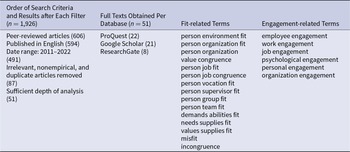
The articles were selected based on searches of the ProQuest Central platform (proquest.com) conducted by the three authors of this paper in December 2021. To ensure currency of results, we restricted the time period to the 10 years prior to our initial search. After our initial search, we did searches on a monthly basis to make sure that we incorporated recently published articles prior to submission. ProQuest is the ‘largest, multidisciplinary, full-text database available’ (ProQuest, 2023, first paragraph) and provides access to 27 databases and 45 sub-databases including PsycArticles PubMed and ABI/INFORM. These databases are originally hosted by well-renowned institutions such as the American Psychological Association and the National Library of Medicine. They cover a broad range of disciplines incorporating social and behavioral sciences, medicine, and business. This ensures our search was not too narrowly focused on research originating from any one field. ProQuest also acts as an archive for journal article abstracts found in other databases. In some cases, where full articles were unavailable on ProQuest, supplementary searches of Google Scholar (scholar.google.com) and ResearchGate (researchgate.net) were also utilized. In these cases, Google Scholar and ResearchGate were only used to facilitate access to articles of interest returned in the original search, and not to conduct a full new search. Therefore, it is probable that other tools such as Scopus or Web of Science could have served a similar function to Google Scholar and ResearchGate. As such, all relevant articles returned in the original searches were considered for inclusion in the literature review. Only peer-reviewed, empirical articles published in the English language were considered for inclusion. The number of articles accessed through each database is provided in Table 1.
Search criteria, search terms employed, and articles accessed per database

Articles of interest were identified by selecting the option to search ‘anywhere except full text’ of papers contained in the ProQuest databases for all combinations of the terms included in Table 1. Aside from the literature related to PO and PJ fit and employee engagement, we uncovered only three papers related to PS fit and four papers related to PG fit that had supported hypotheses. Since we used the mechanism of supplies–values fit to examine PO fit in our research and this mechanism is also useful in explaining PS and PG fit, these papers have been incorporated under the umbrella of PO fit.
Based on our searches, 491 articles were identified, and a staged-review process was implemented (Torraco, Reference Torraco2005). The three authors (two professors in the Human Resource Development (HRD) field and one PhD candidate in the same field) reviewed the titles, abstracts, and keywords of the 491 articles. Irrelevant, nonempirical, and duplicate articles were removed, and the remaining articles were read in full. Irrelevant articles were deemed to be those which contained our search terms in the title, abstract, or keywords, but did not in fact empirically examine the variables. Further criteria for inclusion of articles in our research were based on the operationalization of the variables, the measurement tools, and the rigor and transparency of methods employed in each article. If any of these components were missing or unclear in an article, the article was excluded. Based on these criteria, 87 articles were considered for inclusion. Of the 87 remaining articles, relevance was determined based on how in-depth the discussion and analysis of the relationship between the fit-related and engagement concepts were. In the event of a conflict of opinion about the relevancy of an article, it was agreed among the three authors that its inclusion would be put to a vote. A consensus was reached through discussion, however, and it was not necessary to vote on the inclusion or exclusion of any articles. After these steps were taken, a total of 51 articles published between 2011 and 2022 remained, with 59% (30 out of 51) being published in the 5 years prior to submission. These 51 articles provided the data on which this review is based.
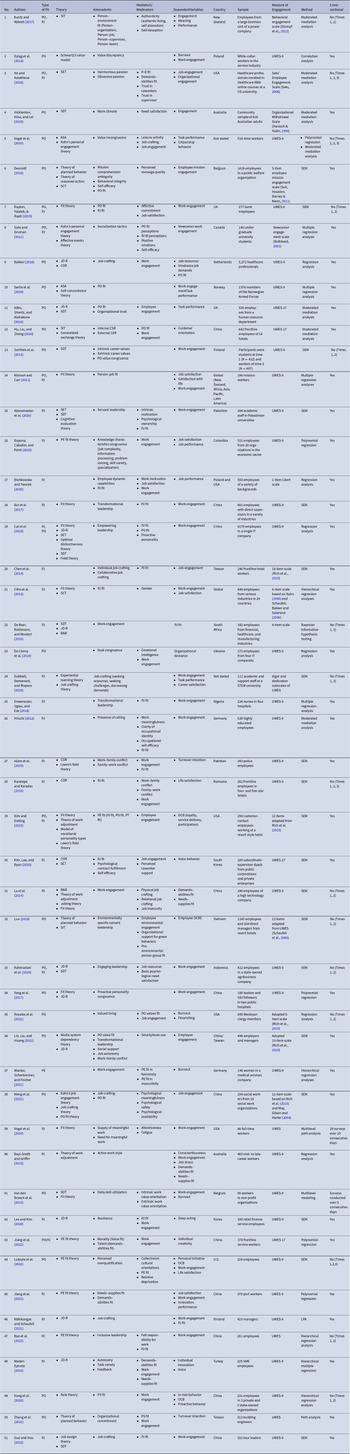
Petticrew and Roberts (Reference Petticrew and Roberts2006) guidelines were followed in the construction of a table to summarize the main points of interest from the selected articles. Table 2 contains the following information for each article included in this review: the authors’ names and the article’s year of publication; theoretical frameworks; antecedents, mediators, and dependent variables; country of research; research context and participants; measure of fit; measure of engagement; unit of analysis; data collection and analysis methods; and source of data.
An overview of the included studies

Note. JD-R = job demands–resources model; B&B = broaden and build theory; SET = social exchange theory; COR = conservation of resources theory; SCT = social cognitive theory; SDT = self-determination theory; SEM = structural equation modeling; LPA = latent profile analysis; UWES = Utrecht work engagement scale.
Findings
The findings of our integrative literature review of the PE fit–employee engagement relationship are divided into four sections. These are presented with specific reference to the JD-R model (i.e., job/personal resources and challenge/hindrance demands) and the SCTHA. The first section is concerned with the organization-, group-, and individual-level antecedents of the relationship. The second section addresses the intervening mechanisms between PE (PO and PJ, specifically) fit and employee engagement. The third section considers the relationship between PE fit and engagement as reciprocal, rather than sequential, or places employee engagement as an antecedent to PE fit. Finally, the fourth section integrates the outcomes of the PE fit–employee engagement relationship.
Antecedents of the PE fit–employee engagement relationship
We classified various antecedents of the PE fit–employee engagement relationship as organization-level (i.e., organizational practices and culture), group-level (i.e., leadership styles and relationships), or individual-level (i.e., personal attributes, attitudes, and behaviors).
Organization-level antecedents
At the organization level, work climate, corporate social responsibility (CSR), and socialization tactics have been found to be prominent antecedents of the PE fit–employee engagement relationship. Work climate refers to the standards, practices, and policies that determine a workplace’s character. The work climate affects employees’ attitudes and behaviors and influences processes through which shared values are maintained and nurtured (Kuenzi & Schminke, Reference Kuenzi and Schminke2009). A collective cultural orientation in the workplace means employees’ personal beliefs and attitudes align with the organization’s work climate. As a result, employees are more satisfied, and an engaged workforce develops (Hicklenton, Hine, & Loi, Reference Hicklenton, Hine and Loi2019; Luksyte, Bauer, Debus, Erdogan, & Wu, Reference Luksyte, Bauer, Debus, Erdogan and Wu2022).
In recent years, CSR has come to be seen as an indicator of how aligned individuals and organizations are with each other and how well employees identify with their organizations (Hu, Liu, & Zhang, Reference Hu, Liu and Zhang2020; Lee, Park, & Lee, Reference Lee, Park and Lee2013). Employees’ perceptions of CSR occur at the individual level but are shaped by organization-level policies that benefit society. CSR has a positive impact on employee engagement such that engagement is stronger when there is a greater degree of PE fit. When an organization attends to its workers’ and society’s values, its employees may recognize that unpleasant situations are minimized. This can lead to greater value congruence and employee engagement (Hu, Liu, & Zhang, Reference Hu, Liu and Zhang2020). However, if an employee does not feel that their values and views on CSR are similar to their organization’s views, misfit may occur. When left unresolved, misfit can cause negative stress-related outcomes (Dyląg et al., Reference Dyląg, Jaworek, Karwowski, Kożusznik and Marek2013; Hu, Liu, & Zhang, Reference Hu, Liu and Zhang2020; Zhang, Ling, Zhang, & Xie, Reference Zhang, Ling, Zhang and Xie2015).
The last salient way in which individuals and organizations can facilitate greater PE fit is socialization tactics. Socialization tactics generally refer to those behaviors undertaken by an individual that facilitate their smooth integration into a new workplace; however, these tactics are also exercised at the group and organization levels as formal and semiformal programs designed to help workers adapt to their new environment (Saks & Gruman, Reference Saks and Gruman2011). If socialization tactics are successful, newcomers’ negative emotions associated with the change of environment are minimized and positive experiences are more likely. From this perspective, socialization tactics help the individual and organization to bring their values into alignment. Such alignment may help to satisfy the individual’s needs for authenticity and belonging, which in turn contributes to employee engagement (Kuntz & Abbott, Reference Kuntz and Abbott2017; Saks & Gruman, Reference Saks and Gruman2011).
The way in which socialization tactics bring newcomers’ and organizations’ values into alignment suggests that results may vary depending on the newcomers’ career stage (Saks & Gruman, Reference Saks and Gruman2011). Values change over time as employees progress through different phases of their professional development; a variety of workplace attributes including policies, structural change, and environmental transformation also influence the work styles and PE fit of employees (Bayl-Smith & Griffin, Reference Bayl-Smith and Griffin2015; Sortheix, Dietrich, Chow, & Salmela-Aro, Reference Sortheix, Dietrich, Chow and Salmela-Aro2013). The shifting nature of PE fit and values highlights the importance of employing appropriate interventions and tactics designed to improve PE fit at different career stages.
Group-level antecedents
At the group level, five different styles of leadership, a proactive personality, and collaborative job crafting were found to be significant antecedents of the PE fit–employee engagement relationship. Specifically, servant leadership (Aboramadan, Dahleez, & Hamad, Reference Aboramadan, Dahleez and Hamad2020; Luu, Reference Luu2019), transformational leadership (Bui, Zeng, & Higgs, Reference Bui, Zeng and Higgs2017; Enwereuzor, Ugwu, & Eze, Reference Enwereuzor, Ugwu and Eze2018), empowering leadership (Cai, Cai, Sun, & Ma, Reference Cai, Cai, Sun and Ma2018), inclusive leadership (Bao, Xiao, Bao, & Noorderhaven, Reference Bao, Xiao, Bao and Noorderhaven2022), and engaging leadership (Rahmadani, Schaufeli, & Stouten, Reference Rahmadani, Schaufeli and Stouten2020) were found to contribute positively to the PE fit–employee engagement relationship.
When leaders invest time in their employees, the employees feel a greater sense of well-being. Increased well-being addresses the individual’s need for the pursuit of pleasurable experiences, which entails avoiding unpleasant circumstances and maximizing situations that make them happy (Meng, Wang, & Tian, Reference Meng, Wang and Tian2021; Vogel, Rodell, & Sabey, Reference Vogel, Rodell and Sabey2020). Other innate needs that can be attended to through healthy relationships with leaders include the needs for greater certainty, autonomy, and belonging (Hicklenton, Hine, & Loi, Reference Hicklenton, Hine and Loi2019). Met needs help employees to navigate ambiguous situations and contribute to their feeling more engaged (Desmidt, Reference Desmidt2016).
Employees with proactive personalities at the group level are better able to take advantage of the platform afforded to them by empowering leadership than employees who are passive (Cai et al., Reference Cai, Cai, Sun and Ma2018; Yang, Yan, Fan, & Luo, Reference Yang, Yan, Fan and Luo2017). Specifically, when organizational members’ collective proactive personalities are aligned with each other and those of their leaders, they enjoy greater PE fit. In line with the underlying tenets of PE fit, this alignment facilitates interpersonal interactions and helps individuals to develop greater understanding of each other’s behavior (Edwards & Cable, Reference Edwards and Cable2009; Van Vianen, Reference Van Vianen2018). Ultimately, a deeper synchronicity between superiors’ and subordinates’ personalities means fewer psychological resources are expended on interpreting one’s colleagues’ behavior. This, in turn, leads to a greater availability of resources to expend on both individual and specific group aims. Further, this group-level alignment leads to greater individual self-control over one’s work, and improved engagement (Cai et al., Reference Cai, Cai, Sun and Ma2018). In this context, effective and appropriate leadership structure is an important antecedent to the relationship between PE fit and employee engagement insofar as leaders can contribute to the formation of an environment that satisfies their employees’ needs. However, employees can also actively participate in the formation of their own character and values, the environment, and their work roles (Guo & Hou, Reference Guo and Hou2022). This employee participation is facilitated by the antecedent job resources of autonomy, task variety, and feedback. These resources encourage employees to recognize that they hold the locus of control; they also empower employees to positively contribute to relationships with their coworkers, which in turn improves levels of fit with their environment (Maden-Eyiusta, Reference Maden-Eyiusta2016).
Aside from the vertical leader–follower relationship, horizontal relationship building between coworkers is important at the group level. Horizontal relationships are a form of reciprocal interaction whereby members of a group co-construct the psychological climate within an organization. An individual influences the groups of which they are members over time and vice versa. This reciprocal influence facilitates the attainment of shared goals, which can be achieved through collaborative job crafting on the basis that relationships in the workplace are strengthened and employees’ abilities to fulfill their job roles are improved (Chen, Yen, & Tsai, Reference Chen, Yen and Tsai2014). This relationship building improves PE fit since employees’ relational needs are met.
Individual-level antecedents
Prominent personal characteristics and attitudes that act as antecedents of the PE fit–employee engagement relationship at the individual level include harmonious passion, obsessive passion, and trust (Ho & Astakhova, Reference Ho and Astakhova2018); intrinsic career values (Sortheix et al., Reference Sortheix, Dietrich, Chow and Salmela-Aro2013); resilience (Lee & Kim, Reference Lee and Kim2020); felt responsibility (Bao et al., Reference Bao, Xiao, Bao and Noorderhaven2022); organizational commitment (Zhang et al., Reference Zhang, Ling, Zhang and Xie2015); and self-efficacy (Kim, Lee, & Byun, Reference Kim, Lee and Byun2020).
Harmonious passion and trust relate to a worker’s desire and ability to form associations at work, while obsessive passion, intrinsic career values, resilience, felt responsibility, and self-efficacy are more closely related to a worker’s desire and ability to function effectively in their work role (Bao et al., Reference Bao, Xiao, Bao and Noorderhaven2022; Ho & Astakhova, Reference Ho and Astakhova2018; Kim, Lee, & Byun, Reference Kim, Lee and Byun2020; Lee & Kim, Reference Lee and Kim2020; Sortheix et al., Reference Sortheix, Dietrich, Chow and Salmela-Aro2013). Employees in possession of greater degrees of harmonious passion and trust feel the psychological safety required to challenge themselves and tackle workplace demands head-on (Ho & Astakhova, Reference Ho and Astakhova2018). Obsessive passion, intrinsic career values, organizational commitment, and felt responsibility provide the drive and stimulus to do so (Bao et al., Reference Bao, Xiao, Bao and Noorderhaven2022; Ho & Astakhova, Reference Ho and Astakhova2018; Sortheix et al., Reference Sortheix, Dietrich, Chow and Salmela-Aro2013; Zhang et al., Reference Zhang, Ling, Zhang and Xie2015). Finally, self-efficacy and resilience allow employees to set lofty goals and endure the difficulties associated with achieving them (Kim, Lee, & Byun, Reference Kim, Lee and Byun2020; Lee & Kim, Reference Lee and Kim2020). Thus, when an individual displays all these personal characteristics, they have the support base to feel comfortable in their work, the motivation to develop workplace strategies, and eventually the confidence to follow through on these strategies, thereby improving PE fit and engagement.
Intervening mechanisms between PE fit and employee engagement
In this section, we used a framework of values–supplies, needs–supplies, and demands–abilities fits to categorize the intervening mechanisms between PO/PJ fit and employee engagement. Additionally, we drew upon the JD-R model and SCTHA to explain the intervening mechanisms based on sound theories.
PO fit and employee engagement relationship
Values–supplies fit
Employees are more engaged when their values are in alignment with the supplies provided by their organization than when there is misalignment (Rayton, Yalabik, & Rapti, Reference Rayton, Yalabik and Rapti2019). When there is misalignment, employees may expend more personal resources to ensure a better values–supplies fit (Van Vianen, Reference Van Vianen2018; Yu, Reference Yu, Kristof-Brown and Billsberry2013). For example, when perceived through a JD-R lens, authenticity at work is strongly associated with job resources which help to buffer the negative impacts of excessive job demands (Kim & Gatling, Reference Kim and Gatling2019; Metin, Taris, Peeters, van Beek, & Van den Bosch, Reference Metin, Taris, Peeters, van Beek and Van den Bosch2016). This can be explained insofar as when individuals are free to act authentically at work due to their values and organizational values being similar, they view themselves as being more autonomous and competent, and also develop a greater sense of belonging. This positive self-conception acts as a robust personal resource and allows the employee to focus more energy on, and be more confident in, their work (Metin et al., Reference Metin, Taris, Peeters, van Beek and Van den Bosch2016). Furthermore, authenticity at work satisfies an employee’s drive for consistency and is a key mediator between PO fit and employee engagement whose benefits become apparent when the employee has greater access to job and personal resources (Kuntz & Abbott, Reference Kuntz and Abbott2017; Yu, Reference Yu, Kristof-Brown and Billsberry2013).
Similarly, when employees experience PO fit, they feel fulfilled in line with their values. Employees’ access to job resources leads to job satisfaction and affective commitment, both of which mediate the PO fit and employee engagement relationship (Rayton, Yalabik, & Rapti, Reference Rayton, Yalabik and Rapti2019), while the personal resource of trust moderates the relationship (Alfes, Shantz, & Alahakone, Reference Alfes, Shantz and Alahakone2016). Kuntz and Abbott (Reference Kuntz and Abbott2017) found that self-deception moderated the mediating effect of self-alienation on the PO fit and employee engagement relationship. As a tendency toward positive self-bias, self-deception assists individuals in reducing their anxiety, uncertainty, and level of conflict while improving their self-esteem and sense of identity by allowing them to take control of their personal situations in the workplace (Kuntz & Abbott, Reference Kuntz and Abbott2017; Yu, Reference Yu, Kristof-Brown and Billsberry2013). On the one hand, individuals may mitigate the negative effects of PO misfit with high self-deception and vice versa. On the other hand, employees may utilize self-alienation tactics to suppress their personal values in order to become more concordant with their organization. From this perspective, greater PO fit can be said to reduce the negative effects of hindrance job demands such as anxiety, while leading to an increase in personal resources such as self-esteem (Xanthopoulou, Bakker, Demerouti, & Schaufeli, Reference Xanthopoulou, Bakker, Demerouti and Schaufeli2007).
Needs–supplies fit
The need for effective communication also plays a vital role in the PO fit and employee engagement relationship. Desmidt (Reference Desmidt2016) identified a positive relationship between PO fit and an employee’s engagement with organizational missions when the relationship was mediated through perceived message quality. Effective communication is facilitated by smartphone use as smartphones allow individual employees to stay abreast of work-related information, interact with colleagues in task-specific functions, and exchange multimedia data to maintain and grow meaningful relationships in the workplace in line with their personal values (Lin, Liu, & Huang, Reference Lin, Liu and Huang2021). In this case, effective communication, particularly through modern technological means, acts as a buffering mechanism with which to deal with job demands, as well as provide a platform through which individuals can agentically influence their environment and contribute to elevated levels of employee engagement (Bandura, Reference Bandura2001b; Kwon & Kim, Reference Kwon and Kim2020).
Demands–abilities fits
An employee’s knowledge, skills, and attitudes to fulfill their job role can be manipulated through proactive behaviors including job crafting and leisure activities, which make the employee feel as if their personal priorities are understood and valued by their organization (Vogel, Rodell, & Lynch, Reference Vogel, Rodell and Lynch2016). When misfit is present, employees can buffer its negative effects by engaging in proactive behaviors. These activities can amplify the benefits of high congruence and somewhat offset the negative consequences of low congruence (Bandura, Reference Bandura1997; Vogel, Rodell, & Lynch, Reference Vogel, Rodell and Lynch2016). From an SCTHA perspective, individuals participating in proactive behaviors demonstrate greater levels of intentionality and foresight to shape their surroundings to their advantage (Yoon, Reference Yoon2019). These studies suggest that while job crafting primarily helps employees tailor their work roles to best suit their specific strengths and abilities, it also reflects the emphasis employees place on autonomy at work.
PJ fit and employee engagement relationship
Needs–supplies fit
While values–supplies fit is useful in explaining the relationship between PO fit and employee engagement, the mechanisms of needs–supplies and demands–abilities fits help explicate the dynamics at play in the relationship between PJ fit and employee engagement. Needs–supplies fit sheds light on how employees enjoy better PJ fit when their individual priorities are supported by the attributes of their organization. For instance, work–family conflict (WFC) and family–work conflict (FWC) are caused by the impact of work-related factors on the performance of an employee’s responsibilities and needs related to family life and vice versa (Islam, Ahmad, Ahmed, & Ahmer, Reference Islam, Ahmad, Ahmed and Ahmer2019). WFC and FWC were found to mediate negatively the relationship between PJ fit and employee engagement (Karatepe & Karadas, Reference Karatepe and Karadas2016). In this instance, WFC and FWC act as hindrance job demands preventing employees from becoming fully immersed in their work. Hindrance job demands can be buffered when an individual’s needs such as authenticity, relatedness, and meaningfulness are met (Kuntz & Abbott, Reference Kuntz and Abbott2017; Rahmadani, Schaufeli, & Stouten, Reference Rahmadani, Schaufeli and Stouten2020).
The need for authenticity at work (Kuntz & Abbott, Reference Kuntz and Abbott2017) and the satisfaction of basic psychological needs such as relatedness and meaningfulness (Rahmadani, Schaufeli, & Stouten, Reference Rahmadani, Schaufeli and Stouten2020) have also been found to mediate the PJ fit and employee engagement relationship. PJ fit has a dual effect in this context. First, it improves the strength of the relationships that employees form with their workmates and contributes to the satisfaction of the basic psychological needs of autonomy, relatedness, competence, and meaningfulness; it also improves attentiveness (Rahmadani, Schaufeli, & Stouten, Reference Rahmadani, Schaufeli and Stouten2020; Vogel, Rodell, & Sabey, Reference Vogel, Rodell and Sabey2020). In this way, PJ fit leads to higher levels of employee engagement. When PJ fit is present, the employee and job complement each other, each supplying what the other needs, which helps the employee feel more engaged with their work. For example, meaning and relatedness can be attained through acceptance and affiliation with one’s peers. When these needs are met, an employee is likely to be more active, dedicated, and involved in the workplace (Rahmadani, Schaufeli, & Stouten, Reference Rahmadani, Schaufeli and Stouten2020; Rayton, Yalabik, & Rapti, Reference Rayton, Yalabik and Rapti2019). However, if misfit is present because the employee’s need for meaning is not satisfied at work, the employee may become fatigued, a condition that negatively impacts employee engagement (Vogel, Rodell, & Sabey, Reference Vogel, Rodell and Sabey2020). A second direct effect of PJ fit is that individuals have greater access to personal and job resources, which frees up mental space and affords the individuals the capacity to change themselves and their environments. This facilitates them in becoming more engaged with their work and buffers the deleterious effects of hindrance job demands.
Demands–abilities fit
Lastly, the mechanism of demands–abilities fit sheds light on the relationship between PJ fit and employee engagement by highlighting how an employee’s ability to proactively participate in positive workplace behaviors and attitudes contributes to the building of rapport with coworkers. This allows them to feel comfortable with their work and is reflected in a study by Rayton, Yalabik, and Rapti (Reference Rayton, Yalabik and Rapti2019) revealing that satisfied and committed workers were more active, dedicated, and involved in the workplace because they had the ability to fulfill the demands of their jobs. The negative effects of PJ misfit on engagement may also be mitigated through the utilization of personal resources that can improve an employee’s understanding of their work situation and their ability to carry out their work functions in the absence of sufficient job resources (Islam et al., Reference Islam, Ahmad, Ahmed and Ahmer2019; Karatepe & Karadas, Reference Karatepe and Karadas2016).
Employee engagement and PE fit
While many studies have viewed PE fit as a precursor to employee engagement, some scholars are beginning to question this view. By acknowledging that PE fit can occur subsequent to employee engagement or that the two concepts play separate roles in a reciprocal relationship, we signal our understanding that PE fit is not static in nature but rather fluctuates over time. Agentic behaviors have been found to be key in the relationship between PE fit and employee engagement and help individuals cope with demands and issues related to their jobs that could otherwise severely hinder their work (Guo & Hou, Reference Guo and Hou2022; Lu et al., Reference Lu, Wang, Lu, Du and Bakker2014). This section examines those papers in which the PE fit–employee engagement relationship was not found to be unidirectional.
Job crafting helps employees to fulfill their work roles and has become an important means of explaining the relationship between employee engagement and PE fit. Job crafting can act as an antecedent of PE fit when PE fit comes before employee engagement in the PE fit–employee engagement relationship (Chen, Yen, & Tsai, Reference Chen, Yen and Tsai2014) and vice versa (Lu et al., Reference Lu, Wang, Lu, Du and Bakker2014). In Lu et al.’s (Reference Lu, Wang, Lu, Du and Bakker2014) study, physical job crafting, which refers to the modification of one’s activities at work, helped engaged employees address issues related to their capacity to meet job demands. Similarly, De Beer, Rothmann, and Mostert (Reference De Beer, Rothmann and Mostert2016) emphasized employee engagement as a predictor of PE fit and considered resource-crafting behavior as a possible intervening process that could enable workers to meet the demands of their jobs. Aside from physical job crafting, relational crafting, which refers to the manipulation of one’s psychosocial work environment, mediated the relationship between employee engagement and dimensions of PE fit (Lu et al., Reference Lu, Wang, Lu, Du and Bakker2014).
When synthesized, these studies point to engaged workers being more likely to participate in the proactive activities and thought processes associated with agentic behaviors and SCTHA, such as intentionality, forethought, self-reactiveness, and self-reflectiveness (Yoon, Reference Yoon2019). Engaged employees are invested in their work and seek to modify work environments, processes, and relationships to the benefit of themselves, others, and their organization as a whole. When modifications are effective and work becomes more efficient, less strain is likely to be placed on the individual. Furthermore, job crafting, as a behavior which engaged employees are more likely to participate in, helps workers cope with job demands which disengaged workers may find difficult to deal with (Lu et al., Reference Lu, Wang, Lu, Du and Bakker2014). As employees shape their surroundings to help them in their job roles, greater PE fit develops over time which, in turn, contributes to the outcomes outlined in the next section.
Together, based on SCTHA (Yoon, Reference Yoon2019), these four studies (i.e., Chen, Yen, & Tsai, Reference Chen, Yen and Tsai2014; De Beer, Rothmann, & Mostert, Reference De Beer, Rothmann and Mostert2016; Guo & Hou, Reference Guo and Hou2022; Lu et al., Reference Lu, Wang, Lu, Du and Bakker2014) point to the role job crafting and other proactive agentic behaviors may play in explaining the reciprocal relationship between employee engagement and PE fit.
Outcomes of the PE fit–employee engagement relationship
The outcomes of the PE fit–employee engagement relationship can be categorized as factors related to in-role performance, factors related to extra-role performance, or other outcomes. In-role performance includes job performance (Bayona, Caballer, & Peiró, Reference Bayona, Caballer and Peiró2020; Bieńkowska & Tworek, Reference Bieńkowska and Tworek2020), task performance (Sørlie et al., Reference Sørlie, Hetland, Dysvik, Fosse and Martinsen2020; Vogel, Rodell, & Lynch, Reference Vogel, Rodell and Lynch2016), and in-role behavior (Kong, Xin, Chen, & Li, Reference Kong, Xin, Chen and Li2020). Extra-role performance includes customer orientation (Hu, Liu, & Zhang, Reference Hu, Liu and Zhang2020), organizational citizenship behavior (Kong et al., Reference Kong, Xin, Chen and Li2020; Vogel, Rodell, & Lynch, Reference Vogel, Rodell and Lynch2016), voice behavior (Kim, Lee, & Byun, Reference Kim, Lee and Byun2020; Maden-Eyiusta, Reference Maden-Eyiusta2016), individual innovation (Maden-Eyiusta, Reference Maden-Eyiusta2016), individual creativity (Jiang et al., Reference Jiang, Chen, Wang, Liu, Ning and Chen2022), deep acting (Lee & Kim, Reference Lee and Kim2020), and proactive behavior (Kong et al., Reference Kong, Xin, Chen and Li2020). Regarding the other outcomes, career satisfaction (Cifre, Vera, Rodríguez-Sánchez, & Pastor, Reference Cifre, Vera, Rodríguez-Sánchez and Pastor2013; Dubbelt, Demerouti, & Rispens, Reference Dubbelt, Demerouti and Rispens2019) and life satisfaction (Karatepe & Karadas, Reference Karatepe and Karadas2016; Manson & Carr, Reference Manson and Carr2011) are two major positive ones. Of course, the outcomes of the PE fit–employee engagement relationship are not always positive. When employees experience misfit at work, they may also experience stress, discomfort, or incompatibility with tasks and colleagues. These feelings can manifest in a lack of employee engagement and ultimately organizational deviance (De Clercq, Bouckenooghe, Raja, & Matsyborska, Reference De Clercq, Bouckenooghe, Raja and Matsyborska2014), burnout (Dyląg et al., Reference Dyląg, Jaworek, Karwowski, Kożusznik and Marek2013; Rosales, Fung, & Lee, Reference Rosales, Fung and Lee2021; Van den Broeck, Schreurs, Guenter, & van Emmerik, Reference Van den Broeck, Schreurs, Guenter and van Emmerik2015; Wacker, Schorlemmer, & Fischer, Reference Wacker, Schorlemmer and Fischer2021), and turnover intentions (Islam et al., Reference Islam, Ahmad, Ahmed and Ahmer2019; Zhang et al., Reference Zhang, Ling, Zhang and Xie2015).
To sum up our findings, the incorporation of the JD-R model and reference to the SCTHA has allowed us to reconceptualize the relationship between PE fit and employee engagement as bidirectional. Through agentic behaviors such as job crafting, employees can actively shape their environment to increase personal and job resources with which they can buffer and cope with the negative impacts of hindrance job demands.
Our findings regarding PE fit and employee engagement are presented in Fig. 1.
Findings of the PE fit and employee engagement relationship.

Discussion
This literature review analyzed 51 empirical articles examining the relationship between PE fit and employee engagement. Based on this analysis, we offer four main contributions to the field. First, our study suggests that the antecedents of the PE fit–employee engagement relationship can be conceptualized at the organization, group, and individual levels. Second, our research questions the conventional belief that PE fit and its dimensions primarily act as antecedents of employee engagement and makes a compelling case for a reevaluation of the relationship. Rather than adopting the prevailing view of the relationship as unidirectional and static, we echo the calls of other scholars for an understanding of the relationship as reciprocal. Third, we bring clarity to the intervening mechanisms of values–supplies fit, needs–supplies fit, and demands–abilities fit in the PE fit–employee engagement relationship. Different forms of resources, including personal and job resources, may be employed via these mechanisms and processes. Fourth, we identified that these mechanisms may be employed by organizations and individuals to consciously manipulate their environments and selves for mutual benefit. Finally, we found various outcomes of the associations between PE fit and employee engagement.
First, due to the flexibility of the JD-R model, it can be applied across environmental contexts and specific work situations. While all jobs are unique, certain job demands and resources (e.g., stress and autonomy) are present to a greater or lesser degree in most jobs (Bakker, Demerouti, & Sanz-Vergel, Reference Bakker, Demerouti and Sanz-Vergel2014). By utilizing this model, we were free to collate the antecedents of the relationship between PE fit and employee engagement and conceptualize them as existing at the organizational, group, and individual levels.
Second, by synthesizing prior literature regarding the relationship between types of PE fit and employee engagement, we were able to establish a theoretical framework that integrates how the three forms of PE fit are related to employee engagement and the job/personal resources of the JD-R model. The interactions between types of PE fit and employee engagement can be manifested by eliminating specific pathways among related constructs. Ways in which the interactions lead to positive and negative work outcomes are shown in Fig. 2. This specification is based on the assumption that PE fit evolves over time and employee engagement provides consistent psychological energy for iterative PE fitting. By maximizing personal and job resources, employees can buffer against, or learn to cope with the demands of their work. Additionally, drawing on the ASA model, the theoretical framework runs parallel to an employee’s career growth within an organization from the pre-hire, entry, after-hire, and finally, exit stages, rather than presenting a static view of PE fitting at a certain career moment. By recognizing that PE fit is malleable, we place the locus of control within the individual to manipulate themselves and their environments to the benefit of the organization, group, and individual.
Interactions between PE fits and employee engagement.
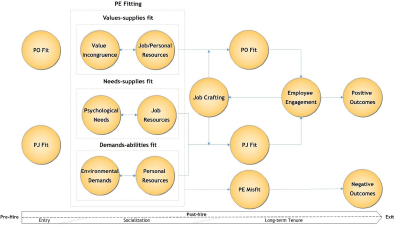
Third, the theoretical framework includes three different mechanisms of PE fitting: the values–supplies, needs–supplies, and demands–abilities fits. Although these mechanisms all occur at the organization, group, and individual levels, and indeed across levels we suggest that each mechanism predominates at a specific level. For example, we identified that PO fit and employee engagement research has focused on value congruence between an organization and its employees through values–supplies fit (Edwards, Reference Edwards1996). As the term suggests, PO fit necessarily includes an input at the organizational level. When employees experience their values and organizational values as misaligned, a variety of job/personal resources can be marshaled to move the values–supplies fit toward employee engagement and positive outcomes (Van Vianen, Reference Van Vianen2018). When value misalignment occurs between the organization and a range of individuals, the organization might question if it is doing its part to provide a healthy, fruitful work environment for its employees. If it is concluded that the environment is lacking in some regard, steps may be taken to rectify the situation, either by changing the environment, or working with employees to ensure access to better personal and job resources.
In addition, we observed that PJ fit is primarily related to needs–supplies fit and demands–abilities fit in terms of employee engagement (Edwards, Reference Edwards1996). An employee’s psychological needs can be attended to through the provision of job resources provided by the organization or workmates. Theories of psychological need fulfillment (Kahn, Reference Kahn1990; Ryan & Deci, Reference Ryan and Deci2000) suggest that many of these needs can be met in the form of positive, healthy relationships with coworkers at the group level. Employees are dissatisfied when their psychological needs are not met; however, and in these cases, job and personal resources can buffer this psychological dissatisfaction (Cable & Edwards, Reference Cable and Edwards2004). For example, if employees are surrounded by supportive colleagues, they may be more inclined to brush off some of the negative impacts of their job demands.
The last form of fit that we observed was demands–abilities fit. This form of fit originated from the discrepancies between the changing demands of a job and the employee’s existing skill set. A person’s skill set primarily exists at the individual level and, as such, personal resources can act as an intervening mechanism that promotes demands–abilities fit. With the aid of personal resources, employees may be able to maintain a persistent level of ability and efficacy and address workplace obstacles by retooling their skill set. Alternatively, organizations may provide access to greater job resources, however at this level, the decision to avail of these job resources ultimately rests with the individual.
Fourth, we identified evidence supporting engaged employees’ use of agentic behaviors for an improved PE fit, as suggested by Yu (Reference Yu, Kristof-Brown and Billsberry2013). From the SCTHA perspective, job crafting incorporates engaged employees’ active behaviors to balance job demands and job/personal resources for PE fit (Yoon, Reference Yoon2019; Yu, Reference Yu, Kristof-Brown and Billsberry2013). Conversely, a lack of job crafting leads to PE misfit because employees are unable to cope with their job demands. By combining the SCTHA with the JD-R model we recognize that it is not enough for employees simply to have access to job and personal resources. Rather it is important that the individual possesses the wherewithal to make changes to their environment based on the foundation afforded to them by their resources. When workers display intentionality, forethought, self-reactiveness, and self-reflectiveness as outlined in the SCTHA, they are better equipped to shape themselves and their environment to their advantage (Yoon, Reference Yoon2019).
Lastly, we incorporated a spectrum of negative effects surrounding PE fit and misfit into the proposed theoretical framework. This framework depicts the dual process by which job resources and demands via employee engagement are linked directly with either positive (e.g., job attitudes and in-role/extra-role performances) or negative (e.g., organizational deviance, turnover intentions) work-related outcomes (Hakanen & Roodt, Reference Hakanen, Roodt, Bakker and Leiter2010).
Implications for research
The proposed theoretical framework can guide future research by specifying the psychological mechanisms underlying the PE fit–employee engagement relationship.
First, specifically with regard to research design, empirical studies are required to analyze the framework depicted in Fig. 1. This figure synthesized the relationships portrayed in the empirical studies reviewed. However, it would be remiss of us to suggest that it is empirically valid until it is tested. As Fig. 1 incorporates a significant number of concepts, it might prove difficult to test the framework as a whole. Instead, researchers might consider testing potential relationships uncovered in the framework which have heretofore remained unexamined. In addition, by employing evidence-based qualitative research methods in parallel to quantitative ones, researchers can provide insight into the perspectives and experiences of individuals or groups of people (Zarestky, Reference Zarestky2023).
Second, in the JD-R model, buffering is considered a major underlying psychological mechanism. Buffering highlights the amount (or frequency) of resources. It assumes more job/personal resources will diminish the negative impact of job demands and lead to higher employee engagement, while a lack of sufficient resources will result in job burnout (Bakker & Demerouti, Reference Bakker and Demerouti2017; Cable & Edwards, Reference Cable and Edwards2004). Job/personal resources have been investigated as a bundle of various heterogeneous constructs and are broadly conceptualized to extend the applicability of the various individual/environmental factors within a higher-order construct (Bakker & Demerouti, Reference Bakker and Demerouti2017). Although this bundling has been beneficial for examining employee engagement as a dynamic psychological state, it has also discouraged scholars from exploring the corollary hypothesis that argues that specific resources should be provided to address specific demands for employee engagement (Bakker et al., Reference Bakker, Hakanen, Demerouti and Xanthopoulou2007; Van den Tooren, de Jonge, & Dormann, Reference Van den Tooren, de Jonge and Dormann2012). As such, future researchers may focus on specifically which resources should be made available for employees to meet demands related to their levels of work engagement.
Third, having reviewed the match between personal characteristics and environmental attributes in PE fit research, in the proposed theoretical framework, we categorize the three different buffering mechanisms as part of the values–supplies, needs–supplies, or demands–abilities fit to highlight the importance (or quality) of resources rather than the amount (Cable & Edwards, Reference Cable and Edwards2004). The specification sheds light on the significance of the match between specific resources and specific demands when value incongruence, psychological needs, and environmental demands emerge. Indeed, while the JD-R model represents an expansion of the job control–demand model (Karasek, Reference Karasek1979), employee engagement scholars have argued that it is difficult to match specific demands and resources. Research that more rigorously examines how resources and demands can be matched to support employee engagement via PE fit is warranted.
Fourth, to mitigate the tension between demands–abilities fit and personal resources in the proposed framework, we consider abilities to include the physical and psychological energies, skills, and knowledge needed for employees to handle environmental demands. Conservation of resources theory suggests that because these energies can be easily exhausted from use, they must be replenished regularly (Hobfoll, Reference Hobfoll2001). Unlike physical and psychological energies, knowledge and skills in abilities are likely to be developed with use over time in addressing environmental needs. Future research that focuses on the ways the three buffering mechanisms we have proposed facilitates the replenishment of physical and psychological energies would add significantly to the current literature. Similarly, an examination of how these same mechanisms assist in the development of knowledge, skills, and abilities over time would be worthwhile.
Fifth, we recognized that personal resources are commonly operationalized by drawing on personal characteristics, traits, and attitudes (e.g., self-efficacy; Kim, Lee, & Byun, Reference Kim, Lee and Byun2020). Knowledge and skills to adapt in cases of demands–abilities misfit are largely omitted when conceptualizing personal resources in favor of highlighting sufficient training opportunities as a type of job resource, especially in the entry-stage socialization process. In today’s workplace, it is hard to provide high-quality training at the right time when misfit occurs. Developing training for highly skilled employees is also becoming more difficult. Learning and development largely occur in the workplace through self-directed learning or learning with others. In this regard, employees’ ability to seek out learning opportunities to handle environmental needs merits a comprehensive examination as a personal resource in terms of the PE fits–engagement dynamic. Future researchers might achieve this by using our proposed framework to uncover which are the most salient personal characteristics that influence an employee’s capacity to pursue learning opportunities at work.
Sixth, because employee engagement originated as the antithesis to job burnout, employee engagement research has paid special attention to the provision of job resources by an organization (Maslach, Schaufeli, & Leiter, Reference Maslach, Schaufeli and Leiter2001; Schaufeli, Reference Schaufeli2013). In this research, employees are largely depicted as passive recipients of the provided job resources. Naturally, a practical implication of employee engagement research is that top management and leaders should mobilize their organizations to provide sufficient job resources and to create resource-rich environments. In the future, researchers could explore which types of leadership are most conducive to the effective supply of sufficient job resources.
Finally, due to increasing changes in external environments, it is imperative to highlight the importance of active and responsible employees who can mobilize resources themselves. Indeed, organizations are unlikely to possess slack resources to be mobilized or newly invested. For example, while we specify psychological needs in the proposed framework, such needs are unlikely to be properly or immediately addressed by an organization due to a lack of resources or resources’ uneven distribution. At this moment, job crafters’ agentic behaviors are the construct that can have the most significant impact on both employee engagement and PE fit. Further research is required to uncover the dynamics of the relationship among PE fit, employee engagement, and job crafting. This could be done by examining the specific structure of the relationship, its temporality, and the potential existence of a feedback loop. Researchers might consider conducting longitudinal or time-series studies on the three variables. By analyzing the impact of the variables on one another over time, we would gain a clearer picture of the mechanisms at play and the directionality of the relationships involved, while also drawing attention to the fluctuating nature of PE fit.
Implications for practice
Through our research, we have uncovered several areas which may be of interest and assistance to HRD practitioners.
First, we recognize that both organizations and employees must adapt to new environments to overcome various business and job challenges, which represent the fluctuating nature of PE fit and its relationship with employee engagement. Our research can inform the development of interventions and other approaches designed to help employees improve their PE fit and employee engagement at work. Not all employees feel they possess the agency to impact their surroundings in meaningful ways (Bandura, Reference Bandura2006). Leaders should pay attention to the specific needs, environments, and career stages of their employees so that appropriate interventions can be designed (Jansen & Kristof-Brown, Reference Jansen and Kristof-Brown2006). Furthermore, leaders should consider adopting empowering, engaging, servant, transformational, and inspirational leadership styles that can help employees feel trusted by more senior members in their organizational hierarchy. Tailoring one’s leadership style to the needs of employees may encourage positive agentic behaviors among employees.
Second, in addition to considering tailored leadership approaches, practitioners might elect to implement human resources policies and talent development interventions that foster job crafting. In the design of these interventions, human resources practitioners may elect to utilize Bandura’s (Reference Bandura2001a, Reference Bandura2006) concepts of self-reflectiveness, forethought, intentionality, and self-reactiveness. Developing an employee’s strengths in these areas may help them focus on the relational crafting element of job crafting and assist in the formation of interpersonal relationships in the workplace. Alternatively, helping employees apply Bandura’s concepts in relation to physical job crafting may empower them to handle job demands more comfortably. As a human resources policy, applying Bandura’s concepts might assist in the manifestation of employees’ human agency, which in turn would promote better PE fit and employee engagement.
Finally, the constantly shifting nature of PE fit and its dimensions highlights the need for long-term and holistic human resources programs. Although general socialization tactics help employees adjust to new organizations and jobs, these tactics tend to be limited to the time of entry (Jansen & Kristof-Brown, Reference Jansen and Kristof-Brown2006; Saks & Gruman, Reference Saks and Gruman2011). By extending this socialization process to employees’ later career stages, encouraging employees to build productive relationships, and assisting in the long-term development of employees’ personal character, practitioners can help ensure workers are capable of adjusting to changes within the organization. Such an extension of the socialization process will also make employees more resistant to negative outcomes associated with organizational changes (i.e., stress) while maximizing PE fit and employee engagement on an ongoing basis.
Limitations
Regarding the limitations of the current study, as a result of specific choices we made in relation to our methods and research design, our research is subject to some limitations. As stated, the purpose of this literature review was to examine the existing empirical literature surrounding the relationship between PE fit and employee engagement. Necessarily, this meant that we did not include conceptual or qualitative studies as subjects for analysis. Also, the selection of articles was based on specific search terms in specific databases. Although we are confident that all relevant search terms were included, it is conceivable that our methods may have led to the omission of conceptually important articles.
Conclusion
In this study, we comprehensively reviewed the extant literature pertaining to the relationship between PE fit and employee engagement. In doing so, we have identified that the antecedents of the relationship exist at the organizational, group, and individual levels and can be conceptualized as socialization, relationship building, and personal character. We have also shed light on the prominent intervening mechanisms of values–supplies fit, needs–supplies fit, and demands–abilities fit. The relationship was found to be temporal and reciprocal in nature, and facilitated by human agency.
Furthermore, this study has implications for both future academic research and practice. It utilizes existing theories and literature to provide a strong foundation upon which subsequent empirical and theoretical studies may be based. Specifically, the emphasis on the reciprocal, temporal nature of the relationship between PE fit and employee engagement can act as a guide in future research agendas and designs. Similarly, the foregrounding of the intervening mechanisms and the role of human agency can act as points of departure for future researchers. From a practice perspective, our research can assist HRD practitioners in the creation of interventions and the formation of organizational cultures targeted at improving PE fit and employee engagement.
Conflict of interest
We have no known conflict of interest to disclose.


 Open access

