

1. Introduction
When and why do countries cooperate with one another in international negotiations and when and why do they not cooperate? This question has concerned scholars for decades and continues to be of interest in academic and policy circles analyzing deadlocks and successes in multilateral negotiations. International economic negotiations are high stake negotiations with significant consequences for the economic wellbeing of citizens and for the survival of governments in power across the world. The behavior of national representatives in these negotiations is therefore not left to chance, but carefully elaborated. What informs the behavior of countries in these negotiations?
To address this question, we analyze negotiations in the World Trade Organization (WTO), the largest international economic organization worldwide in charge with the regulation of international trade at a time when trade is conducive to more than 50% of gross domestic product worldwide (World Bank, 2024). We analyze negotiations over a period of 12 years, roughly corresponding to the failed negotiations in the Doha Round. This time frame provides good material for analyzing the potential drivers of countries’ decisions regarding cooperation (Schwab, Reference Schwab2011).
A consensus has emerged in the literature that cooperation among democracies is strong and widespread (Mansfield et al., Reference Mansfield, Milner and Rosendorff2002). The existence of the European Union, one of the most intense international cooperation projects to ever exist, is built on the premise that its member states are democratic (Eriksen and Fossum, Reference Eriksen and Fossum2002; Tarlea, Reference Tarlea2018). Nonetheless, the precise channel that drives cooperation between democracies is still disputed in the literature (Keohane, Reference Keohane2002; Gartzke, Reference Gartzke2007). The capacity of the member states to be cooperative in order to provide public goods domestically is contested and it seems to hinge on the level of analysis or on the policy issue (see e.g. Bättig and Bernauer, Reference Bättig and Bernauer2009; Morrow et al., Reference Morrow, De Mesquita, Siverson and Smith2008). Regarding international trade, one proposition is that sharing democratic principles and values drives cooperation among liberal democracies. Another view posits that democracies are more cooperative because they trade more intensely with one another. We take the complex interdependencies between domestic and international institutions and interests involved in trade and in trade policies as a starting point to theorize about cooperation during trade negotiations. One expectation is that high volumes of trade are associated with international cooperation largely determined by industry lobbying activities. The more countries trade with one another, the more cooperative they are. However, many other institutions can also influence the cooperation regime. Countries governed by different political regimes are expected to behave differently in negotiations but how exactly these differences pan out is not clear. There is little literature to build on as most existing studies focus on cooperation among democratic countries, with the exception of some notable scholarship (Geddes et al., Reference Geddes, Wright and Frantz2014; Mattes and Rodriguez, Reference Mattes and Rodriguez2014). This lack of attention to how authoritarian regimes cooperate with one another and with democratic countries is particularly concerning, as a large number of countries within the WTO are autocracies able to influence negotiation outcomes (Mansfield et al., Reference Mansfield, Milner and Rosendorff2002).
We build our argument on the premise that expressed preference similarity is one form of cooperation and examine competing explanations about the drivers of similar preferences and thus cooperation in multilateral negotiations. We ask what exactly leads to preference similarity and identify two potential drivers. First, we theorize the different incentives of political leaders to engage in international cooperation regarding trade in both democratic and authoritarian regimes. We expect democracies to be most cooperative and also to distinguish between different types of autocratic regimes. We hypothesize that autocracies that are more similar to democracies, such as party-state autocracies, are more cooperative than other authoritarian regimes. Second, we expect an increase in cooperation when trade flows are higher. Cooperation is dependent on the ability of the different domestic industries to lobby for their interests, such as export lobbies advocating lower tariffs. To satisfy them, governments will cooperate with other countries and democracies are generally more responsive to organized interests (Levy, Reference Levy1999). Finally, we cross-validate the argument by testing whether specific areas of negotiation reveal different patterns than those we propose.
Our theoretical and empirical approach offers a new angle to explain cooperation in the WTO. Our results provide a more nuanced understanding of the behavior of democratic regimes. We show that democracies are not more cooperative by default, as some previous research has suggested. Rather, dyads that include democracies are more cooperative than dyads that include other political regimes but only at high levels of trade. Preference similarity leading to cooperation in WTO negotiations is conditioned by higher levels of trade for democracies. This is consistent with the cooperativeness of democracies depending on the economic self-interest of different industries that can benefit from increased international economic cooperation. Another potential explanation is the expectation of democracies that more trade will lead to democratization, which will lead to more cooperation in the future. Differences in the behavior of various autocratic regimes seem rather negligible, as the dyads including autocracies are almost equally less responsive to high levels of trade compared to dyads including democracies. Lobbying is more restricted in autocratic regimes and its potential to spur cooperation is therefore more limited. The theoretical and empirical analyses below provide support to our findings.
2. Theoretical Approach
2.1 Cooperation Events, Bargaining Space, and Preference Similarity
The theoretical framework is based on the definition of three key concepts: cooperation events, bargaining space, and preference similarity. Of these, cooperation events are central. Cooperation is the process in which participants adjust their behavior to the actual or to the anticipated preferences of others. Such cooperation often implies a process of policy coordination, which can take place if two countries take a common stance in WTO negotiations (Keohane, Reference Keohane2005). We conceptualize common stances as cooperative behavior resting on three reasons: First, from a communal point of view, these international multi- party and multi-issue negotiations are highly complex, and some form of cooperation and coordination is needed to ensure successful outcomes (Olson, Reference Olson1971). By forming alliances, the complexity of the negotiations can be reduced, increasing the likelihood of successfully completing the negotiations (Dupont, Reference Dupont and Zartman1994, Reference Dupont1996). Second, from the perspective of the countries entering coalitions, cooperation allows them to increase their power by pooling their (hard and soft) negotiation resources (Betzold et al., Reference Betzold, Castro and Weiler2012). Cooperation increases the power of the individual countries, which have incentives to form cooperative ties and which would otherwise be rather powerless in large negotiations. Third, cooperation implies that two countries have common interests which they represent together. In general, we assume that cooperation hinges on countries having similar preferences on those interests, since preference similarity aids finding an agreement in negotiation settings (Hinich and Munger, Reference Hinich and Munger1997). In a multi-party setting, when a general agreement is hard to achieve, preference similarity makes countries natural allies and leads to coalition formation. Therefore, we define the instance in which two countries make a joint statement or they register mutual support in the WTO as a cooperation event. We are able to analyze this form of cooperation, which the WTO facilitates, empirically while recognizing that other types of cooperation also exist. WTO talks are a form of international, multi-party, and multi-issue negotiations (Gray, Reference Gray2011). During such negotiations, the preferences of the parties are crucial and they determine the outcome of negotiations as shown by Moravcsik (Reference Moravcsik1997). The reason for this is that preferences define and determine the bargaining space, i.e. the distance between the various negotiating parties. Intuitively, agreement is facilitated if the preferences among the actors are relatively similar, the bargaining space is therefore quite narrow, and possible solutions are feasible and are not too far away from the preferences of all parties (Hinich and Munger, Reference Hinich and Munger1997; Hopmann, Reference Hopmann1996). The importance of this mutuality of interests has long been established by IR scholars for two player games (Axelrod, Reference Axelrod1967; Jervis, Reference Jervis1978).
Our proposed theory rests on the assumption that in international negotiations preference similarity leads to cooperation (Hinich and Munger, Reference Hinich and Munger1997; Hopmann, Reference Hopmann1996). Shared interests lead to similar preferences, which make countries natural allies. Multi- party, multi-issue negotiations such as the WTO trade talks are highly complex. One way of reducing this complexity is the formation of (formal or informal) cooperative ties based on preference similarity (Dupont, Reference Dupont1996). By bringing forward such similarities regarding individual negotiation issues, the bargaining space becomes less crowded and more easily manageable, which increases the likelihood of finding an agreement. As an additional incentive, pooling positions also increases the bargaining power – and thus the influence – of negotiation parties, since multiple parties carry more weight than single parties (Chasek and Rajamani, Reference Chasek and Rajamani2003; Dupont, Reference Dupont1996; Laatikainen and Smith, Reference Laatikainen and Smith2020). Pooling of positions and interest-based cooperation, is thus a precondition for both a successful conclusion of multi-party negotiations, but also the bargaining success of individual countries. For us, the key question is: What are these similarities which can lead to cooperation in negotiations between countries? The premise here is that shared interests lead to preference similarity. These similarities are expressed as common stances, which are one form of WTO cooperation in the negotiation process.
2.2 Domestic Actors and WTO Cooperation
We scrutinize the factors that underpin the formation of cooperation at the dyadic level in international bargaining situations, a necessary condition for the success of such negotiations. Domestic structures inherent to different political regimes condition international cooperation (De Mesquita et al., Reference De Mesquita, Morrow, Siverson and Smith2002; Odell, Reference Odell2009; Weiler, Reference Weiler2012). We expect domestic political and economic actors to be relevant in the process. The widely shared assumption in the literature that democratic regimes act, on average, more cooperatively in international negotiations rests on the idea that such negotiations often focus on the provision of a specific public good (such as free trade, international security, or environmental protection), and that democracies have a tendency to provide more of such public goods (De Mesquita et al., Reference De Mesquita, Morrow, Siverson and Smith2002; Lake and Baum, Reference Lake and Baum2001; Rosendorff, Reference Rosendorff2006). We build on this idea that democracies are more cooperative in general, but add a qualifier, based on new evidence from domestic trade policy that this higher propensity to cooperate is not based on the median voter’s preference, but on lobbying efforts of trading industries (Betz, Reference Betz2017; Betz and Pond, Reference Betz and Pond2019). This leads to the expectation, explained in more detail below, that democracies are only more cooperative in dyads with larger trade relationships, since this is what interlinks the preferences of the countries in question.
The expectation that democracies are more cooperative regarding trade is based on the median voter theorem (Congleton, Reference Congleton2004). Highly simplified, research in trade economics resting on the Heckscher–Ohlin theory argues that free trade is the best policy most of the time (Baldwin, Reference Baldwin2008). Countries can specialize in areas of the economy in which they have a comparative advantage, i.e. where they are able to produce at lower (relative) opportunity costs compared to their competitors. Through free trade, exporters can provide their goods and services to a (much) larger market, while consumers benefit from more choice, better quality, and lower prices. The standard assumption in the economic literature is therefore that the average voter-cum-consumer benefits from free trade, and as a consequence supports free trade. Based on this theory, all countries involved in international trade should benefit overall. From this perspective, the position of negotiating parties should on average lean towards liberalization if the negotiating country aims to maximize overall economic benefit. Such trade liberalization within countries can, however, also produce losers, i.e. the (prior to liberalization) scarce factor of production (Rosendorff, Reference Rosendorff2006). In other words, there is still the potential of significant proportions of the economy to lose (Kapstein, Reference Kapstein2000). However, if the average person wins, as the standard model argues, more trade should be in the common interest and also be the preferred solution. Trade, according to this model, will lead to enhanced welfare for at least certain segments of the population and as the gains outweigh the losses, the losing segments of society can be compensated. The overall net gains should lead to support for free trade by the general population. An increasingly rich body of research tests these micro-level expectations derived from macro-economic theory. They rely on population-based experiments. Bearce and Moya (Reference Bearce and Moya2020) find that concerns about job loss outweigh awareness of lower consumer prices. Baccini, Guidi, and Poletti (Reference Baccini, Guidi and Poletti2022) ask whether citizens would prefer more redistribution or less trade in times of crises. They find that citizens from Italy, France, and Germany support politicians who advocate social spending and redistribution rather than trade restriction. Therefore, citizens are aware of the costs of trade, such as potential job losses, but they expect to be compensated domestically rather than giving up on the consumer benefits of international trade.
Building on this expectation of general support of international trade by the population, selectorate theory (De Mesquita et al., Reference De Mesquita, Morrow, Siverson and Smith2002) then posits that the leader of a political regime controls the policy output, but they are constrained by the selectorate. If the selectorate is large, as in a democracy where the electorate equals the selectorate, the winning coalition, i.e. those who define the policy outcome, should therefore be driven by the will of the majority of citizens of voting age. However, in non-democracies this influence of the average citizen is less pronounced. Thus, the outcome of the cooperative behavior depends more directly on who is affected (positively or negatively) by trade, and the power these stakeholders have within a given non-democratic political system.
Little is known as to why some autocratic leaders are more pro-trade than others. But the volatility of autocratic trade policies is well-documented (Chow and Kono, Reference Chow and Kono2017). Chow and Kono argue that the mode of entry of autocrats can explain their propensity to cooperate on international trade. Leaders who have come into power through extralegal means require public support to consolidate their power, and use trade openness to gain this support. Once their power is consolidated, they often revert to restricting trade. Therefore, the support for trade cooperation of autocrats is driven by a desire to increase the welfare of the population – but only if their position is not secure. Based on this established theory, we could simply derive the expectation that more democratic countries, interested in providing a public good, are acting more cooperatively in international trade negotiations. However, some recent developments in the scholarly debate have cast doubt on this conclusion. For instance, Bättig and Bernauer (Reference Bättig and Bernauer2009) have demonstrated that while democracies have a higher level of political commitments (i.e. they promise to provide more of the public good) for the climate change negotiations, their actual policy outputs in terms of emission reductions are not clear. More related to free-trade policy, Betz and Pond (Reference Betz and Pond2019) do not find evidence that democratic countries offer lower tariffs on goods with high consumption shares, casting considerable doubt on the validity of the selectorate theory and the median voter theorem presented above, at least for the trade realm. Instead, what Betz (Reference Betz2017) posits is that lobbying and reciprocity of interests are much more important for determining free-trade outcomes and cooperation. In sectors with strong exporting industries, strong lobbying efforts arise for free trade, which leads to domestic tariff cuts in exchange for liberalization abroad. In the same vein, research focusing on firms argues that trade divides industries and that larger firms are the most vocal advocates for globalization (Kim and Osgood, Reference Kim and Osgood2019). Export lobbies can influence the lowering of tariffs but their influence is limited by governments’ greater freedom in taxing or subsidizing imports (Levy, Reference Levy1999). Research analyzing the response of businesses to the trade war between China and the US during Donald Trump’s presidency shows that businesses have been rather quiet (Dolan et al., Reference Dolan, Kubinec, Nielson and Zhang2025). This may suggest that during periods of relative political stability, lobbying in favor of free trade occurs largely in the background, attracting limited public attention. However, when trade policy becomes highly salient, lobbying efforts may lose effectiveness, which may result in lobbyists adopting a more restrained approach. On the basis of this new evidence, we propose to update earlier theories on democratic (compared to non-democratic regimes) cooperativeness with respect to international trade negotiations. Instead of simply claiming that democracies are more cooperative in international trade negotiations, we postulate that this is only the case conditional on specific interest group efforts within the country (or country pair) in question. In other words, we still expect more cooperation between democratic dyads, but only when there is sufficient trade between such partners that the affected trading industries step up their lobbying game sufficiently. Therefore, this can be another driver of international trade liberalization.
Of course, the question can (and should) be asked as to why lobbying industries would not also lobby their governments under autocratic rule. Autocracies, as Przeworski (Reference Przeworski2022, 1) states, also ‘collect garbage, regulate traffic, issue dog licenses, and fill street holes: they govern’. One could add that they also negotiate (bilateral and international) trade agreements, and that all such government dealings directly affect the people living under autocratic rule. Hence, some form(s) of lobbying should also be expected in autocracies.
Unfortunately, most studies of interest groups and lobbying focus on democracies, with some notable recent exceptions. While some scholars clearly find that (general) lobbying activity is higher in democracies (Kanol, Reference Kanol2016; Bearce and Roosevelt, Reference Bearce and Roosevelt2023), the question remains: Why? In a recent book, Grömping and Teets (Reference Grömping and Teets2023) develop an interesting framework for analyzing lobbying under authoritarian rule. The authors propose that, while societal groups cannot simply be seen as uninterested bystanders in autocratic regimes, there are overall fewer opportunities for them to engage in due to stricter societal control, and leaders are less interested in what such groups have to say, given that the accountability of democracies is absent. Thus, there are fewer access points for policymakers, because they demand less information and feedback from their constituency. As a consequence, societal groups – whether they represent citizen groups or business interests – have more difficulty in being represented by government action in autocracies than in democracies.
For our trade negotiations, this means that in such a setting with monopolized access to decision makers (Boix and Svolik, Reference Boix and Svolik2013), even industrial groups have a hard time getting the ear of their governments. This is particularly the case since, as shown by Betz and Pond (Reference Betz and Pond2019), governments might be more interested in the revenue generated by tariffs than in other societal interests. Moreover, while in democracies strong lobbies can find ways to sway their governments, autocrats can ignore lobbyists because these have fewer access points and lower information demand than those in democracies. In autocracies, lobbyists can even be prevented from organizing and expressing their interests due to strict societal controls (Grömping and Teets, Reference Grömping and Teets2023).
In our specific case of WTO negotiations, we argue that a high dyadic trade relationship directly links the two countries’ interests in question on the trade issue under negotiation, and is thus a source of also interlinking their preferences. Following the discussion from above, the more democratic the two countries in question are, the more the industries in question will lobby for trade cooperation within these dyads, which in turn should lead to intensified cooperation during the WTO talks. This idea of dyadic cooperation of democracies (but also non-democracies) hinges on the notion of preference similarity, i.e. countries with more similar interests are more likely to cooperate (Hinich and Munger, Reference Hinich and Munger1997; Hopmann, Reference Hopmann1996). In autocratic countries, such preference similarity based on trade relationships is not well represented due to the lack of lobbying opportunities, and thus has no, or a much weaker, effect than it does in democracies. Thus, we hypothesize that for low trade relationships, the likelihood of cooperation is unrelated to regime type; i.e. other than the long-standing assumption in the literature that democracies are more cooperative by default, we do not expect to see such differences when specific societal interests driving such behavior are absent. Once these interests come into play due to more prominent trade relationships, we expect democracies to be more responsive to societal (lobbying) demands. Hence, dyads including democracies (and particularly those with two democracies) are expected to act more cooperatively at higher levels of bilateral trade.
E1: While we do not expect differences among regime types at low levels of trade, we expect that the stronger the bilateral trade relationship is, the greater the likelihood that intensity of cooperation in the WTO will increase among dyads, and we expect this effect to be stronger for dyads including democracies.
So far, we have focused the discussion on the difference between democratic and autocratic regimes, but autocratic regimes are of course not a monolithic block of countries. Thus, we now discuss how we expect cooperation to differ among distinct autocratic regime types, based on the classification of Geddes et al. (Reference Geddes, Wright and Frantz2014).
In non-democratic regimes (which often coincide with less-developed economies) the labor force is the abundant factor according to the Heckscher–Ohlin model (Wu, Reference Wu2015). Thus, the large population in such countries would stand to benefit the most from trade liberalization. Reducing inequality and increasing the income of the poorest segments of society via trade can help autocratic governments to prevent demands for regime change, and as a consequence ensure regime stability (Acemoglu and Robinson, Reference Acemoglu and Robinson2006). From this classical perspective, some level of cooperativeness should also be expected by less democratic regimes in the WTO negotiations. However, as we have seen above, when it comes to trade policy, even in democratic countries governments do not necessarily behave in line with such median voter models of policymaking. Instead, they follow other interests, such as revenue generation or protectionist policies by erecting trade barriers. Overcoming such trade barriers and reciprocity in trade cooperation requires lobbying from affected trading industry groups.
The question, then, is: How do various autocratic regime types differ in terms of allowing and enabling such lobbying efforts? Regimes are defined according to ‘the rules that identify the group from which leaders can come and determine who influences leadership choice and policy’ (Geddes et al., Reference Geddes, Wright and Frantz2014). The selection of leadership in different political regimes and the way in which they take into consideration the interests of societal groups will lead to a different representation of these interests at the international stage (Geddes et al., Reference Geddes, Wright and Frantz2014, 315).
How easily groups can form and are able to lobby autocrats depends again on how much information can flow in such regimes from societal groups. This is, in turn determined by the number of access points to the regime (possibility of lobbying), but also by how strict the social control of a given regime is (formation of groups). Grömping and Teets (Reference Grömping and Teets2023, 23) wrote ‘that information demands differ across autocratic regime types. For instance, more competitive party-based regimes likely have higher information demands than personalist or military regimes without electoral pressure.’’ We agree with this assessment and add that regimes more tailored to a single leader (such as monarchies and personalist regimes), not only have lower information demands, but also tend to be more repressive than party-based autocracies.
Party-centered regimes share some characteristics, such as greater accountability and transparency, with democracies (Dai et al., Reference Dai, Snidal and Sampson2010; Mattes and Rodriguez, Reference Mattes and Rodriguez2014). Indeed, China, the most economically successful party-centered autocracy, has an internally contested economic governance process with various layers of authority and no convergence of preferences within the state (Tan, Reference Tan2020; Tarlea, Reference Tarlea2025). In such settings, societal groups and demands have, in our view, the best chance of being heard among the various regime types in question. Personalist leaders have been shown to be the least likely to be removed from power because they are in charge of the security apparatus and of political appointments (Mattes and Ro-driguez, Reference Mattes and Rodriguez2014). The leader can impede elite coordination against his rule and thus the threat of removal from office is extremely low (Weeks, Reference Weeks2008). At the same time, personalist rulers have been argued to be dependent on international trade because they use international revenues to fund their patronage networks (Escribà-Folch and Wright, Reference Escribà-Folch and Wright2010). The institutions that allow for repression and for the collection of taxes in personalist regimes tend to be weaker in comparison to military or to party systems. Therefore, personalist leaders depend on international revenues which they use for domestic political payoffs (Escribà-Folch and Wright, Reference Escribà-Folch and Wright2010), and this, we contend, opens an entry point for lobbying trade associations.
When bilateral trade is low among autocratic dyads, we do not expect to observe differences among them in trade cooperation negotiations at the WTO. However, as trade relations become more important, and lobbying efforts to cooperate in the specific dyad increase, we posit that this is easier and more successful in party-centered and personalist regimes than in military regimes and monarchies (but less so than in democracies).
E2: While we expect increased cooperation when bilateral trade increases among all dyads, we expect this effect to be strongest in dyads including democracies, followed by dyads with party-centered and personalist regimes. In military regimes and monarchies, we expect this effect to be weakest (if present at all).
To quickly summarize our expectations: when dyads have no, or very low, trade relationships, we do not expect regime types to play a big role in how cooperative they are within the specific dyad. This, we argue, is also true for democracies, and in this way we depart from the long-standing expectation that democracies are by default more cooperative than other regimes. Once the trade relationship between two countries intensifies, and lobbying efforts to facilitate trade and to cooperate pick up, lobby groups’ ease of mobilization and access to policy-makers influence how cooperative governments behave. In democratic countries, lobbying is least restricted and therefore dyads that include democracies are expected to become more cooperative the more they trade, followed by dyads including personalist and party-centered regimes, where some lobbying regarding trade cooperation should be expected, while in military regimes and monarchies we expect the least increase in cooperation as trade relations grow.
3. Data and Method
3.1 Dependent Variable
The WTO officially commenced on 1 January 1995 under the Marrakesh Agreement, signed by 123 nations on 15 April 1994, replacing the General Agreement on Tariffs and Trade (GATT). It is the largest international economic organization in the world. This paper relies on data on bilateral cooperation during these WTO negotiations focusing on various issues and collected by Günther (Reference Günther2016).
This dataset on cooperation among WTO members during the Doha Round negotiations is built around undirected dyads for all WTO members during the years between 2000 and 2011. Because cooperative behavior, as operationalized in this paper, refers to the frequency of interactions between dyads of WTO members without focusing on the initiator of such cooperation, non-directional dyads are used. In other words, for the frequency count of cooperation between country A and country B, it does not matter whether the former or the latter established the contact and started the cooperative interaction. Thus, the dependent variable in this study, WTO member’s cooperative behavior in the Doha Round negotiations, refers to the frequency of cooperation between pairs of WTO members.
Cooperation among WTO members is seen as two members having authored and submitted joint proposals, statements, or other kinds of negotiation documents. To generate the data for WTO member’s cooperative behavior in the 12 year period, of negotiations, a coding procedure was applied to joint proposals and other written submissions. These documents are publicly available via the WTO’s official online database, in contrast to the negotiation meetings and minutes of these meetings which are not public. From the publicly available documents, data were coded regarding the authors of the document (i.e. WTO members), the date the document was created, and which negotiation issue it related to. If a document had more than a single country as its author, the count of cooperative ties for the given year increased by one for all the countries listed as contributors.
This coding procedure was applied to all dyads where the countries held full WTO membership negotiating independently during any year over the research period from 2000 to 2011. Overall, there were 138 such individual WTO members holding full membership, which constitute 9,453 undirected dyads. Due to the research period of 12 years, the analysis should include 113,436 dyad-years. However, if in a given year one member (or both) of such a dyad has not been an independently negotiating full WTO member, a missing value was assigned for this dyad and for the year in question. We made an additional adjustment for the EU, since the EU member states are not considered independently negotiating WTO members and instead act as a ‘single customs union with a single trade policy and tariff’ (WTO, 2015) with a strong executive representing the EU in international negotiations (Tarlea et al., Reference Tarlea, Bailer, Kudrna and Wasserfallen2024). Thus, if a country was an EU member in a given year, no dyads for this country are recorded, and instead this country is considered to be part of the dyads the EU formed with other (non-EU) countries in the negotiations. The 15 EU member countries that joined before the onset of the Doha round are therefore not part of the dataset at all. The 12 countries that joined the EU during the study period (Cyprus, Czech Republic, Estonia, Hungary, Latvia, Lithuania, Malta, Poland, Slovak Republic and Slovenia in 2004; Bulgaria and Romania in 2007) only formed cooperative ties for the years prior to becoming EU members.
Overall, we thus include 94,530 dyads of active, independently negotiating WTO members pairs over the 12 years included in the study. For each such dyad, we record a value for the number of cooperative interactions, i.e. our dependent variable. This count variable ranges from zero to 34 in our overall count of all negotiation issues, with about two-thirds of our observed dyads (i.e. 63,048 of the 94,530 observations) recording zeros, thus indicating the non-existence of cooperation among the respective WTO members. The maximum value of 34 was recorded in the year 2005 for the two Asian WTO members Japan and Taiwan (which officially operates under the unwieldy name Separate Customs Territory of Taiwan, Penghu, Kinmen, and Matsu) in the WTO in order to avoid conflict with the People’s Republic of China).
3.2 Independent and Control Variables
Regime type: To capture a country’s regime type, we rely on the classification of autocratic countries by Geddes et al. (Reference Geddes, Wright and Frantz2014). To operationalize regime type for E1, we simply merge all non-democratic regimes into a single autocratic category. Democracies are not classified by Geddes and colleagues; hence, we recode the countries with missing values in the dataset as democracies, and cross-check this classification with data provided by Freedom House (Freedom House, 2020). Since we need dyadic data, we code country pairs, and form categories for pairs with two democracies (1), for mixed dyads (2), and for autocratic dyads, and (3), because we use dummies for the different pairs in the models below (with democratic dyads as the baseline), the ordering of the variables does not affect the results.
For (E2), we need a finer measure of the dyadic regime type combination. Geddes et al. (Reference Geddes, Wright and Frantz2014) differentiate autocratic regimes into party-centered autocracies, military autocracies, personalist regimes and monarchies. Since there are only few monarchies left in the set of countries that are WTO members today, we reclassify and merge this category with personalist regimes, as these are in our view the closest categories. Again, countries not classified by the authors are coded as democracies. Thus, this second variable capturing regime type has four categories: democracy, party regime, personalist regime, and military regime. We code country pairs as follows: (1) two democracies, (2) democracy-party, (3) democracy-personalist, (4) democracy-military, (5) two party regimes, (6) party-personalist, (7) party-military, (8) two personalist regimes, (9) personalist-military, (10) two military regimes. Again, due to our modeling approach, the ordering of the variables does not affect the results. Based on the two independent variables capturing regime type, we test the hypotheses described above (interacted with trade flows). To avoid simultaneity issues, we lag the two independent variables and other time-varying independent variables by one year.
Trade flows: Data for bilateral trade flows between WTO members (in current US millions of dollars) come from the Correlates of War project (Barbieri et al., Reference Barbieri, Keshk and Pollins2012, Reference Barbieri, Keshk and Pollins2009), and are based on trade data provided by the IMF. The two trade flows within each dyad, i.e. exports and imports, are added to create a measure that represents the strength of the trading relationship among all dyads in the dataset. The trade flow values for the EU are calculated as the sum of the trade flows of all its member states in a given year. The Correlates of War project does not contain data on Hong Kong, Macao, and Liechtenstein, which results in missing trade flow values for those dyads consisting of one of these WTO members. This variable tests the assumption that higher trade flows among dyads lead to an increased likelihood of cooperation. In some models, we also interact this variable with the main independent variable, i.e. regime type, to check whether the strength of the trading relationship has a significant impact on the various regime combinations and how they cooperate. As trade flows are time-varying, and of particular concern when it comes to potential reverse causality, the variable is lagged by one year.
Geographic proximity: We assume proximity to play a role both for a closer trade relationship, and hence also for the likelihood of cooperation during WTO negotiations. To capture proximity, we rely on the cshapes-library of the R statistical computing environment (Weidmann et al., Reference Weidmann, Kuse and Gleditsch2010), and use it to calculate the minimum distance between any country pairs of WTO members in our dataset. Thus, a value of zero indicates that two countries are directly bordering each other, which greatly facilitates trade for such dyads.
Cultural proximity: Cultural proximity, such as a common language, can also greatly facilitate trade and thus increase the likelihood of cooperation during the WTO negotiations. Whether two countries use the same official language is captured via data provided by Mayer and Zignago (Reference Mayer and Zignago2011).
GDP: We measure GDP using the data from the World Development Indicators (World Bank, 2020). Again, we need dyadic data for our models. First, we use a homophily measurement, i.e. the (logged) difference between the GDP of the two countries in question. We assume that if the GDP difference increases, the power disparity between the countries of the dyads grows and the likelihood of cooperation decreases. In addition, by adding together the two GDP values of the countries in question, we also include a measure of total (logged) GDP of the dyad. In doing so, we control for whether more powerful countries are more likely to cooperate. Both GDP variables are again lagged by one year.
Colonial ties: Finally, we include a colonial ties dummy, indicating whether two countries are ‘bound’ by a colonial history, which should, we argue, increase their propensity to cooperate in the WTO negotiations. The data are taken from the Quality of Government Standard Dataset (Teorell et al., Reference Teorell, Dahlberg, Holmberg, Rothstein, Khomenko and Svensson2016).
Negotiations coalitions: Multilateral international negotiations are complex processes in which smaller states or countries from the Global South can often easily become sidelined, with powerful countries dominating the talks. Joining coalitions has proven effective at facilitating the participation of these states (Rickard, Reference Rickard2024; Weiler and Castro, Reference Weiler and Castro2020). Being in the same group in a coalition is an additional observational implication of common interests and how these interests can influence cooperation. Therefore, we expect that countries that share a negotiation group also cooperate more. We expect a substantial part of cooperation within the WTO to be driven by working together in coalitions. Although statements by coalitions are excluded from our analysis, being in such coalitions is still an important expression of preference similarity, and countries in coalitions are used to working closely together. Thus, when controlling for coalition groups it is important not to overestimate the regime type trade effect we want to isolate.
3.3. Empirical Strategy
So far an often unexplored issue in international negotiations is whether the decision to cooperate is a one-shot game, or rather represents a sequential decision-making process. Scholars have thus far mostly theorized cooperation in international forum as the consequence of a single decision: negotiators (or negotiation teams) decide either to include or exclude other country delegations as potential cooperation partners. If both sides decide that cooperation is mutually beneficial, a cooperative tie is formed. In contrast, we model this cooperation game as a sequential decision-making process. In a first step, the decision to cooperate can be quite broad, and can be an indication of a potentially wide coalition to which country delegations want to keep the door open. However, in a second step, negotiation teams then decide on the amount of cooperation with different partners, and this second step separates the core negotiation alliances from those in the periphery, which are less relevant from the point of view of the negotiation team of the country in question.
In order to capture this sequential decision-making process, and to test the relationship between our independent and dependent variables, we rely on Hurdle models, sometimes also referred to as Cragg models. The basic idea is that a Bernoulli probability governs the binary outcome of whether a count variable has a zero or positive realization. If the realization is positive, the hurdle is crossed, and the conditional distribution of the positives is governed by a truncated-at-zero model (Cragg, Reference Cragg1971). Applied to our cooperation data, we argue that there are two stages that contribute to the intensity of cooperation among dyads in the WTO negotiations. First, a selection stage, which decides whether two dyads cooperate at all, and second an allocation stage, in which it is determined how intensely they cooperate. The two stages are estimated separately, but the second stage can only be meaningfully interpreted conditional on the first stage (Clist, Reference Clist2011).
Such Hurdle models are appropriate in the case of sequential decision-making processes, as we have argued our cooperation decision to be. Thus, the first stage is modeled using binary (logit) models and the dependent variable captures whether cooperation exists (1) or not (0). The second stage models the actual number of cooperative ties in a given year only for those dyads that have been selected, i.e. for which a ‘1’ was observed, in the first stage. The models capturing the amount of cooperation in the allocation stage thus have count data (integers), i.e. the number of cooperative ties, as the dependent variables, and are used in this second stage of the modeling process. In addition, as robustness checks, we first run a (full) model combining the two stages, using simply the count variable of cooperative ties as the dependent variable. Second, because of the dyadic and annual nature of the data, there are a large number of zeros in our dataset for the cooperation variable (about 64% of observations). We therefore run an additional robustness check by combining the observations, for all dyads, across the entire time period.Footnote 1 This means we only have a single entry for each of the dyads. For the cooperation variable, we sum up all cooperation events, i.e. we count how often they cooperate overall. For the trade and GDP variables, we take the mean. When coded in this manner, only about 24% of dyads do not cooperate at all, implying a much lower number of zeros.
4. Results
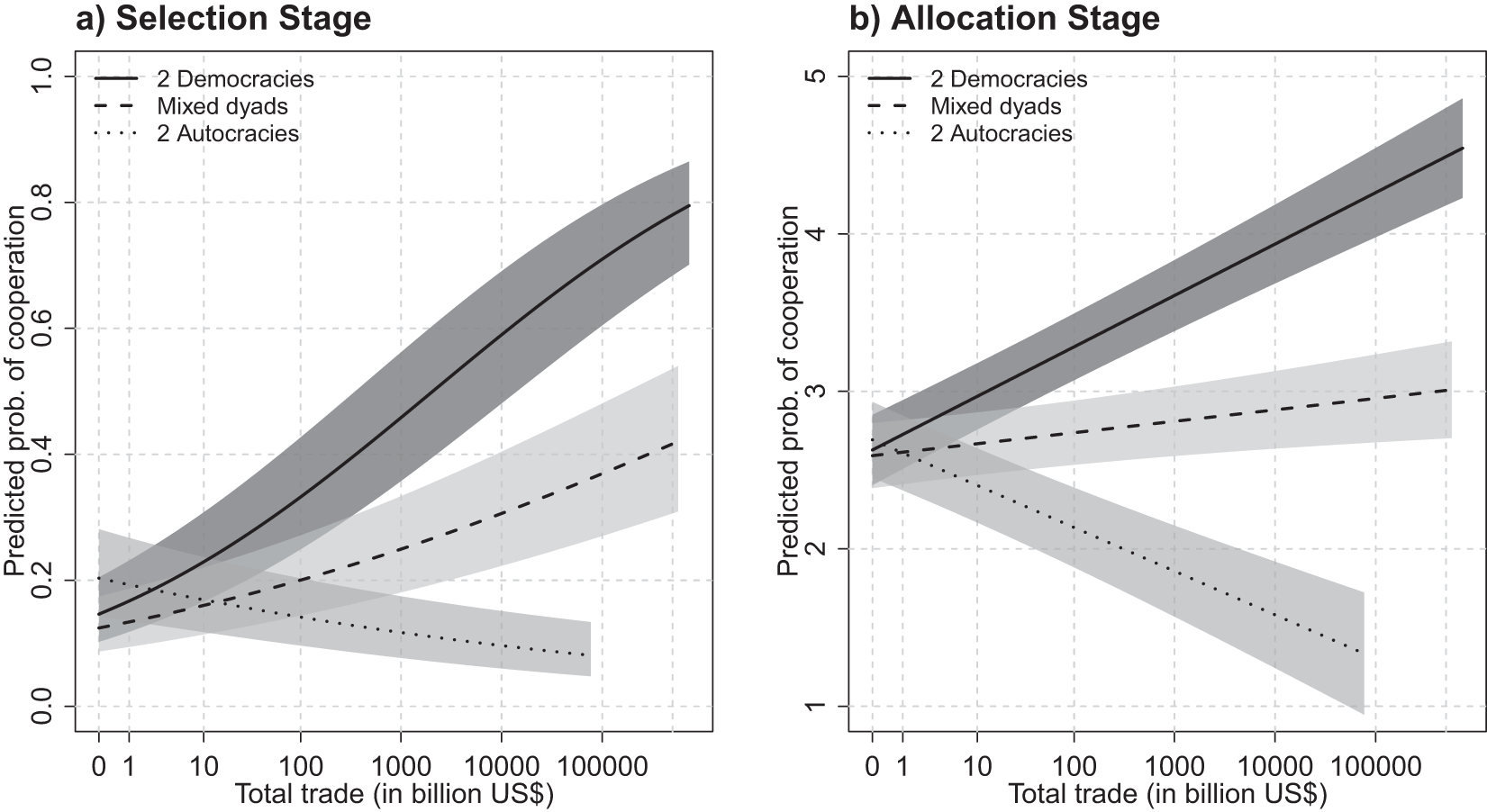
The Hurdle models described above for the dependent variable counting cooperative ties per year and for the dyadic regime variable with only three categories (democratic, mixed, autocratic) are presented in Table 1. In the first two models of the table, the selection and the allocation stage, including the interaction terms, are shown. In the third and fourth columns, we present the robustness checks described above. The third column shows the full model, i.e a model with cooperation per dyad per year, but without separating the model into a selection and an allocation stage. In the last column, we present the model that collapses cooperation for each dyad into a single value. In all the models, we set democratic dyads as the baseline. Thus, the dyad category coefficients represent the degree at which they deviate from the democratic dyad baseline (when dyadic trade is zero). The main effect trade has is the baseline positive effect higher trade volumes have on cooperation for two democracies, and the interaction terms express how this effect deviates from the baseline effect for the dyad category in question. The effect trade has on cooperation is depicted for all three dyadic combinations in Figure 1 for both the selection stage in panel (a), and for the allocation stage on panel (b).
Selection and allocation stages for 3-category regime-dyad effect on cooperation in the WTO negotiations (last column shows full model)

***Note: p < 0.001;
** p < 0.01;
* p < 0.05; ·p < 0.1; year fixed-effects included.
The models reveal a very interesting picture. When we inspect the selection stage model (panel (a) of Figure 1), we see that at low levels of trade (left-hand side of the plotted lines) there is little evidence of democracies acting more cooperatively than non-democracies. On the contrary, at very low trade levels, autocratic dyads have a predicted probability of cooperation at around 20%, while for dyads including at least one democracy, this probability is lower (at around 15%), although this difference in not statistically significant. In other words, when the trade relationships between dyads are weak, the regime types of the two dyads in question are not strong predictors for the likelihood of cooperation.
Graphical representation of results of the selection stage for regime-type dyads (democratic, mixed dyads, and autocratic), interacted with trade volume. (a) Selection Stage, (b) Allocation Stage.

However, this changes dramatically once the level of trade between dyads increases. Now we see that at higher levels of trade, democratic dyads exhibit increasingly higher probabilities to cooperate. At the highest level of trade recorded in the dataset, the predicted likelihood of cooperation for two democracies is almost 80%. In contrast for autocratic dyads, the probability of cooperation is not significantly related to how much they trade with each other (and if even slightly negative). Mixed dyads, including one democracy, are somewhere in the middle. At low trade values, they have low predicted probabilities of cooperation, which then increase as the trade levels grow to almost 50%.
The picture is quite similar in the allocation stage (panel b) of Figure 1). When there is little dyadic trade, there are almost no differences in how often the three dyadic categories are predicted to cooperate. Once the trade relationship intensifies, fully democratic dyads increase the number of cooperative ties, as do dyads with dyads with one democratic partner, albeit to a much lesser degree. For fully autocratic dyads, the model even predicts a decrease in the number of cooperative ties.
Thus, the hypothesis that democracies are in general more likely to cooperate, which is a widely held belief in international relations, does not find much support in our models. We therefore believe the idea that democratic countries, in general, are more likely to provide global public goods, such as cooperation in international trade, must be updated (Olson 1993; McGuire and Olson 1996). If this were the case, we should see higher propensities of cooperation to provide the public good of free trade irrespective of the trade levels between (democratic) dyads. Instead, our models indicate that cooperation between democracies and other democracies (or also with non-democratic regimes) increases only when the trading relationship gets stronger and thus the self-interest to cooperate of the democratic regime in question becomes more salient. Thus, the democratic cooperation hypothesis, at least when it comes to trade negotiations, must be qualified by adding that it depends on the self-interest of democratic countries, here captured by the volume of trade. This is in line with newer findings in the literature pointing out the absence of consumer interests in trade policy (Betz and Pond, Reference Betz and Pond2019; Betz, Reference Betz2017), an indication that lobbying opportunities in democracies do play a role for driving dyadic cooperation (Grömping and Teets, Reference Grömping and Teets2023), and strong evidence in favor of our expectation E1.
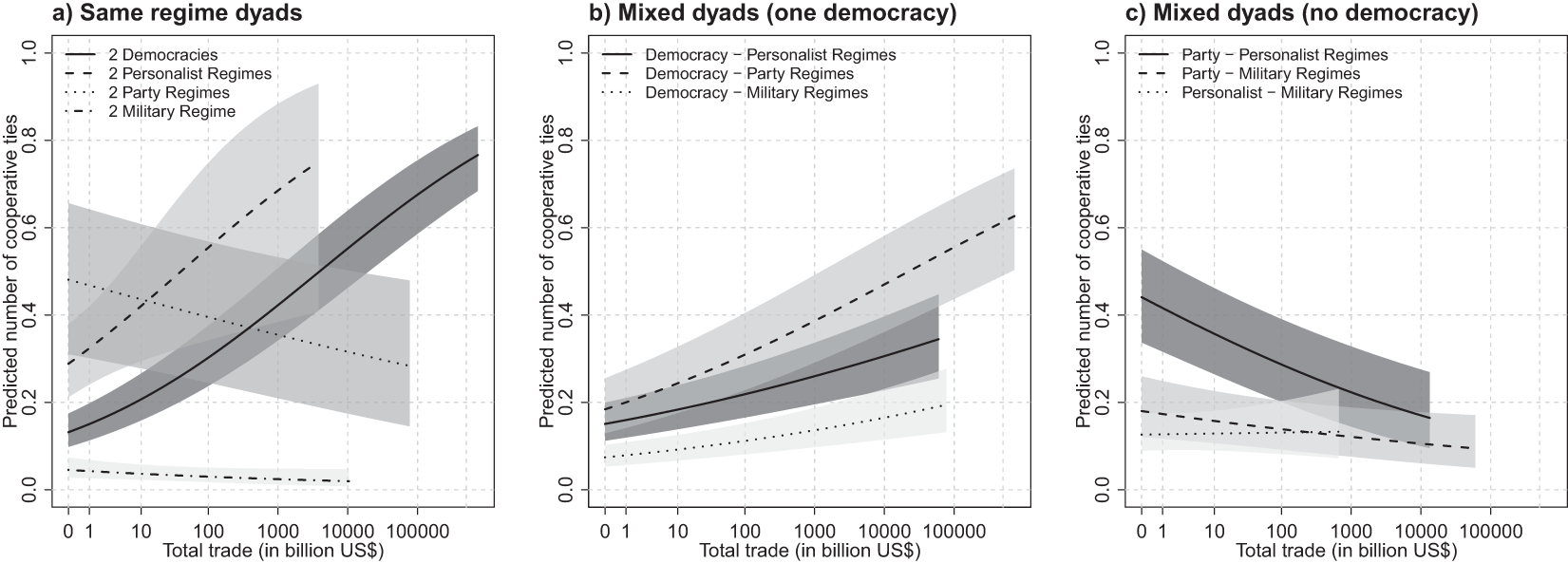
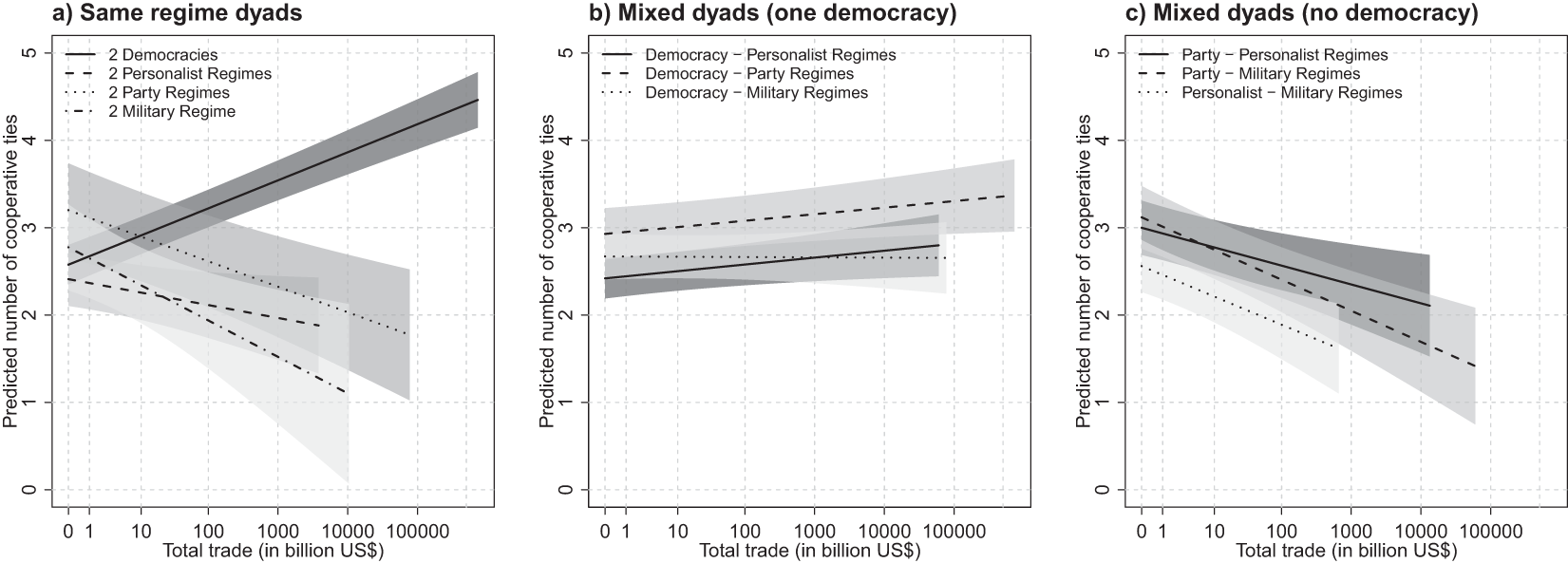
As a next step, and to test E2, we run the same Hurdle models as before, but now we differentiated between different types of autocratic regimes, using the second dyadic coding described above with the ten possible regime combinations (two democracies, democracy-party, democracy-personalist, democracy-military, two party regimes, party-personalist, party-military, two personalist regimes, personalist-military, (two military regimes). Table 2 shows the results when using this variable, again for the selection and allocation stages, as well as a full model combining the two stages (column 3), and the model combining years (column 4) as robustness checks. Here, we also add models (selection and allocation stage) focusing on the highly important negotiation issues of agriculture and Non-Agricultural Market Access (NAMA) only. These models use the same independent variables as the other models, but the cooperation variable is only coded when dyads make joint statements on agriculture or NAMA. Focusing on the Hurdle models, the selection stage is graphically represented in Figure 2, the allocation stage in Figure 3. In both figures we further separate the different dyad types into three panels, which helps us to avoid over-crowding of the figures and makes it easier for the reader to discern the effects of specific dyads. Panel (a) in both figures exhibits dyads of the same type, panel (b) are mixed dyads where one partner is democratic and the other one a non-democratic regime, and panel (c) shows the various fully non-democratic dyads. The three tables show result for the ten possible regime combinations.
Graphical representation of results of the selection stage for regime-type dyads, interacted with trade volume.

Graphical representation of results of the allocation stage for regime-type dyads, interacted with trade volume.

Selection and allocation stages of cooperation in the WTO negotiations (with and without interaction terms)

***Note: p < 0.001;
** p < 0.01;
* p < 0.05; ·p < 0.1; year fixed-effects included.
Again, we see that fully democratic dyads in both stages have a strong tendency to in- crease cooperation to provide a public good only when the trade relationship increases. This is also true for the three dyadic combinations with only one democratic partner, particularly in the selection stage, with comparable effect sizes for personalist and party regimes (although higher for the former). Military regimes do exhibit a significantly increased likelihood of cooperation with democracies, but at a significantly lower level than the other autocratic regime types. In the allocation stage, the democratic dyads exhibit a highly positive and significant effect as the trade relationships grows. When only one partner is democratic, the relationship is positive again for personalist and party regimes, although significant only at the 90% confidence level. For militarist regimes, there is no positive relationship. This, again, is evidence in favor of our E1 that democratic cooperation does hinge on domestic preferences, and should not be a generalized as a priority. Regarding our E2, when cooperating with democracies, party-centered and personalist regimes seem to be more cooperative (and increasingly so with more trade) than military regimes. Between the two, however, it is difficult to discern their cooperative behavior, based on our results.
For all the non-democratic dyads in both stages (with one notable exception) we see that trade intensity has no influence on how strongly autocracies cooperate with each other in the WTO negotiations. The effects for these various regime combinations are either flat as trade increases or in some instances even slightly negative. We do observe some differences in how different regime types cooperate with each other, at least in the selection stage. For example, party regimes are predicted to have a stronger tendency to cooperate (at around 40% irrespective of trade) than military regimes (under 10% irrespective of trade). However, these differences are only relevant in the selection stage; in the allocation stage, there are very few differences among the various autocratic regime combinations. Mixed autocratic dyads also exhibit only negligible differences in the selection stage. Overall, the effect of trade on cooperation is rather weak for autocratic dyads, irrespective of type. It can, however, be said that military regimes are the lowest in the pecking order of cooperation, both with democracies and with other autocratic regimes. Thus, together with the findings above on mixed dyads, there is some weak evidence for our E2.
One question arising from these findings: Why do we sometimes observe negative effects for non-democratic dyads as trade increases? This is interesting and contrary to our expectation, which states that as trade intensifies, cooperation should increase across all dyads (albeit less so for non-democratic dyads). Investigating these negative effects in more detail, we found that within most autocratic dyad combinations, most country pairs show relatively little trade. For instance, 90% of personalist dyads have trade values of fewer than $35 million per year. For non-democratic dyads overall, 90% trade less than $150 million a year. Dyadic combinations, including democracies, tend to have higher trading values, with the 90th percentile for democratic dyads being more than $1,300 million. Over the relatively low range of trade observed by most non-democratic dyads, the negative effects shown in our figures are insignificant. We therefore conclude that the negative effects are driven by a small number of bigger autocratic countries, who might be more powerful and thus rely more on their own negotiation stance without having to compromise with others when submitting their positions. In general, we conclude trade volumes for autocratic dyads are mostly irrelevant for cooperation.
The one exception is personalist regimes in the selection stage, which show a remarkably high propensity to cooperate, which also strongly increases as the trading relationship gets stronger. What drives this behavior remains somewhat unclear and requires additional research. At this point, we can only speculate that in personalist regimes the leaders are of particular relevance, and form good and stable relationships with similar leaders, which drive cooperative behavior. Personalist leaders could also be engaging in performative governance. However, since this observation is only valid for the selection stage, while in the allocation stage no such increased cooperation among personalist behavior can be observed, as a second explanation we posit that this effect is driven by the small sample size of fully personalist dyads (less than 1.5% of our dyads).
The robustness checks in Tables 1 and 2 show very similar results to the models discussed in this section, providing some evidence of the reliability of the models. For the agricultural and NAMA issues, we also find similar results, but the level of cooperation in general is much lower on this highly salient issue.
5. Discussion and Conclusion
In the results section above, we presented evidence that democracies are more likely to cooperate with each other, but also with various kinds of autocratic regimes, than the latter are to cooperate with each other. The expectation that democracies behave more cooperatively in international trade negotiations is confirmed, but with the important caveat that this depends on additional preference similarity based on bilateral trade relations. As trade increases in democracies, the likelihood of cooperation (with all countries) increases, but especially between fully democratic dyads. The fact that democracies cooperate more the more they trade is a good indication of the economic driver of cooperation between democracies, and thus of the argument that increased international cooperation also hinges on the self-interest of countries, even among democracies.
At the same time, we should also concede that cooperation in the WTO could be driven by non-trade related reasons. Such a rationale can be an attempt of democracies to trigger institutional change abroad. Many trade practitioners have based their efforts on the security externalities of trade, arguing that countries trading with one another do not go to trade with one another (Rosendorff, Reference Rosendorff2006). Similarly, large democracies can use their trade power in the WTO framework to regulate migration or to tackle human rights issues by creating economic interdependencies with economically underdeveloped countries (Jurje and Lavenex, Reference Jurje and Lavenex2014; Lavenex and Jurje, Reference Lavenex and Jurje2015). However, if this was the main driver of co- operation, the interaction between trade and democracy should not be strongest for democratic dyads, as no regime change is expected in democracies according to these theories. More research should be devoted to this area.
In our understanding, the results provide an indication that the drivers of co- operation at high levels of trade are the trading industries that would benefit from higher cooperation. These industries have more room for maneuvers in democracies compared to autocratic regimes. Furthermore, democracies have a large selectorate, and the political survival of decision-makers, i.e. being re-elected by the people for another term, depends on whether this electorate feels represented (De Mesquita et al., Reference De Mesquita, Morrow, Siverson and Smith2002). If trade is beneficial to the average voter (Milner, Reference Milner1999), then a rational course of action for democratic leaders would be to favor increased international cooperation in trade, especially with those partners with which the democratic country has close trade relations. While we may not see the issue of international trade negotiations as being as central to voters’ electoral success, negative press coverage and opposition parties taking up the issue could have negative consequences for future electoral success. This is where lobbying industries can make themselves seen in a democracy and therefore contribute to more cooperation on international trade.
We can also look at this evidence through the lens of rational choice institutionalism (Hall and Taylor, Reference Hall and Taylor1996). In this view, democratic institutions compel political actors who want to stay in power to follow the will of the selectorate, i.e. the democratic majority. This constraint is much stronger in democratic countries than in autocracies, where the selectorate is (often) much smaller. Also, the set of institutions that guide the decision-making process is different and much more under the control of the elites (who make up a large part of the selectorate in highly non-democratic countries), so it is rational for leaders in these countries to follow a very different set of preferences than the common good. Nonetheless, the fact that democracies are not very cooperative at low levels of trade seems to indicate that the will of the selectorate needs to be channeled by institutions able to lobby the government, such as the trading industries.
Following the logic of two-level games in international negotiations (Putnam, Reference Putnam1988), we see that after the decision at the domestic level to cooperate more (or less), the game of forming cooperative ties and coalitions by pooling power and borrowing strength (Betzold, Reference Betzold2010; Chasek, Reference Chasek2005) at the international level makes countries form ties, particularly with those partners with which they have close trading relationships. We can therefore conclude that democratic countries cooperate the most with each other, but are also likely to form cooperative relationships with non-democracies (of all ‘flavors’), and this is particularly true when they have close trading relations with their (democratic or non-democratic partners). We do not see much variation in how democratic negotiators treat their trading partners from autocratic countries. In fact, Figures 1 and 2 show remarkable similarities between the three dyads of democracies with the party, personalist, and military regime, both when it comes to the selection stage of forming ties, and to the allocation stage when the number of ties formed is decided.
While we therefore conclude that democracies with high levels of trade are more cooperative in trade negotiations than other regime types, we found only limited evidence to discern the cooperative behavior of these autocracies. The volatility of trade cooperation of autocrats is probably partially responsible for this (Chow and Kono, Reference Chow and Kono2017). When looking at the selection stage in Panel (a) of Figure 1, we do see that pure personalist regime dyads are generally quite likely to work closely with each other (although in the allocation stage it is no longer the case that they also increase the amount of cooperation), and military regimes are generally the least cooperative. Thus, the expectation E2 finds some corroboration. However, in both the selection and allocation stages all possible variations of autocratic regime dyads do not appear to increase their cooperative behavior as trade increases (with the exception of the already mentioned pure personalist regimes dyads in the selection stage). For many of these dyadic combinations, the predicted probability of forming ties (selection stage) and of the number of ties formed (allocation stage) is even slightly negative as trade volumes increase. This indicates that indeed a very different institutional logic than in democracies is driving the preferences and the behavior of decision-makers in settings in which lobbying industries are restricted and thus unable to push for more cooperation.
To gain a better understanding of underlying causes of this behavior, we also disaggregated the cooperative tie formation process by looking into two specifically sensitive negotiation issues: agriculture and NAMA. While we found, overall, quite similar patterns as in the sample including cooperative behavior on all negotiations issues, one striking difference was the remarkably low propensity to cooperate on those ‘hard bargaining’ issues. This indicates that democracies use so-called soft bargaining issues as tools to indicate their willingness to cooperate, but when it comes to the core-issue of self-interest, their readiness to actually cooperate (and thereby adjust their bargaining positions and to narrow down the bargaining space) isnot much bigger than that of non-democratic regimes.
Data availability statement
The data and all the materials needed to replicate the findings of this study can be downloaded at https://doi.org/10.7910/DVN/4CBLQM.
Supplementary material
The supplementary material for this article can be found at https://doi.org/10.1017/S147474562510133X.



 Open access

