

1. Introduction
It is no coincidence that, all across the globe, credit cards are 85.6 mm long and 53.98 mm wide, webpages start with HTTP, and all certified scuba diving guides have at least 60 logged dives in open water. These seemingly unrelated occurrences find their roots in international standards—a set of guiding principles that foster global interaction, harmonization of expectations, and a world-wide sense of familiarity and predictability.
Standards are an essential aspect of the globalization process, both emerging from and enabling it. For instance, shipping containers revolutionized global trade by enabling efficient shipping, but, importantly, their adoption rate across ports depended on harmonization through standards (Levinson, Reference Levinson2016). Indeed, the proliferation of standards has led scholars across a broad range of disciplines to study these regulatory initiatives, including their design, diversity, effectiveness, and legitimacy as transnational regulatory tools (Marx et al., Reference Marx, Maertens, Swinnen, Wouters, Marx, Maertens, Swinnen and Wouters2012; De Vries et al., Reference De Vries, Jakobs, Egyedi, Eto, Fertig, Kanevskaia, Klintner, Koch, Mijatovic, Mirtsch, Morone, Orviska, Riillo and Scaramuzzino2018). This article aims to boost the growing body of research on international standards by introducing StanDat, a comprehensive database derived from the International Organization for Standardization (ISO). This database enhances access to descriptive statistics for qualitative purposes and facilitates the study of quantitative relationships, such as those between standardization and trade, innovation and economic growth (Swann, Reference Swann2010; Blind et al., Reference Blind, Kenney, Leiponen and Simcoe2023). It can also be used to address questions related to the legitimacy of standards as regulatory instruments (Bernstein and Cashore, Reference Bernstein and Cashore2007) and how standardization can serve as a source of power (Rühlig, Reference Rühlig2023).Footnote 1
Previously, access to structured data on the topic of standards has been relatively scarce, despite plenty of information being readily available on the internet. Availability of digital data does not prescribe accessibility, and the harvest and processing requirements needed to use these data to answer research questions pose barriers to many social scientists (Lazer et al., Reference Lazer, Pentland, Adamic, Aral, Barabasi, Brewer, Christakis, Contractor, Fowler, Gutmann, Jebara, King, Macy, Roy and Van Alstyne2009). In a time where data collection techniques have allowed for a burgeoning body of datasets within international relations,Footnote 2 it is worth considering how distinct topics such as standards may become understudied compared to topics with readily available datasets, potentially leading to an availability bias in the social sciences (Mahrt and Scharkow, Reference Mahrt and Scharkow2013). Thus, in addition to introducing the StanDat database, this paper shows how a full-fledged database on the domain-specific topic of standards can be constructed through web scraping and made readily available to researchers, hopefully contributing to the expansion of research in this important field (De Vries et al., Reference De Vries, Jakobs, Egyedi, Eto, Fertig, Kanevskaia, Klintner, Koch, Mijatovic, Mirtsch, Morone, Orviska, Riillo and Scaramuzzino2018).
2. The politics of standards
Research on standards and standardization is incredibly diverse. First, studies span several disciplines, including management studies (Narayanan and Chen, Reference Narayanan and Chen2012; Wiegmann et al., Reference Wiegmann, de Vries and Blind2017), organizational studies (Brunsson, Reference Brunsson, Brunsson and Jacobsson2002; Botzem and Dobusch, Reference Botzem and Dobusch2012), law (Pauwelyn et al., Reference Pauwelyn, Wessel and Wouters2012), economics (Weitzel et al., Reference Weitzel, Beimborn and König2006; Swann, Reference Swann2010; Yang, Reference Yang2023), sociology (Timmermans and Epstein, Reference Timmermans and Epstein2010), political science (Abbott and Snidal, Reference Abbott and Snidal2001; Mattli and Büthe, Reference Mattli and Büthe2003; Büthe and Mattli, Reference Büthe and Mattli2011a; Graz, Reference Graz2019), and more recently, multidisciplinary approaches (Eliantonio and Cauffman, Reference Eliantonio and Cauffman2020; Olsen, Reference Olsen2020). Second, standards are produced and adopted at various levels, from the local to the international. Third, a wide range of topics are standardized, including for example education (Elken, Reference Elken2017), human capital (Yarrow, Reference Yarrow2022), child welfare (Sletten and Ellingsen, Reference Sletten and Ellingsen2020), and the environment (Prakash and Potoski, Reference Prakash and Potoski2006).
While it is beyond the scope of this paper to give a full overview of the standardization literature, the complexity illustrated above may explain why, despite an increasing volume of research, some scholars deem standardization to be an “under-investigated area of research” (De Vries et al., Reference De Vries, Jakobs, Egyedi, Eto, Fertig, Kanevskaia, Klintner, Koch, Mijatovic, Mirtsch, Morone, Orviska, Riillo and Scaramuzzino2018, p. 57). Although the field has grown in popularity over the last decades (Yang, Reference Yang2023), in a bibliometric study, Heikkilä et al. (Reference Heikkilä, Ali-Vehmas and Rissanen2021) found that within economic textbooks, the words “standards” and “standardization” are seldom found in the word indices, and the relationship between standardization and economic growth has never been analyzed in the top five economic journals between 1996 and 2018. Arguably, the rich albeit fragmented literature has concealed the importance of this broad phenomenon to many researchers (Narayanan and Chen, Reference Narayanan and Chen2012).
Yet, the political significance of standards has become increasingly evident to social scientists (Mattli, Reference Mattli2001). A standard can be defined as a “rule for common and voluntary use” (Brunsson et al., Reference Brunsson, Rasche and Seidl2012, p. 616) “that structur[es] interaction” (Botzem and Dobusch, Reference Botzem and Dobusch2012, p. 739) and represents the “values against which people, practices and things are measured” (Loconto and Busch, Reference Loconto and Busch2010, p. 526). However, despite originating from expert deliberations, these values can be quite disputed. For instance, the effort to develop standards for humane animal traps was significantly delayed due to activism from animal protection groups, who advocated for a general ban of all animal trapping devices (Hallström, Reference Hallström2004). Another example of conflicting values and trade-offs concerns the creation of a global standard for wireless equipment. A few years after the Institute of Electrical and Electronics Engineers (IEEE) proposed the well-known Wi-Fi, China proposed the WLAN Authentication and Privacy Infrastructure (WAPI). Although WAPI promised better performance, it offered poorer privacy protections, and standard-setters settled on the Wi-Fi (Rühlig, Reference Rühlig2023).
The widespread adoption of the Wi-Fi standard also exemplifies the enduring nature of certain standards; they can produce path-dependencies. The QWERTY keyboard is a classic example within economics of how markets may lock in inferior outcomes. David (Reference David1985) argued that the QWERTY layout was designed to slow down typing on typewriters to prevent jamming, and suggested that a different layout would have been more efficient for computers. This demonstrates how standards (both de facto and de jure) can become so deeply entrenched that even suboptimal outcomes are difficult to change, benefiting some actors over others. Indeed, standards are powerful instruments for technology diffusion, and winning a “standardization battle” can have long lasting consequences. Ding (Reference Ding2024) has argued that diffusion, in addition to innovative capacity, is a core component of nations’ scientific and technological power.
Within international relations, the topic of standards entered the research agenda in the 1990s, with the increased study of private actors in global governance (Peña, Reference Peña2015). Standards are often viewed as governance tools (Abbott and Snidal, Reference Abbott and Snidal2001), and today many scholars view standard setting bodies as a part of a “power triangle” that govern socio-economic affairs (Higgins and Hallström, Reference Higgins and Hallström2007), posing a form of “transnational private authority” (Graz, Reference Graz2019). StanDat facilitates further studies into the significance of standards in the global economy, to explore the reasons and circumstances under which they have an impact.
3. Data source: The International Organization for Standardization (ISO)
StanDat is built from digital data harvested from the International Organization for Standardization (ISO), one of the oldest and most active standardization organizations on the international arena (Heires, Reference Heires2008). Other notable international standard-setting organizations include the European Committee for Standardization (CEN), the International Accounting Standards Board (IASB), the International Telecommunication Union (ITU), and the International Electrotechnical Commission (IEC) (Büthe and Mattli, Reference Büthe, Mattli, Coen, Wilson and Grant2010).Footnote 3 While StanDat focuses on ISO standards, the approach demonstrated in this article can be used to also gather data on other organizations.
The ISO standards mapped in StanDat are global, generalist (i.e., regulate a range of topics), and widely distributed. Fifteen years ago, they were estimated to encompass approximately 85 percent of all international product standards in collaboration with IEC (Büthe and Mattli, Reference Büthe and Mattli2011a, p. 29). At the time of writing, ISO sports a portfolio of over 25,000 standards organized within 834 technical committees and subcommittees.Footnote 4
Figure 1 gives an overview of some historical highlights along with ISO's cumulative growth of standards. In 1971, ISO transitioned from making so-called “recommendations” to provide what they termed “international standards” (Murphy and Yates, Reference Murphy and Yates2009). The 1979 Tokyo Round resulted in the Technical Barriers to Trade (TBT) Agreement, calling for nondiscriminatory, minimally trade-restrictive standards aligned with international norms (Kim, Reference Kim2018, p. 774). The TBT Agreement became part of GATT-WTO obligations in 1994, requiring members to harmonize technical specifications to reduce trade barriers (Jackson, Reference Jackson1997, p. 223).
Growth of ISO standards over time annotated with selected notable events in ISO's history.

Additionally, ISO has broadened its scope, expanding from purely technical fields into new societal fields. A standard series on Quality Management and Quality Assurance (ISO 9001) was published in 1987, and since then, ISO has expanded its portfolio into Environmental Management (ISO 14001) and Social Responsibility (ISO 26000) (Hallström, Reference Hallström, Boström and Garsten2008; Hallström and Higgins, Reference Hallström, Higgins, Tietje and Brouder2010). Hence, ISO has expanded its reach over time, impacting a wider array of stakeholders and expanding the issue scope covered by standards. To address issues such as representation and stakeholder concerns, ISO has established DEVCO, COPOLCO, and TMB (Bijlmakers, Reference Bijlmakers2023).
ISO has a decentralized structure based on a network of technical committees (TCs). Member countries are represented in these TCs by their most representative national standardization body. Per date, ISO hosts 171 national member bodies, with varying degrees of engagement, activity, and influence depending on membership status, degree of participation, and number of experts.Footnote 5 Besides being members in TCs, national member bodies may assume leadership roles such as secretariat, chair, or convener. The secretariat, responsible for leading TCs, is managed by a member body volunteering for a specific period. It is also important to acknowledge that mere membership in a TC does not necessarily imply active participation. Meaningful engagement in negotiation processes depends on factors beyond formal membership, such as time and expertise (Alshadafan, Reference Alshadafan2020).
4. The StanDat database
StanDat is a database comprised of four parts; “Standards,” “TC-membership,” “Historical,” and “Certifications,” where each part contains 2–3 individual datasets. Units and time series coverage varies across the datasets, as shown in Table 1.Footnote 6 StanDat complements existing datasets like Nautos (formerly Perinorm), which focuses on national and regional standards, by providing detailed information on ISO standards’ standardization process, historical development, and diffusion.
Overview of the StanDat database

Due to ISO not possessing an API, the datasets are mainly derived from web scraping and parsing of ISO's webpages, with some information extracted from Excel and PDF files from their official archive. Detailed data gathering methods are described in Appendix B.
Web scraping is the practice of detecting and extracting information from the HTML-pages, and parsing involves structuring information into a dataset. Despite its growing adoption across various social science disciplines (Luscombe et al., Reference Luscombe, Dick and Walby2022), to the best of my knowledge, this method has not yet been employed to construct a large-scale database of the type described here. Examples of previous use include using web scraping to collect data for specific research questions (Boeing and Waddell, Reference Boeing and Waddell2017; Cavallo, Reference Cavallo2018) and introducing frameworks on how to use web scraping to collect data on specific topics (Braun et al., Reference Braun, Kuljanin and DeShon2018; Anglin, Reference Anglin2019). These are useful contributions, but come with some limitations in terms of data accessibility. The first examples do not always provide replication data, and the latter necessitates technical proficiency (Manovich, Reference Manovich2012). In contrast, the approach presented here focuses on improving data accessibility to the wider research community, showing not only how a large-scale database can be built through web scraping and parsing, but also simplifies data access without requiring technical expertise from individual users.
In essence, StanDat is created through three different procedures. The first procedure collected data for the “Standards“ datasets (first row in Table 1), and involved scraping information on all standards that ISO lists on their webpages. This entails “classic scraping” of contemporary (not historical) webpages, and consisted of three steps; downloading the webpages to a local folder, extracting the relevant information from the webpages, and parsing this information into dataframes. Because ISO lists all standards ever produced on their webpages, the first standard in the “Standards” datasets is dated to 1951.
The second procedure addresses a common shortcoming with web scraping—that webpages are momentary snapshots susceptible to changes. This is the case with the “TC-membership” data; ISO only lists current TC members on their webpage, not past constellations. To address this temporal challenge, the Wayback Machine, managed by the nonprofit Internet Archive, provides a solution (Arora et al., Reference Arora, Li, Youtie and Shapira2016). Utilizing archived webpages enables researchers to retrieve and organize historical information, facilitating the collection of time-series data that might be absent from contemporary webpages.Footnote 7
Information gathered from the Wayback Machine is limited in two senses. First, the time series is limited to the organization's acquisition (and continued ownership) of the domain name. Since ISO bought their domain in 2002, this marks the beginning of the “TC-membership” datasets. Second, due to the Wayback Machine's selective archival, all relevant webpages are not available for every year. Around 28 percent of the units required imputation. The imputation process was rule-based; detailed in Appendix B and validated in Appendix C. While data are available from 2002, it is recommended to use data from 2004, when there were enough snapshots to scrape sufficiently and make valid imputations.
Data validity is evaluated by assessing the correspondence between StanDat and information collected from other sources, including public documents and the United States’ standardization organization ANSI. There are two types of possible error; imputing a country wrongly, leading to a false positive, and failing to observe a country membership, leading to a false negative. To quantify the validity, I employ accuracy as a metric. This metric refers to the correctness of values, here being how close the imputed values are to the reported values in the public documents. Accuracy calculates the ratio of correct observations to total observations, inclusive of false positives and negatives. The average accuracy on the time series excluding year 2002 is 88.82,Footnote 8 indicating that nearly 90 percent of the country-TC-years were correctly recorded. While this highlights an inherent uncertainty within the TC-membership dataset, the amount of bias due to wrong imputations is likely to be low since there is no systematicity in which countries’ webpages the Wayback Machine records or skips. Moreover, an accuracy of almost 90 percent is quite good compared to other similar imputation efforts (Hu and Tsai, Reference Hu and Tsai2022).
The third procedure involved parsing of other file formats, namely PDF and Excel. The “Historical” datasets are parsed from a PDF file in ISO's archive, last updated in 2015. For the “Certifications” datasets, I organized information from the ISO Survey, involving thorough cleaning, structuring, and merging of Excel sheets. The ISO Survey counts the annual number of valid certificates issued by certification bodies that have been accredited by members of the International Accreditation Forum (IAF).Footnote 9 It is important to note ISO's disclaimer when using the “Certifications” datasets: The ISO Survey is not a database. The providers of the data are the certification bodies accredited by IAF members and they participate on a voluntary basis. The level of participation fluctuates from one edition of the survey to another and can impact the survey results especially at the country level. Interpretations of the results and any conclusions on the trends should be made with these considerations in mind.
Concerning ethical aspects, given its novelty, web scraping lacks a direct legal framework, although an emerging body of literature addresses its ethical considerations, such as bias, privacy, and confidentiality (Krotov et al., Reference Krotov, Johnson and Silva2020; Krotov and Johnson, Reference Krotov and Johnson2023). Adhering to these ethical guidelines and respecting web crawling limitations outlined in ISO's robots.txt document, I ensure compliance. Data are sourced exclusively from publicly accessible sources, not ISO's internal archives. Furthermore, practices include spacing out web requests and storing webpages locally, mitigating server load and enhancing reproducibility.
5. Applications of StanDat
The StanDat database can aid the research into standards and standardization in three important ways. First, it makes data directly available, simplifying the making of descriptive statistics. Second, it can be used to assess the scope conditions of findings from previous studies, providing insights into when and why phenomena occur. Third, because StanDat can be merged with other datasets, it can be used to explore new patterns and relationships with regard to international standards and other phenomena such as patents, global value chains, or, as demonstrated in section 6, trade.Footnote 10
5.1. Producing descriptive statistics
Descriptive statistics are a crucial element in both qualitative and quantitative research. StanDat offers a valuable repository of primary descriptive data, replacing previous reliance on secondary sources.
For example, Ruwet (Reference Ruwet2011), in a study on ISO's shift from producing physical standards to producing standards that also regulate societal issues, includes a graph on the distribution of ISO standards by technical sector, shown in Figure 2. Such descriptive data enrich the study, but there are also some limitations due to data scarcity; the graph is gathered from ISO's 2007 annual report, thus being a few years older than the publication, confined to percentages, and does not show development over time. Since StanDat provides more recent and versatile data, it can be used to produce for example Figure 3, showing cumulative growth of ISO standards across technical sectors from the organization's beginning. StanDat can also be used to tailor descriptive data more closely to the analysis at hand, for example, such as Figure 4, which shows the increased establishment of technical committees within the new societal sectors that Ruwet (Reference Ruwet2011) highlights.
Original illustration of proliferation and diversity of standards from Ruwet (Reference Ruwet2011).

Illustrating the proliferation and diversity of standards (Ruwet, Reference Ruwet2011). Cumulative count of standards over time disaggregated by sector, 1950–2023.Footnote 11

Illustrating ISO's shift toward making standards on societal issues (Ruwet, Reference Ruwet2011). Establishment of technical committees within technical and societal issue areas, 1950–2023.

In a different illustration, Rühlig (Reference Rühlig2023) explores diverse perspectives on the notion of technical standardization power, demonstrating China's progressive enhancement in this domain in recent years. One metric employed is the involvement in TCs, illustrated with membership data gathered from AFNOR. StanDat can be used to delve deeper into this metric, offering insights into specific sectors where China's influence has seen notable growth. While prior studies often emphasize China's ascendancy in information technology (Kim et al., Reference Kim, Lee and Kwak2020), Figure 5 illustrates that China's P-membership in TCs has surged or remained high relative to other active countries across all sectors. This poses an interesting pattern, and highlights the potential of StanDat as a valuable resource for assessments of standardization power.
P-membership in technical committees (TCs) and subcommittees (SCs) in the period 2004–2023 for the most active countries as noted by Rühlig (Reference Rühlig2023).

5.2. Assess scope conditions
The encompassing data in the StanDat database enable researchers to evaluate the scope conditions of prior studies on standardization. For instance, much research has been devoted to the causes and outcomes of ISO certification. Scholars have studied questions such as why ISO certifications spread (Sampaio et al., Reference Sampaio, Saraiva and Guimarñes Rodrigues2011), whether certification improves business performance (Chow-Chua et al., Reference Chow-Chua, Goh and Boon Wan2003; Link and Naveh, Reference Link and Naveh2006) or product innovation (Manders et al., Reference Manders, de Vries and Blind2016), or why firms want to pursue certification in the first place (Anderson et al., Reference Anderson, Daly and Johnson1999). Many of these studies use surveys, often relying on the ISO Survey (Sampaio et al., Reference Sampaio, Saraiva and Guimarães Rodrigues2009). Since data from the ISO Survey are only semi-structured and cumbersome to use, StanDat improves data accessibility by providing a portal to parsed and clean timeseries data. With this, scholars can quickly access ISO Survey data to extend previous analyses, and also compare ISO certification within a specific standard with other standards, as illustrated in Figure 6.
Number of valid certificates issued by IAF accredited certification bodies per year for selected ISO standard series, various time series.Footnote 12

This availability simplifies analysis considerably, enabling researchers to investigate whether trends observed in the certification of earlier ISO series are consistent with those of recent ISO series. For example, using a sample of 63 countries, Corbett and Kirsch (Reference Corbett and Kirsch2001) and Vastag (Reference Vastag2004) found that certification in Quality Management was an important predictor for certification in Environmental Management. Using StanDat, these studies can be extended to broader time frames, new ISO series, and more countries. This is demonstrated in an analysis in Appendix E, which, while significantly broadening the scope, largely supports the original findings. Moreover, previous ISO certifications can predict current ISO certifications, even across different topics. Quality Management certification can predict Environmental Management certification, which, in turn, can predict certification within Information Security Management. Overall, this provides valuable insights into how and why standards proliferate, even across changing technological and geopolitical circumstances.
In addition to extending older analyses, StanDat can be used to test the scope conditions of qualitative findings. For instance, Werle and Iversen (Reference Werle and Iversen2006) argue that in standardization processes, output legitimacy is more important than input legitimacy. Rühlig (Reference Rühlig2023) examines Chinese technical standardization power, providing a framework to understand standardization power which, when combined with the more general works of Blind and von Laer (Reference Blind and von Laer2022) and Ding (Reference Ding2024), can be used to assess technical and scientific power among a broader set of countries. StanDat can thus be a resource for researchers aiming to evaluate the validity and reach of such theories.
5.3. Provide new analyses
Lastly, the StanDat database can contribute to new analyses within the topic of standards and standardization. In particular, because the StanDat database can be merged with other datasets, scholars can expand on studies investigating the relationship between standardization and related concepts such as economic growth, legitimacy, global value chains, membership in international organizations, foreign direct investment, and innovation. A few suggestions to topics, possible research questions, general literature, and compatible datasets are given in Table 2. In Appendix E, I provide an example of such an analysis, demonstrating that membership in ICT-related TCs is significantly correlated with patents output in the same technologies, although with no significant difference between P-members and O-members. Section 6 is further dedicated to a new analysis.
Examples of research topics combining StanDat with complementary datasets

There are numerous potential datasets for merging, with a primary identifier being country-year. Additionally, utilizing concordance tables (e.g., as provided by Blind (Reference Blind2004, p. 349)), researchers can match standards’ ICS codes with other entities based on shared keys such as patents IPC codes, industry ISIC codes, or trade SITC codes.
6. Standardization and trade networks
This section showcases StanDat's applicability in providing new analyses by expanding on an important topic; that of standardization and trade. In doing so, the study follows up on the expanding literature on the effects of standards on trade (see, e.g., (Yang, Reference Yang2023)). Previous studies have found a generally positive relationship between adoption of international standards and trade (Swann, Reference Swann2010; Mangelsdorf, Reference Mangelsdorf2011; Blind et al., Reference Blind, Mangelsdorf, Niebel and Ramel2018). The positive relationship can be attributed to the fact that adopting a standard may signal openness, quality, and safety to exporters, as well as enabling exporting countries to adapt their products to foreign markets (Clougherty and Grajek, Reference Clougherty and Grajek2014). However, adopting an international standard is not without downsides—it can be costly, especially when an adopter has had little influence on the standardization process (Blind, Reference Blind2001).
This last observation shifts the question from the trade effect of adopting standards to the effect of producing standards. Büthe and Mattli (Reference Büthe and Mattli2011a) point out the importance of having influence in the standardization process, in particular how early participation in the standardization process allows countries to shape standards according to their needs. A growing body of literature has studied the factors explaining standardization involvement among firms (Blind, Reference Blind2006; Riillo, Reference Riillo2013), and an emerging literature is investigating the involvement of national standard bodies in international standardization fora (Mattli and Büthe, Reference Mattli and Büthe2003; Blind and von Laer, Reference Blind and von Laer2022). In particular, an advantage of participating in the standardization process for trade lies in the capacity to share knowledge efficiently and swiftly. Thus, joint participation in TCs may positively influence bilateral trade through several mechanisms; signaling openness to other countries, enhancing efficient and need-specific harmonization, and enabling knowledge sharing within specific technologies.
Drawing inspiration from recent research in international relations that explores how networks reveal interdependence among international actors, this section investigates the relationship between joint TC membership and trade volumes through networks. International networks facilitate flow of resources like money, goods, or information, while also shaping and constraining the power of actors based on their connections and relative positions within these networks (Farrell and Newman, Reference Farrell and Newman2019). Examining the correlation between standardization networks and trade networks acknowledges the “complex interdependence” of networks, as highlighted by Keohane and Nye (Reference Keohane and Nye1977). Researchers have investigated how trade networks interact with other networks such as migration (Sgrignoli et al., Reference Sgrignoli, Metulini, Schiavo and Riccaboni2015), alliance building (Haim, Reference Haim2016), militarized conflict (Kinne, Reference Kinne2012), and financial integration (Schiavo et al., Reference Schiavo, Reyes and Fagiolo2010). These studies suggest that network constitutions in trade matters for the composition of other networks.
The global standardization network represents flow of information. Assuming that countries must both provide and receive information to reap the benefits of this network, the network consists of P-members connected by common TC membership, illustrated in Figure 7. Each member body sends experts to their respective TCs, where the experts deliberate on producing standards that, in turn, regulate global interactions and transactions, one of them being trade.Footnote 13
Countries sharing P-membership in technical committees, 2022. The size of the node indicates how many TCs the country participates in. A link between the nodes means that the countries participate in the same TC. The size of the link indicates how many TCs the countries share.

Table 4 presents various models examining the relationship between a directed dyads’ TC connections and bilateral trade.Footnote 14 Both dependent and independent variables are logged, reflecting the assumed declining utility of accumulating one extra unit of respectively TC connections and trade. The models rely on the gravity model (Salette and Tinbergen, Reference Salette and Tinbergen1965) to control for trade confounders. Reflecting recent advances in the trade economics literature using the gravity model, the models utilize high-dimensional fixed effects, incorporating fixed effects on dyads, countries, and years (Anderson, Reference Anderson2011), a method recently used by for example Carter and Poast (Reference Carter and Poast2020).
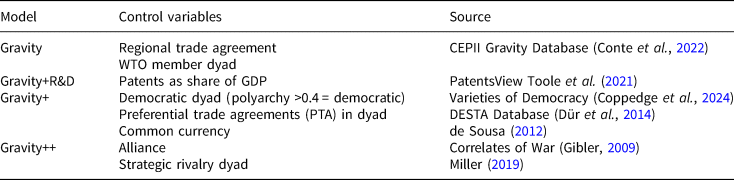
The models employ progressively more controls, detailed in Table 3, but with shorter time series. “Gravity” controls stem from the gravity model, targeting size and proximity. In the high-dimensional fixed-effects specification, conventional Gravity controls such as GDP and capital distance are subsumed by the dyad fixed effects and country-year fixed effects. The “Gravity+R&D” model includes a measure of R&D intensity as patents per GDP. Since R&D intensity may be a mediator, the next models exclude this variable, but add controls beyond the gravity framework. The “Gravity+” control set expands on “Gravity,” including dyad regime similarity, preferential trade agreements (PTAs) and common currency. The “Gravity++” controls encompass the “Gravity+” controls plus indicators for neighboring states’ strategic rivalry and engagement in alliances. Tables displaying coefficients of control variables can be found in Appendix Table F9.
Control variables in Table 4

Relationship between dyadic TC connections and trade volume

Fixed effects by dyad, country, and year, clustered standard errors by dyad and year.
Zero imputation on dyads with missing on TC connections.
Gravity controls: GDP, population, distance between capitals, common language, regional trade agreement, WTO dyad.
Gravity+R&D controls: Adds to Gravity patents per country.
Gravity+ controls: Adds to Gravity+ democratic dyad, preferential trade agreement, common currency.
Gravity++ controls: Adds to Gravity++ strategic rivalry, alliance.
+p < 0.1, *p < 0.05, **p < 0.01, ***p < 0.001.
Table 4 shows patterns in alignment with previous findings regarding the positive relationship between standardization and trade. Frequent TC connections correlate positively and significantly with trade. From the baseline model alone, increasing a dyad's TC connections by 1 percent is indicative of a 7 percent increase in bilateral trade volumes. These results are mostly stable throughout various model specifications, including using alternative measures of trade, using a binary independent variable, and easing the fixed-effect dimensionality to assess the restrictiveness of the model (see Appendix F).
However, three points should be made. First, the significantly positive coefficient becomes insignificant when adding the last set of control variables. Sensitivity checks suggest that this is not due to the shorter time series, indicating that the relationship may be partly driven by other factors, such as the goodwill of democratic dyads or alliances (see Appendix Table F18). Second, when controlling for R&D intensity, the TC coefficient remains significant and strong, suggesting that knowledge advantages gained from joint TC membership in terms of trade may operate partly through R&D intensity. However, this relationship is rather sensitive, as removing zero imputation on missing dyads from the standardization network renders the coefficient on “Gravity+R&D” insignificant (see Appendix Table F16). Third, and importantly, although these models include multiple controls to account for possible confounders, the model cannot rule out reverse causality. For example, while information sharing could facilitate trade, large trade volumes may also incentivize countries to participate in the same TCs to influence standardization procedures. Robustness checks using GMM models indicate that there is no clear causal direction from joint TC membership to larger trade volumes (see Appendix Table F19). A research approach designed for causal inference is necessary to delve deeper into this matter.
With these caveats in mind, the analysis nevertheless shows a rather robust relationship between TC connections and trade volumes, indicating that participating in standardization networks with other countries matter for bilateral trade. This relationship may partly stem from advantages in harmonizing expectations when countries have first-mover advantages in standardization, as noted by Büthe and Mattli (Reference Büthe and Mattli2011a). Further, countries may signal openness, safety, and quality in trade by participating in standardization (Clougherty and Grajek, Reference Clougherty and Grajek2014), and participation may enhance knowledge sharing, boosting R&D efforts and trade. Overall, this study supports the notion of complex interdependence in global markets, in which trade patterns seem to matter for a range of other network constitutions.
7. Conclusion
In the international political economy, standards are important regulatory tools, setting guidelines ranging from the size of containers to the definition of “quality.” This paper aims to boost the growing literature on standards and standardization by presenting a new database, StanDat, constructed from information provided by the International Organization for Standardization (ISO). By doing so, this study also gives insight into the process of producing comprehensive databases when there is a lack of adequate data from other sources, countering availability bias on marginal topics in the social sciences (Mahrt and Scharkow, Reference Mahrt and Scharkow2013).
The StanDat database can be used by qualitative and quantitative scholars alike, either to produce descriptive statistics, assess scope conditions of previous findings, or contribute to new analyses. For example, by utilizing the StanDat database along with UN Comtrade data, this article finds support for the notion of complex interdependence in global markets, namely that countries which frequently participate in standardization processes together also trade more, although the causality of this relationship may go either way. Further examples of important questions encompass the legitimacy and efficiency of standards, or how standards relate to, for example, global inequality or climate change. Because of the interdisciplinary nature of the standardization literature, the StanDat database can be relevant for a wide set of scholars.
While the StanDat database is composed of ISO standards only, several other standardization organizations exist. The methodologies illustrated in this paper, encompassing data collection, tidying, and dissemination, are applicable to these entities as well as numerous additional sources of data within the realm of social sciences. If data are publicly available on the internet, this paper demonstrates the viability of transforming that into research data.
Supplementary material
The supplementary material for this article can be found at https://doi.org/10.1017/psrm.2025.3.
To obtain replication material for this article, Replication Link: https://doi.org/10.7910/DVN/HA8HFW.
Competing interests
None.




 Open access

