

But the greatest abuse in this is digging up and removing the dead from the churches and taking them to the machays, which are the tombs they have in their ancestors’ fields. . . . And when asked why they do it, they say it's cuyaspa, for the love they bear them; as they say the dead in the church are in great sorrow, being bound by the earth, while in the countryside, since they are exposed to the air and not buried, they get more rest [Arriaga Reference Arriaga and Urbano1999 (1621, Ch. VI):67; my translation].
With this passage, Jesuit priest Pablo José de Arriaga hoped to guide fellow extirpators in the violent abolition of Indigenous religious practices during the early colonial period. Despite Arriaga's intention to present central Andeans as ignorant and culturally backward, this text illuminates a rationale that informed some autochthonous mortuary practices in the Peruvian highlands during the seventeenth century. In contrast to Arriaga's transcendental Catholicism, his depiction portrays Andeans’ decisions on the treatment of the dead as rooted in the physical world and human bodies’ immediate needs. Rather than dictated by strict dogma, Arriaga explains these practices as pragmatic love for the deceased, where the living and dead have equivalent desires.
Decades prior, chronicler Pedro Cieza de León emphasized diversity in Andean burial practices; to him, it appeared that “each nation was looking for a new way to make tombs for their dead” (Reference Cieza de León and Pease2005 [1553, Pt. I, Ch. LXIII]; my translation). Unlike Arriaga, Cieza de León did not document the reasoning behind such different kinds of tombs, opting instead to simply dismiss Indigenous beliefs as diabolic superstition. Meanwhile, Spanish legal advisor Juan Polo de Ondegardo complained that the explanations he had heard for distinct mortuary practices were too many to list (Reference Polo de Ondegardo2023 [1566, p. 249r]:141). This means that, while most of these religious philosophies have been lost over time, archaeology presents an opportunity to reconstruct them.
In agreement with early colonial testimonies, archaeologists have detected remarkable heterogeneity in central Andean mortuary practices across space and time (e.g., Covey Reference Covey2008; Eeckhout and Owens Reference Eeckhout and Owens2015; Sharratt Reference Sharratt2017; Velasco Reference Velasco2023). Differences in burial style have been appraised with reference to variables such as sex, social status, and ethnic identity. However, Flammang's (Reference Flammang2021) analysis of 140 funerary contexts across the Inka Empire found no significant correlation between demography, burial style, and grave goods, making room for other explanatory possibilities. In response, this article offers a novel approach by testing whether religious beliefs can account for variation in tomb morphology.
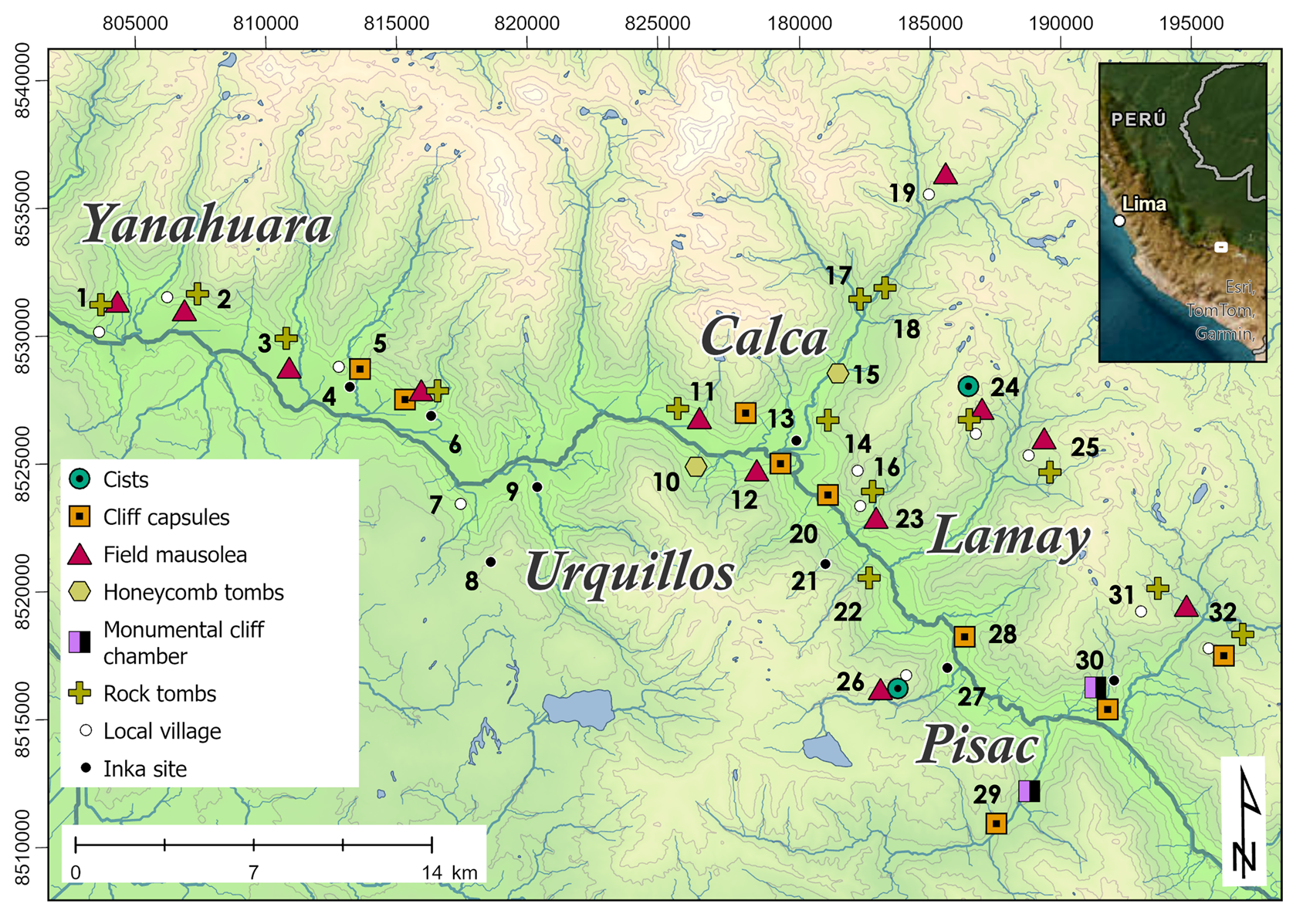
The practices described by chroniclers developed during the late precontact period—encompassing the Late Intermediate (LIP; ca. AD 1000–1400) and Inka periods (AD 1400–1532)—a dynamic time of intergroup competition, aggrandizement, and imperialism. This study takes the Sacred Valley (Cusco, Peru) as a case study to address the question: Why did late precontact peoples inter their dead in different ways? To this end, I analyze a sample of 788 tombs from 30 sites and develop a typology to understand how these structures functioned to facilitate divergent interactions between the living and the dead (Figure 1). As an important region of the former Inka heartland, the Sacred Valley's mortuary landscape offers insight into the political dynamics at play during Inka state formation. The results of this analysis demonstrate how Inka and local (non-Inka) groups cared for the dead according to distinct religious frameworks, where religion encompasses interrelated sets of metaphysical and ethical principles.
Tomb distribution relative to local villages and important Inka sites. Some tomb locations have been modified to enhance visualization and minimize overlap. Relevant sites are numbered as follows: 1, Pataswaylla; 2, Iskumoqo; 3, Pusaqraqayniyoq; 4, Tantanmarka; 5, Yawarmaki; 6, Yucay; 7, Umaspata; 8, Machuqollqa; 9, Urquillos; 10, Antaraqay; 11, Kullkunchayoq; 12, Concón; 13, Wayronqochayoq; 14, Kaytumarka (Cerro Calvario); 15, Piste; 16, K'allaray; 17, Markapunku; 18, Lluq'iqhata; 19, Ankasmarka; 20, Pintaswayq'o; 21, Huch'uy Qosqo; 22, Hatun Raqakay; 23, Pillpintuyoq; 24, Hatun Saywa; 25, Markasunay; 26, Qhapaqkancha; 27, Paullo; 28, Watana; 29, Ñawpa Taray; 30, Pisaq; 31, Muyuch'urqu (Chongo Basin); 32, Pukara Pantilliklla. (Color online)

Ancestor Worship and the Ayllu
Following the disintegration of the Wari and Tiwanaku states by AD 1000, the LIP was marked by political decentralization throughout the central Andean highlands. Around the onset of this period, people across the Andes started building aboveground tombs to house their dead (Arkush et al. Reference Arkush, McCool and Smith2024). Isbell (Reference Isbell1997) accounted for this pattern by deducing that the construction of aboveground tombs, which he called open sepulchers, coincided with the implementation of ayllu social organization in communities across the central Andean highlands. The term ayllu typically refers to a community organized through the idiom of kinship, which articulates claims to lands and resources, coordinates subsistence activities, and practices reciprocal labor exchange. Scholars have drawn on ethnographic and historical accounts to conceptualize ayllus as patriarchal and hierarchical groups that worship seminal ancestor mummies (mallkis; Gose Reference Gose2008; Mantha Reference Mantha2009, Reference Mantha2022; Salomon Reference Salomon and Dillehay1995). In this model, higher status was afforded to members who were closely related to the group founder (Isbell Reference Isbell1997:98).
Based on the work of Isbell (Reference Isbell1997) and others, scholars identified “the ayllu” as the “bedrock of Andean political order” and “the cult of mummified ancestors as the core of Andean religion” (Gose Reference Gose2008:16–17). According to Isbell (Reference Isbell1997:138), “Without the ancestor mummy in its open sepulcher there could be no ayllu.” Likewise, he inferred that the ayllu “did not exist among peoples who buried their principal members” (Isbell Reference Isbell1997:144). This reduces central Andean societies to two discrete, mutually opposing categories: (1) those with ayllus, which required access to ancestor mummies, and (2) those without ayllus, wherein burials eliminated ongoing physical contact between the living and the dead.
One weakness of this model is that it does not account for central Andeans’ distinct trajectories of change in the volatile political context of the late precontact and early colonial periods. Moreover, many Andean highland groups were mobile agropastoralists without pronounced status or wealth differences during the LIP (Parsons et al. Reference Parsons, Hastings and Matos2000; Quave et al. Reference Quave, Covey and Cáceres2018; Wynveldt et al. Reference Wynveldt, María Iucci and Fuertes2023). Because Inka imperialism fomented political centralization and gender inequity, the degree of social stratification that Spaniards documented among some autochthonous groups likely differed from that of the LIP (Costin Reference Costin2016; D'Altroy Reference D'Altroy1987). Furthermore, Inka and Spanish imperial projects promoted stereotypes of central Andean cultural homogeneity to manage subject populations (Stanish Reference Stanish and Reycraft2005:230–231). As Menaker noted, “The post-contact and contemporary ayllu . . . may have been a colonial invention as Indigenous people adapted to the trauma of life after the Spanish invasion” (Reference Menaker2019:20).
While Isbell's (Reference Isbell1997) argument has remained highly influential among scholars more than two decades since its publication, his assumptions of cultural homogeneity and timelessness have hindered the identification of religious diversity. For example, Isbell categorized alternative interment styles as “open sepulchers” (Reference Isbell1997:181) based on nineteenth-century travel writer Ephraim Squier's idealized sketch and short description of the cliff-face cemetery at Pisaq (Reference Squier1877:531–532). Though he had apparently not viewed the tombs in person, Isbell (Reference Isbell1997:181) presented the following interpretation:
Could the bodies be reached easily? Were the cliffs furnished with plazas or other facilities for the ritual adoration of and offerings to important ancestors? What we do know is that Squier reached and inspected the tombs without difficulty, the tombs were designed to preserve the cadavers, and offerings accompanied the bodies. I suggest that Cuzco's cave, rock shelter, and cliff face tombs should be added to the list of open sepulchers.
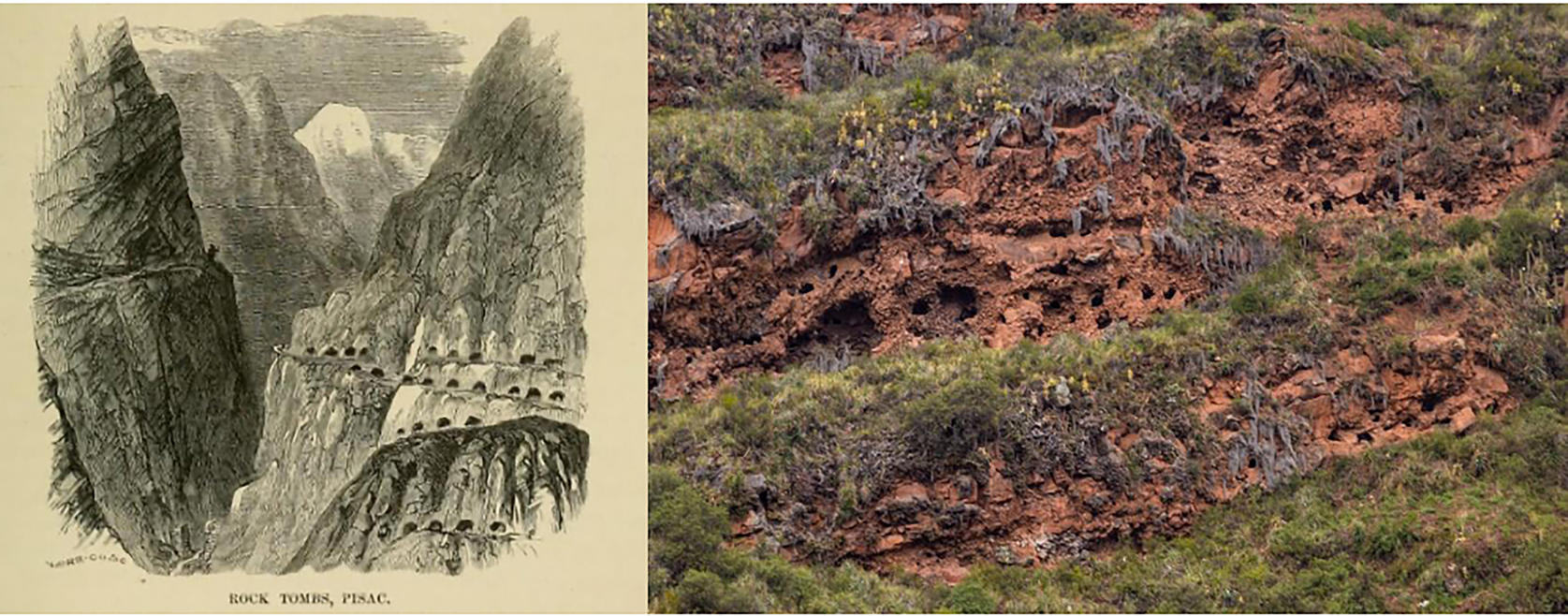
Squier (Reference Squier1877:531–532) did not attest to inspecting the tombs up close, nor did he claim that access was “without difficulty.” Instead, the opposite is true: almost all Pisaq's tombs are virtually inaccessible, and the tombs’ immediate environs are absent of infrastructure that would facilitate large-scale ceremonies to fête ancestors (Figure 2). Thus, Isbell overlooked the significant ways in which certain tombs diverged from his model's expectations.
(Left) Squier's (Reference Squier1877:532) idealized sketch of the cemetery at Pisaq depicts rows of regularly spaced tombs opening onto narrow ledges for access. (Right) A photo of the cemetery shows tombs clustered according to the topography, without defined paths. Note that the visible openings are not original to the structures but were created by looters through forced entry. (Color online)

Considering these observations, this article takes an alternative approach to central Andean mortuary architecture. I contend that variation in the materialities of tomb construction should be taken seriously as indicative of historically specific social practices and religious beliefs (Feinman and Neitzel Reference Feinman and Neitzel2020; Pauketat and Alt Reference Pauketat and Alt2005; Swenson Reference Swenson2015). Suspending the assumption that precontact societies uniformly resembled historically and ethnographically documented ayllus, this study makes space for detecting other modes of engagement between the living and the dead.
Informal Religion and Mortuary Practice
Globally and historically, mortuary practices have been conditioned by a wide array of factors including metaphysics, politics, ethics, aesthetics, and hygiene (Kristensen Reference Kristensen2014:37; Smith Reference Smith, Laneri, Palumbi, Celka, Valentini and Guarducci2019). Differences in the treatment of the dead are often instrumentalized to signal cultural and ethnic identity, class, and piety. The treatment of human remains is often governed by strict rules and biopolitics that may result in penalties for those who do not follow socially accepted guidelines (Stepputat Reference Stepputat2014:4). Cultural and religious systems are concerned with explicitly defining the correct treatment of human corpses and accompanying behavior and rituals in the context of death (Eeckhout and Owens Reference Eeckhout and Owens2015:1).
I define religion as a belief system concerned with the human condition and the numinous (Insoll Reference Insoll2004). Religious systems deal with explicating and ritualizing orthodox responses and interpretations of death (Eeckhout and Owens Reference Eeckhout and Owens2015). Following Smith (Reference Smith, Laneri, Palumbi, Celka, Valentini and Guarducci2019), I interpret the unique materialities of interment practices as evidence for beliefs regarding the nature of being, or metaphysics. While metaphysical principles do not determine mortuary practice, they do influence the viability of practices in each society (Smith Reference Smith, Laneri, Palumbi, Celka, Valentini and Guarducci2019:12). Therefore, my objective is not to precisely delineate or explain religious principles. Instead, I analyze how mourners designed tombs to structure interactions and relationships with the dead, as informed by distinct but intersecting sets of belief.
Religion is often understood as an institutionalized, doctrinal system characteristic of hegemonic societies. In the politically decentralized context of the LIP, we would not expect all communities to subscribe to a uniform religious doctrine. But neither can we say that these groups existed without any form of religion, considering that hegemonic religions must have some precedent. To bridge this gap, I draw on the concept of informal religions. According to Boyer (Reference Boyer2020), “wild” or informal religions have developed in nonhegemonic contexts prior to political centralization and continue to flourish at the margins of state-sponsored religious systems.
Informal religions focus on pragmatic goals and have neither a stable doctrine nor a fixed group of adherents (Boyer Reference Boyer2020). This situation of flexibility and goal-oriented practice, such as respecting and caring for the dead, helps model religious organization among nonstate groups. Informal religiosity also explains fluidity and diversity in mortuary practices, and the overlapping distribution of tomb types. This provides a framework for analyzing hegemonic and nonhegemonic religions as part of the same phenomenon. Such a holistic approach is appropriate for this study, which addresses a period of state formation but does not presuppose the subjugation of autochthonous peoples or the extinction of their traditions during this process.
Cuyaspa and Techniques of Care
Drawing on linguistic evidence helps reconstruct emic conceptualizations of mortuary practices. Colonial documents use a variety of terms to describe Andeans’ interactions with the dead, including venerar (venerate), adorar (worship), and mochar (from the Quechua verb much'ay, “to kiss or adore”). Much'ay is semantically related to begging, reverence, and gratitude (Gonçalez Holguín Reference Gonçález Holguín1608:243). Central Andean informants used these words to describe their own actions, as in the context of idolatry trials (Duviols Reference Duviols2003). Nevertheless, “worship” and “veneration” do not encompass the full scope of central Andean religions across time and space. Here, I consider other dimensions of mortuary practice; namely, socialization and care within a religious framework.
Arriaga's informants explain their actions as “cuyaspa” (Reference Arriaga and Urbano1999 [1621, Ch. VI]:67). Diego Gonçalez Holguín's (Reference Gonçález Holguín1608) colonial Quechua lexicon offers insight into the root word cuya and its uses. As Quechua is an agglutinating language, suffixes are added to root words to convey different meanings. The verb cuyay means “to love and [have] compassion” or “love that gives good” (Gonçalez Holguín Reference Gonçález Holguín1608:75). Arriaga's informants added the suffix -spa to form the present perfect participle, “loving and having compassion.” In modern Quechua dialects, the verb munay is typically used as the translation of the Spanish querer, “to want,” or “to love”; but in Gonçalez Holguín's lexicon, munay translates to “will, wanting, taste, appetite, or love” (Reference Gonçález Holguín1608:173). This way, cuyaspa appears to represent an autochthonous conceptualization of love as informed by ethical principles.
This article interprets interment styles as accommodating historically specific theories about mortality and the human condition. Considering that the perceived mistreatment of human remains elicits a strong emotional response, mourners seek to honor and care for the dead (Arriaga Reference Arriaga and Urbano1999 [1621, Ch. VI]:67; Polo de Ondegardo Reference Polo de Ondegardo2023 [1566, p. 251v]:147). Humans do not make arbitrary or casual decisions about the postmortem treatment of their loved ones. As such, I ground the following appraisal in recognizing mortuary practices as acts of care for individuals transitioning between life stages, which is reflected in the concept of cuyaspa (Allen Reference Allen, Shimada and Fitzsimmons2015; Buch Reference Buch2015).
Early chroniclers claimed that central Andeans generally believed in the immortality of the soul (Cieza de León Reference Cieza de León and Pease2005 [1553, Pt. I, Ch. LXIII]; Polo de Ondegardo Reference Polo de Ondegardo2023 [1566, p. 248v–249r]:140–141), such that the dead retained their identity, needs, and desires, and their relatives maintained social responsibility for them as caregivers. Group members made offerings both to deceased leaders and to their forebears, expressing indebtedness for allowing the living to be born into this world (Polo de Ondegardo Reference Polo de Ondegardo2023 [1566, p. 251r]:146). This attests to personal experiences of mourning and memory that play out on a more intimate scale between immediate family members or loved ones.
Notwithstanding these commonalities, Polo de Ondegardo explained that central Andeans held divergent beliefs regarding the proper treatment of the dead, which in turn gave rise to countless funerary customs (Reference Polo de Ondegardo2023 [1566, p. 252r]:148). For example, some families kept bundled mummies in their houses, whereas others interred their dead in their house and subsequently burned and abandoned it. Still others buried their dead under their house floor, leaving a small hole so libations could be intermittently funneled down. According to Polo, central Andeans feared that neglect or mistreatment of corpses would have catastrophic consequences, both for the deceased and those responsible for the deceased's care (Reference Polo de Ondegardo2023 [1566, p. 251v]:147). For this reason, central Andeans went to great lengths to ensure proper treatment of the dead according to their beliefs and traditions.
Regional Context
The Sacred Valley is a section of the Urubamba-Vilcanota River Valley located some 22 km north of the Cusco Basin. The topography consists of a narrow stretch of fertile alluvial land between steep slopes that rise about a vertical kilometer from the valley floor. This region experienced modest settlement prior to AD 1000, after which a settlement shift occurred and hilltop settlements were established or reoccupied (Covey Reference Covey2014; Kosiba Reference Kosiba2010). Colonial documents identify numerous ethnic groups as the inhabitants of this region, including the Kuyus, Wayllakans, and Pok'is, among others (Sarmiento de Gamboa Reference Sarmiento de Gamboa, Bauer and Smith2007 [1572]). Chronicles also mention villages such as Ankasmarka, Kaytumarka, and Kuyumarka (Pukara Pantilliklla), which are included in this study.
Though commonalities between architecture and pottery styles found at local villages indicate shared cultural values, differences are equally indicative of localized identities and communities of practice (Earle and Romero Villanueva Reference Earle and Villanueva2023). Positioning local villages on hilltops and slopes facilitated access to herding pastures and rainfed slopes for agriculture, ideal for a diversified agropastoral economy (Covey Reference Covey2014). Villagers exploited their ecologically heterogeneous environments by dry-farming tubers, pseudo-cereals, and legumes, while supplementing their diets with wild resources. Local public architecture involved the subtle modification of natural landforms to create open spaces for community events (Parsons et al. Reference Parsons, Hastings and Matos2000). Thus, there is minimal indication of endemic social stratification; instead, pronounced social boundaries and exclusion appear linked with Inka influence.
During the LIP, aggrandizers in the Cusco Basin amassed social power through intergroup competition and alliance building, gradually moving to occupy territory in the surrounding region (Bauer and Covey Reference Bauer and Covey2002). This dynamic political landscape materialized through changing construction and land-use practices on local and regional scales. The Inkas intensified land development in conjunction with the elaboration of a royal estate system in the Sacred Valley. By the time of the Spanish invasion, the estate system in the Sacred Valley had become foundational in supporting Inka sovereign ideology and political economy. Nevertheless, Inka presence remained patchy and largely restricted to the main river valley, while local groups variably responded with opportunism or resistance to Inka power strategies (Covey Reference Covey2014).
Materials and Methods
Field Methods
Building on coarse-grained chronological and settlement data produced by previous surveys (Covey Reference Covey2014), I conducted systematic site surveys in the Sacred Valley and adjacent tributary valleys. My project gathered quantitative, qualitative, spatial, and chronological data on architecture, infrastructure, and tombs at 51 late precontact sites. Relative and absolute chronological data produced by this project and previous research situate site occupations between the AD 800s and 1500s. Site types and cultural affiliations were determined based on evaluations of architecture and surface ceramic scatter. Contrary to previous assumptions based on chronicle narratives, archaeological and historical data do not indicate that the Inkas uniformly expulsed local inhabitants from their territories by AD 1400 (Espinoza Soriano Reference Espinoza Soriano1974; Villanueva Urteaga Reference Villanueva Urteaga1970 [1558]). Therefore, this study treats Inka and local landscapes as contemporaneous and overlapping.
My fieldwork registered 208 tombs by producing technical drawings and recording qualitative and metric data on standardized forms. For an additional 302 tombs that were inaccessible, such as those in sheer cliffs, the project team registered spatial and qualitative data remotely. As such, we directly registered 40.8% of the 510 tombs observed at 28 sites. The dataset analyzed herein also includes 277 additional tombs previously documented in the Sacred Valley (Camala Lizaraso and Jorge Huallpayunca Reference Camala Lizaraso and Huallpayunca2021; Carrillo Salazar and Quiñones Ñaupa Reference Carrillo Salazar and Ñaupa2016; Franco Chávez and Huanca Espinoza Reference Chávez, Williams and Espinoza2018; Inquiltupa Quispe and Flores Quispe Reference Inquiltupa Quispe and Quispe2022; Marocho Orue Reference Marocho Orue2019). The combined data comprise 788 tombs at 30 late precontact sites.
A Note on Tomb Preservation
This study develops a noninvasive approach for analyzing mortuary practice based on tomb structures rather than human remains and grave goods. This is also a practical adaptation to the state of preservation in the Sacred Valley. Here, tombs are more vulnerable to destruction than other classes of archaeological remains in part due to their diminutive size, discrete appearance, and remote locations. For centuries, “extirpators of idolatry” and looters have targeted tombs as conspicuous containers of human remains and grave goods. As a result, all readily visible tombs in this region have been disturbed and damaged, even the most inaccessible. Many are now nearly empty due to looting, containing only scant fragments of human bone. In other cases, human bone is abundant where it has been callously thrown out by looters in search of grave goods, while the rubble and wall foundations are all that is left of collapsed tomb structures. Additionally, hillsides near the valley floor have been increasingly subjected to dynamite and heavy machinery to build roads, indiscriminately destroying any structures embedded therein. It is more important than ever to document and study Sacred Valley tombs given these ongoing threats to their preservation.
Classification and Typology
Given the coexistence of different mortuary structures, builders chose specific designs despite their awareness of alternative practices. Therefore, this research treats variation in tomb characteristics as the result of technological choices (Sillar and Tite Reference Sillar and Tite2000). Tombs broadly share the same function as containers for the dead, yet serve the living for memorialization, identity signaling, conspicuous consumption, and claiming rights to land and resources. Variation in tomb morphology, aesthetics, and spatial position resulted from mourners’ selection of design features to fulfill certain functions during construction, interment, and subsequent engagement.
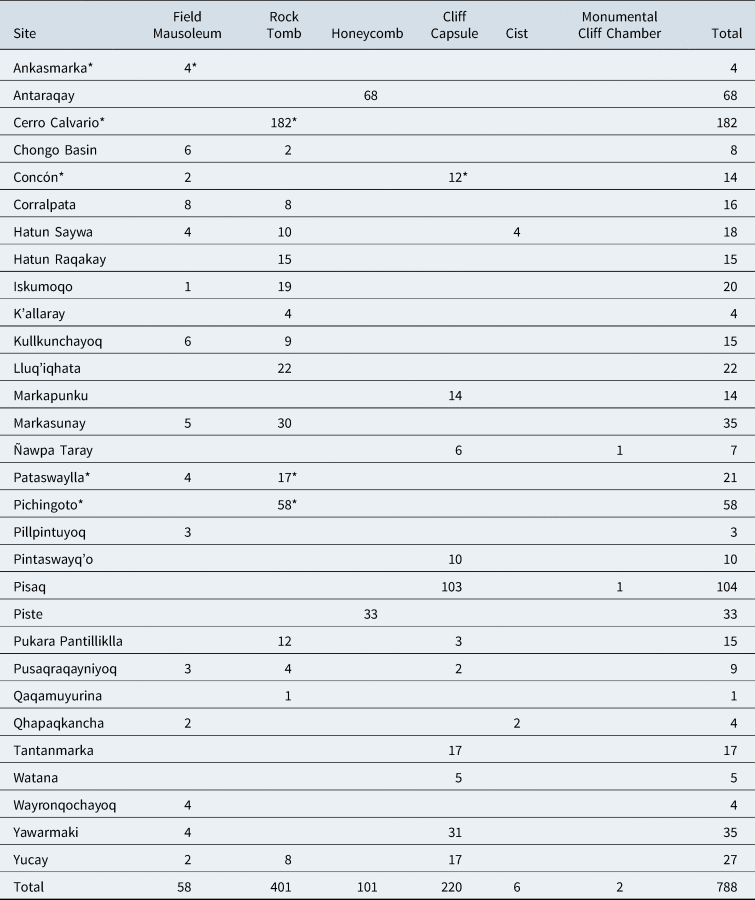
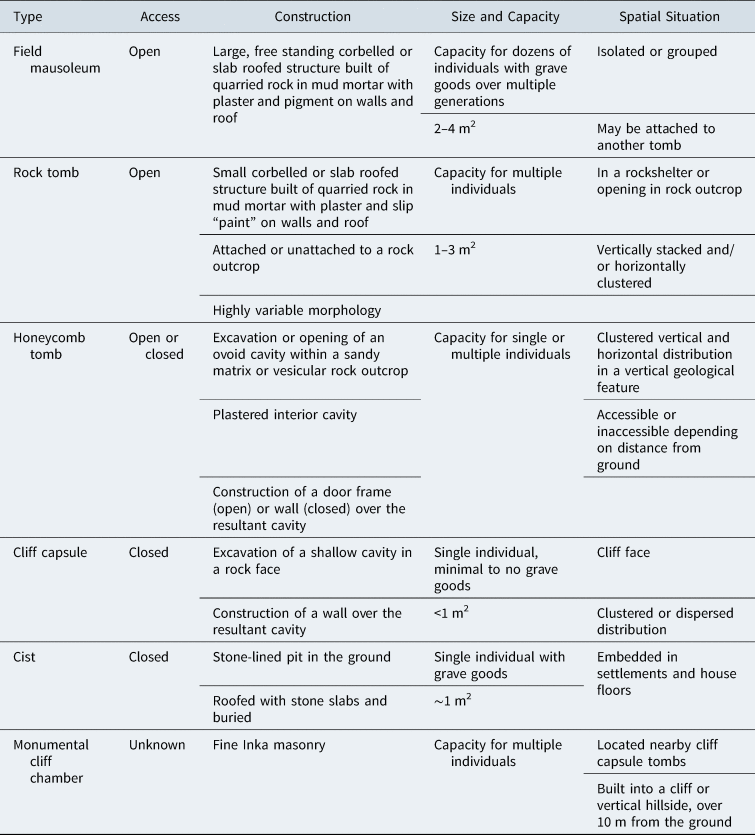
Classification is an analytical tool for identifying patterns in large data sets that reflect human behavior according to research objectives (Rouse Reference Rouse1960). With reference to how previous surveys in the Sacred Valley and contiguous regions classified tombs and developed typologies to analyze distribution patterns (Covey Reference Covey2006; Dean Reference Dean2005; Kosiba Reference Kosiba2010), I developed a new typology to analyze the present sample. Types are defined by how shared and discrete qualities intersect, while aesthetic and technological variations provide evidence of localized identities and communities of practice. Below, I present the resultant typology comprising six tomb types (Tables 1 and 2).Footnote 1
Count of Tombs per Type and Site Included in This Study.

Note: Where indicated with an asterisk (*), tombs were previously published by other studies (Camala Lizaraso and Jorge Huallpayunca Reference Camala Lizaraso and Huallpayunca2021; Carrillo Salazar and Quiñones Ñaupa Reference Carrillo Salazar and Ñaupa2016; Franco Chávez and Huanca Espinoza Reference Chávez, Williams and Espinoza2018; Inquiltupa Quispe and Flores Quispe Reference Inquiltupa Quispe and Quispe2022; Marocho Orue Reference Marocho Orue2019).
Diagnostic Physical Characteristics for Tomb Types.

To reconstruct religious beliefs and practices, I analyzed four dimensions of tomb materiality: (1) physical accessibility, (2) visibility, (3) energetic investment, and (4) temporality. Accessibility (1) attends to how tomb structures and their positions structured postinterment interactions between the living and the dead. Tomb location, size, and the presence or absence of a defined entryway condition the viability of physical interaction. Likewise, tomb location limited the number of individuals who could engage with a tomb space, and in some cases would have excluded certain individuals; for example, those with mobility impairments.
While some tombs eliminated physical engagement, they may have nonetheless prioritized visibility (2) including intervisibility between tombs and territories or landscape features that constituted the tombs’ visual context. This is the only variable considered here that indiscriminately engages individuals who may not be members of the deceased's social group. That is, tombs may visually signal identity, land claims, status, and power to members of other social groups (Bongers et al. Reference Bongers, Arkush and Harrower2012; Mantha Reference Mantha2009; Sharratt Reference Sharratt2017). Energetic investment (3) provides insight into the logistics and knowledge required for construction based on tomb location, scale, and elaboration. This variable is correlated with social power as it signals mourners’ access to labor, specialized knowledge, and material resources. Lastly, the temporality (4) of tomb construction and engagement refers to the frequency that new tombs were built and human remains were added to or removed from the structure. This variable is related to accessibility and interior area, which determine the viable quantity and physical state of interred remains.
Results
Field Mausoleums
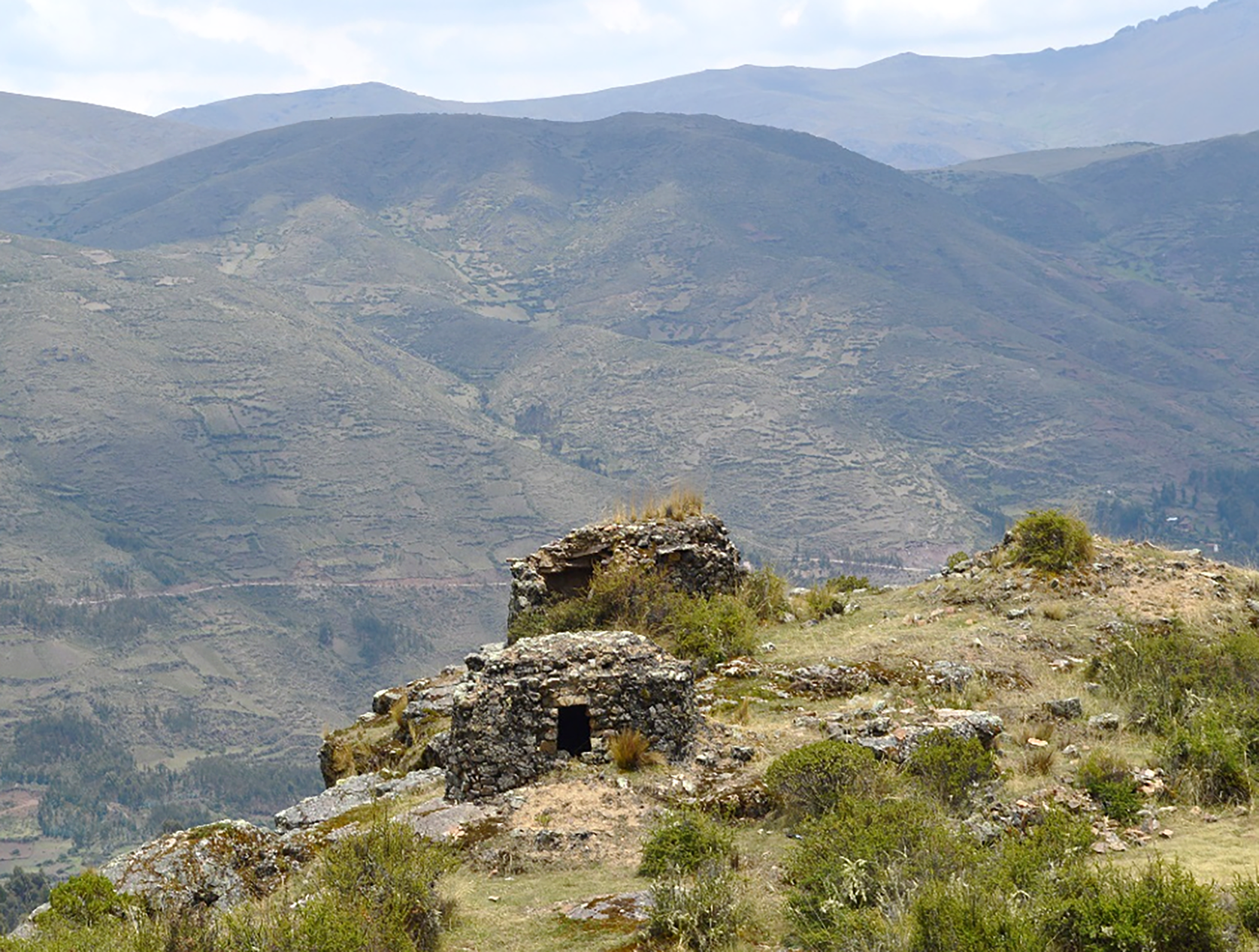
Field mausoleumsFootnote 2 are freestanding structures with capacity for multiple individuals. These tombs are typically positioned in rural agropastoral taskscapes and would have been seen and engaged as people carried out quotidian activities (Figure 3). Where field mausoleums are found in open, unobstructed areas, there were no mobility restrictions or inherent limits on visitation or activities that could be performed. These tombs’ morphology likewise facilitated physical contact between the living and the dead. This is evidenced by their defined entryways, which are large enough to allow a person to enter and interact directly with the deceased. Thus, their spatial and morphological features would accommodate religious activities that prioritized access to human remains, where the living and the dead interacted face-to-face, and tomb contents were routinely added or removed.
Two field mausoleums oriented toward the east and west overlook the Chongo Basin, former territory of the Kuyus. (Color online)

In the Sacred Valley, field mausoleums are short and squat, square or D-shaped in form. A distinctive variant near Urubamba has an elongated, rectangular form with straight walls, a corbelled roof, and an entrance on one of the short sides. With interior areas between 1 and 4 m2, field mausoleums are large enough to have contained the remains of kin members over multiple generations. As such, construction could have occurred infrequently. These tombs are sometimes conjoined, such that once a structure was filled, another was attached to expand the space. Apart from their corbelled or slab roofs of stone, which differ from the thatch roofs used for dwellings, these tombs were built using many of the same techniques, logistics, and materials as those used in the construction of local buildings. These are sturdy, durable structures that would not have required frequent maintenance, except for occasional replastering and painting.
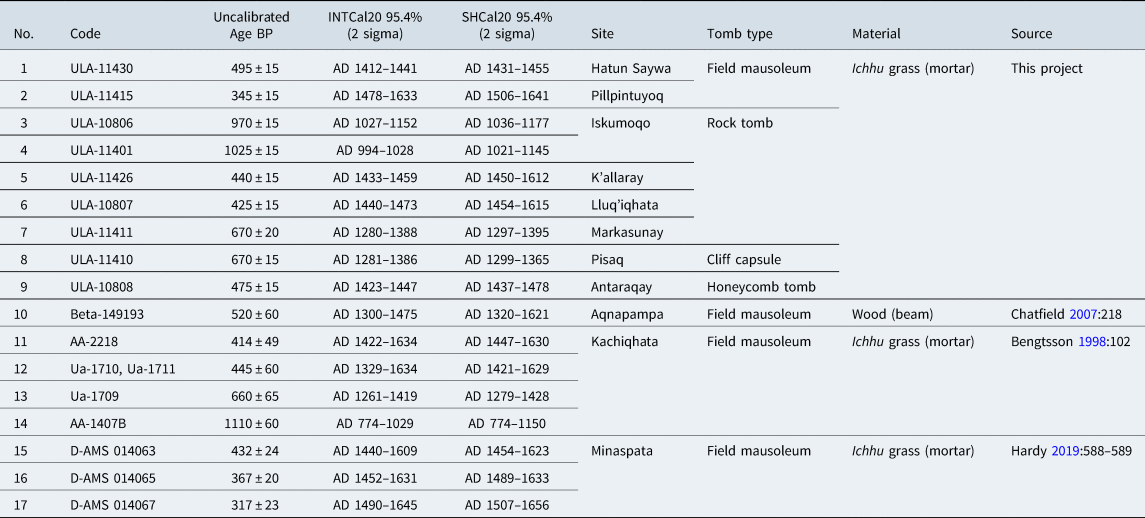
This project produced radiocarbon dates for two field mausoleums in the uplands north of Lamay that indicate they were built in the AD 1400s and 1500s (Table 3). This coincides with four dates for field mausoleums southeast of the Sacred Valley (Chatfield Reference Chatfield2007:218; Hardy Reference Hardy2019:588–589). Likewise, field mausoleums near Ollantaytambo (west of the Sacred Valley) produced early LIP and Inka period dates (Bengtsson Reference Bengtsson1998:102). Therefore, current data indicate that Cusco region inhabitants constructed field mausoleums throughout the late precontact period but that this tomb type may have become more widespread after 1400.
Radiocarbon Dates for Tomb Construction in the Cusco Region.

Note: Dates provided by this project have not been previously published elsewhere.
Rock Tombs
Rock tombs are small or large chambers embedded in outcrops, caves, or cliffs. Different from cliff capsules, rock tombs have well-defined walls and a roof. To build this type of structure, percussive force was first applied to chip away part of the rock outcrop using a hammerstone, creating a space large enough to accommodate a tomb. This procedure served both to procure material and to adapt the outcrop geometry to be conducive for the tomb installation. Rock tombs from the Yanahuara, Calca, and Lamay areas produced overlapping dates spanning the late AD 900s to the 1500s, demonstrating that Sacred Valley inhabitants built this tomb type throughout the late precontact period (Table 3; Burger et al. Reference Burger, Lucy Salazar, Washburn and Fehren-Schmitz2021).
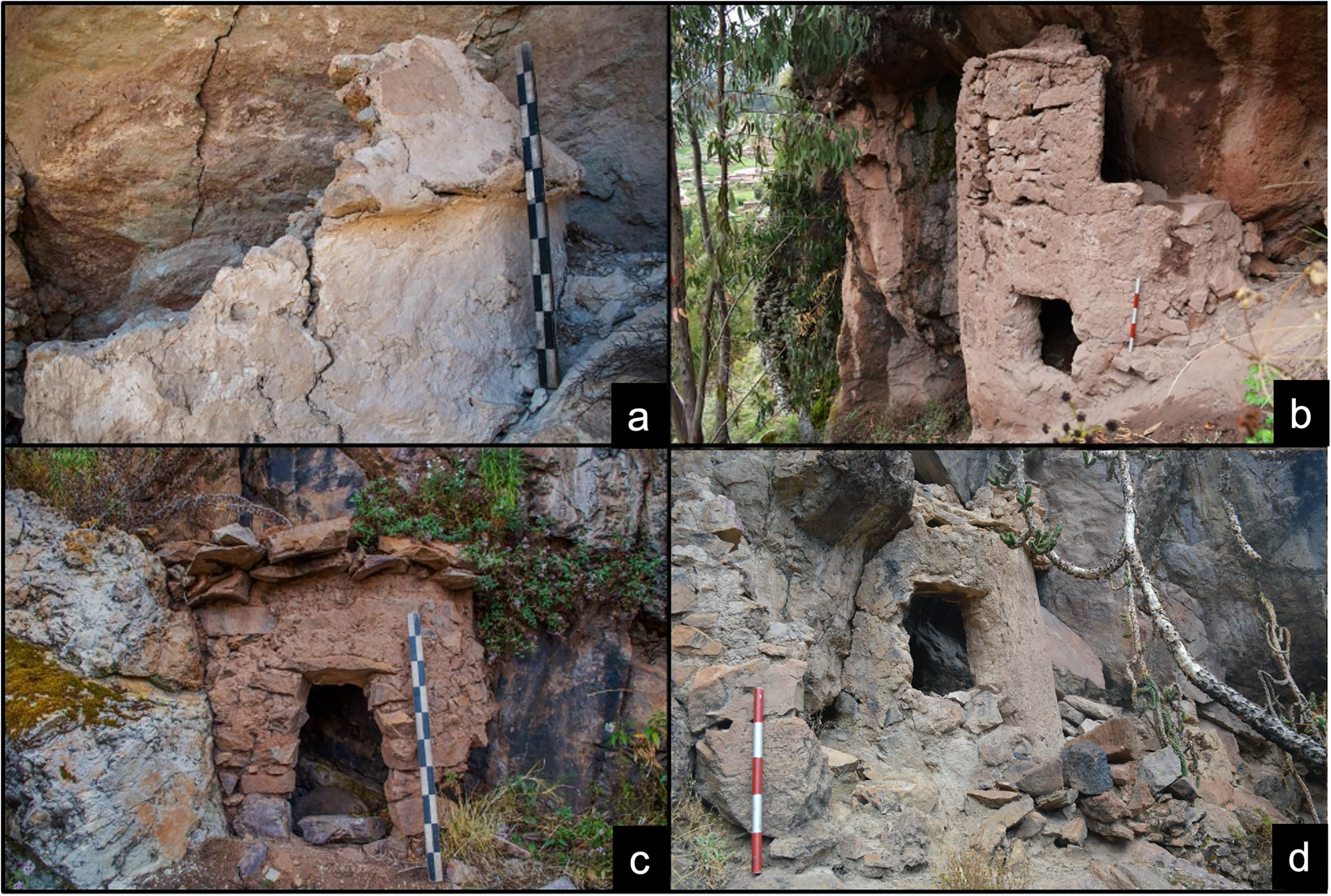
While some rock tombs resemble miniature field mausoleums, others are shaped like boxes or cylinders. Size is highly variable: some rock tombs are as large as field mausoleums, while others are much smaller. Rock tombs such as those at Cerro Calvario are decorated with white gypsum and red clay, replicating the geometric designs of garments like unkus (Camala Lizaraso and Jorge Huallpayunca Reference Camala Lizaraso and Huallpayunca2021:233). Rock tombs exhibit greater morphological and aesthetic variation than other tomb types (Figure 4). But for the purposes of this study, I chose not to separate rock tombs into subgroups (Covey Reference Covey2006; Kosiba Reference Kosiba2010). This is because the relationships and interactions indexed by these tombs are consistent, such that tombs vary as a function of locality rather than intended use. That is, rock tomb morphology derives from builders’ use of local construction techniques (i.e., situated learning) and efforts to aesthetically signal group membership (Kesseli and Pärssinen Reference Kesseli and Pärssien2005).
Morphological variation in rock tombs; (a) a “mushroom cap”–roofed tomb plastered with gypsum at Iskumoqo, scale 1 m; (b) a two-story, box-shaped tomb at Pukara Pantilliklla, scale 0.5 m; (c) a tomb at Markasunay with a trapezoidal doorway, scale 1 m; (d) a small, cylindrical tomb at Markasunay (scale 50 cm). (Color online)

Though most rock tombs have defined entryways, these structures are inherently less accessible than field mausoleums, as they prioritize proximity to a rocky feature over proximity to living relatives. In cases in which rock tombs are positioned in extremely remote locations, these structures were likely not intended to be accessed regularly or by all group members. These tombs also present considerable organizational variability. They may be isolated, sporadically distributed, stacked vertically, or clustered horizontally according to the outcrop geometry. At Cerro Calvario, eight tombs are stacked vertically in a narrow crevice (Camala Lizaraso and Jorge Huallpayunca Reference Camala Lizaraso and Huallpayunca2021:223). At Lluq'iqhata, tombs were built over and in front of previous ones, reaching depths of up to five tombs, and effectively blocking access to older structures as newer ones were built. Tomb agglutination makes use of restricted spaces in rock outcrops so that group members may be interred close together, even while sacrificing accessibility over time.
Sacred Valley inhabitants were acutely aware of opportunities and risks inherent to their surroundings. While most rock tombs are accessible, they were often placed in high-altitude locations on steep hillsides where access is difficult and falling rocks may pose a safety hazard. Such locations require acute coordination and awareness of surroundings. Even in more accessible cases, there are no open spaces where festivities could be carried out. Limited numbers of visitors could access these spaces at a given time, eliminating the possibility of large-scale gatherings and ceremonies. Though rock tombs are usually found in local taskscapes, their relatively remote locations make it likely that they were visited more intermittently. As such, rock tombs implicate a more intimate or private mortuary practice than field mausoleums.
Cliff Capsules
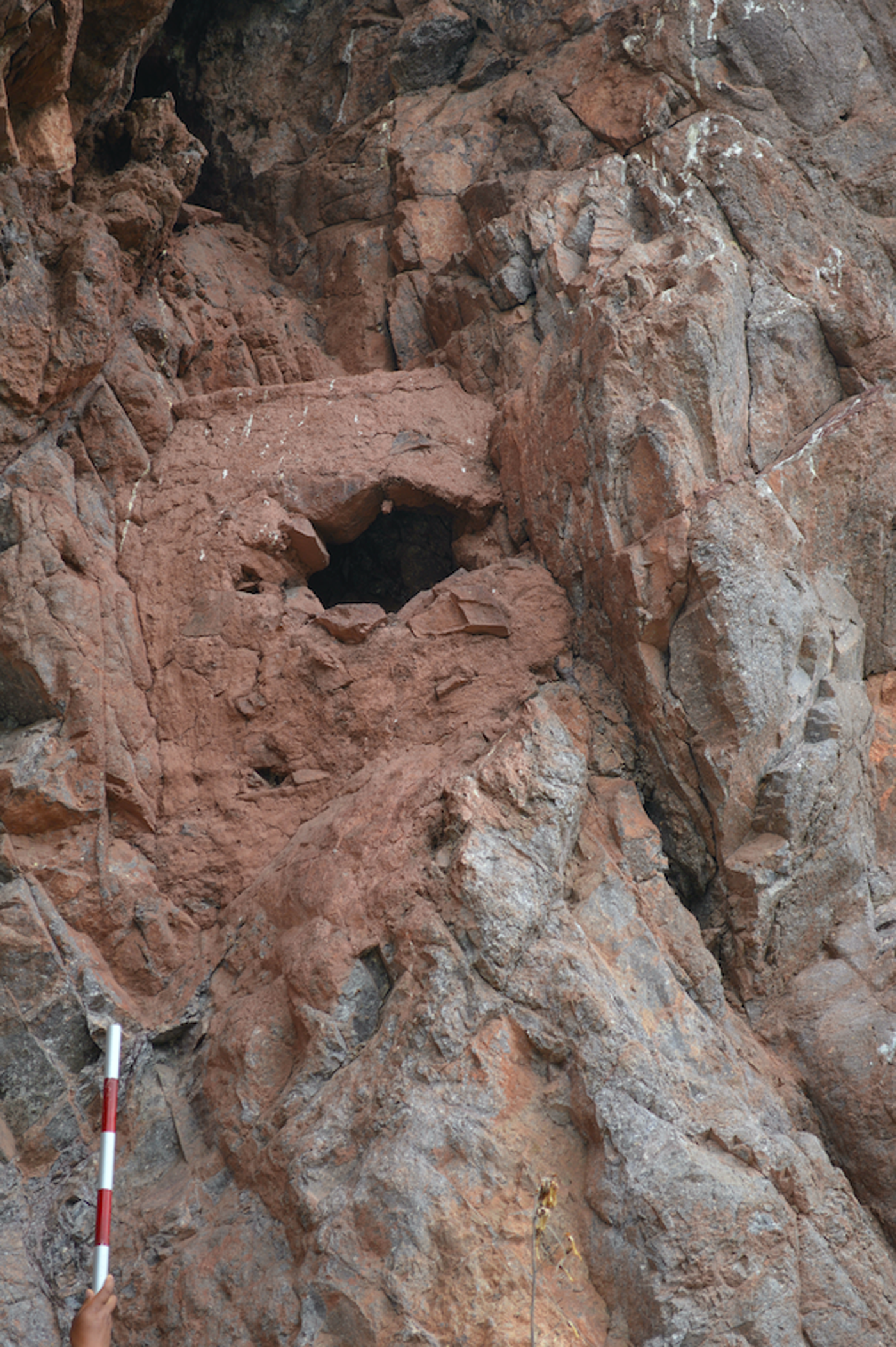
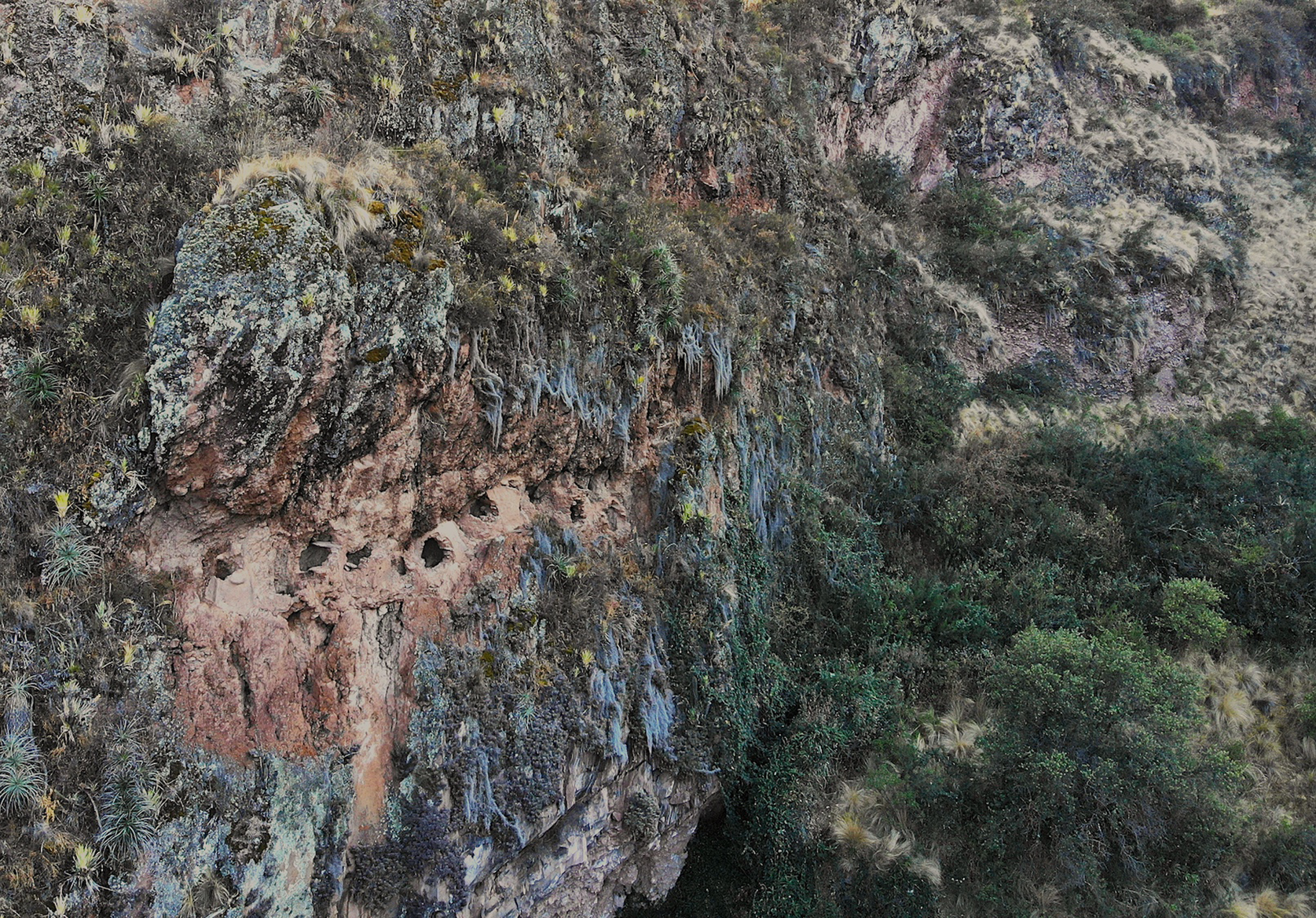
A cliff capsuleFootnote 3 is a closed, dome- or box-shaped cell built into a natural or artificial opening in a vertical rock face or hillside (Figure 5). These structures would have been “single occupant” given their small size and are typically positioned in inaccessible locations. Cliff capsules are built of thin, plastered walls of small stone fragments set in clay mortar; they can be as small as 80 × 30 cm, indicating the interred body was tightly bound, accompanied by few grave goods (Paredes Reference Paredes2003). These structures are found at the Inka estate of Pisaq in large numbers. Elsewhere, they tend to occur in proximity to Inka infrastructure near the main valley floor (Figure 6). A radiocarbon date from a cliff capsule at Pisaq indicates it was built in the late AD 1200s or early 1300s (Table 3). This early date does not preclude Inka affiliation because of the possibility of Inka territorial expansion before 1400 (Arkush et al. Reference Arkush, McCool and Smith2024; Covey Reference Covey2018).
A cliff capsule on the southern slopes of Pisaq, showing how this structure originally lacked a defined entryway (scale 50 cm). (Color online)

Aerial view of at least six cliff capsule tombs at Pisaq. (Color online)

Excavations at Muyuqmarka (Saqsaywaman) revealed similar “capsule” interments, which bear striking resemblance to cliff capsules transposed to a horizontal plane (Paredes Reference Paredes2003). The Muyuqmarka capsules are small structures with 20 cm-thick walls of clay, occasionally inlaid with decorative clays and stones. Each capsule contained a single individual alongside grave goods including Inka pottery. Varying in size according to the individual's height, these structures’ egg shape follows the interred corpse's flexed position as it progressively tapers toward the top (Paredes Reference Paredes2003:91). These capsules were sealed but remained unburied, seated on the ground inside a rectangular enclosure (Paredes Reference Paredes2003:94).
Archaeologists have not documented this capsule-style interment outside the Cusco region (Flammang Reference Flammang2021:265). Though Paredes believed these were not high-status individuals given the paucity of grave goods (Reference Paredes2003:109), neither can they be considered commoners, given their burial location in one of the Inkas’ most important ceremonial sites. The excavation of the Muyuqmarka capsules substantiates the interpretation of cliff capsules as each containing the primary burial of a single flexed individual alongside a small collection of grave goods. This interpretation is further supported by early accounts of looted cliff tombs near Pisaq having contained flexed bodies (Angles Vargas Reference Angles Vargas1970).
Given cliff capsules’ inaccessibility, there was apparently no intention to access the body after interment. Unlike field mausoleums and rock tombs, this tomb type's simplicity allows for minimal morphological variation. Despite their modest appearance, cliff capsules attest to a distinct kind of monumentality that was expressed in the event of construction and interment in a vertical plane. The perilous activities implicated by these tombs would have qualified as spectacles, such that the cliff capsules derived their monumentality as the indices of such a death-defying performance, rather than from the elaboration or scale of the structure (Inomata and Coben Reference Inomata and Coben2006:17; Trigger Reference Trigger1990).
Their location in vertical rock faces posed formidable logistical and technical challenges at every stage of the interment process. The construction sequence involved quarrying rock from the same outcrop to simultaneously accommodate the space and procure construction material. After a space had been opened in the outcrop or hillside, the flexed and bound corpse had to be hauled either on one's back or lowered from above with a rope. To assemble the structure, builders had to move heavy loads of wet clay mixed with grass for mortar and plaster. These activities were conducted at high elevations with minimal space for maneuvering and no room for error (Angles Vargas Reference Angles Vargas1970:109). Because these structures are “single use,” this process was repeated for each interment, demanding much higher energetic expenditure over the long term than mausoleum-type tombs.
Honeycomb Tombs
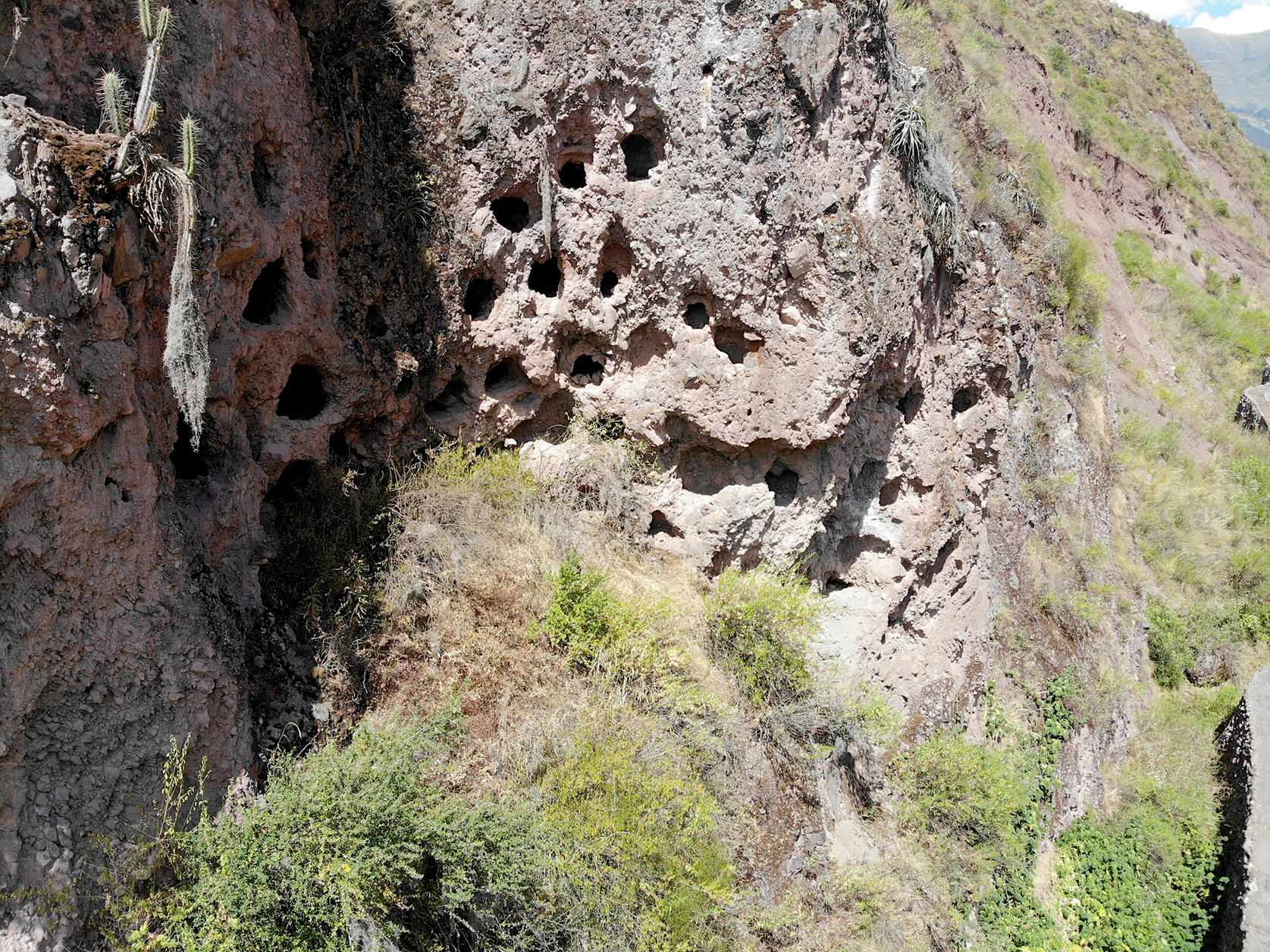
The term “honeycomb” describes these tombs’ appearance as a dense cluster of perforations in a sandy matrix or rock outcrop (Figure 7). Another variant involves opening vesicular rock outcrops, where natural openings in the rock were expanded to be used as tombs. While these tombs occur at two sites in the Calca area, a honeycomb tomb complex also exists in the Lucre Basin, indicating sporadic distribution throughout the Cusco region. With interior areas varying from 0.5 to 2 m2, these tombs could have held single or multiple individuals. A honeycomb tomb at Antaraqay was built in the 1400s, contemporaneous with Inka occupation (Table 3). These tombs are built in semiarid local territories away from the Inkas’ fertile maize-producing lands, which indicates they may be a non-Inka tomb type.
Aerial view of a honeycomb tomb complex at Piste containing at least 33 tombs. Note that the distribution of tombs follows the shape of the deposit in which they are embedded. (Color online)

The construction of this tomb type involved the excavation of an ovoid cavity in the matrix and the subsequent coating of the interior with clay plaster for stabilization. Different from field mausoleums and rock tombs, a honeycomb tomb’s structure is created through the process of material subtraction, which results in a vertically oriented cist. The builders “opened” or sought to imitate naturally occurring vesicles in these sandy deposits. At the opening, builders added either a doorway or a wall to seal the contents inside. However, the existence of a doorway does not necessarily mean the tomb contents were regularly accessed. These tombs were often vertically clustered, where access could only be achieved by rappelling or using a ladder or scaffold. Given the fragility of these tombs and their geological context, access would be necessarily restricted to avoid possible damage. Like cliff capsules, this type prioritizes the merging of human and geological bodies over the accessibility of the remains.
Monumental Cliff Chambers
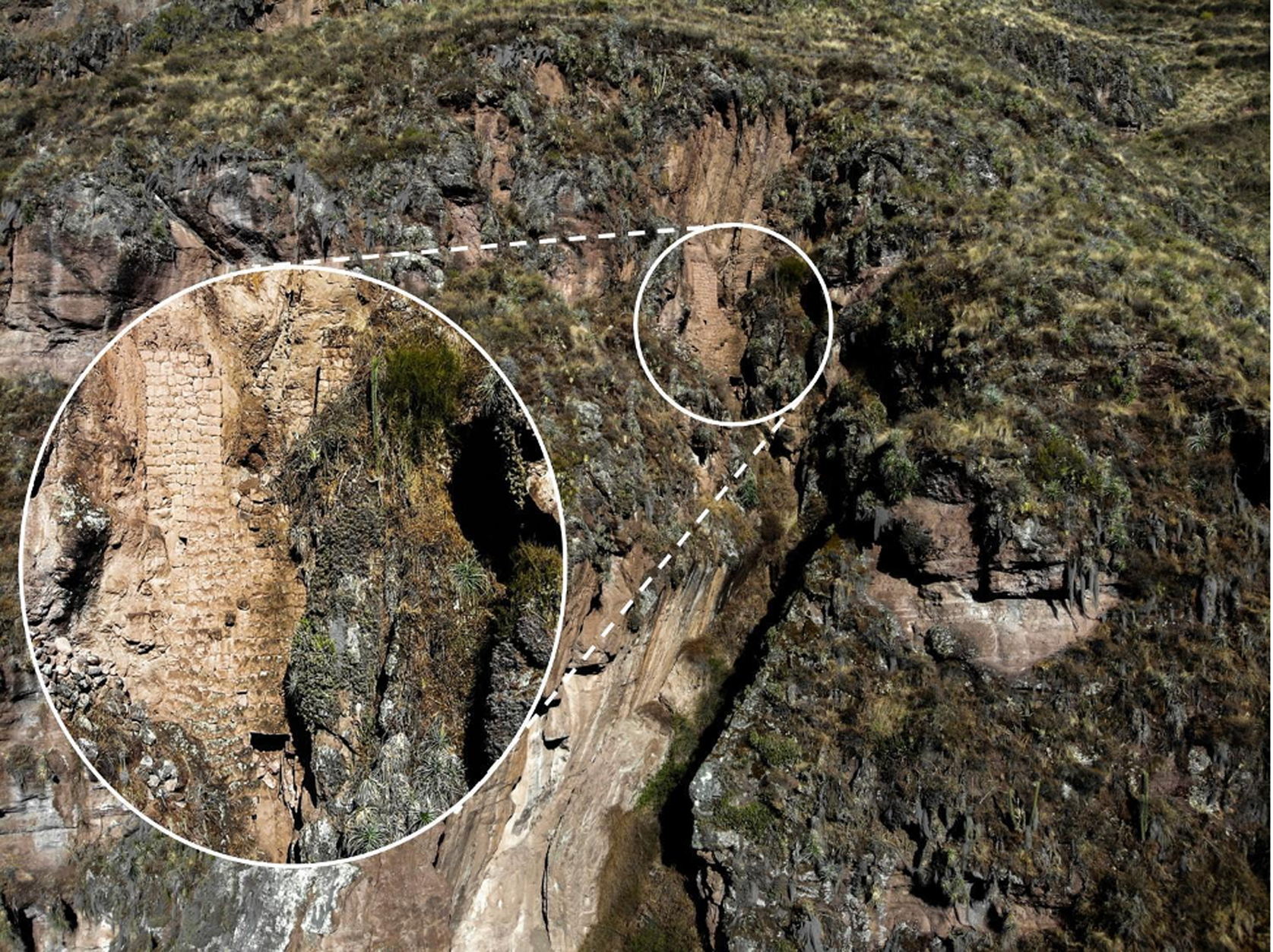
A monumental cliff chamber is a large structure, appearing as a wall of fine polygonal masonry attached to a sheer cliff or vertical hillside (Figure 8). So far, two examples are known: at least one is in the Pisaq cemetery (Angles Vargas Reference Angles Vargas1970), and another is near Ñawpa Taray along the road between the towns of Cc'orao and Pisac. The structure at Pisaq is built on a retaining wall of the same masonry style and below a cluster of small capsule tombs in the steep hillside. Meanwhile, the Ñawpa Taray structure is positioned where the quebrada opens out into the main valley. There are steps ascending this structure on the outer wall, and it features two openings of ambiguous function. Drone photos revealed that the wall is built about 1 m from the cliff face, leaving an opening for bodies and grave goods to be inserted.Footnote 4
Drone photos of the monumental cliff tomb near Huancalle, visible from the highway descending toward Pisac. Note the steps ascending the exterior of the tomb. (Color online)

These structures demonstrate conspicuous consumption in their extraordinary technical and material investment. The logistics of building a fine polygonal wall into a vertical plane over a quebrada are baffling given the life-threatening nature of such an operation. The distinctive aesthetic signal and high technical cost of construction unambiguously indicate that whoever was interred in such a structure was not a commoner. Instead, they were likely affiliated with Inka nobility based on their fine masonry and presence at and near the royal estate of Pisaq. While monumental cliff chambers may have remained open, their forbidding locations necessarily complicated access. This shows that Inka elites were not always interred in readily accessible structures that would allow them to maintain their existing social roles (Bauer and Coello Rodríguez Reference Bauer and Rodríguez2007). Instead, monumental cliff chambers reveal that interment in inaccessible cliff-face structures was desirable enough to warrant considerable material investment and risk to worker safety.
Cists
Cists are round, stone-lined pits measuring roughly 1 × 1 m; they are typically found inside buildings. Unlike more visible aboveground tombs, cists appear to have been a private, exclusive burial type. Because all cists registered by this project had been looted, excavation data help reconstruct interment practices. At Inka sites in the Cusco Basin, archaeologists have excavated burials of one to two incomplete individuals from pits in building floors or walls (Benavides Villena and Vizcarra Molina Reference Villena, Elena and Molina2010; Huacac Quispe Reference Huacac Quispe2022). These burials appear to be secondary, implying that a family would keep the bodies of the dead and inter them later. The remains of individuals interred in cists often present lesions from physical labor, which would suggest nonelite status. Their grave goods tend to be quotidian objects used during a person's lifetime (Flammang Reference Flammang2021).
West of the Sacred Valley at Wat'a, mourners burned offerings on the ground atop a burial associated with an Inka building (Kosiba Reference Kosiba2010:285). At Yunkaray near Maras, excavators uncovered a shaft burial where the interred individual had been removed after deposition and later reinterred; they recorded a burnt offering on top (Quave et al. Reference Quave, Covey and Cáceres2018). At Pukara Pantilliklla, Covey registered four burials—an infant, juvenile, and two adults—in public and domestic structures (Covey Reference Covey2006:160). Other contemporaneous local settlements were found to be absent of human burials, as at Machuqollqa (Guardapuclla Aragón Reference Guardapuclla Aragón2023), suggesting that residents interred their dead elsewhere.
Based on this evidence, cist burials implicate religious practices involving intermittent engagement with the dead (Velasco Reference Velasco2023). Human remains may have been kept in the household for a period prior to interment, constituting an intimate mortuary practice that was inconspicuous and largely limited to domestic spaces (Polo de Ondegardo Reference Polo de Ondegardo2023 [1566]). This privacy differentiates cists from more “public” aboveground structures in rural landscapes, which were visible to a much wider audience.
Discussion
Compared with earlier periods, Cusco's late precontact period is unique for its wide variety of contemporaneous interment styles. Pit burials were practiced at least since the Formative period (Davis Reference Davis2011; Hardy Reference Hardy2019), while the Middle Horizon saw the beginnings of interments in modified rock outcrops (Bélisle Reference Bélisle2011:195). By the LIP, these older traditions evolved as new practices were innovated and introduced. Such diverse interment practices do not neatly correspond to chronological, ethnic, or political divides (Figure 9). Instead, this overlapping distribution pattern may have resulted from the cohabitation of groups with divergent religious beliefs and practices in the same villages and regions (Stanish Reference Stanish and Reycraft2005). The resultant impression of a “cosmopolitan” landscape is fitting, given the cultural, political, and demographic dynamism of this period. Factors affecting this volatility include regional repopulation and ethnogenesis, Inka state formation, and the contestation of placemaking practices that sought to lay claim to lands (Bauer and Covey Reference Bauer and Covey2002; Covey Reference Covey2014).
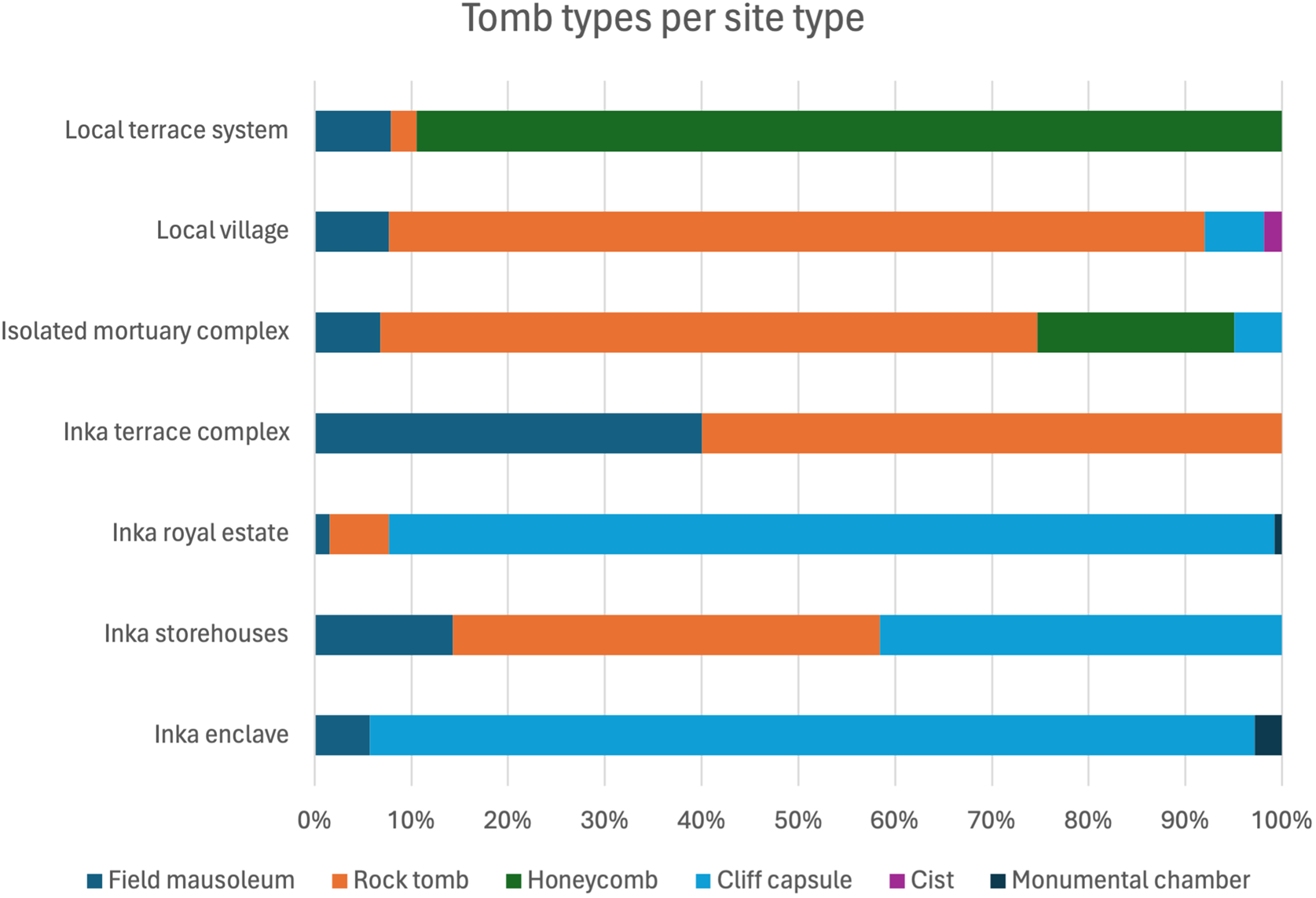
Local villages and taskscapes present the greatest diversity with six tomb types, but rock tombs are clearly predominant. Conversely, Inka sites lack some of the types present in local contexts such as honeycomb, where cliff capsules are most common. (Color online)

Tombs are often clustered in and around areas frequented by the living; as such, they appear to have been involved in local placemaking strategies and territorial claims (Bongers et al. Reference Bongers, Arkush and Harrower2012; Kosiba Reference Kosiba2010; Mantha Reference Mantha2009). Beyond village settings, tombs are usually oriented with their doors facing the direction of a settlement to facilitate intervisibility. Aboveground tombs were attached or positioned in proximity to perimeter walls at local villages near Lamay and Yanahuara. At the site of San Isidro (Yanahuara), human remains were found eroding out of a perimeter wall where they had been inserted as wall fill during construction (Franco Chávez and Huanca Espinoza Reference Chávez, Williams and Espinoza2018:50). In these cases, the dead could have served to mark boundaries (hitos) and actively participate in the delineation and protection of community and territory.
Aboveground tombs have been interpreted as facilitating social and religious practices where the living and the dead routinely interact face-to-face (Isbell Reference Isbell1997:137; Lau Reference Lau, Shimada and Fitzsimmons2015; Mantha Reference Mantha2022). In this scenario, an open entryway providing easy access to the remains would be indispensable for these tombs to function as needed. In the case of cliff capsules, sustained physical contact between the living and the dead clearly was not prioritized and perhaps even avoided (Sharratt Reference Sharratt2017). Inaccessible, single-occupant tombs seem to contradict a system of ethics or metaphysics wherein community between the living and the dead depended on regular physical interaction and proximity between parties (Figure 10). These dramatic differences would have supported different belief systems regarding personhood and the nature of life and death.
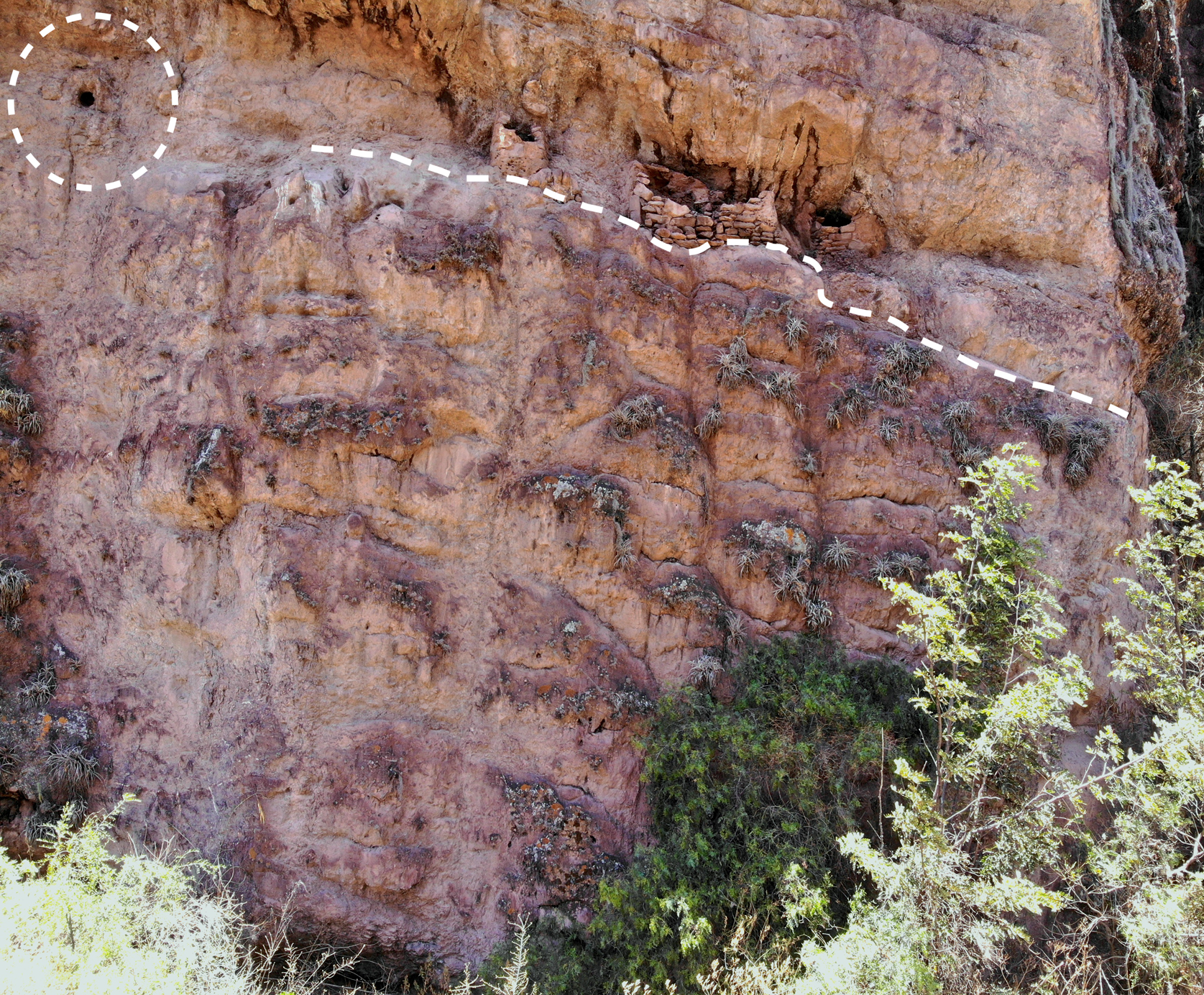
Five cliff capsule tombs near Pintaswayq'o, along the valley floor between Lamay and Calca. A very narrow ledge is indicated by the dotted line, where four tombs are located. An additional tomb (circled) is built directly into the rock face and would be practically invisible if not punctured by looters. This exemplifies how cliff capsule construction implicated significant logistical challenges, making them the most inaccessible tomb type in this sample. (Color online)

Cliff capsules implicate a distinct temporality and energetics of construction: Single-use burials required a new construction event for each death, whereas collective burials involved a single construction event for multiple interments. Tombs in inaccessible locations would have prevented people with mobility impairments from interacting with the dead. Such accessibility restrictions did not apply to other tomb types like field mausoleums, nor did the construction of field mausoleums require highly specialized skill sets or logistical considerations. It is likely that the accute dangers involved in cliff capsule construction imbued these otherwise innocuous structures with potent significance.
Cliffside burials may have been reserved for members of Inka nobility who did not qualify for veneration as illas (Bauer and Coello Rodríguez Reference Bauer and Rodríguez2007). According to historical accounts, the Inkas and some contemporaneous groups understood that rock and flesh were prone to mutual transubstantiation, and that mummified bodies were subject to gradual lithification (Allen Reference Allen, Shimada and Fitzsimmons2015; Dean Reference Dean2010; Nielsen Reference Nielsen, Hayashida, Troncoso and Salazar2022:238). Cliff capsules and monumental chambers may reflect an effort to expedite this process and amalgamate human bodies with rock, especially in locales with particularly evocative geological features. This way, cliff-face tombs could have been designed in part to support Inka imperial ideology and territorial expansion strategies by embedding sovereign claims into local landscapes (DeMarrais et al. Reference DeMarrais, Castillo and Earle1996).
Conclusions
The treatment of the dead entails profound decisions and consequences, in accordance with historically specific ethical and metaphysical frameworks. Arriaga's informants considered one way of laying the dead to rest as appropriate and moral, categorically rejecting other interment styles akin to Catholic burials (Reference Arriaga and Urbano1999 [1621, Ch. VI]:67). Patterned differences in tomb construction and distribution demonstrate the coexistence of divergent belief and value systems that conditioned mourners’ decisions on how to respect and care for the dead. Physical contact between the living and the dead ranged from facilitating accessibility and gatherings in highly visible spaces to more restricted access and intimate engagements in private or domestic contexts. Given the pronounced differences between tomb types, we cannot assume that all late precontact peoples—even those living in the same communities—invariably shared the same beliefs and values. How can we understand the coexistence of such radically different mortuary practices in the late precontact Sacred Valley?
Polo de Ondegardo (Reference Polo de Ondegardo2023 [1566]) recorded three interrelated details that help answer this question: (1) Andeans developed distinct beliefs regarding death, (2) these beliefs shaped their diverse mortuary practices, and (3) Andeans went to great lengths to inter their dead according to their beliefs. He stated that “the veneration and honor of corpses, where they are placed, and the ceremonies that are performed vary depending on their opinions . . . according to whatever they learned about what happens after death” (Polo de Ondegardo Reference Polo de Ondegardo2023 [1566, p. 251v]:147; my translation). This way, central Andeans developed diverse and complex systems of thought through philosophical and experiential knowledge production, which were discrete but likely shared epistemological and ontological foundations.
With reference to the ethical principle of cuyaspa, this diachronic, multiscalar study demonstrates at least six ways in which the Sacred Valley's late precontact inhabitants actively structured their interactions and relationships with death. I evaluated variation in tomb morphology as the result of technological choices that variably facilitated or restricted distinct functions. In the context of the Inka heartland, this study tracks the concurrent development of local and Inka mortuary landscapes. These insights will be crucial as we reevaluate models of Inka state formation to better account for local political agency.
Acknowledgments
I am grateful to Brian Bauer, R. Alan Covey, Enrique Rodríguez-Alegría, Rachel Schloss, and three anonymous reviewers for comments on earlier drafts that helped improve this article. Permission to conduct this research was granted by the Peruvian Ministry of Culture (RDN 001103-2019-DDC-CUS/MC, 000183-2022-DDC-CUS/MC). Except where otherwise noted, all illustrations are by the author.
Funding Statement
This research was generously funded by the National Science Foundation (2212652, 2022), the Rust Family Foundation (RFF-2022-175, 2022), the American Philosophical Society (2019), the Social Sciences and Humanities Research Council of Canada (752-2018-0029, 2018), and the University of Texas at Austin.
Data Availability Statement
All data used in this article are available on request.
Competing Interests
The author declares none.

 Open access

