

Introduction
In recent years, Basic Income (BI) experiments have proliferated globally, driven by growing interest in tackling poverty, inequality, economic insecurity, and labour market disruptions (Gentilini et al., Reference Gentilini, Grosh, Rigolini and Yemtsov2020). These trials have sparked substantial academic and public debate, with most literature focused on their economic, behavioural, and social outcomes. However, limited attention has been given to the governance, policy design, and socio-political contexts shaping these experiments. Key questions about how trials are designed, implemented, and interpreted, and their influence on social security reform, remain underexplored.
BI experiments involve multiple actors and institutional layers, making their implementation and policy interpretation highly dependent on governance structures and political context. This study builds directly on the research agenda proposed by Chrisp and De Wispelaere (Reference Chrisp and De Wispelaere2022) by taking up the very questions they identified as neglected, concerning policy impact, actor strategies, and reform potential, but advances the debate through original empirical investigation. Departing from their primarily conceptual approach, this study integrates literature reviews, systematic document analysis and semi-structured interviews to produce a grounded, comparative account of the on-the-ground implementation and interpretation of BI experiments.
Existing research has largely prioritised experimental outcomes over the broader policy processes surrounding implementation and reform (Chrisp and De Wispelaere Reference Chrisp and De Wispelaere2022).
This paper aims to contribute to the literature on social policy by offering a comparative analysis of four Basic Income (BI) experiments (Finland, the Netherlands, Spain, and Uganda) conducted during the same period (2017–2019). While prior research has focused on the effects of UBI on employment or poverty, this study shifts the focus to the governance, design, and implementation of BI experiments, dimensions that are often under studied but crucial for understanding real-world policy development.
First, the study offers a comparative framework showing how institutional settings, political actors, and administrative capacities shape BI experimentation. Grounded in policy diffusion and implementation theory, it shows how BI designs remain conditioned by local socio-political contexts. Second, it clarifies BI’s conceptual boundaries by examining how experiments diverge from ideals of universality and unconditionality.
These findings inform ongoing debates about the feasibility and adaptability of BI within existing welfare systems.
Our review suggests that the Dutch and Finnish experiments had limited influence on subsequent social policy design. In contrast, the trajectories in Uganda and, possibly, Catalonia show greater potential to advance policy measures resembling basic income.
Third, the paper offers practical lessons for future social policy experiments on stakeholder alignment, duration, funding, and political framing, showing what works across contexts. Finally, by including Uganda, the study challenges the dominance of Global North perspectives and broadens comparative UBI analysis to under-institutionalised settings.
The paper is structured into five sections. It begins with an overview of the selected BI experiments. That part is based on previous studies. The next section introduces the theoretical framework based on policy implementation, diffusion, and social experimentation. The methodology section outlines the qualitative comparative approach. This is followed by the comparative analysis, structured around three dimensions: initiation and governance, design and methodology, and interpretation of results. This section synthesises existing research with evidence gathered through our thematic interviews.
The final section presents conclusions, including main findings, policy implications, and limitations.
Basic features of the selected BI experiments
BI experiments are important because they provide empirical evidence that can challenge common assumptions about work incentives and reveal broader effects on health and well-being. They also function as policy laboratories, testing implementation strategies across different contexts (Standing, Reference Standing2021). However, their findings remain limited in external validity and are often subject to political and media framing (Widerquist, Reference Widerquist2018; Mäkkylä, Reference Mäkkylä, Kangas, Jauhiainen, Simanainen and Ylikanno2021).
The case selection strategy aims to capture heterogeneity across governance levels and institutional arrangements in social policy systems. The four selected countries conducted BI experiments at national, sub-national, and community levels within the same 2-year period. They also represent distinct welfare models shaping BI implementation: Finland follows the Nordic model, characterised by comprehensive legislated benefits and a strong safety net; the Netherlands aligns with the Central European model, emphasising contributory income transfers; Spain represents the Southern European model, often described as a “clientelist social policy” (Manow, Reference Manow, Béland, Leibfried, Morgan, Obinger and Pierson2021); and Uganda represents a developing economy with still-emerging social policy systems, often based on employer liability schemes (SSPTW, 2019: pp. 266–268). Likewise, the four BI experiments differ in design and approach (Table 1). This reflects a ‘most different’ comparative strategy aimed at identifying differences and possible commonalities (Przeworski and Teune, Reference Przeworski and Teune1970).
BI experiments in Finland, Netherlands, Spain, and Uganda
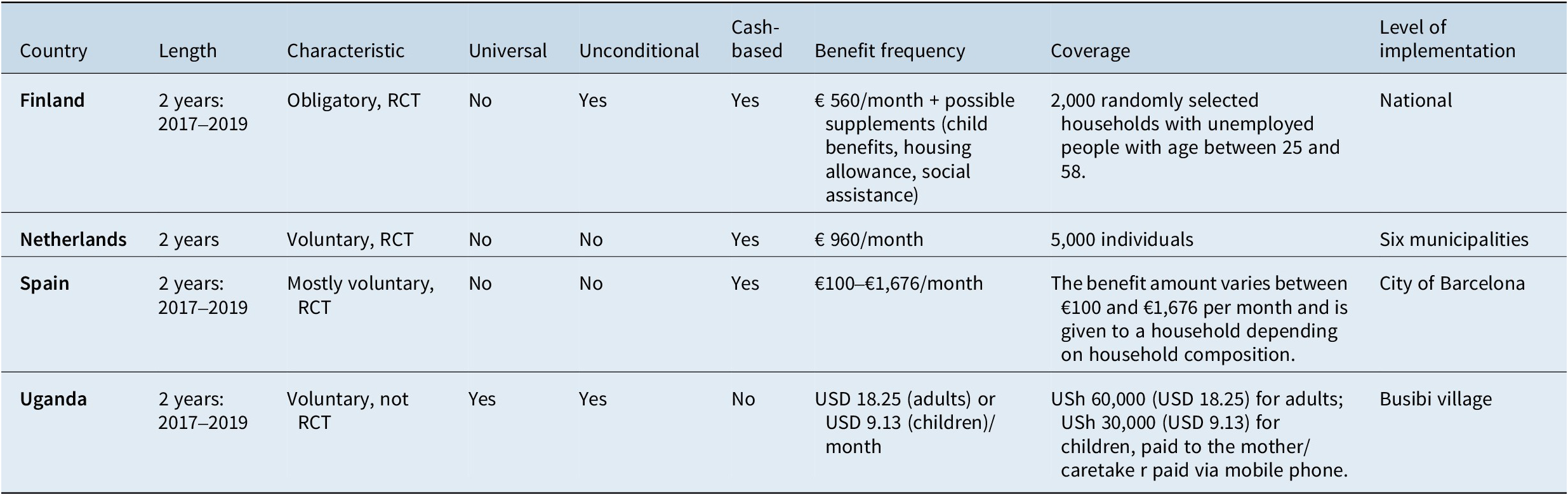
Table 1. Long description
The table consists of nine columns: Country, Length, Characteristic, Universal, Unconditional, Cash-based, Benefit frequency, Coverage, and Level of implementation.
* Finland: 2 years (2017 to 2019). Obligatory, R C T. Universal: No. Unconditional: Yes. Cash-based: Yes. Benefit: 560 Euros per month plus possible supplements. Coverage: 2,000 randomly selected households with unemployed people aged 25 to 58. Level: National.
* Netherlands: 2 years. Voluntary, R C T. Universal: No. Unconditional: No. Cash-based: Yes. Benefit: 960 Euros per month. Coverage: 5,000 individuals. Level: Six municipalities.
* Spain: 2 years (2017 to 2019). Mostly voluntary, R C T. Universal: No. Unconditional: No. Cash-based: Yes. Benefit: 100 to 1,676 Euros per month. Coverage: Benefit varies by household composition. Level: City of Barcelona.
* Uganda: 2 years (2017 to 2019). Voluntary, not R C T. Universal: Yes. Unconditional: Yes. Cash-based: No. Benefit: U S D 18.25 for adults or U S D 9.13 for children per month. Coverage: Paid to mother or caretaker via mobile phone. Level: Busibi village.
Source: Authors’ creation using data from Gentilini et al. (Reference Gentilini, Grosh, Rigolini and Yemtsov2020) and Hiilamo (Reference Hiilamo2022b).
Although these experiments are referred to as BI trials, they do not fully meet the definition of universal basic income (UBI). They were not designed to cover the entire population, and some included conditional elements (see Table 1). Therefore, we call them BI experiments not UBI experiments.
All four BI experiments were conducted within the same 2-year period, enabling a synchronised comparison while reducing interference from external shocks such as economic crises, pandemics, or geopolitical events. This shared temporal context strengthens the comparative analysis by clarifying how governance structures, policy designs, and socio-political environments shape BI implementation and its challenge.
Table 1 below reports the main features of the four selected BI experiments (including cash- based, universal, and unconditional).
Finland. Since the 1980s, BI has remained present, though unevenly, in Finnish political debate (Perkiö, Reference Perkiö2019), while surveys in 2002 and 2015 showed stable public support (Kela, 2016). Political support, however, remained largely limited to the Left Alliance, the Greens, and the Centre Party until 2015, when a centre-right government launched a BI experiment without involving these advocates (Halmetoja et al., Reference Halmetoja, De Wispelaere and Perkiö2018). The experiment aimed to improve employment and reduce work disincentives in the social security system (FINLEX, 2016) and was entrusted to a consortium led by Kela, involving VATT, universities, think tanks, and entrepreneurs. Several BI models, inspired by earlier U.S. experiments, were considered, but legislative, administrative, financial, and scheduling constraints made the original design unfeasible (Kela, 2016). A partial BI model was therefore adopted (Kangas, Reference Kangas2017, Reference Kangas, Kangas, Jauhiainen, Simanainen and Ylikanno2021). The treatment group included 2,000 unemployed adults aged 25–63 selected through national randomisation from Kela registers, while around 170,000 unemployed individuals formed the control group (Verho et al., Reference Verho, Hämäläinen and Kanninen2022). The experiment thus focused exclusively on unemployed individuals.
Despite consultations with legal and tax experts (Kalliomaa-Puha et al., Reference Kalliomaa-Puha, Tuovinen and Kangas2016), institutional disagreements and resource constraints led to a simplified design: a tax-free €560 monthly transfer replacing other Kela-administered benefits, while additional earnings remained taxable under existing law.
Political leaders planned to extend the experiment beyond 2018, and the government elected in 2019 allocated funds for a new trial, but the COVID-19 pandemic and the war in Ukraine halted further experimentation.
Despite its limitations, the Finnish experiment remains significant as a nationwide obligatory randomised controlled trial (RCT). Finnish longitudinal registers made it possible to identify causal effects, showing modest employment gains (Verho et al., Reference Verho, Hämäläinen and Kanninen2022) and improvements in health-related outcomes (Simanainen, Reference Simanainen2024; Hämäläinen et al., Reference Hämäläinen, Simanainen and Verho2025; Salokangas et al., Reference Salokangas, Sirniö, Hiilamo, Moision, Erola, Moisio and Peltoniemi2026; see also Simanainen and Tuulio-Henriksson, Reference Simanainen, Tuulio-Henriksson, Kangas, Jauhiainen, Simanainen and Ylikännö2021).
Netherlands. After the 2008 economic crisis, the Netherlands shifted towards social investment policies, opening debates on BI. In 2017, unlike the Finnish nationwide pilot, several local experiments with minimum income guarantees emerged, incorporating behavioural insights into welfare policymaking. Inspired by BI principles, these experiments tested alternative social assistance models by easing application requirements, earnings deductions, and sanctions, aiming to provide an unconditional minimum income while encouraging individual initiative (Groot et al., Reference Groot, Muffels and Verlaat2018).
The Dutch BI experiments were implemented as RCTs across six municipalities: Deventer, Groningen, Nijmegen, Tilburg, Utrecht, and Wageningen. Participants were randomly assigned to three treatment groups or a control group: (1) a self-management and exemption group focused on labour market reintegration; (2) an earnings-release group allowing recipients to retain 50 per cent of additional earnings up to €200 per month; and (3) a tailor-made supervision group offering increased caseworker support (Groot et al., Reference Groot, Muffels and Verlaat2018).
Some municipalities combined treatment types, reflecting the decentralised nature of the pilots. While the central government prioritised employment transitions, municipalities focused more broadly on well-being, health, and self-management, in line with the trust-based approach (Muffels and Gielens, Reference Muffels, Gielens and Delsen2019; Roosma, Reference Roosma2022).
Evaluations took place at three levels: municipal researchers assessed local impacts on employment, participation, and well-being, while two national institutes commissioned by the Ministry of Social Affairs conducted process and overall evaluations. However, low participation and heterogeneous designs limited definitive conclusions (Groot et al., Reference Groot, Muffels and Verlaat2018; Roosma, Reference Roosma2022).
Results showed that exempting participants from job-seeking obligations did not significantly increase full-time employment, and intensive job-search support had limited effects. However, reduced means-testing and supplementary earnings positively affected part-time employment (Groot et al., Reference Groot, Muffels and Verlaat2018; Roosma, Reference Roosma2022; Hiilamo and Hiilamo, Reference Hiilamo2022b).
Despite inconclusive outcomes, the Dutch BI experiment remains significant for its scale (5,200 participants), decentralised governance, methodological diversity, and empirical contribution to BI implementation debates (Groot et al., Reference Groot, Muffels and Verlaat2018; Widerquist, Reference Widerquist2018; Muffels and Gielens, Reference Muffels, Gielens and Delsen2019; Muffels, Reference Muffels, Laenen, Meuleman, Otto, Roosma and van Lancker2021; Hiilamo and Hiilamo, Reference Hiilamo2022b).
Spain. Noguera (Reference Noguera2018) identifies two main drivers behind Spain’s BI experiment: rising poverty and welfare cuts, which increased demands for social security reform, and the political emergence of Podemos, which intensified debates on BI and income guarantees. Barcelona was selected because of its structural poverty and economic segregation, aggravated by the 2008 financial crisis (García, Reference García2022).
The B-MINCOME experiment was designed to address the limitations of Spain’s contributory benefit system in reducing poverty and insecurity (Riutort et al., Reference Riutort, Laín and Julià2023). Its main objective was to reduce poverty and social exclusion in Barcelona’s most deprived districts, Nou Barris, Sant Andreu, and Sant Martí (Laín, Reference Laín2019; Hiilamo and Hiilamo, Reference Hiilamo2022b). The initiative was planned and evaluated by four institutions, the Young Foundation, IGOP, the Polytechnic University of Catalonia, and the Catalan Institution for Evaluation of Public Policies, while the Barcelona City Council also consulted pilot experiences in Finland, Ontario, and Utrecht.
The project had a budget of €13 million, including €4.85 million from the European Commission’s Urban Innovative Action initiative. It combined four cash-transfer schemes with four active policy components: employment and training, social entrepreneurship, room rental support, and community participation (García, Reference García2022). Of 1,527 valid applications, 1,000 households entered treatment groups, 383 formed the control group, and 144 were reserves.
The experiment combined elements of a saturation study and an RCT, assigning households to eleven groups (ten treatment, one control). The evaluation used both quantitative and qualitative methods, supported by administrative data and repeated surveys.
Results were mixed. The programme reduced material deprivation, food insecurity, and housing insecurity, while improving subjective well-being and reducing financial stress (Riutort et al., Reference Riutort, Julià, Laín and Torrens2021). However, employment outcomes remained weak, as active policy components did not improve entrepreneurship or job access and in some cases reduced labour force participation (Laín, Reference Laín2019; Hiilamo and Hiilamo, Reference Hiilamo2022b).
Uganda. The Belgian organisation Eight launched a pilot BI project in Uganda after its founders, Maarten Goethals and Steven Janssens, witnessed extreme poverty and sought practical solutions. In 2017, they initiated a 2-year BI pilot in Busibi, distributing unconditional monthly cash transfers of €16 (USD 18.25) for adults, around 30 per cent of average low-income household earnings, and €8 (USD 9.13) for children through mobile banking. The programme ended in 2019 and involved 146 participants (56 adults and 88 children) (McFarland et al., Reference McFarland, Prochazka and Shanahan2017).
The evaluation was conducted by the Institute of Development Policy (IOB) at the University of Antwerp using a quantitative design to assess long-term effects. Surveys were carried out in Busibi and a control village during the programme, immediately after, and 2 years later. The final round coincided with the COVID-19 pandemic and assessed the durability of the intervention’s impacts (Grisolia et al., Reference Grisolia, Dewachter and Holvoet2023).
Results showed substantial and lasting improvements, persisting 2 years after the intervention. Key outcomes included greater food security, dietary diversity, entrepreneurship, and life satisfaction, with statistically significant increases in both the quantity and variety of food consumed (Grisolia et al., Reference Grisolia, Dewachter and Holvoet2023).
The Ugandan BI experiment is notable as a genuine UBI project in a low-income country, initiated externally but implemented locally, and for generating robust evidence on BI in a remote rural context.
Theoretical framework
We build a conceptual framework to understand how BI experiments are designed, implemented, and interpreted in different contexts. We interpret these experiments as political and institutional processes shaped by national and local conditions. The framework draws on three main theoretical areas: policy implementation, policy diffusion, and social experimentation.
Policy implementation. This theory helps explain how public policies, such as BI experiments, are put into practice and how they evolve through real-world constraints. Rather than assuming that policies are implemented as planned, this literature highlights how actors and institutional structures shape outcomes (Saetren, Reference Saetren2014). In this paper, we look at who designed and managed the experiments, the role of bureaucracies and researchers, and the institutional factors that enabled or constrained the process. We treat implementation as an interactive and context- dependent phase, influenced by both political leadership and administrative capacity.
Policy diffusion. Policy diffusion theory focuses on how policies spread from one place to another. Governments often learn from each other, adapt policies to their own settings, or try to follow international trends (Marsh and Sharman, Reference Marsh and Sharman2009). This is relevant for BI because many of the experiments were inspired by examples from other countries. However, when policies are transferred across borders, they are often adapted to local institutions, political cultures, and economic conditions. Our framework uses this perspective to understand how and why BI took different forms in Finland, the Netherlands, Spain, and Uganda.
Social experimentation as governance. Social experimentation refers to testing new policy ideas on a small scale before deciding whether to apply them more broadly (Standing, Reference Standing2021). While this can provide useful evidence, experiments are never completely neutral. The way they are designed, who is included, what outcomes are measured, how long they last, reflects political priorities and practical limitations. Experiments can also be interpreted in very different ways by different actors, depending on their interests and beliefs. This perspective helps us analyze not only what the experiments found, but how the results were used (or ignored) in policy debates.
Based on these theories, we use three dimensions to compare the BI experiments:
-
– Initiation and Governance: Who started the experiment and why? What level of government or organization was responsible? This shows how political and institutional settings shape BI policy development.
-
– Design and Methodology: How was the experiment designed? Who received the benefit and under what conditions? What kind of data was collected? This helps us understand how real- world experiments differ from the ideal version of UB/UBI.
-
– Interpretation and Use of Results: How were the results communicated and by whom? Were the findings used to support or oppose further policy changes? This captures how evidence is shaped by politics and public debate.
Methodology
This study examines how governance structures, policy designs, and socio-political environments shape the outcomes and implementation challenges of BI experiments. It adopts a qualitative comparative approach based on document and secondary data analysis, complemented by semi-structured interviews with key stakeholders.
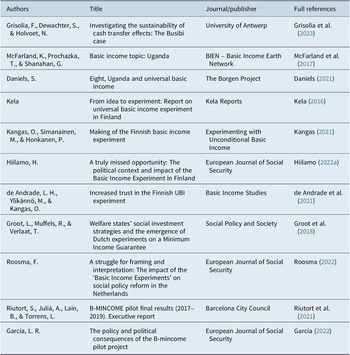
First, we analyse official documents, policy reports, evaluation studies, and peer-reviewed publications to examine the design, governance, implementation, and outcomes of the experiments. Documentary evidence ensures consistency and replicability in the comparative framework (Table 2). While the documentary corpus relies substantially on journal articles and book chapters, this reflects the available evidence base, as primary administrative records (e.g., legislative dossiers or tender documents) are often not systematically published or translated. Where primary documents were available, including the Finnish Basic Income Experiment Act (FINLEX, 2016), the government programme (Prime Minister’s Office Finland, 2015), the electoral manifesto repository (Pohtiva, 2026), and the B-MINCOME final results report (Riutort et al., Reference Riutort, Julià, Laín and Torrens2021), they were consulted and cited. Semi-structured interviews with nineteen stakeholders constitute the study’s primary original empirical contribution, providing insider perspectives beyond the published literature.
Documentary sources used for the comparative analysis of basic income experiments
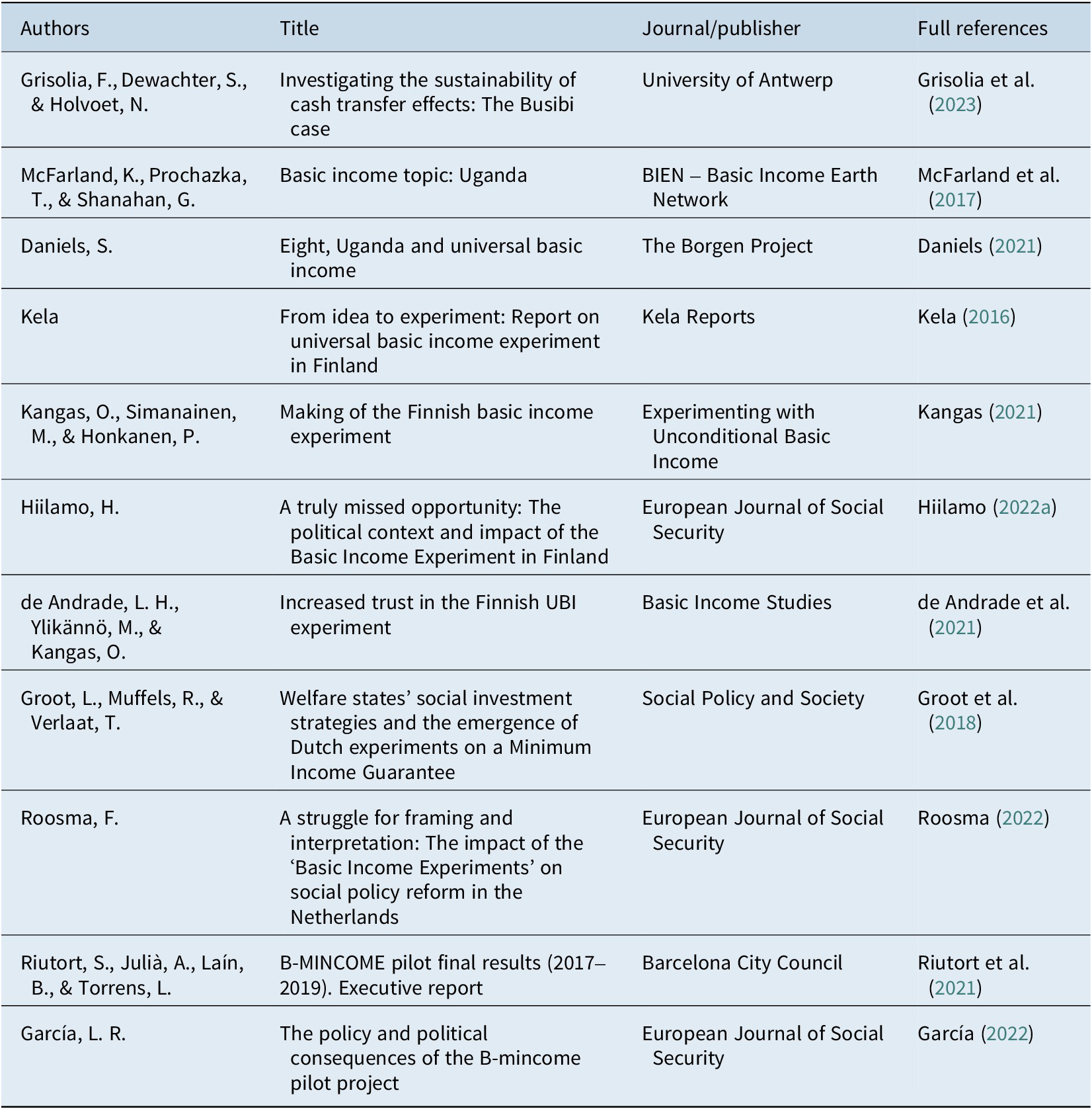
Table 2. Long description
The table consists of four columns: Authors, Title, Journal/publisher, and Full references.
Row 1: Grisolia, F., Dewachter, S., and Holvoet, N.; Investigating the sustainability of cash transfer effects: The Busibi case; University of Antwerp; Grisolia et al. 2023.
Row 2: McFarland, K., Prochazka, T., and Shanahan, G.; Basic income topic: Uganda; B I E N – Basic Income Earth Network; McFarland et al. 2017.
Row 3: Daniels, S.; Eight, Uganda and universal basic income; The Borgen Project; Daniels 2021.
Row 4: Kela; From idea to experiment: Report on universal basic income experiment in Finland; Kela Reports; Kela 2016.
Row 5: Kangas, O., Simanainen, M., and Honkanen, P.; Making of the Finnish basic income experiment; Experimenting with Unconditional Basic Income; Kangas 2021.
Row 6: Hiilamo, H.; A truly missed opportunity: The political context and impact of the Basic Income Experiment in Finland; European Journal of Social Security; Hiilamo 2022 a.
Row 7: de Andrade, L. H., Ylikännö, M., and Kangas, O.; Increased trust in the Finnish U B I experiment; Basic Income Studies; de Andrade et al. 2021.
Row 8: Groot, L., Muffels, R., and Verlaat, T.; Welfare states’ social investment strategies and the emergence of Dutch experiments on a Minimum Income Guarantee; Social Policy and Society; Groot et al. 2018.
Row 9: Roosma, F.; A struggle for framing and interpretation: The impact of the ‘Basic Income Experiments’ on social policy reform in the Netherlands; European Journal of Social Security; Roosma 2022.
Row 10: Riutort, S., Julià, A., Laín, B., and Torrens, L.; B-M I N C O M E pilot final results 2017–2019. Executive report; Barcelona City Council; Riutort et al. 2021.
Row 11: García, L. R.; The policy and political consequences of the B-mincome pilot project; European Journal of Social Security; García 2022.
Source: Author’s creation.
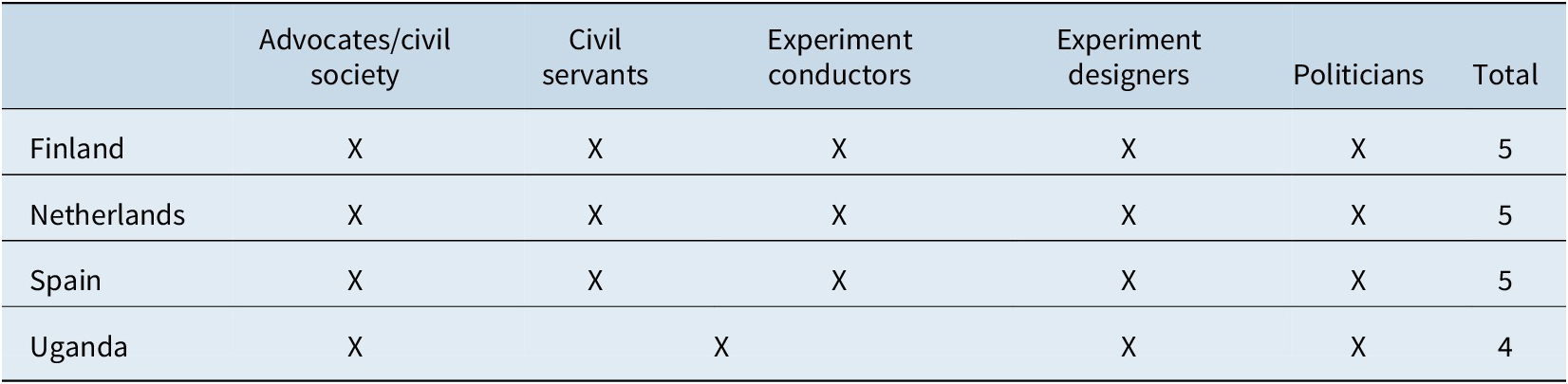
Planning and implementing large-scale experiments involves diverse actors with different expertise at different stages. To capture these perspectives, we conducted interviews across the four BI experiments with up to five individuals directly involved in planning and implementation. Participants were selected from five categories, politicians, civil society representatives, civil servants, experiment designers, and experiment conductors, to ensure heterogeneity of perspectives. In total, 19 participants were interviewed (Table 3).
Interviewed advocates of the national basic income experiments
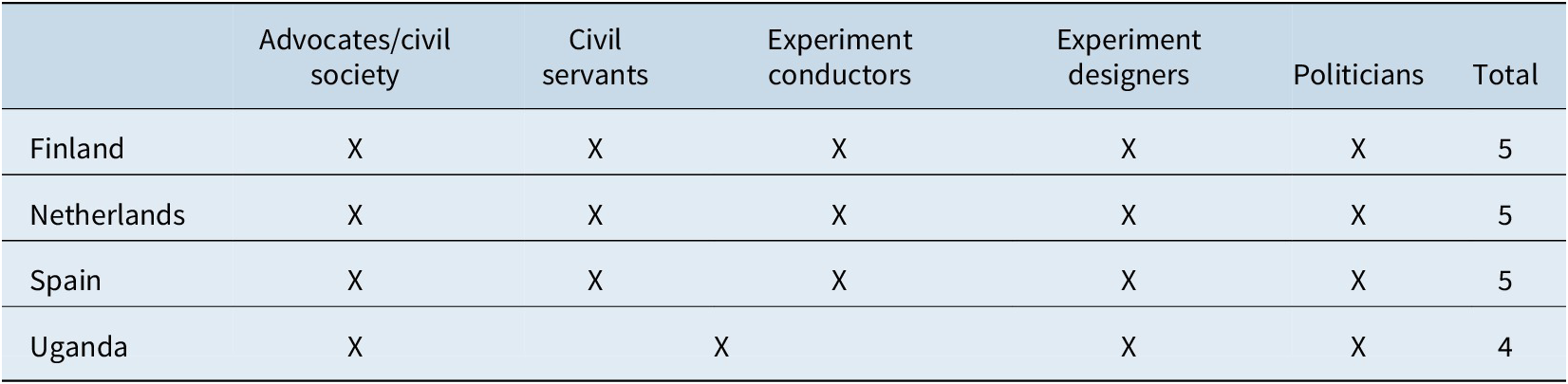
Table 3. Long description
The table consists of seven columns and five rows.
Columns from left to right are: Country, Advocates/civil society, Civil servants, Experiment conductors, Experiment designers, Politicians, and Total.
Rows from top to bottom:
* Finland: Marked with an X in all five categories (Advocates/civil society, Civil servants, Experiment conductors, Experiment designers, and Politicians). Total is 5.
* Netherlands: Marked with an X in all five categories. Total is 5.
* Spain: Marked with an X in all five categories. Total is 5.
* Uganda: Marked with an X in Advocates/civil society, Experiment conductors, Experiment designers, and Politicians. The Civil servants category is blank. Total is 4.
Source: Authors’ creation.
Interviews were conducted with key stakeholders involved in the planning and implementation of the four BI experiments. Semi-structured interviews were chosen for their flexibility in exploring participants’ experiences. The interview schedule included 15 questions, with each session lasting about 1 hour (approximately 17 hours in total). All interviews were recorded with consent, and transcripts were anonymised and, where necessary, translated into English.
The data were analysed through content analysis to identify recurring patterns and themes. After transcription and familiarisation, an initial coding framework was applied covering project origins, funding, experiment design, institutional autonomy, research-team selection, and result interpretation. Open coding captured unexpected themes, including political dynamics and the effects of economic crises. The coded data were then synthesised into four dimensions for comparative analysis.
Comparative analysis
Documentary analysis. In Finland, the BI experiment originated from a proposal by the think tank Tänk, commissioned by the Finnish Innovation Fund (SITRA), which recommended a nationwide field experiment based on random selection to test UBI under real-world conditions (Sitra, 2014). The proposal gained political visibility during the 2015 electoral campaign, especially through the Greens, the Left Alliance, and the Centre Party, whose manifesto stated that “the effectiveness of basic income should be tested” (Pohtiva, 2026). The government programme subsequently committed to a BI pilot despite scepticism from coalition partners (Prime Minister’s Office Finland, 2015). The experiment was institutionalised through the Basic Income Experiment Act (FINLEX, 2016), confirming its top-down character.
In the Netherlands, the experiments emerged as a response to the 2015 Participation Act, whose strict conditionalities were criticised by researchers and municipalities for undermining reintegration and producing weak employment outcomes (Bregman, Reference Bregman2017; Sociaal en Cultureel Planbureau, 2019; van Waveren, Reference van Waveren2020). The municipal pilots were designed to test less conditional and more trust-based welfare approaches (Groot et al., Reference Groot, Muffels and Verlaat2018).
In Catalonia, B-MINCOME aimed to combine BI-type transfers with social investment policies to address poverty and exclusion in Barcelona’s poorest districts (Laín and Torrens, Reference Laín and Torrens2019). The experiment emerged after Ada Colau’s electoral victory and was developed by the Barcelona City Council with research partners and EU co-funding (Laín and Torrens, Reference Laín and Torrens2019). Its main documentary sources include official reports and academic evaluations (Laín, Reference Laín2019; Riutort et al., Reference Riutort, Julià, Laín and Torrens2021; García, Reference García2022; Riutort et al., Reference Riutort, Laín and Julià2023), although internal municipal records remain inaccessible.
Uganda differs fundamentally, as the Busibi pilot was initiated externally by the charity Eight rather than public institutions, reflecting a bottom-up model aimed at addressing extreme poverty (Janssens, Reference Janssens, Downes and Lansley2018).
Overall, Finland represents a clearly top-down model, Uganda a bottom-up model, while the Netherlands and Spain combine both dynamics. Funding structures also varied: Finland relied on domestic public funding, Uganda on philanthropy, while the Netherlands and Spain combined domestic and external resources, including EU funding. Across all four cases, independent institutions played a central role in evaluation, though through different governance arrangements. Finland, the Netherlands, and Spain used RCTs, while Uganda relied on longitudinal surveys. Finland and the Netherlands prioritised labour market outcomes, whereas Spain and Uganda focused more broadly on well-being and poverty reduction.
The interpretation of results was strongly shaped by domestic politics. In Finland, opponents stressed weak employment effects, while supporters emphasised well-being and trust (Mäkkylä, Reference Mäkkylä, Kangas, Jauhiainen, Simanainen and Ylikanno2021). In Spain, positive poverty-reduction effects did not translate into sustained political support (Laín, Reference Laín2019). In the Netherlands, municipal variation limited generalisability (Muffels, Reference Muffels, Laenen, Meuleman, Otto, Roosma and van Lancker2021). In Uganda, positive effects on food security, entrepreneurship, and education enabled expansion to additional villages (Grisolia et al., Reference Grisolia, Dewachter and Holvoet2023). These differences show how institutional settings shape both the framing and policy use of BI experiments.
In depth analysis
Governance of the experiments. The experiments conducted in Finland, the Netherlands, Spain, and Uganda were shaped by distinct governance models and historical–political contexts.
In Finland, the experiment was initiated by the central government and overseen by the Ministry of Social Affairs and Health, while Kela designed and implemented the project, including legislative preparation and data collection for subsequent analyses. The Kela-based planning group played the central role in shaping the experiment, while the ministry retained formal political responsibility and endorsed its proposals (Kangas, Reference Kangas, Kangas, Jauhiainen, Simanainen and Ylikanno2021). As FIN1 noted, “the planning group” effectively decided the pilot’s design. The experiment was framed as politically neutral and required a special law to regulate the relationship between BI, earned income, taxation, and social benefits. As FIN4 observed, “everything related to the trial had to be based on the legislation through which it was implemented.” Drafting the legislation for the experiment was a laborious process: it was prepared within Kela and the Ministry of Social Affairs and Health, presented to the Government, which in turn submitted the bill to Parliament, where the Basic Income Experiment Act was ultimately approved (see Kalliomaa-Puha et al., Reference Kalliomaa-Puha, Tuovinen and Kangas2016).
In the Netherlands, decentralised governance allowed municipalities to tailor experiments in collaboration with local researchers. As NL7 noted, “All the design questions, all the evaluation questions were discussed within this informal consortium.” This autonomy enabled context-specific designs and academic collaboration (Groot and Verlaat, Reference Groot and Verlaat2016; van der Veen, Reference van der Veen2019).
In Catalonia, B-MINCOME was designed by the Barcelona City Council with five research organisations, while implementation and participant coordination remained under the City Council (Laín and Torrens, Reference Laín and Torrens2019). As SP1 noted, “Ivàlua was behind the experimental design of the project.” Other institutions, including IGOP, ICTA, and Novact, contributed to a multidimensional evaluation strategy (SP1).
In Uganda, Eight implemented the project, while the Institute of Development Policy at the University of Antwerp provided analytical support. As UG1 noted, the project relied primarily on a quantitative methodology, although the research design evolved over time. UG3 added that “the working method was made” by University of Antwerp researchers, highlighting their central role in shaping the project’s methodology and implementation.
Taken together, the interviews reveal three governance patterns. First, the mode of initiation shaped experimental scope: top-down state-driven experiments (Finland, the Netherlands) faced stronger legislative and budgetary constraints, while bottom-up or externally initiated cases (Uganda and partly Catalonia) had greater room for innovation but weaker institutional embeddedness. As FIN1 noted, the planning group held effective design authority despite the ministry’s formal responsibility, reducing political ownership.
Second, independent research institutions were central to credibility, but their mode of selection mattered: open competition (Finland, Spain) produced greater methodological pluralism than direct appointment (Uganda, parts of the Netherlands).
Third, the lack of long-term political commitment emerged as a shared vulnerability. As NL7 observed, “all the design questions were discussed within this informal consortium,” reflecting reliance on informal coordination rather than institutionalised governance. Overall, these patterns suggest that governance structure, more than experimental design alone, shapes the quality and policy impact of BI pilots.
Design and methodology. Design features varied across national contexts, shaped by methodological constraints, communication strategies, and ethical considerations.
In the Netherlands, mistrust significantly affected participant recruitment. As NL4 observed, “If you mean it from your heart, then people on the other side of the desk can sense whether you are sincere or merely playing a role.” NL1 similarly explained that potential participants were contacted through letters bearing the official government logo, which often triggered suspicion: “This frequently caused mistrust… using new numbers causes recipients to lose trust.” In addition, NL6 noted that “there were some problems during the pilot… at any stage in the beginning and then implementation,” highlighting the operational uncertainties that accompanied the rollout.
Catalonian B-MINCOME adopted a quasi-experimental approach. SP4 reported, “We did not have the capacity to design a randomised evaluation, so it was a quasi-experimental evaluation.” SP5 described how it “combined methods, quantitative and qualitative, from the beginning,” and SP3 emphasised ethical concerns: “No one can be harmed by participating in the experiment.” The design targeted long-term disadvantaged groups. SP2 explained, “Because the experiment targeted very vulnerable people that had been for a long time in a situation of poverty and social exclusion, the program had to be 4 years instead of two.”
Uganda faced technical and logistical challenges. UG3 said, “So they only have two villages that are running, the control village and the main one.” UG2 observed, “It is becoming more difficult to find appropriate control group villages to participate in the new experiments, given the popularity of the project.” UG5 remarked, “So what was the main method used to analyse the results?” which underscores the practical questions faced by local actors. Mobile transfers and in-village monitoring were used to support consistency and access.
Once the practical, administrative, and legal challenges had been resolved, including the ethical and constitutional question of whether participants could be obliged to take part in the experiment (see Kalliomaa-Puha et al., Reference Kalliomaa-Puha, Tuovinen and Kangas2016), the implementation of the Finnish RCT proceeded smoothly. Kela had complete register data for both treatment and control groups, payments were automated, and the mandatory nature of the experiment kept attrition to a minimum. The combination of randomisation and comprehensive registers provided a strong basis for identifying causal effects. However, the nationwide randomisation also meant that saturation effects could not be examined. For this reason, the use of random selection was questioned: “For the analytics, the problem was not the study design. The random selection was the problem.” (FIN4). FIN1 similarly reflected on the design’s purpose: “The Finnish BI experiment was mainly focused on the labour supply response of unemployed people.” Consequently, it was not possible to analyse substitution effects, such as how the labour supply of employed individuals might change if they were to receive an extra net €560 payment.
Outcome and contributions. The BI experiments produced tangible outcomes but also revealed limits in participation and sustainability. In Spain, SP4 observed that “The results are very interesting… especially in terms of qualitative and quantitative dimensions.” SP5 emphasised “effects on economic impact, well-being, mental health, and inclusion,” while SP2 noted that the experiment helped people “focus their lives” after gaining a reliable income. At the same time, SP5 pointed to a “U-shaped curve in well-being” linked to stress at the project’s end.
In Uganda, the pilot also produced significant local effects. UG2 reported “improvements in housing conditions and an increase in the number of people building their own homes.” UG1 stated, “It contributed significantly to strengthening the community,” while UG3 added, “The Busibi pilot showed results in education and crime reduction.” UG6 noted that the project also strengthened national BI discourse.
A key challenge for the policy relevance of the Finnish experiment was that the first evaluations relied on surveys and qualitative interviews, both of which suffered from low response rates. As FIN1 noted, “Less than 30% of the beneficiaries in the pilot responded to the questionnaire.” This substantially weakened the evaluative power and political message of the early findings. Results from more robust register-based analyses (e.g., Verho et al., Reference Verho, Hämäläinen and Kanninen2022; Simanainen, Reference Simanainen2024; Hämäläinen et al., Reference Hämäläinen, Simanainen and Verho2025; Salokangas et al., Reference Salokangas, Sirniö, Hiilamo, Moision, Erola, Moisio and Peltoniemi2026) were available too slowly to contribute to the ongoing political debate in 2019 concerning the experiment and its relevance for policymaking. Although the survey and interview results were broadly consistent with the later register-based studies, their reliability remained open to question. Now when the more reliable results establishing causal loops are available, political debate has already shifted away from basic income. In this sense, The Finnish experiment has been described as a missed opportunity (Hiilamo, Reference Hiilamo2022a), but public attitudes towards UBI remain highly politicised, limiting the capacity of experimental evidence to shift opinions. In the Netherlands, implementation variation shaped outcomes, as NL7 noted: “no one was forced to execute that within their local experiment,” while NL2 observed that polarised actors “did not learn that much from this experiment.” Finally, public perceptions remain central: as SP4 argued, “UBI should be seen as a right that you have because you are a citizen,” highlighting how normative framing shapes political acceptance and scalability.
Conclusions
This study examined four BI experiments in Finland, the Netherlands, Spain, and Uganda to assess how governance structures, policy design, and socio-political contexts shape implementation and outcomes. The comparative analysis shows that BI experiments are not neutral technical exercises: their design, execution, and interpretation are deeply embedded in institutional and political structures.
A first key finding concerns participant selection and governance arrangements. Finland and Uganda adopted mandatory participation, producing broader and more representative samples, while the Netherlands and Spain relied on voluntary participation, which created recruitment difficulties, especially for control groups. This highlights an important methodological trade-off: voluntary participation may increase legitimacy and autonomy but can undermine statistical robustness and representativeness. At the same time, the relatively short duration of all experiments limited the ability to assess long-term behavioural and social effects, suggesting that future BI pilots require longer time horizons.
Second, the experiments produced mixed empirical outcomes. Across all four cases, BI generated positive social effects, particularly in mental health, well-being, empowerment, food security, and community cohesion. However, labour market effects remained modest or absent, especially in Finland and the Netherlands. This confirms that BI may have stronger social than employment effects, challenging policy frameworks that justify BI primarily through labour market activation. Yet these findings remain politically contested. The interpretation of BI outcomes is strongly shaped by ideological framing, often more than by empirical evidence itself. In the Finnish case, for example, political debate was dominated by value-based interpretations rather than fact-based reasoning (Varjonen et al., Reference Varjonen, Niemelä and Kangas2014; Perkiö, Reference Perkiö2020). This suggests that evidence alone has limited power to transform public or political attitudes towards BI.
Third, the analysis shows a tendency for BI experiments to be scaled down into more targeted and conditional interventions. Concerns over financial sustainability, labour supply, and political feasibility pushed governments towards smaller and more controlled designs rather than universal models. This was especially visible in Finland and the Netherlands, where labour market participation and cost justification became central policy objectives. Such priorities narrowed the experimental scope and shifted attention away from BI’s broader social and psychological effects. While this targeting may respond to immediate policy concerns, it limits the generalisability of findings for universal BI schemes.
Political support also proved highly unstable. BI gains momentum during periods of economic crisis but often loses support once economic conditions stabilise. This pattern was visible in Finland and Spain, where promising experiments did not translate into long-term institutional reform. In Finland, proposals to expand the experiment were abandoned, and recent reforms have moved closer to the logic of Universal Credit than to BI. In Spain, B-MINCOME did not directly produce the Ingreso Mínimo Vital, but it generated an important policy legacy by demonstrating reductions in deprivation and improvements in well-being without labour market collapse. Its influence on later Catalan BI initiatives shows that experiments can shape policy trajectories indirectly, even when institutional adoption remains incomplete.
Uganda offers an important contrast. Unlike the European cases, its BI experiment was externally initiated and operated outside a highly institutionalised welfare state. This created greater flexibility in design and implementation and reduced political constraints linked to public spending. The results were strongly positive, particularly regarding food security, entrepreneurship, and life satisfaction. The Ugandan case shows that BI may have particularly strong effects in contexts where social protection systems are weak and material deprivation is more severe.
Overall, the comparison suggests that governance structure matters as much as policy design. Top-down state-led experiments benefit from scale and institutional legitimacy but face stronger political and administrative constraints. Bottom-up or externally driven experiments may innovate more freely but often lack institutional continuity and policy embeddedness. These governance differences shape not only implementation but also how results are framed and used politically.
The study also has limitations. It relies on a relatively small interview sample and examines only four experiments, which limits generalisability. Moreover, the focus on elite stakeholders leaves out the perspectives of participants and affected communities. Future research should expand both the number of cases and the range of actors involved.
For future BI experiments, several lessons emerge: stakeholders must share clear objectives; political commitment must extend beyond the launch phase; planning and implementation require sufficient time; budgets must support adequately large and representative samples; and responsibilities for implementation and evaluation must be clearly defined. Most importantly, positive results alone are insufficient to generate policy change. Political framing remains central. BI experiments succeed not only through evidence, but through their ability to align evidence with institutional interests and political opportunity structures.
Disclosure statement
O.A.O.E.K. was a member of the committee that planned and evaluated the Finnish BI experiment. In this capacity, he possesses inside information on the planning process and the motivation behind various solutions. As a member of the evaluation group, he has critically evaluated the pros and cons of the experiment. Thus, there are no major conflicts of interest.


 Open access

