


16.1 Introduction: A Potted History of the Press Publishers’ Right
The introduction of the press publishers’ right has grown into one of the most controversial regulatory interventions in the intellectual property field. Provided for in Article 15 of the Directive on Copyright in the Digital Single Market (CDSM),Footnote 1 it offers publishers of press publications a primary entitlement on their news content in the shape of a related right. While the beginnings of the press publishers’ right were rather modest, linked to a single type of service (news aggregator) of a single company (Google), the discussion gained considerable momentum, with the press publishers’ right argued to be a ‘matter of life or death’ for journalism and democratic debate.Footnote 2
Digitisation has not been kind to the legacy news media, which continue to seek sustainable business models. Traditional revenue sources such as print circulation and related advertising are drying up, and the losses are not being offset by revenues from digital distribution. This has made news organisations weary of third parties using their content without permission, particularly when such uses are by digital platforms enjoying the lion’s share of digital advertising revenues and dominating search (Google) and social media (Facebook) markets. At the same time, however, press publishers have started to rely on the internet traffic coming from those platforms. The publishers first took their grievances to the national legislators; when German (2013)Footnote 3 and Spanish (2014)Footnote 4 interventions bore no fruit, they turned their efforts to the European Union, which at that time was looking to update its copyright framework to embrace the changes that digital technologies had brought to the creation, distribution and use of creative content.Footnote 5
With the publishers setting the tone of the public discussion, the European Commission consulted in 2016 on granting a new neighbouring right that should enable press publishers to license and be paid for online uses of their content.Footnote 6 The new right, modelled after the German intervention, was included in the 2016 proposal for the CDSM Directive. The positive reaction of the legacy news media was met with opposition by not only digital platforms but also civil society organisations, which pointed out that the right goes against basic principles of the internet and would subdue users’ ability to share information online.Footnote 7 Three years of discussion brought only small changes to the shape of the press publishers’ right; the EU adopted the right in 2019 as a means to guarantee the sustainability, freedom and pluralism of the press sector.Footnote 8
16.2 Bargaining Frameworks and Bargaining Theory
We have sketched in Section 16.1 how the EU press publishers’ right was invented as a private-law solution to a policy problem: how to channel money from digital platforms to news publishers in order to sustain a quality press, which was deemed to be central to democratic societies. The new intellectual property right was to be the lever that would allow press publishers to replace major losses of advertising revenues with licensing deals with the same intermediaries.
But how were such licences for news content to be negotiated in a setting of complex interdependencies? As predicted early on in the debate,Footnote 9 platform intermediaries may choose not to enter negotiations at all and reduce exposure to news content below the threshold of the press publishers’ right (which permitted ‘use of individual words or very short extracts’ – Article 15(1) CDSM Directive). During licensing negotiations, parties may promise or threaten. For example, publishers can offer APIsFootnote 10 to news content or make linking difficult; intermediaries can promote or throttle online traffic to news publishers, potentially even further reducing online advertising revenues associated with the news content of the legacy press. In such a setting, platform intermediaries may have the market power to negotiate free licences. Predicted revenue flows therefore appear to depend on a bargaining framework that has not been addressed at all in the private rights regime conceived by Article 15 CDSM Directive.
Enter Australia. In response to the same policy challenge that had driven EU intervention, in 2021 the Australian Competition and Consumer Commission (ACCC) developed a code of conduct ‘to address bargaining power imbalances between Australian news media businesses and digital platforms, specifically Google and Facebook’ (henceforth ‘the Code’).Footnote 11 Drawing on competition law concepts, the Code mandated bargaining directly, resulting in remuneration agreements between digital platforms and news businesses. The Australian compulsory bargaining approach became a factor in the national implementations of the EU’s Article 15 CDSM Directive right.Footnote 12 Considerable national variations in bargaining emerged against the background of the same statutory (intellectual property law) provision. This is of considerable theoretical interest.
In this chapter, we present four different constructions of bargaining frameworks that have been operationalised in EU Member States following the adoption of Article 15 CDSM Directive, as well as the bargaining framework that evolved in Australia (and Canada) without the underpinning of a new intellectual property right. We then analyse these frameworks from the perspective of ‘bargaining in the shadow of the law’. We intend to draw general lessons on the relationship between statutory law and private bargaining as mediated by institutional frameworks. Before setting out these four (plus one) bargaining frameworks in detail, we sketch the theoretical assumptions underpinning our bargaining analysis.
The idea that private bargaining takes place ‘in the shadow of the law’ has a long history. It is the preferences, expectations and uncertainties that (rational) parties bring to negotiations that result in different outcomes. The law intervenes in multiple ways. It may grant endowments, such as rights, that may function as bargaining chips. It may regulate enforcement that enables parties to bind each other. It may condition process and who sits around the table. Some shadows are cast directly by legislators or judges; others are cast by arrangements such as collective bargaining, which are forms of private ordering that are indirectly permitted or facilitated.
The classic expression of the ‘shadow’ theory focuses on dispute settlement in divorce cases.Footnote 13 The law provides a framework under which a married couple can negotiate their future responsibilities as a flexible (but enforceable) private ordering arrangement. A court may not adjudicate but ‘rubberstamp’ distributional arrangements concerning marital property, alimony, child support and custody. Negotiating parties implicitly attribute probabilities to certain outcomes.Footnote 14
In this chapter, we first set out four different bargaining settings that have developed in the EU in the shadow of the CDSM Directive’s press publishers’ right. We also explain the Australian bargaining framework that developed during the same period without an underlying statutory right. It influenced the national operationalisation of the press publishers’ right in the EU. We then advance an analysis of the frameworks under four criteria taken from bargaining theory: who the bargaining parties are; what endowments they have been given; what procedural mitigations are available; and what is the function of the regulatory authority. We conclude with reflections on the relationship between law and private ordering in the shadow of the press publishers’ right.
16.3 An Empirical Exploration of Negotiation Frameworks
While not exhaustive, the bargaining settings we have selected for exploration represent the main approaches to the operationalisation of the press publishers’ right in the EU. These European case studies are supplemented by the influential Australian solution.Footnote 15
The bargaining frameworks are constructed on the basis of the national implementations of the press publishers’ right, including preparatory documents, decisions of relevant public bodies, stakeholders’ press releases and public statements, and news reports. The enquiry focuses on the structure of the frameworks, not on the particular agreements signed by publishers and digital platforms, which as a rule are not available to the public.
Each negotiation framework is examined through rich descriptions, capturing its facilitator, beneficiaries and relevant uses, opening of the negotiations, criteria taken under consideration while determining the amount of remuneration, transparency obligations, and enforcement mechanisms, including the mode of distribution of licensing fees.
16.3.1 Competition Law Commitments in France
France was the first Member State to implement the press publishers’ right,Footnote 16 and to date the only one to see a competition authority’s decision on it.Footnote 17 In June 2022, the French competition authority (Autorité de la Concurrence, ADLC) approved a set of commitments proposed by Google, creating a framework for negotiations.Footnote 18 This decision followed from the proceedings initiated by the ADLC due to complaints by the Alliance de la Presse d’Information Générale (APIG), Agence France-Presse (AFP) and the Syndicat des Éditeurs de la Presse Magazine (SEPM) asserting that Google had abused its dominant position by refusing to bargain pursuant to the press publishers’ right.Footnote 19 After the imposition of an obligation to negotiate in good faith via interim measures, a failed appeal and a sizable fine of €500 million,Footnote 20 in December 2021 Google submitted a set of commitments to put an end to the competition law concerns regarding its behaviour. Pursuant to Article L 4464-2 of the French competition code, the ADLC accepted Google’s commitments as means to halt its anti-competitive practices.
The framework created by the commitments was designed to perpetuate and complete the provisional measures ordered by the ADLC in April 2020. The negotiations carried out by the parties are overseen by a Monitoring Trustee, a person or an entity chosen by Google from the candidates approved by the ADLC. The Trustee’s task is first and foremost to verify Google’s compliance with the commitments and to report back to the ADLC. For this reason the commitments include extensive provisions on potential conflicts of interest between the Trustee and Google.Footnote 21 Next to its supervisory and reporting roles, the Trustee also plays an active role in settling the disagreements between the parties, including, to some degree, the interpretation of the substantive law. While the Trustee’s involvement is optional, their opinions are binding for Google.Footnote 22
The framework is open to press publishers and news agencies who benefit from the new right pursuant to Article L 218-1 of the Intellectual Property Code (IPC), whose authorisation is required prior to the use of their ‘protected content’.Footnote 23 As such, the commitments do not refer to a press publication as an object of protection, but adopt a new concept of ‘protected content’ that includes ‘texts, photos and videos’ produced by press publishers and news agencies.Footnote 24 Rather uniquely, Article L. 218-1 IPC refers to already existing definitions of a news agency and an online press service to designate the beneficiaries of the new right.Footnote 25 If parties disagree whether a particular entity or content meets the definition, they can refer their disagreement to the Trustee.
A publisher, a news agency or a collective management organisation triggers the negotiation by sending a ‘Complete Negotiation Request’ using an online form or other means determined by Google. The contents of the request and a confidentiality agreement template are specified in the commitments, and their completeness is assessed by Google under the supervision of the Trustee. The commitments make a distinction between existing uses (Google Search, News and Discover) and Google News Showcase and other future uses, with the negotiations covering only the former. What constitutes use itself is not specified beyond a general statement that it is reproduction and communication to the public of protected content.
Google is required to make an offer of remuneration that envisages at least an annual update. If the parties cannot reach an agreement on remuneration within three months, they can refer the case to the arbitral tribunal,Footnote 26 which will then set a price per impression, a minimum remuneration that is to be paid by Google. While determining the price, the tribunal takes account of the factors enumerated in Article L 218-4 IPC, the same ones that the parties are obliged to consider during the negotiations. They take account of both direct and indirect revenues from the use of protected content: this includes, for example, the human, material and financial investments made by publishers and press agencies, the contribution of press publications to political and general information, and the importance of the use of press publications by online public communication services. Google is obliged to make information which allows the assessment of those factors available to the other party, pursuant to Article L 218-4 IPC and the commitments. The mode of payment of the agreed remuneration remains unaddressed, and thus it lies within the parties’ discretion.
AFP, APIG and SEPM,Footnote 27 the three organisations that launched complaints with the ADLC, concluded licensing agreements with Google on press publishers’ rights prior to the ADLC decision on merits. The text of the agreements is not available to the public. Additionally, the Société des Droits Voisins de la Presse, a collective management organisation dedicated to the press publishers’ rights, concluded its own agreement with Google in October 2023.Footnote 28
16.3.2 Collective Management and Licensing with Extended Effect in Denmark
A number of Member States explicitly or implicitly allow for collective management of the press publishers’ right. In some cases this includes extended collective licensing, where a collective management organisation (CMO) representative of a considerable number of rightholders can act on behalf of its non-members.Footnote 29 The extended collective licensing arrangement is characteristic of the Nordic countries, and the most notable example of its application to the press publishers’ right comes from Denmark.
The Danish implementation of Article 15 CDSM Directive, adopted in June 2021, builds on section 50 of the Danish Copyright Act, providing for a general contractual licence.Footnote 30 It is an open-ended extended licensing provision, which allows a representative CMO approved by the Ministry of Culture to conclude licensing agreements within a specific well-defined area, authorising the use of works of its members and non-members where they are of the same nature. The rights-holders who do not wish for works to be covered by the scheme are able to opt out and conduct (or not) their own licensing negotiations.
Shortly after the implementation of the press publishers’ right, on 2 July 2021, the Danish Press Publishers’ Collective Management (Danske Pressepublikationers Kollektive Forvaltningsorganisation, DPCMO) was established. The news was widely reported as the DPCMO brought together a considerable number of Danish press publishers.Footnote 31 As of July 2023 it had thirty-seven members, including well-established media houses, local and regional publishers, and public service radio and television stations, purportedly representing 97 per cent of all press publishers in Denmark.Footnote 32 To become a member of the DPCMO, an organisation needs to be registered with the Danish Press Council (Pressenævnet), an independent public body competent to decide on ethical complaints about media conduct. According to the Danish Media Liability Act, domestic periodicals and stations automatically fall under the Press Council’s jurisdiction, but any other producers of printed or digital news-reporting content need to seek registration.Footnote 33 At the time of writing, the Press Council website lists more than 2,800 registered websites.Footnote 34 Not all registered outlets are, however, eligible for DPCMO membership, but only those that ‘aim to provide the public with news or other media content published on the publisher’s initiative and under the publisher’s control and responsibility’.Footnote 35
The DPCMO had begun pursuing licensing agreements with intermediaries even before it acquired the approval of the Ministry of Culture in September 2023 for its extended collective licensing scheme.Footnote 36 It had success with Microsoft (Bing), Google, upday, Yahoo!, DuckDuckGo, Ecosia and Qwant,Footnote 37 but less so with Facebook, with whom the negotiations will now be facilitated by the mediator appointed by the Ministry of Culture pursuant to section 52 of the Danish Copyright Act.Footnote 38 Neither the text nor the details of the agreements signed by the DPCMO are made available to the public. What is also not publicly available, even though it should be accessible on each CMO’s website pursuant to section 22 of the Danish Act on Collective Management of Copyright, is a general policy for the distribution of amounts due to rightholders. It is therefore not possible to assess how the remuneration is determined, collected and distributed by the DPCMO.
While subjecting the press publishers’ right to extended collective licensing, Danish legislators decided to make only one addition to the general contractual licence scheme: a possibility for the parties to refer a question to the Copyright Licensing Board, in case the contractual conditions offered by an authorised CMO are unreasonable.Footnote 39 The Board is an administrative body set up by the Ministry of Culture to address, among other things, remuneration disputes with regard to collective management of rights.Footnote 40 Following the reference of a question, the Board assesses the terms offered, and if it finds them unfair it makes determination on remuneration and appropriate terms. The fairness determination is based on the overall assessment of case circumstances: that is, considerations of public policy and competition law.Footnote 41 The decision of the Board provides a basis for an agreement between the parties, and it cannot substitute such an agreement.
16.3.3 Final Offer Arbitration and the Key Role of a Regulator in Italy
Not unlike Australia, a selection of Member States opted for creating a negotiation framework in which a public body, a ministry or a regulator plays a key role, including making a decision on the level of remuneration due to publishers. Italy was the first to take this route. It granted considerable competences to the Autorità per le Garanzie nelle Comunicazioni (AGCOM), its communications regulator, making it responsible for determining the criteria for assessing whether the remuneration agreed between the parties is fair, and making a selection between parties’ remuneration offers in case they cannot reach an agreement (so-called final offer arbitration).Footnote 42 While the Italian example is not free of controversy, with its compatibility with the CDSM Directive being currently considered by the Court of Justice of the European Union,Footnote 43 it was quickly followed by others, including in Belgium (Institute for Postal Services and Telecommunications),Footnote 44 Greece (Hellenic Telecommunications and Post Commission)Footnote 45 and Czechia (Ministry of Culture).Footnote 46
Article 43-bis of the Italian Copyright Act settles the core of the Italian negotiation framework, with the AGCOM Regulations on the identification of reference criteria for determining fair compensation (Regulations) filling in the details.Footnote 47 The framework is open to all publishers who benefit from the press publishers’ right.Footnote 48 In its resolution approving the Regulations, the AGCOM emphasises that as a default, press publishers and intermediaries should negotiate and agree on the remuneration unaided.Footnote 49 The remuneration should cover reproduction and communication to the public of press publications,Footnote 50 which goes beyond very short extracts. Here, quite uncommonly, Italy provides a definition of such extract, building on the notion of a substitution effect: it is a portion of a press publication that ‘does not dispense with the need to consult the journalistic article in its entirety’.Footnote 51
In case the parties do not reach an agreement within thirty days, either can ask the AGCOM to determine fair remuneration. This option is an alternative to launching a case with a judicial authority and cannot be used when a court case is pending. When asking the AGCOM for an intervention, a party needs to submit the basic documentation and propose an offer of remuneration that they consider to be fair. Since the AGCOM can declare an application inadmissible, it indirectly decides on the scope of the right. In particular, it determines whether a platform is an information society service provider and if so, what type. The type matters, as the Regulations distinguish between media monitoring and press review companies on the one hand and other intermediaries on the other, providing two sets of criteria for determining fair remuneration. In devising those criteria, the AGCOM was restricted by Article 43-bis(8) of the Italian Copyright Act, which provides an open list of factors that need to be taken under consideration: these include ‘the number of online consultations of the article, the years of activity and the market relevance of the publishers … and the number of journalists employed, as well as the costs sustained for technological and infrastructural investments by both parties, and the economic benefits deriving, for both parties, from the publication in terms of visibility and advertising revenues’. This list, with an addition of a requirement for compliance with the codes of conduct and codes of ethics, was adopted for intermediaries other than media monitoring and press review companies.
While these factors look beyond the mere use of press publications, the basis for calculating fair remuneration is the direct advertising revenue an intermediary generates due to such use, minus the publisher’s revenue from the referential traffic.Footnote 52 Following the logic of the last offer arbitration, the AGCOM will chose the offer which better reflects the criteria, and if none do it will set the remuneration itself. The AGCOM is able to assess the remuneration’s fairness due to the transparency obligation included in Article 43-bis of the Italian Copyright Act and detailed by the AGCOM Regulations, safeguarded by its competence to impose pecuniary fines in case of non-compliance. The AGCOM’s decision on fair remuneration does not replace an agreement between the parties, who can, if they do not agree with the AGCOM’s determination, seek a resolution by a court or abandon the negotiations.
The Czech negotiation framework largely follows the Italian model; however, the level of procedural obligations it imposes on intermediaries depends on their type and their position in the market. Search engines and social media that occupy a dominant market position are subject to stricter procedural restrictions, including a prohibition to conclude agreements offering ‘disproportionately unfavourable’ conditions to publishers. It is not clear who is mandated to assess this disproportionality.
16.3.4 Extended News Previews Program
The Extended News Previews (ENP) program was unilaterally created by Google and launched in May 2022.Footnote 53 While it is not the first licensing framework Google has offered to publishers, it is the only one which concerns solely the press publishers’ right. The main focus of the Google News Showcase, a global licensing framework predating ENP, has always been a dedicated news product of the same name.Footnote 54 Even though the agreements made with the European publishers for the News Showcase also provided for remuneration for the press publishers’ right,Footnote 55 this remuneration has been rather ancillary. As claimed by the European Publishers Council, by incorporating the press publishers’ right into the News Showcase agreements, Google tried to ‘dictate terms and conditions’ for negotiations, pre-empting publishers’ separate claims for remuneration under the new right.Footnote 56 The growing dissatisfaction of the publishers with the bundling of the new right with other Google products, and especially the News Showcase, led some of the Member States to speak against such pairing.Footnote 57 Consequently, the ENP program was born.
Google provides basic information on the ENP on a dedicated support website.Footnote 58 It declares that ENP is open to all press publishers who ‘meet the criteria established in national laws implementing Article 15’,Footnote 59 but the ultimate assessment of who is eligible to participate in the ENP belongs to Google. A publisher can enter the ENP framework either online, using Google’s Search Console, or offline. The Search Console is an online tool providing access to information on a website’s performance in Google search, allowing optimisation of its visibility.Footnote 60 Publishers that had already claimed a website that qualified as a press publication in the Google Search Console on the day the ENP was launched were to receive an invitation to the program automatically. Those who had not, were asked to register their website with the Search Console and then enrol with the program. While the ENP website refers to publishers who ‘signed up for ENP offline’, it does not explicitly explain how such offline enrolment works. The ENP was designed to cover all EU Member States, but as of October 2023 it covered only sixteen countries.Footnote 61
While the publishers enrolled with the ENP sign standardised agreements, the standard text is not available to the public. Publishers themselves can access and download the text of an agreement they have signed by using the Search Console or by contacting a Google representative when enrolled offline. As indicated on the ENP website, the program covers ‘the use of preview content in search results that goes beyond … short extracts and hyperlinks’. This general declaration mirrors the text of the CDSM Directive, even though it recognises its ‘uncertainty’.Footnote 62 After enrolling in the ENP, a publisher receives an offer from Google. The remuneration is calculated on an annual basis, following ‘consistent criteria which respect the law and existing copyright guidance, including how often a news website is displayed and how much ad revenue is generated on pages that also display previews of news content’.Footnote 63 Offers could also account for national differences, but it is not specified what those differences are: for example in law or in the press market.Footnote 64 Publishers can ‘give feedback’ on the offer to the ‘responsible team’, but it is not clear whether and how an offer would be adjusted. It seems that if a publisher does not agree with Google’s offer, the publication will still be included in the search results free of charge, unless a publisher opts out from Google search entirely. As such, the offers seem to come on a take-it-or-leave-it basis. The agreed annual remuneration is distributed to the publishers in equal monthly instalments by a third-party service.Footnote 65
Since agreements are not made public, and Google does not report on the number of the agreements concluded except in occasional press releases, we do not know how successful the negotiation framework is, how much revenue it generates for publishers or whether there are any material differences between legacy, digital and local publishers. According to Google’s June 2023 press release, more than 1,500 agreements had been signed, a 50 per cent increase compared to its November 2022 update. Still, no information on the amount of money paid to publishers under the scheme has been made public.
16.3.5 Australian News Media Bargaining Code
Unlike the EU, Australia followed a competition law route when intervening in the relationship between news media and digital platforms. The Australian Code creates a mandatory bargaining framework without awarding new rights, relying instead on the obligation to bargain and on non-discrimination requirements. The Code applies to those news businesses registered with the Australian Communications and Media Authority (ACMA) which fulfil the four tests (revenue, content, targeted audience and professional standards) and to those digital platforms which are designated by the responsible minister. While the Code was created with Google and Facebook in mind, formally designated platforms should be those that benefit from a significant bargaining power imbalance towards Australian news businesses. To date, no platform has been designated, as both Google and Facebook ‘made a significant contribution to the sustainability of the Australian news industry through agreements relating to news content of Australian news businesses’ by signing licensing agreements outside of the framework, avoiding designation.Footnote 66
Pursuant to the Code, a digital platform is under an obligation to bargain in good faith with all registered news businesses that notify it of their desire to do so. The remuneration for making news content available is the main issue that the parties can bargain about, but not the only one. The Code defines making available as all situations when news content or an extract of it is present or linked to on a service.Footnote 67 Thus the Code’s ‘making available’ is broader than ‘the right of making available’ known to copyright. The parties have three months to reach an agreement, and if they fail to do so either can refer the case to mediation facilitated by an ACMA-appointed mediator. By default the mediation lasts two months, unless parties agree to its extension. If it terminates without agreement a media organisation can request arbitration on the remuneration, but only when the digital platform consents to the procedure.Footnote 68
As already mentioned, the Code’s arbitration is so-called final offer arbitration, where an arbitral panel composed of an ACMA-appointed chair, potentially accompanied by two members, makes a choice between the final remuneration offers submitted by the parties. To prepare those offers, each party can make a reasonable request for information from the other; its reasonableness in case of a disagreement is assessed by the panel.Footnote 69 The offers should include a lump-sum payment covering a period of two years. In making its choice between the offers, the panel takes account of the monetary and other benefits enjoyed by both parties due to the availability of news content on a platform, the reasonable respective costs incurred by the media organisation and the digital platform for producing the content and making it available to Australian audiences, and whether a particular remuneration amount would place an undue burden on the commercial interests of the digital platform service.Footnote 70 The panel can opt for making adjustments to one of the offers only when neither of them is in the public interest.Footnote 71 The panel’s decision on remuneration is final, and a case can be referred back to arbitration only after the period of two years. Compliance with the Code is subject to general provisions of the Competition and Consumer Act 2010, of which the Code is a part, with some adjustments. The ACCC can impose pecuniary penalties for the circumvention of the Code’s provisions in a sum up to 600 penalty units, which currently stand at 313 AUD.Footnote 72
As no platform has so far been designated, the Code does not apply in practice. This, however, does not discourage other countries from following suit. In June 2023 Canada adopted the Online News Act,Footnote 73 which essentially copies the Australian Code. It does so, however, with some notable modifications. First, digital platforms do not require designation for the negotiation obligation to apply. It is sufficient for a platform to self-identify as a ‘digital news intermediary’ as defined by the Act. Second, the Act introduces a transparency element, where an independent auditor is tasked with the preparation of an annual report on the effects of the agreements made by news media and digital platforms on the Canadian news market. Among others things, the report published on the website on the Canadian Radio and Broadcasting Commission, the body responsible for safeguarding the act, is supposed to disclose the aggregate value of the agreements made.
16.4 Analysis
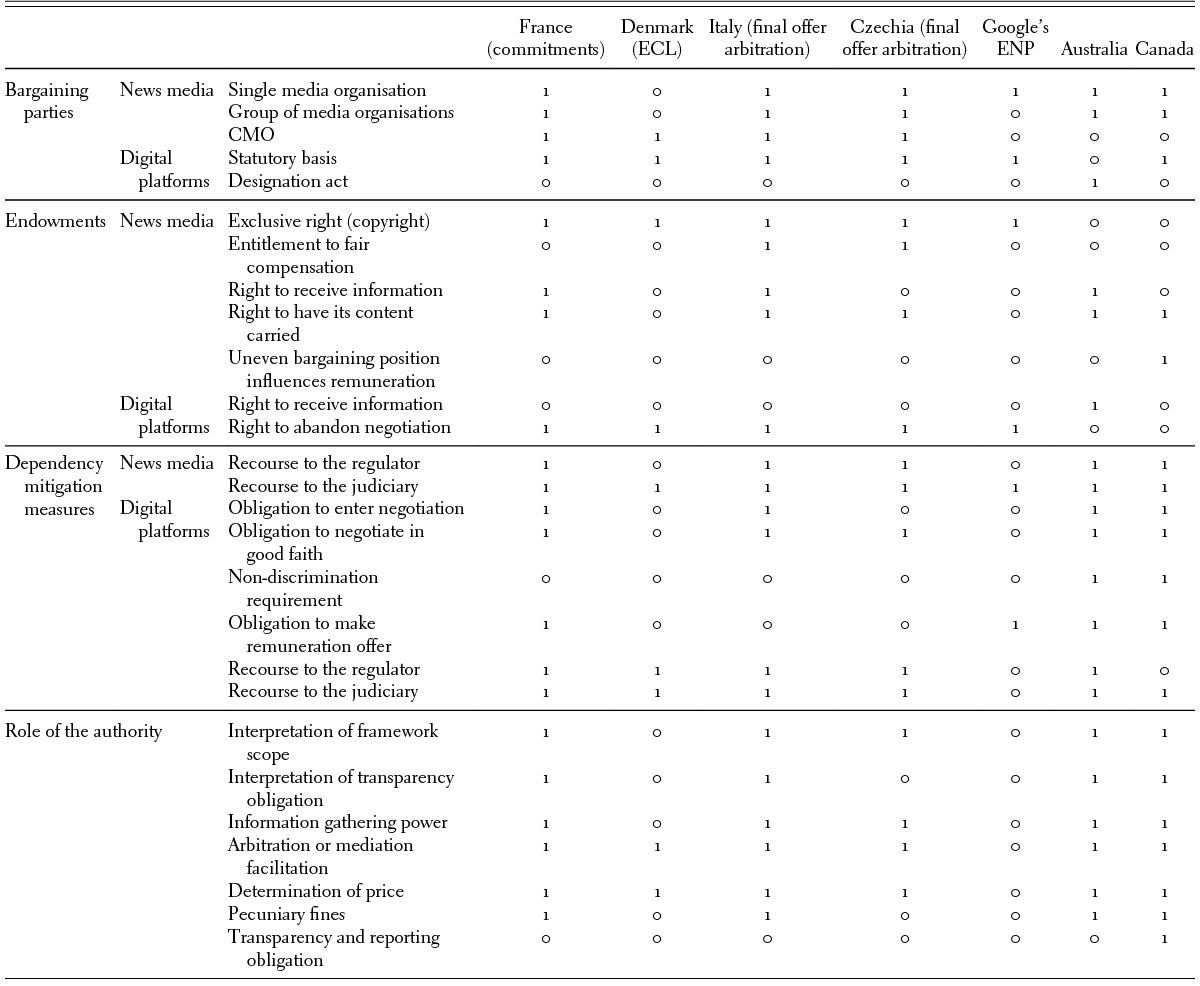
Having assembled the institutional details of the operationalisation of bargaining in a variety of settings in the EU, as well as in Australia (and Canada), we now proceed to code the key parameters of variation under four dimensions we take from bargaining theory. The coding is based on the same set of documents we used for the construction of the negotiation frameworks, which includes, among other things, statutes, preparatory documents, stakeholders’ press releases and public statements, as well as news reports. Table 16.1 provides an overview of the key coded parameters: 1 indicates that a parameter is present, 0 that it is not. Such coding enables us to see bargaining taking place under an institutional framework. In the sections that follow, we will summarise the key patterns that emerge.
| Policy goals | Tools | Current tensions |
|---|---|---|
| Proper functioning of the internal market | E.g. EU coordination of national legislation on AVMSs, rules on jurisdiction and the country of origin principle, Commission guidelines to help Member States with the implementation of certain aspects of the Directive. | Outdated definitions delineating an ‘AVMS’, combined with the minimum harmonisation nature of the Directive, lead to differences in interpretation and application in Member States. Significant discrepancies are undesirable from an internal market point of view, considering that influencer content is often consumed across national borders, while enforcement remains a national matter. This means that a single viewer can encounter different levels of protection depending on the country of origin of the content creator. In case of ‘editorial responsibility’, discrepancies can even lead to the inability to designate one single provider as the editorially responsible entity. |
| Protection of freedom of expression | E.g. a ‘light regime’ for VSPs, transparency of media ownership, promoting media pluralism. | This policy goal is challenged by the current interpretation of the reference to Articles 56 and 57 TFEU (‘the economic service criterion’). Applying too low a threshold could result in a disproportionate regulatory burden. It blurs the line between hobby and professional activities, potentially creating a chilling effect in light of freedom of expression: platform users could be discouraged from producing audiovisual content. Increasing interference by platforms and brands in influencer content could also impact freedom of expression. |
| Protection of viewers and users, minors in particular | E.g. rules regarding commercial communication, restrictions regarding AVMSs which may impair the physical, mental, or moral development of minors, obligation for a content description system to indicate the potentially harmful nature of content, accessibility requirements. | Influencer marketing is one of the most popular and effective forms of online marketing. This can be problematic considering the significant presence of questionable practices on VSPs (see Section 6.2). Furthermore, influencers do not (yet) consistently identify the presence of commercial communication in their videos.Footnote a Knowing that they are particularly popular with minors, this requires additional attention. From a viewer/user protection perspective, it therefore essential to clarify exactly when an influencer is considered to be an AVMS provider, and consequentially has to abide by the AVMSD’s rules. Legal uncertainty in this regard negatively affects compliance and enforcement. What does the exclusion of purely promotional audiovisual content via the ‘to inform, entertain or educate’ criterion mean for influencer videos dealing with the promoted product or service from start to finish, such as unboxing videos, product reviews or live stream shopping? |
| Promoting fair competition | E.g. moving away from the graduated approach, inclusion of VSPs and certain UGC under the Directive. | The current scope of the AVMSD leads to an uneven playing field on three levels. Among influencers with a differing degree of professionalism: regardless of their following and impact, all are treated the same from the moment they are remunerated in some form. Among influencers from different Member States: as the AVMSD is not straightforward, Member States/their media regulators have their own interpretation of the Directive’s scope and sometimes even introduce tools to facilitate monitoring and enforcement (e.g. minimum thresholds to distinguish between active and passive supervision). Influencers versus other AVMS providers: influencers often still escape scrutiny as regulatory authorities are reluctant to enforce the rules. This can be due to lack of clarity regarding the application and interpretation of some provisions as well as to the fact that they are still fairly new to the AVMSD. The ruling in the Peugeot case also raises questions regarding fair competition (see Section 6.3.2.3.1). |
a European Commission, ‘Investigation of the Commission and consumer authorities finds that online influencers rarely disclose commercial content’, Press Release, 14 February 2024, available at: https://ec.europa.eu/commission/presscorner/detail/en/ip_24_708.
Under ‘Bargaining parties’, we code who has a seat at the bargaining table and on what basis. Here, ‘Group of media organisations’ refers to a formal or informal grouping of media organisations able to partake in a single negotiation, referred to for example as acting ‘in association or consortium’ (Italy). ‘CMO’ stands for a collective management organisation, regardless of an explicit reference to a statutory definition of such organisation, for example a ‘collective society or association’ (France).
Under ‘Endowments’, we code what parties are bargaining with: what are the ‘bargaining chips’ they have been given by the legislator. We consider both entitlements stemming from statutory provisions and those provided for in executive acts and agreements. The right to have a news media organisation’s content carried could be phrased as a digital platform’s obligation to refrain from ‘arbitrarily restricting’ its service so that it no longer falls within the scope of the press publishers’ right, which would give a digital platform a reason for abandoning the negotiations (Czechia).
Under ‘Dependency mitigation measures’, we code how power imbalances are being addressed procedurally. We look at both general behavioural directives and specific procedural norms: for example, those which provide negotiation parties with the right to appeal the original settlement or lack thereof to a higher, or simply a different body. Such recourse can be phrased as a right to request a relevant body to make a decision after a set period of time passes without an agreement between the parties (France) or simply as a right to appeal an unsatisfactory settlement to a competent court (Australia).
Under ‘Role of the authority’, we code the interventions of the regulator. We look at the powers and actions a regulatory body or its proxy can take during the bargaining process, which is primarily led by the bargaining parties. For example, we investigate whether a regulator might be called upon when parties disagree on the scope of the transparency obligation imposed on one of them, as in France, where the Monitoring Trustee on request provides an opinion on the feasibility of supplying additional information.
16.4.1 Bargaining Parties
The first question to be asked when looking at the negotiation frameworks is who are the parties eligible to bargain. In the EU, the matter is seemingly simple: those who may bargain are all entities that (self-) identify as publishers of press publications or as information society service providers pursuant to Articles 2(4) and 15 CDSM Directive, no matter what their effect or role in the news media market. There are, however, some notable differences between the frameworks, with some allowing publishers to band together to strengthen their bargaining position. Here, the involvement of collective management organisations sets the solutions mandated by Member States apart from code-based approaches, as well as from Google’s privately created Extended News Previews program. A CMO has no place in bargaining frameworks which belong to the competition law domain. Additionally, an authority might be explicitly (France) or implicitly (Italy) authorised to assess a particular entity’s eligibility.
The Australian solution requiring a digital platform to be explicitly designated by a ministerial act is unique on the global scale, and to date has not found any followers, with Canada taking the EU route of (self-) identification based on a statutory provision. That said, in code-based frameworks only digital platforms with qualified market status and effect on the news market in a given country are to bargain. While the EU frameworks do not include similar requirements, Czechia does support a probably unacceptable bifurcation of the press publishers’ right regime, imposing stricter obligations on digital intermediaries enjoying dominant market position during the negotiation process.Footnote 74 The CDSM Directive treats all digital intermediaries equally.
16.4.2 Endowments
When looking at the bargaining chips each of the negotiating parties enjoys, it is clear that the news media side has been better resourced. The basic endowment is that of a press publishers’ right itself, an exclusive related right, absent in the code-based frameworks. It is further supplemented by an opaque entitlement to receive fair compensation, as well as the guarantee that the display of one’s content will not be altered during the negotiations, which could negatively influence the online traffic and revenues of news media, and the right to receive information from a digital platform on the use of news content and associated revenues, allowing the publishers to better assess the remuneration they might ask for. The transparency requirements are not bilateral, unlike in Australia, and news media are under no obligation to supply digital platforms with information on the benefits they generate from their content being available in platforms’ services.
The core endowment of digital platforms is their potential power to abandon negotiations. Here, we were looking at whether a platform can walk away from the bargaining table without needing to cease the use of all news content in their services. In effect it means whether a platform can pick and choose parties they bargain with. While the code-based negotiation frameworks exclude such situations, frameworks concerning the press publishers’ right are more lenient. Even in the case of extended collective licensing, in theory a platform could abandon the negotiations with an authorised CMO and enter into an individual agreement with any news organisation which opted out from an extended collective licensing scheme. In Czechia, while in general a digital platform can walk away from negotiations, this appears not to be possible when such a platform is a dominant search engine or social medium.
16.4.3 Dependency Mitigation Measures
The parties do not come to the negotiation table on an equal footing: news organisations are dependent on intermediary traffic. This dependency makes digital platforms such as Google and Facebook unavoidable trading partners for news organisations, but the same cannot be said about any particular news organisation. Thus the negotiation frameworks anticipate digital platforms exploiting news media dependency and introduce mitigating measures. The majority of the measures come in the shape of obligations imposed on digital intermediaries, determining how an intermediary should behave procedurally. The most far-reaching is an obligation to enter negotiations, as it imposes an ultimate restriction of the digital platforms’ freedom to contract. This obligation lies at the core of code-based frameworks and is now also present in France and Italy. Less invasive, and among the most common measures, is an obligation to bargain in good faith which is not always linked to the requirement to make an offer of remuneration. Thus, a behavioural instruction (good faith) does not necessarily lead to any result (remuneration offer), and even if it does, this result does not need to come at a minimum level (e.g. permissibility of zero offer in France). Since code-based negotiations do not build on intellectual property entitlements, non-discrimination measures, mandating equal treatment of all news media operating in a particular jurisdiction, were included as a means of strengthening the bargaining obligation. Similar non-discrimination requirements are absent in the EU.
Interestingly, the measure which is the most used for dependency mitigation is that of recourse to a regulatory body. With the exception of Denmark it is bilateral, allowing both parties to direct their complaints to a regulatory body or to an agent acting on its behalf (e.g. a Monitoring Trustee in France). Only Google’s ENP framework does not envisage such a measure, as would be expected in a private framework.
16.4.4 Role of the Authority
While the negotiations take place between the parties, they are not free from the input of an authority, a regulatory body or its proxy, in whose creation or functioning such body plays a part (Monitoring Trustee in France, Copyright Licensing Board in Denmark and arbitration panel in Australia). The authorities act as facilitators of the negotiations, overseeing the functioning of the frameworks and enabling mediation or arbitration when required. In the majority of settings, they have interpretative powers and are able to make binding decisions on the frameworks’ scope and judge the extent of and adherence to the transparency obligations imposed on the parties. This, however, happens only at the parties’ request. The role of the authorities is most pronounced in the code-based frameworks and the European solutions inspired by them, with the authorities empowered not only to make decisions on the level of remuneration due to media organisations but also to impose pecuniary fines on digital platforms in case of non-compliance with its decisions and the framework in general. When the role of the authority is considered, Google’s ENP framework stands notably apart, as it does not envisage any role for the regulator or its proxy. This cannot be surprising since Google is both a party and the facilitator in the ENP, with the framework fully relying on private ordering between the parties.
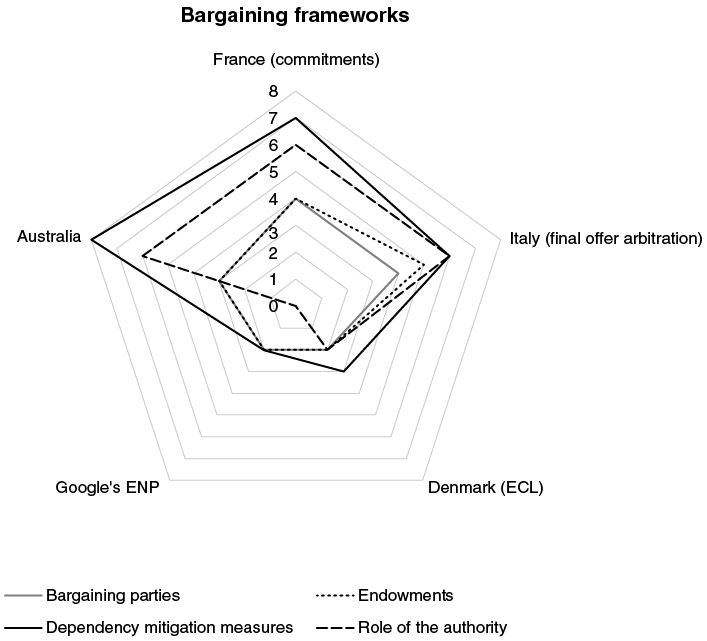
In Figure 16.1, we illustrate key quantitative differences among the bargaining frameworks. The values for each framework, which were calculated based on the data shown in Table 16.1, indicate a number of parameters addressed within four dimensions taken from bargaining theory.
Quantitative differences between bargaining frameworks.
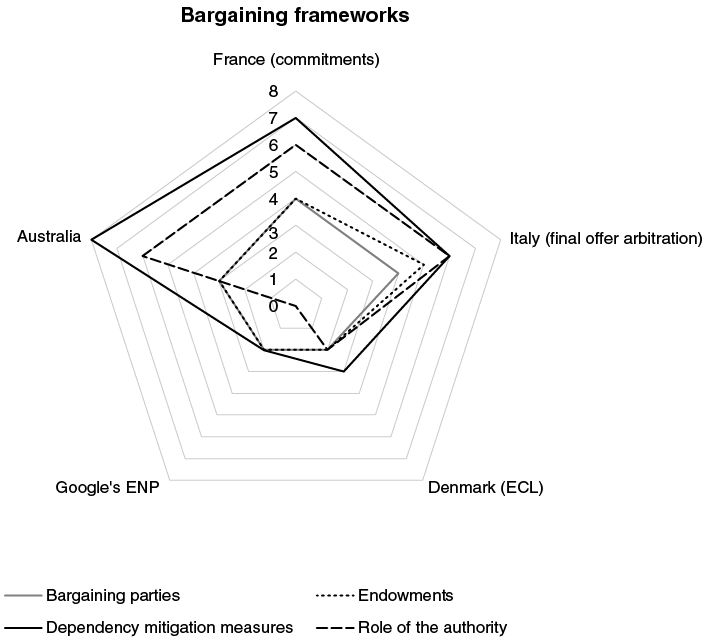
Figure 16.1 Long description
This indicates the intensity of factors that facilitate and those that force bargaining, namely: bargaining parties, endowments, dependency mitigation measures, role of the authority.

Table 16.1 Long description
The table provides an overview of the key coded parameters, namely bargaining parties, endowments, dependency mitigation measures, and role of the authority. 1 indicates that a parameter is present, 0 that it is not.
The radar graphical representation in Figure 16.1 captures the difference between frameworks that facilitate and those that force bargaining. Under forced bargaining frameworks, procedural rules and the power of the regulatory authority come to the fore (as reflected in the higher scores on these parameters for Australia and France). The private ENP framework established by Google remains silent on these points.
16.5 Conclusions
We know the policy aim of the press publishers’ right (i.e. to channel money from digital platforms to legacy, quality news publishers), but how does the intervention work? We have argued that it is important to go beyond the legal language of implementation to the structure that governs the empirical reality of bargaining. This is what we call the bargaining framework.
The bargaining framework is the invisible structure that is formed in the shadow of the statutory ‘related’ intellectual property right. Having collected the empirical details of bargaining in four EU settings and Australia, we then used bargaining theory to make the structure visible, identifying (1) bargaining parties; (2) endowments; (3) procedural mitigations; and (4) the function of the regulatory authority.
What have we learned? There are two main lessons. From a theoretical perspective, we have demonstrated how to identify and make visible different bargaining frameworks that operate under the same, or similar, statutory intervention. This makes an important contribution to the ‘shadow of the law’ literature. We show that bargaining frameworks sit as complex institutional constraints between purely private ordering and the law.
From a policy perspective, the different bargaining frameworks identified offer an appropriate unit of analysis for assessing the performance of the EU intervention. If it is the institutional translation into bargaining that matters for the range and frequency of outcomes (such as the flow of money), further empirical study should now be able to quantify the effects of the framework types. An independent impact assessment of the press publishers’ right is overdue.

 Open access