


1. Introduction
Agricultural nonpoint sources are the leading contributor to water pollution in the United States, but the problem can be reduced by adopting appropriate management practices (U.S. Environmental Protection Agency [EPA], 2005). Cover cropping is a conservation practice in which another crop is planted to cover the soil and protect it from erosion during the nongrowing season (U.S. Department of Agriculture, Natural Resources Conservation Service [USDA-NRCS], 2018). Planting cover crops can be a win-win solution because it can not only reduce nonpoint-source pollutants (Sharpley and Smith, Reference Sharpley, Smith and Hargrove1991; Zhang et al., Reference Zhang, Tan, Zheng, Welacky and Wang2017) but also benefit crop yields (Conservation Technology Information Center [CTIC], 2017). Specifically, cover crops can be an effective practice for reducing soil erosion and nutrient loss, sequestering carbon, and improving soil health (Hoorman, Reference Hoorman2009). It also can help stabilize yields (Bergtold et al., Reference Bergtold, Ramsey, Maddy and Williams2017). Even though use of cover crops is expanding (CTIC, 2017), the adoption rate is still low, less than 13% of cropped farms in 2017 according to the Census of Agriculture (U.S. Department of Agriculture, National Agricultural Statistics Service [USDA-NASS], 2019). A deeper understanding of cover crop adoption would be beneficial not only for farmers but also for environmental quality.
Research has shown that time/labor costs, lack of available equipment, and climate conditions, like precipitation and growing season, affect the feasibility of cover crop use (Arbuckle and Roesch-McNally, Reference Arbuckle and Roesch-McNally2015; Bergtold et al., Reference Bergtold, Ramsey, Maddy and Williams2017; CTIC, 2017; Midwest Cover Crops Council, 2015). The few studies on adoption of cover crops, however, have omitted consideration of climate variables. This may be caused by the limited geographic scope of most studies. The objective of this study was to identify the factors affecting adoption of cover crops using the 2012 USDA Agricultural Resource Management Survey (ARMS), which focused on soybean producers in 19 states. This data set enables us to examine factors that hinder or facilitate adoption and also allows us to evaluate the impact of climate conditions on adoption of cover crops, which, to our knowledge, has not been examined previously.
Probit regression results showed that the influences on cover crop adoption were related to labor and equipment challenges, as well as climate conditions. Additionally, using cover crops was positively correlated with adoption of other environmental practices, such as no-till or reducing fertilizer use, and is thus seen as a complement to these practices.
The next section provides some scientific background on cover crops as a best management practice. The conceptual model section reviews the literature on adoption of conservation practices and, more specifically, cover crops, to generate the hypotheses that will be tested. A description of the data and methods is followed by presentation of the results. The conclusion discusses the implications of the research and suggests some areas for future research.
2. Background on cover crops
Water quality issues caused by agricultural nonpoint sources are increasing (Sharpley and Smith, Reference Sharpley, Smith and Hargrove1991; Zhang et al., Reference Zhang, Tan, Zheng, Welacky and Wang2017) and can be mitigated by the use of cover crops. Nitrogen (N) losses occur primarily through leaching, denitrification, and volatilization potentially contributing to groundwater pollution, eutrophication, hypoxia, and climate change (Cameron, Di, and Moir, Reference Cameron, Di and Moir2013; Ribaudo et al., Reference Ribaudo, Delgado, Hansen, Livingston, Mosheim and Williamson2011). Nitrate (NO3) is a toxic compound that can leach into groundwater. It is produced via mineralization and nitrification of existing organic N by microbes and microorganisms in soil (Johnson et al., Reference Johnson, Albrecht, Ketterings, Beckman and Stockin2005). Dinnes et al. (Reference Dinnes, Karlen, Jaynes, Kaspar, Hatfield, Colvin and Cambardella2002) and Castellano et al. (Reference Castellano, Helmers, Sawyer, Barker and Christianson2012) argue that there are temporal differences between nitrate use by crops and soil nitrate production under U.S. midwestern conditions. Most nitrate production from soil occurs in spring, but the peak of crop nitrogen requirements occurs in summer (Dinnes et al., Reference Dinnes, Karlen, Jaynes, Kaspar, Hatfield, Colvin and Cambardella2002). Thus, cover crops can mitigate nitrate leaching by taking up the available N during periods when crop utilization is low (Castellano et al., Reference Castellano, Helmers, Sawyer, Barker and Christianson2012; Strock, Porter, and Russelle, Reference Strock, Porter and Russelle2004; Tonitto, David, and Drinkwater, Reference Tonitto, David and Drinkwater2006). Reduced amounts of NO3 reduce gaseous losses, including nitrous oxide (N2O), a greenhouse gas (Davidson et al., Reference Davidson, Keller, Erickson, Verchot and Veldkamp2000). These reductions of available nitrogen also can reduce N runoff.
Cover crops can reduce soil erosion. Laloy and Bielders (Reference Laloy and Bielders2010) found that there was less soil loss and runoff in fields using cover crops than in those left untilled postharvest. Phosphorus (P) typically moves to surface water in runoff with the potential to cause eutrophication, especially in freshwater systems (Carpenter, Reference Carpenter2005). Runoff contains both soluble P and eroded soil particles, which have a high P content (Devlin et al., Reference Devlin, Losses, Pierzynski and Janssen2002). Therefore, using cover crops can reduce runoff of total P (Langdale, Leonard, and Thomas, Reference Langdale, Leonard and Thomas1985; Yoo, Touchton, and Walker, Reference Yoo, Touchton and Walker1988). Runoff is reduced because cover crops reduce rainfall energy on soils because of interception by their stalks and leaves, and they also increase infiltration capacity and water storage ability. For example, tap-rooted cover crops can penetrate soil and create pores that facilitate the infiltration of rainfall (Chen and Weil, Reference Chen and Weil2010; Reeves, Reference Reeves, Hatfield and Stewart1994). Cover crops can also increase infiltration by reducing crusting, or the surface sealing of soil. Therefore, cover crops can reduce nonpoint-source pollutants from agriculture.
A concern is that cover crops and weeds might compete with cash crops for nutrients, but Wittwer et al. (Reference Wittwer, Dorn, Jossi and Van Der Heijden2017) found that using legume cover crops not only reduced weed pressure but also increased yields because of the additional N source from atmospheric nitrogen fixation. Nutrient competition by cover crops may inhibit weeds, as can waterborne components (leachates) from the decomposition of some cover crops, such as winter rye and black oats. This can be useful in soybean production because the crop itself is insensitive to winter rye leachates (Forcella, Reference Forcella2014; Midwest Cover Crops Council, 2015).
Soil organic matter or carbon is another important factor for productivity and, to farmers, one of the well-known benefits of using cover crops (CTIC, 2017; Kaspar and Singer, Reference Kaspar, Singer, Hatfield and Sauer2011; Myers and Watts, Reference Myers and Watts2015). Mbuthia et al. (Reference Mbuthia, Acosta-Martínez, DeBruyn, Schaeffer, Tyler, Odoi, Mpheshea, Walker and Eash2015) conducted a long-term (31 year) cotton production study in Tennessee and found there was more total organic carbon under cover crop (legume) and no-till, as well as higher yields, than no cover crop and tilled fields.
In relation to climate change, cover crops may contribute to both mitigation and adaptation. Important benefits may include carbon sequestration, as well as enhanced water infiltration and reduced evaporation (Kaye and Quemada, Reference Kaye and Quemada2017). Sequestration of carbon transfers carbon dioxide, CO2, from the atmosphere into the soil and is one way to increase soil organic matter. Using cover crops can increase carbon sequestration and may thus help mitigate climate change (Kaye and Quemada, Reference Kaye and Quemada2017; Lal, Reference Lal2004). Heavy rainfall events and drought could increase because of climate change (Kaye and Quemada, Reference Kaye and Quemada2017; Lu et al., Reference Lu, Bryant, Buda, Collick, Folmar and Kleinman2015). During spring storms, the ability of cover crops to reduce erosion and runoff by covering soil and to reduce nutrient loss by uptake of residual nutrients (Steenwerth and Belina, Reference Steenwerth and Belina2008; Strock, Porter, and Russelle, Reference Strock, Porter and Russelle2004) would be particularly helpful. In a drought, cover crops can help retain soil moisture because of the mulch provided by cover crop residues (Kaye and Quemada, Reference Kaye and Quemada2017). Also, certain crops with taproots, like radish, can create soil pores, which increase infiltration, and also enable the roots of cash crops to penetrate deeper (Chen and Weil, Reference Chen and Weil2011). However, farmers need to be careful with cover crop termination because of water use competition with cash crops (Alonso-Ayuso, Gabriel, and Quemada, Reference Alonso-Ayuso, Gabriel and Quemada2014). Specifically, if termination of cover crops is delayed,Footnote 1 they will deplete soil moisture, especially in some regions that have soils with limited water holding capacity, and thus negatively affect cash crop yields (Balkcom et al., 2016).
Even though there are many advantages to using cover crops, this practice is complex and farmers need to consider issues such as timing of planting and termination, as well as the additional time and labor costs (Ward et al., Reference Ward, Sharpley, Miller, Dick, Hoorman, Fulton and LaBarge2018). The first concern of farmers considering adoption of cover crops is successful establishment of cover crops to get the associated benefits. According to a cover crops survey (CTIC, 2017), 73% of respondents planted cover crops after harvest. Regions with a short growing season have a short window to plant cover crops because cover crops that are not winter hardy, such as legumes, need at least 4 to 6 weeks to obtain full benefits (Midwest Cover Crops Council, 2015). Also, farmers prefer to plant cover crops before soybeans rather than before corn (Midwest Cover Crops Council, 2015). This may be because there is a possibility of reduced yields of corn because of later planting if cover crop termination is delayed (Wallace et al., Reference Wallace, Williams, Liebert, Ackroyd, Vann, Curran, Keene, VanGessel, Ryan and Mirsky2017). Competition for water, as well as establishment and termination issues, shows that climate is important.
Additionally, trialing cover crops might be easier for farmers who have already adopted no-till because of their equipment. For example, farmers need planting equipment with the ability to handle residue, such as no-till drills or planters (Grisso, Holshouser, and Pitman, Reference Grisso, Holshouser and Pitman2009; Mirsky et al., Reference Mirsky, Ryan, Teasdale, Curran, Reberg-Horton, Spargo, Wells, Keene and Moyer2013).
In this section, we have focused on the scientific background related to cover crops, and in the next section we examine the literature on adoption in order to develop our conceptual model and testable hypotheses.
3. Conceptual framework
Farmers will adopt cover crops if their expected utility, subject to their preferences and constraints (e.g., time and climate), is maximized by doing so. Utility is a function of various factors including expected benefits and costs of adopting a practice versus not adopting. The factors affecting adoption can be divided into five categories: (1) demographic factors, (2) farm characteristics, (3) adoption of related management practices or technologies, (4) environmental attitudes, and (5) climate. These categories and explanatory variables are based on the extensive literature related to adoption studies of technologies and best management practices.
Among demographic factors, age is considered to negatively affect adoption of new practices. Older farmers are less likely to change their practices because of a shorter planning horizon (McBride and Daberkow, Reference McBride and Daberkow2003; Prokopy et al., Reference Prokopy, Floress, Klotthor-Weinkauf and Baumgart-Getz2008; Soule, Tegene, and Wiebe, Reference Soule, Tegene and Wiebe2000). In their review, Bergtold et al. (Reference Bergtold, Ramsey, Maddy and Williams2017) highlight the fact that short-term versus long-term considerations are important for cover crop adoption decisions. For cover crops, we hypothesize that younger farmers will have a higher likelihood of adoption, because benefits are realized over a period of years. Education assumes a linkage between knowledge and adopting a practice and has had a positive effect on the likelihood of adoption (McBride and Greene, Reference McBride and Greene2013; Rogers, Reference Rogers2003; Schimmelpfennig and Ebel, Reference Schimmelpfennig and Ebel2016; Weber and McCann, Reference Weber and McCann2015). Bergtold et al. (Reference Bergtold, Duffy, Hite and Raper2012) used an education variable in their study of cover crops in Alabama, but it was not significant. Nevertheless, we expect that farmers with a higher education level are more likely to adopt cover crops because of the complexity discussed in the previous section.
Off-farm employment could be a factor affecting the adoption decision. In the literature, off-farm employment has shown mixed results because it can increase financial capability (Schimmelpfennig and Ebel, Reference Schimmelpfennig and Ebel2016) and reduce time available to consider and adopt a new technology (McBride and Greene, Reference McBride and Greene2013). Gedikoglu, McCann, and Artz (Reference Gedikoglu, McCann and Artz2011) explained that off-farm employment may have a positive impact on a capital-intensive practice but a negative effect on a labor-intensive one. In a cover crop study, Bergtold et al. (Reference Bergtold, Duffy, Hite and Raper2012) used a dummy variable for off-farm income, but it was not significant. Concerns about complexity and time may outweigh concerns regarding out-of-pocket expenses (Midwest Cover Crops Council, 2015; Ward et al., Reference Ward, Sharpley, Miller, Dick, Hoorman, Fulton and LaBarge2018). Thus, we included operator’s off-farm work days to capture the time constraint and expect that farmers who have more off-farm works days will be less likely to adopt this practice.
Farm characteristics also have been shown to affect adoption. Larger farm size is often associated with adoption. Larger farms may benefit from economies of scale if there are fixed costs associated with a practice. Also, farm size could be a proxy for profitability of the farms. In a cover crop study, Dunn et al. (Reference Dunn, Ulrich-Schad, Prokopy, Myers, Watts and Scanlon2016) found farmers who have larger farms are more likely to plant more cover crops. On the other hand, according to CTIC (2017), one of the concerns about using cover crops for nonusers was time/labor costs that could become an issue for larger farms. So, we suspect that given the nature of the practice, while farmers operating larger farms will be more likely to adopt cover crops, the size effect will not be linear. Economies of scale with respect to equipment and information may benefit larger farms, but for very large farms, this effect is expected to level off. Additionally, the time constraint varies over the year; farmers plant and terminate cover crops when they are also planting and harvesting cash crops. Therefore, if farmers have more labor availability, it may enable them to more easily manage cover crops. However, labor costs are also one of the concerns farmers have about using cover crops (CTIC, 2017; Midwest Cover Crops Council, 2015). So, farmers with higher labor costs may be reluctant to adopt cover crops because of additional costs and labor management requirements. We include the number of hired laborers in the analysis and expect farmers who hire more workers to be more likely to use cover crops but that the relationship may be nonlinear. In addition, we included an interaction term between farm size and labor to capture potential interdependencies that may exist in farming systems, such as the higher labor requirements of systems that include animal production.
Land tenure determines whether farmers can make sustainable management plans and whether they would receive the future benefits from planting cover crops (McBride and Daberkow, Reference McBride and Daberkow2003; Soule, Tegene, and Wiebe, Reference Soule, Tegene and Wiebe2000). In a cover crop adoption study, Bergtold et al. (Reference Bergtold, Duffy, Hite and Raper2012) found farmers renting more area were less likely to use cover crops. In a survey, a farmer said that “farmers are not farming rented land like the ground that they own” and “renters are afraid to make long-term investments” (Midwest Cover Crops Council, 2015, p. 23). We therefore include the percentage of acres owned of the total operated acres (owned plus rented) and expect that farmers with more owned acres are more likely to adopt cover crops.
Production diversity on a farm may create synergies and thus be an indicator of adoption of cover crops. Farmers planting a variety of crops may have a lower barrier to trying cover crops because of their equipment infrastructure and experiences with multiple crops (Arbuckle and Roesch-McNally, Reference Arbuckle and Roesch-McNally2015; Singer, Nusser, and Alf, Reference Singer, Nusser and Alf2007). For example, a particular planter or drill can handle different sizes or types of seeds. Thus, we included the number of field cropsFootnote 2 and expect farmers who planted more crops will be more likely to use the practice. Farmers with livestock could get additional benefits from cover crops (Arbuckle and Roesch-McNally, Reference Arbuckle and Roesch-McNally2015; Singer, Nusser, and Alf, Reference Singer, Nusser and Alf2007). Farmers having livestock can receive short-term economic returns from planting cover crops because they could provide grazing or forage for livestock (Lazarus and Keller, Reference Lazarus and Keller2018; Midwest Cover Crops Council, 2015). Specifically, we included a variable for having cattle and calves on their farm and expect those farmers to be more likely to adopt cover crops.
Controlling weeds is one of the other potential benefits of using cover crops. Mirsky et al. (Reference Mirsky, Ryan, Teasdale, Curran, Reberg-Horton, Spargo, Wells, Keene and Moyer2013) found cover crop mulches can reduce weed germination by reducing sunlight and physical contact between weed seeds and soil. Also, Myers and Watts (Reference Myers and Watts2015) found 28% of respondents used cover crops for weed control. Thus, we included percentage of cropped land (including pasture) treated for weeds and expect that farmers who treated land for weeds will be more likely to plant cover crops.
Crop insurance might have either a positive or negative effect on adoption of cover crops. Kaye and Quemada (Reference Kaye and Quemada2017) argue that using cover crops can reduce risk from extreme weather conditions, such as severe storms and drought, and other studies show cover crops are beneficial for the risk-averse farmer (Lu et al., Reference Lu, Watkins, Teasdale and Abdul-Baki2000; Sarrantonio and Gallandt, Reference Sarrantonio and Gallandt2003). However, farmers who used cover crops had an issue with possibly losing eligibility for crop insurance because of a tight deadline for cover crop termination (Marzen and Ballard, Reference Marzen and Ballard2016). So, risk-averse farmers in some areas may be reluctant to use cover crops. Thus, the effect of federal crop insurance is unclear based on the literature. In our model, we use a dummy variable for whether they enrolled in federal crop insurance to capture these potential effects.
Farmers may adopt soil conservation and nutrient management practices because of on- and off-farm benefits of the practices. One popular perceived benefit is reducing soil erosion, which can improve productivity (CTIC, 2016; Midwest Cover Crops Council, 2015) in addition to improving water quality. Thus, we included whether the soybean field on the operation was classified as highly erodible by the NRCS and expect this to be positively correlated with adoption.
Previous adoption of other management practices or technologies that improve water quality could be an indicator for adoption of cover crops (Schimmelpfennig and Ebel, Reference Schimmelpfennig and Ebel2016; Weber and McCann, Reference Weber and McCann2015). Cover crops may improve water quality by reducing nutrient loss (Sharpley and Smith, Reference Sharpley, Smith and Hargrove1991; Zhang et al., Reference Zhang, Tan, Zheng, Welacky and Wang2017). A study found farmers adopted practices for reducing fertilizer use if they believed the practices would improve water quality (Feather and Amacher, Reference Feather and Amacher1994). Farmers using soil tests can get detailed information about nutrients in their soil, which could help farmers use less fertilizer (Williamson, Reference Williamson2011) and reduce nutrient runoff. Soil tests also provide information on organic matter in the soil, so these farmers would have information on this soil health benefit of cover crops. Traditional tillage tends to increase soil erosion and reduce water infiltration, thus increasing water and nutrient runoff (Lal, Reicosky, and Hanson, Reference Lal, Reicosky and Hanson2007). Using conservation/no-tillage can reduce these problems and thus reduce water pollution (Gebhardt et al., Reference Gebhardt, Daniel, Schweizer and Allmaras1985). We include adoption of reduced fertilizer use practices, soil testing, and conservation tillage/no-till in our model and hypothesize that farmers using these practices and technologies will be more likely to adopt cover crops.
The federal government has programs that encourage cover crop adoption. Conservation programs subsidize farmers to help them use environmentally friendly agricultural practices including cover crops. These programs include the Environmental Quality Incentives Program (EQIP) and the Conservation Stewardship Program (CSP). We expect farmers who have received funding from these programs will be more likely to adopt cover crops.
General pro-environmental attitudes could be a factor influencing adoption of cover crops and other environmental practices such as no-till. ARMS data do not include explicit questions on environmental attitudes that could be used to test this directly. One of the motivations to invest in solar energy use among early Austrian adopters was environmental awareness (Haas et al., Reference Haas, Ornetzeder, Hametner, Wroblewski and Hubner1999), and this has been confirmed more generally (e.g., Chen, Reference Chen2014). Beckman and Xiarchos (Reference Beckman and Xiarchos2013) found farmers using conservation practices were more likely to be using renewable energy than the average farmer in California (USDA-NASS, 2011). Renewable energy systems, such as solar, are not associated with on-farm or off-farm benefits of cover crops or impacts on water quality. Thus, we included farmers’ use of renewable energy systems (i.e., solar panels, wind turbines, geothermal, or small hydroFootnote 3 ) as a proxy for general pro-environmental attitudes and hypothesize that farmers using them will be more likely to adopt cover crops. These systems are not related to crop production and, because they require a substantial investment, may be an indicator of relatively strong environmental preferences.
As mentioned previously, timing is a very important factor for successful establishment and termination of cover crops. The window for establishment or termination is largely dependent on climate variables, such as growing season and precipitation. As mentioned before, cover crops that are not winter hardy, like legumes, need at least 4 weeks for establishment (Midwest Cover Crops Council, 2015). If regions have longer growing seasons, farmers can have a longer window for seeding cover crops and higher probability of successful establishment. Also, precipitation is another important climate factor for termination. Farmers in dry regions without irrigation need to be careful about termination of cover crops because they can deplete the water available for cash crops. So, farmers in dry regions need to terminate cover crops earlier than in average or wet regions. Thus, we created variables for the 5-year state average of growing season and of county-level precipitation, as detailed in the next section. We expect longer growing season and more precipitation to be associated with a higher likelihood of adoption of cover crops. We used the previous 5 years because the climate is changing (EPA, 2016) and recent events/weather are more likely to affect behavior than weather in the more distant past (Hertwig et al., Reference Hertwig, Barron, Weber and Erev2004; Kaufmanna et al., Reference Kaufmanna, Mannb, Gopala, Liedermanc, Howed, Pretise, Tanga and Gilmore2017; Li, Johnson, and Zaval, Reference Li, Johnson and Zaval2011). In addition, we included an interaction term between growing season and precipitation to capture the fact that either one may be limiting for crop growth. In one model, we also included state dummy variables as controls instead of growing season to capture not only state specific climatic conditions but also policy and farming system differences.
Irrigation can ease the water constraint in drier areas. Farmers using irrigation may use cover crops to increase soil water availability (Bergtold et al., Reference Bergtold, Duffy, Hite and Raper2012) and reduce irrigation costs (Curell, Reference Curell2012). In a cover crop adoption study, Bergtold et al. (Reference Bergtold, Duffy, Hite and Raper2012) used conservation tillage, irrigation, and the total number of conservation practices, but only irrigation was significant, and more irrigation increased adoption.
To summarize, based on the literature, we hypothesize that younger, more educated farmers with less off-farm work will be more likely to adopt cover crops. Larger farms, and those with more labor, a greater percentage of owned land, more cropping diversity, cattle, and more area treated for weeds will be more likely to adopt. Crop insurance may increase or decrease adoption. Renewable energy production, as a proxy for pro-environmental attitudes, as well as adoption of other conservation practices and participation in federal programs, is expected to increase adoption. Adoption will be more likely in areas with longer growing seasons and more precipitation, as well as on farms that irrigate.
4. Methods and data
4.1. Random utility theory and probit model
Decision making for adoption of cover crops can be explained by random utility theory (Train, Reference Train2003). Farmers want to maximize their expected utility when they make a decision regarding adoption. However, there will be some factors that cannot be observed in the data. Thus, a farmer’s expected utility as a function of cover crop adoption can be decomposed into Uic = V ic + ϵic , where Vic is based on observable factors, Xi and ϵic which are unobserved or unobservable factors that affect can affect his or her utility and which are treated as random and assumed to have a normal distribution. The subscript c denotes whether a farmer adopted cover crops or not (1: adopted; 0 otherwise). The probability of individual i adopting cover crops can be written as follows:
 $$\matrix{{{\rm {Prob}}(y = 1|X)} { = {\rm {Prob}}({V_{i1}} + {\varepsilon _{i1}} \gt {V_{i0}} + {\varepsilon _{i0}})} \cr {} { \,\,\,\,\,\,\,\,\,\,\,\,\,\,\,\,\,\,\,\,\,\,\,\,\,\,\,\,\,\,\,\,\,\,\,\,\,\,\, = {\rm {Prob}}({\varepsilon _{i0}} + {\varepsilon _{i1}} \lt {V_{i0}} - {V_{i1}}).} \cr } $$
(1)
$$\matrix{{{\rm {Prob}}(y = 1|X)} { = {\rm {Prob}}({V_{i1}} + {\varepsilon _{i1}} \gt {V_{i0}} + {\varepsilon _{i0}})} \cr {} { \,\,\,\,\,\,\,\,\,\,\,\,\,\,\,\,\,\,\,\,\,\,\,\,\,\,\,\,\,\,\,\,\,\,\,\,\,\,\, = {\rm {Prob}}({\varepsilon _{i0}} + {\varepsilon _{i1}} \lt {V_{i0}} - {V_{i1}}).} \cr } $$
(1)
We use a probit model to estimate the likelihood of adoption because of the dichotomous nature of the dependent variable. If a farmer adopts cover crops, then the independent variable is 1; otherwise (does not adopt) it is 0. The probit regression is
 $${\rm{P}}\left( {{y_i} = 1{\rm{|}}{X_i}} \right) = {\rm{\Phi }}\left( {{X_i}\beta } \right),$$
(2)
$${\rm{P}}\left( {{y_i} = 1{\rm{|}}{X_i}} \right) = {\rm{\Phi }}\left( {{X_i}\beta } \right),$$
(2)
where ${\rm{\Phi }}\left( \cdot \right)$
is the cumulative normal distribution, Xi
= (x
1, …, xk
) is a transposed vector including independent variables, and β = (β
1, …, βk
)′ is a vector of coefficients.
${\rm{\Phi }}\left( \cdot \right)$
is the cumulative normal distribution, Xi
= (x
1, …, xk
) is a transposed vector including independent variables, and β = (β
1, …, βk
)′ is a vector of coefficients.
Additionally, we used clustered error terms to correct for spatial heterogeneity at the state level. Observations in the same state could be correlated because of similar policies and climatic conditions, but errors of individuals in other states are less likely to be correlated (Cameron and Miller, Reference Cameron and Miller2015). We can thus increase the efficiency of the estimates by using a clustered standard error term (Rogers, Reference Rogers1993; Wooldridge, Reference Wooldridge2010).
4.2. ARMS data
ARMSFootnote 4 is a multiphase survey jointly conducted by the USDA Economic Research Service (ERS) and NASS. The survey is designed to be representative and to support key agricultural states. The survey consists of three phases. Phases 1 and 2 are conducted in the reference year, and phase 3 is conducted the following year. In phase 1, they screen farmers who produce the targeted commodity for that year’s survey (e.g., corn, soybeans, wheat, cotton, etc.) during the summer. In phase 2, in the fall and winter, they conduct the field-level survey by choosing randomly from farmers identified in phase 1 about inputs, management practices, and costs for a specific field planted to the targeted crop. In phase 3, in the spring of the following year, they collect data at the whole-farm level about returns and costs, and household characteristics. The phase 3 sample is randomly selected from phase 1 and also those who finished phase 2. Thus, the sample size of phase 3 is smaller than phase 2. Finally, the credibility of the gathered data is checked by ERS and NASS. In this study, the 2012 ARMS Soybean survey was used. A total of 2,472 and 1,871 observations were collected from 19 states in phases 2 and 3, respectively; however, only 1,712 observations were available for the analysis of cover crop adoption because of merging of the two phases and nonresponse to a few questions by some respondents.
The growing season data by stations within states for the previous 5 years were gathered from the High Plains Regional Climate Center (HPRCC, 2018). The growing season is defined as the number of days between first and last days equal to or above freezing. The yearly accumulated precipitation data at the county level were from the National Oceanic and Atmospheric Administration (NOAA, 2018). Five-year (2008–2012) averages of growing season by state and precipitation by county were calculated.
5. Results
5.1. Descriptive statistics
Table 1 shows summary statistics for the ARMS data used in the regression. Footnote 5,Footnote 6 Approximately 17% (288 of 1712 respondents) reported adopting cover crops on their farm. The average age was 56, and 56% of respondents had an education level more than or equal to a college degree. Twenty-one percent of respondents had more than 100 days of off-farm work, which would imply they are probably not full-time farmers. The mean farm size was 1,780 acres, and on average, 39% of farmland was owned. The average number of hired laborers per farm was 0.17. Respondents planted 2.55 field crops on average, and a third of farmers had cattle and calves. Seventy-seven percent of cropland or pastureFootnote 7 was treated for weeds. Of the soybean fields that were the focus of the phase 2 survey, 12% of farmers reported it was classified as highly erodible land by NRCS. Most farmers, 85%, were enrolled in federal crop insurance programs.
Summary statistics (N = 1712)

Note: CSP or CStP, Conservation Stewardship Program; EQIP, Environmental Quality Incentives Program.
a Field crops were soybeans, corn, wheat, rice, peanuts, potatoes, and tobacco.
b Renewable energy systems were solar panels, wind turbines, and geoexchange and small hydro systems.
c State-level 5-year average.
d County-level 5-year average.
e Growing season length was defined as days between the average last day (spring) and first day (fall) with a minimum temperature less than or equal to 32°F.
Adoption rates for conservation practices among soybean farmers were 22% for adoption of practices to reduce fertilizer use,Footnote 8 20% for a soil test, and 74% for no-till or conservation tillage. With respect to federal conservation programs, in 2012 these farmers on average received $1.58/acre (based on total farm acres) from EQIP or CSP contracts. As a proxy for general environmental attitudes, 2% of respondents had some type of renewable energy system.
Finally, the 5-year average of growing season was 175 days, and the 5-year mean precipitation was 39 inches, while 23% of farmers used irrigation on their farm.
5.2. Probit regression results
Table 2 shows the probit regression resultsFootnote 9 for our preferred models (climate variable and state dummy models). The first model incorporates the 5-year average growing degree days for the farmer’s state and the relevant county-level average precipitation for that time period. County-level growing degree days are not available (P.E. Guinan, Missouri State Climatologist, personal communication, November 2, 2018). This model allows us to directly examine the effect of climate on cover crop adoption. The second model includes a set of dummy variables for the states, which allows us to control for climate and characteristics such as cropping systems and policies (e.g., soil conservation subsidies). We include county-level precipitation in this model, but when we included state-level growing degree days it resulted in multicollinearity problems. The Akaike information criterion values were 1,318 and 1,255, and the pseudo-R 2 values were 0.173 and 0.214, respectively, which are quite reasonable for adoption models. Marginal effects were also calculated.Footnote 10
Results of probit regression and marginal effects for adoption of cover crops with robust standard errors

Notes: Robust standard errors in parentheses. ***P < 0.01; **P < 0.05; *P < 0.1. CSP or CStP, Conservation Stewardship Program; EQIP, Environmental Quality Incentives Program; NRCS, Natural Resources Conservation Service.
The significant demographic factors in both models were that farmers having more than 100 days of off-farm work were less likely to adopt cover crops, consistent with McBride and Greene (Reference McBride and Greene2013) and Gedikoglu, McCann, and Artz (Reference Gedikoglu, McCann and Artz2011). Also, higher education was positively associated with cover crop use, as expected.
There were several significant results relating to farm characteristics. Farmers owning a higher percentage of their farmed land were more likely to adopt cover crops in the climate variable model, consistent with Bergtold et al. (Reference Bergtold, Duffy, Hite and Raper2012). Ownership implies that farmers will be able to receive the long-term benefits of the practice.
Although farm size was not significant, the squared term was; very large farms seem somewhat less likely to adopt cover crops. Farmers who hired more laborers were more likely to adopt cover crops, but the negative squared term indicates this effect was diminishing.Footnote 11 The interaction term between farm size and labor was also significant. Together with the finding regarding off-farm work, this implies that labor costs and labor availability could be an important issue for adoption of cover crops. Additionally, marginal effects (which incorporates the squared and interaction terms) showed hired labor was the most important factor for adoption of cover crops. In both models, if farmers hire 1 more unit of labor, the likelihood of adoption of cover crops would increase by more than 50 percentage points. More labor availability would reduce the time constraints farmers face with cover crops, especially during the busy planting and harvest seasons.
In both models, farmers who plant a greater variety of field cropsFootnote 12 and have cattle were more likely to use cover crops, consistent with Arbuckle and Roesch-McNally (Reference Arbuckle and Roesch-McNally2015) and Singer, Nusser, and Alf (Reference Singer, Nusser and Alf2007). As we indicated earlier, diverse cropping systems may imply availability of appropriate equipment for cover crops, as well as knowledge of a broader range of crops. Farms with ruminants have additional benefits from using cover crops (i.e., forage). The result regarding the percentage of cropland or pasture treated for weeds was contrary to our expectations in the climate variable model (and insignificant in the state dummy model). One potential explanation is that, according to a recent cover crop survey, farmers who have not used cover crops were afraid that cover crops would become weeds (CTIC, 2017). It is also the case that the agronomic studies focus on the weed inhibiting effects of cover crops before cash crops, but the herbicide variable in the ARMS data does not allow us to examine that land use separately from pasture.
As expected, we also found that cover crop adoption was positively related to other best management practices for water quality including reduced fertilizer use and conservation tillage/ no-till. Cover crops thus seem to be viewed as complements to, rather than substitutes for, these practices. Farmers using cover crops perceived that the practice could help reduce inputs, including fertilizer (CTIC, 2017). Those who have received more federal EQIP or CSP payments were more likely to adopt the practice, consistent with Arbuckle and Roesch-McNally (Reference Arbuckle and Roesch-McNally2015) and Singer, Nusser, and Alf (Reference Singer, Nusser and Alf2007). Cover crops are one of the practices supported by these programs, and economic theory predicts that subsidizing practices will increase adoption.
Farmers having renewable energy systems were more likely to adopt, as expected. Use of these technologies is likely related to farmers’ general environmental awareness and attitudes. Renewable energy had a very low adoption rate (2%) in our data, and these farmers can thus be defined as early adopters of those technologies according to Rogers (Reference Rogers2003). Early adopters of environmentally friendly technologies, such as solar energy (Haas et al., Reference Haas, Ornetzeder, Hametner, Wroblewski and Hubner1999) and electric vehicles (Curtin, Shrago, and Mikkelsen, Reference Curtin, Shrago and Mikkelsen2009; Plotz et al., Reference Plotz, Schneider, Globisch and Dutschke2014), tend to have stronger environmental preferences. In addition, marginal effects showed that having a renewable energy system was the second most important factor for adoption of cover crops; it increased the probability of using cover crops by more than 11 percentage points. Given the previous results for practices that improve soil health and water quality, and which may themselves indicate conservation attitudes, this result is notable.
In both models, farmers in counties with more precipitation were more likely to use cover crops, but the interaction term in the climate variable model between growing seasonFootnote 13 and precipitation implies that the probability was decreasing as each factor was increasing. The rate of decrease was relatively smaller for precipitation than growing season because of the scale of the respective coefficients as we can see in the marginal effect of growing season length. Although the effect of precipitation was small, it does support the discussion of climatic constraints to cover crop use in the literature. Favorable growing conditions are needed for establishment of cover crops after harvest, and cover crops could reduce water availability for the next cash crop if terminated too late in dry regions (Unger and Vigil, Reference Unger and Vigil1998).
The state dummy variables control for a variety of factors in addition to those in our model. As indicated earlier, we were not able to include state-level growing season data in our state dummy model. The state dummies may also incorporate factors such as topography. Iowa is fairly centrally located and is a major agricultural state and is therefore used as the base. States less likely than Iowa to have farmers who have adopted cover crops, ceteris paribus, include Arkansas, Illinois, Kansas, Louisiana, Mississippi, North Carolina, North Dakota, and South Dakota. Of these, the marginal effect was greatest for Louisiana. States more likely than Iowa to adopt include Indiana, Kentucky, Michigan, Minnesota, Virginia, and Wisconsin. Of these, the marginal effect was greatest for Virginia. In order to visualize the results, Figures 1 and 2 show the predicted probabilities of adoption by state for the two models. Cold, dry states such as North and South Dakota have a lower probability of adopting cover crops, as expected. On the other hand, warm, wet states in the Mississippi Delta are also less likely to adopt. One possible explanation is that this climate enables double-cropping (Borchers, Truex-Powell, and Nickerson, Reference Borchers, Truex-Powell and Nickerson2014), making cover crops less advantageous. The ARMS data show that in 2011 Louisiana, Arkansas, and Mississippi had double-cropping rates of 20%, 13%, and 9%, respectively. This result may also be related to the growing season results in the climate model. In areas with a long growing season and sufficient precipitation, it may be feasible and more profitable to have a second cash crop, rather than planting cover crops.
State-level maps with predicted probabilities (model: climate variables).
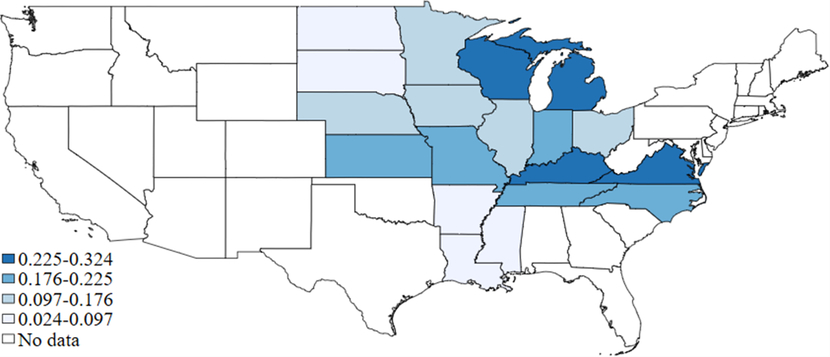
State-level maps with predicted probabilities (model: states dummies).

6. Conclusion
Reducing nonpoint-source pollution from agriculture into water resources is important. Cover crops can be a solution that not only reduces nonpoint-source pollutants but also improves soil health and provides other benefits, which can have positive effects on yields of cash crops. Thus, cover crops can be a win-win practice for farmers as well as the environment. Our results provide evidence that there are a number of barriers to adoption that vary with climate and farming system.
The adoption rate of cover crops is still low, especially in regions with a short growing season, because of the small window for seeding cover crops after harvest of cash crops. In addition, most farmers plant cover crops after harvest of their cash crops, which is one of the busiest times for farmers. In this situation, farmers may not be able to seed cover crops because of limited labor/time. Nevertheless, some states such as Michigan have higher adoption rates, so shorter growing seasons may be overcome. Researchers have been working on cover crop interseeding to enable planting of cover crops before harvest (Wells et al., Reference Wells, Hard, Ristau and Nicolai2016). However if farmers seed cover crops too early, it could cause cash crop yield reductions because of competition for nutrients or water before harvest (Uchino et al., Reference Uchino, Iwama, Jitsuyama, Yudate and Nakamura2009). Our results also highlight the small but significant effect of higher precipitation, using county-level data. Management of cover crops in dry regions is complex because if not terminated early enough, the cover crops may compete for moisture; however, the mulch created by cover crops can reduce water evaporation (Kaye and Quemada, Reference Kaye and Quemada2017). Another interesting finding is that some areas that would seem to have favorable conditions for cover crops actually have lower adoption rates. We think this may be because of the potential for double-cropping.
According to our results, availability of appropriate equipment for seeding cash crops, for interseeding, and for planting cash crops into cover crop residue is important. Farmers who already have diverse cropping systems and who practice conservation tillage may already have the necessary equipment. Although the effect was fairly small, participation in cost-share programs such as EQIP and CSP was associated with higher probability of adoption. Additional economic incentives may thus increase adoption rates.
However, the most important finding regarding barriers to cover crop use is the effect of the additional labor and management requirements during busy times of the year. This finding suggests that the development of less complicated and less time-consuming technologies may contribute to greater cover crop adoption. A more general implication of our research is that there is a need to consider how to create recommended cover crop approaches that take account of both differing climates and differing farming systems.
Our findings suggest some interesting future research. It would be helpful to carefully study the effect of farming systems on cover crop adoption. The farming system will affect the costs and benefits from cover crops. For instance, corn needs a longer growing season than soybeans. This affects the window in which cover crops can be planted and thus may affect farmers’ adoption of cover crops. Ruminants can benefit from forage production, but this may be more relevant for cow-calf operations. More generally, compatibility with the current farming system, including issues such as rotations and double-cropping, needs to be examined. A long-term longitudinal study could examine whether changing climatic conditions, which would increase the on-farm benefits of cover crops, would affect adoption of this practice. Complementary research to this study would examine the effect of cover crops on yields and profits under different climatic conditions and in different farming systems.
Acknowledgments
The research was partially supported by the USDA National Integrated Water Quality Grant Program number 110.C (Award 2012-03652), and by the USDA Multi-state Grant W-3190 Management and Policy Challenges in a Water-Scarce World, as well as the Missouri Agricultural Experiment Station. We appreciate the support of Mr. Brad Parks at the USDA-NASS data lab in St. Louis, Missouri.
Conflict of interest
None.


 Open access

