


1.1 Introduction: Averting Tragedy Begins with Understanding Dilemmas
The concept of “data” carries implicit promises of potential value: information, knowledge, and wisdom. Digital data’s attributes as a resource – nonrivalry, inexhaustibility, instantaneous transmission – lend themselves to assumptions that reinforce such promise: of generative, if latent, energy. This promise is expressed quite literally in the cliché that “data is the new oil,” which posits data as an opportunity for propulsive intelligence, bringing forth a new industrial revolution, this one on purportedly cleaner terms than the last, as if the “exhaust” of data systems is not pollution but rather recursive resource streams to be reprocessed into cybernetic meta-intelligence.
This promise has expressed itself in various formulations – open data, big data, blockchained data, and most recently large language models and other trappings of “artificial intelligence” – which have tended to swell, crest, and crash like waves through elite discourse and the marketing strategies of technology companies and consulting firms. Across these episodic cycles, a theme is apparent: In the shadows between promise and reality, there lurk dilemmas. Many of these dilemmas are by now quite predictable: often economic, occasionally technical, and to a certain extent even material, but above all social. Such dilemmas have confounded many efforts to use data as a resource, perhaps especially well-intentioned aspirations that instead tend to fizzle out or even result in undesirable outcomes that run counterproductive to the original purpose. By now it is almost equally clichéd to observe that, very much like oil, industrialized data systems yield toxic externalities that corrode societal trust and institutional integrity.
To the extent that there are common patterns in these effects, we can seek to understand them – and strive to perhaps overcome them. Following Elinor Ostrom (Reference Ghosh, Hess and Ostrom2007), we can ask: Under what circumstances can collective efforts avoid failure when producing and using data for some social purpose, despite the myriad dilemmas that they may inexorably face?
1.2 What Are Boundaries in Digital Resources?
Ostrom’s framework might at first glance seem like an awkward fit for digital resources, because of conceptual disjunction with the first principle articulated in governing the commons: clearly defined boundaries.
Governing a resource begins with agreement upon what is the governed resource. In the context of natural resource systems, the most significant dimensions of this principle are spatial and material: The governed resources are physical things that exist in a place. Digital resources, however, seem to invert important attributes of natural resource systems: They can be accessed anywhere, by anyone with capable equipment and connectivity, simultaneously and inexhaustibly. Furthermore, the potential value of data resources tends to increase in scale with use, as the types of use for which such data can be leveraged tend to increase over time.
In conventional institutional settings – of a private firm or public organization – boundaries around digital resources are established through the means of authority and hierarchy. The potential benefits of knowledge that is public, or at least shared, however, hinge to a significant degree on transcending such institutional boundaries.
1.3 What Kinds of Boundaries Are Relevant to Institutional Design of Knowledge-Sharing Systems?
There are at least a couple of obvious answers to the question of what kind of boundaries can be drawn around knowledge commons. First and foremost, there is the boundary of scope, which specifies the kinds of information that are managed within. Any information that falls out of scope should be, presumably, excluded. Boundaries can also be literally drawn in data flow diagrams that describe the entities and relationships in an information system; through such technical documents, designers can specify the various users, structures, and data flows that are involved in the production, management, and use of data over time.
Scope and system boundaries, however, are insufficient to describe the breadth of potential uses and users associated with digital resources, which can expand in number and kind far beyond that which was initially envisioned by a system’s architects, especially in open systems. In Levin and Beckwith’s framework (2015) of a “datashed,” the flows of data are conceived as if through a natural ecosystem, like the water cycle – but one that is easily dissociated from place and local context. This ecosystemic understanding of digital resources reveals collective action problems that are different in kind from those of natural resources – not owing to subtractability and exclusivity of the resources themselves, but rather the social and institutional relationships from which they are extracted and in which they are used. Indeed, just a few years after the dawn of the modern internet, communities of environmental planners already recognized that the rapid expansion of data-sharing capacities posed not just opportunity but also significant risks, as the “permeability of boundaries threatens to inhibit the ability for groups of people to sustain the trust needed for effective cooperation” (Van House et al. Reference Van House, Butler and Schiff1998, 341).
What kinds of boundaries, then, can delineate not just what and where a knowledge resource is, but who (among potentially overlapping sets of data contributors, data subjects, and/or data consumers) ought to have what privileges in it, toward what ends?
1.4 Knowledge Commons Are Conceptually Bounded by the Values Associated with Their Provision
This chapter argues that a key principle of institutional design for provision of knowledge resources is the explicit articulation and deliberative application of value statements.
Knowledge is inherently structured in accordance with certain values – that is, what is good? What are our purposes? What are the positive qualities that we expect as a result? What kinds of outcomes are, in turn, considered undesirable and even unacceptable?
Different parties are likely to have different answers to these questions. (Some impacted parties might never be directly involved with the knowledge production and sharing process – and likely will never have the privilege of being asked in a meaningful way.) Many of these answers can conceptually align in harmony with each other; some, however, might conflict.
In this context, value statements, then, function as a kind of boundary object, in that they enable groups of people with different perspectives to collaboratively share meaning (Star and Griesemer Reference Star and Griesemer1989; Carlile Reference Carlile2002) – in this case, by creating a normative conceptual space within which different parties’ interests can be aligned. As such, these boundary objects are of a constitutional nature: They establish the terms under which communities can make an array of subsequent collective-choice decisions pertaining to the design, promotion, evolution, and protection of knowledge resources.
1.5 The Governing Knowledge Commons Framework Adapted Ostrom’s Institutional Analysis and Development (IAD) Framework to the Analysis of Informational Resources
This claim may have been implicitly assumed by Frischmann et al. (Reference Dedeurwaerdere, Frischmann, Hess, Lametti, Madison, Schweik and Strandburg2014) as they adapted Ostrom’s IAD framework for application to the domain of informational resources. Their Governing Knowledge Commons (GKC) project was introduced with a set of research questions that can guide the empirical analysis of knowledge-sharing initiatives. One of the first questions in the GKC research framework is: “What normative values are relevant for this community?”
The GKC authors carefully noted that their own work is empirical in nature, rather than normative, “focused primarily on community goals and objectives rather than on values from higher-level social contexts or foundational ethical and moral principles” (Madison et al. Reference Madison, Frischmann, Sanfilippo and Strandburg2022, 18). For the purposes of research and analysis, this position is logical. However, as a practitioner with decades of experience in building (and defending) community-based capacities for knowledge sharing, I want to uphold a particular pragmatic principle: A community should explicitly state its core principles. There is value in the collective declaration of shared values.
In practice, these constitutional artifacts can be instrumental in the practice of institutional design and governance for collaborators who may lack technical knowledge of such processes. Likewise in research, such artifacts can guide analysis of the relationships among a community’s normative claims, collective choices, and operational processes. By naming value statements as the tools with which communities can draw normative boundaries, we make it easier to apply the Ostromian theory of institutional analysis and design to the practice of sustainable knowledge sharing.
1.6 What Are Value Statements?
Value statements are part of a family of artifacts that are often – but not always – found across organizational contexts, sometimes described (especially in the nonprofit sector) with the shorthand of “MVV” – which stands for Mission, Vision, and Values.
A vision statement describes a project’s idealized future, the utopian destination that is pointed toward by a mission statement, which describes a project’s work. Such statements are similar to statements of purpose or scope – which specify what kind of result a project intends to achieve, and what product it produces toward that end.
Value statements tend to further qualify the attributes of a project’s purpose and vision: They make normative claims about the positive qualities that animate a project – such as sustainability, accountability, accessibility, and so on. Conversely, these statements imply a set of qualities which should be avoided, discouraged, or even refused – qualities which presumably describe the status quo or the result of failure.
Principle statements may be considered distinct from and complementary to value statements. In my own practice, I posit that principles describe procedural attributes, that is, the ways a group agrees to do work. If value statements articulate the reasons “why” a group does work, principle statements articulate “how” the work ought to be done. Principles underlie working agreements and decision-making processes – specifying collective expectations such as “rough consensus and running code” (associated with early web standards initiatives such as the Internet Engineering Task Force) (Russell Reference Russell2006; see also Lessig Reference Lessig1999, 4) or “We begin by listening” (Allied Media Projects n.d.).
For the purposes of this chapter, I will refer broadly to value statements as the primary example of this broader family of normative artifacts – making distinctions when relevant, but otherwise assuming that statements of purpose, vision, values, and principles perform boundary-drawing roles that are similar enough to be considered together.
1.7 Are the Values Typically Associated with Knowledge-Sharing Initiatives Clear and Sufficient?
So far, so obvious. A reader might understandably consider value statements to be mundane, tactically ornamental rather than strategically instrumental.
And yet fully articulated value statements are not ubiquitous either. Indeed, many knowledge-sharing initiatives simply declare a value in their name – such as “Open” this and “Smart” that – without any further specification.
Close examination of these common, nominal claims reveals various problems that arise from ambiguity in and underspecification of such value statements.
1.8 “Openness” Implies that Data Can Be Accessible to Anyone for Any Number of Uses
“Open,” for instance, has been waved as a banner of progress by advocates, consultancies, and information technology contractors alike. On President Barack Obama’s very first day in office, he signed two executive orders (out of a total of three) issuing “open government” directives. Four years later, McKinsey published a widely cited report on “open data” which estimated its total potential economic benefit across sectors as amounting to more than $3 trillion.
Among just these two examples we find a diverse array of value claims: The Obama administration’s open government directives called for “transparency, participation, and collaboration” (Coglianese Reference Coglianese2009) while McKinsey focused on “efficiency” and “optimization.” The former implies purposes of public accountability and “democratization” that redistributes political agency among citizenry; the latter implies market-shaping infrastructure that can foster competition and innovation. As a signifier, open is open to all of these interpretations; sometimes, they might comfortably coexist. But such harmony cannot be taken for granted.
The hypothetical promise of democratization through openness is tested by the actual qualities of our existing political economy. While, hypothetically, anyone could use and benefit from open data, the actors who are most likely to actually use open data are not those who previously lacked access to such data. Rather, the actors who are most likely to directly benefit from open data are those who already had the means and motivation to use public knowledge to private ends. The late Michael Gurstein was a champion of the field of “community informatics,” yet when considering the value of access to open data, he observed that it is in and of itself “sufficient only to … provide additional resources to the Sheriff of Nottingham rather than to Robin Hood” (Gurstein Reference Gurstein2011).
Indeed, some of the most prominent large-scale open data initiatives have resulted in – for instance – transfers of property rights from low-income communities, or public lands, to corporate interests (McKenzie 2017).
1.9 “Smartness” Implies that Data Can Be Processed Into Intelligence – Like Fuel for an Engine
“Smart,” like open, is a similarly common value statement, with similarly problematic ambiguity. Most commonly associated with the “smart cities” meme, smart in such contexts presumably refers to intelligence that can emerge from cybernetic flows of massive data about the activities of people and things. “Smartness” seems inherently beneficial, and the word “city” implies collectivity – yet the phrase itself does not specify who, exactly, gets to be smart and attain the benefits of smartness (Beckwith et al. Reference Beckwith, Sherry, Prendergast, de Lange and de Waal2019).
Indeed, the objects of smart city discourse tend to be large-scale surveillance endeavors, established through processes that are often opaque and undemocratic (Scassa Reference Scassa2020). As Frischmann et al. observe in the first chapter of Governing Knowledge Commons (2014):
The “smart” character of the smart city elides the fact that resident identities and behaviors are necessarily abstracted in smart city processes in the conversion from their material origins to their digital representations. That makes these digital representations controllable, shareable, and analyzable in ways that living humans being often are not. It also makes it easier to keep the collection and manipulation of the data hidden from the people that the data represent.
Observing this trend in which “smartness” is often used as justification for efforts that enclose knowledge about communities, and privatize decision-making apparatuses about surveillance and data use, Beckwith et al. propose “stewardship” as a protective value through which communities can reassert control over their own informational resources and, in turn, preserve collective autonomy and personal dignity.
1.10 Articulating the Values and Principles of Digital Infrastructure for the Common Good
In a current working paper about “digital public infrastructure” – a concept that is implicitly posited as a corrective to the ambiguous framing of “smart cities” and “open data” – Eaves and Mazzucato (Reference Eaves, Mazzucato and Vasconcellos2024) assert that the concept of “public value” must be carefully specified in order to ensure that information systems that serve the public are created and governed for the “common good.”
Toward this end, they make a distinction between two frames for understanding the values imbued in sociotechnical systems: the frame of “attributes” that describe the technical design of such systems, and the frame of “functions” that describe their societal purpose and benefits.
As an example of this distinction, consider the complementary difference between the FAIR Principles and the CARE Principles.
1.11 The FAIR Principles: Setting Boundaries Around the Technical Attributes of “Openness”
The FAIR Principles (Findable, Accessible, Interoperable, and Reusable) describe specific attributes that qualify the “openness” of data (Wilkinson et al. Reference Wilkinson, Dumontier and Aalbersberg2016). Each such attribute is further defined in substatements with principles by which open data can be made useful at scale – such as metadata with relevant attributes, unique and persistent identifiers, and detailed provenance.
These principles are technical and tactical – offering standardized criteria for production of data that is useful. This concretizes the meaning of “open data” as that which is specifically designed to be shared and used across many technologies and contexts.
Despite its name, however, the FAIR statement makes no normative claims about the purposes for which open data might be used – fairly or otherwise. The boundaries of openness are drawn around a set of objective questions pertaining to data formatting, publication, and licensing.
1.12 The CARE Principles: Setting Boundaries Around the Normative Dimensions of Data Practices
The CARE Principles, by contrast, describe the positive functions of shared data: CARE – which stands for “collective benefit, authority to control, responsibility, and ethics” – describes the circumstances in which environmental, communal, and personal data can be collected and used for beneficent purposes (Carroll et al. Reference Carroll, Garba and Figueroa-Rodríguez2020).
As such, these principles draw a standardized set of normative boundaries around the purposes of data sharing, especially that which involves Indigenous people and/or the environmental resources that they steward. In Eaves and Mazzucato’s terms, these are functional values that complement the FAIR Principles’ technical attributes.
1.13 “Diversity, Equity, and Inclusion”: Attributes of Pluralism
Similar analysis can be applied to the common triad of “diversity, equity, and inclusion” (DEI) value statements. Democracy presumes equality among citizens – but in a world in which the boundaries and terms of citizenship are compromised in various ways by racism and wealth inequality, the attributes of democracy must be further qualified. The values of DEI are commonly posited in recognition of the otherwise-invisible power structures within and around institutions, as a declaration of commitment to strive to avoid the default states of hegemonic whiteness and capitalist disenfranchisement of those who do not have such claims to hegemonic power.
As with openness and smartness, however, DEI does not fully describe the functions to which these attributes are applied. Does inclusion of individual people of color in an organization’s board – and, in turn, equitable remuneration of those persons – in and of itself mean that the organization serves a broader democratizing function in a diverse society? Perhaps not. Without further qualification, we can expect the interests of capital to be served often in ways that conflict with the interests of people and the public.
Functional values would specify the ends to which DEI serves democratic purposes. By answering the question what are the results that we value? a community can qualify what it would look like to achieve diverse, equitable, and inclusive results.
1.14 Examples of Value Statements in Action
For digital infrastructure processes that are committed to the maximization of the common good, Eaves and Mazzucato (Reference Eaves, Mazzucato and Vasconcellos2024, 18) assert that “a combined functional and attribute perspective is desired.” They acknowledge, of course, that such common good will not be maximized simply through the act of articulating these values of functional purpose and technical attributes. Instead, this synthesis must be enacted through governance.
With just a brief glance at some examples, we can see what it looks like to apply values as boundaries in practice. These examples display a range of conditions on access to data – from partially open, to conditionally shareable, to entirely closed – that reflect values which have been intentionally prioritized over “openness” and “smartness.”
1.15 The International Union for Conservation of Nature Red List: Weighing Openness Against Conservation
The International Union for Conservation of Nature (IUCN), for instance, is a global authority on ecosystem science. The IUCN’s Red List compiles granular data about the location and concentration of plant and animal species. This data is essential for conservation efforts, and the IUCN’s purpose is for public education – so an abstracted level of the data is intended to be “open” (in the sense of the FAIR principles) as a public knowledge resource. However, this data can also be useful for poaching efforts that target specific species. This is to say that there are tensions between the values upheld by the IUCN’s mission.
As a result, the more granular levels of data in the IUCN’s Red List are only available on request, under a licensing agreement that requires adherence to a stated function of conservation. The value of conservation is first established as a norm, reinforced by trust-building processes and, ultimately, rules. None of these steps can entirely prevent bad actors from conceivably repurposing this data for poaching purposes, but they can mitigate such risks – and establish the necessary preconditions for remediation.
1.16 Te Mana Raraunga’s Consent-Based License
Te Hiku Media is a cultural initiative that has recorded and annotated hundreds of hours of spoken Māori language. This data is an essential input for the development of technologies that could serve iwi communities such as speech-to-text tools. Before sharing this cultural data trove on the internet, however, Te Hiku Media first designed and assigned a special license, the Kaitiakitanga License. This license is not premised on openness, but rather consent. The license requires that any project which uses the data must directly benefit the Māori people, subject to their approval.
In describing the rationale for this license, Te Hiku Media cites Te Mana Raraunga (n.d.), a network of Māori technologists that advocates for tribal sovereignty in matters pertaining to digital information about Māori people, language, culture, resources, and environments. Their statement of principles specifies Authority, Relationships, Obligations, Collective benefit, Reciprocity, and Guardianship (as translated from Māori language).
Accordingly, this license reinforces these boundaries around local knowledge, in defense of autonomy against more powerful private interests that might otherwise use open geographic, linguistic, and cultural data to facilitate a new wave of tribal dispossession.
1.17 Mapping Palestinian Jerusalem: Weighing Openness Against Justice
In another example, Public Lab worked with Palestinian communities to produce a participatory map of the urban environmental attributes of their neighborhoods in Jerusalem. Public Lab’s mission specified the production of shared outputs – by which they typically meant open hardware, open-source software (such as MapKnitter, the tool used in this project), and open data – but this project’s output was never published online in any format. This decision was made in order to protect the communities involved in its production. As Public Lab’s leadership codesigned this project with Palestinian community leaders, they articulated values for the project that included “justice” and “sovereignty,” which participants noted were directly in tension with “openness” in this context.
“Maps are so political,” says Public Lab co-founder Liz Barry, reflecting on this project years afterward. “They are objects of power at the same time as they are objects of science. Open data isn’t a universal good when its subjects are vulnerable. They may be producing data about themselves so that they can have more agency to determine their own fate, but that same data in other hands could enable outsiders to gain power and dominate them” (personal correspondence; see also Rambaldi et al. Reference Rambaldi, Chambers and Fox2006).
1.18 Why This Matters: Wishful Words or Design Parameters?
Just as a natural resource system does not resemble the simplistic “commons” of Garrett Hardin’s thought experiment (just a field, barren of any social context), a knowledge commons is more than just a dataset (Hardin Reference Hardin1968). Knowledge commons include systems of collective choice-making about what kinds of data will be collected, what kinds of data are considered useful, how data is made available. We make these choices in accordance with our values.
Of course, we know that any given institution’s declared value statements will not necessarily inscribe all of the values that drive the collective choices of a community, much less the actions of the individuals within it – as with Ostrom’s distinction between rules-in-form and rules-in-use, what is written down does not necessarily correspond with what actually happens (Ostrom Reference Ostrom2005).
And yet value statements can serve as the cornerstones of institutional design – shaping a conceptual container from which new norms can emerge, and with which collective choice-making processes can be steered toward congruency in rules and equitability in outcomes.
1.19 Common Objections to the Articulation of Values
Yet I often come across projects that seem to lack any such statements, or that have never bothered to apply or update them after their initial formative stages. In my experience, proposals to draft value statements, or revise them, tend to meet with resistance.
This resistance typically takes the form of some combination of the following reasons:
First, different people may have different values, so communities might be reluctant to exclude any particular group.
Second, value statements can be interpreted in different ways by different people, which leads some to conclude that such statements are useless or, even worse, may foment uncertainty and friction.
Third, value statements are in and of themselves unenforceable – and therefore are considered performative artifice rather than instrumental artifact.
Finally, value statements are assumed to be difficult to articulate in a democratic process.
The rest of this chapter will address each of these concerns. In order, I will observe that value statements can help to establish a community’s identity, and subsequently apply this identity to the process of coping with dilemmas that naturally emerge among members with diverse interests; as such, value statements are instrumental in even if insufficient for good governance; and, finally, these statements are quite practical to draft without getting mired in endless procedural contention. I will conclude by offering pragmatic guidance for developing and applying value statements in open knowledge communities.
1.20 Values Can Shape a Group’s Identity: Excluding Behaviors, if not People
Different people have different values, and sometimes these values can be in tension with each other. So the concern is that a given set of values might exclude some people from a resource that is meant to be universally shared. This, however, is precisely a reason to articulate values: By specifying those values that are of presumably universal benefit and appeal, a community can delineate between those interests of its members that are held in common, and, conversely, those that may not be served.
As boundary objects, these artifacts create the space in which collective goals can emerge. Practically speaking, this can facilitate the formation and growth of a knowledge-sharing community by signaling trustworthiness to prospective contributors. By clearly articulating the good qualities associated with a knowledge-sharing initiative, the initiative can more easily attract participants and provide them a shared sense of identity.
In my own experience, this process can even shift the dynamics of competition in markets that otherwise risk failure. By articulating a shared purpose, and involving market actors who might feel accountable to that shared purpose (given its alignment with their brand, mission statement, etc.), value statements can imply the threat of a reputation cost to those who might not participate, because such nonparticipation may signal a rejection of these values.Footnote 1
1.21 Value Statements Enable the Generation of “Normative Knowledge” for Coping with Dilemmas
While shared data is the basis of “descriptive knowledge” produced by an informational commons, shared values are the basis of “normative knowledge” – about the purposes of such information, and the prospective risks that may be associated with it. Of course it is true that the same statement can be interpreted differently by different people (each of whom might have different secondary values, as acknowledged earlier) (Voida et al. Reference Voida, Dombrowski, Hayes and Mazmanian2014). This diversity of meanings, however, can itself be a strength rather than a liability for a community, in that it cultivates a rich collective understanding of its own dilemmas.
As Friedman et al. wrote (2006) about Value-Sensitive Design: “Generally, the more concretely (act-based) one conceptualizes a value, the more one will be led to recognizing cultural variation; conversely, the more abstractly one conceptualizes a value, the more one will be led to recognizing universals. Value Sensitive Design seeks to work both levels, the concrete and abstract, depending on the design problem at hand.” This normative knowledge can facilitate the emergence of new kinds of norms – and, eventually, rules – by creating a shared framework for discourse and, in turn, deliberative institutional design. By establishing a rubric for articulation of trade-offs posed by dilemmas emerging from conflicts among stakeholders – including situations where different shared values are in tension with each other – communities can engage in a kind of “value-sensitive institutional design.”
With this logic, communities can more effectively coordinate activities that might constrain some individual interests in order to promote those that are shared. As such, value statements enable the emergence of other logical and ethical boundaries not just around scope but also around contributors, data subjects, uses, and outcomes. By equipping a knowledge-sharing community to describe both the common good and individual benefit using the same terms, we can translate Ostrom’s second principle – “Rules regarding the appropriation and provision of common resources that are adapted to local conditions” – from a primarily spatial orientation to a social context.
1.22 Value Statements Are Not Directly Enforceable, but They Are Useful for Prioritization
In and of themselves, value statements may not be enforceable as rules. They express aspirations. Even if a norm is essentially universally recognized, there is not any consensus as to what consequences should result from its violation.
Value statements, however, can entail attendant logics about what kinds of use are intended, and what kinds of outcomes are expected. In turn, uses and outcomes that are considered inappropriate and unsanctioned can be disincentivized, if not prohibited (Sanfilippo and Frischmann Reference Frischmann, Madison and Rose Sanfilippo2023).
Despite the limitless potential inherent in the promise of openness, there are always constraints of time and energy that require some kinds of data, and some kinds of uses, to be prioritized over others. In this way, value statements can help overcome the conceptual limitations of “open” or “smart” initiatives by specifying additional parameters for successful outcomes. Certain kinds of values such as trust and safety are essentially subtractable resources: They can be depleted by inappropriate actions. Such undesirable actions might not be entirely preventable by a given community – given the nature of the knowledge and/or the other kinds of values in a community – but the community can decide to establish processes and structures that can mitigate these risks.
1.23 Values Help Us Know What We Want to Know: How to Monitor, What to Evaluate
Values also clarify the kinds of curation and feedback that are desirable – making explicit the kinds of user inputs that are considered positive or negative. This, in turn, may have significant implications on design decisions pertaining to monitoring and evaluation of data quality. Without such normative knowledge, many knowledge-sharing projects might default to monitoring that which is easily quantifiable – number of entries, rate of growth, and so on – which does not necessarily accord with the most important aspects of the health of the knowledge ecosystem and its community of users.
How do we observe what is happening with the resource? Do we have processes for reflecting on this analysis, and acting accordingly in affirmation of our values?
Parmiggiani and Grisot (Reference Parmiggiani and Grisot2020) observe that these questions are not just asked by designers, but also through the distributed activities of administrators and users in a knowledge-sharing commons, as they engage in “situated resolution” of various kinds of problems encountered as they engage in achieving data quality, filtering the relevant data, and ensuring data protection.
“[T]he practices for assessing data quality are emergent and contextual, as well as involve stakeholders with different interests and training in data management and who actively participate in producing the data and ensuring their quality by means of several informal heuristics. Generating good quality data is thus open to interpretation and context dependent.” Parmiggiani and Grisot (Reference Parmiggiani and Grisot2020, 22) describe examples, for instance, in which satellite monitoring includes cranes in a dataset about urban trees – a kind of error that is more likely to be caught by local knowledge that can distinguish among signals such as height. “Often, these contributions remain visible to other workers on the same research site but invisible to managerial levels in the organization where data governance decisions are formally made” (Parmiggiani and Grisot Reference Parmiggiani and Grisot2020, 28). By explicitly stating values, a knowledge-sharing community can promote distributed data governance decisions as close as possible to the context in which data is gathered, verified, and used.
1.24 Democratic Writing Without Gridlock: The Advice Process
Useful value statements reflect a variety of perspectives, and as such the process of crafting them tends to benefit from a degree of democratic input (Allen Reference Allen2014). As per Ostrom’s principle of “collective choice arrangements,” truly valuable value statements are those that reflect (and can be changed in accordance with) the perspectives of the various members of a community that contributes to and uses a resource.
Effective “democratic writing,” however, does not need to be conducted by committee. Responsibility for drafting value statements on behalf of a community can be distributed through a method such as the Advice Process (Bakke Reference Bakke2013; see also the Equal Experts’ Advice Process Playbook n.d.). Through such a process, authorial power is delegated to an individual, or small group of people, with requirements to engage all interested parties in iterative cycles of review, feedback, and revision.
Before further considering these means, I should briefly address the ends: True consensus is not strictly necessary for effective democratic writing. A middle path between majority vote or unanimous agreement is concordance and consent: The result should reflect the broadest possible agreement that can be reached without strong objection. In other words, everyone does not have to totally agree with everything, as long as all are willing to live with it. This process – delegation, feedback, and consent – can enable a group to account for differences without getting bogged down by disagreement.
1.25 Identifying and Engaging Stakeholders
Assuming there is already an articulated purpose for a given project, the next step is to identify the different sets of stakeholders who are impacted by this purpose. This might include the public at large, but also should include specific groups of direct participants and indirectly impacted parties – data contributors, data subjects, and so on. With the purpose statement front and center, invite representatives of each group to share their reactions. This can be done in many one-on-one dialogues, though group discussions can generate invaluable energy and, in turn, insights. Write down what they say (and make sure to review with them to affirm you have got it right).
1.26 Articulation and Synthesis
As this process iterates, different stakeholders will likely use different vocabularies. This is OK; patterns will emerge. Look for similar statements that can be coherently grouped together under a single word or phrase: These are your contenders. Polling can help identify those which resonate the most across groups.Footnote 2 This process may benefit from cycles of expansion and convergence: generation of all possible value statements, followed by clustering, synthesis, and naming the smallest possible set of unique themes.
My personal preference for formatting value statements takes a pyramidal approach: Values ought to be expressible as a single word or phrase, and from there can be elaborated. A single word or phrase ought to be definable in a single sentence. And this single phrase with its one-sentence definition can then be elaborated in a longer paragraph that addresses the various permutations of that value across significant contexts. Such a nesting structure enables the artifact as a whole to be adapted for multiple purposes – from thumbnails to essays.
There is no rule about this, but I suggest looking for a number of value statements that can be counted on one hand. Any larger and it is hard to keep track; anyway, I would bet that among six or more potential statements, at least two will be similar in intent and can be merged.Footnote 3
1.27 Forge a Balancing Instrument
An appropriate set of values should work together as a system – like primary colors, elemental attributes, or cardinal directions. One value on its own might be insufficient and conflict with others if prioritized exclusively; together, they can form a kind of normative compass. (For instance, a value of sustainability might entail revenue-generation strategies, but these might conflict with values of equitability or accessibility; there may not necessarily be one right way to resolve these tensions, yet by naming them communities can begin to cope with them.)
The value statements should be political, in the sense that they offer a positive vision of how the world should work, though noncontroversial, in that they should be universally appealing (at least among the identified stakeholder groups).
With these values in hand, a community can continue this practice of dialogic inquiry throughout its lifecycle: In any given context, ask how a given value can be best realized, how a given set of values can best be brought into balance.
1.28 In Conclusion: A Way to Begin, and Means to Endure
In reviewing my outline for this piece, I spoke with one organizer who expressed that they had once relented in the face of resistance to this process – “There was a sense that we didn’t have time, that just doing the work was more important” – only to eventually regret it when conflicts later emerged. “Spending time to agree on these principles and values enables you to be flexible and adaptive later. It enables different people working on different things to feel committed to each other, because they share this common language.”
Through this process of elaboration, a community can both set the parameters for more complex forms of collective choice-making and engage in collective learning about the process thereof, in order to clear pathways through what might otherwise seem to be intractable dilemmas.
Value statements are of course not sufficient – not inherently binding in and of themselves, and subject to interpretation by different stakeholders with different logics that may be in tension with each other and result in conflict. For effective and sustainable collective action to steward digital resources, however, value statements may be considered practically essential – critical inputs to ongoing, iterative processes of evaluation and collective choice-making.Footnote 4
This foundation of normative knowledge can give leaders, members, and subjects alike a common framework for communication about their motivations, and about the rationale for decisions, as they navigate and negotiate across contexts. By explicitly stating its values, a community establishes an agenda for education of its members as cocreators of a shared world.
For people to effectively share an environment, they usually also must effectively share knowledge about that environment. While seemingly obvious and intuitive, this insight is often overlooked in literature about governing resources as commons.Footnote 1 Focusing on the knowledge commons associated with an environmental commons helps to illuminate a host of complex governance dilemmas. This chapter examines the interrelationship between environmental and knowledge commons, weaving together different strands of commons research and practice.
Every environmental commons has a corresponding knowledge commons that provides an essential foundation for managing the shared environmental resources.Footnote 2 We can improve our understanding of an environmental commons by investigating its associated knowledge commons.Footnote 3 In addition, our prescriptions for environmental commons governance should account for the relationship between an environmental commons and its associated knowledge commons and for the challenges of creating and maintaining an associated knowledge commons.
The knowledge commons associated with an environmental commons includes a diversity of knowledge relevant to the environmental commons. At a minimum, the knowledge commons includes the knowledge necessary for a relevant community to delineate and understand the shared environmental resources, their collective relationships with those resources, and the social demand for institutionalized governance. In addition to this descriptive baseline knowledge, the knowledge commons includes managerial knowledge – that is, descriptive knowledge about the community’s relationship to the shared resources that enables the community to make ongoing decisions about how to manage the resources. This may include, for example, knowledge about how one use of the shared environmental resources affects other uses. It also may include knowledge about how to operationalize rules-in-use. At a minimum, the knowledge commons provides the type of descriptive account of the environmental commons that community members might provide first hand or that one might encounter in a conventional Ostrom-inspired case study of a commons.
Effective management requires more than just descriptive knowledge of the environmental commons. In addition, the community must make certain normative judgments about the environmental commons that are in some sense constitutive of the community itself. The community must, for example, define whose interests in the environmental commons count and who will have a voice in managing the environmental commons. And the community will have to determine other normative judgments that will guide its management decisions, such as whether the community will adhere to an egalitarian ethic or give some uses or users of the environmental commons priority over others. An understanding of these normative judgments among the community will be crucial to the ability of the community to manage the environmental commons. Indeed, to the extent that the community lacks a shared understanding of the environmental commons or of its normative priorities, this is likely to significantly impede the community’s ability to effectively manage the environmental commons. Normative disagreements about the environmental commons are likely to induce disagreements about even the descriptive knowledge in the knowledge commons. The knowledge commons thus plays an important role as a venue for communicating, contesting, and negotiating normative judgments and governance decisions about the environmental commons. Because the knowledge commons is crucial to managing the environmental commons, conflicts about managing the environmental commons will often manifest themselves in conflicts in the knowledge commons.
As Figure 2.1 illustrates, the relationship between an environmental commons and its associated knowledge commons is bidirectional. The physical, social, and political characteristics of the environmental commons generate the knowledge that constitutes the associated knowledge commons. In this sense, the knowledge commons depends deeply on the environmental commons. But humans understand the environmental commons through the lens of the knowledge commons, and governance of the environmental commons therefore requires the knowledge commons to inform decision making about the environmental commons. The bidirectional relationship creates an interdependency between environmental commons governance and knowledge commons governance. Controversies in environmental commons governance are likely to cause controversy over the knowledge commons, and vice versa.Footnote 4
The knowledge commons–environmental commons relationship.
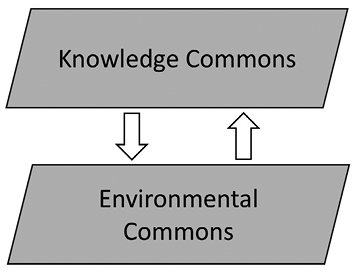
Figure 2.1 Long description
Diagram has two slanted rectangular blocks, the upper one labeled Knowledge Commons and the lower one labeled Environmental Commons. Between them are two arrows: one pointing downward from the upper block to the lower block, and one pointing upward from the lower block to the upper block. The layout illustrates a reciprocal relationship between the Knowledge Commons and the Environmental Commons.
Recognizing the existence of knowledge commons associated with environmental commons, and the role of knowledge commons in managing environmental commons, yields at least three important insights. First, to understand environmental commons, we often will have to study their associated knowledge commons.Footnote 5 Second, because normative judgments are embedded in the knowledge commons, understanding the relevance of knowledge commons to environmental commons also highlights the role of normative judgments in what otherwise may be assumed to be objective information about the environmental commons. Understanding knowledge commons as commons means recognizing that the knowledge in a knowledge commons is itself a socially determined product of governance decisions, not merely “the facts.” Third, as shared resources and potential loci of stakeholder conflict, knowledge commons present distinct social dilemmas that demand governance institutions. Ostrom’s design principles for commons, as well as the Governing Knowledge Commons (GKC), Institutional Analysis and Development (IAD), and Social-Ecological Systems frameworks, can be useful for understanding and managing knowledge commons associated with environmental commons.Footnote 6
Section 2.1 illustrates our basic points about the environmental commons–knowledge commons relationship with a simple example, the well-trodden allegory of a pasture shared by a community of herders. We extend the descriptive account of the environmental commons to show the necessary existence of a corresponding knowledge commons. Then, we illustrate the additional functions of the knowledge commons.
Section 2.2 takes the shared grazing pasture example and expands it in three deliberate steps, by adding stylized variations in the types of grazing animals and corresponding effects. Each step complicates the scenario in ways that present different governance challenges and depend upon different knowledge. The final two extensions present distinct types of normative complications that present additional demands on knowledge institutions. One involves interaction effects that force a normative choice about priorities among uses of the shared resource, and the second involves external effects that extend beyond the community and shared resource system itself; these are like an extraterritorial effect. Whether or not, and to what extent, a community cares about such effects is a sociopolitical consideration about priorities.
The highly stylized examples in Section 2.1 and Section 2.2 are merely illustrative. In lieu of a pasture, we could present similar stylized examples and variations using a different shared natural resource, such as a lake or woodland, or even a built environment, such as a road system, computer server, or living room. By illustrating different types of social dilemmas and governance challenges, we hope to provide a bridge between the environmental commons and knowledge commons. Essentially, we show how governance of the environmental commons depends upon the knowledge commons, and how, as the scale, scope, and heterogeneity of the environmental commons increase, the complexity of the knowledge commons increases as well.
Section 2.3 applies the insights developed in Sections 2.1 and 2.2 to a series of examples. We open with an example of a natural environment (forest management) and then turn to two examples of built environments (road systems and living rooms).
Section 2.4 builds on the insights from these examples to begin to address questions of how attributes of environmental resource commons affect their associated knowledge commons, and how to govern knowledge commons so that they can support better governance of environmental commons.
In conclusion, we propose additional research both to retrospectively mine past case studies of environmental commons to highlight the often-hidden knowledge commons at work and additional case studies of more complex commons that may raise more complicated and nuanced issues with respect to the environmental commons–knowledge commons relationship. Overall, this is an area rich with opportunity for additional theoretical and empirical inquiry.
2.1 A Stylized Exploration of a Classic Environmental Commons and Corresponding Knowledge Commons: Herding Sheep on a Shared Pasture
Assume an environmental resource, such as a meadow (natural) or highway (built), that is shared freely without restriction. That is, assume the resource is presumptively open to all-comers and there is no mechanism for coordinating the actions of resource users. Consumption may initially be nonrivalrous, if, for example, the population is small relative to the capacity of the resource, but it may turn rivalrous over time.Footnote 7 The resource may be depleted and even destroyed entirely, as individuals rationally decide to use the resource at a rate and in a manner that maximizes private gains but disregards the effects that such use has on other users or more generally on the sustainability of the resource. Here is how Hardin (Reference Hardin1968, 1244) famously explained it:
Picture a pasture open to all. It is to be expected that each herdsman will try to keep as many cattle as possible on the commons…
As a rational being, each herdsman seeks to maximize his gain. Explicitly or implicitly, more or less consciously, he asks, “What is the utility to me of adding one more animal to my herd?” This utility has one negative and one positive component.
1) The positive component is a function of the increment of one animal. Since the herdsman receives all the proceeds from the sale of the additional animal, the positive utility is nearly +1.
2) The negative component is a function of the additional overgrazing created by one more animal. Since, however, the effects of overgrazing are shared by all the herdsmen, the negative utility for any particular decision-making herdsman is only a fraction of −1.
Adding together the component partial utilities, the rational herdsman concludes that the only sensible course for him to pursue is to add another animal to his herd. And another; and another…. But this is the conclusion reached by each and every rational herdsman sharing a commons. Therein is the tragedy. Each man is locked into a system that compels him to increase his herd without limit – in a world that is limited. Ruin is the destination toward which all men rush, each pursuing his own best interest in a society that believes in the freedom of the commons. Freedom in a commons brings ruin to all.
Hardin recognized two potential solutions to this type of social dilemma: government regulation and privatization. Both rely on collective action through governmental institutions to introduce constraints on resource consumption. Government can constrain consumption by directly managing or regulating use of the shared resource, limiting consumption to sustainable levels. Alternatively, government can create a system of private property rights delineating ownership of the resource, which supports incentives for conservation by internalizing the externalities of resource use. The approaches differ substantially in terms of the manner in which ongoing (month-to-month, day-to-day) resource allocation decisions are made. Both effectively eliminate the commons and replace it with a different governance regime.Footnote 8 Notably, although not explicitly described in most accounts of commons, including Hardin’s, both governance approaches require a body of knowledge about the resource that is accessible to those managing the resource, whether government officials or private owners.Footnote 9 This knowledge includes an understanding of the resource itself, but also an understanding of the relationships between users and the resource and of the normative judgments underlying management of the resource.
Elinor Ostrom challenged Hardin’s frame by asking two foundational sets of questions: First, how well does the tragedy of the commons allegory describe reality? Does the allegory accurately predict real-world behavior of individuals sharing common-pool resources? Second, does the allegory provide a useful basis for choosing or designing management solutions? Are the governance options limited to government command-and-control regulation and private property-enabled markets? (Frischmann Reference Frischmann2013).
As to the first set of questions, Ostrom posited that reality is much more complicated and nuanced than Hardin’s simple allegory suggests, in ways that are important to managing resources. Ostrom (Reference Ghosh, Hess and Ostrom2007; 1990) identified many ways in which Hardin’s allegory was overly reductionist and distorting, so much so that it could “lead the analyst to miss what is most important and focus on what is least relevant” (Frischmann Reference Frischmann2013, 390). In other words, Hardin’s allegory itself presented a knowledge dilemma.
Hardin conflated resource and governance by referring to the shared pasture that was openly accessible to all-comers as the commons, which then, on certain strict assumptions, was doomed to tragedy. But the resource (e.g., pasture) is distinct from the governance regime (e.g., open access, commons, government regulation, private property enabled market) that manages it. The term “commons” describes a form of governance, not a type of resource. Furthermore, a resource managed as a commons is not necessarily subject to open access. Commons involve “institutionalized sharing of resources among members of a community,” but not necessarily with nonmembers or the general public (Madison et al. Reference Madison, Frischmann and Strandburg2010, 841).
As to the second set of questions, Ostrom argued that effective cooperative management is theoretically and practically feasible. Natural resource commons can be effectively managed as commons and therefore are not doomed to suffer tragedy and need not be eliminated. Community management, social norms, and other related institutions can and often do outperform government regulation and privatized market arrangements.Footnote 10
How to effectively govern shared resources as commons has been a core interdisciplinary research question for decades. The provisional answer is that effective commons governance depends on the context and community. It also depends, we argue, on shared knowledge.Footnote 11 Based on extensive fieldwork, Ostrom proposed the following design principles:
1. Define clear boundaries for the community and shared resources.
2. Tailor appropriation and provision rules to local needs and conditions.
3. Enable those affected by operational rules to participate in modifying the rules.
4. Ensure monitors are accountable to (or are) the appropriators.
5. Use graduated sanctions for rule violators.
6. Provide accessible, low-cost means for resolving conflicts.
7. Make sure external authorities recognize and respect the rule-making authority of community members.
8. When part of larger resource systems, build responsibility for governing the common resource in nested tiers.
These offer useful, albeit broad, guidance. Notably for our purposes, each principle relies substantially on shared knowledge – for example, how different rules would affect use of a resource, or whether different possible sanctions might deter potential rule violators. The design principles promote effective governance because they help individuals understand their capacity to cooperate in self-governance, which in turn depends on a shared base of knowledge about the resource and the community. Ostrom recognized this, albeit sometimes only implicitly and indirectly. Ostrom explained how the credibility of the design principles as an explanation of persistent, and thus effective, commons governance depended on showing that the design principles affected incentives of community members and perpetuated across generations. Both of these impacts – incentivization and perpetuation – require internalization and transmission of knowledge.Footnote 12
To illustrate how environmental commons are inexorably linked to knowledge commons, let us return to Hardin’s stylized allegory of a pasture shared by a group of sheepherders. For the herders to manage the pasture as a commons, they need to share some knowledge about the pasture and about themselves as a community. For our sheepherders, that knowledge may be as simple as understanding that other sheepherders are using the pasture to graze their sheep and that the pasture’s capacity to sustainably support grazing is limited. Conceivably that knowledge alone could be enough to lead the herders to limit their use of the pasture for their common benefit.
More sophisticated management of the pasture may require more knowledge. The herders would benefit from recognizing themselves as the group of individuals that is mutually dependent on the pasture. It also would be helpful if they have a technical understanding of the pasture and the effects of grazing on the pasture. Beyond such technical knowledge, the herders have certain normative understandings of themselves as a community – for example, whether their access to the pasture is presumptively equal or whether some herders have priority over others, or whether the pasture should be managed for short-term benefit or long-term benefit, and whether anyone else other than the herders should have a say in managing the pasture. If there are any rules governing use of the pasture, the herders need to know them. Perhaps the herders should consider whether the pasture should be used for grazing or instead for other uses, such as cropland, hunting, or natural preserve. It is also helpful, albeit not necessarily essential, if the herders communicate with each other about these areas of knowledge and share a common understanding.Footnote 13 In short, to relate this discussion to the IAD and GKC frameworks, the herders must have some shared understanding about the action arena within which they operate, and this requires shared knowledge about the biophysical characteristics, attributes of the community, and rules-in-use.
To be clear, this common knowledge need not be perfect, in the sense of being comprehensive, fully accurate, or universally agreed upon. The herders may disagree about the carrying capacity of the pasture, about whether grazing rights should be allocated equally among herders, or about who has the right to graze on the pasture. Differences of opinion regarding management of the pasture may well manifest in differences of opinion as to the relevant knowledge about the pasture. The more accurate and agreed upon the knowledge is, however, the better the knowledge can motivate and support cooperation via community governance. Given an opportunity to communicate (and not artificially forced into a one-shot prisoner’s dilemma), the herders may be able to develop, share, and act upon such common knowledge.Footnote 14
Despite the centrality of knowledge to commons governance, we, as analysts or storytellers about environmental commons, tend to presume that a knowledge commons functions effectively in the background but generally do not focus on the knowledge commons as a subject of our analysis or story.
Suppose our group of sheepherders agrees about the collective need to constrain use of the pasture according to a set of agreed-upon rules. The pasture, they realize, can become overcrowded with sheep, causing deterioration. Assume each sheepherder uses the pasture similarly and that the sheep graze similarly. The social dilemma they face is thus what economists call an “anonymous crowding” (congestion) problem because using the pasture in this scenario entails homogeneous uses (Cornes and Sandler Reference Cornes and Sandler1996, 355). The attributes of individual users (herders, sheep) do not matter for the purpose of making the rules for the pasture. What matters is the overall capacity of the pasture, the overall number of sheep grazing in the pasture, and the rate (intensity) at which the sheep are consuming the pasture grass. It follows that effective governance in this situation requires some knowledge about each of these parameters. Such knowledge informs the primary governance decision about allocation rules for the pasture, which may boil down to simple rationing – that is, how many sheep can each herder graze, and for how long.Footnote 15
Game theory models and common knowledge. The tragedy of the commons has been modeled in game theory as a prisoner’s dilemma. While the model predictably leads to defection and tragedy, Ostrom emphasized how real-world scenarios rarely fit the model (Frischmann Reference Frischmann2013, 390–392; Ostrom Reference Ghosh, Hess and Ostrom2007, 15183). Once communication among players and/or repeated interactions among players is allowed (rather than assumed away), cooperation is much more likely. Notably, to talk meaningfully about available moves, strategies, and consequences – i.e., the “payoff structure” in game theoretic terms – requires some base level of shared understanding, which in turn implies the existence of knowledge commons.
If the sheepherders are committed to governing their shared pasture as a commons, rather than resorting to other governance regimes such as government command-and-control or privatization, then a corresponding knowledge commons dilemma also arises.Footnote 16 Essentially, the community of herders must generate and share the knowledge needed to govern its environmental commons. The herders may need, for example, to develop an understanding of consumption patterns and long-term impacts. Understanding the need for such information, the herders may create the knowledge commons intentionally through planning and study. Alternatively, the knowledge commons may arise informally and unintentionally as individual herders debating governance options share their experiences with the pasture and what they have observed about the effects of grazing.
The relevant information in the knowledge commons may develop through consensus, or it may be hotly contested among stakeholders. Conflicts may arise over how to frame risks, resolve uncertainty, or deal with contested knowledge. Heuristics, biases, and other psychological and sociological phenomena may challenge the commonality of the knowledge commons. Or, by contrast, the herders may govern the knowledge commons in ways that reduce conflict and build consensus about how to manage the pasture. They may, for example, agree to defer to the judgment of an appointed person – someone known and trusted by the community, or an outside expert – as to the carrying capacity of the pasture.
Regardless, our point is simply that even the most basic environmental commons requires joint effort toward the generation, curation, and sharing of knowledge about the environmental commons. This is implicit in Ostrom’s first three design principles, which focus on defining the resource and the community, finding rules that reflect local needs and conditions, and enabling participation to change rules.
Ostrom’s other design principles also depend upon developing and communicating shared knowledge – among community members, with outsiders, and as integral parts of governance institutions (e.g., sanctions, dispute resolution). Suppose, for example, that our community of sheepherders agrees on a system for allocating grazing rights among themselves. Effective governance will require monitoring and tracking compliance with these rules-in-use.Footnote 17
The quality of an environmental commons – its value to the community – depends on the effectiveness of the community’s governance. Like an environmental commons, a knowledge commons also may need active management to serve its function of informing decisions about the environmental commons. Left unmanaged, problems of inaccurate knowledge and lack of access to knowledge may dominate the knowledge commons. The absence of definitive information about transmission of the COVID-19 virus, for example, deprived public health experts of a consensus of information on which to build norms of mutual protection. Because effective environmental commons governance requires a well-functioning knowledge commons, effective environmental commons governance therefore will require an effective strategy for governing the associated knowledge commons.
So far, we have described the environmental resource as if it only generates outputs – here, grazing areas for the herders’ sheep. This view implicitly presumes the pasture is natural.Footnote 18 Of course, it is not. The pasture itself is a social construction, involving a reshaping of the natural environment through particular human activities. Rather than a pasture, it could be many other things.Footnote 19 Further, consider how the community contributes inputs that affect the environmental resource as well as complementary goods that affect how community members interact with the resource and each other. Herders may, for example, create trails in the pasture, construct a fence around the pasture, or build a place to sit while the sheep graze. The benefits of these inputs and complementary goods inure to the herders who invest in them, but also to all other herders as well. This creates a potential problem. Users of shared resources may be disinclined to invest in contributions that would add value to the resource system without any confidence that they, as opposed to other users, will be able to enjoy the fruits of their efforts. A herder may not bother to build a place to sit, for example, even though other herders would also enjoy sitting there and benefit from the first herder’s efforts.
Similar issues arise for knowledge resources, which often function as inputs and complementary goods and face incentive issues rooted in concerns about free riding. Take, for example, information about areas of the pasture that are especially good for grazing. A herder with knowledge of the best grazing areas may be disinclined to share that information with other herders because sharing the information will not benefit, and may in fact disadvantage, the first herder. Similarly, a user may be disinclined to invest in contributing potentially valuable information to the knowledge base because other users will take advantage of the information, without benefit (and potentially with detriment) to the first user. For example, a herder may be disinclined to invest the time to survey the precise boundaries of the pasture because the cost of surveying the pasture outweighs the benefits to the herder, not taking account that the survey would be valuable to other users as well.
Yet in some cases, unlike a conventional environmental resource, information will be more advantageous to the user if other users have access to it. For example, if the pasture is generally believed to support only grazing by 200 sheep, but one herder who would like to have more sheep has information (or an innovation) supporting the idea that the pasture actually can sustainably support grazing by 300 sheep, it is in that herder’s interest first to invest in contributing that information to the communal knowledge base and second to make that information accessible to the other herders. Thus, here the incentives have reversed. The presence of other herders gives the herder more, rather than less, incentive to invest in contributing the information to the communal knowledge base and to make the information accessible to others. Managing a knowledge commons effectively requires taking into consideration the different incentives that members of the community will have to contribute to, or hinder, the accumulation and distribution of information about the environmental commons.
2.2 Extending the Stylized Exploration of Classic Environmental Commons and Corresponding Knowledge Commons: Herding Sheep and Other Animals on a Shared Pasture
We now build from the sheepherding example and expand it in three deliberate steps, by adding stylized variations in the types of grazing animals and corresponding effects. At each stage, varying the facts has implications both for the environmental commons and the associated knowledge commons.Footnote 20
Even prior to undertaking the challenge of managing the pasture as a commons, the community must make certain foundational decisions. The herders and perhaps others must decide, either individually or collectively, that they want to use the land as a pasture rather than for other purposes, such as homesites, a forest for harvesting timber, cropland, or recreational uses. This decision presents a governance dilemma, which requires both descriptive and normative knowledge for the community to address. Descriptively, the community must understand the land in question as a potential pasture site. Ideally but not necessarily, the community also will have some knowledge about other potential uses for the land, and the relative advantages and disadvantages of each alternative use. Normatively, the community must define who may participate in the decision about how to use the land and the process for making that decision, as well as the criteria the community will apply in deciding among alternatives. Like the use of the land itself, contributions of information to the knowledge commons are likely to occur strategically. A proponent of using the land as cropland, for example, may publicize the benefits of cropland and the disadvantages of other potential uses. How the community creates and manages the knowledge commons may effectively decide how it decides to use the land, such as if the community envisions land use as a matter of tradition and the land has traditionally been used as a pasture. Or the knowledge commons may play a supporting but not defining role in managing the environmental commons. The ability of the community to decide the best use of the land will depend in significant part on whether it is able to generate a robust and diverse knowledge commons on which to base its decisions about the land.
Turning to management of the land as a pasture, in the first scenario, described in Section 2.1, a community of sheepherders shared a pasture and governed it (and themselves) as a commons. Grazing sheep on the pasture gave rise to a potential social dilemma that can be framed as an anonymous crowding congestion problem. Managing congestion and avoiding tragedy required the community to determine rules-in-use regarding grazing and to monitor compliance with and to enforce the rules. The management decisions that created and implemented the rules depended on the existence of a shared body of knowledge, with both descriptive and normative components, about the pasture and the herders’ relationship to the pasture and to each other. Thus, this natural resource commons is accompanied by an associated knowledge commons. We also highlighted potential social dilemmas concerning incentives to invest in public goods (whether inputs or complementary goods) that contribute to the environmental and knowledge commons.
2.2.1 Herding Sheep and Goats on a Shared Pasture: Knowledge Concerning Heterogeneous Uses
Now suppose our community of herders share the same pasture but some fraction herd sheep and the rest herd goats. Thus, we are shifting from homogeneous use to heterogeneous uses, albeit still within a rather narrow scope (herding livestock). Assume that the only relevant difference between sheep and goats for purposes of managing the shared pasture is the rate at which the grazing animals consume the resource.Footnote 21 On these stylized facts, the addition of goats presents a complication for rules-in-use concerning allocation and tracking.Footnote 22 The herders will have to decide whether and how to factor the differences between sheep and goats into the rules-in-use.
The additional complication for rules-in-use for grazing creates complications for the associated knowledge commons as well. The herders will have to understand the different rates of consumption and will have to track sheep and goats separately. They also will have to communicate with each other about whether and how the differences between sheep and goats should influence the allocation rules. Yet the move from the base scenario in Section 2.1 to this variation does not necessarily present a substantial challenge, either for governing the pasture or for developing the underlying requisite knowledge commons, so long as the only difference between sheep and goats is in the rates of consumption.
There could be complications, and even conflict, in distinguishing animal types and measuring consumption rates, and dealing with such complications could put pressure on the knowledge commons institutions. Herders may engage in strategic behavior to game rules-in-use by, for example, selectively highlighting information favorable to their interests in discussions over management of the pasture. Nonetheless, if the only difference between sheep and goats is their rate of consumption, the information challenges for the shift from sheep to sheep and goats primarily concern descriptive and managerial knowledge similar to the initial sheep-only scenario.Footnote 23
We can extend this scenario along similar lines, for example, from 2 → 3 → … → n different types of animals, which would complicate matters mostly in terms of accounting. Creating and maintaining a knowledge commons is costly to the community. As the number of types of grazing animals increases, the cost of creating and maintaining a knowledge commons sufficient to support management of the pasture increases as well. If these costs (a form of transaction costs for governing the pasture) increase enough, then they may constrain governance choices.Footnote 24 If, for example, ten different breeds of goats graze on the pasture, each with a somewhat different rate of consumption, the cost of understanding the differences between the breeds at some point may exceed the benefits of differentiating among the breeds, leading the herders to treat all goats alike even if they are not.
2.2.2 Herding Sheep, Goats, and Donkeys on a Shared Pasture: Knowledge Concerning Interaction Effects
Heterogeneity also can introduce potential interdependencies among uses, referred to as interaction effects. Some interaction effects can be positive, as when uses are complementary (mutually beneficial). Some can be negative, as in the case of interuse congestion, also referred to as cross-crowding. Various uses may interact with each other in a manner that goes beyond competition for scarce capacity. Rivalrousness may arise because a certain use raises the marginal costs for another use, reducing consumption opportunities for that use, even if the capacity of the underlying resource is not scarce. To illustrate, consider once more our shared pasture.
Suppose our community of herders share the same pasture, and they herd sheep, goats, and donkeys. Again, assume the only relevant difference in resource consumption between sheep, goats, and donkeys is quantitative (rate, intensity). This presents the same issues raised in Section 2.2.1. Now assume the following stylized fact: Donkeys and sheep don’t get along and tend to fight with each other.Footnote 25 Herding both types of animals on a common pasture would then give rise to negative interaction effects and rivalry, even if the capacity of the pasture is more than enough to support both flocks.
Interaction effects can give rise to another type of externality; individuals choosing which and how many animals to add to their flock may not account for the interaction effects and consequential impacts on other herders in the community. Again, as with the previous scenarios, this presents a social dilemma, and thus creates demand for governance, in both the natural resource commons and corresponding knowledge commons. The community must be able to describe, understand, and address the challenge of interaction effects.
Cross-crowding complicates conventional approaches to managing congestion. A sizable capacity cushion does not necessarily eliminate cross-crowding; nor does restricting total membership size of the user community; nor does congestion pricing. Interaction effects arise because of interdependencies among uses that are unrelated to scarce capacity. As a result, where interaction effects are significant, some other manner of coordination may be necessary. In particular, managing cross-crowding may entail managing the membership size of subsets of users based on the identity of their use. In the context of our stylized scenario, this would mean the community might choose to restrict (or even prohibit) sheep or donkeys.
Heterogeneity thus introduces another choice in governance, which is the scope of uses – whether to allow all types of animals or limit the range. In other words, the community may decide to (de)prioritize some uses. Importantly, this type of decision can push beyond managerial in the descriptive and technical sense and have a sociopolitical, normative dimension, much like the constitutive community decision to designate the shared natural resource a pasture rather than a recreational field, wildlife preserve, or something else.
Where two uses are interdependent in a fashion that gives rise to interuse congestion, both uses cause the congestion (Coase Reference Coase1960).Footnote 26 Cross-crowding is not attributable exclusively to one use or the other. Interuse congestion would not arise unless both uses were present. For example, interaction effects between industrial pollution and swimming in a lake are attributable to both uses, and not, as is often assumed, to the industrial use alone. Eliminating interaction effects between these uses can be accomplished by eliminating either of the two uses, or in some cases, by restricting the intensity, timing, or some other characteristic of one use or the other.
Deciding how to coordinate interdependent uses, and which use(s) to restrict, are difficult questions that must be evaluated in context. This contextual evaluation depends heavily on shared knowledge. Some of this knowledge is descriptive and similar to the type of knowledge necessary to manage the pasture for its carrying capacity, as in the first scenario. For example, it may be that sheep and donkeys only bother each other when they are in close proximity, and that problems can be avoided if they are kept apart. But other knowledge necessary for managing a pasture with sheep, goats, and donkeys is more constitutive. For example, do some grazing animals have normative priority over others? Perhaps sheep have long-standing cultural resonance in the community, and therefore the community, in managing the pasture, will give sheep preference over donkeys. This type of knowledge may be subject to debate within the community. There may be questions, for example, regarding who may speak to the community’s normative preferences.
The basic point of this subsection is to show how interaction effects can force (de)prioritization and thus trigger (additional) normative, even constitutive, decisions. In prior scenarios without interaction effects, the community did not need to choose among types of grazing animals. Of course, choosing to designate the land as a pasture for grazing animals is itself a normative decision, constitutive of the community. It is worth noting that such a decision also deals with potential interaction effects, not among types of grazing animals (uses of the pasture) but rather among land uses (pasture, cropland, recreational park, etc.).
2.2.3 Herding Sheep, Goats, and Cows on a Shared Pasture: Knowledge Concerning External Effects to Outsiders
Now suppose our herders share the same pasture, and they herd sheep, goats, and cows; let’s leave the antagonistic donkeys aside. Again, assume the only relevant difference in resource consumption between the animals is quantitative (rate, intensity). This presents the same issues raised in Section 2.1. However, now assume that grazing sheep, goats, and cows causes soil erosion that deposits sediment in the river that runs by the pasture. The sediment pollutes the river, which downstream communities use for drinking water. The sediment in the river is thus a byproduct of grazing animals in the pasture.
Some byproducts of grazing animals, such as wool and milk, are private goods that yield benefits captured by the herders, whether directly through their own use of those goods or through market transactions in which they sell those goods. The sediment byproduct of grazing animals, however, is a public bad – bad because the water pollution is harmful rather than beneficial, and public in the sense that the water pollution it causes is nonexcludable and nonrivalrous. This is a type of negative externality, yet it is a different type of negative externality than the one posited by Hardin. Hardin described a negative externality among community members, where each herder made a decision that generated unaccounted-for harm to other herders sharing the pasture. In this stylized scenario, each herder’s animals may generate both the Hardin-style externality associated with overconsumption of the shared pasture and a productive-use-style externality involving unaccounted-for harm to outsiders, meaning people who are not community members.Footnote 27
The sediment (productive use externality) scenario raises three distinct knowledge dilemmas for which knowledge commons could play a critical role. First, the community must be able to understand the new environmental problem. The harms associated with the sediment byproduct are quite different and more complex than what we have encountered so far. It can be difficult to know that the downstream effects exist, to appreciate how the harms come about, and to attribute them to individual decisions about herding animals on the pasture.Footnote 28 This additional knowledge may implicate new sources of information and new expertise.
Second, the community must recognize (or choose to ignore) the need for community governance regarding the sediment byproduct, and this entails deciding whether and to what degree the consequences to outsiders matter to the community. The political economy of such a decision depends on shared knowledge, for example, about who the outsiders are and where and when they may suffer the harms. It also depends on existing relations with other communities and whether there are intercommunity norms and governance institutions that mediate these types of relationships. A community may decide wholly on its own that it cares about the impacts on outsiders, or it may be pressured (forced) to internalize the externalities by outsiders.
Third, community governance of sediment production (river pollution) presents a different environmental commons dilemma in the sense that rationing pasture use based on resource consumption does not address the productive use externality problem. Other governance mechanisms are needed. A tax on animals, for example, could reflect the marginal external cost and lead herders to internalize the external effects of their decisions. We leave aside a more detailed comparative analysis of options, and instead note that these will generate the same types of demands for ongoing descriptive and managerial knowledge described previously.
The first and third types of knowledge dilemmas are similar to those raised in Sections 2.1 and 2.2, with the added difficulties of generating and sharing descriptive and managerial knowledge about more complex and attenuated phenomena. But the second dilemma implicates specific normative values of the community – namely, whether, to what degree, and how to care about outsiders. This dilemma is constitutive of the community’s identity – what type of community it is and wants to be, how the community regards outsiders, and so on. Of course, all normative considerations are to some extent constitutive of community identity. For example, how community members treat each other is similarly constitutive. Even treating the land as a pasture rather than a nature preserve is constitutive of community identity.Footnote 29 Our point is to highlight how knowledge commons support the social processes communities undertake to deal with these types of issues.
The stylized scenarios in this section illustrate how governance of an environmental commons depends on the associated knowledge commons, and vice versa. Moreover, as the scale, scope, and heterogeneity of the knowledge commons increase, its dynamic, constitutive functions in the associated environmental commons become both more important and more challenging. Conscious consideration of the environmental commons–knowledge commons relationship therefore can facilitate more effective governance of the environmental commons and the knowledge commons. The same combined environmental commons–knowledge commons analysis can apply to many other shared resource settings, such as traffic on roads involving cars, trucks, bicyclists, and pedestrians; uses of the internet involving streaming video, gaming apps, and social media; or even the atmosphere, involving numerous uses including aesthetics, air travel, supply of life-sustaining gases, water vapor storage and transport, pollution dumping, and heat traps.
2.2.4 Summary
In the preceding scenarios, we have shown how each governance dilemma in the environmental commons is associated with a corresponding body of information in the knowledge commons. The ability of the community to address a governance dilemma in the environmental commons will thus depend in part on the community’s ability to manage the associated knowledge commons effectively, and how the community manages the knowledge commons will influence how it governs the environmental commons. In Table 2.1, we summarize the types of knowledge necessary for effective resource governance in each scenario.Footnote 30 As the resource governance dilemmas increase in complexity, the requisite knowledge that must be available to the community increases in complexity as well. At every stage, the requisite knowledge includes both descriptive components and normative components and includes the knowledge required for prior scenarios. Thus, for example, when the herders confront the problem of congestion among sheep, they must reach a common understanding of who participates, what criteria to apply, and what process by which to decide how to limit sheep on the pasture.
| Scenario | EC Dilemma | Requisite Knowledge Descriptive | Requisite Knowledge Normative |
|---|---|---|---|
| 0 | Choice of land use (e.g., pasture, preserve, recreation) | Possible uses Consequences of uses | Who participates What criteria What process |
| 1 | Homogeneous congestion (potential externalities among community members) | Capacity of pasture Number of sheep grazing Rate of consumption Rules-in-use Monitoring/tracking use | Same as for Scenario 0 How to govern (e.g., government, market, or community) |
| 2 | Heterogeneous congestion (potential externalities among community members) | Same as for Scenario 1, but more complex | Same as for Scenario 1, but more complex |
| 3 | Interaction effects (potential externalities among community members) | Interdependency effects among uses (e.g., conflict between different species) Rules-in-use Monitoring/tracking use | (De)prioritization of uses Same as for Scenario 1 |
| 4 | Productive use externalities (potential external effects on noncommunity members) | External effects, who is impacted, to what extent, and how Mechanisms can be complex | Who matters and how much Same as for Scenario 1, but complicated by external governance structures and relations |
Although the different scenarios outlined in the table are analytically discrete, in practice the classification of a commons may be fluid and depend on judgments made within the community. For example, before the pasture can be managed for homogeneous congestion in Scenario 1, the community must decide – perhaps explicitly, perhaps implicitly – that all sheep are to be treated equally. This decision requires both descriptive knowledge about the sheep (how different are they, and in what ways) and normative knowledge about the community’s priorities (whether it wants to overlook any differences). As another example, the community may decide for normative reasons or for ease of administration to treat sheep and goats as if they were the same, even though they are not – essentially, to treat a Scenario 2 situation as a Scenario 1 situation. Similarly, if the community chooses to ignore effects outside the community, it might treat a Scenario 4 situation as if it were another type of scenario, but such a community decision is normative and could, and we suggest should, be based upon knowledge about external effects. Of course, in reality, incomplete knowledge about external effects is a persistent governance challenge.
To some extent, the interrelated environmental commons and knowledge commons resemble the interrelated governance functions that Michael McGinnis has described in his work on networks of adjacent actions (McGinnis 2011, 52). McGinnis argued that, whereas scholarship under the IAD framework often focuses on a single regulatory function, in reality, commons governance entails multiple interrelated functions, each of which “constitutes an action situation in its own right.” Complex policy settings, especially those characterized by polycentric governance, can thus be framed as networks of mutually dependent adjacent action situations, with each governance function entailing its own action situation.
Interdependent environmental commons–knowledge commons relationships, like McGinnis’s networks of adjacent action situations, highlight related commons. In some sense, environmental commons–knowledge commons relationships could be viewed as a specific type of networks of adjacent action situations. But environmental commons–knowledge commons relationships also have their own distinctive attributes. First, using the GKC framework incorporates insights from the knowledge commons literature. The GKC framework builds from the IAD framework but with substantial adaptations that account for many differences in the underlying resources, governance dilemmas, and dynamic and often constitutive relationships among resources and communities. Second, the environmental commons–knowledge commons relationship generally operates at a broader level than the network of interdependent governance functions that McGinnis describes. The information, knowledge, and beliefs that comprise the knowledge commons underlie every governance decision for the knowledge commons, and the knowledge commons itself includes numerous governance decisions and functions. The environmental commons and the knowledge commons thus each encompass their own networks of adjacent governance functions, and the environmental commons–knowledge commons relationship involves a web of relationships among specific environmental commons functions and knowledge commons functions.
2.3 Additional Examples
The stylized pasture hypothetical described in Section 2.2 offers just one example of the environmental commons–knowledge commons relationship. This section describes additional examples drawn from both natural and built physical environments.
2.3.1 Natural Environmental Example: Forest Management
Forests are a well-known example of an environmental commons subject to potential management issues of congestion, conflicts among uses, and externalities (e.g., Arnold Reference Arnold1993). Managing a forest effectively as a commons depends on an associated knowledge commons with information ranging from data about use of forests, scientific information about impacts, and shared or disputed values about forests. Government agencies such as the US Forest Service are often charged with managing forests on public lands, guided by statutes and regulations such as the National Forest Management Act that provide a general management framework.
For managing forests on public lands, the governing statute, regulations, guidance documents, and other legal decisions designate lands as a unit of the national forest system and assign certain goals and values to guide management of the lands. These decisions provide the foundation for judgments that delineate the baseline Scenario 0. Some of these decisions are made by Congress or the Forest Service at the national level, while others are made more locally. At all levels, deciding what lands to designate as a national forest and what uses and values to prioritize for the forest requires information about the range of potential uses and benefits that can be derived from the forest and the values implicated by those uses and benefits. Thus, for example, historically, the Forest Service managed its lands primarily for the purpose of timber harvesting, but eventually received a mandate to manage forests for multiple uses, including recreation and environmental benefits in addition to resource extraction.
When the Forest Service’s mission focused on timber harvesting, its management decisions focused on Scenario 1 and 2 issues of congestion and, in particular, determining how much timber harvesting was sustainable for a forest. If there was only one type of timber harvesting, this would raise issues of homogeneous congestion under Scenario 1. If multiple types of timber harvesting were in play – say, clearcutting and selective cutting – then Scenario 2 issues arise. In either scenario, the Forest Service needs descriptive information about the impacts of timber harvesting on forest productivity for future timber harvesting. Different stakeholder groups, including scientists, the timber industry, and environmental groups, are likely to have information to contribute to the understanding of how much timber harvesting a forest can sustain. Agencies sometimes employ formal mechanisms such as public comment and public meetings to elicit information relevant to their decisions. The information that stakeholders contribute is often not impartial, but instead reflects the normative priorities of the stakeholder that produces it. Thus, contestation over knowledge in the knowledge commons reflects disputes over physical resource use in the environmental commons. Having mechanisms that facilitate broad participation from all stakeholders and clear rules for how the agency treats the information it obtains through those mechanisms can increase stakeholders’ perceptions of the legitimacy of the agency’s decisions, potentially reducing conflict in the environmental commons.
Now that the Forest Service has a mission to manage forests for multiple uses, managing interactive effects among uses is an important part of its role. Some uses may conflict – for example, off-road vehicles may annoy hikers, and timber harvesting may at least temporarily displace wildlife. Other uses may benefit each other, such as when off-road vehicles use logging roads. Again, stakeholders are likely to contribute information that advances their agenda for the forest – for example, hikers complaining about the aesthetic impacts of logging.
When the Forest Service considers the positive and negative externalities of forest management, it is in Scenario 4. Logging may cause sedimentation of rivers and streams, impairing downstream water quality. Logging and recreation may contribute to the local economy, helping to sustain rural communities. To represent the broad public interest, the Forest Service needs descriptive information about these external impacts and also needs to reach an understanding of what value to attach to these different effects. Different stakeholder groups will generate relevant information consistent with their interests in uses of the forest.
In considering forests and other public lands management, we often think of the agency as a land manager, a label that indicates its responsibility for stewarding the environmental commons of the forest (or rangeland or wildlife refuge or state or national park). But these public lands managers also play an important role as managers of the knowledge relevant to stewarding the environmental commons. Debates about public land management draw on a wide variety of knowledge from various stakeholder groups. Because of the environmental commons–knowledge commons relationship, public lands managers must manage their knowledge commons well if they hope to manage their environmental commons effectively.
Public agencies often have rules and practices – some as formal laws or principles, some as informal norms – for what information and knowledge to consider in making decisions. These rules and practices should depend on the type of decision the agency is making, as indicated by our different governance scenarios. For example, if the Forest Service is deciding how much timber harvesting in an area would be sustainable (Scenario 1), this is primarily a scientific question and so scientific knowledge should be most relevant to the agency. Stakeholders will know this and attempt to cast the information they produce in scientific terms. The agency will have to evaluate the scientific merit of the potentially relevant information in the knowledge commons – for example, by assessing the methodology of the work that produced the information. By contrast, if the agency is deciding whether how to manage conflicts between off-road vehicle users and hikers (Scenario 3), it needs both descriptive information about how much off-road vehicles bother hikers and vice versa, but also normative information about how much value to place on off-road vehicle use versus hiking. For normative information, the agency has to undertake a different kind of evaluation – for example, determining the extent to which a comment represents the views of a broader group of stakeholders. The clearer and more transparent the agency can be about how it will treat different types of information, the more effectively stakeholders can structure their contributions to the knowledge commons.
Under administrative law principles, agencies often formally designate a body of knowledge and information as the administrative record on which they base their decisions. At least in theory, the agency’s decisions must consider all knowledge and only knowledge in the administrative record. Stakeholders hoping to influence agency processes accordingly vie to get their positions supported by information in the administrative record. Agency processes such as comment periods and public meetings can reduce obstacles to stakeholder contributions to the administrative record, thereby enriching the quality of the knowledge commons. Whether the agency is able to leverage a robust knowledge commons into better governance of the environmental commons is a different issue.
This brief summary conveys only the tip of the iceberg regarding the interactions of environmental resource governance and knowledge commons governance in the context of public lands and administrative agency decision-making. Further research should examine the relationship between public lands and their associated knowledge commons, and in particular how agency practices for managing public lands and agency practices for managing associated knowledge commons can mutually support each other.
2.3.2 Built Environment Examples
We now provide an abbreviated look at how the insights from the previous section would apply to some familiar examples of built environments: roads and the living room.
2.3.2.1 Roads
Roads are an important infrastructure generally managed as commons (Frischmann Reference Frischmann2012).Footnote 31 Governance of roads involves both the physical resource of the road infrastructure itself and an associated knowledge commons. The interaction of the two commons raises issues similar to the pasture example discussed in Section 2.
The baseline Scenario 0 presents the normative question of what roads to build and where to build them. Addressing this question requires considering information about the present and future transportation needs of the community, possible transportation options (which may include alternatives to roads, such as mass transit), and normative judgments about transportation as a fiscal priority compared with other pressing concerns.
Scenario 1 involves homogeneous traffic (e.g., similar-sized cars), which presents a basic congestion problem. Roads are not inevitably or always congested, but they can be, depending on capacity (supply) and demand patterns. Tolerating some congestion, especially at low levels, may be preferable or even necessary. Like the pasture, an individual vehicle’s use of a road can impose externalities on other users – once there is some congestion, each additional vehicle on the roads increases travel times for other vehicles as well. When congestion reaches certain levels, for example, for certain routes during rush hour, sustaining the roads as useful commons may depend upon rationing or congestion pricing as mechanisms for dealing with anonymous crowding. The knowledge required for a community to choose among possible policy options for managing congestion and then to implement the chosen policy tracks the analysis described earlier for the pasture. Decision-makers will need to know information about resource capacity, number of users, the rate of consumption, pattern of consumption, rules-in-use, and monitoring.
Scenario 2 introduces heterogeneous traffic, such as different types of vehicles – say, cars and trucks. This complicates the descriptive details (e.g., different consumption rates, potentially different rules-in-use) but does not alter the basic analysis.
Scenario 3 involves interaction effects, for example, among vehicles (cars, trucks, and bicycles) and among use types (vehicles and pedestrians). Rules governing access to highways generally exclude bicycles and pedestrians to avoid interaction effects; communities deploy speed bumps and other traffic calming measures on residential streets for similar reasons. In addition to the knowledge requirements of other scenarios, new challenges arise: understanding how the interaction effects work, what the types of risks are for different users and types of roads (highways versus residential), and how to (de)prioritize across contexts. Managing this additional information may require new forms of expertise and the additional exercise of political (community) judgment. Further, strategic behavior in the generation and sharing of knowledge also becomes a more prevalent concern. As may be familiar to many readers, the politics associated with deployment of speed bumps highlights how the knowledge dilemmas for knowledge commons are not simply scientific or technocratic.
Finally, Scenario 4 surfaces the many positive and negative externalities associated with roads, beyond mere congestion effects among road users. Beyond their direct benefits and costs to road users, roads enable economically and socially productive activities (among different communities) that generate positive externalities (social surplus). These positive externalities provide a potentially important justification for managing road systems as commons rather than, for example, relying on toll roads. Roads also create negative externalities such as noise and pollution that impact neighboring communities. Information about these positive and negative externalities, and normative judgments about the consequences of their impacts, are potentially important to managing the road system for the benefit of the community.
As with the pasture example, the relevant decision-makers must determine which distinctions among road users matter and which do not matter and what this means for managing road congestion. These decisions may implicate different types of knowledge. For example, whether different types of vehicles contribute differently to congestion will determine whether traffic congestion is treated as homogeneous (Scenario 1) or heterogeneous (Scenario 2). This decision primarily depends on descriptive knowledge about vehicle use and its effects on congestion.Footnote 32 Other management decisions will depend on both descriptive and normative knowledge. For example, whether to apply preferential rules-in-use to electric vehicles may depend on the number of such vehicles on the roads, but also how much the public cares about pollution from gasoline-powered and diesel vehicles.
Despite the many differences between pastures and roads, each step in the analysis for roads triggers the same types of knowledge dilemmas and challenges summarized in Table 2.1. Our analysis of roads is admittedly cursory; we could write an entire chapter on this example alone. Still, the point is to reveal the shared features and spark interest in further exploration in the future.
2.3.2.2 Living Rooms
The living room of a home provides an overlooked everyday example of an environmental commons. Living rooms raise governance issues similar to pastures and roads.
The baseline Scenario 0 presents the question of how to use a particular room in a house – for example, as an office, dining room, or living room. The baseline decision reflects a commitment to shared space, shapes the set of complementary goods and inputs (e.g., furniture, design, decoration, and lighting), and also shapes expectations and social norms regarding the range of acceptable uses of the room.
Scenario 1 conflicts over the living room would involve issues of homogeneous congestion – for example, when a large group gathers to watch television. Managing congestion requires knowing how many people want to watch television, potentially including people from outside the home; the carrying capacity of the room, which in turn depends on people’s aversion to (or preference for) crowding and seating preferences; and possible rules-in-use for managing the congestion.
Scenario 2 conflicts over the living room would involve issues of heterogeneous congestion – for example, children who take up less room on the couch than adults, or people who insist on sitting together. This requires additional information, but does not differ significantly from problems of homogeneous congestion.
Scenario 3 issues arise when different people want to use the living room for different purposes that conflict with each other – for example, when some people want to watch television and some want to read. Managing these conflicts requires additional descriptive information about the relationship between the conflicting activities – for example, how much television watching bothers readers – and also normative information about the relative weight of the activities.
Scenario 4 considers the broader impacts of how the living room is used. Perhaps noise from the television disturbs the sleep of other members of the household, or perhaps the living room can be used as a place for neighborhood children to socialize. If these externalities are important to the residents of the home, then making best use of the living room will require both descriptive and normative information about these external impacts of living room use.
Although the living room example may seem trivial (or even silly), it highlights the pervasiveness of commons governance in our everyday lives and the significance of knowledge and information to that governance. Accepted social norms and strong knowledge flows can make the living room a well-functioning environmental commons, and lack of communication can cause squabbles and divisions within the household.
2.4 Building Robust Commons Governance
So far, the discussion of the pasture, woodlands, roads, and living room examples have highlighted the commonalities among them. In particular, each type of environmental commons potentially raises different governance challenges, and each governance challenge for the environmental commons in turn has implications for associated knowledge commons. But there are important differences across commons resources as well, and these differences potentially have significant implications for the knowledge commons.
Compare, for example, a road system with a living room. Road systems are geographically dispersed, governed polycentrically by government agencies, and used by a very large number of people, often in the millions. Congestion and other interpersonal effects are highly complex and difficult to discern. Most users are relatively anonymous to each other and have only limited contact with the various public officials making governance decisions about the roads. Because they involve government agencies, decision-making processes for roads tend to be formal and bureaucratic.
The knowledge institutions that effectively manage the information needed to govern a road system reflect these features. Because of the complexity of the issues, expert professionals are hired to analyze traffic effects, environmental impacts, and economic costs and benefits of different options. Because road users are numerous, dispersed, and anonymous, rules-in-use are communicated through centralized and formal means such as highway signs. Because bureaucratic processes are involved, information is developed through formal mechanisms such as traffic studies.
Living rooms, by contrast, are a single space, governed informally, and used by the same small number of people for an extended time. Interactive effects are relatively easy for users to discern. The small number of users are socially cohesive, bonded as a couple, a family, or roommates. A small number of adults, often related, may exercise total control of living room use. Decisions tend to be made through social norms and custom rather than formal processes, and these customs are either well known to the users or easily communicated.
The knowledge institutions that manage living rooms reflect the features of a living room and contrast with those for road systems. Because of the informality of the decision-making and communication processes about use of the living room, the knowledge institutions are informal as well. Users come to their own understandings of living room use and communicate those understandings and their preferences directly to others in the home. Rules-in-use arise through social norms rather than formal process. Little communication about the rules is necessary.
If the living room example is modified slightly to the lobby of an apartment building or a common room in a college dormitory, then the features of both the environmental commons and the knowledge commons change as well. Residents in an apartment building are more anonymous to each other than people who live together in a home, requiring more formal processes of communication such as sending emails and posting signs. Residents may have only a limited understanding of how uses affect each other – for example, whether sitting with their dog in the lobby will bother anyone.
In theory, a well-functioning knowledge commons would contain all information and knowledge relevant to governing and using the associated environmental commons, and this information and knowledge would be easily accessible to all stakeholders in the environmental commons. Economists often assume perfect information as a precondition of a perfectly functioning market. In reality, however, information is costly to produce and to consume, and so a knowledge commons contains only some potentially relevant information, and the information in a knowledge commons is not perfectly available to all stakeholders in the environmental commons. A variety of barriers may impede access to a knowledge commons, including both access to produce knowledge that becomes part of the knowledge commons and access to consume knowledge that is part of the knowledge commons. Effective governance of a knowledge commons, which itself is important to governance of the associated environmental commons, thus requires attention to issues of access.
Some access issues arise because the cost of generating knowledge varies; some knowledge is easier to generate than other knowledge. In the hypothetical pasture, for example, it will be easier for sheepherders to understand the effects of congestion from their sheep than it will be to understand the effects of congestion from goats, and even more difficult for them to understand the effects that grazing has on downstream water quality. Without concerted efforts to find out about knowledge that is more difficult to acquire, decisions about the environmental commons – here, the pasture – will tend to depend on more readily available knowledge.
As observed in Section 2.3, as the complexity of an environmental commons increases, this increases the complexity of the associated knowledge commons. In Scenario 1, involving only homogeneous congestion, the associated knowledge commons can focus on sheep. As more interactions are introduced into the environmental commons – sheep, goats, donkeys, cows, and downstream water quality – the knowledge commons associated with the environmental commons becomes more complicated. Because generating, curating, and accessing information is costly, the costs of maintaining an effective knowledge commons increase as the complexity of the environmental commons increases. The relative costs of maintaining an effective knowledge commons should be factored into decisions about managing the environmental commons – in other words, one reason to confine use of the pasture to sheep, in our stylized hypothetical, is to avoid the cost of learning about sheep–goat–donkey interactions.
Knowledge commons are also unlikely to be neutral as to the interests in the environmental commons. Because existing uses of the environmental commons generate information naturally as a byproduct of the use, a knowledge commons will tend to include more information and knowledge about existing uses than about potential other uses. Because generating information, especially in accessible form, is costly, the information and knowledge in the knowledge commons also will tend to reflect the financial interests of stakeholders who have invested in creating and disseminating information favorable to their interests. Effective governance of the environmental commons may therefore benefit from institutional buffers that insulate the knowledge commons from conflicts in the environmental commons. Institutional buffers could take the form of, for example, publicly funded research to generate knowledge that would be underproduced by stakeholders in the environmental commons.
A well-functioning environmental commons–knowledge commons relationship supports effective governance of both commons. When knowledge commons and environmental commons are out of sync, this may pose a significant obstacle to effective governance. Ostrom (Reference Ostrom1990, 68–69) offers the example, described by McKean (1986, 565) of a situation in which Japanese villagers thought that their village leader had set a gathering season for forest products too late, thereby endangering their ability to obtain a type of pole they gathered from the forest and then used to support their gardens. The discrepancy between the villagers’ understanding of the facts and the rules-in-use imposed by their leader led them to violate the rules despite the risk of severe sanction in the form of fines and forfeiture of what they had gathered. It is unclear from Ostrom’s description whether the leader was correct or the villagers were correct, and in some sense it does not matter; conflicts in the knowledge commons led to a breakdown in the system used to govern the environmental resource.
Changing conditions also may have implications for governing both the environmental commons and the knowledge commons. Ostrom (Reference Ostrom1990, 88) noted that the stability of the system – for example, a consistent population of users – can contribute to effective governance. She pointed to the incentives that stability creates to act consistently with developed norms. A farmer who cares about his reputation in the community is more likely to comply with norms about water use for irrigation. But stability also supports effective governance of an environmental commons because stability allows the existing knowledge commons to support decision making and communication about the environmental commons. Changing conditions in the environmental commons, by contrast, may render knowledge obsolete, requiring updating of information (posing a challenge for managing the knowledge commons) or making decisions about the environmental commons with less information (posing a challenge for managing the environmental commons). Resilience in commons governance thus may require building an ability to respond to changing conditions in both the environmental commons and the associated knowledge commons.
2.5 Conclusion: Future Directions
Every environmental commons has an associated knowledge commons, and the interdependence of the environmental and knowledge commons means that neither one can be fully understood without the other. Effective governance of one also depends on the other, and conflict in one commons increases the risk of conflict in the other.
Future research should investigate these complex environmental commons–knowledge commons relationships. What are the implications of specific features of environmental commons for effective governance of the associated knowledge commons, and vice versa? For example, can some strategies prevent controversies in the environmental commons from infecting the associated knowledge commons, allowing for commonly accepted knowledge from which the community can draw in governing the environmental commons? Case studies exploring environmental commons–knowledge commons relationships can shed light on this question and point to governance strategies that productively manage the relationship between associated environmental commons and knowledge commons.
We also propose a retrospective empirical project that revisits and entails a meta-analysis of prior environmental commons studies. The aim would be to map the understudied and underappreciated knowledge commons implicit in many past studies of environmental commons.
There are also ample opportunities for additional case studies. In writing this chapter, we discussed and even drafted descriptions of many different examples, drawn from many different domains. Yet the GKC book of which this chapter is a part is its own entangled environmental commons–knowledge commons. There are many authors contributing shared knowledge, and there is only so much space in a book. And so, for brevity’s sake, we held much in reserve. In closing, however, consider two examples that we hope inspire further research.
Digital networked environments on the internet are amalgams of knowledge resources (data, software, images, design, and so on) running on physical resources (hardware, connectivity infrastructure). A website, for example, can include text, images, video, design, and other content (knowledge resources) accessible on a screen (physical resources) as well as software code (knowledge resources) running on a computer (physical resources). To be a virtual environment that users visit, whether to obtain access to content or to interact with others, a website also depends on shared infrastructures for connectivity. Simply put, virtual spaces involve many shared resources, both tangible and intangible, often governed as commons. A social media platform, an email or Discord server, or even just a chat room presents many of the governance scenarios we have described. Communities that manage shared digital environments as commons often depend upon shared knowledge to deal with homogeneous congestion (e.g., too much information or too many users), interaction effects (e.g., bullying), and externalities (e.g., viral misinformation). Content moderation on digital tech platforms, such as social media, for example, must distinguish between interaction effects among platform users and productive use externalities associated with off-platform speech effects, even if sometimes both occur simultaneously. Of course, the extraordinary scale, scope, and speed of digital networked communications makes the governance challenges even more difficult, and this puts more pressure on the knowledge commons. As community members, users may play a limited role in platform governance; for example, flagging content that violates platform policies. Not surprisingly, tech platforms rely heavily on algorithmic systems to automate content moderation. These systems typically are highly opaque and often seem to displace potential knowledge commons. At the heart of many complex social dilemmas arising in digital networked environments are interdependent and evolving environmental commons–knowledge commons. We have only scratched the surface of this rich topic for future policy-relevant research.
Another area rich with environmental commons–knowledge commons interactions worthy of sustained study is public health. Consider, for example, the emerging global crisis of antimicrobial resistance (AMR), which impacts health, economic welfare, food security, and the global environment. In the twentieth century, penicillin and other antibacterials added years to life expectancy by preventing many infectious diseases (the major cause of death pre-antibiotics) and by enabling treatment of infections associated with surgery and other medical procedures. The global spread of AMR threatens to upend these incredible gains. AMR already hits hardest in low- and middle-income countries, where its effects are aggravated by inequity, but it also threatens high-income countries. Like climate change, AMR is a global-scale wicked problem that entails many interdependent environmental commons–knowledge commons. Antimicrobial effectiveness (AME), for example, is an essential public infrastructure for advancing public health and human flourishing. And AME implicates a body of knowledge about antimicrobial effectiveness, ranging from medical and public health studies to social norms of hygiene. Considering the challenge of AME in terms of infrastructure highlights the complex interactions between natural and built environments, knowledge commons, and public health, and it emphasizes how sustainability depends upon developing knowledge commons for sharing various knowledge resources globally to describe and diagnose shared resource dilemmas, devise potential solutions to manage collective action among diverse stakeholders, and engage different communities in a global conversation about normative priorities and values. A possible response to AMR would be to create a global institution of experts charged with compiling and disseminating consensus scientific information about AMR, similar to the Intergovernmental Panel on Climate Change (IPCC). Whether an IPCC-like institution would be effective for AMR/AME depends on a variety of factors regarding the technical, social, and political context of AMR. Like digital networked communications, the question of how knowledge institutions can contribute to addressing AMR warrants more examination and research.
3.1 Introduction
Barely ten minutes into the annual United Way Live United event at Prairie Meadows Racetrack and Casino in Altoona, Iowa, on May 10, 2023, KCCI Channel 8 News This Morning anchor Alyx Sacks told the crowd: “If you’ve attended this event in the past you might notice the lunches are being handled a little bit differently this year. Thanks a lot to the work by Prairie Meadows, any lunches that are not served today will be donated to our good friends at Urban dreams so thank you Prairie Meadows” (United Way of Central Iowa 2023).
The statement received warm applause as United Way leadership basked in goodwill from a community where the often unimagined reality that food insecurity could exist in the middle of an agricultural state pulled at the heartstrings of many local leaders. This publicly stated commitment, backed by a secured offtake agreement with Urban Dreams, a local nonprofit working to “overcome obstacles and uplift underserved and underrepresented people” in Des Moines, was a major change from the same awards event one year earlier.
The year 2022 saw many celebrated initiatives designed to fight hunger, from the Greater Des Moines Partnership’s 15th Annual Hunger Fight (Zimmerman Reference Zimmerman2022) to the DSM Fellows Capstone Panel praising initiatives such as the Corporate Giving Garden on Farm Bureau’s West Des Moines office campus (Greater Des Moines Partnership 2022). From the OpportUNITY Plan to Iowa Stops Hunger to the social media campaigns such as #NoHungerCentralIowa, hunger was an inequity that most civic leaders felt they could take on without fear of the common socioeconomic third rails in an overwhelmingly white state then grappling with its place in a pandemic-riddled society still reeling from George Floyd’s murder in Iowa’s northern neighbor. Ending hunger was an environmental, social, and governance (ESG) badge of honor that every local executive could wear proudly at a time when many Des Moines-based diversity, equity, and inclusion (DEI) directors felt required to intentionally censor words such as “diversity” from their public statements. Efforts to end hunger were an ESG currency that many felt comfortable trading in, and the United Way staked their claim that morning to the intangible value of feeding those less fortunate.
Yet, unlike in 2023, less than two hours after the 2022 Live United awards banquet kicked off, more than eighty meals that could have been donated to Urban Dreams that year were in the trash.
Aubrey Alvarez, the Executive Director of United Way-funded food rescue organization Eat Greater Des Moines (EGDM), who was preparing to take those meals to Urban Dreams in 2022, was brought to tears when Prairie Meadows staff intervened, preventing her from taking the perfect edible food to Urban Dreams, and instead threw all of the more than eighty meals into the trash right in front of her. Her tears led to anger at this perceived hypocrisy and fueled Aubrey to pen an emotionally stirring letter sent to EGDM supporters where she mused, “I’m regularly told is to ‘be patient’ … [but] how many more studies, data points, and personal stories will be enough for real change?” (Alvarez Reference Alvarez2022).
By calling out Prairie Meadows banquet staff when writing, “asked if they really wanted this food to go into the garbage instead of to a person, their answer was a resounding yes” (Alvarez Reference Alvarez2022), Aubrey had poked the eye of an organization to which United Way was indebted. By 2022, Prairie Meadows had given $2.1 billion over just six years to local nonprofits and organizations often supported by the United Way (Prairie Meadows 2022), including $1,000,000 to the United Way of Central Iowa directly in 2020 (Stewart Reference Stewart2020). On July 8, 2022, less than sixty days after Aubrey’s call to action for EGDM supporters, United Way of Central Iowa Chief Community Impact Officer Renée Miller sent a letter saying they would no longer provide funding to support EGDM’s efforts to end hunger in central Iowa (Ta Reference Bataille, Hrozensky, Moranta and Campos2022). No additional explanation was given in the letter, though when pressed, Axios was told the defunding was due to “EGDM staff that didn’t align with United Way’s “inclusive, respect-based work,” according to a statement the organization sent to Axios that it declined to attribute to a specific person (Ta Reference Bataille, Hrozensky, Moranta and Campos2022).
United Way of Central Iowa pulling its funding left EGDM with an economic shortfall that exceeded more than half its senior leadership payroll. Less money meant less time to organize fewer resources to distribute, resulting in fewer people getting fed. For Aubrey, it meant many would go hungry because a few were embarrassed.
The core issue evident on May 9, 2022, at Prairie Meadows, which almost directly drove the nationally recognized battle pitting the Food Bank of Iowa against nearly every other nonprofit in Iowa fighting food insecurity,Footnote 1 is the fundamentally asymmetrical nature of ESG value realization and extraction. In short, small organizations such as EGDM struggle to receive fair compensation for the ESG value they create. Yet at the same time, donations to organizations that claim to create ESG value at scale rise exponentially even in the face of proven greenwashing or fraud. Food rescued by EGDM provides their donors with tax credits equal to the market value of the food being donated, a financial windfall for high-margin products such as bread, yet food rescue organizations struggle to convince donors that it is fair to share in the directly identifiable economic benefit those nonprofits provide. At the same time, donations to United Way of Central Iowa exponentially appreciated if donors believe food is being recovered even when it is being thrown away.
Unverified promises made in the opening remarks of a celebratory lunch to generate undue intangible value are at the heart of the greatest threat to ESG. Dependencies on opaque metrics compiled at scale are what lead to scandals such as Verra, where “more than 90% of [their] rainforest carbon offsets … are worthless” (Greenfield Reference Greenfield2023). Lack of ESG standardization for both carbon-based and noncarbon derived value is why verification costs often exceed $40,000 to create a tradeable voluntary carbon offset or credit typically worth less than $6 since 2022 (Carbon Credits.com 2023). These combinations of opacity and uncertainty lead to systems where evidence of effect is so difficult to prove that reputation is used as a proxy for verifying action. Yet when an organization is small, there is no benefit of the doubt, and even less access to the fair value being produced.
Despite its size, calculating EGDM’s ESG value to its community can be done relatively straightforwardly. For example, Feeding America data shows that 7.3 percent of Iowans were food insecure in 2020 (Feeding America 2023). Closing the food security gap that year was projected to require $112,519,000 at an estimated cost of $3.05 per meal. With the average adult needing between 0.9 and 1.2 pounds of food per meal to feel satisfied, this could have been achieved by providing roughly 33 million pounds of food to 229,500 people. The food rescued by EGDM that went directly to reducing food insecurity during 2020 was enough to meet over 12 percent of that projected hunger gap (Eat Greater Des Moines 2023). Yet the cash donations supporting those executing the organization’s mission barely exceeded $186,000 during that year. Using this Feeding America data as a benchmark, the EGDM team solved a $13.6 million problem for less than 1.4 percent of the expected cost.
The net ESG value created by EGDM in 2020 may have arguably exceeded $13.4 million, yet Aubrey struggled to monetize that intangible value. Like any small nonprofit, donor focus rested on covering and containing costs versus rewarding achievement. Food donors saw EGDM’s services as a waste management alternative instead of EGDM being the source creating the near windfall tax credits – equaling the retail value of the food being rescued – providing outsized benefits to food donor bottom lines. Donor reluctance to fairly account for the value EGDM created led Aubrey to seek out ESG markets, yet food rescue never fit nicely into the plethora of nearly exclusively carbon-based ESG credits. While food rescue reduces the number of miles food had to be transported, reduces the energy required for production, and reduces energy conversion at any ingredient’s source, a marketable greenhouse gas (GHG) reduction had too many variables to track. While rescuing the food prevented it from producing GHGs as it decomposed in a landfill, the true net impact compared with its consumption is difficult to truly evaluate. And calculating any GHG reduction estimation for the ESG benefit of feeding food insecure people is a challenge that many then consider void of any discernible starting point.
It was in this effort to find a path for monetizing the ESG value of EGDM food rescue activities that did not nearly conform to carbon-based equivalency calculations that Aubrey came across regenerative authentication credits (RACs) and the Human Impact Unit (Hu) to price them. Through two RAC auctions between fall of 2022 and spring of 2023, Aubrey was able to secure investment from individuals and organizations who would not have otherwise donated to EGDM, directly marketed the intangible value EGDM created instead of losing value by using a carbon-based intermediary, and proved an average market value of $3.53 per pound rescued. Through RAC sales, Aubrey had found a vehicle for moving from a donor appetite of $0.014 per dollar of ESG value created to a market paying a 16 percent premium over Feeding America estimates. For organizations such as EGDM, these kinds of RAC markets priced in Hu may end up being the equalizer that turns today’s nonprofits from being the guests at galas or luncheons to the benefactors through fairly monetizing the intangible value they create in our communities.
3.2 ESG as Knowledge Commons Governance
3.2.1 How EGDM Demonstrated the Broader Issues in ESG
This chapter argues that the fundamental problem limiting community Trust in ESG efforts is its use of modeled data or secondary indicators to prove its Truth. In the case of the disagreement between EGDM and United Way, arguments could be made that EGDM was measuring ESG impact in pounds of food rescued, where United Way was measuring the number of participating organizations. In the ESG industry, more broadly, it will be argued here that the primary measure of success since 1997 has been tied to carbon when the majority of ESG goods does not have a meaningful carbon component. This lack of a carbon component requires valuations to adopt rather tenuous relationships as Truth that are later identified as being in conflict with the same community’s interpretation of objective truth.
While it is commonly perceived that issues of double counting or “greenwashing” are typically products of fraud (Runyon Reference Runyon2022), the framing of limited ESG Trust being due to misaligned communication identified earlier is more likely. For example, very few projects directly model carbon emissions or sequestration, yet carbon credits are awarded and traded based on point estimates of metric tons of carbon. When estimation methods or the input data to these estimates change, which is common, the community interprets this as a modification of its previously accepted objective truth. This chapter argues that Truth must remain immutable in order to facilitate Trust.
Where ESG value is tracked without the use of carbon credit equivalency, historic deficiencies in the definitions of what constitutes ESG value have similarly damaged Trush by again misidentifying Truth that has the ability to align with the community’s interpretation of objective truth. For example, the most common method that early ESG investors used to expand access was to invest in equities of publicly traded companies that were believed to embody the objectives of or were positively contributing to meaningful ESG outcomes. These types of secondary mechanism strategies do not guarantee the desired actions will be taken as seen with the Volkswagen emissions scandal (2015), Theranos fraud (2016), Wells Fargo fake accounts scandal (2016), and the Rio Tinto Juukan Gorge destruction (2020). Identically to carbon credits, these are examples where Truth was applied to items that were more variable than expected, leading to observations of the defined Truth that conflicted with the same community’s perception of their objective truth, leading to losses in Trust.
These issues that emerge when Truth is applied as variables whose performance has a reasonable certainty that they will conflict with the community’s interpretation of objective truth are addressed in this chapter. These issues are contrasted with the Hu valuation methodology and RAC asset, tools that more clearly define Truth using tangible, objective measures, and valuation estimations using relativistic comparisons of measurement units that directly reflect the ESG intentions of a valued action. It is argued herein that these two strategies reduce the prevalence of conflicts between any stated Truth and the community’s ability to recognize it as objectively true.
3.2.2 ESG Governance as Knowledge Commons
ESG governance can be theorized through the linkage between an environmental commons (EC) and a knowledge commons (KC). As explained in Chapter 1, every EC has a corresponding KC for the purpose of managing the shared environmental resources. The relationship between an EC and its associated KC is bidirectional, creating an interdependency between EC governance and KC governance. “Knowledge” refers to “a broad set of intellectual and cultural resources.” As Strandburg, Frischmann, and Madison explain, “The basic characteristic that distinguishes commons from non commons is institutionalized sharing of resources among members of a community” (Strandburg et al. Reference Strandburg, Frischmann, Madison, Strandburg, Frischmann and Madison2017, 10). KC is an institutional approach to governing the management or production of a particular type of resource – knowledge (Strandburg et al. Reference Strandburg, Frischmann, Madison, Strandburg, Frischmann and Madison2017, 10). Overall, KC is the institutionalized community governance of the sharing and creation of information, science, knowledge data, and other intellectual and cultural resources. This includes information, science, knowledge, creative works, data, and so on.
ESG can be perceived as a KC created to manage the EC. The environmental risks ESG aims to govern include declining biodiversity, pollution, resource scarcity; and potential climate change impacts, for instance (Gnanarajah and Shorter Reference Gnanarajah and Shorter2022, 1). ESG factors are considered to be an integral part of discussions about sustainability, “an approach that creates long-term shareholder value through managing opportunities and risks that derive from economic, environmental and social developments” (Gnanarajah and Shorter Reference Gnanarajah and Shorter2022, 1). ESG is typically fulfilled by reporting, such as publishing a sustainability report or disclosing data through their web pages, showcasing the company’s ESG performance.
The March 6, 2024, adoption by the US Securities and Exchange Commission of “rules to enhance and standardize climate-related disclosures by public companies and in public offerings” (US Securities and Exchange Commission 2024a) represented another significant step towards the standardization of ESG and sustainability reporting. The preamble notes that the rules “were modeled on the [Task Force on Climate-related Financial Disclosure] TCFD disclosure framework … that provide a structure for the assessment, management, and disclosure of climate-related financial risks: governance, strategy, risk management, and metrics and targets” (US Securities and Exchange Commission 2024b, 37) and
concepts developed by the [Greenhouse Gas] GHG Protocol for aspects of the final rules, as it has become a leading reporting standard for GHG emissions. Because many registrants have elected to follow the TCFD recommendations when voluntarily providing climate-related disclosures, and/or have relied on the GHG Protocol when reporting their GHG emissions, building off these reporting frameworks will mitigate those registrants’ compliance burdens and help limit costs.
When looking at the other frameworks referenced in the rule such as CDP Worldwide (formerly Carbon Disclosure Project), Sustainability Accounting Standards Board, and Global Reporting Initiative (GRI); or the United Nations Global Compact and its Sustainable Development Goals, the International Sustainability Standards Board International Financial Reporting Standards Sustainable Development Goals, or Climate Disclosure Standards Board framework, the underlying implication across these tools is the risks businesses will face in the future are due to climate change that is most likely a result of GHG emissions, which can be characterized using carbon dioxide (CO2) emissions coefficients or factors (US Energy Information Administration 2024). These frameworks and tools provide access to a perspective that each reporting company will have a cost of someday dealing with the effects of climate change or must now pay a cost for helping to avoid it, with the latter seen in the regulations requirement that a company report on any “carbon offsets and renewable energy credits or certificates (RECs) if used as a material component of a registrant’s plans to achieve its disclosed climate-related targets or goals” (US Securities and Exchange Commission 2024a).
The broad acceptance of climate change being the primary risk that ESG reporting is designed to characterize, and that this risk can be mitigated through GHG emissions reductions, has empowered a robust carbon trading industry. This industry of emissions reductions or carbon sequestration tracking and auditing, leading to a wide range of carbon offset or credit generation and trading programs or markets, has driven most to model any corporate value owing to ESG initiatives in terms of metric tons of CO2 since that metric can be valued using efficient carbon markets.
The carbon data cycle typically goes as follows. First, firms communicate their carbon performance to stakeholders through a variety of channels (In and Schumacher 2021, 4). Firms can adhere to or fall under carbon emissions disclosure regimes, either mandatory or voluntary (In and Schumacher 2021, 4). Once a firm discloses its carbon performance, the data is then analyzed by third-party rating agencies, which act as intermediaries between company disclosures and investors seeking to access and use that data (In and Schumacher 2021, 4). These rating agencies create indicators and metrics based on the data provided by firms, distinguishing between high-carbon performers from low-carbon performers (In and Schumacher 2021, 4).
However, there are several issues with this model. First, while carbon data has been commonly used as an indicator, the majority of ESG goods do not have a meaningful carbon component, leading to a disconnect between ESG goals and actual environmental impact. Most ESG initiatives cannot be appropriately measured using CO2 equivalence. For example, the primary value of food rescue is completely unrelated to carbon emissions reductions. The same can be said for water reclamation, habitat restoration, community literacy, or data governance, just to name a few. The disconnection between meaningful ESG efforts and the most popular method of valuing ESG as a function of carbon credits or offsets results in valuations that are either inaccurate or generally inappropriate for these “beyond carbon” initiatives.
Second, the lack of standardized metrics and reporting frameworks can result in inconsistent data, making it difficult to compare and assess the effectiveness of ESG initiatives across different organizations. Overall, there is an inconsistency of firm-originating carbon data (In and Schumacher 2021, 11). It is likely that companies take advantage of the current systemic inconsistencies (In and Schumacher 2021, 5). Firms have been found to employ a variety of methods for reporting both direct and indirect emissions under voluntary regimes (In and Schumacher 2021, 12). Rating agencies are themselves inconsistent, leading to low convergence between ratings (In and Schumacher 2021, 12). In fact, they are incentivized to highlight their climate mitigation activities or ambitions as more progressive than they actually are (In and Schumacher 2021, 12).
3.3 A Polycentric ESG Knowledge Commons Governance: Hu and RAC
3.3.1 Valuing ESG and Sustainability Efforts: Human Impact Unit
The valuation challenge of ESG has sparked work on the Hu methodology, which was publicly introduced in a 2023 white paper (Gillibrand and Draper Reference Gillibrand and Draper2023). The Hu methodology starts from the assumption that ESG initiatives are intended to address conditions that exist owing to human actions or inactions. It then reasons that, if a normalizing denominator is found for directly comparing these previously disparate actions, valuations for actively traded initiatives such as carbon reduction or sequestration could be directly compared with beyond carbon efforts. This normalizing factor used to calculate a project’s Hu is found by defining the size of problem (SOP) per citizen in the relevant community in terms of the impact’s measurement units (Figure 3.1).
Human Impact Unit (Hu) normalization formula.

Figure 3.1 Long description
Diagram illustrates a normalization formula for the Human Impact Unit. On the left is the text Hu followed by an equals sign. To the right is a large shaded circle representing the Size of Problem per responsible population. Inside this circle is a smaller shaded circle representing Your Impact. Arrows point to each circle with corresponding labels. The layout visually conveys that the Human Impact Unit is based on comparing an individual’s impact to the overall size of the problem.
The SOP is typically a discoverable for many ESG challenges without much effort, as it is most similar to the serviceable addressable market or served available market common within entrepreneurial education (Blank and Dorf Reference Blank and Dorf2012, 226). Finding the SOP is most directly found by the practitioner posting the question: “How much of my fix for this problem would be required before the problem is solved?” For example, if an organization is looking to calculate its impact in Hu for every ton of plastic it removed from the ocean, the SOP would be the total amount of harmful ocean plastic, or 6.1 million tons as of 2019 (Gillibrand and Draper Reference Gillibrand and Draper2023). The more challenging aspect of the analysis is identifying the community that this SOP should be normalized against.
Given the core premise behind the Hu methodology, the community associated with the SOP should be defined as those who could have prevented the problem. In the example of ocean plastic waste, the challenge is fully identifying who truly was capable of preventing the problem. Since it is an international problem, it is the population of the world that is at fault? Or since children are likely not large contributors or capable of supporting laws that would have prevented such waste, should they really be included? Or should the community at fault really be those who are directly causing the waste, even though lawmakers could make the production of such waste far more risky with stricter laws? Or does it come back to the voting public since it is their ambivalence to the issue that enables inaction on the part of our governments? The fact that these are not straightforward questions, and are fraught with consequential trade-offs, provides context for the power of the Hu methodology when supporting the complex and uncertain challenges posed by ESG.
The immediate value of the Hu, though, is that normalizing the impact made by the SOP being addressed allows projects with no public market to price their impact using their Hu equivalence to active markets. For example, agricultural runoff is a significant ESG issue that requires meaningful intervention, yet meaningful impact is measured in nitrogen and phosphorus runoff reductions. Unlike other efforts where improvements can be modeled in GHG reductions, such as energy reduction measures in a commercial office building, the ESG benefit of reducing nitrogen and phosphorus runoff is the improved water quality. The fact that the true benefit does not have a carbon emissions link, even though clean water clearly improves the environment, means valuing this activity cannot use typical approaches that require carbon emissions factors. In the state of Iowa, the SOP for agricultural runoff pollution is massive. Runoff from the state of Iowa alone is estimated at just under 1.1 million tons of the nearly 2 million tons of nitrogen and phosphorus pollution that enters the Mississippi River each year as of 2019 (US Environmental Protection Agency 2023c), and has been modeled as the cause of more than 55 percent of the Gulf of Mexico dead zone (Eller Reference Eller2018). This problem is one that can clearly be addressed through human intervention because its cause can be directly attributable to humans. The vast majority of agricultural runoff issues in the state of Iowa are caused by the approximately 143,000 producers as of 2022 who either directly pour the outputs of their field tile drainage systems directly into state waterways without any treatment, or the runoff is enabled by producers associated with operations that allow such practices to occur (Jordan Reference Jordan2022). By scoping the problem in this manner, the Hu methodology would attribute each individual classified as an Iowan producer as contributing 7.45 tons per year to expansion of the Gulf of Mexico dead zone. This normalizing factor would allow a project that sequesters 10 tons of phosphorus each year from Iowa rivers to define its impact as 1.3 Hu per year. Following a similar process using the average CO2 emissions across the US and carbon credit pricing as of the first financial quarter of 2024 to find a value per Hu of $1,492.40 (Meidh Technologies 2023a) provides a basis for pricing the intangible value of a 10-ton reduction in phosphorus at $14,924. This approach still currently requires active markets such as carbon to provide a guide price, yet the Hu method allows that price to be directly related to the benefits provided in a manner that accounts for the cost and impacts on the communities impacted.
The ability for the Hu to provide a normalizing comparator across disparate ESG efforts is uniquely valuable. Yet an asset is only worth what someone will pay for it. Reexamining the food rescue example from earlier, when the intangible value of EGDM efforts was actually auctioned, it fetched $3.53 per pound. Taking a national view of food rescue, one Hu can be calculated as being worth 23.4 pounds of food (Meidh Technologies 2023a). If accurate, this Hu estimate means the food recovery efforts performed by EGDM given the Hu valuation used in the agricultural runoff example given here should be worth $67.78 per pound versus the $3.53 per pound actually paid by bidders. Similar variations are seen when looking at various market estimates or use cases, as seen in the valuation distribution computed with June 2024 data (Figure 3.2).
Hu valuation, in US dollars, probability density function and cumulative density function as of June 2024.

Figure 3.2 Long description
Figure is a line graph plotting Hu valuation in US dollars on a logarithmic horizontal axis ranging from 10 to 10,000. The vertical axis runs from 0 to 1. Three elements appear: a light solid line showing the Hu Value probability density function (PDF), a dashed line showing the cumulative density function (CDF), and a bold vertical line marking the median at 69.70 dollars. Text labels identify example points along the PDF curve: food recovery near the lower dollar range, water remediation around the mid-range, and CO subscript 2 from biochar in the higher dollar range. The graph illustrates how Hu valuation is distributed and accumulated as of June 2024.
This variation is definitely stark, but does not indicate the Hu model is ineffective. It indicates more that the means of transferring the intangible values associated with ESG efforts, and the evidence supporting the validity of the actions behind the projected values, is highly inefficient and must be better and more transparently understood.
3.3.2 The Regenerative Authentication Credit (RAC)
The paper “The Problem of Social Cost” by Ronald H. Coase (Reference Coase1960, 3) could reasonably be seen as the catalyst for the modern environmental credit and offset trading industry. Its proposal that applying property rights to pollution would encourage actors to efficiently control it through economic arbitrage (Coase Reference Coase1960) appeared influential as the US Environmental Protection Agency (EPA) efforts to reduce sulfur dioxide and nitrogen oxide emissions saw the Agency introduce an “emissions trading system in 1977 that allows emissions from new sources to be offset by reductions from existing sources and later allowed for states to bank ‘excess’ emissions reductions” (Chandrasekhar Reference Chandrasekhar2023). This cap-and-trade strategy was first rolled out successfully with the Leaded Gasoline Phasedown program between 1982 and 1987. With concurrent advocacy around the Montreal Protocol system for tradable permits to reduce chlorofluorocarbon usage (Farber Reference Farber2004), World Resources Institute land-based carbon-offset projects (World Resources Institute 1992), and Project 88 efforts to explore cap-and-trade efforts more broadly (Stavins Reference Stavins1988), successful EPA programs for sulfur dioxide and nitrogen oxide were rolled out through the 1990s and early 2000s in the US (Schmalensee and Stavins Reference Schmalensee and Stavins2015). While early offset discussions were broadly inclusive and wide ranging with regard to the environmental projects that could be solved, the Kyoto Protocol caused inertia to start building in 1997 towards GHG equivalency as the frame through which ESG has been primarily viewed since (Pearce Reference Pearce2021). For example, even the most recognized environmental offset programs of Renewable Energy Certificates introduced in 2001 for renewable electricity, Renewable Identification Numbers approved in 2005 for renewable liquid and organic fuels, and the Low Carbon Fuel Standard approved in 2009 to reduce the carbon intensity of liquid fuels in California are all use-specific proxies for carbon credits.
Even with the growth of voluntary markets since the 1999 launch of International Emissions Trading Association (International Emissions Trading Association 2023), most noncarbon markets have remained academic pricing exercises or conceptual secondary markets, with both typically slowed by the complexity of developing universally accepted models or standards. The realities of proving carbon claims has routinely left many calling for more standardization or Commodity Futures Trading Commission regulation (Fredman and Phillips Reference Fredman and Phillips2022), yet the science of carbon and other environmental phenomena is not straightforward. It was in this environment that RACs were created in 2022 to address the core flaw seen in many carbon-defined offsets.
A RAC is a contract for transferring intangible ESG value from the originator to any future buyer (Figure 3.3). Each RAC is a combined document made up of the following components (Packin 2023):
Redacted Evidentiary Documents. The originator has the right to choose what evidence of any claim it makes it included for public viewing. This evidence may be a redacted version of an unredacted copy, or some other form for presenting the sensitive information that is stored elsewhere.
RAC Value Definition (RVD). This document contains the definition of the intangible value represented by the RAC, the evidentiary document identifier (EDI) which is a Secure Hash Algorithm 256-bit (SHA256) hash of the unredacted evidence proving the actions that led to the generation of the defined intangible value, and lot size defining the number of units into which the RAC can be segmented. Between the ability to segment one RAC and for one action to have many different intangible values isolated in separate RACs, an identical EDI may be present in multiple RACs.
Statement of Ownership at Origin (SOAO). This document identifies the owner of the intangible value at the time the actions associated with the RAC were taken, and the registrar who generated the RAC in the clearinghouse on behalf of the owner.
RAC Transfer Agreement (RTA). This document defines the buyer and seller for a RAC, the terms of the sale, and identifies which RAC is retired as a result of the sale. In the case of lot segmentation, two new RACs would both reference the same retired RAC.
Example of the four components that make up a RAC contract (from left to right): RTA, SOAO, RVD, and redacted evidence.
Figure 3.3 Long description
Diagram illustrates four document sets arranged from left to right to represent the components of a RAC contract. The first set shows the RAC Transfer Agreement (RTA). Next is the Statement of Ownership at Origination (SOAO). The third document is the RAC Value Definition (RVD). The final set consists of redacted evidence pages, including an invoice and supporting records. The layout provides a visual example of the four elements that together form a complete RAC contract.
The RAC framework mimics a REC in two very important ways. First, the RAC separates the intangible value of an ESG action identically to a REC, requiring the prior owner to reference any work associated with the RAC to be considered “null work” in the same way that renewably generated electricity for which its RECs are separated is considered “null energy.” Second, a RAC is built around proving the completion of a specific, tangible event in the same way a REC is directly associated with generated electricity. Additionally, the intangible value definition in the RAC mimics a feature retained from its predecessor, the Green Fuels Exchange Land Use Restriction Agreement that was first deployed in 2012 in support of a US Green Building Council Leadership in Energy and Environmental Design certification effort, of defining the intent of any actions taken without specifying or promising any specific effect or its magnitude.
This unique combination of features differs from most other offsets that reference a specific effect of a stated magnitude that can only be determined through modeling. For example, very few carbon credits are generated by direct observation of the emissions reductions they are citing. In the case of Verra, for example, the number, type, and characteristics of trees are audited, and the results of the audit are inputted into a model that projects the amount of carbon sequestered by the observed forest. This use of engineering judgment and modeling provides significant access to both error and fraud (Correa Reference Correa2023).
Excluding intangible value or modeled estimations allows a RAC to avoid this access to errors or fraud. A RAC incorporates evidence about a directly observable, tangible action; allows the originator to define any fraction of the intangible values generated by that tangible action; and then depends on the market to independently define the RAC’s value based on an analyst’s estimate of certainty regarding the claimed action based on the reviewable evidence provided in the RAC. This approach directly acknowledges the existence of uncertainties that are typically buried in the models underlying traditional offsets and provides greater accessibility to markets. For example, a food rescue organization could generate a RAC stating 46,000 pounds-worth of strawberries were rescued, and the intangible value available for sale includes all benefits associated with feeding food-insecure citizens. Since operational standards and budgets vary widely in the food recovery space, the amount of evidence that may be available to prove these tangible actions could also vary widely. The RAC framework does not prevent any organization from generating a RAC with minimal evidence. However, if all that is provided as evidence in the case of a 46,000-pound rescue is an image of strawberries, it is expected that the acceptability of this evidence will be seen in the RAC’s market valuation. In this case, it would be expected that anyone who purchases that RAC based solely on a picture of strawberries would reduce the price paid to account for any uncertainty regarding whether the amount of strawberries was actually received and the uncertainty regarding whether those strawberries made it to food-insecure individuals. Alternatively, if the food rescue organization were to instead include in the RAC a detailed document package identifying the bill of lading for the truck, the name and signature of the truck driver, the location of the offload location, and a signature of the recipient at offload, this type of a RAC would be likely to fetch a higher price.
The evidentiary variations cited in the food recovery example here would typically lead to calls for standardization. Yet the RAC framework assumes modern analytics can allow it to see even greater market efficiency by incorporating a “first principles” approach.
ESG RACs provides blockchain validated RAC contracts accessible via its clearinghouse. Technologically, ESG RACs:
receives the thumbprint of evidentiary documents in the form of a SHA256 hash,
commits that thumbprint token to the Trokt neopublic blockchain network (Meidh Technologies 2023b),
builds a full RAC document that incorporates the evidentiary thumbprint and the redacted evidence defined by the originator,
saves the combined RAC document so it is accessible in the clearinghouse, and
writes the thumbprint of the combined RAC document back into the Trokt network.
This basic architecture and workflow of the RAC technology solution is presented in Figure 3.4.
Process and technology involved in the creation of a RAC.
Figure 3.4 Long description
Diagram illustrates a process for creating a RAC using documents, a digital security step, and two resulting outputs. On the left, a stack of source documents appears, including repeated invoice pages from Biochar Now, with a large block-like graphic on top that serves as a thumbprint. An arrow labeled Thumbprint leads from this stack to the center. The central element is a stylized double-helix structure containing strings of random characters, representing a digital or security mechanism such as encrypted processing or a ledger system. From this mechanism, two arrows move to the right. The upper arrow, labeled RAC Number, points to documents such as the RAC Asset Transfer Agreement. The lower arrow, labeled EDI, points to documents including the RAC Value Definition and the Statement of Ownership or legal registration. The layout shows how original documents pass through a secure digital process to generate both a unique RAC number and standardized EDI outputs.
This structure for generating a RAC allows the originator to control the level of transparency it feels it must meet in order to provide sufficient trust in its ESG efforts to the market, while retaining full control over any information it deems to be commercially sensitive. When the intangible value represented by a RAC is sold, a new RAC is created by prepending an RTA that references the current RAC Number, and the new RAC Number of the new RAC is added to the Trokt network. This technique is commonly considered a “retirement” process. In order to provide the transparency needed that prevent double counting or “greenwashing,” the old RAC number will remain in the system, yet the new RAC will identify that the RAC associated with that prior token no longer represents the intangible value of the associated action.
The relationship between the RAC and Truth and Trust as used in this chapter requires an understanding of the Trokt network and its Ostrom-inspired governance (Draper Reference Draper2020). In the Trokt network, all data submitted into the network is equivalently valid, permanent, and contributes to how users perceive Truth within the network. However, each node is managed by its own community that develops its own standards for when validated data is sufficient for representing a Truth that should be incorporated and collaboratively protected by the Trokt blockchain network. The Ostrom inspiration behind the Trokt network constitution is seen in three major ways. First, each community representing each node is allowed to self-organize, defining the rules for membership, operations, and data validation. Second, these self-organized node governance committees are empowered with sufficient sovereignty to initiate their own actions that they deem best for managing the Truth associated with their contributions to the network. And lastly, the wider collective of communities is able to prevent the actions of one node if it is believed those actions would harm the value of the network or wider community. Figure 3.5 presents the primary components of network governance on the left that are responsible for generating what the network considers Truth.
Structure of the Trokt network governance architecture.
Figure 3.5 Long description
Diagram illustrating a network governance process. On the left, a single human figure is labeled Trusted Submitter, and an arrow leads from this figure to an icon of a document labeled Validated Data. Another arrow directs this validated data toward a server stack labeled Node. Above the node is a group of figures labeled Node Governance Committee, indicating an oversight group associated with the node. From the node, a chain of connected dark circles extends horizontally, representing a distributed ledger or network. At the end of this chain is a document labeled Truth. The layout shows validated data submitted by a trusted individual, reviewed through a governed node, and added to a distributed chain that produces a final record called Truth.
The Trokt neopublic network differs from traditional public networks in that all Nodes must be preapproved like a private network, with any data payload arriving at any node being considered appropriate for replicating throughout the network. This differs from systems where a consensus protocol has the potential for rejecting an arriving payload for some reason. If a payload arrives at any node, it is considered validated data that is appropriate for replication.
The public component of the network is its node governance. Each node defines its own rules for what it considers data that is suitably validated such that its token should be allowed to be accepted and replicated within the Trokt network. Compliance is then required of the individuals who operate the system and send data packets of thumbprint tokens into the system. Once the thumbprint arrives and is replicated in the system, it is considered a representation of Truth.
3.3.3 Truth as a Shared Resource
RAC presents a compelling case where “Truth” is a shared resource within the ESG KC, governed by blockchain. The conception of Truth as a shared resource focuses on the fact that a token held in the system, by the nature of the network’s immutability, is permanent. This permanence, meaning that one can prove the immutability of data since the time its thumbprint arrived at the system, does not mean that this system Truth will produce information that is acceptable to all members of the community. It is possible that the data represented by a token in the system can produce misleading or incorrect information either at the time or at some point in the future owing to the discovery of additional data or information. If this situation where items considered network Truth represent data that the community feels capable of generating false or misleading information, Trust in the system will rapidly erode. Because the governance structure counts on its member community to manage the quality of the data entering the system, with parties receiving a share of any financial gain that comes from wider use of the system, the Truth the system is generating can be considered a shared resource that will be eroded in value if overused or misused.
The notion of Truth has been discussed extensively in the marketplace of ideas theory, where the pursuit of Truth serves as an important purpose of speech. In 1644, John Milton, an English poet and essayist, wrote “Areopagitica” to induce Parliament to allow unlicensed printing. He articulated the seminal view that freedom of expression enhances the social good and that unrestricted debate would lead to the discovery of truth. In 1859, John Stuart Mill, an English philosopher and economist, linked liberty to the ability to progress and to avoid social stagnation in “On Liberty” (Smolla Reference Smolla1992). Mill argues that the suppression of opinion is wrong, whether or not the opinion is true: If it is true, society is denied the truth; if it is false, society is denied the fuller understanding of truth which comes from its conflict with error; and when the received opinion is part truth and part error, society can know the whole truth only by allowing the airing of competing views. In other words, society benefits from an exchange of ideas, and people could trade false notions for factual ones, but only if they could encounter them.
Justice Oliver Wendell Holmes further introduced the concept of the marketplace of ideas into American law, following John Milton and John Stuart Mill’s discussion. In Abrams v. United States (1919), Abrams was accused of publishing pamphlets that criticized President Woodrow Wilson’s deployment of troops and advocated a strike against munitions plants. The Supreme Court ruled that publishing such pamphlets during wartime was not protected by the First Amendment. Justice Holmes famously stated in his dissenting opinion that:
When men have realized that time has upset many fighting faiths, they may come to believe even more than they believe the very foundations of their own conduct that the ultimate good desired is better reached by free trade in ideas- that the best test of truth is the power of the thought to get itself accepted in the competition of the market, and that truth is the only ground upon which their wishes safely can be carried out.Footnote 2
This statement has been repeatedly quoted by different courts as the basis of the “Marketplace of Ideas Theory.”
Under the marketplace of ideas theory, a functioning market requires two premises. First, the pursuit of objective “truth.” All the major thinkers articulate the marketplace of ideas theory based on the concept of “truth.” The marketplace of ideas is built on the belief that among all the information disseminated, some ideas are considered as true and others are considered as false. Properly understood, the marketplace of ideas is not linked to certitude that what actually emerges from the market is inviolable, objective “truth” (Smolla Reference Smolla1992). Instead, truth was never meant by “certainty” (Smolla Reference Smolla1992). Justice Oliver Wendell Holmes famously said that “certainty generally is an illusion, and response is not the destiny of man” (Holmes Jr. 1897, 8). Simply put, seeking “truth” is the intended goal while speaking.
Second, the market is functional: “Good ideas” will always survive challenges from lesser ideas. The value of the marketplace of ideas is its capacity to provide “the best test of truth.”Footnote 3 The marketplace is not the end but the quest, not the market’s capacity to arrive at the final and ultimate truth but rather the integrity of the process (Smolla Reference Smolla1992). However, the ideas of the wealthy and powerful will have greater access to the market; the marketplace will inevitably be biased in favor of those with the resources (Holmes Jr 1897, 8; Barron Reference Barron1967; Wellington Reference Wellington1979; Ingber 1984). As American philosopher Herbert Marcuse stated, “the concentration of economic and political power allows effective dissent to be blocked where it could freely emerge” (Wolff et al. Reference Wolff, Moore and Marcuse1969). In the mid 1940s, the Commission on Freedom of the Press also discovered that the press had become increasingly concentrated in the hands of fewer individuals. Therefore, the free market requires regulation, just as a free market for goods needs a law against monopoly (Chafee Reference Chafee1947). For instance, in “A Free and Responsible Press” (1947), the Hutchins Commission suggested the government finance new media outlets and that an independent government agency oversee press performance, and encouraged a subsidized and more-regulated media space, one in which a number of views could be disseminated (Commission on Freedom of the Press 1974).
Under the marketplace of ideas theory, objective truth is not only regarded as a shared belief but also as a shared resource. The puzzle within the marketplace of ideas is that empirically testing the proposition that “truth will triumph over error” would itself require some objective measure of what ideas are true and what ideas are false – a measurement that the marketplace theory itself forbids (Smolla Reference Smolla1992). However, this dilemma is the strength of this theory, which spurs us to accept the noblest challenge of the life of the mind: never to stop searching (Smolla Reference Smolla1992). As John Stuart Mill instructed, even when we are relatively confident in the truth of received opinion, “if it is not fully, frequently, and fearlessly discussed, it will be held as dead dogma, not a living truth” (Mill Reference Mill1986). When conflicting dogmas offer themselves to the market as truth, the modern mind is most comfortable subjecting each to the intellectual acid bath of adversarial contest, for our intuition and experience reveal that truth may lie somewhere in between them (Smolla Reference Smolla1992). Practically speaking, we arrive at a suitably objective truth once belief in that truth can survive all rational objection.
An example of these issues in a more relatable context may be Truth Social, the social media platform launched on February 1, 2022, and used heavily by President Donald Trump. Conceptually similar to Trokt, users who are provided access to contribute to the network generate “Truths” that other people can read. The relationship between these “Truths” and the objective reality they represent or reference is defined by the operator who created the “Truth” in the Truth Social system. As “Truths” are added, the community’s interpretation of how closely the information derived from the “Truths” contained in the network influences the level of Trust the community has in the network’s ability to retain and protect the objective truth of its system Truth. Truth Social very clearly highlights the issues that arise when the community driving the network is able to see validity in its network Truth when the information accepted as objective truth by that community is in direct opposition to what other communities consider objective truth.
3.3.4 Polycentricity in Addressing the Certain Level of Uncertainty
The RACs approach – via Blockchain governance – offers an alternative governance approach from the traditional ESG approach. One important difference is that, as various scholars have identified, blockchain networks exhibit the attribute of polycentricity. Polycentricity is the concept of “multiple centers of decision-making, or multiple authorities, no one of which has ultimate authority for making all collective decisions,” which has been recognized as the work of Vincent and Elinor Ostrom, in collaboration with researchers at the Ostrom Workshop at Indiana University (Stephan et al. 2019, 31). Blockchains are polycentric as “they are governed by rules that provide the basis for interaction in political, socio-economic systems, while establishing the social positions that different individuals may occupy according to their rights, obligations and empowerments to act in specific situations” (Bodon et al. Reference Bodon, Bustamante, Gomez, Krishnamurthy, Madison, Murtazashvili, Murtazashvili, Mylovanov and Weiss2019, 11). Alston and others further highlights that polycentricity is the defining feature of a permissionless blockchain network, where governments, too, are part of blockchain’s polycentricity (Alston et al. Reference Alston, Law, Murtazashvili and Weiss2021).
The polycentricity aspects effectively address the certain level of uncertainty within the ESG industry. ESG and the data underlying much of its quantification has typically struggled with the fact that significant uncertainty is unavoidable. For example, arguably the most successful initiatives at mobilizing climate action have levered the EPA ENERGY STAR program. In the retail space it is broadly known for appliance efficient ratings, and in the commercial building space it is the leading tool for energy, water, and GHG benchmarking among property investment funds. In states such as New York and California and some local jurisdictions any real estate transaction is required to provide energy data in the ENERGY STAR format, and many real estate brokers now voluntarily look to it as a means of third-party validation for communicating the energy usage and efficiency of a property. Its tools for commercial buildings are used by more than 300,000 properties across the US (US Environmental Protection Agency 2023b), nearly 95 percent of all households in the US benefit from an ENERGY STAR program delivered more than 840 utilities, and over 90 percent of Americans recognize ENERGY STAR (US Environmental Protection Agency 2023a). By nearly all accounts, ENERGY STAR is a widely recognized measure that has changed community behavior by offering an understanding of how to choose higher performing equipment and buildings. Yet even practitioners struggle to agree on how to evaluate the accuracy of the ENERGY STAR model. For example, the EPA notes on a frequently asked questions page in response to questions about ENERGY STAR model uncertainty that “there is no standard approach for combining those [model] uncertainties” into a single estimate across the model (US Environmental Protection Agency 2020), and academic research presents opportunities for improving various parameters by between 4.9 percent to 24.9 percent per parameter (Arjunan et al. Reference Arjunan, Poolla and Miller2020).
ENERGY STAR is a great example of a highly complex solution communicated effectively enough that its level of uncertainty is accepted within its relevant community, regardless of whether the community fully understands the underlying complexity or subtleties of the results it produces. Similarly, the RAC framework’s lack of restrictions on intangible value definition and lack of standardization in evidentiary structure and visibility allows RAC originators to dynamically balance the competing forces that drive perceived value and acceptable price in markets where innovation is outpacing community knowledge. For example, originators of nonstandard commodities such as biochar are currently needing to balance how much evidence is visible in redacted form against what data if released would do commercial harm. In the case of the Biochar Now LLC RAC presented in Figure 3.3, the originator elected to provide sales invoices with pricing blacked out as evidence that a particular weight of a specific product was delivered for its stated use. As the Biochar Now LLC product has specific qualities that differentiate it from competitors, yet those qualities are not sufficiently defined by the broader industry to allow for specific definitions, the RAC was constructed in a manner that Biochar Now LLC felt an informed community member would have enough information to validate the type of biochar referenced in the invoices without providing any commercially sensitive specifics about the product. At the same time, for most individuals who considered purchasing all or a portion of that RAC, there was little concern that the product identified in the redacted invoices was not being deployed as intended when it was purchased. Owing to instances such as the Verra fraud highlighted earlier, the community has the ability to lose confidence that the full chain of actions from intent to implementation are completed. In this case of the Biochar Now LLC RAC, Biochar Now LLC believed the community would find the uncertainty that exists between the evidence that a product was purchased and the stated intent of how that product would be used once purchased would be accepted.
In environments more prevalent to pervasive theft of fraud, such as the fats, oils, and greases industry, this connection between an intended action and its completion can often be bolstered with photographic or video evidence that could also be referenced in or built into the RAC. For example, the GreaseTrack compliance software provided by RAC produces a quality label that is integrated into any renewable crude RAC as the redacted evidence (GreaseTrack 2024). This method of providing the community unique references that can be tied to any specific collection, with the images or other tracking data associated with that location collated in a manner that allows for their permanence to be validated using the Trokt neopublic blockchain network, and provides access to trust without full transparency (Figure 3.6).
Example of a GreaseTrack quality label that displays the probability of any specific collection event being contained in the total quantity shipped.

Figure 3.6 Long description
Document is titled Quality Details and lists information about a shipment. At the top, it shows a shipment code 3CC-24133, a shipped weight of 182,120 pounds, a shipped date of 10/24/2023, and a load reference number IARX703851. Below this section, two quality values are displayed: free fatty acids at 11.59 percent and moisture, impurities, and unsaponifiables at 0.94 percent. The lower portion of the page contains a table with two columns. One column lists source reference codes, and the other lists ingredient types with their percentage share of the shipment. The ingredients include UCO and rUCOe, with percentages ranging from about 11.92 percent to 1.15 percent. The table contains many individual entries, each representing a portion of the total shipment. The image serves as an example of a GreaseTrack quality label showing the probability of specific collection events being represented in the total quantity shipped.
Like the evidence provided in the Biochar Now LLC example, the valuation of a renewable crude RAC that provides a quality label as its public evidence is influenced by the perceived uncertainty that any token in the quality label may not be corroborated by the underlying evidence upon further investigation. Attempts to minimize this influence of uncertainty on value, which often manifests in a community as a lack of trust, can be seen in the design and implementation of the technology defining a RAC relative to its interpretation of Truth and relationships to Trust.
Transparency plays a crucial role in fostering trust within a polycentric system, as it enables various actors to share information openly, collaborate effectively, and hold each other accountable, thereby strengthening the overall governance structure. Trust serves as a central role in coping with dilemmas (Ostrom Reference Ostrom2010, 661). As explained by Elinor Ostrom, “it is … the structure of the situation [that] generates sufficient information about the likely behavior of others to be trust- worthy reciprocators who will bear their share of the costs of overcoming a dilemma” (Ostrom Reference Ostrom2010, 661). Such disclosure creates a foundation of mutual confidence, where participants are more likely to cooperate and contribute to the collective effort.
3.4 Conclusion
Exploring ESG value realization and the challenges of maintaining truth and trust within the ESG KC makes clear that the current frameworks, particularly those focused on carbon-based metrics, are insufficient for capturing the full scope and impact of ESG initiatives. These problems are best addressed by shifting towards more nimble, simplified presentations of the nuance required for meaningful ESG valuation such as the Hu offering valuation standardization for bespoke intangible value transfer contracts like RACs. These tools offer a way to authenticate and monetize the intangible value created by ESG activities, linking them to tangible, verifiable actions rather than abstract or speculative outcomes. By doing so, they provide a clearer, more reliable connection between ESG claims and their real-world impact, thereby enhancing transparency and trust within the community.
This chapter argues that industry must undertake a rethinking of ESG governance as a KC, where the management of environmental resources is intrinsically linked to the governance of the knowledge and truth that underpin ESG efforts. The concept of polycentric governance is particularly relevant here, as it recognizes the need for multiple stakeholders, each with varying levels of authority, to collaborate and share information openly. In this context, a balanced approach to auditable transparency is not just a desirable attribute but a crucial element for maintaining trust and ensuring that the shared resource of truth is preserved and respected.
The current approach to ESG valuation and governance must evolve to better reflect the diverse impacts of ESG initiatives. By moving away from an overemphasis on carbon metrics and towards frameworks that prioritize truth, transparency, and tangible outcomes, the ESG sector can more effectively align with community values and expectations. The adoption of information sharing tools such as RACs and analysis frameworks such as the Hu, combined with a commitment to transparent and accountable governance, offers a pathway to restoring and enhancing trust in ESG efforts. This, in turn, will ensure that the value created by these initiatives is recognized, respected, and appropriately compensated, paving the way for a more equitable and effective approach to addressing the critical ESG challenges of our time.
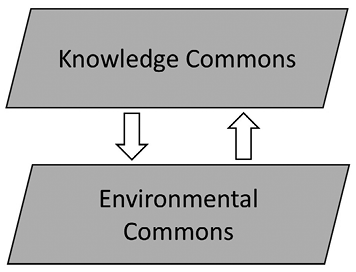
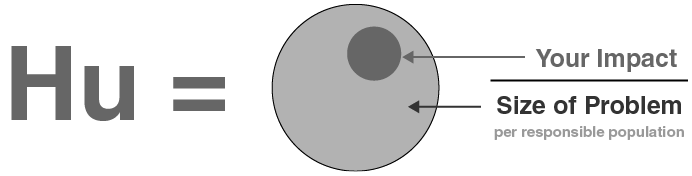
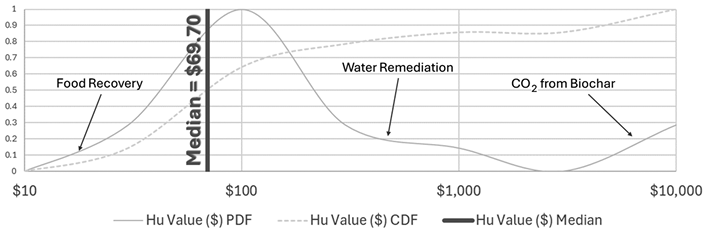


 Open access