


1. Introduction
Online learning has long been an essential part of education since the popularization of computers. Especially over the past decade, with the high demands of learning, pre-recorded classes that can be taken at learners’ own pace bloomed due to their flexibility and convenience (Castro & Tumibay, 2021). Despite the advantages of online learning, there remain specific challenges in maintaining effective learning outcomes (Reference Schacter and SzpunarSchacter & Szpunar, 2015). Online learning is typically regarded as self-regulated learning because it requires learners to regulate their attention independently. Without the supervision of teachers, learners usually find it hard to stay focused and allocate their attention appropriately (Reference Jansen, van Leeuwen, Janssen, Conijn and KesterJansen et al., 2020). While watching pre-recorded classes, learners might pause the video for a long time or just let the video play, leading to missing or misunderstanding key concepts or disproportionately concentrating on certain parts of the material, resulting in knowledge gaps.
Particularly, shifting attention from the task at hand to self-generated, irrelevant thoughts refers to mind-wandering (MW), a prevalent phenomenon during online learning (Reference Zhang, Miller, Sun and CortinaZhang et al., 2020). MW can occupy up to 45% of online learning, raising the significance of understanding and reducing MW (Reference Risko, Anderson, Sarwal, Engelhardt and KingstoneRisko et al., 2012; Reference Kane, Smeekens, von Bastian, Lurquin, Carruth and MiyakeKane et al., 2017; Reference Szpunar, Khan and SchacterSzpunar et al., 2013).
To address the challenges of MW and its impact on learning outcomes in online education, it is essential to enhance MW detection and intervention methods. Recent advances in eye-tracking technology have provided researchers with an invaluable tool to investigate MW through physiological metrics such as pupil dilation, fixation duration, and gaze dispersion. These metrics offer critical insights into learners’ attention allocation and cognitive engagement, forming the foundation for designing effective interventions.
Many researchers have used eye trackers to understand how learners collect visual information via eye movements and provide an advanced view of humans’ cognitive processes, such as where they looked at, how long, and in what order (Carter et al., 2020). The research is built based on the principle of the eye-mind link, where people have a high motivation to move their eyes to focus on the stimulus they are currently thinking about or processing (Reference RaynerRayner, 2009). The potential eye movement and pupillometry metrics include fixation duration, saccade amplitude, pupil diameter, etc. (Reference Mahanama, Jayawardana, Rengarajan, Jayawardena, Chukoskie, Snider and JayarathnaMahanama et al., 2022). These metrics can be used to reveal cognitive levels, for example, pupil dilation increases when people are concentrated on demanding tasks (Reference Skaramagkas, Giannakakis, Ktistakis, Manousos, Karatzanis, Tachos, Tripoliti, Marias, Fotiadis and TsiknakisSkaramagkas et al., 2021). On top of these fundamental metrics, eye-tracking data has been further analyzed for the Area of Interest (AOI) designation, heatmap analysis, and scan path analysis.
Using eye-tracking data, existing studies have explored strategies for redirecting learner attention, including real-time intervention, such as pop-out quizzes, text recall, oral reading, and text or sound alerts, (Reference McMaster, van den Broek, Espin, Pinto, Janda, Lam, Hsu, Jung, Leinen and van BoekelMcMaster et al., 2015; Reference Han, Miao, Lu, Guo and XiaoHan et al., 2022), and Al-based systems like Avatar learning companion and Nao robot (Reference Lee, Allessio, Rebelsky, Sottilare and SchwarzLee et al., 2022; Blancas et al., 2018). However, there are limitations in their ability to personalize interventions and minimize disruptions to the learning process. To address this gap, we propose a novel framework with delayed intervention by utilizing insights from MW detection metrics and existing intervention strategies. This framework involves an eye-tracking-based video reconstruction and replay (EVRR) system. It uses eye data to reconstruct learning material by highlighting knowledge that learners missed or misunderstood or MW and replay to them. The detailed system design and development are described in Section 4.1.
To examine if the system could effectively guide learners’ attention and improve learning outcomes, we conducted a human-subject experiment regarding engineering concepts.
2. Related Works
2.1. Mind-wandering Metrics
MW is typically assessed through eye movement metrics, such as pupil dilation, fixation duration, and gaze patterns. Previous research has shown that pupil dilation is associated with the brain’s locus coeruleus-norepinephrine (LC-NE) system, which is vital for attention and cognitive arousal (Reference Eckstein, Guerra-Carrillo, Miller Singley and BungeEckstein et al., 2017). Furthermore, mean pupil dilation positively correlates with the cognitive workload, indicating comprehension difficulty (Reference Skaramagkas, Giannakakis, Ktistakis, Manousos, Karatzanis, Tachos, Tripoliti, Marias, Fotiadis and TsiknakisSkaramagkas et al., 2021).
Reference Zhang, Miller, Sun and CortinaZhang et al. (2020) examined the correlation between MW and eye movement patterns during video lectures. They found that MW is typically associated with longer fixations on the slides, because participants may process the information on the slides more slowly or not actively. Additionally, MW could reduce fixation dispersion on the slides, indicating that participants focused their attention on a smaller area of the slides, possibly reflecting a less active engagement with the content (Reference Jang, Yang and KimJang et al., 2020; Reference Zhang, Miller, Sun and CortinaZhang et al., 2020; Reference Krasich, McManus, Hutt, Faber, D”Mello and BrockmoleKrasich et al., 2018).
2.2. MW Intervention Methods
Numerous intervention methods have been developed to address MW and redirect learner attention. The most common types of intervention are pop-out quizzes, screen flashes, and text or sound alerts. Based on traditional interventions, some researchers implemented message reminders based on their developed AI learning systems to help learners better learn and stay focused (Reference Hutt, Krasich, Brockmole and D”MelloHutt et al., 2021; Reference Lee, Allessio, Rebelsky, Sottilare and SchwarzLee et al., 2022). Moreover, considering the future of virtual learning environments, virtual teachers’ eye contact with learners has also become a novel real-time intervention method (Reference Han, Miao, Lu, Guo and XiaoHan et al., 2022). Despite the growing number of real-time interventions, false MW detections can still disrupt learners’ (Reference Lee, Allessio, Rebelsky, Sottilare and SchwarzLee et al., 2022). Distracted learners might also ignore interventions, especially if they were not motivated to obey (Reference Lee, Allessio, Rebelsky, Sottilare and SchwarzArakawa et al., 2021).
Many tools, for example, Eye-Mind Reader, have been designed to help learners comprehend and address the occasionally inaccurate MW detection Reference Mills, Gregg, Bixler and D”MelloMills et al. (2021). It implemented an intelligent reading interface, which uses two primary intervention techniques, re-reading prompts, and self-explanation exercises, to mitigate MW in comprehension. A nonlinear probabilistic approach is used to decide when to intervene. When the system detects reduced engagement, such as prolonged fixation durations or inconsistent reading pace, the system encourages learners to revisit specific content sections, reinforcing critical information. The self-explanation technique prompts the reader to express their understanding about the text in their own words, encouraging active engagement.
However, interventions such as self-explanation exercises can significantly increase their learning time, decreasing learning efficiency. Additionally, individual differences in eye movement patterns and the lack of personalization further limit the effectiveness of these interventions.
3. Hypotheses
In this study, we investigated if the EVRR effectively enhances learning outcomes, which were assessed by two quizzes on the learning material. Participants in the experiment group were exposed to an EVRR-based intervention by watching a reconstructed video. In contrast, those in the control group were prompted to watch the learning material at their own pace as a comparison. First, we compared the learning outcomes between the experiment and control groups to test the EVRR’s effectiveness. We further investigated whether the improvement was based on the reconstruction and replay of the material enabled by the EVRR method. Therefore, we proposed the following two sequential hypotheses.
-
H1: EVRR leads to a higher positive score difference than the self-review.
-
H2: Replaying more AOIs that are related to incorrect quiz questions leads to greater score improvement.
4. Methods
4.1. Experiment Design
We designed a human-subject experiment to investigate the effectiveness of the EVRR system with the approval of the Institutional Review Board. Participants were randomly divided into experiment and control groups, where the experiment group utilized the EVRR.
4.1.1. Procedure
This experiment consists of four steps. Step 1: Participants were asked to complete a questionnaire to collect their demographic information and self-report their familiarity with seven computer networking topics in the learning material. Step 2: Participants watched a 12-minute video while their eye data were collected and took a quiz after the video. Step 3: Following a 5-minute break, participants entered the review phase, after which they retook the quiz without knowing their previous scores or which answers were correct. Step 4: Participants completed an experience survey.
During the review phase in Step 3, participants in the experiment group watched a reconstructed video generated based on their eye data. The process of video reconstruction is explained in detail in Section 4.2.2. Participants in the control group reviewed the original video. They were allowed to control the playback using the progress bar, allowing them to navigate to any part of the learning material during the review phase.
4.1.2. Experiment Setup
We used Tobii Pro Fusion to collect eye data, using its maximum sampling frequency of 250 Hz (Tobii, n.d.). To ensure the accuracy and reliability of the data collection, we asked participants to face the screen with a resolution of 1920 × 1080 pixels and maintain a distance of about 65 cm from the screen when watching the learning video. Further, we used the Tobii Pro Lab to apply nine-point calibration and pre-process participants’ eye movements, such as noise-cleaning and clean data exporting.
4.1.3. Learning Materials and Quiz
The learning video was obtained by slide recording. The slides cover the fundamental concepts of computer networking, including IP Address, Domain Name System (DNS), HTTP request, Transmission Control Protocol (TCP), Three-way Handshake (TWH), Forward Proxy, Reverse Proxy, Cache, and Cookies. These concepts about the computer network were chosen from Kurose et al. (2021) to ensure that the task was not too difficult for participants with no prior knowledge and was not common sense for college students. Different paragraphs in each slide are divided into different AOIs based on the specific concept points described.
Figure 1 shows an example of an AOI design in which all AOIs are highlighted in different colors. Certain AOIs are grouped as associated AOIs to explain technical concepts or processes. For instance, the first two paragraphs in Figure 1 are grouped because they introduce the DNS queries. Similarly, the last three paragraphs and the figure are associated AOIs, explaining how DNS queries work and the order of the queries.
AOI Design Example

To determine when to proceed to the next slide, we calculated the Estimated Reading Time (ERT) for each AOI across all pages. The calculation is derived from the formula outlined by Reference Lee, Allessio, Rebelsky, Sottilare and SchwarzBrysbaert & Marc (2019), which calculated the predicted reading speed with different average word lengths in different texts during silent reading. The average word length of non-fiction texts is 4.6, and the average reading rate is 238 words per minute (wpm). For the learning material and the material-based quiz, a 130 wpm recall reading rate is adopted from the literature Carver et al. (2019). The ERT calculation is shown in Equation (1).
As shown in Figure 1, the AOI “03 DNSQ D1” contains 20 words, totaling 87 characters (excluding spaces). Consequently, the average word length is 4.4. Using Equation (1), an estimated reading time of 8.8 seconds is calculated for this AOI. The ERT for an entire page is calculated from the sum of all AOIs reading times.
 $$ERT = {{W \cdot L \cdot f} \over {R \cdot 4.6}}$$
where W indicates the total word count in the AOI, while L represents the average word length. The reading rate R is set at 130 wpm based on recall reading speed and f is a conversion factor of 60, used to transform the rate from minutes to seconds.
The learning outcome quiz used to quantify participants’ learning outcomes consisted of 15 questions. Each question was worth 5 points for a total score of 75 points. The answers to all the questions can be found in the corresponding slides. We acknowledged that participants might have various levels of knowledge regarding the topics. To control for its influence, we asked participants to report their familiarity level with each topic on a five-point scale, from “Not at all familiar,” “Slightly familiar,” “Somewhat familiar,” “Moderately familiar,” to “Extremely familiar.”
4.2. EVRR Design
The EVRR system design consists of an Eye (E) movement data threshold design and a Video Reconstruction and Replay (VRR) design.
We collected participants’ eye movement data while participants engaged with the learning material in Step 2, focusing on average fixation duration (AFD) and average pupil diameter (APD) during the entire video, average pupil diameter during the AOI (APDaverage), MW time (MWT), total fixation time (TFT), and valid reading time (VRT).
4.2.1. E-Eye Movement Data Threshold Design
To identify MW during learning, it is essential to determine appropriate fixation duration thresholds based on prior reading and visual attention research.
Reference RaynerRayner (2009) demonstrated that fixation durations can range from 50-75 ms to 500-600 ms, depending on task complexity. Particularly, the average fixation duration ranged from 225-250 ms for silent reading. Following this, Reference Trabulsi, Norouzi, Suurmets, Storm and RamsyTrabulsi et al. (2021) adopted a minimum fixation duration of 60 ms in their research on reading optimization. In contrast, Reference Hooge, Niehorster, Nyström, Andersson and HesselsHooge et al. (2022) suggested that fixations shorter than 100 ms are unlikely to reflect meaningful visual processing, underscoring the variability in fixation thresholds across studies. In addition, 2000 ms is a commonly used upper boundary for attention-related fixations during video lectures Reference Zhang, Miller, Sun and CortinaZhang et al. (2020); Cornelissen & Võ (2017). However, we adopted a more strict threshold of 600 ms based on the prior study from Reference RaynerRayner (2009), because fixation longer than 600 ms may indicate disengagement or unrelated cognitive processes, particularly in video-based learning contexts.
In summary, we adopted 250 ms as the benchmark AFD for reading. To address the significant individual differences, we set two adaptive thresholds, 100 * (AFD / 250) as the minimum threshold and 600 * (AFD / 250) as the maximum threshold. To further validate the thresholds, we conducted a pilot test of eight participants and found that the average fixation time of participants watching the video ranged from 187 ms to 320 ms (250 ± 70). To refine the minimum threshold, we tested 0.4 * AFD, 0.5 * AFD, 0.6* AFD, comparing MW detection results with self-reported MW. 0.5 * AFD yielded the best results. Thus, we used 0.5 * AFD as the minimum threshold and 600 * (AFD / 250) as the maximum threshold for MW detection. Fixations shorter than the minimum or longer than the maximum threshold will be considered MW and added to MWT. Subsequently, the VRT for each AOI can be calculated in Equation (2), depending on the presence or absence of MWT.
 $$VRT = \Bigg\{ \matrix{ {{\rm{TFT}} - {\rm{MWT}},} \quad \quad{{\rm{if \ MW occurs}},} \cr {{\rm{TFT}},\quad\quad\quad\quad\quad} \quad{{\rm{otherwise}}.} \quad\ \ \cr }$$
We integrated pupil sizes to enhance MW detection validity because the mean pupil dilation positively correlates with the cognitive workload, indicating comprehension difficulty (Reference Skaramagkas, Giannakakis, Ktistakis, Manousos, Karatzanis, Tachos, Tripoliti, Marias, Fotiadis and TsiknakisSkaramagkas et al., 2021). The APDaverage of all fixations on each AOI is calculated to determine whether MW occurred on certain AOI. Given our strict MW detection thresholds, we set an initial threshold 35% of TFT instead of 45%, which was suggested by Reference Zhang, Miller, Sun and CortinaZhang et al. (2020). Also, we compared 25%, 30%, 40%, and 45% in the pilot test to determine when the MW should be considered harmful to the learner’s learning. We concluded that an AOI required intervention if MWT exceeded 30% of the TFT and its APDaverage was larger than its APD.
By analyzing the relationship between the proportion of VRT in ERT and missing AOIs, MW AOIs, and misunderstanding AOIs in the pilot test, we set 30% * (AFD / 250) of ERT as the missed AOI threshold (Tmissed), as most participants had little to no recall of these AOIs. 80% * (AFD / 250) of ERT was used as the MW detection threshold (TMW). Additionally, 120% * (AFD / 250) of ERT was identified as the misunderstood AOI threshold (Tmisunderstood), as exceeding this threshold indicated comprehension difficulty, often leading participants to misunderstand the AOI and reduced the reading time of other AOIs on the same page. In this case, we re-evaluated the AOI associated with the misunderstood AOI and adjusted the threshold to 50% * (AFD / 250) of ERT as the misunderstood associated threshold (Tassociated). Using the aforementioned threshold values, Figure 2 shows the flow of detecting MW and determining if an AOI will be highlighted and replayed.
4.2.2. VRR-Video Reconstruction and Replay Design
Guided attention was used in our study to ensure learners focused on replayed AOIs. Figure 3 shows two examples of reconstructed pages. AOIs that learners have fully learned are mosaiced in Figure 3(a).
MW and Knowledge Gap Detection Flow

AOIs that learners need to relearn are highlighted in the red line, and related AOIs are generally displayed without intervention. In Figure 3(b), the diagram is associated with the definition, and bullet points are associated with each other. So, no AOI is mosaiced on this page.
VRR Examples. (a) Replayed AOIs with associated AOIs, (b) All AOIs are associated with Replayed AOIs

5. Analysis and Results
5.1. Participant Demographics and Knowledge Familiarity Distribution
Forty-one participants were recruited for our study. Participants’ eye data were collected, and no video recording was stored. The demographics and English proficiency data are shown in Table 1. Considering the small sample size, Near Native and Native Speakers were combined into the high Proficiency group, and Proficient and Fluent were combined into the medium Proficiency group. Overall, the high Proficiency group has 19 participants, and the medium Proficiency group has 22 participants.
The weighted familiarity accounts for the varying occurrences of concepts across quiz questions. Each concept’s familiarity score is multiplied by its number of occurrences in the quiz. The weighted scores are then summed and divided by the total number of quiz questions to standardize the result. The average familiarity of all participants with all concepts and their weighted familiarity in the experiment and control groups are shown in Figure 4(a). Figure 4(b) shows the number of samples in the experimental and the control groups at different levels of familiarity.
Demographic Distribution

Participants Average Familiarity. (a) Average Familiarity by Knowledge Point for Control and Experimental Groups, (b) Number of Samples by Familiarity Level for Experimental and Control Groups

5.2. Hypotheses Test
The mixed-effect model was utilized in this part to examine the relationships between the following variables while controlling for individual differences. The replay represented the hit rate for the correct option for the AOIs highlighted in the reconstructed video. The higher the value is, the more likely the participant was to get more questions right in the second quiz. Since only the experience group watched the reconstructed video, it is used to examine the effects relationships among the experiment group. In the model, DSij represents the score difference for the jth participant in the ith group, calculated as the difference between the second and first quiz scores to measure performance improvement after the revision. Gi is a categorical variable indicating group membership. GPi denotes grouped English proficiency, as detailed in Section 5.1. Participants’ nervousness level while using the eye tracker is denoted by Nij , while Lij represents their perceived usefulness of the eye tracker in improving learning performance. The variable Rij refers to the hit rate of the AOI corresponding to the correct answer for a previously incorrect question, which is highlighted for review.
The model includes random effects (uj) to account for participant-level variations not captured by the fixed effects, assuming a normal distribution $({u_j}\backslash N(0,\sigma _u^2))$
. The residual error term (εij
) represents unexplained variability in the score difference, also assumed to follow a normal distribution
$({u_j}\backslash N(0,\sigma _u^2))$
. The residual error term (εij
) represents unexplained variability in the score difference, also assumed to follow a normal distribution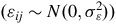 $\textstyle(\varepsilon_{ij}\sim N{(0,\sigma_\varepsilon^2)})$
. The terms (β, θ, and γ represent the fixed-effect coefficients in the models, corresponding to the intercept and various predictors, including group membership, proficiency, nervousness, likelihood, replay, weighted familiarity, and their interaction effects.
$\textstyle(\varepsilon_{ij}\sim N{(0,\sigma_\varepsilon^2)})$
. The terms (β, θ, and γ represent the fixed-effect coefficients in the models, corresponding to the intercept and various predictors, including group membership, proficiency, nervousness, likelihood, replay, weighted familiarity, and their interaction effects.
To test H1, we controlled for differences in weighted familiarity by dividing participants into low, medium, and high familiarity groups using the quantile method. A mixed-effect model was built to examine factors influencing score differences, as shown in Equation (3).
The results indicated that high English proficiency significantly improves scores for low and medium-familiarity learners, while medium-English proficiency has a more significant positive effect for high-familiarity learners. The results suggested that when familiarity is low, high proficiency aids understanding, whereas when familiarity is high, those with medium proficiency may compensate by revising more carefully. Since eye tracker nervousness and likelihood were not significant, they were removed in Equation (4). The revised model confirms that the experimental group significantly outperforms the control group among low-familiarity learners, demonstrating the effectiveness of the EVRR method. High English proficiency also continues to benefit low-familiarity learners. The p-values are provided in Table 2. Thus, H1 is partially supported.
 $$DS_{ij} = \beta _0 + \beta _1 G_i + \beta _2 GP_i + \beta _3 N_{ij} + \beta _4 L_{ij} + u_j + \varepsilon _{ij} $$
 $$DS_{ij} = \beta _0 + \beta _1 G_i + \beta _2 GP_i + u_j + \varepsilon _{ij} $$
P-values for Various Mixed-Effect Models

Note: n.s. indicates a non-significant result (p > 0.05); — indicates that the effect was not included in the model.
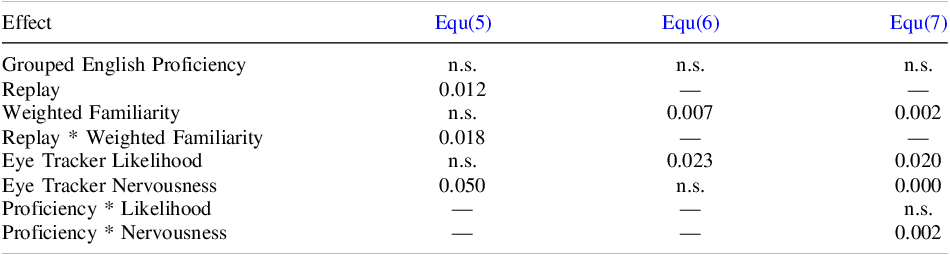
Regarding H2, we analyzed the experimental group to test if replaying more AOIs that are related to incorrect quiz questions leads to a greater score improvement. The results of the full model shown in Equation (5) confirmed that a higher replay hit rate significantly enhances scores, while eye tracker nervousness negatively impacts scores. Additionally, when replay and weighted familiarity increase, their interaction significantly reduces scores. The p-values are summarized in Table 3. Since replay represents guided attention, a higher replay rate increases focused learning through EVRR. Thus, H2 is supported.
 $$DS_{ij} = \theta _0 + \theta _1 R_{ij} + \theta _2 WF_{ij} + \theta _3 (R_{ij} \cdot WF_{ij} ) + \theta _4 GP_i + \theta _5 N_{ij} + \theta _6 L_{ij} + u_j + \varepsilon _{ij}$$
Since eye-tracking data was only collected in the first session, we further explored why eye-tracker nervousness negatively impacts scores by analyzing participants’ first quiz scores in the model described by Equation (6). The results reveal that higher weighted familiarity improves scores, whereas higher eye tracker likelihood reduces them. Then, we speculated that there was an interaction between English proficiency, eye tracker likelihood, and eye tracker nervousness. We used the model in Equation (7). Compared to high proficiency, medium proficiency had a significant negative effect on the first test score, i.e., lower English proficiency led to lower learning outcomes, which is consistent with common sense. Furthermore, higher weighted familiarity improves scores, while eye tracker likelihood and nervousness negatively affect first quiz performance. However, when English proficiency and nervousness increase, first scores significantly improve, suggesting that moderate anxiety, combined with higher proficiency, enhances focus and understanding, as shown in Table 3.
 $$FS_{ij} = \gamma _0 + \gamma _1 GP_i + \gamma _2 WF_{ij} + \gamma _3 N_{ij} + \gamma _4 L_{ij} + u_j + \varepsilon _{ij}$$
 $$FS_{ij} = \gamma _0 + \gamma _1 GP_i + \gamma _2 WF_{ij} + \gamma _3 N_{ij} + \gamma _4 L_{ij} + \gamma _5 (GP_i \cdot N_{ij} ) + \gamma _6 (GP_i \cdot L_{ij} ) + u_j + \varepsilon _{ij}$$
6. Conclusion
We proposed a new personalized and delayed intervention, EVRR, that adapts to individual differences but does not interfere with the learner’s learning process. EVRR shows significant positive effects on improving learning outcomes compared to self-review for learners who are unfamiliar with the concepts.
P-values for Various Mixed-Effect Models

* n.s. indicates a non-significant result (p > 0.05); *— indicates that the effect was not included in the model.
While they have difficulty effectively acquiring and absorbing knowledge during the initial learning process, EVRR’s personalized intervention compensates for this by prompting them to review content they have not mastered. Additionally, increased replay of AOIs related to participants’ incorrect quiz questions resulted in a higher positive score difference, further verifying guided attention’s effectiveness. Our analysis also revealed that for learners with medium English proficiency, giving them moderate nervousness during learning can help them concentrate better and improve their learning performance. For learners with high English proiciency, the nervousness in the learning process should be minimized as much as possible to help them concentrate. These findings highlight the importance of tailoring interventions based on individual characteristics. The EVRR intervention is based on each individual’s eye movement data to carry out learning interventions and, therefore, has robust scalability in personalized education. It can also be applied to live classes, especially online classes that require the camera to be turned on to interact with the teacher.
While the likelihood of using an eye tracker negatively impacted initial scores, its interaction with other factors was not signficant, making it challenging to speculate this indirectly as the trust of the eye tracker or the reconstructed video warrants further exploration. EVRR’s use of eye movement data offers robust scalability in personalized education and can be applied to live or online classes requiring teacher interaction. Future research should explore the role of eye tracker likelihood and refine EVRR for broader applications.






 Open access

