

International donor interest in and support for cash transfers and income grants is growing in countries where no universal system of social protection is financially feasible, both to support development and promote social protectionReference Alviar and Pearson1 and in emergencies.Reference Peppiatt, Mitchell and Holzmann2, Reference Gore and Patel3 Promoted as a means of fueling markets and encouraging economic growth or recovery,Reference Farrington, Harvey and Slater4 cash handouts are becoming an increasingly common approach to international assistance.Reference Standing5
Background
The main argument in favor of cash handouts is their cost-effectiveness, usually meaning they are less expensive for the donor. Certainly transaction costs are lower than they are for most other development assistance. It is argued that in some emergencies a larger percentage of the small pot of money available for humanitarian aid reaches the beneficiaries when given in the form of cash transfers rather than food aid, provided the cash transfers programs follow a careful assessment and are implemented well.Reference Harvey6 The issue of effectiveness remains open. Peppiatt and colleagues listed compelling virtues of cash aid in emergencies: the cash is easily convertible, it allows greater beneficiary choice, and it stimulates local markets because people have money to buy things.Reference Peppiatt, Mitchell and Holzmann2 They also listed disadvantages of cash handouts, after issues of cash availability are settled: loss from inflation, which can be driven by the very handouts, system leakage, difficulties in targeting, nonfood consumption when the cash is intended to support food security (tobacco, alcohol), and antisocial uses. Recognizing that “there can be no blueprint,” they pointed to 2 key issues in weighing the balance of cash handouts to support food security in emergencies: access to markets of those with the cash handouts and food availability in those markets.
An Oxfam reviewReference Creti and Jaspars7 detailed many advantages of cash transfers, including stimulation of food markets, greater choice, flexibility, dietary diversity, empowerment, “dignity for the beneficiaries,” and probably most important of all a faster and much less expensive to implement approach for donors and humanitarian agencies. The authors dismissed much of the downside of cash assistance as “perceived risks and fears.” For positive effects to outweigh negative ones the cash should be placed in the hands of the most vulnerable, and not assimilated into the underlying power structure that distorted the entitlements in the first place. The Oxfam authors proposed rigorous monitoring to ensure that the more powerful factions do not divert cash handouts (eg, to male family members). The authors do not explain the difficulties this rigorous monitoring may present in an emergency or post-conflict setting, how much it costs, and who has the skills to do it. None of the situations they reviewed came close to rigorous monitoring of diversion of cash handouts.
A case study in the Democratic Republic of Congo interviewed all 40 recipients of a cash assistance program.Reference Bailey and Walsh8 Not surprisingly, recipients preferred this cash-in-the-hand modality to receiving a collection of nonfood items. The scheme was small enough to put the cash literally in the hands of the most vulnerable people. The authors concluded that “cash and voucher interventions put the beneficiary at the centre of the process, empowering beneficiaries to choose the items they determine to be most necessary for their predicament.” With 40 recipients, many things are possible; with 400 000, as was the case in Bosnia, the options are more limited and the stakes higher.
Harvey reviewed cash-based responses in emergencies, citing a number of reports, including those of large programs in post-conflict situations.Reference Harvey6, Reference Harvey9 He concluded that targeting cash transfers shared common challenges with in-kind assistance programs (eg, food aid), but in some contexts cash may be more difficult to target effectively and more likely to be diverted by local elites or parties involved in the conflict.Reference Harvey6 Although corruption—diversion of assistance—is difficult to monitor and evaluate, there is little empirical evidence that the problem is worse for cash than for other forms of relief; however, Harvey reported that “most cash programmes are still relatively small, and the real test will come when programming is scaled up and projects are managed less intensively.”Reference Harvey6
World Bank Cash Transfers Program Bosnia
The Dayton Accords were signed in December 1995, formally marking the end of the Bosnian war, although outbreaks of violence persisted for some years. Motivated by the World Bank in Bosnia in 1996, 4 international donors (the Netherlands, Canada, Italy, and Sweden) contributed DM33 million (about US$21 million at the time) to the Emergency Social Fund to be given out as cash payments, as part of the Emergency Recovery Project, which had the explicit aim of stimulating the immediate postwar market economy. The Emergency Social Fund program originally expected to raise DM60 million (US$39 million).10
The program aimed to provide support during a short period: “Payments through this fund, based on declarations of household incomes, will provide temporary cash relief over a period of one year, permitting the revival of better-targeted social assistance programs similar to those that existed before the war, involving income proxies (such as employment status and age) and documentary evidence on household incomes”(p 47).10 Eligibility for the cash transfers was determined entirely on the basis of a declared household monthly income of less than DM50 (US$28). The original intention was to pay each eligible household DM50. Beginning in mid-1996, there were up to 5 rounds of disbursement, made through 190 municipal centers, to some 525 000 people.11
The program of cash transfers added to an extensive food aid program in the region, led by the United Nations High Commission for Refugees (UNHCR) and the World Food Programme. The food aid program was intended to be universal until 1996, when, as recovery progressed and markets reopened, UNHCR defined priority categories for targeting the food aid. Households in priority category 1 had a monthly income of less than DM25 (US$16), plus at least 1 vulnerability criterion. Households in priority category 2 had a monthly income of less than DM75 (US$49), plus a vulnerability criterion. Vulnerability criteria included female-headed households, displaced people in the household, unemployment, pregnancy, and large households (>4 people). Those in priority 1 and 2 households were supposed to receive food aid, whereas those in category 3 were supposed to receive food aid only after the higher-priority groups had received it. The UN priority categorization held for the whole household; in the case of food aid, the amount received was supposed to be calculated on the basis of the number of individuals. The World Bank cash transfers program in 1996-1997 did not use the priority categorization to determine eligibility and relied only on declared household income.
In April/May 1997, shortly before the completion of the 1-year program of cash transfers, the international technical nongovernmental organization CIET (Centro de Investigation de Enfermedades Tropicales; Community Information and Epidemiological Technologies), commissioned by the World Bank, undertook a population survey and a separate survey of named cash program beneficiaries to evaluate the program's targeting, assessing how much of the disbursed cash reached the intended beneficiaries. The population survey represented the fourth in a series of linked population surveys in the area (beginning in 1994) that served, among other things, to evaluate the food aid program in the region.Reference Andersson12 The present article reports on the evidence from the two 1997 surveys about targeting of the cash transfers program in relation to vulnerability, according both to the World Bank's single criterion of declared income and other relevant vulnerability criteria.
Methods
Survey Samples
The 1997 population survey used the stratified, random cluster sample established and visited in 3 previous surveys in Bosnia. In 1994, UNHCR regional teams with first-hand knowledge of each program area provided their population registers as a sample frame. This comprehensive official listing of potential beneficiaries in 9 operational areas could be divided into blocks of 1000 people. Stratifying by operational area, numbering the blocks, and using a random number table, we randomly drew 41 initial sites (communities), 1 site for every 100 000 people on the register. Because of inflation of beneficiary population figures, this number may have been closer to 1 site per 50 000 people on the register. Subsequent surveys revisited the same sites as much as was possible. In 1995, additional sites (communities) were added in Republika Srpska (RS), using the same random sampling approach based on UNHCR beneficiary lists. Some sites could not be visited in some years because of active fighting in the area, and some were replaced because of population movements during and after the conflict; details ofchanges in the sample across the 4 surveys are given elsewhere.Reference Andersson12 The population survey in April/May 1997 covered 55 communities, 45 in Bosnia and Herzegovina (BiH) and 10 in RS. For each site, approximately 100 households were covered in the survey.
For the beneficiaries survey, we identified from the official lists of the World Bank cash transfers program a random sample of 840 beneficiaries. The sample comprised 20 named beneficiaries randomly selected (using random number tables) from each of 42 official distribution lists provided by the municipal social welfare officers in locations of the cash benefit scheme. The 42 distribution lists were of roughly equal length, each containing several hundred names. There were too few listed beneficiaries in RS to include these in the random sample of listed beneficiaries, so the sample only included named beneficiaries in BiH.
Data Collection
Local field teams undertook the population survey in April/ May 1997. Each field team aimed to cover a site in 1 day, interviewing an adult respondent in each of approximately 100 contiguous households in the community, radiating from a randomly selected starting point, with no subsampling within the site. Whenever possible, the household respondent was the head of the household, otherwise a senior adult household member.
Field teams undertook the beneficiaries survey in April 1997. For each of the selected named beneficiaries, an interviewer went to the address provided and inquired about the person in question; if there had ever been someone by that name at the address, then the interviewer made inquiries about his or her whereabouts and made an appointment to meet the person. If it was not possible to meet the individual, then he or she was counted as present but receiving an unknown amount. If the person was unknown at the address in question and in the 2 neighboring households, then he or she was counted as unreachable. By these means, the survey teams successfully contacted and interviewed 681 of the sample of listed beneficiaries.
Survey Questions
In the population survey, the directly administered questionnaire documented the household structure (with age and sex of each member), the sex and employment of the head of the household, and the employment status of household members. Interviewers asked each household whether they received any cash handouts from the Municipal Welfare Office in the last 12 months and, if so, how much was received and how was the money used. They also inquired about household stores of wheat, coffee in the house, sufficiency of food in the last week, household income in the last 1 month, remittances from abroad, the presence of any refugees or displaced people in the household, the presence of any disabled household members, and whether any woman in the household was pregnant.
In the beneficiaries survey, interviewers asked the named beneficiaries they were able to trace the same questions about their receipt and use of cash transfers.
Analysis
Data entry relied on EpiInfo (Centers for Disease Control, Atlanta, GA), the public domain data entry and analysis package. Double data entry and verification of discordant records minimized keystroke errors. Additional cleaning looked for logical inconsistencies and out-of-range responses, checking against the original paper records as necessary. Analysis relied on CIETmap, freeware that combines epidemiological analysis with raster and vector mapping.Reference Andersson and Mitchell13
Based on the household questionnaire responses and the official UNHCR vulnerability criteria for their priority categorization for food aid, we defined a number of vulnerable groups. These groups included households with young children, households with elderly members (65 years and older), elderly people living alone (without younger adults, with or without children younger than 15 years), female-headed households, displaced households and households including displaced people, households without employed adults, households with people with disabilities, and households not receiving any remittances from abroad.
We estimated the coverage of the cash transfers program and amounts received overall and across different geographic areas and different groups of households. We then examined the association of reported receipt of cash transfers with the World Bank income criterion, the UNHCR priority categories, and the vulnerability factors described above. In each case, we calculated the coverage (the proportion of the target or vulnerable group that received a cash transfer), the exclusion error (the complement of the coverage: the proportion of the target or vulnerable group that did not receive a cash transfer), and the inclusion error (the number of nontarget or nonvulnerable households that received a cash transfer as a proportion of the target households).
Ethical Aspects
We did not obtain formal approval from an ethical review board for the survey. No such review board was operating in the region at the time. Assessing the targeting was an integral part of the cash handouts program, and the survey posed no risk to participants. We conducted the work in adherence with the Declaration of Helsinki, particularly regarding informed consent and confidentiality.
Results
Coverage of Cash Transfers
Interviewers were unable to find 19% (159/840) of the random sample of 840 people from the BiH beneficiaries list. Some 17% (116/681) of those they did find said they had not received any cash handouts (Table 1). Almost all of those who received cash said that they used the money to purchase food (Table 1).
Cash Transfers in the Random Sample of Beneficiaries From the BiH Lists and From the Population Survey (BiH and RS)
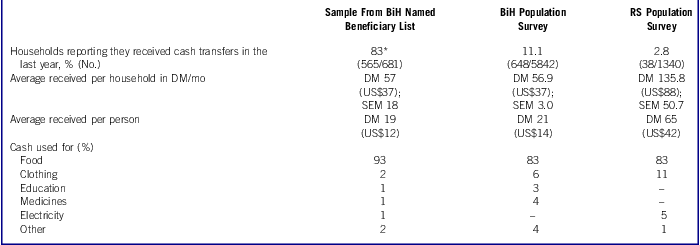
*Interviewers could find only 681 (81%) of the random sample of 840 beneficiaries. Counting all those not found as nonexistent would produce an actual coverage rate of 67.3% (565/840).
BiH indicates Bosnia and Herzegovina; DM, Deutsche mark; RS, Republika Srpska; SEM, Standard error of the mean.
The population survey covered 5842 households in BiH and 1340 households in RS. Table 1 shows that fewer households received cash in RS, but on average they received roughly 3 times as much as those receiving cash transfers in BiH. There was little difference between the 2 entities with respect to use of the handout; 83% used the cash for food and much smaller proportions for clothes, education, and health.
By the time of the 1997 population survey, 2 rounds of disbursement under the cash transfers program had taken place. We compared the actual coverage, estimated from responses to the population survey, with the expected coverage, estimated from official figures for population and figures for numbers of beneficiaries reported from social welfare centers administering the cash transfers, summarized by the World Bank (Table 2). The officially expected coverage of the first disbursement of cash benefits in BiH was 18% of the estimated population (Table 2, column 2). This provides a benchmark for the coverage that was detectable in the household survey. The second disbursement was officially 16% (Table 2, column 3). The best-case scenario from the standpoint of positive evaluation of the coverage was that the 16% second tranche overlapped fully with the 18% first tranche; the benchmark of expected coverage would thus remain at 18%. In fact, in some cantons it was an entirely different set of households, which should have increased the coverage of at least 1 payment to somewhere between 18% and 34%. Assuming full overlap of the first and second payments (all households in the second disbursement had received handouts in the first), it was possible to calculate the minimum proportion of the funds that were lost in the distribution mechanism. The minimum deficit is 44% ((1 – actual)/ highest of the 2 expected). The deficit varied considerably between cantons. Sarajevo and central Bosnia achieved the closest actual delivery to the officially declared delivery. West Bosnia and Neretva had the lowest levels of actual coverage in relation to declared. The large variation in the deficit between actual and officially declared coverage shows the variation in the likely degree of leakage, ranging from almost no leakage in some places to 83% leakage in Neretva (Table 2). There is no information about where this money went.
Expected and Actual Coverage of Cash Benefits: Estimation of Deficit in Coverage of the Distribution Mechanism
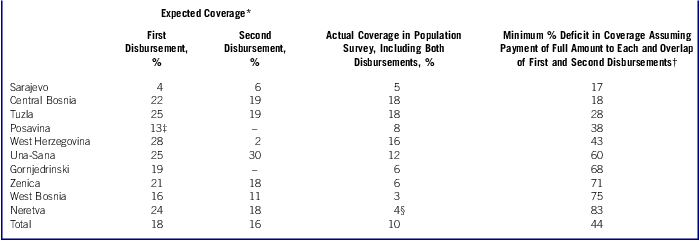
*Expected coverage is based on the World Bank summary for total beneficiaries reported by the social welfare centers and population figures for each canton provided by the Institute of Statistics, February 25, 1997.
†Both assumptions are optimistic: the deficit is calculated as (1 – actual coverage)/highest of the 2 expected coverage figures for disbursements.
‡Using only data for Odzak.
§Mostar east and west only.
In the beneficiaries survey, coverage also varied considerably between cantons. Overall, some 83% (565/681) of the contacted beneficiaries confirmed that they had received at least 1 cash handout. There was much lower coverage in 2 or 3 cantons (Table 3); these were the same cantons in which there was much lower actual coverage than expected, based on the findings from the population survey (Table 2). Consistently poor performance was apparent in Neretva and western Bosnia, with consistently good performance in central Bosnia and West Herzegovina.
Amount Received From Cash Transfers Program (DM/Disbursement) Reported in Population Survey
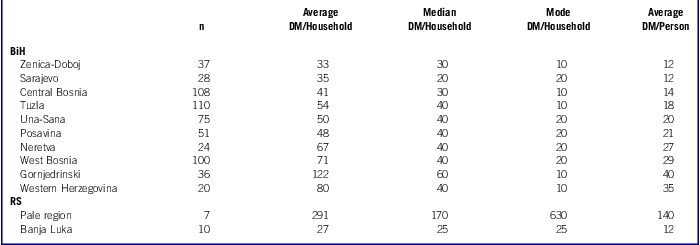
BiH indicates Bosnia and Herzegovina; DM, Deutsche mark; RS, Republika Srpska.
Not all of the respondents in the surveys were able or willing to report on the amounts of cash that they received. Among those households that reported that they received cash, 589 in BiH and 17 in RS reported on the amount they received. The average cash benefit among these households was DM57 (US$37) per household (DM21 [US$14] per person) in BiH; similar average amounts were reported by those in the listed beneficiaries sample in BiH who reported that they received cash (Table 1). Again, there was considerable variation across the region. The average amount received per household per disbursement, among households that received cash, ranged from DM33 (US$21) in Zenica to DM122 (US$79) in Gornjedrinski (Table 4). The mode is informative, showing that most households received extremely low amounts. The maximum in each of the cantons was DM800 (US$520) per household, and the minimum was DM5 (US$3). With the small number of households (17) in RS reporting on the amount of cash received, the average amounts for RS shown in Table 4 are indicative only.
Target and Vulnerable Groups and Receipt of Cash Transfers: Coverage, Exclusion Errors, and Inclusion Errors, From Population Survey

DM indicates Deutsche mark; DP, displaced people.
In addition to receiving cash benefits under the World Bank–sponsored program, a tiny number of households in the population survey reported other cash benefits: as foster parents (2 of the 27 households reporting foster children), for educational support (4 households), for medical support (9), for food support (46), other cash benefits (22), and cash credit (37 households, almost all in BiH).
Vulnerability and Targeting Cash Transfers
Coverage of those in the population survey eligible for the cash transfers program, according to the World Bank income criterion, was only 17.5% (189/1077), giving an exclusion error of 82.5%. At the same time, many people who received cash transfers were not eligible according to the income criterion, giving an inclusion error of 46% (Table 4).
We also evaluated the receipt of cash handouts in relation to the UNHCR priority categories. Priority 1 households were significantly more likely to receive cash transfers than priorities 2 and 3: 13.1% (278/2125) in priority 1, 8.1% (259/3214) in priority 2, and 8.1% (149/1843) in priority 3 (χ2 for trend 30.47, 2 df, p < .005). If the cash handouts received by priority 2 and 3 households had been given instead to priority 1 households, however, nearly one third of these highest-risk households would have received the handout (compared with 13%, as things turned out; Table 4).
We calculated coverage, exclusion errors, and inclusion errors for other vulnerable groups. These groups were not directly targeted by the cash transfers program but were recognized vulnerable groups in the area at the time, which may be expected to have needed cash assistance. The last column of Table 4 shows the proportion within each of the vulnerable groups that reported an income below DM50, and these would therefore have been eligible for the cash transfers program.
Perhaps not surprisingly, the highest coverage with cash transfers was among those also receiving food aid, and in this case the inclusion error was small (not many people not receiving food aid received cash transfers; Table 4). For many vulnerability categories the proportion without the vulnerability factor that received cash was almost the same as the proportion with the factor that received cash. The inclusion error in some cases was larger than the coverage among the vulnerable groups.
Accounting for Cash Disbursed by the Program
Extrapolating the population survey reports of cash receipts to the whole population, we could account for only US$2 million to US$4 million received by households in BiH and RS in the 2 tranches up to May 1997, by which point, according to briefings at the time, $16 million had been dispersed by the program. The higher-end estimate of US$4 million actually received by households assumes that the second round of handouts went to the same households, which then only reported a single receipt when they had received both. The lower-end estimate of US$2 million actually received assumes the household responses were correct, and those who reported only 1 handout had received only 1.
Comment
The cash transfers program in BiH and RS was poorly targeted, and it failed to reach many of those eligible by its own criterion based on declared income. Many who received cash were not eligible according to the income criterion. Assessed against more general vulnerability categories, the program did no better. Our findings suggest a high level of leakage or diversion of funds: 33% of listed beneficiaries denied receiving cash or could not be traced at all; expected receipts of cash based on official disbursement figures were much higher than actual receipts based on household reports; and extrapolation of our figures for amounts received to the whole population accounts for only a small proportion of the cash dispersed.
Our findings have several potential limitations. Our sample, based on a stratified random sample originally selected in 1994, may not have been fully representative of the population in the areas covered by the cash transfers program. Although the sample was modified between 1994 and 1997, we have no reason to believe that modification introduced bias (eg, by excluding a particularly vulnerable or nonvulnerable segment of the population). Indeed, by 1997 it was possible to include areas not previously accessible, and this would, if anything, have improved representativeness. Respondents may have underestimated receipt of cash handouts, perhaps feeling ashamed to admit to such handouts (this seems unlikely in Bosnia, where there had been a universal food aid program in operation for several years) or feeling that it may prejudice their chances of receiving further assistance. It is, however, unlikely that households with lower income would be less likely to recall a cash handout than households with higher income, so recall bias is not likely to explain the poor targeting performance we found for the cash transfers program in relation to low income. Our extrapolation of findings about amounts of cash received from the sample to the whole population assumes representativeness of the sample and reasonably accurate declaration of amounts received by the households. It is possible that for some reason the sample happened to have a much lower proportion of recipients of cash transfers than in the general population and/or that the amounts received were much lower than received by recipients in the general population. It is also possible that the survey respondents underestimated their receipts of cash handouts. However, the discrepancy between the amount dispersed by the program and the estimated amount received by beneficiaries is so large that even if our extrapolated amount of received cash was several times too small, there would still be a large amount of dispersed cash for which we could not account.
In 2004, the G8 (Group of 8) declared its intention to “unleash the power of markets through cash-for-work and cash-for-relief programs.”Reference Farrington, Harvey and Slater4 In addition to the advantages for donors, there are theories of entitlement, dignity, choice, food diversity, and market stimulation. The disadvantages—security risks, corruption, diversion, increased gender inequity, antisocial use, inflation of local markets—argue for greater caution. The much-quoted virtues of cash handouts to place the beneficiary at the center of the process and to empower beneficiaries to choose what they need are easy to envisage in small hands-on schemes. The benefits are not so easy to demonstrate in large-scale interventions not run by embedded nongovernmental organizations.
Several authors assert that the well-recognized negative aspects of handouts—security, corruption, misuse, gender inequality, market inflation, and targeting—can be avoided as long as humanitarian agencies have the skills to identify when cash transfers are appropriate and when adequate monitoring systems are in place.Reference Harvey6, Reference Nigenda14-Reference Devereux, Marshall, MacAskill and Pelham16 None of the humanitarian agencies in Bosnia at the time of the crisis had these systems in place or the skills to staff them. Even the community-based population survey described here could only detect inclusion and exclusion errors at the household level; the official institutional monitoring achieved considerably less with its list of names of cash beneficiaries, 1 in every 5 of whom could not even be traced.
Opaque as many emergency assistance programmes are, the Bosnian cash transfers were shrouded in more than the usual confusion. The amount available for distribution was clear: US$30 million. To whom the money was supposed to be distributed was also clear: those with a monthly income below DM50 (US$28), based on a direct question. Who could actually expect to receive it became much less clear as “local flexibility” came into play. Local flexibility was a description used by aid agencies on the ground to describe how they were required to give control over the program's targeting and disbursement at the local level (who got cash and how much) to local government agencies.
In the random sample of known beneficiaries, it was not possible to confirm receipts of cash in more than one third of named cash beneficiaries in the random sample; some could not be found and others denied receiving the money. This fits with cash transfers coverage rates in the population survey being about one third less than those declared by the distribution agencies (10% vs 16%, Table 2). Using the World Bank criterion for eligibility, the 46% inclusion error was more than double the coverage of the target population (17.5%), and 82.5% of intended beneficiaries were excluded. The modal amount received per household was DM10 (US$6.5) or DM20 (US$13), depending on the municipality; with an intended amount per person of DM50 (US$32), this suggests further leakage.
One possible explanation for the low coverage of cash assistance may have been underestimation of the population by the authorities drawing up the lists. Thus, when the actual population was contacted in the 1997 survey, a smaller percentage was found to have received the cash benefits. Against this explanation is the widely accepted fact that the beneficiary lists for food aid were, in fact, inflated. Also, the discrepancy between expected and actual coverage was not constant across cantons, showing likely “local agency.” It also does not explain the finding of incomplete coverage among the random sample of named beneficiaries.
The number of cash transfers disbursements in the year before the evaluation varied from canton to canton. Although the amount was set by central policy, actual amounts disbursed altered in individual cases, making it impossible to ascertain how much should have been disbursed per person. Any estimates of cash losses from system leakage are therefore minimum estimates; actual levels of losses could be several times higher.
Perhaps more important for reconstruction than the actual cash transfers, the support services (computers, training, office equipment) that were put in place to support the distribution of cash were used by canton authorities to establish canton-level administrative systems. In the words of 1 cantonal minister in an analysis workshop, “This is the only help we have had; we get nothing from the federal government.” In establishing the cash assistance program, the World Bank worked directly with canton authorities, developing local infrastructure for delivery of the cash handouts. Although there was little tradition of local handling of cash by local administrations, the cash assistance program in some cantons did reach a proportion in each target group.
Even recognizing these gains in local infrastructure, the Bosnian case remains a sobering lesson in cash assistance. Some 6 years after it ended, perhaps not surprisingly, the internal 2004 World Bank evaluation of the cash-handout program found it impossible to track records of payments or to reconcile amounts that were provided to the program with the amounts it claimed to distribute: “Inaccessible records in this case may result indirectly from Bank inexperience in overseeing an emergency humanitarian relief operation of this type that other organizations are better equipped to handle.”11
The report recognized the shortcomings of the World Bank in this theater, noting that the cash handouts “should not have been part of a project focused upon reconstruction,” and that the “humanitarian goal [was] unrelated to the Bank's expertise and role.”
A World Bank document published in 2001 used the data from the 1997 population survey to report that the use of a proxy means test in targeting, instead of the simple statement about income, would have improved program performance:
Though the current aid program has reached many of the poor, it has also excluded a sizable part of the neediest. By using a simple proxy means test approach we show that improving targeting accuracy in the aid delivery process can yield improved coverage and reduced leakage and, more important, can have a larger impact in terms of poverty reduction.11
The problem, however, was not so much the eligibility criterion or the means of defining who fulfilled the criterion but the distribution of funds based on eligibility. Revision of the targeting algorithm was not needed as much as revision of the relationships with those interposed between the UN agencies and the communities. That is where the refusal to accept UN targeting lay, and where the system leakage happened.
The Bosnian cash transfers program came at the end of several years of a large food aid program that was initially intended to be universal and by 1997 targeted according to a UNHCR priority categorization. We examined targeting and impact of the food aid program across several years and have reported our results elsewhere.Reference Andersson, Paredes-Solis, Sherr and Cockcroft17
In 1997, nearly half of the priority 1 households did not receive food aid. This coverage is better than that of the cash transfers program for its eligible population, but it still reflects the general difficulties with targeting and system leakage.
A recent review points out that cash assistance has become a commonplace delivery mode for international assistance. Using language such as “power to prioritise,” “creative way to receive relief with dignity,” “make strategic choices for themselves,” evaluations declared cash transfers programs in Ethiopia, Somalia, and Zambia to be “affordable and conducive to livelihood revival in chronically poor areas.”Reference Alviar and Pearson1
The authors of a 2005 review paper pressed the argument about cash transfers: “By allowing people to exercise choice, they switch emphasis from the supply to the demand side, at a single stroke increasing local demand for food and other products, and reducing the disruption to local markets that transfers in kind may cause.”Reference Farrington, Harvey and Slater4 They pointed to the need for “simple, transparent targeting criteria, automatic and robust delivery mechanisms and transparency regarding people's entitlements.”
Targeting criteria, delivery mechanisms, and transparency are at the heart of arguments about cash transfers. Harvey, writing for the Overseas Development Institute,Reference Harvey6 saw the choice between food aid and cash assistance as essentially a context-specific judgment about markets and whether cash could be delivered and spent more or less safely than in-kind alternatives. He repeated the list of potential problems—corruption and diversion of funds, antisocial use, disadvantages to women, and negative market effects—with the recommendation that these need to be assessed on a case-by-case basis.
Conclusions
Targeting of the cash transfers program was poor, with large inclusion and exclusion errors. Much of the dispersed cash apparently did not reach intended beneficiaries and could not be accounted for. Agencies on the ground did not have the necessary skills to handle the disbursements or to train national organizations to do so.
Authors’ Disclosures
The authors report no conflicts of interest.
Acknowledgments
The population and beneficiary surveys were commissioned by the World Bank. Indira Kulenovic and Kate Galt supported the data collection. Mary Cameron and Jeff Jarabek helped with retrieval of the literature.



