





Introduction
Food banks (FBs) justify their role in society as crucial institutions that seek to contribute simultaneously to fighting food insecurity and food waste (FEBA, 2022). This is a claim that is sponsored by global institutions (European Commission, 2025; FAO, 2019) when they endorse their societal role as food waste collectors and emergency food providers. FBs are a specific type of nonprofit organization (NPO), usually a byproduct of Western industrialized societies, that typically relies on support from governments, businesses, and public–private partnerships to pursue their aim (Osborne & Bade, Reference Osborne and Bade2006). As noted by Dodd (Reference Dodd and Nelson2020), currently, FBs find themselves becoming the primary charitable response to food insecurity in many high-income countries while facing growing institutional and operational challenges.
This dynamic must be understood within the broader context of the global food paradox. While millions face hunger and malnutrition, enormous quantities of edible food are discarded, representing a failure in both economic and ecological terms. Globally, over US$1 trillion worth of food is lost or wasted annually. Meanwhile, around 783 million people are undernourished, and 150 million children under five suffer from stunted growth due to a lack of essential nutrients (UNEP, 2024).
The case of Spanish FBs provides an illustration of the organizational conundrum many FBs, particularly those operating in the Global North, are facing. The Spanish Federation of Food Banks (FESBAL) coordinates 54 FBs in Spain. With a country population of 47 M people, Spanish FBs assist 1.2 M beneficiaries and distribute an average of 117 kg/person/ year through a network of 6,500 intermediary associations and more than 78,000 volunteers (Castaños, Reference Castaños2024; FEBA, 2024). In this context, the removal of the European Aid Assistance program (Fund for European Aid to the Most Deprived [FEAD]) in 2024, which had aimed to assist FBs in distributing emergency food, was replaced by a €100 M food voucher program of the Spanish government. This is a card that allows low-income families with dependent children to buy food in a selected number of supermarkets while granting the families autonomy and agency.
The removal of the program left a budgetary hole equivalent to 25% of the ordinary budget of the Spanish FBs. In addition, a regional–federal dispute over the governance, administration, implementation, and funding meant that, at the time of writing this article, no vouchers had been distributed yet. First estimates show that only one in ten FESBAL beneficiaries will end up receiving food vouchers and that 50–80% of the smaller towns and cities currently served by FBs will have no food retailer accepting such vouchers (Castaños, Reference Castaños2024).
With pervasive food price inflation and an intensifying housing crisis, additional pressure is placed upon FBs to fill the gap caused by the missing public support. Beneficiaries are turning once again to charitable solutions to access emergency food. Additionally, amidst this institutional transformation, the new Law on the Prevention of Food Loss and Waste in Spain establishes that “all actors in the food supply chain are obliged to promote agreements or arrangements to donate their food surpluses to social initiative entities and other nonprofit organizations or food banks” (BOE, 2025, art.6). In a context shaped by institutional change and critiques of the future role of FBs, the looming question is what pathway FBs should take.
Prior literature has connected some of the FB shortcomings to a pervasive legitimacy crisis (McIntyre et al., Reference McIntyre, Tougas, Rondeau and Mah2016; Poppendieck, Reference Poppendieck1999; Warshawsky, Reference Warshawsky2024; Williams et al., Reference Williams, Cloke, May and Goodwin2016) that demands to be addressed while making calls to improve and upgrade their services. In this context, we examine the potential of digital transformation (DT) (Jong & Gazaroli, 2023) specifically to enhance the legitimacy of the FB organizational model. In this empirically informed article, we begin with the analysis of 12 cases of digital platforms that share the goal of FBs: fighting food waste, hunger, or both.
We first highlight the main legitimacy hurdles that FBs face. Then, we seek to address the following research question: How can recent digital innovation taking place in the area of food waste encourage FBs in their efforts as they try to overcome the already identified legitimacy problems? To address this question, we analyzed 12 empirical cases of food waste management where digitalization—more precisely: platformization—has demonstrated, if not effectiveness, at least feasibility. In this regard, using a deductive approach based on organizational areas (Parker et al., Reference Parker, Mook and Kao2020), we identified key challenges related to operations, products, collaboration, and mission, where achieving pragmatic legitimacy is possible.
From this analysis, three main practical contributions emerge. First, we expand the existing literature on FBs and digitalization by showing how their combination can help address some hurdles related to pragmatic legitimacy. Second, we detail how past initiatives in food waste management can serve as inspirational examples for FBs by analyzing various digital innovations within the same sector. To close, we emphasize the need to reassess the value of pragmatic legitimization strategies, especially in an institutional environment increasingly influenced by significant regulatory, social, and technological changes, where societal reliance on FBs is unlikely to diminish.
Finally, our article makes three distinct theoretical contributions to scholarship studying food waste, nonprofit initiatives, and digitalization processes: i) We operationalize pragmatic legitimacy deficits for FBs across different domains and hence link legitimacy theory with very concrete organizational dimensions; ii) we conceptualize platformization not only as an efficiency tool but as a legitimacy repair strategy open to diverse NPOs; and iii) we revisit the role of pragmatic legitimacy in these kinds of organizations by arguing that, amidst institutional and technological institutional change, pragmatic strategies can complement moral and cognitive legitimacy.
Background
According to Lambie-Mumford (Reference Lambie-Mumford2019), FBs can be defined as “charitable initiatives providing emergency food to people in need” (p. 4), that mostly “rely on donated funds to support their operations” (Blackmon et al., Reference Blackmon, Chan, Carbral, Chintapally, Dhara, Felix and Wu2021, p. 3395). Even if these NPOs can never match the reach of governmental action (Warshawsky, Reference Warshawsky2024), they play a relevant role when recovering and redirecting food surpluses that would otherwise become waste (European Commission, 2025; FAO, 2019; FEBA, 2022) and, more importantly, channeling surpluses produced throughout the food supply to a social purpose. Their relevance is reinforced again when, admittedly, there is no integral solution provided to the pernicious coexistence of food waste and hunger (Dart, Reference Dart2004).
Food banks’ legitimacy under fire
The role that FBs play in society, and their operational limitations specifically, have been questioned in multiple ways. Even if FBs provide a rapid response to severe food deprivation, their ability to enhance overall food security and tackle the structural issues underlying food scarcity is perceived as limited (Bazerghi et al., Reference Bazerghi, McKay and Dunn2016; Warshawsky, Reference Warshawsky2024). Criticism encompasses their outdated infrastructure and logistics model (Poppendieck, Reference Poppendieck1999) as part of an overall rebuttal of the capacity of perceived amateurish organizations to provide services that should be under the purview of governments. In the book Sweet Charity (Poppendieck, Reference Poppendieck1999), the critique of the FB model is summarized around the seven deadly “ins” (i) inaccessibility, (ii) inadequacy, (iii) inappropriateness, (iv) indignity, (v) inefficiency, (vi) insufficiency, and (vii) instability. McIntyre et al. (Reference McIntyre, Tougas, Rondeau and Mah2016) expand the critique with five additional “ins”—ineffectiveness, inequality, institutionalization, invalidation of entitlements, and invisibility. Generally speaking, the legitimacy of the FBs remains questioned.
An organization is said to be legitimate to the extent that its means and ends appear to conform with social norms, values, and expectations (Dowling & Pfeffer, Reference Dowling and Pfeffer1975). Legitimacy is a generalized perception or assumption that the actions of an entity are desirable, proper, or appropriate within a socially constructed system of norms, values, beliefs, and definitions (Suchman, Reference Suchman1995, p. 574). Three distinct types of legitimacy coexist: (i) Moral legitimacy arises from normative judgments and reflects whether the organization’s actions are “the right thing to do” according to broader societal values; (ii) cognitive legitimacy is rooted in taken for grantedness and assesses if an organization is perceived as necessary or inevitable; and finally, (iii) pragmatic legitimacy rests on whether the organization delivers practical benefits to stakeholders (Suchman, Reference Suchman1995, p. 577).
For the purpose of this article, we observe how FBs can indeed find avenues to address the limitations on their organizational legitimacy and, notably, on the specific critiques referring to pragmatic legitimacy, where the concern is focused on the “organization’s capacity to achieve practical outcomes in its immediate environment” (Suddaby, Reference Suddaby, Bitektine and Haack2017, p. 454). Importantly, our research conceptualizes pragmatic legitimacy as a perception held by stakeholders. This perception represents an evaluative judgment based on observed practices and outputs. In the context of voluntary and NPOs (Lall, Reference Lall2019; Meyer et al., Reference Meyer, Buber and Aghamanoukjan2013), it reflects, too, the need to demonstrate the rationality and effectiveness of these practices according to the stakeholders’ self-interested calculations and the assumption that these actions will influence organizational performance positively.
In any case, we acknowledge a broader debate on what FBs can or should do (e.g., Poppendieck, Reference Poppendieck1999; Warshawsky, Reference Warshawsky2024). Our analysis does not resolve these normative questions. Rather, we focus on a narrower, organizational issue: Given the persistence and institutionalization of FBs in diverse settings and institutional contexts, how might they address specific pragmatic legitimacy deficits identified in the literature through digitalization and platformization?
Food banks: Blind spots on pragmatic legitimacy
We must start by further understanding which gaps in the academic literature should be addressed. When identifying gaps in the pragmatic legitimacy of FBs, logistics and infrastructure emerge as some of the crucial dimensions. According to Gharehyakheh and Sadeghiamirshahidi (Reference Gharehyakheh and Sadeghiamirshahidi2018), “one of the typical challenges that FB managers are commonly faced with is the collection and distribution approach of donated food” (p. 1) that assures the variety and regularity of food supply, particularly when dealing with perishable items. As recent empirical work shows (Agostinho & Paço, Reference Agostinho and Paço2012; Gharehyakheh & Sadeghiamirshahidi, Reference Gharehyakheh and Sadeghiamirshahidi2018), operational activities related to logistics consume a significant portion of the limited time of essential volunteers. Major improvements in personnel management thus seem necessary if organizational effectiveness is to be achieved.
When it comes to stakeholders, calls have been made for “collaborative approaches” (Parker et al., Reference Parker, Mook and Kao2020, p. 923) that may increase the organizational effectiveness of these entities. This includes establishing interorganizational relationships and partnerships with the aim of increasing social impact (Chen & Graddy, Reference Chen and Graddy2010, p. 405). The application of public norms and the relation with regulatory bodies are yet another dimension which could be improved if we are to increase the effectiveness of FBs. Depending on the institutional context where FBs operate, compliance becomes yet another important hurdle that calls for organizational upgrades. Furthermore, there are general regulations affecting FBs across the board which force food donations to comply with “food safety, hygiene, traceability, liability, and fiscal requirements” (Galli et al. Reference Galli, Cavicchi and Brunori2019, p. 293).
In what follows, we use operational efficiency in a narrow sense, to refer to the capacity to handle equal or greater volumes of food, with equal or higher quality, using the same or fewer resources (time, storage, transportation, administrative effort). We treat such efficiency gains as one important mechanism that can contribute to pragmatic legitimacy, insofar as stakeholders interpret them as evidence of reliable service delivery.
The “digital imperative” and the food banks’ organizational weaknesses
According to Jong and Ganzaroli (Reference Jong and Ganzaroli2024), two distinct trends appear to be converging when trying to address the abovementioned shortcomings. The authors refer to i) the sustainability imperative as the necessity for societal actors to take on expanded roles in creating social and environmental value and to ii) the digital imperative as the transformative organizational and social changes driven by the proliferation of digital technologies (Hanelt et al., Reference Hanelt, Bohnsack, Marz and Antunes2021).
If, as we argue, DT, and in particular platformization, seems a feasible pathway to work on pragmatic legitimacy deficits, we can understand DT as the “organizational change that is triggered off and shaped by the widespread diffusion of digital technologies” (Hanelt et al., Reference Hanelt, Bohnsack, Marz and Antunes2021, p. 1160). It has been argued that digital technologies serve to enhance NPOs’ ability to recruit volunteers, expand and diversify the volunteer pool, attract professionals, and reduce administrative costs associated with volunteer management (Chui & Chan, Reference Chui and Chan2019; Eimhjellen, Reference Eimhjellen2023). Referring to FBs specifically, Bernstein et al. (Reference Bernstein, Song and Zheng2008) argue that the platformization of FBs would allow them to expand their operational capacities into the so-called clicks-and-mortar model (Bernstein et al., Reference Bernstein, Song and Zheng2008), to boost effectiveness (Eisinger, Reference Eisinger2002; Michelini et al., Reference Michelini, Grieco, Ciulli and Di Leo2020), and to expand the number and type of stakeholders and volunteers (Kolk & Ciulli, Reference Kolk and Ciulli2020).
While the potential for improvement seems evident, the central issue is determining the course of action. In this regard, Parker et al. (Reference Parker, Mook and Kao2020) provide an interesting framework for the analysis of potentially interesting cases working at the crossroads between food waste and digitalization. The authors argue that the FB organizational model presents four key areas of intervention. Operational issues involve ensuring fast and flexible service; effective communication; helpfulness and reliability; upgrading transportation systems and storage facilities; and improving coordination for efficient pickups and deliveries to preserve edible food. Product issues relate to the provision of food or meals by FBs, with a focus on generating cost savings; ensuring access to fresh items; securing supply; and achieving variety and consistency in corporate food donations. Collaboration issues address aspects of cooperation and partnership among stakeholders. Effective collaboration can include joint problem-solving, sharing resources, and aligning strategies to address food insecurity. Finally, mission-related issues pertain to support for the organization’s core mission or expanding the scope of its activities beyond food provision, such as enhancing its service quality or achieving other long-term goals.
In light of the FB model limitations, societal needs, and identifiable avenues for intervention, our research question was articulated in the following manner: How can recent digital innovation taking place in the area of food waste encourage FBs in their efforts as they try to overcome the already identified legitimacy problems? In the section below, we explain the empirical analysis we followed, and then, we engage with the analysis of our findings and the discussion.
Method
The selection process was guided by purposeful sampling, based on “information-rich cases for study in depth” (Patton, Reference Patton2002, p. 230). Two strategies were applied to collect our cases: criterion sampling and maximum variation sampling, namely (i) being a platform in the food distribution sector; (ii) belonging either to the private sector (Not-For-Profit, social enterprise, corporation) or to the public sector; (iii) targeting people in need and/or aiming at providing affordable goods or services; (iv) tackling food waste as part of their mission; (v) having information available related to their social impact; and vi) existing relevant secondary sources that could provide relevant information about the case.
Design and sampling
In this paper, we conduct a qualitative study that explores how digital practices, tools, or pathways emerging from existing platformization initiatives are shaping the field of food waste management. In order to capture a diverse range of digital responses to tackle hunger, food waste, or both, we began our selection process by collecting potential case studies tackling food waste through digital initiatives from two secondary sources: a literature review and online desk research using publicly available archival information including websites, reports, social media, press coverage, the Crunchbase dataset, and records of awards or acknowledgements. Our selection process focused on initiatives operating at the intersection of digital technology and food systems, encompassing keywords such as food delivery, food sharing, food sovereignty, sustainability, circular economy, and food tech.
We compiled a list of 125 digital initiatives and documented each case’s digital characteristics and social impact orientation. These were assessed using a framework structured around two main aspects: i) the extent to which the initiative informs the DT of FBs and ii) the means by which the initiative generates its social impact. Supplementary Table A1 outlines the framework used to map the digital and social dimensions of these initiatives. Following this initial mapping, we refined our selection based on the availability and reliability of information. Initiatives with insufficient or unverifiable data were excluded. To ensure analytical depth and relevance, we applied additional selection criteria, including (i) organizational sector (for-profit, nonprofit, or social enterprise) while excluding digital marketplaces which prioritize commercial exchange over social value creation; (ii) location and geographical reach; and (iii) maturity of the initiative (exclusively considering those in existence for more than 12 months and showing evidence of financial solvency).
Data collection
Data collection started in 2020 with the creation of the preliminary database. After the selection process, we started the interviews alongside additional research that permitted us to compare information based on the pre-selected cases. Interviews with the organizations started the next year. We conducted a follow-up analysis in 2025 that allowed us to contextualize and update selected insights and impacts.
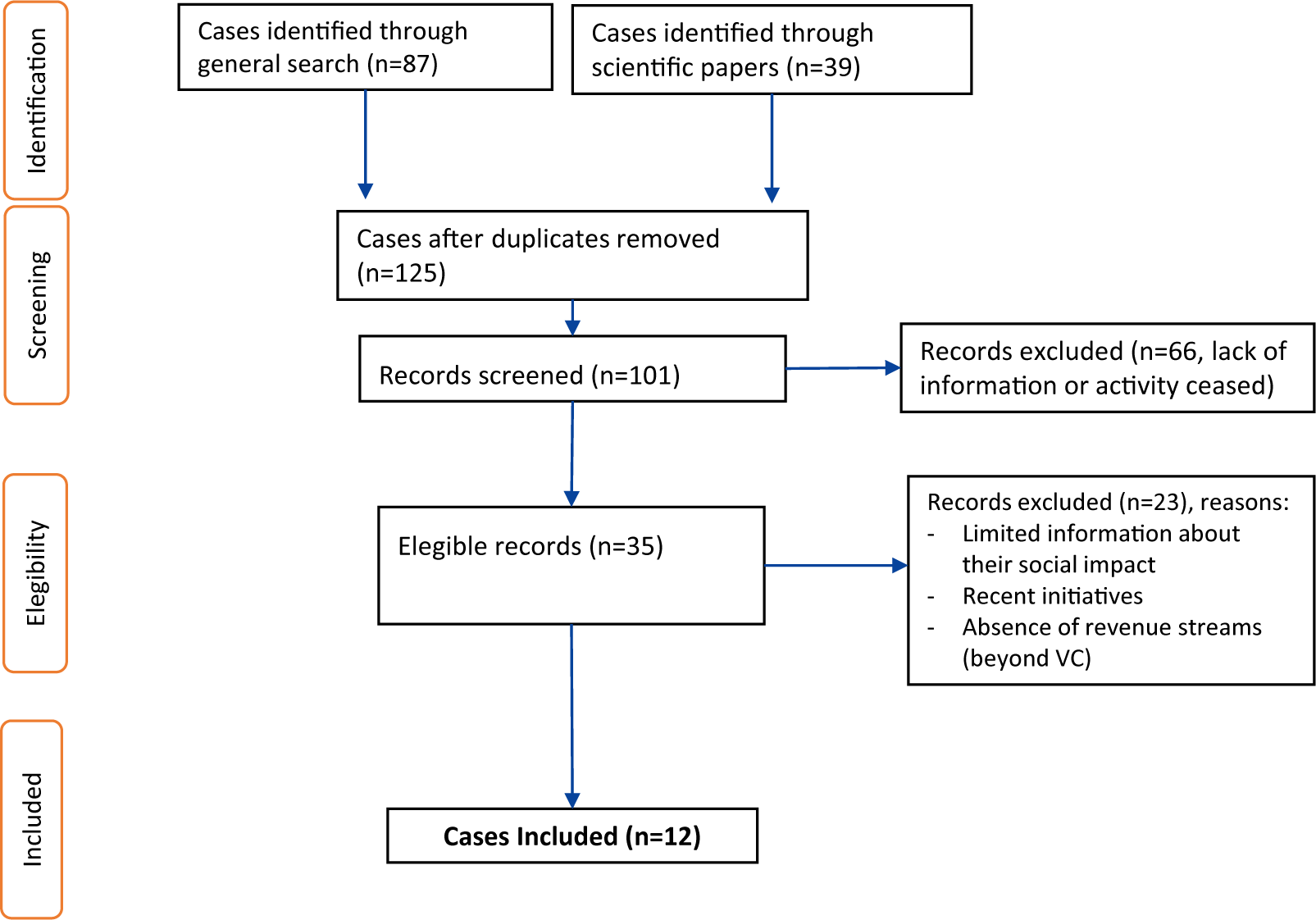
As shown in Figure 1, the final sample comprised 12 cases representing a diverse set of countries (for detailed information about the descriptive variables of the cases, see Supplementary Table A2). To triangulate the collected data for “verification purposes” (Jones & Donmoyer, Reference Jones and Donmoyer2020, p. 894), all the cases were contacted and invited to contribute and check the information we had collected about their organizations, thus, following Patton (Reference Patton2002, p. 560), increasing the accuracy, completeness, fairness, and perceived validity of our data analysis. Besides archival research, data collection from primary sources included 22 interviews conducted online due to public health restrictions. The interviewees included volunteers, code developers, founders, CEOs, and general managers, as well as staff in diverse departments (Human Resources, Customer Satisfaction & Compliance and Institutional Communication). The audio lengths ranged from 31 minutes to 1 hour and 23 minutes. Finally, when interviewees reported specific operational improvements, we triangulated their accounts with publicly available documents (e.g., annual reports, impact reports, and websites) to ensure the accuracy and consistency of factual claims.
Selection process and sampling.

Fig. 1. Long description
The flowchart is organized into four vertical phases labeled on the left.
1. Identification phase. Two boxes at the top show Cases identified through general search n equals 87 and Cases identified through scientific papers n equals 39. Arrows from both lead to a single box.
2. Screening phase. The first box is Cases after duplicates removed n equals 125. An arrow leads down to Records screened n equals 101. A lateral arrow to the right indicates Records excluded n equals 66, lack of information or activity ceased.
3. Eligibility phase. An arrow from the screened records leads down to Elegible records n equals 35. A lateral arrow to the right indicates Records excluded n equals 23, for reasons including limited information about their social impact, recent initiatives, and absence of revenue streams beyond V C.
4. Included phase. A final arrow leads to the bottom box labeled Cases Included n equals 12.
From an ethical standpoint, this research is aligned with the requirements set forth by the Committee for the Use of Human Subjects in Research (CUHSR) at our home institution regarding data collection, analysis, confidentiality, and anonymity, while strictly adhering to ethical standards. Participant confidentiality was always maintained, with identifying information removed or anonymized during both the collection and analysis phases.
Data analysis
Data analysis was aimed at identifying how the cases provided solutions in any of the key dimensions of the FB legitimacy issues. After reviewing both transcripts and initial memos, we began with a preliminary round of readings of the collected material, aimed at developing a general map of the cases. We followed a deductive analytical approach, using a predefined set of conceptual dimensions to guide interview design and analysis using the key areas of focus identified by Parker et al. (Reference Parker, Mook and Kao2020): operational issues, product issues, collaboration issues, and mission-related issues. Each author codified the information according to these focus areas. Thematically coded excerpts were primarily organized around categories.
We reached a consensus on the codification process based on the agreed-upon guidelines. Finally, we conducted a negative case analysis (Morse, Reference Morse2015) to ensure the validity of our results. Throughout the coding process, we systematically searched for cases that contradicted or did not align with the emerging patterns, particularly regarding organizational logics and the role of digitalization. When such discrepant cases were identified, they were used to refine, add nuance, or qualify our initial interpretations.
The analysis that follows is, thus, the result of the assessment of such digital initiatives as espoused by the interviewees, which implies that our empirical focus is based on how interviewees describe the perceived capacity of such initiatives to address the operational and organizational shortcomings identified above.
Results and discussion
As presented, we analyzed multiple digital initiatives (see Supplementary Table A2) to assess their potential for addressing food waste, with a focus on achieving operational efficiency, to be understood as improved use of resources and logistics and, hence, increasing pragmatic legitimacy. Below, we present and discuss the main findings of our research according to the typology of areas of intervention established by Parker et al. (Reference Parker, Mook and Kao2020) and denote its potential for FBs willing to confront the abovementioned challenges.
Operational issues
The cases collected reveal how digitalization can be used to enhance collection, transportation, and storage management capacity, which can be achieved through two conduits. The first strategy deploys via the digitalization of food deliveries from warehouses to distributors. A dual strategy is proposed here, in which a physical facility (i.e., a warehouse) is complemented by a new parallel digital infrastructure. The new process integrates a platform that facilitates quick and efficient resolution of unexpected or small pickups, which may involve fresh produce. This expedited delivery allows FBs to expand their product offerings, thereby improving the nutritional variety of their diets.
The second strategy deals with algorithmic forecasting, which improves the stock management of warehouses. This, in turn, favors more efficient control of the warehouse that might prevent storage breaking points, reduces the fluctuations caused by produce seasonality, and provides more accurately monitored food deliveries. With the same physical space, larger amounts of food can now be managed.
Digital innovations in logistics and infrastructure appear as having a significant impact on both food recovery (Michelini et al., Reference Michelini, Grieco, Ciulli and Di Leo2020) and the optimization of logistics, transportation routes, and delivery schedules (Nair et al., Reference Nair, Grzybowska, Fu and Dixit2018). A notable example in our sample is the app Misión Entrega, introduced by the Buenos Aires FB. This app was specifically developed to manage small-scale donations and perishable products for immediate delivery. One of its staff members described it as follows:
The key development aspects led us to focus on a complex use case, so we created an MVP [minimum viable product] to resolve the critical path: being able to bring donated food from point A to point B as quickly as possible and under the best conditions. We aimed for a scalable solution with the current technological standards (Staff at “Misión Entrega APP”).
The app connects donors, volunteers, and charities, offering an agile process that is supervised by the FB itself, even when the food does not go through its facilities. A manager explains the process:
The system uses geolocation, which is crucial for managing small, time-sensitive donations. […] When a donation is made, it becomes visible to social organizations located within a 5-kilometer radius […] The organization can immediately see the product details, including its expiration date and amount […] Once the organization accepts the donation, a network of volunteers is notified. These volunteers, also within a nearby radius, are alerted to pick up the donation and deliver it. When a volunteer accepts the task, the logistics process is automatically set in motion (Manager, Buenos Aires FB).
Additionally, the manager highlighted the quantitative impact of the app’s adoption:
We move 400,000 kilograms of food per month, with only 2,000 kilograms (0.5% of the total) coming through the app. However, the app allowed us to increase the amount of protein distributed, improving the overall nutritional balance.
Managing volunteers also emerges as a key aspect in operations. Developing a robust network of volunteers requires recruiting, training, coordination, and supervision. The digitalization of the wide array of tasks carried out by volunteers is seen as a major upgrade in operations, specifically in aging societies. OLIO is another platform that implements innovative practices on the screening, training, and management of volunteers. As one of the co-founders explained, “the real beauty [of our business model] is that we have created something that is all about community and not charity” (OLIO co-founder). At OLIO, people are nudged to become food waste heroes while joining a global community that is part of the zero-waste movement.
I remember how absurd it felt to throw away so much food, knowing that there were likely people just a few hundred meters away who would have gladly taken it. The problem was, they simply didn’t know [what]. I had to give away. It was while I was discreetly packing non-perishable items into the bottom of my moving boxes that the idea struck me: to create an app that could connect me with my neighbors so I could share the food instead (OLIO co-founder).
Automation plays a crucial role in optimizing surplus food management by enhancing logistics, reducing waste, and minimizing manual intervention. For instance, Misfits Market streamlines sourcing and delivery with automated inventory and supply chain systems. Phenix and Chowberry use real-time digital matching to connect donors with charities or nongovernmental organizations (NGOs), reducing logistical frictions. FoodCloud and MealConnect automate donor notifications and pickup coordination, accelerating redistribution. Karma and OLIO leverage apps to enable consumers and neighbors to access discounted or donated food, minimizing waste. HopHopFood, Plan Zheroes, and BringTheFood offer platforms that automate donor–recipient matching and logistics. Finally, Banco de Alimentos de Buenos Aires and Basic Life Charity utilize digital inventory and scheduling systems to improve transparency and efficiency. Overall, these initiatives demonstrate how digital automation has the potential to enhance responsiveness, traceability, and cost-effectiveness in food donation systems.
At the operational level, as pointed out by Gharehyakheh and Sadeghiamirshahidi (Reference Gharehyakheh and Sadeghiamirshahidi2018), “The major problem with the current food banks’ collection-distribution approach is that it is highly dependent on limited transportation resources, resulting in sub-optimal performance in terms of demand fulfillment, food waste, and logistics costs” (p. 1). Our analysis shows that some existing initiatives have proven successful when tackling similar issues through digitalization.
Product issues
The provision of food or meals is the second main hurdle identified by Parker et al. (Reference Parker, Mook and Kao2020). In our sample, Misfits is an organization that focused originally on tackling the deficiencies of food distribution through a platform that connects them with customers who want to acquire “high-quality staples at affordable prices” (Misfits Market, 2025). Misfits works “directly with farmers and makers to rescue organic produce and other grocery items that might otherwise go to waste” (Misfits Market, 2025). In past years, digitalization has been central to Misfits’ operational transformation, and the organization has implemented advanced logistics and supply chain management systems, including a comprehensive warehouse management system and in-house built technology, which streamlines the storage, picking, packing, and delivery of perishable goods. The launch of “Fulfilled by Misfits” in 2024 leverages this infrastructure to offer scalable, cost-effective, and customizable fulfillment solutions for both its own operations and third-party brands. In their 2023 Impact Report, they claim to have rescued an average of £500,000 weekly in food through streamlined logistics and lean operations.
Another relevant example comes from Feeding America, the US foodbanking network. Their “Meal Connect” platform ensures the most convenient and efficient match between stakeholders, based on distance. The app “is the convenient, free and safe way to reduce wasted food and donate surplus meals to your food insecure neighbors. It allows easy real-time tracking of your recovered excess product: saving you time, lowering your costs, creating hassle-free tax deductions and making a positive impact” (Meal Connect, 2025). It works through three steps: first, the donor posts a photo with information on the donated food. Second, the post will be sent to a trusted nonprofit partner in your community. Finally, once the donation is selected by an entity, the food will be picked up by a volunteer. This process enables producers to easily distribute their products while ensuring the cold chain is maintained. This, indirectly, increases the nutritional value of produce, resulting in more balanced and healthy meals that incorporate fresh or cooked products.
In the dimension of quality control and diversification of food donations, our findings reveal that (i) data analytics can be used to tailor product offerings, ensuring quality even with “imperfect” goods (e.g., Misfits Market); (ii) platformization enables retailers to dynamically price and list surplus food, promoting quick turnover and reducing spoilage (e.g., Karma); (iii) digital tracking of expiration dates ensures that only safe products are redistributed (e.g., Chowberry, FoodCloud, MealConnect); and (iv) community feedback and app-based quality checks can provide additional safeguards to uphold high safety standards (e.g., OLIO, HopHopFood).
As seen, managing the variety and regularity of donations remains a crucial organizational dimension for FBs, which are always challenged by the variability and seasonality of donations. Rethinking and reordering the food supply chain can significantly contribute to a better approach to food provisioning and, as pointed out by Berti et al. (Reference Berti, Giordano and Mininni2021), potentially render broader transformations in the food system.
Collaboration issues
Communication and coordination with stakeholders, from donors to local charity groups, is a crucial part of the food waste management process. With the advent of digitalization and the diffusion of smartphones, new collaborations among entities have surfaced. HopHopFood was founded with the purpose of creating a community of people devoted to fighting food waste and precariousness. Currently, they create local communities of support consisting of neighbors, retailers, charities, and volunteers connected through a peer-to-peer app that links individuals and food donations.
Organizational hurdles such as tracking donations or maintaining the cold chain of products do not disappear in the digital sphere, but digitalization makes possible the creation of new and diverse multistakeholder initiatives that bring new life to food waste. One of the co-founders of HopHopFood was encouraged to “develop innovative, united solutions, to support people in precariousness who are in [a situation of] food insecurity, but never in a patronizing manner. Always accompanying them: giving people the tools to move themselves” (Co-founder at HopHopFood).
Stakeholder integration and partnerships can be fostered through digital platforms since they play a central role in enabling effective collaboration among the diverse actors involved in food redistribution. In our sample, Misfits Market uses its digital infrastructure to onboard new brands, suppliers, and logistics partners, while also supporting business-to-business fulfillment for other food waste organizations. Similarly, Phenix operates a digital matching system that brings together businesses, charities, and transport providers on a single platform, facilitating coordinated action. Chowberry fosters integration by linking retailers, NGOs, and end users within a shared digital ecosystem, enabling seamless communication and resource allocation. FoodCloud’s scalable platform supports partnerships with both national and local food retailers and charitable organizations, promoting operational consistency and adaptability.
In the United States, MealConnect provides an example of how its integration with Feeding America’s vast donor and FB network allows for efficient, real-time collaboration. Also, OLIO combines business partnerships with grassroots community engagement through its app, significantly expanding its reach and social impact. Other platforms such as Karma, Plan Zheroes, and BringTheFood simplify stakeholder onboarding and coordination, ensuring that contributions from various sources are efficiently managed and redistributed. Altogether, these initiatives illustrate how digital tools serve not only for logistical purposes but also as enablers of robust, multistakeholder ecosystems in the fight against food waste.
When it comes to assessing new avenues to enact multistakeholder initiatives, in the literature, platforms are often referred to as multilateral markets, supporting a vast array of supply and demand interactions that help increase the communication and coordination between stakeholders and the typology of interaction (Kolk & Ciulli, Reference Kolk and Ciulli2020). As argued by Parker et al. (Reference Parker, Mook and Kao2020), “effective communication and relationship management, and facilitating a shared vision are common collaborative management principles that can facilitate better resource provision and increased impact” (p. 934). Hence, it seems reasonable to believe that the digitalization of FBs can activate such collaborative capacities for the benefit of their networks too.
Mission-related issues
Mission-related issues are the last area identified by Parker et al. (Reference Parker, Mook and Kao2020). The growing regulations in place in areas such as public health are adding external demands upon FBs in areas such as transparency and accountability. At a time when market dynamics and emerging regulation are redefining the attribution of responsibility among players, some new agents address head-on some of these controversies by providing legal and fiscal support to organizations operating around food waste. As an example, FoodCloud collects food transactions and conducts data analysis to track different business activities with third parties. Its “BringTheFood” initiative incorporates a system that provides donors “with all the documentations needed to benefit from a tax shield proportioned to their donation” (Representative at BringTheFood). Phenix is moving digitally in the same direction, thus incentivizing food donations with a purpose.
Having access to digital tools is not only important for operational efficiency and stakeholder coordination but also to enable organizations to scale their impact and measure mission success with higher precision. Misfits Market exemplifies this by digitally tracking the rescue of over £230 million worth of food since its launch, generating transparent reports, and effectively communicating sustainability outcomes to stakeholders. On a similar note, Phenix leverages real-time data to quantify its impact and share results with donors and partners, reinforcing accountability and trust. Chowberry monitors meals saved and beneficiaries reached, strengthening publicly its case for funding and collaboration. For this specific organization, its Food Voucher app enhances reach by supporting an electronic food stamp program, allowing families in need to redeem tokens for food from nearby merchants—thus integrating impact with accessibility.
FoodCloud and MealConnect use digital metrics to demonstrate their social value, which supports both fundraising efforts and advocacy campaigns. OLIO relies on app analytics to quantify food saved and foster community engagement, while Karma employs public dashboards to visualize environmental benefits, motivating both users and partners. Platforms like Banco de Alimentos de Buenos Aires and Plan Zheroes use digital records to ensure transparency, facilitate compliance, and support mission-driven storytelling. Finally, BringTheFood encapsulates this approach by encouraging donors with clear benefits—donating more effectively, recovering greater volumes, enjoying legal tax incentives, and ultimately helping those in need—made possible through digital tracking and reporting.
Overall, while the digital initiatives presented above differ in their models, technical approaches, narratives, and even intention, they enact new organizational capabilities that respond directly to the problematic issues identified by Parker et al. (Reference Parker, Mook and Kao2020).
Digitalization enhancing pragmatic legitimacy
We have argued that pragmatic solutions to organizational problems can underpin legitimation strategies for FBs insofar as these solutions are recognized by stakeholders as effectively dealing with identified shortcomings. Traditionally seen as inferior when it comes to social enterprises or NPOs (Dart, Reference Dart2004, p. 419), pragmatic legitimacy can be reassessed considering the rapid social and technological transformations that call for massive and swift overhauls of service provision and existing organizational models. In that respect, our cross-case analysis allows us to theorize how specific forms of digitalization can contribute to addressing pragmatic legitimacy deficits in FB scholarship.
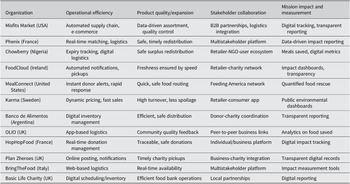
As the Spanish case in the introduction illustrates, when public or market failures arise, emergency food provision networks, such as FBs, are once again activated and required to step in. Hence, strengthening pragmatic legitimacy should be a critical organizational concern and a crucial legitimation strategy for securing stakeholder approval (Herlin, Reference Herlin2015, p. 823). A key takeaway from our research on organizations aiming at curbing food waste (summarized in Table 1) is the central role digitalization plays in scaling operations, improving efficiency, and ensuring transparency. The digital tools analyzed not only streamline internal processes but also foster collaboration by linking businesses, charities, and consumers through shared platforms. Importantly, the adoption of digital tracking and reporting mechanisms also allows organizations to clearly measure and communicate their mission impact.
Insights: taking stock of digitalization to address pragmatic legitimacy deficits

Table 1. Long description
The table consists of five columns: Organization, Operational efficiency, Product quality/expansion, Stakeholder collaboration, and Mission impact and measurement.
- Misfits Market (U S A): Automated supply chain and e-commerce; data-driven assortment and quality control; B 2 B partnerships and logistics integration; digital tracking and transparent reporting.
- Phenix (France): Real-time matching and logistics; safe, timely redistribution; multistakeholder platform; data-driven impact reporting.
- Chowberry (Nigeria): Expiry tracking and digital logistics; safe surplus redistribution; retailer-N G O-user ecosystem; meals saved and digital metrics.
- FoodCloud (Ireland): Automated notifications and pickups; freshness ensured by speed; retailer-charity network; impact dashboards and transparency.
- MealConnect (United States): Instant donor alerts and rapid response; quick, safe food routing; Feeding America network; quantified food rescue.
- Karma (Sweden): Dynamic pricing and fast sales; high turnover and less spoilage; retailer-consumer app; public environmental dashboards.
- Banco de Alimentos (Argentina): Digital inventory management; efficient, safe distribution; donor-charity coordination; transparent reporting.
- O L I O (U K): App-based logistics; community quality feedback; peer-to-peer business links; analytics on food saved.
- HopHopFood (France): Real-time donation management; traceable, safe donations; individual/business platform; digital impact tracking.
- Plan Zheroes (U K): Online posting and notifications; timely charity pickups; business-charity integration; transparent digital records.
- BringTheFood (Italy): Web-based logistics; real-time availability; multistakeholder platform; impact measurement tools.
- Basic Life Charity (U K): Digital scheduling/inventory; efficient food bank operations; local partnerships; digital reporting.
Our assessment of these ventures and their impact on organizational legitimacy dovetails with previous work, which highlights how “the more substance in terms of objects, technical quality, and tangible outcomes, the less organizational character judgments will depend on beliefs loosely coupled to the core activities” (Alvesson, Reference Alvesson1990, p. 385, cited in Herlin, Reference Herlin2015, p. 823). Indeed, if credibility is an important factor that influences legitimacy judgments (Jahn et al. Reference Jahn, Eichhorn and Brühl2020, p. 547), the actual capacity of organizations such as FBs to address operational limitations indicates that credibility can be constructed via addressing pragmatic legitimacy shortcomings.
We acknowledge that this relation is not always univocal. Oftentimes, potential pathways to address such shortcomings (e.g., the creation of a digital community of users, volunteers, and/or the setting up of new forms of collaboration with stakeholders) imply trade-offs that can simultaneously hinder the overall legitimacy of NPOs.
Conclusions
Food banks as platforms: Main insights and theoretical implications
In this paper, we have shown how the critique of the FB organizational model reveals dysfunctions in four key domains—operational, collaboration, mission-related, and product issues—and how these shortcomings can be addressed by taking stock of real examples of organizations that operate in the digital and food waste spheres.
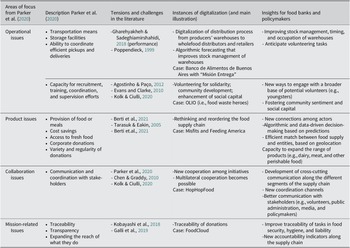
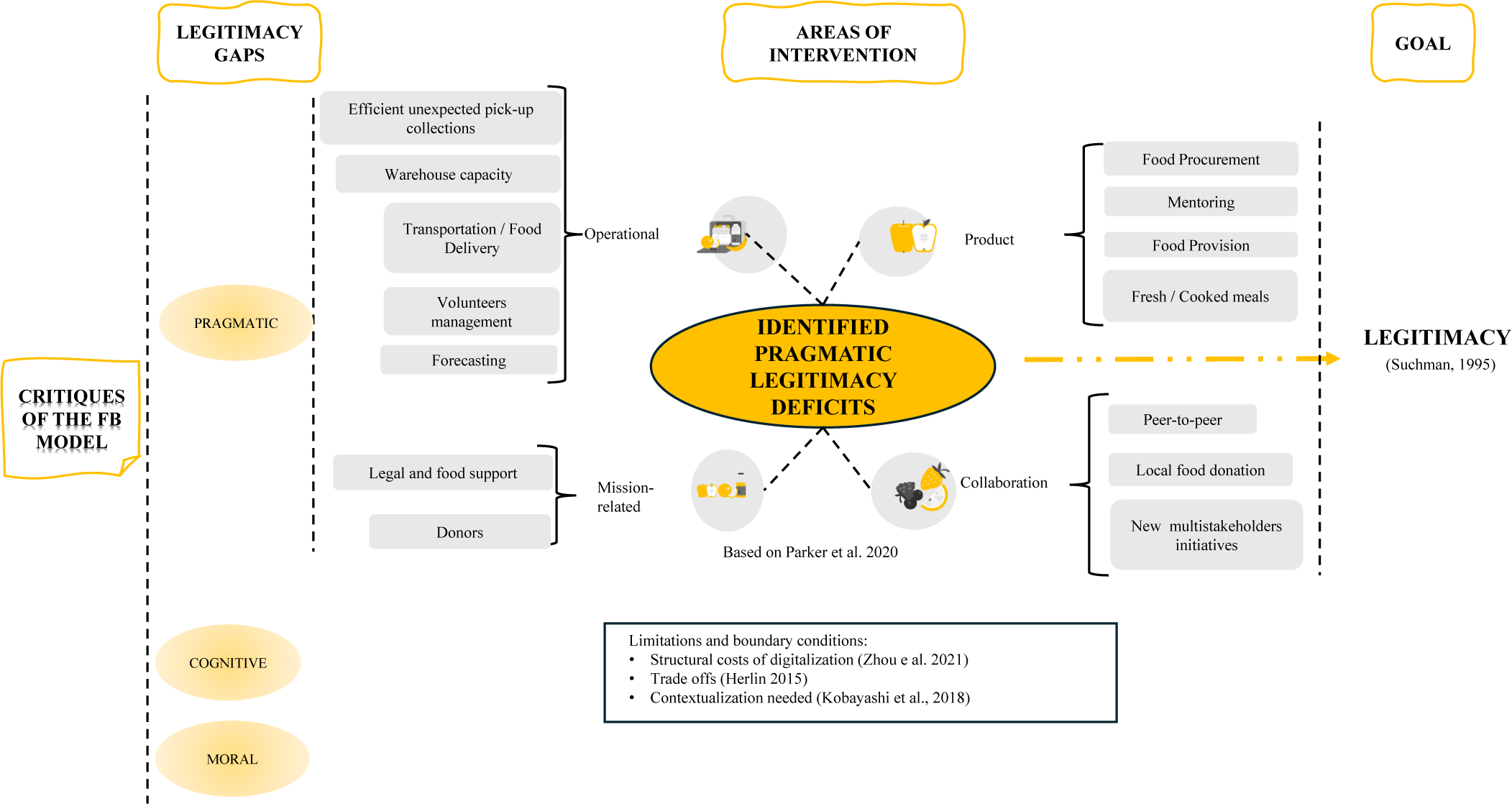
To address such legitimacy gaps, diverse instances of digitalization laid out by businesses and NPOs have been provided to show how FBs can be inspired by alternative forms of organizing and the concrete social, economic, and environmental cues related to the platformization of organizations. Table 2 summarizes the main findings, the observed avenues for the digitalization of FBs, how these transformations can, in turn, lead to plausible operational gains, and the main insights for both FBs and policymakers willing to support such organizational transformation. Drawing from the organizational weaknesses identified in the literature and the cases studied, we have suggested several operational pathways that can provide actionable insights for FBs and other NPOs working along similar parameters, confronting similar critiques, and embracing similar goals (see Figure 2).
Summary of the key dimensions of intervention, tensions and challenges, instances of digitalization, and main analytical insights

Table 2. Long description
The table is organized into five columns: Areas of focus from Parker et al. 2020, Description, Tensions and challenges in the literature, Instances of digitalization, and Insights for food banks and policymakers.
* Operational issues: Focuses on transportation, storage, and coordination. Challenges cited by Gharehyakheh and Sadeghiamirshahidi 2018 and Poppendieck 1999. Digitalization includes algorithmic forecasting and the Misión Entrega case. Insights involve improved stock management and volunteer anticipation.
* Volunteer management: A sub-section of operational issues focusing on recruitment and training. Challenges cited by Agostinho and Paço 2012 and others. Digitalization includes the O L I O case for community development. Insights involve engaging younger volunteers and fostering social capital.
* Product issues: Focuses on food provision, cost savings, and fresh food access. Challenges cited by Berti et al. 2021 and Tarasuk and Eakin 2005. Digitalization includes Misfits and Feeding America cases. Insights involve data-driven decision-making and geolocation for matching supply with entities.
* Collaboration issues: Focuses on stakeholder communication. Challenges cited by Parker et al. 2020 and others. Digitalization includes the HopHopFood case for multilateral cooperation. Insights involve new coordination channels and better communication with public administration and media.
* Mission-related issues: Focuses on traceability, transparency, and reach. Challenges cited by Kobayashi et al. 2018 and Galli et al. 2019. Digitalization includes the FoodCloud case for donation traceability. Insights involve improved accountability indicators and hygiene liability tracking.
Digital avenues for addressing pragmatic legitimacy deficit. An empirical approach.

Fig. 2. Long description
The diagram is organized into three main vertical sections separated by dashed lines.
1. Left Section: Critiques and Gaps.
At the far left is a sticky-note icon labeled Critiques of the F B Model. To its right, under the heading Legitimacy Gaps, are three yellow ovals: Pragmatic, Cognitive, and Moral.
2. Middle Section: Areas of Intervention.
This section is centered around a yellow oval titled Identified Pragmatic Legitimacy Deficits. Four dashed lines radiate from this center to circular icons representing intervention categories:
- Top-Left: Operational. This branches into five gray boxes: Efficient unexpected pick-up collections, Warehouse capacity, Transportation / Food Delivery, Volunteers management, and Forecasting.
- Bottom-Left: Mission-related. This branches into two gray boxes: Legal and food support, and Donors.
- Top-Right: Product. This branches into four gray boxes: Food Procurement, Mentoring, Food Provision, and Fresh / Cooked meals.
- Bottom-Right: Collaboration. This branches into three gray boxes: Peer-to-peer, Local food donation, and New multistakeholders initiatives.
Below this central cluster is a text box titled Limitations and boundary conditions, listing structural costs of digitalization, trade offs, and contextualization needed.
3. Right Section: Goal.
A yellow dashed arrow points from the central deficits toward the far right, where the word Legitimacy is written in large bold text, followed by the citation Suchman, 1995.
From a theoretical standpoint, we put forward three main contributions: First, we operationalize pragmatic legitimacy deficits for FBs across four domains (operational, product, collaboration, mission-related) and show how they can be addressed through digitalization, hence linking legitimacy theory (Suchman, Reference Suchman1995; Suddaby et al., Reference Suddaby, Bitektine and Haack2017) with very concrete organizational dimensions (Parker et al., Reference Parker, Mook and Kao2020). Second, we extended DT and platformization research (Hanelt et al., Reference Hanelt, Bohnsack, Marz and Antunes2021; Kolk & Ciulli, Reference Kolk and Ciulli2020; Jong & Ganzaroli, Reference Jong and Ganzaroli2024) to nonprofit food assistance by conceptualizing platformization not only as an efficiency tool but as a legitimacy repair strategy in contexts oftentimes critical with the FB model (Poppendieck, Reference Poppendieck1999; Bazerghi et al., Reference Bazerghi, McKay and Dunn2016; McIntyre et al., Reference McIntyre, Tougas, Rondeau and Mah2016, Warshawsky, Reference Warshawsky2024). Finally, we revisited the role of pragmatic legitimacy in NPOs by arguing that, in an environment of institutional and technological change, pragmatic strategies can complement moral and cognitive legitimacy (Suchman, Reference Suchman1995; Suddaby et al., Reference Suddaby, Bitektine and Haack2017) while, as acknowledged above, also entailing trade-offs that need to be critically assessed.
Pathways for future research and limitations
All research comes with its limitations. While we have assumed that digitalization has a positive impact on the pragmatic legitimacy of FBs, various authors, such as Zhou et al. (Reference Zhou, Kautonen, Dai and Zhang2021), highlight the structural costs involved in developing, upgrading, and maintaining information technology (IT) systems. Therefore, rather than asserting a direct and conclusive link between digitalization and operational improvements, our analysis points to pathways for further exploration. Such avenues are informed by promising initiatives where sustainability and digitalization intersect but surely require deeper investigation. Accordingly, the endorsement of platformization as a tool to address legitimacy deficits must be accompanied by caution and a call for contextual analysis.
In methodological terms as well, while the framework proposed by Parker et al. (Reference Parker, Mook and Kao2020) proves useful, the areas oftentimes lack dynamism. Dimensions are not closed but porous categories. For instance, communication, included in the frame as a collaboration issue, can be seen as part of efficient provisioning management, which is an operational issue, too. Presenting such dimensions as isolated concepts, in our view, is valuable, but it does not adequately address the complexity required in real examples. Furthermore, there is a huge “variety of operational models” to what we call FBs (Bennett et al., Reference Bennett, Vijaygopal and Kottasz2021; Schneider, Reference Schneider2013) that might showcase different institutional and operational boundaries and constraints other than the ones we indicated.
One additional limitation concerns the heterogeneity of interviewees. The informants occupied highly diverse roles within their respective organizations, including volunteers, software developers, chief executive officers (CEOs), and managers, which may have influenced how they reported their experiences.
Finally, even if our study has provided evidence that digitalization may be a fruitful strategy to enhance pragmatic legitimacy, new research should specifically study the conditions upon which FBs can acquire the resources and the transformational competencies needed to embrace digitalization in the manner suggested here. Whereas our analysis takes digitalization as an empowering trend for FBs to increase pragmatic legitimacy, a debate remains on digitalization as a double-edged sword, for both corporations and societies. Ultimately, contextual realities need to be considered when discussing organizational (in)efficiencies (Kobayashi et al., Reference Kobayashi, Kularatne, Taneichi and Aihara2018) to an extent that our analysis could not address.
Supplementary material
The supplementary material for this article can be fount at http://doi.org/10.1017/S0957876526000264.
Acknowledgements
We are grateful to our editor and the three anonymous reviewers for their valuable guidance and constructive comments, which greatly improved this paper. Earlier versions were presented at ESADE’s Institute of Social Innovation research seminar, and we thank the participants for their helpful feedback. Any remaining errors are our own.
Competing interests
The authors have no relevant financial or non-financial interests to disclose.


 Open access

