

In light of the sway that anti-immigrant movements have had in many countries, political commentators and academics alike debate the strategies available to mainstream parties (Bale et al., Reference Bale, Green-Pedersen, Krouwel, Luther and Sitter2010; Abou-Chadi and Krause, Reference Abou-Chadi and Krause2020; Down and Han, Reference Down and Han2020; Spoon and Klüver, Reference Spoon and Klüver2020; Chou et al., Reference Chou, Dancygier, Egami and Jamal2021; Hjorth and Larsen, Reference Hjorth and Larsen2022): Are voters hard-wired to respond to threatening anti-immigrant messages and immune to more inclusive appeals, or can the political mainstream insist on a pro-immigrant platform? The answer provided by existing research is that pro-immigrant messages are mostly unable to or only affect immigration attitudes to a limited extent (Grigorieff, Roth, and Ubfal, Reference Grigorieff, Roth and Ubfal2020; Schleiter, Tavits, and Ward, Reference Schleiter, Tavits and Ward2022), and that anti-immigrant messages always outperform them in effectiveness (Helbling, Reeskens, and Wright, Reference Helbling, Reeskens and Wright2016; Flores, Reference Flores2018; Avdagic and Savage, Reference Avdagic and Savage2021). Negativity bias—the notion within psychology that individuals take more notice of negative and threatening information than positive information—is thought to explain the power imbalance between exclusive and inclusive elite articulations, representing “a formidable challenge to those on the pro-immigrant side of the argument” (Avdagic and Savage, Reference Avdagic and Savage2021, 642).
I argue, however, that pro-immigrant politicians may overcome the disadvantage otherwise associated with negativity bias by using moral language. Moral language emphasizes norms and principles, framing political issues as fundamental matters of right and wrong. This is in contrast to non-moral language, which highlights pragmatic, instrumental concerns such as efficiency, practicality, and reasonableness (Luttrell, Philipp-Muller, and Petty, Reference Luttrell, Philipp-Muller and Petty2019; Jung Reference Jung2020). Research shows that by using moral rhetoric, politicians can make their messages more powerful, because audiences become more emotionally invested and take greater notice of the content (Lipsitz, Reference Lipsitz2018), in turn spurring political mobilization (Brady et al., Reference Brady, Wills, Jost, Tucker and Van Bavel2017; Jung Reference Jung2020) and affecting attitude change in the direction of the message (Clifford and Jerit, Reference Clifford and Jerit2013; Luttrell, Philipp-Muller, and Petty, Reference Luttrell, Philipp-Muller and Petty2019). This suggests that moral language is a promising rhetorical tool in politicians' toolbox but whether it can be used to boost pro-immigrant messages and overcome negativity bias is yet to be examined.
To investigate the political potential of moralization, I designed a pre-registered survey experiment manipulating exposure to anti- and pro-immigrant messages, varying the use of moral languageFootnote 1. Taking advantage of a unique political situation in the aftermath of the 2019 election in Denmark, I was able to investigate the role of political parties in shaping immigration attitudes. This is an inherently difficult task because parties usually have stable policy positions. In addition, because immigration is a highly salient topic, citizens are aware of these positions, a fact that prevents researchers from experimentally manipulating party sponsorship. At the time of data collection, however, the two major mainstream parties in Denmark—the mainstream-left Socialdemokratiet and the mainstream-right Venstre—both sent mixed signals about their immigration positions, making it possible to formulate pro- and anti-immigrant messages that could be credibly sponsored by either party. The experimental realism of this setting enables the study to inform our understanding of the rhetorical strategies available to mainstream parties in the immigration domain.
1. The power of moral language and partisan-motivated reasoning
Research within the tradition of moral reframing argues that to be effective in shaping attitudes, moral arguments must be (re)framed in a way that speaks to the particular moral values of the target audience (Day et al., Reference Day, Fiske, Downing and Trail2014; Feinberg and Willer, Reference Feinberg and Willer2015). This work takes moralization—the process that transforms an issue from the non-moral to the moral domain—as a given, and then compares the impact of different moral arguments. However, a new line of research on moralization indicates that moral rhetoric more generally, even when it is not tailored to specific audiences' values, holds promise, because it increases the emotional and psychological impact of the message and motivates audiences to be on a morally high ground by aligning themselves with the message (and messenger) (Luttrell, Philipp-Muller, and Petty, Reference Luttrell, Philipp-Muller and Petty2019; Jung Reference Jung2020; Simonsen and Bonikowski, Reference Simonsen and Bonikowski2022). The present study puts the political potential of moralization to the test by examining whether using moral rhetoric (vs. non-moral rhetoric) can boost pro-immigrant arguments in the face of a well-established anti-immigrant threat message. This question is particularly relevant for mainstream parties, since they must appeal broadly; that is, to different segments of the electorate, thus precluding highly targeted rhetorical tailoring. Since politicians are unlikely to have sufficient insight into the specific moral values of their voter base (Kalla, Levine, and Broockman, Reference Kalla, Levine and Broockman2022), general moral appeals, into which different individuals can read their values, become crucial.
To sum up, existing studies of the effect of pro- and anti-immigrant political rhetoric leads to the negativity bias hypothesis, H1a: Anti-immigrant political messages are more effective than pro-immigrant messages when these messages are couched in non-moral language. However, given the potential power of moral language, I expect it to boost pro-immigrant communication, so that H1b: A moral pro-immigrant message is more effective than a non-moral pro-immigrant message. In turn, moral rhetoric may be able to compete with negativity bias, so that H1c: A moral pro-immigrant message is as effective as anti-immigrant messages. In this study, I conceptualize effectiveness as increased support for the policy proposed in the message.
In addition, existing studies on effects of moral language as well as immigration communication tend to neglect the fact that the way a political message is received often depends on the messenger: People are “motivated partisans”, making them more easily persuaded by political messages from parties they feel closer to (Slothuus and de Vreese, Reference Slothuus and de Vreese2010). This phenomenon is likely to be particularly pronounced with moral language, since it is considered a key medium for fostering groupness, which in turn should amplify partisan tendencies (Brady et al., Reference Brady, Wills, Jost, Tucker and Van Bavel2017; Lipsitz, Reference Lipsitz2018; Jung Reference Jung2020); H2: Political messages on immigration are more effective for individuals who identify with the message-sponsoring party-camp, and especially so if the messages are couched in moral language. An implication of H2 is that the positive effects of moralization hypothesized in H1b-H1c are likely weaker among, or might not even extend to, out-party supporters, thus reducing its strategic potential for mainstream parties.
2. Study context and design
In the fall of 2019, strategic, ideological, and party competitive pressures produced ambiguity in the positional signaling on immigration of the two traditionally government-bearing parties in Denmark, the mainstream-left Socialdemokratiet (SD) and the mainstream-right Venstre (V). This ambiguity is a key feature of the study design, making it possible to formulate credible pro- and anti-immigrant messages that could be sponsored by either party.
In an attempt to win back voters from the far-right Danish People's Party, SD had campaigned for the June election on a more restrictive platform than previously; however, its dependency on support from parties on the left to win and maintain government power raised questions about the viability and credibility of the restrictive turn. Not least V promoted the calling-into-question of SD's new policy line (Hjorth and Larsen, Reference Hjorth and Larsen2022), which was echoed in leading national news outlets throughout the fall of 2019. The media interrogated whether SD was retreating from its restrictive immigration pledges, publishing analyses on the party's potential “relaxations” on immigration. Illustratively, just five days before the launch of the survey experiment, an article on SD's immigration policy in the tabloid newspaper B.T. carried the telling headline “Breach of promise?”.
V's dependency on the Danish People's Party as support party since 2001 had led it in a more restrictive direction on immigration (Simonsen, Reference Simonsen, Christiansen, Elklit and Nedergaard2020). However, after losing the June election, internal discussions about how to balance this pressure against the party's ideological commitment to liberalism led to a showdown, resulting in the replacement of the former leader in September. Nevertheless, because the new leadership was divided, disputes about V's position on immigration continued to loom large. Receiving intense media attention, the new party leader's lack of clarity on immigration policy was identified as a key challenge for the party. For instance, on November 15 (two weeks before fielding the experiment), in an interview to the liberal-conservative newspaper Weekendavisen the new party leader admitted to having doubts about the direction to take on immigration. This interview was followed by significant reporting in large broadsheets about “intense disputes” on immigration within the party. That immigration policy was identified as a key challenge for both SD and V in the months, weeks, and days leading up to the launch of the survey experiment substantiates the claim that ambivalence characterized the two parties in the public eye, enabling the formulation of SD- and V-sponsored pro- and anti-immigrant messages that would appear authentic to respondents.
The survey was web-based and carried out by the survey firm YouGov. Respondents took part in the survey from 30 November 2019 to 10 December 2019. The sample includes 1563 respondents who answered the relevant questions for this study, sampled from the adult (18+) population on key variables: age, gender, region, and education. The survey experiment randomly assigned respondents to one of four messages (non-moral pro-immigrant; moral pro-immigrant; non-moral anti-immigrant; moral anti-immigrant). Based on a review of speeches and party communication from SD and V, the messages were constructed to follow the same structure and include the same types of arguments (concern over immigration numbers/disregard of this concern, no obligation/obligation to help refugees, economic concerns/benefits, cultural concerns/benefits, appeal to “Danish values”). Each message could be sponsored by SD or V; to signal party sponsorship, the sponsoring party was mentioned in the introductory text, and the party's logo was displayed together with the message.
Moral language is defined as the use of words that signal that the topic of speech concerns ideas about fundamental “right” and “wrong”. I drew the words from a moral dictionary used for automated text analysis (Jung, Reference Jung2020, translated into Danish). The two non-moral messages contain no moral words, whereas the two moral messages each contain 35 moral words. For instance, for the pro-immigrant messages, compare “A better and sounder immigration and integration policy” (non-moral) and “A fairer and more decent immigration and integration policy” (moral words emphasized here; see appendix for details and full vignette texts). Respondents in the four treatment conditions were debriefed at the end of the survey, informing them that the statement was developed by the researcher in charge of the study, not the alleged party sponsor. The debriefing statement explained the study rationale (“to examine whether political messages affect people's immigration attitudes”), along with the author's contact information.
After exposure to one of the messages, respondents answered the outcome question about their support of the policy presented in the vignette. I use this question to evaluate the effectiveness of the message. Aiming for high degrees of face validity as well as to avoid morally connoted language that could prime respondents' moral evaluations, the policy support question asks respondents to which degree they would support the political proposal they had just read, with five response categories ranging from “not at all” (1) to “to a very high degree” (5). As the treatment messages mention broad policy priorities, we can think of this item as measuring the general persuasiveness of the message through respondents' willingness to support the political cause.
Finally, to investigate H2, the survey included questions on partisanship (placed before message exposure to avoid post-treatment bias). Following the literature on partisan-motivated reasoning, H2 focuses on partisans of the two opposing mainstream camps (Slothuus and de Vreese, Reference Slothuus and de Vreese2010; Bisgaard, Reference Bisgaard2019) (55 percent of the sample), leaving out partisans of extreme (right/left-wing) parties and non-partisans. V-camp partisans are respondents who indicated that they saw themselves as supporters of or felt closer to Venstre, the Conservative Party, or Liberal Alliance (the parties V had most recently shared government power with). Partisans of the SD-camp are respondents who indicated seeing themselves as supporters of or feeling closer to Socialdemokratiet, the Social Liberals, or the Socialist Party (the parties SD had most recently shared government power with). The appendix contains further details on the design, insights into media reporting on the two parties in the lead-up to the experiment, materials that inspired the vignette texts, along with additional analyses and robustness checks.
3. Can moral language boost pro-immigrant messages?
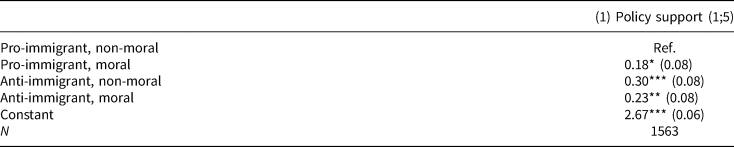
Investigating H1a–H1c (full sample), Table 1 presents OLS regressions of treatment groups on policy support.
OLS regressions of treatment groups on policy support
Notes: *p < 0.05;**p < 0.01;***p < 0.001. Unstandardized coefficients, standard errors in parentheses.
Replicating findings from the literature (Flores, Reference Flores2018; Avdagic and Savage, Reference Avdagic and Savage2021), respondents exposed to the non-moral anti-immigrant message display greater policy support than those who received the non-moral pro-immigrant message (support for H1a). However, moral language gives the pro-immigrant message a boost: policy support is significantly greater among respondents exposed to the moral than the non-moral version of the pro-immigrant vignette (support for H1b). The effect size corresponds to around 20 percent of a standard deviation, moving policy support to the value expressing “some degree”. Finally, pairwise comparisons show that the effects of the anti-immigrant messages and the moral pro-immigrant message are statistically equal in size, offering support for H1c (see Figure A2.1). In sum, these findings indicate that moralization is an effective strategy for mainstream parties to gain support for pro-immigrant policies. These findings replicate when treating the policy support measure as ordinal and using ordered logistic regression instead of OLS (see Appendix 3), as well as when including a control for the party sponsor (see Appendix 4).
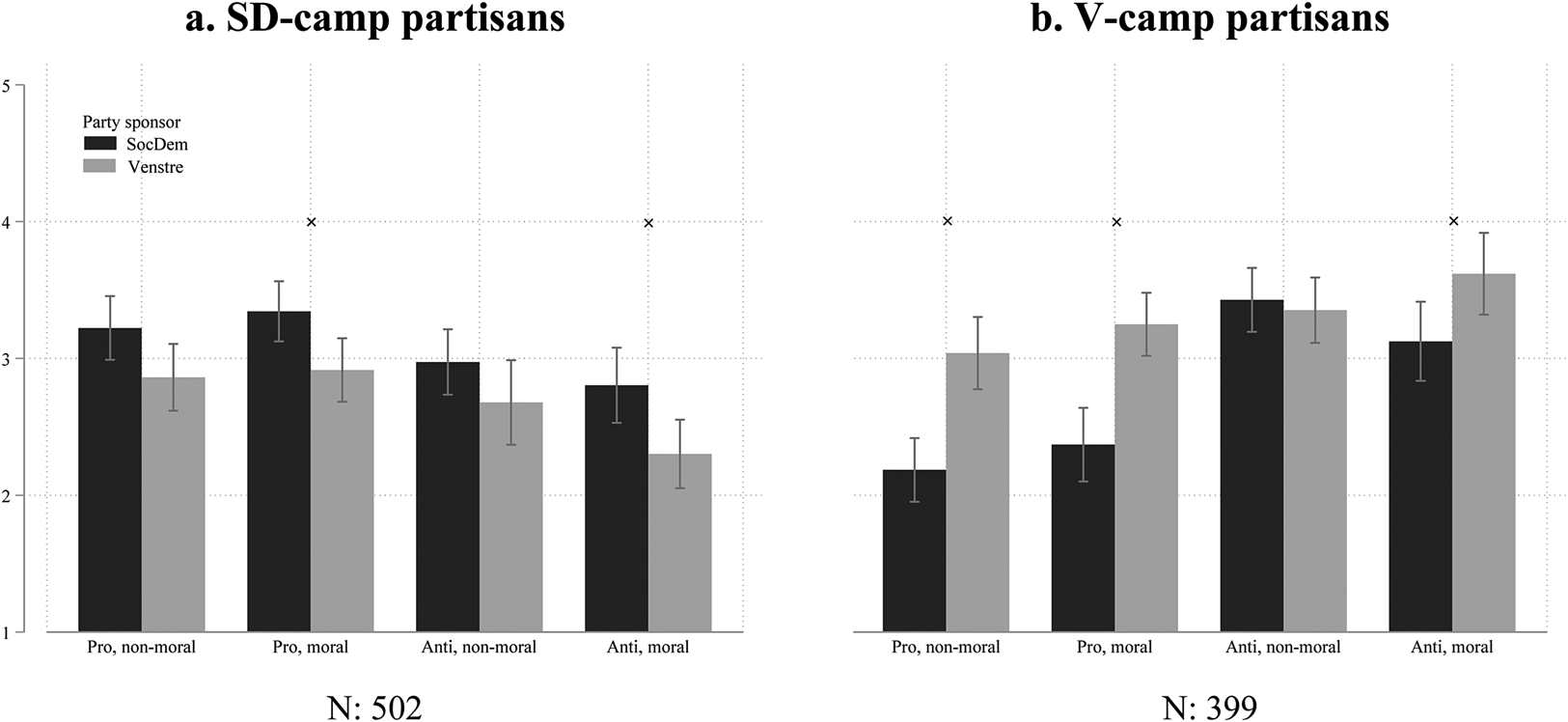
To examine party sponsor effects (H2), Figure 1 displays mean policy support across the four messages and the two party sponsors for partisans of the SD-camp, respectively the V-camp. The figure shows that partisan-motivated reasoning affects respondents' reactions to most of the messages: For the two moral messages, respondents from both camps display greater policy support when the message is sponsored by their party (vs. the opposing party); a pattern that also holds for the non-moral pro-immigrant message, however only at p = 0.05 for respondents in the SD-camp. As the only exception, respondents' policy support for the non-moral anti-immigrant message does not depend on their alignment with the party sponsor. These results offer qualified support for the notion that partisan-motivated reasoning shapes peoples' reactions to immigration messages, and that moral language should amplify this tendency: The partisan pattern is generally more robust and tends to be greater in substantial terms for moral messages.
Partisan responses.
Note: The bars indicate the mean policy support under different experimental conditions for respondents in the SD-camp (a) and V-camp (b). Bars indicate 95 percent confidence intervals around the mean value; x above bars indicates that the difference in means for the given treatment group(s) is statistically significant at the p < 0.05 level.
4. Discussion
This article nuances our understanding of the constraints and agency available to mainstream parties in the immigration domain. While it is generally difficult to change underlying immigration attitudes (Kustov, Laaker, and Reller, Reference Kustov, Laaker and Reller2021) and extant research suggests that anti-immigrant actors have the upper hand, the results of this study indicate that it is possible for the mainstream to gain support for pro-immigrant policies. However, for pro-immigrant policy proposals to be as positively received as anti-immigrant proposals, they must be couched in moral language. This finding suggests that negativity bias serves to boost anti-immigrant (vis-à-vis pro-immigrant) messages in the non-moral versions (Avdagic and Savage, Reference Avdagic and Savage2021), but once immigration rhetoric is moralized, the topic enters into the moral domain, and the mechanisms of moralization take over, putting the two sides of the argument on a par: When politicians appeal to moral considerations, citizens appear, on the mean, to be equally convinced by pro- and anti-immigrant arguments. That the anti-immigrant side does not seem to gain anything from moralizing beyond the advantage it already possesses through negativity bias, suggests that negativity bias and moralization are not additive but rather substitutive mechanisms. This leaves anti-immigrant politicians with two viable, alternative, rhetorical strategies where pro-immigrant politicians have just one.
Adding party sponsorship to the picture provides further nuance: The finding that the non-moral anti-immigrant message was not subject to partisan-motivated reasoning suggests that this strategy will meet least resistance among out-party supporters; a finding that may explain the apparent attractiveness of (non-moral) anti-immigrant communication to mainstream parties. In contrast, pro-immigrant communication and moral rhetoric seem to be primarily popular among the home base. On the one hand, then, pro-immigrant politicians have some potential for fostering support by using moral language; on the other hand, they are more constrained than their anti-immigrant counterparts because their winning rhetorical strategy—moralization—is not equally effective among out-partisans. Still, these findings provide an important corrective to the idea that the pro-immigrant side will always lose out against anti-immigrant advocates.
This study's findings for immigration policy support may be seen as contrasting recent research documenting a high degree of stability in immigration attitudes over time (Kustov, Laaker, and Reller, Reference Kustov, Laaker and Reller2021), indicating that politicians have limited power to affect public opinion in this area. However, if we consider that policy support is likely to tap into political mobilization, the findings indicate that moral rhetoric can mobilize audiences to support a political cause (Jung, Reference Jung2020), even in the absence of underlying opinion change (results in Table 1 replicate when adding a control for immigration attitudes).
While unique political circumstances in Denmark in the fall of 2019 were central to the credibility and validity of the experiment, the strategic dilemma for mainstream parties that motivated it is relevant to understanding contemporary German, Swedish, and French politics, just to name a few cases. In these countries, mainstream parties including the German SPD, French Renaissance, and the Swedish Socialdemokraterna perceive themselves to be caught between ideological commitments to pro-immigrant positions and pressures to move to the right to maintain popular backing. This study suggests that policy support from broad segments of the electorate can be secured by these parties not only through going more anti-immigrant, but equally so from pairing their pro-immigrant messages with moral rhetoric. That I find evidence for a rhetorical strategy that puts pro-immigrant communication on a par with anti-immigrant communication in a context of prolonged salience of anti-immigrant rhetoric gives reason to believe that similar effects can be found in these other cases. A clear scope condition of the study, however, is its applicability to mainstream parties in multi-party systems: It is the possibility for these parties to appeal to the median voter with (more or less) centrist immigration attitudes that creates room for maneuver. Extreme parties and parties in two-party systems, in contrast, will be more constrained because their voter bases are less ideologically flexible, especially as long as immigration remains highly salient and politicized.
Supplementary material
The supplementary material for this article can be found at https://doi.org/10.1017/psrm.2024.45.
To obtain replication material for this article, https://doi.org/10.7910/DVN/QOV745
Acknowledgements
For helpful comments and suggestions, I thank the three anonymous reviewers, PSRM editor Professor John Griffin, Anna van Vree and Tobias Widmann. This research was supported with a grant from the Independent Research Fund Denmark (9057-00027B).


 Open access

