

Joni Mitchell thought of California in 1971 as a lover awaiting her return:
California, I’m coming home
Oh, it gets so lonely
When you’re walking
And the streets are full of strangers
All the news of home you read
More about the war
And the bloody changes
Will you take me as I am?
There is some mythology here of California that Mitchell taps into: that question will you take me as I am? becomes an anthem of a possible kind of love and acceptance belonging to the mountainous, gold rush, golden gate, golden state. “I left my heart in San Francisco”—Tony Bennett in 1962 enshrined the California city with a perpetual sense of longing for a place left behind and relegated to the past. And yet, he offers a horizon-oriented vision for a future on the other side of a journey toward return. Deb Talan and Steve Tannen of the band The Weepies (who now perform solo) gave us a San Francisco melody in their 2006 song “San Francisco” that follows from Mitchell and Bennett in imagining the city in relation to the distant lover who we “wonder if she’s still down in the Mission.”
The name “San Francisco” comes from California’s Christian missionary histories, perpetually citing the displacement of Indigenous peoples and their ongoing dispossession and wars over former Mexican territory. “Whereas European explorers named land and bodies of water after themselves or their patrons,” notes Connie Chiang in her discussion of Coll Thrush’s (2007) historical work on Indigenous histories in the west, “natives named [land and bodies of water] in relation to their lived experience” (2014:575). Indeed, the naming of the area now consolidated under “San Francisco” is itself indicative of a matrix of colonial forces. It is that same matrix that gave way to a region eventually associated with a “progressive” political identity even as it remains deeply marked by the westward agendas of North American colonization, particularly through the construction of the transcontinental railroad during the middle of the 19th century.Footnote 1 Surrounding the history of that railroad is the violent treatment of Chinese immigrants to California who were hired as railroad laborers but were denied legal protections for achieving citizenship. Recall the Chinese exclusion act of 1882, which turned the site of Angel Island, the west coast counterpart to Ellis Island, into a detainment center for immigrants trying to relocate their families to California during the turn of the 20th century. And it was Angel Island’s history of detainment that laid the foundations for the Japanese internment camps in California during the Second World War.Footnote 2 When I come home to you, San Francisco, your golden sun will shine for me. So, then, who or what or where or when is the San Francisco that Dear San Francisco addresses?
My family lived in the Bay Area from 1999 to 2004, and because I was a jumpy, bendy kid my parents brought me to the San Francisco Circus Center where I went on to train in their youth circus under the late Master Lu Yi. I could sense his importance and magnitude at the time. Lu Yi, who also published a memoir titled Training Is Bitter: Reflections on Life, Effort, and Acrobatics with Master Trainer Lu Yi (2023), previously led acrobatic companies in China and came to California in the late 20th century during the contemporary circus boom in North America. Although I was doing okay in some skills at the time, I primarily struggled with acrobatics because I was too scared to throw myself upside down in the air. Lu Yi was very patient with me and worked with me to be more comfortable upside down—sometimes having me just do handstands against a wall for what felt like hours. My family returned to Washington, DC, before I could conquer that fear. Yet, when I found myself lost in New York City after college, I decided to find a way to move back to California—near San Francisco specifically, hoping I’d return to some part of what I left behind. When I did land there amidst the Covid-19 crisis, I also reencountered my love of circus upon attending Dear San Francisco, a show by Les 7 Doigts de la Main (The 7 Fingers) in residence at Club Fugazi.
Based in Montréal, Canada, Les 7 Doigts de la Main are leaders in the contemporary circus movement. They describe themselves as a “creative collective,” focused on “tell[ing] human stories with superhuman skills.” On their website, which details the company’s history and their ongoing works, they write, “In 2002, the 7 founders set out to redefine circus by stripping down the spectacle to its thrilling essence” (7fingers.com 2025). This redefinition involves interdisciplinary and institutional collaborations, particularly with the Centre for Circus Arts Research, Innovation, and Knowledge Transfer (CRITAC). Audiences are also familiar with their work on Broadway, from the 2013 Pippin revival to the 2024 musical Water for Elephants.
Dear San Francisco, which has been running continuously since it opened on 12 October 2021, is the Montréal-based company’s first residential show in San Francisco and is directed by Gypsy Snider and Shana Carroll, both born and raised in the Bay Area. Snider is the daughter of Peggy Snider, who founded the Pickle Family Circus in 1974, which would eventually grow into the San Francisco Circus Center. Circus and San Francisco have a rich history, including the beginnings of the transcontinental railroad in the mid-19th century when California was a destination for “Wild West Shows” (Hughes Reference Hughes, Arrighi and Davis2021). But it was during the 1970s that contemporary circus companies and activist social circus organizations—which, as Jennifer Spiegel notes, “us[e] circus arts as a form of social outreach to address issues of trauma and social turmoil with communities” (2021:206)—emerged in the Bay Area in response to the Vietnam War and the Civil Rights Movement.Footnote 3 Dear San Francisco engages this ethos as its nine acrobats burst through the Club Fugazi, an intimate venue—formerly the home of the long-running comedy and variety show Beach Blanket Babylon—in the South Beach neighborhood at the border of Chinatown and Little Italy. Club Fugazi is a historical landmark in the city: The Grateful Dead had their first album release party there, and the beat poets—whose City Lights bookstore is nearby—frequented the venue.Footnote 4
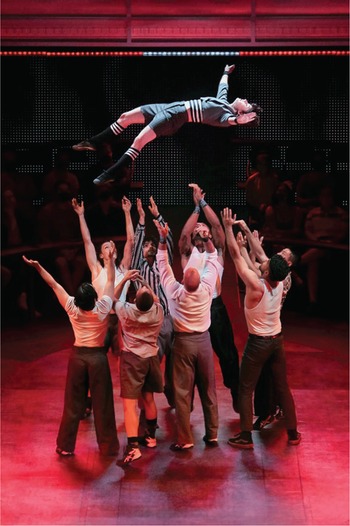
The performance begins when a curtain flies across the proscenium arch of the stage and becomes a screen for black-and-white archival footage of San Francisco at the turn of the 20th century. We follow a horse and carriage and then, suddenly, fire tears at the screen. We are thrown into the 1906 earthquake that shattered and burned the city. Years went by as San Francisco built itself anew, learning how to design architecture specifically for earthquakes and stretching hills.Footnote 5 The curtain is struck to reveal all nine acrobats swirling into an extended acrobatic dance sequence whose choreography emphasizes the collective rather than any individual performer. This is Dear San Francisco’s opening number and it is 7 Fingers’ slant on a traditional charivari act, which is often an explosive introduction to the performers of the circus and might feature distilled bits from various acts in quick succession. Dear San Francisco’s charivari features the company performing as a fluid, amoebic organism to the song “Fire” by the show’s composer, Colin Gagné:
From fire to ashes
From ashes to tremor
My city is calling.
From fire to ashes
And ashes to life
My city is rising.Footnote 6
Bodies burst upward and sideways, thrown from within and alongside the tightly packed audience, yet always caught with ease. One of the performers, held up and gently guided by the others, walks entirely upside down along the stage’s shallow proscenium arch (fig. 1). Almost like the performer is learning again how to walk, how to fly: a phoenix rising. Circus is the art of magnifying the everyday by reaching toward the extreme,Footnote 7 and the pedestrian act of walking itself is slowed and inverted here. This magnification of the labor of what it takes to walk imaginatively envisions San Francisco rising from the ashes; the gesture reworks walking into a feat of flight that requires the collective. Dear San Francisco invites its audience to ask: how do we carry on? What became of the city during and after the quake? And, what became of us?
Ellie Rossi walks upside down on proscenium arch in Dear San Francisco by Les 7 Doigts de la Main. Club Fugazi, San Francisco. (Courtesy of David Dower/Club Fugazi)

The opening “charivari” with the ensemble, as Natasha Patterson flies in the air. Dear San Francisco by Les 7 Doigts de la Main at Club Fugazi, San Francisco. (Photo by Kevin Berne; courtesy of David Dower/Club Fugazi)

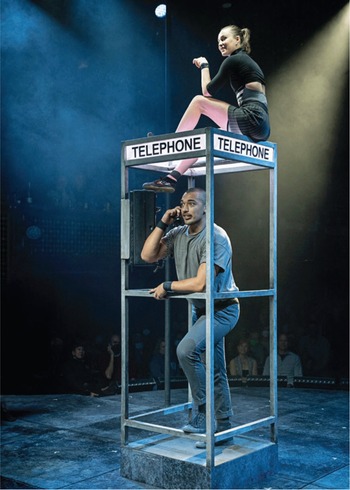
Maya Kesselman Cruz (top) and Serena Aguilar Izzo with the telephone booth in Dear San Francisco by Les 7 Doigts de la Main. Club Fugazi, San Francisco. (Courtesy of David Dower/Club Fugazi)

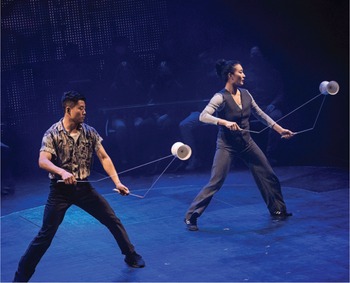
Enmeng Song and Shengnan Pan perform the Diabolo sequence in Dear San Francisco by Les 7 Doigts de la Main. Club Fugazi, San Francisco. (Courtesy of David Dower/Club Fugazi)

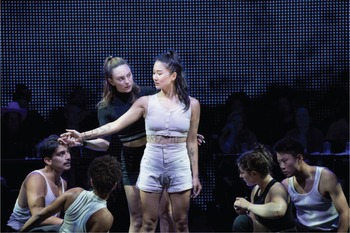
Writing on the body of Shengnan Pan in Dear San Francisco by Les 7 Doigts de la Main. Club Fugazi, San Francisco. (Courtesy of David Dower/Club Fugazi)

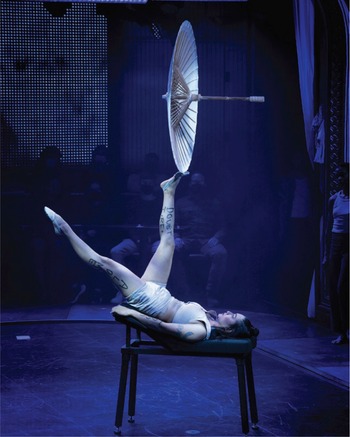
Shengnan Pan juggles umbrellas for the final act of Dear San Francisco by Les 7 Doigts de la Main. Club Fugazi, San Francisco. (Courtesy of David Dower/Club Fugazi)

Following this phoenix-inspired charivari, the performers wheel a bulky phone booth around the stage. A montage of new arrivals to the city ensues as they one-by-one enter the booth, the presence of which signifies a bygone era of communication. They each handle the receiver and call their respective families to let them know they’ve arrived, or to ask for a little more money to make the rent, or to let them know about strange occurrences such as the sky turning orange, as it did across Northern California in Fall 2020 due to local fires (see Rexroat Reference Rexroat2021). Dear San Francisco is fascinated with technologies for communication. That horse and carriage we follow at the opening of the show visually recalls the Pony Express, which began in Northern California during the early gold rush years.Footnote 8 With its mail carried by horses, calls back home from public phone booths, and ultimately the iPhone, Dear San Francisco offers a meditation on the politics and poetics of epistolary form.
Prior to each performance, Club Fugazi staff invite audience members to write letters to the city that begin with “Dear San Francisco.” These are collected prior to the start of the performance and performers read some of the letters aloud during the show. They also keep some that rotate in and out of the show, but always read one letter, either saved or new, that addresses the city’s history of being a haven for those looking for a queer community.
The performance eventually moves to the iPhone-laden present and explores how the seeming presence and urgency that digital modes of communication attempt to perform is itself a mark of absence. Communication via technologies such as iPhones are marked by uncanny expressions of presence, liveness, and social connection—and yet there we are, alone, desperately trying to “speak to a representative,” as performer Enmeng Song repeatedly attempts to do throughout Dear San Francisco. A sequence later in the performance enacts an inversion of the earlier phone booth sequence. Instead of the ensemble crowding around the small phone booth and awaiting their chances to slip inside and make their calls, they are scattered throughout the venue talking on cell phones, leaving voicemails to unseen, unheard receivers. One performer, Zoe Schubert, offers a larger meditation on norms surrounding “apps”—the attempt to achieve intimacy through establishing “connections” and shared app usage:
At this stage in our relationship, I feel like a voicemail is maybe too much, like voice memos are fine, but texting is probably better or, you can literally contact me on Instagram, Messenger, WhatsApp, Twitter, Snapchat, or Viber if you’re into that kind of thing. And for when we hang out, we should make sure we are connected on Splitwise, Venmo, Paypal, or Zelle. Or should we wait? Is it too soon for that level of intimacy?Footnote 9
In an earlier iteration of Dear San Francisco—which, like many long-running contemporary circus shows, shape-shifts to adjust for the specialties and personalities of its rotating cast—a member of the ensemble, Michael Patterson, emerged at one point as a clown-ish interpretation of a Silicon Valley techie. Wielding an iPhone and wearing a lanyard nametag around his neck, visible through a sleek puffer vest that immediately mocks the Silicon Valley silhouette, Patterson’s techie arrived at the proscenium’s edge to sell us his new app, Privatize This. At the end of his “presentation”—à la Steve Jobs’s infamous product launches—the clown asked the audience to stand and smile for a picture to celebrate the launch of his new app. Patterson turned and lifted his iPhone as if to try to capture the entire audience into the frame with him. And yet, the bit ended to reveal that he only took a picture of himself. A critique of the self(ie) in relation to the collective, Patterson’s clown routine aptly illustrated a contradiction surrounding digital communication technologies: “social networking” platforms purport to build communities by bridging great distances and differences but end up isolating people. Finally, Dear San Francisco’s address to the city embeds within its fun a rehearsal for the future grief it envisions for society. A future of more absences—uncanny, ghostly performances marked by an ethos where “disruption,” as Adrian Daub describes it, is the buzzword for Silicon Valley’s start-up culture powered by venture capital (2020:202). But what about the past? How does the show teach us to engage histories as a critical practice for envisioning different futures for San Francisco? And us within it? At the center of Dear San Francisco is an acrobatic couple, Shengnan Pan and Enmeng Song, who perform a partner juggling act known as “Diabolo.” Woven into the performance of the Diabolo act is also a lesson about the history of the act, and a history of how these two artists came to fall in love with Diabolo, with each other, and with San Francisco. Together, they perform while telling the story of their shared journey as circus artists, as Chinese immigrants to San Francisco, married, raising children in the city. An original song, “Coming West,” composed by Gagné, accompanies their performance and underscores their dialog. We learn that they met and fell in love years ago when he asked her to teach him Diabolo, an act that, she notes, is historically performed only by women. Now, the act has become the source of their life and livelihood. Near the end of their act, Enmeng Song and Shengnan Pan speak in unison as they tell us that the Diabolo “brought us here to all of you.” The act of juggling becomes an art practiced daily, helping them navigate everything from parenting to the US immigration system to the challenges of circus performance. In citing how their juggling brings them together, they exemplify how such skills reinforce Dear San Francisco’s focus on communication and networks of relationality where choreographies of precarity—acts whose movements are predicated on dealing with failure, working with the forces of gravity rather than succumbing to themFootnote 10—find fulfillment in juggling life’s many complexities, not in aloneness but in togetherness. Juggling it all with a partner, with “all of you”—and, implicitly, with San Francisco.
The exploration of San Francisco as an archival and layered text of technologies for connecting turns here to the art of circus itself. There is a moment during their act where the duo tells us the history of Diabolo, emphasizing its materiality:
SONG: This is a Chinese yo-yo. It was a very popular toy in the time of the Ming Dynasty.
PAN: In Mandarin this is called kong zhu which means “Hollow Bamboo.” It was originally made from bamboo. When you pull the strings it spins faster and faster.
SONG: Listen.
Enmeng Song raises the spinning diabolo up to the microphone attached near his face so we can hear the amplified sound of the thin string against the Diabolo.
SONG: At some point, this toy became a traditional Chinese circus act. But the act was only performed by women.
PAN: In English this is called “Diabolo.”
The Diabolo speaks. It tells the histories of Chinese circus. It speaks through the touch of the Diabolo against the string, engaging the technology of electronic amplification, bringing the sound of a material history to the whole theatre. At this point, Enmeng Song and Shengnan Pan’s act with the Diabolo is an homage to the history of the Diabolo itself. At one point during the act, they name Master Lu Yi and his influence on their lives, careers, and on the show. They note that many acts performed in Dear San Francisco have a history in Chinese acrobatics and circus, which Lu Yi introduced to contemporary circus in the US through his leadership at the San Francisco Circus Center. From its premiere, each performance of Dear San Francisco has been dedicated to Lu Yi, who died 24 October 2023 (see Janiak Reference Janiak2023).
Through this dedication and the fact that the whole performance is a letter to the city, Dear San Francisco meditates on the lines of communication that contend with the force of absence, including the death of Lu Yi. Life goes on, the shows used to go on—until the lethality of Covid-19 transformed theatres into potential sites of contagion. How do cities go on? “Cities,” wrote Peggy Phelan in 2021 while we were still in the grip of Covid-19, “are dense instantiations of the past and aspirations toward the future.” Situated between a past tense and a future tense, cities hold tension by coaxing visions of layered temporalities, recurring currents of living and dying, immigrants and long-time residents, devastation and revitalization.
Covid-19’s disruption to the sense of life’s linear momentum revealed the city as a doing. We do cities more than a city is. San Francisco—an imagined someone something someplace full of a history with us and beyond us—only ever lives on in the realm of memory; yet it is a future-oriented destination that promises an Odyssean journey home. Its ephemerality as a “place” finds its solidity as a future looking back. A future of artificial intelligence encroaches: the erosion of the poet behind the poem, the artisan behind the bamboo carving, the human behind the telephone. Can love endure, can the city hold even through the hardest of shakes, burns, and contagions? What began with fire and rising from ashes ends in water. The final act of Dear San Francisco involves the ensemble writing words in different languages across the skin of one of the performers. Hurt, Pain, Breathe, Loss, War, Fear. A recent iteration features Shengnan Pan as the performer on whose body everyone writes. She becomes archival, an embodied text message. And then, she steps toward her apparatus to perform an act that is sometimes referred to as “Umbrella Foot Juggling.” Positioned on her back, her skin covered in writing, she balances, twirls, and flips several umbrellas using her feet and hands. It is a feat of balance, precision, and attention—and we bear witness. Toward the end of her act, Shengnan Pan rises to stand. Upon ascending, the performers pour water—buckets of water—over her, and she scrubs the text from her skin. Empty and yet full, she returns to perform the final sequence of her act—balancing, juggling, holding more umbrellas than before. Embodied in this act is a journey from fire to water, and, perhaps, the twinned relation fire and water have to life and death. But what is also communicated by Shengnan Pan’s washing away of text is the reminder of the possibility to begin again. And that beginning again does not mean beginning with nothing.
Dear San Francisco is, to my eye, both a final gasp and a call to action. It is a call to pause, with attention and quiet balance, to listen to the vibrating strings, the Earth, and urgently address a vision of ourselves in the future. How do we collectively do San Francisco—from fire to ashes, from ashes to tremor, my city is calling, from fire to ashes, and ashes to life, my city is rising (Gagné Reference Gagné2022)—even while the city is but one of many to undergo compounding, interconnecting disasters including housing insecurity and mass vulnerabilities to climate crisis–related fires. Dear San Francisco foregrounds how the power and promise and pleasure of the collective is a story of San Francisco’s past that can still be one for its future. The San Francisco to whom the Dear addresses becomes us, dear audience. And as Les 7 Doigts de la Main weaves together the history of contemporary circus acts with the history of San Francisco, they imbue each act with a mode of address that carries on a history and carries forth a legacy. Les 7 Doigts de la Main’s Dear San Francisco gives us circus as an artform dedicated to the art of dedication.


 Open access

