


Theories of human aggression can inform research, policy, and practice in organizations. One such theory proposes that some victims invite abuse—even violence—through their personalities, styles of speech or dress, actions, and sometimes their inactions. In other words, they are partly to blame for the transgressions of others. This victim precipitation hypothesis originated in the field of criminology, but it fell out of favor in that discipline some time ago. In recent years, however, this concept has caught hold in industrial-organizational (I-O) psychology. This trend, we argue, is troubling.
This article provides an overview and critique of victim precipitation research. We chart the history of the victim precipitation hypothesis, from research on homicide (dating back to the 1940s) to rape (1960s) to abusive supervision on the job (2000s). We also review analyses of victim precipitation stemming from multiple fields of science and practice. In addition, we present some of the practical consequences that emerge (e.g., in the investigation and adjudication of crime) when victim precipitation ideology holds sway.
Confident that I-O psychology can do better than victim precipitation, the second half of this article highlights alternative models for researching and redressing workplace mistreatment. For purposes of illustration, we detail three frameworks that seem especially promising for advancing science and practice in this domain. We also review perpetrator predation, a broad analytic paradigm that explains the same workplace dynamics without blaming one person for the misdeeds of another (Cortina, Reference Cortina, Bowling and Hershcovis2017). Importantly, this framework does not assert that victim characteristics are irrelevant to workplace mistreatment, but rather that the person responsible for those characteristics being relevant is the perpetrator (not the victim). We posit that these alternative perspectives offer stronger, more practical, and more progressive explanations for victimization in organizations.
The Troubled History of Victim Precipitation
Rise of a Model
Over 75 years ago, criminologist Hans von Hentig and defense attorney Beniamin Mendelsohn pioneered the victim precipitation model. They proposed that some victims provoke their own victimization through their character or behavior, often unwittingly. As von Hentig (Reference von Hentig1940) wrote, “the human victim in many instances seems to lead the evil-doer actively into temptation. The predator is—by varying means—prevailed upon to advance against the prey. If there are born criminals, it is evident that there are born victims” (p. 303). Arguing that the victim in these cases “shapes and molds the criminal,” von Hentig (Reference von Hentig1948, p. 384) suggested that victims deserve some of the blame for the crimes that befall them. Mendelsohn (Reference Mendelsohn1956) went so far as to construct a taxonomy of victims that centered on their level of culpability; categories ranged from completely innocent victims (e.g., children) to voluntary victims who share equal guilt with their offenders (e.g., dying in a suicide pact with a spouse) to victims who are the most guilty (e.g., assailants dying at the hands of their victims).
Criminologists and criminal defense attorneys flocked to the victim precipitation hypothesis in the mid-20th century, often as an explanation for violent crime. For instance, Marvin Wolfgang (Reference Wolfgang1957) studied “victim precipitated criminal homicide,” referring to situations where a person had initiated physical attack prior to being killed by the target of that attack (e.g., a man beats his girlfriend, and in self-defense she stabs him to death). Wolfgang went on to become one of the most influential criminologists in the English-speaking world (Cohn & Farrington, Reference Cohn and Farrington1994). Another criminologist, Menachem Amir (Reference Amir1967), wrote about “victim precipitated forcible rape,” meaning:
. . . those rape situations in which the victim actually, or so it was deemed, agreed to sexual relations but retracted before the actual act or did not react strongly enough when the suggestion was made by the offender(s). The term applies also to cases in risky or vulnerable situations, marred with sexuality, especially when the victim uses what could be interpreted as indecency in language and gestures. (p. 495)
When Amir (Reference Amir1967) found cases fitting this description in Philadelphia Police Department files, he concluded that these victims had been “precipitators” of their own rapes, rendering their rapists “less guilty” (p. 502).
The psychoanalytic community embraced the ideology of victim precipitation as well. Mendelsohn, for example, published an important article in the Revue Française de Psychanalyse (French Review of Psychoanalysis; 1958). Moving from proposition to practice, therapies later emerged for “remotivating” victims to stop soliciting abuse. For instance, psychoanalyst Irwin Kutash (Reference Kutash, Kutash, Kutash and Schlesinger1978) used von Hentig, Mendelsohn, and Wolfgang as a springboard and wrote that a victim:
. . . may compulsively and repetitively invite attack to atone for unconscious guilt feelings. Explorations of the victim's history can bring about the insight that all the victimage [sic] is more than coincidence and that he has had a part in promoting it. By zeroing in on the feelings during the victiming [sic] and asking the person when he experienced these feelings before, the therapist can help the victim get back to these previous incidents—perhaps all the way back to childhood experiences with parents. Associating to the feelings in dreams may have the same effect. (pp. 459–460)
Using classic psychoanalytic terms and techniques, the ultimate goal of this treatment is to “prevent the repetition of the invitation to be aggressed against” (Kutash, Reference Kutash and Strean1984, p. 59).
Demise of a Model
In the late 20th century, victim precipitation research came under heavy fire on multiple fronts (e.g., Berger & Searles, Reference Berger and Searles1985; Eigenberg & Garland, Reference Eigenberg, Garland and Moriarty2003; Elias, Reference Elias1986; Franklin & Franklin, Reference Franklin and Franklin1976; LeGrand, Reference LeGrand1973; Ressler, Burgess, Douglas, Hartman, & D'Agostino, Reference Ressler, Burgess, Douglas, Hartman and D'Agostino1986; Timmer & Norman, Reference Timmer and Norman1984; Weis & Borges, Reference Weis and Borges1973). Criminologists lambasted it for logical inadequacies, questionable evidence, unfounded assumptions, untestable hypotheses, and unwarranted generalizations. For instance, some took issue with the circular reasoning inherent in the model, such that the independent variable (victim precipitation) falls apart without the dependent variable (victimization). This becomes obvious when we attempt to study one without the other: “for example, a woman walking alone at night on an unlighted street . . . can hardly be thought of as engaging in crime-precipitative behavior if no criminal act takes place” (Franklin & Franklin, Reference Franklin and Franklin1976, p. 128). Researchers also identified deficits in the empirical record cited as support for the victim precipitation model. Part of Amir's (Reference Amir1967) so-called evidence of victim-precipitated rape, for example, was the “bad reputations” (p. 497) attached to victims prior to their assaults.
Because victim precipitation research generally ignored social conditions and institutions in the etiology of crime, many saw dangerous consequences in this work. Sociologists decried it for fueling regressive victim-blaming attitudes and ineffective crime prevention programs: “The ‘ideology of victim precipitation’—by blaming the individual crime victim—only serves to divert attention and resources away from the structural causes of crime and the structural changes required by a less criminogenic society” (Timmer & Norman, Reference Timmer and Norman1984, p. 63). Political scientist Robert Elias (Reference Elias1986) echoed similar sentiments, observing how victim precipitation “. . . has focused our attention away from law-enforcement failures and has made victims responsible not only for their victimization, but for preventing future attacks. Taking a very individualized view, it has attributed crime to personal failings, directing us away from institutional or structural flaws” (p. 89). As the criticisms mounted, scholars across the social sciences discarded victim precipitation as a reasonable explanation for crime.
On another front, the 1960s and 1970s brought the women's movement and a new wave of feminist mobilization against social inequality. Activists drew the nation's attention to violence against women, demanding that it not be ignored, excused, or denied. Research exploded in this area, and among other things it dismantled victim precipitation explanations of rape. For example, sociologists Ronald Berger and Patricia Searles (Reference Berger and Searles1985, p. 9) rejected the spurious claims implied by the victim precipitation model, which “assumes that the offender rests in a passive state and is set into motion primarily by the victim's behavior, that the victim's behavior is a necessary and sufficient condition for the offense, and that the intent of the victim can be inferred from his or her resultant victimization.” Adding that “the concept merely converts sexist rationalizations into a causal explanation,” they urged that it be abandoned (Berger & Searles, Reference Berger and Searles1985, p. 9).
Rape researchers also exposed disturbing repercussions of victim precipitation ideology. If a woman has participated in the chain of events that ultimately “caused” her sexual assault (as per victim precipitation), then she is partly to blame for that crime. This line of thinking lends itself to questions about her assailant's guilt, sometimes to the point of exoneration: “the victim's behavior becomes grounds for granting a ‘reasonable doubt’ to the offender's criminal intent in a court of law” (Berger & Searles, Reference Berger and Searles1985, p. 9; see also LeGrand, Reference LeGrand1973). Victim precipitation proponents agreed with this reduction in rapist culpability; on the topic of rape, Amir (Reference Amir1967) stated that this model “does not make any offender innocent but allows us to consider some of these men, at least, less guilty and leads us to consider that the victim is perhaps also responsible for what happened to her” (p. 502). Put simply, the victim precipitation model helps violent predators escape penalty for their wrongdoing (Cortina, Reference Cortina, Bowling and Hershcovis2017).
Victim precipitation often crops up to explain “crimes of personal violence committed by (mostly) men against (mostly) women” (Meloy & Miller, Reference Meloy and Miller2010, p. 11). Many other criminal offenses are never explained using this model. For example, if a family endures a home invasion and burglary, it typically does not face accusations of “inviting” crime by having nice things (Cortina, Reference Cortina, Bowling and Hershcovis2017). When people die in automobile accidents, they are not thought to have solicited vehicular homicide by driving their cars on the freeway. This points to a worrisome issue: “Why is it that we tend to sympathize with someone who is mugged, burglarized, or injured by a drunk driver, yet victims of male-on-female violence often experience victim blaming and self-blame?” (Meloy & Miller, Reference Meloy and Miller2010, p. 7). Some answers to this question lie in cultural myths and supports for rape.
Victim precipitation ideas are central to rape mythology, a concept developed in the 1970s (e.g., Brownmiller, 1975; Schwendinger & Schwendinger, 1974). Pervasive in our society, rape myths deny the reality of sexual violence and, when denial becomes impossible, justify it (e.g., Burt, Reference Burt1980; Cowan, Reference Cowan2000; Lonsway & Fitzgerald, Reference Lonsway and Fitzgerald1994; Payne, Lonsway, & Fitzgerald, Reference Payne, Lonsway and Fitzgerald1999; Timmer & Norman, Reference Timmer and Norman1984). These fallacies “deliberately obscure the true nature of rape” (Brownmiller, Reference Brownmiller1975, p. 312). A core myth is that women provoke men to assault them sexually—if not through their attire or behavior then through their lack of behavior (e.g., failure to fend off a rapist). In other words, rape myths assert that victims “ask for it,” making their rapes seem more reasonable and their rapists less responsible. Psychologists Kim Lonsway and Louise Fitzgerald (Reference Lonsway and Fitzgerald1994, Reference Lonsway and Fitzgerald1995) show how endorsement of these fictions serves different functions for men and women: “Its critical function for men is to justify male sexual violence, whereas for women it is to deny personal vulnerability” (Lonsway & Fitzgerald, Reference Lonsway and Fitzgerald1995, p. 709).
Not without consequence, rape mythology looms large in criminal justice proceedings. Research has demonstrated how these beliefs distort police, prosecutor, and jury decision making (e.g., Brekke & Borgida, Reference Brekke and Borgida1988; Coates & Wade, Reference Coates and Wade2004; Lonsway & Fitzgerald, Reference Lonsway and Fitzgerald1994; Tetreault, Reference Tetreault1989). For example, recent investigations by Rebecca Campbell and colleagues (Reference Campbell, Fehler Cabral, Pierce, Sharma, Bybee, Shaw and Feeney2015) suggest that rape myths factored into law enforcement decisions not to submit thousands of rape kits to labs for forensic analysis. Instead of being tested for their evidentiary value, these biological samples were shelved in police storage for decades, all but forgotten (e.g., Human Rights Watch, 2010; The Weiner Report, 2002). This demonstrates how acceptance of myths surrounding sexual violence has practical repercussions that are very real and very alarming.
Similar myths deny and justify sexual harassment in organizations. A common fallacy is that some women “ask for” harassment with inappropriate attire or language on the job, so they are partly to blame for the wrongdoing that ensues (Lonsway, Cortina, & Magley, Reference Lonsway, Cortina and Magley2008). According to empirical research, these misconceptions about workplace mistreatment go hand in hand with rape myths and generally hostile attitudes toward women (Lonsway et al., Reference Lonsway, Cortina and Magley2008). This body of evidence on cultural mythologies concerning gendered violence, documented by psychologists and sociologists over 40 years, exposes the harms of victim precipitation thinking (Cortina, Reference Cortina, Bowling and Hershcovis2017).
Not only scientists but also practitioners in law enforcement have rejected the victim precipitation hypothesis. For example, agents at the Behavioral Sciences Unit of the Federal Bureau of Investigation (FBI) have found limited utility in victim precipitation ideas, instead focusing on patterns of thought and (mis)perception among criminal offenders (Ressler et al., Reference Ressler, Burgess, Douglas, Hartman and D'Agostino1986). Again turning to the example of sexual assault, the International Association of Chiefs of Police (IACP, a professional organization for law enforcement leadership) rejects notions of victim precipitation, advising that police should “reassure victims that, regardless of their behavior, no one has the right to sexually assault them” (IACP, 2005, p. 4). Instead of scrutinizing victims, the IACP directs sexual assault investigators to focus principally on (alleged) perpetrators: “An effective investigation will concentrate on gathering as much evidence as possible on the suspect . . . not on the victim's character, behavior, or credibility” (IACP, 2005, p. 6).
In summary, multiple scientist and practitioner communities have analyzed victim precipitation ideology and rejected it as flawed, even dangerous. Today, this model has fallen out of favor within criminology—the discipline that gave rise to it. For example, among the top-five highest-impact criminology journals (Criminology, Crime and Delinquency, Criminal Justice and Behavior, Sexual Abuse, and Journal of Criminal Law and Criminology), only three articles referenced “victim precipitation” (in a positive light) during the decade from 2006 to 2015. Likewise, searches of the top political science journals (American Political Science Review, American Journal of Political Science, Journal of Politics, and Political Science Quarterly) turn up exactly one contemporary reference to the victim precipitation hypothesis; this article only mentions the model in passing, noting that it is “rightly criticized for blaming victims” (Bateson, Reference Bateson2012, p. 581). In short, recent decades have witnessed a sharp decline in victim precipitation endorsement across the social sciences. I-O psychology, however, is bucking this trend.
Victim Precipitation of Workplace Aggression?
Resurrection of a Model
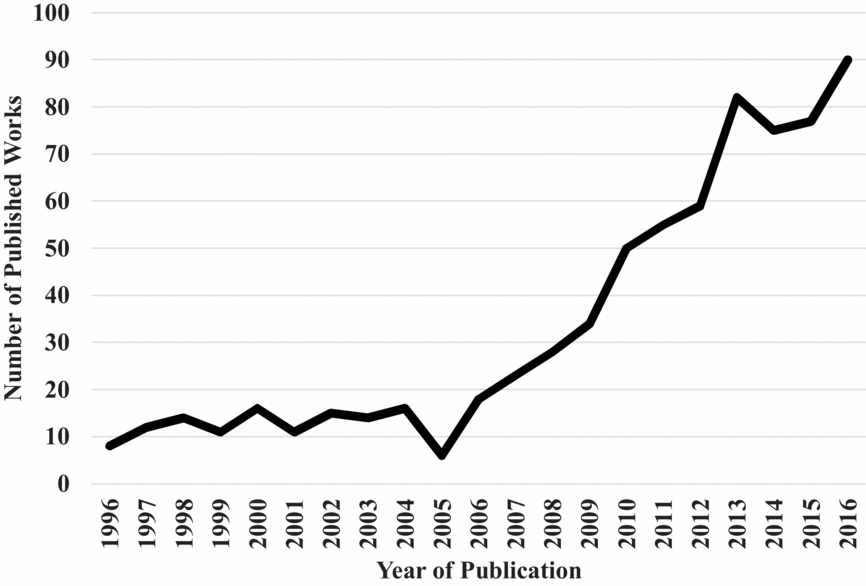
Though many scientists and practitioners have jettisoned victim precipitation as an explanation for aggression, some in I-O are embracing this notion. In the context of organizations, the victim precipitation hypothesis holds that victims of workplace abuse often provoke their own victimization, unwittingly or otherwise. The basic argument is that some employees (e.g., those who are unhappy, unpleasant, underperforming) “consciously or unconsciously participate in the sequence of events that leads to their becoming targets” (Aquino & Byron, Reference Aquino and Byron2002, p. 72). This line of research gestures to psychodynamic concepts (e.g., unconscious invitations, wish fulfillment), which is rare in I-O psychology. Nevertheless, the popularity of this model is on the rise. A Google Scholar search for articles including the terms “workplace,” “victim precipitation,” and varieties of interpersonal mistreatment (any of the following: “mistreatment,” “abuse,” “victimization,” “hostility,” “bullying,” “aggression,” or “undermining”) returns 65 works published between 2001 and 2005. This number leaps to 153 between 2006 through 2010, and it soars to 361 in the years 2011 through 2015. Figure 1 graphically depicts these publication trends over time. Victim precipitation is not central to all of these articles; still, this concept is clearly gaining purchase in I-O psychology.
Results of a Google Scholar search for published works, 1996–2016, including the terms “workplace,” “victim precipitation,” and varieties of interpersonal mistreatment (any of the following: “mistreatment,” “abuse,” “victimization,” “hostility,” “bullying,” “aggression,” or “undermining”).
The victim precipitation hypothesis is turning up across the organizational literature. For example, scholars have drawn on this notion in attempts to explain abusive supervision (Chan & McAllister, Reference Chan and McAllister2014; Henle & Gross, Reference Henle and Gross2014; Tepper, Duffy, Henle, & Lambert, Reference Tepper, Duffy, Henle and Lambert2006; Tepper, Moss, & Duffy, Reference Tepper, Moss and Duffy2011), workplace victimization (e.g., Aquino, Reference Aquino2000; Aquino & Bradfield, Reference Aquino and Bradfield2000; Aquino & Byron, Reference Aquino and Byron2002; Aquino, Grover, Bradfield & Allen, Reference Aquino, Grover, Bradfield and Allen1999; Aquino & Lamertz, Reference Aquino and Lamertz2004), workplace bullying (Samnani, Reference Samnani2013; Samnani & Singh, 2015), workplace exclusion (Scott, Restubog, & Zagenczyk, Reference Scott, Restubog and Zagenczyk2013), workplace ostracism (Wu, Wei, & Hui, Reference Wu, Wei and Hui2011), workplace incivility (Milam, Spitzmueller, & Penney, Reference Milam, Spitzmueller and Penney2009), and negative workplace gossip (Wu, Birtch, Chiang, & Zhang, in press). Some of this work is seeing publication in the top journals of our field, including Journal of Applied Psychology, Personnel Psychology, Journal of Management, and both Academy of Management Journal and Review. These recent developments, we argue, are cause for concern.
When Karl Aquino (Reference Aquino2000, p. 172) asserted that the “concept of victim precipitation is a well-developed component of criminal victimology,” he did not mention that the criticisms of victim precipitation are just as well-developed (if not more so). Victim precipitation research still suffers from the defects documented in criminology, sociology, psychology, political science, feminist studies, and law enforcement. This hypothesis still blames one individual for the transgressions of another. Even when victim blame is not the intent of the researchers, this is what happens when they invoke this model. In other words, “wherever victim precipitation is offered as an explanation, it serves to place responsibility on the victim: you cause, or help to cause, your own victimization” (Timmer & Norman, Reference Timmer and Norman1984, p. 65).
In fact, when the victim precipitation hypothesis informs scientific questions, this leads scientists (as well as police and prosecutors) to focus on victims, with questions about their personalities (e.g., neurotic? disagreeable?), behaviors (submissive? provocative?), performance (low? high?), and so on. When the aggression takes a sexual turn, the (often female) victim's manner of speech, dress, and demeanor also become objects of scrutiny, framed as potential provocative factors in the abuse (Cortina, Reference Cortina, Bowling and Hershcovis2017). Victim precipitation arguments can make misconduct seem justified, because “the concept of victim precipitation provides a cultural framework which offenders can use to rationalize their behavior” (Eigenberg & Garland, Reference Eigenberg, Garland and Moriarty2003, p. 32). Again, this happens even when it is far from the intent of the scientists and practitioners invoking the model.
Unintended consequences of victim precipitation ideology present psychologists with an ethical dilemma. The American Psychological Association (APA) Code of Ethics dictates that, in both science and practice, we must assess potential risks and benefits of our work, ensure that benefits outweigh costs, and avoid or minimize harms; these ideals are central to the principle of beneficence. We must therefore think carefully about possible repercussions of endorsing concepts like victim precipitation. As Elias (Reference Elias1986, p. 85) noted over 30 years ago,
While we cannot impede scientific study simply because our findings might be misapplied or misunderstood, we nevertheless must recognize their likely effects. For example, what will be the impact of this statement taken from [Amir's] rape study: “in a way, the victim is always the cause of crime.” Victim precipitation theories may, unwittingly, rationalize our blaming victims for their victimization and for shifting the burden and responsibility of crime control onto the victim.
Just as problematic, victim precipitation arguments deflect attention away from wrongdoers and the social conditions that set them off.
Interventions addressing sexual violence in military work help illustrate the perils of victim precipitation ideology. Take, for example, the sexual assault prevention poster at Wright Patterson Airforce Base that advised personnel to “Avoid Becoming a Victim.” The poster then listed eight tips, such as “Try to avoid areas that are secluded” and “Socialize with people who share your values” (Wiederspahn, Reference Wiederspahn2013). These recommendations imply that employees have control over the conduct of others, including violent conduct; it then follows that, if violence ensues, the victim is at fault for failing to prevent it (consistent with the notion of victim precipitation; Cortina, Reference Cortina, Bowling and Hershcovis2017). Such messaging campaigns could instead hold personnel accountable for their own (mis)behavior. Under the headline “Avoid becoming a criminal,” advice could include, “Without consent, it's not sex: it's a crime” and “No amount of alcohol buys you the right to another person's body.” Statements such as these would suggest that, if sexual assault transpires, fault for the crime lies with its perpetrator (not its target).
We Can Do Better
After reviewing the long and troubled history of the victim precipitation hypothesis, we struggle to find its appeal. This model simply has too many flaws and inflicts too much harm. Certainly I-O psychology offers better, more practical, and more progressive explanations for workplace mistreatment. Perhaps the features of some employees do make it more likely that hostile colleagues will select them for abuse. For instance, many sexual harassers prey on personnel (regardless of gender) who seem weak in some respect—e.g., young, poor, petite, undocumented in immigration status (e.g, Cortina & Berdahl, Reference Cortina, Berdahl and Barling2008; Escamilla v. SMS Holdings Corp., 2011; Oncale v. Sundowner Offshore Services, 1998). Some victims are in too precarious a situation—occupationally, financially, legally—to report wrongdoing. The victim precipitation model invites scrutiny of these victim “weaknesses” as triggers for the abuses that befall them. If we aim to understand hostile work behavior, let us instead study those who enact it and the contexts that facilitate it.
I-O psychology is replete with theoretical and practical models that explain workplace mistreatment by focusing on instigators and the social environments that set the stage for their offenses. Three examples include Jennifer Berdahl's (Reference Berdahl2007a) account of sexual harassment as social status protection, Lilia Cortina's (Reference Cortina2008) model of factors that fuel selective incivility, and CREW—a civility intervention in the social context of work (e.g., Laschinger, Leiter, Day, Gilin-Oore, & Mackinnon, Reference Laschinger, Leiter, Day, Gilin-Oore and Mackinnon2012; Osatuke, Moore, Ward, Dyrenforth & Belton, Reference Osatuke, Moore, Ward, Dyrenforth and Belton2009). What unifies these frameworks is an emphasis on social/structural (rather than victim) causes of workplace abuse. We review each in turn.
Sexual Harassment as Social Status Protection
Popular culture is rife with images of sexual harassment as something that is welcomed or invited by victims, echoing the victim precipitation model. These popular beliefs have no scientific basis, however. Quite the contrary, studies show how this conduct “derogates, demeans, or humiliates an individual based on that individual's sex” (Berdahl, Reference Berdahl2007a, p. 644). Catharine MacKinnon, noted legal scholar, explains that male-on-female sexual harassment is hardly an expression of flirtation or attraction; instead it is a mechanism that “reinforces and expresses women's traditional and inferior role in the labor force” (MacKinnon, Reference MacKinnon1979, p. 4). It and other forms of sexual violence are fundamentally about social power and dominance (e.g., Brownmiller, Reference Brownmiller1975; MacKinnon, Reference MacKinnon1979). Building on this logic, Berdahl (Reference Berdahl2007a) proposed that “the primary motive underlying all harassment is a desire to protect one's social status when it seems threatened” (p. 641). American society is marked by a gendered (and racialized) hierarchy that results in inequitable access to resources and opportunities; in general, white men hold the greatest access to social power, status, and capital. Harassment serves as a corrective punishment against people who challenge this hierarchy—instigated, for example, against women who are “too assertive, too dominant, or simply too present in traditionally masculine domains of work” (Konik & Cortina, Reference Konik and Cortina2008, p. 319; see also Berdahl, Reference Berdahl2007b; Leskinen, Rabelo & Cortina, Reference Leskinen, Rabelo and Cortina2015). In this way, the larger sociocultural context that is stratified by gender permeates organizational life, and harassment is one means of preserving or reinforcing that stratification (Berdahl, Reference Berdahl2007a).
Perpetrator research supports these theories of sexual harassment as a tool of social power. John Pryor (Reference Pryor1987), for example, found that men who endorse beliefs about social and sexual male dominance are more likely to (1) imagine themselves sexually harassing women in hypothetical scenarios, and (2) engage in actual sexual harassment against women (confederates) during in-person interactions. As Berdahl's (Reference Berdahl2007a) theory would suggest, the motivation to perpetrate harassment is best predicted not by the victim's personality or behavior but rather by the perpetrator's attitudes about dominance and hierarchy. Research further finds that sexual harassment perpetrators are more likely to be higher (vs. lower) in status (e.g., Lopez, Hodson, & Roscigno, Reference Lopez, Hodson and Roscigno2009; O'Connell & Korabik, Reference O'Connell and Korabik2000; Sojo, Wood, & Genat, Reference Sojo, Wood and Genat2016). In this work, perpetrator characteristics—including social location—are key to the incidence of harassment.
Selective Incivility as Modern Discrimination in Organizations
Research on a more subtle but pervasive form of workplace hostility—incivility—lends further support to the notion that mistreatment often functions to preserve power differentials. According to Cortina (Reference Cortina2008),
. . . incivility, in some cases, is not “general” at all, instead representing contemporary manifestations of gender and racial bias in the workplace. That is, with the rise of taboos, policies, and laws prohibiting discrimination against specific social groups, blatant intentions and efforts to alienate women and minorities from organizational life are no longer tolerated. However, one can mask discrimination (even without realizing it) behind everyday acts of incivility. (p. 55)
This incivility is “selective” (i.e., discriminatory), with employees from marginalized groups being disproportionately targeted (e.g., racial/ethnic minorities, sexual minorities, older adults; Cortina, Reference Cortina2008; Kabat-Farr & Cortina, Reference Kabat-Farr, Cortina, Fox and Lituchy2012). Power plays a prominent role in these dynamics, granting those at the top of the social structure excessive ability to act on their biases (via uncivil conduct) and protect entrenched hierarchies.
Supporting selective incivility theory, research suggests that women, people of color, and members of both of these groups (i.e., black women) encounter the highest frequencies of workplace incivility (Cortina, Kabat-Farr, Leskinen, Huerta, & Magley, Reference Cortina, Kabat-Farr, Leskinen, Huerta and Magley2013). Likewise, in a study of law professors, sexual minority women reported significantly higher levels of incivility relative to heterosexual women and men of any sexual orientation (Zurbrügg & Miner, Reference Zurbrügg and Miner2016). Women attendees of professional conferences also describe more uncivil treatment than their male counterparts (Settles & O'Connor, Reference Settles and O'Connor2014). Cortina (Reference Cortina2008) explains how these discriminatory patterns of disrespect can arise not only from conscious bias and selective targeting on the part of instigators, but also from asymmetrical social roles, attitudes, and power. Similar findings are emerging in studies of workplace microaggression, a concept not unlike selective incivility (e.g., Basford, Offermann & Behrend, Reference Basford, Offermann and Behrend2014; King et al., Reference King, Dunleavy, Dunleavy, Jaffer, Morgan, Elder and Graebner2011; Offermann et al., Reference Offermann, Basford, Graebner, Jaffer, De Graaf and Kaminsky2014).
CREW: Intervening in the Social Context of Work
Interventions to reduce the incidence and impact of workplace mistreatment can target various levels of analysis, including individuals, workgroups, and organizations. If we understand and approach this problem from a victim precipitation perspective, interventions would focus on individual employees—we would advise potential or actual victims of abuse to modify their physical appearance, attitudes, actions, or personalities to avoid “inciting” others to behave badly. Offering more promising solutions are programs such as CREW (Civility, Respect, and Engagement in the Workplace), which intervenes in organizational culture (Osatuke et al., Reference Osatuke, Moore, Ward, Dyrenforth and Belton2009). The program is structured and rigorous yet also adaptive to the unique needs of a given workgroup. A standard CREW intervention begins with employees brainstorming ways of fostering civility, resulting in a list of workgroup strengths and areas for improvement. They then collectively generate a plan of action that is continually implemented, evaluated, and modified as needed. Weekly meetings proceed over months to reiterate the process: problem diagnosis, identification of course of action, implementation, and evaluation (Osatuke et al., Reference Osatuke, Moore, Ward, Dyrenforth and Belton2009).
Field studies suggest that the CREW program successfully reduces workplace incivility while boosting respect (Laschinger et al., Reference Laschinger, Leiter, Day, Gilin-Oore and Mackinnon2012; Leiter, Laschinger, Day, & Oore, Reference Leiter, Laschinger, Day and Oore2011; Osatuke et al., Reference Osatuke, Moore, Ward, Dyrenforth and Belton2009). CREW has yielded additional benefits for employees and organizations, including lower burnout and absenteeism, and greater perceptions of empowerment, support, resources, and trust in management (Laschinger et al., Reference Laschinger, Leiter, Day, Gilin-Oore and Mackinnon2012; Leiter et al., Reference Leiter, Laschinger, Day and Oore2011). CREW achieves these objectives by intervening in the social context of work—that is, it strives for change in workplace culture and group norms.
In summary, what the Berdahl, Cortina, and CREW frameworks share in common is attention to social-structural forces that motivate employees to treat others with (dis)respect. They identify targets for intervention in the social environment of the workplace, reflecting the belief that social change can foster individual change; the ultimate goal is to prevent workplace abuse altogether. What these models do not do is place the burden of change on would-be victims.
From Victim Precipitation to Perpetrator Predation
Shifting the Paradigm
Still, the skeptical reader might wonder what to make of colleagues who are more likely to suffer abuse than others. Perhaps they are targeted for reasons that make them unpleasant to work with, such as being lazy, irritable, or simply unlikeable. Cortina (Reference Cortina, Bowling and Hershcovis2017) has proposed perpetrator predation as a useful framework for understanding these dynamics. According to Merriam-Webster, a “predator” is a person who “lives by predation,” or “looks for other people in order to use, control, or harm them in some way.” With a perpetrator predation lens, one can still “fall prey” to victimization more often than others, which might be partly attributable to one's own characteristics (e.g., social skill deficits, personality quirks, intellectual disabilities); this framework, however, draws our attention to the individual who targets those characteristics. It also brings power into the picture, with power disparities often separating predator from prey. As Bennett Tepper and colleagues (2011) explain, “potential aggressors choose targets strategically, focusing their hostility on people who seem difficult to like and/or those who appear to be vulnerable and unable to defend themselves” (p. 283). They used this reasoning to illustrate victim precipitation, but really this dynamic is better described as perpetrator predation.
The perpetrator predation framework puts agency and control clearly into the hands of perpetrators. Again citing Merriam-Webster, an “agent” is “a person or thing that causes something to happen” and “one that acts or exerts power.” In cases of workplace aggression, aggressors are the agents. They are typically adults who should understand right from wrong. Most jobs require that they be sober, alert, and awake—that is, fully in command of their faculties and in control of their behaviors. No amount of unpleasantness, underperformance, or unprofessionalism on the part of the victim should absolve perpetrators of responsibility for their own conduct. A victim's traits or behaviors might help us understand why the instigator chose that particular person for abuse, but we must always emphasize that it was the instigator, not the victim, who did the choosing and abusing. That reality stays front and center when viewed through a perpetrator predation lens (Cortina, Reference Cortina, Bowling and Hershcovis2017).
With verbs such as “target,” “select,” and “prey on,” Cortina's (Reference Cortina, Bowling and Hershcovis2017) intention is not to imply that all perpetrators have insight into the selective nature of their conduct, or act out of conscious malice. We know from years of research in social psychology that prejudice can prompt action, whether the actor realizes it or not. That is, stereotypes shape people's behavior even without their intention, awareness, or control (e.g., Devine, Reference Devine1989; Greenwald & Banaji, Reference Greenwald and Banaji1995). An individual may therefore harbor implicit biases against certain groups and then mistreat members of those groups (e.g., women, immigrants, Muslims); that person may have no awareness of the bigotry underlying this behavior. Alternatively, one could be fully aware of one's own prejudices and selectively abuse particular colleagues with full understanding and intent. The concept of perpetrator predation captures both possibilities.
Cortina (Reference Cortina, Bowling and Hershcovis2017) elaborates on the utility of the perpetrator predation concept, explaining that, “Perpetrator predation is not a ‘model’ in the sense of specifying a particular set of variables as cause, consequence, or boundary condition for aggression. It is more of a paradigm—that is, a broad framework or analytic lens . . . a guiding frame through which empirical observations can be viewed and interpreted” (p. 128). This paradigm can be applied to each stage of the scientific process, from hypothesis development to research design to data analysis and interpretation. A perpetrator predation lens can also inform practice—guiding efforts to identify, interrupt, investigate, and remediate workplace mistreatment.
Perpetrator predation could explain many (if not most) workplace mistreatment findings viewed as evidence of victim precipitation. For example, studies have claimed that employee-victims invite abuse through their own uncivil conduct (Scott et al., Reference Scott, Restubog and Zagenczyk2013), neurotic personality traits (Milam et al., Reference Milam, Spitzmueller and Penney2009), and poor job performance (Tepper et al., Reference Tepper, Moss and Duffy2011). Recasting these results, we could instead conclude that employee-offenders selectively target personnel perceived as uncivil, neurotic, or incompetent. The key findings remain unchanged, but the perpetrator predation analytic alters their framing and interpretation. This would also alter implications for intervention, suggesting need for change within the abuser and/or the social context within which he or she operates. In short, perpetrator predation is a paradigm for science and practice, offering more practical and progressive ways of thinking about workplace mistreatment.
Illustrating Perpetrator Predation
To illustrate the perpetrator predation framework, we turn to examples from two lines of research: addressing the victimization of employees based on their conflict management style (Aquino, Reference Aquino2000) and job performance (Kim & Glomb, Reference Kim and Glomb2014).
Aquino (Reference Aquino2000) invokes the victim precipitation model when hypothesizing that certain conflict management styles invite aggression. He focuses in particular on so-called “submissive” and “provocative” victims, a dichotomy derived from research on bullying among Swedish schoolboys (Olweus, Reference Olweus1978). According to Aquino, “both victim types may participate to some degree in their own victimization” (Reference Aquino2000, p. 173). A central proposition is that when one's style of conflict management is either passive (namely, avoidant or obliging) or aggressive (i.e., dominating in a way that emphasizes one's own interests), the individual will elicit higher rates of victimization; Aquino adds that this especially should be true for lower-status employees. He also hypothesizes that employees who adopt integrating styles of conflict management (i.e., showing empathy and concern for both one's own interests and those of the opposing party) should encounter less victimization, especially if they are higher status.
Based on a self-report survey of public utility employees, Aquino (Reference Aquino2000) finds that both obliging and integrating styles predict perceived victimization among low-status workers. He then concludes that, “By attempting to be integrative, which is an assertive conflict behavior, low status employees appear to increase the frequency with which they are victimized by others. Yet being overly obliging also appears to increase their chances of being victimized” (Aquino, Reference Aquino2000, p. 189). Using victim precipitation reasoning, this interpretation locates the cause of the misbehavior within its targets; it implicitly blames employee-victims for their colleagues’ wrongdoing. In a later section on implications for violence reduction, Aquino maintains this focus on victims, offering advice for how they can go about preventing abuse and “eliciting more positive treatment” from others (2000, p. 189).
If we approached these same findings from a perpetrator predation perspective, we would ask different questions and arrive at different conclusions. For example, both integrating and obliging styles are marked by empathy and high concern for others’ interests, so we could ask what characteristics or attitudes lead employees to mistreat colleagues who show concern for others. We could also ask what features of the work context (e.g., local social norms, competitive climates) encourage personnel to abuse empathetic coworkers. This framing would make it clear who is enacting the aggression, and under what circumstances. It would stand in contrast to Aquino's (Reference Aquino2000) article, which in many places erases the perpetrator entirely from the narrative (e.g., p. 173: “Some become targets of aggression because they behave passively”; p. 189: “Victims sometimes precipitate aggressive action into the organizational milieu”).
In a second example citing the victim precipitation model, Eugene Kim and Theresa Glomb (Reference Kim and Glomb2014) suggest that “high-performing employees may instigate unfavorable upward social comparison from fellow group members (i.e., potential perpetrators), which results in harmful behaviors against high performers” (p. 620). Group member envy is hypothesized as a key mediating mechanism in these events. This victim precipitation framing implicitly holds victims accountable for their coworkers’ thoughts and emotions. The concept of perpetrator predation could capture the same dynamics, yielding propositions that workgroups respond to high performers with envy and upward social comparison, and this prompts aggression against those high performers (Cortina, Reference Cortina, Bowling and Hershcovis2017). This is essentially the argument developed by Kim and Glomb (Reference Kim and Glomb2014): “Following unfavorable social comparison with high performers, other work group members may experience negative psychological states (e.g., lowered self-evaluations, emotions of envy), which results in harmful behaviors against high performers” (pp. 620–621). This explanation is straightforward and parsimonious; to make sense of the results, there is no need for the victim precipitation model and its tenuous assumptions about unconscious invitations on the part of the victim.
The issues we raise are not simply a matter of semantics or rhetoric; rather, the perpetrator predation paradigm can alter implications for practice in organizations (Cortina, Reference Cortina, Bowling and Hershcovis2017). Continuing with the same example, Kim and Glomb (Reference Kim and Glomb2014) propose that high performers may reduce victimization by “avoiding the spotlight, downplaying accomplishments or behaving in a humble manner in their interactions with their coworkers” (p. 629). This advice tacitly places responsibility on victims for managing misconduct in others, in line with victim precipitation thinking. The recommended actions can also be professionally damaging: masking one's own accomplishments and successes can reduce chances for recognitions, bonuses, awards, promotions, and other career-advancing opportunities. A perpetrator predation framing would suggest different practical interventions, such as training personnel (would-be wrongdoers) on emotion regulation. For example, organizational development workshops could teach employees how to prevent the activation of negative emotion (e.g., envy) or prevent the translation of negative emotion into negative action (aggression). Teams could also participate in CREW-style trainings to enhance their climates of respect and appreciation, which could head off dysfunctional team processes. With this paradigm shift, the burden of change falls to people with the proclivity to harm, their leaders, and their social/structural contexts.
Closing Thoughts
In writing this article, we reviewed the checkered history of the victim precipitation hypothesis as applied to violence and victimization. According to many scientists and practitioners, this body of scholarship suffers from empirical, logical, and practical flaws—some quite serious (e.g., victim precipitation ideology facilitating the exoneration of violent criminals). Yet, this model is taking hold in I-O psychology.
Perhaps our I-O colleagues have not had opportunity to read the original writings on victim precipitation (e.g., by Amir, Reference Amir1967; von Hentig, Reference von Hentig1940; Wolfgang, Reference Wolfgang1957). If they had, they might share our concerns—seeing this work as obsolete and, in places, offensive. Moreover, the many criticisms of victim precipitation might give them pause, and the distortions this model brings to the criminal justice process might give them alarm. Hopefully others in I-O would reach the same conclusion we did: victim precipitation is an archaic, regressive ideology. Criminologists have long since abandoned it, and so should we.
I-O psychology has stronger, more practical, and arguably more progressive frameworks for investigating and remediating victimization in organizations. We reviewed three specific examples, and there are many more. We also discussed a broad analytic paradigm—perpetrator predation—as a way to think about workplace abuse without blaming the abused. Our larger point is that I-O has plenty of interesting ideas (and new ones emerging every day) for making sense of hostile work behavior. There is no need to fall back on outdated, discredited models. Let us move past that old scholarship and call for new science and new solutions to problems of workplace mistreatment.




Target article
Beyond Blaming the Victim: Toward a More Progressive Understanding of Workplace Mistreatment
Related commentaries (11)
A Comprehensive Approach to Empowering Victims and Understanding Perpetrators
Beyond Victims and Perpetrators
Centering the Target of Mistreatment in Our Measures
Considerations Related to Intentionality and Omissive Acts in the Study of Workplace Aggression and Mistreatment
It Takes Two to Tango: Victims, Perpetrators, and the Dynamics of Victimization
Mistreatment in Organizations: Toward a Perpetrator-Focused Research Agenda
Police Shootings and Race in the United States: Why the Perpetrator Predation Perspective Is Essential to I-O Psychology's Role in Ending This Crisis
Research Framing, Victim Blaming: Toward an Empirical Examination of Victim Precipitation and Perpetrator Predation Paradigms
Victim Precipitation and the Wage Gap
Victim Precipitation: Let's Not Silence That Voice
Who Is the Wolf and Who Is the Sheep? Toward a More Nuanced Understanding of Workplace Incivility