

Introduction
Despite the campaigns to Leave the European Union (EU) being perceived as anti-immigrant and xenophobic, around a third of Britain’s ethnic minority population voted for Brexit (Martin et al. Reference Martin, Sobolewska and Begum2024). This article analyses British ethnic minority attitudes toward immigration in relation to white Britons in the context of Brexit. With existing research finding largely positive attitudes to immigration among immigrants and ethnic minorities (Becker Reference Becker2019; Just, and Anderson Reference Just and Anderson2015; Heath et al. Reference Heath, Davidov, Ford, Green, Ramos and Schmidt2020), why immigrants and subsequent generations of ethnic minorities in Britain would support controls on immigration through voting to leave the EU presents a theoretical puzzle. This article sheds important light on ethnic minority attitudes toward immigration, thus far relatively neglected in studies of immigration attitudes, which tend to focus on white-majority attitudes (Mustafa, and Richards Reference Mustafa and Richards2019).
Taking Brexit as a starting point for the data collection and analysis, the article draws on a thematic analysis of focus groups and interviews with British ethnic minority and white British Leave voters. The article finds that, rather than a sense of immigrant solidarity emerging between more established minority communities in Britain and newer migrants from Poland, Bulgaria, and Romania, British ethnic minorities who voted for Brexit sought to counter the labor, resource, and status competition they perceived as being posed by Eastern European migrants. They did so by positioning themselves as “good” immigrants in relation to Eastern Europeans who they denigrated as “bad” immigrants.
Comparing the attitudes of those with and without a migration background, which is relatively scarce (Becker Reference Becker2019), the article finds that British ethnic minority Leave voters engage in similar discourses on immigration as their white British counterparts, particularly in leveraging classed and racialized logics of evaluating migrants. For some ethnic minorities, perpetuating these logics allows them to valorize their own position as immigrants or descendants of immigrants, marking themselves out as “good immigrants” or “model minorities” while socially distancing themselves from “bad migrants,” in this case Eastern Europeans. This includes delineating themselves as “insiders” appropriating the right to exclude “outsiders,” which is intrinsic to white nativehood (Back et al. Reference Back, Sinha and Bryan2012). The “good immigrant” as anti-immigrant has wider implications for understanding the growing prominence of ethnic minorities or migrant groups opposing newer migrants, including in Russian-German support for Alternative for Germany (AfD) (Spies et al. Reference Spies, Mayer, Elis and Goerres2022), Turkish and Moroccan Belgian opposition to Eastern European immigration (Meeusen et al. Reference Meeusen, Abts and Meuleman2019), and increased Latino/x support for Trump in the 2020 and 2024 presidential elections (Hickel et al. Reference Hickel, Alamillo, Oskooii and Collingwood2020; Bradner Reference Bradner2024).
The article also finds a key distinction between ethnic minority and white British Brexit voters with the former opposing short- to medium-term effects of immigration from Eastern Europe, while the latter are less likely to distinguish between different immigrant and minority groups and demonstrate opposition to longer-term effects of immigration related to rising racial and ethnic diversity.
“We Voted Leave, Now Leave” - Race and the Referendum
Immigration concerns were a key driver in support for leaving the EU (Goodwin, and Milazzo Reference Goodwin and Milazzo2017), with the Leave campaign seen as “triumphing on the back of anti-immigrant prejudice” (Meleady et al. Reference Meleady, Seger and Vermue2017, p3). Of course, support for Leave was also motivated by Euroscepticism (Carl et al. Reference Carl, Dennison and Evans2018), English national identity (Henderson, and Wyn Jones Reference Henderson and Wyn Jones2021), and concerns about sovereignty and control. Younger, university-educated voters were more likely to support Remain, while older, lower-income, and less-educated voters were more likely to support Leave (Hobolt Reference Hobolt2016; Goodwin, and Heath Reference Goodwin and Heath2016). Nonetheless, historically polling as an issue of low importance, the question of EU membership rose in salience following increasing numbers of migrants from Poland, Bulgaria, and Romania, with their accession as EU member states. As the principle of freedom of movement granted EU citizens the right to move and reside freely within the EU, thereafter, the issue of EU membership became fused with immigration (Goodwin, and Milazzo Reference Goodwin and Milazzo2017). While Western Europeans had been largely invisible in immigration debates, EU citizens from Eastern European countries were increasingly marked out as undesirable and culturally distinct (Fox et al. Reference Fox, Moroşanu and Szilassy2015); their white Europeanness continually being contested (Back, Sinha and Bryan Reference Back, Sinha and Bryan2012, p141). Coming from less economically developed former Soviet-bloc countries, racializing and stigmatizing language came to be used to describe Eastern Europeans as an economic and public threat (Fox et al Reference Fox, Moroşanu and Eszter2012, p686), with perceptions of Eastern Europeans as cheap laborers undercutting British workers (Rzepnikowska Reference Rzepnikowska2018, p61), and taking undue advantage of the British welfare state (Benson, and Lewis Reference Benson and Lewis2019, p4). While Eastern European migration was a significant target of public debates on immigration, the campaigns to Leave the EU also tapped into concerns about rising racial, ethnic, and religious diversity. The Vote Leave campaign’s “take back control of our borders” messages also utilized the 2015 European Refugee Crisis, with Europe presented as a gateway into the UK for refugees from the Middle East and North Africa (Kang Reference Kang2021). This was coupled with the continued assertion by Vote Leave that Turkey joining the EU was imminent and freedom of movement would soon apply to a majority-Muslim country, provoking concerns about the prospect of millions of Muslim immigrants as effectively having an “open door” to the UK (Ker-Lindsay Reference Ker-Lindsay2017; Brown Reference Brown2019). The Vote Leave campaign also highlighted Turkey’s geographical proximity to Iraq and Syria (Cowburn Reference Cowburn2016) as presenting a terror threat to the UK. The Leave.EU campaign unveiled a poster entitled “Breaking Point” which included an image from the 2015 Refugee Crisis, of an endless line of male, Muslim refugees seeking entry into Europe (Stewart, and Mason Reference Stewart and Mason2016). Thus, freedom of movement was also conflated with the racialized panic over the refugee crisis and refugees from the Middle East and North Africa potentially coming to the UK through Europe.
Following the Referendum, a sharp increase in hate crimes against racial and religious minorities was recorded (BBC News 2019) with concerns that a Leave victory had legitimated xenophobia. Post-Referendum racist violence was perpetrated against all those perceived as outsiders with “little attempt [made] to distinguish between Black and Brown [British] citizens and white European migrants” (Virdee, and McGeever Reference Virdee and McGeever2017, p1808). While two-thirds of British ethnic minorities voted Remain including due to anti-immigration sentiments and white nationalism associated with Brexit (Begum Reference Begum2023), that as much as a third of ethnic minorities voted for Brexit came as a surprise and why immigrants or their descendants would support curbs on immigration.
Theoretical framework—Explaining Anti-Immigration Attitudes Among Ethnic Minorities
There are competing theoretical expectations and contradictory accounts in understanding ethnic minority attitudes to immigration. Immigrant Linked Fate theory suggests shared experiences of migration will produce solidarity between immigrants (Just, and Anderson Reference Just and Anderson2015), due to a sense of connected political futures (Mustafa, and Richards Reference Mustafa and Richards2019). Immigrants and minorities are generally more positive about immigration due to their own experiences or family history of migrating (Becker Reference Becker2019, p279; Just, and Anderson Reference Just and Anderson2015; Heath et al. Reference Heath, Davidov, Ford, Green, Ramos and Schmidt2020) and are likely to have encountered anti-immigrant discrimination themselves (Khan, and Weekes-Bernard Reference Khan and Weekes-Bernard2015). In fact, despite recent immigration narratives focusing on controlling migration from the EU, ethnic minorities, including those who are British-born, feel they are still regarded as immigrants and therefore, still the “targets” of anti-immigration discourses (Khan, and Weekes-Bernard Reference Khan and Weekes-Bernard2015). In the context of Brexit, some ethnic minorities also perceived anti-immigration discourses to be aimed at them and not just EU migration (Begum 2023). Thus, ethnic minorities are assumed to be less likely to discriminate against immigrants (Ford Reference Ford2011, p1024), with shared experiences of racial or anti-immigrant discrimination potentially fostering empathy for more positive intergroup relations.
Some recent trends point to the reverse, however, with growing anti-immigrant sentiments held by minority groups, including in African American Tea Party support (Johnson Reference Johnson2019), and Latino/x support for Trump in the 2020 and 2024 presidential elections (Hickel et al. Reference Hickel, Alamillo, Oskooii and Collingwood2020; Bradner Reference Bradner2024). Meeusen et al. find negative predispositions among Turkish and Moroccan Belgians toward the arrival of new immigrants in general, and Eastern Europeans in particular (2019, p1). The paradox of immigrants and ethnic minorities opposing immigration has received scant scholarly attention as existing research primarily focuses on white-majority immigration attitudes toward racially minoritized immigrants (Ivarsflaten Reference Ivarsflaten2005; McLaren, and Johnson Reference McLaren and Johnson2007). As Western democracies have grown in diversity and a greater proportion have migration histories, this approach has become more partial. Indeed, the “native” population is becoming increasingly diverse, and responses to migrants can no longer be characterized through the lens of white populations receiving racially minoritized immigrants, with “the distinction between non-whites as the interlopers and whites as the hosts … beginning to unravel” (Skey Reference Skey2014, p331).
Migration Studies debates on underlying mechanisms influencing immigration attitudes tend to center around whether white natives perceive immigrants as a threat to economic interests or to national culture (Ivarsflaten Reference Ivarsflaten2005; Valentino et al. Reference Valentino, Soroka, Iyengar, Aalberg, Duch, Fraile, Hahn, Hansen, Harell, Helbling, Jackman and Kobayashi2017; Jutvik, and Robinson Reference Jutvik and Robinson2019; Heath et al. Reference Heath, Davidov, Ford, Green, Ramos and Schmidt2020). For white natives, immigration attitudes reflect values or normative preferences as they favor white, high-skilled immigrants with a heteronormative nuclear family over migrants who are single, non-white, low-skilled, or potential welfare recipients. Accounting for the class background of immigrants and natives and the ways in which immigrants are racialized, such hierarchizing of immigrants reflects Eurocentrism, “traditional” family values and concerns about costs of immigration to the state. How these hegemonic logics of evaluating immigrants might play out among ethnic minorities in relation to their racial or ethnic background and migration history requires further attention.
The Classed Logics of Immigrant Evaluation
Classed logics refer to how class, economic, and material reasoning shapes attitudes. Competition over economic resources between immigrants and members of the receiving society is understood through material competition over welfare, public services, jobs, and wages (Esses et al. Reference Esses, Dovidio, Jackson and Armstrong2001, p393; Hainmueller, and Hopkins Reference Hainmueller and Hopkins2014, p226; Valentino et al. Reference Valentino, Soroka, Iyengar, Aalberg, Duch, Fraile, Hahn, Hansen, Harell, Helbling, Jackman and Kobayashi2017). Attitudes toward immigration are structured by evaluations of the economic contribution of immigrants, through labor, skills, and taxes. High-skilled immigrants are overwhelmingly preferred over low-skilled (Hainmueller, and Hiscox Reference Hainmueller and Hiscox2010; Ford, and Mellon Reference Ford and Mellon2020), while public opinion looks poorly on migrants who are unemployed or drawing benefits (Hainmueller, and Hopkins Reference Hainmueller and Hopkins2014).
Realistic Group Conflict suggests perceptions of a zero-sum resource competition may lead to efforts by natives to reduce access for the (perceived) competitor group (Esses et al. Reference Esses, Dovidio, Jackson and Armstrong2001, p390–4). Perceptions of group competition may be heightened between longer-settled ethnic minorities and newer immigrants who tend to live in close proximity and compete most directly in the labor market (Jutvik, and Robinson Reference Jutvik and Robinson2019, p29), which in turn may induce prejudiced attitudes toward newer immigrant groups (Meeusen et al. Reference Meeusen, Abts and Meuleman2019, p2; Dražanová et al. Reference Dražanová, Gonnot, Heidland and Krüger2024, p5). Meeusen et al. (Reference Meeusen, Abts and Meuleman2019) find lower socioeconomic status Turkish and Moroccan Belgians were more likely to hold negative attitudes toward Eastern Europeans. Spies et al. (Reference Spies, Mayer, Elis and Goerres2022) found that weak social and economic integration among Russian-Germans was a strong predictor of anti-immigration attitudes and support for the AfD. Media reporting on the ethnic minority vote in the EU Referendum found concerns about the influx of cheap Eastern European workers elbowing out their blue-collar Black and Asian counterparts, as well as resources in traditionally poor communities being stretched further (Parveen Reference Parveen2016).
Moreover, welfare chauvinism in immigration attitudes (Dustmann, and Preston Reference Dustmann and Preston2007) manifests in concerns that immigrants may be exploiting the nation’s resources with natives losing out as well as bearing higher tax burdens due to increased costs of social welfare (Jutvik, and Robinson Reference Jutvik and Robinson2019, p20). Concerns about immigrants claiming more in welfare than they contribute in taxes or placing additional burdens on public services rest on sentiments that immigrants are less entitled to welfare benefits or access to public services than the rest of the population. Autochthonous claims that firstcomers have priority or even exclusive rights to welfare underpin such welfare chauvinistic attitudes toward immigrants.
As well as welfare chauvinism toward immigrants, white natives have been found to exhibit welfare ethnocentrism toward longer-established ethnic minorities (Nijs et al. Reference Nijs, Martinovic, Ford and Coenders2023, p3199). For white natives, autochthony can also be “related to opposition to welfare entitlements for Muslims, ethnic minorities, and [B]lack Britons” (Nijs et al. Reference Nijs, Martinovic, Ford and Coenders2023, p3204). Thus, this form of welfare ethnocentrism can extend to British ethnic minorities despite their migration status being less salient (Nijs et al. Reference Nijs, Martinovic, Ford and Coenders2023, p3200).
The Racialised Logics of Immigrant Evaluation
Racialized logics refer to how the racialization of immigrants shapes attitudes. Perceived threats to the national culture and valuing cultural homogeneity proves an especially strong predictor for opposition to immigration among white natives (Hainmueller, and Hopkins Reference Hainmueller and Hopkins2014, p231; Bloom et al. Reference Bloom, Arikan and Lahav2015; Dražanová et al. Reference Dražanová, Gonnot, Heidland and Krüger2024, p5). Majority-group Britons show stronger opposition to immigrants from racial and cultural backgrounds different from their own (Dustmann, and Preston Reference Dustmann and Preston2007; Blinder Reference Blinder2015; Valentino et al. Reference Valentino, Soroka, Iyengar, Aalberg, Duch, Fraile, Hahn, Hansen, Harell, Helbling, Jackman and Kobayashi2017), with migrants from white-majority, Anglo-Saxon, Christian, English-speaking or Old Commonwealth countries (such as Canada and Australia) preferred over migrants from New Commonwealth countries of Africa, South Asia, and the Caribbean (Ford Reference Ford2011; Back, Sinha and Bryan Reference Back, Sinha and Bryan2012; Hainmueller, and Hopkins Reference Hainmueller and Hopkins2014; Valentino et al. Reference Valentino, Soroka, Iyengar, Aalberg, Duch, Fraile, Hahn, Hansen, Harell, Helbling, Jackman and Kobayashi2017; Ford & Mellon Reference Ford and Mellon2020; Ramos et al. Reference Ramos, Pereira and Vala2020). While there has been significant opposition to Eastern European immigration, EU migrants are generally preferred over non-EU migrants (Markaki, and Longhi Reference Markaki and Longhi2013). Perceived as the most racially and culturally distinct, ethnic minorities and Muslim immigrants generally attract the strongest opposition (Blinder Reference Blinder2015, p83). On the link between opposition to immigration and racial prejudice, Mora, and Paschel (Reference Mora and Paschel2020) find racial prejudice toward African Americans—a group not typically associated with immigration—is highly correlated with anti-immigrant bias.
In the lead-up to the Referendum, the threat posed by freedom of movement to minority communities in the UK also featured in the stigmatization of Eastern Europeans including, “concerns about the possible arrival of neo-Nazis from parts of Europe where the far-right is strong [and] scare stories of Eastern European immigrants murdering Pakistani families and Asian women having their gold bangles torn from their arms by Romanian gangs” (Parveen Reference Parveen2016). As immigrants tend to favor immigrants from their own racial group over other immigrants (Judd et al. Reference Judd, Park, Ryan, Brauer and Kraus1995), the arrival of new immigrants who challenge the collective interests of an established minority group in the social order could result in persistent prejudices toward newcomers due to fears of being overtaken. Resentment may arise with the perception that other groups have had an easier migration journey, for example, Martin et al. (Reference Martin, Sobolewska and Begum2024) find that resentment of EU freedom of movement allowing greater mobility for (Eastern) Europeans motivated first-generation British ethnic minorities to vote Brexit who face greater barriers to entry as Commonwealth immigrants.
Ethnic minorities and more established immigrants may endorse anti-immigrant attitudes as an act of symbolic boundary-making against more recent arrivals. For example, Hickel et al. (Reference Hickel, Alamillo, Oskooii and Collingwood2020) find that a sizable minority of Latinos eschew solidarity in an attempt to escape the lower social status associated with Latino social grouping by prioritizing a US American identity and expressing hostility toward undocumented migrants. Thus, reinforcing (some) immigrants as a threat to the nation and endorsing the need for strong borders can be used to claim their own “insider” status. Back, Sinha and Bryan (Reference Back, Sinha and Bryan2012) present a useful analogy as to how white British and ethnic minority citizens position themselves in relation to newer migrants, making a significant distinction between white border guards and Black border guards:
The white immigration officer is licensed to appear tolerant and understanding to the migrant who comes before them as proof that neither they, nor the system itself, is racist, while the [B]lack immigration officer is expected to be tough and hostile as proof of their real and ultimate allegiance to the state and nation (Back, Sinha and Bryan Reference Back, Sinha and Bryan2012, p148).
Back, Sinha and Bryan (Reference Back, Sinha and Bryan2012) refer to the figure of the Black border guard reinforcing the “British anti-immigrant norm” as a form of assimilation into the (white) host nation, particularly with “‘immigrant’ as a category of gradation that situates racialised nationals as a precarious ‘us’ in relation to new undesired others” (Erel et al. Reference Erel, Murji and Nahaboo2016, p1348). Aware of the existing ethnic hierarchy, “racialized groups see[k] to reduce the social distance between themselves and the racial dominants” (Gans Reference Gans2016, p344). Ethnic minorities can seek to adapt by “adopting behaviours associated with the dominant group, while distancing themselves from stigmatised groups at the bottom of the hierarchy” (Ford Reference Ford2011, p1019). For example, Fox, and Mogilnicka (Reference Fox and Mogilnicka2019) find that Eastern Europeans learn and perpetuate forms of British racism as a strategy of integration, emphasizing their whiteness, Europeanness, and Christianity in relation to British Black and Asian ethnic minorities:
One way to get on the right (and white) side of the community of value is thus to adopt the insider racialising and racist practices that both produce and police the community of value’s somatic boundaries (Fox, and Mogilnicka Reference Fox and Mogilnicka2019, p5).
In this sense, minority groups can simultaneously be agents and objects of racialization and reinforce the good/bad immigrant binary. Andrews (Reference Andrews2017) refers to a “moralizing framework” through which “good” and “bad” behavior for immigrants is prescribed with some immigrants strategically displaying their deservingness by “linking goodness’ to [their] hard work, self-sufficiency, and deference to authority” (2017, p2).
Focus Groups and Interviews with Ethnic Minority and White British Brexit Voters
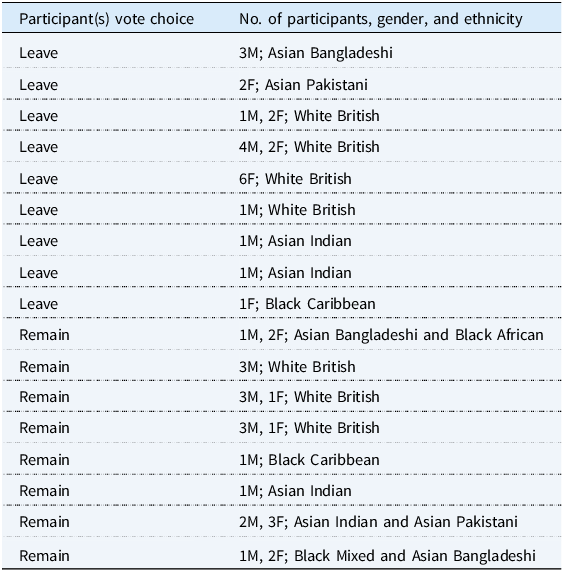
This article tests the classed and racialized logics for evaluating immigrants and attitude formation in the context of Brexit. Comparing the immigration attitudes of ethnic minorities in relation to white-majority attitudes, the article utilizes semi-structured focus groups and interviews with British ethnic minority and white British voters who supported leaving the EU in the 2016 Referendum. Fieldwork was conducted in England in the summer of 2017 taking place in towns and cities where ethnic minority populations were concentrated, including Birmingham, Bristol, and London, and had seen an influx of Eastern European migration. Recruitment took place in spaces frequented by the public including libraries, community centers, and places of worship. Lasting on average one hour to an hour and a half, 11 focus groups and 6 individual interviews were conducted face-to-face with Remain and Leave voters of Black African, Black Caribbean, Indian, Pakistani, Bangladeshi, and white British background (see Table 1). This means the sample was made up of more socioeconomically integrated and “model minority” groups such as Asian Indians and those less-integrated in economic domains including Asian Bangladeshis. The sample was also made up of participants from a range of different levels of educational attainment and age profiles.
Participant information
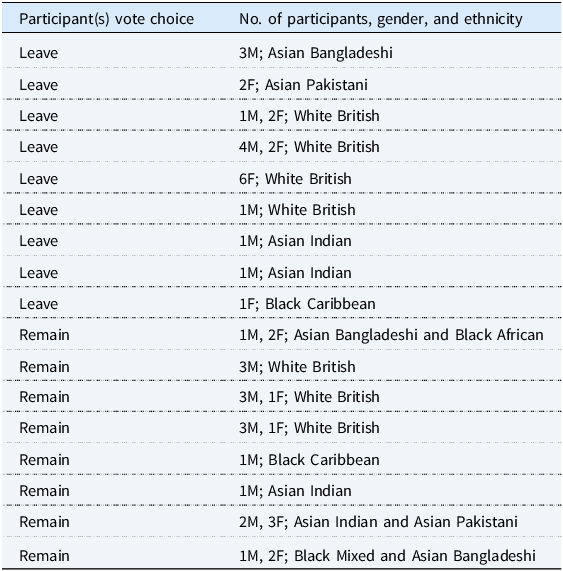
During the focus groups and interviews, participants were asked about their motivations for voting Remain or Leave and also shown campaign material from both sides to understand more about responses to campaign messaging, particularly around immigration and border controls. For the purposes of this article, the analysis will focus on Leave voter attitudes toward immigration (and some Remain participants when they refer to collective understandings around immigration).
A thematic analysis was conducted to explicate hegemonic logics of evaluating immigrants and attitude formation around immigration and how this differed between ethnic minority and white British participants. Drawing on Ryan, and Bernard’s (Reference Ryan and Bernard2003) work on identifying themes in qualitative data, I implemented techniques including analyzing repetition, similarities, and differences in how a topic is viewed or discussed and connections and separations made by participants. I examine key themes in immigration attitude formation, including how participants position themselves as “symbolic border guards” using classed and racialized logics (see Table 2). The use of pseudonyms throughout is to ensure anonymity.
Themes

Findings
Classed Logics in Attitude Formation
Evaluation of Economic Contribution and Resource Threat
Many of the Leave-voting participants expressed concerns about growing immigration to the UK and related this to EU freedom of movement. Leave-voting participants evaluated the economic and skills contribution made by immigrants or the economic burden they posed to the welfare state and public services. As symbolic border guards, participants evaluated immigrants on their level of economic contribution.
Hannah: for me… it’s just about controlled immigration and determining that we get… the right people with the right skills that are going to go on to enhance and develop Britain.
(White British Leave-voting focus group participant)
This reinforces “model minority” narratives of hard-working, skilled immigrants seizing economic opportunities and making a positive economic contribution. There were perceptions of levels of immigration as too high with one member of a White British Leave focus group referring to Britain as a “small island nation” without the necessary space and that increasing immigration was unaffordable for the economy with particularly health services as “straining at the seams.” Similarly, among the ethnic minority Leave voters, one participant referred to “the country becoming overcrowded and not having enough for everyone.” The economic effects of immigration was spoken about a number of times, including pressures on public services, claiming of social welfare, limited school places, and longer waiting times for doctors’ appointments and hospital treatment. As such, competition over public goods and pressures on public services were understood in terms of immigrants taking away resources from natives. Immigration as a strain on public services and resource threat was mirrored by ethnic minority Leave voters, though they primarily focused on migration from Eastern European countries:
Junaid: Basic problem was… the mass immigration in this country. I’ve been living in this town 31 years, I’ve never seen anything like this. Whenever I go to my doctor, I have to wait 3-4 hours to see my doctor… it takes 4-5 weeks to get an appointment because of the immigration, the people especially from Poland and Romania, Hungary coming, Bulgaria as well. They just could not cope, the education, medication and social life affected so badly.
(British Bangladeshi Leave-voting focus group participant)
Immigrants were largely constructed as low-skilled, coming from less economically developed countries and seeking to take advantage of the British welfare state (welfare chauvinism). One British Pakistani Leave-voting focus group felt that people from the EU were “abusing the [welfare] system” and that “they were only coming to go on benefits.” This is consistent with prevalent perceptions of Eastern European migrants as “scroungers” seeking to take advantage of Western European economic prosperity (Erel et al. Reference Erel, Murji and Nahaboo2016, p1348). There were also understandings of EU citizens from Eastern Europe claiming welfare to send money to their families. A White British Leave-voting focus group participant identified Romanians as registering their children in the UK in order to claim child benefits when their children were no longer in the country. In this way, the ethnic minority and white Brexit-voting participants perceived Eastern Europeans as takers rather than economic contributors (Coninck Reference Coninck2019, p4), who they believed to be abusing the welfare state. Eastern Europeans coming from poorer EU countries as “benefit tourists” featured frequently in tabloid media (Lewicki Reference Lewicki2023, p1490) “prompting intense discussion about policy reforms to restrict migrant access to benefits” (Ford, and Heath Reference Ford and Heath2014, p10). While ethnic minority participants focused more specifically on Eastern Europeans, criticisms of “benefit tourism” and “health tourism” for white British Leave-voting participants extended to other parts of the world. One White British Leave-voting focus group participant believed that “some of the biggest offenders on health tourism are run by cartels in Nigeria.” Thus, among the white British participants, discussion of health tourism from Romania and Eastern Europe more broadly slips into concerns about benefit tourism from different parts of the world including Nigeria.
Labor and Resource Competition Posed by (Eastern) European Migrants
Ethnic minority Leave voters raised concerns about increased immigration from Europe depressing wages of British workers as Eastern Europe is considered a source of cheap labor (Lewicki Reference Lewicki2023, p1485). A British Indian male Leave-voting interviewee felt that unlimited low-skilled immigration would be bad for the country, especially in depressing wages for the working classes. For ethnic minority participants, including Remainers, economic concerns emerged with the perception that Eastern Europeans were (successfully) competing for jobs:
Jasmine: Eastern Europeans are coming and taking all the Asian jobs… like corner shops, taxis, kebab shops, restaurants as well.
(British Bangladeshi Remain-voting focus group participant)
This is a variation on the existing trope that “immigrants are taking British jobs” which ironically was often used against immigrants from the Commonwealth in the post-war period and continues to be used against racially minoritized immigrants. In this case, low-skilled work and certain industries in which many South Asians are employed are seen as “Asian jobs.” This reflects the class position of some South Asian groups in society, whereby immigration from Eastern Europe is seen as a threat to sections of the British ethnic minority population and the low-paid, low-skilled work upon which they rely. More likely to work in sectors where migrant labor is used, some ethnic minorities viewed themselves as vulnerable to the competition posed by Eastern European workers at the lower-skilled end of the labor market (Waters Reference Waters2014; Geddes Reference Geddes2014, p293).
Racialized Logics
With perceived status competition, among the ethnic minority participants, model minority discourses and social distancing from “bad migrants” played out through racialized logics of evaluating immigrants.
Attributing Criminality
Many of the ethnic minority Leave participants associated Eastern Europeans with criminality. One focus group of British Pakistani women associated Eastern Europeans with drug-dealing and ATM crime. The participants felt that Eastern Europeans were able to build “lavish houses” in their country of origin and lead decadent lifestyles from drug-dealing and “robbing our bank accounts.” Stigmatizing discourses of Eastern Europeans pickpocketing and committing low-level crime emerged in such perceptions, for example, Fox et al. find, Romanians, in particular, have been “associated with [ATM] and credit card theft, child trafficking, begging, and prostitution” (2012, p687). Similarly, another participant referred to Eastern Europeans as “lazy” and fraudulently claiming welfare:
Junaid: [Eastern Europeans] work for you sometimes two weeks then without telling you they just disappear… they don’t like to work. They come down, they get the benefit, they leave, they get housing benefit, if they don’t work, they get the allowance. They’re just exploiting the loophole of the British system…
(British Bangladeshi Leave-voting focus group participant)
This type of criminality attributed to Eastern Europeans is used to denigrate them as culturally backward and undeserving of the right to be in the UK:
Repeated association of East European migrants with crime, particularly the sensational variety, presents these migrants not as upstanding workers trying to eke out a living but as dangerous criminals and social parasites preying on their well-meaning hosts (Fox et al Reference Fox, Moroşanu and Eszter2012, p687).
More serious cases of criminality and the security threat posed by increasing Eastern European immigration were also raised. One focus group of British Pakistani women associated Eastern Europeans with burglaries as well as murder and rape. Minority participants distanced themselves from Eastern Europeans who they perceived as criminals and felt they were being negatively associated with them:
Anwar: We just can’t imagine, being Asian, British Asian how badly damaged our reputation as well… all the crime they do, we get blamed… because we are immigrant as well.
(British Bangladeshi Leave-voting focus group participant)
This is consistent with Meeusen et al.’s (Reference Meeusen, Abts and Meuleman2019) research on Turkish and Moroccan Belgians immigration attitudes of Eastern Europeans not only taking (their) jobs but also “ruining” their reputation as migrants. Andrews writing on strategies adopted by immigrants vis-à-vis other immigrants finds that migrants tend to present themselves positively and “blame their ‘bad’ counterparts” for problems associated with immigration in order to present themselves as more deserving (2017, p2). In this way, ethnic minority Leave participants reinforced a good immigrant/bad immigrant binary, feeding into negative discourses that denigrate Eastern Europeans as lazy, criminal, and benefit thieves. Such discourses go against “the positive stereotyping of ‘Eastern Europeans’ as hard-working manual labourers” (Lewicki Reference Lewicki2023, p1485), as the Leave-voting ethnic minority participants positioned themselves as “good immigrants” in relation to Eastern Europeans.
Status Competition
There were also implicit understandings of status competition and indications of longer-term concerns of being “overtaken” by Eastern Europeans. Minority participants presented themselves as making a positive contribution and delineated themselves as British in opposition to Eastern Europeans.
Anwar: My identity is the British Bangladeshi. We work hard, we go to school, we go to college, we go to [university], we work, we pay tax, and we obey the law, law and order but those people coming they don’t care, they just come 2-3 months, take all the cars, hijack and they just leave so they’re not British…
(British Bangladeshi Leave-voting focus group participant)
Positioning British ethnic minorities as hardworking, law-abiding taxpayers in relation to Eastern Europeans, the participant seeks to disaggregate immigrants as a category and reinforces a good immigrant/bad immigrant binary. This is consistent with Cadena’s work on Latinx people in the US who have been found to “disaggregat[e] Latinx groupness and positio[n] themselves in opposition to other racialized people [and] distance themselves from [undocumented] Latinxs and Black Americans” (Cadena Reference Cadena2022, p295). Similarly, the participant invokes hard work and obeying the law as British values that excludes Eastern Europeans who they represent as lazy and criminals which allows them to distance themselves from negative stereotypes associated with immigrants (Cadena Reference Cadena2022, p302).
While recognizing that Eastern Europeans were getting much negative attention, one member of an ethnic minority Remain focus group believed that ethnic minorities had it worse:
Jasmine: To me, people who are visibly white, you’re cool, you’re fine. You speak English and you look white, you’re fine… compared to me, or you or you.
(British Bangladeshi Remain-voting focus group participant)
In stating this, the participant, who is British Bangladeshi, looked to the other members of the focus group who were of Black African background and spoke to shared experiences of racial discrimination, who despite all being British and speaking English as a first language, the participant believed white English-speaking Europeans were more accepted compared to ethnic minorities. Here, whiteness is felt to be a more secure guarantee of belonging. For white immigrants, “audio-visual markers of difference disappear over generations after migration” (Lewicki Reference Lewicki2023, p1495) who become subsumed or assimilated into the “white-majority” population. This is possibly related to Black and Asian fears of Eastern Europeans becoming “whitened” or in other words having greater upward mobility as a result of being phenotypically white. Meanwhile, ethnic minorities continue to be “visible” through subsequent generations and racially minoritized.
Xenophobia against Eastern Europeans
Xenophobia toward Eastern Europeans was expressed by some ethnic minority Leave-voting participants. One ethnic minority focus group participant felt Eastern Europeans were not integrating and expressed feeling discomfort around them:
Asma: I don’t want to sound racist [hesitates]… there’s so many like people coming… they’re just sort of taking over and … we’ve been here for like many years and that community coming over like mostly Romanian, gypsies and stuff, we’re not mixing and everything … they’re staying separate, their lifestyle is completely different to us and… I don’t feel comfortable with so many of them…
(British Pakistani Muslim Leave-voting focus group participant)
Here, Eastern Europeans were seen as “taking over” and having “different lifestyles.” This echoes criticism often levelled at some ethnic minority groups, particularly British Muslims as living in ethnic enclaves and claims of British society “sleepwalking into segregation” (Finney, and Simpson Reference Finney and Simpson2009). The participant appears to recognize an anti-discrimination norm as she hesitates and states that she doesn’t want to “sound racist” before going on to speak about Eastern Europeans in racialized derogatory terms including expressing feeling unsafe in their community around people they identified as Eastern European. This focus group’s participants associated Eastern Europeans with anti-social behavior, rubbish dumping and what they referred to as “dirt issues”:
Asma: A lot of rubbish dumping I’ve seen.
Sehrish: There is kind of like the dirt issues and stuff.
Asma: …and going through bins, I’ve seen them with their kids, their kids going through bins and I don’t know, it feels uncomfortable.
(British Pakistani Leave voter focus group)
In this way, strong objection to growing Eastern European immigration among ethnic minority Leave voters, even manifests in xenoracism toward Eastern Europeans (Fekete Reference Fekete2001). They reproduce racialized tropes about Eastern Europeans (Lewicki Reference Lewicki2023, p1483), even though they themselves have been (and continue to be) subject to forms of prejudice and racism. The evocation of uncleanliness, dirt, and smells furthers the racialization and dehumanization process (Goldberg Reference Goldberg1993, p54), through which ethnic differences are seen as innate, and attributing such impressions of Eastern Europeans as uncivilized, and even feral, in “going through bins.” In such ways, the whiteness and Europeanness of Eastern Europeans is contested by ethnic minorities by presenting them as violating the norms of respectability associated with whiteness (Garner Reference Garner2007). Eastern Europeans have been racialized and stigmatized as presenting a “degenerate” or “contingent and degraded form” of whiteness (Rzepnikowska Reference Rzepnikowska2018, p64), with “criminal tendencies, uncivilized behavior, and moral deficiencies” (Fox et al Reference Fox, Moroşanu and Eszter2012, p690). Such attitudes were echoed by ethnic minority Leave-voting participants as they distanced themselves from Eastern Europeans.
Right to Exclude as “British”
Ethnic minority Leave-voting participants also emphasized their Britishness over Eastern Europeans and suggested that they had successfully integrated into British society and were therefore more legitimately British. The suggestion that Eastern Europeans have less of a right to be in Britain and being less able to integrate reinforces ethnic minorities as symbolic border guards policing notions of British identity. While portraying Eastern Europeans as lazy and criminal, participants also presented themselves (and their ancestors) as acquiring Britishness through hard work and obeying the law:
Asma: [my parents] came and they’ve become British, and they’ve embraced it, and they’ve learnt what the rules are here and what the law is…
(British Pakistani Leave-voting focus group participant)
Similarly, another Leave-voting focus group participant of British Bangladeshi background referred to Eastern Europeans as a threat to British identity:
Anwar: my identity is the British Bangladeshi… British system, [Eastern Europeans] haven’t got anything like this… they are Romanian, Bulgarian or Albanian, they keep coming, committed crime… it affects you know the British identity, and they are not British.
(British Bangladeshi Leave-voting focus group participant)
The participant emphasized their British identity in opposition to Eastern Europeans, thereby reinforcing their position as symbolic border guards with the right to exclude those who are not British. The participant also suggests the “British system” as being superior to Eastern Europe reinforcing the region as backward (Lewicki Reference Lewicki2023, p1484).
For ethnic minority Leave participants, it was their ancestral connection to Britishness through the Commonwealth that meant they were more culturally compatible than Eastern Europeans. British national identity, and their Commonwealth ancestry tied to it, was used to appropriate the right to exclude Eastern Europeans, who are seen as undeserving of the right to migrate to the UK. One focus group participant of British Bangladeshi background felt that Britain was neglecting the Commonwealth due to its membership of the EU:
Anwar: Our ancestor, came to this country, contributed to British economy, building infrastructure, and even lots of our ancestor fought in Second World War in favour of Britain. They sacrificed their lives… what’s good [about] being a member of Commonwealth country… they’ve been prioritised and we’ve been neglected, we’ve been stopped bringing our spouse, wife, husband from Bangladesh… so we feel inferiorated.
(British Bangladeshi Leave-voting focus group participant)
In this example, the participant suggests there are few benefits to being part of the Commonwealth and felt it was unfair due to the “historical links” between Britain and the Commonwealth as well as the contribution of Commonwealth soldiers to Britain’s war effort while at war with its European neighbors and the Commonwealth immigrants who helped rebuild Britain after the war. British ethnic minorities were also positioned as making a positive contribution as long-term British citizens but perceive themselves as bearing the brunt of unfair immigration rules while Britain was an EU member:
Junaid: We have been running this restaurant, the Indian restaurant since basically 1960 the Indian Restaurant started, slowly it was so popular in this country, it’s like British heritage and we never had any problem with short[age] of staff… We used to get people from Bangladesh come down here, 1 year, 2 years, government stopped doing that. They stopped issuing the visas…
(British Bangladeshi Leave-voting focus group participant)
In this example, Indian restaurants and the curry industry is hailed as part of “British heritage,” which they feel are suffering as result of what they see as unfair immigration rules. This is directly linked with staff shortages in the Indian restaurant industry with the belief that the government had decreased issuing visas to workers from outside the EU because of uncontrolled migration from Eastern Europe. Seeking to appeal to ethnic minorities, the Vote Leave campaign carried the message that the Commonwealth had been “betrayed” by Britain joining the EU. Former Home Secretary Priti Patel, a prominent campaigner for Vote Leave, argued that leaving the EU would allow for easier Commonwealth immigration (Namusoke Reference Namusoke2016, p466). “Save our curry houses” was used as a message by the campaign to appeal to British Bangladeshi voters, and South Asian voters more generally, attributing staff shortages in the Indian restaurant industry to immigration rules which restricts non-EU immigration (Namusoke Reference Namusoke2016, p467). The participants felt Eastern Europeans were unfairly being given privileged access to the UK through EU freedom of movement, while placing controls on immigration from outside the EU and their countries of origin. Andrews has also found that, “the unfairness of uncontrolled European migration at the same time as an extremely regressive immigration policy toward the Caribbean, Africa and Asia has caused tensions” (2016).
Claiming Britishness for themselves while marking out Eastern Europeans as “not British,” the Leave-voting participants position themselves as symbolic border guards with the right to exclude. The ethnic minority endorsement of the British anti-immigrant norm functions to position themselves as racialized insiders and Eastern Europeans as racialized outsiders. They positioned themselves as more deserving, not only as hard-working and law-abiding (which Eastern Europeans in their view were not), but in their commitment to Britishness and having made a positive contribution to British society.
Growing Racial and Ethnic Diversity as a Symbolic Threat for White Natives
Blinder argues that public perceptions of immigration should account for who people have in their “mental image” as “immigrants” (2015). Given the context of the EU Referendum where freedom of movement was a key issue, we would expect this to be EU citizens. However, in discussions of support for Brexit, white British Leave-voting participants conflated British ethnic minorities with EU immigrants. While ethnic minority Leavers primarily focused on Eastern Europeans referring to concerns over crime and pressures on public services, white Leave voters also included British Black and Asian ethnic minorities in their discussions of immigration and identified British ethnic minorities (including those who were UK-born) as “immigrants.” Despite freedom of movement within the EU at stake in the Referendum, growing racial and ethnic diversity was understood as a symbolic threat to white natives and motivated their support for Leave.
White Leave-voting participants were a lot less likely to distinguish between immigrant groups, with references to Eastern Europeans, refugees, immigrants from outside the EU, and even British citizens of non-white ethnic minority background. For example:
Patricia: When they showed on the telly and they’re all trying to come over here like when they was at France in them ghetto kind of things, they all want to come here… They think it’s a land of milk and honey and they’ll get houses and everything and a lot of them have, but unfortunately it doesn’t work out that way for everybody, does it? And there’s some on the streets…
Nearly every other house is an immigrant in it, but they can’t speak English…
Jill: That’s a very high statistic.
Patricia: Around by us, it’s true.
Jill: It may be pockets around the country.
Patricia: When I walk on the road, every other house was an immigrant in it.
(White Leave focus group)
There is significant slippage between identifying different immigrant groups, Romanians were identified earlier in the focus group as fraudulently claiming welfare in Britain, while here the participant refers to the refugee camp in Calais known as the “Jungle” as “ghettos.” At the same time, the perception that “every other house” is occupied by an immigrant is an overestimation of the level of immigration to the UK. The participant maintains that around a half of the population “around here” are immigrants, even when challenged by another member of the focus group. As the focus group was conducted in a diverse part of Birmingham, the participant includes non-white British citizens in their “mental image of immigrants” (Blinder Reference Blinder2015, p81). This is consistent with existing literature which finds that the British public overestimates the size of the immigrant population:
many people assume [Black Asian Minority Ethnic] people are foreigners and overestimate the proportion of asylum-seekers, immigrants or any group of non-whites… homogenising people who are not white into an undifferentiated mass (Garner Reference Garner2012, p451).
Thus, Eastern Europeans, refugees, and ethnic minorities alike were conflated as immigrants, with rising diversity which includes a growing non-white British population, a key concern underlying white Leave-voting participant attitudes toward immigration. This reflected opposition to longer-term effects of immigration, more a result of post-war immigration from the Commonwealth, than as a result of EU membership. As Patel and Connelly put it:
Leave voters appeared to see the “Brexit” vote as an opportunity to signal a general dissatisfaction with UK immigration policy. For many then, the vote had the potential to directly influence migration from the EU but also to indirectly – or symbolically – send a message of intolerance to non-EU “migrants”… demonstrative of a hierarchy of migration, in which non-EU “migrants” are even less welcome than their EU counterparts (2019, p8).
The identified “immigrants,” which included British ethnic minorities, were seen as outsiders or newcomers, who had contributed less than natives and were thus less deserving of housing and public resources compared to the (white) British:
Patricia: When I walk on the road, every other house was an immigrant in it. And they were friendly, you know waving to me and the little kids were trying to talk to me which I thought was nice, but then I was looking at me own son with his family. He’s had to buy an [old] council house … he couldn’t get a [new] house and it does make you a bit annoyed that [immigrants] can come in and get places… from London they’re sending them down to Birmingham because there’s no houses in London because they’re too expensive.
(White British Leave-voting focus group participant)
The participant sees the “immigrant family” as “friendly”; however, immigrants are implied to be competing with natives, given preferential access to housing (Garner Reference Garner2012, p453), and benefiting at the expense of white natives (Green et al. Reference Green, Hellwig and Fieldhouse2022, p3; Mattinson Reference Mattinson2020). In this way,
“an imaginary [imagined] set of privileges [was] felt to be intrinsic to whiteness: being ‘first in the queue’ when it comes to accessing public housing stock, NHS treatment, school choice, employment opportunities, social security and welfare. Poignantly these imagined ‘white entitlements’ not only exclude newcomers, but fail to extend to second and third generation Black and Ethnic [minorities]” (Finlay et al. Reference Finlay, Nayak, Benwell, Pande and Richardson2019, p18).
While the ethnic minority Leave-voting participants exhibit welfare chauvinism toward Eastern Europeans, the white Leave-voting participant here exhibits welfare ethnocentrism with the perception that her son was unable to get housing because “immigrants” from London were being given housing in Birmingham. In such ways, British ethnic minorities were also included in discussions of immigration around the EU Referendum and were seen as less deserving of public resources.
While ethnic minority Leave-voting participants were more explicit in their xenophobia toward Eastern Europeans, white Leave-voting participants couched their opposition to immigration in more euphemistic terms:
Patricia: When somebody come into the country and they shouldn’t be in… I think they should be locked up and then deported because it’s making it bad for everybody else who comes into the country and we get an attitude [whoever] comes into the country, get ‘em out and it’s not fair on people who are working…
People already in the country, we didn’t want people sort of returned to their home other than criminals… a lot of people that are in the country that have committed offence or got in illegally, those are what people I wanted to stop… The more that come, the less services that the immigrants that are already here are not going to get the service that they need either because there’s too many.
(White Leave focus group participant)
The participant felt that any immigrant, including those with criminal records, were allowed to enter and remain in the UK and that levels of immigration were too high. Some immigrants are implied to be giving others “a bad name”; however, immigrants as potential criminals and posing a security risk is reinforced. A tension exists here with the participant not wanting to be seen as anti-immigrant and emphasizes that they aren’t calling for repatriation and that increased immigration would mean less for “working” immigrants already in the country. While the participant may have tempered their language while responding to a researcher of ethnic minority background, this is also characteristic of the more contemporary context of an “anti-prejudice norm” (Blinder Reference Blinder2015), where explicitly racist or xenophobic statements have become less palatable (Patel and Connelly, p7); thus, arguments are more likely to be framed around resource scarcity and security. This is congruent with Back et al’s (Reference Back, Sinha and Bryan2012) analogy of the white symbolic border guard who should appear welcoming and not opposed to all immigration.
Increased immigration from Eastern Europe was conflated with rising racial and ethnic diversity. In her focus groups with constituents in the Midlands and Northern England, Mattinson (Reference Mattinson2020) finds that while discussing immigration, the white residents identified “the fast-growing Pakistani and Indian communities… as another symptom of the [area’s] decline” (p26). Another discussion on immigration prompted references to “large Asian and Polish communities,” who were identified as undesirable immigrant groups, changing the local area for the worse (p26).
In this way, the racial lens through which some white British voters perceive immigrants becomes explicit, as they also include ethnic minority British citizens. The white British as reserving the “right to exclude” is reinforced through concerns that “immigrants,” including non-white Britons, are incompatible with and cannot integrate into (white) British culture.
As symbolic border guards, for white Leave participants, assimilation was prized in the form of willingness to integrate by accepting “British values” of hard work and by learning English. “Bad immigrants” were seen to make little attempt to integrate or contribute:
Hannah: [they] have no real intention of working because they’re not even going to learn the language, not making the effort, and they’re the people I don’t want.
(White British Leave-voting focus group participant)
Racialized and classed assumptions underpin these evaluations of different immigrant groups as the “ideal immigrant” is considered to be hard-working, law-abiding, and also “works” to learn the English language and assimilate into (white) British culture:
Simon: It’s about signing up to the agenda of this country. Doesn’t matter what their backgrounds are, it’s about are they going to fit in? Are they actually going to bring their culture here and work with us? Not stay in isolated pockets. And I’ve seen that… I’m well aware of multicultural[ism], and seeing how communities actually grew and kept theirselves to theirselves, and that just creates bad feeling and ‘us’ and ‘them’ attitude.
(White British Leave-voting focus group participant)
Here, multiculturalism is seen as encouraging separatism and racial division, rather than minorities assimilating into (white) British culture (Virdee, and McGeever Reference Virdee and McGeever2017, p12). This alludes to perceived cultural threats of immigrants with different values and customs changing the nature of Britain and Britain becoming unrecognizable in the face of growing cultural diversity (Jutvik, and Robinson Reference Jutvik and Robinson2019, p21). These discussions of diversity as posing a threat to cultural unity refers implicitly to post-war Commonwealth immigration and its long-term cultural effects. Rather than being explicitly opposed to immigration, the participants reinforce that immigrants are welcome in Britain so long as they have the “right skills,” learn the English language, and integrate by “signing up to the agenda of the country.”
In discussions of immigration, Leave-voting participants also included concerns about a “race and equality agenda” creating tension between communities:
Gerald: things like Black Lives Matter, well of course they do, but white lives matter as well, black votes matter, white votes…, you know, it turns people off.
Hannah: So we’ve got such an agenda to make sure that we have equality that there’s quite a lot of it now [and] it’s actually just highlighting differences which is counterproductive and therefore fuelling [tensions].
Miranda: It’s like this Black Lives Matter and things like that, you know, we’re all just people.
(White British Leave voter focus group)
Despite not explicitly being related to immigration, here, the participants included issues related to Black Lives Matter. A race equality agenda is seen as going “too far” and as causing divisions in society. This is more to do with the anti-racist activism of Black and ethnic minorities rather than (recent) immigration; however, it is associated with immigration and what are perceived as its negative effects on social cohesion.
Discussion and Conclusion
This article sheds important light on ethnic minority and white British motivations for supporting Brexit, namely how attitudes to immigration affected vote choice. Drawing on focus groups and interviews with ethnic minority and white British voters, the article finds that ethnic minority Leave voters tended to be motivated by opposition to Eastern European immigration. However, white British Leave voters appeared to conflate immigrants with British ethnic minorities into an undifferentiated mass, despite EU freedom of movement at stake in the Referendum. Thus, their support for Leave signaled opposition to growing racial and ethnic diversity as well as concerns about rising immigration.
Countering Immigrant Linked Fate theory, this article finds that British ethnic minority Leave-voting participants perpetuated and reinforced hegemonic logics of evaluating immigrants which they themselves are subject to as immigrants or racialized minorities. Rather than a sense of immigrant solidarity emerging, as demonstrated in the case of ethnic minority Leave-voting participants, immigrants and racialized minorities may seek to signal their own value through denigrating newer migrants, thus negotiating a higher position in an assumed minority/migrant hierarchy. This confounds the theoretical assumption that immigrants or minorities will be more positive about immigration due to their family or their own history of migration (Ford Reference Ford2011) or because they may face anti-immigrant prejudice themselves. This is a significant intervention clarifying otherwise competing theoretical expectations, by examining how these logics of attributing value play out for ethnic minorities compared to whites. This includes acculturation into an anti-immigration norm and engaging in classed and racialized logics of evaluating migrants in order to reinforce their own position as “model minorities’ or “good immigrants.”
The article finds that ethnic minority Leave-voting participant attitudes to immigration mirror that of the white majority but tend to reflect realistic threat concerns rather than symbolic threat. As with white-majority attitudes, similar classed and racialized logics of hierarchizing and evaluating immigrants are at play, but their anti-immigrant sentiments tended to be toward Eastern Europeans. They do this as a form of integration by socially distancing themselves from groups that have been minoritized and marked out as undesirable. As symbolic border guards policing the suitability of immigrants along a good/bad immigrant binary, they ascribed positive attributes to themselves as hard-working, law-abiding, and positive economic and cultural contributors while denigrating Eastern Europeans as lazy, criminal, or seeking to take advantage of the welfare state. Integrated into majority anti-immigrant norms, the idea of the good immigrant being anti-immigrant, and even more so than majority white natives, may abound where reinforcing (some) immigrants as a threat to the nation and endorsing the need for strong borders is used to claim their insider status and demonstrate their commitment to protecting the nation from the “wrong” type of immigrants; their contingent acceptance into Britishness depending on proving their worth in a hierarchy that often positions them below white Europeans or migrants from the English-speaking “white Commonwealth.” Anti-immigration attitudes, then, is a form of seeking acceptance, being complicit within the immigrant hierarchy, which places newcomers below them and grants “a form of contingent belonging” (Back, Sinha and Bryan Reference Back, Sinha and Bryan2012, p148).
Meanwhile, white British Leave-voting participants made little distinction between EU migrants and British ethnic minorities and conflated migration from the EU into the wider pattern of rising racial and ethnic diversity, which is more a result of post-war Commonwealth migration from the Caribbean and Indian subcontinent. Discussions of immigration elicited, for example, criticism of the Black Lives Matter movement, minorities not making the effort to “integrate” and minority cultures being at odds with British values. For white British Leave-voting participants, whiteness granted them the right to exclude with autochthony by birth. As symbolic border guards, their whiteness entailed also having the right to exclude non-white British citizens, policing the borders of acceptability for all immigrants and British ethnic minorities. As the increase in the size of the UK ethnic minority population is no longer principally driven by immigration, this has important implications particularly in relation to the increased political salience of immigration (despite EU migration falling post-Brexit) and promises by British politicians to reduce net migration (Francis Reference Francis2025). As this article has found, white Leave-voting participants often misidentified British-born Black and Asian ethnic minorities as “immigrants.” Indeed, second generation and subsequent generations of Black and Asian ethnic minorities continued to be viewed as “immigrants” as the White British participants treated all immigrant backgrounds and those with minority status as an undifferentiated mass. As the most recent census found that 18% of the UK population is now non-white (Office for National Statistics (ONS) 2022)), the policy fixation with numbers and “control” may do little to quell qualms over immigration which (partly) reflect concerns over growing racial and ethnic diversity and will not necessarily be stemmed by greater controls on immigration.
The limitations of this study includes the difficulty of making broad generalizations based on a relatively small sample. However, the findings reveal important narratives around Brexit and immigration and the reasonings behind immigrant evaluation. The research being conducted by a British Bangladeshi Remain-voting Muslim woman could also have affected Leave voter participants in that they may have been reticent to share their views openly due to fears of being stigmatized. I overcame this with a preamble to the focus group or interview that while I had voted Remain, I sympathized with some arguments on the Brexit side and had family and friends who had voted Leave.
This article has broader implications for understanding opposition to immigration among racially minoritized and immigrant groups as well as immigration attitude formation among white citizens, in particular how attitudes to immigration are formed based on classed and racialized logics. Future research in this area could focus on opposition to immigration among racialized minorities toward members of their own racial group as seen in Latinos voting for Trump in 2024 in opposition to undocumented migrants.
Acknowledgements
The author would like to thank the anonymous reviewers for their constructive feedback. Thanks also to Professor Aurelien Mondon and participants at the 2024 Western Political Science Association (WPSA) Annual Meeting for their helpful comments and suggestions.
Funding statement
The research reported in this article was funded by the Faculty of Social Sciences and Law at the University of Bristol.
Competing interests
No potential conflict of interest was reported by the author.


 Open access

