

What really are conventions? Convention equals a pact, an agreement, a capitulation, it assumes also ceremony, something honest and fair … But conventions of the theatre are something else altogether. Their ingredients are composed of jealousy, presumptions, intrigue, and ignorance.
Nicola TacchinardiFootnote 1Having retired from performance in 1833, the tenor Nicola Tacchinardi penned these words in his treatise on the defects of Italian opera. While the conventions he bemoans pertain to various aspects of performance, from posture and gesture to diction and aria substitution, his polemic is far from diplomatic: it targeted the capricious behaviour of musicos (women who performed male roles), a performer category that, along with the prima donna, dominated the operatic stage at the beginning of the nineteenth century.Footnote 2 He recalls, for example, a musico performing in Zingarelli's Giulietta e Romeo. Dressed ‘more like a woman than a man’, this Romeo refused to carry a sword at her hip because it impaired her movement. When it came to the combat scene, she had to be handed a sword from off-stage, to the amusement of the audience. Another anecdote recalls a musico performing an entrance aria that features her arrival by ship. Displeased with the ship provided for her, the musico decided to enter on foot, climbing over the painted seas. She began her aria while walking on water ‘without any embarrassment for the great laughter produced in reaction to this bizarre entrance’.Footnote 3 To Tacchinardi, such incidents were far from ‘honest and fair’, but instead concealed and authorised the whims of the women who failed to satisfy his standard of masculine presentation.
Such a diatribe may be rooted in jealousy: Tacchinardi's own operatic career had been adversely affected by the tension between the musico and the tenor as dramatic masculine archetypes. As Heather Hadlock has shown, three registers of heroic masculinity coexisted on the Italian stage between 1810 and 1830 – castrato, musico and tenor – and during this time, the tenor's place was the most precarious.Footnote 4 With the stark exception of Rossini's celebrated tenor-vehicle Otello, the roles Tacchinardi sang most in his prime were not decisive, masculine heroes, but rather secondary characters – a father, king, or uncle – who served either as mere backdrop or as an unsympathetic impediment to the conventional romance between soprano and musico.Footnote 5
Tacchinardi's treatise considers these breaches of stage decorum by the musico not as trivial, isolated behaviour, but as a categorical reason to reject the musico as a performer of heroic characters:
We always see the woman who dresses as a man on stage, replacing the already-vanished musico [castrato] in the part of lover, as if in jest or masquerade. Never does she assume the character and appearance of a man. Her stride is always of the woman. The fit of her dress and the style of her hair are always that of a lady. Her helmet is worn at an angle in order to show off her lavish curls, which are parted at the front to descend across her cheeks, always in the feminine manner. How could we ever deceive ourselves that this figure represents a conquistador, a fearsome warrior, a husband already a father, a rival for kings and for queens?Footnote 6
For Tacchinardi, to appear ‘as a man’ on the operatic stage was the standard for masculine performance, a visual criterion rendered unattainable by womanly caprice. The implication of Tacchinardi's complaint is that, once the operatic hero is dissociated from feminine conventions, proper masculinity – honest and fair – will take its rightful place.
It is striking that a tenor's gravest objection to the musico would concern lapses in visual presentation – the way she moves, gestures and dresses – rather than her singing voice. From today's vantage point, the most straightforward argument against the musico as hero would be that her high-lying voice could not possibly index the body of a man. When Tacchinardi was writing, however, the ringing high notes from the chest that, today, typify the Italian heroic tenor had not yet been heard. This was a time before what J.Q. Davies calls ‘a new art of “the voice”’ and its attendant biomedical understanding took hold on operatic discourse, before singing became understood as a ‘grainy’ expression of an individual's natural interiority. The tenor during Tacchinardi's career could not claim his place in the masculine-heroic roster by privileging the gendered timbral quality of his voice: his singing was more an emitted ‘representation’ of fixed mimetic states, not an extracted ‘presentation’ of inner life, a physiological presence from deep within.Footnote 7 To be ‘as a man’ on stage in the 1820s, then, was not determined by an ontologically male voice of particular timbre, but rather was an aesthetic register codified in the performer's visual presentation and decisiveness of action.
I argue that, at the close of the 1820s, normative conceptions of masculine-heroic performativity were textual and ocular-centric, more than sonic or vocal. As Tacchinardi's complaints suggest, the prototypical heroic lead was not determined by vocal range or register, but by the ways they used their bodies on stage. This is not to say that the body in the voice was invariably sexless, but that, to borrow from Freya Jarman's reading of Barthes, the singing voice before 1830 was under-assimilated as an index of gender performance.Footnote 8 Neither the performer's voice nor body were evidently expressive as masculine except as they were inflected and categorised by texts and dramatic situations. In other words, masculine performativity was produced not by gendered vocal timbre, but by a singer's judicious fashioning of character through drama and stage decorum. Furthermore, as my case studies will demonstrate, the tenor voice was not the only site at which fluid and performative versions of stage masculinity were explored. This stance complicates the conventional story of the ‘rise of the tenor’, which centres on the ascendancy of the chest voice, mythologised by Gilbert Duprez's do di petto in 1837, as a successful bid for the tenor's heroic place in the dramatis personae.Footnote 9 By separating vocal timbre from the performance of masculinity, I explore how the singer achieved explicitly male self-definition in this pre-Duprez milieu, not as a voice, but as an author, a master of textual control.
To probe this history, I focus on the practice of aria substitution as a site where singers’ decisions about performance material render visible contemporary attitudes about the proper relationship between character and gender. It was common practice throughout the eighteenth and early nineteenth centuries for singers to discard an aria written for a role and to replace it with a number – an existing aria from a different opera, or a new aria composed to order – that better suited their vocal abilities or showcased the persona they wished to project. Some critics vilified this piecemeal, singer-centric approach as a shortcut by singers who were too lazy, self-absorbed, or technically deficient to perform the opera's original music.Footnote 10 However, Hilary Poriss has shown that aria substitution was a standard practice employed even by top-rank prima donnas such as Giuditta Pasta, Carolina Ungher and Maria Malibran. For these performers, decisions about substitutions entailed careful consideration about musical style and plot consistency.Footnote 11
Departing from Poriss's focus on prima donnas, I focus on male performers, arguing that tenors such as Tacchinardi had many reasons to employ substitute arias, beyond selecting music that flattered their vocal abilities. The recent availability of digitised collections of libretti makes it possible to track substitution practices in more detail than ever, allowing us to compare the content and style of substitute arias across a large number of singers and works.Footnote 12 My comparative study of libretti shows that singers performing male characters sometimes used aria substitutions to enrich and nuance the narrative content of their roles, replacing dramatically static arias with numbers that offered more dynamic situations. In a performance climate centred on the romantic pairing of soprano and musico – that is, a double female lead – male singers carved out a place for themselves by treating aria substitution as a means of plot substitution. As we shall see, Tacchinardi's often drastic choices in substitution were repeated by numerous singers across the 1820s, creating a stable practice that helped to institute new conventions for masculine-heroic representation. Understood in this way, aria substitution becomes the means in which male singers shift from appearance to doing, and from scripted performance to the semblance of action. In a twist on David Halperin's theory on the gender trouble of masculine performativity in ‘Men act, women appear’, the male performers I discuss employ aria substitution to reshape roles that position them as appearing rather than acting – a countermeasure to the predetermined script of their action, in which the violence they face, no matter how heroic, is simulated.Footnote 13
While the careers and reception histories of prominent prima donnas and musicos have received considerable attention from scholars of opera studies, the ‘rise of the tenor’ has almost been taken for granted, its emergent masculinity rushing to fill an obvious void. The early phases of the heroic tenor, before the advent of Adolphe Nourrit and Gilbert Duprez, have been accounted for only by vague gestures towards changes in public taste and the hardening of gender roles in late eighteenth-century Europe. The paucity of historical detail has allowed this particular brand of masculinity – heralded by the technical feat of singing above the staff di petto – to seem a spontaneous and natural emergence, positioning Duprez as a self-made, liberal individual with no tangible predecessors. With a nod to Foucault, Richard Taruskin attributes the decline of the musico to bourgeois domesticity and Victorian morality, while Freya Jarman cites Thomas Laqueur's two-sex theory to argue that audiences across the eighteenth century increasingly understood the boundaries between male and female to be a fundamental binary difference, rather than a gradation of one essential sex.Footnote 14 Naomi Andre reads this equation of masculinity with procreation into a vignette from Meyerbeer's Il crociato in Egitto, in which the castrato-hero hands over his sword to his successor, the tenor Adriano, in what Andre interprets as an allegorical changing of the guard.Footnote 15 Abbate and Parker similarly resort to allegory to narrate this transition, couching it as a passage from the ‘crinoline’ and ‘corsetry’ of florid writing for the male voice to an era that favoured ‘the vocal equivalent of stovepipe hats and dark suits’.Footnote 16
A decade ago, Karen Henson wondered in the pages of this journal whether opera studies had reinscribed the very scenario ‘it wanted to critique, women staged and scrutinised and men invisible, unhistoricised, unquestioned’.Footnote 17 My focus on the male singer stresses that the tenor's heroic masculinity is not the natural outcome of the musico's decline; adapting a formulation of Judith Butler's, I want instead to consider that masculinity in opera was an aesthetic identity constructed through hard-won iteration, ‘an identity tenuously constituted in time – an identity instituted through a stylized repetition of acts’.Footnote 18 By examining substitutions by male singers in Giovanni Pacini's La Sacerdotessa d'Irminsul and Gioachino Rossini's La donna del lago, I reconstruct the substitution practices by which tenors inserted new arias that intensified the active and confrontational dimensions into roles that were otherwise characterised by nobility and restraint. I then turn to Vincenzo Bellini's Norma to examine the only site in which substitution regularly occurred in the opera: the Act II aria for the bass Oroveso. These case studies offer concrete evidence of specific singers who, long before Duprez's famous high Cs, repeatedly altered the operatic text as a means of reinventing the masculine-heroic character. Aria substitution, in this sense, displaces the tired, biocentric framework of vocal prowess and predetermined physiology to allow for more historically sensitive discourses about textual authority and narrative control. Such practices of substitution were the very site of masculine self-invention for the early nineteenth-century male singer.
Bulking up the tenor in Pacini's La Sacerdotessa d'Irminsul
While Tacchinardi himself often deployed substitutions throughout his career, he did not hesitate to chastise singers who practised substitution without discretion. Accusations of hypocrisy aside, the terms of his complaint suggest that Tacchinardi did not object to substitutions in principle; nor did he worry much about their effect on an opera's unity or coherence in the terms that we might call a ‘work concept’. His concern was more specific, and focused on the consistency of genre:
The contradictions and inconsistencies produced by pastiches, which are commonly made by introducing (so-called) trunk arias, are uncountable. These are inserted wherever caprice dictates; both buffo pieces within serious operas and serious pieces within comic operas reduce the music drama to a parody.Footnote 19
In the same breath, Tacchinardi laments lapses in scenery and costuming: Greek helmets on the heads of Egyptians, Turkish accessories on Scottish bards, Gothic architecture in Semiramide, seventeenth-century costumes in Il barbiere di Siviglia. What is at stake is opera's ability to enthral by sustaining a consistent tone and setting.
It is startling, then, that in his many performances of Pacini's La Sacerdotessa d'Irminsul during the 1820s, Tacchinardi introduced a substitute aria whose narrative content differed drastically from Pacini's original. Written in 1820 as a vehicle for the star castrato Velluti as the hero and love interest Ruggiero, La Sacerdotessa d'Irminsul is built around a typical bel canto love triangle. Romilda (soprano), the priestess of Irminsul, loves Ruggiero (musico), the leader of the enemy Norman army, but for political reasons she is pressured to marry the tenor, Clodomiro, son of the slain Saxon king and protector of the druids. After much confusion and intrigue, the opera ends with the tenor yielding the soprano's hand to the musico, as their marriage will unite the warring Normans and Saxons. Legitimising his new position as the merciful ruler, Clodomiro steps beyond personal motives to enact benevolent authority, true to the eighteenth-century opera seria lineage of his character type.
In his first performances of the role in 1821, Tacchinardi performed Pacini's original entrance aria for Clodomiro, ‘Vedo alfin le patrie mura’. Drawing on the conventional situation of a young noble respectfully addressing his honoured, deceased father, the static dramatic pace of this aria positions the tenor as admirable and centrally involved in the political power of familial succession, but not, perhaps, as a locus of passion or romantic energy in the plot.
Clodomiro: Vedo alfin le patrie mura,
L'are antiche alfin saluto:
(S'avvicina alla tomba di Vitikindo)
Io t'adoro o cener muto
Dell'estinto genitor.
Un istante in questo giorno
Ti avvicina; al mio ritorno
Della nostra, e tua sventura
Mi vedrai vendicator.
Coro: Ei ti vede – e il degno erede
Scorge in te – del suo valor.Footnote 20
[At last I see my native walls / ancient altars, at last I salute you (Clodomiro approaches his father's tomb) I adore you, oh silent ashes / of my extinguished father. / That moment approaches / when I return / you will see me vanquish / our, and your, misfortune. / Chorus: He sees you as the rightful heir / of his valour.]
In subsequent performances, however, Tacchinardi replaced the mild and antiquated style of ‘Vedo alfin’ with an entrance aria from a different Pacini opera, Cesare in Egitto, which the composer had written for the tenor Domenico Donzelli just a few months earlier.Footnote 21 The two arias project very different first impressions of Clodomiro as a character. In the aria from Cesare in Egitto, ‘Ma dov’è? Perché sfugge i miei sguardi’, the tenor as lover is front and centre, the filial duty and political responsibility that dominated Pacini's original entrance aria for Clodomiro set aside. Even if his dramatic outcome remains the same at the end of the opera, this Clodomiro's point of origin has been significantly altered.
Clodomiro: Ma dov’è? Perché sfugge i miei sguardi,
Io Romilda non vedo, non trovo,
E una smania nell'anima provo
Che si sente, e spiegar non si sa.
Coro: (Mira! Guarda! Ricerca non trova
Con quei sguardi che dire vorrà?)
Clodomiro: La vedrò quest'amabil Sirena
Che il suo sguardo i più forti incatena
Pascerò ne’ begl'occhi il mio core
Vagheggiando sì vaga beltà.Footnote 22
(Clodomiro: But where is she? Why does she avoid my glance? / I do not see Romilda, I cannot find her / and I feel a frenzy in my soul / that I feel but cannot explain. / (Chorus: Look! Look! He searches and does not find; / what do those glances say?) / Clodomiro: I will find my beloved siren / Whose glances will enchain me further; / my heart will be nourished by those beautiful eyes, / rejoicing in such beauty.)
Both the original and the substituted cavatinas rely on the basic narrative mechanics of looking. While ‘Vedo alfin’ focuses on the patriotic sentiments invoked by the immediate sight of sacred structures, ‘Ma dov’è?’ finds its affective charge in the imagined sight of the beloved woman. In both arias, a chorus of onlookers names and affirms these acts of seeing. In this substitution, Tacchinardi reorients the ocular-centric framework operative in both arias, in which to see, or to solicit sight, is to express and confirm character motivations and desires.
The opera from which ‘Ma dov’è?’ is drawn, Cesare in Egitto, is best known today for a single, violent episode of operatic rivalry. During the opera's premiere performances in December 1821, the title role of Cesare had been sung with great success by Domenico Donzelli, driving the tenor Americo Sbigoli, sharing the stage in the minor role of Tolomeo, to overexert himself in competition with the forceful vocality of the star tenor. As Pacini tells the story in his memoirs:
The quintet of the second act was the cause (to my great sorrow) of the death of the tenor Sbigoli. In singing a phrase similar to that first sung by Donzelli, and wanting to obtain the same applause that Donzelli had aroused, Sbigoli forced his voice in such a way as to produce a jet of blood, so that a short time thereafter he left behind a wife and son in desolation.Footnote 23
Donzelli, a noted ‘baritenor’ with a reputation for singing ‘too high in chest voice and therefore becoming too loud’, has been traditionally cast by opera historians as an early example of the tenore di forza, a heavier and darker voice that by the 1830s would become the archetype of heroic action.Footnote 24 The unfortunate Sbigoli, in contrast, had specialised in Rossinian tenore di grazia roles such as Lindoro (L'Italiana in Algeri), Almaviva (Il barbiere di Siviglia), and Giannetto (La gazza ladra), a type whose decorated aesthetic would eventually cede to the darker, more declamatory style. In histories of the nineteenth-century singer, Sbigoli's fatal performance has been widely instrumentalised as support for a hierarchy of masculine archetypes among tenor performers.Footnote 25 With the gendered rhetoric of Donzelli's potency (and Sbigoli's implied impotence), scholars who bring up this Cesare in Egitto incident establish a sensational crux to the ‘rise of the tenor’ narrative: light-voiced Sbigoli's failure to match the heroic chest-tones of his rival allegorises the literal death of a dated, over-stylised masculinity unable to imitate its virile and forceful successor.
In light of this primal scene of tenor masculinity, it is tempting to understand Tacchinardi's choice of a substitute aria from Cesare in Egitto, mere months after Sbigoli's death, as a bid to capitalise on the mythic masculinity of Donzelli's chest voice (a lethal g1 from the chest, precursor to Duprez's do di petto). After all, Tacchinardi's chest voice extended to the same note: his falsetto began after g1 and extended to c2 and François-Joseph Fétis recorded that Tacchinardi had no difficulty manoeuvring between his chest and head voices (although some contemporary critics noted otherwise).Footnote 26 The connection may be more wishful than actual, however, as indeed may be the entire narrative of Sbigoli's death. While the press, writing immediately after the Cesare in Egitto incident, lamented Sbigoli's untimely death and the misfortune of his surviving wife and children, his demise was never described in the sensational terms adopted by Pacini, whose account was published four decades later in 1865; one journalist at the time attributed the tenor's death to a ‘nervous fever’.Footnote 27 Pacini likely amplified the incident retrospectively, revealing the links between tenor vocality and masculinity that were mainstream by 1865, but latent or even non-existent in the 1820s.
Pacini's revisionism casts into doubt the precise relationship between vocal timbre and masculine performance during Tacchinardi's career and the privileged position of the chest voice in histories of opera. Such language as a critic's preference ‘to hear a man's voice from a man's chest’ and the distaste for ‘those little fluted falsetto notes that make one doubt the virility of he who produced them’ did eventually enter operatic discourse, but from the French side, and after 1837, in tandem with Duprez's much-studied feats.Footnote 28 Berlioz, for instance, described the singer's high notes, in chest voice, as ‘a resonant fullness, an expression of heart-rending grief, and a beauty of tone that so far nothing had led one to expect. A petrified silence reigns in the house, people hold their breath, amazement and admiration are blended in a mood akin to fear.’Footnote 29 But language that wedded a darkened timbre to heightened emotion, amazement akin to fear, or particular gendered archetypes was unknown in the Italian press in the 1810s and 1820s, where the tenor's chest voice was mentioned only in comment to his ability to manoeuvre the register break into falsetto. Italian critics lauded Tacchinardi's singing with consistent praise throughout his career, calling him an accomplished singer, a ‘first rate tenor’ with a round, pleasant tone, praising his flexible and effortless fioritura, and the clarity of his pronunciation (‘never was every syllable pronounced so intelligibly’).Footnote 30 It was simply not in parlance to link any of these vocal descriptions to the singer's ability to perform a role's masculinity.
Studies of the tenor, then, cite Pacini's account of Sbigoli's misfortune to read the connection between timbre and masculinity back from later decades, just as Duprez himself, reminiscing in 1880, would characterise his 1837 high Cs from the chest as ‘manly accents and sublime cries’.Footnote 31 Henry Pleasants comes close to admitting the non-historicity of such developmental narratives: ‘[Donzelli's] contemporaries cannot be expected to have foreseen the royal line running from Nourrit through Duprez, Mario, Tamberlik, Tichatschek, Campanini, de Reszke, and Tamagno to Caruso.’Footnote 32 The chest voice may have indeed ‘risen’ and darkened the timbre of the tenor voice during the careers of Donzelli, Nozzari, and Tacchinardi, but the gendered meanings that are now attached to that timbre are certainly later accretions that cannot be assumed to apply to their technical progenitors. Contemporary reviews here discuss the tenor's ability to manoeuvre the chest voice as an absolute technical feat with its own aesthetic boundaries, rather than a complex locus of gender constitution.
In contrast to the non-specific superlatives used to describe Tacchinardi's voice, critics paid much attention to descriptions of Tacchinardi's body. Reviews across Europe reported how audiences initially ridiculed and gawked at Tacchinardi's ungainly physical appearance, only to change their minds upon hearing him sing. ‘I am here to be heard, not to be seen’, Tacchinardi allegedly exclaimed while on stage, in response to the audience's reaction to his physique.Footnote 33 Specific criticism about Tacchinardi's physique far outpaced description of his voice: his figure was ‘small and not well-formed’, ‘visually unsatisfying’ and ‘disadvantageous for the theatre’. Tacchinardi's body (and not his voice) was criticised as unsuitable for Don Giovanni, a far-from-heroic character who was nonetheless hypermasculine.Footnote 34 Fétis noted the hushed whispers about his hunchback (reports of its severity varied through time and geography), and Jarro recorded a thorough description of the singer's physique: straight, unhunched shoulders, but squat of body, an expressive face (which, unlike Rubini's, was not etched with smallpox), a wide and stocky torso, robust legs, but protrusive knees.Footnote 35 It is no wonder that Tacchinardi focused so much of his polemic on the musico's stage decorum and bodily comportment, as his own physique has perpetually been diagnosed as failing expectations of masculine-heroic performance. In his exclamation – that he was not on stage to be seen – we see the self-consciousness of a performer who is hyperaware of the workings of the gaze in the theatre, and whose signature substitute arias (about which more below) also foreground the male gaze. These substitutions were later widely emulated, and not only by tenors: soprano- and contralto-musicos were also inspired to take up Tacchinardi's sight-staging arias. Talk of chest-register masculinity becomes moot when the same tenor arias can be taken up by female voices in masculine-heroic roles.
The Uberto Problem and the Tacchinardi Fix
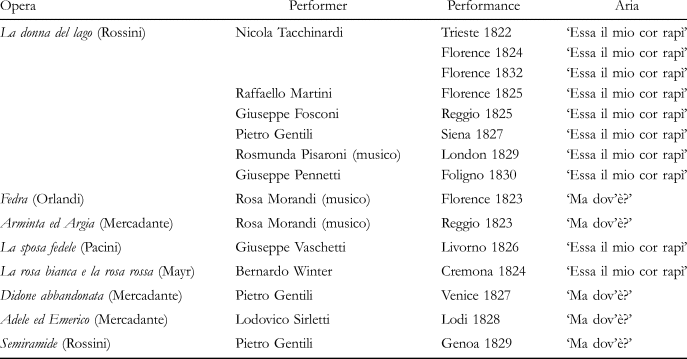
We have seen Tacchinardi's substitution practices in the role of Clodomiro. What, then, of other operas with far more extensive circulation across the early nineteenth century than La Sacerdotessa d'Irminsul? In addition to Sacerdotessa, Tacchinardi's most frequently performed roles across the 1820s were Uberto in Rossini's La donna del lago and the title role in Otello. In both La Sacerdotessa and La donna del lago, Tacchinardi would try out the role as written at its first run of performances, then substitute an aria of his own choosing in subsequent productions. (see Table 1 for an overview of Tacchinardi's substitutions discussed in this article.) As the table shows, Tacchinardi's substitution strategy maintained a consistency throughout his career in these roles: the Pacini arias ‘Ma dov’è?’ and ‘Essa il mio cor rapì’ were not merely interchangeable ‘arie di baule’ to be switched in and out of roles, but became fixed components of his conception of Clodomiro and Uberto. Tacchinardi's adjustments did not go unnoticed; they must have been well received, since they were copied by many tenors of the following generation.Footnote 36 While La Sacerdotessa did not enjoy a robust revival after Tacchinardi's performances, La donna del lago was popular throughout the 1820s, along with the practice of substituting ‘Essa il mio cor rapì’. The tenors who followed Tacchinardi also expanded the reach of these substitute arias, inserting the same two arias by Pacini into different operas by various other composers (see Table 2). Even in roles that Tacchinardi himself had sung without employing aria substitution, younger tenors who took up the same role later would sometimes insert Tacchinardi's signature substitute arias.Footnote 37
Nicola Tacchinardi's aria substitutions
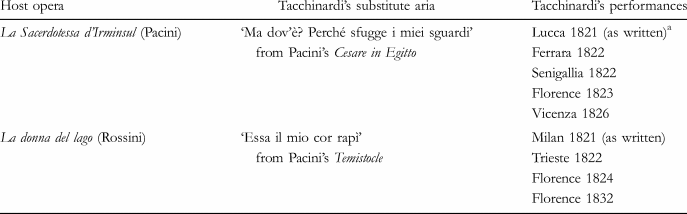
a All libretti consulted were accessed in person at Hargrove Library, the University of California, Berkeley, or online through the Corago libretto collections database operated by the Università di Bologna at corago.unibo.it.
Aria substitution by subsequent singers after Tacchinardi
Tacchinardi did not invariably practice cavatina substitution in all his roles, however. In contrast to his approach to the roles of Clodomiro and Uberto, he adhered faithfully to the original text when performing in Rossini's Otello. In a performance climate where other Otellos, most Desdemonas and even Desdemona's handmaid Emilia tirelessly rotated substitute arias into the opera, Tacchinardi never replaced any of Rossini's music in any of his seven productions of Otello, despite sharing the stage with five other tenors in the opera (two major and three minor). The explanation may be simple: in Otello, Tacchinardi's character was the star and the title character, and the opera already revolved around his interests.
As this stage masculinity relied on situation and appearance more than gendered vocality, Tacchinardi's substitutions were also adopted by musicos: the soprano Rosa Morandi, who shared the stage with Tacchinardi in performances of La Sacerdotessa as his musico rival Ruggiero, chose to perform ‘Ma dov'è?’ as the substitute cavatina in her own musico roles such as Ippolito (Orlandi's Fedra) and Aminta (Mercadante's Aminta ed Argira).Footnote 38 Rosmunda Pisaroni would follow suit, inserting ‘Essa il mio cor rapì’ into her performances as Malcom in La donna del lago.Footnote 39 Such emulations by soprano and contralto performers in male roles attest to the effectiveness of Tacchinardi's substitutions, regardless of vocal register. Singers who emulated Tacchinardi's substitutions stood to gain from association with his fame and virtuosity; but, perhaps just as important, they would also project a consistent brand of stage masculinity. Through singing the same substitute arias, tenors and musicos after Tacchinardi collectively invoked a set of traits newly perceived on the stage as masculine, reinforced and legitimised across the 1820s – as in Butler's formulation – through constant repetition.Footnote 40 In this sense, a substitute aria such as ‘Ma dov’è?’ did not serve as a cushion for technical mediocrity, as critics such as Stendhal had accused, but rather contributed to an emergent masculine aesthetic that was constituted and stabilised through imitation and repetition.
Rossini's La donna del lago presents a unique case through which to examine the tenor's evolving persona as a heroic type, with its three contrasting male characters each vying for the prima donna's affection. In this romantic fantasy of the highlands, urban Scotland, ruled by King James V, is at war with its mountain clans. Elena, the lady of the lake, is in love with the rebel chieftain Malcom, a musico role written for the aforementioned contralto Rosmunda Pisaroni. His fierce rival is Rodrigo Dhu, written for Andrea Nozzari, a ‘baritenor’ type for whom Rossini also wrote Otello. The role of James V (disguised for much of the opera as the commoner Uberto) was conceived for and first performed by the tenor Giovanni David.
Like Clodomiro in Pacini's La Sacerdotessa, Uberto is an aristocratic political leader, to whom the heroine shows affection not out of romantic love, but out of duty and hospitality. True to his opera seria type, Uberto bestows mercy on the defeated highlanders at the end of the opera, and sacrifices his own affection for Elena by endorsing her marriage to Malcom. Exercising the authority of his throne, Uberto stands in contrast to Rodrigo and Malcom, violent tribal leaders involved in military action and political confrontation. Heather Hadlock has shown how Uberto, modelled on the vocal and dramatic profile of the singer who created the role, relied on tropes of a tenuous and dated masculinity:
The light voice and gallant persona of Giovanni David served the opera's idealized image of the aristocratic male as purified of self-serving impulses, and empowered by that purification to claim benevolent authority, bestow personal happiness, and restore political order. In the character of the king, the opera and its source poem depict the aristocratic ‘man of feeling’ as an essentially comic and feminine force … [This] magnanimity seems always in danger of collapsing into unmanly weakness, and noble self-sacrifice into weak lack of self-assertion.Footnote 41
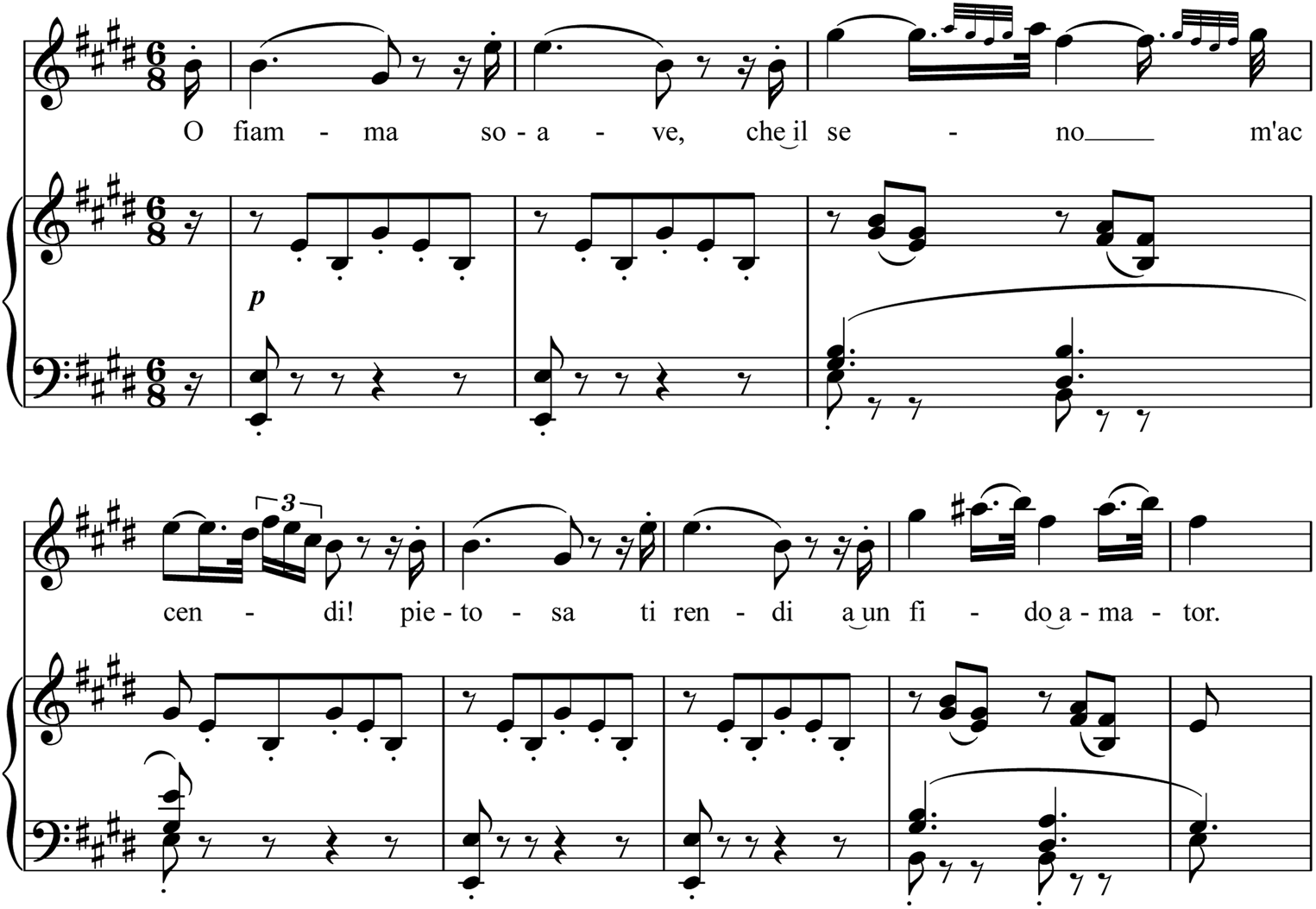
As Hadlock further argues, the character's stylised, aristocratic type was most visible in Uberto's cavatina ‘O fiamma soave’. The aria features sparse orchestration that makes way for the tenor's florid melismatic passagework above the staff, highlighting his dexterity in navigating intricate vocal embellishment. Its dramatic stasis and measured poetry prevent the tenor from appearing as an active and dynamic hero, instead casting him as a distant observer, sighing for the heroine from afar. While the aria may have been successful within the dramatic and aesthetic horizons of the 1810s, such ornate masculinity caused subsequent tenors much trouble in the ensuing years. By 1824, Stendhal would call it ‘the most tedious thing in the world, being overloaded with vulgar little ornaments’.Footnote 42 The ‘sentimental heroism’ of Uberto, then, due to its ornate, gallant characterisation and seria and semiseria roots, projected precisely the traits that Tacchinardi had sought to refashion in La Sacerdotessa's Clodomiro.
Compared to the relative textual stability of its other two male leads, the role of Uberto faced constant reinvention whenever the opera was revived across the 1820s. As a case in point, the delicate ‘O fiamma soave’ (Example 1) has proven so difficult to execute dramatically that even David himself, starting in 1823, abandoned it for a substitute aria, sometimes omitting the solo opportunity entirely. La donna del lago's lasting popularity through the 1830s meant that tenors performing Uberto, an aesthetic type quickly outdated after its premiere, managed the role through substitutions which altered both his musical style and dramatic situation.
Gioachino Rossini, ‘O fiamma soave’, bb. 42–50.
As Table 3a shows, performing Rossini's aria as written seems to have been an infrequent and short-lived preference. It is surprising just how often ‘O fiamma soave’ went unperformed in the opera's first two decades of circulation, frequently supplanted by ‘Essa il mio cor rapì’. Tacchinardi's substitution choice had stabilised as part and parcel of the opera itself in its early performance history: performances of La donna del lago that featured the Pacini substitute far outnumbered performances of Rossini's original music. The twenty-six known instances of substitution detailed in Table 3b testify not only to the untenability of dramatically static, florid-singing aristocratic masculinity across the 1820s and 1830s, but also to the degree and severity of the substitutions.Footnote 43 Tenors in the role of Uberto were looking not only for more vocally suitable music, but also for entirely different registers of narrative action.
Substitution history of La donna del lago, Act II opening
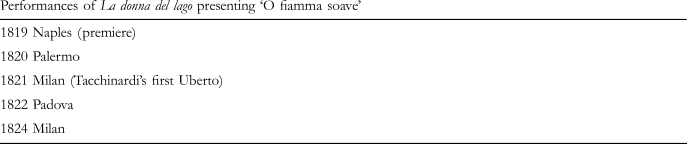
Substitution history of La donna del lago, Act II opening

Seeking to supplant the dated trope of static praise from afar, performers did not merely alter or omit ‘O fiamma soave’: they swapped the following scene with Elena and Rodrigo for completely different scenarios involving different sets of characters. In Paris in 1824, under Rossini's own supervision, a new scene was introduced where Douglas and Rodrigo discover Malcom and Elena locked in sweet embrace, and the four engage in a confrontation quartet borrowed from the composer's Bianca e Falliero. The same situation is repeated with minor adjustments in Turin in 1837 and Milan in 1838. In Venice in 1832, Elena does not show up at all, yet Uberto and Rodrigo argue nevertheless through a duet borrowed from Donizetti's Gabriella di Vergy. In certain productions (Bergamo, 1824, and Vicenza, 1828, by means of different substitutions), Uberto and Malcom sing a duet, with no Rodrigo in the picture. Giovanni David himself in Vicenza in 1828 chose to substitute a tenor-soprano duet that opens Act II of Pacini's Gli arabi nelle Gallie, where a misunderstanding between husband and wife (he in Arabian disguise, she believing the Arab had killed her husband) turns into a duet between Uberto and Malcom: the enraged wife's accusations become Malcom's, and the mistaken husband's placation and justification becomes Uberto's. Throughout the 1820s performers of La donna del lago's masculine leads were in search of decisive and dangerous dramatic situations in which to display themselves, with the understanding of the privileged position of doing/action at the double level of performer and character. This wholesale rejection of a specific scene in an opera with such an extensive performance history is striking: the practice highlights the textual instability of the bel canto repertoire, an instability that not only disrupts at the level of the aria, but also can affect collections of scenes and significant portions of plot altogether. Amidst this sea of constant change, Tacchinardi's choice of ‘Essa il mio cor rapì’ turned out to be the most stable solution.
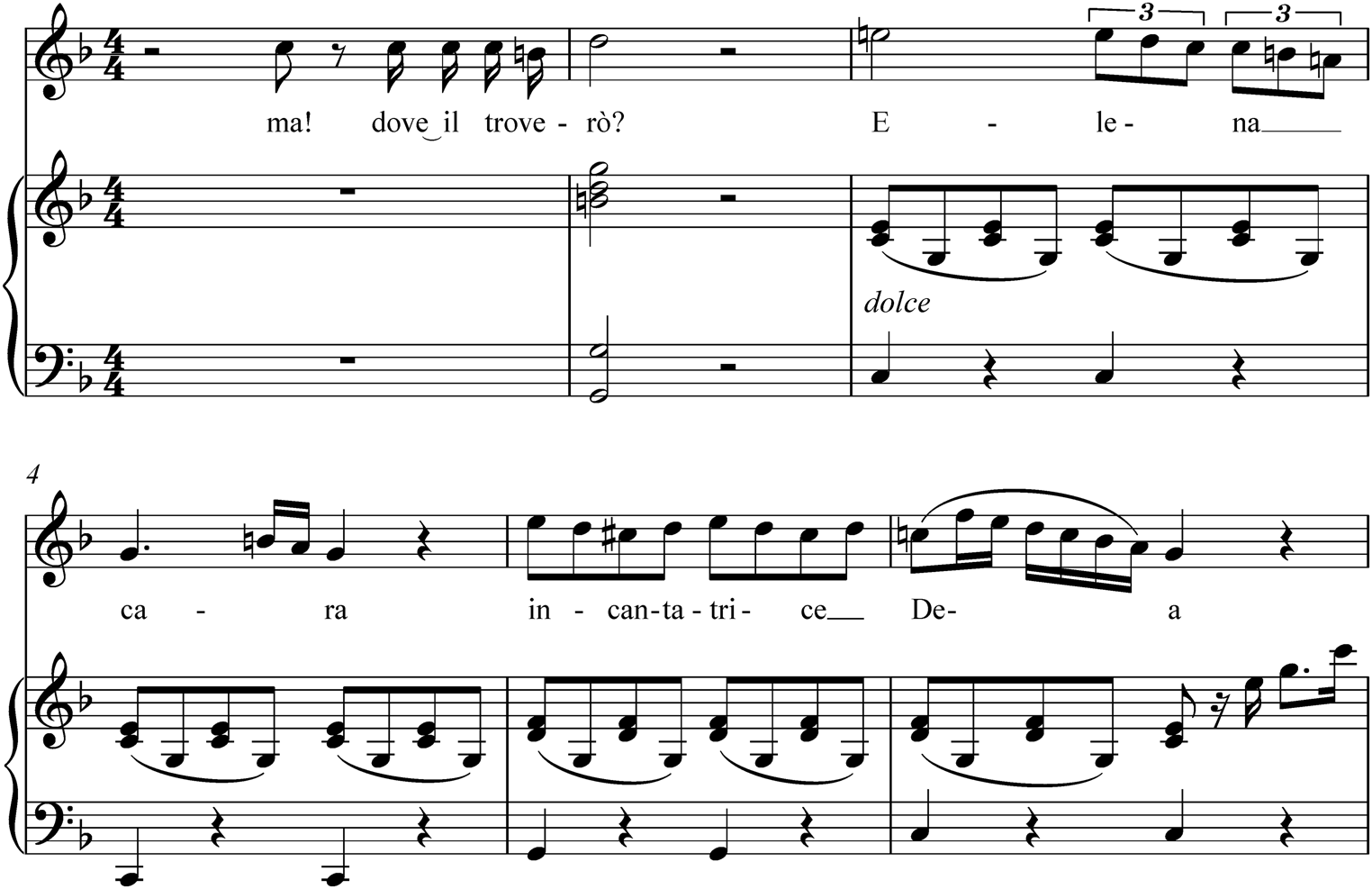
As we have seen, Tacchinardi abandoned ‘O fiamma soave’ after attempting it in his first performances as Uberto at La Scala in 1821, preferring to substitute ‘Essa il mio cor rapì’ from Pacini's Temistocle for all future performances – a practice also adopted by the tenors Raffaello Martini, Giuseppe Fosconi, Pietro Gentili, and Giuseppe Pennetti. By replacing ‘O fiamma soave’ with the aria by Pacini, Tacchinardi and his emulators jettisoned the dramatic stasis of Rossini's original, in which the tenor praises the absent, adored woman, with a far more active scene of yearning (Example 2):
(But where shall I find her? Dear Elena, / enchantress, Goddess, do not hide yourself / with your beautiful gaze return to this heart / and give respite to the sorrow in my breast.)
Pacini's setting of this excerpt from ‘Essa il mio cor rapì’ emphasises the tenor's rhetorical longing, ‘ma dove’, as a pivot between recitative and arioso, and between plot explication and outburst of sentiment. The passage strikingly resembles the ocular-centric demands of Tacchinardi's other signature substitution, ‘Ma dov'è? Perché sfugge i miei sguardi’. Both situations cast the tenor as seeking the adored woman, declaiming her name, demanding that she appears before his eyes, and describing what her presence would do to soothe his heart. Indeed, Uberto's new text also bears a strong resemblance to the rebel leader Rodrigo's Act I entrance aria in La donna del lago:
(But where is she / who ignites such a sweet flame in my breast? / A single glance from her / fills my being with joy.)
Such demands for the heroine's presence supplanted the dated gallantry of arias that heaped her with stately praises from afar (or in Clodomiro's case, similar praises of his deceased father). This new model of stage masculinity not only discarded florid ornamentation – the excuse for non-action – but was also defined by the repetition of a dramatic motif: repeatedly demanding an object for the gaze. Even Malcom, in his cavatina ‘Mura felici’, envies the cottage walls because they constantly have Elena within their sight. When Uberto demands to see Elena's body, he aligns his masculinity, through repetition, with the fierceness of Rodrigo, who also demanded Elena's body in his cavatina. As these roles are passed from singer to singer, re-enacted after Tacchinardi by Martini, Fosconi, Gentili, Pisaroni, and Pennetti, repeated performances amplify the echoed proliferation of the male gaze, bouncing around in the contained space of this opera. The three male characters, and the many tenors and musicos who sing them, create and recreate an image and idea of Elena, trapped in a hall of mirrors, where looking and seeing are a measure of masculinity, legitimised through re-enactment.
Giovanni Pacini, ‘Essa il mio cor rapì’, bb. 53–58.
Norma's immutable text and the problem of the bass
While the tenor lead of La donna del lago faced constant revision and reinvention during the 1820s, the popular star vehicle of the next decade, Bellini's Norma, made its way across Europe with virtually no substitutions imposed on the tenor part.Footnote 45 Indeed, in a performance climate where scene substitution continued to be commonplace, Norma's performance history stands out for the stability of its plot and arias (see Table 4a).Footnote 46 The reason for this lack of change may be as straightforward as not fixing what already works: whenever the tenor hero Pollione is on stage, it is to confront danger in some way, and he is the sole love interest caught between two women, with no musico in sight. For restrained opera seria types Clodomiro and Uberto, once a solution for problematic masculine presentation is found, that musical solution becomes textually stabilised. For Otello and Pollione, roles whose heroic masculinity was already decisive, virile and dangerous, substitution did not occur.
Across Norma's first decade of performance, the few substitutions that did occur targeted the Act II aria for the bass Oroveso, Norma's father and leader of the druids (see Table 4b).Footnote 47 I turn from the tenor to the bass here to demonstrate that the performative paradigm of stage masculinity I discuss is not circumscribed by vocal category among tenor-voiced, male-bodied performers, but could come into play in any role that was gendered male in the narrative. That tenors, basses and musicos all used substitute arias to inflect an opera's narrative and strengthen their characters indicates that such strategic substitutions were viable across male-presenting roles.
Substitution history of Norma
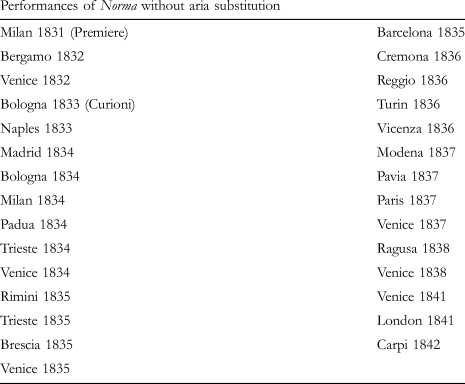
Substitution history of Norma
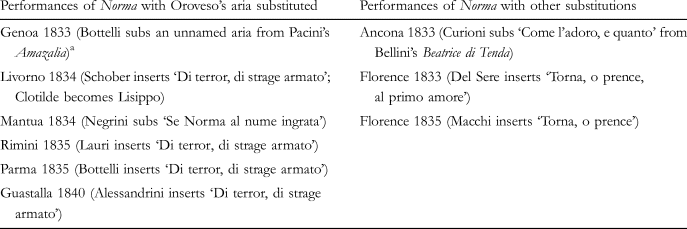
a Genoa 1833, Parma 1835 and Guastalla 1840 are not my findings, but cited in Poriss, 115. I do not have access to these libretti to confirm or expand upon these.
The changeability of Oroveso's aria within an otherwise fixed text is usually explained with recourse to biography: the story goes that the original Oroveso, Vincenzo Negrini, suffered from a weak heart and could not withstand performing an extended scene, forcing Bellini to underwrite the role, leaving its Act II aria with only a brief cantabile and no cabaletta, a prime candidate for substitution. Scholars since Herbert Weinstock have accepted without question the story of Negrini's weak heart and its impact on Bellini's compositional process.Footnote 48 It has escaped notice that this so-called ‘bass’ went on after Norma to specialise in roles such as Enrico (in Lucia di Lammermoor), Riccardo (in I puritani) and Filippo (in Beatrice di Tenda) – vocally demanding roles that in the 1830s were still labelled as basso cantante, but that were far more central to the plot than ‘true’ bass roles such as Lucia's Raimondo and I puritani's Giorgio. The first mention of Negrini in this new style appeared in Il Figaro in 1835, where he is described as ‘basso-cantante, anche veramente baritono’.Footnote 49 Negrini's career, then, fits the trajectory of the divergence of the basso cantante into its own category: the Italian baritone that also emerged out of this transition period, a dramatic type that would go on to feature prominently throughout Verdi's output.Footnote 50 The oft-repeated stories of physical delicacy belie the agency Negrini exerted when he transformed Oroveso into a more forceful leader in his 1834 performances of Norma in Mantua.
In the second act of Norma, a group of druid warriors assemble in secret to ambush the Roman camp, anxious to spark their revolt after sustained placation from Norma. Oroveso enters with dire news: Pollione has been replaced with an even stronger leader, and their attack must be cancelled. In the libretto for the original 1831 production the druids ask:
Druidi: E Norma il sa? Di pace
È consigliera ancor?
Oroveso: Invan di Norma
La mente investigai; sembra che il Nume
Più non favelli a lei
(Chorus of Druids: Does Norma know this? / Does she still speak of peace? / Oroveso: In vain I studied / Norma's thoughts; It appears that god / No longer speaks to her)
While these lines appear in the libretto for the premiere, Oroveso's last few words were never uttered on stage. Bellini's autograph confirms that this expression of distrust in Norma's ability to divine messages from the gods was excised during the compositional process and never set to music.Footnote 51 The druids are left to respect the obscurity of Norma's divinations, still trusting that she is the sole conduit to their god. In the aria that follows, Oroveso and the druids reassure themselves: hide their true strength and disdain for now, and the eventual strike will be the more devastating.
(Ah! I too chafe beneath the Roman yoke / And long for battle; / But the heavens are against us, / We must pretend to be docile. / Let us keep our hatred in our heart, / Until the Romans think it dead: / The day will come when it will blaze forth / To burn with a more tremendous flame.)
This sequence of events, as laid out by Bellini, accords with the decision to excise the previously mentioned recitative lines. The aria's sentiment preserves Norma's authority over her community: the druids sheath their swords because their god, through Norma, has not given the command to attack.
Upon taking up the role of Oroveso for the second time, Negrini chose to play on this ambiguity in the power relations between Norma and the druids, upending the resigned acceptance of Bellini's brief aria. In place of ‘Ah! Del Tebro’, Negrini performed a scene of betrayal and recognition from Pacini's La schiava in Bagdad, rewriting the omitted sentiment of the deleted recitative lines and expanding it into a vengeance aria and cabaletta for Oroveso:

(Negrini's substitution: If Norma, ungrateful to god, / has forgotten duty and honor / vested in this bloody sword / on the altar she will fall: / Her spilled blood / will placate our god. / Oh, how I loved the treacherous one / with a tortured love: / and now I must kill her! / I feel a chill in my heart; / the sorrow of this soul, / Oh God, will be eternal! / Awaken, my courage; / suppress all other feelings, / in my chest is only / vengeance and fury. / Onto all the Romans / the avenging blow will fall.)
This replacement lends the scene and the entire role a new dramatic urgency. Negrini's Oroveso dares to brand Norma as ungrateful to their god and sacrifice her at the altar of Irminsul. As the druids’ leader, Oroveso no longer blindly follows the selfish dictates of Norma, but questions her legitimacy and authority. Threatening to murder his own daughter, Oroveso rehearses the sensational threat of filicide that Norma herself had levelled against her children. This distrust precludes Norma's ability to remain in her community, further sealing her fate and intensifying the dilemmas that she will face in the opera's final scene. Choosing the music of Pacini's substitution also gave Negrini a multipartite scena as opposed to Bellini's brief cantabile, allowing his druid leader to sketch a dramatic arc. While Bellini's ‘Ah! Del Tebro’ builds on the melodic material of the preceding druid chorus ‘Non parti?’, the Pacini substitute stands apart musically, bringing Oroveso out from the homogenous fabric of his people. With this substitute aria, then, Negrini's Oroveso attains a more central role in the dramaturgy, stepping beyond the complacent resignation of Bellini's original bass role, and assuming authoritative, even violent masculinity.
Negrini's case shows that it was not just spurned tenors and late-career musicos who were revising masculine identity on stage. The basso cantante in the role of father and restrained political leader, never in the running for plot centrality in the first place, was also finding ways to exert himself as more significant within the drama, to refurbish dated dramaturgy through the theatrical conventions available to him.
* * *
While much of the music I have discussed here has been lost or scattered in archives across the globe, their poetic texts were preserved in the libretti printed for each run of performances. The very fact that theatres took such care to update and preserve these constantly mutating texts speaks to their importance in performance as the public text which audiences could follow during performance and refer to later at home to evoke memories of the evening. My inquiry, then, relies on the assumption that words and plot matter to the meanings and affects opera conveys. The importance of semantic, visual and dramatic parameters over vocal writing in this inquiry is motivated by a crucial omission in Tacchinardi's polemic of 1833: instead of the rhetoric of predetermined vocal physiology – that women's voices could not possibly index a masculine body – he insisted on critiquing the musico's idiosyncratic dress, gesture and stage ethics, rather than their singing, as unmasculine. It was not the musico's voice that betrayed her as female, but rather the way her body misbehaved on stage.Footnote 54 In the same manner, it was not the tenor's voice that confirmed him as male, but rather the way he constituted his character in narrative.
As a coda, let us briefly consider how a critic writing for the Gazzetta di Milano reacted to Giovanni David's unconvincing performance in the title role of Pacini's Alessandro nell'Indie in 1826:
The conqueror of all empires is only recognizable by his helmet and hauberk. We concede that the proud Macedonian, conquered by the charms of a fair enemy, spoke the language of love with the accent of passion; but [David's] swoons, lazy gestures, and mannered movements are not for the temper of that fierce spirit.Footnote 55
The critic points to David's dress and gesture as parameters for success in masculine-heroic portrayal; comportment of the visible body in action, rather than singing, is the primary index of gender type. The body itself accrues gender through dramatic textualisation, rather than the knee-jerk recognition of a masculine body within the tenor voice. In other words, the notion of a gendered vocalic body has a history: in an era before a singer's individuality was expressed in timbre, the voice as it sings may have produced no bodies at all.Footnote 56
For performers such as Tacchinardi, stage masculinity was far from an always-already maleness that would eventually erupt into the world at Duprez's mythic high C, but rather a textual practice of character posturing and narrative authorship. Before he could rely on the natural physiology of his male body, the male performer exchanged stasis for action – the difference between praise and demand, retreat and attack. It should perhaps trouble us that the markers of decisive action in all these instances of substitution entail the instalment of masculine power over their feminine counterparts. Eve Sedgwick's classic model of triangulation would suggest that the masculine rivalries in Sacerdotessa and La donna del lago appear as a relation of male homosociality expressed through acts of violence and clemency.Footnote 57 Romilda and Elena exist less as autonomous actors than symbolic property for negotiating patriarchal power – when demanded, they appear; their fates are handed down as after-effects of political arbitration, their bonds of love are thin veneers for the bonds of nations. This privileging of the male gaze and of relations between men as a means of diagnosis and control (critics see Tacchinardi, Tacchinardi sees musicos, Tacchinardi sees prima donnas) would seem to render irrelevant musicology's familiar redemptive move of hearing women's voices. Tacchinardi's choice of substitute arias endowed the tenor hero with the agency to demand the prima donna's presence under his gaze, a narrative enactment of control over her whereabouts that, like Wagner's acts of conjuration through narrative, are immediately fulfilled.Footnote 58 Negrini's newfound authority over the text of Norma is one with, and indistinguishable from, Oroveso's newfound agency to commit violence upon his daughter. In their bid to move from representation to presentation, and from appearance to action, male performers codified a new stage masculinity through the stylised repetition of acts: acts in which the masculine hero used aria substitution to exert narrative control over women's bodies.


 Open access

