


Introduction
United States Attorneys lead the charge of presidential policy when it comes to federal law enforcement.Footnote 1 As a result, presidential administrations select and appoint U.S. Attorneys who align closely with their preferences. In Los Angeles, Nevada, New Jersey, New Mexico, and upstate New York, President Trump has utilized the power of acting and interim appointments in an unprecedented fashion to fill U.S. Attorney positions with actors who he hopes will be faithful stewards of his administration’s goals (Orden et al. Reference Orden, Johansen, Cai and Sentner2025). Perhaps the most persistent effort to fill a U.S. Attorney position in history is Trump’s endeavor to make Alina Habba, his former personal lawyer, the U.S. Attorney for New Jersey. President Trump first appointed Habba to serve as the Interim U.S. Attorney in March 2025. Habba replaced another Trump appointee, U.S. Attorney John Giordano, and in May 2025, after Trump appointed Giordano to a new post as U.S. Ambassador to the Republic of Namibia (State 2025).
Habba’s takeover of the U.S. Attorney’s Office in New Jersey can be characterized as an effort to further Trump’s agenda. Her tenure has produced multiple controversies tinged with partisan political significance. In May, Democratic Mayor Ras Baraka of Newark was arrested for his participation in an ICE protest purportedly at the direction of senior officials (Nieto-Munoz Reference Nieto-Munoz2025c). After dropping Baraka’s charges, Habba’s office turned their focus to House Rep. LaMonica McIver, also a Democrat, and charged her for assaulting an officer during the Baraka arrest (Nieto-Munoz Reference Nieto-Munoz2025a).
Immediately after charges were filed on June 10, 2025, the USAO for New Jersey issued a press release titled “Congresswoman Charged for Forcibly Impeding and Interfering With Federal Officers” where the author relays the allegations in the indictment (U.S. Department of Justice, U.S. Attorney’s Office, District of New Jersey 2025). ABC News, National Public Radio, and the BBC all picked up this story within 24 hours of the issuance of the press release, quoting specific language from the release in their reporting (Chappell Reference Chappell2025; Mallin and Deliso Reference Mallin and Deliso2025; Mitchell Reference Mitchell2025). Despite drawing controversy for her focus on state Democrats and criticism from a federal judge in the office’s handling of the Baraka case (Nieto-Munoz Reference Nieto-Munoz2025b), Habba served as a steadfast appointee for President Trump, aligning her office priorities with the administration until her resignation in December of 2025, a week after a federal appeals court found her service as U.S. Attorney unlawful.
While Habba’s case may represent an extreme approach by a president to secure the nomination of a loyalist, presidents routinely fill U.S. Attorney positions with individuals who align with their goals. U.S. Attorneys have broad discretion with very limited oversight. Thus, presidents are incentivized to expend significant resources selecting these nominees to ensure ideological congruence. Past studies have examined federal prosecutors as recipients of political communication, finding that they respond dynamically to the signals of the president, Congress, and their local public within a principal-agent framework (Boldt and Boyd Reference Boldt and Boyd2018; Miller and Curry Reference Miller and Curry2019; Yates and Whitford Reference Whitford and Yates2009).
Our study considers the U.S. Attorney’s role as strategic producers of political messaging in a novel analysis that covers the beginning of President Trump’s second term and part of President Biden’s administration. What effect does a newly appointed U.S. Attorney have on the public relations activities of their office? How does a presidential transition change the composition of press activity and charges filed by federal prosecutors? To answer these questions, we employ a novel dataset of U.S. Attorney’s Office press releases issued during the last 54 weeks of President Biden’s term and the first 30 weeks President Trump’s second term.
Using the data, we analyze strategic signaling behavior by U.S. Attorneys in all offenses, narcotics, criminal immigration, violent offenses, and white-collar offenses. We find that the transition from President Biden to President Trump resulted in a significant increase in press release issuance overall. However, this was largely driven by a large increase in releases related to criminal immigration offenses and, to a much lesser extent, narcotics. Changes in U.S. Attorneys leading district offices had a limited effect on immigration-related statement publication only. This suggests that presidential priorities, rather than local leadership, have a greater weight in the communications activities of federal prosecutors. We also compare the composition of press release content and the proportion of statements published with the population of charge filings nationally during this transition. The results are suggestive of a fundamental reorientation toward criminal immigration enforcement. However, interesting disconnects emerge between communications and charging prevalence indicative of strategic shifts in press releases.
This analysis contributes to a growing literature exploring how politics affects the behavior of federal prosecutors who routinely assert their independence. This highlights the ongoing nature of the principal-agent relationship between the president and U.S. Attorneys. Moreover, it may offer important insight into how prosecutors are constrained by their legal environment, where filings do not match the prevalence of statements about them.
U.S. Attorney selection
At the outset, U.S. Attorneys are nominated by the president and confirmed by the Senate for four-year terms. Both presidents and senators recognize the power of these appointees, given the meaningful discretion over how cases are selected and prosecuted. The politically charged nature of the process is long-standing (Boyd et al. Reference Boyd, Nelson, Boldt and Ostrander2021), as presidents rewarded allies with law enforcement appointments dating back to the early Republic (Huston Reference Huston1967). Home state senators also played an important role in the selection of nominees, and their support, or lack thereof, of a candidate could determine the outcome of the confirmation process (McMillion Reference McMillion2017; Sollenberger Reference Sollenberger2003).
Beyond navigating political confirmation concerns, presidents prioritize the nomination of loyalists (Boyd et al. Reference Boyd, Nelson, Boldt and Ostrander2021) who share the administration’s goals (Eisenstein Reference Eisenstein2007). Presidents choose nominees carefully to ensure their discretionary decisions will align with presidential preferences. Presidential administrations also expend significant resources to vet potential nominees. Recognizing the importance of this process, President Trump personally interviewed some candidates for U.S. Attorney during his first term (Broach Reference Broach2017; Kim and Bresnahan Reference Kim and Bresnahan2017). While it is not the norm for presidents to individually interview potential nominees, presidents as a whole appreciate the importance of selecting the right candidates to serve as U.S. Attorneys. This explains why it is quite common for presidents from both political parties to make changes to U.S. Attorneys’ Offices upon being elected.
While many U.S. Attorneys will assume the role through the traditional route of nomination by the president and confirmation via the Senate, often U.S. Attorney vacancies are filled temporarily. The Vacancies Reform Act and 28 U.S. Code § 546 determine who will act as a U.S. Attorney when there is an office vacancy (Hauser Reference Hauser2018; Whelan Reference Whelan2003). Typically, when there is a vacancy, the current First Assistant to the U.S. Attorney will take on the role as the Acting U.S. Attorney in the office. While the First Assistant typically fills these vacancies, the president may issue a declaration naming a different person to serve as the Acting U.S. Attorney (Boyd et al. Reference Boyd, Nelson, Boldt and Ostrander2021). Acting U.S. Attorneys may serve for up to 365 days (Whelan Reference Whelan2003), after which the Attorney General appoints an Interim U.S. Attorney (§546(d); Whelan Reference Whelan2003). Interim U.S. Attorneys may serve for up to 120 days. At this point, the closest district court can replace the serving Interim U.S. Attorney, but it is not a requirement. If no replacement is named and the Senate fails to confirm a nominee, the Interim U.S. Attorney may continue to serve (Boyd et al. Reference Boyd, Nelson, Boldt and Ostrander2021). All of these methods of appointment allow presidents to set the tone for an ongoing relationship with their U.S. Attorney appointees.
U.S. Attorney decision-making
U.S. Attorneys are agents of the president who are supervised by the Attorney General by way of the Executive Office of U.S. Attorneys, but the president has sole removal power. U.S. Attorneys hold nearly unchecked discretion over most decisions they make while in office (Boyd et al. Reference Boyd, Nelson, Boldt and Ostrander2021; Albonetti Reference Albonetti1987; Davis Reference Davis1969; Jackson Reference Jackson1940). They decide the makeup of their staff, which cases to investigate and bring to the grand jury, how to structure plea negotiations, and which cases to bring to trial. Given such broad discretion and limited oversight, scholars have theorized about the determinants of the federal prosecutor’s agenda (Boldt and Boyd Reference Boldt and Boyd2018). U.S. Attorneys have finite resources and, as a result, they are limited in the number of federal cases they can pursue.
Some scholars have identified the importance of future career goals when prosecutors are making decisions on which cases to prioritize. Prosecutors may choose to focus on cases that they believe will further their individual professional goals in addition to prioritizing cases based on their own individual preferences (Boylan and Long Reference Boylan and Long2005; Eisenstein and Jacob Reference Eisenstein and Jacob1977; Perry Reference Perry1998; Stuntz Reference Stuntz2004). While many focus on Assistant U.S. Attorneys, U.S. Attorneys may also consider their professional aspirations when crafting their prosecutorial agenda, and aspirations to become a judge, serve in another political position, or move to a private position may, too, shape their decision-making when in office (Boyd et al. Reference Boyd, Nelson, Boldt and Ostrander2021; Gordon Reference Gordon2009; Lochner Reference Lochner2002).
As prosecutors set their agendas they necessarily consider political implications. U.S. Attorneys serve the president, and as such, political considerations are inherent to the job. The president, serving as the principal, may encourage preferred behavior from U.S. Attorneys through incentivization. Promotions or other types of professional growth may be utilized in the context of U.S. Attorneys (Boyd et al. Reference Boyd, Nelson, Boldt and Ostrander2021). Lochner’s (Reference Lochner2002) work suggests that federal prosecutors care about their reputation, and they consider how they will be perceived by future nominators or employers whose support is vital during career transitions.
Although U.S. Attorneys operate with limited oversight, they may still fear backlash from the president or Congress. U.S. Attorneys in their first term may be concerned about reappointment, as presidents can reappoint U.S. Attorneys to a second term (Scott Reference Scott2007), and all U.S. Attorneys can face the threat of office consolidation, budget cuts, or restricting jurisdiction (Epstein and O’Halloran Reference Epstein and O’Halloran1999; MacDonald Reference MacDonald2013; Shipan Reference Shipan2004). These threats may serve as a powerful tool to shape federal prosecutor behavior and encourage these prosecutors to make decisions that align with the administration’s goals. When U.S. Attorneys engage in behavior that aligns with the administration’s goals, they are sending a signal to the president that they are complying with presidential priorities, and this signal should insulate the U.S. Attorney from sanctions.
Why and how U.S. Attorneys change behavior
Presidents appoint and fire U.S. Attorneys based on their ideological congruence with administration policy (Golden Reference Golden2000; Dickinson and Rudalevige Reference Dickinson and Rudalevige2004). As we noted, these attorney are ambitious individuals with long-term career goals in sight with this appointment, weighing their futures as federal judges, senators, and governors (Miller and Curry Reference Miller and Curry2019). In order to advance those career goals, especially for future federal appointments, they aim for compliance with administration priorities (Lochner Reference Lochner2002).
This is, as many have put it before, a principal-agent relationship (Selin et al. Reference Selin, Drolc, Butcher, Brothers and Brant2022; Lewis Reference Lewis2009). As principals, presidents communicate their administration’s priorities publicly, frequently using announcements to communicate to the public as well as their agents in the Executive Branch. This presidential rhetoric serves as a signaling tool to bureaucratic agents (Whitford and Yates Reference Whitford and Yates2003; Yates and Whitford Reference Yates and Whitford2009; Eshbaugh-Soha Reference Eshbaugh-Soha2008) and these words can sway agent decision-making (Eshbaugh-Soha Reference Eshbaugh-Soha2010). Rhetorical signals provide clarity to agents while also reducing uncertainty (Carpenter Reference Carpenter1996; Shipan Reference Shipan2004). Thus, U.S. Attorneys can look to presidential speeches and other forms of communication for guidance on administration priorities on federal prosecution. For example, Whitford and Yates (Reference Whitford and Yates2009) demonstrate that an increase in presidential rhetoric on drugs resulted in an increase in federal drug prosecutions. We expect that in presidential transition periods, where there are large priority shifts, presidential signaling can be a powerful tool to guide agents in the president’s preferred direction.
With the importance of signaling on behalf of the president to his agents, we posit that U.S. Attorneys may also engage in signaling behavior. Replying to the presidential directive, U.S. Attorneys can use their rhetoric and decision-making to signal their alignment with presidential priorities. We argue that, as agents of the administration, U.S. Attorneys signal their compliance through two means: press releases and charging decisions. First, press releases allow offices to selectively highlight their compliance efforts in an easy-to-monitor fashion. Rather than collecting extensive data and reporting with a statistically necessary lag, as we will discuss with charging decisions, press releases allow U.S. Attorney offices to highlight selective, compliant outputs as they are audited by the executive branch. We expect to see these changes take hold quickly after U.S. Attorney and administration turnover. Press releases, unlike charging decisions, give these officials broad discretion in what they highlight. Thus, press releases serve as a low-cost signal to the administration that the U.S. Attorney is focusing on the administration’s preferred policies.
For example, on January 29, 2026, in the wake of the killings of Renee Good and Alex Pretti and the protests in Minneapolis, the U.S. Attorney’s Office for the District of Minnesota issued a press release titled “Sixteen Defendants Charged with Violently Assaulting Federal Officers and Property” (U.S. Department of Justice, U.S. Attorney’s Office, District of Minnesota 2026). In the release, U.S. Attorney Daniel N. Rosen (appointed by President Trump in 2025) highlighted not only the obstruction charges but also “Operation Take Back America” as a nationwide initiative to repel illegal immigration, a top administration priority. Local and national media outlets reported on these arrests in the wake of the press release.
Charging decisions, however, are a different animal. First, rapidly changing prosecutorial processes may be easier said than done. For example: “It is one thing for Attorney General Ashcroft simply to proclaim a new priority, and quite another for an assistant U.S. Attorney in Boise or Boston to alter fundamentally his or her area of practice to accommodate the priorities of a political official that the assistant will almost certainly outlast” (Lochner Reference Lochner2002, 273). Long-standing investigations and grand jury indictments do not often turn on a dime.
At the same time, prosecutors retain substantial discretion and power in making charging decisions but prosecutors cannot just select cases out of the ether; they are reactive to law enforcement action and investigations. These priorities can often take longer to play out as cases develop pre-indictment. We expect to see charging decisions change with the leadership at individual offices and the president, but these changes will likely take longer to fully manifest.
Data and research design
To conduct our analysis, we leverage data on press releases and charging decisions from across the United States. The Department of Justice compiles all press releases for U.S. Attorneys’ Offices across the country, sorting them by date. Each release is dated, identifies the issuing USAO, and contains topic tags. Some releases are as short as 30 words with others spanning thousands of words. These releases frequently highlight case results as well as charging decisions. To obtain the press releases, our team scraped the HTML files associated with the URLs, creating a dataset with the full text of the press release along with dates, issuing USAO, and topic tags (U.S. Department of Justice 2025c). After scraping the data, duplication checks based on the office and the text of the body of the release were conducted. Our press release dataset contains 31,408 unique press releases from January 2024 to August 2025.
To track U.S. Attorneys’ behavior in criminal cases themselves, we utilize internal Department of Justice data from the Legal Office Network System (LIONS). LIONS is a multi-user internal database used for case management by federal prosecutors. The database is used by the Executive Office for U.S. Attorneys to produce statistical information for Congress and the public (U.S. Department of Justice 2025b). Released online at the end of each fiscal year and monthly, we rely on the most recent publicly available data for August 2025 (U.S. Department of Justice 2025a). We combined our two data sources to create a panel dataset of U.S. Attorney’s Offices associated with all states and the District of Columbia from January 1, 2024, to August 12, 2025, on a weekly time interval.Footnote 2 Thus, the sample includes 90 U.S. Attorneys’ Offices’ press releases and charging behavior across an 84-week period resulting in 7,560 total district-weeks for the sample.
In the first part of our analysis, we track the number of press release topics and charging document filings (indictments, information, and criminal complaints) to address our research questions. We analyze strategic signaling behavior by federal prosecutors in five categories: all offenses, narcotics, criminal immigration, and white-collar offenses. The four individual kinds of offenses represent mainstays of the federal prosecutorial agenda year-to-year. In fact, over 90 percent of all criminal charging documents filed during our sample period are labeled as falling under at least one of these four prosecutorial program categories. Our key dependent variable is the weekly count of Press Releases tagged on the Department of Justice’s news release website with topics associated with the five categories above.Footnote 3 We utilize negative binomial count models to predict the number of releases. The first independent variable of interest is Trump Administration which takes the value of 1 on and after the week of January 20, 2025. Our second key independent variable is Trump Change U.S. Attorney, which takes the value of 1 when the U.S. Attorney serving the district was replaced by the Trump administration. We anticipate that the change from the Biden administration to the Trump Administration will cause more press releases on all subjects, immigration, narcotics, and violent crime consistent with the Trump campaign’s aggressive immigration and street crime rhetoric. However, in regard to white-collar crime, we anticipate that there will be no significant change in press statements. Similarly, we expect that U.S. Attorneys who were elevated to lead their district (no matter the mechanism) have a clear indication that they should align themselves with administration priorities. Even within the presidential administration, new U.S. Attorneys seem likely to produce additional messaging showcasing their overall efforts and in immigration, narcotics, and violent crime.
The key control variable in this set of models is Lagged Charge Filings which is the count of charge document filings (indictments, information, and complaints) submitted to court in the listed offense type in the previous week.Footnote 4 We expect that charge filings will have an imperfect, though positive, relationship with press releases. The amount of case activity within the district sets the space in which strategic messaging can occur. Yet, press releases may not follow elevated charging if the U.S. Attorney’s Office simply decides not to highlight it. Thus, the gulf between press release activity and charge filings gives a window into what the U.S. Attorney views as important. We anticipate that case activity may act as a mild constraint on press statements; a very small or non-existent population of cases might foreclose the opportunity for desirable signals to their supervising principals. Finally, we account for variability between the individual U.S. Attorneys’ Offices with District Fixed Effects and district-clustered robust standard errors. The effects of time and serial correlation are controlled for via a linear time trend.
In the second part of our analysis, we explore national patterns in the composition of communications about criminal cases and how they compare to actual charge filings in the transition from President Biden to President Trump. Specifically, we examine the change in emphasis in the text of USAO press releases and the percentage of statements labeled with topic codes related to the four offense types of narcotics, criminal immigration, violent crime, and white-collar offense each week. Then, we compare them to the proportion of charge filings in those same four areas on the national level.
The three series of interest are Percent Textual Emphasis, Percent Press Releases, and Percent Charge Filing. Each is constructed on the weekly level across all 90 districts connected to U.S. states or the District of Columbia. Percent Textual Emphasis reflects the percentage of words related to the four specific offense categories found in all the U.S. Attorney’s Office press releases that week. We constructed this measure from the words used within each press release using the textual analysis tool Linguistic Inquiry and Word Count (LIWC) similar to Black and Owens (Reference Black and Owens2016) and Owens and Wedeking (Reference Owens and Wedeking2011). LIWC takes a dictionary-type word list, including word-stems, and uses it to classify content through word counts (Tausczik and Pennebaker Reference Tausczik and Pennebaker2010). We constructed a custom dictionary based on the offense codes used by the Department of Justice internal LIONS (Executive Office for United States Attorneys 2017). For each of the four categories of interest, we identified unique words and word-stems that relate to those charges. For example, cases classified as “White Collar/Fraud” are described as those involving “deceit, concealment, subterfuge, and other fraudulent activity.” We included “fraud*” and ‘conceal*” as word stems for LIWC to classify. We include the complete dictionary in Appendix A.
To examine the changing proportion of releases issued on topics, we include Percent Press Releases. This is the percentage of all releases that are tagged with topic codes relating to the four respective offense types, each week described earlier in Footnote 2. In respect to activities in court, Percent Charge Filing reflects the percentage of charging documents filed in each week that were classified as one of the four offense types in the internal USAO data (LIONS). We evaluate the change from the Biden administration to the Trump Administration with an indicator variable that takes the value of 1 on and after the week of January 20, 2025. We employ a simple difference of means test with Newey-West time series robust standard errors at the 12-week (4-month) lag (Newey and West Reference Newey and West1987).Footnote 5 Each set of series is also graphed along with the pre/post means and time series robust confidence intervals.
This approach allows for a holistic evaluation of patterns in communications and case activity by federal prosecutors. In this section, we do not convey these simple tests as though they demonstrate causal relationships. Rather, we provide a first-of-its-kind exploration of how strategic messaging by U.S. Attorneys changes during a partisan transition. In general, we expect that the shift from Biden to Trump will relate to a much increased focus on criminal immigration prosecutions at the expense of other areas. As more textual space is committed to (and press statements are released about) criminal immigration enforcement, we expect that attention to narcotics, violent crime, and white-collar offenses will decline. We expect a similar relationship between the transfer of power and charge filings.
Importantly, we anticipate that strategic changes in the emphasis and proportion of press releases will be more pronounced than those in charge filings. This is because changing the content and frequency of communications on a given subject has few costs for a U.S. Attorney’s Office. As we indicated previously, one plausible constraint on strategic signaling behavior through press releases is the availability of cases with which to message about. This potential constraint, however, would seem to operate in limited contexts. Any U.S. Attorney’s Office is likely to have an existing stream of routine cases that one could create press releases about across many offense types. Alternatively, a case that may have been profiled as falling under one offense type during the previous administration might have different aspects highlighted during the new one. For example, a white-collar offense committed by a non-citizen might have been described straightforwardly as fraud during the Biden administration. That same case during Trump’s second administration may involve added discussion or attention to the defendant’s immigration status as a non-citizen.
Changing charge filing behavior is quite different for a presidential administration to achieve. Though there is ample evidence that prosecutors respond to political signals in charging decisions (Yates and Whitford Reference Yates and Whitford2009; Boyd et al. Reference Boyd, Nelson, Boldt and Ostrander2021), it is costly to do so. To file a single indictment, a prosecutor must work in concert with law enforcement, gather evidence, and present the case to a grand jury for approval (U.S. Department of Justice 2020). Thus, charging additional cases takes concerted coordination and is resource intensive. Once filed, an underdeveloped case might result in an undesirable plea agreement, a time-consuming trial, or an embarrassing acquittal that could undermine the prosecutor’s standing with the administration. Unlike publishing a press release or adding a few paragraphs of text about a topic within one, filing additional charges targeting one offense type may also mean that investigators and Assistant U.S. Attorneys are not working on other criminal cases that the administration also views as essential. For all of these reasons, we expect that while communications and charging will increase in criminal immigration during the second Trump administration, the effects on communications will be much more pronounced. Similarly, the proportional decline in any other area (narcotics, violent crime, white-collar crime) due to the increased attention on criminal immigration will be smaller in communications than with cases in court. Press release issuance and content can be more easily realigned to compensate for a loss in charge filings in those areas.
Analysis
In the first section of the analysis, we fit count models predicting the number of press releases labeled by U.S. Attorneys in narcotics, criminal immigration, violent crime, white-collar offenses, and across all offense types. The second section of the analysis explores how the shift in presidential administration from President Biden to President Trump affected the composition of U.S. Attorney communications and the proportion of charge filing activity nationally.
Changes in the number of press releases and political control
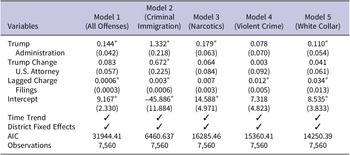
We now turn to an empirical investigation of the impact of presidential influence on U.S. Attorney behavior and its connection to press releases.Footnote 6 We estimate negative binomial count models across five categories: all offenses, criminal immigration, narcotics, white-collar crime, and violent crime. Each model estimates the number of press releases issued by district offices in a given week, with the Trump Administration and the Trump Change U.S. Attorney variables serving as the main predictors of interest. All models include district fixed effects and district-clustered robust standard errors. Overall, our key independent variables and controls behave as expected. Our results are presented in Table 1.
The Effects of the Biden-Trump Transition on the Number of Press Releases by Crime Type

Notes: * p $ \le $
0.05. Entries are negative binomial regression estimates. District-clustered robust standard errors appear inside parentheses. District effects and time trend are omitted.
$ \le $
0.05. Entries are negative binomial regression estimates. District-clustered robust standard errors appear inside parentheses. District effects and time trend are omitted.
Across our five models, the Trump Administration variable is positive and statistically significant in Model 1 (All Offenses), Model 2 (Criminal Immigration), Model 3 (Narcotics), and Model 5 (White Collar). These results indicate that after the transition from the Biden Administration to the Trump Administration, the expected number of press releases in these categories increased. The findings, especially those for criminal immigration, suggest that U.S. Attorneys’ Offices are at least partially using press releases to signal a shift in priorities consistent with the new administration’s agenda. Somewhat surprisingly, there were no significant administration effects for Violent Crime.
The size of the estimated effect varies widely across the models. For All Offenses, moving from the Biden to the Trump Administration corresponds to an increase of 0.61 press releases per week, or about a 16 percent increase on average. This pattern is reinforced when we examine the predicted total number of press releases by administration from that entire model. In our data, the Biden Administration accounts for roughly 64 percent of the 84 weeks in the time series, with a predicted total of about 19,486 overall press releases. In contrast, the Trump Administration accounts for only 36 percent of the weeks in our series, but is predicted to generate approximately 11,930 press releases overall. On average, U.S. Attorneys’ Offices under the Trump Administration are predicted to issue a higher volume of press releases relative to those under the Biden Administration.
We observe much larger changes for Criminal Immigration. In that offense type, the administration shift is associated with an increase of about 0.3 press releases per week, which represents roughly a 279 percent increase. Substantively, this translates to an overall prediction of approximately 1,550 more immigration-related press releases under the Trump Administration compared to the Biden Administration for our entire series. For Narcotics, the expected difference is 0.17 press releases per week, or around a 20 percent increase. Across the series, the Trump Administration is predicted to issue around 2,444 press releases, compared to 4,314 under the Biden Administration, even though the Trump Administration covers only 36 percent of the total period. Finally, White Collar offenses have the smallest change. The effect of the shift is a predicted increase of just 0.08 press releases per week under Trump or a 12 percent change.
Lastly, we examine how changes in U.S. Attorneys affect office communications. Across all model specifications, we find that the Trump administration’s replacement of U.S. Attorneys had a significant effect only on communications related to criminal immigration. In the Model 2 (Criminal Immigration), the Trump Change U.S. Attorney variable is positive and statistically significant, indicating that when the administration took action to install new attorneys to these positions, the number of press releases on criminal immigration increased. Specifically, the expected number of press releases, after the change in attorneys, increased by 0.19 per week, representing roughly a 96 percent increase in weekly communications. Substantively, the model predicts that the total number of criminal immigration related press releases, across the full time series, increased by about 749.
Taken together, these findings indicate that the change in administration coincided with a notable rise in public communication from U.S. Attorneys’ Offices, particularly in areas that aligned with the new administration’s enforcement priorities. The largest increases appear in immigration and, to a much lesser extent, narcotics cases, which were central themes in the administration’s broader policy agenda. The rise in white-collar crime communications, while unexpected, was substantively small. That change, however, is roughly half of the proportional increase in narcotics statements and one twenty-third of the size of the proportional rise in criminal immigration statements. The effect of Trump Administration in white-collar offenses was just statistically distinguishable at p = 0.042.
Does rhetoric match reality? An exploration
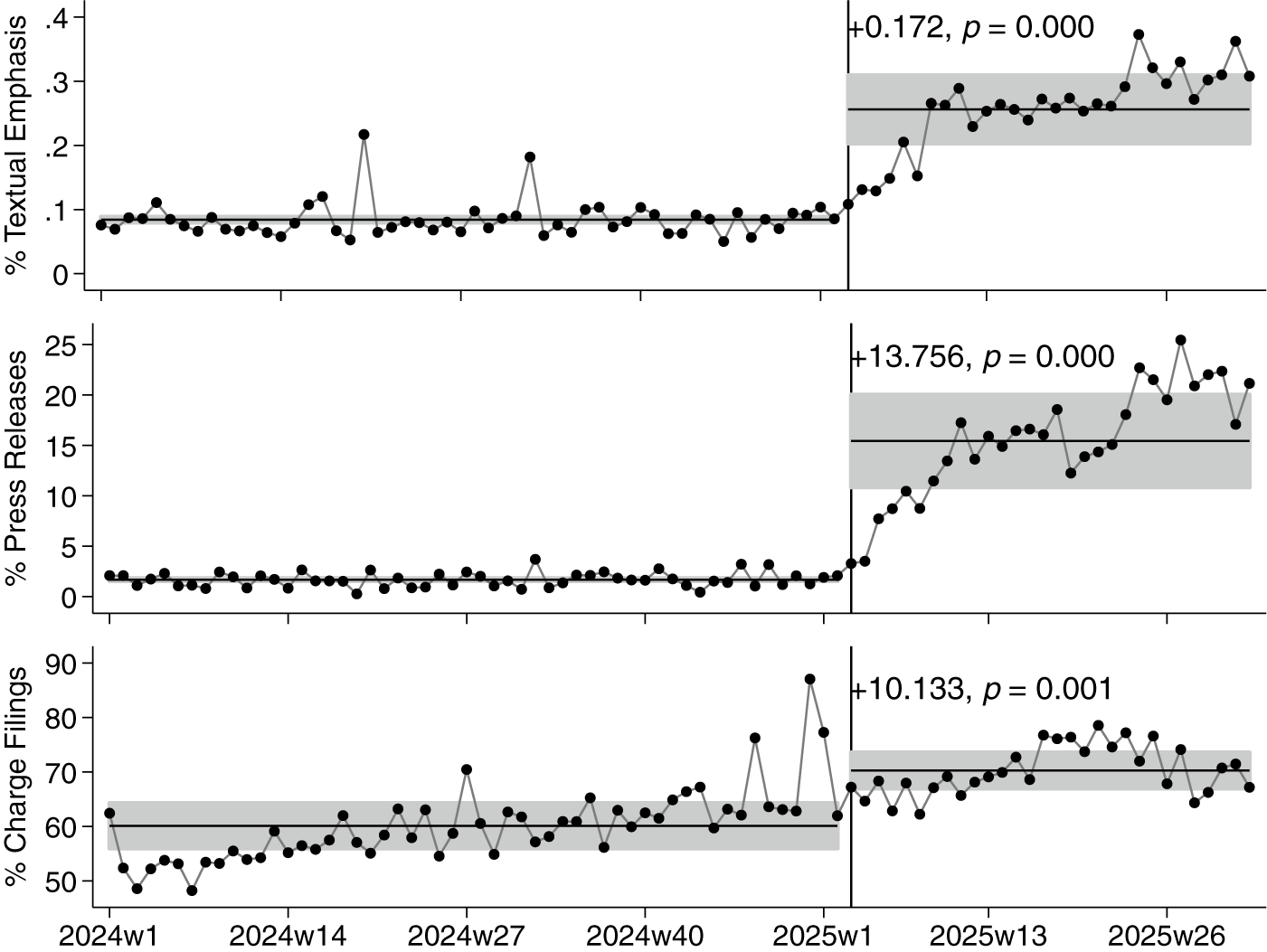
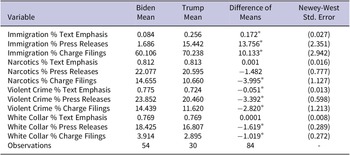
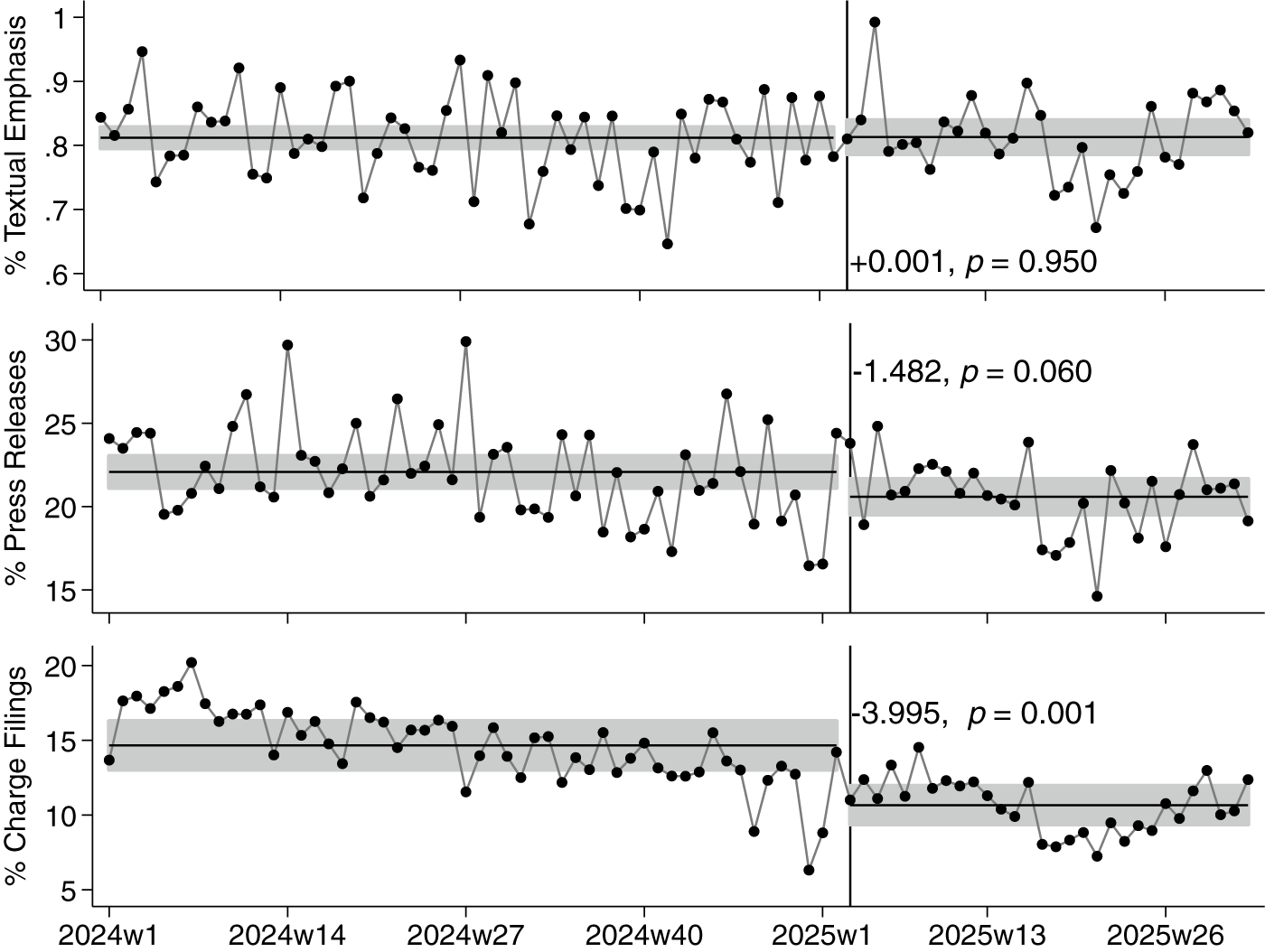
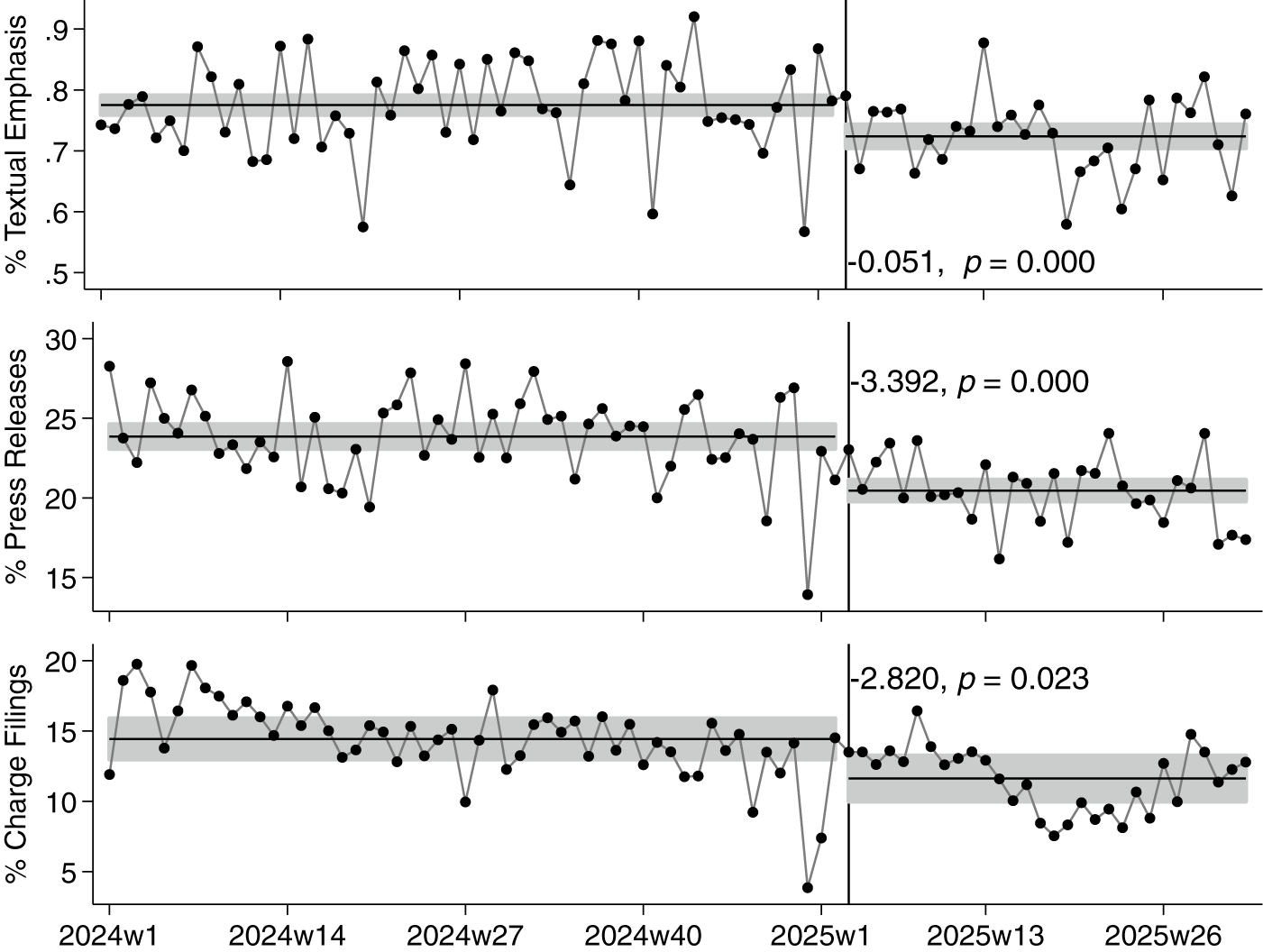
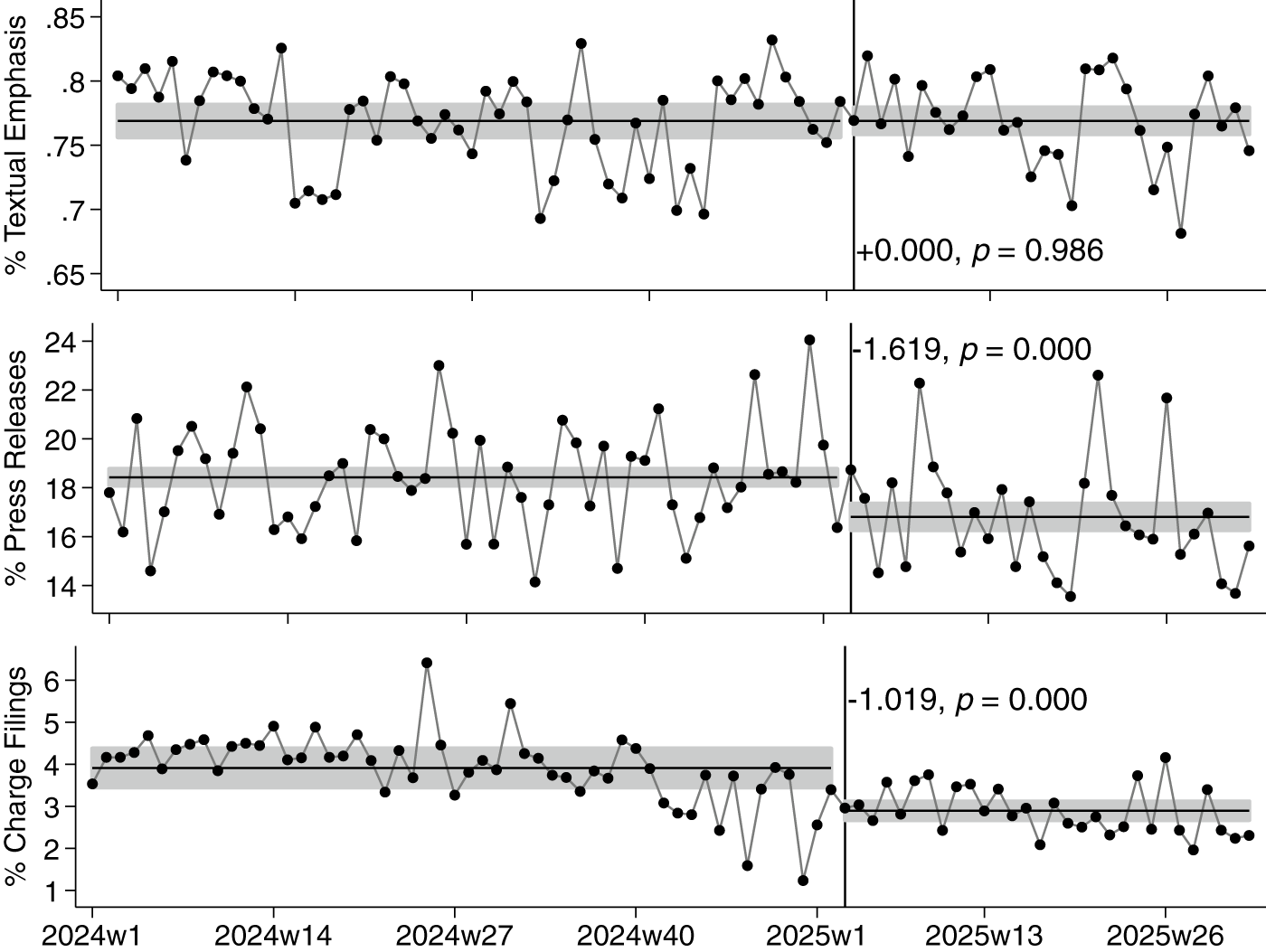
In Figures 1 through 4, we display our measures of the percent composition of press release text, press statements themselves, and charge filing. A solid vertical line is superimposed on the week the Trump Administration begins. Each figure includes the pre/post means with their respective Newey-West serial correlation robust confidence intervals, the difference of means, and p-value of that test. Table 2 also contains each difference of means test along with the Biden and Trump means.
Composition of Criminal Immigration Communications and Charge Filings.

Measures of Text, Press Release, and Charge Document Composition from Biden to Trump

Notes: * p $ \le $
0.05. Difference of means test performed with Newey-West robust standard errors in parentheses.
$ \le $
0.05. Difference of means test performed with Newey-West robust standard errors in parentheses.
Beginning with criminal immigration, one can see substantial increases in the alignment of statement content, press releases, and charging documents after President Trump takes office. These changes comport with our expectation that this area would be an overriding priority of the second Trump administration. Percent Textual Emphasis increases by 0.17 and that difference is statistically significant. During the last year of the Biden administration, terms connected to criminal immigration cases made up, on average, 0.08 percent of all words used in press releases. So far, during the Trump administration that average has been 0.26 percent. That proportion of language used by U.S. Attorneys is nearly 3 times larger than it was under President Biden. The share of press releases produced tagged as immigration-related tells of a similar dramatic change of focus. During the prior administration’s final year, an average of approximately 1.69 percent of all U.S. Attorney press releases were tagged as immigration-related. From Trump’s inauguration to mid-August, immigration tags were being applied to an average of 15.44 percent of all press releases (+14 points, p <0.05). The representation of criminal immigration press releases has increased approximately 9.16 times over President Biden’s final year.
In terms of the distribution of press releases and their content, criminal immigration has taken on a much larger share of federal prosecutors’ messaging. Federal prosecutors seem to be fundamentally shifting their level of attention to be consistent with administration priorities. There is also a significant increase in the percentage of criminal charging documents filed: roughly 10.13 percentage points more per week. Substantively, this is also a large change. A ten percentage point shift in the body of federal criminal matters indicates a potentially sweeping realignment in national prosecution priorities affecting thousands of defendants. However, this change is just 1.17 times relative to what it was before. Moreover, Figure 1 displays a change that is much less visually striking than in communications. In truth, much of federal prosecutors’ in-court attention was already directed at migration with most charging documents filed in district courts being in the criminal immigration program category in a given week under President Biden. It is clear that communications by U.S. Attorneys’ Offices display a larger transformation. This aligns with our expectations that signaling in press statements (both in content and number) is less costly than altering how actual criminal cases are handled. While the reality of criminal immigration charging appears to be undergoing a large transformation, the rhetoric surrounding these cases has seen an even greater remaking.
Narcotics enforcement has taken on heightened importance with the rise of opiates and fentanyl usage in the United States. However, while this heightened importance may be resulting in a greater number of press statements about narcotics offenses according to our count model, Figure 2 displays that there were no significant percentage increases in communications about them. Neither Percent Textual Emphasis nor Percent Press Releases show a significant change in the early days of the second Trump Administration. On the contrary, the percentage of charge filing instruments does show a significant change in its average. The mean percentage of indictments, information, and complaints in the narcotics prosecutorial program decreased slightly by about $ -4 $
.
$ -4 $
.
Composition of Narcotics Communications and Charge Filings.

Though this series is trending downward heading into the second Trump administration, it declines further around the same period where the proportion of criminal immigration filings increases. The disjuncture between communications and filings in the area of drug prosecutions connects, again, to our theoretical expectations. While there were no substantively or statistically significant differences in the percentage of press statements (or what they contained), the share of charging documents declined. We suspect this is because of the resource constraints imposed by pursuing cases and the freedom that U.S. Attorneys have to message about cases. Even though drug prosecutions decline somewhat as a share of enforcement actions during this period, U.S. Attorneys’ Offices likely maintain enough of a drug caseload to be able to write about it for the public.
Violent crime activity appears to have some different patterns compared to narcotics. Across Percent Textual Emphasis, Percent Press Releases, and Percent Case Filings the average is negative and significant in Trump’s second term thus far (see Figure 3). The decline in the percentage of press releases covering violent crime topics was $ -3.39 $
points overall. Starting in January 2025, violent crime press releases represented 0.86 times the share of all published statements. In regard to text, violent crime terms made up an average of 0.78 of all press releases per week under Biden but 0.72 under Trump (a moderate but statistically significant decrease. Charge filing composition experienced the largest decline proportionate to what it was under President Biden. Compared to the prior administration, violent crime charge document filings under Trump made up 0.8 times the share of all charge document filings. The balance of communications both in terms of text and release issuance, again, experienced a smaller magnitude of decline than in charging. This is consistent with the intuitive expectation that U.S. Attorneys exert more control over what they say than what they do in court.
$ -3.39 $
points overall. Starting in January 2025, violent crime press releases represented 0.86 times the share of all published statements. In regard to text, violent crime terms made up an average of 0.78 of all press releases per week under Biden but 0.72 under Trump (a moderate but statistically significant decrease. Charge filing composition experienced the largest decline proportionate to what it was under President Biden. Compared to the prior administration, violent crime charge document filings under Trump made up 0.8 times the share of all charge document filings. The balance of communications both in terms of text and release issuance, again, experienced a smaller magnitude of decline than in charging. This is consistent with the intuitive expectation that U.S. Attorneys exert more control over what they say than what they do in court.
Composition of Violent Crime Communications and Charge Filings.

While the count model predicted a small increase in the number of white-collar crime press releases issued during the early part of the second Trump administration, Figure 4 shows that white-collar offenses exhibit similar declines in the proportion of press releases and charge document filings. However, Percent Textual Emphasis remains largely flat and the effect of the Trump Administration difference of means test is statistically insignificant. The percentage of press releases declines by roughly 2 points. Since press releases on white-collar crime topics comprised 18.43 percent of all published statements prior to the administration change, this is a moderate decrease (0.91 times what it was). Again, as with violent crime and narcotics, the magnitude of the decline in the proportion of charge instrument filing is greater than the effects in communications. White-collar offenses make up approximately 0.74 times the share of all charge filings than they did when Biden was president. There is a distinct possibility that the increases in immigration charge filings are associated with the declines in the average proportion of the three other kinds of offenses. The declines in the share of communication (text or release publication) were smaller in scope than those in the charge document filing across these three series. This is strongly suggestive that, as we expected, communications are less affected by reallocation of case resources.
Composition of White-Collar Crime Communications and Charge Filings.

Discussion and future research
These findings provide initial evidence that changing presidential administration can result in rapid shifts in messaging from U.S. Attorneys’ Offices, even if charging decisions are slower to follow. This finding is in greatest relief on an area saturating the early second Trump administration: criminal enforcement of immigration. U.S. Attorneys, both those appointed by Donald Trump and holdover U.S. Attorneys, substantially increased their messaging on criminal immigration issues. Before January 20, 2025, about 1 in 60 press releases were labeled as immigration-related and, with the Trump administration in office, that has increased roughly to 1 in 6 releases, all things equal. These administration effects do not seem to extend to other major federal prosecutorial priorities, like narcotics, violent crime, and white-collar crime. In fact, as a proportion of charge document filings, all three areas have become a smaller piece of federal prosecutions, plausibly due to criminal immigration’s rise.
Local control seems not to move the needle nearly as much. The new president’s firing of a previous U.S. Attorney and replacing them results in smaller substantive changes in, again, immigration. Still, this supports our initial expectation, that U.S. Attorneys, like other bureaucrats, use their own bully pulpits to signal to the administration and public their acquiescence to new priorities set by their principal: the president.
Our exploration of this intersection of presidential control and direction extends a long line of inquiry into the nature of the principal-agent relationship between presidents and their subordinates. U.S. Attorneys represent a unique combination of national and local needs, with their selection influenced, at least somewhat, by home-state senators. Even in the absence of a more permanent politically-appointed U.S. Attorney, theses offices operate with an eye towards administration policy.
While interesting, our findings are limited by the time period studied. The end of a presidential administration and the advent of a new one might not fully reflect the long-term implications and impacts of presidential policy shifts. These effects could be idiosyncratic and related to the particular practices of President Trump, based on the appointments and firing processes present in his first term. These results might also be a result of increases in law enforcement resources in the area of immigration, with ATF and DEA joining in some immigration enforcement activities. Importantly, with the first eight months of the new Trump administration observed, any effect may grow or shrink as it develops.
Future research could also leverage a larger time period of press releases and charging decisions to see if, eventually, charging increases at a later time. It might very well be that messaging portends changes in charging and case behavior. Expanding the analysis to other administrations would also allow researchers to examine if presidents shift and U.S. Attorneys react in other areas. For example, in August of 2013, Attorney General Eric Holder issued a memorandum directed at DOJ components and U.S. Attorneys to prioritize “(1) protecting Americans from national security threats; (2) protecting Americans from violent crime; (3) protecting Americans from financial fraud; and (4) protecting the most vulnerable members of our society” (Holder Reference Holder2013). If our intuition holds true, U.S. Attorneys’ Offices would be likely to signal increases in violent crime and white-collar crime in their press releases long before seeing any change in charging decisions. A more refined approach at the district-level might also reveal the localized impact of these policy shifts.
Another area we intend to revisit is the dynamics associated with this far-reaching shift toward criminal enforcement of immigration issues. What is the granular cause in the rise of criminal immigration filings and communications? Certainly, a change from President Biden to Trump is apparent. But, was it due to Deputy Attorney General Todd Blanche’s (Reference Blanche2025) memorandum associated with “Operation Take Back America” (Todd Blanche Reference Blanche2025)? Or, did prosecutors act earlier knowing it would be an administration priority regardless of such signals? Was there some other cause? We would be particularly interested in testing whether a change in communications preceded changes in charging activity like our theory would suggest. Moreover, we would more fully consider how the content of immigration-related press releases changed during President Trump’s second term. There are clearly many aspects of federal prosecutor behavior in this space worthy of study.
The changed composition of the press releases flowing from U.S. Attorneys is hard to ignore. Regardless of the source of these seismic shifts in messaging, it is clear that these offices are communicating differently than they were prior to a new administration taking office. As justice is often, in part, meted out in the court of public opinion, these communiques can impact public perceptions of the legitimacy of the criminal justice system even if they are designed for an audience of one.
Supplementary material
The supplementary material for this article can be found at http://doi.org/10.1017/jlc.2026.10021.
Acknowledgments
We want to thank the anonymous JLC referees and editorial staff for their helpful feedback. Additionally, we want to thank Rob O’Reilly and Noah MacDonald for their assistance in the data collection process.
Author contribution
All authors contributed equally to this publication, including conceptualization, data collection, analysis, and writing. Author order is alphabetical and does not reflect relative contribution levels. All authors approved the final submitted draft.
Competing interests
None
Ethical standard
The research meets all ethical guidelines, including adherence to the legal requirements of the study country.


 Open access

