


1. Introduction
Food production systems are inherently influenced by a range of external factors, including social events, economic shifts, and environmental changes, along with human-centric factors such as labour availability, skill levels, and workforce stability (Reference Davis, Downs and GephartDavis et al., 2021; Reference Li and SongLi & Song, 2022; Reference Villar, Paladini and BuckleyVillar et al., 2023). One recent example is labour shortages in the United Kingdom. This social event triggered significant disruptions in the labour market, particularly agriculture, because of its historical reliance on the availability of seasonal migrant workers (Reference Garnett, Doherty and HeronGarnett et al., 2020; Reference Hendry, Stevenson, Bryde, Ball, Sayed and LiuHendry et al., 2019).
For example, the edible horticulture industry has a particularly high demand for seasonal labour, traditionally roles taken by migrant workers. However, recruiting such workers has become increasingly difficult due to labour shortages, further exacerbating the negative impact on agricultural production (Reference Hendry, Stevenson, Bryde, Ball, Sayed and LiuHendry et al., 2019; Department for Environment, Food & Rural Affairs, 2023). Despite a shift towards greater automation and investment in recent technologies, dependence on human workers remains throughout the United Kingdom Food Supply Chain (UK FSC). Nowhere is this dependence more prevalent than in agriculture where 429.000 people were employed in 2021 (Department for Environment, Food & Rural Affairs, 2023).
To address the labour shortages, the UK introduced the seasonal worker visa scheme. However, farmers believe there are still not enough workers to harvest the produce and those who are available tend to lack experience (NFU, 2022). Widespread labour shortages in the agricultural sector reduced food production capacity in the UK and increased risks related to food security (Reference Barbulescu, Vargas-Silva and RobertsonBarbulescu et al., 2021). Therefore, In the context of labour shortages, understanding the impact of human-centric factors on food production, especially in worker-dependent industries, is critical to enhancing operational efficiency and resilience (Reference Salzer, Naor, Yonai, Yechezkely, Kfir, Zait, Dionysis, Charisios, Georgios and MariaSalzer et al., 2021; Reference HassounHassoun, 2024).
Recently studies have applied Agent-Based Modelling (ABM) to simulate individual worker behaviour across multiple sectors, offering insights into workforce dynamics and efficiency. In agriculture, Harman and Reference Harman and SklarSklar (2022) developed an approach for dynamically allocating roles between “pickers” and “runners” to optimise task distribution, while assuming static skill levels. In healthcare, Reference Liu, Zhou, Yang and XinLiu et al. (2024) proposed an empirical approach for reproducing healthcare environment staff activities but ignored individual skill differences. In society, Reference Wang, Ye, Lu and HsuWang et al. (2022) simulate workers’ workplace decision-making behaviour under the influence of multiple factors such as family, colleagues, resources, and stress tolerance, yet the issue of enterprise efficiency is not considered. These studies focus on the impact of worker behaviour on efficiency and productivity, or the impact of human factors on worker behaviour. However, there remains a gap in combining these aspects to examine the direct influence of human factors, such as workforce availability, skill levels, and learning, on production and output.
To address the research gap, this paper proposes a new methodological framework for modelling and analysing human-centric factors in food production. The internal differentiation of human-centric factors and the embodiment of human uniqueness are achieved by using the ABM. This framework is contextualised in an apple-picking scenario under labour shortages, which is considered labour dynamics (workforce availability, capability, and attendance) and integrated into specific human factors (harvest, transportation, judging apple ripeness, and self-growth). This paper aims to create a framework capable of 1) Establishing a process for human-centric factors affecting production in agriculture and 2) Using an apple-picking scenario as a case, accurately reproducing historical data with the prospect of offering key predictive insights to navigate the complexities of modern FSCs.
The structure of the paper is as follows: After reviewing the labour shortages and application of ABM in FSC simulation, Section 2 proposes a methodological framework using ABM, detailing its theoretical structure and integration of human-centric factors. In Section 3, Specific models and simulation parameters are determined and established in the context of an apple-picking scenario. Section 4 discusses the simulation results. Section 5 presents the conclusions and lines for future research.
2. Methodological framework
Aiming at the impact of worker dependency, that is, human-centric factors on agricultural production, this paper adopts the Agent-Based Modelling method and builds a methodological framework to provide theoretical guidance to evaluate this impact (Figure 1).
Diagram of the methodological framework

This framework divides the human-centric factor into two key steps:
-
Labour Dynamics: refers to the patterns, fluctuations, and characteristics of the workforce that influence and are influenced by several factors such as workforce availability, labour supply, migration trends, and the composition of workers (Reference Villar, Paladini and BuckleyVillar et al., 2023). In the context of labour shortages, this would be Labour Shortfall/Type and Labour Experience, which could be described as three key performance indicators (KPIs) ( Availability, Capability , and Attendance ) (Reference Salzer, Naor, Yonai, Yechezkely, Kfir, Zait, Dionysis, Charisios, Georgios and MariaSalzer et al., 2021).
-
Human Factors: understand the individual characteristics, skills, behaviours, and capabilities of the workforce that affect performance, productivity, and outcomes. In the food production process, the characteristics of workers in the production process are simplified through the four key human factors ( Harvest, Transportation, Judging , and Self-growth ) (Reference Salzer, Naor, Yonai, Yechezkely, Kfir, Zait, Dionysis, Charisios, Georgios and MariaSalzer et al., 2021; Reference Zhao, Binks, Kruger, Xia and StenekesZhao et al., 2018), which finally affect the system output KPIs ( Yield, Production, Efficiency , and Productivity ).
Through the integration analysis of human factors and labour dynamics, this framework provides a systematic theoretical approach to food production systems, which helps to reveal the key role played by human-centric factors in the production process.
2.1. Effects (input KPIs)
Human-centric factors related to manual tasks can be summarised by two key questions: 1) are they working? 2) if so, how well are they working? (Reference Salzer, Naor, Yonai, Yechezkely, Kfir, Zait, Dionysis, Charisios, Georgios and MariaSalzer et al., 2021). We selected these two questions because they capture the most critical aspects of manual labour that directly affect productivity. The first question is addressed through Availability and Attendance , in which availability reflects whether workers are accessible for tasks, while Attendance indicates their actual presence during work. These parameters are essential because worker presence is necessary for productivity (Reference Barbulescu, Vargas-Silva and RobertsonBarbulescu et al., 2021). The second question is more complex, as worker performance is influenced by experience, physical conditions, and other factors. To capture these influences in a quantifiable way, we introduced the parameter Capability which combines work speed and decision-making accuracy (Reference Bedford and BedfordBedford & Bedford, 2013).
-
Availability is implemented by adjusting the total number of worker agents generated on model initialisation, which is determined by scenario-specific probabilities.
-
Attendance is defined as the percentage of worker agents who would work during a day.
-
Capability is understood as 1) the speed of the worker performing the tasks; and 2) the quality of the product, which is the quality of the harvested product. Additionally, there is the following relationship between these two:
 $$R_{{{high}}} = {{dP_{{{high}}} } \over {dt}} = {{dP_{{{tot}}} } \over {dt}}J_{{{high}}}^p $$
And
 $$R_{{{low}}} = {{dP_{{{low}}} } \over {dt}} = {{dP_{{{tot}}} } \over {dt}} - {{dP_{{{high}}} } \over {dt}}$$
Where R
high
and R
low
are the rate of picking high-quality and low-quality apples, P
high
and P
low
are the number of high-quality and low-quality products one single harvested, P
tot
is the total number of products one single harvested, and $J^p_{high} $
is the assessing criteria for each product being high-quality.
$J^p_{high} $
is the assessing criteria for each product being high-quality.
2.2. Worker behaviours
In agricultural production tasks that are manual, worker behaviours are the core factor affecting production efficiency and output quality. This paper further divides “Human Factors“ into the following four main categories:
-
Harvest is the core task of the entire harvest process which is reflected by the picking rate. The harvest of each worker during the picking process can be calculated as follows:
(3) $$P_{{{tot}}} = (R_{{{high}}} + R_{{{low}}} )*t_{{{harvest}}} $$
Where t harvest is the time of a single picking.
-
Transportation represents the process of the harvested products transported to the designated location to complete the collection, which can be calculated as follows:
(4)Where t trans is the transportation time of a single picking, L path is the length from the tree to the designated location, ν is the worker transportation speed, and μ is an efficiency factor related to physical condition and tool use.
$$t_{{{trans}}} = {{L_{{{path}}} } \over {v*\mu }}$$
-
Judging is the key behaviour in the harvest process which can be reflected by the “judgement accuracy” parameter. This involves workers assessing criteria such as the quality of the product, namely
$J^p_{high} $
. -
Self-growth shows an improvement in worker abilities in multiple tasks, that is, the “learning effect”. This is primarily demonstrated through an increase in picking speed and judgement accuracy over a specific time and picking counts, highlighting the workers’ capacity to adapt and enhance their efficiency. The following linear growth equation is used here:
(5)Where X is the improvement parameter, namely
$$X = X_0 *(1 + G_X )$$
$J^p_{high} $
and R
high
, X
0 original value, and G
X
is the self-growth factor.


2.3. Impacts (output KPIs)
Impacts on the agricultural sector were described in terms of yield, production, or rate of these. Rates were given per person, per time or both, for example ‘per man-hour’. To quantify the impacts of changing input parameters, the following output KPIs were proposed for framework performance.
-
Yield represents the total number of products harvested during a simulation run and can be calculated as:
(6)Where
$$P_{{{tot}}}^p = P_{{{high}}}^p + P_{{{low}}}^p $$
$P^p_{high} $
$P^p_{low} $
and
$P^p_{tot} $
are the number of high-quality, low-quality, and the total number in storage at the end of the simulation.
-
Production represents the total value of the products harvested during a simulation run, which can be calculated by the following equation:
(7)Where Weight low and Price low are the average weight and price per weight of low-quality apples, Weight high and Price high are the average weight and price per weight of high-quality apples.
$${{Production}} = {{Weight}}_{{{low}}} *{{Price}}_{{{low}}} *P_{{{low}}}^p + {{Weight}}_{{{high}}} *{{Price}}_{{{high}}} + P_{{{high}}}^p $$
-
Efficiency and Productivity are measures of yield per worker-hour and production per worker-hour, respectively. They are calculated as
(8)
$${{Efficiency}} = {{P_{{{tot}}}^p } \over {N_{{{tot}}} T}},{{Productivity}} = {{{{Production}}} \over {N_{{{tot}}} T}}$$


Where Ntot is the total number of workers available in a simulation and T is the time over which a simulation is run measured in hours.
3. Model setting: apple harvesting case study
To investigate the impact of human-centric factors on agricultural production, this section selects an apple-picking scenario in Orchard under labour shortages as a case study. This simulation provides a practical example for the framework to explore the dynamics of worker availability, attendance, and capability within a heavily worker-dependent environment. The Anylogic software was chosen as the simulation platform, which has proved as a successful tool for the simulation (Reference Rahman, Nguyen and LuRahman et al., 2022).
3.1. Orchard environment
Given this framework, relevant parameters were considered to create an interactive orchard environment to establish a reasonable distribution of apple trees to meet the picking and transportation needs of the picker agents. The following three parameters were considered:
-
Apple Type (Gala): Different varieties of apples are suited to different growing conditions and therefore different orchard properties. Due to the popularity of Gala apples, which were named the most-produced apple variety in the UK by British Apple and Pears Limited, Gala apples were selected as the variety choice for the simulation (British Apples & Pears Ltd, 2023).
-
Tree Spacing (4.5m × 6m): The optimum tree density for modern orchards is close to 1000 trees/acre (405 trees/hectare) (Reference Robinson, Hoying, Sazo, Marree and DominguezRobinson et al., 2013). This aligns with the MM111 dwarfing rootstock tree spacing of 4.5m between trees in a row and 6m between rows, yielding an overall orchard density of 370 trees/hectare (The Royal Horticultural Society, 2024).
-
Orchard Size (143.5m × 160m): An efficient orchard should have a maximum row length of 152m and enough unplanted space left at each end of the orchard for the turning off equipment (Western Agricultural Research Center, 2024). Therefore, an orchard consisting of 25 rows and 30 trees per row, with 4m unplanted at each orchard end was built, which resulted in an overall orchard size of 143.5m × 160m.
Figure 2 shows an example of the orchard environment with reduced tree count simulated in Anylogic. Along with trees, the environment is populated with three other agent types: pickers, bins, and a tractor. As apple orchards are planted in single columns with alleys wide enough for a tractor on either side, pickers also move along alleys and only pick from one-half of the tree at a time. To reflect this, trees were modelled as halves belonging to a left or right population. Pickers were then also assigned to a left or right population with members of each only able to pick from the corresponding tree half population. This necessitated the creation of the picker movement networks (green and blue lines) allowing for picker movement along alleys but between them only at the ends of tree rows.
The simulated orchard environment using a reduced tree count for visibility

3.2. Picker decision making
Further following the autonomous ABM approach, pickers were modelled as individual agents with internal behaviour dictated by a discrete event state chart that allows them to autonomously interact with the orchard environment. The picker decision-making process is detailed (Figure 3) which was expanded from the primary picker task order: Determine the ripeness of the apples, then pick qualified apples and put them in buckets/bags (At tree), walk to central container/bin, empty the full bucket/bag (At bin), walk back to the tree and repeat, and as the number of pickings increases, the picker will achieve self-growth and thus improve the picking speed (Reference Salzer, Naor, Yonai, Yechezkely, Kfir, Zait, Dionysis, Charisios, Georgios and MariaSalzer et al., 2021).
Flow diagram representing the discrete event logic implemented as the picker decision-making process

3.3. Simulation parameters settings
For picker logic to be accurately implemented, the following physical picking parameters were derived and set as model parameters.
-
Apple Weight and Price: The weight and price of Gala apples are assumed based on data from the literature, and there are corresponding differences due to differences in quality (Reference Hall, Tustin, Silva and StanleyHall et al., 2015; Ontario apple growers, 2016). The average weight of high-quality apples is 200g and the price is 0.881$/kg, while the average weight of low-quality apples is 166g and the price is 0.302$/kg.
-
Pick Rate (73.3gram/person/second): The apple picking speed is assumed to be completed on a fixed platform, which is calculated based on the average throughput (Reference Fei and VougioukasFei & Vougioukas, 2021). Additionally, the action cost of climbing (5.4%) and moving (6.3%) the platform is added to the picking speed (Reference ZhangZhang, 2015).
-
Worker transportation speed (1.25m/s): In this model, it is assumed that the transportation is done by human labour. Considering the weight of apples, the transportation speed is set to 1.25m/s which is a 20% reduction from normal speed (Reference BohannonBohannon, 1997). The simulation environment determines the path length in Equation 4, and the efficiency of all workers is assumed to be 1.
-
Bucket Capacity (17kg): Apple-picking buckets were designed to hold 17 kg of apples when full. This capacity was adopted in our simulation to ensure alignment with empirical data and to maintain consistency in modelling manual harvesting scenarios (Reference Freivalds, Park, Lee, Earle-Richardson, Mason and MayFreivalds et al., 2006).
-
Bin Capacity (400kg): A typical apple bin has a volume of approximately 0.71 m3 (Reference Freivalds, Park, Lee, Earle-Richardson, Mason and MayFreivalds et al., 2006). Assuming an average apple bushel weighs 45 lbs, this results in a bin capacity of around 400 kg or approximately 2,000 apples (Reference Myers, Corditz, Graberry and KelleyMyers et al., 2022).
-
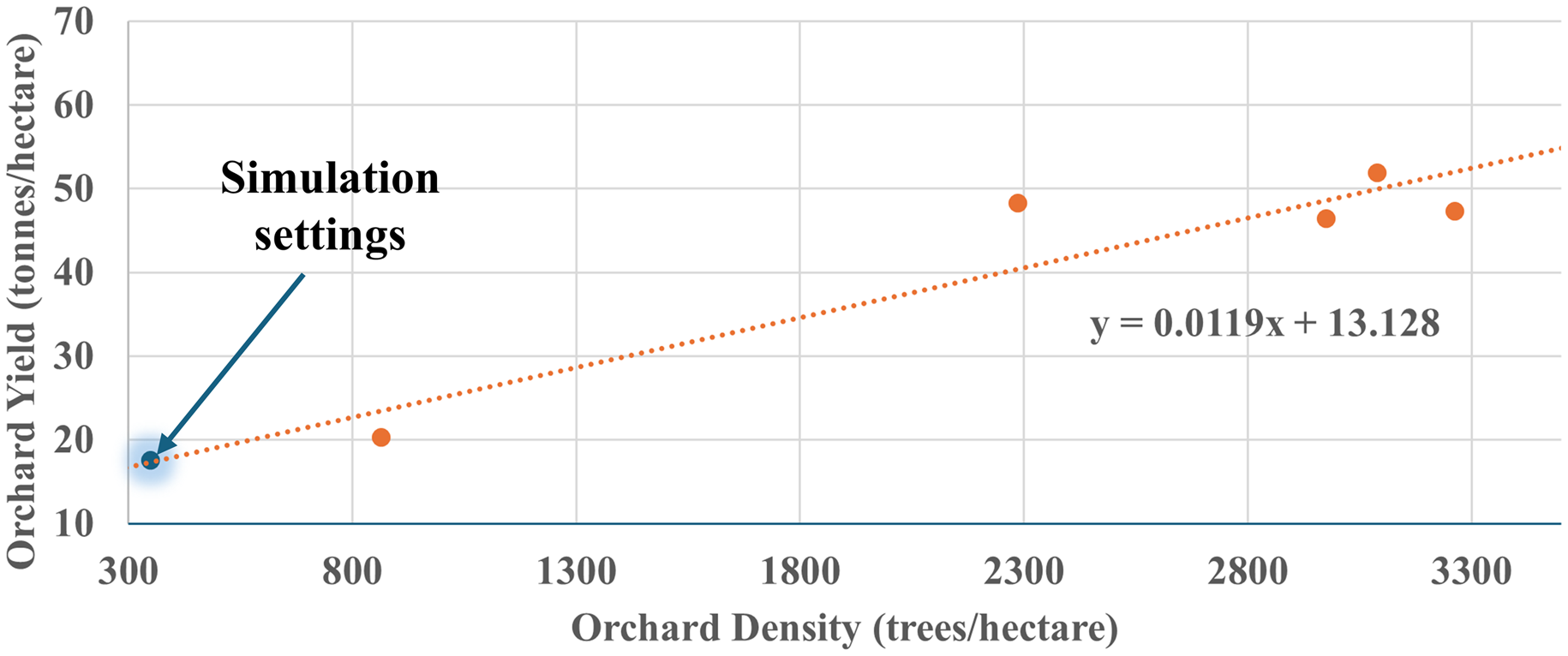
Tree Yield (23.7kg/tree): Figure 4 was used to predict the orchard yield for the chosen orchard density and therefore the per-tree season yield of 47.4 kg/tree. Gala apples are picked over multiple harvests, with the first pick harvesting half the apples available apples (Reference Hall, Tustin, Silva and StanleyHall et al., 2015). Using this assumption, the model environment simulated a first pick by assigning a tree yield of half the actual tree yield at 23.7 kg/tree.
Orchard yield plotted against the density of trees (Treder & Mika, 2001; Hampson et al., Reference Hampson, Quamme and Brownlee2002; Robinson et al., Reference Robinson, Hoying, Sazo, Marree and Dominguez2013; Ontario apple growers, 2015; Reference Treder and MikaMinnesota Fruit Research, 2018)

3.4. Scenario settings
Having established a simplified model capable of simulating human activities in orchard harvesting, this section demonstrates this model in two scenarios based on labour dynamics: the labour shortages in the UK FSC.
3.4.1. Availability
The UK labour landscape experienced both a reduction in workforce size and a demographic shift, with a decline in seasonal pickers and increased reliance on domestic labour (NFU, 2022). From this, two worker categories were identified: seasonal and domestic pickers. Using available data and assumptions on recruitment stability and returner rates, the distributions of these worker types were estimated, with seasonal workers expecting 69% and domestic workers expecting 31% in 2022. (NFU, 2022; Food Standards Agency, 2023).
In this model, the initial number of available pickers was assumed to be 10, of which 7 are seasonal workers and 3 are domestic workers. As an average labour shortfall of 12.75% (Reference Barbulescu, Vargas-Silva and RobertsonBarbulescu et al., 2021), the initial number of available pickers after labour shortages is 9, of which 6 are seasonal workers and 3 are domestic workers.
3.4.2. Attendance
Attendance rates were outlined based on patterns observed in horticulture in New Zealand (Reference Bedford and BedfordBedford & Bedford, 2013), where seasonal workers showed a high attendance probability of 99.7%, compared to 70.1% for domestic workers. These attendance probabilities were applied to the UK workforce assuming that behaviour among UK seasonal and domestic workers was like those in New Zealand.
3.4.3. Capability
Due to the lack of specific data at the individual level, the differences between pickers are reflected by selecting random numbers within a reasonable range, which ultimately reflects the average value and trend of the model parameters.
-
Picking Rate: Pickers’ efficiency fluctuates by ±10% around the average, creating a maximum efficiency difference of 20% between skilled and ordinary workers (Reference Zhao, Binks, Kruger, Xia and StenekesZhao et al., 2018). Considering the decline in picker quality, the picking rate under labour shortages is 5% lower than the original.
-
Judge Factor: When considering the quality of choice in apples, the average percentage of high-quality apples is 87% (British Apples & Pears, 2023). Consequently, the average judgment accuracy for high-quality apples is set to 0.87, with fluctuations consistent with the picking rate.
-
Self-growth: After completing the harvest of 100 buckets or having systematic training programmes, the picker’s picking rate improves by 5% (natural growth) or 10% (training growth), capped at a maximum rate of 80.63 g/person/second. The judgment accuracy also increases, reaching a maximum of 95.7%.
The quantitative modelling of labour availability, attendance, and capability differences clearly reveals the combined impact of labour shortages on the ratio of seasonal and domestic pickers, overall labour reduction, and human factors on picking efficiency and apple quality (Table 1).
Human factors parameter design under labour shortages

4. Results and discussions
4.1. Results
Based on the settings in Section 3, the simulation results in two cases are analysed. The first is to simulate picking activities over 3 hours with 10 repetitions to analyse the impact of labour shortages on agricultural production; The second is to simulate production activities within 6 hours and add a training programme for pickers post-shortage in the third hour (i.e., increase the picking speed) to analyse the impact on the entire production. The simulation results presented in Figure 5 and Table 2 offer a comparative analysis of orchard harvesting performance pre- and post-shortage.
The first case results from the 10 simulations reveal a natural variability in the number of apples picked, due to the randomness in picker capabilities (Figure 5 (a)). Despite these fluctuations, all simulations remain within 5% of the average, indicating that while individual performance can vary, the overall trend remains consistent. Table 2 details the changes in output KPIs based on the simulated average picking number between the pre- and post-shortage scenarios used in this simulation. There was a noticeable decline in the total number of apples picked post-shortage, with a 17.3% reduction in high-quality apples and an 18.7% increase in low-quality apples, which also caused a decrease in production by 15.5%. However, the fluctuation of efficiency and productivity is within 5%, which is consistent with the difference in pickers’ capacity in simulation.
This suggests that the shift in workforce composition, with fewer seasonal workers and increased reliance on domestic workers, may have impacted the efficiency and accuracy of picking. Seasonal workers are typically more experienced, and more adept at selecting high-quality fruit, whereas domestic workers may not have the same level of expertise, resulting in a decrease in quality.
The second case results show how picking activity changes over time after additional training (Figure 5 (b)). This process can be divided into three regions, of which 0-1.5 hours is the stable region, which is caused by the lag of the collection tractor at the beginning of picking; 1.5-3 hours is the gap region, at this time, the advantages of more workers and higher skills pre-shortage gradually emerge, and production greatly exceeds that post-shortage; 3-8 hours is the catch region, which means after suitable training, the skill advantages of post-shortage workers gradually emerge, approaching and eventually catching up with pre-shortage production capacity.
This finding underscores the critical role that workforce composition plays in orchard harvesting. Strategies to mitigate the effects of labour shortages, such as better training for domestic workers or the use of technology (e.g., automated picking tools), could be explored to compensate for the reduction in experienced seasonal workers. Additionally, the possibility of improving the selection and training processes for workers could help bridge the gap in picking efficiency and quality.
Average output KPI values for pre- and post-shortage simulations

(a) The number of apples picked changes in ten simulations, (b) Production changes over time after additional training

While the post-shortage scenario resulted in a reduction in overall production, the modelling suggests that workforce composition, training, and skill development will be key factors in mitigating these challenges and maintaining productivity levels.
4.2. Discussion and applications
This model adopts a systems approach to simulate the complex interplay between societal challenges and the resilience of food supply chains, with a particular focus on human-centric factors such as labour dynamics, policy impacts, and worker well-being. By adjusting the model parameters (such as the number of labour forces, skill levels, social events, etc.), the model is not only adaptable to various scenarios, ranging from the effects of a global pandemic on labour availability to the impact of social changes but also scalable to different food production systems. Further, while the model is applied to food production, it could be applied to the manufacture of physical goods and services, such as those provided by design agencies to understand how external factors and interventions might affect overall capability. This could include, for example, market, training or technical (design-led) interventions, such as new tools/devices or planning strategies, as well as evaluating potential collaborations with external partners. These insights contribute to sustainability and resilience by enabling the optimization of sustainable labour practices, while also addressing aspects of health and well-being through interventions like skill training and workforce management, which bridges societal challenges with actionable strategies for resilient and efficient systems.
5. Conclusions
This paper constructs a framework for assessing the impact of human-centric factors such as availability, attendance, and capacity on agricultural production based on the agent modelling (ABM) approach. Taking apple picking pre- and post-shortage as a case study, the impact of labour changes on production, efficiency and productivity was simulated, capturing both average disruptions and long-term trends. Moreover, this framework is adaptable to different events, countries, and food systems, providing a suitable tool for analysing labour dynamics across diverse agricultural contexts.
Research results show that labour shortages, particularly the reduction of seasonal workers and the increase of domestic workers, directly affect apple-picking efficiency and quality. In our model, the total number of workers decreased from 10 to 9, with seasonal workers reducing from 7 to 6 while domestic workers remained at 3. As shown in Table 1, seasonal workers exhibit significantly higher attendance (99.7% vs. 70.1%), picking rate (69.63-80.63 g/person/s vs. 65.97-76.97 g/person/s), and judgment accuracy (0.826-0.957 vs. 0.783-0.914). Consequently, the reduction in seasonal workers led to a 17.3% decrease in high-quality apple yield and an 18.7% increase in low-quality yield, primarily due to the lower judgment accuracy of domestic workers. Overall production declined by 15.5%, highlighting that labour composition (not just total numbers) critically impacts output. Although efficiency changes remained within 5%, these results confirm the need to compensate for seasonal worker shortages through targeted training for domestic workers or using automation technologies.
Although this paper provides a valuable simulation of the impact of changes in the UK agricultural workforce pre- and post-shortage, there are still several limitations: 1) This paper relies on hypothetical data when setting parameters, such as picking rate, quality assessment, etc. These assumptions may be different from reality and fail to fully reflect all possible environmental factors. 2) Some external factors, such as climate change and market demand fluctuations, are not considered in the study, which may have a significant impact on production efficiency and quality. 3) The data at the worker level is computed from aggregated data and then values within a reasonable range are selected for simulation, which does not accurately reflect the behaviour at the individual level.
To overcome the above limitations, future research can be carried out from the following aspects: 1) In the future, more actual data can be added, and assumptions can be adjusted to ensure that the model can more accurately reflect the complex agricultural environment in reality. For example, variables such as climate conditions and market price fluctuations can be introduced to simulate the diversity and uncertainty of agricultural production. 2) This article mainly focuses on the impact of short-term labour changes on production. In the future, simulations with a longer time range can be conducted to evaluate the continuous impact of labour changes and technological interventions on agricultural production over a long period.
Acknowledgements
The authors would like to acknowledge the support of the China Scholarship Fund.






 Open access

