

6.1 Introduction
This chapter examines the impact of environmental policy on innovation in clean technologies for the mining sector. Mining activities pose several challenges to the environment. The extraction and processing of metals (e.g. copper, gold, aluminum, iron, nickel), solid fuel minerals (coal, uranium),Footnote 1 industrial minerals (phosphate, gypsum) and construction materials (stone, sand and gravel) is associated with air pollution, water contamination by toxic chemicals, landscape disruption and waste generation. Energy-intensive activities such as excavation, grinding of ore and the transport of material by large diesel trucks, generate substantial greenhouse gas emissions: in 2016, the mining sector accounted, for instance, for 16 percent of Australia’s greenhouse gas emissions (Australian National Greenhouse Accounts, 2018), behind the energy sector (38 percent) but above manufacturing (11 percent) and agriculture (12 percent).Footnote 2 The environmental impact of mining explains why the sector is the focus of increasingly stringent environmental policies. On top of permit requirements for new mines, which typically impose an assessment of environmental impact, mining companies have to meet stringent regulations on greenhouse gases, waste management or water pollution.
Innovation in clean technologies (i.e. technologies aiming to reduce the environmental impact of mining operations), can provide an effective solution to address these environmental challenges. Innovative technologies can help reduce water and energy consumption, limit waste production and prevent soil, water and air pollution at mine sites. Examples of such technologies are water-saving devices, electric haul trucks, desulphurization techniques to limit SO2 emissions and underground mining technologies to minimize land disruption (Reference HilsonHilson, 2002).
The objective of this chapter is to estimate the impact of environmental regulations on innovation in clean technologies for the mining sector. Do more stringent environmental regulations lead to higher patenting activities in clean mining technologies? As most existing literature on this topic remains largely anecdotal and based on case studies, our analysis is the first quantitative study looking at the impact of environmental policy on clean innovation in the mining industry across a large range of countries. We rely on a novel dataset of clean patents for the mining industry provided by WIPO for 32 countries over the 1990–2015 period and investigate the impact of environmental policy stringency, as measured by the EPS index developed by the OECD on clean patenting activities. The EPS is a country-level composite index which presents the advantage of aggregating environmental policy stringency in a single indicator across a multitude of existing regulations for a large set of countries. Our analysis finds evidence that stringent environmental policies are associated with higher levels of clean patenting activities in the mining sector: a 1 percent increase in the growth rate of the EPS index is associated with a 0.3–0.45 percent increase in clean patents. These results imply that policies aiming to protect the environment are effective in encouraging mining companies to develop more environmentally friendly technologies. We do not, however, find evidence for a sizeable impact of market-based policy instruments, as often hypothesized in the literature.
The chapter is organized as follows. Section 6.2 provides some background literature and presents the conceptual framework of the analysis. Section 6.3 describes our main measures of clean technological innovation and environmental policy stringency. Sections 6.4 and 6.5 present the empirical analysis and results, respectively. Section 6.6 concludes.
6.2 Literature Review
This study relates to several strands of literature. First, it connects to the literature on the impact of environmental regulations on the development and diffusion of clean technologies (i.e. technologies that aim to reduce the environmental impact of production processes, such as energy-efficient, water-saving or renewable energy technologies). Clean technologies are characterized by a “double externality” (Reference Jaffe, Newell and StavinsJaffe, Newell and Stavins, 2005): first, just like all technologies, clean technologies generate knowledge spillovers (the knowledge externality) and second, they contribute to reducing the negative externality of pollution (the environmental externality). Due to this dual market failure, firms have few incentives to invest in clean technologies in the absence of government intervention and public policies are always justified to encourage the development of these technologies.Footnote 3
Environmental regulations affect firms’ incentives to innovate in the sense that they impact the price of production factors. According to the induced innovation hypothesis, when a factor price increases firms will develop new technologies aiming to reduce this factor (Reference HicksHicks, 1932). Hence, as fuel prices increase, firms will develop fuel-efficient technologies. This hypothesis is widely supported by empirical evidence (Reference Aghion, Dechezleprêtre, Hémous, Martin and Van ReenenAghion et al., 2016; Reference Dechezleprêtre and GlachantDechezleprêtre and Glachant, 2014; Reference Johnstone, Haščič and PoppJohnstone, Haščič and Popp, 2009; Reference Noailly and SmeetsNoailly and Smeets, 2015; Reference PoppPopp, 2002) and the literature generally concludes that firms’ innovation response to environmental regulation will be quick (typically within five years) and of a large magnitude. Empirical work has found that environmental policies tend to have a positive impact on clean innovation in the automobile sector (Reference Aghion, Dechezleprêtre, Hémous, Martin and Van ReenenAghion et al., 2016), electricity generation (Reference Johnstone, Haščič and PoppJohnstone et al., 2009; Reference Noailly and SmeetsNoailly and Smeets, 2015), the building sector (Reference NoaillyNoailly, 2012) and several manufacturing industries (Reference PoppPopp, 2002, Reference Popp2006). So far, however, no study has more specifically looked at the mining industry.Footnote 4
Another insight of the aforementioned literature is that the impact of environmental regulations on clean innovation depends on which specific policy instrument is used (Reference Popp, Newell, Jaffe, Hall and RosenbergPopp, Newell and Jaffe, 2010). Theoretical work generally concludes that market-based instruments – which set a price on the externality, such as emission taxes, emission trading or subsidies – provide higher incentives to innovate than nonmarket command-and-control regulations, such as technology and performance standards. The intuition is that market-based instruments provide more flexibility to firms on how to comply with the regulations and provide continuous incentives for technological improvements. Instead, nonmarket instruments are believed to be less effective as firms have no incentives to go beyond the standard once enacted. In addition, technological standards, in particular, may tend to lock in technological development. Nonetheless, there are also some arguments in favor of nonmarket-based regulations, in particular as command-and-control instruments may be more credibly enforced than market-based instruments. A few theoretical models also raise the possibility that command-and-control policy instruments may lead to more innovation in process innovation, rather than end-of-pipe technologies, such as waste-water treatment or flue gas scrubbers (Reference Amir, Germain and Van SteenbergheAmir, Germain and Van Steenberghe, 2008; Reference Bauman, Lee and SeeleyBauman, Lee and Seeley, 2008). Finally, most countries have traditionally relied on command-and-control regulations and experiences with market-based instruments are still relatively recent, limiting empirical analysis. As a result, the various impacts of market versus nonmarket environmental policy instruments on innovation still need to be worked out empirically.
By its focus on mining, this study also relates to the small literature on innovation in the mining sector. Insights are quite scarce, as the sector remains largely understudied. Overall, the mining sector has the reputation of being a rather traditional and conservative sector in terms of innovation, without many examples of radical innovation over the last decades. The OECD classifies the mining and quarrying sector as a “medium-low” R&D intensity industry, together with the textile, paper and food industry and far from other high-tech (pharmaceuticals, computers), medium high-tech (machinery, electrical equipment) and medium-tech (basic metals, plastic) industries (Reference Galindo-Rueda and VergerGalindo-Rueda and Verger, 2016). Reference BartosBartos (2007) similarly concludes that the mining industry is not a high-tech industry but is rather comparable to general manufacturing.
As noted in Chapter 1, the main characteristics of innovation in the mining sector are as follows: (1) most mining technologies are not developed in-house by mining companies but rather are provided by METS; (2) since mineral commodities provide little scope for product differentiation, innovation in mining is mainly aimed at cost-reduction of mining operations; and (3) profits and thus innovation in the mining industry are largely affected by booms and busts in the mineral-commodity price index (itself affected by shifts in aggregate demandFootnote 5). The empirical evidence has mostly pointed towards a procyclical relationship between industry-specific fluctuations and innovation (Reference BarlevyBarlevy, 2007; Reference Geroski and WaltersGeroski and Walters, 1995).Footnote 6
The specificity of competition in the mining industry has some implications for the impact of environmental regulation on clean technologies. First, as commodities are homogenous, the scope for creating a market for “green” mining products remains limited, although there are many initiatives in this direction in recent years (Reference LaurenceLaurence, 2011; Reference MuddMudd, 2007; Reference WhitmoreWhitmore, 2006). In the absence of a demand push for sustainably mined products, most clean innovation will have to be fostered by government regulation. A wide array of environmental regulations affects mining (Reference BridgeBridge, 2004): greenhouse gas regulations (fuel taxes, emission trading, etc.), water pollution legislation, regulation of land use, policies on waste management and toxic chemicals, etc. Such environmental policies may represent costly investments for mining companies as firms will need to allocate resources to pollution abatement rather than other productive investment. On the other hand, environmental policy may bring benefits if it leads to the implementation of cost-saving technologies or new profitable production processes. Although adopting environmental technologies may lead to productivity gains, the literature is inconclusive on whether these will be sufficient to offset compliance costs.Footnote 7 For now, the literature on the impact of environmental regulation on clean innovation in the mining industry is mainly qualitative and limited to a few case studies. Reference HilsonHilson (2002) looks at the example of the Kennecott copper smelter in Garfield, Utah. Increasing SO2 regulatory stringency led to collaborative innovation by Outokumpu and Kennecott into sulfur-capture technologies. Those innovations led the sulfur-capture rate at the smelter to increase from 93 percent to 99.9 percent. Crucially, that improvement led to a greater than 50 percent reduction in operating costs at the smelter. Reference Warhurst and BridgeWarhurst and Bridge (1997) look at the case of the INCO Sudbury nickel smelter. Increasing stringency governing SO2 emissions, as well as the smelter’s outdated design, meant that it was no longer viable. This led INCO to invest in new smelting technologies that immensely reduced SO2 emissions, which in turn led the smelter to become one of the world’s most productive and efficient nickel smelters. As these studies are mainly anecdotal, the results cannot be generalized to other mining sites or countries.
To conclude, the literature brings important insights for our analysis. First, a large set of environmental regulations are likely to affect the development of clean technologies in mining. Second, since the scope for product differentiation is limited, there is no specific market demand for clean mining products, and we can expect environmental regulations to be particularly important.
6.3 Measuring Clean Innovation and Environmental Policy Stringency
6.3.1 Clean Patents in the Mining Sector
We measure technological innovation by patent counts, as established in the literature on clean technologies (Dechezlepretre et al., 2011). Mining patent data were extracted from the WIPO Statistics Database and the 2017 autumn edition of the European Patent Office’s Worldwide Patent Statistical Database (PATSTAT) using a search strategy outlined in Daly et al. (2019) to build a comprehensive database of mining patenting.
For this analysis, the total number of clean mining patents invented in a given country-year was extracted from the database. Patents were counted by inventor.Footnote 8 The main unit of analysis is the first filing of a given invention, using the earliest filing date.
Clean mining patents were defined as mining patents having a primary focus on the environment. Table 6.1 gives the relevant International Patent Classification (IPC) and Cooperative Patent Classification (CPC) codes, some alone, some in combination and some in combination with keywords in the title or abstract. Specifically, only patents with IPC or CPC codes E21C 41/32 (reclamation of mining areas), C02F (treatment of wastewater), B09C (treatment of soil), B09B (waste disposal), Y02P (technologies related to mineral and metal processing), G21F (protection against radiation), and Y02 (general environmental) were counted as “mining clean patents”. Clean patenting is dominated by four categories: metal processing, mineral processing, metallurgical wastewater treatment, and general clean patents.
| Sub-category | IPC, IPC combinations and IPC/keyword combinations | CPC (if different from IPC) |
|---|---|---|
| Reclamation of mining areas | E21C 41/32 | |
| Treatment of waste water from quarries or mining activities | C02F 103/10 | C02F2103/10 |
| Treatment of waste water |
| |
| Biological treatment of soil |
| |
| Soil treatment |
| |
| Waste Disposal |
| |
| Protection against radiation |
| |
| Environmental |
| |
| Technologies related to mineral processing | Y02P 40/ | |
| Technologies related to metal processing | Y02P 10/ |
See Reference Daly, Valacchi and RaffoDaly et al. (2019) for further details on the methodology. Note that while Y02P 40/ and YO2P 10/ are subclasses of YO2 (similarly COF 103/10 is a subclass of CO2F), we use an assignment system that takes only one category per patent, so patents are only counted once.
As seen on Figure 6.1, on average, 15 percent of mining patents were classified as environmental mining patents over the entire data set. While the share decreased slightly over the 1990–2000 period, it increased at the end the 1990s to stabilize around 16 percent of mining patents.
Number of clean mining patents over time in total sample (left panel) and share of clean patents among all mining patents (right panel).

Table 6.2 gives the top countries ranked by shares of clean patents in mining over the 1990–2015 period. Japanese inventors filed the highest share of clean patents, followed by Austria and Korea. While these countries do not concentrate much on mining activities, they are major providers of clean patents in general and have developed industries specialized in clean technologies – many METS companies are actually located in these countries. Major mining countries such as Australia, Brazil and Canada also appear in the top-10 of innovative countries.
| Country | Percentage | Number of clean mining patents | Total mining patents |
|---|---|---|---|
| Japan | 27% | 30,027 | 113,141 |
| Austria | 26% | 2,710 | 10,236 |
| Korea, Rep of | 22% | 4,770 | 21,641 |
| Italy | 22% | 2,030 | 9,407 |
| Brazil | 21% | 1,140 | 5,327 |
| Germany | 18% | 15,111 | 83,552 |
| Belgium | 18% | 1,054 | 5,918 |
| Australia | 17% | 2,446 | 14,668 |
| India | 16% | 1,012 | 6,143 |
| Canada | 16% | 6,090 | 38,221 |
6.3.2 Measuring Environmental Policy Stringency
We measure environmental policy stringency by the Environmental Policy Stringency (EPS) index developed by the OECD for 32 countries from 1990 to 2015.Footnote 9 The EPS is a composite index which summarizes the stringency of environmental policy in a given country by aggregating several sub-indicators measured on a scale from 0 to 6, with higher numbers being associated with more stringent environmental regulation. At the lower end, 0 means a policy instrument is not present in a given country-year, while 6 means the given policy instrument is the most stringent version of that policy instrument across both years and countries.
The methodology to construct the EPS is set out in detail in Reference Botta and KoźlukBotta and Koźluk, (2014) and Figure 6.2 provides a description of its main structure. The EPS index can be sub-divided into two separate indicators: (1) a component on market-based policies, which groups together instruments assigning an explicit price to externalities such as taxes, trading schemes, feed-in tariffs and deposit-refund systems and (2) a nonmarket-based policies component, which categorizes command-and-control regulations such as environmental standards and governmental R&D subsidies (specific to renewable energy).Footnote 10 We will use both indicators at a later stage in our empirical analysis. Given our focus on the mining sector, we modify the standard index by excluding feed-in tariffs and deposit-refund systems, as these are not likely to be relevant for regulating mining activities.
Decomposition of the OECD EPS index.

The EPS index presents several advantages compared to other measures of environmental policies existing in the literature – namely: single policy changes, pollution abatement and control expenditures (PACE), surveys of executive and/or industry perceptions of stringency, or measures of environmental performance (Reference Botta and KoźlukBotta and Koźluk, 2014; Brunel and Levinson, 2013; Reference SauterSauter, 2014). First, the EPS addresses the challenge of the multidimensionality of environmental policy, which targets various pollution sources and types of pollutants via a multitude of policy instruments. Such multidimensionality cannot, for instance, be captured by counts of single policy changes. Second, the EPS presents the advantage of being comparable across time and space. The aggregation strategy is admittedly a bit simplistic, particularly in its weighting of different policy measures. However, that issue can be resolved by looking at disaggregated measures of EPS, as is done in this study. By contrast, surveys based on subjective judgements cannot easily be compared across time and countries, as the perceived burden of environmental policies will differ depending on the macroeconomic and business environment of the executives being surveyed.
A main challenge when using the EPS index is that it is not specific to mining. Instead, it covers all environmental policies in an economy with a specific focus on policies addressing greenhouse gases and air pollutants. Mining pollutes through several main channels: land degradation, ecosystem disruption, acid mine drainage, chemical leakages, slope failures, toxic dusts and compounds of carbon/sulfur/nitrogen with toxic metal particulates, none of which are covered by the EPS index. Nonetheless, the EPS presents the advantage of summarizing environmental regulations in upstream activities, such as energy and transport, which are polluting inputs highly used in many sectors including the mining and extraction industry. Indeed, mining is highly energy intensive and requires the use of heavy, carbon-emitting machinery. Hence, regulations captured by the EPS are likely to be relevant for mining operations. Also, the exclusion of water or soil pollution legislation may not be as important an issue as it might appear. The OECD, in defending the validity of its index for the analysis of general environmental policy, found that other measures of environmental stringency, including measures related to water and other non-covered sectors, were highly correlated with the EPS (Reference Botta and KoźlukBotta and Koźluk, 2014).Footnote 11
Finally, in identification issues, the non-specificity of EPS is an advantage in that it helps to address endogeneity concerns. It greatly reduces the potential for reverse causality between individual sectors and overall national EPS (Reference Albrizio, Kozluk and ZippererAlbrizio, Kozluk and Zipperer, 2017). Other measures of environmental policies, such as pollution abatement expenditures or measures of environmental performance are more likely affected by omitted variable bias, as they tend to be correlated with how efficient countries are in reducing pollution in a given year – for reasons other than environmental policies.
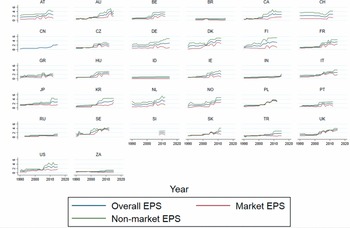
Figure 6.3 plots the evolution of market (red, bottom line), nonmarket (green, top line) and overall EPS over time for the countries in our sample. We observe that the nonmarket EPS is consistently higher than market EPS across the entire dataset. Moreover, there is more and steadier growth in nonmarket EPS. Indeed, nonmarket EPS growth is considerably less volatile than market EPS (std. dev. of 0.08 vs. 0.21, respectively).
Market and nonmarket EPS.
6.4 Empirical Strategy and Descriptive Statistics
6.4.1 Empirical Strategy
We estimate the impact of the stringency of environmental regulations on the number of patent applications related to clean technologies in the mining sector by estimating the following model:
 (1)
(1)
Where PATi are patent counts in country i,
 Footnote 12 and EPS are, respectively, the growth rate and level of the EPS index and X is a vector of covariates. The remaining terms are country fixed effects ci, year fixed effects pt, (or a time trend depending on the specification) and the idiosyncratic error term uit. All variables are expressed as three-year moving averages. The lag structure was chosen due to the nature of patenting. Since it takes time to develop a new technology once a new regulation is implemented, we consider that regulations passed in the period t-2 to t-4 will have an impact on patenting activities in the period t-2 to t, so we assume that the effect of environmental policy will occur within two years. This structure is in line with the literature, although there is some debate as to the exact lag length (Reference Lanoie, Laurent‐Lucchetti, Johnstone and AmbecLanoie et al, 2011; Reference NoaillyNoailly, 2012; Reference Noailly and SmeetsNoailly and Smeets, 2015).
We chose to include both the (logged) levels of EPS and the growth rate of EPS (in percent) in the absence of conclusive evidence from the literature. Indeed two recent studies cited in this chapter, Reference Albrizio, Kozluk and ZippererAlbrizio, Kozluk and Zipperer (2017) and Reference Fabrizi, Guarini and MelicianiFabrizi, Guarini and Meliciani (2018) use growth and levels of EPS, respectively. Given that yearly patenting data measure the flow of environmental innovative output, it seems more likely that the marginal change in EPS (i.e. its growth rate), will be more determinative of marginal output than the level of EPS.
In the second part of our analysis, we aim to compare the effect of market-based versus nonmarket-based policy instruments on patenting activities. To do so, we disaggregate the EPS index into nonmarket and market instruments (and then into their subcomponents, namely R&D support and standards, and taxes and trading schemes, respectively) and estimate equation (2) as followsFootnote 13:
 (2)
(2)
We use the Poisson fixed effects (FE) regression model to estimate both equations (1) and (2). The Poisson FE estimator was chosen following Reference Allison and WatermanAllison and Waterman (2002), which identified fundamental flaws in the panel fixed effects negative binomial estimator constructed by Reference Hausman, Hall and GrilichesHausman, Hall and Griliches (1984). In the presence of overdispersion, Allison and Waterman propose using either a Poisson FE model or an unconditional negative binomial dummy variable estimator (NBDV). Poisson FE were chosen over NBDV following Reference WooldridgeWooldridge (1999), who demonstrated that a Poisson FE model remains consistent as long as the specification of the conditional mean and strict exogeneity are respected. Issues stemming from overdispersion can moreover be dealt with using robust standard errors.
The identification strategy is based on the main assumption that patenting activities in a given country are affected by domestic environmental policy stringency. In reality, there may be a disconnect between the geographic location of inventors and where extraction and mining operations take place. This may weaken the identification strategy, as mining firms subject to a given country’s regulation can simply import patents for useful technologies from other countries. Empirically, the result of that would be a zero, or insignificant, coefficient estimate. As a result, the coefficient we find may be a lower bound estimate.
We may be worried about endogeneity concerns if, for instance, high levels of clean patenting activities facilitate the adoption of more stringent environmental policies or if countries with low levels of clean patents may successfully lobby against environmental regulation. In the estimation, this would lead to a potential reverse causality between clean mining innovation and the EPS index. Nonetheless, as discussed earlier, these concerns are likely minimized when using the EPS index: the EPS captures regulation in upstream sectors (energy, electricity and transport) and it is less likely that mining firms are active into these sectors. In addition, in the estimation the EPS variable is lagged by two years to avoid reverse causality and simultaneity issues. Finally, the estimation includes fixed effects to control for additional time-invariant confounding factors that may be omitted and affect both innovation and the level of environmental stringency (such as, for instance, the level of development of a country).
We chose a set of covariates that accounts for several factors likely to affect clean innovation in the mining industry and that relate to (1) demand-side factors not captured by policy (greenhouse gas emissions, GDP per capita, global mineral prices), (2) characteristics of a country’s mining sector (net mining imports, mineral rents) and (3) technological capacity in the mining sector.
Table 6.3 gives the list of covariates used in the analysis.
| Variable | Description / unit | Source |
|---|---|---|
| Greenhouse gas emissions per capita | 1,000 per unit of GDP | World Resources Institute’s CAIT |
| Growth of GDP per capita | percent | World Bank’s World Development Indicators (WDI) |
| Mining imports, exports | percent of all export | World Bank’s World Development Indicators (WDI) |
| Mineral rents | percent of GDP | World Bank’s World Development Indicators (WDI) |
| Mining net exports | 1,000 USD | UN COMTRADE database |
| Growth of global mineral price index | percent | IMF |
| Total mining patents | Excluding clean patents | WIPO |
Regarding demand-side factors, we include the level of greenhouse gas (GHG) emissions per capita in each country to reflect increasing concerns about pollution and the need for technological solutions to address it. We expect, therefore, GHG per capita to have a positive impact on clean mining patents. The level of GHG is also likely correlated with GDPFootnote 14 and captures the level of development of a country, so higher output and income per capita is generally associated with higher levels of innovation.
To capture the global demand for mining products, as well as the profitability of the mining sector, we include fluctuations in the global mineral price index. We use the IMF’s mineral price index, which captures changes in the price of copper, aluminum, iron ore, tin, nickel, zinc, lead and uranium and which is set on the global market.Footnote 15 This will capture business cycles effects specific to the mining sector. In line with the empirical literature and with the findings of Chapter 7, we expect innovation to be procyclical, so that higher prices and profitability will be associated to higher levels of patenting.Footnote 16
We include covariates to control for the characteristics of the mining sector in each country. We add mining imports and exports computed as percentage of total imports, mineral rents as a percentage of GDP, and the value of net exports of minerals. These covariates aim to capture the concentration of mining activities in a given country. In general, we expect a higher concentration of mining activities (lower imports, higher exports, higher share of mineral rents into GDP) to be associated with higher levels of clean innovation. Nonetheless, the results may be sensitive to multicollinearity issues if, for instance, exports are highly correlated with imports, and if mineral rents and the volume of net mining exports are correlated with the level of development of the country (GDP per capita, GHG emissions), such that a higher dependence on mineral rents would translate into lower levels of innovation.
Finally, we also include the total number of (non-clean) mining patents to control for the baseline innovativeness of a country’s mining sector over time. A positive sign is expected, given that a country that is more innovative in the mining sector should also be more innovative in the specific subfield of mining clean innovation.Footnote 17
6.4.2 Summary and Descriptive Statistics
The data set is a panel of principally developed countries, as well as the major developing country miners of Brazil, China, Indonesia, India, Turkey and South Africa. Because it does not include other developing countries with important, dominant, mining sectors (e.g. Botswana, Papua New Guinea, Zambia), results are not necessarily externally valid to all countries. Indeed, all the countries in the data set are at least middle income and all have been politically stable for as long as they have been present in the data set. The years covered are from 1990 to 2015. Table 6A in the Appendix provides summary statistics of the sample.
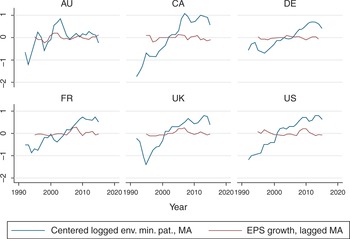
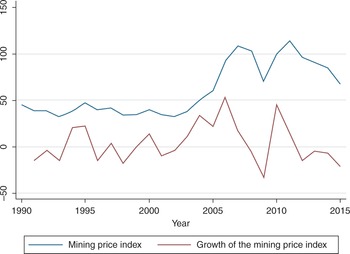
Figure 6.4 plots the evolution of clean mining patents and EPS growth over time for a subset of countries.Footnote 18 There is considerable commonality between these trends, particularly in the cases of the United States, France and Australia, suggesting the existence of a positive effect of tightening EPS on patenting. Figure 6.5 plots the level and growth of the IMF’s index mineral prices. As can be seen from Figure 6.5, mineral prices have been quite volatile over the years covered in the data, more than doubling between 1990 and 2008, only to drop during the financial crisis, rebound and then fall rapidly again starting in 2011. There is no clear link between the evolution of the mineral commodity price index and the share of clean mining patents.
Mining patenting and lagged EPS.
Mineral price index (MPI).
6.5 Results
6.5.1 Baseline Results
Table 6.4 sets out the results of estimating equation (1). Columns (1) and (2) include only GHG emissions per capita and total mining sector patents as covariates, whereas columns (3) and (4) add trade exposure covariates. Odd-numbered columns include year trends, while even-numbered columns include year fixed effects. As these are Poisson regressions, and the independent variables are either percentages or natural logarithms, coefficients are easily interpretable as elasticities.Footnote 19
| VARIABLES | (1) | (2) | (3) | (4) |
|---|---|---|---|---|
| Level of EPS, (logged MA) | −0.0510 | 0.0480 | −0.00592 | 0.106 |
| (0.219) | (0.209) | (0.169) | (0.188) | |
| Percentage change in EPS (MA) | 0.434*** | 0.359*** | 0.332*** | 0.343*** |
| (0.100) | (0.134) | (0.118) | (0.126) | |
| Level of GHG per capita (logged MA) | −0.419 | −0.447 | −0.724 | −1.061 |
| (0.527) | (0.596) | (0.673) | (0.710) | |
| Total number of mining patents (logged MA) | 0.616*** | 0.574*** | 0.585*** | 0.552*** |
| (0.141) | (0.158) | (0.137) | (0.162) | |
| Growth of the MPI (logged MA) | 0.263 | 8.535*** | ||
| (0.189) | (2.669) | |||
| Mining exports (percent of GDP, MA) | −7.930** | −5.985 | ||
| (3.473) | (3.829) | |||
| Mining imports (percent of GDP, MA) | 2.181 | 7.131 | ||
| (4.366) | (5.572) | |||
| Mineral rents (percent of GDP, MA) | 6.498 | 4.070 | ||
| (10.85) | (12.81) | |||
| Net exports of minerals (1,000s USD, MA) | −1.33e-09 | −1.59e-09 | ||
| (3.01e-09) | (3.55e-09) | |||
| Time trend | Yes | No | Yes | No |
| Year fixed effects | No | Yes | No | Yes |
| Observations | 553 | 553 | 503 | 503 |
| Number of countries | 31 | 31 | 30 | 30 |
*** p < 0.01, ** p < 0.05, * p < 0.1.
Across specifications, and regardless of the presence or absence of year fixed effects, there is evidence of a strongly significant, positive effect of the growth rate of policy stringency on clean mining patenting. Specifically, a 1 percent increase in the growth rate of environmental policy stringency is associated with anywhere from a 0.3 percent to 0.45 percent increase in clean patenting. Those results are significant at 1 percent level across all specifications. By contrast, we find no significant effect of the level of EPS on patenting.
As expected, there is evidence of a positive relationship between total mining patents (excluding clean) and clean mining patents, which is strongly significant in all specifications. Specifically, a 1 percent increase in overall total mining patents is associated with a 0.5 to 0.6 percent increase in clean mining patents. The magnitude of this coefficient is notably only somewhat larger than the coefficient on EPS growth, indicating EPS’s important role in inducing mining innovation. The impact of fluctuations in the global mineral price index is positive and significant in column (2), although we may be concerned about issues of multicollinearity with the year fixed effects terms. Other covariates do not appear to have a statistically significant impact on clean mining patents.Footnote 20
Several robustness checks were performed. We first considered different estimation models.Footnote 21 Poisson FE results are robust to the use of cluster-bootstrapped standard errors. Results are somewhat robust to NBDV and negative binomial “fixed effects” estimators, for which we found positive coefficient estimates with statistical significance in some specifications, but none in others.
Next, we considered different lag structures as shown in Table 6B in the Appendix. The results are robust to specifications using individual lags, as opposed to moving averages, as covariates. Interestingly, those results find a negative impact of the level of EPS in t-2, which is offset by a similarly sized positive impact of the level of EPS in t-3. In other words, two years after legislation is passed, EPS had a negative impact on patenting, but that negative impact is counterbalanced by a positive effect as of the third year. This could indicate that in the relatively short term, environmental policy may crowd out innovation, but a positive impact occurs in the longer term. Finally, results are robust to defining variables in terms of two-year moving averages.
6.5.2 Market vs. Nonmarket Instruments
We now turn to estimating the impact of different environmental policy instruments, comparing market with nonmarket-based policy instruments. Table 6.5 reports the results of estimating equation (2), where we include both market and nonmarket sub-indicators of the EPS.Footnote 22 Column (1) includes a time trend, while column (2) includes year fixed effects. As in the preceding section, the level of the EPS variables has no statistically significant effect on patenting, while only the growth rate of EPS appears relevant. Specifically, a 1 percent increase in the growth rate of nonmarket EPS is associated with between a 0.25 percent and 0.5 percent increase in clean patenting. The magnitude of that effect is roughly comparable to the estimate from overall EPS, suggesting that the estimated impact on clean patenting from overall EPS is driven by nonmarket instruments. By contrast, we find no statistically significant impact of market-based instruments contrary to the theoretical insights.
| VARIABLES | (1) | (2) |
|---|---|---|
| Level of market EPS (logged MA) | 0.0659 | 0.0437 |
| (0.151) | (0.142) | |
| Percentage change of market EPS (MA) | −0.166 | −0.162 |
| (0.140) | (0.130) | |
| Level of nonmarket EPS (logged MA) | −0.0466 | 0.0604 |
| (0.191) | (0.221) | |
| Percentage change of nonmarket EPS (MA) | 0.478*** | 0.277** |
| (0.150) | (0.137) | |
| Level of GHG per capita (logged MA) | −1.326*** | −1.875*** |
| (0.476) | (0.513) | |
| Total number of mining patents (logged MA) | 0.566*** | 0.588*** |
| (0.133) | (0.164) | |
| Growth of the MPI (logged MA) | 0.321 | 6.234** |
| (0.199) | (2.869) | |
| Mining exports (percent of exports, MA) | −3.219 | −1.057 |
| (3.651) | (3.317) | |
| Mining imports (percent of imports, MA) | −5.672 | −3.048 |
| (3.848) | (4.704) | |
| Mineral rents (percent of GDP, MA) | −2.278 | −4.142 |
| (12.53) | (12.00) | |
| Net exports of minerals (1000s USD, MA) | −4.38e-09** | −6.32e-09** |
| (2.09e-09) | (2.75e-09) | |
| Year trend | Yes | No |
| Year fixed effects | No | Yes |
| Observations | 465 | 465 |
| Number of countries | 28 | 28 |
*** p < 0.01, ** p < 0.05, * p < 0.1.
To investigate this striking result further, we further disaggregate the analysis by type of policy instrument. In Table 6.6, we estimate the separate impact of the various policy instruments: namely environmental standards and government renewable R&D for nonmarket instruments and environmental taxes and trading schemes for market-based instruments – see Figure 6.2 for the construction of the EPS index across the various types of instruments. The results find evidence for a positive and statistically significant effect of the growth rate of environmental standards. Specifically, a 1 percent increase in the growth rate of the stringency of environmental standards is associated with a 0.5 percent to 0.8 percent increase in clean patenting. This is a larger impact than the aggregate EPS index growth found in Table 6.4. Government R&D expenditures in renewable energy is found to have a negative impact on clean mining patenting activities: a 1 percent increase in R&D EPS is associated with a roughly 0.2 percent decrease in mining clean patenting. Given that renewable energy technologies are not highly relevant for mining activities, we can expect that more spending on renewable energy will lead to some crowding out of clean innovation related to mining.
| VARIABLES | (1) | (2) |
|---|---|---|
| Nonmarket-based instruments: | ||
| Percentage change in env. standards EPS (MA) | 0.572** | 0.811*** |
| (0.235) | (0.240) | |
| Percentage change in R&D EPS (MA) | −0.192*** | −0.227*** |
| (0.0712) | (0.0871) | |
| Level of standards EPS (logged MA) | 0.0691 | 0.0492 |
| (0.0687) | (0.0618) | |
| Level of R&D EPS (logged MA) | −0.00322 | 0.0743 |
| (0.0573) | (0.114) | |
| Market-based instruments: | ||
| Pct. change in tax EPS (MA) | −0.207 | −0.135 |
| (0.144) | (0.178) | |
| Pct. change in trading schemes EPS (MA) | −0.0853*** | −0.0485 |
| (0.0296) | (0.0388) | |
| Level of tax EPS (logged MA) | −0.0156 | 0.00863 |
| (0.0179) | (0.0253) | |
| Level of trading schemes EPS (logged MA) | 0.132 | 0.0194 |
| (0.121) | (0.133) | |
| Other covariates: | ||
| Level of GHG emissions per capita (logged MA) | −1.801*** | −1.836*** |
| (0.443) | (0.520) | |
| Total non-clean mining patents (logged MA) | 0.548*** | 0.508*** |
| (0.121) | (0.134) | |
| MPI growth (MA) | 0.190 | 5.891*** |
| (0.168) | (2.171) | |
| Mining exports (percent of exports, MA) | −0.710 | −1.938 |
| (3.429) | (3.743) | |
| Mining imports (percent of imports, MA) | −6.208* | −3.380 |
| (3.707) | (4.837) | |
| Mineral rents (percent of GDP, MA) | −8.295 | −4.951 |
| (13.05) | (13.87) | |
| Net exports of minerals (1000s USD, MA) | −7.38e-09** | −8.37e-09** |
| (3.69e-09) | (3.93e-09) | |
| Year trend | Yes | No |
| Year fixed effects | No | Yes |
| Observations | 462 | 462 |
*** p < 0.01, ** p < 0.05, * p < 0.1.
Further, we find no evidence that environmental taxes have an impact on clean patenting, while the growth in the stringency of tradable permits is associated with a very small statistically significant decline in clean patenting activities in mining in column (1), but this result is not robust to adding year fixed effects in column (2). Overall, these results confirm the ones found in Table 6.5, namely that market-based policy instruments do not appear to have a significant impact on clean innovation in the mining industry.
Just as before, we perform a set of robustness tests and find that results are robust to various estimation models and to alternative lagged structure and moving averages.Footnote 23 Using disaggregated measures of EPS, the coefficient on the growth rate of environmental standards remains significant across various moving-average specifications.
The large significant impact of environmental standards, compared to market-based instruments, may seem puzzling in light of the theoretical results. Nonetheless, as discussed in Section 6.2, a main challenge in testing the theory arises from the lack of sufficient experience with stringent market-based instruments. Environmental standards (related to air pollution in the EPS index) remain traditionally the most popular form of environmental policy and have been used extensively in many countries. In our dataset, it appears that the stringency of environmental standards has increased consistently and remained higher than other instruments over the years.Footnote 24 As seen in Figure 6.3, nonmarket EPS is consistently higher than market EPS across the entire dataset. Moreover, there is more and steadier growth in nonmarket EPS. Indeed, nonmarket EPS growth is considerably less volatile than market EPS (std. dev. of 0.08 vs. 0.21, respectively). In addition, the particularly positive impact of standards may also be ascribable to their high level of stability: their growth is uniformly positive, indicating that, once implemented, standards are not repealed. By contrast, environmental taxes and tradable schemes are still relatively new, have not been set at high stringency levels yet and may tend to be more geographically concentrated in Europe, rather than in regions where mining activities are prevalent.Footnote 25
6.6 Conclusions
This chapter provides a first exploratory investigation of the impact of environmental policy stringency on clean innovation in the mining sector. Using a novel dataset of patenting activities in the mining industry developed by WIPO, we are able to identify mining patents specific to clean technologies. We combine patents data with the EPS index of environmental policy stringency developed by the OECD and conduct the analysis for a set of 32 countries over 1990–2015. Our findings show that environmental regulations do trigger mining firms to develop new clean technologies: a 1 percent increase in the EPS index is associated with an increase of 0.3 to 0.45 percent of clean patenting activities in mining. Given that the policy indicator is quite broad and abstract from water or soil regulation, our estimates are likely to be a lower bound of the impact. In further analysis, we investigate which types of policy instruments between market- and nonmarket-based policies, are the most effective in encouraging clean patenting. We find that nonmarket policy instruments, in particular environmental standards (mainly related to air pollution as defined in the EPS index) explain most of the effect. This may be due to the prevalence of traditional command-and-control types of regulations in countries most active in mining, with, so far, few implementations of stringent market-based policies – but a detailed investigation of this question is left for future analysis.
As our study is mainly exploratory, there are still many questions worth investigating in future work. First, the novel dataset on clean mining patents used in this study calls for a more in-depth understanding and mapping of the various types of technologies that aim to reduce the environmental impact of mining. As an illustration, the CPC Y02 classification that flags “environmental patents” is very broadly defined and could be further disaggregated. Second, an important assumption in our analysis is that domestic environmental regulations spur innovation at home. This assumption may not hold, however, if foreign METS firms are instead important technology providers to domestic mining corporations. Third, our analysis could be extended to test the robustness of our results to other specific policy instruments for the mining sector, rather than the aggregate EPS index. Finally, it would be worthwhile to investigate whether innovation in clean technologies triggered by regulation leads to productivity gains – as a contribution to the debate on whether environmental policy may foster competitiveness of the mining industry.


 Open access