


Introduction
Nearly every Latin American country has promoted the constitutional inclusion of its Indigenous citizens, irrespective of its political leaning, governance model, and history of anti-Indigenous policies and practices. Institutionalist explanations for this phenomenon would characterize Indigenous inclusion as part of a wave of global norms. Meanwhile, bottom-up accounts attribute inclusion to mobilized Indigenous organizations. Each is an inadequate explanation for the variation in the timing (chronology) and degree of reform. In this article, I present a novel index of Indigenous inclusion and trace the causes of each case of constitutional Indigenous inclusion. Through a comparative analysis of the variation in the timing and degree of inclusion, I synthesize and extend these literatures by highlighting the interplay between state objectives, legitimization efforts, and intended audiences.
The World Society Framework (WS) posits that norms are disseminated through a process of legitimization, whereby new norms (or “scripts”) become taken-for-granted models (Downey et al. Reference Downey, Lawrence, Pyles and Lee2020; Meyer and Jepperson Reference Meyer and Jepperson2000; Meyer et al. Reference Meyer, Boli, George and Thomas1987). Policymakers adopt these norms because they consider them appropriate courses of governance. Meanwhile, in coercive policy diffusion accounts, pressure from powerful actors leads subordinate states to implement reforms to gain access to resources (Djelic and Sahlin-Andersson Reference Djelic and Sahlin-Andersson2008; Gilardi Reference Gilardi, Carlsnaes, Risse-Kappen and Simmons2013; Hafner-Burton Reference Hafner-Burton2009).
WS provides insights into the global spread of norms. However, this explanation of institutional change often overlooks power dynamics and presupposes that governments operate within a singular global field (Haack et al. Reference Haack, Schilke and Zucker2021; Wimmer Reference Wimmer2021). It also assumes that policymakers try to behave legitimately. These oversights limit WS’s ability to explain variations in the timing and degree of norm adoption within similar contexts. These limitations can be overcome by identifying specific relationships, because the audience for policy reform can affect the extent to which norms are implemented.
Coercive policy diffusion accounts are sensitive to adopting governments’ agendas and their relationships with more powerful actors. However, powerful actors’ expectations are often vague or unclear. Without resorting to global scripts, this approach cannot predict which norms get implemented.
Scholars have also explained Indigenous inclusion by focusing on the resistance mounted by Indigenous groups (Andolina et al. Reference Andolina, Laurie and Radcliffe2009; Stavenhagen Reference Stavenhagen and Sieder2002; Yashar Reference Yashar2005). However, some countries enacted reforms despite weak Indigenous mobilization. By analyzing the entire universe of reforms beyond the typically studied cases, I show that strong Indigenous mobilization is an important but not a necessary factor for constitutional inclusion.
This article begins by introducing a novel index of Indigenous inclusion, which reveals significant variation in the timing and degree of reform. Recognizing that the existing literature cannot fully account for these variances, I propose an alternative explanation centered on policymakers’ responses to legitimacy deficits and their intended audiences.
Next, I analyze every instance of constitutional Indigenous inclusion in continental Latin America from 1970 to 2023.Footnote 1 I categorize each as a response to internal (domestic) or external (international) legitimacy deficits, noting Indigenous movements’ contemporaneous strength. In a universe of 22 cases, six are internal legitimization efforts in the context of strong Indigenous movements, eight are internal legitimization efforts in the context of weak movements, and eight are instances of external legitimization efforts and weak movements. Internal legitimization efforts, coupled with strong movements, are associated with higher degrees of inclusion; external legitimization, coupled with weak movements, is associated with low degrees of inclusion; and instances of internal legitimization and weak movements tend to score somewhere in between. Finally, I conclude with expanded case studies to probe the relationship between legitimacy audiences, social movements, and policy objectives. These cases demonstrate how inclusionary reforms are delineated by broader policy agendas. For example, Ecuadorian Indigenous movements secured important reforms in the 1990s, but these were confined to areas that did not contradict the market-oriented reforms driving constitutional change.
In this article, I present a unique comparative study of a universe of cases. By combining an analysis of all cases with representative expanded cases, I attempt to overcome the issue of case selection, which has long preoccupied historical research (Beck Reference Beck2017; Inwood and Maxwell-Stewart Reference Inwood and Maxwell-Stewart2020).
These cases advance the literature on Latin American political studies, which has renewed its attention on the emergence of inclusionary policies (Kapiszewski et al. Reference Kapiszewski, Levitsky, Yashar, Kapiszewski, Levitsky and Yashar2021; Rayo et al. Reference Rayo, Mosinger and Thaler2024; Schmid Reference Schmid2025). More broadly, they contribute to sociological debates on policy diffusion, which increasingly complicate the notion of global convergence (Cole Reference Cole2025; Schofer et al. Reference Schofer, Hironaka, John, Longhofer, Amenta, Nash and Scott2012; Wimmer Reference Wimmer2021). By bridging insights from the social movements, norm diffusion, and legitimacy literatures, I highlight the importance of legitimating audiences in shaping the content, timing, and degree of institutional change.
Variation in Indigenous constitutional inclusion
Since the 1970s, Latin American countries have enacted constitutional reforms enhancing Indigenous peoples’ symbolic stature, material rights, and political power (Van Cott Reference Van Cott2000a, Reference Van Cott2005a). This article focuses on this form of de jure inclusion. Without ignoring the importance of de facto institutional change, formal institutions are practically and analytically important. Practically, even when not fully implemented, these reforms impose obligations on states, create opportunities for redress through litigation, and offer social movements a rallying point for mobilization. Analytically, the study of constitutions reveals the distribution and dynamics of state power (Scheppele Reference Scheppele2004).
Past categorizations of Indigenous inclusionary policies (e.g., Rayo et al Reference Rayo, Mosinger and Thaler2024; Van Cott Reference Van Cott2005a) have applied a binary approach, determining simply whether a country recognizes specific rights, thereby limiting our ability to compare across distinct reforms.
For a more systematic analysis, I adapt Kapiszewski et al. (Reference Kapiszewski, Levitsky, Yashar, Kapiszewski, Levitsky and Yashar2021: 4–9) framework of popular inclusion – which distinguishes symbolic, political, and material dimensions – to the domain of Indigenous rights. I build on their framework, which identifies inclusion in binary terms, by scoring each instance along the three axes, ranging from zero (not applicable) to three (high inclusion). Scores reflect domain-specific claims from scholars and stakeholders, such as Horton’s “continuum of outcomes of state multiculturalism” (Reference Horton2006: 832–5). Constitutional texts were accessed via the Comparative Constitutions Project (for latest data see Elkins and Ginsburg Reference Elkins and Ginsburg2026).
Material allocation is the most common claim among Indigenous communities and takes several forms. One is the provision of high-quality public goods. Historically, public goods for Indigenous people have had assimilationist and integrationist purposes (Stavenhagen Reference Stavenhagen and Sieder2002). By contrast, inclusionary public goods redistribute resources while addressing their specific material and cultural needs. A second and more substantial form of material distribution is the guarantee of territorial autonomy in the form of land rights and communal ownership. Land and natural resource ownership have been the linchpins of Indigenous demands in the context of constitutional reforms (CONAIE 1994; Mendez Reference Mendez2008: 111). Communal ownership is particularly important given past processes of Indigenous cultural annihilation through the forced adoption of Western modes of social formation and individual land ownership (Glenn Reference Glenn2015; Wolfe Reference Wolfe2001, Reference Wolfe2006).
Latin American states have committed to redistributing material resources to Indigenous groups in two ways: First, and in increasing order of budgetary commitment, are the creation of programs, institutions, and ministries for the development of Indigenous cultures; and second, also in increasing order of redistribution, are guarantees to land usage, inalienable land rights, inalienable collective ownership, and sole rights to the usage of natural resources (Aylwin Reference Aylwin2002; Mendez Reference Mendez2008). At the lower end of this spectrum, “to Indigenous communities the reservation of necessary lands and collective ownership thereof, to ensure their economic well-being” (art. 116). On the higher end is Bolivia’s constitution, whereby “collective property is declared indivisible, imprescriptible, unseizable, inalienable and irreversible … communities may be the titleholders, recognizing the complementary character of collective and individual rights and respecting the identity-based territorial unity … Fiscal lands shall be granted to Indigenous originary peasants, intercultural Indigenous communities, afro-Bolivians, and peasant communities …” (art. 394).
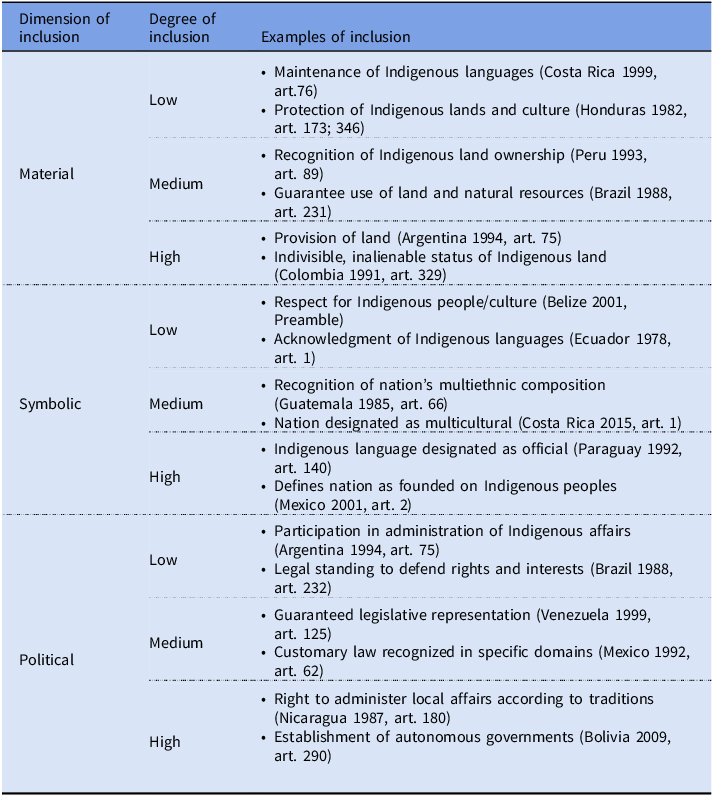
In summary, texts are coded as low on material redistribution if the state commits to cultural development programs or makes aspirational statements about protecting Indigenous interests without specifying enforceable rights. Medium scores reflect recognition of Indigenous land ownership or guaranteed use of land and natural resources. Highly redistributive constitutions assign land to Indigenous groups, establish inalienable collective ownership, or guarantee sole rights to natural resources.
Symbolic recognition addresses the marginal placement of a group in the national moral order. States create identity hierarchies through different forms of classification (Brubaker Reference Brubaker2006; Verderey Reference Verderey, Vermeulen and Govers1994). Official discourses affect discriminatory practices (Wimmer Reference Wimmer2013) and frame people’s social relations and solidarity-building habits (Marshall Reference Marshall1950; Mettler and Soss Reference Mettler and Soss2004). In Latin America, the symbolic exclusion of Indigenous people through institutionalized patterns of cultural value has been a feature in national imaginaries (Itzigsohn and vom Hau Reference Itzigsohn and vom Hau2006; Loveman Reference Loveman2014).
In response, robust recognition policies promote that cultural minorities be seen as peers within, or co-constitutive of, the nation (Fraser and Honneth Reference Fraser and Honneth2003; Kymlicka and Norman Reference Kymlicka and Norman2000). I therefore classify explicit parity of Indigenous and non-Indigenous groups as high on the recognition axis. Paraguay’s 1992 constitution scores a 3 in symbolic redistribution by defining the state as “a bilingual country with a pluralistic culture. Its official languages are Spanish and Guarani. ... Indian languages, as well as those of other minority groups, are part of the cultural heritage of the nation” (art. 104; also art. 77). Costa Rica’s 2015 amendment, meanwhile, makes the parity less explicit, and thus scores 2 out of 3: “Costa Rica is a democratic, free, independent, multiethnic and multicultural republic” (art. 1).
Taylor (Reference Taylor and Gutmann1994: 64) distinguishes between the recognition that members of a minority group have a cultural identity that should be preserved and the recognition that their culture is of equal worth and value to the dominant group. Following this distinction, a score of 1 goes to texts that merely “recognize,” “respect,” or acknowledge the existence of Indigenous groups without referencing their status as full members of the nation – for instance, designating Indigenous languages as official only within Indigenous territories. Ecuador’s 1978 amendment is archetypical of a low score: “Quechua and other Indigenous languages are recognized as elements of the national culture” (art. 1).
Political redistribution is an important right for groups not incorporated into the majority within a racialized nation-state. Power-sharing regimes such as quotas in government entitle national minorities to access levers of power hitherto denied (Lijphart Reference Lijphart2004). A different approach, accounting for the differences between civil law and Indigenous forms of social organization, is recognizing Indigenous customs and juridical practices and elevating these to national or regional validity (Figuera Vargas 2015; Yrigoyen Fajardo Reference Yrigoyen Fajardo2000). Either way, political redistribution aims to enhance Indigenous people’s influence over their governing institutions.
The integration of traditional law ranges from the recognition of customary Indigenous systems of rule to the full institutionalization of juridical plurality. The lowest version of such integration is what Figuera Vargas (2015) calls “weak pluralism” and scores a 1. For example, Brazil’s 1998 inclusion of Indigenous people in political matters is limited to the recognition of Indigenous “social organization, customs, languages, creeds, and traditions” and their “standing under the law to sue to defend their rights and interests” (art. 231). Regimes that implement judicial plurality can be classified as “ethnocentric” (predominance of state law and the individual subject) or “coexistent” (Indigenous law with equal rank as civil law) (Sánchez Botero Reference Sánchez Botero2004). Ethnocentric regimes, which score 2, recognize customary law only in particular cases. For instance, in 1992, Mexico’s constitution recognized “legal practices and customs” only in “agrarian trials” (art. 62). Coexistent regimes, scoring 3, try to establish legal parity. Among them, Nicaragua’s 1987 constitution grants Indigenous people the right to “their own forms of social organization and to administer their local affairs according to their traditions” (art. 89).
Table 1 presents representative examples of different existing inclusionary measures scored as “high,” “medium,” or “low” in material, political, and symbolic axes of inclusion.
Examples of different existing inclusionary measures

Table 1 Long description
The table has three columns: Dimension of inclusion, Degree of inclusion, and Examples of inclusion. It is divided into three main sections based on the dimension of inclusion: Material, Symbolic, and Political. Each section is further divided into low, medium, and high degrees of inclusion. Row 1: Dimension of inclusion, Material, Low. Row 2: Degree of inclusion, Examples of inclusion, Maintenance of Indigenous languages (Costa Rica 1999, art.76), Protection of Indigenous lands and culture (Honduras 1982, art. 173; 346). Row 3: Dimension of inclusion, Material, Medium. Row 4: Degree of inclusion, Examples of inclusion, Recognition of Indigenous land ownership (Peru 1993, art. 89), Guarantee use of land and natural resources (Brazil 1988, art. 231). Row 5: Dimension of inclusion, Material, High. Row 6: Degree of inclusion, Examples of inclusion, Provision of land (Argentina 1994, art. 75), Indivisible, inalienable status of Indigenous land (Colombia 1991, art. 329). Row 7: Dimension of inclusion, Symbolic, Low. Row 8: Degree of inclusion, Examples of inclusion, Respect for Indigenous people/culture (Belize 2001, Preamble), Acknowledgment of Indigenous languages (Ecuador 1978, art. 1). Row 9: Dimension of inclusion, Symbolic, Medium. Row 10: Degree of inclusion, Examples of inclusion, Recognition of nation's multiethnic composition (Guatemala 1985, art. 66), Nation designated as multicultural (Costa Rica 2015, art. 1). Row 11: Dimension of inclusion, Symbolic, High. Row 12: Degree of inclusion, Examples of inclusion, Indigenous language designated as official (Paraguay 1992, art. 140), Defines nation as founded on Indigenous peoples (Mexico 2001, art. 2). Row 13: Dimension of inclusion, Political, Low. Row 14: Degree of inclusion, Examples of inclusion, Participation in administration of Indigenous affairs (Argentina 1994, art. 75), Legal standing to defend rights and interests (Brazil 1988, art. 232). Row 15: Dimension of inclusion, Political, Medium. Row 16: Degree of inclusion, Examples of inclusion, Guaranteed legislative representation (Venezuela 1999, art. 125), Customary law recognized in specific domains (Mexico 1992, art. 62). Row 17: Dimension of inclusion, Political, High. Row 18: Degree of inclusion, Examples of inclusion, Right to administer local affairs according to traditions (Nicaragua 1987, art. 180), Establishment of autonomous governments (Bolivia 2009, art. 290).
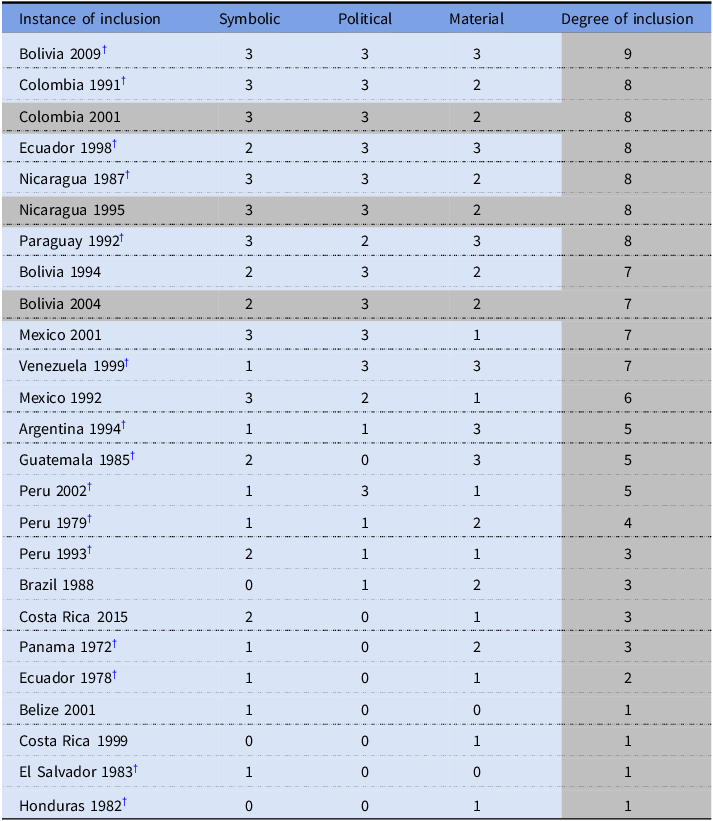
Table 2 scores every constitutional event between 1970 and 2023. The data come from the Comparative Constitutions Project, which archives past versions of constitutions. Highlighted rows indicate instances where specific language changed but scores did not. The scoring focuses exclusively on explicit mentions of Indigenous people or of specifically named Indigenous communities. It excludes, for example, Ecuador’s 1978 amendment extending voting rights to illiterate citizens, which enfranchised thousands of Indigenous individuals. Table 2 reveals substantial variation in both the timing and degree of Indigenous inclusion. Next, I introduce a framework to explain these patterns.
Constitutional Indigenous inclusion scores

Table 2 Long description
The table presents data on Indigenous inclusion scores across various countries and years. It has five columns: Instance of inclusion, Symbolic, Political, Material, and Degree of inclusion. The table includes 24 rows, each representing a different instance of inclusion with corresponding scores in the Symbolic, Political, and Material columns, and a total Degree of inclusion score. Row 1: Bolivia 2009, 3, 3, 3, 9. Row 2: Colombia 1991, 3, 3, 2, 8. Row 3: Colombia 2001, 3, 3, 2, 8. Row 4: Ecuador 1998, 2, 3, 3, 8. Row 5: Nicaragua 1987, 3, 3, 2, 8. Row 6: Nicaragua 1995, 3, 3, 2, 8. Row 7: Paraguay 1992, 3, 2, 3, 8. Row 8: Bolivia 1994, 2, 3, 2, 7. Row 9: Bolivia 2004, 2, 3, 2, 7. Row 10: Mexico 2001, 3, 3, 1, 7. Row 11: Venezuela 1999, 1, 3, 3, 7. Row 12: Mexico 1992, 3, 2, 1, 6. Row 13: Argentina 1994, 1, 1, 3, 5. Row 14: Guatemala 1985, 2, 0, 3, 5. Row 15: Peru 2002, 1, 3, 1, 5. Row 16: Peru 1979, 1, 1, 2, 4. Row 17: Peru 1993, 2, 1, 1, 3. Row 18: Brazil 1988, 0, 1, 2, 3. Row 19: Costa Rica 2015, 2, 0, 1, 3. Row 20: Panama 1972, 1, 0, 2, 3. Row 21: Ecuador 1978, 1, 0, 1, 2. Row 22: Belize 2001, 1, 0, 0, 1. Row 23: Costa Rica 1999, 0, 0, 1, 1. Row 24: El Salvador 1983, 1, 0, 0, 1. Row 25: Honduras 1982, 0, 0, 1, 1.
†Denotes new constitutions; otherwise, amendments. Sorted by degree of inclusion. Shaded rows indicate revised texts with identical scores.
Inclusionary politics in Latin America
I treat Indigenous constitutional inclusion as a form of norm adoption whereby state actors adopt globally recognized norms in response to perceived deficits in legitimacy. Legitimacy refers to the extent to which political authority is recognized as appropriate and justified by relevant audiences. Following Weber, legitimacy is not an inherent property of the state but a relational one, rooted in the beliefs and expectations of those whose acceptance is necessary for governance.
I present a framework that synthesizes three existing, individually insufficient, explanations of Indigenous inclusion: the diffusion of global norms (from World Society theory), coercive pressures (from the policy diffusion literature), and bottom-up mobilization (from social movement scholarship). All three explanations share a logic of legitimation: state actors occasionally face incentives to pursue actions that signal conformity with prevailing normative standards. Legitimacy deficits occur when the objectives of state actors hinge on their governments being perceived by another actor as more legitimate than they currently are. In these instances, Indigenous inclusion becomes one possible strategy through which governments seek to bolster their legitimacy by demonstrating alignment with widely endorsed principles of rights. Because legitimacy is relational and context-dependent, its pursuit produces variation in the depth of reform depending on the audience whose recognition is sought.
Formally, legitimacy arises when the expectations of an evaluating audience are met by an object of legitimacy, i.e., the entity being evaluated (Johnson Reference Johnson and Johnson2004; Johnson et al. Reference Johnson, Dowd and Ridgeway2006; Weber 1921[Reference Weber2013]. This process entails the co-occurrence of three elements: a relationship between audience and object, in our case states; expectations by the audience, here of institutionalized norms; and conformity to expectations, reflected in the implementation of those norms (Schoon Reference Schoon2022).
I hypothesize that due to their greater ability to monitor norm adoption, domestic (internal) audiences demand a higher degree of norm adoption than international (external) audiences. Within internal audiences, strong stakeholders are likely to obtain greater concessions.
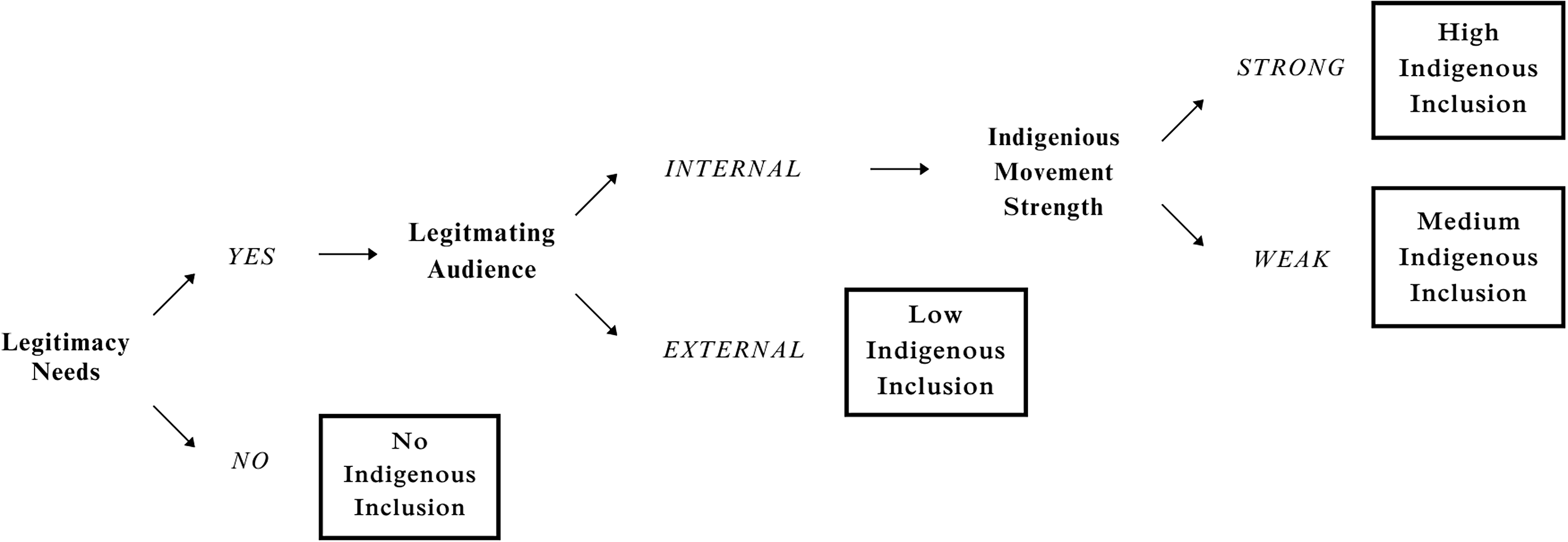
This framework is summarized in Figure 1. The three main factors are listed in boldface: whether there is a legitimacy deficit, the type of legitimizing audience, and the contemporaneous strength of national Indigenous movements. The possible values of these variables are presented in capital letters, and the predicted outcomes are placed in boxes. This argument is probabilistic, meaning it shows likely outcomes, and might not (and in fact does not) always predict the outcome. In analyzing the universe of cases, I discuss how the symbolic strength of Indigenous movements can lead to higher degrees of inclusion than otherwise predicted. The rest of this section discusses the insights and limitations of the world society, policy diffusion, and backlash accounts.
Schema of the framework.

Legitimacy, coercion, and inclusion
Pro-Indigenous and anti-racist policies proliferated starting around the 1970s and were enshrined by the International Labor Organization’s Indigenous and Tribal People’s Convention of 1989 (Steinhilper Reference Steinhilper2015; Wiessner Reference Wiessner2011). Two dominant models can explain their spread: world society theory (WS) and policy diffusion.
WS scholars study the isomorphic process through which ideas become internalized notions of correctness (Drori and Krücken Reference Drori and Krücken2010; Johnson et al. Reference Johnson, Dowd and Ridgeway2006; Meyer et al. Reference Meyer, Boli, George and Thomas1987). In this framework, states enact internalized ways of acting or respond to name-and-shame pressure, typically from Scandinavian governments or nongovernmental organizations (NGOs) (e.g., Cole Reference Cole2005; Finnemore and Sikkink Reference Finnemore and Sikkink1998; Goodman and Jinks Reference Goodman and Jinks2004; Kentikelenis and Seabrooke Reference Kentikelenis and Seabrooke2017; Meyer and Jepperson Reference Meyer and Jepperson2000). Thus, norm adoption is explained by a country’s structural position in the international field, with more embedded countries likelier to adopt norms (Wotipka and Ramirez Reference Wotipka, Ramirez, Simmons, Dobbin and Garrett2008; Wotipka and Tsutsui Reference Wotipka and Tsutsui2008). Decoupling – gaps between norms and enactment – is attributed to resource scarcity or local cultural incompatibilities (Schofer et al. Reference Schofer, Hironaka, John, Longhofer, Amenta, Nash and Scott2012).
WS provides valuable insights into the spread of global ideas, yet it presents some limitations. It cannot explain why norm adoption can vary despite two countries’ similar structural positions or why a country more integrated into the global field might adopt a norm later than a less integrated one. Similarly, a country enacting different degrees of adoption in close succession renders decoupling an incomplete explanation.
These limitations stem from WS’s tendency to assume that norm internalization exerts pressure to conform. Though some in WS acknowledge that state actors consider the cost of acting illegitimately (e.g., Cole Reference Cole2005), WS struggles to explain why and when states seek to be perceived as legitimate and by whom. Studies of legitimacy show that, beyond norm internalization, actors often pursue legitimacy to secure support for resource acquisition or to foster stability by building a reservoir of trust (LaFree and Morris Reference LaFree and Morris2012; Roy, Reference Roy2004; Schoon et al. Reference Schoon, Joosse and Brinton Milward2020). Thus, properly understanding legitimation processes requires locating the relevant evaluating audience (Haack et al. Reference Haack, Schilke and Zucker2021; Tost Reference Tost2011). This compels us to zoom into the global field and interrogate specific relationships.
The policy diffusion literature pays closer attention to power dynamics between states. Proponents argue that institutional diffusion is best explained through mimetic or coercive mechanisms (Beckert Reference Beckert2010; Wimmer Reference Wimmer2021: 1397–99). In mimetic processes, similar to WS, institutions are adopted because they are perceived as best practices (Simmons and Elkins Reference Simmons and Elkins2004). In coercive processes, powerful actors demand institutional change from less powerful ones. The mechanism here is conditionality; subordinate states comply with some policy requirement to access certain resources (Gilardi Reference Gilardi, Carlsnaes, Risse-Kappen and Simmons2013; Hafner-Burton Reference Hafner-Burton2009). A classic example is the push for privatization by international banks and Global North countries (Lechner Reference Lechner2016). In these accounts, global normative scripts are simply façades for economic considerations (Downey et al. Reference Downey, Lawrence, Pyles and Lee2020).
Coercive diffusion explanations focus on explicit mandates from external actors (e.g., Djelic and Sahlin‑Andersson Reference Djelic and Sahlin-Andersson2008), but coercion can also be subtler. States may reform to appear as legitimate peers in an international field. Without reference to the global scripts emphasized by WS, the substantive content of these reforms remains unexplained.
Attempts to synthesize the WS and policy diffusion suggest moving past the all-encompassing global field and instead considering specific relationships (Volden Reference Volden2006; Wimmer Reference Wimmer2021). However, these efforts overlook legitimacy’s role and, by focusing on inter-country dynamics, overlook internal sources of coercion.
Distinguishing between legitimization efforts aimed at internal versus external audiences is useful because those differences might be associated with different outcomes (Drori and Honig Reference Drori and Honig2013). Domestic actors’ ability to harm the state’s reputational capacity can lead to radical policy transformations (Carpenter and Sin Reference Carpenter and Sin2007; González Reference González2020), and states are particularly responsive to strongly mobilized groups (Collier and Collier Reference Collier and Collier1991). Meanwhile, international stakeholders often have limited abilities to monitor compliance, potentially leading to lip-service adoption (Cordella and Dell’Ariccia Reference Cordella and Dell’Ariccia2002; Hyde Reference Hyde2011).
Internal legitimacy has been pivotal to explain constitutional Indigenous inclusion. The most influential explanation is Van Cott’s (Reference Van Cott2000a, Reference Van Cott2000b, Reference Van Cott2005a. c.f. Rayo et al. Reference Rayo, Mosinger and Thaler2024) argument that governments facing governability crises use Indigenous rights to bolster their legitimacy. She contends that states pursue constitutional reform for reasons beyond Indigenous inclusion; however, once a reform is underway, Indigenous rights can be leveraged to advance state objectives (Van Cott Reference Van Cott2000b: 51–3). Pursuing legitimacy through Indigenous inclusion bridged global and national discourses: within a global script of racial equality, Indigenous peoples carried unique symbolic weight in Latin American national imaginaries, making their recognition a particularly effective strategy of legitimation (Hooker Reference Hooker2005; Paschel Reference Paschel2016).
Internal legitimacy efforts explain well-known instances of Indigenous inclusion, but different explanations are necessary in the absence of governability crises. Mexico’s 1992 reforms, for instance, were enacted by a powerful government that controlled the judiciary and legislature, hardly in need of bolstering its internal legitimacy. By expanding cases considered, I reveal a different process from Van Cott’s crisis-centric account.
Inclusion and mobilized backlash
A different explanation for inclusion focuses on bottom-up backlash. Scholars of Indigenous mobilization argue that governments have adopted inclusionary policies as a means of containing dissent and restoring political control (Andolina et al. Reference Andolina, Laurie and Radcliffe2009; Hale Reference Hale2002; Postero and Zamosc Reference Postero and Zamosc2004; Richards Reference Richards2004). Andolina (Reference Andolina2003) shows that backlash against neoliberal reforms enabled Indigenous movements to broaden their alliances and increase their leverage, resulting in constitutional gains. More broadly, research on mobilized backlash links popular protest to the expansion of inclusionary policies across Latin America (Brysk and Wise Reference Brysk and Wise1997; Cameron Reference Cameron, Kapiszewski, Levitsky and Yashar2021; Collier and Collier Reference Collier and Collier1991; Garay Reference Garay, Kapiszewski, Levitsky and Yashar2021; Kapiszewski et al. Reference Kapiszewski, Levitsky, Yashar, Kapiszewski, Levitsky and Yashar2021; Yashar Reference Yashar2005).
Backlash accounts underscore the role of movements in influencing policy. Still, backlash alone cannot explain the pervasiveness of Indigenous inclusion. Undemocratic regimes with weak Indigenous movements, and democracies where Indigenous stakeholders did not form a significant electoral block, still enacted reforms.
My framework synthesizes and extends the WS and policy diffusion literatures while integrating them with backlash accounts. Rather than assuming that state actors axiomatically pursue legitimacy, this framework suggests that implementing institutionalized norms can enable states to access resources from particular evaluating audiences. It also argues that, in the absence of explicit demands, and in the face of legitimacy deficits, states often implement scripts institutionalized in the international field. Finally, it argues that legitimization dynamics are affected by social movements’ capacity to threaten or support states.
Tracing constitutional change
I use process tracing for all 22 cases of constitutional Indigenous inclusion in Latin America between 1970 and 2023. A case is an amendment or new constitution that meaningfully changed previous language concerning Indigenous people. Process tracing involves examining within-case observations to reconstruct the sequence of events that produced an outcome (Falleti and Mahoney Reference Falleti, Mahoney, Mahoney and Thelen2015). Individual observations vary in their probative value for determining the validity or invalidity of a hypothesis. Some offer suggestive but limited bearing, others are necessary corroboration, and a few constitute decisive “smoking guns” (Collier Reference Collier2011; Goertz and Mahoney Reference Goertz and Mahoney2012). Causal assessment thus depends on the quality and diagnostic strength of evidence (Collier et al. Reference Collier, Brady and Seawright2010).
The task is to identify why policymakers enacted inclusionary reform and whether and how it related to their broader policy goals. This involves analyzing public statements, contemporaneous actions, and secondary accounts of their governments. Sources include monographs, newspapers, biographies, convention proceedings, memoirs, and correspondence from Indigenous organizations, civil society actors, and policymakers.
In my framework, the timing of inclusionary reform reflects legitimacy deficits, and its extent reflects the type of audience (external; internal and strong; or internal and weak). Evidence that policymakers adopted inclusionary language to meet an identifiable audience’s expectations in pursuit of political objectives indicates legitimacy dynamics (see Schoon Reference Schoon2022: 491). Conversely, the absence of aim–conformity dynamics, of responsiveness to Indigenous movements, or the presence of competing mechanisms (e.g., internalized norms or name-and-shame dynamics) would weaken support for the framework.
Table 3 summarizes the events leading to each instance. For succinctness, it presents only proximate causes. A separate column describes the strength of contemporaneous Indigenous groups. Strong groups have the ability to mobilize supporters; capacity to disrupt politics-as-usual; broad geographical scope; and a high degree of institutionalization and membership numbers (Chartock Reference Chartock2011: 304–6; Yashar Reference Yashar2005: 21–22). Strength is also present when groups achieve significant electoral success or are prominent allies to ruling coalitions (Van Cott Reference Van Cott2005b: 2).
Summary of immediate causes of Indigenous inclusion in constitutions

Table 3 Long description
Table with multiple columns summarizing events leading to Indigenous inclusion in constitutions. Columns include proximate causes and strength of Indigenous groups. Strength is described based on the ability to mobilize supporters, disrupt politics-as-usual, geographical scope, institutionalization, membership numbers, electoral success, and alliances with ruling coalitions.
+ Denotes a new constitution, otherwise amended. Sorted alphabetically.
In six of the 22 cases, reformers enacted Indigenous-inclusive reforms in response to strong Indigenous groups. In eight other cases, state actors sought to boost their government’s domestic legitimacy – either among Indigenous populations or broader civil society – even in the absence of strong Indigenous movements. In the remaining eight cases, inclusion occurred when state actors aimed to bolster the state’s legitimacy abroad. Across most cases, reforms functioned as instruments for achieving broader political goals, including advancing market-oriented reforms, consolidating new regimes, or securing access to external resources such as US aid.
Typology of constitutional inclusion
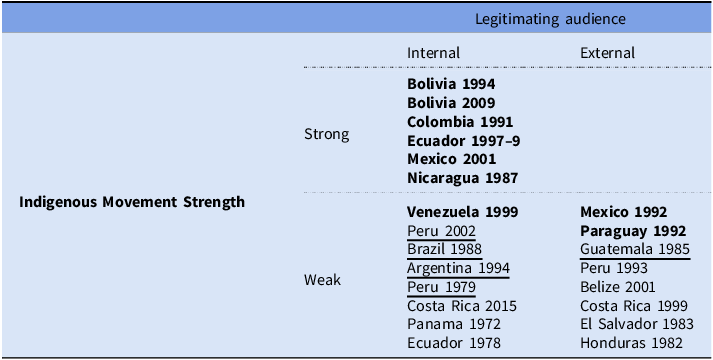
Table 4 categorizes each case in a two-dimensional typology based on its intended audience and contemporaneous Indigenous movement strength. Each case is assigned its corresponding degree of inclusion. I classify total scores of 1–3 as low, 4–6 as medium, and 7–9 as high. High scores are bolded, medium underlined, and low presented in plain font. This typology mirrors the causal pathways outlined in Figure 1, translating the framework’s probabilistic expectations into observable combinations of audience orientation and movement strength.
Two-dimensional typology of Indigenous inclusion instances

Table 4 Long description
A table categorizing Indigenous inclusion instances based on audience and movement strength. The table has two dimensions: legitimating audience and Indigenous movement strength. The legitimating audience is divided into internal and external columns. Indigenous movement strength is divided into strong and weak rows. Each cell contains specific countries and years. Strong internal includes Bolivia 1994, Bolivia 2009, Colombia 1991, Ecuador 1997-9, Mexico 2001, and Nicaragua 1987. Strong external includes Venezuela 1999 and Peru 2002. Weak internal includes Brazil 1988, Argentina 1994, Peru 1979, Costa Rica 2015, Panama 1972, and Ecuador 1978. Weak external includes Mexico 1992, Paraguay 1992, Peru 1993, Belize 2001, Costa Rica 1999, El Salvador 1983, and Honduras 1982. High scores are bolded, medium underlined, and low presented in plain font.
Scores of inclusion are denoted typographically: HIGH, MEDIUM, LOW.
The absence of cases in the “external audience/strong movement” quadrant reflects the political dynamics involving strong movements. While reforms often targeted multiple audiences, in no instance did strong Indigenous movements coincide with principally externally driven reform. Following Yashar’s (Reference Yashar2005) definition of strength, and in light of Van Cott’s (Reference Van Cott2000b) analysis, this is unsurprising: strong movements use reform openings to secure concessions, effectively becoming the primary audience.
This section examines how state objectives, audiences, and Indigenous movement strength interact, expanding on each quadrant’s “most typical” (Seawright and Gerring Reference Seawright and Gerring2008) cases, as well as outliers, and negative cases. I present the material using a narrative approach, which allows for the contextualization of each step of the causal process and makes the sequence of events visible, while accommodating the unique contingencies of each case (Büthe Reference Büthe2002).
Ecuador exemplifies the internal audience/strong movement quadrant, demonstrating that even in these circumstances inclusion was shaped by broader objectives. Panama exemplifies internal audiences/weak movements, showing why inclusionary policies were adopted in the absence of strong movements. Then I discuss the overlooked scenario of external audiences. The case of Mexico shows how governments adapt to external expectations.
Finally, I discuss the three outlier cases – Paraguay, Mexico, and Venezuela – and two negative cases – Chile and Uruguay. These cases highlight the role of the symbolic weight of Indigenous people and institutional constraints.
Internal audiences and strong movements
In Nicaragua (1987), Bolivia (1994), and Mexico (2001), governments pursued constitutional reform to pacify relations with armed Indigenous groups. In Colombia (1991), Indigenous movements’ organizational strength and visibility enabled their electoral representation in the constitutional assembly (Findji Reference Findji, Escobar and Alvarez1992; Jackson Reference Jackson2011; Van Cott Reference Van Cott2005b:178–82). In Bolivia (2009) and Ecuador (1997), policymakers sought to incorporate powerful Indigenous organizations into governing coalitions. The Ecuadorian case exemplifies this quadrant, showing how the broader objectives behind legitimization efforts shape inclusionary outcomes.
The Ecuadorian reforms of 1997 followed a legitimacy crisis triggered by political turmoil and the impeachment of President Abdalá Bucaram. Pachakutik, the largest Indigenous political party, was courted by both the right and left wings in the assembly. Indigenous interests exerted pressure through street mobilizations led by the Confederación de las Nacionalidades y Pueblos Indígenas del Ecuador (CONAIE), Ecuador’s largest Indigenous organization, and through a stakeholder consultation process.
At the time, Ecuador had some of the continent’s strongest Indigenous movements. This strength led to constitutional reforms which were considered, until recently, the “broadest and strongest regime of protection for Indigenous and black rights” (Van Cott Reference Van Cott2005a: 258; Yashar Reference Yashar2005: 85–152). Symbolically, this constitution recognized the Ecuadorian nation’s pluricultural character. Politically, it carved out spaces for Indigenous law and customs to regulate social life. And, materially, it declared Indigenous lands to be inalienable, unattachable, and indivisible.
Ecuadorian Indigenous movements brought clearly articulated demands to the assembly. These included political and economic decentralization; legislative and judicial autonomy; land redistribution and the breakup of large landholdings; improved management of state enterprises, including greater control over key industries; rejection of the privatization of the energy sector and protection of water resources; and recognition of Indigenous cultural identities through the declaration of a plurinational state, bilingual education, and the institutionalization of Indigenous medicine (CONAIE 1994: 13–50).
However, the government’s coalition, while aiming to legitimize the state, also sought to liberalize the economy. This latter goal delineated Indigenous inclusion: The assembly rejected demands for decentralization and localized autonomy (Burbano Jativa Reference Burbano Jativa2003: 31–32). Meanwhile, demands for political decentralization and for representative, corporatist governance were met with a model that administratively subsumed Indigenous groups into government sub-organizations, creating new forms of political and economic dependency (Andrade Reference Andrade, Andrade U and Viciano2004; Chuji Gualinga Reference Chuji Gualinga2008; CONAIE 2007; Walsh Reference Walsh2008: 16). In the economic realm, CONAIE’s agenda of anti-privatization and protection of the natural environment was defeated (Brysk Reference Brysk2000). Instead, the conservative government put together small majorities to achieve its goal of increased foreign capital investment and the retrenchment of the state (Ávila Santamaría Reference Ávila Santamaría2012: 31–34). For example, the constitution allowed for the privatization of public companies (removal of article 46); the concession of subsoil resources, drinking water, energy services, and natural resources (articles 247–9); and the involvement of the market in social security (article 55).
Ecuador’s constitutional Indigenous inclusion and its neoliberal transformation were interactive processes. As Walsh argues, inclusion was prompted by the need of the state to legitimate the process of neoliberal transformation in the eyes of a highly mobilized influential Indigenous movement (Walsh Reference Walsh2008: 3).
Internal audiences and weak movements
In the absence of mobilized stakeholders, why do states enact inclusionary reforms? Understanding the broader policy agenda of state actors is key to answering this question. In the eight cases in this quadrant, political elites saw inclusion as a tool for nation-building and governance.
In Peru (2002), Argentina (1994), Costa Rica (2015), and Brazil (1988), reforms occurred amid governance crises or transitional governments. Indigenous rights helped associate the state with positive transformation by addressing historical injustices while simultaneously linking the state to the ancestral origins of the nation (Hooker Reference Hooker2005; Loveman Reference Loveman2014). In Peru (1979) and Panama (1972), authoritarian governments incorporated reform as part of nation-building and governability efforts.
The case of Panama under Omar Torrijos’ dictatorship (1968–1981) exemplifies how inclusion can boost internal legitimacy (see also Rayo et al. Reference Rayo, Mosinger and Thaler2024). A main priority for Torrijos was unifying and modernizing the state, transforming it from a “caricature of a country into a nation” (Neiva Moreira Reference Neiva Moreira1981).Footnote 2 Here, the regime’s legitimacy deficit arose from Torrijos’s need to secure broad social support for his state-building project (Priestley Reference Priestley1986).
Indigenous inclusion served to bolster the state’s legitimacy as a governing institution and enhance its governance capacity, while simultaneously helping to increase Torrijos’ support (Herlihy Reference Herlihy1995: 83–86; Jordan-Ramos Reference Jordan-Ramos2010: 167–81). Inclusion aimed to increase the state’s visibility within Indigenous communities and to boost their participation in national politics (Gjording Reference Gjording, Young and Bort1991; Matutino 1977; Young and Bort Reference Young, Bort and Locker1999). The expressed goal was to “[bring Indigenous people] voluntarily into the ‘nation’ in physical and cultural terms through state recognition and the expansion of state services into rural areas” (Horton Reference Horton2006: 837–8). For example, increases in state funding in education for Indigenous people, as mandated by the 1972 amendments, resulted in heightened identification with the nation across different comarcas (Foss Reference Foss2012: 35–47).Footnote 3
More broadly, appeals to Panama’s Indigenous ancestry, as elsewhere in the region, helped construct a populist nationalist ideology that fueled popular support (Murgas Reference Murgas1981; Szok Reference Szok2001). The Torrijos regime’s cultural policies focused on pluriethnic nationalism, including renovating historic districts, founding museums, and emphasizing cultural events such as the National Symphony Orchestra, folklore dancing, and fine arts. The regime’s rhetoric of a “diverse cultural and racial mosaic” involved the official recognition and celebration of Indigenous and European roots (Barletta Reference Barletta1981).
Indigenous policy under the Torrijos regime highlights the connection between Indigenous inclusion, internal legitimacy, and state objectives in the absence of explicitly articulated pressure. This case also demonstrates the limitations of this form of inclusion. While Indigenous people were transformed into political subjects through political participation, they were simultaneously unable to prevent mining and dam projects which their communities strongly opposed (Gjording Reference Gjording, Young and Bort1991; Horton Reference Horton2006; Wali Reference Wali1993).
External audiences and weak movements
Constitutional Indigenous inclusion also occurred in the absence of internal legitimacy deficits. These eight cases represent the least-studied mechanism toward Indigenous inclusion, and they illustrate the intersection of coercion and legitimacy in the absence of explicit mandates. Rather than responding to clear directives from international actors, governments pursued inclusion as part of broader efforts to bolster regime legitimacy. Inclusion was part of efforts to signal democratization in Paraguay, to offset de-legitimizing events in Belize, Peru, El Salvador, Guatemala, and Honduras, or to secure international capital in Argentina, Costa Rica, and Mexico.
Mexico (1992) exemplifies externally oriented reforms. Indigenous inclusion in the reforms of 1992 was not a hard-fought victory by Indigenous stakeholders, who were largely excluded from the drafting process (Castellanos Guerrero and López y Rivas Reference Castellanos Guerrero and Lopez y Rivas1997: 146; Reference Castellanos Guerrero and Lopez y Rivas1992: 19; Echánove Huacuja Reference Echánove Huacuja2000: 3–7). Instead, these amendments were directed by President Carlos Salinas de Gortari, and rubber-stamped by the legislature (Gomez Rivera Reference Gomez Rivera2013: 45–46. See also Aguayo Quezada 1992). Focusing on his agenda shows that political negotiations surrounding the North American Free Trade Agreement (NAFTA) created a legitimacy deficit that shaped Mexican Indigenous constitutional inclusion.
Mexican presidents De La Madrid (1982–1988) and Salinas de Gortari (1988–1994) pursued a strategy of market liberalization and international trade as a solution to a prolonged fiscal crisis. This was pursued through global market integration, through entry into the Organization for Economic Co-operation and Development (OECD) and the signing of NAFTA. After nearly a century of insularity, the Mexican government became hypersensitive to the opinions of American and other international actors (Fraser Reference Fraser1991; Eisenstadt Reference Eisenstadt1992; Sánchez Reference Sánchez2001).
NAFTA negotiations made Mexico a priority for US human rights NGOs, unions, and politicians (Behr Reference Behr1993; Human Rights Watch 1990). Human rights interest groups leveraged this increased attention to demands that the Clinton administration address “human rights issues as it engages the Mexican government in trade negotiations” (Bartels Reference Bartels, Lester, Mercurio and Bartels2015: 8; HRW 1993) A particular concern was the treatment of Indigenous people in Southern Mexico (HRW 1990). Human rights concerns carried over into US congressional politics and were reported by the mainstream press. Unprecedentedly, social issues were used to oppose trade policy. For example, Congress used these concerns as a reason to deny a presidential request for the authorization to fast-track NAFTA negotiations (US Congress 1988). Chairman of the Congressional Human Rights Caucus Tom Lantos (D-CA) argued that “you can’t have free trade when you don’t have a free society,” (US Congress 1993a) while Congressman John LaFalce (D-NY) threatened: “if NAFTA is to be agreed to … it should be the carrot to clean up human rights abuses beforehand rather than after” (US Congress 1993b).
US commentators recognized that human rights concerns were not just discursive ploys; they could undermine NAFTA. While President H.W. Bush had papered over human rights abuses in Mexico in selling NAFTA to his constituents, then-candidate Bill Clinton stressed the need for supplemental agreements on labor issues (Bush Reference Bush1991; Clinton Reference Clinton1992).Footnote 4 Pro-business advocates, including the Cato Institute and the Heritage Foundation, were alarmed by the prominence of non-commercial issues in the negotiations (Salinas-Leon Reference Salinas-Leon1993; Wilson Reference Wilson1993). Meanwhile, major newspapers, including The Washington Post, The Wall Street Journal, and The New York Times, repeatedly highlighted NAFTA’s precarious status due to these concerns.
Mexican officials grew concerned that, within the US government, “opponents of the accord have asserted that the … human rights problems in Mexico are reason enough for American legislators to reject greater economic integration” (Golden Reference Golden1993).Footnote 5 They also feared that, if elected, Clinton would demand the inclusion of human rights provisions (Dunne Reference Dunne1993; Fraser Reference Fraser1992; HRW 1992). Meanwhile, Clinton urged Salinas to accelerate human rights reforms (Wilson Reference Wilson1993). Notably, while Mexico faced criticism over its human rights record, there was an absence of specificity regarding what measures would make the agreement acceptable.
Salinas was quick to react and expressed his willingness to address these issues (HRW 1992). To him, it was clear that “to be accepted in the world, it is no longer enough to have economic growth, but a fundamental requirement is a reduction of violations against human rights” (Aguayo Quesada 1992: 488).Footnote 6 In response to these criticisms, Mexico undertook a series of constitutional amendments and the creation of the Commission on Human Rights. Visits by members of both US Houses were arranged to discuss human rights and labor laws (Weisskopf Reference Weisskopf1993). In 1992, a hearing to review the US Department of State’s country reports on human rights practices explicitly depicted the 1992 constitutional amendments as a positive sign of Mexico’s move toward improving human rights conditions, a sentiment echoed by Amnesty International. In November 1993, President Clinton voiced praise for these reforms (Clinton Reference Clinton1993).
Further evidence of the role of an international audience can be found within the Mexican legislature. As Senator Carrasco Altamirano explained: “the reform does not emerge in Mexico in isolation of the international context. The constitutions of most countries in the continent … include already rights for [Indigenous] people” (Cámara de Senadores 1991b). Thus, according to Senator Sierra Sánchez reforms came about because: “Internally, the demand for justice forces us to transform ourselves, and externally, interdependence calls us to seek a better insertion in the changes that are taking place in the international community” (Cámara de Senadores 1991a). Multiculturalism, the government argued, allowed Mexico “to face the cultural challenges posed by international economic relations” (Salinas de Gortari Reference Salinas de Gortari1990). Salinas pointed out to his Congress the importance of his human rights agenda and its links to Indigenous rights in creating an “image we project to the world, that of a country dedicated to the modernization of its structures; that of a civilization with millenary roots, forging a proud identity” (Diario Oficial de la Federación 1992). Salinas’ understanding of human rights and Indigenous recognition as policy roadblocks led to the development of reforms that would cast a positive image of Mexico, a seemingly indispensable requirement to the passing of NAFTA (Vargas Reference Vargas1994).
Indigenous inclusion in Mexico was not intended as structural change. Rather, it was an “ornament” for the international community (Sotelo 2020). By the end of the decade, the constitutional reforms would galvanize armed Indigenous mobilization, leading observers to ironically comment that “if Salinas had imagined what he was doing, he would never have promoted the amendment” (Saldivar Reference Saldívar2003: 330).
Actors operate within political and institutional structures that constrain and enable the potential for policy change. The wording of the 1992 amendments echoed the ILO’s Indigenous and Tribal Peoples Convention and reflected the “multicultural moment” that permeated international rhetoric in the 1990s (Thompson Reference Thompson2016). While norm institutionalization shaped the specific way in which legitimacy was pursued, the policy agenda of international market integration was the catalyst for change. The need to “exchange” international legitimacy for US Congressional approval of NAFTA was the mechanism that led to constitutional reform.
Outliers: The role of symbolic weight
The cases of Mexico, Paraguay, and Venezuela are notable due to their relatively high scores. In Mexico and Paraguay, inclusionary scores were high despite being targeted at external audiences, and in Venezuela despite the country’s weak Indigenous movements. These scores were mediated, in the former cases, by the role of Indigenous people within the national imaginary, and in the latter by political rhetoric of radical change.
Indigenous peoples’ place within the social conception of the nation plays a crucial role in their legal incorporation (Hooker Reference Hooker2005; Paschel Reference Paschel2016). In Mexico and Paraguay, Indigeneity has been particularly prominent, playing a significant role in nation-building efforts.Footnote 7
In Venezuela, despite a history of erasure, Indigenous peoples gained significant symbolic weight in the lead-up to the 1999 constitutional assembly (Angosto-Ferrández Reference Angosto-Ferrández2010, Reference Angosto-Ferrández2017). President Hugo Chávez’s rhetoric focused on rectifying past injustices, including a signed pact to address the “historical debt to Indigenous peoples” and providing material and political support for their constitutional inclusion (Angosto-Ferrández Reference Angosto-Ferrández2008: 13; see also Garcia-Guadilla and Hurtado (Reference Garcia-Guadilla and Hurtado2000). As elsewhere, Indigenous rights served to legitimize radical state transformation, symbolizing both re-vindicative change and a bridge to the nation’s ancestral origins (Angosto-Ferrández Reference Angosto-Ferrández2008, Reference Angosto-Ferrández2010, Reference Angosto-Ferrández2017; Orellano Reference Orellano2016: 126–8).
Absence of reform
In continental Latin America, only Chile and Uruguay have not enacted any form of constitutional Indigenous inclusion. In Chile, constitutional Indigenous inclusion was proposed throughout the 1990s as an amendment and as part of a new constitution in 2023. Both efforts failed. In Uruguay, contrasting its neighbors, nation-building narratives have completely excluded Indigenous origins.
Chile’s right-wing has staunchly opposed efforts to include Indigenous people in its constitution, and until 2015, legislative institutions heavily favored this coalition. Under a “binomial” electoral system, each legislative district elected two seats, but the threshold for winning both seats was unfeasibly high. The result was that almost all districts returned one legislator from each of the main alliances: the center-left and the right-wing opposition (Alemán et al. Reference Alemán, Cabezas and Calvo2021). The influence of Chile’s right-wing in the legislature was further bolstered by a “politics of consensus” arrangement, which sought broad agreement between these alliances (Fábrega et al. Reference Fábrega, González and Lindh2018). These two factors effectively prevented the center-left from implementing inclusionary reforms, despite repeatedly proposing such reforms during the 1990s (Contesse Reference Contesse2011). Framed in the terms of the present study, Chilean institutions prevented legitimacy deficits from mattering, as the right-wing coalition had secure access to the levers of power.Footnote 8
Another opportunity for Indigenous inclusion emerged in 2022 when Chile held a national referendum on a radically progressive constitution. The proposed text would have positioned Chile’s constitution among the region’s strongest on Indigenous rights. The constitution was voted down, including by a significant proportion of Indigenous voters (Pavlic Reference Pavlic2024). It is too early to make a full assessment of the causes of this result but the rejection campaign centered on portraying Indigenous judicial and symbolic autonomy as exacerbating violence and promoting national factionalism (Lankes Reference Lankes2022). Commentators argue that rather than representing a break from past injustices inclusionary language came to represent national disunity (Bauer Reference Bauer2022; Montes Reference Montes2022).Footnote 9 Whether this reflects a specificity of the Chilean case, or a paradigm shift in the region remains to be seen.
In Uruguay, Indigenous people have been absent from the national imaginary. Uruguayan national narratives have long maintained that it is a “country without Indigenous people or an Indigenous legacy” ( Arocena and Aguiar Reference Arocena and Aguiar2007: 7) where “the process of demographic homogenization [has] continued to be treated as fait accompli” (Loveman Reference Loveman2014: 248). Burgeoning Indigenous associations have encountered negative responses from state officials, scholars, and the general public, and there has been no serious attempt to ratify international conventions on Indigenous rights (Verdesio Reference Verdesio2021). The absence of Indigenous people in the national mythos and their perceived absence as potential recipients of rights means that there are no potential legitimacy gains from inclusionary reform (Hooker Reference Hooker2005).
Conclusion and implications
This article sheds light on the processes behind the constitutional inclusion of Indigenous peoples in Latin America. Unlike previous research on norm adoption, which predominantly relies on large-N quantitative analyses or focuses on selected case studies, the current study’s comparative approach unveils nuanced elements pivotal to understanding norm adoption. I suggest that Indigenous constitutional inclusion enabled governments to advance their agendas by being perceived as legitimate by specific evaluating audiences.
I present a framework that emphasizes legitimacy deficits, legitimating audiences, and social movement strength. This framework bridges the world society and policy diffusion literatures. I argue that states resolve legitimacy deficits by implementing legitimizing norms, which partially explains the timing of norm adoption. Whether audiences are external or internal matters, because internal audiences demand higher degrees of norm adoption, especially when stakeholders are strongly mobilized. Thus, contrary to the general perspective in world society, which regards legitimacy as a function of isomorphism within a global field, I have shown that specific relationships matter. These expectations, however, tend to be more ambiguous than those outlined in coercive policy diffusion accounts.
Focusing on state objectives raises a further question: Do different legitimacy audiences yield different forms of inclusion? My index does not suggest clear distinctions between reforms oriented toward transnationally embedded movements and those aimed at more isolated ones. Nor is there sufficient variation in audience type to draw firm conclusions. Future work could extend this analysis to a broader range of legal reforms or examine how audience orientation interacts with regime type and groups’ international embeddedness.
This study’s scope is inherently limited, focusing solely on formal rule changes. It does not address aspects of implementation, potential harms of state objectives, nor the trade-offs between rights and economic liberalization. I also did not delve into the important role that transnational movements have had in creating and legitimizing global scripts (Brysk Reference Brysk2000). Finally, as in all typologies, my framework risks obscuring the role of factors not captured in the external/internal framework. As Trevizo (Reference Trevizo2014) research shows, while NAFTA negotiations explain the timing of human rights reform in Mexico, those reforms might not have happened in the absence of advocacy by civil society and complex electoral dynamics.
Still, these findings present useful conclusions for debates on institutional change. While efforts from international organizations such as Human Rights Watch to “name and shame” can be effective, these can only work if they coincide with a country’s broader objectives. Even when successful, external pressures for institutional change can be limited. Thus, a key takeaway is that bottom-up pressure from national stakeholders is an important mediating factor in maximizing formal gains. Therefore, strengthening local groups remains an essential consideration for stakeholders interested in inducing inclusionary change.
Supplementary material
The supplementary material for this article can be found at https://doi.org/10.1017/ssh.2026.10129.
Acknowledgments
I am grateful to the many people who made this article possible. Special thanks are due to James Mahoney, Monica Prasad, Noor Anwar-Ali, Rina Cáceres Gómez, Charles Camic, and Anthony Chen, as well as to three anonymous reviewers for their thoughtful comments. I am also grateful to participants at Northwestern’s Comparative Historical Social Science Workshop and at the annual meetings of the American Sociological Association, the Law and Society Association, and the Latin American Studies Association.



 Open access

