





Introduction
Attention-deficit/hyperactivity disorder (ADHD) is a common neurodevelopmental disorder in children characterized by inattentiveness, hyperactivity, and impulsivity (Posner, Polanczyk, & Sonuga-Barke, Reference Posner, Polanczyk and Sonuga-Barke2020), with a prevalence of ~5% worldwide (Cortese et al., Reference Cortese, Song, Farhat, Yon, Lee, Kim and Solmi2023). Executive function deficits, including working memory (WM) and inhibition deficits, are considered core cognitive deficits in ADHD (Barkley, Reference Barkley1997; Biederman et al., Reference Biederman, Petty, Fried, Fontanella, Doyle, Seidman and Faraone2006).
Audition and vision are both important ways for children to receive external information. Many studies have separately investigated the neural mechanisms of automatic sensory processing (Gomes et al., Reference Gomes, Duff, Flores and Halperin2013; le Sommer et al., Reference le Sommer, Low, Møllegaard, Fagerlund, Vangkilde, Habekost and Oranje2023; Lee, Jeong, Kim, & Kim, Reference Lee, Jeong, Kim and Kim2020; Rothenberger et al., Reference Rothenberger, Banaschewski, Heinrich, Moll, Schmidt and Van'T2000; Rydkjær et al., Reference Rydkjær, Møllegaard, Pagsberg, Fagerlund, Glenthøj and Oranje2017; Yamamuro et al., Reference Yamamuro, Ota, Iida, Nakanishi, Kishimoto and Kishimoto2016) and visual WM (Bonetti et al., Reference Bonetti, Haumann, Brattico, Kliuchko, Vuust, Särkämö and Näätänen2018) in patients with ADHD. Research has also shown that (Barkley, Reference Barkley1997) patients with impaired attention often exhibit deficits in WM and other cognitive domains. Therefore, a connection may exist between automatic sensory processing and visual WM, and this relationship warrants further attention. Mismatch negativity (MMN) is associated with auditory attention and is considered a reflection of the automatic detection of unpredictable sounds within a sequence of high-frequency standard sounds (Fitzgerald & Todd, Reference Fitzgerald and Todd2020). MMN is considered to reflect the processing of automatic sensory changes (Escera, Yago, & Alho, Reference Escera, Yago and Alho2001; Friedman, Cycowicz, & Gaeta, Reference Friedman, Cycowicz and Gaeta2001), indicating the preattentive processing ability of the auditory cortex to detect changes in stimuli (Zhang et al., Reference Zhang, Qiu, Pan and Zhao2020). Previous research has shown that MMN in children with ADHD is smaller than that in normal children (Gomes et al., Reference Gomes, Duff, Flores and Halperin2013; Hsieh, Chien, & Gau, Reference Hsieh, Chien and Gau2021; Huttunen-Scott, Kaartinen, Tolvanen, & Lyytinen, Reference Huttunen-Scott, Kaartinen, Tolvanen and Lyytinen2008; Kilpeläinen, Partanen, & Karhu, Reference Kilpeläinen, Partanen and Karhu1999; Kim et al., Reference Kim, Baek, Kwon, Lee, Yoo, Shim and Kim2021; Lee et al., Reference Lee, Jeong, Kim and Kim2020; Rothenberger et al., Reference Rothenberger, Banaschewski, Heinrich, Moll, Schmidt and Van'T2000; Winsberg, Javitt, Silipo, & Doneshka, Reference Winsberg, Javitt, Silipo and Doneshka1993; Yamamuro et al., Reference Yamamuro, Ota, Iida, Nakanishi, Kishimoto and Kishimoto2016) and that this attenuation may be due to deficits in early auditory information processing, which may be affected by defects in the frontal lobe (Alho, Reference Alho1995). WM is one of the core components of executive function (Cristofori, Cohen-Zimerman, & Grafman, Reference Cristofori, Cohen-Zimerman and Grafman2019), and refers to the ability to retain information while processing complex tasks (Baddeley, Reference Baddeley1992). Atypical activation in the inferior frontal cortical area (IFC) is prevalent in individuals with ADHD in executive functioning processes involving inhibition and cognitive control (Kowalczyk, Mehta, O'Daly, & Criaud, Reference Kowalczyk, Mehta, O'Daly and Criaud2022). Notably, IFC activity is not only closely related to deficits in WM in children with ADHD (Li, Motwani, Cao, Martin, & Halperin, Reference Li, Motwani, Cao, Martin and Halperin2023b; Mattfeld et al., Reference Mattfeld, Whitfield-Gabrieli, Biederman, Spencer, Brown, Fried and Gabrieli2016) but also strongly linked to MMN abnormalities (Deouell, Reference Deouell2007). Previous research has shown that (Lavie, Reference Lavie1995) in healthy adults, processing with a high perceptual load can exhaust perceptual resources, thus passively suppressing the perceptual processing of distractors. Moreover, other studies (Zhang, Chen, Yuan, Zhang, & He, Reference Zhang, Chen, Yuan, Zhang and He2006) have found that high loads during visual tasks can exhaust the attentional resources of healthy adults thus passively suppressing the perceptual processing of acoustic distractors. These studies reveal a competitive allocation of perceptual resources, supporting the theory of trade-offs between attentional resources across modalities. Recent research (Kong et al., Reference Kong, Zhao, Li, Li, Hu, Liu and Song2024) further suggests that healthy adults may share a limited-capacity mechanism for auditory change detection (such as MMN) and visual selective attention, allowing attention resources to be flexibly allocated across different tasks. This finding provides new evidence for the trade-off of attention resources between visual and auditory tasks. Based on these finding, we predict that children with ADHD may also exhibit a trade-off phenomenon in attention resources.
In the current study, we assessed the WM capacity through a visual task and utilized an auditory task to elicit MMN responses. We aimed to verify whether a difference exists in auditory MMN between children with ADHD and typically developing (TD) children. More important, we sought to better understand the relationship between auditory sensory processing and the visual WM capacity of two groups of children by exploring the correlation between individual differences in MMN and WM performance. We predicted that these two abilities at least in part share a common underlying mechanism, and that children with larger MMN that are more sensitive to auditory stimuli changes may also be better at allocating visual selective attention to the remembered items and have a better WM capacity. However, if this underlying mechanism reflects a finite resource, then the greater visual WM capacity could reduce an individual's capacity for auditory information processing (i.e. a trade-off). This outcome would be reflected in individual differences, with those children who have better visual WM performance tending to have less capacity remaining for auditory change detection (i.e. smaller MMN).
Methods
For this study, approval was obtained from the Ethics Committee of the Affiliated Brain Hospital of Guangzhou Medical University (approval number: AF/SC-08/02.0). Furthermore, all procedures were conducted in accordance with the ethical principles of the Declaration of Helsinki. All the subjects participated voluntarily, provided written informed consent, and received compensation for their participation.
Participants
This study recruited a total of 179 children (ADHD: n = 88; TD: n = 91). The ADHD group was recruited from the Affiliated Brain Hospital of Guangzhou Medical University, and the healthy control group was recruited from local schools. Data from three participants were excluded from the analyses because they were ineligible (ADHD: n = 2; TD: n = 1) because of low intelligence quotient (IQ) scores (<80). In the end, data from 176 participants (ADHD: n = 86; TD: n = 90) were included in subsequent studies (see Table 1). The age range of the participants was 6–16 years. Of the 86 patients with ADHD, 21 had not been treated with medication and the rest had been treated with drugs such as atomoxetine and methylphenidate hydrochloride.
Participant characteristics
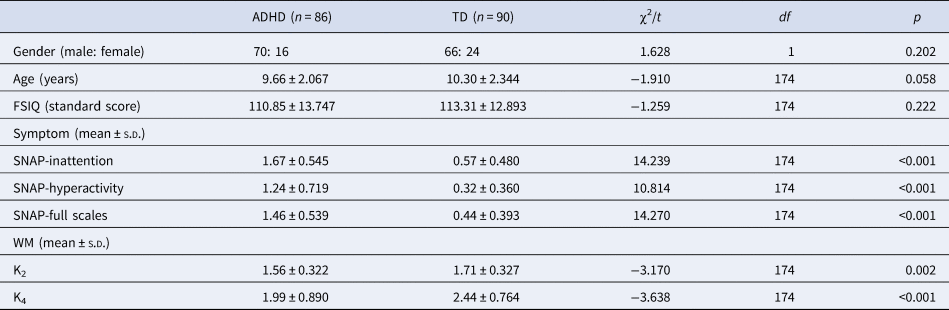
ADHD, children with attention-deficit/hyperactivity disorder; TD, typically developing children; FSIQ, full-scale intelligence quotient; SNAP-inattention, SNAP-IV, attention deficit scale; SNAP-hyperactivity, SNAP-IV, hyperactivity/impulsivity scale; SNAP-full scales, full version of SNAP-IV; K2, low-load WM; K4, high-load WM; s.d., standard deviation; comparisons between sexes were performed using χ2 tests; comparisons based on age, IQ, symptom scores, and WM scores were performed using independent samples t tests.
All participants and their primary caregivers (usually parents) underwent semistructured diagnostic interviews conducted by a qualified psychiatrist. The Child-SADS-Lifetime Version (K-SADS-PL) was used to initially ascertain trends in ADHD symptoms (Kaufman et al., Reference Kaufman, Birmaher, Brent, Rao, Flynn, Moreci and Ryan1997). Children diagnosed with ADHD met all criteria outlined in the DSM-V (Diagnostic and Statistical Manual of Mental Disorders, 5th edition) and SNAP-IV (Swanson, Nolan, and Pelham rating scales, 4th edition) assessment scales (Abhayaratna et al., Reference Abhayaratna, Ariyasinghe, Ginige, Chandradasa, Hansika, Fernando and Dassanayake2023), whereas TD children did not meet these criteria. Children diagnosed with ADHD were required to discontinue stimulant medication for 24 hours prior to the experiment. All participants in this study met the following inclusion criteria: (a) normal hearing; (b) normal or corrected-to-normal vision; (c) absence of comorbidities such as schizophrenia, mood disorders, autism spectrum disorders, epilepsy, oppositional defiant disorders, tic disorders or learning disabilities; (d) no history of unconscious head trauma; (e) absence of organic diseases, neurological disorders, or other severe illnesses; (f) right-handedness; and (g) normal IQ (Chinese WISC-IV full-scale IQ > 80) (Wechsler, Reference Wechsler2003)). No intergroup differences in age (p = 0.058), sex (p = 0.202), or IQ (p = 0.217) were observed. The ADHD group presented significantly higher scores on the SNAP-inattention, SNAP-hyperactivity, and SNAP-full scales than did the TD group (p < 0.001) (see Table 1).
WM measures
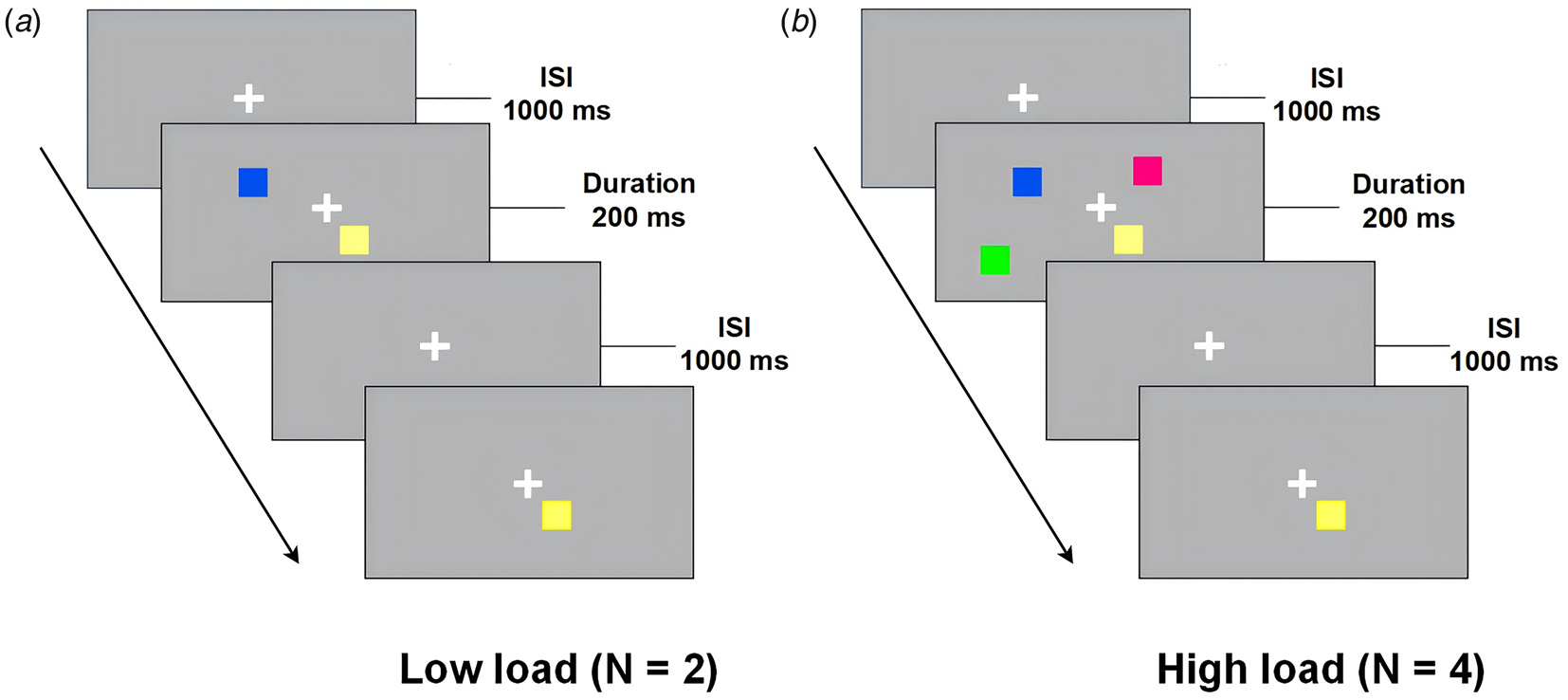
The WM capacity (K value) was measured using a change detection task (Vogel & Machizawa, Reference Vogel and Machizawa2004) (Fig. 1). The experiment consisted of two sessions: a low load (memory size: 2) and high load (memory size: 4). The memory object was an array of randomly arranged squares with different colors. The test stimulus was a colored square presented at one location in the memory array. A 50% probability existed that the color of the test square was the same as the same position in the memory array (congruent condition; the others were incongruent conditions). In each trial, the screen first presented the memory array for 200 ms followed by an interstimulus interval (ISI) for 1000 ms, and then the search array for an unlimited amount of time until the subject responded with a key press. The participants were instructed to remember the color and position of the square in the memory array and to determine whether the color and position of the test square were the same as those of the memorized square. The participants responded by pressing ‘1’ or ‘0’ on the keyboard with their left or right index finger, respectively. For each session, 40 trials were presented, of which 20 congruent and 20 incongruent conditions were presented. Before each experimental session, the participants completed 10 practice trials to ensure their understanding of the task requirements. We used the K score as an indicator of the visual spatial WM capacity. The experimental environment had a background luminance of 300 cd m−2, with the participants' eyes level and directly facing the fixation point. The screen refresh rate was 60 Hz, the distance between the stimuli and the participants was between 50 and 70 cm, and all the participants had normal vision. The K value was calculated using the following formula (Cowan, Reference Cowan2001; Rouder, Morey, Morey, & Cowan, Reference Rouder, Morey, Morey and Cowan2011):

where N represents the number of squares to be memorized, h denotes the hit rate, and f represents the false alarm rate. We used K2 to represent the K value for a low load, and K4 for the K value of a high load.
Schematic diagram of the visual WM task. Note. (a) Low load (N = 2); (b) High load (N = 4). The subject needed to judge whether the color and position of the test square matched the corresponding square in the memory array and press ‘1’ if it matched or ‘0’ if it did not match.
Procedure and tasks
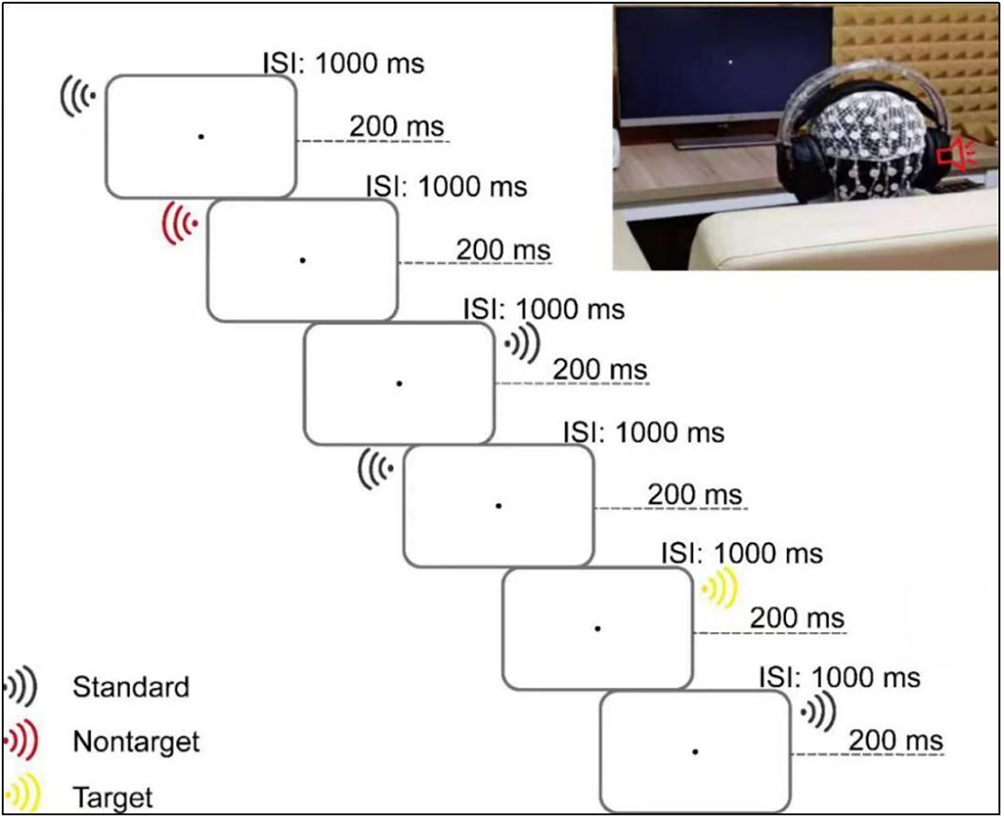
The experiment was an auditory oddball task consisting of three pure tones with frequencies of 200, 600, and 1000 Hz (Fu et al., Reference Fu, Li, Yin, Huang, Liu, Song and Dang2022). The three stimuli were presented randomly in either the left or right ear (balanced across trials) for 200 ms with an ISI of 1000 ms. The entire task consisted of eight blocks comprising 1472 trials. Monaural sound stimuli were delivered through professional over-ear headphones (HP GH10 Wired Gaming Headphones, USA). Trials were divided into three conditions based on the target type and stimulus frequency: target oddball stimuli (16.3% probability of occurrence, 240 presentations of either 200 or 1000 Hz tones, balanced across participants), non-target oddball stimuli (16.3% probability of occurrence, 240 presentations of either 200 or 1000 Hz tones, balanced across participants), and standard stimuli (67.4% probability of occurrence, 992 presentations of 600 Hz tones). If the 200 Hz pure tone was the target stimulus, the 800 Hz pure tone was the non-target stimulus, and vice versa. The selection of target stimulus types was counterbalanced across participants. The participants were instructed to press a button when the target stimulus was presented but not when the other two stimuli were presented. The experiment was conducted either in the morning or afternoon, specifically between 9 A.M. and 5 P.M. All EEG measurements were performed in a professional soundproof chamber to minimize external noise and electromagnetic interference. During the measurement, the participants remained calm and focused on ensuring the accuracy of the EEG data. Before the formal EEG experiment, the participants performed some trial exercises to ensure that they understood the experiment well. The experiment lasted approximately 45 min Fig. 2.
Illustration of a typical sequence of stimuli and a scene of a real experiment. In the left panel, the flowchart shows a slice of the stimulus sequence. One stimulus was pseudorandomly played at a time via a headphone (either the right or left side). Three types of stimuli were defined: target deviants (16.3% occurrence) and unattended deviants (16.3% occurrence) counterbalanced with the two tones (200 and 1000 Hz) between subjects and non-target standards (67.4% occurrence). Each trial with a duration of 1200 ms consisted of one stimulus played for 200 ms, followed by an interstimulus interval (ISI) of 1000 ms. In the right panel, the children were instructed to keep their eyes on the fixation point on a computer screen; meanwhile, they were instructed to determine the side of the target deviants as accurately and quickly as possible and ignore the other stimulus.
EEG data recording and preprocessing
EEG signals were synchronously collected using a 64-channel system (Electrical Geodesics, Inc., Eugene, OR; Hydrocel Geodesic Sensor Net). During EEG collection, electrode Cz was used as the physical reference electrode, and impedances for all electrodes were maintained below 50 kΩ. The sampling rate was 1000 Hz. The data from four electrodes (corresponding to channels 61–64 in a 64-channel EEG cap) located on the cheeks were excluded because they are prone to interference from facial expressions and muscle movements. The data were preprocessed using the EEGLAB toolbox (Delorme & Makeig, Reference Delorme and Makeig2004) in the MATLAB environment (MathWorks, Inc., Natick, MA, USA). The data were downsampled to 250 Hz and filtered at 1–30 Hz using a zero-phase finite impulse response filter. An average reference was used. After bad segments containing excessive artifacts were artificially removed from continuous EEG data, independent component analysis (ICA) was performed to remove components with ocular origins. Data were segmented from −200 ms to 600 ms around the stimulus onset, and the baseline preceding the stimulus (−200 to 0 ms) was subtracted. EEG segments were averaged for each condition (target oddball, non-target oddball and standard stimuli).
In accordance with previous studies (Fitzgerald & Todd, Reference Fitzgerald and Todd2020; Katayama & Polich, Reference Katayama and Polich1998), two types of MMN and P3 waveforms were calculated by subtracting the waveforms of standard stimuli from the oddball waveforms (target MMN and P3: target oddball minus standard; non-target MMN and P3: non-target oddball minus standard). We highlighted the analyses of target and non-target MMN waveforms. Target MMN reflects the brain's sensory processing of the intended stimulus, whereas non-target MMN reflects the sensory processing of irrelevant stimuli (Fitzgerald & Todd, Reference Fitzgerald and Todd2020). The analysis of these components helps to reveal the brain's automatic sensory processing capacity of the brain in response to different types of stimuli. We used an electrode point-to-time point (point-to-point) method to select electrodes. First, using a one-tailed t test, we screened out electrodes with electrode amplitudes less than 0. After screening, we selected CZ, C1, C2, C3, C4, C5, C6, CP1, and CP2 as the target electrodes and used the total average values of these electrodes from 160 to 280 ms (i.e. 60 ms before and after the group-averaged peak as the MMN amplitude). We defined C1, C3, C5, and CP1 as left hemisphere electrodes, whereas C2, C4, C6, and CP2 were classified as right hemisphere electrodes to investigate the cerebral hemispheric effect. In our study, we calculated the overall average values of the left and right hemisphere electrodes under different conditions as the MMN amplitude. We selected FZ, FCZ, and CZ and used the average values from 300 to 400 ms as the P3a amplitude and FCZ, CZ, and PZ with average values from 400 to 500 ms as the P3b amplitude.
Statistical analyses
A repeated-measures ANOVA was implemented on the WM data with Group (ADHD, TD) as a between-group factor and Load (K2, K4) as a within-group factor. For the analysis of EEG data, repeated-measures ANOVA was implemented with Group (ADHD, TD) as a between-group factor and Sound type (non-target, target) as a within-group factor. We employed repeated-measures ANOVA to evaluate the group differences in MMN amplitude across different hemispheres (left hemisphere and right hemisphere) under different auditory stimulus conditions (left side and right side). In addition, a partial correlation analysis was performed to explore the relationships between functional/clinical symptom data (WM scores and ADHD symptom scores) and EEG data (MMN and P3), and age was controlled in the model.
Results
Visual WM
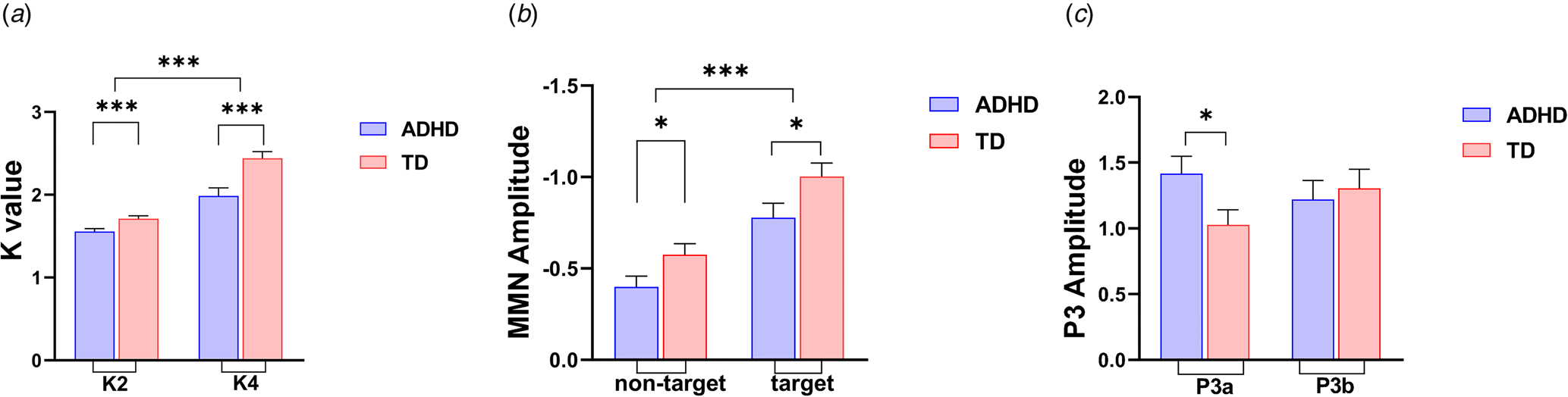
The results of the repeated-measures ANOVA revealed a significant effect of Load [F (1, 174) = 110.624, p < 0.001, $\eta _p^2$ = 0.389], a significant effect of Group [F (1, 174) = 15.589, p < 0.001, $\eta _p^2$
 = 0.082] and an interaction of Load × Group [F (1, 174) = 7.364, p = 0.007, $\eta _p^2$
 = 0.041] (Fig. 3a). The simple effects analysis indicated that under both the low- and high-load conditions, the performance of children with ADHD was significantly lower than that of the TD group (low: F (1, 174) = 10.052, p = 0.002, $\eta _p^2$
 = 0.055; high: F (1, 174) = 13.236, p < 0.001, $\eta _p^2$
 = 0.071). The results suggest that the performance of children with ADHD on the K2 and K4 tasks was significantly lower than that of the TD group, and this decrease in behavioral performance was more pronounced under high-load conditions than under low-load conditions (Supplement Table 1).
Results of the statistical analysis of the WM capacity (low load and high load), MMN amplitude (non-target MMN and target MMN components) and P3a/P3b amplitude. *p < 0.05 and ***p < 0.001.
Auditory MMN
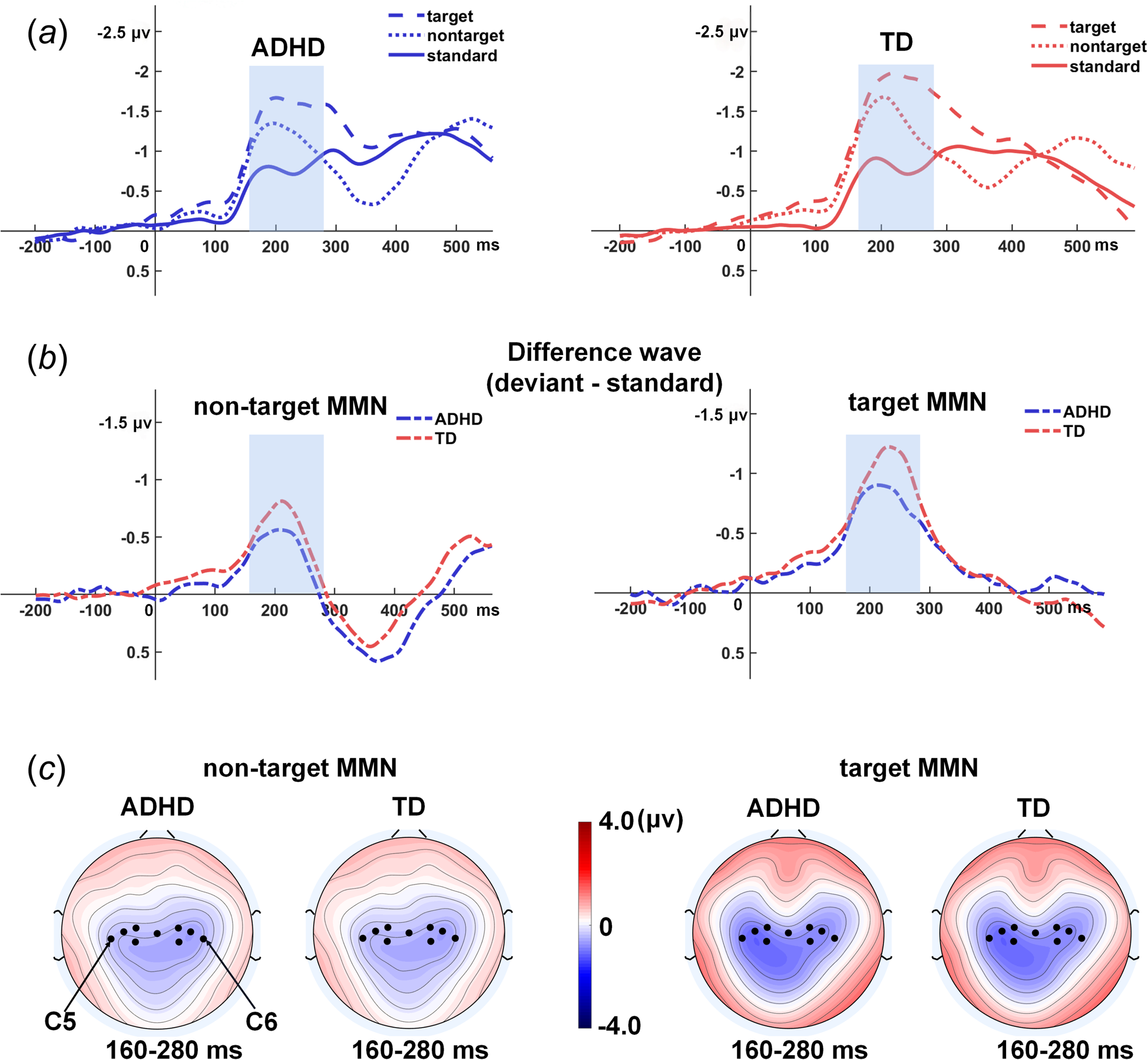
Both groups of children produced significant EEG fluctuations between 160 and 280 ms after the occurrence of the sound, suggesting that the occurrence of the deviant sound effectively triggered an electrophysiological response in the children (Fig. 4a). Figure 4b clearly shows that a reliable MMN component was evoked at 160–280 ms after the sound. The existence of this effect was further confirmed by the topographic map plotted in Fig. 4c. One-sample t tests revealed that the MMN amplitude (160–280 ms) was significantly different from the baseline value for the ADHD group (non-target: −0.400 ± 0.543 μV; t = −6.824, p < 0.001; target: −0.778 ± 0.737 μV; t = −9.799, p < 0.001) and the TD group (non-target: −0.576 ± 0.567 μV; t = −9.626, p < 0.001; target: −1.003 ± 0.700 μV; t = −13.592, p < 0.001).
MMN waveforms and MMN topographical maps. Note. The grand-average waveforms and topographical maps of MMN. (a) ERP waveforms (averaged across the CZ, C1/C2, C3/C4, C5/C6, CP1/CP2 electrodes) of the target deviation stimulus, non-target deviation stimulus, and standard stimulus for the ADHD group and the TD group (healthy control group). (b) Difference waveforms at the computation of ERPs of non-target deviant stimuli (ERPs of target deviant stimuli) minus ERPs of standard stimuli in the ADHD and TD groups. (c) Topographical maps of (160–280 ms) MMN in ADHD and TD individuals. Ps: The shaded area indicates the analysis time window (160–280 ms).
The results of the repeated-measures ANOVA revealed a significant effect of the Sound type (F (1174) = 49.404, p < 0.001, $\eta _p^2$ = 0.221) and a significant effect of Group (F (1, 174) = 6.578, p = 0.011, $\eta _p^2$
 = 0.036) (Fig. 3b). However, the effect of the interaction between Sound type × Group was not significant. These results indicated that the amplitude of the target MMN was significantly larger than that of the non-target MMN and that the amplitude of the MMN in children with ADHD was significantly smaller than that in TD children for both target and non-target sounds.
The results of the repeated-measures ANOVA revealed a significant main effect of Group (target MMN: F (1, 174) = 4.624, p = 0.033, $\eta _p^2$ = 0.026; non-target MMN: F (1, 174) = 4.389, p = 0.038, $\eta _p^2$
 = 0.025). However, the effect of the Stimulus condition × Hemisphere × Group interaction was not significant (target MMN: F (1, 174) = 2.248, p = 0.136, $\eta _p^2$
 = 0.013; non-target MMN: F (1, 174) = 0.809, p = 0.370, $\eta _p^2$
 = 0.005).
P3a and P3b
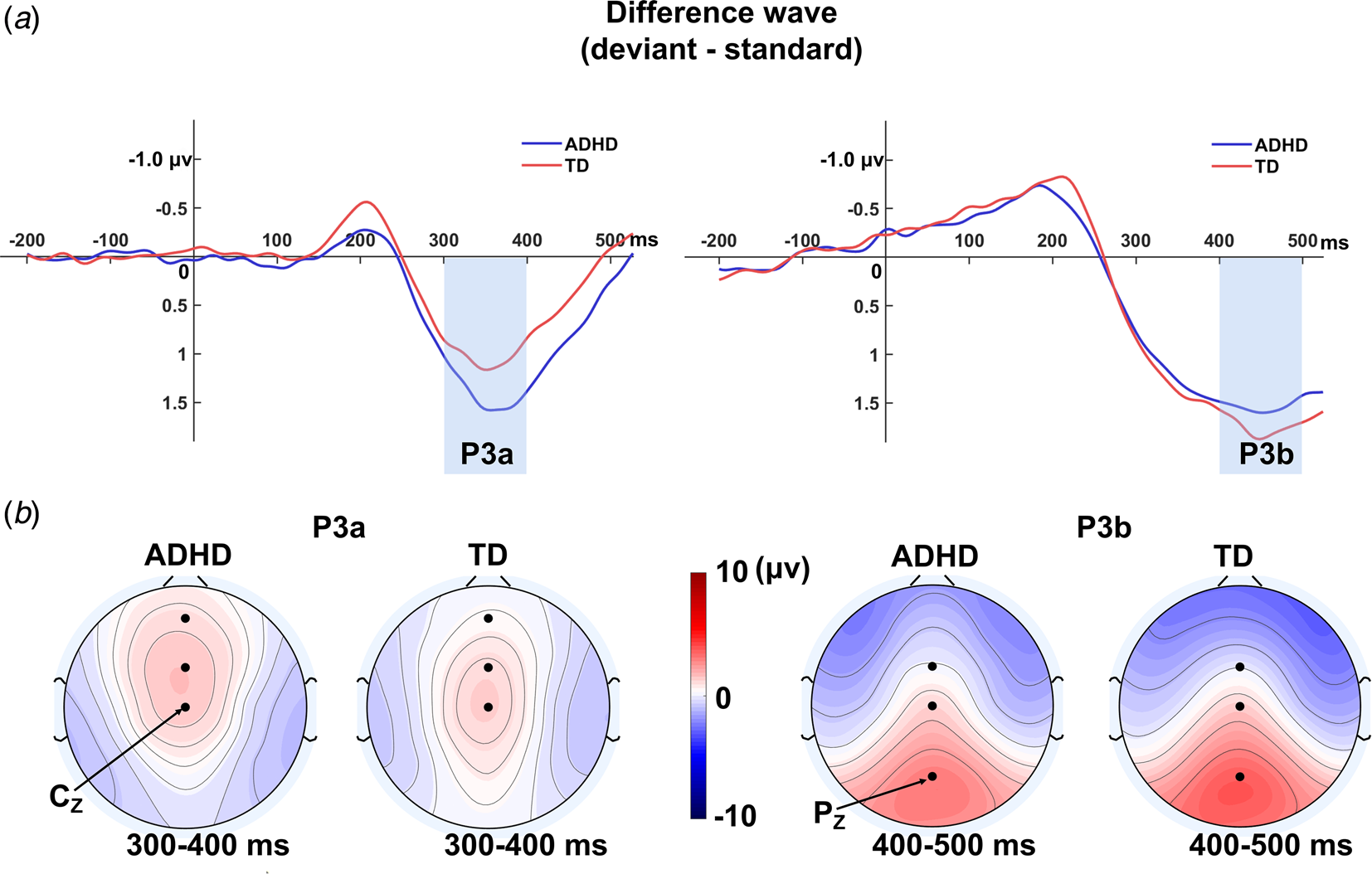
Both groups of children produced significant EEG fluctuations between 300 and 500 ms after the occurrence of the sound, suggesting that the occurrence of the deviant sound effectively triggered an electrophysiological response in the children (Fig. 5a, 5b). One-sample t tests revealed that both the P3a (elicited by non-target deviant stimuli) and P3b (elicited by target deviant stimuli) amplitudes were significantly different from those at baseline for the ADHD group (P3a: 300–400 ms, 1.418 ± 1.214 μV; t = 10.832, p < 0.001; P3b: 400–500 ms, 1.219 ± 1.353 μV; t = 8.363, p < 0.001) and the TD group (P3a: 300–400 ms, 1.028 ± 1.092 μV; t = 8.926, p < 0.001; P3b: 300–400 ms, 1.306 ± 1.374 μV; t = 9.018, p < 0.001).
Waveforms and topography of P3a and P3b.
Note. The grand-average waveforms (averaged across the Fz, FCZ, CZ, and Pz electrodes) and topographical maps of P3a and P3b. (a) Difference waveforms were computed as the ERPs of non-target deviant stimuli (P3a) and the ERPs of target deviant stimuli (P3b) minus the ERPs of standard stimuli in the ADHD and TD groups. (b) Topographical maps of P3a (300–400 ms) and P3b (400–500 ms) in the ADHD and TD groups. Ps: The shaded area indicates the analysis time window (300–400 ms, 400–500 ms).
A repeated-measures ANOVA revealed that the main effects of the Sound type (F (1, 174) = 0.142, p = 0.706, $\eta _p^2$ = 0.001) and Group (F (1, 174) = 0.925, p = 0.337, $\eta _p^2$
 = 0.005) did not reach significance. However, a significant interaction between Sound type × Group was observed (F (1, 174) = 5.001, p = 0.027, $\eta _p^2 \;$
 = 0.028), as shown in Fig. 3c. The simple effects analysis indicated that the P3a amplitude of children with ADHD was significantly higher than that of TD children (F (1, 174) = 5.022, p = 0.026, $\eta _p^2$
 = 0.028), whereas no significant difference in the P3b amplitude was observed between the ADHD and TD groups (F (1, 174) = 0.1724, p = 0.677, $\eta _p^2$
 = 0.001) (see Table 2).
Group differences in ERP measures in the auditory selective attention task

ADHD, children with attention-deficit/hyperactivity disorder; TD, typically developing children; s.d., standard deviation.
Correlations between auditory MMN and the visual WM capacity
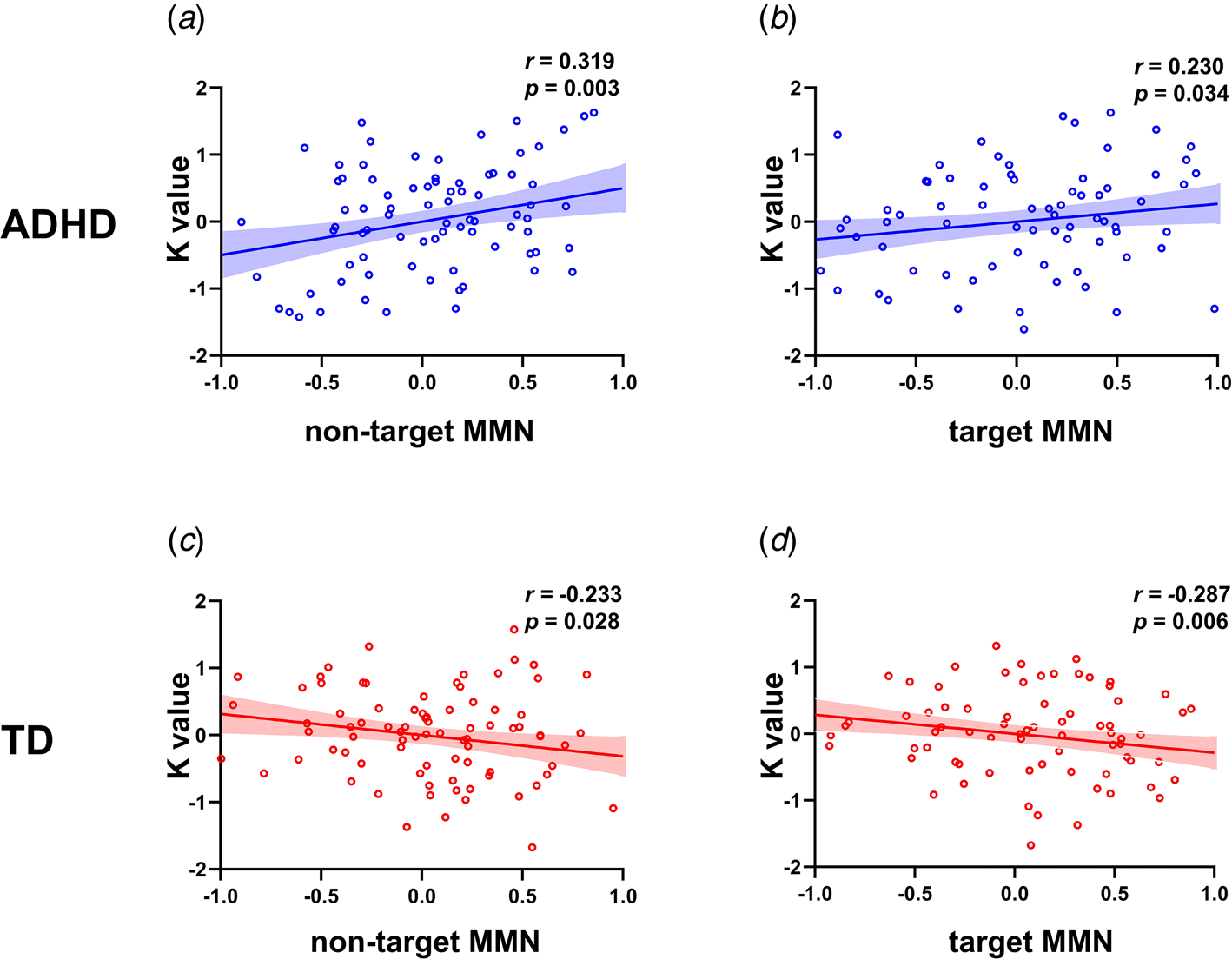
We performed correlation analyses between ERP measures and WM capacity (K2 and K4). The results showed that in the TD group, for both target and non-target sounds, the greater the MMN amplitude was, the greater the K value of the WM capacity (as reflected by the high-load K4 value; non-target MMN: r = −0.233, p = 0.028; target MMN: r = −0.287, p = 0.006) (Fig. 6c, 6d). More surprisingly, the smaller the MMN amplitude was, the greater the K value of WM capacity in children with ADHD (as reflected by the high-load K4 value; non-target MMN: r = 0.319, p = 0.003; target MMN: r = 0.230, p = 0.034) (Fig. 6a, 6b). For both the ADHD and TD groups, no significant correlations were observed between WM and P3a/P3b amplitudes or between WM and the low-load WM volume reflected by K2 and the MMN amplitude (Supplementary Table 2). Additionally, to test whether the Group factor as a moderator influencing the correlation between MMN and WM. We included the Group factor in the regression model. These results indicate that the interaction effect is significant in the model, further suggesting a significant difference in the correlation between the two groups and that the Group factor plays an important role as a moderator(Supplementary Figure 1).
Results of the correlation analysis of the MMN amplitude and WM capacity in children with ADHD and TD children. Note. (a) Correlations between non-target MMN and high-load WM in children with ADHD. (b) Correlations between target MMN and high-load WM in children with ADHD. (c) Correlations between non-target MMN and high-load WM in TD children. (d) Correlations between target MMN and high-load WM in TD children. Ps: The shaded areas represent confidence intervals, usually at the 95% confidence level.
Correlations between auditory MMN and symptom scores
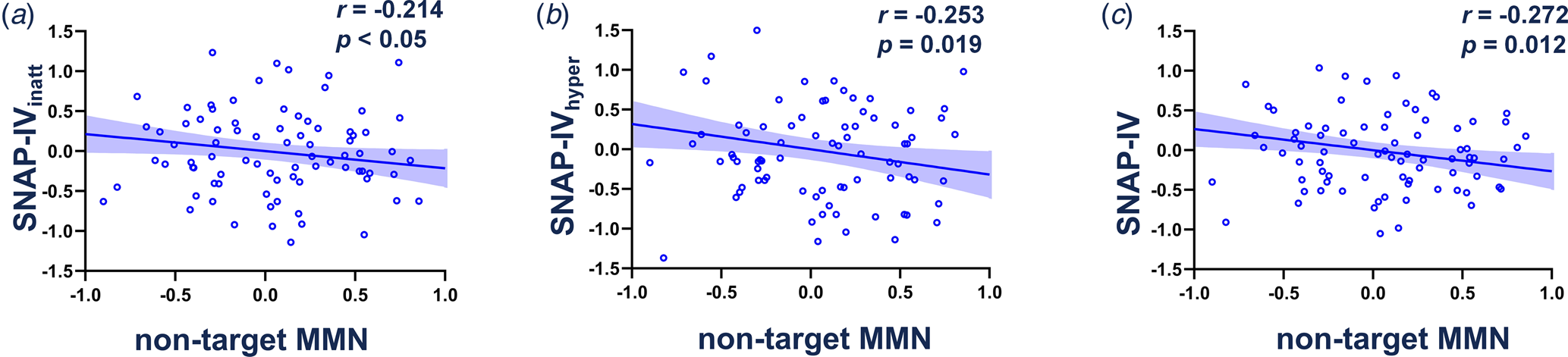
We performed correlation analyses between ERP measures and ADHD symptom scores (Supplemental Table 3). The strongest relationship between the behavioral and ERP measures across the children with ADHD was observed for the non-target MMN amplitude. A smaller MMN amplitude predicted lower scores (lower symptom severity) on the inattention subscale (r = −0.214, p = 0.049), the hyperactivity/impulsivity subscale (r = −0.253, p = 0.019), and their sum (r = −0.272, p = 0.012) of the SNAP-IV in the children with ADHD (Fig. 7). No significant effect was observed for the TD children, and no similar effect was found for the target MMN amplitude or P3a/P3b amplitudes (Supplemental Table 3).
Correlation analysis between the MMN amplitude and symptom scores in children with ADHD. Note. (a) Correlations between non-target MMN and SNAP-inattention scores of children with ADHD. (b) Correlations between non-target MMN and SNAP-hyperactivity scores of children with ADHD. (c) Correlations between non-target MMN and SNAP-full scale scores of children with ADHD.
Discussion
The present study investigated the neurophysiologic basis underlying the associations between auditory change detection and visual WM in children with ADHD. We found that visual WM is associated with auditory change detection in the preattentive stage. Compared with TD children, children with ADHD had lower WM scores and smaller MMN amplitudes for both target and non-target sounds, especially in the right hemisphere. Surprisingly, the smaller MMN amplitude in children with ADHD predicted higher K values for WM capacity (as reflected by high-load K4 values) and lower SNAP-IV scores. In contrast, the greater MMN amplitude in TD children predicted their higher K value for WM capacity (as reflected by the high-load K4 value). Namely, the significant correlation between auditory MMN and visual WM showed the opposite trend in the two groups of children. These results suggest an intimate relationship between visual WM and auditory processing function.
We found that the amplitude of MMN was reduced in children with ADHD, which was consistent with previous research (Kemner et al., Reference Kemner, Verbaten, Koelega, Buitelaar, van der Gaag, Camfferman and van Engeland1996; Kilpeläinen et al., Reference Kilpeläinen, Partanen and Karhu1999; Kim et al., Reference Kim, Baek, Kwon, Lee, Yoo, Shim and Kim2021; Lee et al., Reference Lee, Jeong, Kim and Kim2020; Rothenberger et al., Reference Rothenberger, Banaschewski, Heinrich, Moll, Schmidt and Van'T2000; Zhang et al., Reference Zhang, Qiu, Pan and Zhao2020). Variations in MMN amplitude and latency have been linked to cognitive decline, disease progression, and changes in brain structure (Kim et al., Reference Kim, Kim, Kim, Park, Park, Bae and Jeon2017). Therefore, the reduced amplitude of MMN in children with ADHD may be attributed to dysfunctions in the frontal lobe, leading to the deficits in auditory information processing (Alho, Reference Alho1995). Notably, the reduced MMN in children with ADHD was also observed in visual oddball tasks (Dang et al., Reference Dang, Luo, Zhu, Li, Feng, Xu and Sun2023; Stefanics, Kremláček, & Czigler, Reference Stefanics, Kremláček and Czigler2014). These findings suggest that defects in sensory change detection may be typical characteristics of ADHD, which may be independent of the modality of sensory information. Furthermore, in the present study, ADHD patients presented significantly smaller MMN amplitudes in both the target and non-target conditions, a result suggestive of a general deficit in autosensory processing.
Compared with TD children, children with ADHD presented a lower visual WM capacity in both the high- and low-load conditions, which was also consistent with the findings of previous studies (Alderson, Kasper, Hudec, & Patros, Reference Alderson, Kasper, Hudec and Patros2013; Cockcroft, Reference Cockcroft2011; Kasper, Alderson, & Hudec, Reference Kasper, Alderson and Hudec2012; Martinussen, Hayden, Hogg-Johnson, & Tannock, Reference Martinussen, Hayden, Hogg-Johnson and Tannock2005) and further suggested that a WM impairment is an important feature of ADHD. Studies have revealed significant differences in the brain activation patterns of children with ADHD and healthy controls when the WM load exceeds individual processing capabilities (Ko et al., Reference Ko, Yen, Yen, Chen, Lin, Wang and Liu2013). Specifically, compared with TD children, children with ADHD have weaker functional connections between the right IFC of the brain and the basal ganglia, parietal lobe, and cerebellum during WM tasks (Rubia, Halari, Christakou, & Taylor, Reference Rubia, Halari, Christakou and Taylor2009).
The novel and most critical point from our study is that individual differences in the magnitude of auditory MMN and visual WM capacity were correlated. Larger MMN amplitudes in TD children predicted a better visual WM capacity. In contrast, the smaller MMN amplitudes in children with ADHD predicted a less impaired WM capacity and milder ADHD symptoms. Recent studies suggest that sensory processing underlies executive function (Pastor-Cerezuela, Fernández-Andrés, Sanz-Cervera, & Marín-Suelves, Reference Pastor-Cerezuela, Fernández-Andrés, Sanz-Cervera and Marín-Suelves2020) and ADHD symptoms (Papp et al., Reference Papp, Tombor, Kakuszi, Balogh, Réthelyi, Bitter and Czobor2020), with changes in sensory integration potentially linked to impairments in executive function (Li et al., Reference Li, Wang, Cheng, Li, Feng, Ren and Wang2023a). Carmona et al. (Reference Carmona, Hoekzema, Castellanos, García-García, Lage-Castellanos, Van Dijk and Sepulcre2015) hypothesized that in ADHD patients, sensory processing is dominant, with regions associated with attention and executive function receiving less information, potentially affecting their ability to balance external and internal information. le Sommer et al. (Reference le Sommer, Low, Møllegaard, Fagerlund, Vangkilde, Habekost and Oranje2023) further reported that the ADHD population overreacts to abnormal environmental stimuli, making them more prone to distractions and thus less attentive to the task at hand. In other words, the excessive positive response of children with ADHD to immediate stimuli actually weakens their ability to process complex information. In TD children, the brain is healthy and attentional resources are plentiful. Therefore, the positive correlation between the auditory MMN and visual WM seems reasonable because they might share a common neurophysiological foundation. Owing to a shortage of attentional or cognitive resources, however, children with ADHD exhibited poorer performance in both visual WM and auditory change detection task. This resource limitation results in a trade-off effect: a greater visual WM capacity could reduce an individual's capacity for auditory information processing. We can reconcile our findings that auditory MMN and visual WM are positively correlated across participants when attentional resources are plentiful (reflecting a shared mechanism tin the TD group) while also allowing for a trade-off between the two in the ADHD group (because the shared mechanism has a total limitation).
For TD children, larger MMN amplitudes were associated with a greater WM capacity only at high loads but not at low loads. This result is consistent with the study by Bonetti et al. (Reference Bonetti, Haumann, Brattico, Kliuchko, Vuust, Särkämö and Näätänen2018) of healthy adults. Previous research has shown that WM function under different load conditions is regulated by a coordinated network composed of frontal and occipito-parietal regions, and cross-brain cooperation shows different patterns between the two WM load conditions (Puszta et al., Reference Puszta, Pertich, Giricz, Nyujtó, Bodosi, Eördegh and Nagy2020; Soto, Greene, Chaudhary, & Rotshtein, Reference Soto, Greene, Chaudhary and Rotshtein2012). Our findings further suggest that TD children adopt different patterns in the brain network when faced with tasks with different cognitive loads.
In recent ERP studies, mixed results have been obtained for the P3a amplitude in children with ADHD, and has been reported in different studies as a small increase (Gumenyuk et al., Reference Gumenyuk, Korzyukov, Escera, Hämäläinen, Huotilainen, Häyrinen and Alho2005), a small decrease (Liotti, Pliszka, Perez, Kothmann, & Woldorff, Reference Liotti, Pliszka, Perez, Kothmann and Woldorff2005; Seifert, Scheuerpflug, Zillessen, Fallgatter, & Warnke, Reference Seifert, Scheuerpflug, Zillessen, Fallgatter and Warnke2003) or no significant difference (le Sommer et al., Reference le Sommer, Low, Møllegaard, Fagerlund, Vangkilde, Habekost and Oranje2023) compared with TD children. Similarly, studies of the P3b amplitude are also inconclusive (Barry, Johnstone, & Clarke, Reference Barry, Johnstone and Clarke2003; Gomes et al., Reference Gomes, Duff, Ramos, Molholm, Foxe and Halperin2012; Jonkman et al., Reference Jonkman, Kemner, Verbaten, Koelega, Camfferman, Vd and van Engeland1997; Rothenberger et al., Reference Rothenberger, Banaschewski, Heinrich, Moll, Schmidt and Van'T2000). Our present data showed that the P3a amplitude is significantly larger in children with ADHD than in TD children, but this difference was absent in P3b. P3a is elicited by infrequent non-target or novel stimuli and reflects the orienting response or involuntary shift of attention to these stimuli (Polich, Reference Polich2007). Our findings suggest that both groups of children have a stronger response to novel sounds, but children with ADHD exhibit weaker inhibitory control in response to non-target sounds.
Limitations
This study has several limitations. First, the homogeneity of the sample may be a potential limitation. The present study included only right-handed children with normal IQs, which may limit the generalizability of the results to adequately represent the diversity of the population of children with ADHD. Second, the ecological validity of the WM and ERP tasks used in this study may be limited. Although these laboratory tasks are effective at measuring specific cognitive functions, they may not accurately reflect the executive functioning of children with ADHD in the real world. Executive functioning in the real world involves more complex and variable environments; therefore, future research should design tasks that are more relevant to real-life situations to improve the ecological validity.
Conclusions
Our EEG experiment provides neurophysiological evidence that the visual WM impairment in children with ADHD is at least partially related to deficits in auditory processing function. Our findings provide an explanation for the neurophysiological basis of WM deficits in ADHD patients and highlight the importance of the relationship between auditory processing impairment and visual WM deficits in children with ADHD.
Supplementary material
The supplementary material for this article can be found at https://doi.org/10.1017/S0033291724003076.
Author contributions
Study concept and design: SY, DCP. Data collection: YH, DYY, FT, HST. Data analysis, interpretation and writing of the manuscript: YH, GJL, SY, DCP. Manuscript review and revision: YH, GJL, DYY, SY, DCP. Supervision:, SY, DCP. Verification results: DYY, HJP. All authors accepted the last draft of the manuscript
Funding statement
This work was supported by the STI 2030–Major Projects (2021ZD0200500), the National Natural Science Foundation of China (No.32271094), Fiscal Subsidy Project for the Construction and Development of Higher Education in the Sui districts –2023 Higher Education Quality and Teaching Reform Project of Guangzhou City: Off-campus Practice Education Base for College Students (Guangzhou Medical University in Collaboration with The Affiliated Brain Hospital to Guangzhou Medical University (2023XWSJJD002) and the 2023 Guangdong Province Education Quality and Teaching Reform Projects for Undergraduate Degrees: Developing a Practice Teaching Innovation Model for the Application Psychology Major Using Blended Project-Based Learning and Service-Learning (01-408-2401067).
Competing interest
The authors declare that the research was conducted in the absence of any commercial or financial relationships that could be considered as a potential conflict of interest.
Ethical standards
The authors assert that all procedures contributing to this work comply with the ethical standards of the relevant national and institutional committees on human experimentation and with the Helsinki Declaration of 1975, as revised in 2008.


 Open access

