

Introduction
Michael Lipsky’s seminal work Street-Level Bureaucracy (1980) has generated a lively and expansive field that applies street-level perspectives to the operation of government and public services. Over the 40 years since its publication, much has changed in street-level bureaucracy in advanced welfare states, including growing outsourcing of public service delivery to contracted third parties (both for-profit and not-for-profit), increasing managerialist practices, and introducing and expanding digital technologies in managing, delivering and reporting on public services (Brodkin, Reference Brodkin2012; Hupe et al., Reference Hupe, Hill and Buffat2015). This work has primarily focused on public services in developed countries, while street-level studies of social welfare in developing countries is now growing.
The street-level perspective of public services provides an insightful and flexible research ontology and framework to better understand the lived experiences of government by everyday users and workers. This means that despite often significant differences in social welfare policy and services between developing and developed countries, the framework is likely to be readily deployable to understanding everyday government. Common experiences of evolving social welfare in developing countries include fragile public institutions, minimal public resourcing to support social welfare services, sometimes endemic corruption and varying socio-economic service delivery contexts. Literature also shows that providing social assistance in developing countries is complex and may cause stigma (Roelen, Reference Roelen2020). While comparisons between advanced welfare states (e.g. Esping-Andersen, Reference Esping-Andersen1990) have demonstrated the importance of socio-political and cultural histories and values in shaping the policy and service settings, comparisons of social welfare practices between developed and developing countries are also likely to highlight the importance of non-Western cultures in shaping street-level social welfare services in developing countries.
This paper seeks to better understand how cultural patronage practices intersect with street-level social welfare operations, particularly in developing countries. In particular, the paper aims to answer the following research questions:
-
How do cultural patronage practices influence decision making within street-level bureaucracies in the provision of social welfare?
-
What are the implications of this influence for the lived experience of societies’ poorest?
It does so by examining how patronage practices in Pakistan – called sifarish – operates within Pakistan’s two social assistance programs – Zakat and Pakistan Bat Ul Mal (hereafter PBM). Pakistan also provides an interesting case study because its framing of social welfare is informed by western welfare states and also by Islamic teachings. In particular, eligibility to Zakat’s social assistance programs has religious affiliation criteria. However, it is important to emphasise that this paper is not a critique of Pakistan social welfare’s religious-based philosophy and implementation; rather, its social policy analysis explores insights into how social assistance broadly and street-level operation particularly is experienced by different stakeholders in that context. This focus on cultural practices of patronage in street-level social welfare is also significant as it provides a more expansive way to think about and investigate the role of third parties in street-level organisations.
The paper is structured in five different sections. Following this introduction, the second section provides an overview of the key concepts, insights and observations of street-level bureaucracy and street-level social services research, including the role of culture in such operations. This is followed by a brief outline of the research context and design. The study’s findings cover three topics: the operation and characteristics of sifarish, the necessity of sifarish to access social assistance, and implications for attitudes to fairness and equity. The paper closes with a concluding discussion.
Street-level bureaucracy: cultures and third parties
In 1980, Lipsky’s ground-breaking work about street-level bureaucracy (henceforth SLB) highlighted how policy implementation is not a straightforward process but influenced by a range of factors and forces. In his original work, Lipsky, Reference Lipsky2010 defines street-level bureaucrats as:
Public service workers who interact directly with citizens in the course of their job, and who have substantial discretion in the execution of their work…typically street-level bureaucrats are teachers, police officers and other law enforcement personnel, social workers, judges, lawyers and other court officers, health workers and many other public employees who grant access to government programs and provide services within them (p. 3).
Lipsky and others have found that street-level bureaucrats (in this paper, named street-level workers (SLWs)) are often inadequately resourced, exercise discretion in operation (Lipsky, Reference Lipsky2010), play a key role in the ‘making of public policy’ (Brodkin, Reference Brodkin2011), and their decisions directly decide the fate of citizens (Hupe et al., Reference Hupe, Hill and Nangia2014; Hupe et al., Reference Hupe, Hill and Buffat2015; Lipsky, Reference Lipsky2010; Thomann, Reference Thomann2015). Instead of the traditional top-down view of policy implementation, SLWs execute it bottom-up.
This street-level perspective recognises that SLBs operate at the interface between the formulation of formal policy by the government and the implementation and operation of policy programs. This occurs where ‘citizens experience directly the government they have implicitly constructed’ (Lipsky, Reference Lipsky2010. P. xi); this interaction is significant in that it acts as a relationship between citizens and the state (Brodkin & Majmundar, Reference Brodkin and Majmundar2010). Challenging the traditional distinction between policy formulation and implementation, Lipsky argues that SLWs make or enact policy through their decision-making processes (Reference Lipsky2010). Thus, policy should not be understood as formulated in legislatures and at top-level administration only. It is also made day-to-day in public ‘crowded offices’ when SLWs decide cases, ‘establish routines’, and create new ways to deal with workloads and ‘uncertainties’ (Lipsky, Reference Lipsky2010. p. xiii). To an extent, SLWs are those who formulate policy more than the ones who implement it (Hupe & Hill, Reference Hupe and Hill2007). Their role as policymakers relies on factors like relatively high discretion (Lipsky, Reference Lipsky2010; Brodkin, Reference Brodkin2012) that opens avenues for their personal preferences to influence their decision making (Maynard-Moody & Musheno, Reference Maynard-Moody and Musheno2000; Zacka, Reference Zacka2017).
A plethora of literature speaks about how SLWs determine who receives benefits or services and who misses out. Their decisions are shaped by a range of organisational and individual factors, including eligibility criteria, policy guidelines available resources (Hupe et al., Reference Hupe, Hill and Nangia2014), personal judgments and preferences (Keiser, 2010; Keulemans & Walle, 2020), organisational conditions (Cohen, Reference Cohen2016), and available services (Cooper et al., Reference Cooper and O’Donnell2015). Constrained resourcing in frontline work is a key factor precipitating the need for discretion as judgments need to be made about resource prioritisation. The gulf between scarce resources and demand is often vast (Vedung, 2015).
Apart from individual and organisational factors, an essential piece of the jigsaw of street-level decision making is culture (Cohen, Reference Cohen2016; Peeters et al., Reference Peeters, Trujillo Jiménez, O’Connor, Ogarrio Rojas, González Galindo and Morales Tenorio2018) and the influence of local cultural practices. Existing evidence suggests that perceptions, values, economic incentives and adherence to law are the factors that influence the decision-making processes at the street level (Cohen & Gershgoren, 2016; Keiser, 2010). However, Cohen emphasised that ‘scholars avoid pointing to culture as a significant factor in understanding SLBs’ discretion’ (2016, p. 176). Indeed, the role of a society’s culture in shaping street-level decisions is not, as far as we can find, substantially dealt with in research in SLB in Western countries. Cohen’s own research undertaken in the context of Israel’s health system emphasised the significance of preferential cultural practices (such as financial incentives and professional quid pro quo relationships) and their impact on the operation of street-level organisations, including access to limited resources. Moreover, in different parts of the non-Western world, a growing body of literature now highlights the social, economic, political and cultural factors affecting street-level operation (Hudson et al., Reference Hudson and Peckham2019; Zarychta et al., Reference Zarychta and Andersson2020; Peeters, Reference Peeters, Trujillo Jiménez, O’Connor, Ogarrio Rojas, González Galindo and Morales Tenorio2018; Iyer & Mani, 2012; Callen et al., Reference Callen, Gulzar, Hasanain, Khan and Rezaee2023) emphasising different epistemology (Russ-Smith et al., Reference Russ-Smith, Farwa and Wheeler2023). To be sure, while Lipsky referred to organisational cultures of bureaucracy, that is, informal organisational practices, by ‘culture’ we refer to broader cultural practices (socio-political behaviours) that occur in society and carry a profound, meaningful impact on everyday life of a citizen as well as organisational operations.
In addition to culture, our study focuses on third-party actors in SLBs. In the 40 years since Lipsky’s original work, governments, particularly in anglophone countries, have increasingly used commercial and not-for-profit organisations to deliver government-funded social services. Agencies largely delivered social welfare services in many Organization for Economic Co-operation and Development (OECD) countries through contractual relationships under processes of partnership, outsourcing or quasi-marketisation (Goodwin & Phillips, Reference Goodwin, Phillips, Meagher and Goodwin2015; Petersen & Hjelmer, Reference Petersen and Hjelmar2014; Powell & Exworthy, Reference Powell and Exworthy2002). Accordingly, such third parties are enmeshed into formal contractual relationships with the state that become quasi-state actors and are intended to act according. While the operation of such formal third-party actors are well examined in street-level research, the literature has little to say about the role of informal third parties, namely actors that are involved with or influence the operation of SLBs and the decision-making of SLWs but who have no formally recognised role in the process.
We posit that socio-cultural practices can operate as informal influences and contributors to the operation of and decision-making in SLBs, and that those culturally sanctioned actors are informal third-party actors. Informal practices can be understood as behaviours that are embedded in culture, not institutionalised nor formalised, as Cohen observes: ‘Behaviors stemming from informal, culturally based practices are a phenomenon evident in societies worldwide and are a major factor that influences public policy processes’ (2016, p. 176). Indeed, it is operation of cultural patronage practices that we seek to understand and investigate. Such informal third-party patronage actors, especially in developing countries, may include a local influential, community gatekeeper (government teacher, local cleric), local government representative, a lawyer or a public servant. Given very little research has been undertaken into the existence, role and impacts of such informal third-party actors in SLBs our research is significant in advancing the recognition of cultural practices and the operation of SLBs beyond formally recognised actors. As public institutions are often weaker in developing countries, we hypothesise that cultural practices of patronage play a more significant role in SLB decision-making than in developed countries. At the same time, the insights from developing countries may provide an impetus to consider informal cultural practices shaping SLBs in advanced welfare state. By studying such practices, a more comprehensive and nuanced understanding of SLBs can be developed, and new patterns in the factors shaping street-level decision making can be discerned.
Cultural patronage practices
Cultural practices of patronage are regularly observed in different countries and contexts. These are widespread in many societies, such as Goanxi in China, Jaan Pehchaan in India and Tadbeer in Bangladesh (see Table 1). These practices are embedded in their respective societies. Undoubtedly, patronage is not unknown within Western developed countries, though as Max Weber observed, it was the development of state bureaucracies that objectively applied rules that sought to reduce the influence of personal connections on public services (Weber, Reference Weber1978). Interestingly, patronage is understood to operate more widely in developing nations where bureaucratic state institutions may not be well developed.
Patronage practices in different countries
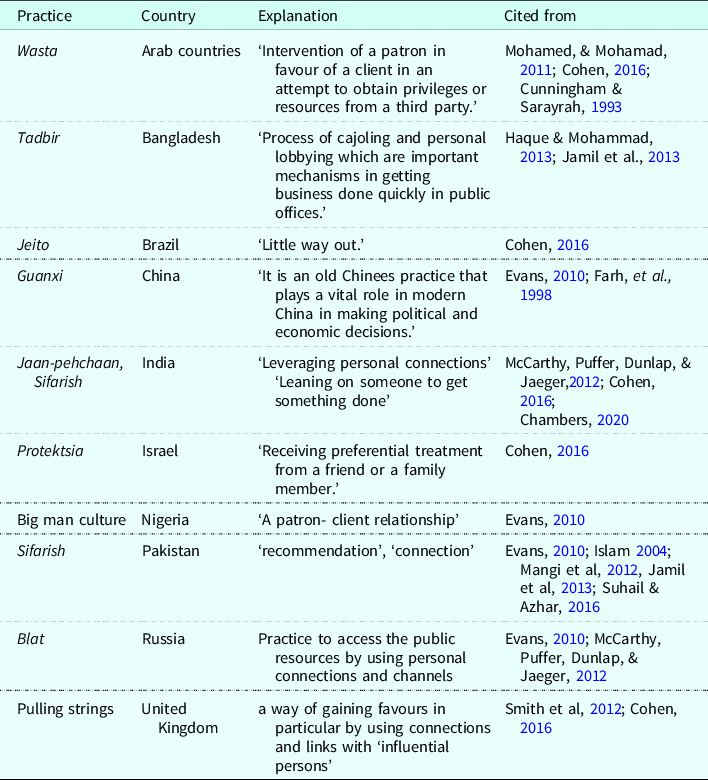
Given the present study was undertaken in Pakistan, it is important to understand the meaning of sifarish, an Urdu word used to refer to a strong informal localised personal reference system. Its closest translation in English is ‘recommendation’, ‘reference’ or ‘use of social connections to obtain ends’. It operates as a reference/recommendation system to acquire something, get a task done or obtain a favourable decision. Based on power, political, cultural and social relations, Sifarish involves a recommendation by a person (sifarshie) in a powerful political, social, religious and economic position for a favour (e.g. favourable decision, access to service) from a functionary (someone in a position to grant the favour). In Pakistan’s administrative culture, Islam explains that sifarish ‘involves finding a relative or close friend [or someone who has influence] who knows the functionary’ (2004, p.322). Hence in this research, sifarish refers to using connections that allow people access to services. Sifarish is the action/practice, and the person undertaking this action, the actor, is called sifarishie in the studied culture. This paper utilises both words as appropriate to discuss this cultural practice.
It is important to clarify that we investigate sifarish’s actual operation as an everyday practice in frontline decision making. Accordingly, we do not reify it as an archetypical practice. Our research is from a culturally neutral standpoint to understand how sifarish operates in this context and eschew the normative Western cultural perspective whereby patronage is chiefly viewed negatively and a possible breach of due process. We need to understand these practices from within the culture rather than judging them from the outside. Judging such practices from the outside is seen as an ontologically reductionist approach (Ruud, Reference Ruud2000) that, ‘… prevents us from understanding that these are practices developed within a fully mature normative system of no less moral validity than any other normative system’ (Smith, Reference Smith2001). Indeed, ethnographies conducted in South Asia and other parts of the world illustrate various patronage practices that operate beyond the simplistic interpretation of corruption (e.g. Shah, Reference Shah2009; Ruud, Reference Ruud2000; Smith, Reference Smith2001; Piliavsky, Reference Piliavsky2014). We thus avoid making a judgment of sifarish as positive or negative; but seek to understand how participants experience and evaluate sifarish.
Research context and design
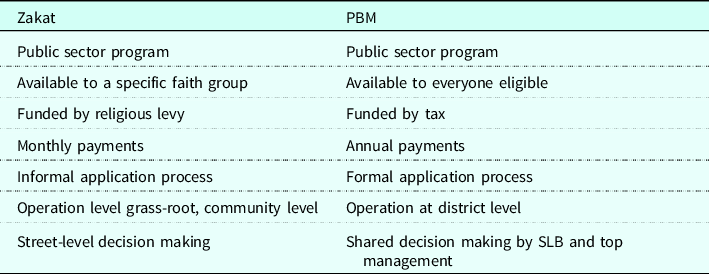
The current study focuses on two social assistance programs in Pakistan: Zakat and Bait-ul-Mal. While both programs consist of various initiatives, this study reports on the cash transfer components known as Guzara Allowance (subsistence allowance) in Zakat, and Individual Financial Assistance (IFA general) in PBM. The overview comparison of both programs is provided in Table 2. Zakat in Pakistan is financed as an annual religious tax levied upon Muslims owning a significant amount of wealth. It is collected by the government as an individual 2.5% tax on different assets (Sayeed, Reference Sayeed2004). In contrast, PBM is financed by federal government general revenue (Kabeer et al., Reference Kabeer, Mumtaz and Sayeed2010; Sayeed, Reference Sayeed2004; Yusuf, Reference Yusuf2007), making it vulnerable to economic conditions. Zakat is offered to a specific faith group (Muslims), while the PBM is universally available. Unlike Zakat (subsistence allowance), which is paid monthly, IFA general is one-off payment per annum. In Zakat, benefit decision making occurs at the local community level, whereas in PBM it is largely made by SLWs but with input from higher level regional management.
Program overview
Matrix of participants
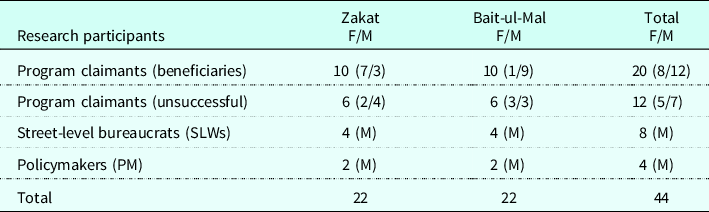
This paper draws on findings from a doctoral study of the first author who has lived experience of living within Pakistan and its culture. A qualitative approach was adopted where 44 in-depth interviews were used to understand the operation and experiences of these programs from the perspective of four different participant groups: beneficiaries; unsuccessful claimants; street-level bureaucrats; and policymakers.
The study was conducted in four districts of Punjab, one of Pakistan’s provinces. The districts were selected for several reasons, including their high poverty rates, language, accessibility and safety. Purposive sampling followed by snowball sampling was used to recruit participants who met the inclusion criteria. Following gatekeeper approval from Zakat and PBM management to conduct the research, localised SLWs assisted in claimant recruitment by providing the researcher’s contact information to the claimants and the contact of interested claimants to the researcher with their permission. Interviews were conducted in the participant’s preferred location, which was often their house or residence. Semi-structured interviews of an average length of 60 minutes were conducted in participants’ native language, audio-recorded, and then transcribed and translated by author one. All interview data was coded and thematically analysed in an iterative and interactive process between the authors. Different participant types and programs were analysed separately initially using an inductive approach and then patterns of similarities and differences within and across these different participant groups were identified. During analysis we were alert to key ideas and concepts from SLB literature, such as rationing and discretion. As an interesting and prominent area, this paper reports only on the role of sifarish identified from our analysis. Ethical approval for the study was obtained from The University of Queensland. Pseudonyms are used in reporting. Information about claimants and SLWs was extensively deidentified to remove the risk of identification and its potential effect on the receipt of benefits and employment.
Findings
Findings are reported in three main sections. First, the role of sifarish in helping claimants navigate and access Pakistan’s social assistance systems is reported. Second, sifarish is a necessary conduit to access the system, and third, the implications of sifarish’s role for participants’ perceptions of fairness are provided.
The operation and characteristics of sifarish
In the context of research, sifarish was found to be highly important for the receipt of cash transfers. An overwhelming majority of the research participants emphasised and acknowledged the operation of sifarish/sifarishie across participant groups and in both Zakat and PBM, but at different organisational levels where in Zakat, it was more explicit and in PBM highly implicit. While sifarishies operate locally in the Zakat system, in PMB, it is prevalent at higher levels of the bureaucracy. Interviews identified that the sifarishie typically recommends an applicant to the SLW in Zakat, or to the public officials in PBM, who consider the application to grant benefit. Participants also identified that the sifarishie as a recommender is not necessarily a powerful person in the community. They can be a relative or a friend of the decision maker with a level of influence/access to SLWs. Five different sifarishies/channels were identified in this study: employers; political actors; key community leaders; heads of trade unions; and family, friends and neighbours (employed in either organisation). As explained in a separate sub-section below, sifarishie’s role was found to be an enabler of access to social assistance and a channel of information and informal assessment. For Skeena, it was the district court lawyer who lived in the neighbourhood, and she worked as a seamstress for his family.
When I heard about the benefit, I spoke to him [district court lawyer]… I received it because of him; otherwise, I would still be standing in the queue. (B-ZakatFootnote 1 )
A sifarishie can equally be an SLB insider:
You know the clerk of the [PBM] office, he made things possible for me. I am illiterate and know nothing about these complex processes. (Hamza, B- PBM)
Sifarishies exercise different levels of influence. All participant groups, whether explicitly or implicitly, discussed that a vital characteristic of the sifarishie is their strength, being ‘strong’. There were instances where claimants had sifarishie, but they were not ‘strong enough’ to act as a conduit to receipt of welfare. This happened with Akbar, where sifarishie’s help/sifarish did not work couple of times. Another beneficiary said:
You need to have a strong influence, a good sifarish…. So, if the sifarish is strong and you go, then they will simply grant you the benefit. (Khadija, UA-PBM)
Fazal, one of the Zakat SLW, honestly spoke about the phenomena:
Sometimes applicants come with sifarish of the opposite political party representative…. Sometimes applicants have sifarish from the district office as well…. In such instances, we reject already selected beneficiaries and consider those who have strong sifarish but meet the criteria….in general, we evaluate applicants on the level of their hardship, yet those with sifarish are also there (SLW-Zakat).
Explicitly in this quote, we see that benefit decision making is being made by balancing both need (“hardship”) and (the strength of) sifarishie.
It is not only essential to have sifarish, but the significance/worth of that sifarishie is equally important. Sometimes sifrishie promise to do sifarish, and then either they do not do it, or they are not strong or influential enough to compel the SLW. The strength of sifarish was perceived to be closely related to the success of an application. It thus may appear that sifarish acts as an obligatory passage point (Callon, Reference Callon1984), a necessary informal requirement, to access social welfare, pushing that applicant into the position of privilege. This is not to say that beneficiaries might be ineligible for the benefits. Author one observed that people receiving the benefit were indeed poor, and likely to meet eligibility criteriaFootnote 2 , but those having sifarish entered the system with relative ease.
Sifarish’s role in accessing benefits
A large majority of (successful and unsuccessful) claimants (26 of 32) said that a sifarishie is instrumental in receiving cash benefits. Claimants believed that one needs to have a sifarishie to receive payments, while one of them explained that though she was poor, she was denied support until she used a sifarishie to get it:
My neighbour, an influential government official, told me that the [Zakat SLW] is distributing the benefit. So, I went to him, and he said, ‘“I do not have any funds, I have no money, and you better go to Bait-ul-Mal and ask them they will give you a cheque’ (sigh). Then that government officer did sifarish for me…. and I received the benefit (Rabia B-Zakat).
Her account is an example of Gaal and Mckee’s (Reference Gaal and McKee2004) observation of claimants devising new ways of accessing services using informal channels such as personal connections. This also demonstrates that sifarish acts as a channel of prioritisation. Several participants strongly reinforced this opinion that a sifarishie plays a crucial role in access.
Apart from the majority who talked about the prevalence of sifarish, a small proportion of the claimants denied it operated. Interestingly, those who denied its existence had used sifarishie in the process; they did not acknowledge it or did not want to acknowledge it.
Similar to claimants, all the SLWs and one policy maker acknowledged the prevalence of sifarish in the system. The necessity of sifarish was reinforced by management at the PBM district office saying that due to limited funds, all the successful PBM applicants in that district would have had used sifairsh. However, they did not explicitly link sifarish to benefit decision-making. To refer to sifarish/sifarisie, SLWs also used English words such as ‘reference’, ‘assurance’, ‘recommendations’, ‘pressure’, ‘influence’, ‘approach’ and ‘personal link’, interchangeably. Apart from accepting the external influence, many administrators claimed they decided cases on merit and rejected any sifarish. However, Fazal was an exception among SLWs speaking frankly about the phenomena, saying, ‘If someone says that we do not consider sifarish, they are lying (laughter)’. (SLW, P1)
Asad similarly commented:
You know, there is sifarish in our broader social system. Suppose there are five applications of deserving people and one must decide on a successful applicant among them, the decision will favour the deserving with approach [sifarish], especially in the current scenario when there are no funds. So, then it is kind of a constraint for us. Everyone has an equal right. But if the funds are limited, the decision will favour the one with sifarish. Yes, these are our constraints and realities. (PM)
The prioritisation of clients using sifarish is evident in this account, and that a lack of funding is a critical challenge that administrators face, a well-repeated theme in SLB research (e.g. Lipsky Reference Lipsky2010). Thus prioritising claimants by using sifarish can be viewed as a resource management strategy. Sifarish prioritises claimants within resourcing constraints. Although administrators were reluctant to acknowledge the role of sifarish, using different words, they all recognised its existence, which directly corresponds to what successful and unsuccessful claimants said.
Apart from acting as a reference system, sifarishies also provide access to Zakat and PBM by informing those who did not even know about the program and offering them access. Instead of applicants, local influential often initiated access for the potential beneficiaries offering their help. They would do this because they believed the beneficiary was marginalised and needed this benefit, so they recommended potential beneficiaries to SLWs.
I work at the home of a session judge as a helper. One day I was sharing my problems with his wife, and he overheard. He asked if I would be interested in receiving this benefit, I agreed. What else could I have asked for? He did sifarish for me, and I received the benefit. (Malka, B-Zakat)
The president of a trade union recommended several PBM claimants. SLWs found a sifarishie’s intervention helpful in making hidden ‘eligible’ claimants visible and increased access to the program to those most in need yet invisible:
Sometimes with sifarish, we can access people whom we cannot access otherwise. So, it sometimes acts as a facilitator in accessing hidden populations who really need such benefits. One of my friends recommended a potential beneficiary who otherwise would never be able to access the system due to her social, cultural and physical constraints. (Akram, SLW-PBM)
In providing access into social welfare, sifarish operates as a navigator and guide into the social assistance systems. Sifarisies operate at two levels. In the first instance, claimants used them to make themselves visible to the social assistance system, a different way of representing themselves as eligible. On the other level, they helped the effectiveness of the system by making hidden vulnerable groups visible to SLWs.
Implications of Sifarish
Although benefits were observed to be distributed to the most marginalised of the population, there was still an element of privilege amongst those with sifarish. Sifarishies make SLWs select between eligible claimants in the backdrop of limited resources (benefit available for ten among eligible 100 applicants). This processes of selection raises issues of equity and fairness; however, in this context, it is equally about the interconnection of classic street-level debates of winners and losers of policy, resource constraints and official discretion. Claimants recognised that the operation of sifarish in the system is unfair, and one must be able to receive the benefit without sifarish. However, they agreed that those who receive it with or without sifarish in most instances are equally poor.
Look, I have received the payment, but my neighbour did not; she is experiencing even more financial adversity than I, but she couldn’t find a ‘reference’ [another word for sifarish]. I’m not too fond of this idea. If the benefit is for the poor, why do you need a sifarish? (Musarrat, B, P2)
Most claimants recognised having a sifarishie as a kind of informal eligibility criteria, a way one makes themselves ‘legible’ to the system (Sweet, Reference Sweet2019), was required to access benefits. Given sifarish not only enables people to receive the benefit it is also a perceived barrier for those who do not have one. Asif’s perspective offers interesting insights into the system:
Here almost 70% of the population is aware that PBM provides financial assistance. … However, they don’t have access. … Since they don’t have sifarish, this keeps them from applying for the benefit. … Their quest for sifarish will not end until… they receive the benefit without any sifarish. (B-PBM)
As Asif explained, the absence of sifarish can keep potential recipients from applying to a program established to support them. As a result, people do not approach the program, not because they are not eligible but because they lack a patron required to enter the system. Lipsky (Reference Lipsky1984) describes some similar processes as ‘bureaucratic disentitlement’, that is, administrative processes that effectively stop people from receiving the benefits or services they are formally entitled to.
Sifarish raises important questions about access and equity to social assistance, which in turn raises questions about its impact on discretion in officials’ decision making. Sifarish is a widespread phenomenon (Islam, Reference Islam2004) and has become part of Pakistani culture. Despite being a widespread element of social functioning, it was not necessarily characterised as a clear ‘good’ or ‘evil’. Individuals’ interpretation was profoundly personal; different participants and groups viewed it differently. Having insights into the broader social system, one of the policymakers called sifarishie ‘facilitator’:
People try to find their facilitator, someone who can help them do their task or job. This is how our system is. (Ahmed)
In this way sifarish is a reality of society in which Pakistan’s social assistance system operates. Though sifarish is not always free of negative connotations. SLW Aslam used the word ‘assurance’, choosing to avoid the word sifarish as it may not be considered positive. While talking about it, almost all the SLWs recognised the role of sifarishie as part of the ‘culture in Pakistan’, Raza articulated:
Yeah, people try to come through sifarish; you know it is part of our system. They try to exert political and other pressures… people, have kind of accepted that they need an approach to access the system. But the problem for us is the budgetary constraints, which complicates the situation…. Among eligible poor, we pick those with sifarish. (SLWs, PBM)
Left with limited resources to distribute among the claimants who may or may not have a sifarish, SLWs argued that everyone who received benefits was eligible and deserving; however, they choose claimants with sifarish, thereby enacting a different form of discretion coming from outside.
Look, you know we have to listen to sifarishie, but we cannot acknowledge it, as it will question our fairness. We are not unfair; the benefit still goes to the poor. (Noor, SLWs - Zakat)
As this quote suggests, the operation of sifarish is not completely desirable, but nor does it undermine the goal of social assistance going to people who need it. It operates as a necessary element of the functioning of the system.
Operation of sifarish is part of broader processes of social life in that setting that also impacts organisations. The way sifarish operates, in this case, is not seen as disruptive or destabilising street-level processes. Instead, it has been a facilitator in certain situations. For instance, one of the SLWs claimed that without sifarish he would not be able to identify and grant assistance to some beneficiaries; sifarishie made them aware of particular clients. Our findings accord with Chambers who finds that ‘sifarish is not seen as inherently immoral but contains both moral and immoral modes (a continuum) of performative acts’. (Nadeem & Kayani, 2017 in Chambers, Reference Chambers2020)
From a Western perspective, one might characterise sifarish as a ‘bad practice’. However, the cultural and socially embedded nature of sifarish, like other similar practices, does not make it morally and ethically justified. It raises questions of equity. The operation of a reference system implies greater success for those who are better connected; the one with sifarish has privileged access, and that makes them a winner of the practice, which is inequitable. In both programs, winners are those with better social connections and social networks. This does not necessarily mean they are non-deserving and not poor but are the poor with better networks and connections. Sifarish work as a testimony to poverty, pushing that person into the position of privilege among other equally poor claimants. The question of equity becomes even more explicit in this instance.
In summary, the operation of sifarish created questions about equity in the receipt of Pakistan’s social assistance programs. At the same time, there was an acceptance of its existence, a necessary evil, for eligible claimants to receive benefits, which was a structural component in the fabric of society. Using the SLB lens, sifarish can be seen as enacting a form of discretion – by both sifarishie and SLWs – within a resource constrained environment where bureaucratic processes are flexible, and operation is affected by informality.
Concluding discussion
The purpose of this paper was to examine the role of cultural patronage practices as informal third-party actors within street-level welfare organisations. It did so by investigating the role of Pakistan’s sifarish practices in two social assistance programs: Zakat and Bait Ul Mall. Sifarishies were widely reported as operating in both social assistance programs. They play an important role in benefit decision making by SLWs, but the way sifarish was experienced by claimants and SLWs was different within and across the programs. Sifarishie operated in a nuanced, subtle or less visible manner in the PBM, whereas it was overt in Zakat. Its operation contributed significantly to the experiences of claimants in both programs, while many SLWs acknowledged its presence, whether implicitly or explicitly. As the claimants are often ‘too weak’ and have no social voice to receive necessary social services (Nielsen, Reference Nielsen2006), they devised new ways to access goods and services by channelling their claims through personal connections (Gaal & Mckee’s, Reference Gaal and McKee2004). For most marginalised groups, access to goods and services involves intermediaries (Chambers, Reference Chambers2020). Such workarounds may seem reminiscent of the workarounds Lipsky observed among SLWs to manage the tensions and challenges in operating SLBs; however, the operation of sifarish possesses unique characteristics.
Several writers have previously discussed the operation of the informal cultural practices of patronage in the operation of social policy in developing countries. Evans states that:
[Informal cultural practices help us understand] society which can only be fully grasped with reference to the cultural context, in particular how the informal networks of patronage operate. (2010, p. 19)
Cohen focuses on behavioural links to policy, stating that cultural practices influence the policy process. ‘Hence, even after decades of democracy, informal activities may still exist in a society, while traditional and formal policies are marginalised’ (2016, p. 3). Sifarish was observed to play an essential role in welfare benefit decision making and has implications for the operation of power in wider Pakistani society. As Sherif (1966, p.14 cited in Evans, Reference Evans, Jones, Lane and Schulte2010) explained, …social norms are powerful, and although not unchanging, can provide significant insights into how decisions are reached.
Lipsky’s (Reference Lipsky1980) street-level research and those following his approach have not often mentioned the significant role of culture in the work of SLBs. This study of the culturally embedded patronage practice of sifarish provides a novel observation about the nature of street-level bureaucracy operating in the global south. Several other studies observe that sifarish plays a crucial role in Pakistan (Evans, Reference Evans, Jones, Lane and Schulte2010; Jamil et al., Reference Jamil, Askvik and Dhakal2013; Khilji, Reference Khilji2003; Islam, Reference Islam2004; Ismail, Reference Ismail1999; Suhail & Azhar, 2016; Mangi et al., Reference Mangi, Jhatial, Shah and Ghumro2012), which suggests such informal processes do impact on decision-making processes in other sectors as well as social protection. This cultural practice is embedded in SLBs, and the culture of society gets enacted in that culture of bureaucracy resulting in the operation of a different form of discretion. Due to its highly ambivalent nature, one cannot determine whether it is entirely positive or negative; we have found that it is both in receiving financial assistance for most underprivileged groups in the country and creates a different form of inclusion/exclusion (Carswell & De Neve Reference Carswell and De Neve2020). This practice is ‘normatively constructed and understood within its own localised moral and ethical frameworks…. it also forms a deeply embedded web of infrastructural conduits through which people/state interactions take place’ (Chambers, Reference Chambers2020, p.11). In contrast with the global south, to the authors’ awareness, no research has highlighted cultural patronage practices affecting street-level bureaucrats in the global north, arguably due to the belief that high formalised public administration practices and strong institutional governance and policy processes elide such practices.
This study of the operation of sifarishie offers another novel finding to street-level research relating to the role of third parties. Sifarish operates as an informal third party in the street-level operation of Pakistan’s social assistance program. This phenomenon is, firstly, distinct to influence of political operatives in governmental policy making, which occurs within the political realm. It is also distinct to the formal third parties increasingly operating to deliver of social services in the global north, most notably in continental Europe’s long-standing social partners or in Anglophone countries’ quasi-marketisation and contractualisation to private and not for profit organisations (Henman, Reference Henman, Henman and Fenger2006). Such formalised third parties act as authorised quasi-state actors according to government policy. They do not influence decision making as outsiders. What this study finds is that sifarish introduces another third-party actor – albeit informal – in decision making and in doing so, becomes part of the street-level policy making processes Lipsky identified decades ago.
In conclusion, this paper’s finding of the importance of socio-cultural (patronage) practices in street-level decision making points to the need for street-level research to give greater attention to both the cultural settings in shaping street-level practices and the role of informal third-party actors in street-level decision making, especially in the global north where bureaucracies and state agencies are often conceived as neutral machines acting according to rules, albeit with administrative/professional discretion to enable policy to respond to the complex circumstances of street-level bureaucracies and their clients.
Acknowledgements
We thank the anonymous referees for their useful suggestions. Dr Farwa would like to express her deepest gratitude to her spouse Faisal and her secondary supervisor, Dr Rose Melville, for their invaluable support in this research.
Competing interests
The author(s) declare none.


 Open access

