

I. INTRODUCTION
Recent technological developments have increased the prospects of the commercial use of outer space beyond satellite applications, such as space mining and manufacturing in space. Known as the NewSpace economy, the array of potential opportunities increasingly available to the space industry is expected to create a multi-billion market which is already attracting significant public and private investments.Footnote 1 At the same time, the possibility of new market forces establishing themselves on a first-come, first-served basis runs the risk of widening the economic gap between the countries possessing financial and technological capabilities to perform space activities and those without. This begs the question of whether international law is equipped to regulate the distribution of the benefits stemming from commercial activities in outer space.
The Outer Space Treaty (1967) is the foundational document regulating the permitted uses of outer space.Footnote 2 Ratified by 113 States,Footnote 3 it is widely acknowledged to be the constitution for outer space.Footnote 4 Article I, paragraph 1 states that ‘[t]he exploration and use of outer space … shall be carried out for the benefit and in the interests of all countries, irrespective of their degree of economic or scientific development’. Drafted at the height of the Cold War, the Outer Space Treaty establishes guiding principles for the peaceful uses of outer space without concerning itself with specific types of space activities, whether scientific or commercial in nature. In this respect, it has a comprehensive scope.
However, the provisions of Article I, paragraph 1 lack an implementing mechanism. As a result, States and scholars alike hold different views about the content and scope of the obligation to share benefits deriving from the exploration and use of outer space. In practice, States have largely overlooked the obligation of benefit sharing, leading scholars to conclude it is only a moral, as opposed to a legal, obligation.Footnote 5 In the absence of an implementing mechanism, can the requirement of benefit sharing as set out in the Outer Space Treaty be implemented by the actors (public or private) engaging in commercial space activities and subsequently enforced by a court of law?
Scholarly positions on the extent to which the benefit sharing obligation applies to commercial space activities can be grouped into three streams. The first requires States to perform space activities that are not detrimental to other States without necessarily sharing the benefits deriving from their space activities (a negative conception of benefit sharing).Footnote 6 Effectively, it embeds the logic underpinning the claim to exclusive rights under the freedoms of the high seas prior to the adoption of the Declaration of Principles Governing the Seabed in 1970.Footnote 7 The second requires States to perform space activities that benefit all States simultaneously, irrespective of the degree of actual benefit generated for individual States (a positive conception of benefit sharing).Footnote 8 It posits that, as an area beyond State jurisdiction like the oceans, outer space possesses the status of common property.Footnote 9 The third requires States to perform space activities that substantively, and not merely formally or nominally, benefit all States (a distributive conception of sharing).Footnote 10 This takes into consideration the capability of the recipient State to benefit effectively from the space activity performed. In other words, it entails equitable sharing considerations.
These streams of thought tend to provide rigid interpretations of the content and scope of the benefit sharing obligation through selective comparisons with the law regulating other global commons, in particular the law of the sea.Footnote 11 As a result, they present benefit sharing as a unitary concept which applies indiscriminately across various fields of international law. This article takes a different methodological approach to the problem of implementation (and possible enforcement) of the benefit sharing obligation in the context of commercial space activities. First, it reconstructs the web of provisions under international space law referring to the concept of benefit sharing in order to identify the extent to which they supplement or depart from the text of the Outer Space Treaty. In doing so, it identifies underlying legal concepts informing the obligation of benefit sharing, such as the legal status of outer space and its resources.
Secondly, the article examines how subsequent State practice has imparted different shades of meaning to Article I, paragraph 1 of the Outer Space Treaty with a view to conceptualizing the structure of the obligation and identifying the ultimate goals that States seek to achieve through benefit sharing, such as ensuring equitable access to outer space for all States. In doing so, it provides an empirically grounded analysis based on extensive archival research. The documents consulted include the annual reports adopted by both the United Nations (UN) Committee on the Peaceful Uses of Outer Space (COPUOS) and its Legal Subcommittee as well as the official statements made by delegations since 1986, the year in which a group of delegations proposed the inclusion of benefit sharing on the agenda of the Legal Subcommittee.Footnote 12 The empirical investigation also identifies the specific actions envisioned by States to achieve the set goals, such as the role of international cooperation in the implementation of the benefit sharing obligation.
Thirdly, taking stock of the analysis on subsequent State practice, the article elaborates an implementing mechanism for the benefit sharing provision in the Outer Space Treaty—namely, an original proportionality test. Given that States remain responsible for the activities in outer space carried out by private entities under their jurisdiction,Footnote 13 the design of the proportionality test enables any space actor (whether public or private) to apply it to their commercial activities, thus embedding an inclusive conception of benefit sharing under international space law. A unique aspect of the proportionality test is that its component elements have been identified and developed through the technique of extrapolation instead of analogy with the global commons.Footnote 14
By bringing together legal concepts and principles found in documents regulating areas of international law other than space law, extrapolation is instrumental to the elaboration of a normative standard aimed at facilitating the implementation (and potential enforcement) of the benefit sharing obligation under the Outer Space Treaty. For the purposes of this article, the process of extrapolation focuses predominantly on three areas regulating the equitable use of shared resources—namely, the law of non-navigational uses of international watercourses, the law of transboundary aquifers and the international protection of the atmosphere—the main reason being that they focus on the use of non-living resources, like those involved in commercial space activities.
A recognized advantage of extrapolation is that it allows gaps in the law to be filled by building on existing standards rather than inventing new ones which may lack legitimacy.Footnote 15 A limitation is that it assumes universal agreement on the selected concepts and principles. As Sivakumaran writes, ‘[u]ltimately, the “generalized standard” approach packages things neatly and presents a coherent picture when, in reality, the law is rather messy’.Footnote 16 In order to mitigate this, the concepts and principles used to drive the process of extrapolation are those which are also supported by State practice on benefit sharing and international case law.
The proportionality test aims to facilitate the determination of the appropriate amount of benefit sharing due to the international community by both public and private actors on a case-by-case basis. In doing so, the article advances the scholarly literature on the obligation of benefit sharing under international law in general, and international space law in particular. The findings are also useful for wider audiences, since they provide practical guidance to States and other interested space actors on how to conduct their commercial activities in compliance with Article I, paragraph 1, of the Outer Space Treaty. Equally, they enrich the legal background informing the current work of the COPUOS Working Group on the Legal Aspects of Space Resource Activities, where discussions about the scope and content of the benefit sharing obligation under the Outer Space Treaty feature prominently.Footnote 17
The article is divided into five sections. Section II provides an overview of the sources of benefit sharing under international space law and evaluates the foundational role of the Outer Space Treaty. Section III conceptualizes the structure of the benefit sharing obligation under the Outer Space Treaty. It shows that, over time, State practice has imparted three different meanings to the obligation, thus demonstrating that the concept of benefit sharing under international space law is not static. At the same time, the findings indicate that State practice converges in recognizing that benefit sharing must be equitable. Section IV evaluates the role of equity in the structure of the benefit sharing obligation. While considering the equitable sharing requirements developed in context of other areas of international law, it shows that equitable considerations under the Outer Space Treaty remain necessarily vague and, ultimately, devoid of practical applications. Consequently, Section V proposes to replace considerations of equivalence with a more structured proportionality test and assesses the wider implications of introducing the concept of proportionality for both the progressive development of international space law and other fields of international law. Section VI offers some concluding remarks.
II. SOURCES OF INTERNATIONAL SPACE LAW ON BENEFIT SHARING: AN OVERVIEW
International space law is a specialized field of international law possessing special characteristics relating to aspects of the lawmaking process.Footnote 18 Currently consisting of five multilateral treatiesFootnote 19 and five sets of guiding principles,Footnote 20 the corpus juris spatialis has been created by and evolves through the method of consensus.Footnote 21 This involves ‘adopting a text without a vote in the absence of formal and substantive objections’ by the States participating in the COPUOS deliberations.Footnote 22 As a result, international space law is particularly sensitive to political and diplomatic interactions requiring the active participation of spacefaring nations in the formation, implementation and enforcement of any norms aimed at regulating activities in outer space.
The special traits of international space law have a bearing on the number and type of sources addressing the concept of benefit sharing. This section examines the relationship between Article I, paragraph 1 of the Outer Space Treaty and other sources of international space law referring to the principle of benefit sharing with a view to establishing the extent to which they converge on core elements or depart from the seminal conception contained in the Treaty. In doing so, the analysis identifies the normative premises informing the concept of benefit sharing in treaty law (Section A) and soft law (Section B). Given the limited number of States possessing space technology and domestic legislation regulating space activities, customary international law and general principles of law have not significantly contributed to the development of the principle of benefit sharing in the context of space activities.Footnote 23 Equally, national and international case law has not played a central role in the development of international space law.Footnote 24
A. Treaty Law
Two multilateral treaties—the Outer Space Treaty and the Moon Agreement—explicitly require States to share the benefits generated by space activities. This section examines the provisions detailing the obligation of benefit sharing within the two treaties in order to identify the underlying legal concepts informing that obligation. In doing so, it also provides a comparative assessment of the main characteristics of the benefit sharing regimes contained in other multilateral treaties governing areas beyond national jurisdiction and their resources.
1. Outer Space Treaty
Article I, paragraph 1 is the only provision of the Outer Space Treaty which deals with the obligation of benefit sharing. It laconically establishes that the exploration and use of outer space must be carried out for the benefit and in the interests of all States, thus raising interpretative difficulties as to the delimitation of its content and scope.
On the one hand, scholars unanimously acknowledge that the text lacks clarity, as it does not define the key terms ‘benefit’ and ‘interests’.Footnote 25 Also, it does not specify how all States will benefit from space activities. The negotiating history of the provision does not provide much interpretative guidance either, as its predecessor—Article 1 of the 1963 Soviet Union's draft treaty—simply states that the exploration and use of outer space ‘shall be carried out for the benefit and in the interests of the whole of mankind’.Footnote 26 At the same time, individual statements by delegations during the treaty negotiations indicate that it was intended to cover the sharing of scientific data and research findings.Footnote 27
On the other hand, the obligation of benefit sharing sits in context of a more general provision concerning the lawful exploration and use of outer space. The full text of Article I, paragraph 1 of the Outer Space Treaty reads:
The exploration and use of outer space, including the Moon and other celestial bodies, shall be carried out for the benefit and in the interests of all countries, irrespective of their degree of economic and scientific development, and shall be the province of all mankind.
This has led some scholars to conclude that it introduces a principle of far-reaching significance subordinating all space activities to the requirement of benefit sharing in the interest of all States.Footnote 28
Placed in its wider normative context, the obligation of benefit sharing indicates that outer space is an inclusive environment—that is to say, an area that everyone can use on equal terms (‘the province of all mankind’), provided that the activities carried out benefit the international community of States.Footnote 29 In doing so, it rejects the idea that outer space is terra nullius. Article II confirms this interpretation by declaring that outer space is not subject to national appropriation. This shows that the underlying legal principle governing the obligation of benefit sharing under the Outer Space Treaty is that outer space is a res extra commercium.Footnote 30 In other words, it is an area available for everyone to use without being the property of anyone (whether individual States or the international community as a whole). It follows that spacefaring States are under no obligation to compensate the international community for the use of a communal property. They are only required to treat outer space as an inclusive environment to be used for the benefit of all States.
Compared to other multilateral treaties, Article I, paragraph 1 is a progressive provision. Neither the Antarctic Treaty (1959)Footnote 31 nor the Wellington Convention (1988)Footnote 32 address the issue of benefit sharing in relation to activities taking place in the Antarctic region when qualifying Antarctica as an area not subject to national appropriation.Footnote 33 However, when compared to both the UN Convention on the Law of the Sea (UNCLOS, 1982)Footnote 34 and the Draft Agreement on Marine Biological Diversity of Areas beyond National Jurisdiction (2023),Footnote 35 the Outer Space Treaty lacks a mechanism for benefit sharing creating institutions endowed with specific decision making, management and review powers.Footnote 36 The main reason for this divergence is that, unlike the Outer Space Treaty, both UNCLOS and the Draft Agreement on Marine Biological Resources conceive of the oceans and the deep seabed as being common property of the international community.Footnote 37
2. Moon Agreement
The Moon Agreement (1979) contains two provisions articulating the benefit sharing obligation. Article 4(1) mirrors the text of Article I, paragraph 1 of the Outer Space Treaty. It reads: ‘The exploration and use of the Moon shall be the province of all mankind and shall be carried out for the benefit and in the interests of all countries, irrespective of their degree of economic or scientific development.’ However, Article 11(5) states that the parties to the Moon Agreement ‘undertake to establish an international regime, including appropriate procedures, to govern the exploitation of the natural resources of the Moon as such exploitation is about to become feasible’. Paragraph 7(d) then clarifies that one of the main purposes of the international regime is to enable:
An equitable sharing by all States Parties [to the Moon Agreement] in the benefits derived from those resources, whereby the interests and needs of the developing countries, as well as the efforts of those countries which have contributed either directly or indirectly to the exploration of the Moon, shall be given special consideration.
The combined provision on benefit sharing in Articles 11(5) and 11(7)(d) departs from Article I, paragraph 1 of the Outer Space Treaty in two ways. First, they restrict the applicability of the benefit sharing regime to the parties of the Moon Agreement whereas the Outer Space Treaty refers to benefits for the international community. Secondly, they add conditions for sharing—namely, giving special consideration to the interests and needs of developing countries, as well as the efforts of States utilizing the Moon's resources—thus enriching the obligation in the Outer Space Treaty. In order to support this double departure from the Outer Space Treaty, Article 11(1) states that the Moon and its natural resources are the common heritage of mankind.
While its specific meaning is to be established by the international regime foreseen in Article 11(5),Footnote 38 this reference to the common heritage of mankind suggests that the Moon and the other celestial bodies within the Solar SystemFootnote 39 are the common property of the international community. As a result, the Moon Agreement does not envision outer space as an inclusive environment as does the Outer Space Treaty. Rather, it envisions the creation of a dedicated system for resource management and redistribution of benefits based on needs of the recipient States. In this respect, the Moon Agreement envisions a benefit sharing system largely compliant with UNCLOS and the Draft Treaty on Marine Biological Diversity. For instance, Article 137(2) of UNCLOS establishes the International Seabed Authority (ISA) as the institution competent for managing the resources of the Area (that is to say, the oceans and the deep seabed) on behalf of humankind as a whole, the latter being the holder of all rights in the resources of the Area. Similarly, Article 48 of the Draft Treaty on Marine Biological Diversity establishes a Conference of the Parties which has the power to adopt decisions concerning the implementation of the treaty in general and, in consultation with the Access and Benefit Sharing Committee established by Article 11bis, the implementation of provisions concerning the sharing of monetary benefits in particular.
Given its reliance on the contested concept of the common heritage of mankind,Footnote 40 the Moon Agreement has never garnered full support among States. As Cheng writes, its rushed adoption at COPUOS after years of stalemate had been possible only as a result of intense, informal consultations on the compromise formula contained in Article 11. The latter declares the Moon and its resources to be the common heritage of mankind while reserving the establishment of an international regime for resource exploitation to a future treaty.Footnote 41 Such an agreement has never been negotiated and the Moon Agreement has turned out to be the least successful of the space treaties concluded under the aegis of the UN, having been ratified by only 17 States, none of them a major spacefaring State. Equally, developing countries have not widely ratified it, thus signalling an overall lack of support for its normative underpinnings (which also inform the benefit sharing obligation).
B. Soft Law
The corpus juris spatialis includes a set of principles addressing the role of international cooperation in generating shared benefits: the Declaration on International Cooperation.Footnote 42 Paragraph 1 states that:
International cooperation in the exploration and use of outer space for peaceful purposes … shall be carried out for the benefit and in the interests of all States, irrespective of their degree of economic, social or scientific and technical development, and shall be the province of all mankind. Particular account should be taken of the needs of developing countries.
As this suggests, the Declaration on International Cooperation builds on two provisions of Article I of the Outer Space Treaty—namely, paragraph 3 (requiring States to facilitate and encourage international cooperation in the scientific investigation of outer space), to be read in combination with the provision on benefit sharing contained in paragraph 1.Footnote 43 At the same time, it supplements the text of the Outer Space Treaty by requiring spacefaring States to take into account the needs of developing countries—a requirement which paragraph 3 of the Declaration extends to States with incipient space programmes stemming from international cooperation negotiated ‘on an equitable and mutually acceptable basis’. This largely mirrors the provisions of Article 11(7)(d), of the Moon Agreement and other multilateral treaties governing activities in areas beyond national jurisdictionFootnote 44 while at the same time refrains from declaring outer space to be the collective property of the international community.
As a resolution adopted by the UN General Assembly (UNGA), the Declaration on International Cooperation is not legally binding.Footnote 45 Nor does its adoption amount per se to an amendment of the Outer Space Treaty in the absence of either a subsequent agreement or subsequent practice among the parties concerning the interpretation of Article I.Footnote 46 The negotiating history of the Declaration does not provide evidence of an intention by the UN member states to consensually agree on a specific interpretation of Article I. However, some scholars describe the Declaration on International Cooperation as a defining moment in the development of international space lawFootnote 47 and as providing an authoritative interpretation of the principle of international cooperation set out in Article I of the Outer Space Treaty.Footnote 48
This appears to be rooted in a misconception of the meaning of consensus in the context of the UNGA's lawmaking process. For instance, Thaker argues that ‘there is no doubt that [the Declaration on International Cooperation's] unanimous adoption by the Assembly gives the resolution considerable weight with regard to its binding effect’.Footnote 49 However, consensus entails the adoption of a resolution without a voteFootnote 50 rather than by unanimity. Also, it does not indicate genuine commitment to abide by the resolution.Footnote 51 As a result, it is not possible to draw from the simple adoption by consensus of a resolution an authoritative interpretation of Article I.Footnote 52 The Declaration on International Cooperation does not challenge the conceptual underpinnings of the Outer Space Treaty qualifying outer space as an inclusive environment.Footnote 53
III. CONCEPTUALIZING THE STRUCTURE OF THE OBLIGATION
Article 32 of the Vienna Convention on the Law of Treaties (VCLT, 1969) states that, where the meaning of a treaty provision remains ambiguous or obscure, recourse may be had to supplementary means of interpretation. The latter include any subsequent practice in the application of a treaty.Footnote 54 Since the specific contours of the obligation of benefit sharing in the Outer Space Treaty remain unclear, and in the absence of an implementing mechanism, subsequent practice can shed light on its meaning, including the structure of the obligation.Footnote 55
At COPUOS, delegations have advanced three different claims concerning the content of the obligation of benefit sharing contained in the Outer Space Treaty. Since the decision making process at COPUOS is governed by the rule of consensus,Footnote 56 each has emerged as an alternative to another. As a result, they are largely mutually exclusive, each entailing a different structure of the benefit sharing obligation. The following subsections examine, in turn (and in chronological order), the content of each claim, evaluate the extent to which they are supported by State practice outside COPUOS and identify potential areas of convergence.
A. Access to the Means for Space Activities
Emerging in the mid-1980s, the first claim about the content of the benefit sharing obligation maintains that all States have an equal right to benefit from the exploration and use of outer space. Given the different levels of space capabilities among States,Footnote 57 this requires that all States have access to the means for conducting space activities, with a view to financially benefitting from their own commercial operations (as opposed to benefitting from the space activities of others).Footnote 58 Hence, States with space capabilities have a special responsibility to help develop the capacities of othersFootnote 59 through international cooperation.Footnote 60 This, in turn, involves three requirements: mandatory cooperation with developing countries;Footnote 61 transfer of know-how and space technology;Footnote 62 and the equitable sharing of benefits deriving from space activities.Footnote 63
Effectively, this claim makes international cooperation an integral part—if not the object in itself—of the obligation of benefit sharing. In addition, by imposing strict requirements on the conduct of collaborative space activities, this approach reflects what Ago termed an obligation of means. Originally included in Draft Article 20 of the International Law Commission (ILC) Articles on Responsibility of States for Internationally Wrongful Acts (ARSIWA), the obligation of means is ‘an international obligation specifically calling for [a State] to adopt a particular course of conduct’ whose breach occurs ‘simply by virtue of the adoption of a course of conduct different from [the one] specifically required’.Footnote 64 However, Article I, paragraph 1, of the Outer Space Treaty does not refer to international cooperation. As a result, conceptualizing the benefit sharing obligation as one of means centred on international cooperation is problematic in at least three respects.
First, by prescribing specific forms of conduct, it deprives States of any degree of discretion in the interpretation of and compliance with the treaty provision. As Dupuy writes, Ago's formulation of the obligation of means is ‘distinctly contrary’ to the general understanding of an obligation of due diligence.Footnote 65 The latter is an obligation to strive to attain a given result but without constraints as to the means employedFootnote 66 whereas obligation of means reduces the options available to State conduct to that which is prescribed. It thus conflates the concept of due diligence in the implementation of a treaty provision with the requirements of more specific legal obligations.Footnote 67
For all practical purposes, making certain forms of international cooperation an end in itself turns the benefit sharing obligation into an obligation to facilitate access to the means of conducting space activities, rather than sharing the benefits derived from the exploration and use of outer space. Obligations combining required forms of conduct with goals to be achieved are not unusual. For example, Article 194(2), UNCLOSFootnote 68 requires States to ‘take all measures necessary to ensure that activities under their jurisdiction or control are so conducted as not to cause damage by pollution to other States and their environment’. However, in such cases the treaty provision leaves States a degree of flexibility in choosing how to fulfil the obligation. Conversely, the access to the means claim results in a rigid interpretation of Article I, paragraph 1 of the Outer Space Treaty which is not justified by the letter of the treaty.Footnote 69 In the light of Article 31(1) VCLT, States must interpret treaty provisions according to the ordinary meaning of the terms used.
Secondly, by requiring a specific course of conduct, the moment at which the breach of the obligation of means occurs is predetermined.Footnote 70 As a result, determining State responsibility turns out to be a formalistic exercise instead of an assessment of actual State conduct in the light of the context and circumstances surrounding it.Footnote 71 When applied to the benefit sharing obligation, it suggests that the responsibility of a State arises the moment it undertakes space activities which do not also involve other States which lack the capacity to do so. Activities in breach of the benefit sharing obligation would thus include space exploration by individual States and cooperation activities between spacefaring countries, something which the documented history of space exploration does not support.Footnote 72 Another possible breach might arise from international cooperation partnerships with developing countries which did not include transfer of space technology. This suggests that conceptualizing the benefit sharing obligation as an obligation of means results in a restrictive, if not arbitrary, interpretation.
Thirdly, understanding benefit sharing as an obligation of means does not identify the damaged State, nor does it determine who is authorized to take action if it is breached. As an asymmetrical obligationFootnote 73 assigning a special responsibility to spacefaring States to assist States lacking space technology,Footnote 74 the benefit sharing obligation does not appear to be an obligation erga omnes. At the same time, in the absence of an institution to manage the distribution of benefits deriving from space activities on behalf of the international community or a sector-specific dispute settlement mechanism,Footnote 75 the enforcement of the obligation necessarily rests on individual States. However, State practice shows that adjudication by national and international courts has not played any significant role in the progressive development of international space law.Footnote 76 It thus seems unlikely that States will act as the enforcers of the obligation of benefit sharing through adjudication.
In addition to these conceptual difficulties, subsequent practice suggests that the access to the means approach did not really garner a consensus at COPUOS.Footnote 77 Also, it is not currently supported by States. Calls for compulsory cooperation between developed and developing States, as well as mandatory technology transfer, have almost completely disappeared. The few remaining instances in which transfer of technology provisions feature are as bilateral agreements concluded between interested parties. For example, a Memorandum of Understanding concluded in 2013 between Brazil and a French company stipulates that, as part of an agreement to construct a geostationary satellite, the company must train selected Brazilian engineers and transfer a limited amount of technology.Footnote 78 In 2018, Japan and Rwanda concluded a similar Memorandum of Understanding for the development of small satellites.Footnote 79 In such cases, technology transfer serves a capacity building, rather than redistributive, function. Most importantly, the obligation has a contractual, voluntary basis, rather than being treaty-based.
Outside of contractual obligations, calls for compulsory transfer of technology have been progressively replaced by invitations to promote, and possibly share, the use of space technology in support of development activities. For example, the outcome of the third UN Conference on the Exploration and Peaceful Uses of Outer Space calls for the recognition of the major contribution that space technology and its application can make to economic and social development.Footnote 80 Outside COPUOS, States have consistently engaged in cooperation partnerships that do not entail the mandatory transfer of technology. For example, since 2018, the European Union has been supporting the development of Satellite Based Augmentation System services providing 18 African countries with air traffic services.Footnote 81 At the same time, it is noteworthy that State practice remains silent on the issue of the equitable sharing of benefits deriving from space activities.
B. Access to Outer Space
Emerging in the mid-1990s, the second claim concerning the content of the benefit sharing obligation is that all States have an equal right of access to outer space for the purposes of its exploration and use, subject to this being with the aim of benefitting the international community of States.Footnote 82 Like the access to the means claim, international cooperation is seen as the most practical way of achieving this.Footnote 83 However, this rests on two guiding principles which depart from the logic of the approach based on securing access to the means for space exploration and use.Footnote 84 First, cooperation activities must ensure the efficient allocation of limited resources—primarily financial resources, but also technology and know-how—in order to avoid duplication of effort and waste.Footnote 85 Secondly, they must allow States to determine freely all aspects of their cooperation ‘on an equitable and mutually acceptable basis’.Footnote 86 Contrary to the access to the means claim, this means that developing countries are to be treated as equal partners with developed countries,Footnote 87 thus rejecting the idea that international cooperation is to be on more favourable terms for developing countries.
In addition, whilst strongly encouraging recourse to international cooperation in space activities, including cooperation with developing countries on an equitable basis,Footnote 88 the access to outer space claim considers this to be optional rather than mandatory—a voluntary choice on the part of those involved.Footnote 89 From a normative perspective, understanding international cooperation as an optional means to an end means that the access to outer space claim sees the benefit sharing obligation as an obligation of conduct, which is essentially an obligation of due diligence.Footnote 90 As a result, States are free to choose the means that they deem most suitable to fulfil the obligation.Footnote 91 Whilst flexible, the access to outer space claim is problematic in at least two respects.
First, it assumes that contributing to the overarching goal of cooperation in space activities automatically satisfies the due diligence obligation of benefit sharing. For example, in relation to scientific cooperation, delegations have stated that:
as long as activities [are] undertaken in an orderly manner, avoiding abuse, recklessness or risk-taking, and undertaken with the purpose of exploration of space, such activities should be considered for the benefit and in the general interest of all countries because of the technological progress and scientific advancements following from such activities.Footnote 92
This means that it is for the actor performing a space activity to determine what amounts to a benefit for the international community. Whilst this might arguably be adequate for sharing the benefits of scientific missions, in the absence of equitable criteria, such an approach is not necessarily appropriate for determining the quantum of benefit sharing due in relation to commercial space activities.
Secondly, the access to outer space claim does not provide guidance on what the equitable requirement means. It appears from the quotation aboveFootnote 93 that in international space law the obligation of due diligence requires that space activities must be conducted in an orderly, fair and transparent manner. Hence, it serves a purposive function. Conversely, under customary international law the due diligence obligation serves a preventive function.Footnote 94
Other normative considerations relate to the moment at which State responsibility arises. Under the access to outer space claim, the breach of the obligation arises when the State intentionally or negligently acts without due diligenceFootnote 95—a situation widely recognized in international case law.Footnote 96 This requires a case-by-case assessment, rather than its being predetermined by the structure of the obligation, as in the case of the access to the means claim.Footnote 97 The obligation of conduct approach thus allows States to undertake cooperative space activities involving both developing and developed countries without breaching the obligation. Equally, it allows States to conclude partnership agreements involving transfer of technology and know-how on a voluntary basis. At the same time, the level of flexibility that this approach permits is a potential weaknesses, since it renders any assessment of compliance with the due diligence requirement highly subjective.
State practice shows that the access to outer space claim is widely supported. For instance, the work of both the European Space Agency (ESA)Footnote 98 and the African Space AgencyFootnote 99 are informed by the principle of efficient allocation of resources. In addition, both the US-led Artemis missions to the Moon and the forthcoming establishment of an International Lunar Research Station by China and the Russian Federation foresee space resource utilization as being on a first-come, first-served basis while committing themselves to share the findings of scientific research with the international community, as appropriate.Footnote 100 At the same time, as with the access to the means claim, State practice does not clarify what cooperation with developing countries on an equitable basis entails, something which the access to outer space claim openly encourages.
C. Access to Space Resources
Emerging at the turn of the millennium, the third claim concerning the content of the benefit sharing obligation is that the exploration and use of outer space must be inclusive.Footnote 101 While individual States have an equal right to access outer space, space activities must benefit the international community as a wholeFootnote 102 on an equitableFootnote 103 and non-discriminatory basis.Footnote 104 Compared to the other two claims, the access to space resources claim has a narrower focus. Given that space resources are currently accessible only to a limited number of States and a handful of enterprises within those States,Footnote 105 it advocates the creation of an international mechanism specifically designed for the coordination of space resource activities and the sharing of extracted resources.Footnote 106
By requiring the sharing of space resources rather than the sharing of the benefits deriving from space activities, the access to space resources claim sees the benefit sharing obligation in Article I, paragraph 1, of the Outer Space Treaty as an obligation of result with its own particular characteristics. On the one hand, the theoretical underpinnings of the claim involve considering the international community as itself having international legal personality.Footnote 107 Although supported by some scholars,Footnote 108 this is grounded on a de-contextualized analogy with the law of the sea and appears to go beyond the letter and spirit of the Outer Space Treaty. For instance, Article 137(2), UNCLOS states that ‘[a]ll rights in the resources of the Area are vested in mankind as a whole, on whose behalf the [International Seabed] Authority shall act’. However, the Outer Space Treaty does not establish an institution equivalent to the ISA acting on behalf of humanity.
On the other hand, the access to space resources claim presupposes that space resources are, legally speaking, collective property.Footnote 109 Whilst this accords with the legal underpinnings of the Moon Agreement, it is not supported by the letter of the Outer Space Treaty.Footnote 110 Also, it does not indicate criteria for sharing the extracted resources. It simply implies that a breach of the benefit sharing obligation occurs whenever resources are not shared with the international community of States, possibly on the basis of equality. This suggests that the benefit sharing obligation is an erga omnes obligation, meaning that every State party to the Outer Space Treaty has a legal interest in compliance with the benefit sharing obligation.Footnote 111
However, having an interest in compliance with the obligation does not itself confer an entitlement to enforce the obligation for two main reasons. First, the erga omnes character of the benefit sharing obligation does not automatically mean that every State has suffered damage. Given its treaty-based origin, the alleged right to a share of space resources is only opposable to States parties to the Outer Space Treaty, not to the international community as a whole.Footnote 112 Secondly, since the Outer Space Treaty does not explicitly establish the benefit sharing obligation as erga omnes (nor does the latter possess customary status),Footnote 113 the corresponding right can be enforced only by a party which has been injured by a breach of the benefit sharing obligation.Footnote 114 Yet, while all States parties to the Outer Space Treaty have a common interest in securing compliance with the benefit sharing obligation, the lack of benefit sharing criteria prevents the determination of which States have been the injured—and hence the enforceability of the obligation.
In addition to the conceptual difficulties associated with the enforcement of an obligation of result, State practice suggests that the access to space resources claim is not widely supported. For instance, several delegations at COPUOS have qualified the obligation of benefit sharing by pointing to the efforts of States conducting space resource activities, in addition to ensuring that all States can ‘benefit in ways that [do] not have a negative impact on investment incentives for public and private engagement and participation in such activities’.Footnote 115 Similarly, other delegations have called for the elaboration of a set of practical principles to guide States in how to conduct space resource activities ‘with due regard to the rights of others’, including the right of States to conduct space resource activities ‘in a sustainable, economically viable and rational manner’.Footnote 116
It is likely that the access to space resources claim will continue to develop as the work of the COPUOS Working Group on the Legality of Space Resource Activities unfolds. As it stands, it converges with the other two claims in recognizing that benefit sharing in relation to activities conducted in outer space entails international cooperation and equitable considerations. Like the access to the means claim, it foresees an instrumental role for international cooperation (as opposed to the enabling role that is found in the access to outer space claim). It also envisions a role for equity in the determination of the appropriate amounts to be shared with the international community. However, like the other two claims, it does not elaborate on this, meaning that it remains, in effect, an aspirational goal in need of actualization. The next section addresses this conceptual gap.
IV. THE ROLE OF EQUITY IN THE STRUCTURE OF THE OBLIGATION
Although largely mutually exclusive, the three claims concerning benefit all acknowledge that there is a role for equity in the structure of the obligation (Table 1). However, none of them elaborates on the functions that equity serves and their theoretical underpinnings. Also, they do not provide criteria concerning how the equitable sharing of the benefits deriving from the exploration and use of outer space happen.
Normative elements of the three claims on benefit sharing
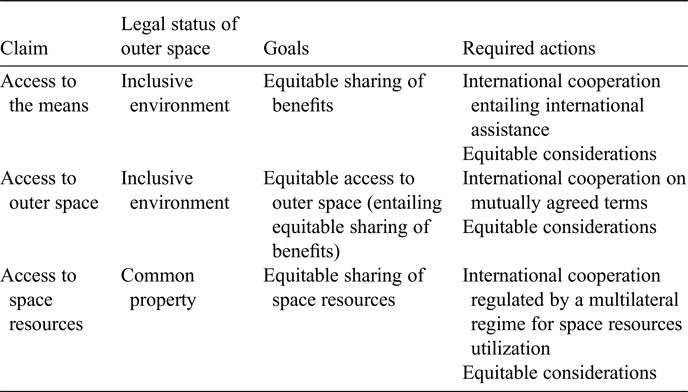
This section fills the theoretical gap by examining how the equitable sharing requirement operates when informed by the principles which underpin the claim of access to space resources (Section A) and the claim of access to outer space (Section B), respectively—these being the two claims which are currently supported by State practice.
A. The Function of Equity in the Obligation of Result
The access to space resources approach envisions benefit sharing as an obligation of result.Footnote 117 Within this, equity appears to serve a distributive function, providing access to space resources to countries which lack the capacity to undertake extraction activities and balancing the interests of States with differing space capabilities.Footnote 118 This approach finds support in both the scholarly literatureFootnote 119 and international case law.Footnote 120 Similarly, the Moon Agreement acknowledges that the equitable sharing of benefits derived from the exploitation of the Moon's resources involves special consideration being given to both ‘the interests and needs of developing countries’ and ‘the efforts of those countries which have contributed whether directly or indirectly to the exploration of the Moon’.Footnote 121
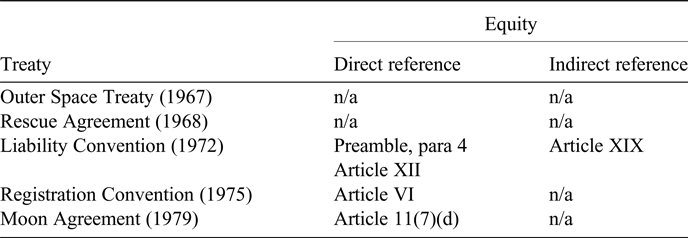
Some scholars argue that the normative origins of the concept of equity as distributive justice lie in the space treaties,Footnote 122 which contain several references to equity (Table 2). For instance, Article XII of the Liability Convention refers to equity as the criterion for determining compensation for damage. Equity is referred to indirectly in Article IX of the Outer Space Treaty, which requires that due regard be given to the corresponding activities of other States in space. The latter is also considered an equitable principle in its own right.Footnote 123
References to equity in the UN outer space treaties
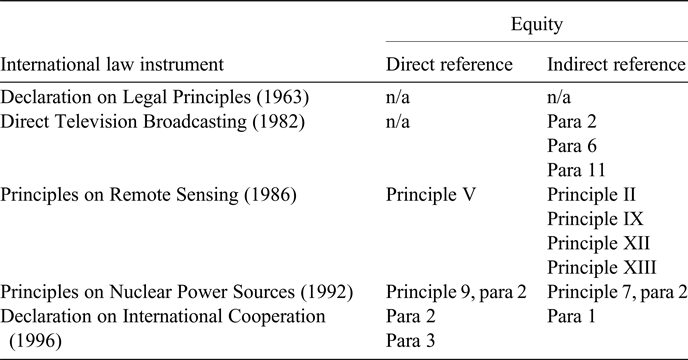
UNGA resolutions also provide a principled approach to space activities and contain several references to equity in support of redistributive goals (Table 3). For instance, Principle XII of the Principles on the Remote Sensing of the Earth requires the sensing State to grant the sensed State access to the resulting information on a non-discriminatory basis and at a reasonable cost, taking particular account of the needs and the interests of developing countries. Similarly, paragraph 2 of the Principles on Direct Television Broadcasting states that satellite broadcasting ‘should promote the free dissemination and mutual exchange of information and knowledge … particularly in developing countries’.
References to equity in non-binding instruments
Other scholars argue that the concept of equity as distributive justice originates in the economics and politics of decolonization and has its normative roots in the resolutions on the New International Economic Order (NIEO),Footnote 124 which recognize that the benefits of technological progress are not equitably distributed among the members of the international community.Footnote 125 Viewed from this angle, the application of equity requires the broadest level of cooperation among States with a view to eliminating economic, social and political disparities among them.Footnote 126
Taken together, these considerations suggest that equity as a means for distributive justice focuses on the identity of beneficiaries, the interests protected by the redistributive process and the legal status of outer space, including its resources.
The ultimate beneficiary of the exploration and use of outer space is humanity as a whole.Footnote 127 As Williams argues, the space treaties ensure that State interests do not have priority over the interests of the international community.Footnote 128 For instance, in relation to the remote sensing of the Earth by satellite, the international community of States, acting on behalf of humanity, ‘has a certain right to intervene’ in the regulation of matters such as ‘economic advantages derived from speculation’.Footnote 129 International tribunals should therefore be empowered to decide such cases on the basis of the principles of justice and equity.Footnote 130
Legally, outer space, including its resources, is the common property of humanity.Footnote 131 Given that the subject of space law is humanity as a whole, this leads to the conclusion that ‘the benefits obtained by whoever may materially extract such products, belong ab initio to Humanity’.Footnote 132 Accordingly, States able to extract space resources are only entitled to ‘an adequate compensation’ for having done so.Footnote 133
In terms of interests protected, some scholars argue that equity in international space law serves an anticipatory function—namely, that of being the ‘inspirer of norms and, to a lesser extent, [of guidance] in the application of norms’ governing space activities.Footnote 134 For instance, Janis writes that international law, including international space law, should aim at granting ‘prominence to the principle of equity’ and its distributive function.Footnote 135 Similarly, Haq writes that ‘[t]he case for obligatory transfer of resources rests ultimately on [the acceptance and implementation of] the principle of distributive justice and economic equity in the global context’.Footnote 136 In doing so, scholars end up advocating a function of equity ante legem, which is not recognized in international law. The latter distinguishes between three typologies of equity,Footnote 137 all qualifying equity as a judicial remedy.Footnote 138
Equity as distributive justice does not relate to the exercise of judicial discretion, but seeks to influence the development of the law.Footnote 139 This suggests that equity ante legem could be judicially enforced only as a matter of decision ex aequo et bono—that is to say, through a decision not necessarily based on the lawFootnote 140 and, as such, requiring the consent of the parties.Footnote 141 Whilst decisions ex aequo et bono occasionally involve consideration of distributive justice,Footnote 142 it is noteworthy that the International Court of Justice (ICJ) on several occasions has confirmed that equity is an ad hoc corrective rather than a tool for distributive justice.Footnote 143
It has been argued that provisions of the UN space treaties which aim at distributive justice, such as Article 11(7) of the Moon Agreement, turn out to be ‘of difficult, if at all possible, practical (normative) application’.Footnote 144 More generally, it is argued that equity expressed in the form of demands of distributive justice is ‘of doubtful legal significance’.Footnote 145 This suggests that the access to space resources claim does not include equity as an anticipatory test. It does, however, require the equitable distribution of resources, effectively inviting consideration of proportionality embedding the principle of distributive justice.Footnote 146 This is explored in Section V.A.
B. The Function of Equity in the Obligation of Due Diligence
The access to outer space claim is rooted in an obligation of due diligence.Footnote 147 Under this approach the efficient allocation of resources and international cooperation on an equitable and mutually acceptable basis are the guiding principles for space activities. Yet, like the access to space resources claim, it does not clarify how equitable sharing through cooperation with other countries in space activities will take place.
The principle of efficient allocation of resources as the rationale for undertaking collaborative space activities is widely recognized in international space law. For example, Article 5 of the Declaration on International Cooperation states that the ‘rational and efficient allocation of financial and technical resources’ should inform the conduct of collaborative space activities.Footnote 148 Similarly, regional space treaties list the efficient use of resources as an integral component of collaborative space activities.Footnote 149 At the same time, references to efficient utilization of resources are not confined to the law of outer space. For example, UNCLOS refers to ‘the equitable and efficient utilization of [the seas and oceans’] resources’.Footnote 150 However, none of these documents clarify the relationship between the concepts of efficiency and equity in context of an obligation of due diligence.
The only proposal so far advanced by delegations at COPUOS that seeks to do so appears in a joint paper submitted by Luxembourg and the Netherlands concerning the lawfulness of space resource activities.Footnote 151 Aimed at benefit sharing through the promotion of participation in space resource activities by all countries, the proposal lists several types of benefits deriving from those activities.Footnote 152 Of particular relevance is the provision stating that space actors ‘should be encouraged to provide for benefit sharing’,Footnote 153 since it shows that the relationship between equitable sharing of benefits and efficiency of resource utilization ‘does not necessarily imply equality’ among States.Footnote 154 As Menter also notes, the share of any benefits due to a non-contributing State may be zero,Footnote 155 thus suggesting that the determination of equity is inherently subjective.Footnote 156 Further evidence that equity in this context is subjective and discretionary is the clarification that benefit sharing does not include compulsory monetary sharing.Footnote 157
Ultimately, the Luxembourgish–Dutch proposal appears to favour the amicable determination of the quantum of equitable benefit sharing in relation to space activities. However, absent agreement among States, the working paper does not offer any guidance on how to determine the criteria for doing so. This leads to the conclusion that the obligation of benefit sharing comes down to attempting to find an agreement among States on equitable sharing. This is problematic, since discretion and flexibility can turn into arbitrariness.Footnote 158
Perhaps it is unavoidable that international space law is particularly exposed to the risk of flexibility descending into arbitrariness, the main reason being that the source of equity consists of State practice and soft law—such as the Luxembourgish–Dutch proposal and, to an extent, the Declaration on International Cooperation—instead of binding law, such as treaty, custom or general principles of law. It is nonetheless possible to consider due diligence as the guiding principle for the determination of the equitable sharing of benefits in the context of the access to outer space claim.
Obligations of conduct are often associated with the equitable principle of due diligence, which is also a general principle of law.Footnote 159 Although Article I, paragraph 1 of the Outer Space Treaty does not refer to it, the structure of the benefit sharing obligation, coupled with State practice at COPUOS, points to the existence of a requirement to act with due diligence, taking into account context and circumstances.Footnote 160
States do not act with due diligence only for legal reasons. McDonald argues that policy reasons for doing so include the efficient use of resources, effective decision making and controlling costs, for example.Footnote 161 This suggests that any assessment of what is equitable within a due diligence obligation requires a case-by-case approach.Footnote 162 The absence of a benefit sharing mechanism in the Outer Space Treaty further indicates that equity plays a supplementary role—that is to say, it facilitates solutions ‘by balancing the relevant circumstances in an area where the law does not provide sufficiently detailed rules’.Footnote 163
This means that, over time, ‘due diligence practice by States can … serve a law-generating function’ in the field of benefit sharing.Footnote 164 This suggests that, in the absence of equitable criteria, a proportionality test which embeds due diligence considerations in the benefit sharing obligation appears to be a suitable approach, and avoids turning equity into a discretionary judicial corrective or a distributive mechanism. As Janis puts it, a third type of equity (which is neither distributive nor wholly discretionary) requires that ‘the result is fairly proportional to some non-legal standards’.Footnote 165 This would embrace both the contributions of those involved in activities in space and the needs of developing countries (Section V.B).
V. REORIENTING THE DEBATE: TOWARDS PROPORTIONALITY?
The concepts of equity and proportionality are intimately related to the idea of justiceFootnote 166 and fairness.Footnote 167 They are also related to each other. For example, Reuter describes proportionality as an application of equity.Footnote 168 This indicates that it is possible to achieve an equitable result through recourse to proportionality, including in relation to the obligation of benefit sharing under the Outer Space Treaty. Given that the anticipatory equity test is not applicable to claims of access to outer space and access to space resources,Footnote 169 this section examines possible models for a proportionality test that could be applied by both space actors and a court of law.
Section A examines the feasibility of developing a proportionality test aimed at achieving distributive justice within the context of the obligation of result which forms a part of the claim to access to space resources. It shows that, as a test derived from an analogy with the law of the sea, it is unlikely to produce the desired results. Section B develops a new approach which is tailored to the obligation of conduct which underpins the access to outer space claim, and which requires the application of due diligence. Section C evaluates the impact of adopting a proportionality test based on due diligence considerations upon the progressive development of international space law and other areas of international law.
A. Proportionality in Relation to Inequalities
The obligation of result which is embedded in the claim based on access to space resources means that there should be an equivalence among States with unequal space capabilities in terms of receiving and enjoying the benefits resulting from the exploitation of space resources. This requires a balancing of different interestsFootnote 170 through a proportionality test which takes account of such inequalities. This reflects the approach found in documents inspired by the NIEO. For instance, the Seoul Declaration on Progressive Development of Principles of a NIEO states that ‘equal cases have to be treated equally [and] unequal cases … differently in proportion to those inequalities which are relevant’.Footnote 171 However, it does not find support in international case law. For example, in Tunisia v Libya, the ICJ held that ‘the only absolute requirement of equity [applying to a question of proportionality] is that one should compare like with like’.Footnote 172
Establishing the appropriate balance of interests where such inequalities exist requires a subjective assessment taking account of social, political and economic factors. According to Lapidoth, equivalence consists of an impartial search for a balance between interests, especially in the presence of special circumstances.Footnote 173 However, what amounts to such special circumstances where there are deep inequalities among States is difficult to ascertain. Article 160(f)(i) UNCLOS clarifies that the special circumstances relevant to ‘the equitable sharing of financial and other economic benefits derived from activities in the Area [consist of] the interests and needs of developing States’. This indicates that the determination of equivalence of interests among States with unequal capabilities, including space capabilities, requires a needs-based approach to achieve the intended distributive justice goals.Footnote 174 It also suggests that the needs and interests of States in general form the basis of the determination of equivalence, as opposed to the needs and interests of individual States.
A technical study on the sharing of benefits deriving from deep seabed mining by the ISA Financial Committee provides a test for determining the interests and needs of developing countries and for the proportional distribution of benefits.Footnote 175 Its theoretical underpinning is that equitable sharing consists of ‘a state in which each ISA member's welfare is increased to the maximum extent possible, without making any other ISA member worse off, given the limited resources in the Area and the [deep seabed mining] returns available for distribution’.Footnote 176 It thus matches the conceptual premises of the obligation of result embedded in the access to space resources claim.Footnote 177
A central part of the ISA proportionality test involves determining an appropriate level of benefit sharing, which is a requirement of equity also acknowledged in international case law.Footnote 178 Appropriateness in this context ‘expresses what is reasonable and customary in a sharing situation’ and it is ‘shaped partly by principle, partly by precedent, and partly by what can be practically implemented’.Footnote 179 In practice, the ISA proportionality test applies the formula which is used by the UN for the allocation of State contributions to its budget, the reason being that this represents ‘the revealed preference of the highest possible global authority and representation of humanity, the UN General Assembly, to develop appropriateness and income progressivity … in a manner consistent with UNCLOS’.Footnote 180 In doing so, it builds on a widely accepted formula for the equitable allocation of the financial burdens which are treaty based.
By adapting the UN budget formula to the UNCLOS requirements, the ISA proportionality test identifies the equity criteria which are applicable to deep seabed mining operations. They consist of ‘permanent formulae (algorithms)’ expressing proportions of the total benefit multiplied by the deep seabed proceeds generated in a given time period.Footnote 181 Specifically, in order to produce a progressive allocation of the funds (deep seabed royalties),Footnote 182 the sharing formula considers:
each State party's share of the total population of all States parties … adjusted by social distribution weights that can be used to account for either the article 140 or article 82 [UNCLOS] criteria by giving greater weight, as appropriate, to States parties that are low-income or low-income and landlocked, respectively, compared to higher-income and coastal beneficiaries.Footnote 183
Known as the geometrical mean formula, the resulting equitable distribution algorithm produces the distribution of shares indicated in Table 4.Footnote 184
Equitable distribution by ISA regions
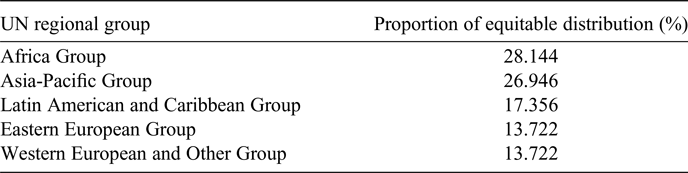
Source: ISA Technical Study (2021) 58.
Although conceptually sophisticated, the ISA proportionality test for benefit sharing can only allocate modest resources, thus generating limited impacts on the target beneficiaries.Footnote 185 As the ISA technical study explains, the funds available for sharing consist of the net funds remaining after the payment of the ISA's administrative expenses since its inception in 1998Footnote 186 and the payment of compensation to developing countries suffering serious adverse effects on their export earnings or economies because of activities in the Area.Footnote 187 As a result, the test is unable to achieve the distributive justice goal of correcting inequalities among the international community of States—at least in the foreseeable future.
Despite this limitation, the ISA proportionality test does offer a template for the equitable sharing of benefits deriving from the exploration and use of outer space.Footnote 188 In particular, its reliance on the UN budget formula satisfies the requirement of simultaneously considering the interests and needs of all developing countries at a given point in time, as the access to resources claim requires.Footnote 189 At the same time, it shows that seeking to implement the obligation of result embedded in the access to resources claim by means of a proportionality test based on inequalities runs the risk of delivering formal rather than substantive equity. As this does not amount to a breach of the benefit sharing obligation, there would be no opportunity for a court of law to assess the criteria selected and the weight accorded to the particular circumstances of the case.Footnote 190
Ultimately, the equitable distribution of benefits deriving from space resource activities—whether in the form of the redistribution of resources based on their monetary value or a share of monetary profit—remains both flexible and subjective and so does not fit easily with a proportionality test aimed at redressing inequalities.
B. Proportionality in Relation to Capacity
The obligation of conduct contained in Article I, paragraph 1 of the Outer Space Treaty requires States to carry out their space activities ‘for the benefit and in the interests of all countries’. At the same time, State practice indicates that space activities should be informed by considerations of efficient allocation of resources and cooperation on mutually acceptable terms.Footnote 191 Seen from this perspective, benefit sharing should include support for capacity building in relation to space activities. Whilst not redistributive, this indirectly supports the aim of redressing inequalities.
The Outer Space Treaty does not provide any guidance on the extent to which benefit sharing must contribute to capacity building. Also, it does not indicate which State or group of States should be its beneficiaries. At the same time, seen as an obligation of conduct, the benefit sharing obligation requires States to attempt to benefit as many States as possible, but not necessarily the international community as a whole.Footnote 192 Likewise, at COUPUOS delegations have pointed out that benefits deriving from the conduct of space activities should take into account the interests of the parties involved in space activitiesFootnote 193 rather than the generic interest of the international community as a wholeFootnote 194 or the States parties to the space treaties.Footnote 195 This raises the following questions: which interests does the benefit sharing obligation protect? And how should they be balanced through a proportionality test?Footnote 196
Menter argues that the equitable sharing of benefits does not imply a redistribution of the resources exploited or a division of monetary benefits. Rather, it involves the distribution of opportunities to benefit from space activities.Footnote 197 This suggests that a proportionality test should aim to ensure, fairly and rationally, that all States receive adequate support to develop their own space sector. Accordingly, redistribution should promote impacts that have the potential to benefit several States and discourage those that have negative effects.Footnote 198 Three criteria which are well suited to facilitate this goal are reasonableness, non-detrimental effects and the maximization of benefits for the international community. They all entail an assessment of its conduct by the actor engaged in space activity.Footnote 199 In this respect, while indirectly contributing to the goal of welfare maximization, these criteria significantly differ from those informing the proportionality test implementing an obligation of result, as this focuses on the level of development of the recipient States. The following sections examine these three criteria in turn.
1. Reasonableness
When identifying the interests involved in a given space activity, the actors concerned must act with reasonableness.Footnote 200 This includes determining what can feasibly be shared by them (and with whom).Footnote 201 While discretionary, such an assessment is not arbitrary. State practice, as reflected in the work of the ILC on shared natural resources, indicates the existence of three guiding principles.
The first principle concerns the level of due diligence required of individual space actors, which depends on the latter's technological and financial capabilities. As the ICJ noted in the Nicaragua case, the same level of due diligence cannot be expected from States with different economies and resources available to them.Footnote 202 Applied to space activities, this suggests that factors affecting the financial sustainability of a space activity, such as disbursing the investors’ dividends and investing in the maintenance and upgrade of technology, form part of the considerations relating to the efficient use of resources by space actors.Footnote 203 The requirement applies equally to established and emerging space actors, irrespective of whether they are based in a developed or developing country.Footnote 204
The second principle refines the first by requiring space actors to optimize the use of space resources. They must not only use resources efficiently, but use them only to the extent that is necessary to perform the authorized space activity.Footnote 205 As the Commentary to the ILC Draft Articles on Non-Navigational Uses of Watercourses clarifies, reasonableness indicates the search for the optimal use of the natural resource while preserving its sustainability and protecting the interests of all the parties involved in its uses.Footnote 206 Similarly, Article 44 of the International Telecommunications Union Convention establishes that, in order to ensure the equitable use of the geostationary orbit, States can reserve a segment of the orbital spectrum and related radio frequencies subject to their actual use.Footnote 207 Without use, such conduct would prevent other interested States from availing themselves of a limited space resource.Footnote 208 This means that a space actor can only occupy a spot in outer space when this is necessary in order to undertake a planned mission, both physically and temporally. It also follows that space actors must use any resources extracted for their own ends. Conversely, they cannot extract resources merely for the purposes of accumulating them, since that would deny others the opportunity to use and benefit from them.Footnote 209
The third principle requires State actors to ground their decisions in relevant past practice in order to secure consistency and enhance legal certainty, while also preserving the flexibility essential for the progressive development of the law. When assessing past practice, space actors must have regard to the state of development of the relevant areas of law.Footnote 210 For instance, space resource utilization is largely unregulated by the space treaties and no past practice exists. This unavoidably affects the perception of the due diligence standards required of space actors at any given point in time. As the ILC stated in relation to the harm deriving from hazardous activities:
What would be considered a reasonable standard of care or due diligence may change with time; what might be considered an appropriate and reasonable procedure, standard or rule at one point in time may not be considered as such at some point in the future.Footnote 211
The status of space technology also affects the determination of past practice, since the level of development of the technology determines the type, quality and quantity of possible space activities.Footnote 212
2. Non-detrimental effects
A proportionality test must also ensure that both the method applied and the result achieved are equitable.Footnote 213 This implies that, as a minimum, the space activities do not have a detrimental impact on other States.Footnote 214 State practice identifies two guiding principles which appear suitable for space activities.
The first is the principle of no harm.Footnote 215 Developed in relation to environmental issues, such as those raised by the use of transboundary resources,Footnote 216 it also applies to the global commons, including outer space.Footnote 217 It requires that States utilizing shared resources enjoy the benefits accruing therefrom while at the same time avoiding causing significant harm to other interested States.Footnote 218 Article IX of the Outer Space Treaty only requires that States operating in space do so ‘with due regard to the corresponding interests of all other State Parties’. However, due diligence requirements also demand that States ‘take all appropriate measures to prevent causing significant harm to [other] States’.Footnote 219 In the context of the use of shared resources, significant harm consists of ‘something that is more than “detectable” but not necessarily “serious” or “substantial”’.Footnote 220 This suggests that, for example, a space mining operator (whether public or private)Footnote 221 must take precautions not to scatter plume or debris from its mining site over areas of a celestial body or outer space, potentially damaging the equipment of other space actors.Footnote 222 To that end, the space mining operator could estimate the breadth of a safety zoneFootnote 223 and inform the UN Secretary-General and the international community of it taking such a precautionary approach.Footnote 224
The second, and related, principle involves undertaking a prior assessment of the potential effect of the planned activity when the space actor has reasonable grounds for anticipating the possibility of adverse effects being caused by its activities in outer space.Footnote 225 What amounts to ‘reasonable grounds’ depends on the ability of the individual space actor to gather relevant information concerning the plans of others, based on formal notifications to the UN Secretary-General and the international community regarding the ‘nature, conduct, locations and results’ of space activities.Footnote 226 Effectively, this entails a reciprocal duty of due diligence between space actors.Footnote 227 In addition, read together, Articles IX and XI of the Outer Space Treaty require space actors to assess the impact of their activities on the environment of both outer space and the Earth, the latter consisting of harmful contamination resulting from the introduction of extraterrestrial matter.Footnote 228
3. Maximization of benefits
In addition to ensuring that there are no detrimental effects on other States, space actors must also evaluate the impact of their activities on space sector capacity building in beneficiary States, with a view to achieving the maximum impact possible.Footnote 229 This involves a consideration of the ability of the recipient to generate widespread societal benefits from any increase in its capacity levels. For example, a space actor may decide to share the benefits deriving from its activities with one State, thus generating a significant impact on the beneficiary to the exclusion of others. However, a higher overall impact might be achieved by benefit sharing with several States, even if the benefits for any one of them is lower. Another option would be to share benefits deriving from space activities with international institutions empowered to redistribute those benefits among States lacking space capabilities. This, arguably, would produce the highest possible level of benefit sharing. To an extent, it would also contribute to the distributive justice goal of maximizing the welfare of the recipient State, flowing from benefit sharing being seen as an obligation of result.Footnote 230
The ISA Technical Study provides guidance on how space actors might invest in capacity building. It states that public goods—such as marine scientific knowledge—are of interest to the international community as a whole, since global public goods benefit everybody in various degrees ‘without reducing the benefits of others’.Footnote 231 The rationale behind this approach is that all peoples have equal rights under UNCLOS and ‘equally benefit from the increase in scientific knowledge, capacity building and research’.Footnote 232
Options for investing in public goods include the creation of a new international body. The ISA Technical Study envisions the establishment of a Seabed Sustainability Fund ‘to invest in knowledge and competence related to the Area’Footnote 233 as a precondition for the exploitation of the oceans’ resources, since investing in knowledge and capacity building constitutes ‘a precautionary and sustainable approach’.Footnote 234 In practice, the Fund would finance two main activities: research (basic, applied and innovation)Footnote 235 and capacity building. The latter includes basic and advanced education as well as specific technical training to be offered to all participants, including vulnerable communities, with a view to enabling them to fully understand and use the outcomes of scientific research in the oceans.Footnote 236
According to the ISA Technical Study, a potential disadvantage of creating the Fund is the costs of its establishment and operation. Menter raises the same concern in relation to the equitable sharing of benefits derived from the exploitation of space resources under the Moon Agreement, which remains subject to the recovery of expenses for the creation and operation of the envisaged institutional mechanism.Footnote 237 The creation of a new institution for outer space would face the same administrative and financial obstacles.
While largely unsuitable for activities in the Area,Footnote 238 an alternative solution for the maximization of the benefits deriving from space activities is to empower existing institutions, such as the UN Programme on Space Applications (PSA).Footnote 239 Created in 1971, the PSA's mandate includes the provision of capacity building, education, research and development support as well as technical advisory services with a view to reducing the gap between developed and developing countries.Footnote 240 A space actor offering a share of the benefits of its space activities to the PSA would be likely to maximize the impact of its doing so by allowing the international body to involve as many interested participants as possible in its work. For example, a space actor could offer a package of training on how to operate small or micro satellites, which is the form of space technology currently most in demand among developing countries.Footnote 241 In turn, the PSA could mobilize other administrative or financial resources in order to allow the participation of as many beneficiaries as possible,Footnote 242 thus maximizing the impact of the benefits generated by individual space activities (which, in turn, are intended to have a developmental impact on the beneficiary societies).
Either way, as an intervention targeted upon capacity building in space, supporting the activities of the PSA benefits from a perceived legitimacy deriving from its contribution to the mission of a UN programme informed by sustainable development goals.Footnote 243 It thus directly contributes to the use of outer space ‘for the benefit and in the interests of all countries’, as set out in Article I, paragraph 1 of the Outer Space Treaty.
C. Implications of the Introduction of a Proportionality Test for the Progressive Development of the Law
The formulation of a proportionality test based on capabilities within the framework of the obligation of due diligence embedded in the access to outer space claim contributes to the progressive development of the law in two main ways. Section 1 examines the specific contribution this makes to the development of international space law while Section 2 evaluates its contribution to international law more generally.
1. Implications for the development of international space law
The elaboration of a due diligence proportionality test implementing the benefit sharing obligation in Article I, paragraph 1 of the Outer Space Treaty makes a broad contribution to the progressive development of international space law in three ways. First, it introduces the concept of proportionality into international space law. Secondly, in doing so it clarifies the content and scope of benefit sharing as a normative concept. The international space law literature does not contain a generally accepted definition of benefit sharing.Footnote 244 Some scholars refer to it as an indeterminate obligationFootnote 245 whilst others describe it as an emerging principle of international lawFootnote 246 or a moral obligation.Footnote 247 Conversely, the introduction of a due diligence proportionality test shows that the implementation of the obligation of benefit sharing under the Outer Space Treaty rests on the application of equitable principles which are also general principles of law—reasonableness, non-detrimental effects and maximization of benefits (Table 5). Hence, it has identifiable, although flexible, core components.
Constitutive elements of the due diligence proportionality test
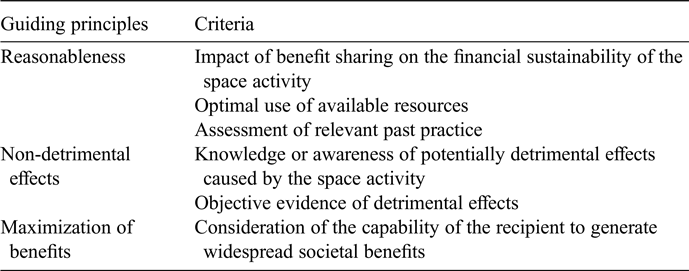
Thirdly, the application of the due diligence proportionality test contributes to the development of this area of the law by providing practical and conceptual means to ensure the enforceability of benefit sharing as an obligation of due diligence by a court of law. Identified through the technique of extrapolation,Footnote 248 it is underpinned by principles of equity, which are general principles of law—that is to say, a formal source of international law enforceable by courts.Footnote 249 As the ICJ held in the North Sea Continental Shelf cases in relation to maritime delimitation, ‘it is precisely a rule of law that calls for the application of equitable principles’.Footnote 250 In practice, a breach of the due diligence obligation due to the lack of proportionalityFootnote 251 may occur where there is unreasonableness, detrimental effects or the lack of maximization of benefits.Footnote 252
In relation to unreasonableness, a breach of the obligation occurs when the space actor makes an arbitrary decision on benefit sharing—that is to say, a decision taken without evidence of the impact of benefit sharing on the financial sustainability of the space activity or the optimal use of available resources, in addition to an assessment of relevant past practice (Table 5).Footnote 253 This also means that performing an activity in outer space unaccompanied by benefit sharing does not necessarily amount to a breach of the obligation.
As regards detrimental effects, international case law suggests that a State is in breach of the obligation only if it knew or ought to have known that its space activity would be detrimental to other States (Table 5).Footnote 254 International practice also indicates that the detrimental effect (in the form of significant harm) must be capable of being established ‘by objective evidence’ (Table 5).Footnote 255 Conducting an impact assessment prior to the commencement of space activities may thus provide evidence of due diligence on the part of the space actor, especially in the event of that space activity having detrimental effects on other States. Since the burden of the proof lies with the States conducting activities,Footnote 256 the impact assessment may also help reduce the risk of disputes arising.Footnote 257 A breach of this obligation may result in reparations in the form of elimination or mitigation of the significant harmFootnote 258 or in the form of compensation.Footnote 259
In relation to the lack of maximization of benefits, a breach of the obligation will occur when suboptimal impacts are intentional (Table 5). In practice, space actors must justify why they do not share benefits deriving from their space activities with the PSA or similar institutions.
2. Contribution to the development of international law
The introduction of a due diligence proportionality test implementing the obligation of benefit sharing under the Outer Space Treaty also contributes to international law in three ways. First, it provides a conception of benefit sharing primarily grounded in the analysis of international practice. Currently, the normative core of benefit sharing in international law builds only on selected treaty regimes, and does not include international space law.Footnote 260 Secondly, it strengthens the identification of two core elements of benefit sharing—namely, that benefits can be both monetary and non-monetaryFootnote 261 and that power asymmetries influence the practical implementation of the obligation of benefit sharing.Footnote 262 Thirdly, the elaboration of a proportionality test aimed at producing equitable results corroborates the wider claim that benefit sharing is an operationalization of the principle of equity.Footnote 263
At the same time, benefit sharing under the Outer Space Treaty departs from benefit sharing under international law more generally because it attaches to any activity conducted in outer space. Under the Outer Space Treaty, the obligation of benefit sharing is part and parcel—in a sense, the legitimating factor—of the freedom of exploration and use of outer space.Footnote 264 In other words, it is an inherent component of the concept of outer space as an inclusive environment. As such, it serves a purposive function requiring space actors to undertake activities in an orderly, fair and transparent manner.Footnote 265 It thus rejects the selective notion of triggers for benefit sharing—that is to say, the occurrences activating the benefit sharing obligation which characterize current understandings of benefit sharing.Footnote 266 These triggers—such as bioprospecting, the use of natural resources, the production of knowledgeFootnote 267 and environmental conservation measures in the territories of indigenous peoplesFootnote 268—aim to protect the underlying values of the beneficiariesFootnote 269 with a view to redressing perceived injustices.Footnote 270 They thus serve a redistributive function by leveraging the notion of equity as the underlying normative concept.Footnote 271
VI. CONCLUSION
Advances in space technology have increased the quantity and type of commercial activities that take place in outer space. They also invite fresh thinking about the role of international law in regulating the conduct of space actors with a view to avoiding such activities having detrimental effects for the international community. Accordingly, this article has examined the scope and content of the benefit sharing obligation set forth in Article I, paragraph 1 of the Outer Space Treaty. The findings show that State practice currently supports two different understandings of that obligation, demonstrating that the concept of benefit sharing is not static.
Some States focus on access to space resources, and as a result argue that benefit sharing is an obligation of result that seeks to redistribute resources extracted equitably and which brings about distributive justice. However, in the absence of equitable sharing criteria, such an understanding of the benefit sharing obligation turns out to be difficult to implement and, ultimately, not enforceable by a court of law.
Others place their focus on access to outer space and consider benefit sharing to be an obligation of conduct. Governed by due diligence principles, it provides guidance on how to conduct activities in space with due regard for the interests of other States, including those lacking the means to conduct such activities themselves. As an obligation of conduct, it focuses on the actions of space actors rather than the characteristics of its beneficiaries. In practice, this makes the content of the obligation dependent upon the assessment of the space actor, who determines what they consider to amount to appropriate benefit sharing relative to the risks and circumstances associated with their activities.
To better operationalize the duty of due diligence which is embedded in the access to outer space claim, this article has argued from the adoption of an original proportionality test which can be used to determine the equitable amount of benefit sharing which is due to the international community. Grounded on equitable principles which are also general principles of law, the proportionality test makes benefit sharing under the Outer Space Treaty an obligation enforceable by a court of law. It thus introduces a novel legal construct to international space law. In addition to facilitating the progressive development of international space law, the elaboration of this due diligence proportionality test also enriches the understanding of the obligation of benefit sharing under international law more generally.


 Open access

