

1. Introduction
Large igneous provinces (LIPs) are characterized by voluminous volcanic sequences (>105 km2; >105 km3) erupting over a short period of time (1–5 Ma), and their formation is generally related to mantle plumes (Richards et al. Reference Richards, Duncan and Courtillot1989; Campbell & Griffins, Reference Campbell and Griffins1990; Chung & Jahn, Reference Chung and Jahn1995; Campbell, Reference Campbell2005). The association of picrites with LIPs provide one of the important lines of evidence in favour of a relatively high-temperature plume source (He et al. Reference He, Xu, Chung, Xiao and Wang2003; Hanski et al. Reference Hanski, Walker, Huhma, Polyakov, Balykin, Trong and Thi2004; Ali et al. Reference Ali, Thompson, Zhou and Song2005; Campbell, Reference Campbell2005, Reference Campbell2007; Zhang et al. Reference Zhang, Mahoney, Mao and Wang2006; Shellnutt, Reference Shellnutt2014; Santosh et al. Reference Santosh, Hari, He, Han and Manu Prasanth2018; Condie & Puetz, Reference Condie and Puetz2019). However, some recent studies suggested that the source of the Emeishan large igneous province (ELIP) picrites involved variable proportions of pyroxenite or eclogites (Kamenetsky et al. Reference Kamenetsky, Chung, Kamenetsky and Kuzmin2012; Yu et al. Reference Yu, Song, Chen and Li2014, Reference Yu, Shen, Song, Ripley, Li and Chen2017; Liu et al. Reference Liu, Xia, Kuritani, Hanski and Yu2017; Zhu et al. Reference Zhu, Zhang, Reichow, Li, Cai and Pan2018). The presence of eclogites or pyroxenite in the mantle source region can lead to overestimates in temperature as the thermometers assume a peridotite-dominated source (e.g. olivine–liquid equilibrium for primary magmas produced by melting of fertile peridotite; Zhang et al. Reference Zhang, Mahoney, Mao and Wang2006; Herzberg, Reference Herzberg2011; Shellnutt & Pham, Reference Shellnutt and Pham2018). One of the important challenges is therefore to clarify whether the mantle source of ELIP picrite is dominated by peridotite or pyroxenite.
As one of the earliest crystallized minerals from typical mantle-derived magmas, the composition of olivine phenocrysts with high Fo values (atomic 100×Mg/(Mg + Fe)) can provide important information on the primary magma. Recent studies suggest that some trace elements (such as Mn and Zn) in olivine from pyroxenite-derived and peridotite-derived melts have two distinct trends (Le Roux et al. Reference Le Roux, Lee and Turner2010; Howarth & Harris, Reference Howarth and Harris2017) and can therefore be used to distinguish pyroxenite components in the mantle source region. Some studies recorded picritic rocks in the inner zone of the ELIP (Hanski et al. Reference Hanski, Kamenetsky, Luo, Xu and Kuzmin2010; Kamenetsky et al. Reference Kamenetsky, Chung, Kamenetsky and Kuzmin2012; Yu et al. Reference Yu, Shen, Song, Ripley, Li and Chen2017; Yao et al. Reference Yao, Zhu, Li, Zhong, Yu, Ripley and Bai2019), which were thought to have formed at relatively high temperatures (Xu et al. Reference Xu, Chung, Jahn and Wu2001; Zhang et al. Reference Zhang, Hao, Wang and Mahoney2004, Reference Zhang, Mahoney, Mao and Wang2006; Shellnutt & Pham, Reference Shellnutt and Pham2018). However, some other studies suggested that the picrites were derived from a metasomatized pyroxenite-bearing mantle source (Kamenetsky et al. Reference Kamenetsky, Chung, Kamenetsky and Kuzmin2012; Yu et al. Reference Yu, Shen, Song, Ripley, Li and Chen2017). The role of high-temperature primary magmas in the ELIP therefore remains contentious. In this paper, we investigate this aspect based on petrology and mineral chemistry of olivine phenocrysts from Dali picrite in the inner zone of the ELIP, with a view to evaluate the nature of the mantle source and the conditions of melting.
2. Geological setting
The ELIP is mainly located in the western part of the Yangtze craton in SW China (Fig. 1). Its southwestern margin is bounded by the Ailaoshan–Red River Fault, and the northwestern boundary is traditionally thought to be the Longmenshan–Xiaojinhe Fault. The volcanic successions in the ELIP trend N–S with a rhombic shape and cover an area of more than 2.5 × 10⁵ km2, with a total erupted volume of more than 3 × 10⁵ km3 (Xu et al. Reference Xu, Chung, Jahn and Wu2001, Reference Xu, He, Chung, Menzies and Frey2004; Ali et al. Reference Ali, Thompson, Zhou and Song2005, Reference Ali, Fitton and Herzberg2010). The thickness of the volcanic sequence ranges from c. 5000 m to several hundred metres, with the thickest zone located near the Lijiang and Binchuan sections in the western part of the ELIP and the thinnest area located in the eastern part of the ELIP (Xu et al. Reference Xu, He, Chung, Menzies and Frey2004; Song et al. Reference Song, Zhou, Hou, Cao, Wang and Li2001, Reference Song, Zhou, Cao and Robinson2004; Xiao et al. Reference Xiao, Xu, Chung, He and Mei2003, Reference Xiao, Xu, Mei, Zheng, He and Pirajno2004; Zhang et al. Reference Zhang, Mahoney, Mao and Wang2006). The ELIP comprises a succession of tholeiites, with minor picritic and rhyolitic/trachytic lava flows. Many mafic-ultramafic intrusions are exposed in a belt extending along the Panzhihua–Xichang region in the SW part of the ELIP, and some of these intrusions host giant Fe-Ti-V oxide and Ni-Cu-PGE sulphide deposits (Shellnutt, Reference Shellnutt2014). Previous studies have indicated that the main phase of magmatism took place at c. 260 Ma over a short duration of 1 Ma (Zhou et al. Reference Zhou, Yan, Kennedy, Li and Ding2002; He et al. Reference He, Xu, Huang, Luo, Shi, Yang and Yu2007; Shellnutt et al. Reference Shellnutt, Zhou, Yan and Wang2008, Reference Shellnutt, Denyszyn and Mundil2012; Zhong et al. Reference Zhong, Zhu, Hu, Xie, He, Liu and Chu2009, Reference Zhong, Campbell, Zhu, Allen, Hu, Xie and He2011, Reference Zhong, He, Mundil and Xu2014; Sun et al. Reference Sun, Lai and Wignall2010; Xu et al. Reference Xu, Chung, Shao and He2010; Jerram et al. Reference Jerram, Widdowson, Wignall, Sun, Lai, Bond and Torsvik2016).
Simplified regional geological map of the Emeishan large igneous province showing the concentric zones (dashed grey line), volcanic and intrusive rocks, and sampling location (modified after Kamenetsky et al. Reference Kamenetsky, Chung, Kamenetsky and Kuzmin2012; Wu et al. Reference Wu, Ren, Handler, Zhang, Qian, Xu, Wang, Wang and Chen2018).

The picritic lavas mainly occur in the central ELIP such as those in the Dali and Binchuan districts, and these areas are considered to represent the centre of the mantle plume (Zhang et al. Reference Zhang, Mahoney, Mao and Wang2006; Hanski et al. Reference Hanski, Kamenetsky, Luo, Xu and Kuzmin2010; Kamenetsky et al. Reference Kamenetsky, Chung, Kamenetsky and Kuzmin2012; Li et al. Reference Li, Zhang, Ernst, Lu, Santosh, Zhang and Cheng2015; Ren et al. Reference Ren, Wu, Zhang, Nichols, Hong, Zhang, Zhang, Liu and Xu2017; Wu et al. Reference Wu, Ren, Handler, Zhang, Qian, Xu, Wang, Wang and Chen2018). The samples of Dali picrite for this study were collected from a road-cut section c. 20 km NE of Dali City (25° 40′ 48″ N; 100° 21′ 14″ E), the occurrence of which was reported by Hanski et al. (Reference Hanski, Kamenetsky, Luo, Xu and Kuzmin2010) and Ren et al. (Reference Ren, Wu, Zhang, Nichols, Hong, Zhang, Zhang, Liu and Xu2017). The picrites occur in the bottom part of the Emeishan basaltic sequence (Fig. 2a). A newly opened quarry from where the basalts and picrites are mined exposes fresh outcrops, where the picrites are easily distinguished from their darker colour compared with the associated basalt flows.
(a) Picritic lava showing sharp contact with basalt in the Dali geological section. (b) Olivine and clinopyroxene phenocrysts in Dali picrite (cross-polarized light). (c) Small Cr-spinel grains included by olivine phenocryst (plane-polarized light). (d) Plagioclase phenocrysts in those basalts that coexist with Dali picrites (cross-polarized light).

Most of the picrites are porphyritic (with 20–40 vol% phenocrysts), and the dominant phenocryst is olivine (c. 80 vol% of the phenocrysts) with minor clinopyroxene. The olivine phenocrysts are subhedral to euhedral, generally ranging from 0.2 to 2 mm across with the largest grains up to 4 mm in diameter. Some olivine crystals are altered to serpentine along the rims and cracks, but their cores remain unaltered. Minor euhedral to subhedral Cr-spinel grains occur within the olivine phenocrysts (Fig. 2c). The groundmass consists predominantly of microcrystalline–cryptocrystalline olivine, anhedral clinopyroxene and small plagioclase crystals. Some Cr-spinels and Fe-Ti oxide minerals occur in the groundmass.
The basalts are porphyritic (with 15–40 vol% phenocrysts), and plagioclase is the dominant phenocryst (c. 80–90 vol% of the phenocrysts; Fig. 2d) with minor clinopyroxene (c. 10–20 vol% of the phenocrysts). The groundmass consists predominantly of microcrystalline plagioclase, anhedral clinopyroxene, some basaltic glass and a small amount of magnetite and Fe-Ti oxide.
3. Analytical methods
Polished thin-sections of picrite samples were prepared for the analysis. The olivine phenocrysts selected for analysis show little alteration with no zoning. The unaltered Cr-spinel inclusions without any fractures were selected for analysis.
Major and minor elements in olivines and Cr-spinels were analysed using an EPMA-1720 electron microprobe at the EPMA Laboratory, Institute of Earth Sciences, China University of Geosciences, Beijing (CUGB). For most elements, the accelerating voltage was 15 kV, beam current 20 nA and beam diameter 1 μm, with the on-peak counting time set for 10 s per element and 5 s for background. The Al element was analysed using a 60 s peak counting time and the background was set for 30 s. The standard samples are natural minerals and synthetic oxides produced by SPI Supplies of the United States of America. The precision is better than 1% for most major and minor elements.
Trace-element concentrations of olivine were determined by laser ablation – inductively coupled plasma – mass spectrometry (LA-ICP-MS) using the Agilent 7900 Quadrupole ICP-MS coupled with a Photon Machines Analyte HE 193 nm ArF Excimer laser ablation system. The analyses were carried out at the Mineral Geochemistry Lab, Ore Deposit and Exploration Centre (ODEC), Hefei University of Technology, China. In this study, the ablation protocol employed a spot of 30 μm diameter at 8 Hz with an energy of c. 4 J cm–2 fluence. Each spot was measured for 40 s, and each spot analysis was followed by a gas blank for 20 s. Helium was used as the carrier gas and argon was used as the make-up gas, and they were mixed via a T-connector before entering the ICP (Ning et al. Reference Ning, Wang, Xue and Zhou2017; Wang et al. Reference Wang, Ge, Ning, Nie, Zhong and White2017). Reference materials GSE-1G, GSD-1G, BCR-2G and SRM-612 were used as external standards, and they were measured every 10–12 spot analyses to check reproducibility through the analytical session. Off-line selection and the integration of background and analytical signals, and time-drift correction and quantitative calibration, were performed with ICP-MS Data Cal (Liu et al. Reference Liu, Hu, Gao, Günther, Xu, Gao and Chen2008). The precision for most trace elements in each spot was better than 10%.
4. Mineral chemistry of olivine and Cr-spinel
The major elements and some minor elements (Ni, Mn and Al) were analysed by EPMA, and all the analytical spots were on fresh core regions of the grains (online Supplementary Table S1a, available at http://journals.cambridge.org/geo). The olivine phenocrysts show Fo values of 82.1–93.3. The grains with low Fo values (Fo < 85) are relatively small in size compared with those with high Fo values (Fo > 85). Most olivine grains with high Fo values show 0.2–0.4 mm diameter with a few cracks, whereas those grains with low Fo values are mainly 0.1–0.2 mm in diameter.
Generally, the content of NiO (0.25–0.51 wt%) shows a positive correlation with the Fo values, whereas the MnO content displays a negative correlation with the Fo values (0.11–0.32 wt%). The CaO concentration is relatively high, ranging from 0.25 to 0.46 wt%, with no correlation with the olivine Fo values. The Al2O3 content in olivine range from 0.03 to 0.11 wt%. All the olivine phenocrysts of the Dali picrites contain > 0.25 wt% CaO content, and exhibit no kinked band. We infer that they were crystallized from magma and are not mantle xenocrysts, and can therefore be used as an indicator of the primary melt.
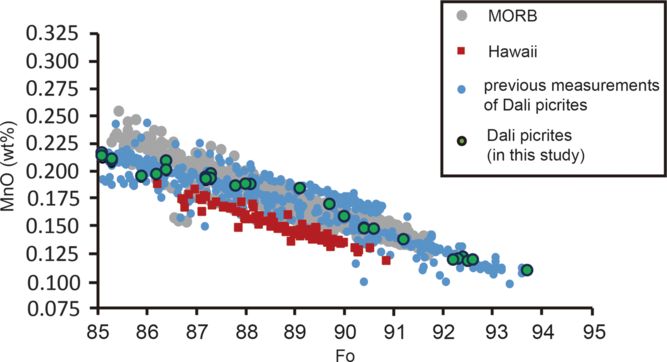
With regard to the minor- and trace-element concentrations in the core of the olivine phenocrysts (analysed by LA-ICP-MS), the Ni concentration ranges from 2563 to 3897 ppm (0.32–0.49 wt% NiO) and shows a positive correlation with the Fo values (Fig. 3). The CaO concentration ranges from 0.25 to 0.50 wt%. MnO content ranges from 0.11 to 0.22 wt% (Fig. 4), whereas the Zn concentration range is 49.8–120.9 ppm, showing a positive Zn–Mn correlation (Fig. 5a; online Supplementary Table S2, available at http://journals.cambridge.org/geo). In addition, the olivine contains 115.6–171.1 ppm Co, 5.8–21.1 ppm V and 4.4–8.9 ppm Sc. However, most rare earth elements (REEs), especially light REEs (LREEs), are present in quantities lower than the detection limits. Although some minor elements such as Ni and Mn were analysed by both EPMA and LA-ICP-MS, we discuss the LA-ICP-MS data as it is of greater precision.
Relationship between the forsterite (Fo) content and Ni concentration in olivine from picrites erupted on thick and thin lithosphere. Dali picrite data were analysed by LA-ICP-MS; errors on measurements are smaller than the symbols. WPM-thick and WPM-thin data from Sobolev et al. (Reference Sobolev, Hofmann, Kuzmin, Yaxley, Arndt, Chung, Danyushevsky, Elliott, Frey and Garcia2007). Karoo and Etendeka data from Howarth & Harris (Reference Howarth and Harris2017). The previously measured olivine Dali picrite data are from Hanski et al. (Reference Hanski, Kamenetsky, Luo, Xu and Kuzmin2010) and Yu et al. (Reference Yu, Shen, Song, Ripley, Li and Chen2017). WPM – within-plate magmas.

The Cr no. (atomic Cr/(Cr + Al)) of Cr-spinel ranges from 0.570 to 0.685 (online Supplementary Table S1b). The content of TiO2 is in the range of 0.4–1.8 wt%, and total iron as FeO (FeO*) is 19.5–29.2 wt%. The MgO contents vary from 9.7 to 14.3 wt%, and the Al2O3 values range from 16.4 to 20.8 wt%.
5. Discussion
5.a. Origin of high-Ni olivine
The Ni content of primitive mantle is estimated as 1960 ppm, which is similar to that of the depleted peridotite (McDonough & Sun, Reference McDonough and Sun1995; Herzberg et al. Reference Herzberg, Asimow, Ionov, Vidito, Jackson and Geist2013), whereas the Ni concentration of olivine in mantle peridotite ranges from 2800 to 3100 ppm (Ionov, Reference Ionov2007; Herzberg et al. Reference Herzberg, Asimow, Ionov, Vidito, Jackson and Geist2013, Reference Herzberg, Vidito and Starkey2016). However, the olivine phenocrysts in Dali picrites, especially those grains with high Fo values, have much higher Ni concentration (with Ni concentration up to c. 3900 ppm, Hanski et al. Reference Hanski, Kamenetsky, Luo, Xu and Kuzmin2010; Yu et al. Reference Yu, Shen, Song, Ripley, Li and Chen2017) than those from mid-ocean ridge basalts (MORBs) or mantle peridotite (Fig. 3). The excess Ni in olivine can result from the following processes. (1) The core–mantle interaction can produce a less-degassed Ni-rich source, and this source continues adding into the mantle plume, which finally formed picrites with high Ni content (Herzberg et al. Reference Herzberg, Asimow, Ionov, Vidito, Jackson and Geist2013, Reference Herzberg, Vidito and Starkey2016). (2) The silica-rich melts formed from recycled crust might interact with mantle peridotite to form a secondary olivine-poor pyroxenite source. Magmas derived from such metasomatic pyroxenite source would therefore contain higher Ni content than those derived from peridotite source (Sobolev et al. Reference Sobolev, Hofmann, Sobolev and Nikogosian2005, Reference Sobolev, Hofmann, Kuzmin, Yaxley, Arndt, Chung, Danyushevsky, Elliott, Frey and Garcia2007; Herzberg, Reference Herzberg2006; Foley et al. Reference Foley, Jacob and O’Neill2011, Reference Foley, Prelevic, Rehfeldt and Jacob2013). (3) Higher melting temperature and pressure would decrease the partition coefficient of Ni between olivine and melts (KDNiol/melt); this will result in a higher Ni concentration in primary melt, and the olivine crystallizing from this melt will have higher Ni content (Niu et al. Reference Niu, Wilson, Humphreys and O’Hara2011; Putirka et al. Reference Putirka, Ryerson, Perfit and Ridley2011; Matzen et al. Reference Matzen, Baker, Beckett and Stolper2013, Reference Matzen, Wood, Baker and Stolper2017).
Olivine with high Ni content has also been recognized in other LIPs. The picrites in Baffin Island and West Greenland also have olivine phenocrysts containing high Ni concentration (c. 3800 ppm) (Sobolev et al. Reference Sobolev, Hofmann, Kuzmin, Yaxley, Arndt, Chung, Danyushevsky, Elliott, Frey and Garcia2007; Herzberg et al. Reference Herzberg, Asimow, Ionov, Vidito, Jackson and Geist2013), even 20% higher than the modern MORB source (2800–3100 ppm) (Ionov, Reference Ionov2007). These picrites are characterized by elevated 3He/4He ratios (Starkey et al. Reference Starkey, Stuart, Ellam, Fitton, Basu and Larsen2009). Picrites from Baffin Island and West Greenland show 3He/4He values up to 50 times the atmospheric value. Herzberg et al. (Reference Herzberg, Asimow, Ionov, Vidito, Jackson and Geist2013) proposed that a less-degassed mantle reservoir formed by core–mantle interaction near the core–mantle boundary contains high 3He/4He, and they correlated the elevated 3He/4He associated with high Ni concentration to the less-degassed Ni-rich material from core–mantle boundary that was added to the mantle source region. For the ELIP, however, picrites from Dali, Binchuan and Lijiang area generally have higher Os concentration and slightly lower Re concentration than many other ocean island picrites, although the 187Os/188Os ratios are obviously lower than the mantle value with negative γOs values (Chen et al. Reference Chen, Zhi, Zhang and Shim2007; Xu et al. Reference Xu, Suzuki, Xu, Mei and Li2007; Zhang et al. Reference Zhang, Zhi, Chen, Saunder and Reichow2008; Li et al. Reference Li, Xu, Suzuki, He, Xu and Ren2010; Hao et al. Reference Hao, Huang, Zhang and Shi2011), which are distinctly different from the Siberia LIP picrites that display relatively positive γOs values. The Os isotopic compositions of the picrites in the ELIP therefore suggest no major input from the core–mantle boundary to the source region.
If the silica-rich melt derived from recycled crust reacts with peridotite, an olivine-free pyroxenite source can be generated that would produce magmas with high Ni concentration (Sobolev et al. Reference Sobolev, Hofmann, Sobolev and Nikogosian2005). Olivine crystallizing from such a magma will generally be characterized by high Ni concentration and low Mn/Fe. The Mn, Fe and Zn in olivine mostly occur as divalent elements and their ionic radii is close to that of Mg2+ (De Hoog et al. Reference De Hoog, Gall and Cornell2010); they therefore behave similarly in the olivine–melt system. Since Mn, Fe and Zn have similar olivine–melt partition coefficients (0.89, 1.1 and 1.09, respectively; Foley et al. Reference Foley, Prelevic, Rehfeldt and Jacob2013; Howarth & Harris, Reference Howarth and Harris2017), their ratios are relatively constant during partial melting or fractional crystallization. The ratios of these melts could therefore well constrain the nature of their mantle source (Sobolev et al. Reference Sobolev, Hofmann, Kuzmin, Yaxley, Arndt, Chung, Danyushevsky, Elliott, Frey and Garcia2007; Herzberg, Reference Herzberg2011; Foley et al. Reference Foley, Prelevic, Rehfeldt and Jacob2013; Herzberg et al. Reference Herzberg, Vidito and Starkey2016). Experimental studies show that the olivine crystallized from melts derived from pyroxenite have 100×Mn/Fe values of 1.05–1.35, whereas those in melts derived from peridotite source show higher 100×Mn/Fe values (>1.5) (Sobolev et al. Reference Sobolev, Hofmann, Kuzmin, Yaxley, Arndt, Chung, Danyushevsky, Elliott, Frey and Garcia2007; Foley et al. Reference Foley, Prelevic, Rehfeldt and Jacob2013). The Dali picrites have olivine phenocrysts with higher Mn content compared with those of Karoo or Hawaii, and show a similar trend to the Mn content of MORB (Fig. 4). Additionally, the high 100×Mn/Fe ratios (1.43–1.73) of olivine in Dali picrites are consistent with those olivines crystallized from melts derived from peridotite (Fig. 5b). This evidence indicates that the primary magma of the Dali picrites was more likely derived from a peridotite-dominated source.
The forsterite (Fo) values versus MnO concentrations in olivine phenocrysts. Dali picrite data analysed by LA-ICP-MS; errors on measurements are smaller than the symbols. Olivine MORB and Hawaii data from Sobolev et al. (Reference Sobolev, Hofmann, Sobolev and Nikogosian2005, Reference Sobolev, Hofmann, Kuzmin, Yaxley, Arndt, Chung, Danyushevsky, Elliott, Frey and Garcia2007) and the previously measured olivine Dali picrite data are from Hanski et al. (Reference Hanski, Kamenetsky, Luo, Xu and Kuzmin2010) and Yu et al. (Reference Yu, Shen, Song, Ripley, Li and Chen2017).
(a) Diagram of Zn concentrations versus forsterite (Fo) values of olivine phenocrysts in Dali picrites. (b) 100×Mn/Fe versus 10 000×Zn/Fe of primitive olivines in the Dali picrites. Tuli, Mwenezi, Etendeka and Buffin picrite data from Howarth & Harris (Reference Howarth and Harris2017). (c) Mn/Zn ratio of the olivine phenocrysts. Olivine from a pyroxenite-derived melt is characterized by low Mn/Zn ratios (<14), while those from peridorite-derived melt have high ratios (>14).

Sobolev et al. (Reference Sobolev, Hofmann, Kuzmin, Yaxley, Arndt, Chung, Danyushevsky, Elliott, Frey and Garcia2007) suggested that the percentage of metasomatic pyroxenite (Xpx) in the mantle source could be calculated based on the Mn/Fe values of the olivine phenocrysts. The equation was proposed as: Xpx = 3.48−[2.071×(100×Mn/Fe)]. Combined with the trace-element data from LA-ICP-MS analysis (online Supplementary Table S2), we calculate an average Xpx in the Dali picrite mantle source of 22.6% (Fig. 6). For comparison, Sobolev et al. (Reference Sobolev, Hofmann, Kuzmin, Yaxley, Arndt, Chung, Danyushevsky, Elliott, Frey and Garcia2007) suggested an average Xpx value of 17% for MORBs. However, the data for olivine in MORB reported by these authors spans a somewhat larger range in Xpx values, which show a similar range to the Dali picrites (Fig. 6); this suggests that the mantle source of Dali picrites is not pyroxenite dominated. It is notable that high pressure may increase the partitioning of Mn between olivine and melts (KDMnol/melt) (Matzen et al. Reference Matzen, Wood, Baker and Stolper2017). Our calculation of Xpx using the method of Sobolev et al. (Reference Sobolev, Hofmann, Kuzmin, Yaxley, Arndt, Chung, Danyushevsky, Elliott, Frey and Garcia2007) is therefore very likely to be flawed.
The percentage of pyroxenite in the mantle source (Xpx) calculated based on Mn/Fe ratios of olivine phenocrysts in Dali picrites and picrites and basalts from Siberian large igneous province (LIP), Hawaii, Karoo LIP, Gran Canaria, Azores, Iceland and MORBs (Sobolev et al. Reference Sobolev, Hofmann, Kuzmin, Yaxley, Arndt, Chung, Danyushevsky, Elliott, Frey and Garcia2007).

The ratio of inter-mineral exchange coefficient of Zn/Mn between olivine and clinopyroxene, KD(Zn/Mn)cpx/ol, defined as KD(Zn/Mn)cpx/melt/KD(Zn/Mn)ol/melt, is c. 0.26 (Le Roux et al. Reference Le Roux, Lee and Turner2010). It has also been established that KD(Zn/Fe)ol/melt is close to 1, but for clinopyroxene (KD(Zn/Fe)cpx/melt), the value is much lower (Le Roux et al. Reference Le Roux, Lee and Turner2010). This suggests that Zn/Fe is minimally fractionated during partial melting of peridotite mantle, but strongly fractionated during melting of pyroxene. As demonstrated previously, olivine grains in magmas derived from peridotite-dominated sources and pyroxenite-dominated sources have significantly different variation trends when plotted in the 100×Mn/Fe versus 10 000×Zn/Fe diagram (Howarth & Harris, Reference Howarth and Harris2017). Moreover, olivine equilibrated with melts derived from pyroxenite was demonstrated to have 10 000×Zn/Fe values of >14 (Le Roux et al. Reference Le Roux, Lee and Turner2010; Howarth & Harris, Reference Howarth and Harris2017). Olivines in Dali picrites have 10 000×Zn/Fe values of 8.0–12.7, showing a similar trend to olivine in picrites from Edenteka and Baffin Island, which were derived from a peridotite source (Fig. 5b). In addition, olivine crystallized from pyroxenite-derived melts have a relatively low Mn/Zn ratio (<14), while those from peridotite-derived melts exhibit a higher Mn/Zn ratio (>14). The Mn/Zn values of the olivine in the Dali picrite range from 13.6 to 18.4, with most Mn/Zn values >15, also indicating a peridotite dominate source (Fig. 5c).
All the features presented above suggest that Dali picrites are more likely to have formed from peridotite-dominated mantle source. However, how a peridotite source can produce a picrite with high-Ni olivine phenocrysts needs to be evaluated further. According to recent experimental studies, the partition coefficient of the Ni element between olivine and melts (KDNiol/melt) is mainly controlled by temperature and pressure. Under conditions of high temperature and pressure, the Ni partition coefficient (KDNiol/melt) will decrease and result in less Ni left in residual olivine. As the melts rise to a shallower level or even to the sub-surface, the partition coefficient of Ni between olivine and melts (KDNiol/melt) will increase due to the decreasing pressure. This may result in higher Ni concentrations in olivine phenocrysts, which are even higher than those in residual olivine in mantle (Li & Ripley, Reference Li and Ripley2010; Niu et al. Reference Niu, Wilson, Humphreys and O’Hara2011; Matzen et al. Reference Matzen, Baker, Beckett and Stolper2013, Reference Matzen, Wood, Baker and Stolper2017).
Matzen et al. (Reference Matzen, Baker, Beckett and Stolper2013) presented results from experimental work which allowed them to investigate the effects of temperature (T) and pressure (P) on KDNiol/melt, independent of substantial changes in liquid composition. The partition coefficient of Ni between olivine and melts is described by the equation:
 $${\rm{In}}\,({{\rm{K}}_{\rm{D}}}{\rm{N}}{{\rm{i}}^{{\rm{ol/liq}}}}) = [( - {\rm{\Delta} _{\rm{r}}}{{\rm{H}}_{{\rm{Tref,}}\,{\rm{Pref}}}})/({\rm{R}}T)] + ({\rm{\Delta} _{\rm{r}}}{{\rm{S}}^{\rm{o}}}_{{\rm{Tref,}}\,{\rm{Pref}}}{\rm{/R}}) - {\rm{In}}[{\rm{X}}{({\rm{MgO}})^{{\rm{liq}}}}/{\rm{X}}{({\rm{MgS}}{{\rm{i}}_{0.5}}{{\rm{O}}_2})^{{\rm{ol}}}}]$$
where −ΔrHTref, Pref/R and ΔrS°Tref, Pref/R are constants independent of pressure and temperature, and T is the olivine liquidus temperature in degrees Kelvin. Putirka et al. (Reference Putirka, Tao, Hari, Perfit, Jackson and Arevalo2018) reproduced the calibration data (n = 17) with a standard error of estimate of ±1.3 with an R 2 of 0.82, using the high-precision work of Matzen et al. (Reference Matzen, Baker, Beckett and Stolper2013). The above equation can be simplified to:
 $${{\rm{K}}_{\rm{D}}}{\rm{N}}{{\rm{i}}^{{\rm{ol/lir}}}} = {{\rm{e}}^{(3349/T) - 0.79}}$$
where the olivine liquidus temperature T is in degrees Celsius. From a rough estimate of the source region pressure via the inversion of lanthanide REE data and olivine–melt equilibrium, the pressure at the start of melting is estimated as 4 GPa (Xu et al. Reference Xu, Chung, Jahn and Wu2001; Zhang et al. Reference Zhang, Hao and Wang2003, Reference Zhang, Mahoney, Mao and Wang2006). Tao et al. (Reference Tao, Putirka, Hu and Li2015) used the olivine and clinopyroxene composition in ELIP picrites to determine the P-T condition when magma crystallization occurred, and reported that the olivine phenocrysts crystallized at a pressure of 1 GPa. As we calculate later in Section 5.b, the olivines in Dali picrites crystallized at a temperature of c. 1491°C, and the mantle potential temperature T p is c. 1560°C. When these temperature estimates are introduced into the simplified equation above, the resulting Ni partition coefficient KDNiol/melt is c. 3.8 and 4.3 for melting and crystallizing, respectively. The Ni content of melts derived from peridotite is defined as:
 $${\rm{N}}{{\rm{i}}_{{\rm{melt}}}} = 2.9594 \times {\rm{Mg}}{{\rm{O}}_{{\rm{melt}}}}^{1.859}$$
where Ni is in ppm and MgO in wt%, provided by Niu et al. (Reference Niu, Wilson, Humphreys and O’Hara2011).
According to the olivine–bulk-rock equilibrium and melt inclusions data, previous studies suggested that the primary melt of the Dali picrites had MgO content of 20–23 wt% (Li et al. Reference Li, Zhang and Nie2012, Reference Li, Wang, Ren, Xu, He and Xu2014; Ren et al. Reference Ren, Wu, Zhang, Nichols, Hong, Zhang, Zhang, Liu and Xu2017). When we use the primary melt MgO content in the equation above, the Ni content is 776–1006 ppm. The Dali picrites melted at high pressure (c. 4 GPa), adiabatically ascended to the near-surface environment at low pressure (c. 1 GPa) and started to crystallize olivine. In this case, the Ni partition coefficient KDNiol/melt = 4.3. In order to crystallize olivine with c. 3900 ppm Ni concentration, there should be at least c. 907 ppm Ni in the melt. This is consistent with the calculated Ni concentration in the primary melt of Dali picrite, suggesting that it is possible for the Dali picrite melt to crystallize high-Ni olivines. In other words, the Dali picrites were produced by partial melting of a peridotite source. We therefore propose that the high concentration of Ni in olivine in the Dali picrites might be attributed to the relatively low KDNiol/melt during peridotite partial melting at conditions of high temperature and high pressure, which resulted in enrichment of the primitive magmas with Ni, and the high KDNiol/melt when the deep mantle-derived magma rose to a shallower environment of lower temperature and pressure, which resulted in crystallization of those Ni-rich olivines. There is therefore no need for eclogites or pyroxenite in the generation of Dali picrites.
5.b. Estimation of mantle potential temperature
Based on the temperature-dependent behaviour of Al between coexisting olivine and Cr-spinel, the newly established Al-in-olivine thermometer proposed by Wan et al. (Reference Wan, Coogan and Canil2008) and Coogan et al. (Reference Coogan, Saunders and Wilson2014) can be used to estimate the olivine crystallization temperature. Compared with the traditional olivine–melt equilibrium thermometer, Al-in-olivine thermometer has the advantage of being independent of crystallization pressure, parental melt composition, oxygen fugacity and water content (Wan et al. Reference Wan, Coogan and Canil2008; Coogan et al. Reference Coogan, Saunders and Wilson2014). In addition, Al is expected to diffuse much more slowly through the olivine lattice than Mg and Fe, so the initial composition of the olivine-spinel pair is preserved (Spandler & O’Neill, Reference Spandler and O’Neill2010). It is therefore much more useful and convenient for us to determine the crystallization temperature of olivines in Dali picrites. The experimental results provided by Wan et al. (Reference Wan, Coogan and Canil2008) and Coogan et al. (Reference Coogan, Saunders and Wilson2014) suggested a restricted range for this thermometer; only Cr-spinel with Cr no. of 0–0.69 (Cr/(Cr + Al), mol) can be used for a reliable result from the Al-in-ol thermometer. The spinels in this study exhibit Cr no. values in the range of 0.570–0.685, all within the calibration range of the thermometer. We can therefore use these olivine and Cr-spinel composition data to estimate the crystallization temperature of olivines (°C), and the thermometer calibration equation is expressed:
 $$\eqalign{
& {{\rm{T}}^{{\rm{ol - spl}}}} = 273.15 + 10{\mkern 1mu} 000/[0.575 + (0.884 \times {\rm{Cr}}{\mkern 1mu} {\rm{no}}.) - 0.897 \cr
& \times {\rm{In}}({\rm{A}}{{\rm{l}}_2}{{\rm{O}}_3}^{{\rm{ol}}}{\rm{/A}}{{\rm{l}}_2}{{\rm{O}}_3}^{{\rm{sp}}})]. \cr} $$
$$\eqalign{
& {{\rm{T}}^{{\rm{ol - spl}}}} = 273.15 + 10{\mkern 1mu} 000/[0.575 + (0.884 \times {\rm{Cr}}{\mkern 1mu} {\rm{no}}.) - 0.897 \cr
& \times {\rm{In}}({\rm{A}}{{\rm{l}}_2}{{\rm{O}}_3}^{{\rm{ol}}}{\rm{/A}}{{\rm{l}}_2}{{\rm{O}}_3}^{{\rm{sp}}})]. \cr} $$
The calculated temperature for Dali picrites ranges from 1221 to 1491°C (by EPMA data, online Supplementary Table S1c). Accordingly, we also calculated the uncertainty of the thermometer by error propagation, and the calculated 2σ error ranged from ± 57 to ± 65°C (online Supplementary Table S1c). The maximum crystallization temperature is estimated as 1491 ± 65°C (Fig. 7), which constrains the liquidus temperature to Tol/liq ≥ 1491°C. When compared with olivine crystallization temperatures reported from other plume-related settings, such as continental flood basalts or other LIPs, the hottest Dali olivine–spinel crystallization temperatures are c. 50°C higher than the maximum olivine crystallization temperatures for ELIP samples from Yongsheng, Binchuan and Dali estimated by Xu & Liu (Reference Xu and Liu2016) (1440 ± 63°C). The samples of Dali picrite for this study were collected from a road-cut section located close to the Dali sections where Xu & Liu (Reference Xu and Liu2016) collected their samples, and the higher crystallization temperature estimated in Dali picrites might be attributed to their higher Fo value of the host olivine than the samples of Xu & Liu (Reference Xu and Liu2016). For comparison, the highest Dali picrite olivine crystallization temperature is 1491°C, which is similar to the highest olivine crystallization temperature estimated for Karoo, Madagascar and Etendeka, but about 100°C higher than those estimated for Iceland and SE Greenland (Coogan et al. Reference Coogan, Saunders and Wilson2014; Heinonen et al. Reference Heinonen, Jennings and Riley2015; Xu & Liu, Reference Xu and Liu2016; Matthews et al. Reference Matthews, Shorttle and MacLennan2016; Jennings et al. Reference Jennings, Gibson and MacLennan2019; Table 1). This temperature is about 200°C higher than the maximum crystallization temperature of MORB (1270°C) calculated by the same thermometer (Coogan et al. Reference Coogan, Saunders and Wilson2014), and provides robust evidence for a pronounced thermal anomaly in the mantle source of the Dali picrites.
Results of Al-in-olivine thermometry for the Dali picrites shown in olivine Fo versus T (°C). Estimated 2σ errors for the temperatures are shown (see Section 5.b).

The highest-reported olivine-spinel equilibrium temperature and the Fo values for the host olivines. Data sources: MORB, Gorgona, SE Greenland, Baffin Island and Madagascar: Coogan et al. (Reference Coogan, Saunders and Wilson2014); Karoo: Heinonen et al. (Reference Heinonen, Jennings and Riley2015); Etendeka: Jennings et al. (Reference Jennings, Gibson and MacLennan2019); ELIP: Xu & Liu (Reference Xu and Liu2016); Iceland: Matthews et al. (Reference Matthews, Shorttle and MacLennan2016).

As for the mantle potential temperature (T P), there is a simple method for evaluating T P of a peridotite source from the olivine crystallization temperature. It is generally considered that progressively ascending melts are nearly adiabatic before olivine begins to crystallize. Because of the enthalpy of melting and adiabatic cooling, T P should be higher than the maximum crystallization temperature. In order to calculate T P of the Dali picrites, a temperature correction for melt generation and adiabatic cooling is required (Putirka et al. Reference Putirka, Perfit, Ryerson and Jackson2007; Herzberg & Asimow, Reference Herzberg and Asimow2015; Matthews et al. Reference Matthews, Shorttle and MacLennan2016; Jennings et al. Reference Jennings, Gibson and MacLennan2019). Putirka et al. (Reference Putirka, Perfit, Ryerson and Jackson2007) and Herzberg & Asimow (Reference Herzberg and Asimow2015) assumed a simple two-step approach to calculate the mantle potential temperature from the crystallization temperature: first, correct back to the liquidus temperature at 1 atm along an adiabat, then correct the temperature which dropped through melting and crystallizing at 1 atm.
The water content of magma also needs to be taken into consideration, due to its potential effect on the T p calculation. As reported by Liu et al. (Reference Liu, Xia, Kuritani, Hanski and Yu2017), the H2O contents in Dali picrites were calculated to be 2–4 wt% based on the study on clinopyroxene–melt equilibrium. However, considering that the crystallization of olivine and spinel usually occurs earlier than that of clinopyroxene, an increase of H2O in the residual melts can be expected, and the reported H2O contents might be an overestimate. As our samples lack other hydrous primary minerals (e.g. amphibole, mica) and the basalts coexisting with Dali picrites (Fig. 2a) contain large amounts of plagioclase phenocrysts (Fig. 2d), we propose that the water content of our Dali pictrite samples was probably relatively low.
Based on experimental data, Herzberg & Asimow (Reference Herzberg and Asimow2015) defined the effect of pressure on increasing olivine liquidus temperature as:
 $${{\it{T}}_1}^{{\rm{ol/lig}}} = T{(P)^{{\rm{ol/liq}}}} - 54P + 2{P^2}$$
where T 1 ol/liq (°C) is the olivine liquidus temperature at a pressure of 1 atm and T(P)ol/liq (°C) is the olivine liquidus temperature at pressure P in gigapascals. Tao et al. (Reference Tao, Putirka, Hu and Li2015) suggested that the olivine crystallization pressure is c. 1 GPa, and the liquidus temperature T(P)ol/liq is constrained to ≥1491°C, resulting in T1 ol/liq ≥ 1439°C. The mantle potential temperature T P is related to the olivine liquid temperature at 1 atm (T 1 ol/liq) along the solidus line by the equation (Herzberg & Asimow, Reference Herzberg and Asimow2015):
 $${T_p} = 1.049 \times {T_1}^{{\rm{ol/liq}}} - [0.00019 \times {({T_1}^{{\rm{ol/liq}}})^2}] + [1.487 \times {10^{ - 7}} \times {({T_1}^{{\rm{ol/liq}}})^3}].$$
Using T 1 ol/liq in the above equation, we obtain a T P of 1559°C. We also consider the uncertainty of the crystallization temperature in the calculation, yielding a propagated uncertainty in T P of c. +95/–90°C. We therefore infer that the mantle potential temperature of the Dali picrites is ≥ 1559 +95/–90°C, which is consistent with previous studies (c. 1620°C; Zhang et al. Reference Zhang, Mahoney, Mao and Wang2006). For comparison, Matthews et al. (Reference Matthews, Shorttle and MacLennan2016) used a similar method to calculate a T P of 1480 +37/–30°C for the Iceland mantle plume and 1318 +44/–32°C for the MORB from the olivine–spinel crystallization temperatures. The mantle potential temperature of the Dali picrites is c. 200°C higher than that of normal MORB, and is therefore consistent with a plume-head origin (even if our method represents a simplification and neglects the uncertainty in water content, oxygen fugacity and the melt fractions). The mantle potential temperature T p is definitely higher than the olivine crystallization temperature, and T ol–spl = 1491°C is still much higher than the mantle potential temperature of the normal MORB T P(MORB) = 1318 +44/–32°C).
6. Conclusions
-
1. The trace-element data of primitive olivine in Dali picrites are consistent with a peridotite-dominated source for the primary magma.
-
2. The high Ni content in olivine phenocrysts can be explained by the relatively low KDNiol/melt during partial melting in the deep mantle and the high KDNiol/melt during crystallization in the relatively shallow level. This model suggests that a significant contribution from a metasomatic pyroxenite to the formation of high-Ni olivine is not a prerequisite.
-
3. Based on the Al-in-olivine thermometer, we compute the maximum olivine crystallization temperature T ol–spl of 1491 ± 65°C. Since the Dali picrite was derived from a peridotite-dominated source, the estimated mantle potential temperature T P is ≥ 1559 +95/–90°C, which is c. 200°C higher than the mantle potential temperature of the MORB, confirming the role of a mantle plume.
Supplementary material
To view supplementary material for this article, please visit https://doi.org/10.1017/S0016756820001053
Acknowledgements
This study was financially supported by the National Key Research and Development Program of China (2016YFC0600502) and the National Natural Science Foundation of China (41761134086) as well as the 111 Project (B18048). We are grateful to Fang-Yue Wang and Qin Li for their assistance with LA-ICP-MS analysis and to Jing-Wu Yi for his assistance with EPMA analysis. We thank reviewer Rong Xu, an anonymous reviewer and editor Kathryn Goodenough for their constructive comments and useful suggestions.


 Open access

