




A medieval English manuscript of Walter of Châtillon’s Alexandreis now in the collection of Princeton University Library is a fascinating example of the paradox Rosalind McKitterick noted of palimpsest manuscripts: ‘their most striking feature … is … that they represent evidence preserved by destruction’.Footnote 1 The thrifty producer of the manuscript now catalogued as Garrett 119 (hereafter PRu Garrett 119) systematically cut up, erased and then repurposed a chronicle roll, multiple account rolls and three music rolls in order to assemble the parchment used to copy the Alexandreis text and for the volume’s binding materials. But, as proof of McKitterick’s paradox, if these materials had not been mutilated, this set of important sources of medieval polyphony might have been forever lost to history. Well known to medieval musicologists, the music fragments transmit twelve fragmentary polyphonic compositions, the most famous of which is the jaunty voice-exchange motet Thomas gemma/Thomas cesus, written in honour of Thomas Becket and the lesser-known Thomas of Dover. Also recorded on one of these fragments is the evocative two-voice motet Veni mater gracie/T. Dou way Robin, which is one of only two extant medieval motets that has a texted tenor in Middle English.Footnote 2
The survival of three rolls of late medieval polyphony reused within this one manuscript codex is a significant number, given that in total just over 140 (mostly fragmentary) sources of any type survive from the British Isles from c.1200 to c.1350. Twenty music rolls, including these three, are extant from this time period.Footnote 3 Kenneth Levy’s 1951 article-length study introduced the music fragments of PRu Garrett 119, and is an inventory and discussion of the music compositions in terms of their notation, style and compositional structures.Footnote 4 The specific local contexts of their original production and subsequent reuse have yet to be examined in depth, with the exception of Don Skemer’s comprehensive 2009 study of the repurposed chronicle roll.Footnote 5 However, there are significant inaccuracies in previous descriptions of PRu Garrett 119 that relate to its dating, place of copying and production process. Based on new evidence gleaned from one of the account rolls bound with PRu Garrett 119 and a codicological and palaeographical examination of the host volume, I propose the possibility of a Yorkshire location and a Cistercian institution at least for the initial compilation of the host volume and the copying of at least one of the music fragments. If this hypothesis is correct, the fragmentary sources of PRu Garrett 119 would join a small but important collection of polyphonic sources linked to Yorkshire, several of which have connections to Cistercian abbeys in that region.
Prior descriptions and datings of Princeton University Library, Garrett 119
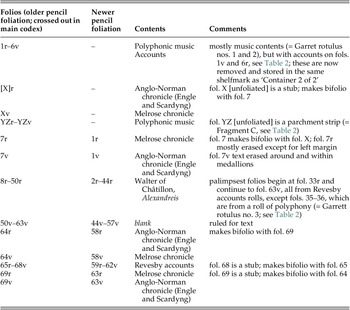
PRu Garrett 119 has a one main text, the twelfth-century medieval Latin poem Alexandreis by Walter of Châtillon (fols. 8r–50r), which was a popular school text in the later Middle Ages, with more than 200 copies surviving today.Footnote 6 The binding is modern, described in the Princeton University Library catalogue as follows: ‘England, 17th century. Calf over pasteboard, with gold-stamped and blind-embossed panels; gilt edges; red, blue, and ochre marbled endpapers’.Footnote 7 Table 1 lists the complete contents of the manuscript, including the fragmentary contents of the other manuscripts that were repurposed for this copy of Walter’s poem. The music endleaves were removed from the host volume at some point after Levy published his article and are now stored in a separate envelope under the same shelfmark (labelled ‘Container 2 of 2’).Footnote 8
The complete contents of PRu Garrett 119
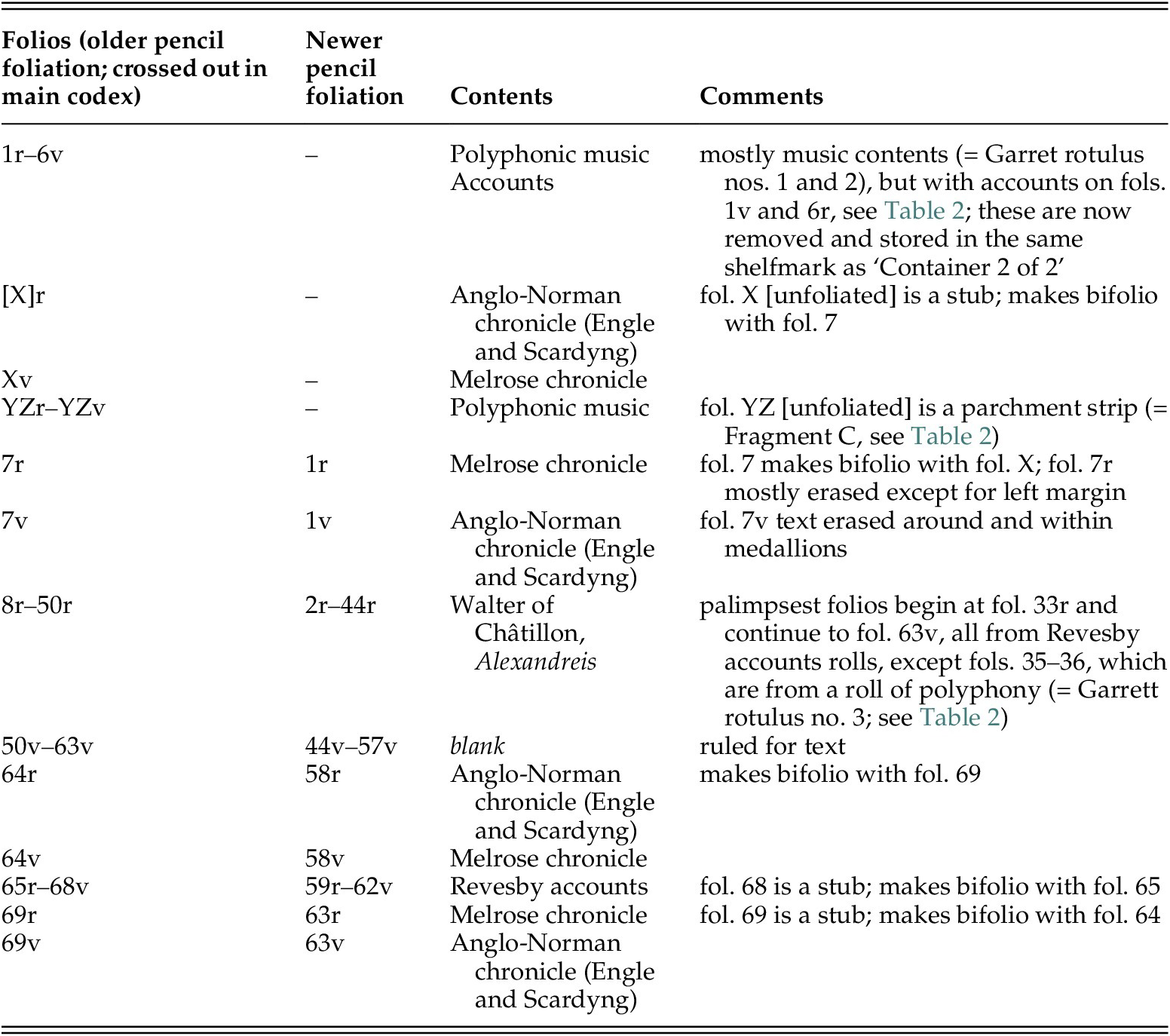
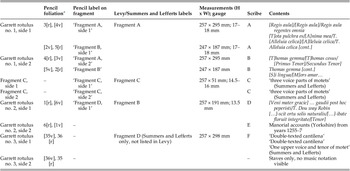
The front and rear endleaves of PRu Garrett 119 have fragments from a chronicle roll that transmit the story of Engle and Scardyng in Anglo-Norman (the bifolios that were originally rolls are fols. Xr and 7v at the front, and 64r and 69v at the rear) and with portions of the Melrose chronicle in Latin in another hand on the reverse of the roll (bifolios are fols. Xv and 7r at the front, and 64v and 69r at the rear). The contents of contexts of both these texts are discussed in detail by Skemer. Two music rolls (Garrett rotulus no. 1 and Garrett rotulus no. 2) were also used as front endleaves, one of which has accounts on one side (fols. 6r and 1v). A strip from a music codex (Fragment C) was used as a reinforcement strip (see Table 2 for more details on the music fragments).Footnote 9 Along with the chronicle fragment that is at the rear, account rolls are found as rear endleaves (fols. 65r–68v). In addition (and relatively unusually) the latter half of the manuscript (fols. 33r–63v) was made from palimpsest parchment, mostly from the same account rolls that were used as the rear endleaves, but one of the palimpsest parchment bifolios (fols. 35 and 36) has portions of staves, passages of Ars nova notation, and some underlaid text visible to the naked eye and under ultraviolet light (Garrett rotulus no. 3).Footnote 10
Music fragments in PRu Garrett 119
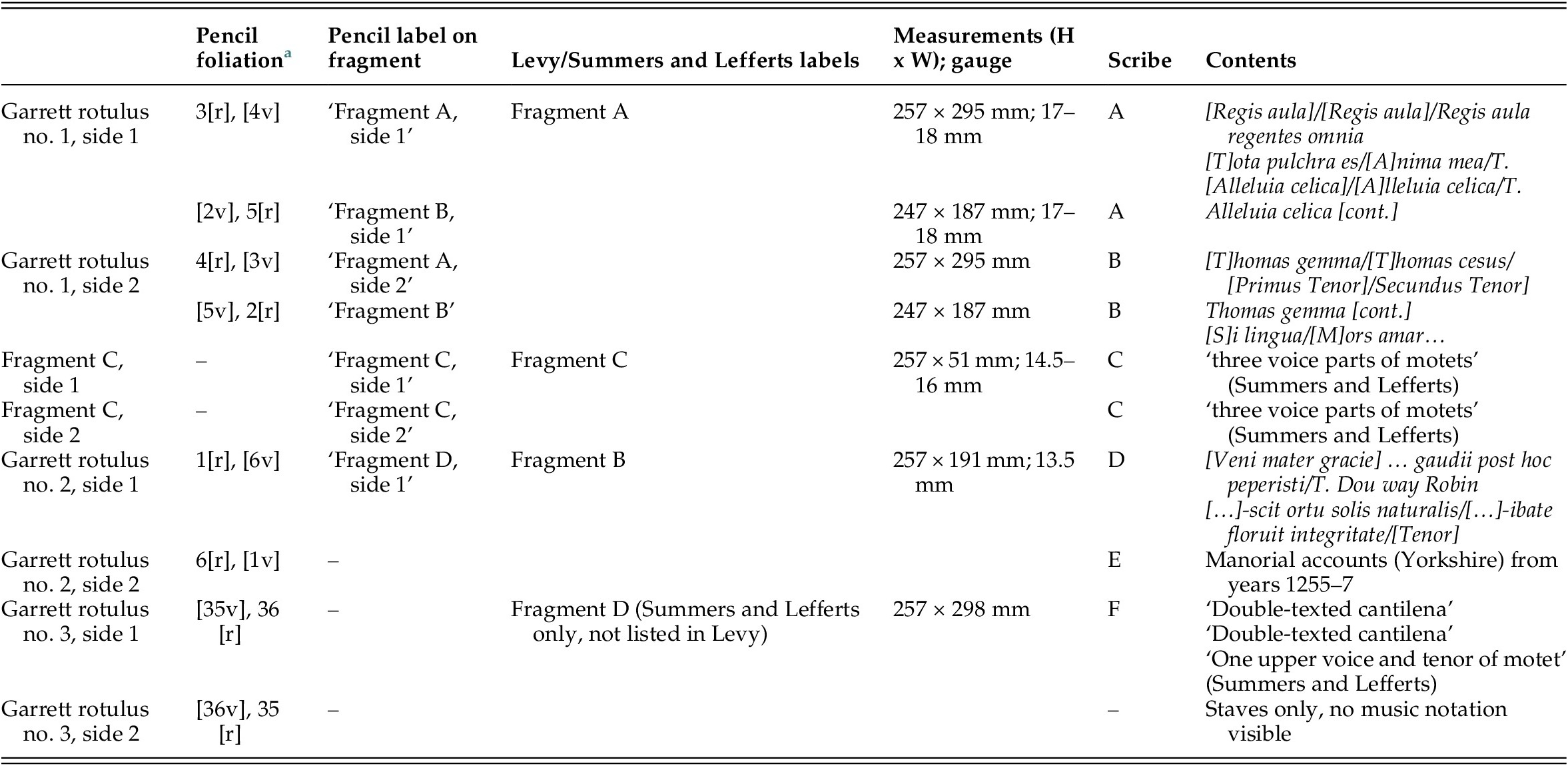
a Numbers were only placed on the recto side of the folios: since the recto and verso sides not indicated, these are enclosed in square brackets here.
Levy, writing in 1951, gave the dating of the main part of the manuscript as late fourteenth century.Footnote 11 He assigned all the music endleaves to the ‘last quarter of the 13th century or the very early 14th’, and did not localise them, beyond their copying in England.Footnote 12 He described the monastic accounts that are found on the back of Garrett rotulus no. 2 as dating from the ‘fourth or fifth decade of the 14th century’ (thus after the copying of the music).Footnote 13
Like Levy, Skemer – writing in 2009 – dated the main contents (the Alexandreis) to the second half of the fourteenth century.Footnote 14 The volume’s provenance, he wrote, ‘as a whole is somewhat confusing, though it can be localised to Lincolnshire’, since the accounts used as endleaves have expenses and receipts for the years 1332 to 1333 recorded by Robert de Ratheby (now Raithby), cellarer of Revesby Abbey, a Cistercian abbey in Lincolnshire.Footnote 15 Skemer proposed, however, mostly based on circumstantial evidence, that the main text of the manuscript and the fragments of the chronicle roll may have originated or at least been later present in a different Lincolnshire abbey, the Benedictine Abbey of Croyland (Crowland).Footnote 16
William Summers and Peter Lefferts, in their 2016 catalogue entry for the Princeton fragments, reproduce Levy’s and Skemer’s assertions that the Alexandreis was copied in the fourteenth century. Given Skemer’s Croyland hypothesis, they indicate caution with the question mark ‘Written for Revesby?’ under the ‘History’ section of the catalogue entry.Footnote 17 They also introduce some new errors; namely, that the palimpsest accounts from Revesby are thirteenth-century accounts, and that Garrett rotulus no. 2 also has accounts from Revesby on the verso.Footnote 18
The account copied on Garrett rotulus no. 2 has a completely different layout, however, and is in a different hand to the cellarer’s accounts of Revesby Abbey that serve as the rear endleaves of PRu Garrett 119, a fact that had gone unnoticed (or at least unremarked) in all prior studies. Close examination of this account’s handwriting and contents suggests an earlier date and different place of copying for Garrett rotulus no. 2. In the following, I lay out this evidence and consider the implications of the redating and ‘re-placing’ of this fragment. But first, a physical examination of the manuscript as a whole indicates that it too must be redated, and furthermore, that there was a significant break in its production, which supports the hypothesis of a different date and origin for Garrett rotulus no. 2. It is a fascinating story of the creative and practical ways manuscript compilers worked with their materials, including discarded music manuscripts. It fits well with the emerging picture of the wide range of activities in the purview of the monastic precentor, which along with their music role, also included custody and care of the monastery’s books.Footnote 19
A century-long break in production?
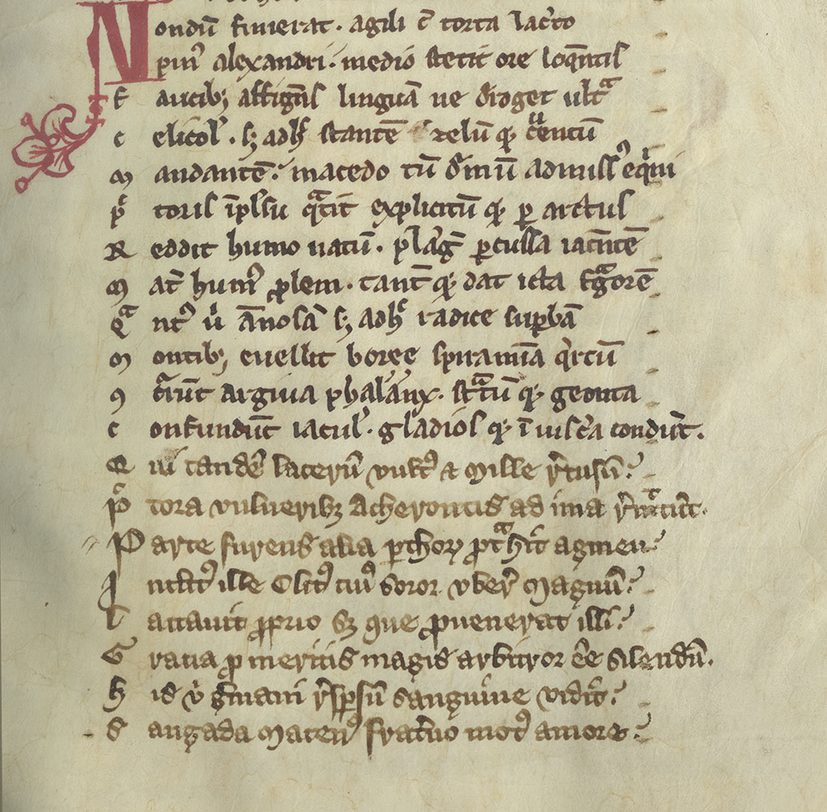
Pace the datings in all previous scholarship, the Alexandreis manuscript is in fact an early thirteenth-century manuscript that was later completed in the fourteenth century. This can be seen quite clearly on the first page of the poem (fol. 8r), which is copied in a semi-formal smaller gothic bookhand of the first half of the thirteenth century.Footnote 20 This same hand continues until fol. 31r in the fourth quire. For the last eight lines of fol. 31r a new scribe takes over and continues the copying of Alexandreis until fol. 50r: this is a mid-fourteenth-century hand (the switch between the two hands can be seen in Figure 1). Thus, a thirteenth-century scribe began the copying of this poem, and more than a century later a fourteenth-century scribe continued it, mid-text.
Change of scribe on fol. 31r, eight lines from the bottom. Princeton University Library, Special Collections – Manuscripts, Garrett 119 (detail). Image courtesy of Princeton University Library.
The palimpsest portion of the manuscript mentioned earlier (fols. 33r to 63v) begins in quire 5, just two folios after this change in hand.Footnote 21 The mid-fourteenth-century scribe, therefore, finished the incomplete quire left by the thirteenth-century scribe and fashioned recycled parchment into quires to finish the copying of the Alexandreis. Most of these palimpsest bifolios were thoroughly scraped, although the underwriting is somewhat more visible on fols. 50v–63v since these fourteen folios were left blank and have no overwriting.Footnote 22 Apart from the single palimpsest music roll Garrett rotulus no. 3 (fols. 35 and 36), the palimpsest bifolios that begin at fol. 33 appear to be account rolls from the same set of accounts as those found in the rear endleaves, cut up and turned at ninety degrees to make bifolios. Their layout and hand suggest that these accounts are also by Robert de Rathby of Revesby, thus strengthening the links of this fourteenth-century stage of production of the Alexandreis manuscript to Revesby Abbey (i.e., it is not only the accounts of the rear endleaves that have the Revesby links, but the also the underwritten parchment of the main manuscript).Footnote 23
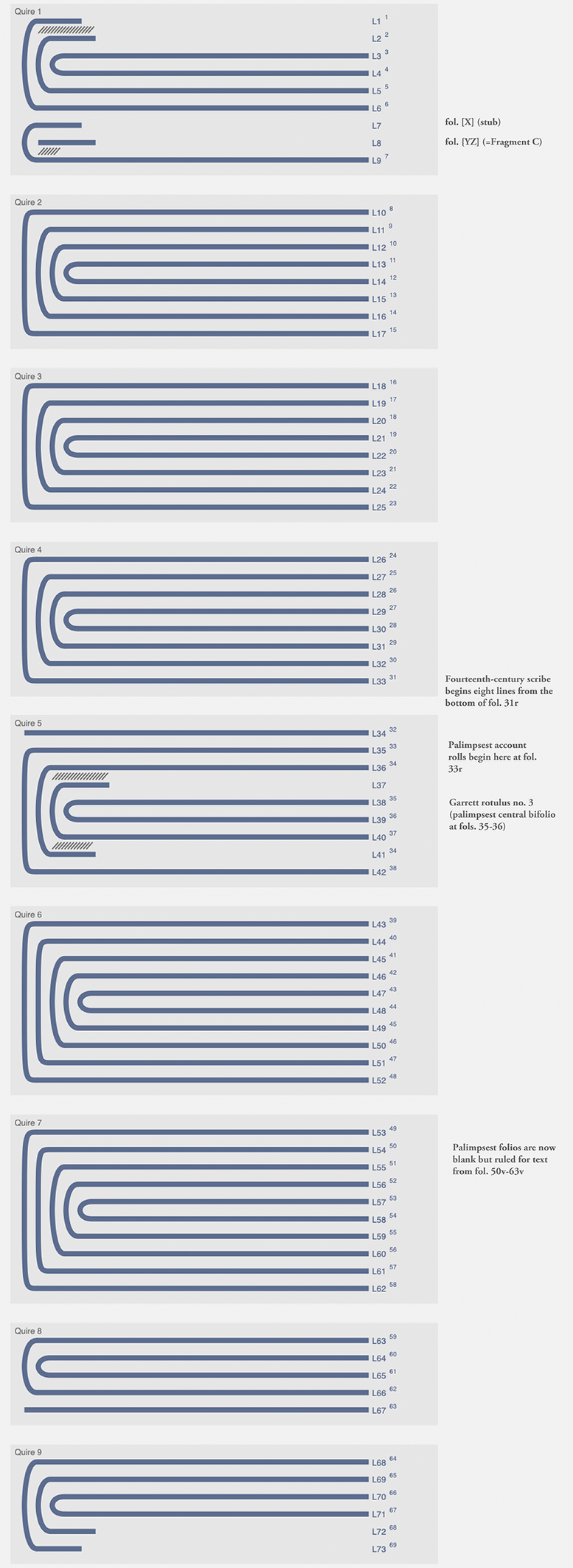
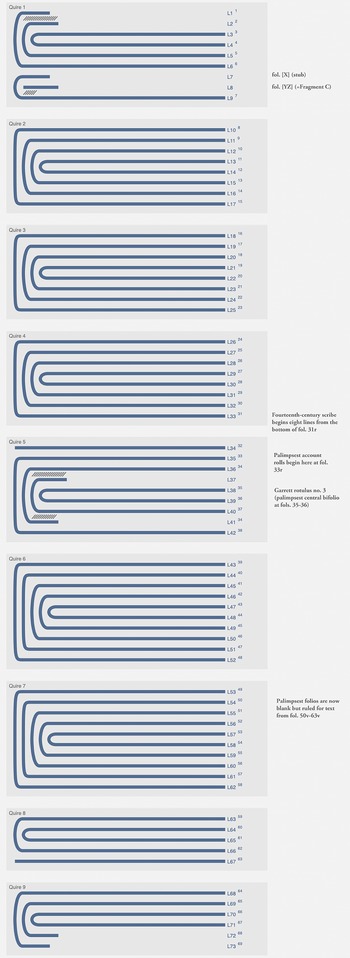
The collation of PRu Garrett 119 as given in Figure 2 reflects this significant break in the production.Footnote 24 The first stage proceeded according to a carefully regularised production plan. The text of Alexandreis begins in quire 2, and quires 2–4 are all consistently quaternions, and catchwords are present at the end of each of these quires. But from quire 5 on, catchwords are no longer present. The palimpsests begin in quire 5, which is also a significantly irregular quire.Footnote 25 With quires 6 and 7, whoever was now in charge of directing the production of this manuscript began to form the quires with consistency, but now as quinternions. Quire 8 is again irregular (two bifolios and a single leaf), and quires 1 and 9 are the endleaf quires.
Collation of PRu Garrett 119. Since there are unfoliated stubs, leaf numbers are included (indicated by ‘L’) and to the right of these in superscript are the numbers of the older pencil foliation.
The decorated initials that occur in the earlier part of the manuscript appear to be later additions (both those in brown and those in red), most likely added in the fourteenth century during this second stage of production. Again, their deployment is not consistent, and quire 5 is a moment of transition where the compiler tweaks their practices: the style of the major initials changes within quire 5, on fol. 35v, and the red ink that had been used up to fol. 36r to decorate the first letter of each line of text is no longer used from fol. 37v on.
This change in the availability of materials and/or institutional resources and book production processes (catchwords, decoration, use of red ink, the number of folios per quire and the type of parchment used) indicate either a significant change in the workplace practices, or an actual change of workplace between the earlier and later stages of the compilation of this manuscript. This makes a lot of sense given the century or more that separates the two stages of production. The fourteenth-century stage was more ad hoc. Hannah Ryley describes a similar process in the production of an English fourteenth-century copy of Chaucer’s Pricke of Conscience (Oxford, Bodleian Library, Rawl. C. 35), where fifty of its 118 folios can be identified as palimpsests, including palimpsest leaves with music underwriting: she suggests that although it ‘might sound fanciful … scraping was undertaken on demand as the project proceeded’.Footnote 26 In the case of Oxford, Bodleian Library, Rawl. C. 35, Ryley hypothesised that it became ‘expedient’ to resort to palimpsest parchment, including palimpsest leaves with music notation, near the end of the book’s production, and that the scraping was done as needed to accommodate the new text.Footnote 27 Ryley also discusses a manuscript of Chaucer’s Treatise on the Astrolabe (Cambridge, St John’s College, E.2) that also uses palimpsest music leaves: this manuscript has at least six palimpsest leaves that were cut down from an antiphonal, and like the cut-up account rolls of PRu Garrett 119, reoriented ninety degrees and used as bifolios.Footnote 28
What evidence do the ‘endleaf quires’ (quires 1 and 9) contain that supports this hypothesis of a creative and opportunistic use of repurposed materials? One thing the repurposed parchment immediately suggests is an individual who had a particular enthusiasm for the scraping knife. How this individual engaged with this ‘waste’ parchment, however, first requires a consideration of how the endleaves were used in the original medieval binding.
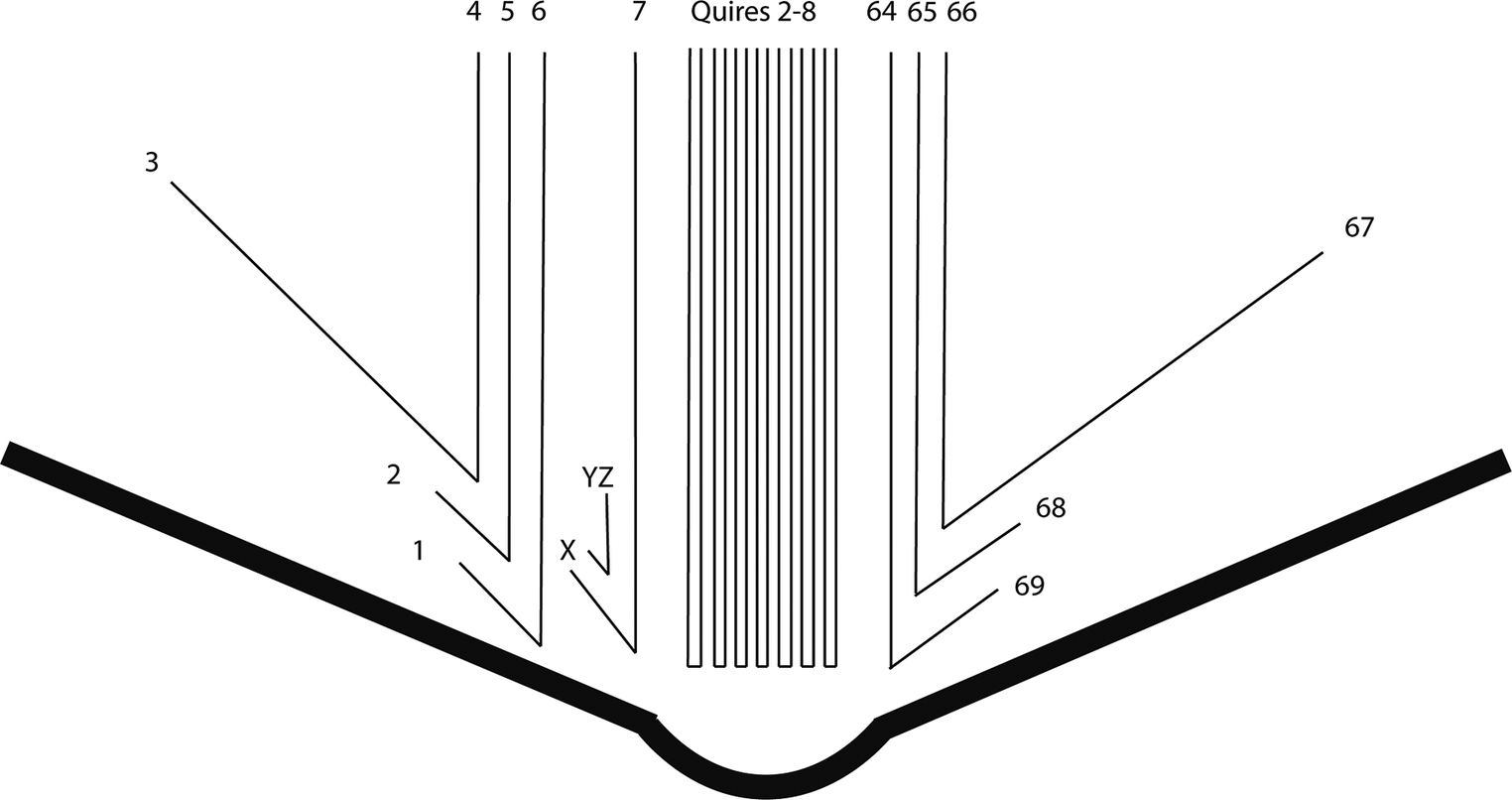
Since PRu Garrett 119 was rebound in the seventeenth century, and the front endleaves removed by Princeton Library in the twentieth century, deciphering details of the original medieval binding is difficult. Figure 3 reconstructs how the endleaves were used in the seventeenth-century binding (before the removal of the front endleaves after 1951, aided by Levy’s description and the modern pencil labelling and foliation).
Reconstruction of endleaf use in the early modern binding.
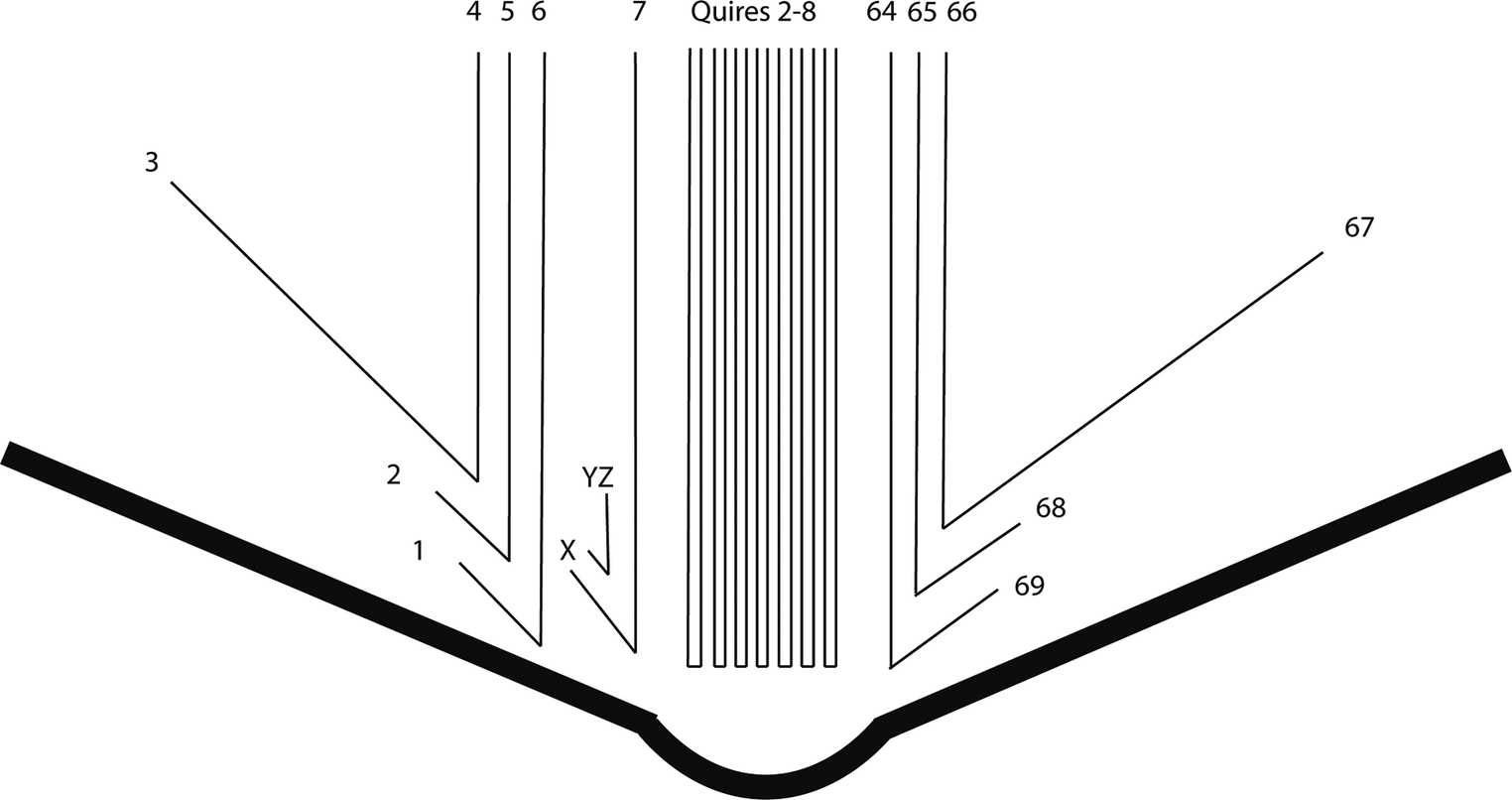
In this early modern binding (Figure 3), the music leaves formed a ternion (fols. 1–6), mirrored in the arrangement of the chronicle and account rolls at the back of the codex (fols. 64–69), which is also a ternion. Fols. 1, 2, 68 and 69 are stubs, and offsets and glue stains on the four stubs indicate fols. 1 and 2 were pasted together and similarly fol. 68 was pasted to fol. 69. Note that the stubs have diagonal cut-outs at the top and bottom outer corners: this may be seen in the image of fols. 1 and 6 in Figures 5 and 7. Fols. 3 and 4 and fols. 66 and 67 are the bifolios that were located at the centre of these ternions (Figure 3).Footnote 29
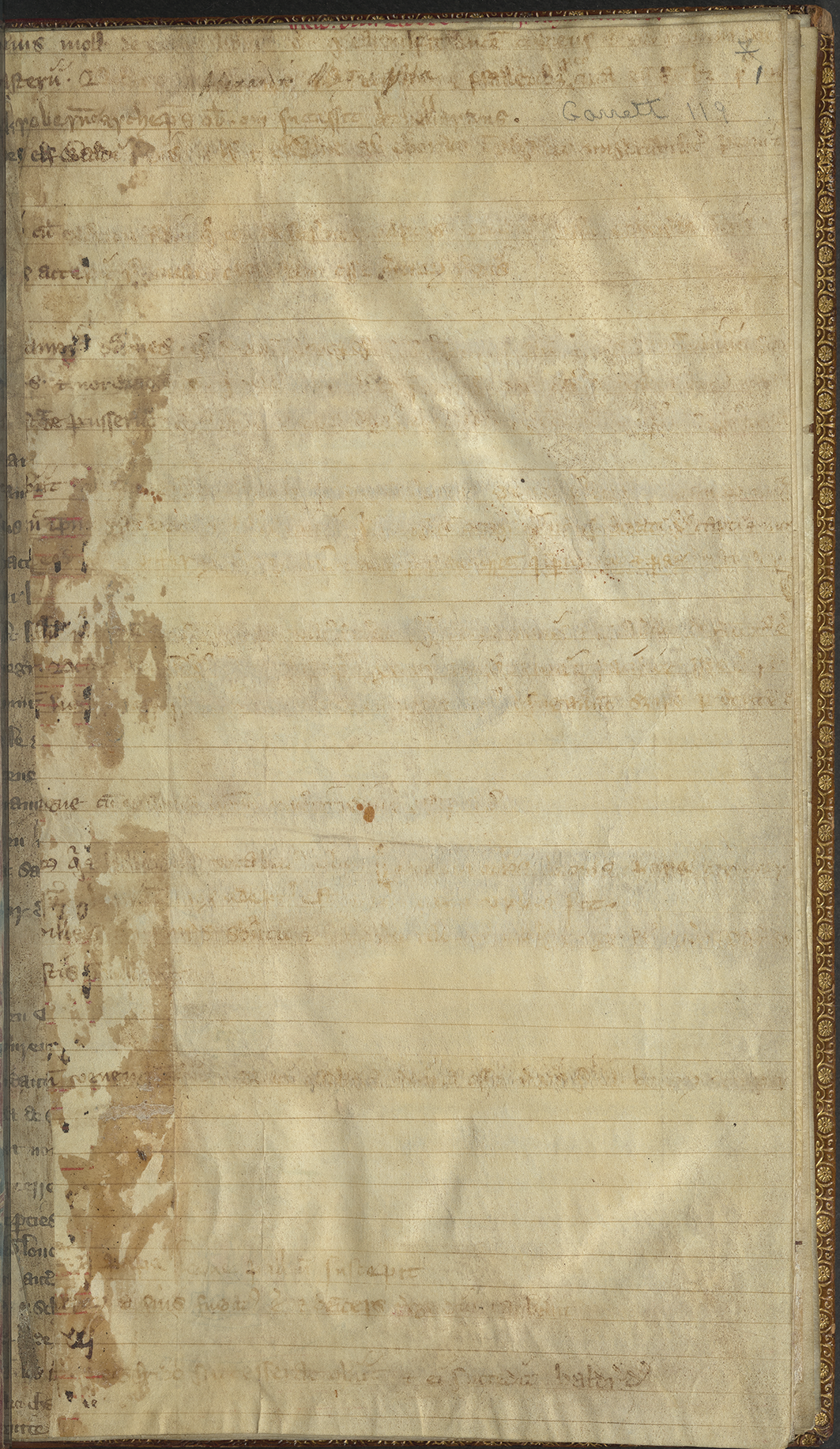
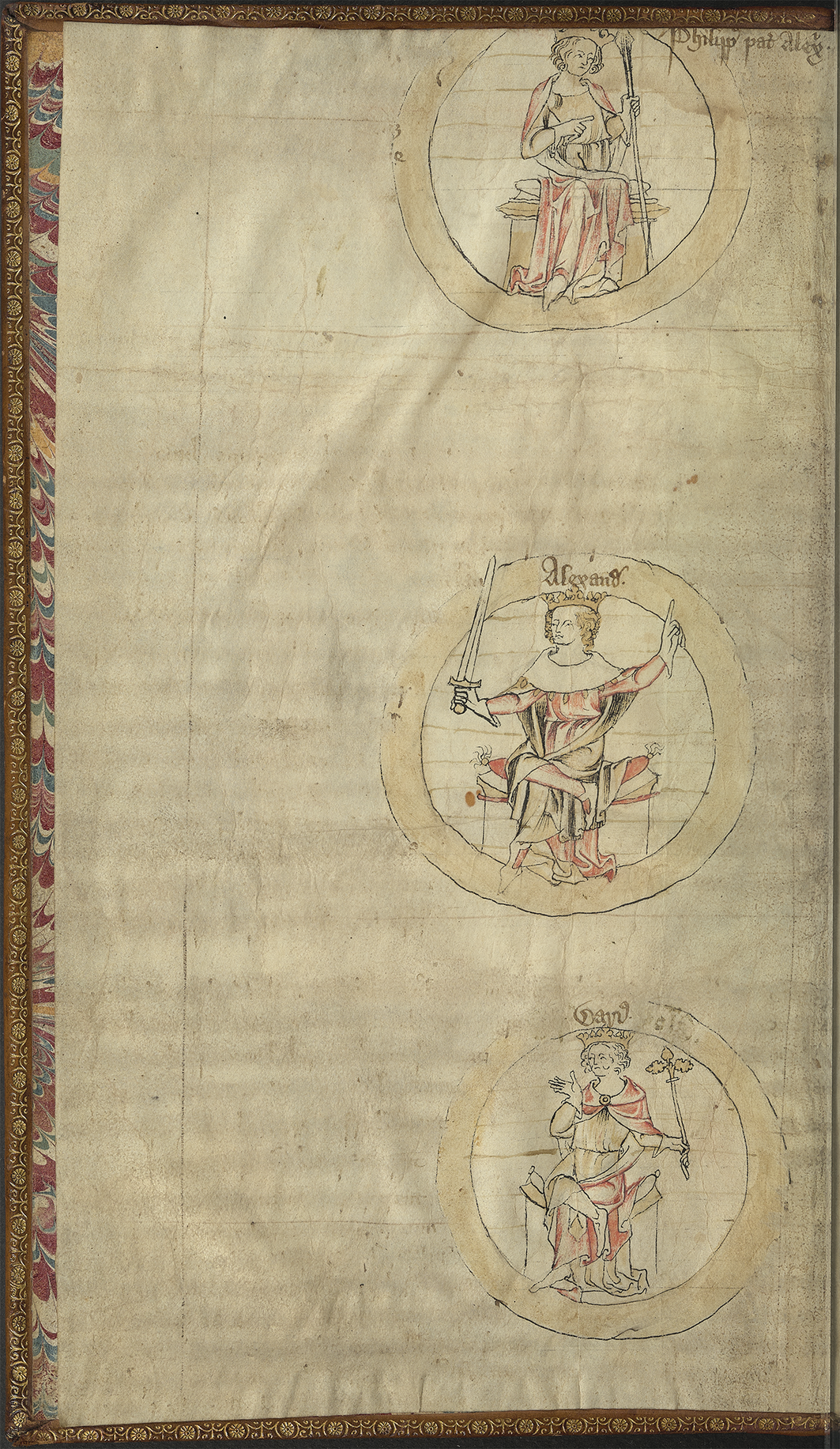
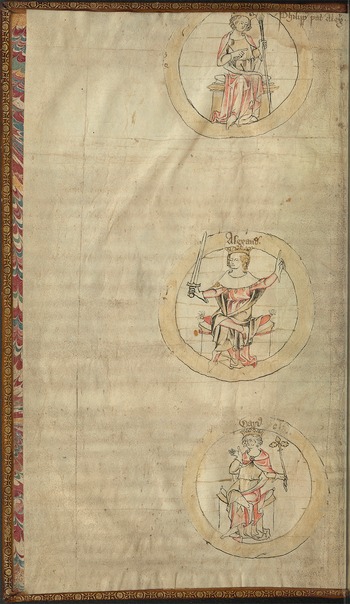
An additional fragment from the chronicle roll upsets this symmetry, however. Fol. 7 is conjoined to a stub that has not been given a pencil foliation (Levy labelled this fol. X). I would propose the current position of fol. 7 is an artefact of the original medieval binding. Fols. 7 and the conjoined stub (fol. X) possibly functioned as a quire guard, with fol. X wrapped around the first quire, although there are no obvious offsets of the stub fol. X in between quires 2 and 3 (neither fol. 15v nor fol. 16r). The medieval compiler likely purposefully selected fol. 7v for this prominent position – directly facing the beginning of the Alexandreis text – in order to preface the main text with the three tinted medallion portraits of rulers from the Anglo-Norman chronicle (Figure 4b).Footnote 30 The compiler scraped off the text of the Anglo-Norman chronicle around these medallions and erased the rulers’ names within the medallions and copied new names over them. They also scraped the text of fol. 7r leaving a mostly blank page (Figure 4a).
PRu Garrett 119, fols. Xr, 7r, with area where Fragment C was pasted in the left margin of fol. 7r visible. Princeton University Library, Special Collections – Manuscripts, Garrett 119. Image courtesy of Princeton University Library.
PRu Garrett 119, fol. 7v, showing the erasures around the illustrated medallions of the Anglo-Norman chronicle roll. Princeton University Library, Special Collections – Manuscripts, Garrett 119. Image courtesy of Princeton University Library.
Ink offsets of staves, clefs and notation now visible the left margin of fol. 7r indicate that two-thirds of the Fragment C strip (the ‘Z’ of Levy’s ‘YZ’ label for this strip) was pasted on top of fol. 7r, probably as a reinforcement strip.Footnote 31 Because Fragment C has now been removed, the Melrose chronicle text is visible in the left margin where Fragment C was originally pasted (i.e., it was never scraped), as are ink offsets of the verso of the ‘Z’ portion of Fragment C on top of the Melrose text (Figure 4a). This indicates it was the medieval compiler who pasted Fragment C as a reinforcement strip before the text was scraped.Footnote 32 In other words, the scraping of the parchment was occurring contemporaneously with the assembly process of the book (its copying and its binding), reflective of the sorts of ad hoc production processes hypothesised by Ryley for other English manuscripts.
While it is difficult to say with certainty how the remainder of the endleaves (now quires 1 and 9) were used in any bindings prior to the early modern binding, ink offsets, glue stains, other wear and the cut-outs on the stubs offer some clues.Footnote 33 There would have been no reason for the pasting together of the stubs (fol. 1v pasted to 2r, fol. 68v pasted to fol. 69r), nor the diagonal cut-outs on these stubs within the context of the early modern binding: these must be artefacts of an earlier binding. Diagonal cut-outs such as these are often found on stubs that were pasted to the inside spine edge of wooden binding boards, leaving the conjoint leaves to serve as free endleaves.Footnote 34 The stains and damage on fols. 1r and 69v indicate these were the sides that were glued to the boards.
The final question is why were several staves at the top of fol. 4r–v scraped (i.e., the top staves of the actual music roll)? Possibly the compiler considered completely scraping the musical contents of these pages, as they did with fol. 7r–v (apart from the medallions), in order to have another blank flyleaf. They began to scrape off the music staves on both sides but then decided against it. Or perhaps they had momentarily considered using the music roll as a bifolio for use within the main text (as they did with fols. 35–36) but then changed their mind (perhaps it was more difficult to completely scrape off the red stave lines?), and instead used mostly the account rolls as palimpsests, and the music rolls for binding materials.
Given the predilection of this manuscript’s compiler for scraping and erasure, I would propose that the erasure of the chronicle roll occurred contemporaneously with the copying and compilation of the manuscript in the middle of the fourteenth century. Consequently, I would also propose that the medieval binding, including the use of all the ‘binding waste’, is contemporaneous with this scraping activity. This all suggests that the fragments used here in the medieval binding were collected at an early stage in this manuscript’s history. Indeed, it is also possible that some materials that ended up in PRu Garrett 119’s mid-fourteenth-century binding were first used as a temporary wrapper for the four-quire unfinished thirteenth-century Alexandreis and travelled with them when the manuscript project was completed in the second half of the fourteenth century. In any case, all these materials were gathered and available to the fourteenth-century compiler as the compiler made ad hoc decisions in the process of copying and producing the final bound book. In possibly adverse or changed circumstances, this compiler was particularly resourceful in sourcing parchment for the second phase of copying (the use of the palimpsest parchment), and in choosing the facing illustrations for the Alexandreis text from a recycled roll. This dating – mid-fourteenth century – provides a terminus ante quem for when the music rolls were discarded (and obviously also for the copying and composition of the music compositions on them).
But was the initial thirteenth-stage of this project begun at Revesby, or somewhere else, and what more can these binding materials tell us? Multispectral imaging of the palimpsest account rolls of quires 5–8 might reveal more dates and further localisation information on the later stage of compilation: such analysis of this quantity of account rolls is beyond the scope of the current article.Footnote 35 However, an analysis of the accounts copied on one side of Garrett rotulus no. 2 suggests a different date and origin for that roll than the fourteenth-century Revesby or Croyland origins for PRu Garrett 119 asserted in previous scholarship.Footnote 36 This opens up new possibilities for the creative environment in which at least one of the music rolls originated.
Garrett rotulus no. 2 and Yorkshire
An incomplete manorial account is found on one side of Garrett rotulus no. 2 (Figure 5). Owing to the trimming at the top, the text that began the year’s account of the manor’s harvest (e.g., flour, oats) is missing.Footnote 37 The section on the harvest is followed by the livestock check that begins with the centred heading ‘Compotus Instauri’.Footnote 38 The livestock check is incomplete since the bottom part of the roll was trimmed, probably when it was repurposed as binding material. The fragment has also been trimmed at the right margin; very little text is missing at this margin, however, just the ends of some words, and most of the sentences make sense grammatically.
PRu Garrett 119, fols. 6r–1v, the manorial account. Princeton University Library, Special Collections – Manuscripts, Garrett 119. Image courtesy of Princeton University Library.
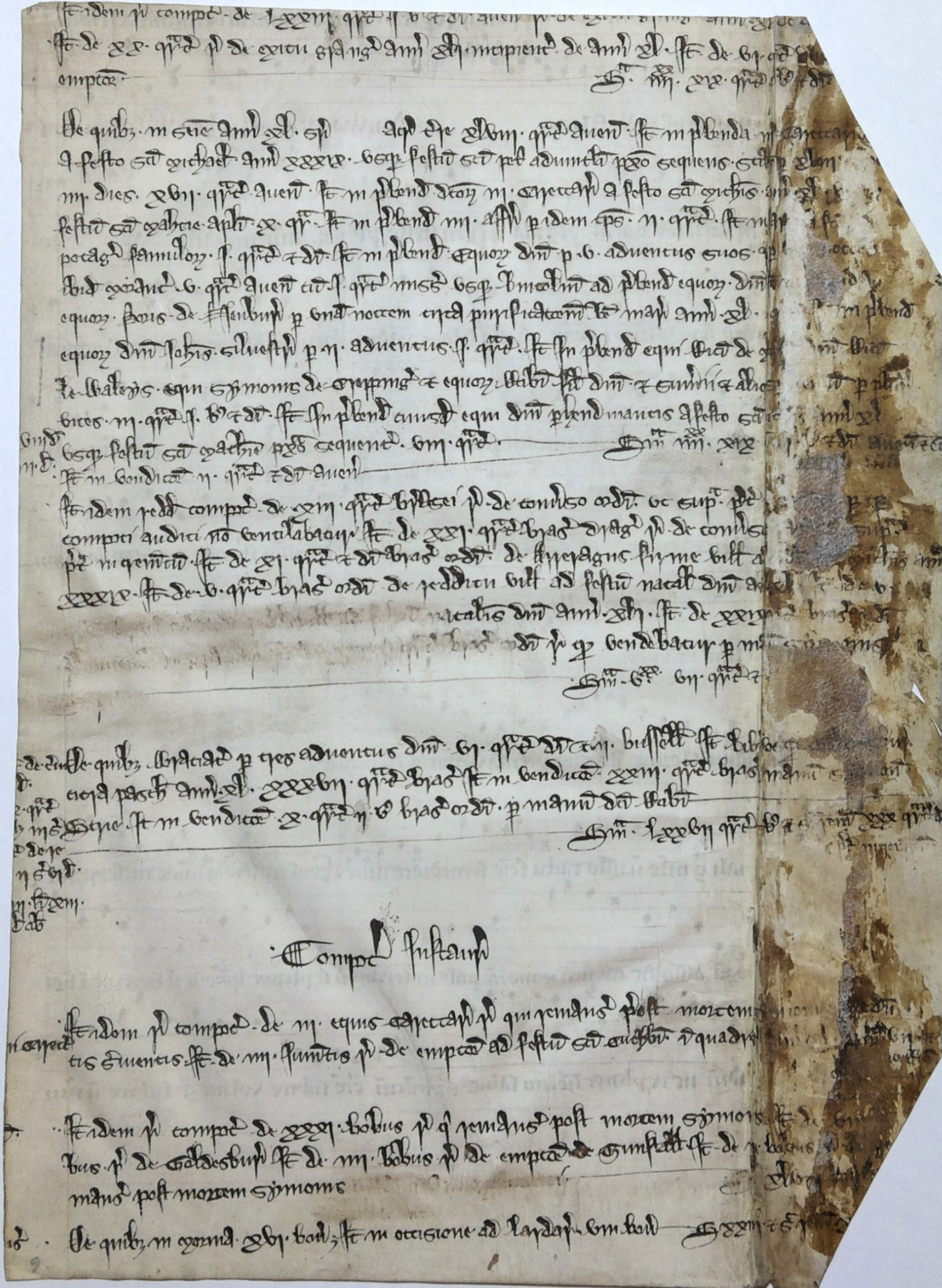
The account contains these dates: ‘anno xxxix’, ‘anno xl’ and ‘anno xli’. Following common accounting practice of the time, these dates most likely refer to the regnal year, rather than the calendar year. Given that the references are to the 39th, 40th and 41st regnal year, the only two possibilities for the reign referenced would be either Henry III (1207–72), or Edward III (1312–77). Thus, because of the different dates of these two kings’ accessions, the latest date referenced in this account fragment is either 21 September 1257,Footnote 39 or 25 December 1367.Footnote 40
Palaeographical features of the cursive script, however, suggest that a late 1360s date is too late for this account. In particular, the forked ascenders on b, h, and l present in this document, and which are characteristic of Anglicana in the second half of the thirteenth century, had largely disappeared by the early fourteenth century.Footnote 41 Thus the dates must refer to Henry III’s regnal years. The copying of this account on this roll was completed in or shortly after the latter part of 1257.Footnote 42
Several visitors to the manor over the period 29 September 1256 to 21 September 1257 are mentioned in this account, due to the provision of oats and transport for their horses, including for the Prior of Newburgh (probably of Newburgh Priory, an Augustinian foundation in Yorkshire); the other visitor names mentioned are Lord Richard le Waleys, Richard de M., Symon de Crepping and Lord Johannes Silvester.Footnote 43 In addition, a ‘Robert’ is mentioned as the son of the Lord (of the manor). The death of a ‘Symon’ is also referenced twice in the ‘Compotus Instauri’.
References to these names can be found in other medieval records. A Symon de Crepping is mentioned as a king’s clerk in chancery rolls of the 1260s and 1270s.Footnote 44 Symon de Creping is also mentioned as receiving part of the manor at Mekil Hall, Norfolk, from Aymer de Valence (c.1275–1324), although it is unclear whether this is the same individual.Footnote 45 A later Symon de Crepping, but possibly of the same family, is mentioned in a 1335 document relating to the Middleton estate in Yorkshire; various references to Symon de Crepping relating to this estate go back to the year 1300.Footnote 46 Richard le Waleys is also found frequently in the chancery rolls: he is mentioned in 1256,Footnote 47 and possibly is the same Richard le Waleys who is mentioned as having been killed in 1269 by Robert de Suningwell in self-defence, although with the caveat that ‘Le Waleys’ was a relatively common name.Footnote 48 This Richard le Waleys held land in Lancashire and York: references are made to the family’s gift of land to Fountains Abbey, and to St Mary’s, Monkton.Footnote 49 Finally, there are mentions of Johannes Silvester in the chancery rolls of 1263 and 1264.Footnote 50 It is therefore possible to locate all these names within a decade of the date proposed for this fragmentary account roll (1257), and to locate perhaps three of them (the Prior of Newburgh, and possibly Richard Le Waleys and the Crepping family) in Yorkshire.
Place names mentioned in the manorial account are of more help in narrowing down where it was written, which was almost certainly in north Yorkshire. Figure 6 provides a map of the place names referenced in the manorial account roll, including the above-mentioned monastic institutions and others that will be discussed in the next section. In addition to the connections of Richard le Waleys and the Prior of Newburgh to Yorkshire, three place names feature. Mention is made of oats being sent to Lincoln, cattle received from Goldesborough, and cattle received from a purchase in Tunstall. There are multiple places with these names, but the Goldesborough near Knaresborough and the Tunstall near Richmond are more likely as they are closer together and nearer to Newburgh priory.
Map of place names referenced in the manorial account roll, and selected religious houses in Yorkshire and Scotland (Cistercian abbeys marked with +) .
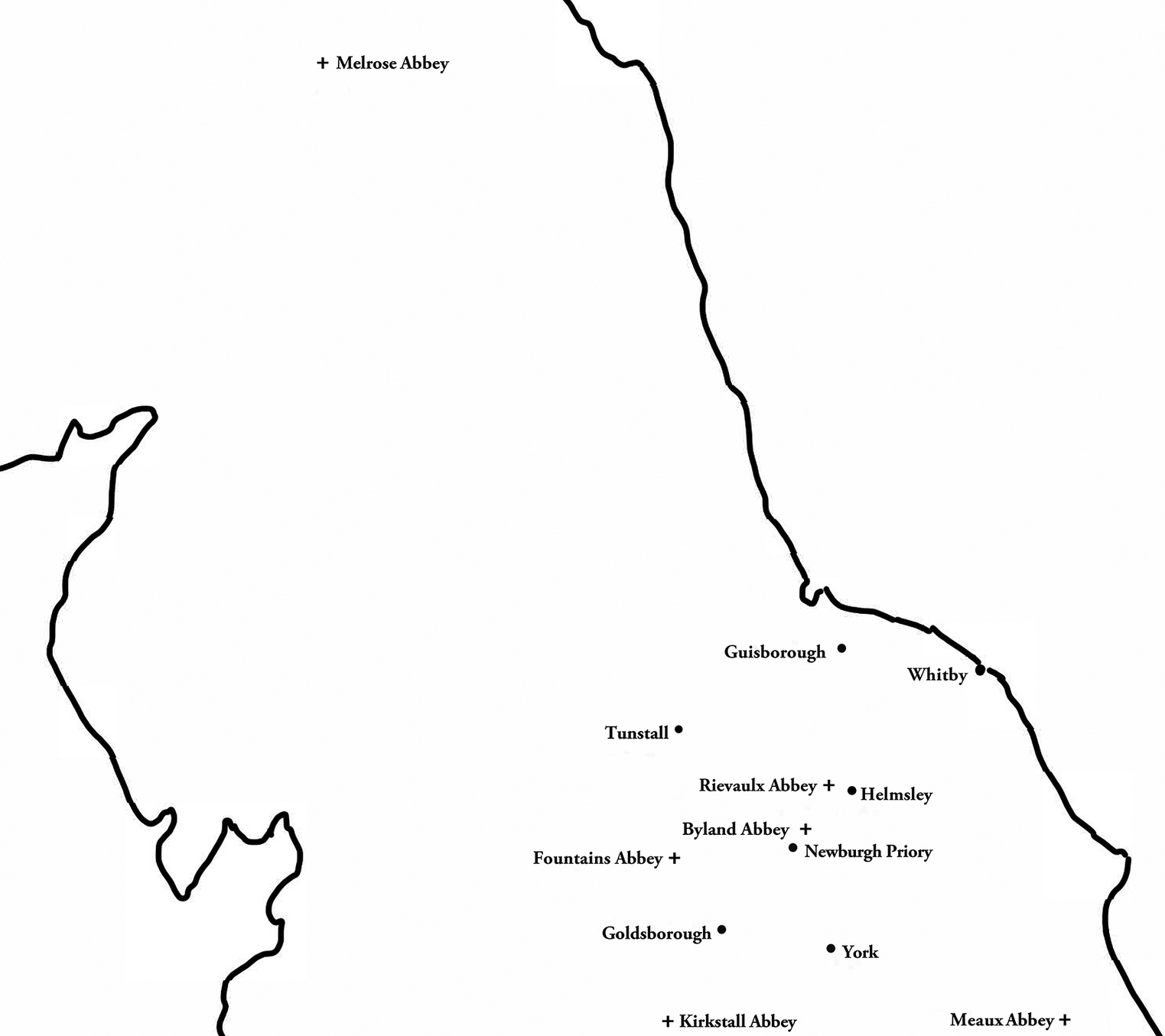
Numerous large abbeys in North Yorkshire could have been the source of this account (such as Whitby or Guisborough); however, the mention of Goldesborough and Tunstall here (in addition to Newburgh Priory) suggests the Cistercian abbey of Rievaulx as a good possibility. The transfers of grain and stock to and from Goldsborough make it unlikely that the manor in question was much more than 25 miles or so distant: Rievaulx is 30 miles from Tunstall, and 28 miles from Goldesborough.Footnote 51 Newburgh Priory was within a 15-mile radius. It had close connections with Rievaulx and specific instances of cooperation between Prior John of Newburgh and Rievaulx in the 1250s are reported, including charters of Rievaulx witnessed by Prior John.Footnote 52
Rievaulx, described by modern historians as the most important Cistercian abbey in England, was one of the most wealthy religious institutions in Yorkshire and held twenty granges by the early fourteenth century, although its fortunes declined as the century progressed.Footnote 53 Revesby in Lincolnshire, the source of the account on the rear endleaves, was a daughter house of Rievaulx, as was Melrose Abbey in Scotland, the Cistercian institution where the Melrose Chronicle was written, fragments of which are also found bound with PRu Garrett 119.
It is possible to speculate further: if Rievaulx is feasible, then perhaps Helmsley is the particular manor to which these accounts refer (granted by the Ros family, who were patrons of Rievaulx since the twelfth century), given the mention of ‘Robert, the son of the Lord’ in the manorial account: in 1257, the Anglo-Norman William de Ros was head of the family, and Robert de Ros (III) was his son (Robert then became Lord from 1258 to 1285). Fountains Abbey is another possibility, as it is also very close geographically to Tunstall, Goldesborough and Newburgh Priory, and has the possible connection to Richard Le Waleys mentioned earlier. Byland Abbey is also a possibility, further from Tunstall and Goldesborough, but just five miles from Newburgh.
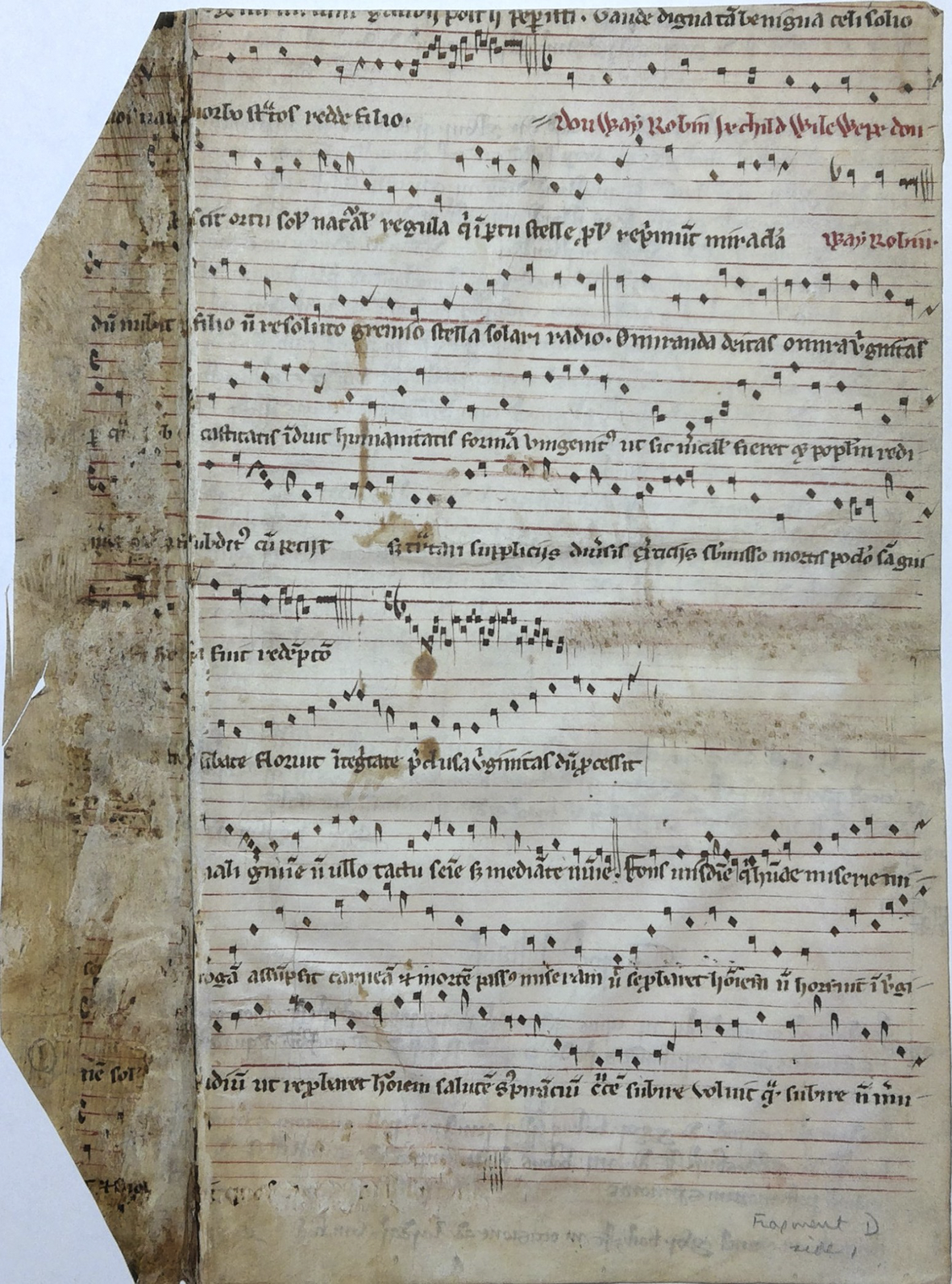
Did the copying of the music originate in the court of the manor to which these accounts refer, or was the parchment roll recycled in the institution to which this manorial landholding belonged? Directly bearing on this question is whether the account or the music was copied first. Physical aspects of the roll suggest the account was copied first. While it is difficult to distinguish between the hair and flesh side as the parchment was quite carefully prepared, some knife marks in the left margin of the music side suggest the music side may have been the hair side, and the knife marks made when the hair was removed from the skin in the initial preparation of the parchment. In addition, the music side is slightly yellower and more worn, suggesting that it may have served as the blank exterior of the roll when rolled up, with the accounts on the inside of the roll.Footnote 54 Furthermore, the account is cut off mid-sentence at the bottom of the extant parchment, whereas there is considerable blank space left at the end of the composition at the bottom of the music side, with no further staves added (see Figure 7). Perhaps the music copyist cut off the bottom of the roll when they were finished copying the music composition, cutting off the text of the waste accounts on the reverse. I propose that music compositions were copied after the account, which gives the terminus post quem for their copying as 21 September 1257.
PRu Garrett 119, fols. 1r–6v, the motets. Princeton University Library, Special Collections – Manuscripts, Garrett 119. Image courtesy of Princeton University Library.
Palaeographical evidence might also point to the priority of the accounts side over the music side, although it is difficult to make definitive arguments based on the palaeography alone. Since the music text is written in a Textualis script there are fewer features that can point to a specific date, but it is probably late thirteenth century.Footnote 55 The account would have been submitted to the institutional landholder soon after the account was compiled, and this indicates that the re-use of the roll for music copying was likely at the landholding institution, that is, at one of the abbeys in Yorkshire suggested earlier, when the account was no longer needed.
What does it mean to redate and relocate the accounts copied on Garrett rotulus no. 2, and thus to place the copying of the music in Yorkshire, probably in the last quarter of the thirteenth century? While Skemer had assembled circumstantial evidence associating the chronicle roll with Lincolnshire, in fact, some of that evidence also points to Yorkshire; for example, the Engle and Scardyng story appears to have circulated equally widely in Yorkshire as in Lincolnshire.Footnote 56 As for the Melrose chronicle, between the years 1291 and 1322 its sole copy was removed from Scotland and ended up in Lincolnshire; whether it might have passed through Yorkshire, however, and other copies or redactions made there, is unknown.Footnote 57 Melrose Abbey itself was founded by monks from Rievaulx Abbey in Yorkshire. Thus, it is entirely possible, but unfortunately still speculative, that, along with the manorial account fragment, the chronicle roll fragment may also have originated in Yorkshire, and perhaps even Garrett rotulus no. 1, the roll that transmits the Thomas Becket motet. For now, however, I will consider the case of Garrett rotulus no. 2 in some detail and explore the implications of its Yorkshire and possible Cistercian provenance. Interestingly, the only concordance for the Dou way Robin motet, one of only two motets to survive with an English-texted tenor, is also on a fragment from Yorkshire (BL Cotton Fragment xxix).
The motets of Garrett rotulus no. 2, and other Yorkshire music fragments and their Cistercian connections
Two compositions are partially preserved on Garrett rotulus no. 2 (Figure 7). The very end of the motetus voice and the entire tenor survive for the two-voice motet Veni mater Gracie/T. Dou way Robin. Footnote 58 The second composition is a three-voice double Latin motet, […]-scit ortu solis naturalis/[…]-ibate floruit integritate/[Tenor], with an unidentified tenor. Both are copied in English mensural notation: breves are notated as lozenge shapes, the English conjunctura is occasionally used, and the interpretation of ligatures follows the overriding rhythmic patterning rather than a following strict Franconian mensural interpretation.
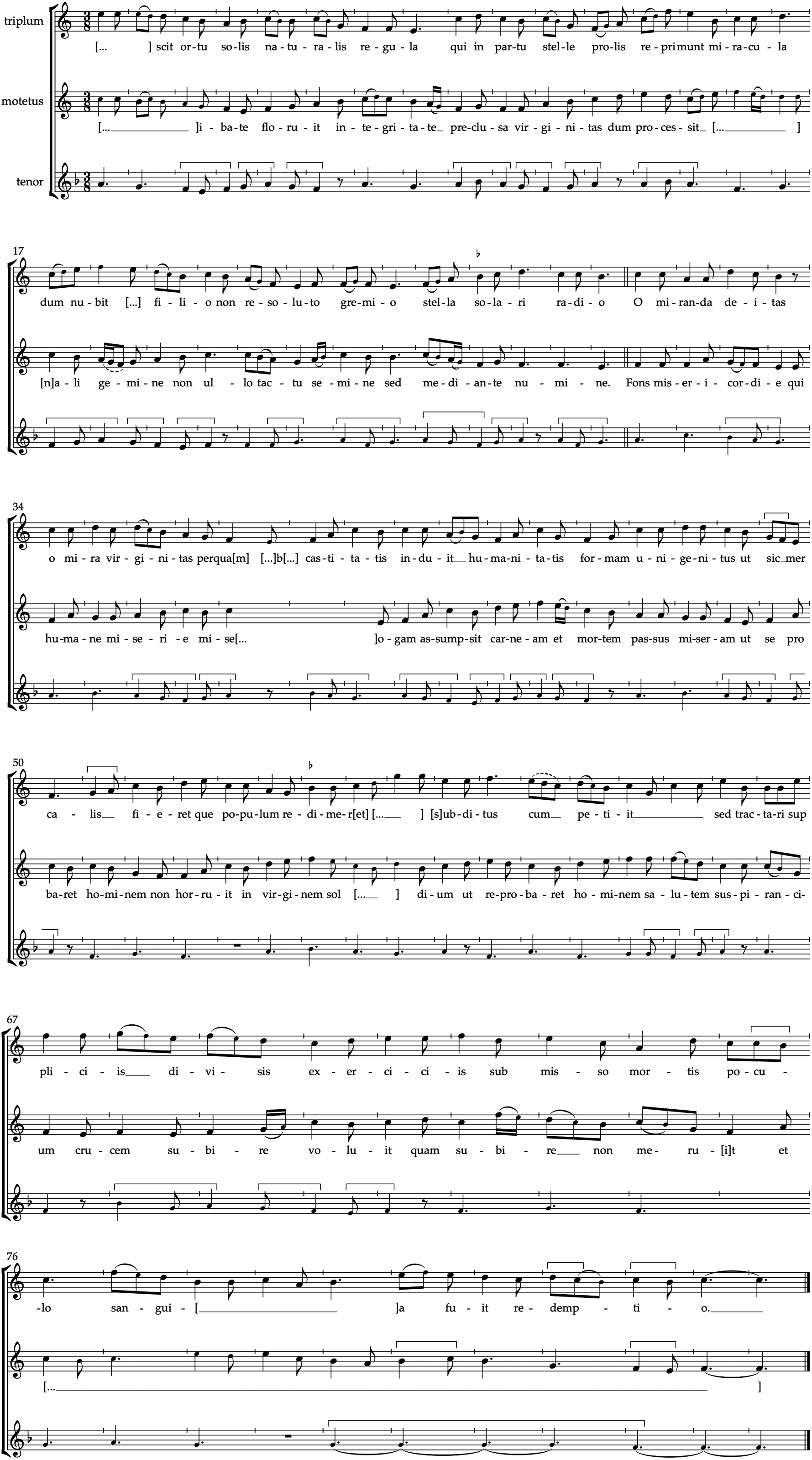
Since there is no printed critical edition of […]-scit ortu solis naturalis/[…]-ibate floruit integritate/[Tenor] I provide a transcription as Example 1 in the Appendix.Footnote 59 For some reason, the majority of the tenor (the end of the sixth and seventh staves in Figure 7) has been erased: it is unclear whether these erasures were carried out by the compiler of the host volume in the middle of the fourteenth century, who, as we have seen, made frequent use of the scraping knife, or whether the scribe or user of the original music roll was responsible.Footnote 60 The tenor is rhythmically repetitive (a six-perfection rhythm is repeated, and then an eight-perfection rhythm is likely repeated); if it is based on pre-existent material this has not yet been identified. A noteworthy feature of the motet is the repetitive use of a short triadic motif in an almost imitative manner (but which is not strict voice-exchange) between the motetus and triplum (see perfections 39–40 and 43–44 in the triplum and perfections 41–42, 49–50 and 53–54 in the motetus in Example 1 in the Appendix), especially given the predominance of voice exchange compositions in Garrett rotulus no. 1.
The Dou way Robin motet has a concordance in BL Cotton Fragment xxix, a single burnt fragment leaf that is part of a nineteenth-century collection of miscellaneous burnt fragments. The music on the fragment has been localised and given a terminus ante quem due to added text at the bottom of the recto side that mentions the dates 1348 and 1349 and the church in Adel, Yorkshire: Reaney dates the music folio to c.1300 on his assessment of the notation (no minim stems); on the other hand, Summers and Lefferts give a mid-thirteenth-century date.Footnote 61 Two compositions are notated on this leaf: on the recto is the concordance of the two-voice Dou way Robin motet, and on the verso is a three-voice setting of Angelus ad virginem. Footnote 62 The modern editions of the Dou way Robin motet use the Cotton fragment as their base text, since the motet is preserved in its entirety there.Footnote 63 The tenor of the Dou way Robin motet is most likely a refrain from a lost popular song in the vernacular: ‘Dou way Robin, the chile will wepe, dou way Robin’ (‘Stop it, Robin, the child will weep; stop it, Robin’).Footnote 64 This tenor statement is notated just once in Garrett rotulus no. 2, with a red text underlay, and three times in the Cotton fragment (the tenor text is not underlaid here), but must be sung thirteen times in all over the course of the motet. Lisa Colton observes that the final ‘O’ gesture of ‘filio’ relates the motet to carols and other medieval genres that gloss the Benedicamus Domino and posits a clerical or monastic milieu for the origins and performance contexts of this Cotton fragment.Footnote 65
Four other significant sets of fragments dating from the thirteenth and fourteenth centuries have been linked to Yorkshire, and specifically to Cistercian abbeys in Yorkshire (Meaux, Fountains and Kirkstall). Richard L. Greene convincingly argued the Meaux Abbey provenance of the four fragmentary bifolios used as binding materials for a manuscript now at the University of Chicago (Cu 654), which has an inscription of ownership by the abbey (‘Liber Beate Marie de Mensa’). Cu 654 still has its original library pressmark (‘Y xviiij’) and is listed in the Meaux library catalogue of 1396.Footnote 66
Three sets of polyphonic fragments are linked to Fountains Abbey in Yorkshire, the mother house of Meaux Abbey, although one of these dates from the fifteenth century, and so is outside the period under consideration here. Bertram Schofield discovered two sets of fragments in the binding of a fifteenth-century accounts book of Fountains (BL Add. 40011 A).Footnote 67 Eight strips of parchment remain with the accounts book and have an earlier repertoire of fourteenth-century motets copied in Franconian mensural notation: these strips have recently been reassessed as likely originating as a roll rather than from a codex.Footnote 68 A third set of fragments is found in BL Add. 62132 A, another Fountains Abbey book, whose final folios (fols. 228–331) transmit eleven fourteenth-century liturgical polyphonic compositions in English Ars nova notation.Footnote 69
Finally, perhaps more tentative, but also worth mentioning, are the links between the important thirteenth-century source of Anglo-Norman, Latin and Middle English song, BL Arundel 248, to Kirkstall Abbey in Leeds, also in Yorkshire. BL Arundel 248 is a miscellaneous manuscript that includes three Middle English songs.Footnote 70 It also has an English contrafact (Gabriel fram even King) for Angelus ad virginem, also in the Yorkshire BL Cotton fragment xxix described earlier (but with a different melody). The names of later owners of the manuscript, who had connections to Kirkstall Abbey, are noted in BL Arundel 248.Footnote 71 Networks of exchange – in music books, rolls and repertoire – can be envisaged between these centres, and provide a context for the possible Rievaulx origins for Garrett rotulus no. 2 proposed here.
Conclusions
Over sixty years ago, in an essay titled ‘The Topography of English Mediaeval Polyphony’, Dom Anselm Hughes mapped out the origins of the manuscript sources of English polyphony (as understood at that time), and found that almost half were linked to institutions located towards the west of England.Footnote 72 The extensive fragments that survive from the Benedictine Cathedral at Worcester of course support Hughes’s hypothesis of a flourishing polyphonic tradition in the ‘westcuntre’.Footnote 73 More recent musicological scholarship has broadened out from this initial focus on the west of England, most explicitly in the work of Nicky Losseff, who analysed the significant cluster of fragmentary manuscript codices, many with high production value, associated with East Anglian centres.Footnote 74 Yet the north does not figure in Losseff’s narrative, and, indeed, Yorkshire is mentioned by name just once in her monograph. Sources with connections to the north are, of course, far fewer than those that can be associated with the east or west: other than those Yorkshire possibilities outlined earlier, the best known is the connection of W1 with St Andrews in Scotland, but there are also Insular fragments associated with Orkney, Abroath and Durham Cathedral. In addition, the prevailing narrative has been that most Insular polyphony – or at least that which survives from the written tradition – originated in wealthy Benedictine institutions.Footnote 75
This study has opened up the possibility of a flourishing network of written polyphony in the Cistercian houses of Yorkshire. Documentary evidence outlined by Greene attests to the facilities available at these institutions: the extensively detailed chronicle for Meaux Abbey, dated 1396, lists two sets of organs for its church, many bells in the abbey buildings and grounds and ample provision of choir stalls.Footnote 76 The production context uncovered here for PRu Garrett 119 suggests an individual who had access to parchment used in two neighbouring regions: Yorkshire and Lincolnshire. As described earlier, changed and possibly adverse circumstances may have had an impact on the production of the second half of the host volume. Relocation of the manuscript to a daughter house – from Rievaulx to Revesby – offers a compelling hypothesis for the change in the production process and the combination of materials used for binding the volume in the middle of the fourteenth century, and I have outlined previously why Rievaulx Abbey in Yorkshire is a good candidate for the origins of Garrett rotulus no. 2. Indeed, Rievaulx Abbey experienced a series of unfortunate events from the late thirteenth century, which prompted the temporary dispersals of both the monks, and their goods, as described by Michael Carter:
In the 1270s and 1280s its flocks were devastated by epidemics of sheep scab, leaving the abbey badly in debt and even causing the temporary dispersal of the community. The abbey’s woes were compounded by warfare between England and Scotland in the early fourteenth century. On 14 October 1322, the Scots defeated the army of Edward II at the battle of Shaws or Scawton Moor, near Rievaulx. The victorious Scots sacked the abbey. A largely overlooked contemporary annotation in a manuscript from the monastery, a beautifully decorated thirteenth-century copy of Roger of Howden’s Historia Anglorum, records this event, noting that the Scots despoiled the abbey and carried off ‘books, chalices and the sacred ornaments’ of the monastery.Footnote 77
Whether or not the other fragments – Garrett rotulus no. 1 and Fragment C and the chronicle roll – also originated in Yorkshire and were then later brought to Lincolnshire (along with Garrett rotulus no. 2), possibly during this temporary dispersal of the Rievaulx community in the 1320s, remains unclear. Further study of the connections between the Yorkshire polyphonic sources (and their host volumes and institutional connections) outlined earlier should bring more aspects of this regional activity into focus.
Appendix
[…]-scit ortu solis naturalis/[…]-ibate floruit integritate/[Tenor] in Garrett rotulus no. 2.




 Open access

