


Introduction
In recent decades, there has been an increase in partisan polarization surrounding the Senate confirmation votes for U.S. Supreme Court nominees (Cottrill and Peretti, Reference Cottrill and Peretti2013; Basinger and Mak, Reference Basinger and Mak2020). Public opinion toward nominees is also strongly polarized along partisan lines (Sen, Reference Sen2017; Rogowski and Stone, Reference Rogowski and Stone2021; Levendusky et al., Reference Levendusky, Patterson, Margolis, Pasek, Winneg and Jamieson2024). Existing studies show that these patterns of partisan polarization are linked, finding a “systematic and powerful link between constituency opinion and voting on Supreme Court nominees” (Kastellec, Lax and Phillips Reference Kastellec, Lax and Phillips2010, p. 767, also see Kastellec et al. Reference Kastellec, Lax, Malecki and Phillips2015). Specifically, public opinion toward a nominee influences senators’ decisions on whether to vote in favor of confirmation (Kastellec, Lax and Phillips, Reference Kastellec, Lax and Phillips2010, p. 767).Footnote 1
However, no existing study systematically investigates how much and in what ways different partisan configurations of the Court affect Americans’ evaluation of individual nominees. We examine this question using a preregistered conjoint experiment (Hainmueller, Hopkins and Yamamoto, Reference Hainmueller, Hopkins and Yamamoto2014; Clayton et al., Reference Clayton, Horiuchi, Kaufman, King and Komisarchik2023) that randomizes respondents into different hypothetical scenarios about the Court’s partisan configuration. Respondents compared pairs of hypothetical nominees and chose which nominee should be the new Justice in their given scenario. Previous conjoint experiments on Supreme Court nominations (Sen, Reference Sen2017; Kaslovsky, Rogowski and Stone, Reference Kaslovsky, Rogowski and Stone2021; Krewson and Owens, Reference Krewson and Owens2021; Rogowski and Stone, Reference Rogowski and Stone2021; Krewson and Owens, Reference Krewson and Owens2022; Badas and Justus, Reference Badas and Justus2024) vary nominee attributes but do not manipulate institutional context.
In the real world, nominee evaluations are not solely judgments of individual-level characteristics such as ideology, race, credentials, or even elite rhetoric about individual nominees. Instead, citizens are consistently reminded that a vacancy may alter the Court’s ability to deliver preferred policy outcomes. News coverage of nominations frequently emphasizes the Court’s current partisan split and whether a nominee would “tilt the balance.” We therefore anticipate that nominee evaluations are shaped by psychological reactions to partisan threat when citizens feel that the opposing party is on the verge of “winning” the Court.
Our experiment shows that the Court’s partisan composition does, indeed, affect how members of the public evaluate nominees. As expected, Democrats and Republicans become less concerned about a nominee’s partisanship when their party is already solidly “winning” the Court. However, Democrats and Republicans are just as concerned about partisanship when the Court is split 4-4 as when their side is solidly “losing” the Court, even though the new Justice would only swing the Court in the former scenario. Drawing on the affective polarization literature, we argue that the salience of partisanship is primarily motivated by partisans’ fear of the other party’s dominating, causing them to prioritize a nominee’s partisanship even when their side is already far behind.
This study makes three contributions. First, we show that partisan evaluations of Supreme Court nominees are conditioned by institutional context: Americans do not rely on partisan cues uniformly, but instead weight nominee partisanship more heavily when they perceive higher stakes for partisan control of the Court. Second, by foregrounding a political psychology perspective, we demonstrate that nominee evaluations reflect not only preferences over individual candidates but also psychological reactions to perceived partisan threat and institutional advantage. Third, methodologically, we extend conjoint analyses of judicial nominations by explicitly manipulating the hypothetical partisan composition of the Court, allowing us to estimate how institutional context shapes the salience of nominee attributes. Taken together, these contributions clarify how institutional stakes and political psychology jointly structure public opinion toward Supreme Court appointments.
Theory and hypotheses
Despite increasing politicization of the Court and existing research showing that public opinion influences Senate confirmation votes, no prior study has examined the extent to which the Court’s partisan composition influences Americans’ assessments of individual Supreme Court nominees. In this section, we first discuss the Supreme Court’s increasing politicization. We then explain why the partisan composition of the Supreme Court should affect public opinion. Finally, we present our preregistered hypotheses.Footnote 2
Increasing politicization of the Supreme Court
In 1941, President Franklin Roosevelt secured Senate confirmations for three Supreme Court nominees within a month. In 2016, however, Merrick Garland’s nomination was blocked by the Republican Senate majority’s unprecedented refusal to hold a hearing or vote on his nomination – even though he was “among the most qualified candidates ever named” (Sen, Reference Sen2017, p. 374). Partisan polarization today is not limited to Republican senators and Democratic nominees. In 2017, only three Democrats voted to confirm Justice Gorsuch. Similarly, only one Democrat voted to confirm Justice Kavanaugh in 2018, and no Democrat voted to confirm Justice Barrett in 2020.
Nor is partisan polarization surrounding nominees confined to senators. Among the public, only 21% of Democrats supported Justice Gorsuch’s confirmation, compared to 76% of Republicans; only 14% of Democrats supported Justice Kavanaugh’s confirmation, compared to 76% of Republicans; and only 15% of Democrats supported Justice Barrett’s confirmation, compared to 89% of Republicans (Jones, Reference Jones2022). Most recently, in 2022, only 20% of Republicans supported Justice Jackson’s confirmation, compared to 66% of Democrats (Dunn, Reference Dunn2022).
Before the mid-twentieth century, Supreme Court nominees enjoyed a much less contentious Senate confirmation process. From 1937 to 2010, however, the percentage of nay votes for each nominee has dramatically increased (Cameron, Kastellec and Park, Reference Cameron, Kastellec and Park2013). In recent decades, even relatively uncontroversial nominations have sparked “months of vetting by the Senate, significant media coverage, [and] interest group activity on both sides” (Cameron, Kastellec and Park, Reference Cameron, Kastellec and Park2013, p. 283). Thus, as Rogowski and Stone (Reference Rogowski and Stone2021, p. 1251) note, “Contemporary US Supreme Court nominations are unavoidably and inevitably political.” Some researchers argue that starting in the mid-to-late 20th century, the Senate began to prioritize ideology over “ethics, competence, and integrity” when evaluating Supreme Court nominees (Epstein et al., Reference Epstein, Lindstädt, Segal and Westerland2006, p. 296).
Justices themselves have become increasingly partisan (Clark, Reference Clark2009a; Hasen, Reference Hasen2013; Bartels, Reference Bartels, Thurber and Yoshinaka2015; Gooch, Reference Gooch2015; Bonica and Sen, Reference Bonica and Sen2017; Devins and Baum, Reference Devins and Baum2017). Before 2010, the Court never had “clear ideological blocs that coincided with party lines,” but today’s partisan split is both unprecedented and enduring (Devins and Baum, Reference Devins and Baum2017, p. 301). As a result, American voters have increasingly recognized the importance of securing seats on the Supreme Court for their political party, as shown by the Court’s emergence as a critical issue in the 2016 presidential campaign (Devins and Baum, Reference Devins and Baum2017; Badas and Simas, Reference Badas and Simas2022). Since 2020, the public has become even more polarized along partisan lines in its perceptions of the Court (Levendusky et al., Reference Levendusky, Patterson, Margolis, Pasek, Winneg and Jamieson2024).
These trends suggest not only that the Court has become more politicized, but that citizens increasingly interpret judicial appointments in terms of policy consequences and partisan advantage. When partisan control of the Court is salient in public discourse, a prospective Justice is evaluated less as an individual and more in terms of how their confirmation would shift the institution’s ideological direction.
Why partisan composition matters
Existing research examines how Americans evaluate nominees based on individual-level attributes (Sen, Reference Sen2017; Kaslovsky, Rogowski and Stone, Reference Kaslovsky, Rogowski and Stone2021; Krewson and Owens, Reference Krewson and Owens2021; Rogowski and Stone, Reference Rogowski and Stone2021; Krewson and Owens, Reference Krewson and Owens2022; Badas and Justus, Reference Badas and Justus2024) – such as ideology, race, credentials, or even elite rhetoric about that individual nominee – without situating those attributes within the Court’s partisan context. The partisan composition of the Supreme Court, however, should matter in shaping public opinion for two reasons.
First, when reporting on Supreme Court nominees, the media consistently situate them in the context of the Court’s existing partisan composition. For instance, major news outlets reporting on Ketanji Brown Jackson’s nomination emphasized how she would not change the Court’s 6-3 conservative majority (see, e.g., Kapur, Reference Kapur2022; Long, Balsamo and Miller, Reference Long, Balsamo and Miller2022; Tapper et al., Reference Tapper, de Vogue, Zeleny, Klein and Vazquez2022). Meanwhile, major news outlets reporting on Amy Coney Barrett’s nomination emphasized how she would cement a 6-3 conservative majority (see, e.g., Bruggeman, Santucci and Faulders, Reference Bruggeman, Santucci and Faulders2020; Egan, Reference Egan2020; Vazquez and Liptak, Reference Vazquez and Liptak2020). The same happened for Gorsuch (see, e.g., Hurley and Chung, Reference Hurley and Chung2017). News coverage has long framed the Court in terms of a “conservative majority” or “5-4 conservative Court,” well before the recent 6-3 configuration, making partisan composition a familiar and salient aspect of how the public has encountered information about the Court (see, e.g., Savage, Reference Savage2016). Furthermore, the news media are the primary source through which most Americans receive information about the Court (Badas and Justus, Reference Badas and Justus2023). Such coverage increasingly presents the Court in explicitly ideological and partisan terms.
Second, politicians have openly stated that changes in the Court’s partisan composition would change how they evaluate two similar nominees. For example, in 2005, a socially liberal Republican senator concerned about preserving abortion rights voted to confirm John Roberts but then said that he “would apply a more skeptical standard to the next nominee because of the balance of the court and might even oppose a jurist similar to Judge Roberts” (Kirkpatrick, Reference Kirkpatrick2005, emphasis added). For the same reason, a different Republican senator said, “This is certainly a different level of evaluation, especially because of the balance of power on the court” (Kirkpatrick, Reference Kirkpatrick2005, emphasis added).
Members of the public may engage in similar reasoning.Footnote 3 Given the Dobbs decision and other heated controversies among politicians, which have generated significant media coverage of the Court, the public has become even more informed about the Court and concerned about its partisan composition (Levendusky et al., Reference Levendusky, Patterson, Margolis, Pasek, Winneg and Jamieson2024). Therefore, Americans’ post-Dobbs sense of whether their side is currently “winning” or “losing” the Court should influence their preferences for nominees. From a political-psychology perspective, this informational environment makes partisan control of the Court cognitively and emotionally salient. Partisans may react especially strongly when they believe their side is losing control of consequential institutions, in which case perceptions of being “behind” on the Court should amplify the weight they attach to a nominee’s partisanship.
Furthermore, partisan conflict over Supreme Court nominations must also be understood against a broader backdrop of polarization in electoral contexts. Scholars have documented how growing partisan divisions have reshaped legislative behavior and party strategy in Congress (Theriault, Reference Theriault2008). At the same time, the emergence of genuinely competitive and alternating majorities has heightened the stakes of majority control, encouraging parties to treat institutional control as a central objective of their activity (Lee, Reference Lee, Gerber and Schickler2016). These dynamics help explain why maintaining or shifting the ideological balance of power in key institutions such as the Supreme Court has become so politically consequential. Existing research on contemporary lawmaking further shows how parties pursue their agendas within this polarized environment and under significant constraints, highlighting the strategic character of majority-party efforts in Congress (Curry and Lee, Reference Curry and Lee2020). Finally, recent research on senators’ partisan rhetoric demonstrates that this polarized, high-stakes context is reflected in how senators communicate with the public, including on social media (Russell, Reference Russell2021).
Our study focuses on public opinion toward Supreme Court nominees for three reasons. First, as the literature suggests, the public’s preferences for individual nominees affect Senate confirmation votes and, in turn, who becomes a Supreme Court Justice (Kastellec, Lax and Phillips, Reference Kastellec, Lax and Phillips2010; Kastellec et al., Reference Kastellec, Lax, Malecki and Phillips2015). Second, public opinion toward the Court may have implications for judicial legitimacy and authority (Ura and Merrill, Reference Ura and Merrill2017). Third, beyond judicial politics, our study contributes to broader research on how the public evaluates partisanship.
Hypotheses and research questions
Given the literature reviewed above, our theoretical expectation is as follows: public support for a nominee depends not only on shared partisanship with the nominee but also on whether the appointment would alter the Court’s partisan composition in a favorable direction. Citizens who believe that their party is at a disadvantage on the Court should feel a heightened sense of policy threat, leading them to weigh partisan identity more heavily when evaluating a nominee from the opposing party. Conversely, when their party already holds a secure majority, partisan stakes – and thus the salience of partisan identity – may be reduced. Because media coverage routinely highlights the Court’s balance, even minimal partisan-composition information in a survey setting is likely to be interpretable and politically meaningful to respondents.
More specifically, we examine the following preregistered hypotheses.Footnote 4 We first test the following hypothesis:
Hypothesis 1 (Salience of Partisanship): Partisanship is the most salient attribute for respondents’ choice of a nominee.
This hypothesis is consistent with previous experiments showing that respondents rely heavily on the political leanings of Court nominees when evaluating them (Sen, Reference Sen2017; Krewson and Owens, Reference Krewson and Owens2021). Partisanship provides a clear and easily interpretable signal of a nominee’s likely judicial behavior, making it a highly diagnostic cue for the public. Even in the absence of institutional information, citizens often evaluate nominees through the lens of their own party’s policy stakes. An important note here is that this hypothesis does not assume anything about the Supreme Court’s partisan composition. In the context of our experiment, we test this hypothesis using the control group in which respondents are not exposed to a hypothetical scenario about the Supreme Court’s partisan composition.
We also examine whether partisanship remains the most salient attribute in respondents’ choice of a nominee, even after exposure to a hypothetical scenario about the Supreme Court’s partisan composition (Research Question 1). Furthermore, across the four experimental conditions (see the next section), we examine whether the partisanship attribute is significantly more salient for Democrats than for Republicans, or vice versa (Research Question 2).
As the Supreme Court becomes more politicized, it is increasingly important to study how the public understands new nominees in relation to the existing Court. Instead of dispassionately evaluating individual nominees’ qualifications, members of the public may conceptualize the Court strategically, adapting their preferences for judicial nominees based on the Court’s partisan composition. Partisan stakes are highest when neither party has secure control over the Court, making the new Justice uniquely pivotal for the institution’s future decisions. When neither party has secure control and the Court is closely divided, citizens on both sides should experience the stakes of a vacancy as especially acute and therefore lean even more heavily on partisan identity as a decision rule. Consequently, we expect the following:
Hypothesis 2 (Conditional Salience of Partisanship): Partisanship becomes most salient for respondents when the Court is split 4-4.
We also explore whether this effect is significantly larger for Democrats than for Republicans or vice versa (Research Question 3).
Research design
We test these two hypotheses and explore these three research questions using a conjoint experiment with between-subject randomization of a hypothetical scenario about the Supreme Court’s partisan composition. Conjoint experiments typically ask respondents to compare two randomly generated “profiles” with various “attributes” multiple times in a tabular format. In each task, respondents choose the profile that they prefer most. By pooling these responses, researchers can estimate respondents’ multidimensional preferences.
We recognize that members of the Senate vote “yea” or “nay” to confirm a single nominee, rather than choosing between two nominees. Indeed, this procedure motivates Sen (Reference Sen2017) to present respondents with only one profile. However, some recent conjoint experiments on this topic use a standard two-profile conjoint design (e.g., Krewson and Owens, Reference Krewson and Owens2022, Reference Krewson and Owens2021). Five factors motivate our use of a two-profile design in this study. First, as discussed above, senators have stated that they often compare an actual nominee to a counterfactual nominee (Kirkpatrick, Reference Kirkpatrick2005). Second, media outlets often compare judges on the White House “shortlist” for potential nominees by discussing their race, gender, prior experience, and other attributes (see, e.g., Nick, Reference Nick2022; Rogers, Reference Rogers2022). Third, pairwise comparisons in conjoint experiments provide various methodological benefits (Hainmueller, Hopkins and Yamamoto, Reference Hainmueller, Hopkins and Yamamoto2014). Fourth and fifth, Krewson and Owens (Reference Krewson and Owens2021) discuss two additional reasons for presenting respondents with a pair of nominees. First, people generally make decisions based on a reference point (Kahneman and Tversky, Reference Kahneman and Tversky1979). Second, news outlets often compare nominees with the Justices they are replacing.Footnote 5 For these five reasons, we follow in the footsteps of recent studies that use a standard two-profile conjoint design to study public preferences for Supreme Court nominees.
Sample
We recruited study participants from September 30 to October 15, 2022, through Lucid Theorem, to obtain a quota-based online sample matched to U.S. Census benchmarks on age, gender, race, and region.Footnote 6 We filtered out respondents who failed two pretreatment attention checks and respondents with duplicated respondent IDs. The final sample of respondents consisted of 9,895 adults residing in the United States. We collected 9,895 respondents to achieve sufficient statistical power to detect nuanced differences among the four experimental groups.
We additionally conducted a pretest to identify any issues in the survey design and to ensure the reliability and validity of our treatments and measures. Specifically, we used Lucid Theorem to collect data from 436 respondents from September 15 to 30, 2022. We do not include these responses in our main sample.
Treatment conditions
Before the conjoint experiment, we randomly assigned respondents to one of the following four scenarios, in which the partisan composition refers to the eight sitting Justices before filling the vacancy:
-
• Control (assigned with $ \frac{1}{3} $
 likelihood)
 -
• Split (assigned with $ \frac{1}{3} $
likelihood) -
• Republican Majority (assigned with $ \frac{1}{6} $
likelihood) -
• Democratic Majority (assigned with $ \frac{1}{6} $
likelihood)


In the Control condition, respondents were not asked to consider a hypothetical scenario while completing the conjoint tasks. In the Split condition, respondents were asked to consider a hypothetical scenario in which the Supreme Court comprises four conservative Republican Justices and four liberal Democratic Justices. In the Republican Majority condition, respondents were asked to consider a hypothetical scenario in which the Supreme Court comprises six Republican Justices and two Democratic Justices. In the Democratic Majority condition, respondents were asked to consider a hypothetical scenario in which the Supreme Court comprises six Democratic Justices and two Republican Justices. The exact text and visual image for each treatment are presented in Section B of the Supplementary Materials.Footnote 7
The Republican Majority and Democratic Majority conditions are intended to gauge how respondents evaluate a nominee’s partisanship when that nominee would not swing the balance of the Court. Therefore, those two conditions asked respondents to consider firm 6-2 divides instead of a more malleable 5-3 divide.Footnote 8
Designing the conjoint experiment
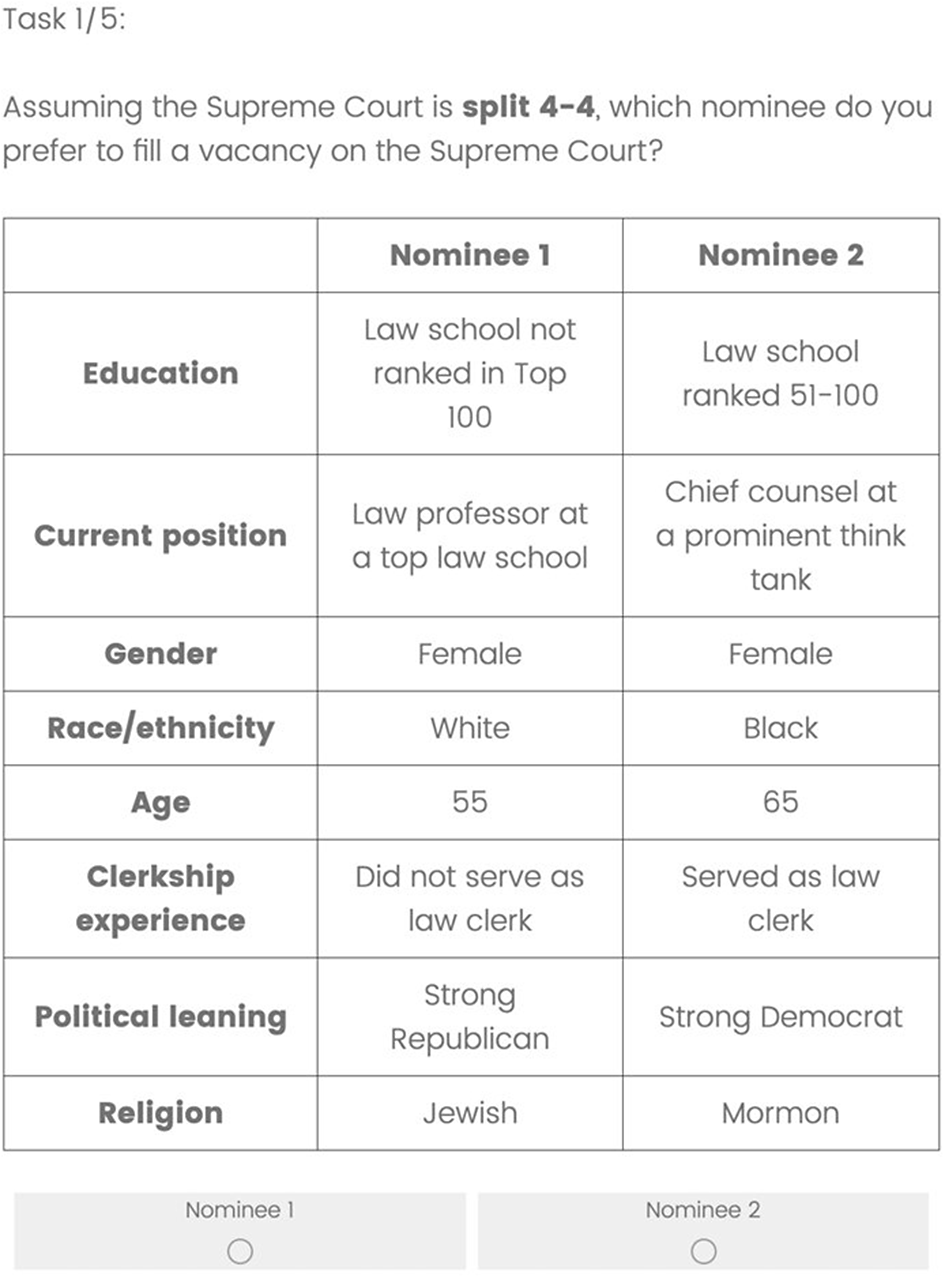
All respondents then completed a conjoint experiment in which they chose between two hypothetical Supreme Court nominees to fill a vacancy on the Supreme Court (see Figure 1 for a sample screenshot). The hypothetical nominees possess the following attributes: age, gender, current position, partisanship, race/ethnicity, religion, education, and law clerk experience.Footnote 9 We adapted these attributes and attribute levels from previously published studies. Specifically, we use Sen’s (Reference Sen2017) attribute levels for gender, partisanship, race/ethnicity, religion,Footnote 10 education,Footnote 11 and law clerk experience. We use Rogowski and Stone’s (Reference Rogowski and Stone2021) attribute levels for age, gender, and current position. In Section C of the Supplementary Materials, we show all the levels for each attribute, as well as the frequencies (i.e., weights) for all attribute levels.Footnote 12
Example of a conjoint task shown to respondents in the Split condition.

Figure 1. Long description
The table has three columns: attribute labels on the left, Nominee 1 in the center, Nominee 2 on the right. From top to bottom, the attributes are: Education—Nominee 1 attended a law school not ranked in the top 100, Nominee 2 attended a law school ranked 51 to 100. Current position—Nominee 1 is a law professor at a top law school, Nominee 2 is chief counsel at a prominent think tank. Gender—both are female. Race or ethnicity—Nominee 1 is white, Nominee 2 is black. Age—Nominee 1 is 55, Nominee 2 is 65. Clerkship experience—Nominee 1 did not serve as a law clerk, Nominee 2 served as a law clerk. Political leaning—Nominee 1 is a strong Republican, Nominee 2 is a strong Democrat. Religion—Nominee 1 is Jewish, Nominee 2 is Mormon. Below the table are two radio buttons labeled Nominee 1 and Nominee 2 for selection.
After showing respondents a table of two nominees, we asked: “Which nominee do you prefer to fill a vacancy on the Supreme Court?” Respondents in the three treatment conditions were reminded of the hypothetical scenario they were asked to consider. For example, for respondents in the Split condition, we added “Assuming the Supreme Court is split 4-4, …” at the beginning of the question, with the condition (“split 4-4” in this example) highlighted in bold (see Figure 1). We asked each of the 9,895 respondents to complete this task five times, resulting in 49,475 profile pairs. Each time, the pairs of nominees were generated independently and randomly. However, respondents remained in the same experimental condition throughout; i.e., they considered the same hypothetical scenario about the Court’s composition when completing all five tasks.
Nominee partisanship
Our conjoint experiment presents respondents with nominee partisanship rather than nominee ideology for three reasons. First, existing conjoint experiments on this topic have done the same by using “partisanship” as an attribute rather than “ideology” (Sen, Reference Sen2017; Krewson and Owens, Reference Krewson and Owens2021, Reference Krewson and Owens2022; Badas and Justus, Reference Badas and Justus2024).Footnote 13 In fact, to our knowledge, no conjoint experiment on this topic has included ideology as an attribute – though some have included neither partisanship nor ideology as attributes (Kaslovsky, Rogowski and Stone, Reference Kaslovsky, Rogowski and Stone2021; Rogowski and Stone, Reference Rogowski and Stone2021).
Second, recent research shows that “the terms ‘liberal’ and ‘conservative’ are unfamiliar to many Black Americans” (Jefferson, Reference Jefferson2024). Thus, using “partisanship” rather than “ideology” as an attribute ensures that our results are valid for Black Americans.
Third, for other groups of Americans, it is unlikely that there are any differences in how they perceive nominee “partisanship” versus nominee “ideology,” given research showing that ideological and partisan identifications are essentially the same nowadays (Lupton, Smallpage and Enders, Reference Lupton, Smallpage and Enders2020).Footnote 14
Measuring attribute salience
In existing studies using conjoint experiments, political scientists typically report Average Marginal Component Effects (AMCEs) or Marginal Means (MMs) at the level of profiles or profile pairs (Hainmueller, Hopkins and Yamamoto, Reference Hainmueller, Hopkins and Yamamoto2014; Leeper, Hobolt and Tilley, Reference Leeper, Hobolt and Tilley2020; Clayton et al., Reference Clayton, Horiuchi, Kaufman, King and Komisarchik2023). A marginal mean (Leeper, Hobolt and Tilley, Reference Leeper, Hobolt and Tilley2020) is the probability of choosing a profile (e.g., a nominee) when a particular level (e.g., “Strong Republican”) for a given attribute (e.g., a nominee’s partisanship) is included, averaged over all possible combinations of the other attributes (e.g., age, gender, etc.) and across all respondents.Footnote 15 An AMCE is simply the difference between two MMs (e.g., “Strong Republican” compared to “Strong Democrat”).
When it comes to conjoint experiments analyzing attitudes toward Supreme Court nominees, to our knowledge, all existing studies estimate only the AMCEs or MMs (Sen, Reference Sen2017; Kaslovsky, Rogowski and Stone, Reference Kaslovsky, Rogowski and Stone2021; Krewson and Owens, Reference Krewson and Owens2021, Reference Krewson and Owens2022; Rogowski and Stone, Reference Rogowski and Stone2021; Badas and Justus, Reference Badas and Justus2024). However, we are not interested in respondent preferences given a specific attribute level (e.g., Partisanship = “Strong Democrat”) or the effect of the specific attribute level compared to the specific baseline (e.g., Partisanship = “Independent”) on respondent preferences. Instead, we are interested in how much respondents care about each attribute in their choices.
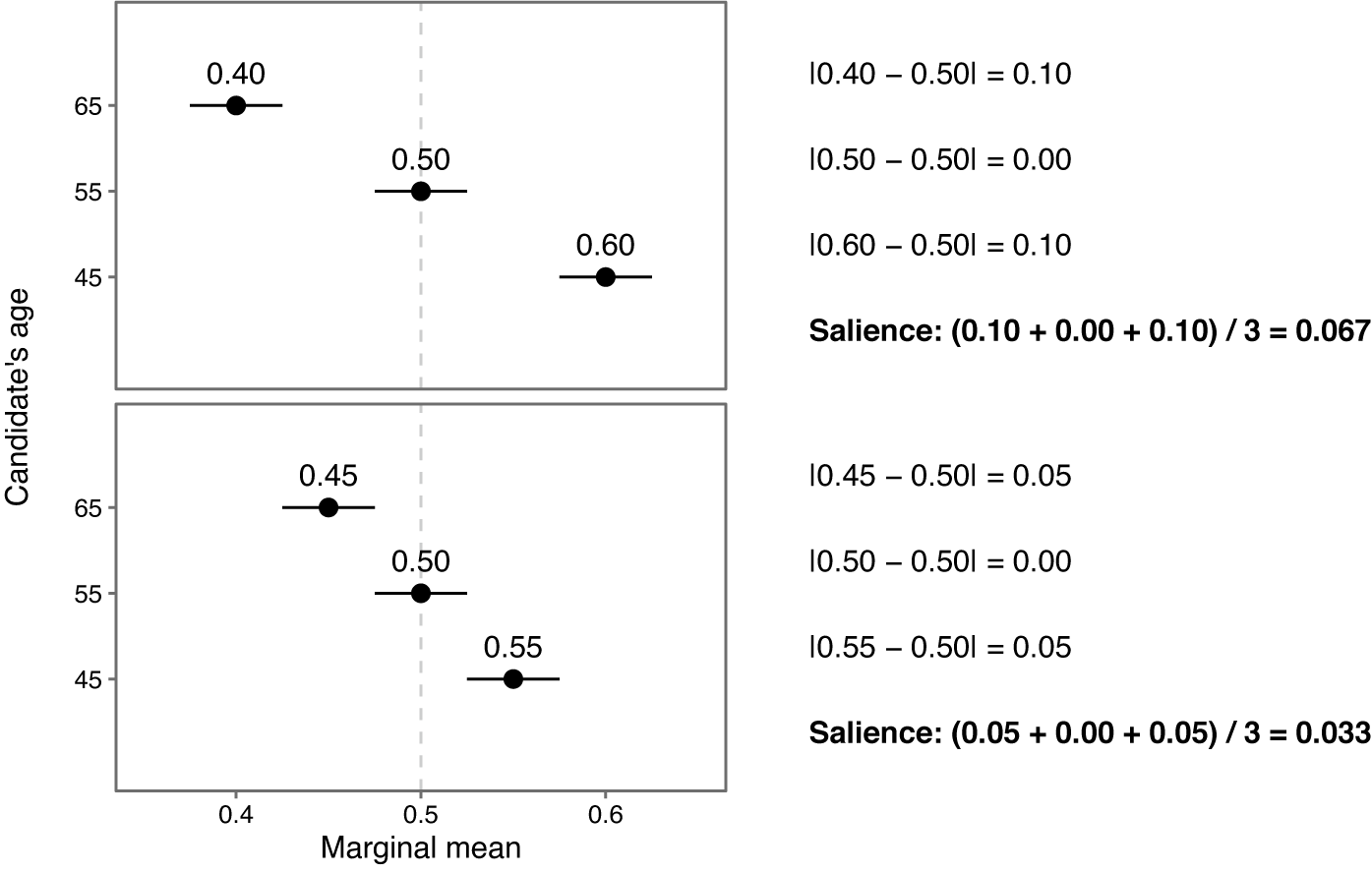
Specifically, the quantity of interest in our study is the (between-subject) effect of each partisan-composition treatment, compared to the control condition, on the salience of a hypothetical nominee’s partisanship. Therefore, we use a “salience score,” which is the average deviation of (profile-level) marginal means from 0.5 for each attribute (Clayton, Ferwerda and Horiuchi, Reference Clayton, Ferwerda and Horiuchi2021). We calculate the absolute difference between the probability (0–100%) of choosing a nominee with a given attribute level and 50%, which is the probability of choosing a nominee randomly. We then calculate the average difference from 50% across all the levels for a given attribute.Footnote 16
Figure 2 visually depicts an intuitive illustration of salience scores by presenting two scenarios: one where age is more salient (top panel) and one where age is less salient (bottom panel). The horizontal axis shows (hypothetical) marginal means, and the vertical axis indicates the three levels for the “age” attribute. In both cases, we assume that respondents prefer younger nominees, but the salience score is larger in the top panel (
$ \left(|-0.1|+0+0.1\right)/3=0.067 $
 ) compared to the bottom panel (
$ \left(|-0.05|+0+0.05\right)/3=0.033 $
) compared to the bottom panel (
$ \left(|-0.05|+0+0.05\right)/3=0.033 $
 ). Substantively, this score indicates how much respondents, on average, care about a given attribute. If a given attribute is utterly unimportant to respondents, the marginal means would be close to 0.5 across all levels of the attribute, yielding a salience score close to 0.
An illustration of salience scores.

Figure 2. Long description
The top panel displays three dots with horizontal error bars at ages 65, 55, and 45, labeled 0.40, 0.50, and 0.60 respectively. The x-axis is marginal mean, y-axis is candidate’s age. To the right, calculations show absolute differences from 0.50: 0.40 minus 0.50 equals 0.10, 0.50 minus 0.50 equals 0.00, 0.60 minus 0.50 equals 0.10. Salience is computed as open parenthesis 0.10 plus 0.00 plus 0.10 close parenthesis all over 3 equals 0.067. The bottom panel shows dots at ages 65, 55, and 45, labeled 0.45, 0.50, and 0.55. Calculations to the right show: 0.45 minus 0.50 equals 0.05, 0.50 minus 0.50 equals 0.00, 0.55 minus 0.50 equals 0.05. Salience is open parenthesis 0.05 plus 0.00 plus 0.05 close parenthesis all over 3 equals 0.033. Both panels illustrate how salience scores are derived from the deviation of marginal means from the reference value 0.50.
Results
We divide respondents into Democrats and Republicans and calculate the salience scores separately, as we preregistered. In Section D.2 of the Supplementary Materials, we also report results for pure independents and for all respondents pooled. Unless otherwise noted in Section A.1 of the Supplementary Materials, all analyses follow our preregistered analysis plan.
Marginal means
Before presenting the results of testing our hypotheses, we present the estimated (profile-level) marginal means (MMs) for all levels of all attributes. As we explained earlier, a marginal mean is the probability of choosing a profile when a particular level (e.g., “Strong Republican”) of a specific attribute (e.g., Partisanship) is included, and is averaged over combinations of other attributes (and the combinations of all attributes in a comparison profile) and over respondents.
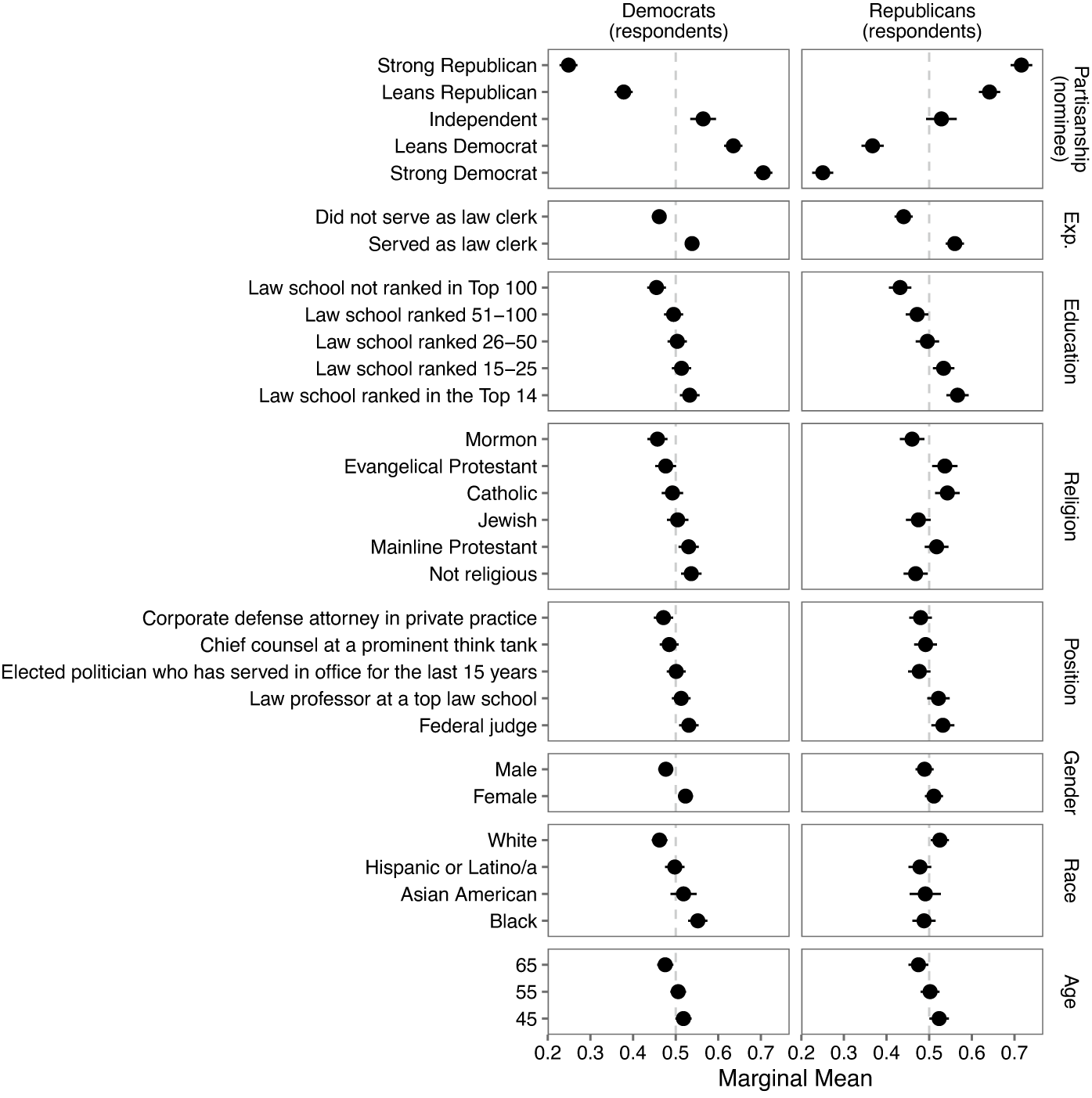
Figure 3 shows the results. As expected, Democrats strongly prefer Democratic nominees, and Republicans strongly prefer Republican nominees. Furthermore, the variation in MMs is considerably larger for Partisanship than for other attributes. The marginal means of the other attributes are much closer to 0.5, the indifference benchmark between the two profiles. In other words, these estimates suggest that respondents care about nominees’ partisanship considerably more than they do about other attributes.
Marginal means of choosing nominees based on each attribute level. Note: We abbreviate the labels for some attributes for the purpose of presentation. “Exp.” is Law clerk experience. “Position” is Current position. “Race” is Race/ethnicity.

Figure 3. Long description
From top to bottom, the panels represent Partisanship, Experience, Education, Religion, Position, Gender, Race, and Age. Each panel contains two columns: Democrats (left) and Republicans (right). Within each panel, rows list attribute levels, such as ‘Strong Republican’ to ‘Strong Democrat’ for Partisanship, ‘Did not serve as law clerk’ and ‘Served as law clerk’ for Experience, and so forth. Dots indicate the marginal mean for each attribute level, plotted along a horizontal axis labeled ‘Marginal Mean’ ranging from 0.2 to 0.7. For Partisanship, Democrats favor ‘Strong Democrat’ nominees, while Republicans favor ‘Strong Republican’ nominees. For Experience, both groups show higher marginal means for nominees who served as law clerks. Education panel shows preference for higher-ranked law schools. Religion panel reveals variation, with Democrats favoring ‘Not religious’ and Republicans favoring ‘Evangelical Protestant.’ Position panel shows both groups prefer ‘Federal judge’ and ‘Law professor at a top law school.’ Gender panel shows similar marginal means for male and female nominees. Race panel indicates Democrats favor ‘Black’ and ‘Asian American’ nominees, while Republicans favor ‘White.’ Age panel shows higher marginal means for older nominees in both groups.
Hypothesis 1
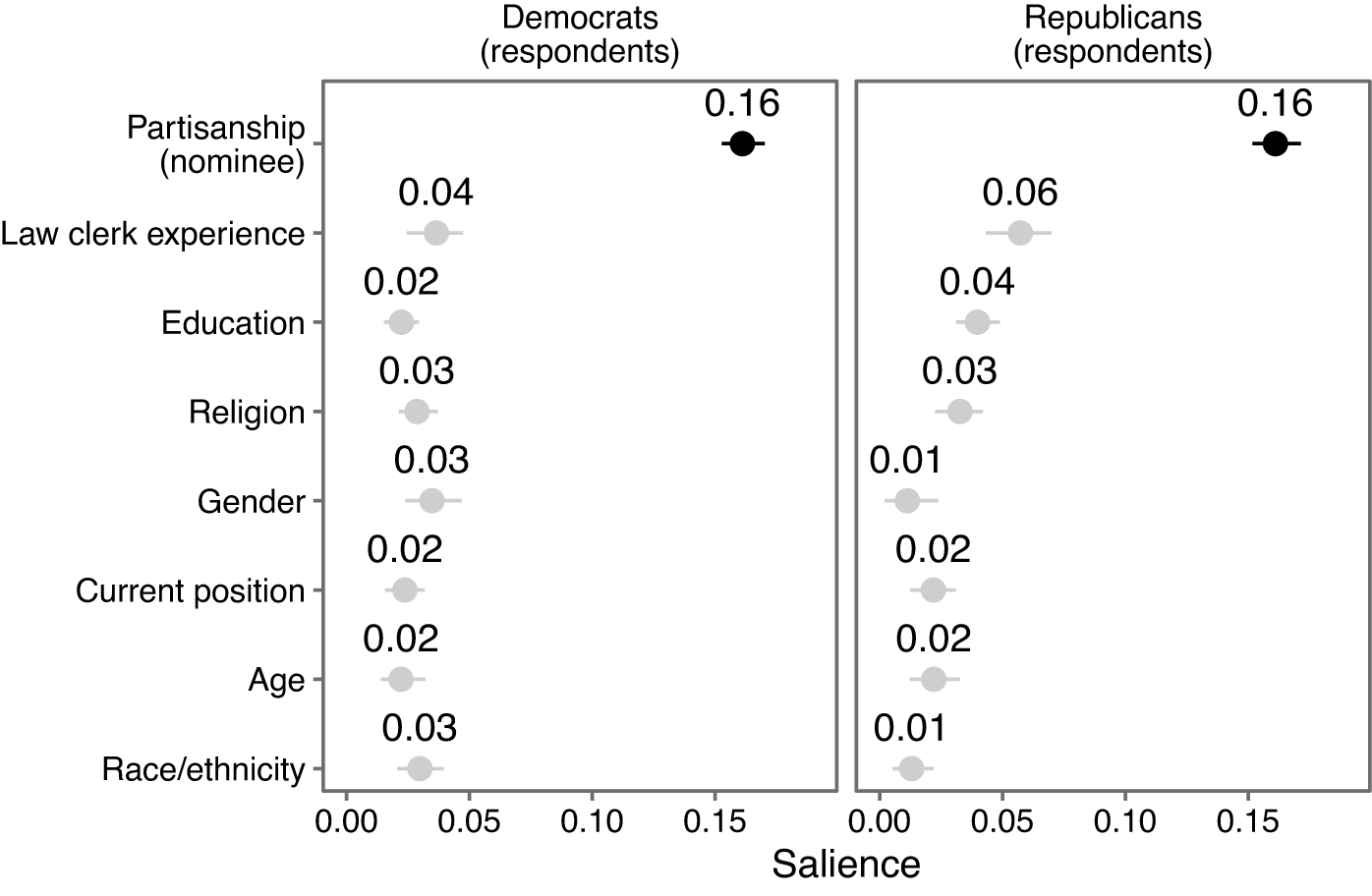
Figure 4 shows that our results strongly support Hypothesis 1: Partisanship is the most salient attribute for respondents’ choice of a nominee. Each dot corresponds to the salience score. The horizontal bars indicate 95% confidence intervals. The estimates for our attribute of interest – partisanship – are highlighted in black; otherwise, they are in gray.
Attribute salience for respondents’ choice of nominee in the control condition.

We find that partisanship is the most salient attribute for Democrats (left panel) and Republicans (right panel) when they are not exposed to a hypothetical scenario about the Supreme Court’s partisan composition. The salience score is 0.161 for Democrats and 0.161 for Republicans. Even compared to the attribute with the second-largest salience scores (Law clerk experience; 0.037 for Democrats and 0.057 for Republicans), the salience scores for partisanship are 2.8–4.4 times larger. Thus, unsurprisingly, partisanship’s effect on respondents’ choice of nominee is substantial.
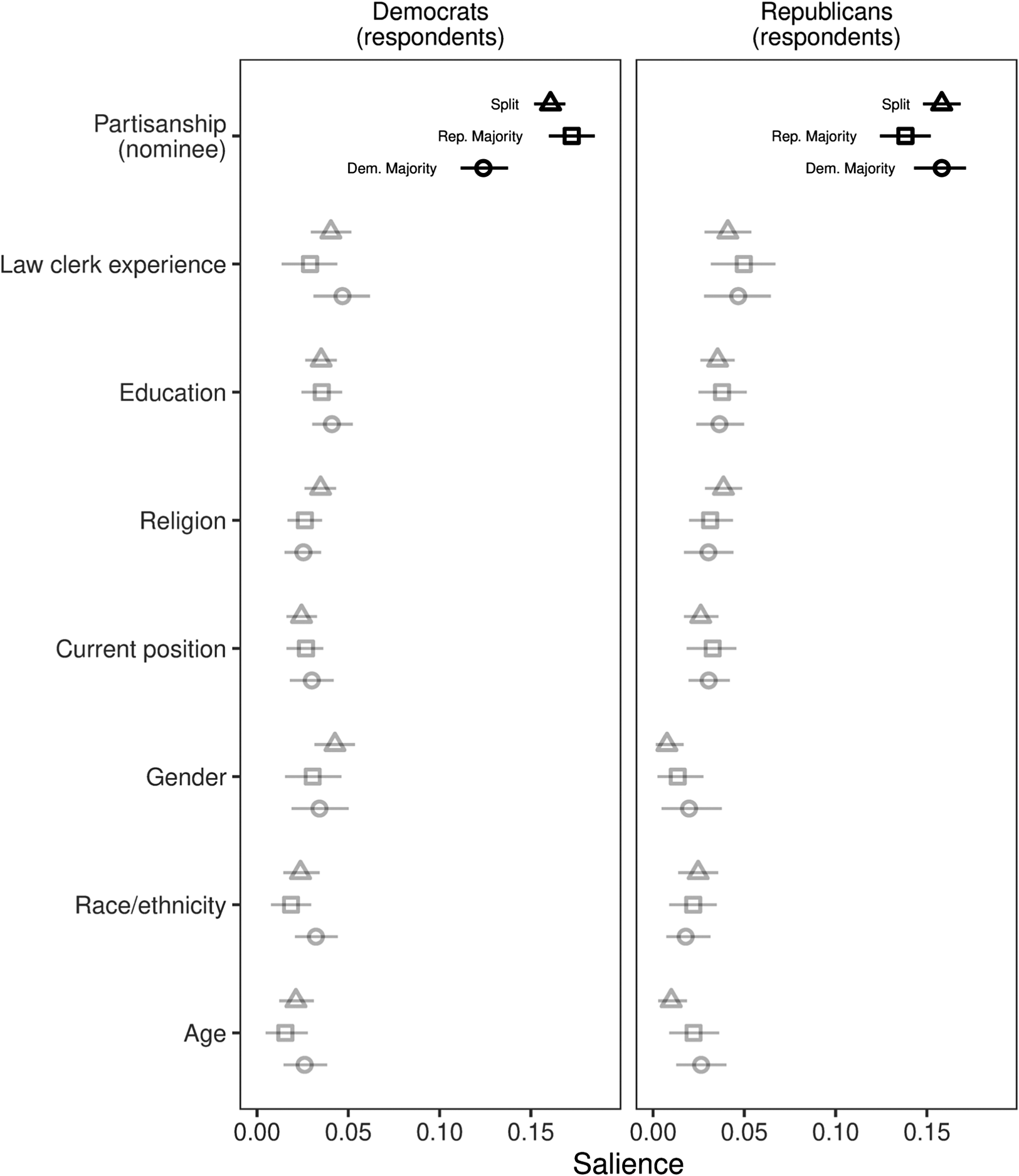
Figure 5 shows the salience scores for Democrats and Republicans under the three conditions for all the attributes.Footnote 17 Partisanship remains the most salient attribute for Democrats and Republicans, even when they are exposed to a hypothetical scenario about the Supreme Court’s partisan composition (Research Question 1).Footnote 18
Attribute salience for respondents’ choice of nominee by condition.

Figure 5. Long description
Starting from the top, each panel represents respondents: left for Democrats, right for Republicans. Both panels list eight attributes vertically: Partisanship (nominee), Law clerk experience, Education, Religion, Current position, Gender, Race/ethnicity, Age. For each attribute, three horizontal plots are shown: triangle for Split, square for Rep. Majority, circle for Dem. Majority. Salience values are plotted along the x-axis from 0.00 to 0.15. In both panels, partisanship (nominee) has the highest salience, with Split and Rep. Majority conditions showing higher values than Dem. Majority. All other attributes have lower and similar salience across conditions, with minimal variation between groups.
In sum, we find strong support for Hypothesis 1, consistent with prior research (Sen, Reference Sen2017). Democrats and Republicans choose nominees based almost exclusively on partisanship, despite the extensive literature on “judiciousness” (Lerner, Reference Lerner1937) and despite how presidents, lawyers, and senators alike intentionally emphasize their preferred nominee’s qualifications (O’Neill, Reference O’Neill2007; Amar, Reference Amar2018; Blatt, Reference Blatt2018; Feldman, Reference Feldman2020).Footnote 19
We then examine whether partisanship is more salient for Democratic or Republican respondents across the four experimental conditions (Research Question 2). We find that in the Democratic Majority condition, partisanship is significantly more salient for Republicans than for Democrats (
$ 0.158-0.124=0.034 $
 ); in the Republican Majority condition, partisanship is significantly more salient for Democrats than for Republicans (
$ 0.172-0.138=0.034 $
); in the Republican Majority condition, partisanship is significantly more salient for Democrats than for Republicans (
$ 0.172-0.138=0.034 $
 ).Footnote 20 In other words, Republicans care more than Democrats about a nominee’s partisanship when their side is “losing” the Court. Similarly, Democrats care more than Republicans about a nominee’s partisanship when their side is “losing” the Court. However, Democrats and Republicans care equally about a nominee’s partisanship when they are not exposed to a hypothetical scenario about the Court’s partisan composition (the Control condition) or when the Court is split 4-4 (the Split condition).Footnote 21
Therefore, this analysis shows that the relative salience of partisanship between Democrats and Republicans varies depending on the partisan composition of the Supreme Court. Previous studies that focus solely on individual nominees may have underestimated or missed context-specific differences in Democratic versus Republican concern about nominee partisanship. In Section D.1 of the Supplementary Materials, we discuss in more detail how this result suggests an essential way for future conjoint experiments on this topic to improve their external validity.
Hypothesis 2
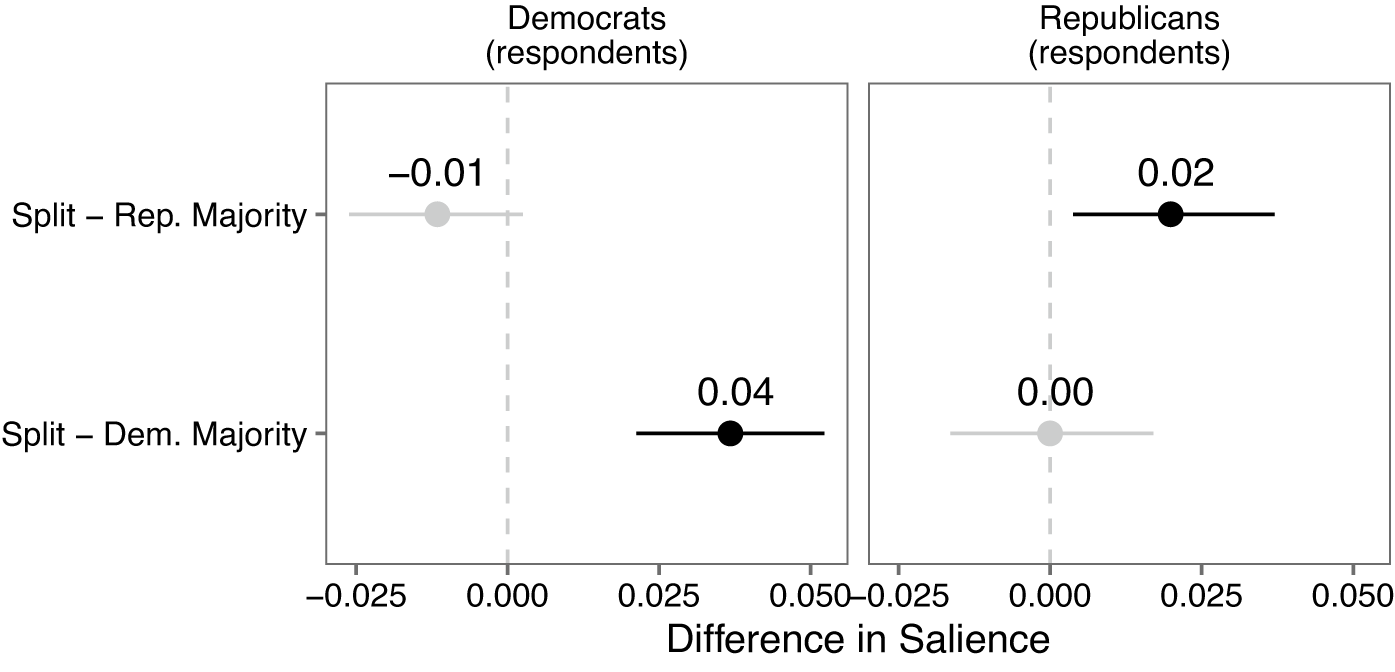
Figure 6 presents the results of testing Hypothesis 2: Partisanship becomes most salient for respondents when the Court is split 4-4, compared to respondents assigned to the Democratic Majority condition or the Republican Majority condition. We take the difference in the salience scores between the Split and Democratic Majority conditions and between the Split and Republican Majority conditions.Footnote 22 Similar to Figure 4, the horizontal bars are 95% confidence intervals. The statistically significant differences are highlighted in orange.
Difference in the salience of partisanship between the partisan-majority and Split conditions.

Figure 6. Long description
The left panel is labeled Democrats (respondents). The top row shows Split – Rep. Majority with a gray dot at minus 0.01 and a horizontal error bar. The bottom row shows Split – Dem. Majority with a black dot at 0.04 and a horizontal error bar. The right panel is labeled Republicans (respondents). The top row shows Split – Rep. Majority with a black dot at 0.02 and a horizontal error bar. The bottom row shows Split – Dem. Majority with a gray dot at 0.00 and a horizontal error bar. The x-axis is labeled Difference in Salience, ranging from minus 0.025 to 0.050. Vertical dashed lines mark zero in both panels.
As expected, we find that partisanship is more salient for Democrats assigned to the Split condition compared to Democrats assigned to the Democratic Majority condition (left panel, bottom estimate), and partisanship is more salient for Republicans assigned to the Split condition compared to Republicans assigned to the Republican Majority condition (right panel, top estimate). Thus, partisans become more concerned about nominee partisanship when the Court is evenly divided than when their party is already solidly “winning” the Court by 6-2.Footnote 23
However, contrary to our expectations, Figure 6 also shows that partisans assigned to a condition where the opposing party leads the Court 6-2 (left panel, top estimate, for Democrats; right panel, bottom estimate, for Republicans) care just as much about the nominee’s partisanship as do partisans assigned to the Split condition, where the Court is composed of four Democrats and four Republicans. These differences in salience are not significant at the 0.05 level.
These results are surprising because the new Justice would not swing the Court in either of the two Majority conditions. Because the new Justice would only swing the Court in the Split condition, our preregistered Hypothesis 2 states that partisanship should be more salient in the Split condition than in any other treatment condition. Therefore, our results only partially support Hypothesis 2.
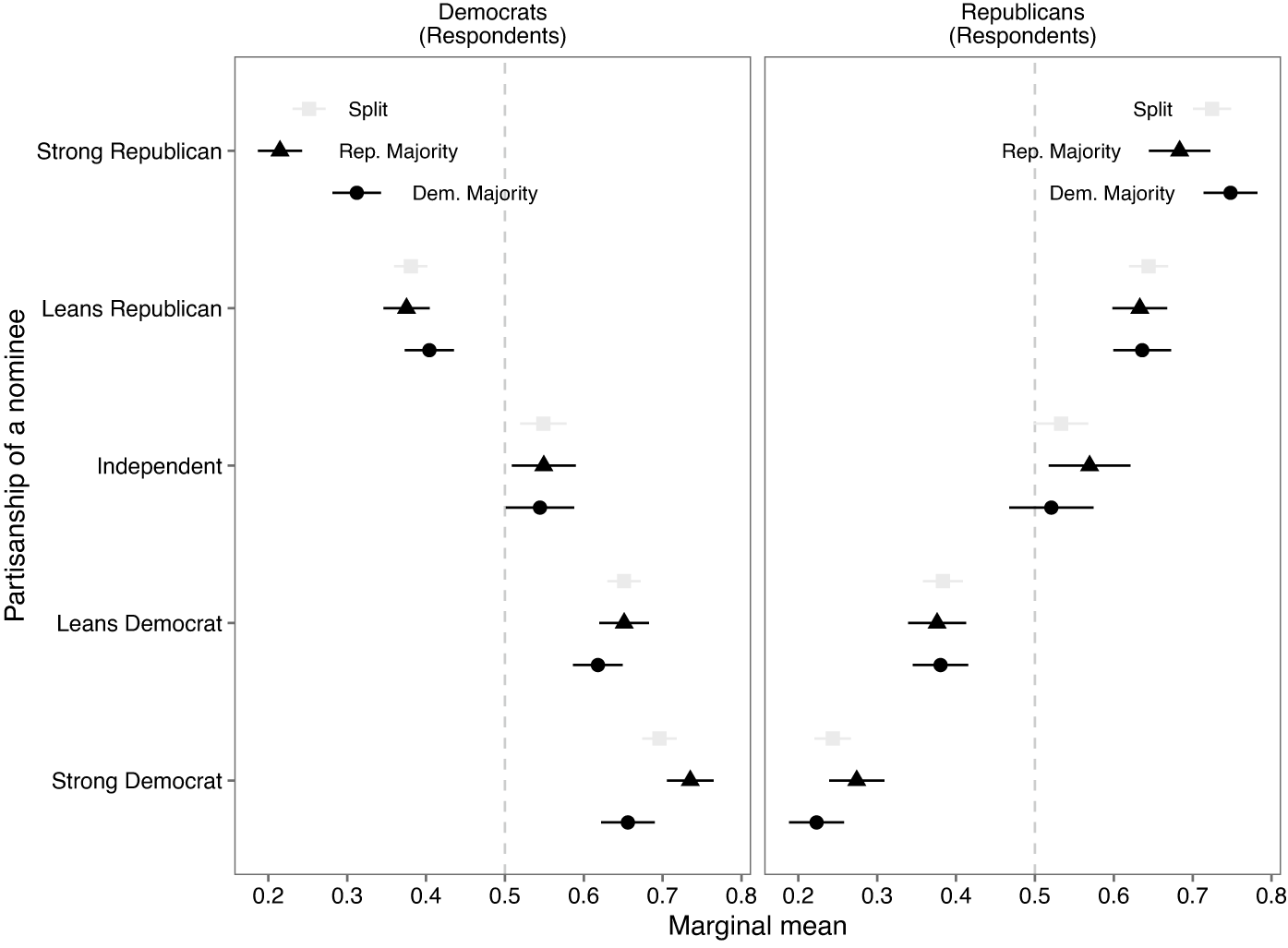
To more deeply explore these unexpected results, we conduct exploratory analyses calculating the marginal means for the attribute of interest – a nominee’s partisanship – by experimental conditions and by respondents’ partisanship (Figure 7). The vertical axis shows each of the five levels of partisanship, ranging from “Strong Democrat” to “Strong Republican,” and the horizontal bars are 95% confidence intervals of estimated marginal means (on the horizontal axis).
Marginal means of choosing nominees based on their partisanship.

Figure 7. Long description
From left to right, the first panel is labeled Democrats (Respondents), the second Republicans (Respondents). Both panels share the y-axis labeled Partisanship of a nominee, ordered from Strong Republican at the top to Strong Democrat at the bottom. The x-axis is labeled Marginal mean, ranging from 0.2 to 0.8. For each partisanship category, three horizontal data points are shown: Split (gray square), Rep. Majority (black triangle), and Dem. Majority (black circle). In both panels, respondents favor nominees aligned with their own party, with marginal means highest for Strong Republican nominees among Republican respondents and Strong Democrat nominees among Democrat respondents. Split conditions consistently yield intermediate marginal means. Error bars are present for each point.
We find that the differences in marginal means between the Republican Majority and Democratic Majority conditions are considerably larger when a nominee’s partisanship is “Strong Republican” or “Strong Democrat.” Specifically, the probability of choosing a “Strong Republican” nominee increases among Democrats by almost 10 percentage points (
$ 0.312-0.215=0.097 $
 ) when the condition changes from the Republican Majority to the Democratic Majority condition. By contrast, the probability of choosing a “Strong Democrat” nominee decreases among Democrats by almost 8 percentage points (
$ 0.656-0.735=-0.079 $
) when the condition changes from the Republican Majority to the Democratic Majority condition. By contrast, the probability of choosing a “Strong Democrat” nominee decreases among Democrats by almost 8 percentage points (
$ 0.656-0.735=-0.079 $
 ) when the condition changes from the Republican Majority to the Democratic Majority condition.
The changes are less substantial among Republicans, but the effect directions are the same: the probability of choosing a “Strong Democrat” nominee increases among Republicans by about 5 percentage points (
$ 0.274-0.223=0.051 $
 ) when the condition changes from the Democratic Majority to the Republican Majority condition. By contrast, the probability of choosing a “Strong Republican” nominee decreases among Republicans by almost 7 percentage points (
$ 0.683-0.748=-0.065 $
) when the condition changes from the Democratic Majority to the Republican Majority condition. By contrast, the probability of choosing a “Strong Republican” nominee decreases among Republicans by almost 7 percentage points (
$ 0.683-0.748=-0.065 $
 ) when the condition changes from the Democratic Majority to the Republican Majority condition.
In sum, when their own party occupies a 6-2 majority on the Court rather than a 2-6 minority, Democrats and Republicans alike become more likely to support a strong partisan from the other party. They also become less likely to support a strong partisan from their own party. However, when their own party occupies a 2-6 minority on the Court rather than a 6-2 majority, Democrats and Republicans alike become more likely to support a strong partisan from their own party. They also become less likely to support a strong partisan from the other party.
These effects are surprising if we expect Democrats and Republicans to simply always choose strong co-partisan nominees – rather than adjusting their preferences based on the Court’s partisan composition. It is also surprising that these effects are largest for “Strong Republican” and “Strong Democrat” nominees; one might expect that when their party is already “winning,” partisans are only likely to give weak opposition partisan nominees a “pass” – but not strong opposition partisan nominees.
Discussion
The results above reveal two counterintuitive patterns. First, nominee partisanship is no more salient when the Court is evenly split than when the opposing party already holds a decisive 6-2 majority, even though only the former case is mechanically pivotal. Second, exploratory analyses show that when respondents’ own party already holds a secure majority, they become more willing to select strong opposition partisan nominees rather than merely shifting toward moderation.
A political-psychological interpretation helps account for both patterns. With respect to the first, respondents appear to respond less to whether a single appointment is pivotal and more to the perceived partisan threat posed by the Court’s overall composition. When the opposing party controls the Court, partisan identity remains highly salient even if the immediate nomination cannot alter control, consistent with affective polarization and group-based threat perceptions. By contrast, when respondents’ own party holds a secure majority, perceived threat diminishes, reducing the urgency of partisan cue-taking.
This same reduction in perceived threat also helps explain the second pattern. When partisan control is perceived as secure, respondents may feel less compelled to screen nominees defensively, increasing tolerance not only for moderate opposition nominees but even for strong partisans from the other party. In this sense, the shift does not reflect a preference for moderation per se, but rather a broader relaxation of partisan vigilance when institutional control appears stable.
An alternative interpretation emphasizes strategic or utility-based reasoning, whereby the marginal value of adding another co-partisan Justice declines once partisan control is secure. While this logic may also be consistent with the observed patterns, the present design does not allow us to distinguish cleanly between these mechanisms. We therefore emphasize the political-psychological interpretation in the main text and present a fuller discussion of both perspectives in Section E of the Supplementary Materials.
Conclusion
Our study shows that changes in the Supreme Court’s partisan composition have substantial effects on how Democrats and Republicans evaluate individual nominees. Using a national sample of American respondents, we find that members of the public strategically conceptualize the Court, adapting their preferences for nominees based on the Court’s current partisan composition. Democrats and Republicans alike are particularly concerned about the partisanship of the new Justice when their party is “losing” the Court and when the Court is split 4-4, but they become less concerned about the nominee’s partisanship when their party is “winning” the Court.
While the between-subject random assignment of the partisan composition within our experiment allows us to isolate its causal effect, we acknowledge two remaining limitations regarding external validity. First, respondents evaluated hypothetical nominees without an accompanying nominating president, even though real-world nomination attitudes can be shaped by presidential context. But because actual nominations pair a nominee with a co-partisan president – an additional and mutually reinforcing partisan cue – presenting the nominee’s partisanship in isolation, if anything, likely yields a conservative estimate of how salient partisanship would be in a real nomination. Second, our conjoint profiles occasionally juxtapose nominee attributes that would not appear together in a single real-world nomination (e.g., a “Strong Republican” and a “Strong Democrat” considered side by side). This is a deliberate abstraction that lets us estimate preferences over attributes independently of the political context in which nominees actually emerge, but presenting sharply opposed partisans side by side may instead make the partisan dimension unusually easy to act on, potentially inflating the absolute salience of partisanship relative to a real, single-nominee evaluation (de la Cuesta, Egami and Imai, Reference de la Cuesta, Egami and Imai2022). Crucially, however, both features are held constant across all four experimental conditions; they may shift the absolute level of a given salience score, but they cannot generate the between-condition differences in salience on which our central findings rest.Footnote 24
Another concern relevant to the scope of our study is timing. The survey was fielded from September 30 to October 15, 2022, several months after the confirmation of Justice Ketanji Brown Jackson and during a period when the Court had a 6-3 conservative majority. These contextual factors may have influenced how respondents interpreted the partisan-balance treatments. In particular, some partisan-balance conditions – particularly those counter to the well-known conservative majority at the time our survey was fielded – may have engendered confusion, despite our repeated instructions to consider the conditions as mere “hypotheticals.” Future work should test the generalizability of these results across different institutional contexts and real nomination environments.
The findings and interpretations discussed above contribute to the broader study of partisan polarization and Americans’ evaluation of partisanship. At least in the context of the Supreme Court, we show that Democrats and Republicans adjust the extent to which they care about partisanship depending on whether their party already dominates the status quo. They will even become substantially more likely to choose a strong partisan from the other party if their own party already occupies a majority.Footnote 25 Thus, Democrats and Republicans alike seem more concerned about stopping the opposing party from cementing its majority than they are worried about aiding their own party to secure its majority.
Our findings also have significant implications for the literature on the Court’s politicization and on how Americans perceive Justices and nominees. In particular, concerns about external validity should motivate future studies to consider the partisan composition of the Court rather than focusing solely on individual Justices or nominees (see Section D.1 of the Supplementary Materials). In the real world, when members of the public receive information about Supreme Court nominees from the news media, they also receive information about the Court’s partisan composition. Our results show that informing Americans about the Court’s partisan composition changes how they evaluate individual nominees – either through an informational effect, a priming effect, or a combination of the two.
Of course, we do not suggest that all conjoint experiments on Supreme Court nominees should include the same between-subject treatment that we employed. Instead, from an external validity perspective, researchers might consider providing respondents with information about the Court’s partisan composition at the time of the survey (since news media coverage of nominees often includes such information). But we acknowledge that providing such information may very well conflict with specific research designs or be irrelevant for particular research questions. In such cases, researchers should at least consider how the Court’s partisan composition at the time might be affecting their findings.
Finally, we also provide two other contributions. First, our results show which attributes are most relevant for Americans evaluating candidates. In the context of Supreme Court nominees, we confirm prior research showing that partisanship is the most essential attribute; other attributes are much less salient. For example, respondents do not appear to consider the age of nominees, despite (1) existing research on voter evaluations of age (Eshima and Smith, Reference Eshima and Smith2022), (2) recent news media discussions about the ages of Joe Biden and Donald Trump, and (3) the importance of age for Supreme Court Justices in terms of strategically timing their retirements to coincide with co-partisan presidential administrations. Second, our findings have implications for how the relevance of different attributes may shift in response to situational factors external to the candidates themselves. We show that candidate evaluation is not necessarily a stable process, and that it is affected not only by the identities of the candidate and the evaluator. Instead, the same person may evaluate the same candidate differently depending on changes in the partisan composition of the body the candidate seeks to join.
The political climate in the United States has grown more polarized, with citizens’ attitudes and behaviors increasingly influenced by their partisan affiliations. The Supreme Court, responsible for protecting individual liberties, is intended to remain politically impartial. However, our research indicates that the traditional theory emphasizing Justices’ qualifications over their partisanship (Lerner, Reference Lerner1937) no longer holds. Our findings are consistent with recent studies showing that attitudes toward the Court have become highly polarized, and control of the Court is now understood as a crucial partisan priority (Levendusky et al., Reference Levendusky, Patterson, Margolis, Pasek, Winneg and Jamieson2024). Political scientists must continue to study public opinion on Supreme Court nominees, as public preferences shape Senate confirmation votes. Especially as the Supreme Court becomes more politicized, it is increasingly important to study how Americans strategically adapt their preferences for nominees in response to changes in the Court. Our research contributes to the scholarly discussion in this area by showing how the partisan composition of the Supreme Court affects Americans’ evaluation of individual nominees.
Supplementary material
The supplementary material for this article can be found at http://doi.org/10.1017/jlc.2026.10029.
Data availability statement
A complete replication package is available at https://doi.org/10.7910/DVN/C7T9S3.




 Open access

