


Every day, thousands of children worldwide are forced to serve as soldiers in armed conflicts, becoming the recipients and perpetrators of violence and thus experiencing a great number of atrocities. It has been officially estimated by the United Nations Children's Emergency Fund that about 300 000 children younger than 18 years of age are currently serving as soldiers, guerrilla fighters or in support roles in more than 50 countries around the world.1 These minors undertake a variety of roles, including acting as spies, porters and front-line soldiers, and are often involved in the exertion of extraordinary violence toward others as well as being subjected to repeated physical, sexual and emotional violence. Thus, former child soldiers are at high risk of developing mental disorders like post-traumatic stress disorder (PTSD).Reference Betancourt, Brennan, Rubin-Smith, Fitzmaurice and Gilman2, Reference Derluyn, Broekaert, Schuyten and De Temmerman3
In August 2014, when troops of the self-proclaimed ‘Islamic State’ conquered areas of northern Iraq, they turned on the long-established religious minorities in the area with tremendous brutality, especially the Yazidis.Reference Cetorelli, Sasson, Shabila and Burnham4 Vast numbers of men were executed, and women and children were abducted and wilfully subjected to sexual violence.Reference Kelly, Branham and Decker5
From the beginning, the Islamic State deliberately targeted boys aged between 8 and 14 years old, tearing them away from their families and training and indoctrinating them as child soldiers,Reference Kelly, Branham and Decker5, Reference Gerdau, Kizilhan and Noll-Hussong6 often by means of daily religious indoctrination and martial arts to achieve dehumanised indifference to pain, brutality and terror.Reference Nasiroglu and Ceri7 Nevertheless, some of these young Yazidis managed to flee captivity or have been freed in return for a ransom payment. These former child soldiers now live near Duhok and Zakho in northern Iraq in approximately 24 refugee camps, each housing up to 28 000 refugees. Treatment options within these camps are severely limited or non-existent.Reference Ceri, Ozlu-Erkilic, Ozer, Yalcin, Popow and Akkaya-Kalayci8, Reference Tekin, Karadag, Suleymanoglu, Tekin, Kayran and Alpak9
Previous research such as that in northern Uganda, Palestine or Rwanda revealed high rates of post-traumatic reactions among children who had been abducted as child soldiers.Reference Dyregrov, Gupta, Gjestad and Mukanoheli10–Reference Moscardino, Scrimin, Cadei and Altoe13 Nasiroglu and CeriReference Nasiroglu and Ceri7 interviewed children and adolescents in a refugee camp in Turkey approximately 2 years after the 2014 Islamic State attack in Iraq, and concluded that 43% of the survivors showed moderate to severe post-traumatic stress reactions. Post-traumatic stress reactions in children and young adolescents were associated with parental loss, exposure to violence and, most importantly, the feeling that their life was perpetually in danger. In the study mentioned, there is no information about child soldiers and their mental health situation. Until now, there has been a paucity of studies specifically comparing the mental health status of former child soldiers with that of children living through war without being recruited into armed groups. Thus, Kohrt et al.Reference Kohrt, Jordans, Tol, Speckman, Maharjan and Worthman14 compared differently exposed groups in Nepal and reported greater severity of mental health problems in former child soldiers compared with children never conscripted by armed groups, after controlling for trauma exposure. However, it is not yet clear what aspects of the child soldier experience contribute to the poorer mental health outcomes in this population.Reference Kohrt, Jordans, Tol, Speckman, Maharjan and Worthman14, Reference Thabet and Vostanis15 Specifically, the extent to which this difference may be related to the effect of other experiences on children's psychosocial well-being, such as sexual violence, is still unknown.
Moreover, research suggests that trauma events can also be followed by lowered self-esteem in children,Reference Freh16 which can affect the mental health and the (development of) personality over the long term.Reference Lee and Hankin17 Many studies have demonstrated an association between violence or abuse and low self-esteem in children.Reference Turner, Finkelhor and Ormrod18, Reference Young and Widom19
Against this background, FrehReference Freh16 noted that children's exposure to war-related trauma varies greatly as a function of context and other individual factors, such as gender or ethnicity. Last but not least, given that effective intervention strategies need to be culturally sensitive and respectful of the social ecology, it is of special importance to report on the mental health of former child soldiers misused by the Islamic State in Iraq in comparison with children who were never directly abducted by the Islamic State, to address the specific problems faced by this most sensitive war-affected population.
Altogether, there have been no studies done so far that focus specifically on the psychological burden on Iraqi child soldiers. Although it might be intuitive that war and widespread violence leave deep bio-psychosocial scars, it is essential to further our understanding of the mental health effect these scars have on children. The relevance of the topic is striking at a medical, developmental and humanitarian level, as lost childhood can take years to recover from and physical and psychological trauma may be long lasting.Reference Gerdau, Kizilhan and Noll-Hussong6–Reference Ceri, Ozlu-Erkilic, Ozer, Yalcin, Popow and Akkaya-Kalayci8
Method
The study was led by the Institute of Psychotherapy and Psychotraumatology at the University of Duhok in Iraq. The study was approved by the University Ethical Review Board and Health Directorate in Duhok, Iraq, and performed in accordance with the Declaration of Helsinki. We confirm that all the research meets ethical guidelines, including adherence to the legal requirements of the country in the study. Written informed consent was obtained from the patients for publication of this article and any accompanying information.
Sample
The former child soldiers (group one) were Yazidi boys aged between 8 and 14 years (n = 81; mean 12.61, s.d. 2.61) from the area of Sinjar in northern Iraq. They were held captive between August 2014 and May 2017 for at least 3 months by the Islamic State in Iraq and Syria. The first control group (n = 32; mean 12.24, s.d. 2.46; group two) met the following criteria: they were Yazidi boys who came from the same region and were living in refugee camps, but did not serve as child soldiers. The second control group (n = 31; mean 12.89, s.d. 2.96; group three) met the following criteria: they were Muslim boys who came from the same region and were living in refugee camps, but did not serve as child soldiers. At the time of the investigation, all participants were living in refugee camps near the city of Dohuk in northern Iraq.
The first author (J.I.K.) got in touch with both the investigational and the control group through licensed physicians and psychologists in the refugee camps who he knew from earlier joint projects. Before the actual data collection, a first visit was made to the participants’ housing with the following aims: to provide the adolescents and their families/legal guardians with a description of the study and its purpose, and to tell them how the anonymised data would be used, to ensure informed consent and to obtain written permission for their participation in the study. It is of note that everyone (children and guardians) who had been asked to participate in the study and/or give approval agreed to do so and completed the full procedure detailed below. The interviews were done verbally with 194 male individuals and the investigators promptly transcribed the answers according to the chosen instruments. Not all interviewees filled in the complete questionnaire (n = 113, 58.2%) and after elimination of the incomplete data-sets, there remained a sample of 81 interviewees (41.8%) for analysis. Each interview lasted approximately 60 min on average.
All participants were examined within a time period of 3 days before the interview by a licensed physician from the refugee camps, and none had any clinically relevant medical findings or records. The data collection was carried out by trained professionals from 1 July to 15 October 2017, with continuous supervision by J.I.K.
Measures
The Children's DIPSReference Unnewehr, Schneider and Margraf20 is the children's version of the ‘Diagnostic Interviews for Mental Disorders’.Reference Margraf, Schneider, Ehlers, DiNardo and Barlow21, Reference Margraf, Schneider, Ehlers and Psychologie22 It is the extended version of the ‘Anxiety Disorders Schedule – Revised’.Reference Di Nardo and Barlow23 This interview is a structured one in which the nature and order of the questions as well as the coding and the evaluation of answers are predefined, in accordance with the SCID (Structured Clinical Interview for DSM-IV) system for adults. The interviewer may, however, put further questions to remove ambiguity, for example, if they feel that there is a question the younger interviewee does not understand. The Children's DIPS allows for the diagnosis of lifetime and point prevalence of mental disorders on the basis of both the criteria of the DSM-IV and the investigation criteria of the ICD-10.Reference Margraf, Schneider, Ehlers, DiNardo and Barlow21 It is earmarked for children and juveniles aged 6–18 years. Interrater and test-retest reliabilities are rated as satisfactory by the test authors.
The questionnaire was translated from its German version into Arabic and then re-translated and checked by an Arabic-speaking physician and psychologist in Germany. Systematic validity or reliability studies have not been carried out so far.
The Event Scale, adapted by Dyregrov and YuleReference Dyregrov and Yule24 for the situation in Iraq, is a 15-item questionnaire designed to assess the nature and extent of exposure to various war events. The answers reflect whether the event occurred before, during or after captivity (multiple answers are possible) and whether the respondent only witnessed the event or personally experienced it.
The Child PTSD Reaction Index (Arabized Version) is a translation of the Child PTSD Reaction Index (CPTSD-RI) developed by Frederic et al.Reference Steinberg, Brymer, Decker and Pynoos25 It consists of a 20-item self-report (interview format) questionnaire based on DSM-IV criteria for PTSD. Items are rated on a five-point Likert scale ranging from 0 (never) to 4 (most of the time). CPTSD-RI score ranges and corresponding degrees of PTSD symptom severity are as follows: 0–11, none; 12–24, mild; 25–39, moderate; 40–59, severe and 60–80, very severe. The CPTSD-RI total scale displayed good to excellent internal consistency, and reliability across age ranges, gender and racial/ethnic groups.Reference Thabet and Vostanis15, Reference Qouta, El-Sarraj and Punamäki26 Thus, the Arabized instrument has been previously used with Palestinian children and was found to be appropriate for this population.Reference Thabet, Abed and Vostanis27 The CPTSD-RI total scale displayed good to excellent internal consistency, and reliability across age ranges, gender and racial/ethnic groups (α = 0.78–0.88).Reference Thabet, Abed and Vostanis27
The Arabized Version of the Children's Depression Inventory consists of 27 items related to depression symptoms, measured on a three-point scale (always, sometimes or never). It is based on the original instrument developed by Kovacs.Reference Kovacs28 Reliability and validity of the Arabized version have been shown to be comparable with the original instrument.Reference Ghareeb and Beshai29 Reliability and validity of the Arabized version have also been shown to be comparable with the original instrument (α = 0.86).Reference Ghareeb and Beshai29, Reference Abdelaziz and Mona30
The Coopersmith Self-Esteem InventoryReference Coopersmith31 is a 25-item scale that was translated, Arabized, normed and validated on Arab children by Musa and Dassouki.Reference Musa and Dassouki32 The instrument has been used widely on Arab children, including Palestinians, and was found to be appropriate for such populations (α = 0.92).Reference Coopersmith31
Statistical analyses
The data were analysed with SPSS (IBM, New York, USA), version 11.0 for Microsoft Windows. The data were scored, coded and analysed with descriptive statistics and discriminant analysis on the scores of the three groups of children according to age, gender, PTSD, depression and self-esteem. A critical statistical significance was determined for an overall effect at α = 0.05. Given the size of the survey sample, statistical analyses were carried out with non-parametric statistical methods. The multiple comparisons of the groups were undertaken by means of the Mann–Whitney U test, considering the statistical significance adjusted according to Bonferroni.
Results
Demographics
Table 1 shows the sociodemographic data of the three groups. The final sample consisted of 81 child soldiers with a mean age of 12.2 (range 8–14; s.d. 2.61) years; 32 Yazidi boys who were not child soldiers, with a mean age of 12.1 (range 9–14; s.d. 2.12) years; and 31 Muslim boys who were not child soldiers, from the same area with a mean age of 12.4 (range 8–14; s.d. 2.16) years.
Demographic data of participants.
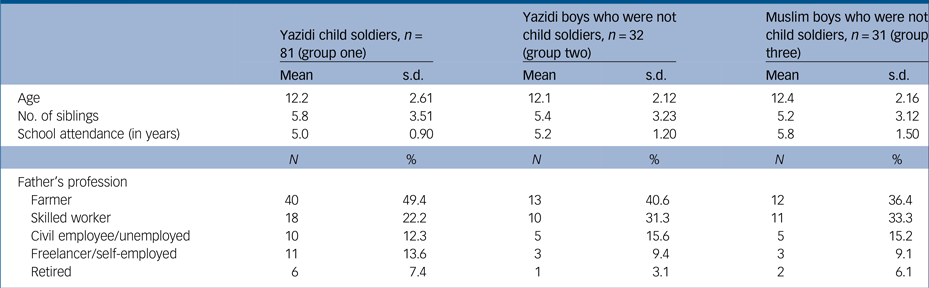
With regard to their guardians and employment (income US$800–1000), 40 fathers (49.4%) described themselves as farmers (income US$600–800), 18 (22.2%) were skilled workers (income US$600–800), 11 (13.6%) were freelancers or self-employed (income US$800–1200), ten (12.3%) were civil service employees or unemployed (income US$800–1200) and six (7.4%) were retired (income US$400–600). There are no significant differences between the groups (Table 1).
In the past 20 years, the interviewed participants (selected boys and their parents/guardians) had not been involved in any war action, flight, captivity and/or organised use of force/violence until the attack by the Islamic State in 2014.
Events
As expected, the self-reported exposure to traumatic events was very high. On the Event Scale, all participants showed that they had experienced some kind of violence, had been exposed to threatening events, had been raped and/or had lost family members during the Islamic State attack or captivity. About 81% of the boys had seen dead or mutilated bodies or had been the victim of an attack or looting (100%).
Many participants had witnessed someone being brutally killed (47%), had witnessed the death of family members (cousins, aunts, uncles, etc.) (37%) or had lost siblings (90%). The child soldiers reported that they had injured someone with a weapon (15%). The mean total score on the Event Scale for the whole sample was 12.6 out of a maximum of 15 (s.d. 2.9; median 13; range 11–15).
Psychological disorders
All child soldiers remembered the day of the beginning of their captivity as being extremely frightening and traumatising. Over 78% of the boys described feelings of intense fear, helplessness, horror and severe pain, and over 74% were still suffering from intrusive re-experiences of their captivity. For 68% of the participants, the event was unexpected and without any preliminary or non-integrable explanation.
Table 2 shows that almost 45.6% of the child soldiers met the criteria for an anxiety disorder. A total of 14.8% were suspected of suffering from disorders of their developing personality and 49.3% met the criteria for a somatoform disorder. In addition, 50.6% of the child soldiers complained of a range of unspecific somatic problems. In the Yazidi control group, 31.2% met the criteria for a somatoform disorder, and 12 (37.5%) boys fulfilled the criteria for an anxiety disorder. Two met the criteria for a personality disorder (6.3%). Fourteen (43.8%) boys from the control group complained of somatic disturbances (Table 2).
Mental disorders (as measured with the children's version of the Diagnostic Interviews for Mental Disorders).

PTSD symptoms
The mean PTSD score for group one (48.3) falls within the high PTSD symptom score range (32–67) (Table 3). The two control groups (group two 14.5; group three 14.2) fell within the low PTSD symptom score range (12–25). The scores, however, varied widely among the two control groups, ranging from experiences of mild (0–18) to very severe symptoms (>28). The child soldiers in group one had a significantly higher PTSD symptom score range (P < 0.001).
The mean depression scores depicted in Table 3 reveal that group one displayed moderate (45th–54th percentile) symptoms of depression. Groups two and three displayed minor (0–18th percentile) symptoms of depression. Table 3, however, also shows that child soldiers (group one) displayed depression scores significantly (P < 0.001) higher (mean 36.57) than the Yazidi (mean 16.07) or Muslim boys who had not been child soldiers (mean 15.09). The dispersion of depression scores was particularly pronounced in group two (range 0–18) compared with group three (range 0–16) and group one (range 23–38).
PTSD, depression and self-esteem.
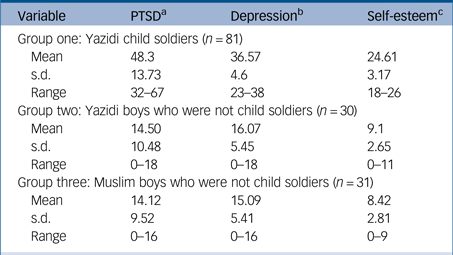
Means, s.d. and ranges of post-traumatic stress disorder (PTSD), depression and self-esteem scores distributed according to group membership.
a Theoretical range 0–80.
b Theoretical range 0–54.
c Theoretical range 0–25.
The results depicting self-esteem scores show that the mean values of group one (24.61) fall outside the norms for their peers in the Arabic-speaking world.Reference Thabet, Abed and Vostanis27 Group two (9.1) and group three (8.42) scored inside the norms (fifth stanine). There is a significant difference between group one and groups two and three (P < 0.001). Groups two and three did not differ from each other significantly, as shown in Table 4.
F values for education, age, post-traumatic stress disorder (PSTD), depression and self-esteem means according to group membership.

The results of the discriminant analysis revealed that PTSD (P < 0.001), depression (P < 0.001) and self-esteem (P < 0.001) scores were variably capable of discriminating between the three groups with statistical significance.
Discussion
This study looks at the prevalence of PTSD, depressed mood and associated risk factors like altered self-esteem among former child soldiers of the Islamic State. The results of this study indicate that the experience of being a child soldier is likely to cause various psychological disturbances, leading to mental disorders, especially PTSD. The high rate of PTSD of more than 48.3% in the investigated group is comparable with the rate of PTSD in child soldiers in other countries such as Rwanda, Uganda or Sudan, which on average ranges from 30 to 67%.Reference Derluyn, Broekaert, Schuyten and De Temmerman3, Reference Schaal and Elbert33, Reference Omona and Matheson34 Altogether, symptoms of depression, psychosomatic conditions, sleep disturbances and PTSD were found to be above normal levels. These findings are likewise congruent with previous findings in studies on child soldiers.Reference Betancourt, Newnham, McBain and Brennan35, Reference Miller, el-Masri, Allodi and Qouta36 The results of the study also showed that symptoms of depression and low self-esteem can constitute an index capable of discriminating between the three groups with statistical significance.
Despite the fact that warlike situations and human rights violations as ‘anthropological constants’ have existed over the centuries, especially against religion minorities such as the Yazidis in Iraq, the results imply that even the embedment of societies does not comprehensively protect against the development of PTSD and other mental disorders.Reference Tagay, Ayhan, Catani, Schnyder and Teufel37
Although the results of this study suggest that being a child soldier in a terrorist organisation like the Islamic State exerts a major negative effect on mental health beyond somatic complications, some caution is warranted in the interpretation of these results. This could, on the one hand, be ascribed to the fact that the circumstances in which these children had to survive are traumatising in themselves, and it is difficult to distinguish the effects of different types of trauma on the development of mental and especially post-traumatic stress symptoms or disorders. Moreover, the effect of a trauma is always linked to the subjective attribution of the events and to the historical–cultural, social and political contexts.Reference Kizilhan and Noll-Hussong38, Reference Pagotto, Mendlowicz, Coutinho, Figueira, Luz and Araujo39
Last but not least, the alarmingly high rates of psychiatric disturbances among the child soldiers provide striking evidence that researchers and clinicians, as well as policy makers, have an ethical obligation to pay more attention to the urgent needs of child soldiers as the most sensitive and often neglected members of our societies. Comprehensive psychosocial rehabilitation beyond the provision of education and vocational training, including psychological therapy, should therefore form the basis of re-settlement and re-integration according to the United Nations Convention on the Rights of the Child. It has to be stressed that treating child soldiers with PTSD who are from traditionally family- or collective-oriented societies like the Yazidis requires a different, culturally sensitive approach and adapted skills for an effective and specifically psychotherapeutic treatment.Reference Betancourt, Borisova, Williams, Meyers-Ohki, Rubin-Smith and Annan40, Reference Noll-Hussong, Glaesmer, Herberger, Bernardy, Schönfeldt-Lecuona and Lukas41
Moreover, a special multidisciplinary long-term concept with teachers, social workers and therapists is needed to effectively reintegrate the child soldiers into society.
Finally, the presence of mental health problems among never-conscripted children illustrates the need for comprehensive, post-conflict community-based psychosocial care not restricted only to child soldiers. The long-lasting effects of childhood traumatisation needs further examination.Reference Betancourt, Borisova, Williams, Meyers-Ohki, Rubin-Smith and Annan40, Reference Noll-Hussong, Glaesmer, Herberger, Bernardy, Schönfeldt-Lecuona and Lukas41
Limitations
The Children's DIPS was translated from its German version into Arabic and then re-translated and checked by an Arabic-speaking physician and psychologist in Germany. This limits the explanatory power of the study. The group size of participants presents an important limitation of the study and the results do not allow for general conclusions about the prevalence of mental disorders in child soldiers. The composition characteristics of the groups (i.e. their low age and level of education) might also have had an influence on our findings.




eLetters
No eLetters have been published for this article.