





Introduction
The term ‘late talkers’ (LTs) is typically used for children who by the age of 2 produce fewer than 50 words (Ellis Weismer et al., Reference Ellis Weismer, Venker, Evans and Jones Moyle2013; MacRoy-Higgins & Montemarano, Reference MacRoy-Higgins and Montemarano2016; Rescorla, Reference Rescorla2011) and no two-word phrases (MacRoy-Higgins & Kliment, Reference MacRoy-Higgins and Kliment2017; MacRoy-Higgins & Montemarano, Reference MacRoy-Higgins and Montemarano2016; Pearson, Reference Pearson, Rescorla and Dale2013). These children tend to fall below the 15th percentile for expressive vocabulary (Colunga & Smith, Reference Colunga and Smith2008), with some studies classifying any child below the 30th percentile as a LT (Colunga & Sims, Reference Colunga and Sims2017; Jones & Smith, Reference Jones and Smith2005). While some LTs will catch up and become ‘late bloomers’, others exhibit significant language development delays throughout their lives (Colunga & Sims, Reference Colunga and Sims2017). All LTs, even the ones that eventually catch up, are at risk of persistent developmental and academic difficulties related to their initial language difficulties (e.g., Bleses et al., Reference Bleses, Makransky, Dale, Hojen and Ari2016; Dale et al., Reference Dale, McMillan, Hayiou-Thomas and Plomin2014; Di Giacomo et al., Reference Di Giacomo, Ranieri, Donatucci, Caputi and Passafiume2016; Gilkerson et al., Reference Gilkerson, Richards and Topping2017; Moyle et al., Reference Moyle, Weismer, Evans and Lindstrom2007; Poll & Miller, Reference Poll and Miller2013; Rice et al., Reference Rice, Taylor and Zubrick2008). They are also at risk of a future diagnosis of Developmental Language Delay (DLD) (Perry & Kucker, Reference Perry and Kucker2019; Rudolph & Leonard, Reference Rudolph and Leonard2016).
The underlying reasons why LTs know and produce fewer words are currently not well known. However, it is known that LTs seem to have significant deficits in mapping words to their referents and in recognising words. For example, MacRoy-Higgins and Montemarano (Reference MacRoy-Higgins and Montemarano2016) found that in experimental settings, LTs are slower than typically developing (TD) children at learning words. These difficulties are also persistent even when LTs receive the same input and see the same stimuli as TD children (Desmarais et al., Reference Desmarais, Sylvestre, Meyer, Bairati and Rouleau2008; Ellis Weismer et al., Reference Ellis Weismer, Venker, Evans and Jones Moyle2013; MacRoy-Higgins et al., Reference MacRoy-Higgins, Shafer, Fahey and Kaden2016). LTs also recognize and process familiar words differently to TD children. Using eye-tracking, Ellis et al. (Reference Ellis, Borovsky, Elman and Evans2015) showed that LTs between 18 and 24 months of age are slower than TD children at recognizing the correct referents for auditorily presented object names. Thus, LTs may also be attending to their surroundings differently than TD children.
Vocabulary interventions for LTs
Different techniques have been used to promote language learning and development in LTs with positive results. Some of these techniques include: modelling target words in context, general language stimulation, and milieu teaching. Modelling target words in context consists of modelling sentences using certain words and mentioning them to the child in an informal, play-like context (Cable & Domsch, Reference Cable and Domsch2011). The general language stimulation technique consists of creating a rich environment in which the child can experience different objects and related activities (Finestack & Fey, Reference Finestack, Fey, Rescorla and Dale2013) such as reading books, playing, helping in everyday activities, among others. Finally, the milieu teaching approach consists of identifying specific goals and, with the use of naturalistic settings or activities, encourages the child to attempt to use target words or behaviours (Finestack & Fey, Reference Finestack, Fey, Rescorla and Dale2013). These techniques have been found to positively affect LTs’ expressive vocabulary development (e.g., Alt et al., Reference Alt, Meyers, Oglivie, Nicholas and Arizmendi2014; Buschmann et al., Reference Buschmann, Multhauf, Hasselhorn and Pietz2015; Girolametto et al., Reference Girolametto, Pearce and Weitzman1997; Robertson & Weismer, Reference Robertson and Weismer1999; Weismer et al., Reference Weismer, Murray-Branch and Miller1993). For example, Robertson and Weismer (Reference Robertson and Weismer1999) taught LTs words in context. After 12 weeks, LTs produced on average 37 additional words outside the experimental setting, while participants in a control group produced on average 10.3 new words. Similarly, Alt et al. (Reference Alt, Meyers, Oglivie, Nicholas and Arizmendi2014) taught four LTs different words during 7 to 10 weeks in a cross-situational based intervention. Results showed that LTs were able to learn and produce most taught words (participants learned 90.75% of the target words), and that they acquired 21.6 words per week outside the research environment. Thus, most of these studies have examined either how to teach specific words which LTs do not know or how learning words in context can impact their general vocabulary growth.
Research regarding interventions specifically created for LTs is rather limited (e.g., Alt et al., Reference Alt, Meyers, Oglivie, Nicholas and Arizmendi2014, Reference Alt, Mettler, Erikson, Figueroa, Etters-Thomas, Arizmendi and Oglivie2020; Girolametto et al., Reference Girolametto, Weitzman, Earle, Rescorla and Dale2013; Hodge & Gaines, Reference Hodge and Gaines2017; Niese & Brackenbury, Reference Niese and Brackenbury2020). Most research has focused on teaching specific words or specific communication patterns that LTs do not know, and investigating the effects that this has on children’s general vocabulary growth. Only limited research has been done regarding developing other general skills that can help develop LT’s vocabulary (e.g., Alt et al., Reference Alt, Meyers, Oglivie, Nicholas and Arizmendi2014, Reference Alt, Mettler, Erikson, Figueroa, Etters-Thomas, Arizmendi and Oglivie2020; Niese & Brackenbury, Reference Niese and Brackenbury2020). One of these interventions is the VAULT intervention (Alt et al., Reference Alt, Meyers, Oglivie, Nicholas and Arizmendi2014, Reference Alt, Mettler, Erikson, Figueroa, Etters-Thomas, Arizmendi and Oglivie2020). In this program, LTs are presented with words and their referents in different contexts and scenarios allowing them to identify the co-occurrences between words and their referents to build rich semantic, phonological and lexical representations (Munro et al., Reference Munro, Baker, Masso, Carson, Lee, Wong and Stokes2021), which can support the learning of other words (Alt et al., Reference Alt, Meyers, Oglivie, Nicholas and Arizmendi2014, Reference Alt, Mettler, Erikson, Figueroa, Etters-Thomas, Arizmendi and Oglivie2020; Munro et al., Reference Munro, Baker, Masso, Carson, Lee, Wong and Stokes2021). Positive results have been found when using this intervention in children between 21 and 25 months of age (e.g., Munro et al., Reference Munro, Baker, Masso, Carson, Lee, Wong and Stokes2021).
The shape bias
One factor that might be contributing to LTs’ difficulties in learning new words is that they may not be using the same word learning biases as TD children. TD children develop the tendency to name and generalise object labels on the basis of object properties towards the end of the second year of life. This can be the functions of objects when infants are allowed to manipulate and interact with the objects and their functions (Zuniga-Montanez et al., Reference Zuniga-Montanez, Kita, Aussems and Krott2021), but they typically learn to generalise object labels by shape similarities of the objects, often referred to as the ‘shape bias’ (Borgström et al., Reference Borgström, Torkildsen and Lindgren2015; Landau et al., Reference Landau, Smith and Jones1998; Perry & Samuelson, Reference Perry and Samuelson2011). The shape bias is a useful word learning strategy for noun generalisation because most words infants learn during the first years of life refer to categories of objects organised by shape (Samuelson & Smith, Reference Samuelson and Smith1999; Sandhofer et al., Reference Sandhofer, Smith and Luo2000; Schonberg et al., Reference Schonberg, Russell and Luna2019). Interestingly, the robustness of the shape bias is related to vocabulary size (e.g., Gershkoff-Stowe & Smith, Reference Gershkoff-Stowe and Smith2004; Perry & Samuelson, Reference Perry and Samuelson2011), with children with smaller vocabularies also having a less robust shape bias. The direction of this relationship is likely bidirectional (Gershkoff-Stowe & Smith, Reference Gershkoff-Stowe and Smith2004; Perry & Samuelson, Reference Perry and Samuelson2011). A stronger shape bias can lead to the acquisition of more shape-based nouns and the knowledge of shape-based nouns can direct attention more strongly to the shape of objects.
The shape bias is a predominant early word learning bias present in typical language development – however, it is not a word learning bias that LTs typically exhibit (e.g., Colunga & Sims, Reference Colunga and Sims2012, Reference Colunga and Sims2017; Ellis Weismer et al., Reference Ellis Weismer, Venker, Evans and Jones Moyle2013; Jones, Reference Jones2003). Instead, LTs show a preference for generalising labels to objects sharing the same texture, or do not have a preference at all (Jones, Reference Jones2003). Additionally, LTs show difficulties in other tasks related to shape – for instance, recognizing the shape of caricature stimuli even if the objects are part of their productive vocabulary (Jones & Smith, Reference Jones and Smith2005). These results suggest that LTs do not show the typical preference for object shape in word learning expected at this age. Since previous research has shown that the shape bias is beneficial for typical word learning and that it is related to the vocabulary spurt (Gershkoff-Stowe & Smith, Reference Gershkoff-Stowe and Smith2004), a lack of a shape bias in LTs may contribute to their slow acquisition of words.
Besides being a characteristic of typical language development, the shape bias can be used as a means to boost vocabulary learning in TD children. Smith et al. (Reference Smith, Jones, Landau, Gershkoff-Stowe and Samuelson2002) showed that 17 month-olds, thus children who had not developed the bias can yet be taught to generalise names to objects that share the same shape. In this seven-week training programme conducted by Smith et al. (Reference Smith, Jones, Landau, Gershkoff-Stowe and Samuelson2002), infants were presented with objects organised by shape and their labels and were able to play and manipulate the objects while listening to their names. After seven weeks, researchers assessed if infants were able to generalise known and novel labels to objects sharing the same shape. Results showed that infants that were part of this training learned to generalise known and novel nouns based on the objects’ shapes. Results of this study also showed that teaching the shape bias also boosted infant’s expressive vocabulary development.
While the shape bias has been identified as one potentially important deficit for LTs’ vocabulary development, limited research has been conducted investigating if LTs can acquire a shape bias when being taught that objects can be organised by shape and that labels can be applied to novel objects with the same shape (e.g., Niese & Brackenbury, Reference Niese and Brackenbury2020). Since the shape bias is related to vocabulary size (Gershkoff-Stowe & Smith, Reference Gershkoff-Stowe and Smith2004; Perry & Samuelson, Reference Perry and Samuelson2011), promoting the development of a shape bias may help boost LTs’ vocabulary development. In other words, an intervention programme targeting a word learning principle that LTs might not have yet acquired is an important step forward in our understanding of the underlying difficulties of LTs’ word learning, and it could potentially help LTs develop a useful attentional bias for word learning and generalisation. The results of a pilot study by Niese and Brackenbury (Reference Niese and Brackenbury2020) suggest that it might be possible to teach a shape bias to LTs and that it might be beneficial for their vocabulary development. But participants’ results varied considerably and since no control group was included in the study, it is unknown whether the shape intervention promoted a vocabulary boost. Nevertheless, there is evidence that highlighting shape information seems to be beneficial for LTs’ word learning. Singleton and Anderson (Reference Singleton and Anderson2020) found that accompanying the teaching of common object labels (e.g., giraffe) with gestures that highlight the objects’ shapes compared to indicator gestures (e.g., pointing or touching) promoted the learning of word-referent pairs in four LTs, aged between 21 and 30 months. It also promoted generalising labels to untaught instances of the same category (e.g., other giraffes). While this study showed that highlighting an object’s shape aids noun learning and first-order generalisation of noun labels, it is unknown whether repeatedly highlighting shape during the teaching of word labels can promote a shape bias and therefore a more general word learning strategy in LTs – that is, second-order generalisation by shape. In typical development, second-order generalisation by shape has been related to the acquisition of novel object names at a rapid rate (Smith et al., Reference Smith, Jones, Landau, Gershkoff-Stowe and Samuelson2002). The acquisition of a shape bias could therefore be very beneficial for LTs’ vocabulary development.
The current study
The current study investigated if LTs can be taught to use object shape for generalising taught labels (first-order generalisation) and novel labels (second-order generalisation). Additionally, given the evidence of the benefits of teaching infants a shape bias for their language development (Smith et al., Reference Smith, Jones, Landau, Gershkoff-Stowe and Samuelson2002), and considering that highlighting shape via gestures seems to aid noun learning and first-order generalisation in LTs (Singleton & Anderson, Reference Singleton and Anderson2020), the current study examined the effects that a shape bias training has on the growth of their general expressive vocabulary, especially object labels (i.e., nouns). Following the design by Smith et al. (Reference Smith, Jones, Landau, Gershkoff-Stowe and Samuelson2002), a group of LTs (shape training group) completed a seven-week training programme in which they were taught through play that objects with the same shape also shared the same name. We compared the performance of the shape training group against an active control group of LTs who also followed a seven-week training programme. Children were partly recruited via the National Health Service (NHS, United Kingdom), which required that our control group received an intervention that supported children’s vocabulary development. We therefore opted for the control group for a training that is used in clinical practice – namely, to teach children labels for real objects; but importantly, they were taught labels without any reference to object shape. After the training programmes, participants’ first and second-order generalisation abilities were assessed. Furthermore, parents reported their children’s expressive vocabulary before and after the training programme.
If LTs can be taught a shape bias, participants in the shape training group should be able to generalise taught (first-order generalisation) and untaught labels (second-order generalisation) based on shape similarities. If a shape training boosts general vocabulary acquisition, participants in the shape training group might show accelerated vocabulary development at the end of the study compared to participants in the control group. Following the results of Smith et al. (Reference Smith, Jones, Landau, Gershkoff-Stowe and Samuelson2002), it was expected that LTs in the shape training group would, in particular, learn more nouns than other words. If the shape training boosted more general word or noun learning, such an intervention could function as a powerful alternative to teaching children specific words.
Method
Participants
Fourteen LTs between 2 and 4 years of age were recruited with the help of Speech and Language therapists working for the Birmingham Community Healthcare NHS Foundation Trust, through Language Through Play groups (sessions that provide parents with guidance on language development and teach activities and games to promote language development), and via community groups, social media and playgroups. If children were recruited via Language Through Play groups, community groups, social media or playgroups, children’s status as LTs was established via a pre-assessment in form of parental questionnaires. Parents filled in the Oxford CDI (O-CDI) (Hamilton et al., Reference Hamilton, Plunkett and Schafer2000), a vocabulary checklist for expressive and receptive vocabulary. We followed previous studies that implemented a more liberal cut-off point to categorise children as LTs (Colunga & Sims, Reference Colunga and Sims2012; Jones, Reference Jones2003; Jones & Smith, Reference Jones and Smith2005). To be able to take part in the study, children had to fall below the 25th percentile for their chronological age on the O-CDI. Parents also filled in a general development questionnaire that was used to determine if the child had any conditions or disorders that could explain the child’s delay, their general health, and their socioeconomic status. Only children born full term with no hearing problems or any other conditions or disorders that could explain their language delay were invited to take part.
If recruited via the Birmingham Community Healthcare NHS Foundation Trust, children had typically attended an individual screening session with a speech and language therapist to assess if they should receive an intervention provided by the Trust. These children were evaluated and divided into categories of mild, moderate and severe language delay. Families of children with a moderate to severe language delay and with no conditions or disorders that could explain their delay were given a leaflet about the present study by the therapist. They were informed that their participation in our study would not affect any services provided to them by the Trust and that they were still going to receive an evaluation/intervention appointment in the future if the child had a severe delay. At the time of the study, it took up to a year between the initial assessment and the start of the NHS intervention, meaning that the intervention in our study occurred before any NHS intervention. Children’s late talker status was confirmed in our study through the same parental questionnaires as other children – that is, via the O-CDI and the general development questionnaire.
Participants were randomly assigned to one of two groups: shape training group (M age = 2.76 years; SD = 0.52 years; range: 2;01 – 3;03) or control group (M age = 2.61 years; SD = 0.43; range: 2;01– 2;11). The groups did not differ in age, t(12) = .55, p = .589, or socioeconomic status, t(12) = .08, p = .935. All participants were full-term (born after 37 weeks of gestation), monolingual English native speakers from Birmingham and its surrounding areas. There was no family history of speech or language disorders and none of the participants had attended any formal language interventions prior to the study or commenced one during the course of the study. Five participants were on waiting lists to receive additional support from speech and language therapists. See Table 1 for a list of participant characteristics. Five additional infants were recruited, but parents terminated the participation during the study. Four additional participants did not finish the study due to closures during the Covid-19 pandemic, and a further three finished the study but were excluded from the analysis because they either exhibited behavioural features of ASD (n = 2) or were diagnosed with ASD after participating in the study (n = 1).
Participant Characteristics
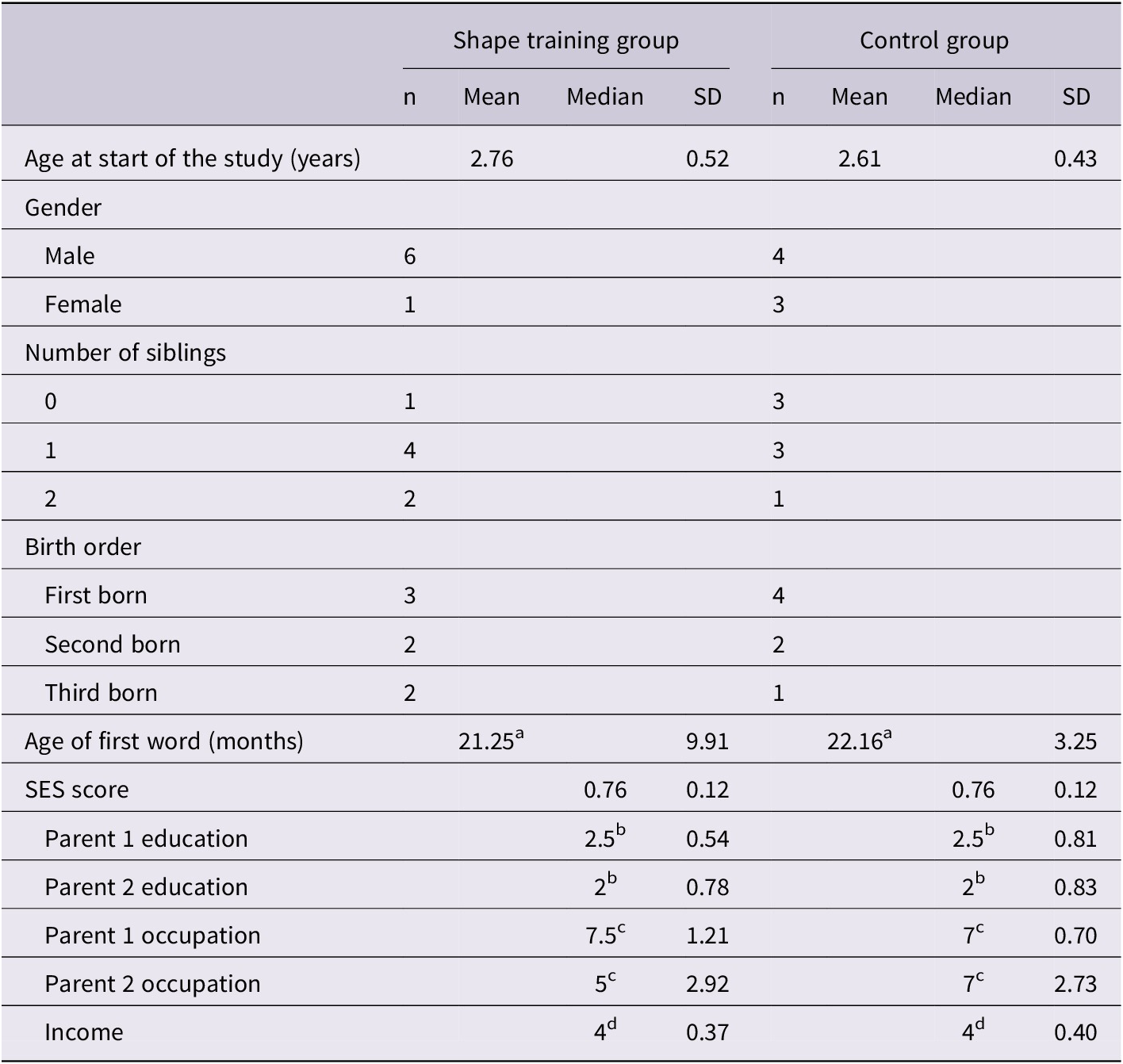
Note. a. Two children of the shape training group and two children of the control group were not yet using words to communicate at the beginning of the study, as reported by parents. b. Education level was not reported for Parent 1 for one participant in the shape training group and one in the control group. Education level was not reported for Parent 2 for one participant in the control group. c. Parent 1 occupation was not reported for two participants in the control group. Parent 2 occupation was not reported for one participant in the shape training group. d. Income was not reported for one participant in the control group.
All participants were individually assessed at the Infant and Child Lab (University of Birmingham). The study was approved by the West Midlands – Solihull Research Ethics Committee supporting research in the National Health Service (NHS, United Kingdom) and by the Ethics Committee of the University of Birmingham. Parents signed a consent form before the start of the study, and children were asked if they wanted to play. The children’s parents were reimbursed for travel expenses, and the children received a sticker after each visit as well as a book and a “Junior Scientist” diploma at the final visit.
Socioeconomic status (SES)
An SES score was calculated by averaging a parents’ education score, a parents’ occupation score, and a household income score. See below for more information on how each score was calculated. Note that for one participant, socioeconomic status was based only on the parents’ occupations as household income and parents’ education was not reported.
Parent education
A 4-point scale was used to determine each parent’s education, with 1 = No formal education, 2 = Less than an undergraduate/bachelor degree, 3 = Undergraduate/bachelor degree, 4 = Postgraduate education. The education scores of both parents were averaged and converted to a value between 0 to 1.
Parent occupation
Occupation of all parents was classified using the nine levels of the Office for National Statistics - Standard Occupational Classification Hierarchy (Office for National Statistics, 2010) and each parent was assigned a score from 1 to 9, where 9 indicated the highest ranked occupations and 1 the lowest. The scores of both parents were averaged, except for families with a stay-at-home parent, for which the occupation score was based only on the parent that was in paid employment. This score was then converted to a value between 0 and 1.
Household income
Annual household income was measured on a 4-point scale (1 = less than £14,000, 2 = £14,001 - £24,000, 3 = £24,001 - £42,000, 4 = more than £42,000). This score was then converted to a value between 0 and 1.
Procedure
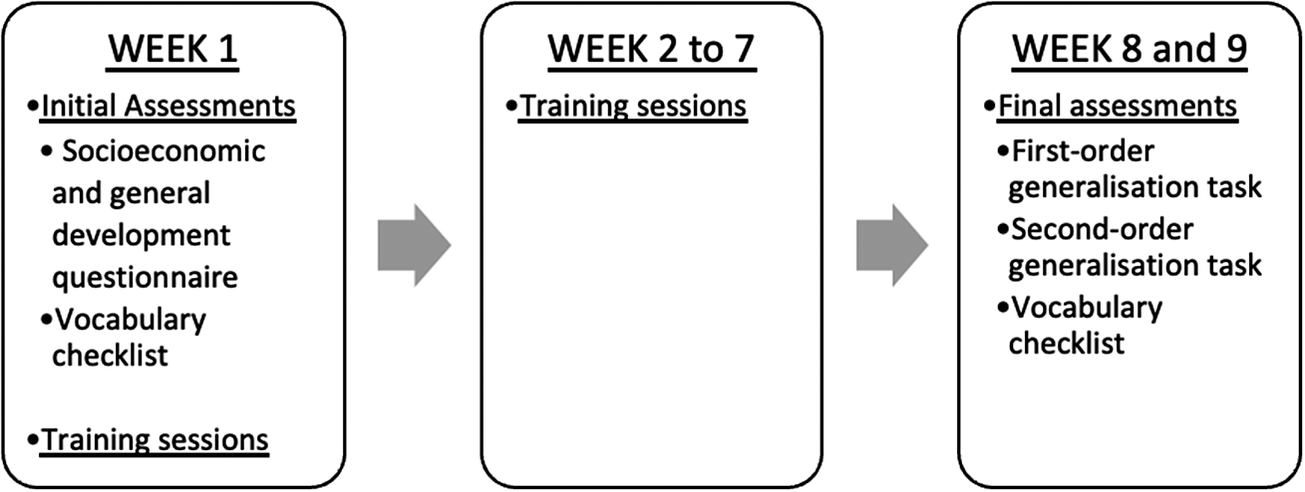
The study took place over nine weekly visits and was divided as follows: initial assessments (week 1), training sessions (weeks 1 to 7), and final assessments (weeks 8 & 9) (see Figure 1). The same initial and final assessments were used for both training groups, but the nature of the training differed across groups. During the initial assessment, only parents of children recruited via the Birmingham Community Healthcare NHS Foundation Trust filled in the general development questionnaire and the vocabulary checklist (O-CDI), as others had done this as part of the pre-assessment to determine eligibility for this study.
Timeline of Assessments.
Initial assessments
In week 1, parents completed the socioeconomic and general development questionnaire as well as the Oxford CDI (O-CDI) (Hamilton et al., Reference Hamilton, Plunkett and Schafer2000). All participants were also assessed with a shape sorting task, an attention task and a cognitive assessment to ensure that the two groups did not differ in these areas. No differences between groups were found. For more information regarding these assessments see Supplementary Material.
Socioeconomic and general development questionnaire
This questionnaire covered various aspects of children’s development, their family and socio-economic status. It was used to check inclusion and exclusion criteria.
Vocabulary checklist
The Oxford CDI (O-CDI) (Hamilton et al., Reference Hamilton, Plunkett and Schafer2000) is a parental vocabulary checklist of words that children may know or understand during the first years of life.
Training sessions
During seven weekly sessions (weeks 1 to 7), participants were introduced to several toys or toy-like novel objects. The stimuli and procedure for each training group were as follows.
Shape training group
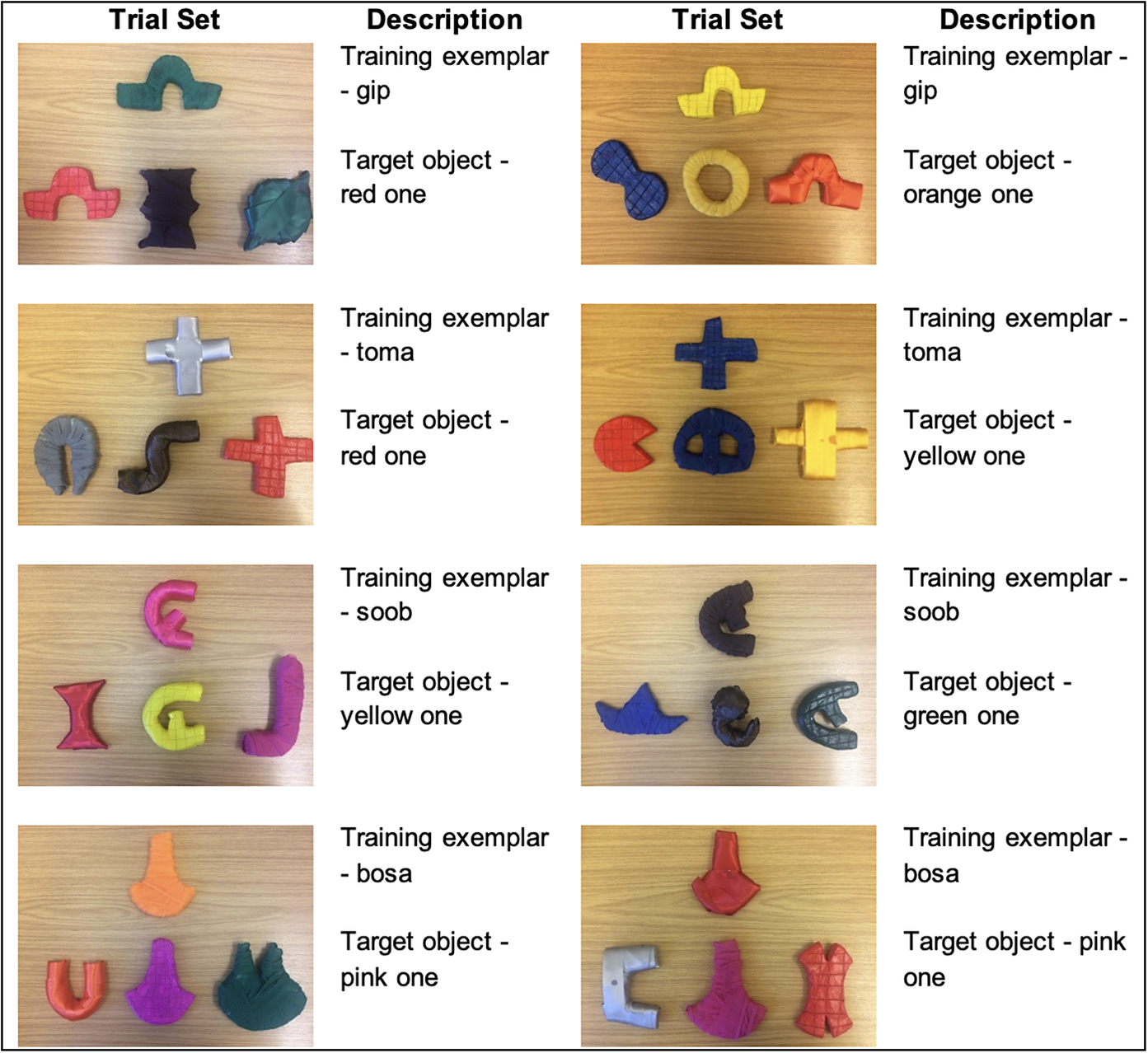
Children in the shape training group were presented with four novel words paired with four novel sets of objects in a play-like session. Each set of objects consisted of two exemplars and a contrasting object (see Figure 2). The two exemplars shared the same shape but had different colours and textures. The contrasting object had a different shape than the exemplars but had the same colour as one of the exemplars and the same texture as the other exemplar. Since the same procedure as Smith et al. (Reference Smith, Jones, Landau, Gershkoff-Stowe and Samuelson2002) was followed, the same number of objects and labels were presented, but the objects and labels were different. Each set was presented for 3 minutes, and each session lasted approximately 12 minutes.
Sets of Objects Used in the Shape Training Sessions.
Note. Each set consisted of two exemplars that shared a shape and one contrasting object that shared the colour of one exemplar and the texture of the other.
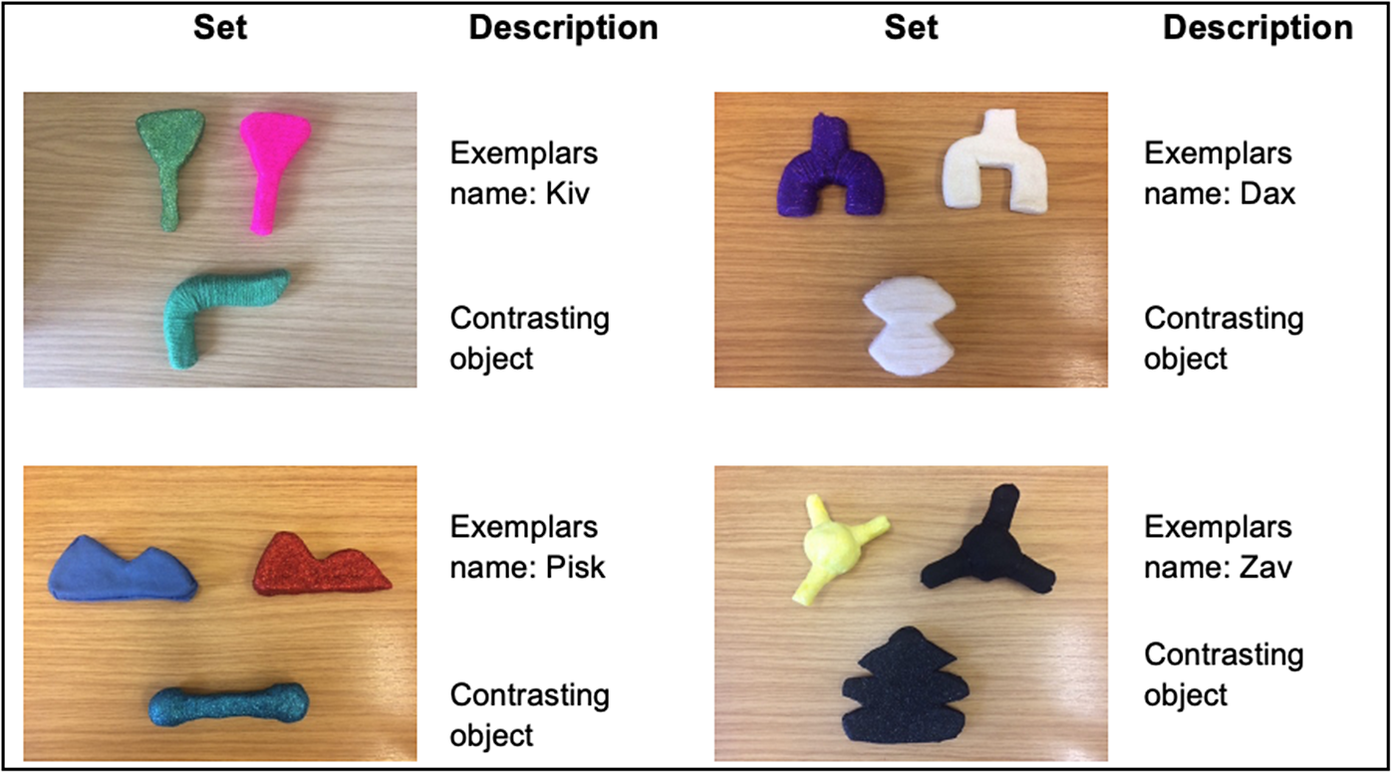
During each session, the experimenter first presented one of the exemplars of a set by saying, for example: “Look! It is a kiv. Do you want to play with the kiv?”. The researcher presented the second exemplar with a similar sentence (e.g., “Look! This is also a kiv. Let’s play with the kiv”). The participants were allowed to play with the objects. While doing so, the researcher mentioned the objects’ names with sentences such as “You are playing with the kiv.” Halfway through the play with the exemplars (after approximately 1.5 minutes), the researcher brought out a third, contrasting object and said: “Oh no, look, this is not a kiv.”. This was mentioned around 3 times and then the contrasting object was taken away. After that the experimenter and the participant continued playing with the two exemplars. All names were mentioned between 10 and 20 times per session. The same procedure was used to present the three remaining sets of objects.
The same four sets of objects and the same procedure was followed across the seven training sessions. The presentation order of sets was randomized across sessions and participants.
Control group
Children in the control group were introduced to 28 real objects and their names (see Table 2). These words were divided into seven sets of four words. Words were selected from the ‘Wordbank: An open database of children’s vocabulary development’ (Frank et al., Reference Frank, Braginsky, Yurovsky and Marchman2016), which is an open data repository from the MacArthurBates CDI. Words were randomly selected as target words from a list of words that 80% of children in the UK know at 25 months.
Sets of Objects Used in the Control Group

During each session of the control intervention, one set of objects and their names were presented to participants (see Table 2). At the start of the session all objects from the set used during that session were introduced by saying, for example: “Look! This is a giraffe, and look, this is a bear. Do you want to play with the giraffe and the bear?”, “Look we also have a mouse and cheese, shall we also play with the mouse and the cheese?”. The participants were allowed to touch all objects and play freely with all objects. Additionally, techniques such as focused stimulation and modelling target words were used. For example, the researcher would incorporate the target words in their interaction and present them in a meaningful but play-like context where the word was repeated to facilitate the children’s comprehension and potentially production of the word (e.g., “Look, you have the mouse and it is now eating the cheese, do you think the bear (pointing at the bear) and the giraffe (pointing at the giraffe) would also like to eat the cheese?”). The names of each target object were mentioned between 10 and 20 times per session. Similarly to the shape training group, each session lasted approximately 12 minutes and the presentation order of the sets and the words in the sets were randomised across participants.
Final assessments
To assess if, after the training sessions, participants generalised object labels by shape, both participant groups were assessed with a first-order (week 8) and a second-order generalisation task (week 9). At week 9, parents were also asked again to fill in the O-CDI (Hamilton et al., Reference Hamilton, Plunkett and Schafer2000) to assess vocabulary growth over the nine weeks.
First-order generalisation task
Participants in both groups were assessed with the same first-order generalisation task which consisted of two practice trials (practice phase) and eight test trials (test phase). Both groups were presented with exactly the same objects and identical procedures.
Practice phase
Two practice trials were used to familiarize participants with the procedure of the task. In each practice trial, a standard object (e.g., a yellow plastic ball) was presented, accompanied with three objects, each sharing only one property with the exemplar (e.g., shape: a blue spiky ball, colour: a yellow wooden block, and texture: an orange plastic chair). The experimenter said “Look, this is a ball. Can you give me the other ball?”. A second trial was introduced with another set of familiar objects (a green plastic spoon, a metal spoon, a plastic chair and a green block) and the same procedure was followed. All participants chose the correct (shape matching objects) on their first attempt.
Test phase
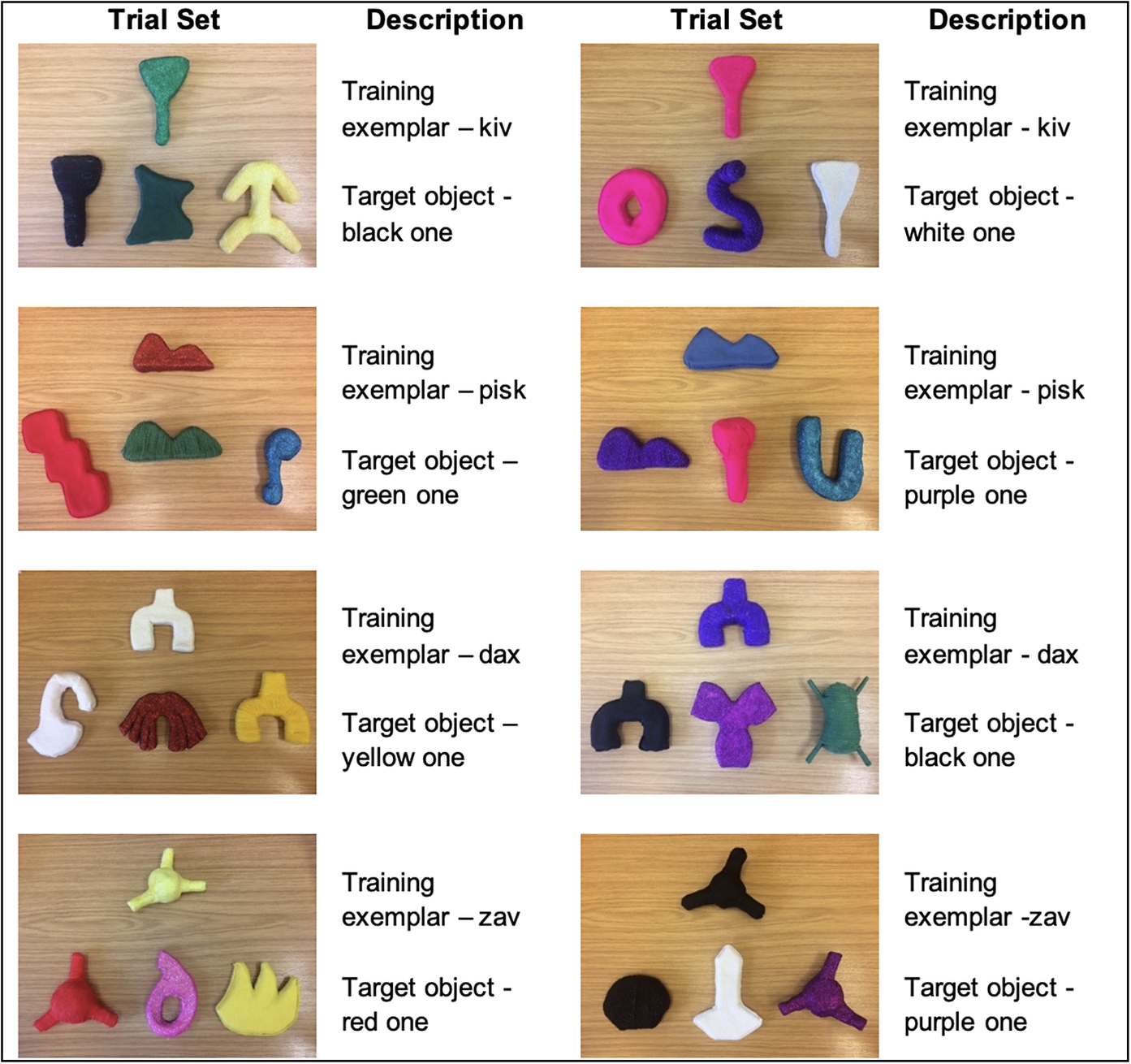
This phase consisted of eight trials. In each trial, the participants were presented with one of the exemplars used during the training sessions of the shape training group accompanied by three objects that matched the exemplar on shape, colour or texture only (see Figure 3). For each trial, the experimenter presented one of the exemplars and said, for instance, “Look, this is a kiv”. Then the researcher said “Now look at these ones” while placing on the table the three objects sharing each one visual property with the exemplar, and asked, “Can you get the other kiv?”. The same procedure was used for the remaining seven trials. Trials were presented in one of two possible orders which was counterbalanced between participants.
Sets of Objects Used During the First-Order Generalisation Task (Week 8).
Note. Each set consisted of one exemplar (top) and three possible matching objects (bottom), with each one matching the exemplar on shape, texture or colour only. The target object was always the object that shared the same shape with the exemplar.
Second-order generalisation task
Participants were assessed with a second-order generalisation task which, like the first-order generalisation task, consisted of two practice trials (practice phase) and eight test trials (test phase). Both groups were presented with exactly the same objects and identical procedure.
Practice trials
The same practice trials of the first-order generalisation task were administered.
Test trials
The test phase consisted of eight unfamiliar objects paired with four novel words, neither of which had been used during the training sessions (see Figure 4). The same procedure as the one for the first-order generalisation was followed.
Sets of Objects Used During the Second-Order Generalisation Task (Week 9).
Note. Each set consisted of one novel exemplar (top) and three possible matching objects (bottom), with one object matching by shape, one by texture and one by colour. The target object was always the object that shared the same shape with the exemplar.
Design and data analysis
First- and second-order generalisation tasks
To assess participants’ preference to generalise object labels by shape, we calculated the percentage of shape choices, for both first- and second-order generalisation. A choice counted as a shape choice if the object chosen shared the same shape with the referent object. While the total number of trials for both the first- and second-order generalisation was eight, we had to adjust this number for one child in the first-order generalisation task and one child in the second-order generalisation task who did not make a choice for one trial. We also compared the percentage of shape choices against chance for each group separately using t-tests. As participants had to choose one of three options (either shape match, colour match or texture match), chance was 33.33%.
Vocabulary growth
This analysis investigated if both groups differed with regards to increase of specific word types. Since the intervention conducted by Smith et al. (Reference Smith, Jones, Landau, Gershkoff-Stowe and Samuelson2002) showed that a shape bias training boosted mainly expressive noun learning, we divided expressive vocabulary into nouns and other words. Nouns included all object names from the O-CDI (Hamilton et al., Reference Hamilton, Plunkett and Schafer2000), while other words included the remaining words from the O-CDI (Hamilton et al., Reference Hamilton, Plunkett and Schafer2000). We conducted a 2 (Group: shape training group vs control group) x 2 (Testing time: before vs after training) x 2 (Word type: nouns vs other words) analysis of covariance, with number of words produced as dependent variable. As participants had different vocabulary sizes at the start of the interventions, we also controlled for participants’ expressive vocabulary (namely, total vocabulary – that is, nouns and other words) before the start of the intervention by adding this into the analysis as a covariate. Note that the 28 words taught to the control group were removed from this analysis. Out of those 28 words, participants produced on average 6.35 words (SD = 8.04) prior to the start of the study. When looking at each group separately, two participants in each group did not produce any of those 28 words, three participants in each group produced five or fewer words, and two participants in each group produced six or more words.
Results
First and second-order generalisations
Figure 5 shows the percentage of shape choices for the two participant groups for both first and second-order generalisations. For first-order generalisation, participants in the shape training group chose more shape matching objects than the control group, t(12) = 2.40, p = .033, d = 1.29. Participants in the shape training group generalised labels to objects by shape significantly above chance (M = 56.63%, SD = 18.37), t(6) = 3.35, p = .015, but this was not the case for participants in the control group (M = 37.50%, SD = 10.20) t(6) = 1.08, p = .321.
Percentage of Shape Choices in First- and Second-order Generalisations Tasks.
Note. The dashed line represents chance level and error bars represent 95% confidence intervals.
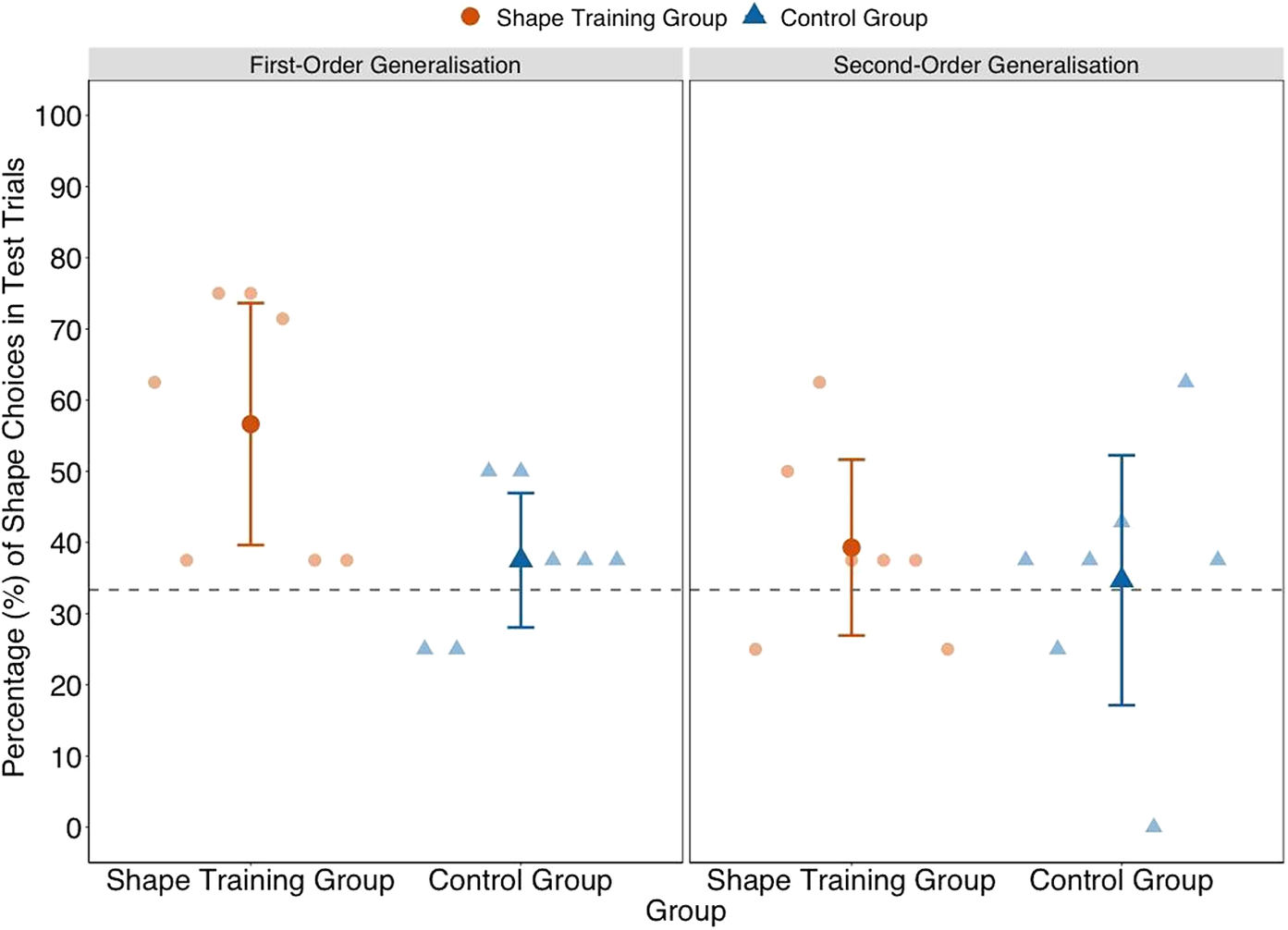
For second-order generalisation, participants’ shape choices were at chance level in both groups (shape training group: M = 39.28%, SD = 13.36, t(6) = 1.17, p = .283; control group: M = 34.69%, SD =18.97; t(6) = 0.19, p = .855). The percentage of shape choices was also not statistically significant between groups, t(12) = 0.52, p = .610, d = 0.28. Thus, shape bias training led to successful first-order generalisation in the shape training group, but not second-order generalisation by shape, while participants in the control group did not show evidence of either generalisation.
An exploratory analysis was conducted to investigate participants’ shape choices when only participants under the 10th and 20th percentile for their chronological age on the O-CDI were included in the sample (see Table 3). Results followed a very similar pattern as results that included all participants (i.e., those under the 25th percentile). No statistical analyses were conducted for the sample that included only participants under the 10th percentile due to a small sample size. For participants under the 20th percentile, participants in the shape training group chose more shape matching objects than the control group in the first-order generalisation task (t(11) = 2.21, p = .049). Participants in the shape training group generalised labels to objects by shape significantly above chance (t(6) = 3.35, p = .015), but participants in the control group did so at chance levels (t(5) = 0.91, p = .403). No significant group difference was found for the second-order generalisation task, and responses of neither group differed from chance.
Shape Choices of Participants Under the 10th and 20th Percentile for their Chronological Age on the O-CDI
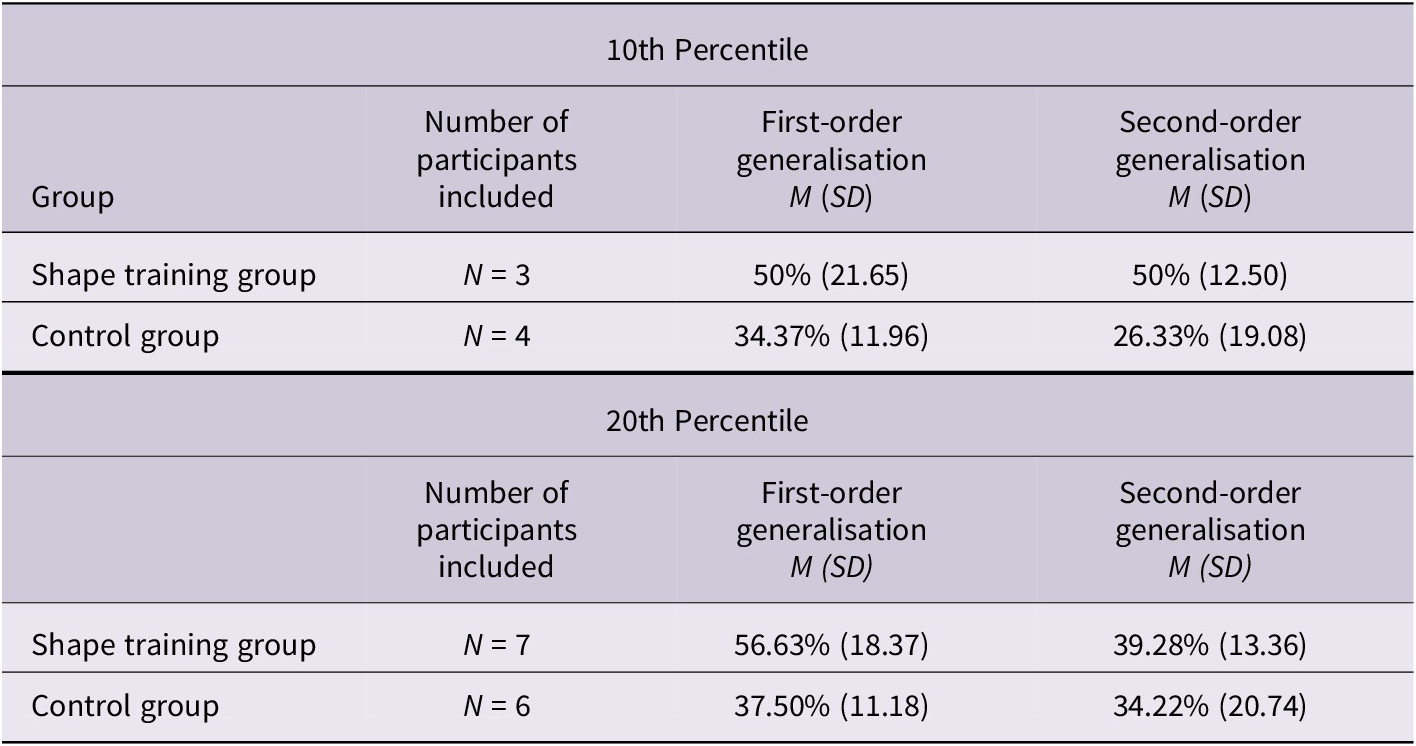
Note. Chance level is 33%.
Expressive vocabulary growth
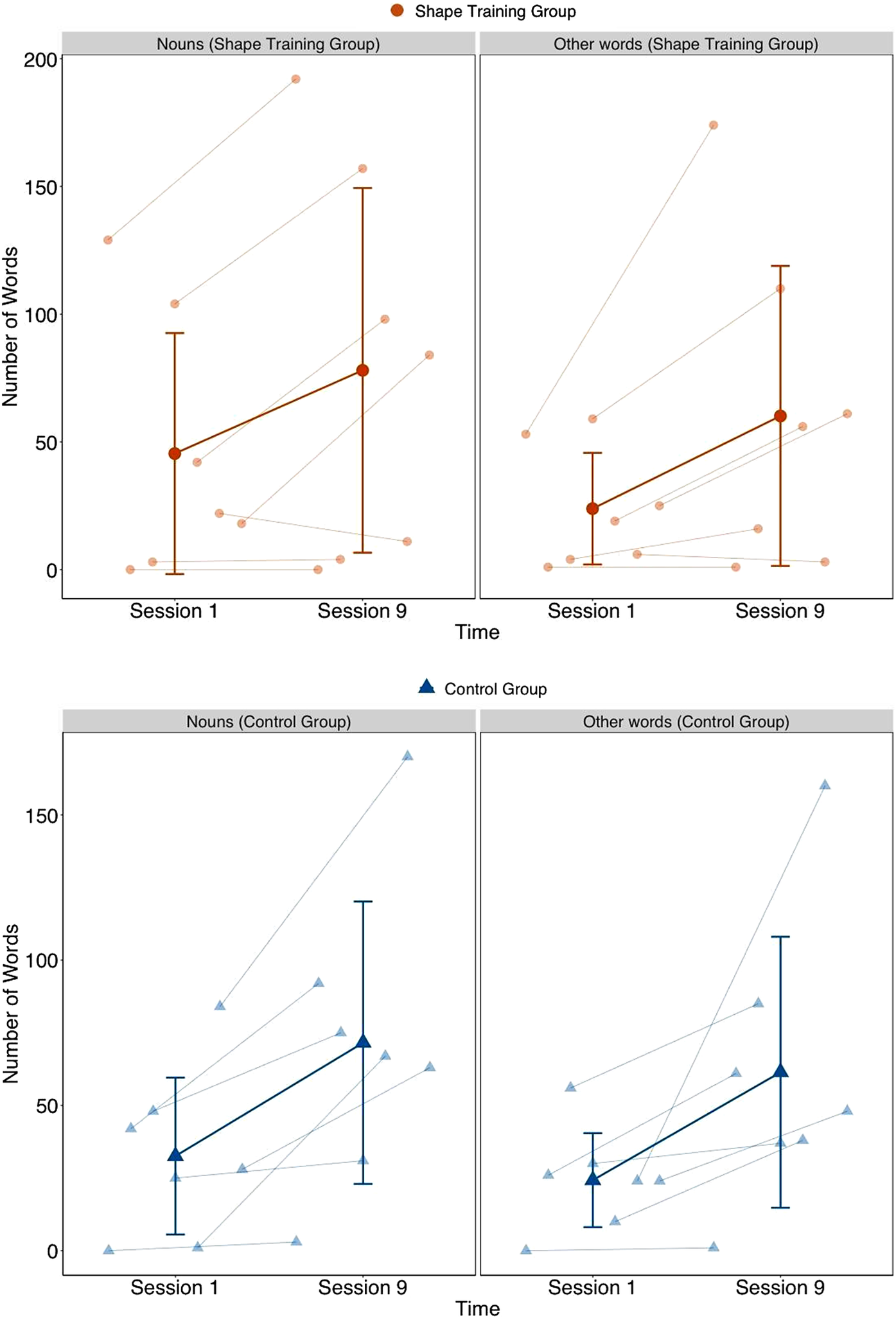
Figure 6 shows the growth of expressive vocabulary for nouns and other words and for both participants groups. We found no main effect of Group (F(1,11) = 0.40, p = .539, ηp2 = .03), Testing time (F(1,11) = 0.71, p = .414, ηp2 = .06) or Word type (F(1,11) = 0.01, p = .923, ηp2 = .001). Similarly, there was no significant interaction between Testing time and Group (F(1,11) = 0.40, p = .539, ηp2 = .03), Word type and Group (F(1,11) = 1.09, p = .318, ηp2 = .09), and Testing time and Word type (F(1,11) = 2.31, p = .156, ηp2 = .17). The three-way interaction between Testing time, Word type and Group was not significant either (F(1,11) = 0.03, p = .851, ηp2 = .003). However, we found a significant main effect of our control variable – that is, initial expressive vocabulary size (F(1,11) = 125.74, p <.001, ηp2 = .92)–, a significant interaction between Testing time and initial expressive vocabulary size (F(1,11) = 11.40, p = .006, ηp2 = .50), as well as a significant interaction between Word type and initial expressive vocabulary size (F(1,11) = 13.48, p = .004, ηp2 = .55). As indicated in Figure 6, children with larger initial vocabularies showed larger vocabularies at the end of the study and produced more nouns than other words. Exploratory analyses for each group separately showed that initial vocabulary predicted final vocabulary in both groups (control group F(1,5) = 21.09, p =.006, ηp2 = .80; shape training group F(1,5) = 147.11, p <.001, ηp2 = .96).Footnote 1
Number of Nouns and Other Words at the Start and End of the Training Sessions in the Shape Training and Control Group.
Note. Dark-coloured circles and triangles indicate group means. Error bars represent 95% confidence intervals. Light-coloured circles and triangles indicate data points of individual participants. Connecting lines show performance differences across the two testing points.
Discussion
The current study investigated whether LTs can be taught to use object shape for generalising taught labels (first-order generalisation) and novel labels (second-order generalisation), and whether a shape bias training might boost the growth of LTs’ expressive vocabulary. We therefore administered a shape training intervention where we introduced LT’s with objects organised by shape and their labels and compared them to a control group that were taught real labels for real objects. Our study has three main findings. First, we were able to teach LTs to use shape for generalising familiar object names. This was evident in their first-order generalisations based on shape similarities. Second, and contrary to initial predictions, LTs were not able to generalise their knowledge about the importance of shape for particular objects and use it for novel objects (second-order generalisation). Thus, a preference for extensions by shape was limited to objects and labels they had experience with. Third, contrary to what was predicted, no evidence was found that a shape bias intervention facilitated expressive vocabulary growth outside the laboratory more than a training programme that teaches specific words.
The current findings support previous research in two ways. First, in line with previous findings (Jones, Reference Jones2003), we found no evidence that LTs naturally develop a shape bias. In the current study, participants in the control group did not show a preference for shape in either first or second-order generalisation tasks. Contrary to some LTs in Jones (Reference Jones2003), they did not show a preference for texture either (see Supplementary Material). Second, our results are in line with the findings by Singleton and Anderson (Reference Singleton and Anderson2020) that by highlighting shape, LTs are able to learn the importance of shape for first-order generalisation. Singleton and Anderson (Reference Singleton and Anderson2020) taught LTs to use shape for first order-generalisation by showing gestures referring to the object’s shape while the object was being presented. In the current study, this was achieved through repetitive exposure with objects organised and named according to their shapes, and with the presentation of contrasting objects. Another difference between the two studies is the type of material that was used. While Singleton and Anderson’s study presented objects and names that the children were very likely to have experienced and seen beforehand, we introduced them to completely novel objects and names. By doing so, we eliminated the possibility that children were affected by any knowledge of the objects or labels that they gained outside of the experiment. We can therefore be certain that it was our training that led to the effects.
Late Talkers can learn to extend labels by object shape for taught object labels but do not do so for novel object labels
To understand how a lack of shape bias for second-order generalisation affects vocabulary learning, it is important to understand how the shape bias is developed. Smith et al. (Reference Smith, Jones, Landau, Gershkoff-Stowe and Samuelson2002) proposed that the development of a shape bias is a four-step process. In the first step, infants learn that a specific object they play with has a specific name (e.g., a car). After multiple exposures to other objects also labelled car, the infant learns that all objects with the shape of a car will also be called car. This first-order generalisation can allow infants to start forming categories of objects that they have encountered before. In the current study, through repetitive exposure to objects organised by shape and their labels, LTs in the shape training group were able to map those specific labels to the specific objects that they frequently played with (e.g., the name zav referred to a specific yellow round object with three cylindrical arms they played with). Then, after repetitive exposure, they learned that all objects with, for example, a zav-shape would be called zav, and therefore were able to generalise this name to other objects with the same shape. According to Smith et al. (Reference Smith, Jones, Landau, Gershkoff-Stowe and Samuelson2002), after being exposed to multiple sets of objects organised by shape and their names, in the third step, TD children start learning that objects tend to be organised in categories with clear shape similarities in general (second-order generalisation). So, finally, they learn that one can extend known and novel labels to objects based on shape similarities in general. At this stage, infants do not need repetitive experience with objects and object names in order to be able to know which property is relevant (i.e., shape) for object naming and categorisation. Therefore, developing a shape bias can be considered a way of learning how to learn nouns.
The fact that LTs in the current study could not generalise labels of novel objects by shape suggests that they had not learned that shape is a property that can provide information about what objects are and how they are called. This could mean that LTs may require direct and constant experience with the same objects and the same names in order to map a novel word to their referent. This is an inefficient strategy and would require additional effort and time, making noun learning a slower and more complicated process than how it should be. So, a lack of shape bias for second-order generalisation means that LTs lack a shortcut for learning and generalising nouns.
But why can LTs learn to use shape for first-order generalisations but not for second-order generalisations? It has been suggested that the development of a shape bias requires the development of different cognitive processes such as attention, memory, object recognition and statistical learning (Kucker et al., Reference Kucker, Samuelson, Perry, Yoshida, Colunga, Lorenz and Smith2019). Therefore, it is possible that LTs’ difficulty in establishing a shape bias may be related to deficits in some of the processes that are required for the development of the shape bias, and not to an inability to learn the importance of shape in word learning.
An important word learning mechanism that could be affected in late-talking children is statistical learning. Limited research has been conducted with LTs. However, research done in children diagnosed with Developmental Language Disorder (DLD) may help to understand the difficulties observed in LTs. This is because the two groups overlap (some LTs will be diagnosed with DLD, but not all children with DLD had been LTs) and share two important characteristics: a delay in language development and a lack of a shape bias (Collisson et al., Reference Collisson, Grela, Spaulding, Rueckl and Magnuson2015). Research has found that children diagnosed with DLD tend to show deficits in statistical learning and in tasks that require fast mapping of words to novel referents (Haebig et al., Reference Haebig, Saffran and Ellis Weismer2017; Leonard, Reference Leonard1998). Thus, they require additional exposure to stimuli when learning about new things in order to achieve the desired result (Haebig et al., Reference Haebig, Saffran and Ellis Weismer2017; Rice et al., Reference Rice, Oetting, Marquis, Bode and Pae1994). It can be suggested that similarly to DLD, LTs may also require increased exposure to learn the same things as their TD peers.
Potential deficits in statistical learning, accompanied by deficits in fast-mapping tasks (Ellis Weismer et al., Reference Ellis Weismer, Venker, Evans and Jones Moyle2013), could suggest that LTs show difficulties in the initial stages of word learning. This can have a negative cascading effect in the development of the shape bias. If LTs have an initial difficulty in identifying what two objects have in common in order to be called the same, they will struggle to identify that objects can in general be organised by shape. Thus, they will struggle to develop a rule (i.e., the shape bias) to assist their word learning.
Shape bias training did not accelerate vocabulary growth in comparison to a specific word training
We also found no differences in expressive vocabulary growth between the two participant groups, suggesting that either both interventions boosted the growth to the same degree or none of the interventions had an effect. Interestingly, children in the shape bias group showed an expressive vocabulary increase that did not differ significantly to that found by Smith et al. (Reference Smith, Jones, Landau, Gershkoff-Stowe and Samuelson2002) in their shape bias training with TD 17-month-olds in a sample of similar size. In the current study, participants in the shape training group increased their vocabulary by 32.5 nouns over the course of the study. In comparison, participants in Smith et al. (Reference Smith, Jones, Landau, Gershkoff-Stowe and Samuelson2002) study increased their vocabulary by 41.4 nouns. It is important to note that, while the number of words acquired in both studies was very similar, participants in Smith et al. (Reference Smith, Jones, Landau, Gershkoff-Stowe and Samuelson2002) study were 17 months, while participants in the current study were between 24 and 47 months of age. Participants were thus much older, and they varied more in terms of vocabulary size at the start of the intervention. Additionally, different versions of the MacArthur Communicative Development Inventories were used. Therefore, any conclusions based on a direct comparison need to be tentative.
Also, the increase observed in both groups in the current study was higher than what LTs without an intervention typically learn. Rescorla et al. (Reference Rescorla, Mirak and Singh2000) showed that LTs tend to learn between 3.34 and 5.14 words per week, and participants in the current study learned on average 7.7 new words per week in the shape training group and 8.4 in the control group, meaning that both interventions might have accelerated vocabulary development. It needs to be noted here that vocabulary growth was related to initial vocabulary size, with children with a larger vocabulary size at the beginning of the study showing larger vocabularies at the end of the study. Thus, the higher vocabulary growth compared to other LT studies might be driven by children who started off with larger vocabulary sizes.
When comparing the current results with other longitudinal interventions for LTs, important differences in expressive vocabulary growth are apparent. It is reassuring that the increase in expressive vocabulary of most of the children in our shape training group was comparable to that of LTs in Niese and Brackenbury’s (Reference Niese and Brackenbury2020) shape intervention. However, expressive vocabulary growth in the current study was higher than the one observed by Robertson and Weismer (Reference Robertson and Weismer1999) for a general language stimulation intervention that taught LTs between 21 and 30 months of age different words in context. In this study LTs learned on average two new words per week. Finally, the increase in our study was smaller than the one observed by Alt et al. (Reference Alt, Meyers, Oglivie, Nicholas and Arizmendi2014), who reported that LTs between 23 and 29 months of age showed an average increase of 21.60 words per week. Interestingly, Alt et al. (Reference Alt, Meyers, Oglivie, Nicholas and Arizmendi2014) study taught a set of words through cross-situational statistical learning (see also Munro et al., Reference Munro, Baker, Masso, Carson, Lee, Wong and Stokes2021). They proposed that their results were due to the highly variable linguistic input and contextual diversity that they provided. They speculated that this helped LTs to identify what was constant during each naming event allowing them to identify what was relevant for object naming and to create a rule about how words can be learned. If we consider that LTs may have difficulties in identifying regularities in naming experiences, intervention using techniques such as the ones implemented by Alt et al. (Reference Alt, Meyers, Oglivie, Nicholas and Arizmendi2014) may help LTs overcome these deficits.
One important characteristic that could have contributed to a lack of an accelerated vocabulary growth in our study, and even potentially to a difficulty for a second-order generalisation by shape, is that there was great variability in the number of words children produced at the beginning of the study. Participants’ initial expressive vocabulary ranged from 1 word to 186 words. The present sample size was too small to investigate an interaction of vocabulary size and intervention type – however, results do suggest that a larger vocabulary size at the start of the study led to a larger vocabulary growth. Exploratory analyses conducted with children under the 10th and 20th percentile of vocabulary knowledge showed a similar pattern of shape generalisations than the whole sample of children (i.e., under the 25th percentile), which suggests that children with very limited vocabularies may still be able to learn to generalise known labels by shape, but may struggle to generalise unknown labels. Note that this exploratory analysis included a very small sample size for children under the 10th percentile, which should thus be taken with caution. Therefore, future studies should look at whether a shape bias intervention may be only useful for LTs with a certain vocabulary size (e.g., participants with very limited vocabularies, or vocabularies larger than 50 words).
Limitations
This study has some limitations. For instance, it is not known if seven weeks of training are enough to demonstrate that LTs do not develop a shape bias like TD children. It could be that, since LTs can generalise labels (first-order generalisation) after multiple exposures, and considering that they may have deficits in statistical learning and fast-mapping, a longer intervention is required. Future studies should look at a modified version of the Smith et al. (Reference Smith, Jones, Landau, Gershkoff-Stowe and Samuelson2002) intervention with potentially more sets of stimuli, more sessions and/or more repetitions to confirm if LTs indeed cannot learn a shape bias or whether they require more support than what was offered to them in the seven weeks of the current intervention. Additionally, it is possible that variations on how the novel labels and objects were presented could provide information on how LTs can learn to generalise by shape bias. For example, pointing out similarities and differences between the objects, increasing exposure to the contrasting object and/or naming the contrasting object. It is also important to note that participants in this study shared similar family and socioeconomic characteristics – thus, future research should also look at if variability in these characteristics could impact the results.
One might also wonder whether the sample size of the current study (seven children per group) was too small to find an effect on second-order generalisation. However, this is unlikely for two reasons. First, our sample was large enough to show clear evidence of shape-sensitivity for first-level generalisations. It should therefore be large enough for second-order generalisation. In addition, the sample size is very similar to that in Smith et al. (Reference Smith, Jones, Landau, Gershkoff-Stowe and Samuelson2002), who showed the effect of shape training on second-order generalisation with eight participants per group.
Finally, it needs to be noted that the training for the two participant groups varied in more than one way. The shape training group was taught to focus on object shape when being taught novel labels for novel objects. In contrast, the control group was taught real words for existing objects, without any reference to the object’s shapes. The choice for the control intervention was partly motivated by recruitment and ethical considerations. In addition, it satisfied the requirement of an active control group and that children were not taught that labels refer to objects with the same shape. The main potential drawback of this approach, though, is that teaching real words might have affected children’s vocabulary development. We excluded any words that the children knew when they started the intervention from the vocabulary measurement, meaning that the vocabulary comparison between the groups was not directly affected by the control intervention. However, being taught labels for objects that children had potentially encountered before might have made it easier for them to learn the words we taught them, and learning some new words might have accelerated their vocabulary development more generally. This is not because they picked up on a shape bias (they do not show any evidence of that), but because they might have attended more to parents’ attempts to teach them words or they might have become more motivated or focussed more strongly on learning words. Additionally, since parents witnessed our control intervention, it is possible that parents increased their attempts to explicitly teach words to their children. These possibilities might have caused the lack of differences between the two participant groups in vocabulary development. Importantly, though, the control group still satisfied its main purpose in the study. Since the control group did not generalise object names by object shape, being taught real words did not provide the children with opportunities to pick up on object shape as a word learning bias. Future studies might add additional control conditions – for instance, a condition in which children are not taught any words, but where they play with the same novel objects as the children in the training group. This could test whether the mere exposure to objects of similar and different shape would help first-order generalisation. Note that the possibility that children would pick up on a shape bias for second-order generalisation in this condition is unlikely given the current results.
In summary, to our knowledge, the present study is one of the first ones to teach the shape bias as an intervention for vocabulary learning in LTs, and one of the first to highlight shape as a way of promoting word learning (see also Niese & Brackenbury, Reference Niese and Brackenbury2020; Singleton & Anderson, Reference Singleton and Anderson2020). Results confirmed earlier findings (Singleton & Anderson, Reference Singleton and Anderson2020) that LTs can learn to use shape as the predominant property for extending taught labels (first-order generalisation) when attention is led to shape similarities. However, they cannot extend this knowledge and use it for novel labels (second-order generalisation). We also did not find that a shape bias intervention led to accelerated vocabulary growth compared to a more conventional intervention for LTs that teaches specific words. Consequently, we have found no evidence that a shape-based intervention adds any more additional benefit for general word learning than an intervention focused on teaching specific words. Potential deficits in statistical learning may have constrained children’s acquisition of a shape bias for second-order generalisation. Therefore, a modified version of a shape-based intervention that also targets those additional potential deficits might be more successful.
Supplementary material
The supplementary material for this article can be found at http://doi.org/10.1017/S0305000924000163.
Acknowledgements
We thank the parents and children who participated in the study.
The materials necessary to replicate the findings presented here are not publicly accessible. The data and analytic code necessary to reproduce the analyses can be accessed using the following UR: https://osf.io/mg7fw/
The analyses presented were not pre-registered. Prior to recruitment and data collection, a protocol for the current study was registered on ClinicalTrials.gov (NCT03379818)
Competing interest
The authors declared that there were no conflicts of interest with respect to the authorship or the publication of this article.
This work was supported by a PhD studentship awarded to C. Zuniga-Montanez by the Mexican National Council for Science and Technology (CONACyT).


 Open access

