


These are times of considerable change for consultants in general adult psychiatry. Most existing services are organised around sectorised community teams, with consultants accepting all patients from a clearly-defined geographical area and remaining responsible for patients across the full range of treatment settings. This has advantages for continuity of care and clear allocation of responsibility, but the sustainability of the model is increasingly questioned. Many consultants feel burdened by large personal caseloads (Reference Tyrer, Muderis and GulbrandsenTyrer et al, 2001) and report dissatisfaction with the catch-all nature of the work (Reference ColganColgan, 2002). Recruitment and retention to the specialty continue to be a concern.
At the same time, the Department of Health is promoting the development of three types of specialist mental health team: assertive outreach, crisis resolution and teams for early intervention in psychosis (Department of Health, 2000, 2001). The Policy Implementation Guidance for the development of these teams recommends that psychiatrists be appointed to work exclusively with the new teams. This inherent specialisation could present an opportunity to redefine general adult psychiatry, but it is essential that psychiatrists themselves are involved in the debate. A limited number of enthusiasts (Reference Smyth and HoultSmyth & Hoult, 2000; Reference BirchwoodBirchwood, 2003) have promoted these developments, whereas others are consistently negative about their impact (Reference Pelosi and JacksonPelosi & Jackson, 2000; Reference PelosiPelosi, 2003). The views of the majority of consultant psychiatrists have not been widely sought.
Method
In early 2003, the Sainsbury Centre for Mental Health ran a series of workshops for consultant psychiatrists on the development of assertive outreach and crisis resolution teams. A number of consistent themes emerged from the workshops and were incorporated into a questionnaire seeking the views of a wider audience of consultants.
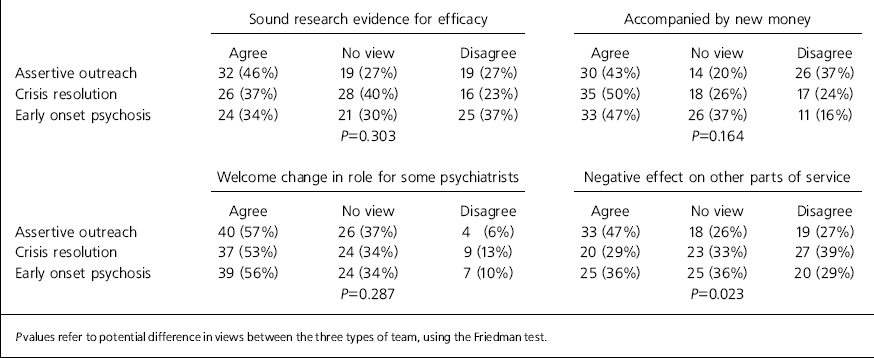
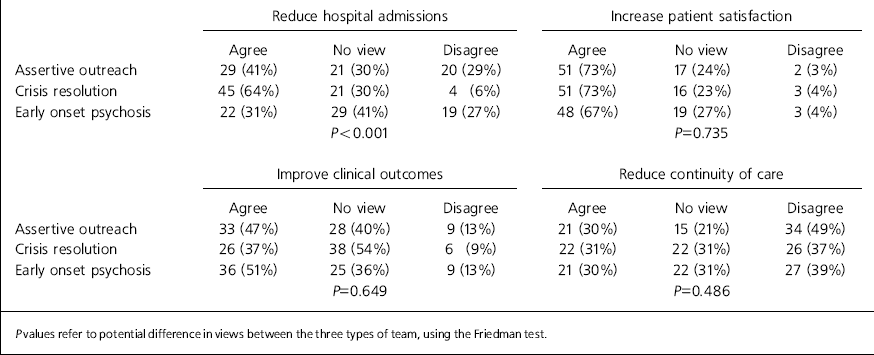
The questions asked were the same for each of the three types of specialist team. If a team existed in the locality, consultants were asked about level of resources, new money for consultant time and threshold for acceptance by the service. Using a five-point scale (strongly agree/agree/don’t know or no view/disagree/strongly disagree), all consultants were then asked for their views on eight different aspects of each of the new teams (see Tables 1 and 2) and on specialisation for psychiatrists by treatment setting (e.g. in-patient/community) or by clinical groupings. Finally, using a visual analogue scale from 0 to 10, consultants were asked for their overall view about each of the three types of team and space was left for any general comments.
Consultant views on structural aspects of new teams
| Sound research evidence for efficacy | Accompanied by new money | |||||
| Agree | No view | Disagree | Agree | No view | Disagree | |
| Assertive outreach | 32 (46%) | 19 (27%) | 19 (27%) | 30 (43%) | 14 (20%) | 26 (37%) |
| Crisis resolution | 26 (37%) | 28 (40%) | 16 (23%) | 35 (50%) | 18 (26%) | 17 (24%) |
| Early onset psychosis | 24 (34%) | 21 (30%) | 25 (37%) | 33 (47%) | 26 (37%) | 11 (16%) |
| P=0.303 | P=0.164 | |||||
| Welcome change in role for some psychiatrists | Negative effect on other parts of service | |||||
| Agree | No view | Disagree | Agree | No view | Disagree | |
| Assertive outreach | 40 (57%) | 26 (37%) | 4 (6%) | 33 (47%) | 18 (26%) | 19 (27%) |
| Crisis resolution | 37 (53%) | 24 (34%) | 9 (13%) | 20 (29%) | 23 (33%) | 27 (39%) |
| Early onset psychosis | 39 (56%) | 24 (34%) | 7 (10%) | 25 (36%) | 25 (36%) | 20 (29%) |
| P=0.287 | P=0.023 | |||||
Consultant views on clinical aspects of new teams
| Reduce hospital admissions | Increase patient satisfaction | |||||
| Agree | No view | Disagree | Agree | No view | Disagree | |
| Assertive outreach | 29 (41%) | 21 (30%) | 20 (29%) | 51 (73%) | 17 (24%) | 2 (3%) |
| Crisis resolution | 45 (64%) | 21 (30%) | 4 (6%) | 51 (73%) | 16 (23%) | 3 (4%) |
| Early onset psychosis | 22 (31%) | 29 (41%) | 19 (27%) | 48 (67%) | 19 (27%) | 3 (4%) |
| P<0.001 | P=0.735 | |||||
| Improve clinical outcomes | Reduce continuity of care | |||||
| Agree | No view | Disagree | Agree | No view | Disagree | |
| Assertive outreach | 33 (47%) | 28 (40%) | 9 (13%) | 21 (30%) | 15 (21%) | 34 (49%) |
| Crisis resolution | 26 (37%) | 38 (54%) | 6 (9%) | 22 (31%) | 22 (31%) | 26 (37%) |
| Early onset psychosis | 36 (51%) | 25 (36%) | 9 (13%) | 21 (30%) | 22 (31%) | 27 (39%) |
| P=0.649 | P=0.486 | |||||
The questionnaire was piloted among consultants from one department, and their views incorporated in the final version. Inter-rater reliability was assessed by sending the questionnaire twice to 10 consultants.
The questionnaire was posted to 101 general adult psychiatrists in the Greater Manchester area, employed by four mental health trusts. One reminder was sent after 2 weeks.
Results
Consultants were divided about further specialisation, either by treatment setting or clinical groupings (Table 3). Sixty-six consultants (67%) said they had an assertive outreach team in their area, 26 (37%) a crisis resolution team and 14 (20%) an early onset psychosis team. Where a team existed, 33% of consultants felt the resources available were reasonable (75% or more of that needed), 23% barely adequate (50-75%), 25% inadequate (25-50%) and 10% totally inadequate (less than 25%). The majority of consultants (69%) felt the thresholds adopted by the new teams were about right.
Consultant views on specialisation

| Consultants should specialise | Strongly agree | Agree | No view | Disagree | Strongly disagree |
|---|---|---|---|---|---|
| By treatment setting (e.g. in-patients, home treatment) | 7 (10%) | 20 (29%) | 18 (25%) | 21 (30%) | 4 (6%) |
| By clinical groupings (e.g. affective disorders, psychotic illness) | 6 (9%) | 23 (33%) | 12 (17%) | 22 (31%) | 7 (10%) |
For assertive outreach, 13 consultants (28%) reported that their local team had been able to secure additional consultant time, a further 11 (23%) reported that money had been allocated but it had not been possible to recruit, and 21 (45%) reported that no additional money had been made available for extra consultant sessions. For crisis resolution, only four respondents (15%) reported that extra consultant sessions had been filled, two (8%) had been unable to fill extra sessions and 17 (65%) said no additional money had been provided. For early onset psychosis teams, three consultants (20%) reported that extra sessions had been filled and 11 (73%) reported that no extra money had been provided.
Consultant views on most aspects of the new teams were divided (Tables 2 and 3). At least a fifth of respondents were uncertain about their views on each item, with the highest level of uncertainty relating to the impact of the new services on clinical outcomes. The highest positive ratings were for the new teams providing a welcome change in role for some psychiatrists (55% of responses positive, 9% negative), increased patient satisfaction (71% positive, 4% negative) and improved clinical outcomes (45% positive, 11% negative). The most strongly held negative view was that the new teams would have a negative impact on other parts of the service (37% agreeing, 31% disagreeing).
There were few differences between teams with consultants who viewed one type of team positively, tending to have the same view of other teams. The main exception to this was that 64% of consultants agreed that crisis resolution services could reduce hospital admissions, compared with 41% for assertive outreach and 31% for early onset psychosis teams.
Overall views of the new teams were widely distributed, with mean scores higher than 6 in each case: assertive outreach mean score 6.36, crisis resolution mean score 6.51, early onset psychosis mean score 6.03. Both median and mode scores were highest for assertive outreach (7 and 8, respectively v. 6 and 6 for crisis resolution and 6 and 5 for early onset psychosis teams), but the difference in scores between teams was not statistically significant (Friedman’s test for related samples, P=0.252).
Discussion
The survey generated a high level of interest with a good response rate. Many consultants added their own comments and there was a clear sense of doctors wanting to be heard.
Predictably, there was a wide range of views among consultants about the new teams and about increasing specialisation. It may be possible for some consultants to specialise while others remain generalists (Reference Dratcu, Grandison and AdkinDratcu et al, 2003), but whole service reorganisation will need to take account of this diversity of views.
Overall consultants were positive about the development of assertive outreach and crisis resolution teams and slightly less so about early onset psychosis teams. Consultants could see clear clinical benefits arising from the teams, with most consultants believing that the new teams would be associated with increased patient satisfaction and better clinical outcomes. Crisis resolution teams in particular were thought to be likely to reduce hospital admissions, and in general consultants did not seem too concerned about a reduction in continuity of care.
Consultants seemed less troubled than might have been predicted about the research evidence for the efficacy of the new teams, and were particularly positive about the potential change in role for some psychiatrists. This was tempered by concern about the negative impact of the new teams on the remainder of the service and a view that the new teams had not been accompanied by extra resources. The lack of new money for extra consultant sessions is of particular concern as this suggests that existing consultants are being asked to take on additional responsibilities at a time when many are already overstretched and demoralised.
The negative effect on other parts of the service was not explored further in the structured questionnaire, but many consultants commented that good staff were moving to the new teams causing additional recruitment problems elsewhere. This might also apply to psychiatrists as new recruits and existing consultants are drawn to posts within specialist teams leaving established generalist posts even harder to fill.
The role of the consultant psychiatrist is currently being reviewed within the Royal College of Psychiatrists and the Department of Health, and new ways of working are likely to emerge. It is essential that consultants are not simply asked to take on more and more responsibilities: the development of new teams must be accompanied by money for extra consultant sessions or a clear reduction in responsibilities in other parts of the service through changes to traditional models of working (Kennedy & Griffiths, Reference Kennedy and Griffiths2001, Reference Kennedy and Griffiths2002).
Psychiatrists have too often been viewed as opponents of change. The results of this local survey suggest that consultants see considerable advantages in the new teams but are concerned about the impact on the whole service. If the new teams are well resourced, their introduction sensitively managed and sufficient attention given to the rest of the system, psychiatrists might turn out to be surprising enthusiasts.
Acknowledgements
Many thanks to all consultants who returned questionnaires.


 Open access


eLetters
No eLetters have been published for this article.